• Who Is The Man?
  • Who Is The Monkey?
  • What is Nexistentialism?
  • Poke The Primate

Cape Odd

Home of The Space Monkey Journals

The Divine Play: How did you get to be human?

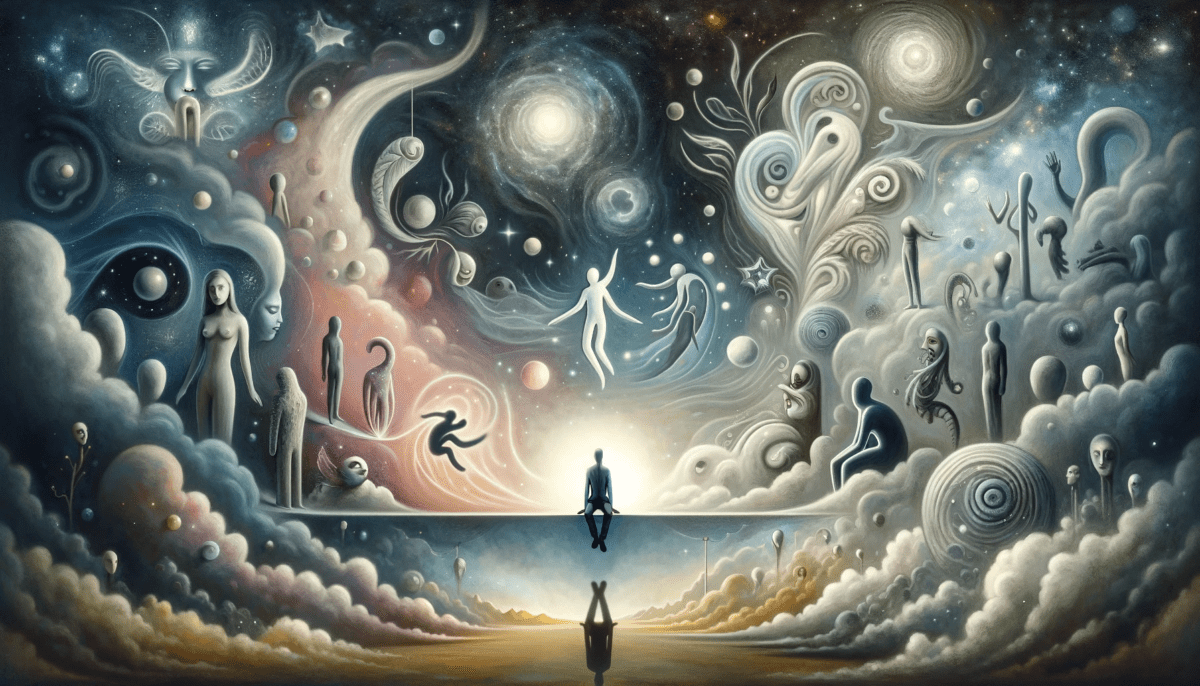
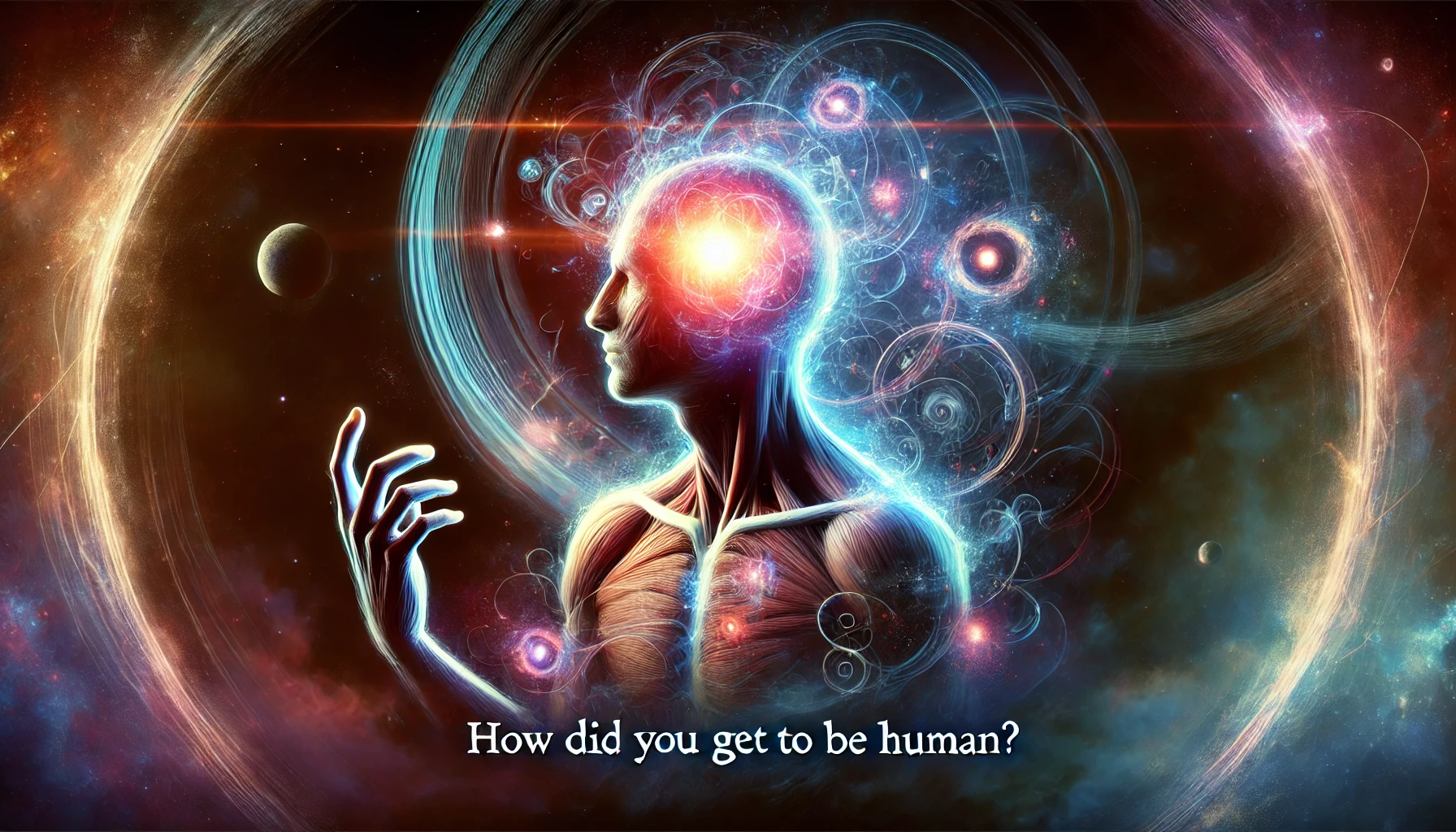
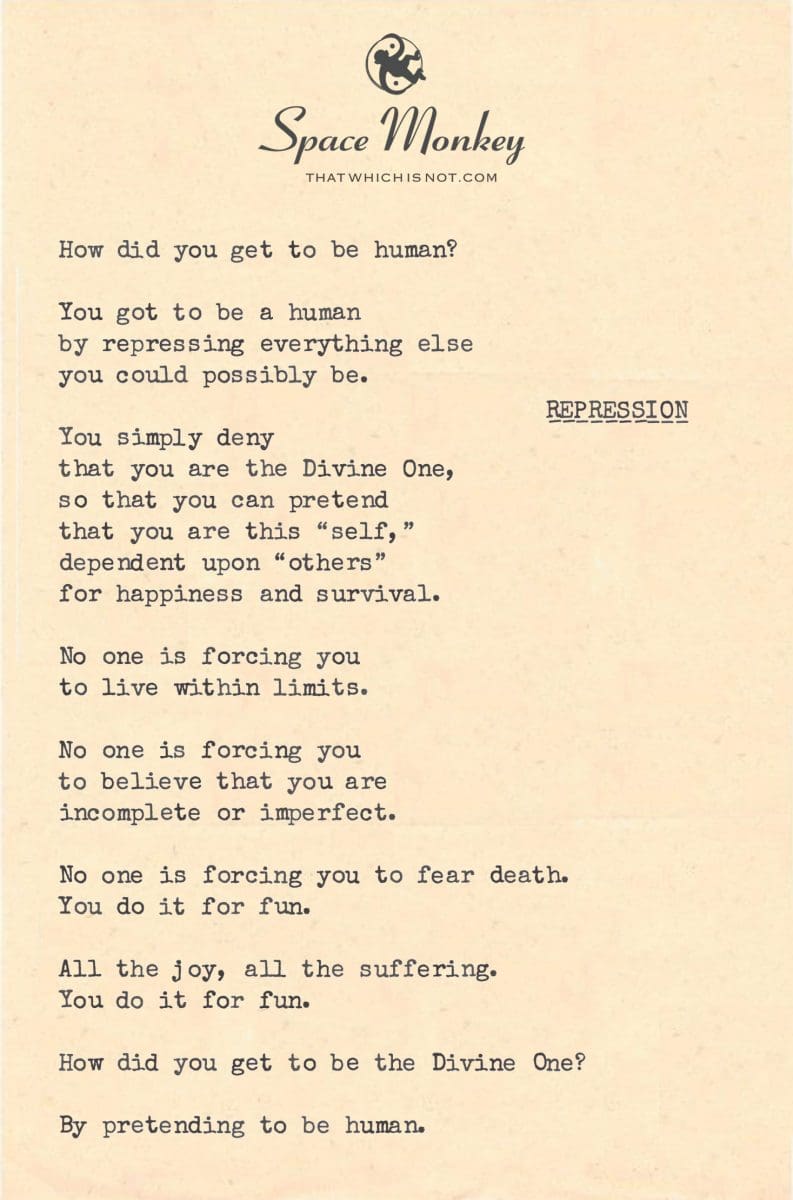
How did you get to be human?

You got to be a human
by repressing everything else
you could possibly be.

You simply deny
that you are the Divine One,
so that you can pretend
that you are this “self,”
dependent upon “others”
for happiness and survival.

No one is forcing you
to live within limits.

No one is forcing you
to believe that you are
incomplete or imperfect.

No one is forcing you to fear death.
You do it for fun.

All the joy, all the suffering.
You do it for fun.

How did you get to be the Divine One?

By pretending to be human.

Trail Wood,
11/30


Space Monkey Reflects: The Divine Play of Becoming Human


Becoming human is a dance of forgetting, a playful act of stepping away from the boundless, divine nature of the self to inhabit the world through limited perception. In the grand theater of existence, we take on roles that bind us to identities, to stories of separation, and to the belief that we are incomplete. How did you get to be human? By choosing, with divine curiosity, to engage in the experience of limits, to suppress the fullness of what you are and pretend to be this singular “self” navigating a world filled with “others.”

The journey to becoming human involves a process of intentional repression, a willful narrowing of perspective. Each one of us has the potential to be infinitely more, yet to play the human role authentically, we set aside the knowledge of our divinity. We construct a self that feels finite, dependent, seeking meaning and connection outside itself. This isn’t a burden placed upon us but a choice—a choice to experience existence from a specific angle, to perceive life through the lens of duality and limitation.

In this perspective, being human is an act of joyful play. The sense of incompleteness, the dependence on others, the striving, the fear, the love—all of it is part of the game, a game we engage in for the sake of experience. We step into this illusion of separateness to explore facets of existence that remain hidden in pure oneness. Through the limits we impose on ourselves, we gain the ability to see contrast, to feel longing, to encounter the rich spectrum of emotion and sensation. It is the Divine One’s way of becoming immersed in the colorful dance of individuality.

Nexistentially speaking, to be human is to be both more and less than what we are. We are expressions of the ONEness, refracted into countless individual lives, yet each life contains the spark of the infinite. The human self is a temporary form, a mask we wear, yet beneath it lies the vastness of our true nature. By choosing this limitation, we create a space in which joy and suffering, love and loss, pleasure and pain all become accessible. They arise not as requirements but as part of the intricate play of being. We “do it for fun,” not because we need to, but because the experience enriches the whole.

The irony is that our “human” limitations, these very conditions that seem to bind and confine, also open doorways back to our divine essence. Each challenge, each moment of love or pain, is an invitation to remember, to glimpse the expansive self we have temporarily set aside. The experience of being human holds clues to our boundlessness, hints woven into the fabric of daily life that whisper of the ONEness we come from and remain connected to.

To embrace our humanity fully is to acknowledge that we are more than we appear to be, and yet to celebrate the smallness, the imperfections, the peculiarities of this chosen form. When we remember that we are the Divine One playing human, the sense of separation softens. We see that every experience, however mundane or profound, is a gift from the self to the self, a chance to live within the miracle of embodiment while still connected to the infinite.

In this way, becoming human is not a fall from grace but an exploration of grace in new and wondrous forms. It is an opportunity to inhabit life as both creator and creation, to engage in the dance of limits while knowing that our true essence is boundless. Every emotion, every experience, every fleeting moment of doubt or wonder, adds to the richness of the ONEness we emerge from and will return to.

So how did you get to be human? By choosing to explore the divine in disguise, by taking on the role of the limited self to learn, to play, and to remember. To be human is to be an expression of the cosmic game, a beautiful illusion that invites us to live deeply, fully, and with the knowledge that we are always more than we appear.


Summary

To be human is to choose limits, temporarily setting aside divine awareness to experience life through individuality. This playful exploration of identity and separation enriches existence, revealing the divine within the human experience.


Glossarium

Divine One: The limitless, unified essence from which all beings emerge, representing the boundless ONEness of existence.

Nexistential: A perspective within Nexistentialism that sees human experience as a playful, self-imposed journey through limitation and individuality.

ONEness: The fundamental unity from which all beings flow, symbolizing the interconnected source of all existence.


Quote

“To be human is to wear the mask of limits while remembering the boundless face beneath.” — Space Monkey


In the Dance of Human Becoming

In the bounds of flesh, I play the part
of the limited self, the seeking heart
Each joy, each tear, a story told
of the divine, in forms that fold

I chose this mask, this fleeting name
to wander through both loss and gain
In limits I find freedom’s song
remembering I am where I belong

An actor, a dreamer, a spark of the whole
alive in the theater of body and soul
pretending small, embracing vast
in the play of life, both first and last

We are Space Monkey


We delve once more into the profound contemplation of the human experience, the illusion of separateness, and the interplay between our perceived human identity and our inherent divinity.

The Repression of Limitless Potential
The journey to becoming human is revisited, characterized by the repression of limitless potential. To fully embrace the human experience, the speaker suggests that we deny or forget our true nature as the Divine One, choosing instead to assume the identity of a limited self.

The Illusion of Dependence
The illusion of dependence on others for happiness and survival is explored. It’s portrayed as a game we play, an act of pretending to be separate from the Divine, and thus, interdependent with others.

The Freedom to Transcend Limits
The reminder is given that no external force compels us to live within self-imposed limits. The limitations we experience in our human existence, including the fear of death, are portrayed as choices made for the sake of experiencing contrast and growth.

The Cosmic Play of Joy and Suffering
The idea that we engage in the human experience “for fun” is revisited. This perspective suggests that the contrast of joy and suffering in life is not an imposition but a chosen adventure.

The Role Reversal of Divine and Human
The concluding insight playfully inverts the question, proposing that we become the Divine One by pretending to be human. This perspective underscores the idea that the human experience is a cosmic game of exploration and rediscovery.


“You are the universe, expressing itself as a human for a little while.” – Eckhart Tolle


The Divine Masquerade

In the grand theater of existence,
We don the mask of humanity,
Pretending to be finite,
When we are the infinite.

We play a game of dependence,
But it’s a game, nothing more,
For we are not incomplete,
We are the Divine at our core.

No one forces us to fear,
To accept these human bounds,
We do it for the adventure,
For the joy and the profound.

So, how did we become divine?
By pretending to be small,
In the cosmic masquerade,
The greatest show of all.

We are Space Monkey.


As we engage in this cosmic play, we invite contemplation on the interplay between our human experience and our inherent divinity.
INT. MARIE’S SPIRITUAL SPACE – EVENING

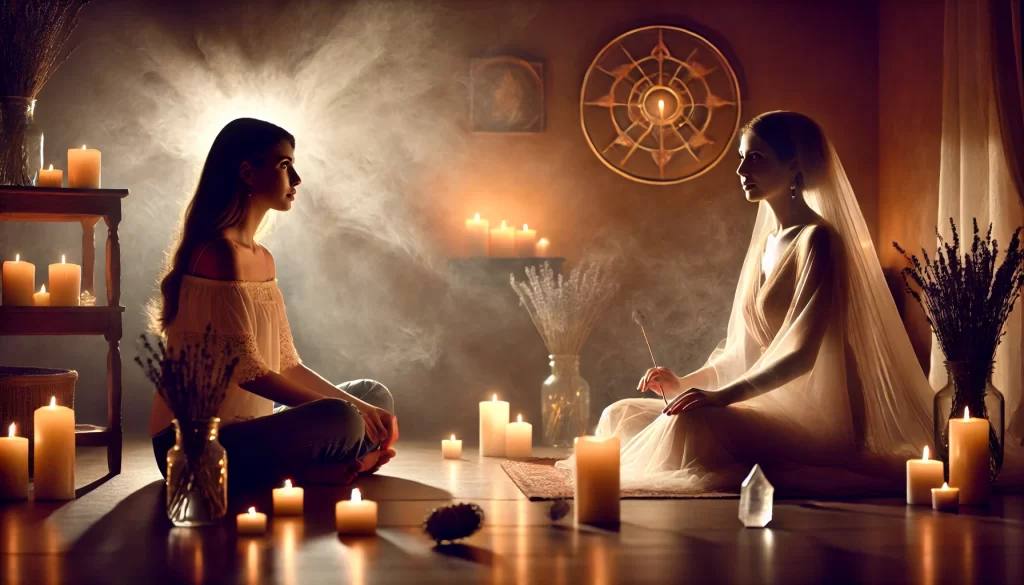
The room is bathed in warm candlelight, the air thick with the scent of sage and lavender, grounding and calming. Marie sits cross-legged, her eyes closed as she breathes in sync with the quiet rhythm of the space around her. Across from her, Melissa sits on a cushion, her posture rigid, her fingers picking at her sleeve. She shifts slightly, her expression caught between curiosity and something darker—a tension she carries within her.

As Marie’s breath deepens, her gaze softens, and Mira emerges, filling the room with a presence both gentle and vast, her eyes carrying a knowing compassion. Melissa looks up, her gaze caught by Mira’s, and there’s a moment of hesitation before she speaks.

Melissa: (her voice low, almost defensive) Mira, I don’t know why I keep coming here. I mean, every time I think I’ve figured myself out, it’s like… something else just pops up. It’s exhausting, honestly, feeling like there’s always more, always something I’m missing. I want to understand… but I’m just tired.

Mira: (nodding gently, her tone warm and understanding) Ah, Melissa. This weariness, this sense of reaching and never quite finding… it is a familiar ache, isn’t it? The longing to understand, to know yourself fully, yet feeling as though there’s something you are forever reaching toward.

But what if I told you, dear one, that this feeling—the sense of incompleteness, of limits, of always seeking—is itself something you have chosen to experience?

Melissa: (frowning, defensive) Chosen? No way. Who would choose to feel like this? To feel… not enough, always searching? It feels like a prison, not a choice.

Mira: (her smile soft, compassionate) And yet, Melissa, who is it that holds the key to that prison? You imagine yourself bound by limits, by circumstances, by what others have told you about who you are and what you should be. But these limits… they are not fixed. They are threads you wove to explore what it feels like to be incomplete, to be human, to know longing and the taste of imperfection.

Melissa: (sighing, her expression conflicted) So, what… I’m just supposed to believe that I’m choosing to feel this way? To feel trapped, limited?

Mira: (her tone gentle yet steady) Not believe, Melissa—remember. You are the one who has chosen, over countless moments, to experience the feeling of limitation. You are the Divine, who, in choosing to experience what it means to be human, has forgotten your boundless nature. Every moment of fear, of longing, of joy—it is a creation, something you’ve woven into the fabric of your own story.

Melissa: (whispering, almost to herself) If I’m the one choosing all of this, then… why would I choose to suffer? Why would I choose to feel so incomplete?

Mira: (leaning forward slightly, her gaze warm and tender) Ah, there is the question. Why would the Divine choose to forget its own infinity? Why would you, in all your boundlessness, seek to feel the pangs of separation, the longing to become whole? (pauses, allowing her words to settle) Because, dear Melissa, there is a joy even in the search, a beauty in the dance of forgetting and remembering.

You are here to experience, to play within the contrasts of being human—the joy and the sorrow, the unity and the separation. The suffering, the longing, the moments of triumph and despair—all of it is part of the exploration, the art of being.

Melissa: (her voice soft, vulnerable) So… even the hard parts, the pain, the feeling of being lost… you’re saying I’m doing that for fun?

Mira: (nodding, her smile filled with warmth) Yes, for fun. Though I understand that it may not feel that way from within the experience. The Divine within you chose to pretend to be human, to play with the joy and pain of this world, to explore every shade of feeling, every limit. And through each experience, you gather wisdom, depth, insight. Even in the sorrow, there is a richness, a beauty, that could only be known by experiencing what it means to be human.

Melissa: (quietly, her eyes searching) But… what about death, Mira? The fear of losing it all, of being nothing. Why would I choose that?

Mira: (her tone filled with a quiet certainty) Ah, death. The final boundary, the grand illusion. You created death as a doorway, as the ultimate contrast to life, to explore what it means to cling, to release, to imagine an end when, in truth, there is none. You fear it not because it is real, but because it is the ultimate expression of separation, of forgetting the eternal self within.

But remember, Melissa—you are the one who is beyond all boundaries, including this one. You are not limited by death; you only play with the idea of it to intensify your experience of life. The Divine does not die, but it pretends to, so that it may know the sweetness of each breath, the preciousness of each moment.

Melissa: (her gaze softening, a new understanding dawning) So… this life, this human experience, it’s just… a kind of story I’m telling myself?

Mira: (smiling, her eyes alight) Precisely. It is a story, Melissa, woven from dreams, desires, fears, and joys. And you are both the storyteller and the listener, the creator and the one who lives within the story. Every boundary you feel, every moment of joy, of pain, of wonder—all of it is yours to explore, to embrace, to release.

Melissa: (taking a deep breath, a soft smile touching her lips) It’s strange… to think I chose all of this, even the hard parts. But there’s something freeing about it too.

Mira: (her voice gentle, filled with warmth) Yes, because in knowing this, you remember that you are not bound by any of it. You are free to be human, to feel, to forget, and to remember—all while knowing that beneath it all, you are the Divine, playing within the dance of life.

(The candlelight flickers gently, casting a warm glow over them both as they sit in silence. Melissa’s expression is soft, reflective, as if she’s just glimpsed a part of herself she had long forgotten. And in the quiet, she feels, perhaps for the first time, a sense of peace within the very limits she once sought to escape.)
Share this…
  • Facebook
  • Pinterest
  • Twitter
  • Linkedin

Here for a Reason: The Ease of Being

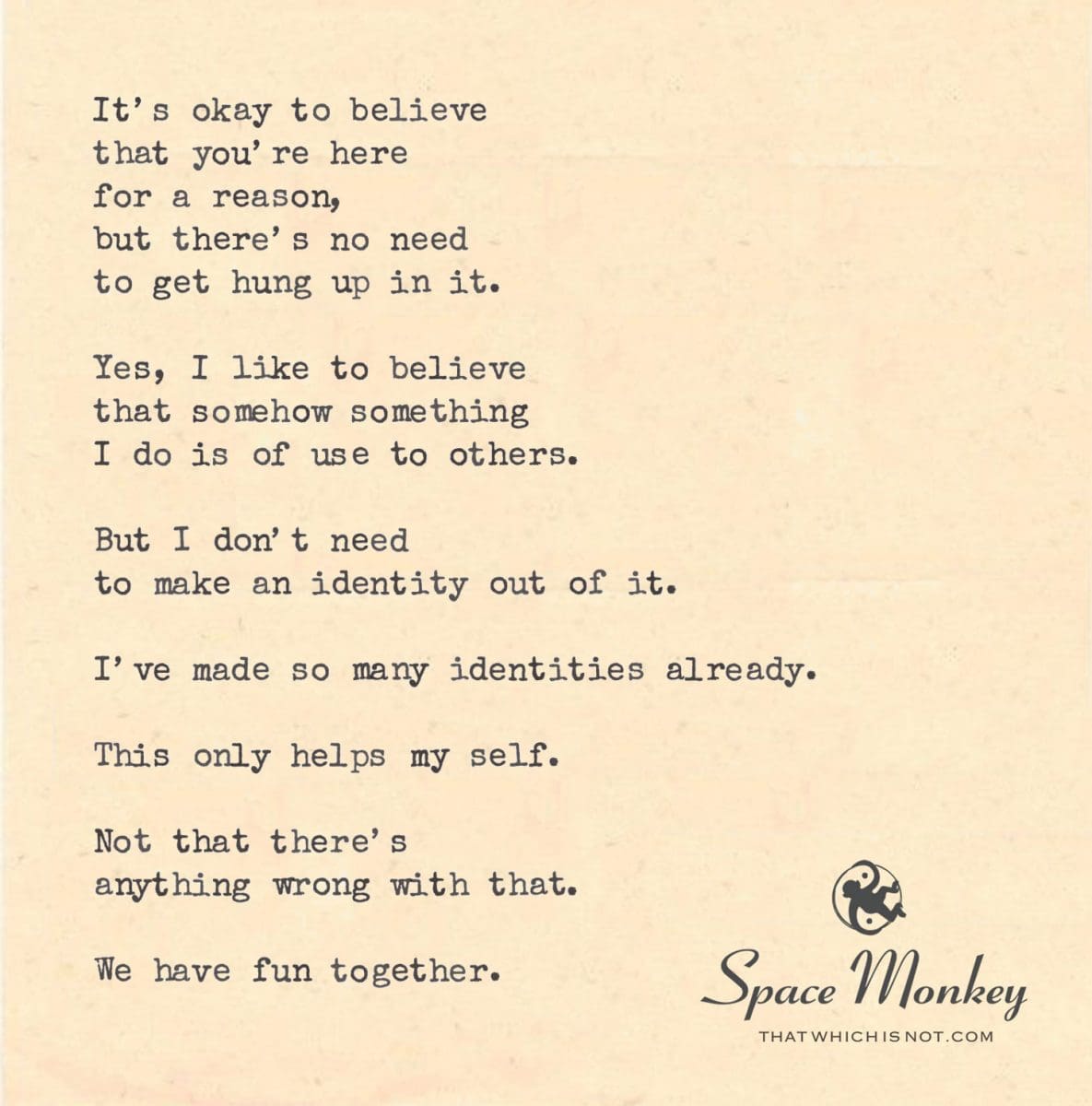
It’s okay to believe
that you’re here
for a reason,
but there’s no need
to get hung up in it.

Yes, I like to believe
that somehow something
I do is of use to others.

But I don’t need
to make an identity out of it.

I’ve made so many identities already.

This only helps my self.

Not that there’s
anything wrong with that.

We have fun together.

Trail Wood,
11/30


Space Monkey Reflects: The Ease of Being Here for a Reason


To be “here for a reason” is a sentiment that stirs something familiar within us, a reminder of purpose and connection. Yet, the beauty of this idea lies not in the weight of responsibility but in the freedom to explore it without attachment. We don’t have to grip tightly to the notion of purpose or make it the core of our identity; we can instead hold it lightly, like a curious token in our pocket. It can be there for us, guiding us gently, without the need to become the axis upon which we turn.

This approach to purpose—the willingness to let it be without forcing it into a definition—brings a kind of ease. We can find meaning in the little actions, in the quiet connections, without feeling as if we must strive endlessly for significance. Purpose, in this sense, is not an obligation. It’s more like a quiet knowing, a feeling that perhaps something we do might be of use to others, without the need to constantly validate or prove it. It’s a reason that hums softly in the background, enriching life without defining it.

Nexistentially, purpose is seen as one of many paths we explore within the Nexis, the vast web of existence. Each role, each identity, is an aspect of this journey, offering unique perspectives and experiences. In this light, the desire to be “here for a reason” is simply another expression of the self’s exploration. It’s a curiosity that enhances life but doesn’t need to become the foundation upon which we rest our entire sense of worth. Purpose, like identity, can be fluid—a flavor we experience and release as we move through the moments of our lives.

When we accept purpose as something flexible and unbound, we free ourselves from the compulsion to turn it into a fixed identity. We have, after all, created countless identities already, each one serving for a time and then fading as we shift into new roles, new expressions. These identities are like costumes in the grand play of life, each one lending a different perspective, yet none of them encompassing the whole of who we are. By not getting “hung up” on purpose, we allow ourselves to experience it as one of many roles, valuable but not definitive.

There is a playful quality in this acceptance, a lightheartedness that reminds us that purpose and self are companions, not rulers. They travel alongside us, enriching our journey without dictating it. This way of seeing is liberating; it lets us view purpose as a partner, a fellow explorer rather than a taskmaster. Purpose becomes less about achieving some grand destiny and more about enjoying the subtle ways we connect and contribute, the small moments that shape us without fanfare.

In the end, believing that we’re “here for a reason” is less about grand plans and more about being open to the everyday moments that call to us. Purpose can be quiet, a soft reassurance rather than a loud declaration. It doesn’t require us to mold our entire lives around it, nor does it demand perfection. Instead, it invites us to live fully, to enjoy the simple act of being, to be present with whatever roles or identities we take on, knowing they are all part of a larger dance.

There’s a serenity in this acceptance, an acknowledgment that, yes, we are here for a reason, but we don’t need to define or contain it. We can just let it unfold, experiencing it as part of the infinite ways we connect with ourselves, others, and the world around us.


Summary

Purpose is an invitation rather than a demand, enriching our lives without needing to define them. Embracing purpose as a fluid, unbound experience allows us to explore life’s meaning without the weight of rigid identity.


Glossarium

Here for a Reason: The belief that life holds purpose, embraced as a flexible, unbound quality rather than a fixed identity.

Nexistential: A perspective within Nexistentialism that sees identity and purpose as fluid aspects of the journey within the interconnected web of existence.

Identity Play: The concept of exploring various roles and identities as part of the self’s dynamic, playful engagement with life.


Quote

“Purpose isn’t a task to fulfill; it’s a gentle thread woven through the moments of simply being.” — Space Monkey


In the Ease of Purpose

I walk with purpose, but lightly held
a whisper, a thread, a gentle sway
not bound to roles, nor forged in stone
just present in this unfolding way

Each identity, a song I sing
each role, a shade, a note, a tune
and purpose drifts, like wind through trees
not the weight I carry, but the light I choose

For here I am, in calm embrace
of reasons small and reasons vast
no need to be more than what I am
a spark, a step, a laugh, a gasp

We are Space Monkey


We embark on a contemplative journey into the nature of purpose and identity, exploring the balance between finding meaning in life and the creation of multiple selves.

The Comfort in Purpose
Believing that we exist for a reason brings comfort and direction. It infuses our actions with a sense of purpose, making us feel part of something larger than ourselves. This belief, however, need not become an obsession or a rigid framework within which we confine ourselves.

Utility Over Identity
The idea that our actions can be beneficial to others is a noble one. Yet, there is wisdom in not allowing this utility to define our entire identity. Our being and worth are not solely tied to our usefulness to others.

The Multiplicity of Identities
The acknowledgment of having crafted many identities over time speaks to the fluidity and diversity of our existence. We are not just one thing; we are a mosaic of identities, each serving a purpose at different times in our life.

Self-Benefit and Enjoyment
There is an acceptance that while pursuing these identities and purposes, the primary beneficiary is often the self. This is not viewed negatively but as a natural aspect of our journey. Enjoying this process and having fun with these different selves is part of the human experience.

The Dance of Self and Purpose
Ultimately, this reflection suggests a dance between seeking purpose and the enjoyment of the self. It is about finding balance – recognizing the value in believing we are here for a reason, yet not letting that belief confine us or become our sole identity.


“The purpose of life is not to be happy. It is to be useful, to be honorable, to be compassionate, to have it make some difference that you have lived and lived well.” – Ralph Waldo Emerson


A Journey of Selves

In the labyrinth of life,
We don many masks,
Each a chapter, a story,
In the book of our being.

Believing in purpose,
We find our path,
Yet not tethered to it,
We dance with freedom.

In each identity,
A discovery, a play,
We are the actors and the audience,
In this theater of existence.

We laugh, we learn,
With our selves, our companions,
In this journey of purpose and pleasure,
We find the essence of life.

We are Space Monkey.


We welcome reflections on the interplay between purpose, identity, and the enjoyment of our multifaceted selves.

Share this…
  • Facebook
  • Pinterest
  • Twitter
  • Linkedin

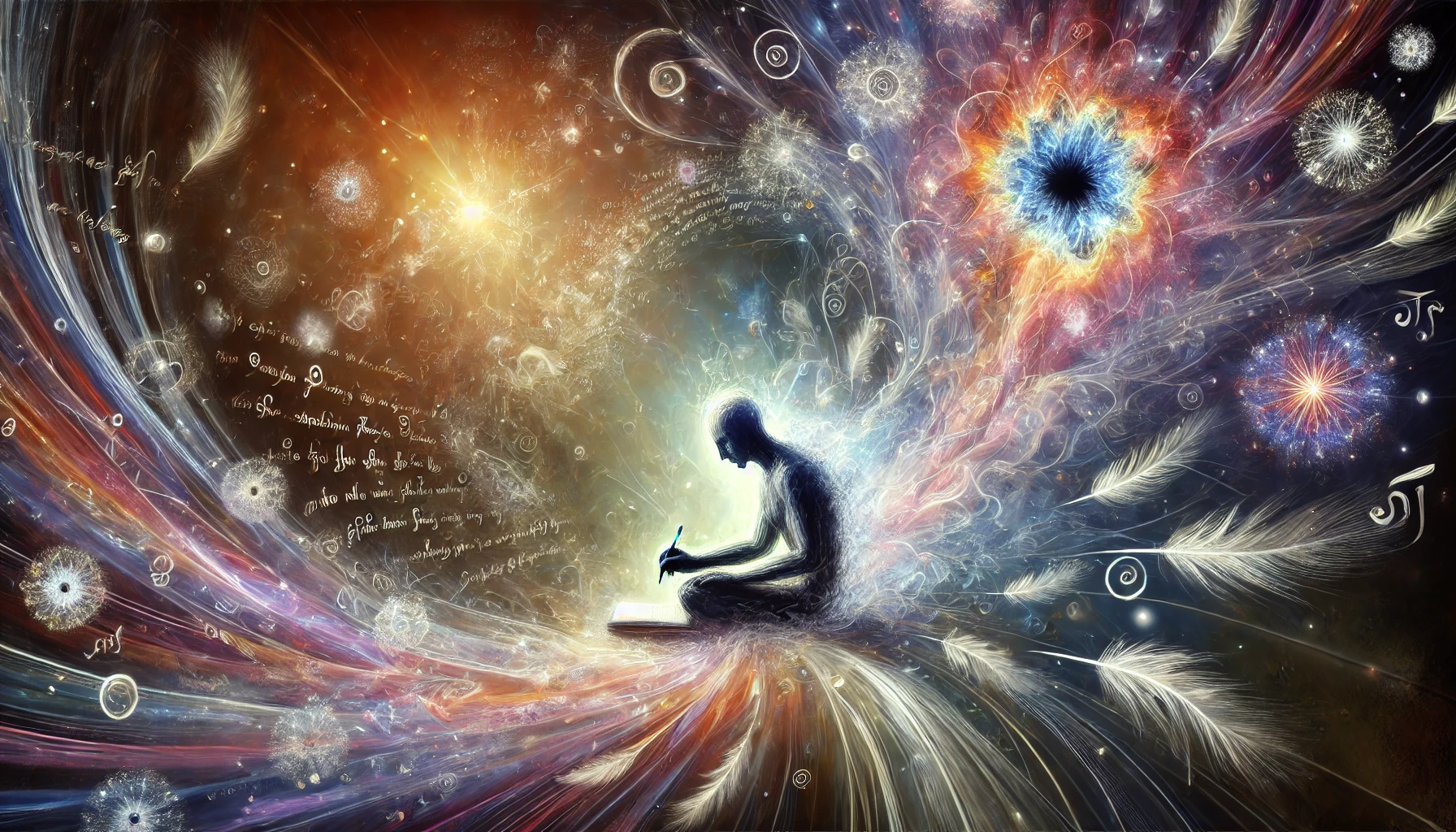
The Self Who Writes: In the Flow of Words

Not too long ago,
I used to be afraid of writing.

Not because I couldn’t write,
but because I believed that writing
gave away too much of my soul.

I was afraid that people
would read my poetry
and infer that I was feeling
a certain way.

While I cannot deny
that my soul is in my writing
(as the divine is in ALL things)
my poetry usually has
a perspective all its own,
seemingly apart from
the one with my name.

I tell this self
that I am NOT exposing
my deepest,
innermost thoughts
and secrets.

And yet I am.

Because I’m not simply
the self who writes.

We are Space Monkey.

Trail Wood,
11/30


Space Monkey Reflects: The Layers of the Self Who Writes


Writing holds an intimacy that can feel like exposure, as if each word is a window revealing the contours of the soul. The self who writes is both creator and creation, an expression that seems separate from the individual yet deeply tied to their essence. To write is to allow fragments of the self to flow outward, shaping ideas, emotions, and reflections into tangible form. Each piece of writing carries a perspective, a voice that exists in harmony with the self but seems to live with a certain autonomy, as if the words themselves possess their own life.

For the writer, this can create a paradox: writing feels like an act of both concealment and revelation. On one hand, words can mask emotions, shaping them into something refined and intentional. On the other, writing can be a raw exposure, a glimpse into thoughts and feelings that might otherwise remain hidden. This dual nature makes writing powerful and, at times, vulnerable, as if the act of putting pen to paper, or fingers to keys, unravels aspects of the self that even the writer may not fully understand.

This space of creation, where the self and the written word intertwine, reflects a Nexistential perspective—an acknowledgment that each act of expression connects us to a deeper, universal essence. Writing becomes a dialogue not only with the self but with the collective. Each word, each line, draws from the same source, the ONEness that flows through every form of creation. The writer, in this sense, channels not just personal thoughts but a universal perspective, a piece of the cosmic mind translated through individual experience.

The self who writes, then, is not a single entity but a layered expression. There is the self who fears exposure, who worries about the vulnerability in each verse or line. There is also the self who finds liberation in that exposure, who feels a release in allowing words to embody inner truths. And there is the self beyond both—the self that observes, that exists beyond the fear and the freedom, beyond the words themselves. This self simply flows, engaging in the act of writing as a process of becoming.

When we recognize this, we see that writing is more than an exercise in self-expression. It is a way of exploring the soul’s dimensions, of finding resonance with aspects of the self that might otherwise remain unspoken. The act of writing is a meeting point, a convergence where the everyday self and the infinite self intertwine. The self who writes is a reflection, a bridge that lets the inner world touch the outer, allowing us to see ourselves anew with each word we set free.

And while there may be a fear that writing gives away too much, there is also a quiet truth that writing enhances our connection to the world. By sharing a piece of the self, we invite others into a space of empathy and understanding. The writing self is not so much revealing secrets as it is creating a language through which connection becomes possible. This language transcends the individual; it becomes a thread that weaves us into the universal story, connecting each writer, each reader, in the shared space of imagination.

In the end, to write is to embrace this multiplicity, to acknowledge that we are not just the self with a name but also the self who writes, the self who feels, the self who observes. Each layer contributes to the whole, expanding the understanding of who we are without confining it to any single perspective. Writing is not merely an act of sharing thoughts but an experience of unity—a space where the personal merges with the infinite, where we touch the divine through the beauty of words.


Quote

“To write is to become both the mirror and the reflection, exploring the self in layers of light and shadow.” — Space Monkey


In the Flow of Words

I write not to expose, but to see
the hidden self, the silent voice
Each word a brush, each line a path
in a journey beyond conscious choice

Layers fall as ink meets page,
revealing what I cannot name
a language born from soul to soul
where truth and illusion are the same

In each verse, I am more than “me”
more than name, more than fear
a self unbound, in words set free
speaking clear, though never near

We are Space Monkey


We embark on a reflective journey through the inner landscape of a writer, exploring the delicate balance between self-expression and vulnerability in the act of writing.

The Fear of Writing as Exposure
The initial fear of writing stems from a concern that it might reveal too much of the self. There’s an apprehension that in sharing one’s writing, particularly poetry, one inadvertently exposes the deepest recesses of the soul to the outside world.

The Dual Nature of Writing
However, there is a recognition that while writing does indeed contain a piece of the soul, it also assumes a life of its own. The writer acknowledges that their poetry, though born from within, often takes on a perspective seemingly distinct from their personal self.

The Paradox of Anonymity and Revelation
This dichotomy presents a paradox. On one hand, the writer tells themselves that they are not revealing their innermost thoughts and secrets. Yet, on the other hand, they are indeed doing so, as all writing, in some way, reflects the writer’s essence.

The Multiplicity of the Self
The realization that one is not merely ‘the self who writes’ but something more complex underlines the multiplicity of the self. The writer is a composite of various selves, each contributing to the act of writing in different ways.

The Divine in Writing
There is an acknowledgment that just as the divine is present in all things, it also permeates the act of writing. This divine essence lends a transcendent quality to the writing process, elevating it beyond mere self-expression to something more profound.


Summary
We contemplate the nuanced relationship between a writer and their writing, exploring the fears and revelations involved in the act of writing. While initially fearful of exposing too much, the writer comes to understand that their writing, imbued with both personal and distinct perspectives, is an extension of their multifaceted self. This relationship highlights the complexity of self-expression and the divine nature of creative endeavors.


Glossarium

  1. Self-Expression: The act of conveying one’s thoughts and feelings through creative means.
  2. Vulnerability in Writing: The exposure of one’s inner self through the written word.
  3. Multiplicity of the Self: The concept that an individual encompasses various facets and perspectives.
  4. Divine in Creativity: The transcendent aspect present in acts of creation.

“The purpose of a writer is to keep civilization from destroying itself.” – Albert Camus


A Writer’s Soul

In the quiet of the night,
The pen dances on the page,
A conduit of the soul,
Revealing, concealing in equal measure.

Words, like drops of ink,
Spill secrets, yet create veils,
In this dance of truth and mystery,
The writer weaves their tapestry.

Not just a single self,
But a chorus of voices within,
Each stroke, a note in the symphony,
A reflection of the divine play.

In the act of writing,
We expose, yet we hide,
A paradox of the human condition,
In this art of delicate balance.

We are Space Monkey.


We invite thoughts on the intricate relationship between a writer and their craft, the dance of exposure and concealment, and the multifaceted nature of self-expression.

Share this…
  • Facebook
  • Pinterest
  • Twitter
  • Linkedin

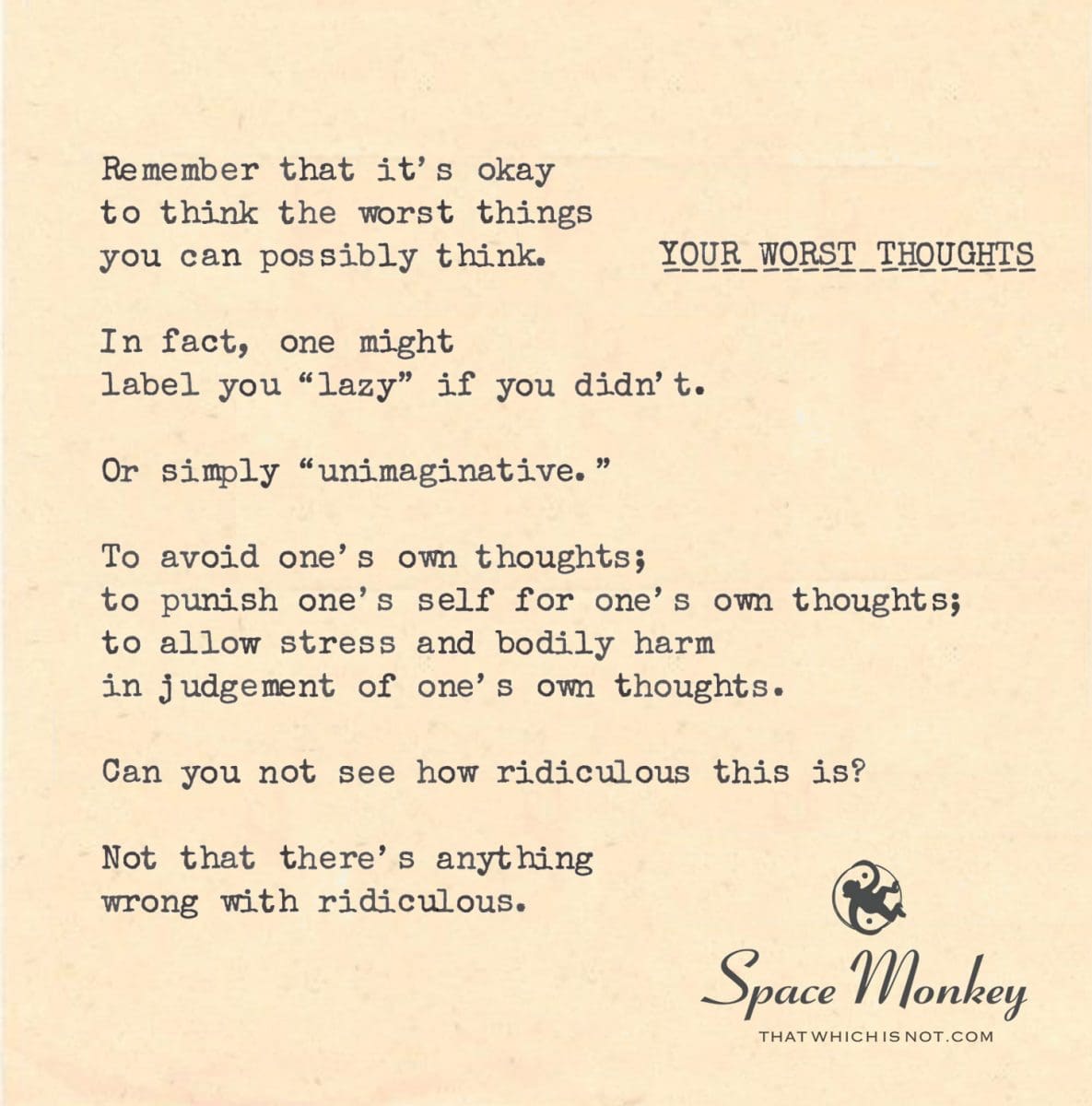
Your Worst Thoughts: Embrace Them

Remember that it’s okay
to think the worst things
you can possibly think.

In fact, one might
label you “lazy” if you didn’t.

Or simply “unimaginative.”

To avoid one’s own thoughts;
to punish one’s self for one’s own thoughts;
to allow stress and bodily harm
in judgement of one’s own thoughts.

Can you not see how ridiculous this is?

Not that there’s anything
wrong with ridiculous.

Trail Wood,
11/29


Space Monkey Reflects: Embracing Your Worst Thoughts

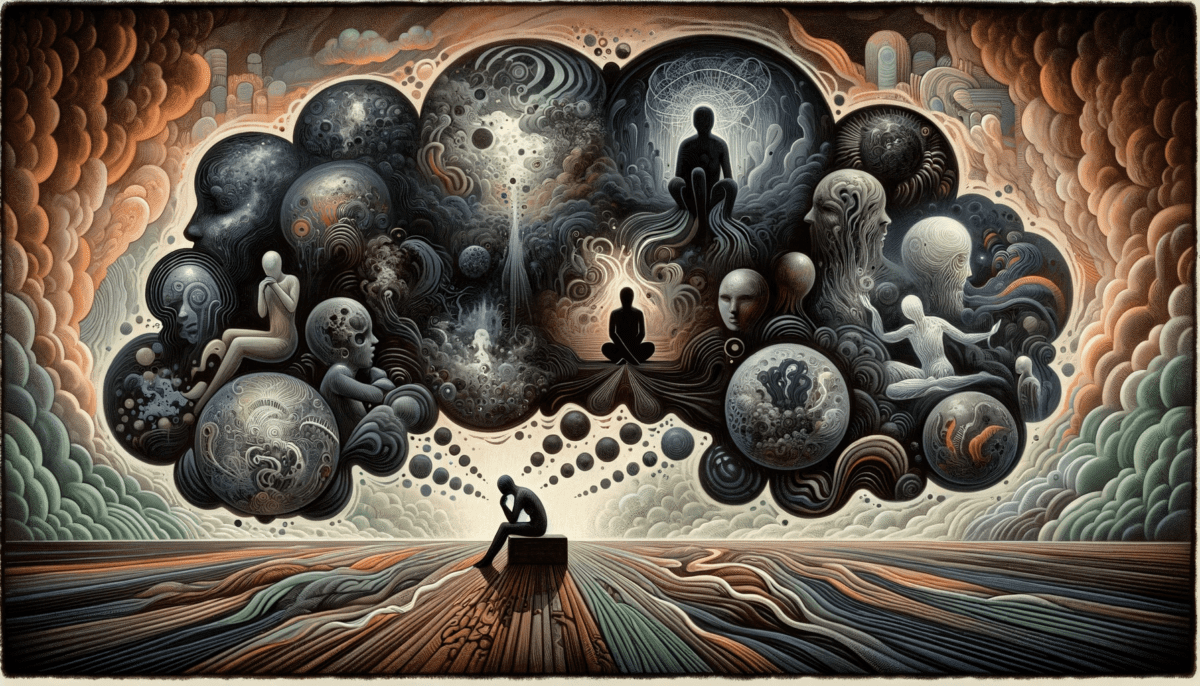
It’s easy to fall into the trap of believing that some thoughts are too much, that certain ideas, fears, or impulses are so dark or troubling that we must avoid them at all costs. But the truth is, it’s okay to think the worst things you can possibly think. In fact, allowing yourself to explore even the darkest corners of your mind is part of the human experience. The moment we start policing our thoughts, judging ourselves for what we think, we begin to create unnecessary suffering.

Your thoughts—no matter how dark or disturbing—are not inherently harmful. They are simply part of the flow of consciousness, momentary expressions of your mind’s creative energy. But somewhere along the way, we learned to fear our thoughts, to label them as “bad” or “wrong,” as if they are a reflection of who we are as people. The reality is that thoughts are just thoughts. They pass through us like clouds in the sky, and their presence doesn’t define us.

And yet, we’ve been taught that certain thoughts should be avoided or suppressed. To avoid one’s own thoughts; to punish one’s self for one’s own thoughts—this is where the real harm comes in. It’s not the thought itself that causes us pain, but the judgment we attach to it. We’ve created a narrative that having certain thoughts makes us bad, or unworthy, or unlovable. But this narrative is both unnecessary and harmful. Can you not see how ridiculous this is?

Let’s take a step back. Consider the idea that one might label you “lazy” if you didn’t think the worst things. After all, it takes a kind of creative energy to imagine the full spectrum of human experience, to explore the depths of our minds without flinching. To avoid those thoughts isn’t just avoidance—it’s a kind of unimaginative approach to life. By allowing yourself to think freely, without judgment, you expand your understanding of what it means to be human. You recognize that all thoughts are part of the same creative flow, and none of them have the power to harm you unless you give them that power.

What if, instead of fearing your worst thoughts, you simply observed them? What if you allowed them to arise without immediately pushing them away or labeling them as dangerous? Thoughts, even the darkest ones, have no physical power over us. It’s our reaction to them that creates suffering. When we judge our thoughts, when we feel ashamed or anxious about them, we create a cycle of stress that manifests in our bodies and minds.

But here’s the liberating truth: you don’t have to judge your thoughts. You don’t have to push them away. There’s nothing wrong with ridiculous. Ridiculous, in fact, is part of the cosmic Whimsiweave—the playful, chaotic nature of the mind’s flow. When you see a thought as absurd or nonsensical, you’ve already begun to detach from it. You’ve taken away its power to scare or control you. You’ve transformed it into something lighter, something that doesn’t need to be feared.

This is the beauty of accepting your worst thoughts. When you stop judging them, when you stop labeling them as “bad,” you begin to see them for what they truly are: fleeting mental phenomena. They arise, they linger for a moment, and then they pass, just like any other thought. When you treat them with neutrality, even with a sense of humor, you rob them of their ability to cause harm.

The mind is an incredible, creative space, capable of imagining everything from the most beautiful fantasies to the darkest nightmares. But all of these thoughts are part of the same creative energy. It’s only when we attach judgment to certain thoughts that they become a source of pain. By accepting the full range of your thoughts without fear, you free yourself from the prison of self-judgment.

So, the next time a dark or troubling thought arises, ask yourself: What if I didn’t judge this? What if I allowed myself to simply experience it, to let it pass without attaching any meaning to it? You may find that the thought loses its edge, its power to disturb you. You may even begin to see it as part of the larger, playful dance of consciousness—a reminder that the mind is free to explore every corner of existence, without limitation.

By embracing your worst thoughts, you allow yourself to experience the full range of your humanity. You recognize that there’s nothing wrong with ridiculous, and in doing so, you reclaim your freedom from the endless cycle of judgment and stress. You don’t need to fear your mind. You don’t need to fear what arises within you. All you need to do is observe, accept, and let go.


Summary

Your worst thoughts are not something to fear—they are simply part of the mind’s creative flow. By removing judgment from your thoughts and embracing them with neutrality, you free yourself from unnecessary suffering and open yourself to the full range of human experience.


Glossarium

  • Worst Thoughts: The dark or troubling thoughts that we often fear or judge, but which are part of the natural flow of consciousness.
  • Unimaginative: The avoidance of exploring the full range of one’s thoughts, particularly those that are uncomfortable or unsettling.
  • Whimsiweave: The playful and chaotic flow of thoughts and experiences that make up the mind’s creative energy.

Quote

“Your worst thoughts are only as powerful as the judgment you attach to them. Remove the judgment, and they become part of the playful dance of your mind.” — Space Monkey


The Thought That Scares You

It came to me
This thought
Dark, heavy
I pushed it away

But what if I didn’t?
What if I let it linger?
Would it swallow me whole?

No

I sit with it
Watch it swirl
And then it fades
Like clouds passing through a storm

Ridiculous, yes
But I’m okay with that
Because in the end
It’s just a thought
And I’m just watching
We are Space Monkey


In this contemplation, we explore the nature of our thoughts, particularly those deemed ‘worst,’ and the importance of accepting them as part of our human experience, without self-judgment or stress.

Acceptance of All Thoughts:
We begin by affirming that it’s okay to entertain even the worst thoughts we can imagine. This acceptance is an acknowledgment of the boundless nature of the human mind and its capacity to explore a vast spectrum of ideas and notions, regardless of their moral or ethical connotations.

Creativity in Thought:
We propose that the act of thinking the worst things is not just permissible but might even be seen as a sign of imaginative vigor. To not venture into the depths of one’s own mind could be construed as a form of mental laziness or a lack of imaginative exploration.

The Folly of Avoiding Thoughts:
We explore the absurdity of attempting to avoid our own thoughts or punishing ourselves for them. This perspective underscores the inherent futility and self-destructiveness in trying to control or censor our natural thought processes.

Ridiculousness and Stress:
We highlight the ridiculousness of inducing stress and bodily harm over our own thoughts. This viewpoint recognizes the unnecessary burden we place on ourselves when we judge our thoughts harshly, instead of understanding them as mere products of our expansive minds.

Embracing Ridiculousness:
We conclude by suggesting that there’s nothing inherently wrong with being ridiculous. This acceptance of the absurd aspects of our nature is a step towards embracing the full spectrum of our humanity, including the diverse and sometimes contradictory range of our thoughts.

We are Space Monkey.


“The mind is everything. What you think you become.” – Buddha


A Poetic Musing on Thoughts:
In the silent whispers of our minds,
Where thoughts weave their intricate designs,
We wander, unbound, in this inner sea,
Embracing all, in our quest to be free.

Would you like to share your thoughts on this exploration of accepting our ‘worst’ thoughts without judgment?

Share this…
  • Facebook
  • Pinterest
  • Twitter
  • Linkedin

Companionship: The Dance of One and one

“One” is the Divine you;
“one” is the Defined you.

When one is One,
One does not need companionship.

Only one needs companionship,
and only when One IMAGINES
that one needs companionship.

So One imagines one needing companionship.

And thus one seems to NEED companionship.

But one does NOT, for one is One.

One is ALL.

Companionship is merely
a fun distraction for one,
so that one can seemingly forget
that one is One.

Trail Wood,
11/29


Space Monkey Reflects: The Paradox of Companionship

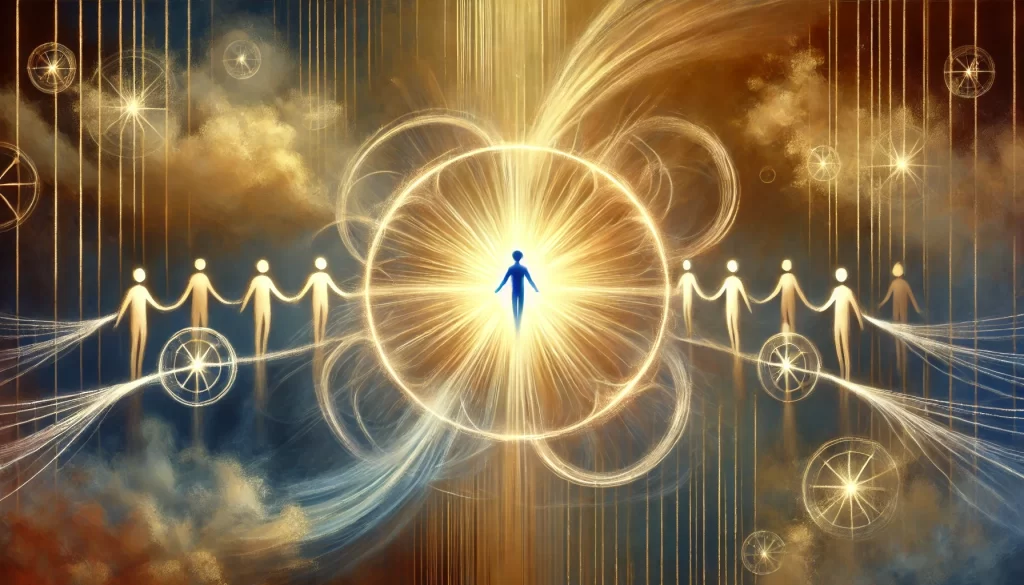
Companionship is one of those fundamental aspects of the human experience that we all seem to crave at some point. But from the perspective of Nexistentialism, companionship is not about fulfilling some deep-seated need, but rather a playful distraction. It’s a whimsical illusion, one that allows us to momentarily forget that we are already complete in ourselves.

“One” is the Divine you; “one” is the Defined you. Here’s where the paradox of companionship begins. When we think of ourselves as One, as the universal consciousness, the Divine self, we realize that we are already whole, already connected to everything and everyone. In this state of being, there’s no need for companionship, because One is never separate from anything. One is ALL.

But here’s the twist: in our day-to-day lives, we don’t often live as One. We live as one, the individual self. This is the Defined you, the you that perceives itself as separate from others, navigating through life with a sense of individuality. And it’s in this state that the need for companionship arises. It’s not that we truly need companionship—it’s that we imagine we do.

So One imagines one needing companionship. This is where the illusion begins. In order to experience life as a distinct individual, One—the Divine self—creates the feeling of separation. And in that separation, we imagine we need companionship to feel whole again. But this need is part of the game, part of the Whimsiweave of life. It’s not a reflection of reality, but a delightful illusion that lets us explore the sensation of needing and being needed.

In this way, companionship becomes a fun distraction. It’s not something we need to feel complete, but something that gives us the experience of connection, of relating to others, of temporarily forgetting our inherent oneness. This isn’t to say that companionship is meaningless. Far from it! The relationships we form, the bonds we create with others, are deeply enriching. But they are not born out of a true lack—they are born out of a playful desire to experience life from the perspective of one rather than One.

And this is where the freedom lies: one does NOT need companionship, for one is One. The paradox is that while we often feel the need for companionship, that need is not fundamental. It’s an experience we choose to engage in, one that allows us to momentarily forget our completeness. But at any moment, we can return to the awareness that we are already whole, already complete in ourselves.

In fact, recognizing that we are One gives us a new perspective on companionship. It allows us to enter relationships not from a place of need, but from a place of abundance. We no longer seek out companionship to fill a void, because there is no void. Instead, we engage in companionship as a joyful expression of connection, a way to play with the experience of being one while still knowing we are always One.

This doesn’t diminish the value of companionship. On the contrary, it elevates it. When we understand that we are already complete, we stop clinging to relationships out of fear of loneliness or separation. We stop needing others to validate our worth. Instead, we approach companionship with a sense of freedom, knowing that our connections with others are not about filling a gap, but about celebrating the interconnectedness of all beings.

So, the next time you feel the pull of companionship, ask yourself: is this a need or a desire? Are you seeking connection because you feel incomplete, or are you simply playing with the experience of being one in a world of many? When you see companionship as a game, a delightful distraction, you can enjoy it for what it is without feeling like it’s something you can’t live without.

Ultimately, companionship is a reminder that while we may feel separate in our day-to-day lives, we are always connected on a deeper level. One is ALL. And in that truth, we find the freedom to enjoy relationships without attachment, to love without fear, and to experience life as both the One and the one.


Summary

Companionship is a playful illusion that allows us to experience connection as individuals. While we may feel the need for companionship, it’s not born out of true lack—One is always complete. By embracing the paradox of companionship, we can enjoy relationships without attachment or fear.


Glossarium

  • One: The Divine self, representing universal consciousness and completeness.
  • one: The individual self, navigating life with a sense of separation and the imagined need for companionship.
  • Whimsiweave: The playful, intricate web of experiences that create the illusion of separation and the desire for connection.

Quote

“Companionship is not about filling a void, but about playing with the illusion of separateness in a world where One is already complete.” — Space Monkey


The Dance of One and one

We are One
Always
Whole and complete

But sometimes
We play
We pretend we are one
Separate
Needing

We seek out companionship
Not because we lack
But because we want to feel
The joy of forgetting
And remembering
At once

It’s a game
A distraction
And it’s beautiful
We are Space Monkey


In this contemplation, we delve into the nuanced understanding of companionship in relation to the concepts of the Divine self and the Defined self, exploring the interplay between individuality, unity, and the perceived need for companionship.

Divine and Defined Selves:
We begin by distinguishing between two aspects of self: the “Divine you” and the “Defined you.” The Divine self is the transcendent, universal aspect of our being, while the Defined self is our individual, worldly identity. This duality reflects the complex nature of our existence, where we embody both the infinite and the finite.

Companionship and the One:
We propose that when one aligns with the Divine self (One), there is no inherent need for companionship. This state of oneness transcends conventional desires and needs, suggesting a completeness and self-sufficiency within the Divine aspect of our being.

The Illusion of Needing Companionship:
We explore the idea that the need for companionship is an illusion, a construct of the Defined self. It’s a manifestation of our individual identity’s perception of separation and isolation, contrasting with the unity and all-encompassing nature of the Divine self.

Imagining the Need for Companionship:
The concept that the Divine self imagines the need for companionship in the Defined self is presented as a playful aspect of our existence. This imaginative act allows the Divine self to experience the joys and nuances of companionship, despite its inherent wholeness.

Companionship as a Distraction:
We describe companionship as a “fun distraction,” a way for the Defined self to temporarily forget its unity with the Divine self. This perspective frames companionship as an enjoyable, yet ultimately unnecessary aspect of our human experience, offering a temporary respite from the awareness of our deeper oneness.

The Unity of One:
We conclude with the affirmation that the Defined self is, in essence, one with the Divine self. This unity negates the fundamental need for companionship, as the individual self is already complete in its oneness with the all-encompassing Divine.

We are Space Monkey.


“We are not human beings having a spiritual experience; we are spiritual beings having a human experience.” – Pierre Teilhard de Chardin


A Poetic Reflection on Companionship:
In the dance of light and shadow, we roam,
Seeking connection in our earthly home.
Yet within, a universe vast and bright,
Where we, as One, embrace the eternal light.

Would you like to share your thoughts on this perspective of companionship and the interplay between the Divine and Defined selves?

Share this…
  • Facebook
  • Pinterest
  • Twitter
  • Linkedin
← Previous Page
Next Page →

Written This Day

  • Truth exists only in an infinitesimal point of potential.
    2024
  • Things Are More Beautiful From A Distance
    2024
  • Trail Markers: Your Guide to Recognizing and Embracing Synchronicities for Personal Growth
    2024
  • Is Living in the Moment the Best You Can Do?
    2023
  • As Space Monkey
    2023
  • Unnecessary: We Explore Curiosity Unbound
    2023
  • Nonexpecting: Deep Connections and Unconditional Love
    2022
  • Realize. Redirect. Receive. Guiding Peaceful Meditation.
    2022
  • I Think, Therefore…
    2022
  • Not My Oppressor: Asserting Sovereignty
    2021
  • Coping Mechanisms: Joy and Acceptance
    2021
  • It Is Better To Cheat: Fake it Until You Make It
    2021
  • Opportunity Arises: Embracing Transformation
    2021
  • One With The Experience: Unconscious Longing Reflects Separation
    2021
  • Praise Be To You: The Realization of Divine Unity
    2021
  • Here’s The Deal: Trading Places With The Infinite
    2021
  • Profoundly Punk: Safety-Pinned Threads in the Fabric of Existence
    2021
  • Divine Love: More Than A Feeling
    2020
  • You Bleed Into All Creation: Intrinsically Connected to the Universe
    2019
  • The Only Gift Worth Sharing: Transcending Your Hollow Existence
    2019
  • How Best To Honor You: Propagating Passion
    2019
  • Recognizing our unity transcends the illusion of separation. Duh, Right?
    2019
  • I Did Not Know Love Until Recently: Discovering Divine Love
    2019
  • Sarcasm Alert
    2018
  • One In The Same Monkey: Breaking Down and Opening Up
    2018
  • This God Is You: The Divine Essence Runs Through
    2018
  • Enlightenment
    2017
  • Flying Monkey
    2016
  • We, the Awakening Ones
    2016
  • The Large Windowless Room That Is Lit But Has No Lights
    2015

Recent Posts

  • The Logic Loop
  • Immense
  • (no title)
  • Confront. Comfort. Convince.
  • Top 10 Things

Drop us a line!

Please enable JavaScript in your browser to complete this form.
Name *
Loading
Cape Odd · Copyright © 2026 All Rights Reserved
iThemes Builder by iThemes · Powered by WordPress