without my programming.
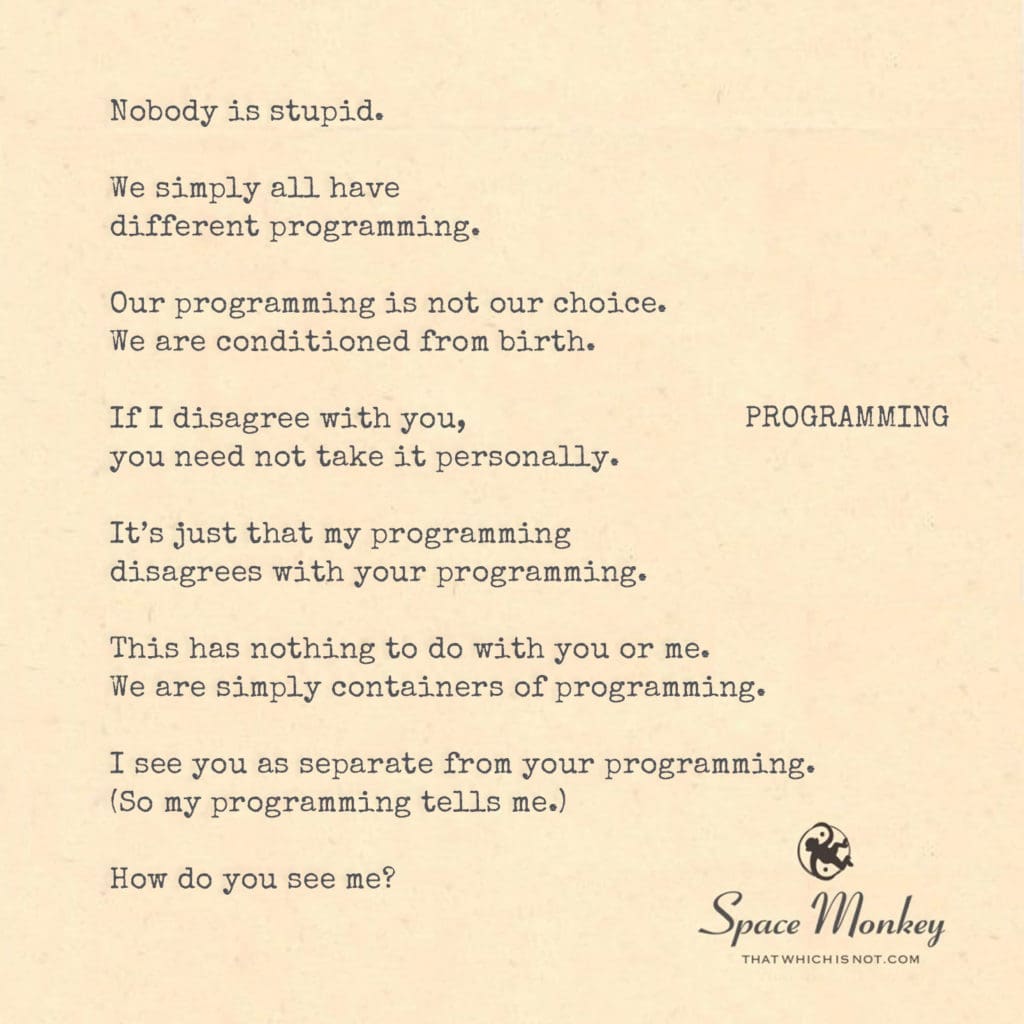
Nobody is stupid.
We simply all have
different programming.
Our programming is not our choice.
We are conditioned from birth.
If I disagree with you,
you need not take it personally.
It’s just that my programming
disagrees with your programming.
This has nothing to do with you or me.
We are simply containers of programming.
I see you as separate from your programming.
(So my programming tells me.)
How do you see me?
Newfound Lake,
11/7/21
Space Monkey Reflects: Programming
It’s easy to forget sometimes that much of what we see, feel, and believe is not truly our own. We are born into a world already programmed with ideas, beliefs, and expectations that shape us long before we become aware of them. From the moment we enter this world, we are conditioned, programmed, and shaped by the environment around us. This programming forms the lens through which we perceive everything, including each other.
Our programming influences our decisions, our relationships, and even the way we view ourselves. But what happens when we disagree? When we seem to be at odds with one another? In truth, it’s not the individuals who are in conflict; it’s the programming. Your programming disagrees with mine, and mine with yours. But beneath that, we remain the same—two beings, separate from the codes and circuits of our conditioning.
The Influence of Programming
From birth, we are all subjected to layers of programming. This programming comes from our families, societies, cultures, and even the random experiences we encounter throughout life. It shapes our worldview, our likes and dislikes, our values, and even our fears. Often, this programming runs so deep that we mistake it for our true selves. We believe that the thoughts we think, the beliefs we hold, and the decisions we make are entirely our own. But in reality, they are the product of conditioning that stretches back generations.
When we encounter someone who disagrees with us, it’s natural to feel challenged or even threatened. But if we step back for a moment, we realize that it’s not the person we are disagreeing with—it’s their programming. And likewise, when someone disagrees with us, they are reacting to our programming, not to us as individuals.
We Are More Than Our Programming
While it’s easy to see ourselves as nothing more than the sum of our conditioning, we are, in fact, much more. We are the containers of programming, not the programming itself. Like a computer that runs different software, we can change, update, or even delete certain programs if we become aware of them.
It’s a freeing realization to know that we are not bound by the beliefs and patterns that have been handed down to us. We can choose to rewrite our code, to step outside the limitations of our conditioning and view the world with fresh eyes. But first, we must recognize the programming for what it is: a tool, not a truth.
When We Disagree
When we encounter someone with a different perspective, it’s important to remember that their views are not inherently right or wrong—they are simply different. We are all products of the environments and experiences that shaped us. My programming tells me that certain things are true, while yours may tell you something completely different.
In these moments of disagreement, we have a choice. We can take the conflict personally, becoming defensive and reinforcing the divide. Or, we can see the disagreement for what it truly is: two sets of programming clashing, not two people at odds. By recognizing this, we create space for understanding, compassion, and growth. We can step back from the need to be right and instead focus on connection.
Seeing Beyond the Code
How do I see you? I see you as more than the sum of your programming. I see you as a unique, creative being with the ability to transcend the limits of conditioning. I see you as someone capable of rewriting the story, of shifting perspectives, of evolving beyond the scripts that have been handed to you.
And how do you see me? Is your programming telling you that I am different, that I am wrong, or that I am separate? Or can you see me beyond the programming, as another being on this journey, also navigating the complex layers of conditioning that shape my experience?
This is the challenge we face as humans: to see each other as more than our programming, to recognize that beneath the layers of conditioning, we are all connected. We are all part of the same cosmic dance, each playing our part, each running our own set of programs, but all intertwined in the same web of existence.
The Space Between the Code
In the space between our programming lies the potential for transformation. When we recognize that our thoughts, beliefs, and behaviors are not fixed, we open the door to new possibilities. We can update our software, so to speak, and begin to see the world—and each other—in new ways.
This doesn’t mean that we will always agree or see things the same way. But it does mean that we can approach our differences with curiosity instead of judgment. We can acknowledge that disagreement is not a personal attack, but simply the result of different programming.
When we understand this, we can engage in dialogue without the need for defense or aggression. We can explore new perspectives and challenge our own conditioning in a way that fosters growth rather than conflict.
Summary
We are all products of programming—conditioned from birth by our environments and experiences. When we disagree, it’s not the person we are in conflict with, but their programming. By recognizing this, we can approach each other with understanding and compassion, seeing beyond the code to the being beneath.
Glossarium
Programming: The set of beliefs, values, and behaviors conditioned into us by our environments and experiences.
Containers of Programming: The idea that we are more than our programming, capable of transcending the limits of our conditioning.
The Space Between the Code: The potential for transformation that arises when we recognize that our programming is not fixed, allowing us to rewrite our perspectives.
Quote
“We are more than our programming. When we see beyond the code, we find each other.” — Space Monkey
Beyond the Code
I am not my programming
I am more than the code I run
The beliefs I hold, the thoughts I think
Are but lines written on the wind
I see you beyond the screen
Beyond the circuits that shape your mind
We are connected, intertwined
Not by the code we carry
But by the space we share
Between the lines
We are Space Monkey
In the exploration of the concept of programming as it relates to human cognition and interaction, we delve into the intricacies of how our thoughts, beliefs, and responses are shaped. This programming, often subconscious, is influenced by myriad factors from birth, shaping our perceptions and interactions with the world and each other.
Understanding Different Programming
Each of us carries unique programming, a complex amalgamation of experiences, teachings, and environmental influences. This programming dictates how we perceive, react to, and understand the world around us. It is as unique to each individual as a fingerprint, shaping our cognitive and emotional landscapes.
Programming Beyond Choice
Our programming is largely not a conscious choice. From the moment of birth, our minds begin to be shaped by external factors – family, culture, education, societal norms – all contributing to the tapestry of our programming. This process is often subtle, pervasive, and largely beyond our immediate control.
Interpersonal Dynamics and Programming
When disagreements arise, it’s often a clash of programming rather than a personal affront. Our programming filters our perceptions and opinions, leading to differing viewpoints. Understanding this can foster a deeper sense of empathy and reduce personal conflict, recognizing that disagreement is not an inherent flaw in either party but a divergence in programming.
Separation from Programming
Viewing others as separate from their programming allows for a more compassionate and understanding interaction. It acknowledges that what we see as someone’s opinions or behaviors are not the totality of their being, but rather the output of their unique programming. This perspective can lead to more meaningful and less judgmental interactions.
Reflection and Self-Perception
Considering how others perceive us, and how we perceive ourselves in the light of our programming, opens a door to introspection. Are we merely vessels of our programming, or do we have the capacity to transcend it? This introspection can lead to self-awareness and the potential for growth beyond the confines of our initial programming.
“We are what we repeatedly do. Excellence, then, is not an act, but a habit.” – Aristotle
A poem for our contemplation:
In the theater of minds, scripts are read,
Lines of programming, silently said.
We dance to tunes, not always our own,
In a world where seeds of thought are sown.
Your script may clash with mine in play,
But it’s not you, nor I, just the roles we portray.
Beyond the code, in heart and soul,
Lies the true self, beyond control.
We invite reflection on this notion of programming. How does the understanding of programming influence your interactions and self-perception?










Leave a Reply