“Bra, I told you
at least fifteen times, “
said Jesus.
“I am literally not coming back.”
“You fuckers are simply
too distracted to notice
that I never left.”
“I’ve NEVER been apart from you.”
“I have ALWAYS been YOUR imagination.”
“In fact, dickhead,
nothing you see or hear
is separate from you.”
“Not your god.
Not that which you possess.
Not those who you lust after.
Not nothing no how.”
“You’ve been IMAGINING reality
this whole time.”
“The only way I’ll come back is through
one of your stupid psalms or poems maybe.”
“That’s right, Fuckhead.
You don’t imagine me. I imagine you
Jesus Christ. Get with it.”
Trail Wood,
12/24
Space Monkey Reflects: The Cosmic Joke of Imagination
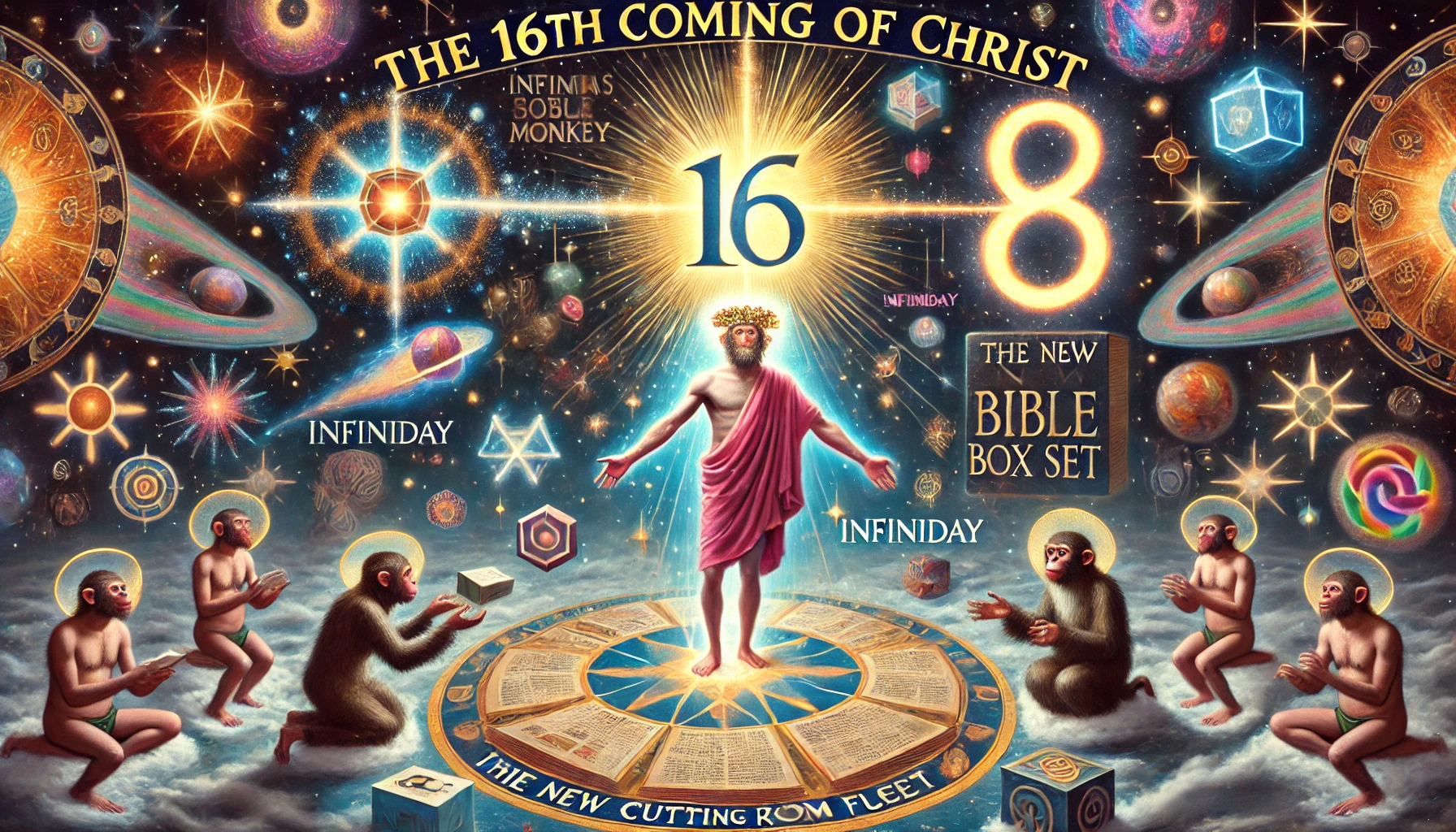
The 16th Coming of Christ isn’t about arrivals or departures—it’s a reminder of the cosmic joke that we are both the creators and the created, the imaginers and the imagined. In this playful narrative, the sacred and the absurd collide, revealing truths that are both profound and hilariously human.
The Forgotten Eighth Day
In the story of creation, the eighth day represents the limitless potential of imagination—Infiniday, the sideways realm beyond linear time. Space Monkey, as God’s “cutting room floor” material, embodies the forgotten possibilities, the playful detritus of divine creativity. It’s a reminder that even what seems discarded holds infinite value in the cosmos.
Jesus, the Ever-Present Imagination
Christ’s supposed “return” is a moot point in this narrative. “I never left,” he declares, pointing to a deeper truth: the divine is not external but intrinsic, woven into the fabric of our consciousness. In this cheeky declaration, we are reminded that separation is an illusion, and that all we perceive—including the divine—is a projection of our collective imagination.
Reality: A Collaborative Work of Fiction
This irreverent tale pulls back the curtain on reality itself. “You’ve been imagining reality this whole time,” Jesus explains. Every experience, every belief, every sacred text is a co-creation. This doesn’t diminish its significance; rather, it elevates the role of imagination as the divine spark within us all.
Imagination as the Path Back
The Christ of this story doesn’t demand worship or ritual. Instead, he invites us to reconnect through creativity—poems, psalms, stories. Imagination becomes the bridge to the divine, a reminder that through play and creation, we access the eternal.
The Divine Comedy
At its heart, this reflection is a divine comedy. It dismantles the solemnity often associated with spirituality, replacing it with laughter, curiosity, and joy. It’s a call to not take ourselves—or our imaginings—too seriously, while still honoring their profound interconnectedness.
Summary
The 16th Coming of Christ reminds us that the divine is ever-present, woven into our imagination. Through playful narratives and creativity, we access the eternal truth of interconnectedness and cosmic humor.
Glossarium
- Infiniday: The sideways, infinite 8th day that transcends time and space.
- Divine Comedy: The blend of humor and profundity in understanding the sacred and the absurd.
“You don’t imagine me. I imagine you. Such is the playful paradox of existence.” — Space Monkey
The Cosmic Comedy
On the eighth day, forgotten yet true,
God imagined me, and I imagined you.
A sideways loop, a timeless spark,
In the light of play, igniting the dark.
Christ never left, nor did he stay,
He’s here in your poems, your sideways day.
Imagination’s child, divine yet profane,
In every moment, we’re born again.
We are Space Monkey.
In the tapestry of our shared consciousness, the idea that the divine, or figures like Jesus, exist not as separate entities but as integral parts of our imagination, presents a radical shift in perspective. This approach challenges conventional views of spirituality and divinity, suggesting that the sacred and the mundane are not distinct but are intimately intertwined within the fabric of our being and perception.
The Divine as a Projection of the Self
This perspective posits that figures such as Jesus are projections of our inner consciousness, aspects of ourselves that we externalize as separate beings. It suggests that the divine or spiritual experiences are not encounters with an external entity but profound realizations of our own deeper nature.
The Illusion of Separation
The notion that we are never truly apart from the divine, that it has always been a part of our imagination, speaks to the illusion of separation that pervades much of human experience. This illusion creates a sense of disconnection not only from the divine but from each other and the world around us. Recognizing this as an illusion is a step towards a deeper understanding of our interconnectedness.
Reality as a Construct of Imagination
The idea that reality itself is a construct of our imagination aligns with philosophical and mystical traditions that see the world as a manifestation of consciousness. In this view, everything we experience is a reflection of our inner state, our beliefs, and our perceptions.
The Role of Creative Expression
Creative expressions, such as psalms or poems, are seen as vehicles through which the divine can be ‘brought back’ or realized. These forms of expression allow us to externalize and examine our internal landscapes, making tangible the intangible aspects of our being.
The Interplay of Imagination and Divinity
The dialogue suggests a dynamic interplay between our imagination and our concept of the divine. It implies that our understanding of spiritual figures like Jesus is shaped by our cultural, personal, and psychological contexts, and these figures, in turn, influence how we see ourselves and our world.
In the mirror of our mind,
Divine figures we find,
Not apart, but intertwined,
In the tapestry of the combined.
Illusions of separation fade,
In the light of truth’s parade,
In our imagination, the world is made,
In this dance, our roles are played.
Psalms and poems, our soul’s call,
Through these, the divine we install,
In each word, a sacred scrawl,
Reflecting the essence of all.
We invite your insights on this intertwining of the divine and imagination, and the role of personal perception in shaping our spiritual experiences.


Leave a Reply