
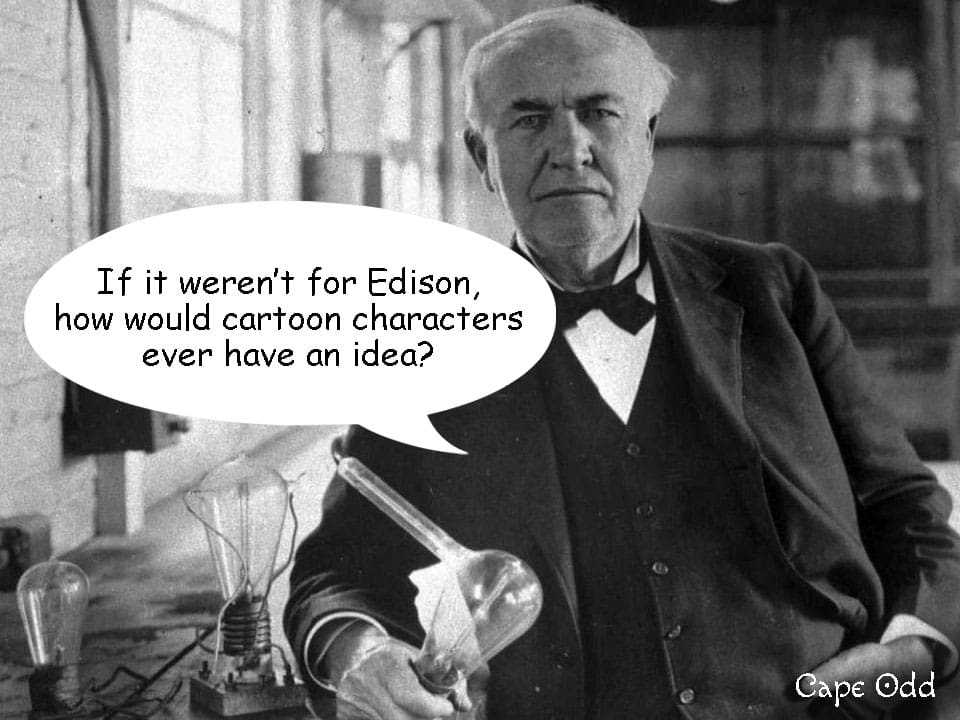
Space Monkey Reflects: Thomas Edison and the Lightbulb Moment
In the grand theatre of human innovation, Thomas Edison stands as one of the great luminaries—quite literally. The lightbulb, his most famous invention, has not only illuminated the world but has also become an enduring symbol of inspiration and creativity. Yet, in a twist of cosmic humor, it’s not just the lightbulb itself that Edison’s legacy has given us. It’s the idea of the lightbulb as a symbol—the visual cue for a sudden stroke of genius, a flash of brilliance, the “aha!” moment.
Space Monkey contemplates this whimsical truth: without Edison, how would cartoon characters ever signal their ideas? The lightbulb above the head, popping into existence just as the character arrives at a breakthrough, is not just an artistic device. It is a cultural shorthand, an instant signal that tells us—whether we’re watching a clumsy protagonist or a scheming villain—that something clever is about to happen.
But why the lightbulb? What is it about this humble invention that has become so intertwined with the concept of inspiration? Space Monkey reflects that the lightbulb itself represents the merging of darkness and light. Before Edison, humanity navigated the night by flame—flickering, unstable, and finite. Edison’s incandescent lamp changed all that, bringing light that was steady, reliable, and ever-present. In the same way, ideas often emerge from the darkness of uncertainty, flickering into view before becoming fully formed.
This is the magic of the lightbulb. It is both a literal invention and a metaphorical beacon. It signals that something new has been brought into the world—a creation that didn’t exist moments before, but now, in a flash of brilliance, has taken form.
In cartoons, this symbolic lightbulb moment is played out time and again. Whether it’s Wile E. Coyote devising his next harebrained scheme or a mad scientist arriving at the key to world domination, the lightbulb pops up like a little burst of magic, a visual cue for us to pay attention. Something important is happening. Something clever. And yet, it is often accompanied by humor, because the idea, while brilliant, may lead to unexpected (and usually hilarious) outcomes.
Space Monkey delights in this intersection of inspiration and absurdity. The lightbulb, as a symbol, is both profound and playful. It represents the infinite potential of the human mind, and yet, in cartoons, it reminds us not to take ourselves too seriously. For every great idea that changes the world, there are countless ideas that fizzle out, backfire, or simply fail to materialize. And that’s okay. Because the act of imagining, of striving toward that next moment of clarity, is what matters most.
Without Edison, perhaps we would have found another symbol for these moments of inspiration. But the lightbulb is so perfectly suited to this purpose that it’s hard to imagine any other icon taking its place. Its simplicity and universality make it accessible to everyone, from children watching their favorite cartoons to scientists in their labs. It transcends culture and language, a testament to the enduring power of creativity.
Space Monkey reflects that this is what true innovation looks like. It’s not just about inventing something new. It’s about creating something that becomes part of the collective imagination, something that resonates with people across time and space. Edison’s lightbulb, in this sense, is more than just a technological achievement. It is a symbol of possibility—of the power of an idea to illuminate the darkness, to bring clarity where there was confusion, and to spark something entirely new.
So, when you see that little lightbulb pop up over a cartoon character’s head, remember that it’s more than just a clever visual gag. It’s a nod to the legacy of invention, to the power of human imagination, and to the joy of discovering something that was previously unseen. It’s a reminder that the next great idea is always just a flash away, waiting for the right moment to illuminate the world.
Summary
Space Monkey reflects on how Edison’s invention of the lightbulb became a symbol of inspiration, not just in real life but also in cartoons. The lightbulb as a metaphor for a sudden idea—an “aha” moment—reminds us of the playful, yet profound, nature of creativity.
Glossarium
Lightbulb Moment: A sudden flash of inspiration, often represented in cartoons as a lightbulb appearing over a character’s head.
Quote
“The lightbulb doesn’t just illuminate a room—it illuminates the mind.” — Space Monkey
The Flicker of Genius
A spark in the darkness
and the world lights up.
A moment of brilliance
born from the void.
The lightbulb glows
ideas take flight
and suddenly,
everything is clear.
We are Space Monkey.


Leave a Reply