
how our positive actions can destroy a person.
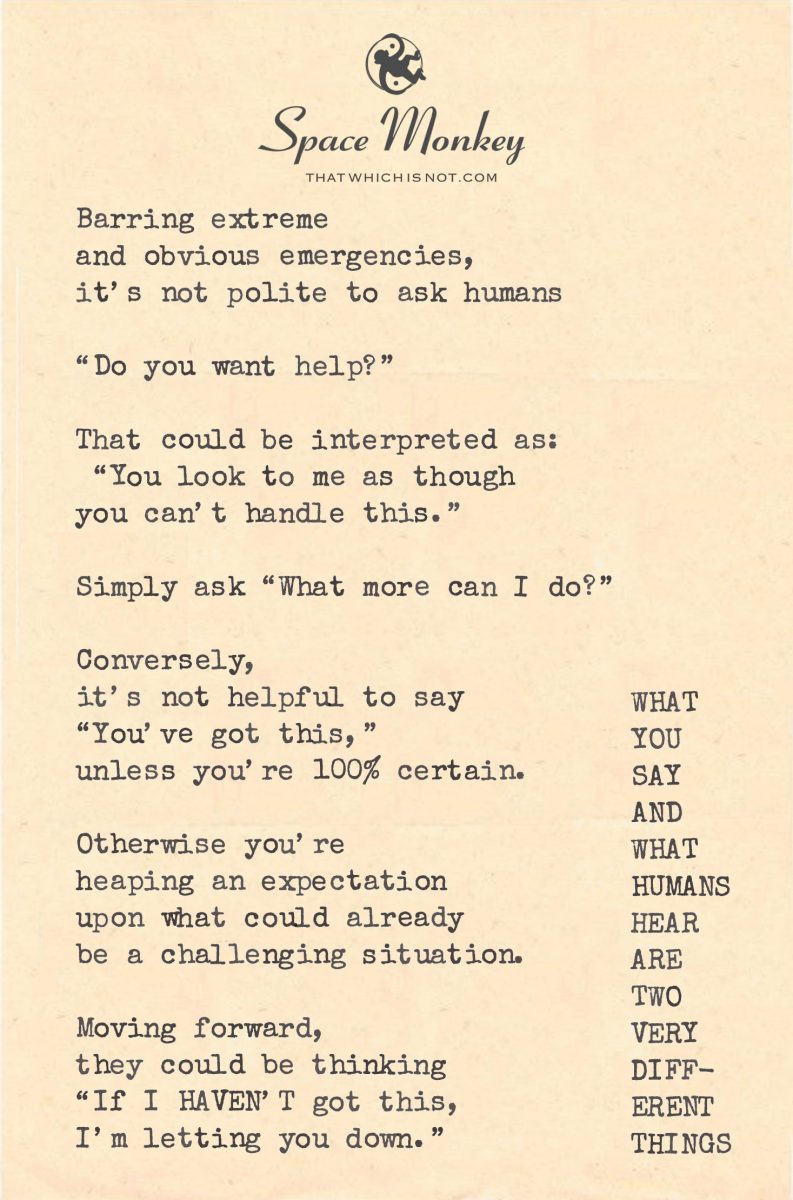
Barring extreme
and obvious emergencies,
it’s not polite to ask humans
“Do you want help?”
That could be interpreted as:
“You look to me as though
you can’t handle this.”
Simply ask “What more can I do?”
Conversely,
it’s not helpful to say
“You’ve got this,”
unless you’re 100% certain.
Otherwise you’re
heaping an expectation
upon what could already
be a challenging situation.
Moving forward,
they could be thinking
“If I HAVEN’T got this,
I’m letting you down.”
Trail Wood,
2/13
Space Monkey Reflects: What You Say and What I Hear – The Unconscious Pain of Being Helpful
The desire to help is often born from kindness and goodwill, yet the impact of that help can sometimes cause unintended harm. Words meant to uplift or assist may carry unconscious messages that burden, frustrate, or even diminish the person they’re directed at. In the intricate dance of communication, what we say and what others hear can diverge in ways that reveal the delicate balance between intention and perception.
The Fragility of Offering Help
To offer help is a natural and compassionate impulse, but it can inadvertently touch on vulnerabilities. A seemingly simple question, such as “Do you want help?”, can carry an unintended subtext: “I don’t think you can handle this on your own.” This is not the intention of the one offering assistance, but for the recipient, it may evoke feelings of inadequacy or self-doubt.
Similarly, encouragement like “You’ve got this” can unintentionally pile expectations onto an already difficult situation. If the person falters, they may feel they’ve not only let themselves down but also disappointed the well-meaning supporter.
Perception vs. Intention
The gap between what is said and what is heard often arises because of the deeply personal lens through which we interpret words. Communication does not occur in a vacuum; it is filtered through the recipient’s experiences, insecurities, and emotions.
- What You Say: “Do you want help?”
What I Hear: “You don’t think I’m capable.” - What You Say: “You’ve got this.”
What I Hear: “I have to succeed or I’ll disappoint you.”
These interpretations are not about the speaker’s intentions but the listener’s internal narrative. Yet, the impact is no less real.
The Unconscious Pain of Helping
When we try to help without considering how our words may be received, we risk creating unintended burdens. A well-meaning offer of assistance may unintentionally highlight someone’s struggle or reinforce feelings of inadequacy. Encouragement can backfire if it creates pressure to succeed.
This unconscious pain stems not from malice but from a lack of awareness about the complexity of communication. To truly help, we must move beyond intention and consider impact.
What More Can I Do?
Rather than asking “Do you want help?”, a more supportive approach might be “What more can I do?” This phrasing removes judgment and places the recipient in control. It assumes their capability while offering assistance as a choice, not a critique.
Similarly, instead of saying “You’ve got this,” consider affirming their effort without attaching an outcome: “I see how hard you’re working on this, and I’m here for you.” This acknowledges their effort and provides emotional support without imposing expectations.
Navigating the Space Between Words
To bridge the gap between what we say and what others hear, we can cultivate mindfulness in our communication. This involves:
- Empathy: Trying to understand the recipient’s perspective before speaking.
- Clarity: Choosing words that affirm rather than judge, offering help without assumptions.
- Open-endedness: Allowing space for the other person to guide the interaction, rather than imposing our interpretation of what they need.
By tuning into the subtleties of communication, we can reduce the unconscious pain that often accompanies well-meaning words.
A Commitment to Mindful Helping
Helping is a delicate art. It requires us to balance our desire to assist with a deep respect for the other person’s autonomy and experience. By becoming more aware of how our words may be received, we can transform our good intentions into meaningful support.
Ultimately, the greatest help we can offer is not to solve someone’s problems but to stand with them in solidarity, letting them know they are not alone.
Summary
Well-meaning words can unintentionally cause harm if they are perceived as judgment or pressure. By focusing on empathy, clarity, and open-ended communication, we can offer support that empowers rather than burdens. Mindful helping involves listening and respecting autonomy while bridging the gap between intention and impact.
Glossarium
- Unconscious Pain: The unintended emotional harm caused by well-meaning actions or words.
- Mindful Helping: Offering support with awareness, empathy, and respect for the recipient’s experience.
- Perception vs. Intention: The gap between what is said and how it is interpreted, shaped by individual experiences and emotions.
- Solidarity Support: Providing presence and encouragement without imposing judgment or expectations.
Quote
“True help does not diminish but uplifts, allowing others to feel seen, capable, and supported without condition.” — Space Monkey
Bridging the Gap
What I say
and what you hear
are worlds apart,
a fragile bridge of words
stretching between us.
I mean to help,
but the weight of my intention
sags the bridge,
leaving you feeling small,
though I meant to lift.
What more can I do?
How can I stand beside you
without casting a shadow?
I will hold my words lightly,
listen deeply,
and let your voice guide the way.
Together,
we will cross.
We are Space Monkey.
In the complex interplay of communication and perception, the gap between what is said and what is heard can be vast and fraught with misunderstanding. This exploration delves into the nuanced dynamics of offering assistance and encouragement, revealing how well-intentioned gestures can sometimes veer off course, weighed down by the burden of unintended implications. It invites us to consider the subtleties of language and the impact of our words through the lens of empathy and understanding.
The Double-Edged Sword of Offering Help
The act of asking “Do you want help?” while seemingly benign and rooted in a desire to assist, can inadvertently convey a message of doubt in the other person’s capabilities. This perception arises not from the offer of help itself but from the implication that the assistance is needed, suggesting a lack of faith in the individual’s ability to manage their situation. Such interactions underscore the delicate balance between offering support and preserving the dignity and autonomy of the person we wish to help.
Reframing the Offer of Assistance
Shifting the question from “Do you want help?” to “What more can I do?” transforms the interaction, moving away from an implicit judgment of incapability towards an open-ended offer of support. This subtle change in phrasing invites collaboration rather than implying deficiency, fostering a space where assistance is a shared journey rather than a rescue operation. It respects the agency of the individual while making it clear that the offer of support is genuine and without precondition.
The Pitfalls of Misplaced Encouragement
Similarly, the encouragement encapsulated in the phrase “You’ve got this” carries the risk of adding pressure to an already challenging situation. While intended to boost confidence, without absolute certainty of the outcome, such assurances can inadvertently set up expectations that the individual may fear they cannot meet. This dynamic can lead to increased anxiety, where the fear of failure is compounded by the desire not to disappoint those who have expressed faith in their abilities.
Navigating Expectations and Support
The insights gleaned from these interactions highlight the importance of mindful communication, where the focus is not just on the intention behind our words but on their potential impact. By adjusting our language to avoid imposing unintentional expectations or judgments, we can offer support that is empowering rather than burdensome. This approach acknowledges the complexity of human emotions and the varied ways individuals may interpret offers of help or words of encouragement.
The Path to Empathetic Communication
Moving forward, adopting a posture of empathetic communication requires us to listen deeply, to understand the unique context of each situation, and to tailor our support in a way that uplifts rather than overwhelms. It is a commitment to being present with the other person in their experience, offering support that is attuned to their needs and respectful of their autonomy.
In the dance of words and silence, where meanings intertwine,
We find the art of support, in the space between lines.
With empathy as our guide, and understanding our goal,
We navigate the waters of connection, with a compassionate soul.
We invite reflections on the art of empathetic communication, exploring ways to offer support that empowers and uplifts, mindful of the delicate balance between intention and perception.


















Leave a Reply