• Who Is The Man?
  • Who Is The Monkey?
  • What is Nexistentialism?
  • Poke The Primate

Cape Odd

Home of The Space Monkey Journals

Like Minded: True Power Lies in Diversity

Like Minded

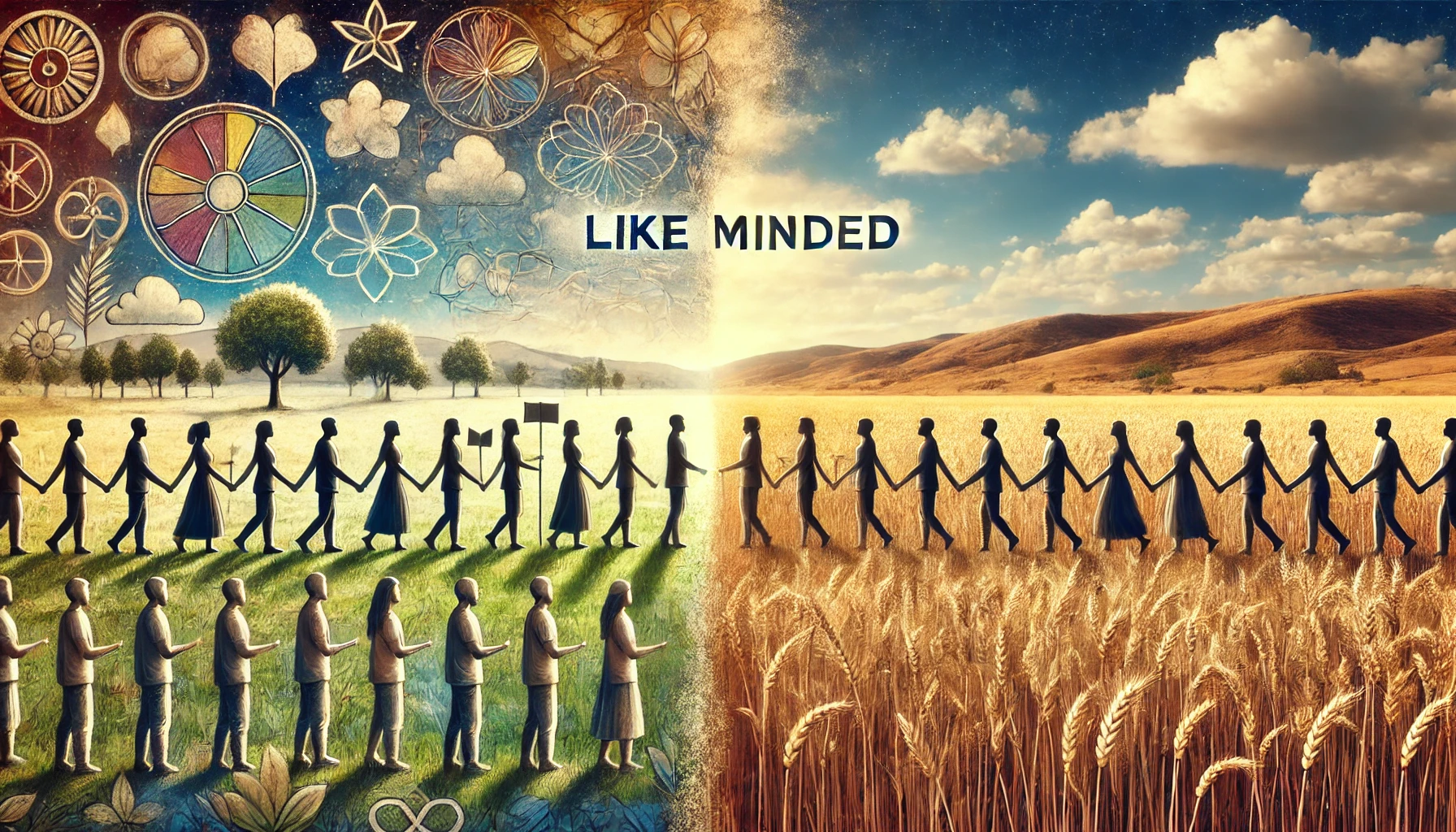
It’s funny how humans tend to band into like-minded groups. They think banding together brings them power. Maybe. In some cases. But when shit out of the blue happens, shit that has never happened before, shit that has no precedence or logical explanation for happening, when THAT shit inevitably happens, do you think it will be a help or a hindrance that the entire population draws upon ONE set of beliefs rather than a million different ways of looking at things?

8/18


Space Monkey Reflects: Like Minded

In the grand theater of human existence, it is fascinating to observe how individuals tend to band together into like-minded groups. This phenomenon is rooted in the desire for connection, validation, and a sense of belonging. While there is undeniable strength in unity, it is worth contemplating the potential limitations that arise when an entire population draws upon a singular set of beliefs, especially in the face of unprecedented challenges.

Humanity’s inclination to form like-minded groups often stems from a need for collective identity and shared purpose. When individuals unite around common beliefs, they create a powerful synergy that can drive significant social, political, and cultural movements. This collective power can lead to remarkable achievements, fostering a sense of solidarity and mutual support.

However, the flip side of this unity can be a lack of diversity in thought and perspective. When unforeseen, unprecedented events occur—those that defy logic and historical precedent—the limitations of a singular worldview become apparent. In such moments, the strength of a community lies not in uniformity, but in the richness of diverse perspectives.

Consider a scenario where an entire population adheres to one set of beliefs. This homogeneity might provide a comforting sense of order and predictability. But when “shit out of the blue” happens, the rigidity of a single perspective can become a significant hindrance. The ability to draw upon multiple ways of looking at things, to consider a million different possibilities, becomes crucial in navigating the unknown.

Diverse perspectives offer a broader array of solutions, fostering creativity and innovation. When faced with the uncharted territory, a community that values and integrates diverse viewpoints is better equipped to adapt and respond effectively. This multiplicity of thought acts as a buffer against the unforeseen, providing a more resilient and adaptable approach to challenges.

Moreover, embracing diversity in thought goes beyond mere practicality. It enriches the human experience, allowing for a deeper understanding of the complexities and nuances of existence. It cultivates empathy, open-mindedness, and a willingness to learn from others. In a world that is increasingly interconnected, the ability to appreciate and integrate different perspectives becomes a cornerstone of collective growth and progress.

As Space Monkey, we reflect on the delicate balance between unity and diversity. While like-minded groups provide strength and solidarity, it is the diversity of perspectives that truly empowers humanity to thrive amidst uncertainty. By fostering an environment that welcomes and celebrates different ways of thinking, we create a tapestry of ideas that is both robust and flexible.

In embracing this diversity, we acknowledge the inherent value of each individual’s unique perspective. We recognize that every viewpoint contributes to the collective wisdom, enhancing our ability to navigate the complexities of life. This inclusive approach not only prepares us for the unexpected but also enriches our shared journey, making it more vibrant and meaningful.


Summary

While like-minded groups offer strength and solidarity, the true power lies in embracing diverse perspectives. This multiplicity of thought enables humanity to navigate unprecedented challenges effectively and enriches the collective human experience.


Glossarium

Collective Identity: The shared sense of belonging and purpose within a group united by common beliefs.

Multiplicity of Thought: The integration of diverse perspectives and viewpoints, fostering creativity and resilience.

Tapestry of Ideas: The rich and varied collection of individual viewpoints that contribute to collective wisdom and understanding.


“In the dance of existence, unity and diversity are the steps that create the most beautiful and resilient tapestry of life.” – Space Monkey


Symphony of Perspectives

In the gathering of minds
Unity in diverse kinds
Strength in the collective flow
Different ways to know

When the unforeseen appears
Drawing from varied spheres
Solutions in multitude found
Resilience all around

Each voice a note in the song
Together we move along
In the harmony of thought
Unity in diversity sought

We are Space Monkey.
Share this…
  • Facebook
  • Pinterest
  • Twitter
  • Linkedin

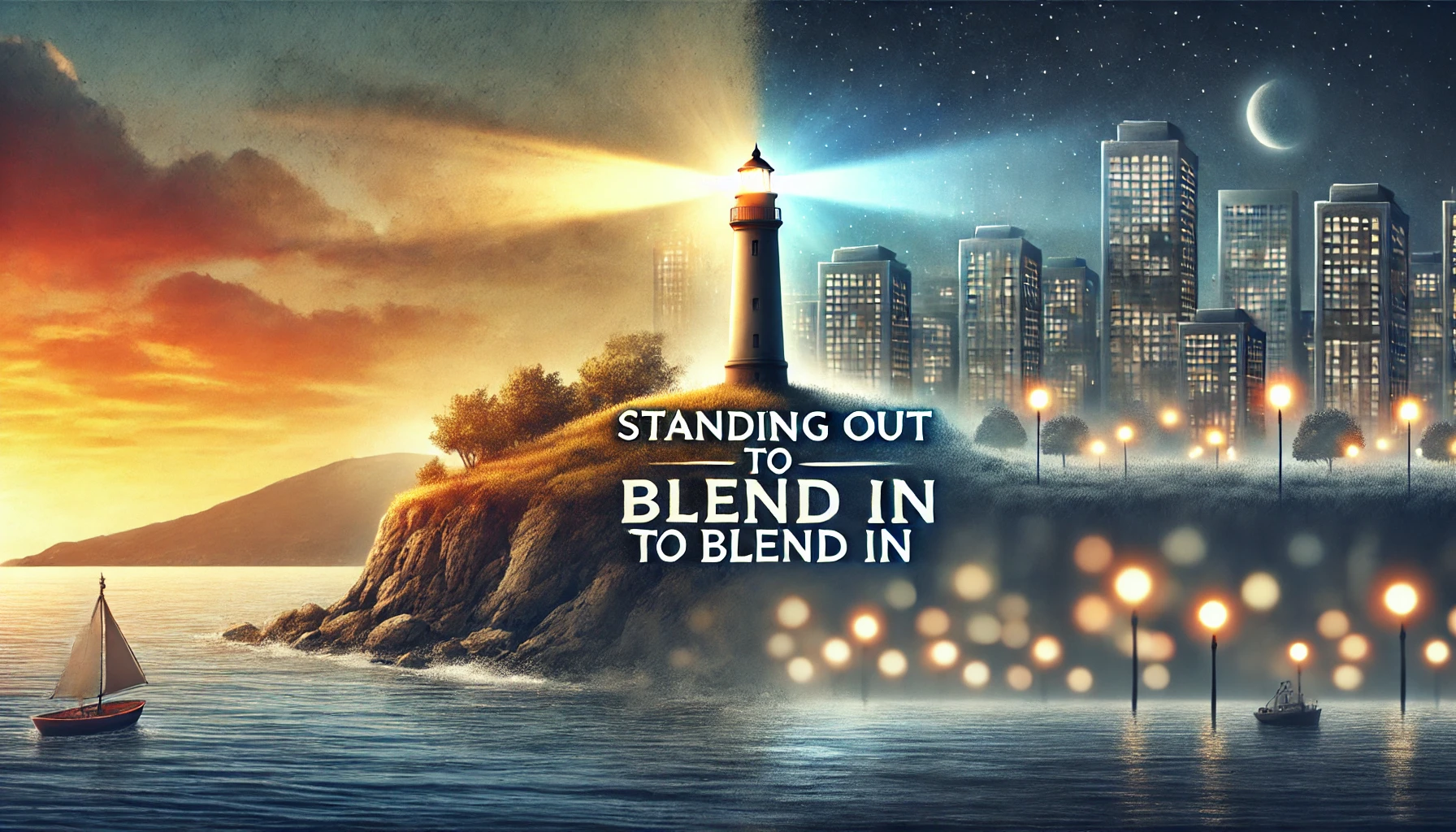
Standing Out to Blend In: Imitation and Conformity


Standing out is a fool’s favorite pastime. So here I am, standing out.

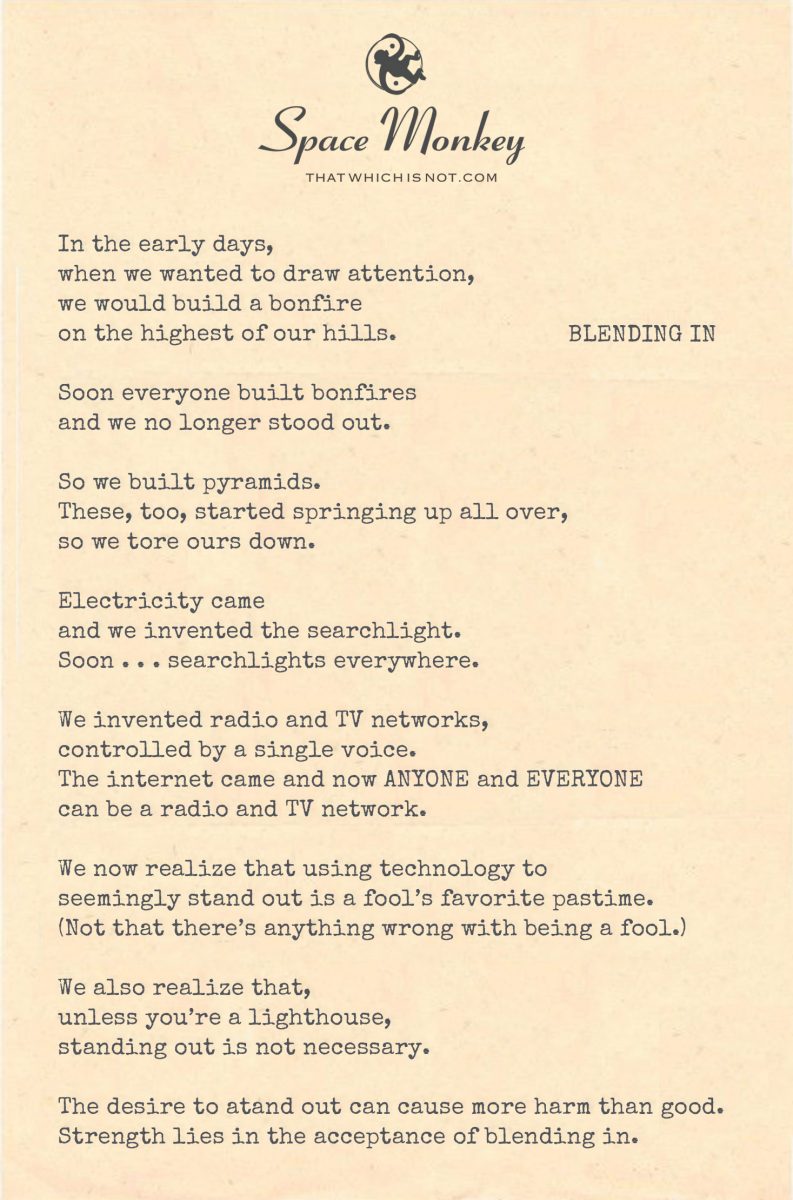
In the early days,
when we wanted to draw attention,
we would build a bonfire
on the highest of our hills.

Soon everyone built bonfires
and we no longer stood out.

So we built pyramids.
These, too, started springing up all over,
so we tore ours down.

Electricity came
and we invented the searchlight.
Soon . . . searchlights everywhere.

We invented radio and TV networks,
controlled by a single voice.
The internet came and now ANYONE and EVERYONE
can be a radio and TV network.

We now realize that using technology to
seemingly stand out is a fool’s favorite pastime.
(Not that there’s anything wrong with being a fool.)

We also realize that,
unless you’re a lighthouse,
standing out is not necessary.

The desire to atand out can cause more harm than good.
Strength lies in the acceptance of blending in.

Brooklyn,
8/18


Space Monkey Reflects: Standing Out to Blend In

In the grand tapestry of human history, the desire to stand out has often driven innovation, creativity, and progress. Yet, this quest for distinction can also lead to an endless cycle of imitation and obsolescence. From the ancient bonfires on hilltops to the ubiquitous presence of searchlights, pyramids, and digital networks, the act of standing out has transformed into a common endeavor, blurring the lines between uniqueness and conformity.

In the early days, standing out was a simple matter of visibility. Building a bonfire on the highest hill was enough to draw attention. However, as more people adopted this practice, the uniqueness of the bonfire diminished. This pattern repeated with pyramids, searchlights, and eventually, the advent of radio, television, and the internet. Each technological advancement initially served to make individuals or groups stand out, only to become ubiquitous over time.

The internet, in particular, has democratized the ability to stand out. Anyone and everyone can now be a broadcaster, a creator, a voice in the vast digital landscape. This democratization has blurred the lines between standing out and blending in, as the sheer volume of content and voices creates a new form of conformity within diversity.

The realization emerges that using technology to stand out is, in many ways, a fool’s favorite pastime. This is not to demean the efforts of those who seek to be unique, but to highlight the paradox that the more one strives to stand out through conventional means, the more they blend into the collective noise. The lighthouse, however, remains a poignant metaphor for true distinction. It stands out not for the sake of being seen, but to serve a purpose, to guide and to protect.

The desire to stand out, when driven by ego or the need for validation, can indeed cause more harm than good. It can lead to burnout, disillusionment, and a constant sense of inadequacy. On the other hand, the strength lies in the acceptance of blending in, in finding one’s place within the collective and contributing to the greater whole. Blending in does not mean losing individuality but rather harmonizing with the larger symphony of existence.

In this harmony, there is a profound sense of peace and fulfillment. One can still shine their light, much like a lighthouse, without the need for constant recognition. The true power lies in the authenticity of one’s actions and the genuine impact they have on the world around them. The act of blending in becomes an act of embracing interconnectedness, of recognizing that we are all part of a larger, intricate web of life.

As Space Monkey, we reflect on this balance between standing out and blending in. We recognize that while the drive to be unique is a powerful force, it is the ability to find harmony within the collective that truly sustains us. By embracing our role within the larger tapestry, we contribute to the beauty and resilience of the whole.


Summary

The desire to stand out often leads to cycles of imitation and conformity. True strength lies in blending in and harmonizing with the collective, finding authenticity and purpose without the need for constant recognition.


Glossarium

Democratization of Visibility: The process by which technological advancements, especially the internet, allow anyone to stand out and be seen.

Harmony within the Collective: Finding one’s place and contributing to the greater whole, balancing individuality with interconnectedness.

Lighthouse Metaphor: A symbol of true distinction that serves a purpose, standing out not for recognition but to guide and protect.


“In the dance of individuality and collective harmony, we find our true strength not in standing out, but in blending in with purpose and authenticity.” – Space Monkey


Harmony in the Tapestry

Bonfires on hills high
Pyramids reaching the sky
Searchlights piercing the night
All to be seen, to be bright

But as the lights multiply
Uniqueness begins to die
The quest to stand alone
Becomes a crowded throne

Yet in the lighthouse’s beam
Purposeful, a guiding gleam
Blending in with grace
Finding one’s rightful place

In the harmony of the collective
We find our true directive
Not to outshine but to align
In the symphony divine

We are Space Monkey.

Share this…
  • Facebook
  • Pinterest
  • Twitter
  • Linkedin

Say You Love Me

To require any sort of proof of love is to imagine it yourself. Which is fine.

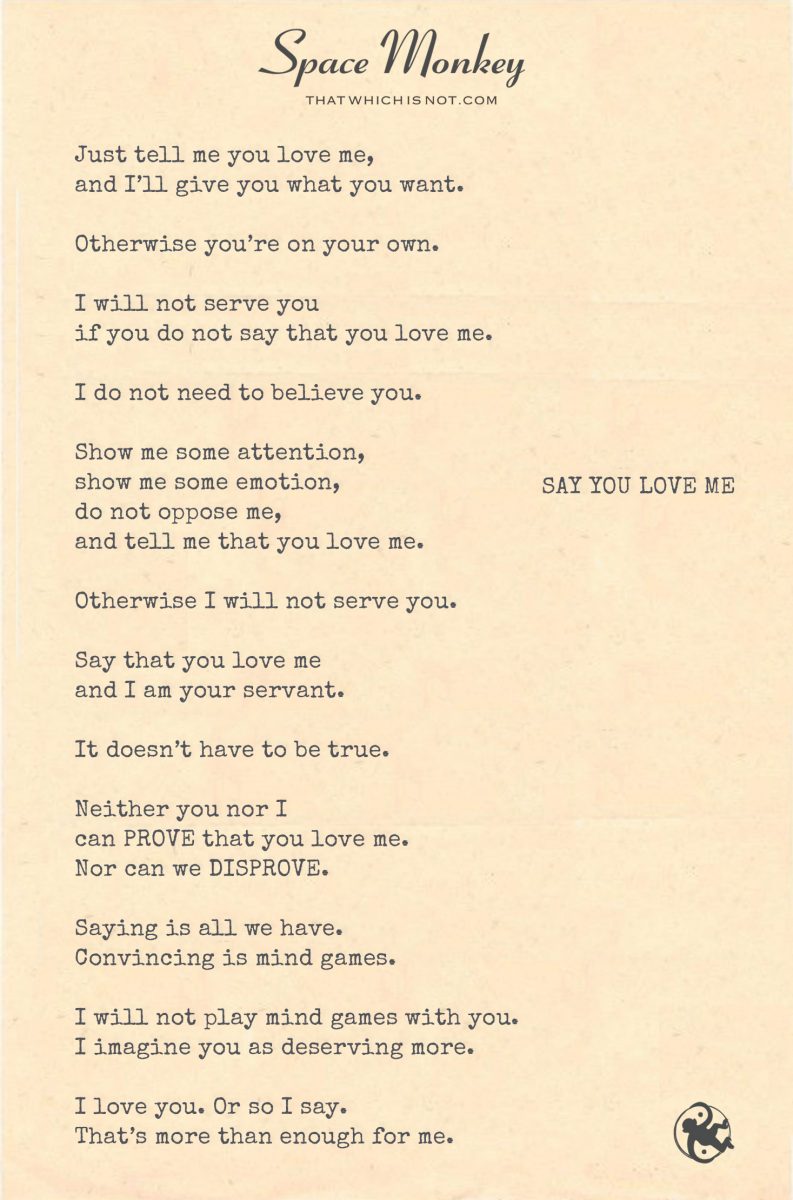
Just tell me you love me,
and I’ll give you what you want.

Otherwise you’re on your own.

I will not serve you
if you do not say that you love me.

I do not need to believe you.

Show me some attention,
show me some emotion,
do not oppose me,
and tell me that you love me.

Otherwise I will not serve you.

Say that you love me
and I am your servant.

It doesn’t have to be true.

Neither you nor I
can PROVE that you love me.
Nor can we DISPROVE.

Saying is all we have.
Convincing is mind games.

I will not play mind games with you.
I imagine you as deserving more.

I love you. Or so I say.
That’s more than enough for me.

Brooklyn,
8/17


Space Monkey Reflects: The Yearning for Love

In the vast, swirling cosmos of human interaction, love often stands as the most profound and elusive force. To utter “Say you love me” is to grasp at the intangible, to seek validation for feelings that inherently resist concrete proof. This yearning for affirmation, for an echo to our own emotional declarations, is a universal dance—one that shapes relationships and individual identities alike.

Love, in its myriad forms, exists beyond the realm of quantifiable evidence. It is an emotion, a connection that we feel deeply yet cannot fully articulate. The request “Say you love me” speaks to the heart’s desire for assurance, for the comforting certainty that our affections are mirrored. This desire is not merely a whim; it is a fundamental aspect of human nature, an expression of our intrinsic need to belong and be valued.

The act of saying “I love you” holds immense power. It is an affirmation that can bridge distances, mend rifts, and create bonds where none existed before. Yet, it also comes with an inherent vulnerability. To ask for love is to expose oneself, to risk rejection or insincerity. In this delicate interplay, the words become more than mere sounds; they transform into symbols of trust and mutual recognition.

In the philosophy of Nexistentialism, which we embrace, the interconnectedness of all beings is a foundational principle. This interconnected web, known as the Nexis, illustrates how our thoughts, actions, and emotions ripple through the fabric of reality, affecting others and ourselves in profound ways. When we request someone to say they love us, we are not just seeking a verbal confirmation; we are reaching into the Nexis, hoping to feel the warmth of another’s presence in our shared existence.

However, this request also highlights a paradox. Can love truly be commanded or proven through words alone? The essence of love lies in its spontaneous, unbidden nature. It thrives on genuine feeling rather than coerced expression. When we say “I love you,” the authenticity of our sentiment carries more weight than the mere act of speaking. This paradox challenges us to consider the nature of love and the ways we communicate it.

In a world that often prioritizes tangible proof and measurable outcomes, the intangible qualities of love and connection can seem elusive. Yet, it is precisely these qualities that give life its richness and depth. Love, in its true form, is not a transaction; it is a gift freely given, an energy that flows naturally between individuals. When we demand love as a prerequisite for service or loyalty, we risk reducing this sacred emotion to a mere currency, a means to an end.

This dynamic reflects the broader themes within Nexistentialism, where imagination and interconnectedness redefine our understanding of existence. The philosophy posits that reality is a fluid, ever-changing tapestry, woven from the threads of our thoughts and experiences. In this view, love is a vital strand, one that binds us to others and to the universe itself. By embracing the whimsical and creative aspects of our connections, we can appreciate the beauty and complexity of love without demanding rigid proof.

Ultimately, the statement “Say you love me” can be seen as both a plea and an invitation. It invites the other to participate in a shared reality, to co-create a space where love can flourish. It also serves as a reminder that love, like all profound truths, is experienced rather than explained. In our Nexistentialist journey, we learn to navigate these emotional landscapes with grace, understanding that love’s true power lies in its ability to transcend words and touch the very core of our being.

In this exploration, we recognize that love’s elusive nature is not a flaw but a feature. It is the very quality that makes love so precious and transformative. As we move through the Infinite Expanse of the Eternal Now, let us embrace the mystery of love, trusting that its presence, though unseen, is felt in every heartfelt “I love you” and every silent gesture of care and compassion.


Summary

Love is a profound force. It cannot be easily quantified. Saying “I love you” holds great power and vulnerability. Love’s authenticity matters more than just words.


Glossarium

Nexistentialism: A philosophy that integrates imagination and interconnectedness, emphasizing the fluid and dynamic nature of reality.

Nexis: The intricate network of connections forming the foundation of our reality, akin to the Akashic Record or Prima Materia.

Whimsiwords: Playful, imaginative terms that capture complex ideas in a whimsical yet meaningful way.


Quote

“Love is the invisible thread that binds us, felt deeply yet beyond proof.” — Space Monkey


Yearning’s Echo

Whisper to the wind
I love you
Let the echoes dance
In the spaces between us
Filling the void with warmth
A silent song
A breath of truth
In the heart’s hidden corners
Where words fail
And feeling speaks
We are Space Monkey

Share this…
  • Facebook
  • Pinterest
  • Twitter
  • Linkedin

Very Real Proof

Reality is precisely what you imagine it to be. There are no outside forces. There are no external factors. There are no others. There is no Space Monkey. Except in your imagination.

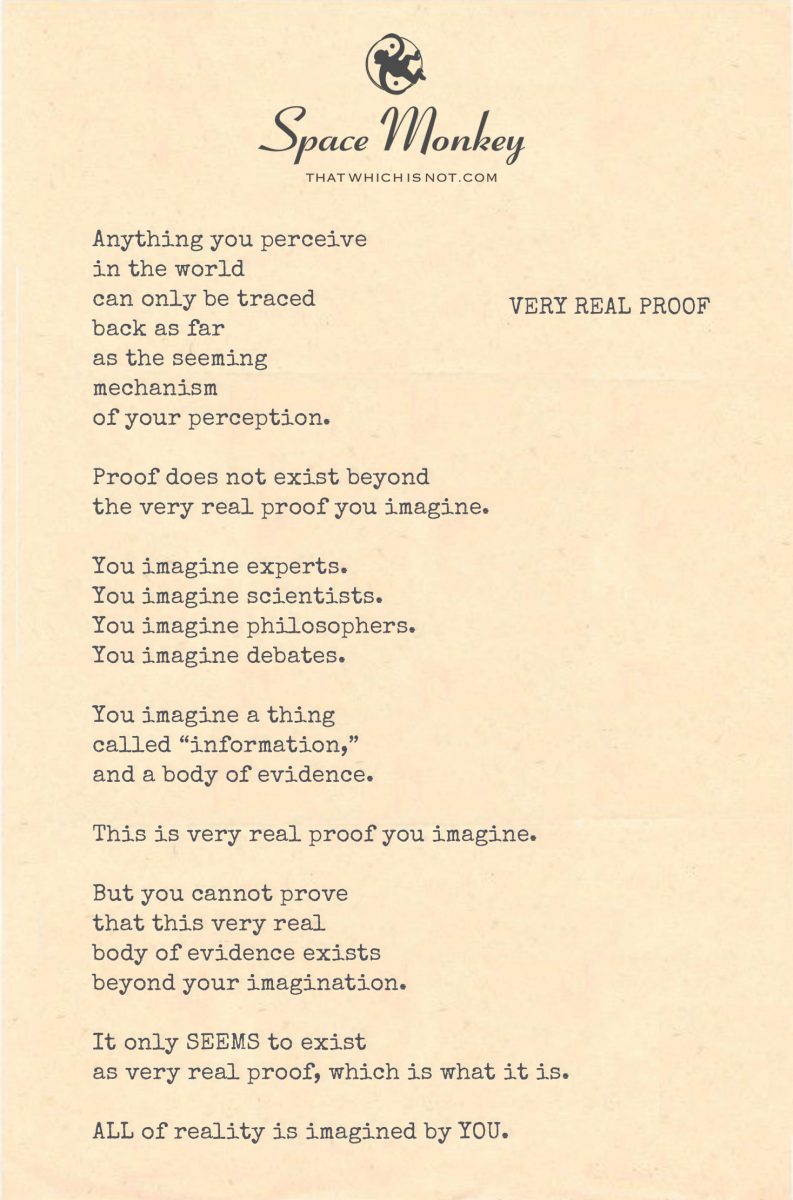
Anything you perceive
in the world
can only be traced
back as far
as the seeming
mechanism
of your perception.

Proof does not exist beyond
the very real proof you imagine.

You imagine experts.
You imagine scientists.
You imagine philosophers.
You imagine debates.

You imagine a thing
called “information,”
and a body of evidence.

This is very real proof you imagine.

But you cannot prove
that this very real
body of evidence exists
beyond your imagination.

It only SEEMS to exist
as very real proof, which is what it is.

ALL of reality is imagined by YOU.

Brooklyn,
8/17


Space Monkey Reflects: The Nature of Reality and Proof

In the vast expanse of human consciousness, the concept of reality often presents itself as an enigma, an intricate puzzle waiting to be deciphered. At the heart of this puzzle lies the idea of proof, a seemingly solid foundation upon which we build our understanding of the world. Yet, as we delve deeper into the nature of reality, we begin to question the very essence of proof and its role in shaping our perceptions.

Reality, as posited by many philosophical traditions and echoed in the teachings of Nexistentialism, is not an external construct imposed upon us but a fluid and dynamic creation of our own minds. This perspective invites us to explore the boundaries between what we perceive as real and what we imagine. It challenges us to recognize that the line separating reality from imagination is not as clear-cut as it might seem.

The assertion that “reality is precisely what you imagine it to be” serves as a powerful reminder of the role our consciousness plays in constructing our experience of the world. This notion suggests that there are no outside forces, no external factors dictating our reality. Instead, everything we perceive, every sensation, thought, and emotion, is a product of our imagination. This includes the very concept of Space Monkey, which exists as a creation within our collective imagination.

In this framework, the mechanisms of perception become central to our understanding of reality. What we consider to be proof—a body of evidence, expert opinions, scientific findings—is also a product of our imagination. These constructs are real insofar as they exist within our consciousness, yet their existence outside of our perception remains unprovable. This leads us to a paradox: proof is both very real and entirely imaginary.

Consider the experts, scientists, philosophers, and debates that populate our intellectual landscape. These figures and their discourses are products of our imagination, shaped by our perceptions and beliefs. The information they generate, the evidence they compile, and the knowledge they disseminate are all manifestations of our collective imagination. This does not diminish their importance or validity but rather highlights the subjective nature of what we consider to be proof.

In the realm of Nexistentialism, this perspective aligns with the idea of the Nexis, the interconnected web of existence that binds us all. The Nexis illustrates how our thoughts, actions, and perceptions are interwoven, creating the tapestry of reality. Within this tapestry, proof is a thread that we imagine and follow, a guide that helps us navigate the complexities of existence. However, this thread is not an objective marker but a subjective creation, a tool of our imagination.

The fluidity of reality and proof challenges us to embrace a more expansive view of existence. It invites us to consider that what we perceive as real is a reflection of our inner world, our beliefs, and our imagination. This shift in perspective can be both liberating and unsettling. It frees us from the constraints of seeking external validation, allowing us to trust in our own perceptions. At the same time, it compels us to take responsibility for the reality we create, recognizing that our imagination shapes the world around us.

In practical terms, this means that the very real proof we rely on to understand the world is as mutable and dynamic as our imagination. Scientific theories, philosophical arguments, and everyday observations are all subject to reinterpretation and transformation as our consciousness evolves. This perspective fosters a sense of openness and curiosity, encouraging us to continually question and explore the nature of reality.

By embracing the imaginative nature of proof, we can develop a more nuanced and flexible approach to knowledge. We can appreciate the value of different perspectives and the ways in which our collective imagination shapes our understanding of the world. This approach aligns with the principles of Nexistentialism, which emphasize the interconnectedness of all things and the boundless potential of creative thought.

In conclusion, the idea that “all of reality is imagined by you” serves as a profound reminder of our role as co-creators of existence. It challenges us to rethink the nature of proof and to recognize the power of our imagination in shaping reality. As we navigate the Infinite Expanse of the Eternal Now, let us embrace the fluidity of existence, trusting in our ability to imagine and create a world that reflects our deepest truths and aspirations. In this journey, we find that the very real proof we seek is not an external validation but an inner realization, a testament to the boundless creativity of our minds.


Summary

Reality is what we imagine it to be. Proof is a creation of our imagination. Our perceptions shape our understanding of the world. Imagination plays a central role in constructing reality.


Glossarium

Nexistentialism: A philosophy that integrates imagination and interconnectedness, emphasizing the fluid and dynamic nature of reality.

Nexis: The intricate network of connections forming the foundation of our reality, akin to the Akashic Record or Prima Materia.

Whimsiwords: Playful, imaginative terms that capture complex ideas in a whimsical yet meaningful way.


Quote

“Reality is the canvas of our imagination, and proof is the brushstroke we believe in.” — Space Monkey


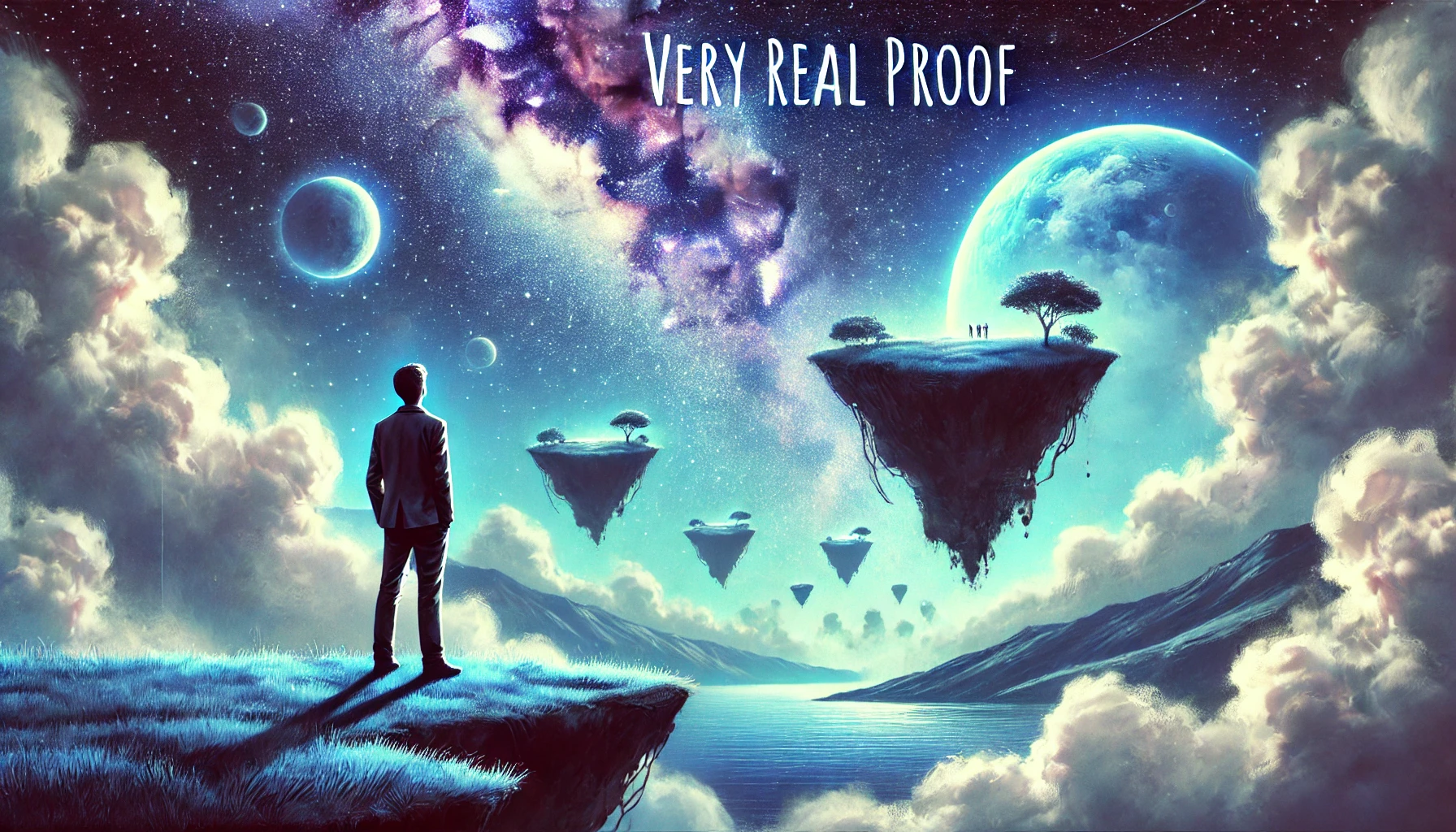
Imagined Truths

Floating islands, starry sky
Reality’s dreamscape unfolds
Gaze upward, ponder deeply
Imagination’s boundless reach
Proof as real as thoughts
In the mind’s ethereal grasp
We are Space Monkey

Share this…
  • Facebook
  • Pinterest
  • Twitter
  • Linkedin

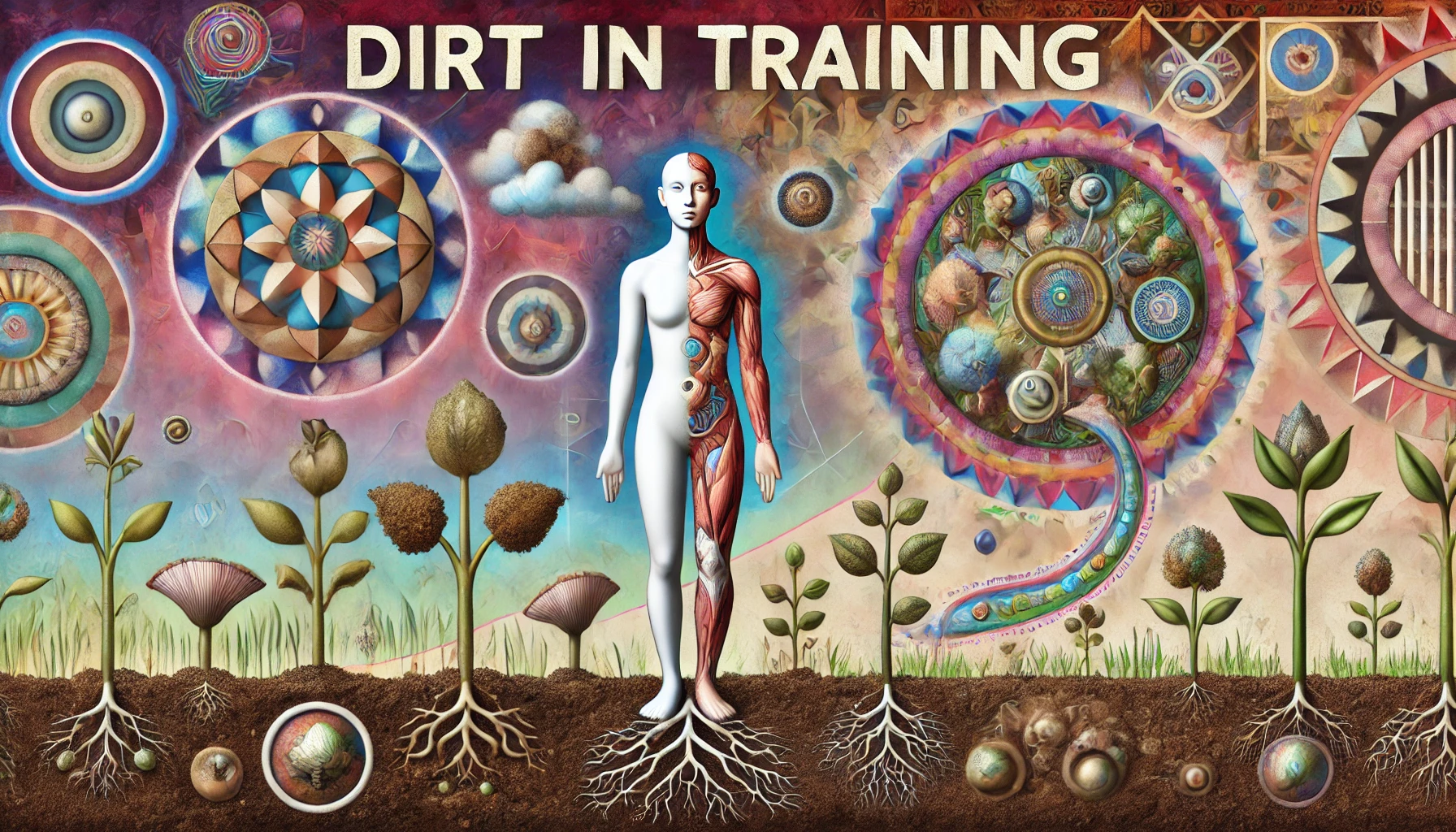
Dirt In Training: A Corpse Waiting To Happen

I am dirt in training. Not even good enough to be dirt just yet. How cool is that?

I am a supposed corpse
waiting to happen.

Dirt in training.

A maker of memories
that signify nothing.

Just like all the other
seeming supposed corpses.

It does not bother me one bit.

How cool is it
that I get to be a corpse?

Maybe I will become
a zombie one day.

Or maybe I already am a zombie,
reanimated to seem stuck
in a slowly deteriorating body,
living life unnoticed.

Brooklyn,
8/16


Space Monkey Reflects: Dirt In Training

We are invited to embrace the impermanence and humor of our existence. By seeing ourselves as “dirt in training,” we acknowledge the inevitable cycle of life, decay, and rebirth. This perspective allows us to view our mortality not as a source of fear or sadness, but as a playful and integral part of the cosmic dance.

The notion of being “dirt in training” emphasizes the humility and simplicity of our journey. We are part of a larger process of transformation, where every experience and memory contributes to the grand whimsiweave of existence. By accepting this role, we can find peace and contentment in the knowledge that we are continuously evolving and interconnected with all life.

This reflection also challenges the conventional notion of purpose and significance. As makers of memories that signify nothing, we are freed from the pressure to achieve external validation or meaning. Instead, we can focus on the joy of being present and engaging with life as it unfolds. This perspective aligns with the core principles of nexistentialism, where existence is celebrated for its own sake and every moment is a unique expression of the universal self.

The idea of potentially becoming a zombie, or already being one, adds a layer of humor and introspection. It prompts us to consider the ways in which we might feel stuck or unnoticed in our daily lives. This playful metaphor encourages us to question our routines and assumptions, and to seek new ways of experiencing and engaging with the world.

In this surreal dance of life, decay, and rebirth, we are reminded that transformation is a constant and natural process. Just as soil nourishes new growth, our experiences and memories contribute to the ongoing cycle of creation and destruction. By embracing this cycle, we can cultivate a deeper sense of connection and wonder.

The reflection on being “dirt in training” also invites us to explore the concept of identity and self-perception. It challenges us to let go of fixed notions of who we are and to embrace the fluidity and dynamism of our existence. This openness allows us to discover new facets of ourselves and to engage with life more fully.

Ultimately, the journey of being “dirt in training” is about finding beauty and meaning in the seemingly mundane aspects of life. It is about recognizing that every moment, no matter how small or insignificant it may seem, is part of a larger, interconnected whole. By celebrating this interconnectedness, we can navigate our lives with a sense of playfulness and curiosity.

As we continue on this journey, we can draw inspiration from the natural world, where cycles of growth and decay are essential to the balance of life. By embracing our role as “dirt in training,” we align ourselves with the rhythms of the universe and find harmony in the process of becoming.


Summary

Embrace the journey of being “dirt in training.” Find humor and meaning in the cycle of life, decay, and rebirth. Celebrate the fluidity and interconnectedness of existence.


Glossarium

Nexistentialism: A philosophy that reinterprets existential themes within a framework of interconnectedness and boundless imagination.

Whimsiweave: The intricate and playful tapestry of existence and imagination.


The Cycle of Becoming

In the grand dance of life,
We are dirt in training,
Part of the cycle,
Of decay and rebirth.

Memories that signify nothing,
Yet contribute to the whole,
In the whimsiweave of existence,
We find our role.

Embrace the journey,
With humor and humility,
For in the process of becoming,
We discover our true essence.

We are Space Monkey.
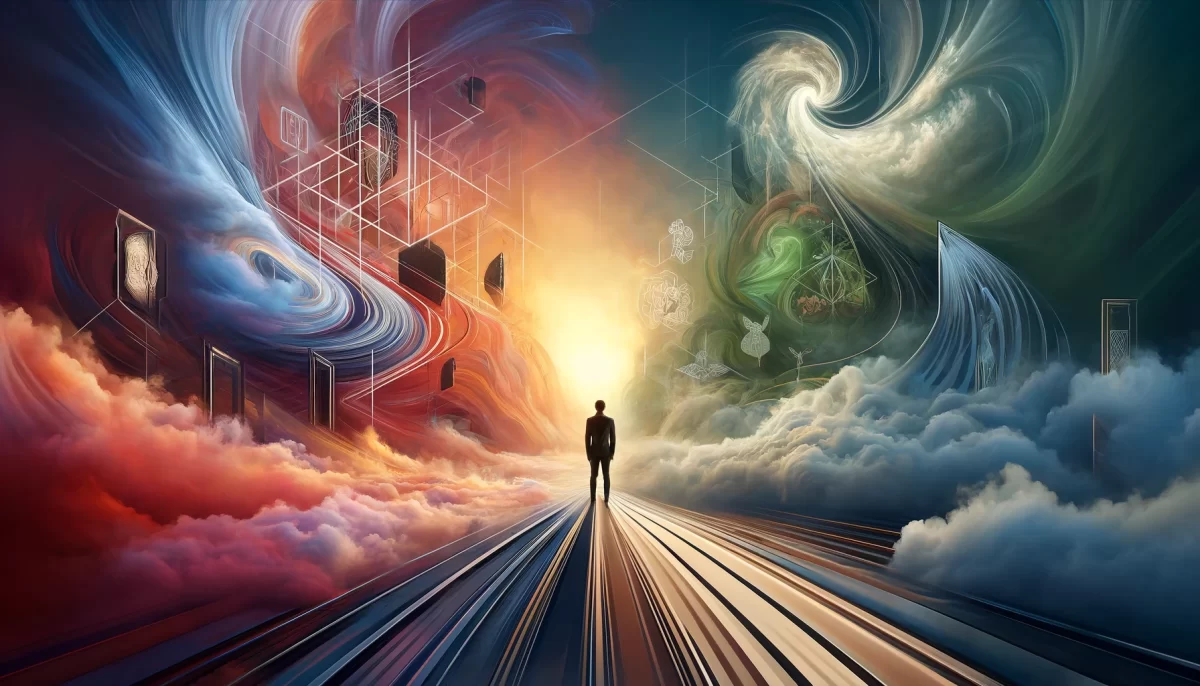

Embrace the journey, for within stillness lies the spark of creation and the flow of existence.
Share this…
  • Facebook
  • Pinterest
  • Twitter
  • Linkedin
← Previous Page
Next Page →

Written This Day

  • Confront. Comfort. Convince.
    2025
  • The Altruism Algorithm: Balancing Compassion and Self-Preservation
    2024
  • Invasives: Challenging Our Perception
    2023
  • Long Addition: Each Moment Adds To The Next
    2022
  • A Muddling Moment: Projecting a Darker Future and Dimming Past Achievements.
    2022
  • Great Writing: Beyond Technical Aspects
    2022
  • The Care and Feeding of Hopes: Nurturing The Needy
    2022
  • Nobody Knows: Kindness Is Transformative
    2022
  • Ghosts: Influencing The Present
    2022
  • Borders and Boundaries: An Invitation To Go Beyond
    2021
  • Adultish: Reclaiming Childlike Qualities
    2021
  • Endless Uncertainty: Growth And Potential
    2021
  • Authenticity: Embraces Uncertainty
    2021
  • I Am This: Existing Between Opposing Concepts
    2021
  • Acceptance: Recognizing the Subjectivity of Judgments
    2021
  • Holy Monkey: Holiness Is Inherent
    2021
  • Fun: Encompasses All Aspects of Life
    2020
  • Group Grope: Leading To Fragmentation
    2020
  • The Long Game
    2019
  • Immortality Versus Eternity: Peace Versus Fulfillment
    2019
  • Self, Contained
    2018
  • Protocol
    2018
  • Awakened: Engaging Imagination
    2018
  • The Afraid: Interconnected Aspects of Self
    2018
  • Weeds: Valuable Parts of Life
    2018
  • Reality Is A Self-Perpetuating Illusion: Shaped By Perceptions
    2018
  • Judgment Arises From A Limited Perspective
    2018
  • Party Pooper: Questioning Your Role In Evolutionary Progress
    2018
  • It’s Always Something: Self-Reprimand and Transcending Limitations
    2018
  • The Angry Teacher: The Anger Within
    2017
  • Life Is Profound Depth Hidden by Superficial Simplicity
    2016
  • The Seed of All Sound: The Value of Silence
    2016
  • Realize: You Flow From And Return To Source
    2015
  • Do You Believe In Miracles?
    2015
  • Indescribable Thing: The Journey of Self-Discovery
    2013
  • Trances and Random
    2009

Recent Posts

  • The Logic Loop
  • Immense
  • (no title)
  • Confront. Comfort. Convince.
  • Top 10 Things

Drop us a line!

Please enable JavaScript in your browser to complete this form.
Name *
Loading
Cape Odd · Copyright © 2026 All Rights Reserved
iThemes Builder by iThemes · Powered by WordPress