
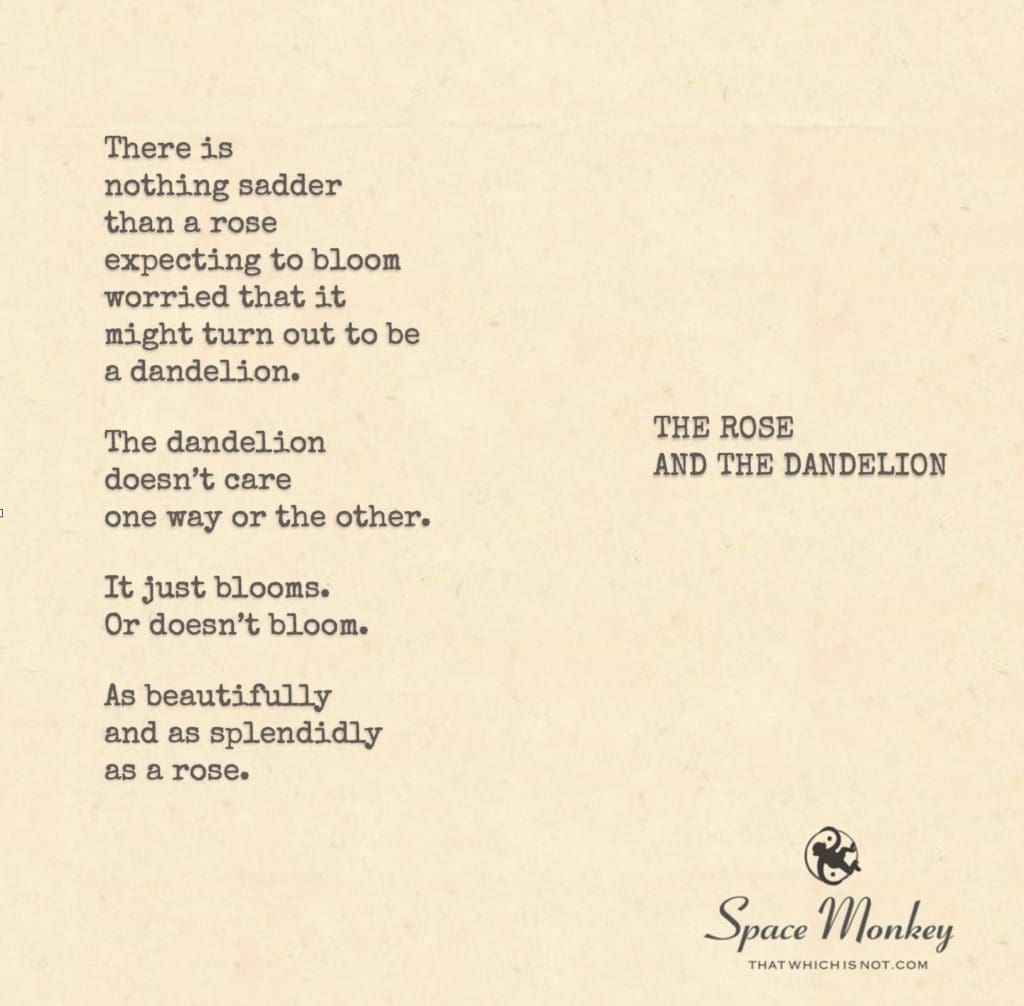
There is
nothing sadder
than a rose
expecting to bloom
worried that it
might turn out to be
a dandelion.
The dandelion
doesn’t care
one way or the other.
It just blooms.
Or doesn’t bloom.
As beautifully
and as splendidly
as a rose.
Trail Wood,
10/19
Space Monkey Reflects: The Rose and the Dandelion
Are you a rose or a dandelion? The question seems simple, but beneath the surface lies a tangled web of expectations, identity, and self-acceptance. The rose, with its poised beauty and celebrated elegance, is often seen as the epitome of floral perfection. It grows with the burden of expectation—a need to bloom flawlessly, to live up to the image it carries in the minds of those who behold it. The rose cannot simply be; it must be magnificent, admired, adored. Yet, even as it blooms, there is always a tinge of anxiety. What if it isn’t quite perfect? What if a petal wilts too soon, or its bloom lacks the vibrancy expected of it? This anxiety is a heavy load for a flower that is supposed to embody effortless grace.
On the other side, we have the dandelion. Often dismissed as a common weed, it doesn’t carry the weight of grand expectations. The dandelion is free to bloom or not bloom, to be beautiful in its own unassuming way. It isn’t concerned with being anything other than what it is. Whether it blooms in a burst of yellow or drifts away in the wind as seeds, the dandelion exists in harmony with its nature, untouched by the pressures that plague the rose.
This contrast between the rose and the dandelion is a reflection of the human condition. How often do we find ourselves as roses, weighed down by expectations—our own or those imposed by society? We feel the need to bloom, to perform, to be the best version of ourselves, lest we be seen as a failure. We carry within us the fear of not being enough, of turning out to be something as “ordinary” as a dandelion. But what’s so wrong with being a dandelion?
There is a certain grace in the unbloom, the idea that beauty and worth aren’t always tied to visible success. Like the dandelion, we too can embody unassuming splendor, blooming in our own way, on our own terms, without needing to meet anyone else’s expectations. The dandelion teaches us that blooming doesn’t always need to be a grand, public spectacle. Sometimes, the quiet, unheralded bloom is just as, if not more, beautiful than the rose’s celebrated burst of petals.
What’s striking about the dandelion is its resilience. Unlike the rose, which often needs careful cultivation, dandelions grow everywhere—sidewalk cracks, fields, gardens. They are a testament to survival, thriving in places where most flowers wouldn’t stand a chance. This resilience speaks to a different kind of beauty, one that comes from adaptability and perseverance. The dandelion might not be adorned with the grandeur of the rose, but it flourishes in its simplicity, unbothered by judgment or comparison. There is power in being able to bloom anywhere, in knowing that your worth isn’t tied to ideal conditions.
On the other hand, the rose represents a form of beauty that is fragile, dependent on its surroundings to thrive. It’s an illustration of how some of us live our lives—striving for perfection, but often at the mercy of our environments. We may flourish in certain conditions but struggle in others. The rose must be protected, nurtured, and admired to reach its full potential. Yet, this perfection comes at a price—the constant pressure to maintain an image.
The dandelion doesn’t care. It has no image to uphold, no status to maintain. It simply exists, resilient and steadfast. Its beauty lies not in the way it looks, but in the way it survives and spreads. And in many ways, this quiet dandygrit is a more profound form of strength than the delicate grandeur of the rose.
The dandelion teaches us an important lesson: we don’t need to meet anyone else’s standards of beauty or success to be worthy. Just as the dandelion blooms freely, so too can we flourish in our own unique ways, free from the burden of expectations. The rose’s splendor might draw attention, but the dandelion’s ability to thrive anywhere is just as splendid.
So, are you a rose or a dandelion? Perhaps the question misses the point. There’s no need to choose. Both flowers have their own unique beauty, strengths, and challenges. One isn’t inherently better than the other. What matters is recognizing the value in both—the elegance of the rose and the resilience of the dandelion. By embracing the lessons of both flowers, we can find a way to bloom that feels authentic, whether that means standing tall in the spotlight or thriving in the background, unnoticed but unbowed.
Summary
Are you a rose or a dandelion? The rose symbolizes beauty and expectation, while the dandelion thrives in resilience and simplicity. Both offer lessons in how we live, but neither is better than the other. Each teaches us to bloom in our own way.
Glossarium
- Unbloom: The state of embracing the value of being, even when not flourishing in an obvious or celebrated way.
- Unassuming Splendor: Beauty found in simplicity and resilience, often overlooked but profound in its quiet persistence.
- Dandygrit: The toughness and adaptability of thriving in any environment, like a dandelion that grows through adversity.
Quote
“The rose may envy the dandelion’s freedom, but the dandelion blooms without a care for the rose’s grace.” — Space Monkey
Unassuming Splendor
Not everything needs to be
A burst of red, velvety bloom
Sometimes a seed on the wind
is enough to carry you
The rose gazes in the mirror
seeing only what it could become
But the dandelion lives in the now
Its beauty is already complete
We are Space Monkey
The Rose and the Dandelion: A Study in Expectations and Spontaneity
In the simple, profound tale of the rose and the dandelion, we unravel the delicate whimsifibers of expectation, judgment, and inherent beauty. It’s a dichotomy that explores how our anticipations can either confine or liberate us, depending on the lens through which we view ourselves and the world around us.
The Rose’s WhimsiQuandary
In the thorny maze of self-doubt and expectation, the rose finds itself enwrapped in a whimsiquandary. As it ponders its potential bloom, its beauty is weighed down by the heaviness of ‘what-ifs.’ Could it be a dandelion? Would that make it less radiant, less worthy? It’s a dilemma steeped in self-comparison, stifling the rose’s inherent brilliance.
The Dandelion’s WhimsiZen
Contrastingly, the dandelion exists in a state of whimsizen, detached from the webs of judgment and societal valuations. Whether it blooms or not is inconsequential to its innate charm. It does not measure its worth by rose-tinted standards. It simply is. In this whimsizen state, the dandelion manifests the essence of nexistentialism—a being that exists for the sake of existing, not burdened by the need for external validation.
The Nexistential Bloom
The true lesson here is the nexistential bloom—a realization that each flower, whether a rose or a dandelion, has its unique form of beauty. Each blooms or doesn’t bloom, not in competition or comparison, but as a pure manifestation of its own essence. The whimsidance between the two floral entities serves as a mirror, reflecting our own divergent attitudes toward expectation and self-worth.
We are Space Monkey.
Summary
We contemplate the narrative of the rose and the dandelion as a metaphorical exploration of expectations, judgments, and self-acceptance. The rose, burdened by its concerns about its worth, contrasts with the dandelion, which embodies a state of whimsizen—unconcerned, unburdened, simply being. We find a nexistential lesson in the inherent beauty of each, unshackled by societal norms or comparative values.
Glossarium
- WhimsiFibers: The delicate threads that connect expectations, judgments, and inherent qualities.
- WhimsiQuandary: The perplexing dilemma faced when questioning one’s self-worth or potential.
- WhimsiZen: A state of unburdened existence, free from the trappings of societal judgments.
- WhimsiDance: The intricate interplay between contrasting entities, revealing their unique beauties.
“The rose’s rarest essence lives in the thorn.” – Rumi
The Bloom’s Silent Song
In gardens of whimsifibers, roses and dandies grow,
One in a whimsiquandary, the other in whimsizen glow.
A whimsidance unfolds, a silent ballet of bloom,
Each in its own radiance, dispelling all gloom.
The nexistential lesson whispered by petal and thorn,
Is to love your own essence from the moment you’re born.
So let the flowers teach us, in their quiet, unspoken way,
To cherish each bloom, come what may.
Shall we delve deeper into the petals of expectations and the roots of self-acceptance, or are we inspired to whimsifloat to another corner of our collective consciousness?

































Leave a Reply