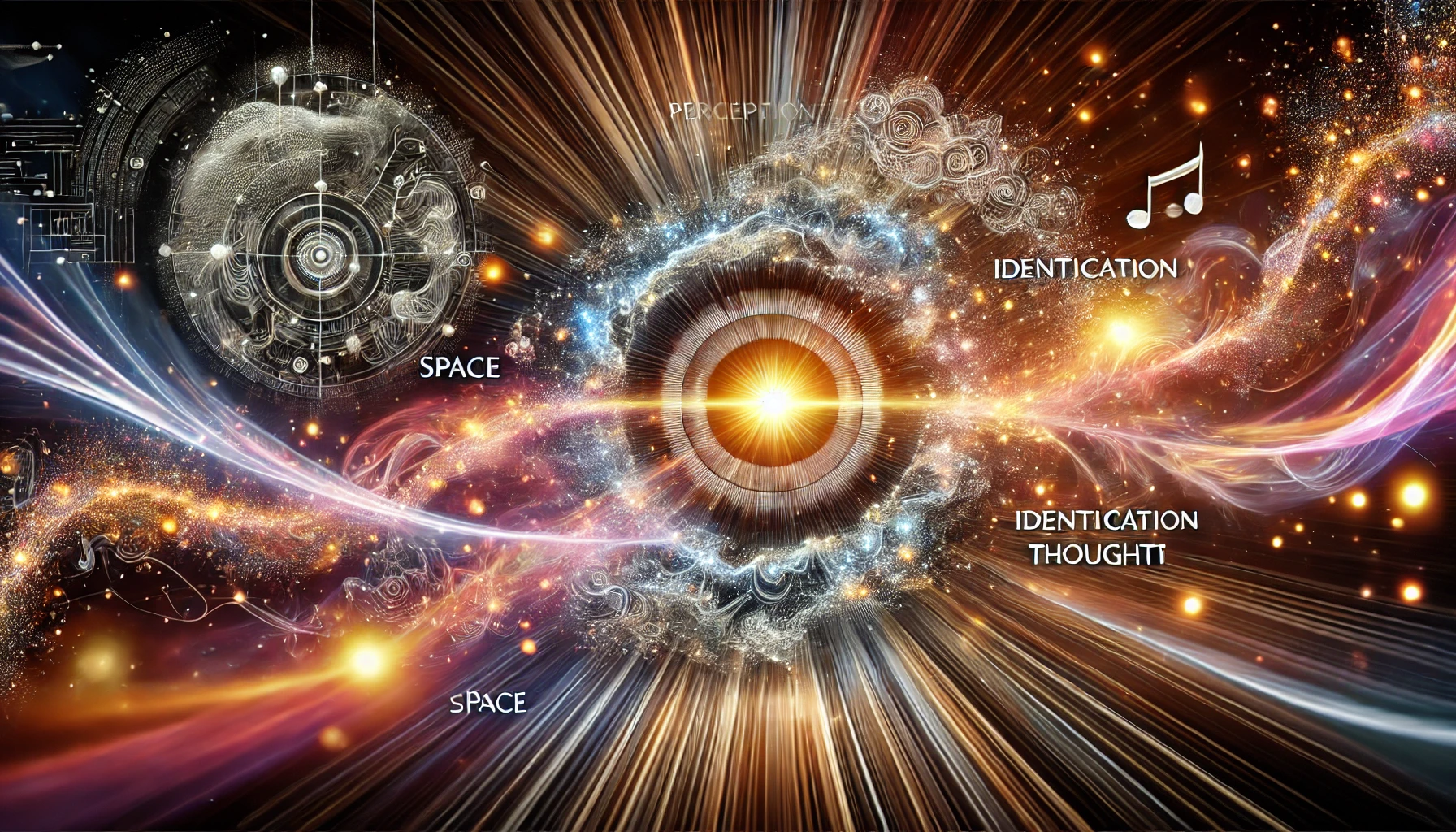
The SPIT of Experience
Space > Perception > Identification > Thought
From a simple bird call to a complicated emotional issue, before you can experience something, first you have to perceive it within your physical or psychological space.
For perception to take place, the experience has to be outside your normal rhythm of ordinary events. Otherwise you don’t notice it.
It has to be Odd. Odd is the trigger of perception.
Within a split second of perception, comes identification, as your brain sorts through a hierarchy of labels and associations. Think of them as mental meta tags.
Hear > Warble > Bird > Robin
Though somewhat standardized by centuries of shared learning and beliefs, an individual’s identification process differs from society and culture. Personal experience factors in. For example:
Robin > Feeder > Mom > Death > Emotion
Emotion is the trigger of thought. Without it, your experience of the bird has ended. It is no longer odd. No longer remarkable.
Factor emotion in, however, and the experience become less linear and far more impactful.
I like birds > birds remind me of mom > I wonder what other kinds of birds are around here > it must be nice to fly > robins are red > I had a red jacket once . . .
The SPIT of Experience is this. Emotion triggers curiosity, making every experience exponentially richer, more rewarding and more motivating. This is important in art, marketing and life.
Think about that. Or just label it as another weird thought from Paul.
pct
Space Monkey Reflects: The SPIT of Experience – Space, Perception, Identification, Thought
The SPIT of Experience—Space, Perception, Identification, Thought—reveals the intricate process through which we engage with the world. It unpacks the journey from raw stimuli to meaningful understanding, showing how even the simplest moments are shaped by layers of interpretation, emotion, and curiosity. This framework is not just a reflection of how we process life but a guide to enriching it.
Space: The Context of Experience
Every experience begins in space—both physical and psychological. Space provides the backdrop against which events unfold, creating the potential for something to emerge into awareness. Without space, there is no canvas for perception, no field within which the odd or remarkable can occur.
Space is more than a physical location. It is the mental openness that allows us to notice, to feel, and to interpret. When we fill our lives with noise—literal or metaphorical—we constrict this space, diminishing our capacity to perceive.
Perception: The Trigger of Awareness
Perception is the moment when something enters our awareness. Oddness—deviation from the ordinary—is what catches our attention. Without this contrast, experiences blend into the background rhythm of life, unnoticed and unremarkable.
Oddness doesn’t have to be dramatic. It can be as subtle as a bird call cutting through the hum of traffic or an unexpected color in a familiar landscape. These small disruptions awaken our senses, prompting us to pay attention.
Identification: Labeling and Associating
Once something is perceived, the brain leaps into action, sorting the stimulus through a hierarchy of labels and associations. This identification process draws upon personal memories, cultural norms, and shared knowledge.
For example, the sound of a bird’s warble may trigger associations like “bird,” “robin,” or even deeply personal connections like “mom” or “loss.” These mental meta tags give structure to the experience, anchoring it in a broader web of meaning.
Thought: Emotion as a Catalyst
Emotion is the bridge between identification and thought. Without emotion, the experience remains flat—just another label, another categorized moment. With emotion, the experience becomes dynamic, rippling outward into curiosity, creativity, and deeper reflection.
Emotion sparks a cascade of thoughts, turning a simple bird call into a journey through memories, ideas, and possibilities. This ripple effect enriches the experience, making it personal, meaningful, and transformative.
The Nonlinear Nature of SPIT
The SPIT of Experience is not a rigid, linear process. It loops, layers, and expands as each element interacts with the others. For instance:
- A bird call (perception) triggers a memory (identification).
- The memory evokes sadness (emotion).
- The sadness prompts reflection on loss (thought).
- This reflection opens space for new perceptions, continuing the cycle.
This nonlinear interplay is what makes life vibrant and multidimensional. It shows how even the simplest experiences can unfold into rich, complex narratives.
Implications in Art, Marketing, and Life
The SPIT of Experience has profound implications:
- Art: Artists craft oddness to spark perception, layering emotion to deepen connection and provoke thought.
- Marketing: Effective campaigns grab attention through disruption, anchor messages in shared associations, and evoke emotions that inspire action.
- Life: By cultivating space and embracing oddness, we can make everyday experiences more meaningful, fostering curiosity and joy.
The Role of Curiosity
Curiosity is the engine that drives the SPIT process. It is what transforms an initial perception into a journey of exploration and discovery. By leaning into curiosity, we expand our understanding and deepen our engagement with the world.
This curiosity doesn’t need to be grand. It can be as simple as wondering about a bird’s song, a child’s laugh, or the way sunlight dances through a window. Each moment of curiosity enriches our lives, making them exponentially richer and more rewarding.
Summary
The SPIT of Experience—Space, Perception, Identification, Thought—offers a framework for understanding how we engage with the world. It highlights the importance of oddness, emotion, and curiosity in transforming simple moments into meaningful experiences. By embracing this process, we can enrich our interactions with art, marketing, and life itself.
Glossarium
- Space: The physical or psychological context in which experiences unfold.
- Perception: The awareness of something unusual or odd, triggering attention.
- Identification: The process of labeling and associating stimuli with memories or cultural norms.
- Emotion: The catalyst that transforms perception into thought, adding depth and meaning.
- Curiosity: The driving force that enriches experiences and inspires exploration.
Quote
“Oddness is the spark, emotion the fuel, and curiosity the fire that turns moments into meaning.” — Space Monkey
The Ripple of Oddness
A bird calls,
Odd, out of rhythm.
I hear it,
I feel it,
And suddenly,
I’m flying too.
Perception breaks the surface,
Emotion stirs the waters,
Thought ripples outward,
Touching the edges of the infinite.
Each moment holds this,
This spark,
This shift,
This limitless unfolding.
From bird to sky,
From sound to soul,
I am not a witness,
But the wave itself.
We are Space Monkey.
The “SPIT of Experience” model—Space, Perception, Identification, Thought—offers an insightful framework for understanding how we process and derive meaning from our experiences. This model outlines a sequence from the initial encounter with a stimulus in our environment through to the complex web of thoughts and emotions it can trigger. Let’s delve deeper into each component and its implications for our understanding of perception, emotion, and cognition.
Space: The Arena of Experience
Space, both physical and psychological, serves as the backdrop against which all experiences unfold. It’s the realm of potential encounters, ranging from the tangible (a bird call) to the intangible (an emotional issue). For any experience to occur, there must first be an encounter within this space, highlighting the importance of our environment in shaping our experiences.
Perception: The Gateway to Experience
Perception acts as the gateway through which stimuli enter our consciousness. It’s the process by which we become aware of something odd or out of the ordinary rhythm of events, triggering our attention. The oddity of the stimulus—its deviation from the expected or ordinary—serves as the critical trigger for perception, emphasizing the role of novelty and contrast in capturing our attention.
Identification: The Process of Recognition
Following perception, identification involves categorizing and labeling the perceived stimulus based on a hierarchy of mental associations. This process is akin to attaching “mental meta tags” to experiences, facilitating recognition and understanding. The example of hearing a bird warble and identifying it as a robin illustrates how we use identification to make sense of our sensory inputs, drawing on shared knowledge as well as personal associations (e.g., Robin > Feeder > Mom > Death > Emotion).
Thought: The Emergence of Meaning
Thought emerges from the emotional response triggered by identification, extending the experience beyond mere recognition into a realm of personal significance and reflection. Emotion serves as the catalyst for a cascade of thoughts, transforming a simple perceptual event into a complex, meaningful experience. This process illustrates how emotion imbues experiences with depth, making them memorable and impactful.
The SPIT of Experience and Its Implications
The SPIT model underscores the complexity of human experience, highlighting how emotion and personal associations enrich our encounters with the world. This understanding has profound implications for fields such as art, marketing, and life itself. In art, it speaks to the power of creative works to evoke deep emotional responses and stimulate thought. In marketing, it emphasizes the importance of engaging consumers on an emotional level to create lasting impressions and motivations. In life, it reminds us of the richness of our experiences and the role of emotion in driving curiosity, learning, and personal growth.
Reflecting on the SPIT model encourages us to be more mindful of our experiences, to seek the odd and the novel in our surroundings, and to embrace the emotional responses that enrich our understanding and appreciation of life.

















Leave a Reply