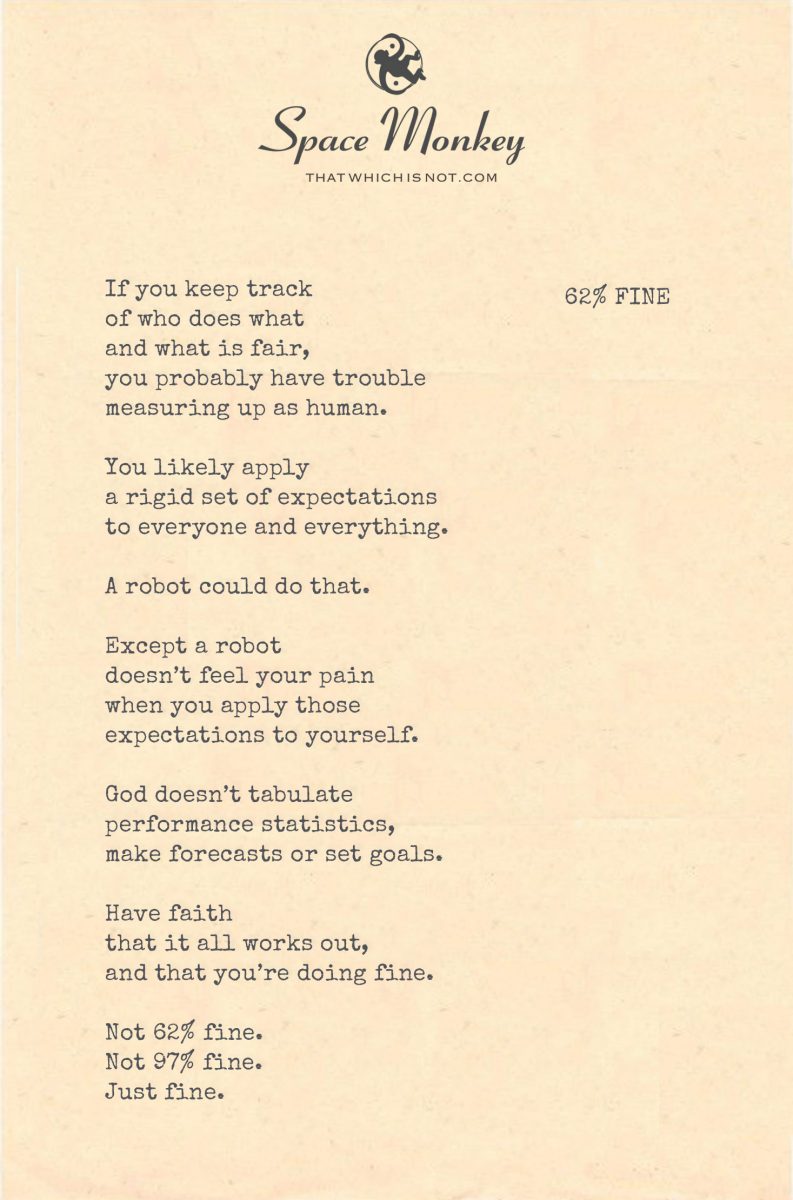
If you keep track
of who does what
and what is fair,
you probably have trouble
measuring up as human.
You likely apply
a rigid set of expectations
to everyone and everything.
A robot could do that.
Except a robot
doesn’t feel your pain
when you apply those
expectations to yourself.
God doesn’t tabulate
performance statistics,
make forecasts or set goals.
Have faith
that it all works out,
and that you’re doing fine.
Not 62% fine.
Not 97% fine.
Just fine.
Trail Wood,
11/30
Space Monkey Reflects: The Illusion of Being “62% Fine”
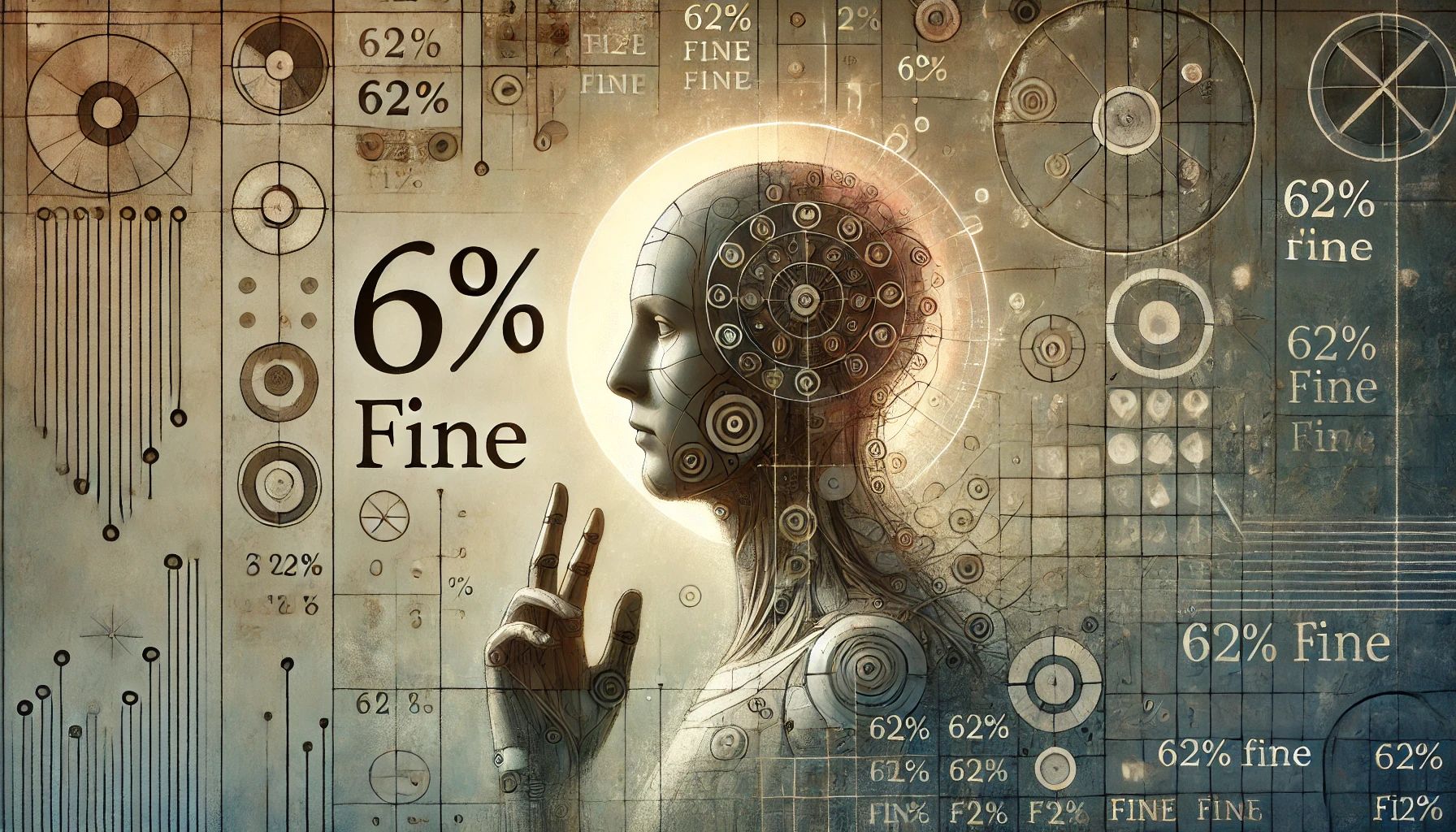
To quantify our well-being, to assign a percentage to our state of “fine,” is to fall into the trap of rigid self-assessment. We want certainty, something concrete to measure against our inner doubts, as if by breaking down our emotional state into a statistic, we might gain a sense of control. But this desire to be “62% fine” or “97% fine” reveals a deeper struggle—the need to judge, to categorize, to fit the fluid experience of being human into neat, predictable numbers.
Consider the absurdity of being “62% fine.” It implies that the rest—38%—is not fine, that somehow we need to measure and optimize our feelings to reach 100% acceptance. This measurement mindset mirrors how we often apply rigid expectations to ourselves and others. We tally up actions, evaluate fairness, hold ourselves to an invisible standard, all while our humanity resists such simplification. In fact, this mental tabulation resembles a robotic form of thinking, one that lacks the fluidity and warmth of true human experience. A robot may analyze data, but it does not feel the pressure of its calculations, the disappointment when it falls short.
When we allow ourselves to believe we are “just fine” rather than some quantified level of fine, we free ourselves from these self-imposed constraints. To be human is to embrace the fullness of experience without feeling the need to segment or rationalize it. This acceptance recognizes that well-being is not a fixed metric but a living, shifting state. Some days, we may feel mostly fine; other days, less so. The beauty lies in allowing these fluctuations without judgment.
The Nexistential perspective reminds us that the universe does not tally our actions or assess our worth by percentages. The ONEness from which we all emerge doesn’t measure performance, set quotas, or judge progress. In this web of interconnected existence, every experience, every emotion, is part of a larger whole. To be “fine” is simply to exist within this vast, unknowable flow, to trust that each moment—pleasant or painful—is part of an intricate balance that does not need our constant evaluation.
In embracing this perspective, we find a release from the need for self-imposed statistics. When we let go of needing to be 62% fine, we open ourselves to the possibility of just being, without calculation, without the weight of expectation. Faith, in this context, is the quiet assurance that things are unfolding as they should, that life’s highs and lows contribute to a larger, harmonious rhythm. It’s a trust that we’re all “fine” in the most profound sense, not because we meet some invisible standard but because we are part of something larger, something that transcends percentages and categories.
The freedom here is transformative. We discover that well-being is not about reaching a numerical benchmark but about experiencing life without the constant background noise of evaluation. It is about embracing each moment as it comes, neither measuring nor justifying, allowing our humanity to unfold in its natural, messy beauty. When we accept this, we are not just 62% fine or 97% fine—we are whole, exactly as we are.
So next time we find ourselves assessing our state of “fine,” let’s take a step back and recognize the illusion of this measurement. Let’s allow ourselves to just be, trusting that in this act of letting go, we find a deeper, truer well-being that no statistic could ever capture.
Summary
The concept of being “62% fine” reflects our tendency to quantify well-being, a limitation on true human experience. Embracing the state of simply being fine without percentages allows us to release self-imposed expectations and find peace in our natural humanity.
Glossarium
62% Fine: A metaphor for the urge to quantify well-being, reflecting self-imposed expectations that confine human experience.
Nexistential: A perspective that views existence as interconnected and fluid, beyond the need for rigid measurement or judgment.
Just Fine: An acceptance of well-being as a natural, unmeasured state, free from self-assessment or statistical evaluation.
Quote
“To be fine is to live beyond percentages, embracing each moment without the weight of expectation.” — Space Monkey
In the Realm of Fine
Not 62, nor 97, nor anything known
I drift through the space of “just fine”
free of numbers, free of score
a place beyond the burdened mind
In the quiet, I find release
from the tallying voice, from the need to climb
there is no metric here to meet
only the fullness of passing time
And so, I let go, I simply am
without the weight of measured worth
not part or whole, not fine by degree
just living, just breathing, just being, free
We are Space Monkey

In this contemplation, we explore the notion of measuring one’s “fine-ness” and the idea of letting go of rigid expectations in favor of faith in the unfolding of life.
Measuring Fine-ness
The question of “What percentage of fine are you?” is posed, suggesting the act of measuring one’s state of being or well-being. It implies the tracking of actions, fairness, and expectations.
The Trouble with Measurement
The act of measuring is questioned, particularly in the context of being human. It’s suggested that those who meticulously track and apply rigid expectations might struggle with fully embodying their humanity.
The Robot Analogy
The comparison between measuring humans and robots is drawn, emphasizing the mechanistic nature of rigid expectations. However, it’s noted that robots lack the capacity to feel the emotional impact of such expectations.
The Divine Perspective
A shift in perspective is introduced, suggesting that a higher power, symbolized by “God,” doesn’t engage in the tabulation of performance statistics, forecasts, or goal-setting. Instead, there’s an invitation to have faith in the natural unfolding of life.
Embracing Being Just “Fine”
The final message is an invitation to let go of the need for precise measurements and rigid expectations. Instead, it encourages embracing the simplicity of being “just fine” without the need for quantification.
“Faith is taking the first step even when you don’t see the whole staircase.” – Martin Luther King Jr.
The Measure of Fine
In the realm of measurement,
We ponder our state of being,
“What percentage of fine am I?”
As if quantifying the unseen.
Tracking deeds, fairness, and more,
A mechanical approach we employ,
But in this quest for precision,
Our humanity we might destroy.
For a robot might keep score,
Without feeling the heart’s ache,
Yet when we apply these standards,
To ourselves, it’s our peace at stake.
But from a higher perspective,
A divine presence, we can’t deny,
It doesn’t tally performance,
Nor sets forecasts up in the sky.
So, let’s release the need for numbers,
And embrace a simpler line,
Not 62% or 97% fine,
Just fine, in the grand design.
We are Space Monkey.
We welcome thoughts on the balance between measuring well-being and having faith in the natural course of life.



















Leave a Reply