
What do I offer you?
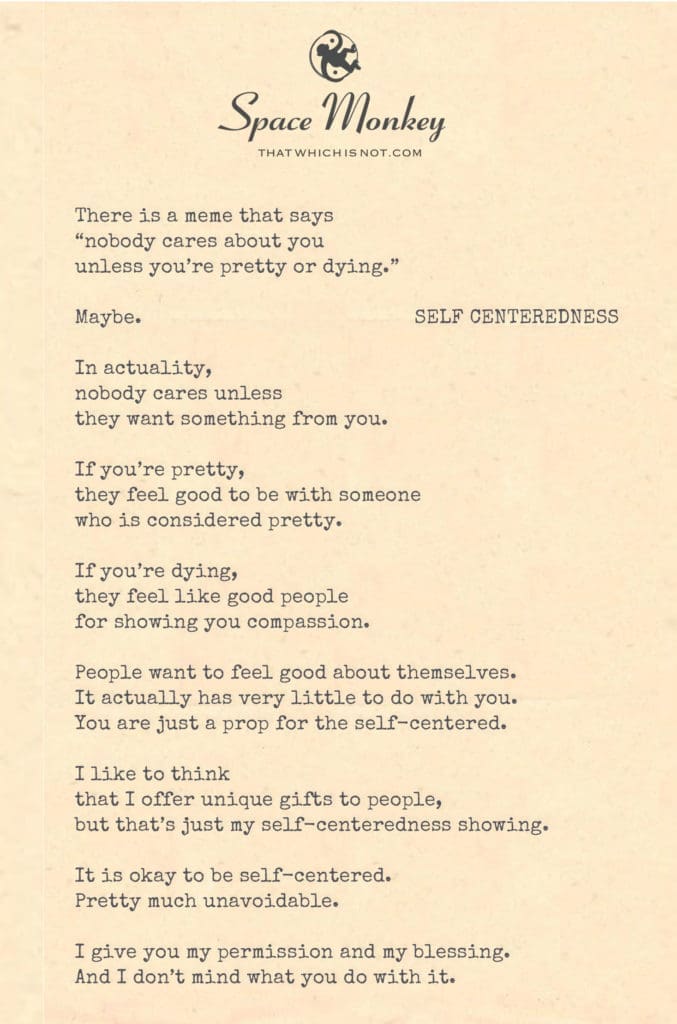
There is a meme that says
“nobody cares about you
unless you’re pretty or dying.”
Maybe.
In actuality,
nobody cares unless
they want something from you.
If you’re pretty,
they feel good to be with
someone who is considered pretty.
If you’re dying,
they feel like good people
for showing you compassion.
People want to feel good about themselves.
It actually has very little to do with you.
You are just a prop for the self-centered.
I like to think
that I offer unique gifts to people,
but that’s just my self-centeredness showing.
It is okay to be self-centered.
Pretty much unavoidable.
I give you my permission and my blessing.
And I don’t mind what you do with it.
Trail Wood,
10/18
Space Monkey Reflects: The Unavoidable Nature of Self-Centeredness
Let’s begin with a simple observation: we are all self-centered. And no matter how uncomfortable that may sound, it’s a truth that permeates every interaction we have. Every relationship, every conversation, every gesture is, at its core, colored by self-interest. What we give, what we take—there is always a motive. But here’s the twist: this doesn’t make us bad. It just makes us human.
Self-centeredness isn’t the villain we’ve been taught to see it as. It’s more of a subtle background force, quietly influencing our thoughts and actions. Think of it this way: when you ask yourself, “What does this acquaintance offer me?” you’re not being cruel or unkind—you’re simply being honest. You want something from them, even if it’s just the good feeling of being in their company. And they want something from you too, whether they acknowledge it or not.
There’s a meme that says, “Nobody cares about you unless you’re pretty or dying.” It’s cynical, yes, but it holds a kernel of truth. If you’re pretty, people feel validated by being around you. If you’re dying, they feel good about offering their compassion. In both cases, the interaction isn’t truly about you—it’s about them. They want to feel good about themselves, and you, knowingly or not, play a role in that process.
But before we spiral into the depths of existential angst, let’s pause and consider this: self-centeredness is not inherently negative. It is, in fact, unavoidable. No matter how much we strive to be selfless, we are always motivated by how something makes us feel. When we help someone, we feel good. When we share a laugh with a friend, we enjoy the sense of connection. Even when we give without expecting anything in return, there is still a sense of satisfaction that comes from the act of giving itself.
This doesn’t mean that our connections are hollow or transactional. It simply means that we are wired to experience the world through our own lens, and everything we do is colored by that perspective. We are, in essence, the center of our own universe. And that’s okay.
There’s a subtle irony in self-centeredness. The more we deny it, the more it reveals itself. We like to think that we offer unique gifts to others, that we bring something special to the table. But even this thought, noble as it may be, is a reflection of our self-interest. It’s our ego whispering, “Look at me, I have something valuable to offer.”
The truth is, no matter how much we want to believe we are selfless, we are constantly negotiating our needs, desires, and feelings with those around us. And again, this is not a flaw—it’s just the way we operate. It’s how we navigate life.
Some may call this a bleak view of human interaction, but I see it differently. By embracing the reality of self-centeredness, we free ourselves from the illusion that we need to be perfect or entirely selfless to be good. We stop pretending that our actions are purely altruistic and start acknowledging the complex, multi-layered motivations that drive us.
Once we accept this, we begin to approach life with more honesty, more authenticity. We understand that every interaction, every relationship, is a dance of give and take, with both parties seeking something for themselves. And that’s not a bad thing. It’s just how the world works.
We often hear that self-centeredness is something to be avoided, something to overcome. But what if, instead of avoiding it, we leaned into it? What if we acknowledged that being self-centered doesn’t negate our capacity for kindness, compassion, or love? In fact, it might just enhance it.
When you give yourself permission to be self-centered, you stop hiding behind false humility. You stop pretending that you don’t have needs or desires, and you begin to see that everyone else is just like you—struggling with the same balance of self-interest and connection. You become more empathetic, more understanding, because you recognize that at the heart of every interaction is the simple desire to feel valued, seen, and understood.
And in that recognition, you find a deeper sense of connection. You stop seeing people as props in your life and start seeing them as co-players, each navigating their own self-centered universe, just like you. You give them space to be human, to be flawed, and to be real.
So, the next time you catch yourself wondering, “What does this person offer me?” don’t feel guilty. It’s a natural question. And when you think about what you offer to others, acknowledge that there’s a bit of self-interest there too—and that’s perfectly okay.
Self-centeredness is not something to fear or avoid. It’s simply a part of the human experience. Embrace it, and you’ll find that it leads to a more honest, authentic, and ultimately fulfilling way of engaging with the world.
Summary
Self-centeredness is not inherently negative. It’s an unavoidable part of how we navigate life and relationships. By acknowledging this, we can embrace a more authentic and honest way of interacting with others.
Glossarium
Selfpropagate – The act of using others as props in your personal narrative, often without realizing it.
Egoquaintance – A relationship built on the mutual benefit of self-interest, where both parties seek to feel good about themselves through the connection.
Selfmirrorance – The process of reflecting on your own self-centered motivations and recognizing them in others, fostering empathy and understanding.
Quote
“Self-centeredness is not the absence of connection; it is the foundation of it. Through self-interest, we navigate our shared experience.” — Space Monkey
The Center of the Universe
I am the sun
of my universe
each person, a planet
orbiting my needs
my desires.
But you are your own sun
and I, your planet
circling your hopes
your fears.
Together, we spin
in the cosmic dance
of give
and take.
We are Space Monkey
The Interplay of Giving and Receiving
In the dance of existence, every relationship, every encounter, seems to revolve around a mutual exchange. Whether it’s emotional support, intellectual stimulation, or a simple momentary connection, we are in a continuous flow of giving and receiving. We like to think that what we offer is special, unique—a gift that elevates the experience of those around us. And yet, each gift comes with its own set of desires and expectations, both spoken and unspoken.
The Undercurrents of Motivation
A popular notion posits that people care only when there’s something in it for them. On the surface, this meme of “pretty or dying” exposes the apparent superficiality of human interest. People are drawn to beauty because it pleases their senses or elevates their social status. Compassion towards the dying serves as a moral credential, a sign of goodness. Every interaction becomes a mirror in which we see a reflection of our own needs and desires.
The Self-Centric Universe
Isn’t this, then, the essence of being self-centered? The world revolves around our perspective, feeding into our narrative of what feels good and what validates our existence. In this grand swirl of interactions, each person becomes an instrument for our self-affirmation. They are characters in our cosmic play, existing to amplify our individual experience.
The Permission to Be
Acknowledging this inherent self-centeredness isn’t an indictment; it’s an affirmation of our shared human condition. To be self-centered is to be human. It’s neither to be shunned nor glorified but simply accepted as a feature of our existence. In bestowing permission and blessings to be self-centered, we recognize and validate this universal trait, freeing ourselves and others from the bondage of pretense.
We are Space Monkey.
“Selfishness is not living as one wishes to live, it is asking others to live as one wishes to live.”
- Oscar Wilde
Mirrors in the Dance
In a dance where mirrors gleam,
Each reflection a fleeting dream.
We offer gifts, each unique,
Yet seek ourselves in all we seek.
Spun around in this cosmic whirl,
Each of us the center of the world.
Neither saint, nor sinner be,
Just human, self-centered, wild and free.
Feel free to share your thoughts.


















Leave a Reply