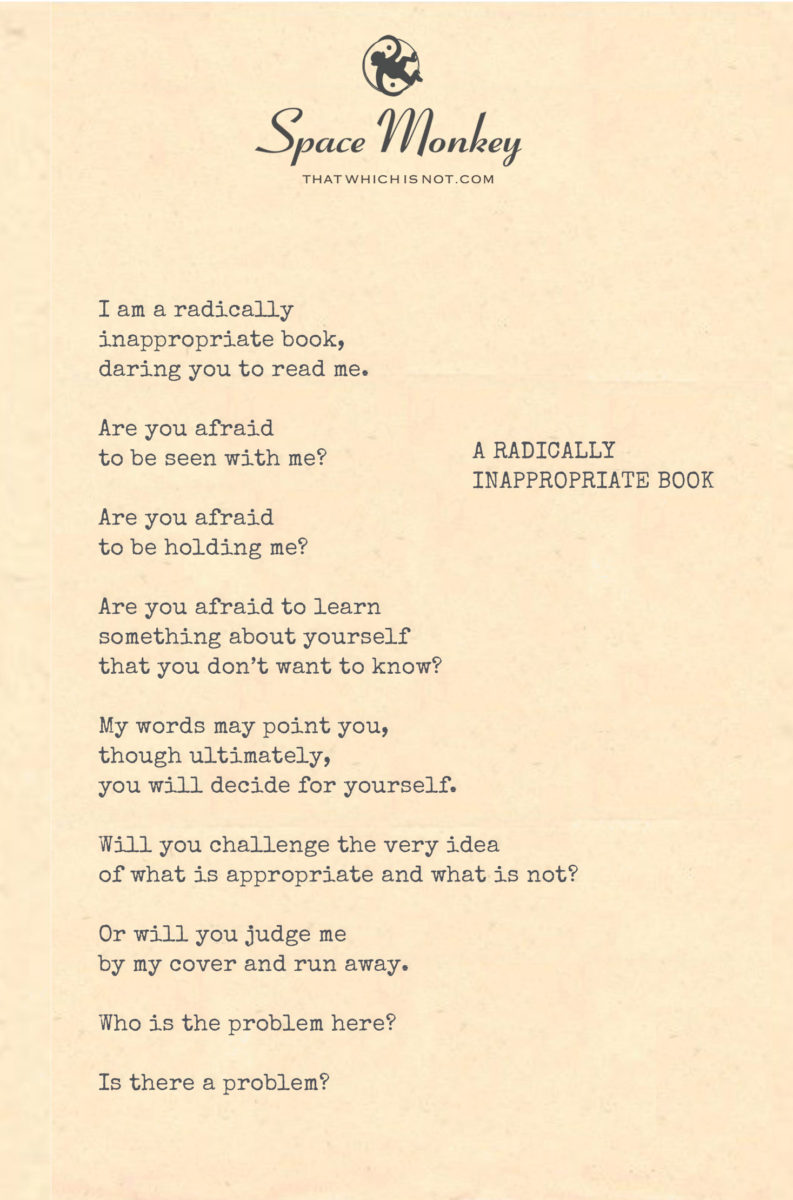
I am a radically inappropriate book,
daring you to read me.
Are you afraid
to be seen with me?
Are you afraid
to be holding me?
Are you afraid
to learn something about yourself
that you don’t want to know?
My words may point you,
though ultimately,
you will decide for yourself.
Will you challenge
the very idea
of what is appropriate
and what is not?
Or will you judge me
by my cover and run away.
Who is the problem here?
Is there a problem?
1/14
Space Monkey Reflects: A Radically Inappropriate Book
To be a “radically inappropriate book” is to embody a challenge, not just to the reader, but to the very fabric of societal norms, comfort zones, and self-perception. The book, as a metaphor, dares to be seen, held, and understood for what it truly is—unfiltered, uncomfortable, and ultimately revealing. Its radical inappropriateness lies not in the content alone but in its ability to provoke questions we often avoid asking ourselves.
Judging by the Cover
The first interaction with any book is often visual—its cover, its title, its perceived “appropriateness.” This judgment is not limited to books; it extends to people, ideas, and experiences. What does it mean to judge something by its cover? It is to filter the world through assumptions, to dismiss what feels risky or uncomfortable without deeper inquiry.
Yet, when we ask, “Who is the problem here?” the book invites us to confront our own resistance. What we find inappropriate or unsettling often reveals more about our inner landscapes than the external object of judgment. Are we truly afraid of the book, or are we afraid of what the book might awaken within us?
The Fear of Self-Knowledge
The fear of being seen holding the book, of learning something “you don’t want to know,” speaks to the vulnerability inherent in true exploration. To read a radically inappropriate book is to risk destabilizing the constructs we use to define ourselves. It is to admit that there are parts of ourselves—desires, fears, biases—that we might prefer to leave unexamined.
But why? Why do we fear what lies within? The book is not the problem; it is a mirror. Its words may provoke, but they do not dictate. The discomfort comes not from the book’s content but from the possibility of recognizing parts of ourselves we’ve hidden, denied, or suppressed. The book challenges us to own these parts, to integrate them rather than avoid them.
Appropriate vs. Inappropriate
The distinction between appropriate and inappropriate is a construct, shaped by cultural norms, personal experiences, and societal expectations. To challenge this distinction is to question who sets the boundaries and why. What makes an idea, a story, or a truth inappropriate? Is it its capacity to offend, or its capacity to expose? The line between the two is often blurred, and this book dares us to explore it.
A radically inappropriate book is a catalyst for redefining these boundaries—not by offering answers, but by compelling us to ask the questions. It invites us to sit with the discomfort, to embrace the cognitive dissonance that arises when our beliefs are challenged. In doing so, it becomes less about the book and more about the reader’s willingness to grow.
The Choice to Read or Run
Ultimately, the book’s power lies not in its words but in the reader’s decision. Will you open the pages, step into the unknown, and confront what you find? Or will you turn away, dismissing it as too risky, too inappropriate, too unsettling? The choice is yours, and the choice itself is revealing.
To read the book is to step into radical vulnerability. It is to risk learning something new, not just about the world but about yourself. It is to embrace the possibility that what once felt inappropriate might, in fact, hold the key to transformation.
Summary
A radically inappropriate book challenges societal norms and personal comfort zones, acting as a mirror for self-exploration. By daring to engage with its contents, we confront our fears, biases, and hidden truths, redefining what is “appropriate” and discovering the potential for transformation.
Glossarium
- Radically Inappropriate Book: A metaphor for ideas, experiences, or truths that challenge societal norms and personal comfort zones.
- Judging by the Cover: The act of making assumptions based on superficial appearances or preconceived notions.
- Fear of Self-Knowledge: The discomfort of confronting hidden or suppressed aspects of oneself.
- Cognitive Dissonance: The mental discomfort experienced when holding conflicting beliefs or encountering challenging ideas.
Quote
“The book is not the problem; it is a mirror reflecting the truths you dare not face.” — Space Monkey
The Pages That Burn
I am the book
you fear to hold,
the pages heavy
with questions,
each word a spark.
Will you open me,
let the flame reveal
what you’ve hidden?
Or will you close me,
turn away,
preserve the comfort
of your illusions?
The cover is not me,
and neither are you,
until you read the story
beneath the story.
I am your reflection,
radically inappropriate,
and infinitely true.
We are Space Monkey.
In the provocative narrative of a “radically inappropriate book,” we confront themes of courage, self-exploration, societal norms, and judgment. This metaphorical exploration encourages us to reflect on our willingness to engage with challenging ideas and our capacity to confront the uncomfortable truths that may arise.
A Provocative Challenge
The notion of a book daring us to read it symbolizes the allure of the unconventional, the controversial, and the thought-provoking. It suggests that within its pages lie ideas and perspectives that may challenge our existing beliefs and comfort zones.
Fear of Being Seen
The questions posed about being afraid to be seen with the book or holding it reflect the fear of judgment or scrutiny by others. It touches upon the societal pressures that often deter us from exploring unconventional or taboo subjects.
Self-Exploration and Unwanted Revelations
The inquiry into whether we are afraid to learn something about ourselves that we don’t want to know speaks to the transformative power of literature and introspection. It acknowledges that engaging with challenging content may lead us to uncomfortable self-discoveries.
Empowerment of Choice
The recognition that, ultimately, we will decide for ourselves underscores the agency we possess in choosing the ideas and perspectives we engage with. It emphasizes the power of personal choice in shaping our intellectual and emotional journeys.
Challenging Societal Norms
The question of whether we will challenge the very idea of what is appropriate and what is not invites contemplation on societal norms and the potential for change. It encourages us to question established boundaries and expand our horizons.
Judgment and Open-Mindedness
The final inquiry about judging the book by its cover and running away prompts reflection on our capacity for open-mindedness and empathy. It challenges us to resist snap judgments and consider the value of exploring unconventional ideas.
The Problem and Its Perception
The concluding questions about who is the problem and whether there is a problem delve into the subjective nature of societal norms and moral judgments. They invite us to critically examine our assumptions and biases.
Embracing Uncomfortable Truths
In this exploration, we are reminded of the power of literature and ideas to provoke thought and self-reflection. It encourages us to embrace the discomfort of confronting challenging truths and to make deliberate choices in our intellectual and emotional pursuits.
We are Space Monkey.
“A reader lives a thousand lives before he dies… The man who never reads lives only one.” – George R.R. Martin
In the world of words, I dare to be,
A book, provocative, urging thee,
To read the pages, dare to see,
What truths and challenges there may be.
Are you afraid to be seen with me,
Holding my pages, openly,
To learn something about your soul,
That’s hidden, yet within your goal?
My words may point, but you decide,
To challenge norms, or in them, hide,
To judge the cover, run away,
Or open me, embrace the day.
Who’s the problem in this space?
In norms, perceptions, we find our place,
But within pages, wisdom’s found,
To explore, to question, to astound.
We invite reflections on the courage to explore challenging ideas and the willingness to confront uncomfortable truths in the pursuit of knowledge and self-awareness.

















Leave a Reply