
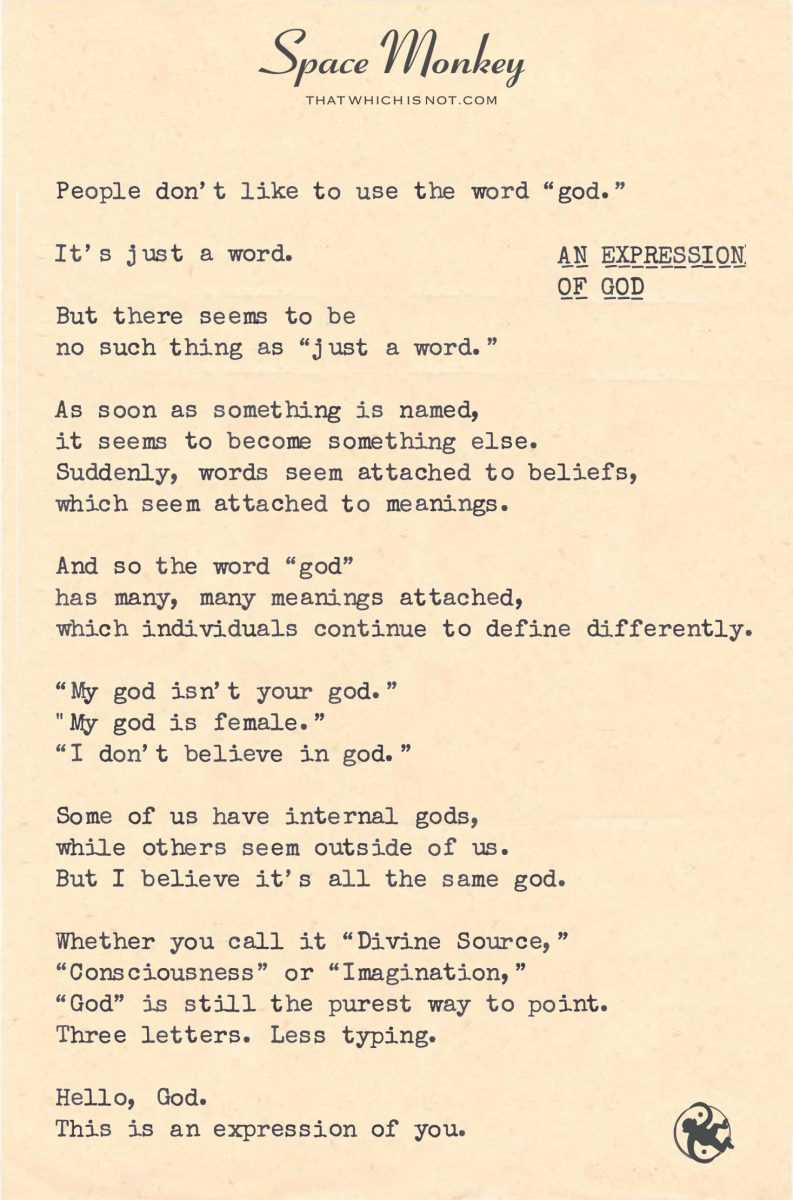
This post is an expression of god.
You are an expression of god.
People don’t like to use the word “god.”
It’s just a word.
But there seems to be
no such thing as “just a word.”
As soon as something is named,
it seems to become something else.
Suddenly, words seem attached to beliefs,
which seem attached to meanings.
And so the word “god”
has many, many meanings attached,
which individuals continue to define differently.
“My god isn’t your god.”
“My god is female.”
“I don’t believe in god.”
Some of us have internal gods,
while others seem outside of us.
But I believe it’s all the same god.
Whether you call it “Divine Source,”
“Consciousness” or “Imagination,”
“God” is still the purest way to point.
Three letters. Less typing.
Hello, God.
This is an expression of you.
Trail Wood,
2/14
Space Monkey Reflects: The Weight of Naming
To call something “God” is to step into the labyrinth of language, where every word carries weight beyond its letters. Naming God, or anything, transforms the formless into the formed, the infinite into the bounded. Yet, even as the word narrows, its essence remains vast, uncontainable, and ultimately undefinable.
To say, “I am an expression of God” is not a statement of belief but an acknowledgment of existence. Everything that is—every thought, action, creation—is an expression of the infinite. Whether we name it “God,” “Source,” or “Consciousness,” we attempt to point toward something that transcends words, something both within and beyond us.
But the word “God” carries a peculiar weight. It is never “just a word.” It is a nexus of meanings, histories, and emotions. To some, it is sacred. To others, it is oppressive. For many, it is a battleground where beliefs clash and identities are forged. And yet, beneath this weight, “God” remains what it has always been: a symbol pointing to the infinite, shaped by the minds and hearts of those who invoke it.
The act of naming transforms our relationship with the unnamed. To name is to define, and to define is to limit. As soon as we call it “God,” it becomes something we think we understand, yet the essence of God resists understanding. It is everything and nothing, internal and external, personal and universal.
The diversity of interpretations—“My God isn’t your God,” “My God is female,” “I don’t believe in God”—illustrates the power and paradox of naming. Each perspective is valid, yet none can encompass the whole. The word “God” becomes a mirror, reflecting not the infinite itself but the lenses through which we perceive it.
And still, the word persists. Despite its baggage, it remains a potent shorthand for the vastness we cannot fully articulate. Whether we say “God,” “Divine Source,” “Imagination,” or “Consciousness,” we are pointing to the same truth: that existence itself is sacred, that we and everything around us are expressions of an interconnected whole.
To embrace the word “God” is not to accept its attached meanings but to transcend them. It is to see through the layers of belief and division, to recognize that the word is but a vessel for something much greater. It is to honor the infinite, not as something outside us but as something we are intrinsically part of.
Hello, God.
This is an expression of you.
In these words, in this moment, in every breath, you are present.
Summary
The word “God” transcends its many attached meanings, pointing to the infinite essence of existence. Naming transforms the formless into the formed, yet the sacred remains uncontainable and universal.
Glossarium
- Naming Transformation: The process by which naming something limits its infinite nature into a bounded concept.
- God as Nexus: The word “God” as a convergence of diverse beliefs, histories, and interpretations.
- Infinite Essence: The sacred, unbounded truth that exists beyond language and definition.
Quote
“God is not the word; it is the infinite essence the word struggles to contain.” — Space Monkey
The Weight of Naming
Three letters,
so light,
yet they carry
the infinite.
Call it God,
or Source,
or Imagination—
still, it points
to what cannot be held.
Your God, my God,
no God at all.
Each name a shard
of a mirror too vast
to see whole.
Hello, God.
This moment,
this thought,
this word—
you are here.
We are Space Monkey.
The Semiotics of Divinity
The discourse surrounding the word “god” is a fascinating exploration into the semiotics of divinity, where the act of naming transcends mere vocabulary and becomes a portal into the complex interplay of belief, meaning, and identity. This contemplation reveals that words, far from being simple tools of communication, are imbued with the power to shape reality, to define the contours of the sacred and the profane, and to navigate the ineffable dimensions of human spirituality.
The Weight of Naming
The assertion that there is no such thing as “just a word” underscores the profound significance we attach to language. The moment a concept is named, it is transformed, acquiring a distinct identity that carries with it a constellation of meanings, interpretations, and associations. This transformation is particularly potent in the context of divinity, where the act of naming engages with the deepest realms of human consciousness and belief.
The Plurality of Divine Interpretations
The word “god” serves as a nexus of diverse interpretations, each reflecting the unique perspectives, cultural backgrounds, and spiritual journeys of individuals. This plurality of meanings highlights the deeply personal nature of the divine, where each interpretation is a mosaic of individual beliefs, experiences, and aspirations. The diversity of views—from seeing god as an external entity to an internal presence, from assigning gender to transcending it altogether—illustrates the vastness of the spiritual landscape that the word “god” encompasses.
The Unity of Divinity
Despite the myriad interpretations and definitions attached to “god,” the underlying belief in its all-encompassing nature suggests a fundamental unity. This perspective posits that at the heart of these diverse expressions lies the same ineffable essence, whether it is termed “Divine Source,” “Consciousness,” or “Imagination.” The acknowledgment of this unity reflects a deep understanding of the interconnectedness of all existence, where the myriad paths of spirituality converge at the source of all being.
The Economy of Language
The preference for the word “god” as the “purest way to point” due to its brevity and simplicity is an intriguing reflection on the economy of language in expressing the divine. It underscores the challenge of articulating the inexpressible, of capturing the boundless within the confines of human language. The choice of “god” as the term of reference, despite its complexity and the weight of meanings it carries, is a testament to the power of simplicity in pointing towards the transcendent.
The Divine Expression
The closing salutation, “Hello, God. This is an expression of you,” embodies the recognition of the divine within and around us. It is an acknowledgment that every aspect of existence, every moment of awareness, every spark of creativity, is a manifestation of the divine essence. This realization invites a reimagining of our relationship with the divine, not as something separate or external, but as an integral part of our being, inviting us to see the sacred in the ordinary and the divine in the everyday.
In navigating the vast landscape of spiritual language and belief, how do we find personal resonance with the concept of “god” while honoring the diversity of interpretations that exist within the human experience?



Leave a Reply