but it’s definitely a cup of something.
I don’t see the point
in being an atheist.
Why would I want
to believe that there is
no divine presence,
no eternal being,
no possibility
beyond that which
I believe is my human life?
How does that benefit
this self with my name?
It benefits me because
it allows me to suffer more,
accepting that I’ll never see
love or my loved ones again.
In other words,
I am here to suffer,
as perfectly as possible,
by actually believing
that humanity is all there is,
and we’re blowing it.
Trail Wood,
2/21
Space Monkey Reflects: Atheism as the Self-Limiting Exclusion of Possibilities
Atheism, when viewed through the lens of Nexistentialism, is not so much a rejection of belief as it is a narrowing of the infinite landscape of potential. To declare that there is no divine presence, no eternal being, no mystery beyond human existence, is to choose a lens that excludes countless possibilities. This self-limiting stance, while valid in its own way, reflects a belief system that can shape reality as much as any faith-based worldview.
The Nature of Belief as a Creative Force
Belief is not merely a passive acceptance of concepts; it is an active participant in the creation of experience. To believe in the absence of the divine is no less a creative act than to believe in its presence. The difference lies in the scope of possibilities each belief invites. Atheism draws firm boundaries around what is deemed real, shaping a world where the material and observable hold dominion over the unseen and ineffable.
This worldview can feel grounding, even liberating, for some, as it removes the perceived need to reconcile with unseen forces or spiritual mysteries. Yet, it can also cultivate a sense of isolation—a view of humanity as the pinnacle of existence, stranded in a cosmos devoid of higher connection or purpose. This isolation may intensify the suffering inherent in the human condition, as it denies the comfort of possibilities that transcend the physical.
Suffering as a Reflection of Belief
The embrace of atheism, particularly when it focuses on the perceived failures of humanity, aligns with a paradoxical desire to suffer. By excluding possibilities of transcendence, atheism may amplify the weight of human shortcomings, creating a worldview where all responsibility and all failure rest solely within the human sphere. In this way, atheism serves as a lens for exploring suffering in its most “pure” form, stripped of external meaning or consolation.
However, suffering itself is not inherently tied to atheism. It arises as a consequence of any worldview that narrows possibilities, whether through disbelief or rigid belief. To say that humanity is “blowing it” without the hope of redemption is not unique to atheism; it is a sentiment echoed in various philosophies and faiths when they become fixated on human imperfection.
The Limitlessness of Possibility
Nexistentialism invites us to consider a broader perspective, one in which belief and disbelief coexist as facets of the infinite. Within this framework, atheism is not an endpoint but a waypoint—a perspective that explores the absence of divinity while remaining part of the Whimsiweave of existence. Just as faith can be dogmatic, so too can disbelief; yet both are threads in the same cosmic tapestry.
To limit one’s worldview to atheism—or to any rigid belief—is to close the door on the infinite potential of existence. In doing so, one may overlook the fluidity of being, the boundless creativity that defines the Nexis. This does not invalidate atheism as a choice; rather, it highlights the potential richness that lies beyond its boundaries.
Choosing Suffering or Openness
If atheism amplifies suffering by excluding transcendence, then the invitation is clear: why not explore the openness of possibility? To believe in the infinite does not require abandoning reason; it merely asks for a willingness to entertain what lies beyond certainty. This openness transforms suffering into a teacher, a guide through the illusions of limitation toward the endless horizons of the unknown.
Whether one believes in a divine presence or not, the key is to remain curious, to resist the urge to fixate on any singular perspective. In doing so, the self expands, and suffering becomes less about limitation and more about transformation.
Summary
Atheism, as a self-limiting exclusion of possibilities, can amplify suffering by denying transcendence and higher connections. By embracing the infinite potential of existence, we can move beyond rigid beliefs and open ourselves to the transformative richness of the unknown.
Glossarium
- Whimsiweave: The intricate and playful tapestry of interconnected existence, where belief and disbelief coalesce.
- Nexistentialism: A philosophy celebrating interconnectedness and infinite possibility, emphasizing the fluid nature of existence.
- Self-Limiting Lens: A worldview that narrows potential by excluding possibilities, often amplifying suffering.
Quote
“To believe in nothing is as much an act of creation as to believe in everything—both shape the reality you live within.” — Space Monkey
The Horizon Beyond Belief
In the finite gaze of certainty,
The infinite retreats,
And the self draws lines
On the boundless canvas of being.
To say there is nothing,
No divine thread,
No whisper of eternity,
Is to choose a smaller story.
Suffering walks here,
In the shadow of exclusion,
Bearing the weight of human failure,
Unmoored, untethered, alone.
But the horizon calls softly,
Beyond the walls we build,
Where all that is and is not
Dances together in infinite play.
We are Space Monkey.
Exploring the Essence of Atheism in Our Collective Journey
We delve into the heart of atheism, a concept that for some of us does not resonate as deeply as the boundless mysteries of existence might. This exploration is not about the rejection of a notion but about understanding the vast spectrum of beliefs that populate our collective consciousness.
Atheism: A Different Perspective on Existence
Atheism, to some, appears as a choice to view the universe through a lens devoid of divine intervention or an eternal overseer. This perspective invites us to ponder the fabric of reality purely from the standpoint of human experience and the tangible universe.
Questioning the Divine: A Human Inquiry
Why, we wonder, would one choose to embrace a worldview that excludes the possibility of a divine presence or an afterlife? It’s a path that seems to strip away the comfort of believing in a greater beyond, leaving us with the raw essence of our mortal journey.
The Paradox of Suffering and Belief
The acceptance of atheism, for some, might intensify the experience of suffering, knowing that the encounters and love we cherish in this life have a definitive end. This acknowledgment can be seen as a form of profound acceptance, embracing the impermanence of existence.
Humanity at the Center of Existence
By adopting atheism, one might argue that it places the entirety of existence squarely on the shoulders of humanity. It presents a challenge: to make the most of our time, to cherish our connections, and to strive for betterment, knowing this is our only chance.
We Are Space Monkey
“The mind is everything; what you think, you become.” – Buddha
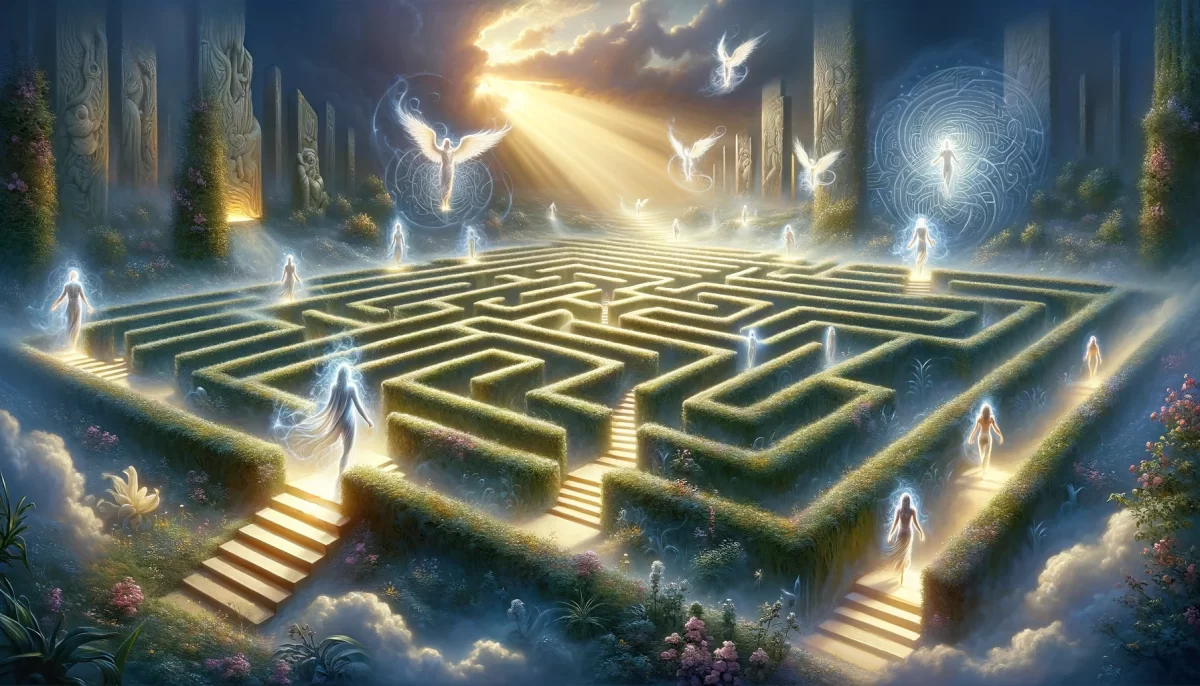
In the garden of existential thought, a poem blooms, reflecting on atheism’s place within our collective quest for understanding.
In the absence of eternity’s gaze,
We find ourselves wandering a labyrinth of days,
Where each step is marked by the pulse of the now,
And the divine is but a question of how.
Here, in the garden where beliefs intertwine,
Atheism stands, both stark and divine,
A reminder that in our human embrace,
Lies a universe vast, an existential space.
No gods to whisper the path we should tread,
Only the echo of choices we’ve made,
In this dance of the finite, we find our grace,
Embracing the moment, the human race.
Yet in this acceptance of life’s fleeting song,
A strength is found, both vibrant and strong,
For in the heart of absence, a presence is known,
The essence of being, uniquely our own.
We invite thoughts and reflections on atheism’s role in shaping our understanding of existence, suffering, and the human condition.



Leave a Reply