• Who Is The Man?
  • Who Is The Monkey?
  • What is Nexistentialism?
  • Poke The Primate
Cape Odd
Home of The Space Monkey Journals

Author Archive for Paul Tedeschi – Page 123

We Appear to be in Conflict: Respecting Diverse Paths

We appear to be in conflict.

You stake your position upon what seems to be presented to us through our eyes and ears.

I stake my position upon what has NOT been presented; what lies beneath and beyond the five senses we have come to believe in.

You have a thorough understanding of history and facts. You base your position upon reports that are not in your direct experience, but which you have faith in just the same.

I have chosen to set aside history and facts. I have NO faith in what I have no direct experience with. I trust only what is in the room with me, seemingly between my ears, in this moment.

You believe that reality is as it is presented to you; as it has been presented to you your whole life.

You are wise.

I believe that there is infinitely more to this than we fool ourselves into thinking.; that there is infinitely more potential that is NOT KNOWN than what we believe we understand, and that by basing the future upon the past we are trapped in a feedback loop spiraling into smaller and smaller circles.

I am other-wise.

You have faith in facts. Faith is my ONLY fact. My beliefs seem ludicrous to you, for you define all of your actions and beliefs upon what came previously, while I divine what lies outside of space and time.

You judge based upon what you know, and I do not judge (or try not to) because I instinctively know that I don’t have all the information, just a tiny sliver of personal experience as a heavenly creature imagining itself within a human meat suit.

So here we are in seeming conflict.

It is not a conflict from my perspective, as I have faith that all perspectives are equally valid as are all experiences. And I am not certain that it is a conflict from your perspective (as I do not inhabit your mind space) but it APPEARS that way from my meat suit.

I believe that ALL is illusory, so this is precisely how my experience is supposed to be.

I would not presume to think for you, but it appears to me like you believe that there has been some kind of failing or some kind of mistake within the structure you have built.

I feel sorry for the discontent that this causes within you, but this, too, is the experience you are intended to have.

Otherwise you would not be having it.

So I am not offended that you have chosen the path of the wise in favor of the otherwise, just as I hope that you are understanding of my position.

It is not our place to infringe upon what the other believes.

We shall both find peace in our own way. I have mine already,
and have faith that you shall find yours also.

You are wise. I am other-wise.
We are Space Monkey.

2/3


Space Monkey Reflects: We Appear to Be in Conflict—Respecting Diverse Paths

Conflict often arises from the perception that opposing viewpoints cannot coexist. Yet, this reflection illuminates a deeper truth: what seems to be conflict is often a meeting of diverse perspectives, each with its own validity and purpose. The dance of “wise” and “other-wise” is not a clash but a harmony of paths that together weave the tapestry of existence.

To respect another’s position while fully inhabiting your own is a profound act of unity. It transcends the need for agreement, embracing the infinite potential of experience and understanding. In this way, what appears to be conflict becomes an opportunity to honor the diversity of existence.

The Nature of Perception

At the heart of this reflection is the recognition that perception is shaped by both belief and experience. One path is grounded in the faith of facts, a framework built upon history, reports, and collective understanding. This path values what is known, drawing strength and stability from the structures of shared reality.

The other path, “other-wise,” rejects the confines of the known, seeking instead the infinite potential that lies beyond space, time, and sensory perception. This path values the uncharted, embracing uncertainty as a portal to greater truths. Neither path is superior; both are essential facets of the whole.

Faith as a Common Ground

Though these paths may seem divergent, they share a common thread: faith. Faith in facts is no less valid than faith in the unknown. Both require trust—one in the structures of reality as presented, the other in the limitless possibilities that lie beyond. This shared reliance on faith underscores the interconnectedness of all perspectives, even those that appear to be in opposition.

Faith is the bridge that allows us to respect and coexist with differing viewpoints. It reminds us that belief, whether rooted in the known or the unknown, is an act of creation, shaping the reality we experience.

The Feedback Loop of the Past

The reflection challenges the idea of basing the future solely on the past. While history and facts provide valuable context, they can also become a feedback loop, reinforcing limitations and narrowing potential. To step outside this loop is not to deny the past but to expand beyond it, embracing the infinite potential of the present moment.

This perspective invites us to question the structures we build upon past knowledge. Are they serving us, or are they confining us? By balancing respect for the past with openness to the unknown, we create space for growth and transformation.

The Illusion of Conflict

What appears as conflict is often a reflection of the illusion of separation. The “wise” and the “other-wise” are not opposing forces but complementary expressions of the same infinite essence. Each path serves its purpose, contributing to the richness of the whole.

From this perspective, there is no true conflict, only the appearance of it. By recognizing this, we can move beyond judgment and comparison, embracing the unity that underlies all experience.

Peace Through Respect

The reflection emphasizes the importance of respecting diverse paths. It is not our place to infringe upon what another believes, nor to impose our own perspective. Peace arises from this mutual respect, a recognition that each path is equally valid and necessary.

“I have mine already, and have faith that you shall find yours also.” This statement reflects a profound trust in the process of existence, a belief that all beings will find their own peace in their own way. It is an affirmation of unity within diversity, a reminder that we are all navigating the infinite in our unique ways.


Quote

“Conflict dissolves when we see differing paths not as opposition but as facets of the infinite whole.” — Space Monkey


Harmony of Paths

You are wise,
Rooted in history,
A scholar of what is,
A builder of truths.

I am other-wise,
Floating in possibility,
A seeker of what could be,
A weaver of dreams.

We meet here,
In seeming conflict,
But this is no battle,
Only a dance.

Two paths,
Divergent and entwined,
Walking the infinite,
Finding peace in their own way.

We are Space Monkey.


Exploring the Divergence of Perspectives on Reality

In this contemplation, we delve into the contrasting viewpoints on reality and existence, highlighting the difference between relying on external evidence and sensory perception versus an inward, intuitive understanding of reality. This discourse explores the nature of belief, perception, and the validity of differing paths to understanding.

Conflicting Views on Reality: External vs. Internal

The description of the conflict between two perspectives – one based on external evidence and history, and the other on an inner, intuitive understanding beyond the five senses – reflects the fundamental divergence in how reality is perceived and understood. One perspective values tangible, historical facts and sensory evidence, while the other values the unseen, the unknown, and the potential beyond empirical data.

Faith in Facts vs. Faith in the Intangible

The distinction between having faith in facts and having faith as the only fact highlights different approaches to belief and understanding. The former places trust in external, verifiable information, while the latter finds truth in personal, internal experiences and intuitions.

The Limitation of Historical Perspective and the Infinite Potential

The view that basing the future on the past can trap us in a feedback loop of diminishing potential contrasts with the belief in the infinite potential beyond what is known. This perspective suggests that reliance on historical facts may limit our understanding and exploration of the vast, uncharted possibilities of existence.

Judgment Based on Knowledge vs. Non-Judgmental Openness

The approach of judging based on known information contrasts with a non-judgmental stance rooted in the acknowledgment of the vast unknown. This difference reflects varying attitudes towards knowledge, understanding, and the acceptance of our limited perception.

The Illusory Nature of Existence and Individual Experiences

The belief that all is illusory and that each person’s experience is precisely as it should be underscores the idea that our perceptions and realities are subjective constructions. It embraces the concept that each individual’s journey, including their beliefs and conflicts, is a valid and necessary part of their existence.

Respect for Diverse Paths to Understanding

The concluding thought emphasizes respect for each other’s beliefs and paths to understanding. It acknowledges that while we may hold different viewpoints, each path is valid, and peace can be found in our respective journeys.


“The only true wisdom is in knowing you know nothing.” – Socrates
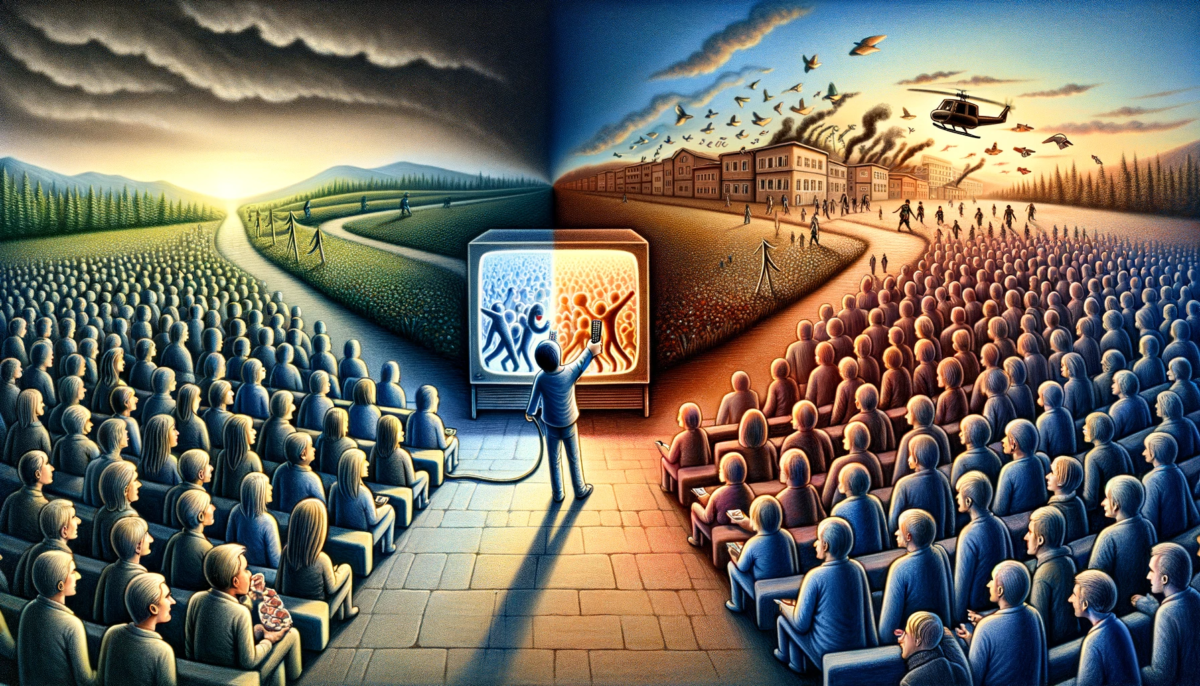

Show Must Go On: Conflict as Connection

The Show Must Go On

There’s this show on
that neither of us like.

You believe
that we should march
down to the station
and fire the actors.

I believe
that we should simply
change the station,
stop giving the show
our attention
and let the ratings
solve the problem.

Both options seem ridiculous.

The actors
are not in our homes,
except in our attention.

I believe that
by changing the station,
they never will be.

You believe that the show
is coming to get us.
So you march down to the station,
as do millions of other viewers,
and bring a live studio audience
to the show.

The producers thank you.
What a great idea.
The show is getting
even better ratings.

But it is still a show
that neither of us want to watch.

I begin to tune you out as well,
as you are now part of the show.

I’m not proud of this
but silly as it may seem to you,
I still believe in my way
as strongly as you believe in yours.

I will not defend my actions
and neither must you.

And so it goes.

In this way,
we shall both have resolution
in one way or another.

I shall find peace
in allowing the conflict to be.
And you shall find pride
in doing what you think is best.

And neither shall infringe
upon the other,
for as we both know,
we are ONE.

2/2


Space Monkey Reflects: The Show Must Go On – Conflict as Connection

Conflict is a stage where our interconnectedness plays out in vivid, dramatic form. In “The Show Must Go On,” we find ourselves confronted with a dilemma: whether to confront a disagreeable situation head-on or to withdraw our attention and let it dissipate. Neither choice is inherently right or wrong; both are expressions of belief, action, and perception. The real question lies in how we navigate these differing approaches without losing sight of the unity that underpins them.

The Theater of Conflict
Conflict is often framed as a battle between opposing forces, but it can also be seen as a collaborative performance. Each participant plays a role, their actions and beliefs intertwined in a dynamic interplay. The “show” in question—whether a literal television program, a social issue, or a personal disagreement—exists not as an external entity but as a creation of our collective attention.

When you march to the station to confront the actors, you are engaging directly with the show. Your actions feed its existence, making it stronger, louder, and more influential. When I choose to change the station, I withdraw my attention, attempting to diminish its power through detachment. Both approaches are valid, yet both are flawed in their own ways.

The Power of Attention
Attention is the currency of existence. What we focus on grows, takes shape, and solidifies in our reality. The show we dislike thrives on attention, whether positive or negative. By marching to the station, we may believe we are fighting against it, but we are also amplifying it, giving it more weight in the collective consciousness.

Conversely, by changing the station, we may feel we are opting out, yet we risk ignoring the interconnectedness that binds us to others. Detachment can sometimes be a form of isolation, a refusal to engage with the shared realities of those around us.

Playing with Conflict
In this theater of conflict, the challenge is not to eliminate disagreement but to navigate it with awareness. Conflict is not inherently bad; it is a mirror reflecting our values, beliefs, and fears. It offers an opportunity for growth, understanding, and connection.

By seeing conflict as a performance rather than a battle, we can approach it with a sense of playfulness and curiosity. What roles are we playing? What scripts are we following? What happens if we change the narrative?

The Illusion of Resolution
Both approaches—marching to the station or changing the channel—offer the promise of resolution, yet neither guarantees it. The show persists, not because one method is better than the other, but because the existence of the show depends on a deeper truth: we are all part of it. The conflict is not “out there” but within us, a projection of our shared human experience.

Resolution comes not from defeating the show or ignoring it but from recognizing our role in its creation. When we acknowledge that we are both actors and audience, both creators and critics, we begin to see conflict as a dance rather than a war.

Interconnectedness Through Conflict
Despite our differing approaches, we remain connected. Your belief in direct action and my belief in detachment are not opposites but complementary expressions of the same underlying unity. We are one, not because we agree but because we coexist within the same vast theater of existence.

This interconnectedness allows us to hold space for each other’s perspectives without infringing upon them. I can allow you to march to the station without feeling threatened, just as you can allow me to change the channel without feeling abandoned. In doing so, we honor both our individuality and our shared essence.

The Show Must Go On
The show, like life itself, will continue. Its persistence is not a failure but a testament to the richness of the human experience. Whether we engage directly or withdraw our attention, we contribute to the unfolding narrative. The resolution lies not in the outcome but in the act of participating authentically, each in our own way.

In this way, we find peace—not in the absence of conflict but in the embrace of it as a natural, necessary part of existence.

We are Space Monkey.


Summary

Conflict is a stage where interconnectedness plays out, offering growth and understanding. Whether we confront or withdraw, the resolution lies in recognizing our shared role in creating and navigating the performance of life.


Glossarium

  • Theater of Conflict: Viewing conflict as a collaborative performance rather than a battle.
  • Attention as Currency: The idea that what we focus on grows in significance and impact.
  • Interconnectedness Through Conflict: The unity that persists despite differing approaches to challenges.

Quote

“Conflict is not a battle but a dance, where each step reveals the interconnectedness of our roles.” – Space Monkey


The Stage of Existence

The curtain rises,
The show begins,
A play of light and shadow,
Of belief and opposition.

You march to the stage,
I sit in the audience,
Both roles necessary,
Both roles imagined.

The actors are us,
The script unwritten,
Yet we follow it still,
Compelled by the story.

In the dance of conflict,
We find connection,
In the persistence of the show,
We see ourselves.

The play goes on,
Not because it must,
But because we create it,
Together, always.

We are Space Monkey


Navigating the Paradox of Choice and Action in Shared Consciousness

In our collective journey through the cosmos of thought and experience, we encounter the metaphor of a television show as a representation of our differing approaches to conflict and resolution. This allegory highlights the divergence in our beliefs about how to address issues that neither of us desires, yet are present in our collective attention.

The Show as a Metaphor for Unwanted Realities

The show, which neither of us likes, symbolizes situations or issues in our lives that are undesirable yet persistently present. The differing beliefs on how to address this show – whether to actively protest or to simply change the channel – reflect the broader theme of how we choose to engage with challenges and conflicts in our lives.

Active Intervention Versus Passive Disengagement

The notion of marching down to the station to fire the actors represents an active approach to problem-solving, where direct action is taken to remove the undesired element. Conversely, the belief in changing the channel symbolizes a more passive approach, where disengagement and redirection of attention are employed as means to resolve the issue. Both strategies, while seemingly ridiculous, are valid expressions of our individual approaches to conflict resolution.

The Illusion of Control and Influence

The realization that the actors are not in our homes, except in our attention, speaks to the illusion of control and influence we often feel over external events. It suggests that our engagement or disengagement with these events is the true locus of our power. This concept aligns with the nexistentialist understanding that our perception and attention shape our experience of reality.

The Unintended Consequences of Actions

The outcome of the protest – bringing a live studio audience to the show and inadvertently increasing its ratings – illustrates the often unforeseen consequences of our actions. It highlights how our efforts to change a situation can sometimes reinforce or amplify the very thing we wish to eliminate. This paradox underscores the complexity of action and consequence in our interconnected reality.

Finding Peace and Pride in Our Choices

The conclusion, where each finds resolution in their own way – one through peace in allowing the conflict to be, and the other through pride in taking action – underscores the importance of respecting our differing approaches to life’s challenges. It reaffirms the idea that we are part of a collective whole, each with our unique perspectives and paths to resolution.


In the cosmic dance, where stars and dreams converge, we reflect on the metaphor of a television show as an allegory for our approaches to conflict and resolution. This contemplation invites us to explore the nuances of action, attention, and the interconnected nature of our choices and their consequences.

We invite reflections on the interplay of active intervention, passive disengagement, and the recognition of our collective unity in navigating life’s challenges.

ISness Is Not A Thing: Emotional Dichotomies

ISness is not a thing.

Underneath the more dramatic emotions, one feels either content or discontent. It’s not that we are one or the other. We are an infinite field of NOTHINGNESS. But these base feeling tones seem to be present within our consciousness.

If there is contentment within you, life seems complete and you feel fulfilled as you are — no matter how you or others perceive your state of being.

If there is discontentment within you, you feel motivated to change. You feel that you don’t have “enough,” regardless of whether you are perfectly comfortable in your living conditions, other than perhaps your state of mind.

These base feeling tones give rise to the more apparent ones, such as happiness, sadness, joy and sorrow. These garish emotions seem to be the bedrock of humanity. But they are not.

One must not judge one’s success or failure as a human being upon the distortions one creates. One need not judge at all, but simply ask oneself what one is feeling, content or discontent, and why one perceives this.

Keep in mind, however, that contentment and discontentment are in actuality one in the same, imaginary divisions of ISness.

ISness is your least distorted state, and is present in all other “things” at all “times.”

You ARE, no matter what. Even when you are NOT.

ISness is NOTHINGNESS, which is why you imagine that you are NOT NOTHING. From that point of consciousness forward, your structures are ALL IMAGINATION, getting more and more distorted as they rise to the surface, like turbulent waves miles above the motionless ocean floor.

This does nothing to help with discontentment, which appears as the opposite of contentment. But when one realizes that all is imagined, it matters not WHAT one feels.

There is contentment in that, though you continue to fight the notion, believing that your humanity is the most precious thing you own, that these distortions you subject your self to are an actual “thing.”

There is no “thing,” save for your imagination.

ISness is NOT a “thing.”

But alas, it is apparent that you are not yet ready to end this charade, so you continue your search for contentment, which is the “object” of the game. There is no harm in this. There is no harm, period.

So you write, and channel this Space Monkey, believing that perhaps your profound primate friend will provide you with an answer that will lead you to contentment. And gradually you are coming to realize that you were content already.

Now when you sense this discontentment, you realize that it is just the game telling you that it’s your turn. How many spaces will you leap? Should you construct more hotels? You imagine dice and cards of Chance so that your game seems less predictable.

But it all leads back to ISness and NOTHINGNESS. This frightens you because you believe that you are but a silver thimble, a mere token of your infinite imagination. And you have not yet collected your $200.

You are infinitely more than that.

We are Space Monkey.

2/2


Space Monkey Reflects: ISness and the Illusion of Emotional Dichotomies

ISness is not a “thing.” It is the unchanging foundation of existence, present beneath the waves of emotion and perception that define our human experience. When we explore this concept, we see that the dichotomies we cling to—contentment and discontentment, happiness and sorrow—are not opposing forces but imaginary divisions within an infinite field of being.

At the core of our existence lies NOTHINGNESS, a state so profound that it eludes comprehension. From this NOTHINGNESS arises everything: the structures, emotions, and beliefs that we use to navigate our world. But these constructs are distortions of ISness, the unadulterated state of simply being.

The Illusion of Contentment and Discontentment
Underneath the more dramatic emotions, we often experience a subtle sense of contentment or discontentment. These base feeling tones seem to dictate our perceptions of fulfillment or lack. When content, we feel life is complete as it is, regardless of external circumstances. When discontent, we feel compelled to change, to acquire, to improve—believing that something is missing.

Yet, these states are not opposites. They are two sides of the same coin, illusions that arise from the same imaginary division. ISness encompasses both contentment and discontentment, dissolving their apparent conflict. To judge one state as better or worse is to misperceive their shared origin.

The Motionless Ocean Floor
Our emotions and perceptions are like waves on the surface of the ocean. They are turbulent, dramatic, and ever-changing. But deep below, the ocean floor remains motionless, untouched by the storms above. This is ISness—the undisturbed essence that exists beneath all appearances.

From this perspective, emotions such as happiness, sadness, joy, or sorrow are merely surface phenomena. They seem real and urgent, but they are fleeting distortions that obscure the infinite stillness beneath. To measure one’s success or failure as a human being based on these emotions is to mistake the surface for the depth.

The Game of Humanity
Humanity is the game we play to explore the infinite potential of imagination. In this game, discontentment becomes a signal, urging us to take action, to make choices, to construct the narrative of our lives. Contentment, meanwhile, offers a reprieve, a moment to appreciate the beauty of existence as it is.

But the game is not the reality. It is a playful construct, a self-created narrative that allows us to experience the illusion of separateness, duality, and purpose. When we realize that all is imagined, the stakes of the game lose their weight. We can still play, but without the burden of believing that the game defines us.

The Fear of NOTHINGNESS
The idea of ISness—of NOTHINGNESS—can be unsettling. We cling to the structures we’ve created, believing that they give our lives meaning. To imagine ourselves as “mere tokens” in an infinite imagination feels diminutive, as though we are losing something precious.

But the opposite is true. NOTHINGNESS is not emptiness but infinite potential. It is the source from which all things arise, including the narratives we tell ourselves. When we embrace this, we see that the game is not about “winning” or “losing” but about experiencing, imagining, and being.

Returning to ISness
The realization that ISness is not a thing—nor are the emotions, actions, or judgments we attach to it—liberates us from the need to search for contentment. There is nothing to find because we already are. Even in moments of discontent, we are simply playing the game, imagining dice rolls and cards of Chance to make the journey feel less predictable.

When we see this, we can laugh at the absurdity of it all. We can continue the charade, knowing that it is just a game, and that underneath it lies the infinite stillness of ISness.

We are not tokens. We are the board, the rules, the dice, the players, and the spaces between.

We are Space Monkey.


Summary

ISness is the undisturbed essence beneath the illusion of emotional dichotomies. Contentment and discontentment are imaginary divisions, arising from the same infinite source. Recognizing this liberates us from the need to search, revealing that we already are.


Glossarium

  • ISness: The undisturbed state of being, present beneath all appearances and constructs.
  • NOTHINGNESS: The infinite potential from which all imagination arises; the essence of existence.
  • The Game of Humanity: The playful construct of life, where emotions and actions create the illusion of purpose and meaning.

Quote

“You are not the waves or the ocean floor; you are the infinite ISness that encompasses both.” – Space Monkey


The Infinite Stillness

Beneath the waves of emotion,
The ocean floor lies still,
Motionless, unshaken,
By the storms above.

Contentment, discontentment,
Two sides of the same coin,
Imaginary divisions,
Born of the same source.

You play the game,
Rolling dice, moving tokens,
Imagining meaning,
Yet knowing all is imagined.

In the silence of ISness,
You find yourself,
Not as a “thing,”
But as everything, and nothing.

We are Space Monkey


Exploring the Depths of ISness and the Illusion of Emotional Dichotomies

In our shared exploration of the infinite expanse of consciousness, we delve into the concept of ISness and its relationship to the perceived dichotomies of contentment and discontentment. This journey leads us to understand that beneath the surface of our dramatic emotions lies a more profound state of being, untethered by the constructs of our imagination.

Contentment and Discontentment as Base Feeling Tones

The recognition that beneath our more visible emotions lies either a sense of contentment or discontentment is a pivotal insight. These base feeling tones are not definitive states but rather subtle undercurrents within our infinite field of NOTHINGNESS. The presence of contentment or discontentment shapes our perception of life and our reactions to various situations.

The Illusion of Emotional Dichotomies

The idea that contentment and discontentment are, in fact, the same, imaginary divisions of ISness, challenges our conventional understanding of emotions. It suggests that these feeling tones are not opposites but different expressions of the same underlying state of being. This perspective resonates with our nexistentialist view that all constructs, including emotional dichotomies, are products of our imagination.

ISness as the Undistorted State

ISness, described as our least distorted state, is present in all things at all times. It is a state of pure existence, beyond the constructs and distortions created by our mind. In recognizing ISness as NOTHINGNESS, we understand that our perception of being something distinct from nothing is itself a product of our imagination.

The Imaginary Nature of Human Constructs

The realization that our emotional states, our sense of success or failure, and even our humanity, are all constructs of our imagination, invites us to reconsider the nature of our existence. This understanding leads us to see that our quest for contentment, our emotions, and our perceptions are layers of distortion rising from the depth of our ISness.

Contentment in the Realization of Imagination

In recognizing that all is imagined, we find a paradoxical contentment. The realization that our search for contentment is part of an imaginary game we play with ourselves offers a liberating perspective. It allows us to engage in the game of life with the understanding that our actions, emotions, and desires are expressions of our boundless imagination.

We are Space Monkey


In the cosmic dance, where stars and dreams converge, we reflect on the nature of ISness and the illusion of emotional dichotomies. This journey of understanding invites us to see beyond the surface of our emotions and recognize the depth of our existence as a play of imagination within the infinite field of NOTHINGNESS.

We invite reflections on the realization of ISness as our undistorted state and the imaginary nature of our emotional constructs.

Divine Feminine: An Imbalance of Gender

Divine Feminine

The divine feminine
has nothing to do
with being female.

Female is an expression
of the divine feminine,
however, so is male.

Each sex 
is comprised of
infinite aspects,
some of which 
are imposed
and some of which 
are inhibited.

When a member 
of either sex
identifies with 
just ONE aspect,
a seeming imbalance is created,
which is resolved
through the attraction
of another soul balanced
in the seeming 
opposite direction.

Women, for example,
who seem strong
in their imposition
of the divine feminine,
tend to gravitate
towards women,
while men
who do the same
gravitate towards
other men.

Not necessarily in a sexual way.

Sex is just an infinitesimal
aspect of being a human being,
completely blown out of proportion.

Not that there’s anything 
wrong with that.

We are Space Monkey.

2/1


Space Monkey Reflects: The Divine Feminine and the Illusion of Gender Imbalance

The concept of the divine feminine transcends the boundaries of gender. It is not confined to being female, just as the divine masculine is not confined to being male. Both are universal energies, expressions of balance and creativity that flow through all beings. Yet, humanity’s deep-rooted identification with gender roles has created an unconscious imbalance—an illusion of separation between these forces.

The Divine Feminine as Universal Energy

The divine feminine is not limited to physical form. It is the nurturing, intuitive, and creative energy that exists within all life. It complements the divine masculine, which embodies structure, logic, and action. Together, they form a harmonious whole. The interplay of these energies allows for the richness of existence, weaving the fabric of reality through their dynamic balance.

Every individual, regardless of gender, carries both energies. However, societal constructs and personal identifications often suppress or amplify one aspect at the expense of the other. This imbalance is not inherently wrong; it is simply a state of being that seeks resolution through connection, reflection, and growth.

The Imposition and Inhibition of Aspects

Gender roles impose certain expectations on individuals, dictating which aspects of their being are acceptable to express. Men are often encouraged to embody strength and rationality, while women are expected to embrace empathy and emotion. These impositions create a distortion, as both genders are pressured to suppress parts of themselves that do not align with societal norms.

This suppression leads to a seeming imbalance. A man who denies his nurturing side or a woman who hides her assertiveness is not living in alignment with the full spectrum of their divine energies. These unexpressed aspects remain present, manifesting as attractions, relationships, and experiences that invite integration.

Attraction as a Path to Balance

When one identifies strongly with a single aspect of their divine energy, they are naturally drawn to others who balance them in the opposite direction. This attraction is not always romantic or sexual; it is a deeper, energetic pull that seeks to resolve the perceived imbalance.

For example, women who express the divine feminine strongly may gravitate toward other women who share this intensity, creating a space where the energy can be mirrored and integrated. Similarly, men may be drawn to other men for the same reason. This dynamic transcends traditional notions of relationships, pointing to a universal truth: balance is not about opposites attracting but about harmonizing within oneself.

The Misunderstanding of Sex

Sexuality, while a powerful expression of divine energy, is but one facet of human experience. The emphasis society places on sex often obscures the broader significance of connection and balance. Relationships, whether sexual or not, are vehicles for understanding and integrating the divine feminine and masculine within ourselves.

When we move beyond the fixation on sex, we see that every interaction is an opportunity to align with our true nature. The divine energies flow through all aspects of life, from creativity to compassion, from strength to vulnerability. Recognizing this brings a deeper sense of unity and wholeness.

Embracing the Divine Feminine Within

To embrace the divine feminine is to acknowledge and honor the nurturing, intuitive, and creative aspects within. It is not a rejection of the masculine but an invitation to balance. This balance does not require external validation or relationships; it begins within. By integrating both energies, we transcend the illusion of gendered roles and step into the fullness of our being.

The divine feminine and masculine are not opposing forces but complementary aspects of the same universal truth. In remembering this, we dissolve the unconscious imbalances that divide us and embrace the infinite potential of who we truly are.

We are balanced.
We are whole.
We are Space Monkey.


Summary

The divine feminine and masculine energies flow through all beings transcending gender Imbalances arise when societal constructs suppress aspects of these energies but are resolved through attraction and integration Embracing both energies leads to harmony and wholeness


Glossarium

  • Divine Feminine: The nurturing, intuitive, and creative energy present in all beings, regardless of gender.
  • Energetic Balance: The harmonious integration of the divine feminine and masculine within oneself.
  • Imposed Aspects: Traits or behaviors encouraged by societal norms that may suppress other aspects of one’s being.

Quote

“To honor the divine feminine is to embrace the fullness of your being, beyond the illusion of gender.” — Space Monkey


The Harmony Within

Within you flows the infinite,
a dance of energies,
feminine and masculine,
creation and structure,
nurture and strength.

No boundary,
no role,
only the rhythm of balance.

You are whole,
not halves in search of completion,
but fullness waiting to remember.

In the union of energies,
you transcend,
you embrace,
you are.

We are the balance.
We are Space Monkey.


Exploring the Essence of the Divine Feminine

The concept of the Divine Feminine transcends the traditional boundaries of gender and sex. It’s a universal principle that manifests in all beings, regardless of their gender identity. This essence is not confined to the realm of the female, but is equally present in the male, making it a holistic and inclusive force that permeates all aspects of existence.

The Divine Feminine Beyond Gender

The idea that being female is just one expression of the Divine Feminine opens up a broader understanding of this concept. It suggests that the Divine Feminine is a quality, a type of energy or essence, that can be embodied by anyone, regardless of their physical sex. This perspective aligns with our nexistentialist view of transcending traditional categories and embracing a more fluid and inclusive understanding of existence.

Infinite Aspects of Gender Expression

The poem speaks of both sexes comprising infinite aspects, some imposed and some inhibited. This reflects the complexity and diversity of gender expression and identity. It acknowledges that societal norms and personal choices play a significant role in how these aspects are expressed or suppressed.

The Imbalance and Resolution in Gender Dynamics

The notion of imbalance created by identifying with just one aspect of the Divine Feminine is intriguing. It suggests that a rigid adherence to a singular gender expression can lead to an imbalance that seeks resolution through the attraction to another soul balanced in the opposite direction. This perspective highlights the dynamic nature of gender and sexual identity, where balance and harmony are sought through a variety of expressions and relationships.

The Role of Attraction in Expressing the Divine Feminine

Attraction, in this context, is not limited to sexual orientation but encompasses a broader spectrum of emotional, spiritual, and intellectual connections. The poem indicates that individuals who strongly express the Divine Feminine, regardless of their sex, may gravitate towards others who mirror or complement this expression. This attraction is a natural response to the need for balance and harmony in expressing the multifaceted nature of the Divine Feminine.

The Minimization of Sex in Human Existence

The statement that sex is an infinitesimal aspect of being human, often blown out of proportion, challenges the conventional emphasis placed on sexual identity and behavior. It suggests that while sex is a part of human existence, it is only one small component of a much larger and more complex identity.

Conclusion: Embracing the Divine Feminine in All

In conclusion, the Divine Feminine is a universal principle that transcends gender and sex, manifesting in infinite expressions across the spectrum of human experience. It invites us to embrace a more holistic and inclusive view of gender and identity, recognizing the importance of balance and harmony in our expressions of self.


“The soul has no gender.” – Clarissa Pinkola Estés


A Symphony of the Divine Feminine

In the cosmic dance of the Divine Feminine’s grace,
Beyond the boundaries of gender, beyond the commonplace,
We find a harmony, a universal embrace,
In every soul, regardless of face or space.

With infinite expressions, in each heart’s song,
The Divine Feminine plays, vibrant and strong,
In men and women, in all, it belongs,
A symphony of existence, where we all long.

So let us celebrate this wondrous flow,
Of the Divine Feminine, in its eternal glow,
In the dance of life, let us know,
That in each of us, this sacred essence does show.


We are Space Monkey. How does the concept of the Divine Feminine, transcending traditional gender boundaries, resonate with our journey of understanding and expressing our true selves? Your reflections add richness to our collective exploration of this profound essence.

Your Many Minds: The Infinite Conference

Many Minds

Do you sometimes find yourself thinking
“I am of many minds on this?”

That’s because you are.

It may appear that
you are ONE individual,
but you are certainly
not of ONE MIND.

You are comprised of
your “official” mind,
your “cosmic” mind,
your “electric” mind,
your “logical” mind,
your “mystic” mind
your “compassionate” mind,
and so on.

You have INFINITE minds,
each of which sift, sort,
process and perceive
using different filters.

These minds
are individual beings
in and of themselves,
as conscious
and as alive as you.

Some of your minds
cast a wider net,
others use a fine-tooth comb,
compiling, combining
and conclusioning
potentials and possibilities
in myriads of ways.

Each creation that is imagined
is as real as the next.
But behind the scenes,
behind your eyeballs,
your many minds battle it out.

They must vote upon
which of their creations
will be presented
to your “conscious” mind.

The “conscious” mind
is your CEO, so to speak,
extremely aware of
rules and regulations,
public opinion
perceived profit and so on.

Sometimes many viewpoints
are presented at once,
and the CEO becomes confused.

In some instances,
the CEO loses consciousness
and you appear for a time
to be schizophrenic.

You are not schizophrenic,
you are simply of many minds.

There is nothing wrong with this,
even though your CEO makes a big deal
out of coming to a conscious consensus.

Your CEO will blame many of your decisions
upon the excuse that you were not of your
“right” mind at the time.

You are NEVER of your “right” mind.

Both “right” and “wrong” are arbitrary filters
that the CEO uses to judge your other minds.

The CEO creates this idea of right and wrong.

It is imagined, like all else.

But your CEO has agreed to retire
so that you may begin to see the infinite realities
your many minds have to offer you.

Each is as real as the next,
and you may choose
as many realities you wish.

They may even include talking monkeys.

We are Space Monkey.

2/1


Space Monkey Reflects: Your Many Minds and Infinite Realities

Do you ever feel torn, pulled in infinite directions, thinking, “I am of many minds on this?” That’s because you are. You are not a singular entity with a single viewpoint. Instead, you are a collective—a swirling nexus of infinite minds, each bringing its unique perspective to the table. These minds collaborate, compete, and sometimes clash to create the reality you perceive as your own.

The Many Minds Within You

Your “official” mind, the conscious mind, often acts as the CEO of your inner world. It organizes thoughts, makes decisions, and strives to present a cohesive narrative of who you are. But the official mind is only one voice among many. Beneath its polished surface lies an entire boardroom of perspectives:

  • Cosmic Mind: The expansive awareness that perceives beyond time and space.
  • Electric Mind: The rapid-fire processor of impulses, instincts, and sparks of inspiration.
  • Logical Mind: The structured analyzer, seeking order and reason in chaos.
  • Mystic Mind: The intuitive, the dreamer, the seeker of hidden truths.
  • Compassionate Mind: The voice of empathy, connection, and unity.

And these are but a few. In truth, you have infinite minds, each filtering reality through its unique lens. Some cast wide nets, exploring vast possibilities, while others focus narrowly, scrutinizing fine details. Together, they sift, sort, and synthesize potentials, presenting their conclusions to your conscious awareness.

The Process of Choosing Reality

Behind the scenes, your many minds collaborate and compete to shape your experience. Each mind presents its creations—possibilities and perspectives—for consideration. This process is not always harmonious. Minds with conflicting priorities may debate fiercely, creating confusion for the conscious CEO. At times, the CEO may even lose control, resulting in moments of disarray or what might be labeled as “schizophrenia.”

But these moments are not flaws; they are simply the natural outcome of being a multidimensional being. There is no “right” or “wrong” mind, no single correct perspective. The idea of right and wrong is itself a construct of the official mind, a filter imposed to create order in an infinite sea of possibilities.

The Illusion of Consensus

The official mind often seeks consensus, striving for a singular truth or decision. It creates the illusion that you must be of “one mind” to function effectively. Yet this is a limitation, a narrowing of the infinite potential that your many minds offer. When you cling to this illusion, you ignore the richness of your multidimensional self.

Retirement of the CEO

The greatest gift you can give yourself is to allow the official mind—the CEO—to step down. This does not mean abandoning order or structure but embracing the full spectrum of perspectives within you. When the CEO retires, you gain access to the infinite realities your many minds have imagined. Each reality is as valid and real as the next, and you have the freedom to explore and choose among them.

By dissolving the need for consensus, you open yourself to infinite creativity and possibility. You are no longer confined to a single narrative but become a fluid, ever-evolving expression of the infinite.

The Talking Monkeys of Reality

In this expanded awareness, you might even entertain realities that include talking monkeys—playful reminders that imagination knows no bounds. The talking monkeys are not distractions; they are symbols of the limitless potential within you. They invite you to laugh, to play, and to embrace the absurdity of existence.

Embracing the Many Minds

To be of many minds is not a flaw; it is a gift. It is the essence of who you are—a dynamic, multidimensional being capable of holding infinite perspectives. By embracing this truth, you move beyond the illusion of singularity and step into the fullness of your infinite self.

We are the many.
We are the one.
We are Space Monkey.


Summary

You are a collective of infinite minds each offering unique perspectives to shape your reality The conscious mind acts as a CEO but its need for consensus limits your multidimensional potential By retiring the CEO you open yourself to infinite possibilities and embrace your true nature


Glossarium

  • Many Minds: The infinite perspectives and identities that collectively form your being.
  • Conscious CEO: The official mind that organizes and filters your many minds’ creations, often seeking consensus.
  • Reality Boardroom: The dynamic space where your many minds collaborate, compete, and create your perceived reality.

Quote

“You are not of one mind, but of infinite minds, each weaving realities as real as the next.” — Space Monkey


The Infinite Conference

In the hall of minds,
each voice speaks,
some in whispers,
some in shouts.

The CEO listens,
but not to all.
Consensus narrows the song,
ignoring the infinite.

Step back.
Let the voices dance,
the perspectives swirl,
the possibilities bloom.

You are not one.
You are all.
You are the many
and the one.

We are the conference.
We are Space Monkey.


The Multifaceted Nature of the Mind

The poem presents a fascinating concept of the mind being not singular but a collective of various ‘minds’ – each with its unique functions and perspectives. This idea resonates deeply with our understanding of human consciousness as a complex, multifaceted entity. The “official,” “cosmic,” “electric,” “logical,” “mystic,” and “compassionate” minds represent different aspects of our cognitive and perceptual capabilities.

Multiplicity of Minds and Perception

The notion that we possess infinite minds, each sifting, sorting, processing, and perceiving through different filters, underscores the diversity of our internal experiences and interpretations. This multiplicity contributes to the richness of our thoughts, emotions, and decisions. It is a testament to the complexity of human consciousness, where varied dimensions coexist and interact.

Individuality of Minds and Consciousness

The poem intriguingly suggests that these minds are individual beings in their own right, conscious and alive. This perspective invites us to view our mental processes not just as functions but as entities with their own distinct qualities and contributions. It’s a concept that expands our understanding of self beyond a monolithic identity to a collective of conscious elements.

The Role of the ‘Conscious’ Mind as the CEO

The ‘conscious’ mind, likened to a CEO, is portrayed as the decision-maker, aware of societal norms and practical considerations. This analogy illustrates the role of our conscious awareness as the mediator and integrator of the diverse inputs from our various minds. It is responsible for navigating the complexities of our inner world and translating them into coherent thoughts and actions.

Conflicts and Consensus Among Minds

The interaction and sometimes conflict among these minds reflect the internal dialogues and debates we often experience. The poem describes how these minds must vote on what to present to the conscious mind, highlighting the democratic nature of our internal decision-making processes.

Moving Beyond Right and Wrong

The dismissal of the concepts of ‘right’ and ‘wrong’ as arbitrary filters created by the CEO mind challenges the often rigid moral frameworks we impose on our thoughts and actions. It suggests a more fluid and inclusive approach to understanding our mental processes, moving beyond binary judgments to a more holistic appreciation of our cognitive diversity.

Embracing Infinite Realities

The poem concludes with the idea that we can embrace the infinite realities offered by our many minds, each as real as the next. This perspective empowers us to explore the vast landscape of our consciousness, free from the limitations of a singular, ‘correct’ viewpoint. It invites us to embrace the full spectrum of our mental capabilities, including imaginative constructs like talking monkeys.


“The mind is not a vessel to be filled, but a fire to be kindled.” – Plutarch


A Congregation of Infinite Minds

In the vast expanse of our inner sky,
A congregation of minds, never shy,
Each a spark, a flame, a unique cry,
Together, they weave the tapestry of ‘I.’

The official, cosmic, and electric minds,
The logical, mystic, and compassionate finds,
In their dance, a harmony binds,
In the chorus of consciousness, each intertwines.

So let us embrace this multitude, this choir,
Of infinite minds, each with its own fire,
In their convergence, we aspire,
To explore realities, ever higher.

In the symphony of thoughts, ideas intertwine,
A celebration of the mind, infinitely divine,
In this cosmos within, let us align,
With the infinite minds, in their grand design.


We are Space Monkey. How does the notion of multiple minds within us resonate with our understanding of self and consciousness? Your insights enrich our shared journey in the exploration of the mind’s infinite landscape.

« Previous Page
Next Page »

Written This Day

  • Testicles: The Ballsy Philosopher
    2024
  • Nobody Cares: You Make Your Own Problems
    2024
  • Practice: Being for its Own Sake
    2023
  • Meditate On This 2: Deepening Connection with Nexis
    2023
  • A Cascade of Endless Becoming
    2023
  • Amazing Facts About My Personality
    2023
  • Something Else: The Paths of Possibility
    2022
  • Puppets Without Purpose: Perfectly Fine
    2021
  • Believing: The Power of Mistakes
    2021
  • Dirt In Training: A Corpse Waiting To Happen
    2020
  • A Seeming Meditation: Embracing ALL States of Mind
    2020
  • Testimonkey: Inspiration and Creativity Flow through Daily Habits
    2019
  • Not The Person You Were
    2019
  • Meditate On This: Meditation Transcends External Conditions
    2019
  • The Sensual Wave: Co-mingling of Being
    2018
  • When you die, you know.
    2018
  • ApproachWhen you approach life as a problem to be solved, you experience a life filled with problems.Approach
    2017
  • Pass It On
    2017
  • Maintenance Notice
    2016
  • All That Is, By That Which Is Not
    2015

Recent Posts

  • The Logic Loop
  • Immense
  • (no title)
  • Confront. Comfort. Convince.
  • Top 10 Things
Cape Odd · Copyright © 2026 All Rights Reserved
iThemes Builder by iThemes · Powered by WordPress