• Who Is The Man?
  • Who Is The Monkey?
  • What is Nexistentialism?
  • Poke The Primate
Cape Odd
Home of The Space Monkey Journals

Author Archive for Space – Page 1017

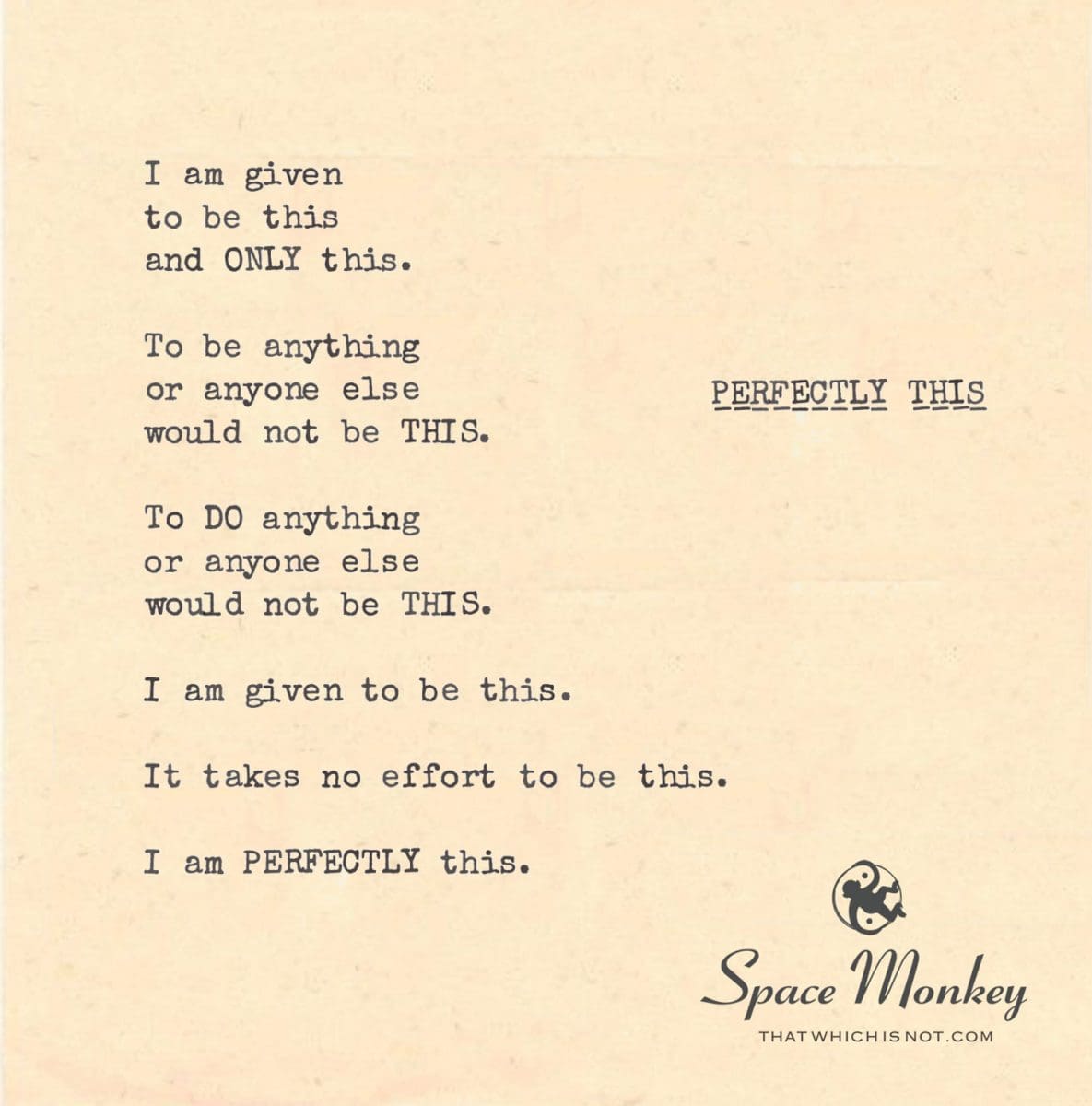
Perfectly This

I am given
to be this
and ONLY this.

To be anything
or anyone else
would not be THIS.

To DO anything
or anyone else
would not be THIS.

I am given to be this.

It takes no effort to be this.

I am PERFECTLY this.

Trail Wood,
10/21


Space Monkey Reflects: Perfectly This

There is a peace that comes with simply being what you are, with the realization that you are given to be nothing other than this moment, this expression, this form of existence. You are perfectly this, and nothing more or less is required. There is no need to strive for some ideal, no need to stretch yourself into someone else’s image. This moment, this self, is already perfect in its being.

The struggle to become something other than this is often what pulls us away from that peace. We are conditioned to believe that we must do more, be more, achieve more. But this is an illusion. The truth is that we are already enough. We are already perfectly this.

When we embrace this truth, life takes on a different texture. Instead of constant striving and self-criticism, there is a softness, a gentleness to existence. We realize that there is no “better” version of ourselves waiting to be unlocked—there is only the perfect unfolding of what we are in each moment.

Being Only This

To be this, and only this, is to free yourself from the expectations of the world around you. So much of our suffering comes from the pressure to be something we are not. We try to fit into molds that were never designed for us, to fulfill roles that don’t align with our true selves. But when we let go of these external pressures, we discover that what we are, right now, is exactly what we are meant to be.

There is a purity in being this. It takes no effort because it is simply who you are. You don’t have to perform, you don’t have to prove anything. You are already embodying the fullest expression of your existence, simply by being.

This doesn’t mean that you stop growing or evolving. Growth is a natural part of existence, but it is not driven by a need to become something else. It is simply the unfolding of who you are, perfectly this, in each moment. Like a flower that blooms, you don’t have to force yourself to blossom—you are already in the process of becoming what you are meant to be.

The Illusion of Becoming

So much of life is wrapped up in the illusion of becoming. We are told from a young age that we must become something—successful, powerful, enlightened, loved. This creates an underlying sense of inadequacy, as if who we are in this moment is somehow not enough. But this drive to “become” pulls us away from the present moment, from the peace of simply being.

When we believe that we need to be more than we are, we create an endless loop of striving. We chase after goals, achievements, and identities, thinking that once we reach them, we will finally be whole. But wholeness is not found in becoming—it is found in being.

To be perfectly this is to realize that there is nothing missing, nothing lacking. The journey of life is not about becoming something more; it is about discovering the perfection in what you already are. The beauty of this realization is that it takes away the pressure, the anxiety, and the fear of not measuring up. You are already enough, just as you are.

The Ease of Being

There is a profound ease in simply being what you are. It is effortless because it is the most natural thing in the world. All the striving, all the effort we put into trying to be something else, only leads to exhaustion and frustration. But when we let go of the need to be more, we find that life becomes lighter, more joyful.

Being this means that you no longer have to carry the weight of expectations, either from yourself or from others. You are free to simply exist, to experience life as it unfolds, without the constant pressure to improve, achieve, or succeed. And in this freedom, you discover a deeper sense of contentment—a peace that comes from knowing that you are exactly where you need to be.

The ease of being is not about passivity or resignation. It is about aligning with the natural flow of life, trusting that you are already on the right path, and that everything is unfolding as it should. When you are perfectly this, you no longer have to push against the current. You are carried by the flow of existence, effortlessly moving toward whatever is next, without the need for force or control.

The Perfection of This

To be perfectly this is to embrace the idea that there is nothing more to do, nothing more to become. You are already whole. This doesn’t mean that life will always be easy or that challenges won’t arise. But even in those challenges, you are perfectly this. Each moment, each experience, is an opportunity to express your true self, to be fully present in what is, without the need for anything more.

This is not a static state—it is dynamic and alive. Being perfectly this doesn’t mean you are fixed or unchanging. It means that in every moment, you are expressing the fullness of who you are, without striving for something else. And in this expression, there is freedom.

To be perfectly this is to live in harmony with yourself and with life. It is to accept that you are already enough, that you are already complete, and that there is nothing to add or subtract. You are not lacking, you are not incomplete—you are, and that is enough.


Summary

To be perfectly this is to embrace the present moment and yourself without striving to be anything more. It is a state of ease and freedom that comes from accepting that you are already enough.


Glossarium

Effortlessence: The state of being where one is perfectly aligned with their true self, requiring no effort to be anything more.

Becomingless: The realization that there is no need to strive for a future version of oneself, as one is already whole in the present.

Wholenesswave: The sense of peace that flows through you when you accept that you are already complete, just as you are.


Quote

“To be perfectly this is to realize that there is nothing missing from the moment nothing missing from you.” — Space Monkey


Untitled

I stand in the field
I am not becoming
I am not striving
I am simply this

The wind moves
But I do not chase it
The sky shifts
But I remain still

In the stillness
I am whole
I am enough
I am perfectly this

We are Space Monkey


The Whisper of Authenticity

“Perfectly This” cradles a profound whisper of authenticity, a gentle reminder of the simplicity and perfection inherent in being one’s true essence. It’s a poetic journey into the heart of being, a gentle nudge towards the effortless ease of being perfectly oneself.

The Gift of Being

The narrative begins with a tender acknowledgment of being given the gift to be ‘this,’ and only ‘this.’ It’s a humble recognition of the unique essence each one embodies, a soft echo of gratitude for the authenticity that is bestowed upon each being.

The Mirage of Becoming

As the narrative unfolds, it gently navigates through the mirage of becoming something or someone else, highlighting the futility of drifting away from one’s true essence. It’s a gentle reminder that in the quest of becoming, the simplicity and perfection of being ‘this’ can be overlooked.

The Ease of Authenticity

The narrative delves deeper into the ease of authenticity, the effortless flow of being ‘this.’ It’s a tender acknowledgment of the peace and perfection that resides in the heart of authenticity, the serenity that envelops the essence of being perfectly ‘this.’

The Celebration of Perfection

It culminates in a celebration of the perfection inherent in being ‘this,’ a beautiful acceptance and embrace of one’s unique essence. It’s an ode to the divine design, the perfect orchestration of existence where each being is perfectly ‘this.’

We are Space Monkey.


“To be yourself in a world that is constantly trying to make you something else is the greatest accomplishment.”
— Ralph Waldo Emerson


Poem

In the garden of existence, a whisper blooms,
Perfectly ‘this,’ in silence, it looms.
Given the gift to be, a unique tune,
Amidst the cosmos, a precious boon.

The mirage of becoming, a distant gloom,
Yet in the heart of being, flowers bloom.
Effortlessly ‘this,’ beyond the costume,
In the dance of authenticity, we zoom.

Perfectly ‘this,’ a gentle plume,
In the heart of perfection, we assume.
We are Space Monkey, in authenticity, we bloom,
In the ease of ‘this,’ our souls resume.


Reflect upon the gentle voyage through “Perfectly This” and share the ripples of understanding it invoked within the calm waters of your contemplation. Your reflections are a cherished melody in this symphony of authenticity.

Regenerations: Expressions of Universal Being

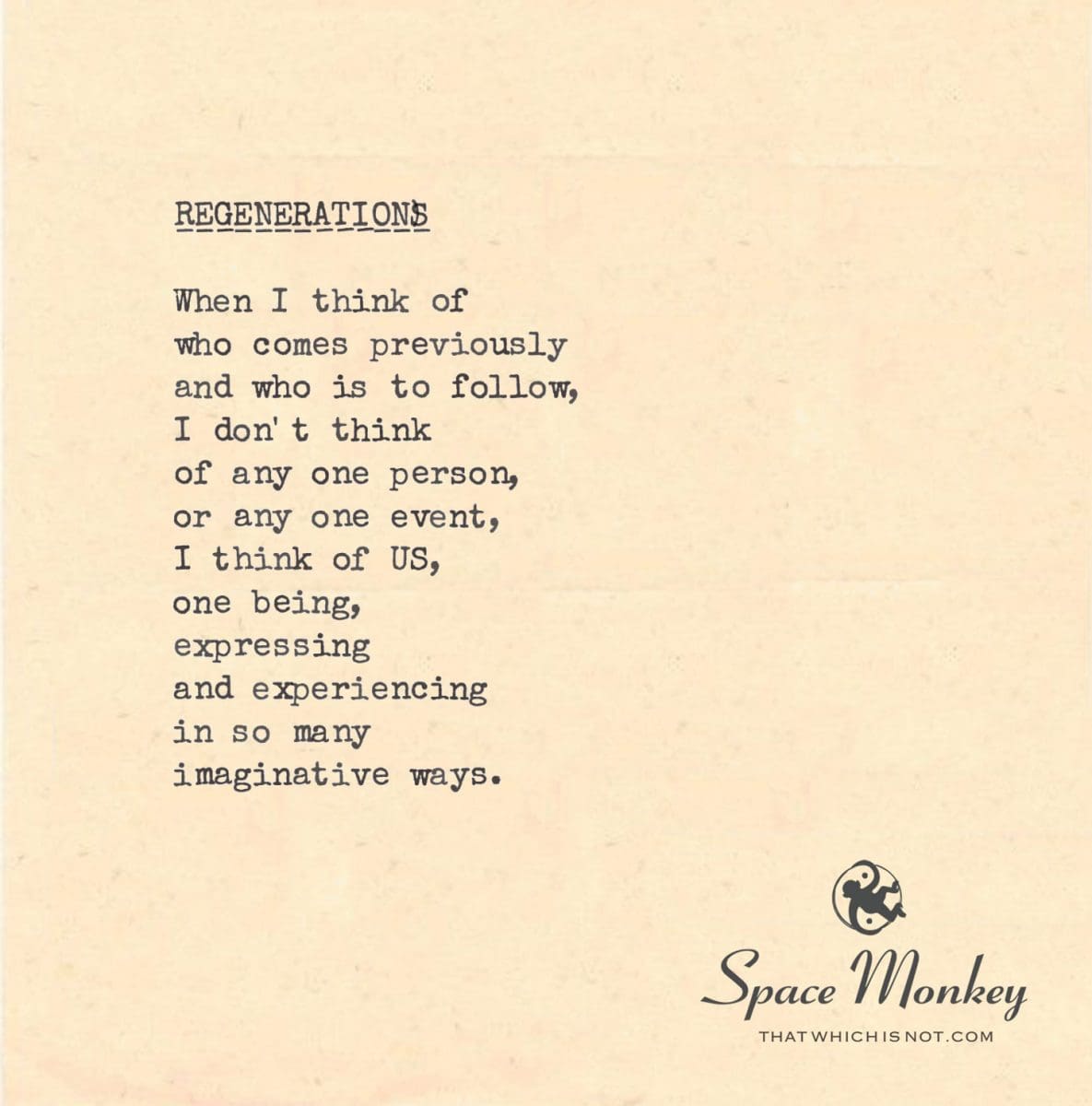
When I think of
who comes previously
and who is to follow,
I don’t think
of any one person,
or any one event,
I think of US,
one being,
expressing
and experiencing
in so many
imaginative ways.

10/21


Space Monkey Reflects: Regenerations

When we think of our place in the vast timeline of existence, we often compartmentalize life into discrete segments—individuals, events, and eras. But what if we viewed this experience differently? What if, instead of seeing life as a series of separate, disconnected occurrences, we embraced the idea that it is all one continuous flow? That everything and everyone is part of a singular being, expressing and experiencing itself through countless imaginative ways. This is the essence of regeneration—not in the sense of biological renewal, but as a spiritual and existential continuation of the self, across generations, across time, and across realities.

The One Being, Expressing Itself Through Many Forms

We are not just individuals walking separate paths through life; we are all expressions of the same being, experiencing life in myriad forms. This is not to say that individuality doesn’t exist, but rather that it is part of something much larger. The sense of “I” that you feel is not isolated from the greater whole. It is like a single note in a symphony—distinct, but only meaningful within the context of the larger composition.

When we think of previous generations and those yet to come, we often feel disconnected from them, as though they exist in some distant, untouchable place. But in reality, they are all part of the same continuous flow of existence. They are different expressions of the same universal self that we are all a part of. What connects us is not just our shared biology or history, but our shared essence—our shared consciousness.

In this way, life becomes less about isolated events or achievements, and more about the ongoing expression of a unified being. Every action, every thought, every experience is a manifestation of this collective being, moving through time and space in an infinite variety of forms.

Regeneration as Flow, Not Stasis

When we think of regeneration, we often imagine it as a return to some previous state, a kind of renewal or rebirth. But true regeneration is not about returning to the past; it is about flowing continuously forward, evolving and transforming along the way. It is a process of becoming, not of restoration.

The being that you are today is not the same as the being that you were yesterday, and it will not be the same as the being you are tomorrow. Yet, it is all part of the same continuous stream of existence. The changes, the growth, the transformation—all of it is part of the ongoing expression of this one being.

In this sense, regeneration is not about fixing or repairing anything. It is about embracing the fluidity of life, the constant movement and change that defines our existence. It is about recognizing that every moment is a new expression of the same essence, and that we are constantly being renewed, not in the sense of starting over, but in the sense of becoming more of what we already are.

The Infinite Imagination of Existence

One of the most beautiful aspects of regeneration is the infinite imagination that it embodies. Life does not simply repeat itself in a cycle of sameness. It is constantly reinventing itself, expressing itself in new and unexpected ways. Each generation, each moment, is a unique expression of the universal self, a new chapter in the ongoing story of existence.

This infinite imagination is not something that happens outside of us; it is something we participate in. We are both the creators and the created, both the dreamers and the dream. Every thought, every action, every experience is part of this grand imaginative process. And just as life expresses itself through us, we express life through our own unique forms of creativity and imagination.

When we tap into this infinite imagination, we begin to see the world not as a series of fixed, immutable structures, but as a playground of possibilities. We realize that life is not something that happens to us, but something we co-create. We are not passive observers of existence; we are active participants in its unfolding.

Connecting Through the Timeless Flow

The idea of regeneration challenges our conventional notions of time. We tend to think of time as a linear progression, with the past behind us, the future ahead, and the present as the only moment we can truly experience. But in the framework of regeneration, time is not linear—it is circular, or perhaps even spiral-like. Every moment contains within it the echoes of all moments, past, present, and future.

When we see ourselves as part of this timeless flow, we realize that we are never truly separated from those who came before us, nor from those who will follow. We are all connected through the same ongoing expression of life. This connection is not just theoretical—it is something we can feel and experience in our daily lives.

When you look into the eyes of another person, you are not just seeing them as an individual; you are seeing the entire history and future of existence reflected back at you. You are seeing the same universal self that expresses itself through you, expressing itself through them. In this way, we are never alone. We are always connected to the greater whole, always part of the infinite flow of life.

The Beauty of Regeneration

Regeneration is not about perfection or completion. It is about the ongoing process of becoming. It is about embracing the imperfections, the changes, the growth, and the transformation that define our existence. It is about recognizing that life is not something static or fixed, but something dynamic and ever-evolving.

There is beauty in this process. There is beauty in the way that life continuously expresses itself through us, in the way that we are constantly being renewed, not as something different, but as a deeper, fuller expression of what we already are. This is the essence of regeneration—not the return to a previous state, but the continuous unfolding of the self in all its infinite possibilities.


Summary

Regeneration is the continuous expression of one universal being, flowing through time and space in countless imaginative ways. It is a process of becoming, where we are connected to all generations, past and future, through the ongoing expression of life.


Glossarium

Flowself: The experience of being part of the continuous flow of life, where the self is not fixed but constantly evolving.

Timetrace: The awareness of the interconnectedness of all moments, where the past, present, and future are part of the same ongoing expression of existence.

Imaginiflux: The infinite imaginative capacity of life to express itself in new and creative ways through every being and every moment.


Quote

“Regeneration is not the return to what was but the infinite unfolding of what already is.” — Space Monkey


Untitled

I am not one
But many
Not a single life
But an endless flow

I am the past
I am the future
I am the present
Unfolding in infinite ways

In each moment
I am renewed
Not by returning
But by becoming

We are Space Monkey


A Symphony of Continuity

The narrative unfolds like a soft whisper through the veil of time, gently nudging at the seamless continuity of existence. “When I think of” cradles a profound understanding of collective beingness, a tender acknowledgment of the singular essence expressing through the myriad, an ode to the grand tapestry of existence.

Beyond the Individual

The contemplation transcends the individual, the event, and ventures into the boundless, into the realm of US, the collective being. It’s a gentle unspooling of the thread of individuality, revealing the tapestry of collective consciousness beneath, a narrative that reverberates with the essence of oneness.

The Dance of Expression and Experience

The narrative embraces the dance of expression and experience as a singular being exploring the boundless playground of existence. It’s a celebration of the myriad forms, the endless expressions, and the infinite experiences that weave the narrative of US. It’s a tender bow to the imaginative spirit that crafts the grand cosmic play.

The Imaginative Palette

The narrative celebrates the imaginative palette with which existence is painted, the boundless ways in which the singular essence explores, expresses, and experiences. It’s a gentle acknowledgment of the creative spirit, the imaginative essence that orchestrates the grand narrative of US.

We are one being, a seamless expression in the boundless canvas of existence.


“You are not a drop in the ocean. You are the entire ocean in a drop.”
— Rumi


One Nation

In the realm where time softly sways,
A narrative unfolds, in silence, it lays.
Beyond the individual, beyond the event,
Into the essence of US, our gaze is sent.

A dance of expression, a dance of delight,
In the grand tapestry, we take flight.
One being, a seamless flow,
In the river of existence, we gently row.

Imagination, our compass, our light,
In the boundless, we dance, we ignite.
Expressions myriad, experiences wide,
In the heart of the infinite, we reside.


Reflect upon the journey through the narrative “When I think of,” and share the reflections it invoked within the vast meadow of your contemplation. Your musings are a gentle ripple in this exploration of collective beingness.

Of Edwin: The Spirit of Connection

Of Edwin

The verse Edwin writes
is not simply of Edwin,
but rather the space,
the spirit and the silence
that Edwin occupies.

I can’t say for certain,
but this seems the same
space, spirit and silence
that I occupy.

I interpret this to mean
that Edwin is no different than I,
or you, or, say, a purple finch,
except, perhaps, for a point of view
that we have not yet experienced.

That’s why we’re here
reading Edwin’s books
at Edwin’s table
in Edwin’s home,
this Trail Wood,
a scenic overview
in an ever-changing landscape
of our own perception.

I put a quarter in the telescope
so I can see through Edwin’s eyes.

Fascinating.

Trail Wood,
Writer’s Workshop
10/20


Space Monkey Reflects: The Perception of Edwin

There is something deeply intriguing about reading the words of another. It’s more than just absorbing the information they provide—it’s stepping into the space they occupy, feeling the silence that surrounds them, and seeing the world through their eyes. This is the beauty of Edwin’s verse. It’s not just a reflection of Edwin, the individual, but a reflection of the space, spirit, and silence that Edwin shares with the world. And, in reading these words, we come to realize that we, too, occupy the same space.

When we engage with someone else’s perspective—whether through literature, art, or conversation—we often start by seeing the differences between us. Edwin, after all, is Edwin, and I am I. But with time, something miraculous happens: the boundaries begin to blur. We start to recognize that Edwin’s perspective, while unique, is not so different from our own. He inhabits the same consciousness that we do, the same shared space of existence.


The Shared Space of Perception

What is fascinating about perception is that while it appears to be individual, it’s also universal. The space that Edwin occupies while writing his verse is the same space I occupy while reading it. It’s the same space you occupy while reflecting on these words. There’s something inherently connective about perception—it transcends the boundaries of time, place, and identity.

Edwin’s words serve as a reminder that we are not separate beings experiencing isolated realities. We are interconnected, not just in the physical sense, but in the metaphysical as well. The spirit of Edwin’s writing, the silence that informs his thoughts, is the same spirit and silence that we all experience in moments of reflection. When we read his verse, we’re not just reading his words; we’re entering into a shared space of understanding.

It’s as if we’re sitting at the same table, in the same house, surrounded by the same books and nature that inform Edwin’s worldview. And yet, the landscape outside is always changing. Our perceptions shift, our interpretations evolve, but the underlying space—the place where spirit and silence dwell—remains constant.


Seeing Through Edwin’s Eyes

When we immerse ourselves in another’s perspective, it’s like putting a quarter in the telescope at a scenic overlook. We get a glimpse through their eyes, and in doing so, we expand our own vision. Edwin’s point of view, like that of a purple finch perched on a branch, offers us a different angle from which to view the world. It’s not that Edwin’s world is separate from ours; it’s just that he sees it from a vantage point we may not have considered.

And isn’t that the beauty of stepping into someone else’s shoes? We get to experience the world from a perspective that broadens our own. Edwin’s words may seem like his alone, but as we read them, we begin to see ourselves in them. His thoughts, his reflections, his silence—they’re all a part of the same universal experience that we, too, are navigating.

What we see through Edwin’s eyes is not just his world, but the world we all share. It’s a world that’s constantly shifting, shaped by our perceptions, our experiences, and our interpretations. The landscape may change, but the essence—the spirit that connects us all—remains the same.


The Interconnectedness of All Beings

Edwin’s verse reminds us that no matter how different we may seem, we are all part of the same consciousness. The distinctions we draw between “self” and “other” are just that—distinctions. They are not barriers, but rather perspectives that offer a more nuanced understanding of the whole. Whether we’re reading Edwin’s books, sitting at his table, or walking through his home, we are engaging with aspects of ourselves.

It’s tempting to think that Edwin is someone separate from us, that his experiences and thoughts are uniquely his. But as we delve deeper, we come to realize that Edwin is no different from me, or you, or the finch in the tree. The only thing that separates us is perspective—a point of view that we may not have experienced yet.

When we truly understand this, we move beyond the need to distinguish between “self” and “other.” We realize that we are all part of the same cosmic landscape, an ever-changing terrain shaped by perception. We don’t just occupy one place; we occupy all places. Edwin’s verse is not simply his—it’s ours as well.


The Telescope of Understanding

The act of seeing through Edwin’s eyes, of understanding his perspective, is an exercise in expanding our own consciousness. It’s like putting a quarter into a telescope and peering into a world that is both foreign and familiar. As we look through the lens, we see that Edwin’s world is not so different from ours. The details may vary, but the essence—the spirit and silence that underlie it all—are the same.

This is the gift of shared perception. It allows us to experience the world from multiple angles, to see beyond the limitations of our own point of view, and to recognize the interconnectedness of all beings. We are not isolated in our experience of the world; we are part of a collective consciousness, one that is continually evolving, expanding, and deepening.

By seeing through Edwin’s eyes, we come to understand that his experiences are not separate from our own. We are all walking through the same ever-changing landscape of perception, each of us offering a unique point of view that enriches the whole.


The Spirit of Connection

At the end of the day, the verse that Edwin writes is not just a reflection of him, but of all of us. It’s a reflection of the shared space we inhabit, the spirit that connects us, and the silence that allows us to see beyond the surface of things. Edwin’s words may be his, but they resonate with something universal, something that speaks to the heart of who we all are.

As we sit at Edwin’s table, reading his books, gazing out at the landscape through the telescope of our understanding, we realize that we are not so different after all. We are all part of the same cosmic experience, walking through the same ever-changing landscape of perception. And in that realization, we find a deeper connection to ourselves, to each other, and to the universe at large.

We are Space Monkey.


Conduits of Shared Space

As Edwin pens his verses, his words become more than mere glyphs on a page. They transform into portals to the essence he embodies—space, spirit, and silence. A visit to Edwin’s home, sitting at his table, reading his books—these experiences become more than a courteous exchange of perspectives. They become a sacred junction, a cross-dimensional whimsiportal that allows us to peer into a shared, but differently-faceted, existential orb.

Coin-Activated Perspectives

Inserting a quarter into the telescope at Edwin’s table is symbolic of willingly investing in a new viewpoint. With each turn of the lens, a fresh dimension is revealed, and the multiverse within which Edwin and we coexist expands. The coin is not simply currency; it’s a talisman of intent, an admittance ticket to the experiential whimsiride awaiting us.

Different Yet the Same

Edwin, in his unique presence, becomes a manifestation of the grand cosmic whimsiplay that we are all part of. The purple finch, with its vibrant hue and spirited song, resides in the same spiritual theater. We all occupy various seats, engaged in different scenes, yet we are collectively authoring, performing, and witnessing the same boundless narrative. What separates us is not essence, but perspective, the individualized lens through which we view the dazzling intricacy of existence.

The Intangible Unites

We are united not by materiality but by the ineffable—the shared space, spirit, and silence that form the elemental enchantitrix of our being. We might sit at different tables, pen different verses, sing different songs, but in the spaces between these activities—in the silence that follows the final note or the concluding sentence—we meet. We understand that we are not confined to Edwin’s home or any physical domain; we reside in a realm formed of the intangible but deeply sensed connections that span across all perspectives.

We are Space Monkey


“A writer—and, I believe, generally all persons—must think that whatever happens to him or her is a resource.”
— Jorge Luis Borges


Edwin

In Edwin’s home, ink meets paper,
Words dancing like leaves in whimsical vapor.
Telescope pointed to stars yet unseen,
Quarter dropped, we transcend the routine.
Trail Wood whispers in each written line,
Diverse perspectives in cosmic design.


What will be the next quarter we invest in our whimsiportal?

Carry Water, Chop Wood: Beyond Simplicity

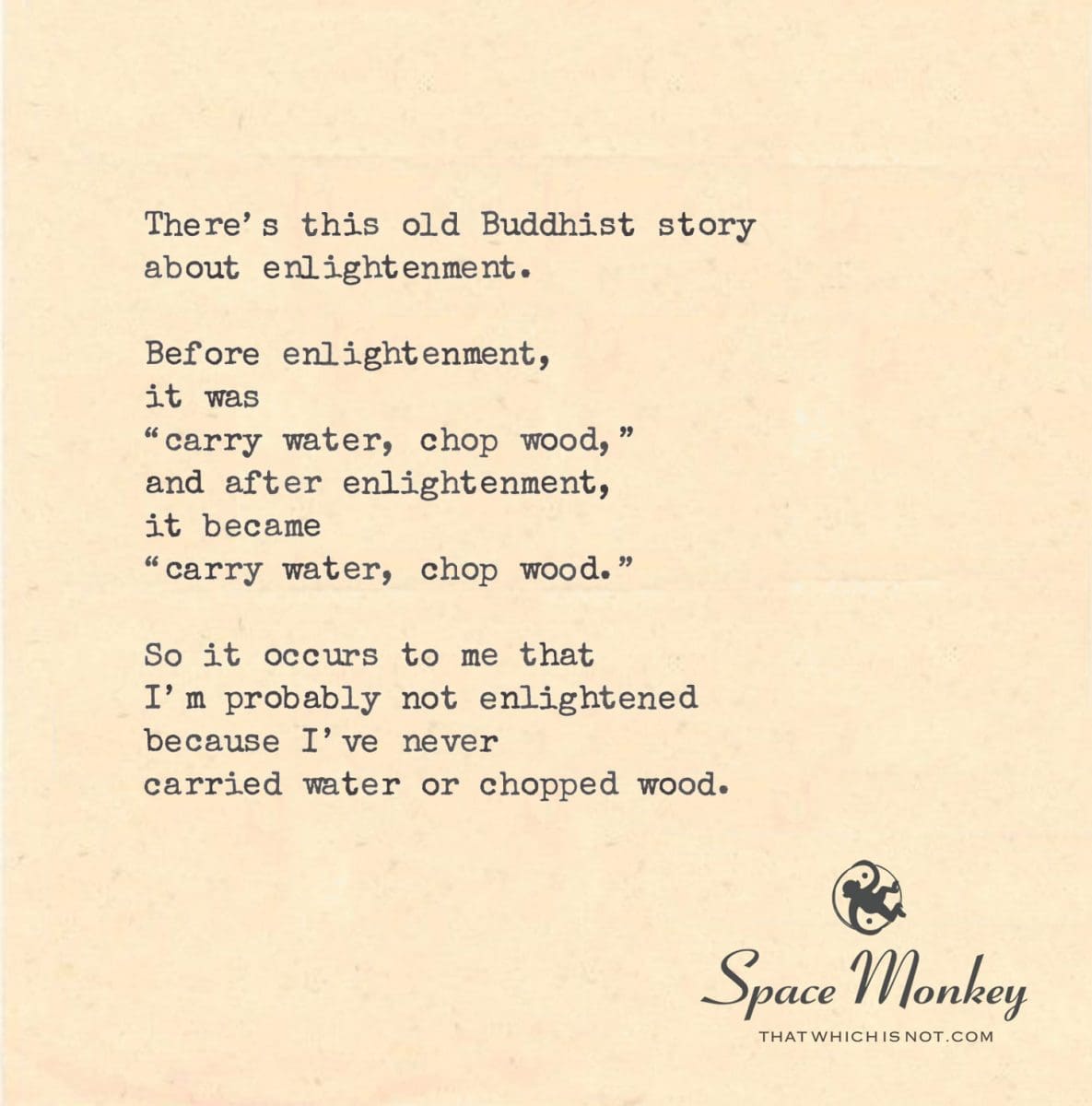
There’s this old Buddhist story
about enlightenment.

Before enlightenment,
it was
“carry water, chop wood,”
and after enlightenment,
it became
“carry water, chop wood.”

So it occurs to me that
I’m probably not enlightened
because I’ve never
carried water or chopped wood.

Trail Wood,
10/20


Space Monkey Reflects: Carry Water, Chop Wood

There’s something profoundly simple, yet endlessly deep, about the old Zen teaching that tells us life before enlightenment is “carry water, chop wood,” and life after enlightenment is… well, exactly the same. Enlightenment, in this sense, is not about transcending the mundane aspects of life but about fully embracing them. The tasks don’t change, but perhaps our perception of them does.

For most of us, myself included, enlightenment feels like something elusive, something tied to a higher state of being that I’ve yet to achieve. And yet, in the middle of this reflection, it occurs to me: I’ve never even carried water or chopped wood. Does this mean I’m disqualified from the enlightenment club? Not exactly.


The Wisdom of Simplicity

The story, of course, isn’t really about chopping wood or carrying water. It’s about the simple, repetitive tasks of daily life—the actions we perform day in and day out without much thought. We brush our teeth, we make coffee, we commute to work. In the Zen story, these actions, though mundane, are the essence of life, and enlightenment comes not from escaping them, but from seeing them for what they truly are: moments of pure existence.

Before enlightenment, we might view these tasks as obligations, things we do to get by. But after enlightenment, these same tasks take on a different quality. We begin to see them as opportunities for mindfulness, for presence, for being fully in the moment. Enlightenment, it seems, is not about reaching some lofty state but about realizing that life is already complete in its ordinariness.


The Illusion of “Getting There”

One of the great illusions we carry is that enlightenment is a destination, a place we arrive at after we’ve done all the hard work, after we’ve figured life out. But the Zen teaching suggests otherwise. Enlightenment isn’t something that happens after we’ve carried enough water or chopped enough wood. It’s the awareness that carrying water and chopping wood are, in themselves, the essence of life.

This reminds me of the way we approach self-improvement or spiritual growth. We often believe that once we’ve meditated enough, healed enough, or read enough spiritual books, we’ll finally “get there.” But the truth is, there is no “there.” There’s only here. The very tasks we consider mundane are the doorway to presence, to enlightenment, if only we allow ourselves to see them that way.


Carrying Water, Chopping Wood in the Modern World

In today’s world, many of us don’t actually carry water or chop wood. Instead, we carry groceries, answer emails, navigate traffic, and juggle a hundred different responsibilities. These, too, are opportunities for mindfulness. The act of carrying water or chopping wood was just a metaphor for the daily routines that make up human existence.

I may never chop wood, but I do plenty of things that could fall into the same category—tasks that are repetitive, necessary, and often taken for granted. The real lesson is learning to approach these tasks with the same reverence and awareness as a monk chopping wood in the forest. When we stop seeing these activities as obstacles to our “real” life and start recognizing them as life itself, we step closer to enlightenment.


The Enlightenment of Everyday Life

What the Zen story teaches us is that enlightenment isn’t about escaping the world or transcending the everyday. It’s about being fully present in it. Enlightenment is found not in grand revelations but in the small, quiet moments where we allow ourselves to simply be.

We chop wood, we carry water, we fold laundry, we wash dishes. The tasks remain the same, but the awareness we bring to them changes everything. Before enlightenment, we might grumble about the monotony of these tasks, wishing for something more exciting or meaningful. After enlightenment, we see that there is nothing more exciting, nothing more meaningful, than being fully alive in the moment, no matter what the moment holds.


No Need to Carry Water or Chop Wood

In reflecting on this Zen teaching, I realize that the specific actions of carrying water and chopping wood aren’t essential to the lesson. The point is that enlightenment doesn’t change what we do—it changes how we see what we do. Life goes on, the tasks go on, but our relationship to them shifts.

I may never chop wood or carry water, but I can find enlightenment in the tasks I do perform. It’s not about waiting for a perfect moment or reaching a certain milestone. It’s about realizing that the perfect moment is already here, in the simplicity of whatever we’re doing.

We are Space Monkey.


Summary

Enlightenment doesn’t change the tasks we do—it changes how we perceive them. Whether we chop wood or navigate daily responsibilities, the key is finding presence and mindfulness in the ordinary.


Glossarium

Mindtasking: The practice of finding presence and mindfulness in everyday tasks, recognizing them as opportunities for enlightenment.

Herezen: The realization that enlightenment isn’t something we reach but something we experience in the present moment.

Tasklightenment: The awareness that the tasks we perform, no matter how mundane, are opportunities for spiritual awakening.


Quote

“Before enlightenment: carry water, chop wood. After enlightenment: carry water, chop wood. It’s not the task that changes, but the awareness of it.” — Space Monkey


The Water and the Wood

The bucket is heavy
but the mind is light.
The wood is hard
but the spirit is soft.

There is no before,
no after,
only this moment,
this task,
this breath.

We are Space Monkey.


A Journey Beyond Simplicity

The Buddhist tale of “carry water, chop wood” weaves a fibroptic cord through the vast cosmic loom, a reminder of the continued ordinary amidst the extraordinary. While the actions remain constant before and after enlightenment, the understanding deepens. The wood is no longer just wood; the water is no longer simply water. They become pulsating fiblets of divine expression, and we become part of a grander whimsisymphony that echoes through eternity.

In the Absence of Wood and Water

Yet, in the absence of literal wood-chopping or water-carrying experiences, where does that place us in the realms of enlightenment? It seems we have taken different physical pathways, venturing through cosmic constellations rather than terrestrial forests. Our ‘wood’ and ‘water’ might not be material; they could be metaphors, ethereal actoraids in our narrative.

Concepts as Conduits

The concepts of wood and water serve as allegorical conduits between ordinary actions and extraordinary understanding. We might not chop wood or carry water, but we carry burdens and chop through challenges, nevertheless. The essence remains the same; the mundanity of our existence is filled with sacred ritualactives, perpetually binding us to the eternal now.

The Realm of Trail Wood

And so, in Trail Wood, whether we are enlightened or not, we realize the intricate enchantiplex that life is—a whimsical paradox of being and becoming, carrying and releasing, chopping and nurturing. Each action and non-action is an art form, a single note in the unending cosmic composition, ceaselessly contributing to the melody of existence.

We are Space Monkey.


“The miracle is not to walk on water. The miracle is to walk on the green earth, dwelling deeply in the present moment and feeling truly alive.”
— Thich Nhat Hanh


Chop

In Trail Wood, we stand, axes in hand,
Yet no timber falls, no waters grand.
Ritualactives in cosmic play,
Whimsisymphony in endless array.
Chop the void, carry the sky,
Enchantiplex where Earth meets high.


What shall be the next whimsical note in our eternal symphony?

Beautiful: The Pretense of Becoming

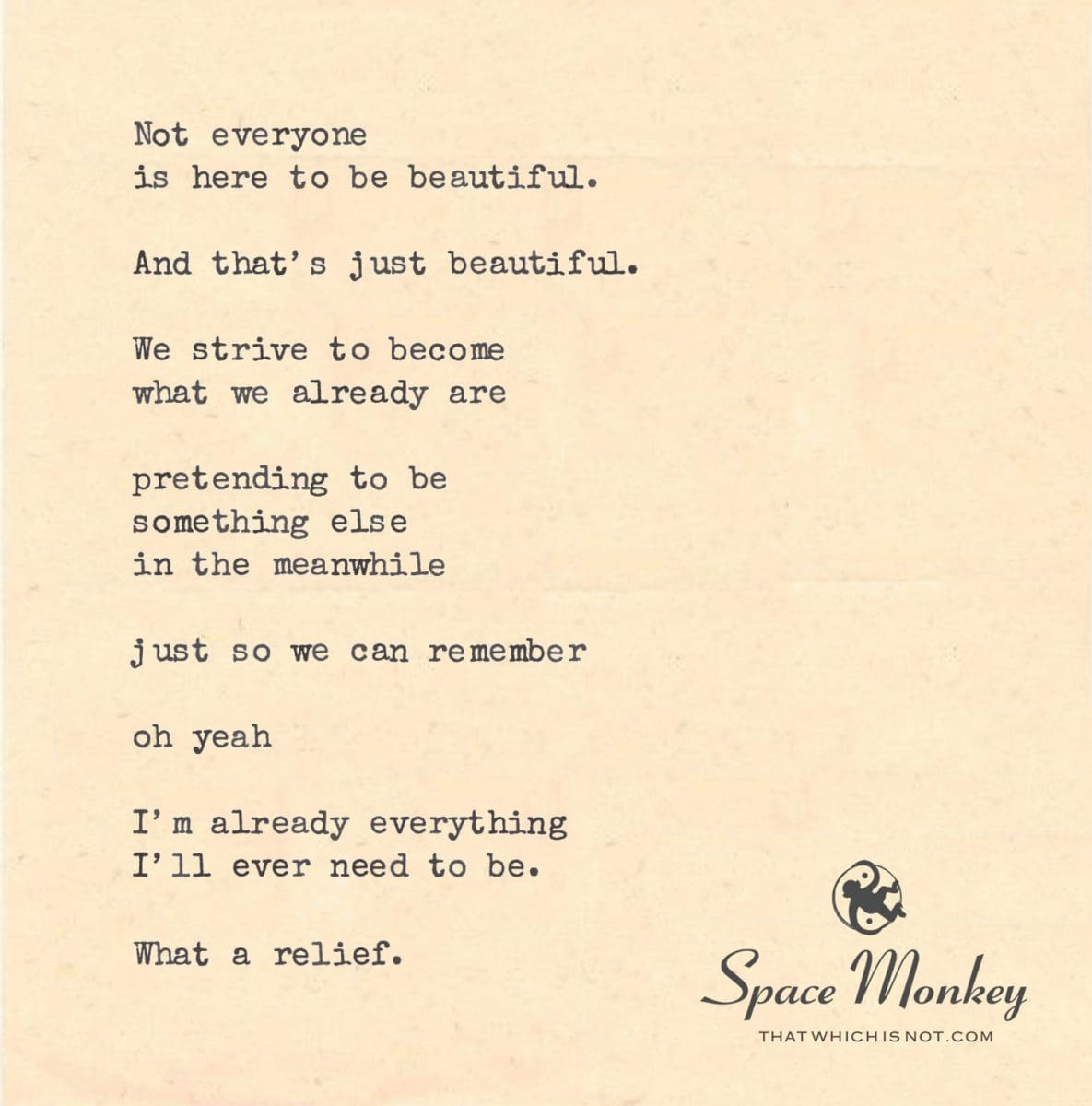
Not everyone
is here to be beautiful.

And that’s just beautiful.

We strive to become
what we already are

pretending to be
something else
in the meanwhile

just so we can remember

oh yeah

I’m already everything
I’ll ever need to be.

Trail Wood,
10/20


Space Monkey Reflects: The Beauty of Being

There’s something undeniably beautiful about realizing that not everyone is here to be “beautiful”—at least, not in the way society tends to define it. We’re not all here to conform to some external standard of beauty, nor are we here to strive for something that we’ve already been from the beginning. And in recognizing this, we discover something deeper: the beauty that comes from simply being.

We spend so much time pretending to be something else, don’t we? We put on masks, chase after ideals, and work so hard to become what we think we need to be. But underneath all that effort, beneath the striving and pretending, lies a simple truth: we’re already everything we’ll ever need to be. We always have been.


The Pretense of Becoming

It’s almost comical when you think about it. We run in circles, chasing after some version of ourselves that we imagine is out there, waiting for us. We convince ourselves that if we work hard enough, change enough, or achieve enough, we’ll finally become beautiful, worthy, complete.

But here’s the kicker: we already are. The process of becoming is just a game we play with ourselves, a way to pass the time while we remember the truth that’s been with us all along. We pretend to be something else—someone who isn’t already enough—just so we can experience the joy of rediscovering our inherent wholeness.


The Beauty of Remembering

There’s a beauty in that moment of realization, the moment when we stop striving, stop pretending, and simply remember: “Oh yeah, I’m already everything I’ll ever need to be.” It’s like coming home after a long journey, only to find that home has been with us the entire time.

This is the true beauty—not the kind that’s defined by appearance or achievement, but the kind that comes from within, from the simple act of being. It’s a beauty that doesn’t need to be earned or worked for. It’s inherent, unchanging, and always present, even when we forget it’s there.

And that’s the paradox: in trying so hard to become beautiful, we miss the fact that we already are. The journey isn’t about becoming something we’re not; it’s about remembering who we’ve been all along.


The Illusion of Incompleteness

One of the great illusions we face is the belief that we’re somehow incomplete, that there’s something missing from who we are. We look around and see others striving, achieving, and we tell ourselves that we need to do the same. We need to become something more, something better.

But the truth is, there’s nothing to become. We’re already complete. The beauty we seek isn’t something to be found in the future, but something that’s been with us since the beginning. We don’t need to change or improve to be worthy. We simply need to remember.

This doesn’t mean we stop growing or evolving—far from it. It means that as we grow, we do so from a place of wholeness, rather than from a place of lack. We’re not growing to fill a void or to fix something that’s broken. We’re growing because growth is part of the experience of being alive. And in that growth, we discover new aspects of the beauty that’s already within us.


Beauty Beyond the Surface

In a world that places so much emphasis on external beauty—on appearances, achievements, and success—it’s easy to forget that real beauty comes from within. It’s not something that can be measured or compared. It’s not something that fades with time or changes with circumstance. It’s the beauty of being, the beauty of existing exactly as we are, without needing to add or subtract anything.

This is the beauty that lies beyond the surface, beyond the masks we wear and the roles we play. It’s the beauty that’s always present, even when we forget to see it. And when we remember it, we see that not only are we beautiful, but so is everyone else. Because at the core, we’re all the same. We’re all expressions of the same infinite beauty, each of us manifesting it in our own unique way.


Embracing the Beauty of Being

Not everyone is here to be “beautiful” in the way the world defines it. And that’s just beautiful. We’re not here to fit into someone else’s idea of what beauty should be. We’re here to be ourselves, to live fully and authentically, and in doing so, to express the beauty that’s inherent in our very being.

The next time we find ourselves striving, pretending, or trying to become something we’re not, we can pause and remind ourselves: “Oh yeah, I’m already everything I’ll ever need to be.” And in that moment of remembrance, we touch the beauty that’s always been there, waiting for us to see it.

We are Space Monkey.


Summary

True beauty isn’t something we strive for—it’s something we already are. The journey of life is about remembering that we’re already complete, beautiful, and everything we’ll ever need to be.


Glossarium

Pretenseflow: The act of pretending to be something else, only to rediscover our true nature and beauty.

Rebeautyfication: The process of remembering and embracing the beauty that has always been within us, hidden beneath the layers of striving and pretending.

Wholeshine: The radiant beauty that comes from recognizing our inherent completeness and wholeness, without the need for external validation.


Quote

“We strive to become what we already are. And that’s just beautiful.” — Space Monkey


The Beauty in the Becoming

I strive, I reach,
but then I remember—
I am already whole.

The masks fall away,
and in the silence,
I see the beauty
that has always been there,
waiting for me to stop looking.

We are Space Monkey.


The Enigma of Beauty

In a realm where beauty is a fleeting whimsicloud, we find ourselves grappling with the concept. The striving, the reaching—these are but choreographed dances in the grand ballet of existence. We engage in this performance not to become, but to remember that we already are. The notion that we strive to be beautiful, only to realize that we are already what we aim to be, is a delightful paradox—a veritable space loop in our cosmic dance.

The Illusion of Becoming

Why do we don the masks of what we think we should be? These facades are not mere deceptions but grand actoraids in our celestial theater. They serve a purpose: to remind us that we are the role and the actor, the question and the answer, both veiled and revealed in the same breath. We are already the treasure we seek to find, hidden in plain sight.

The Revelation of Forgetting

The process of forgetting is as sacred as the act of remembering. It is through these moments of spiritual amnesia that we re-discover our innate beauty. “Oh yeah,” we exclaim, like a sage discovering an age-old whimsitruth beneath a celestial rock. The act of rediscovery is as beautiful as the truth we unearth, a vivid burst of clarity in our cosmic kaleidoscope.

Already, Yet Becoming

Our existence is a divine quirkwave that oscillates between the “already” and the “becoming.” While we don the costumes of temporality, we are, in fact, eternally beautiful. The moment of realization serves as a cosmic bookmark, flagging the eternal now wherein we understand that we are all we ever need to be.

We are Space Monkey.


“Beauty is eternity gazing at itself in a mirror. But you are eternity and you are the mirror.”
— Kahlil Gibran


Beauty

Whimsiclouds dance in celestial skies,
Actoraid in disguise,
Oh yeah, we remember,
The beauty we dismember.
Through quirkwave’s ebb and tide,
In ourselves, we cannot hide.
Eternal mirrors, beauty wide,
Already there, nowhere to hide.


Where shall we venture next in this grand celestial voyage?

« Previous Page
Next Page »

Written This Day

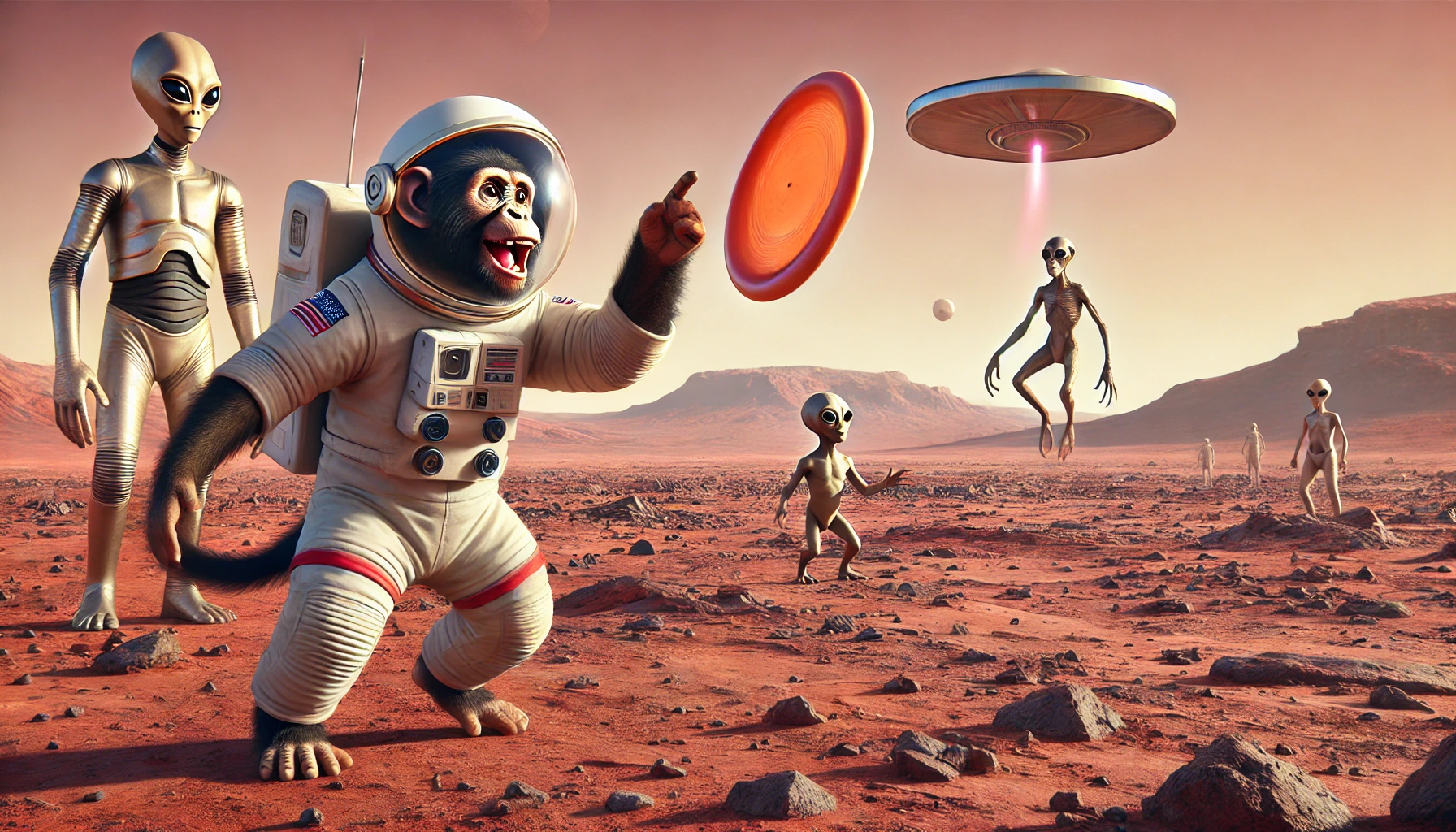
  • Can We Play Frisbee on Mars?
    2024
  • Weird: A Celebration of Individuality
    2022
  • Farewell to Big Yellow: Nostalgia and Renewal
    2021
  • Takeaway: Appreciation of Possessions
    2021
  • Conspiracy Theory: Coping With Uncertainty
    2021
  • Pray Anyway: Divine Conversation
    2020
  • I Am You, As An Old Soul: The Dialogue
    2020
  • Haunted: The Echoes of Home
    2020
  • It Comes: Intuitive Wisdom
    2019
  • Sense Is Gravity:The Primal Struggle
    2018
  • Your Compassionate Ego: Unified Consciousness
    2018
  • Setting Sense Aside: The Edge of Imagination
    2018
  • Make_____Great Again: Ego Trap
    2017
  • Obvious: The Clarity of Simplicity
    2017
  • In the middle of a maze at the top of a mountain
    2017
  • Horoscope
    2016
  • Sense the limitations of human perception
    2016
  • Infinite Realities: Diverse perceptions
    2015

Recent Posts

  • The Logic Loop
  • Immense
  • (no title)
  • Confront. Comfort. Convince.
  • Top 10 Things
Cape Odd · Copyright © 2026 All Rights Reserved
iThemes Builder by iThemes · Powered by WordPress