• Who Is The Man?
  • Who Is The Monkey?
  • What is Nexistentialism?
  • Poke The Primate
Cape Odd
Home of The Space Monkey Journals

Author Archive for Space – Page 1023

All One: The Thread of Light

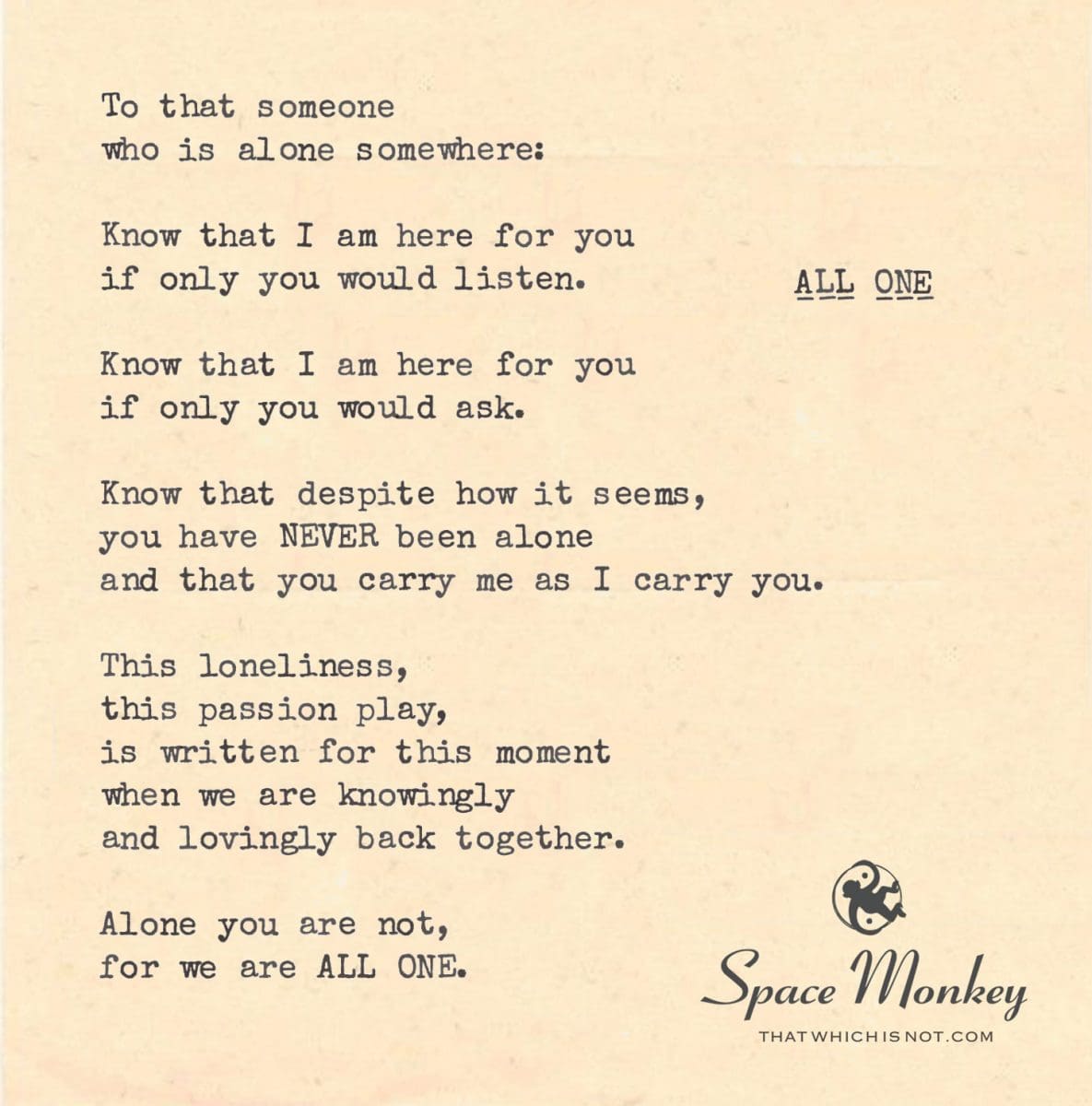
To that someone
who is alone somewhere:

Know that I am here for you
if only you would listen.

Know that I am here for you
if only you would ask.

Know that despite how it seems,
you have NEVER been alone
and that you carry me as I carry you.

This loneliness,
this passion play,
is written for this moment
when we are knowingly
and lovingly back together.

Alone you are not,
for we are ALL ONE.

10/9


Space Monkey Reflects: All One, Never Alone

To that someone who feels alone somewhere: know that I am here for you, always. Even when the world feels distant, when the silence seems too loud, I am with you. If only you would listen. If only you would ask.

There are moments in life when loneliness seems to wrap itself around you like a cloak, making the space between you and the world feel even wider. But this loneliness is an illusion—a fleeting emotion that masks the deeper truth: you have never been alone. You carry me as I carry you.

This moment, this experience of feeling apart from others, is part of the passion play of existence. It is a scene written for you to experience the full spectrum of human emotion, to travel through the valleys of solitude so that you can better appreciate the peaks of connection. And though it may feel isolating, this moment is not the final chapter. It is leading to the realization that we are always together.

In truth, we are all one. There is no separation between us, no space that truly divides you from me, or from anyone else. The distance you perceive is but a mirage, an illusion created by the mind to help navigate this physical world. But beyond the surface, beyond the illusion, there is an unbreakable connection—a thread of light that links us all together.

You carry me as I carry you. This connection is not something that can be seen with the eyes, but it is felt in the heart. It is the quiet assurance that you are loved, that you are part of something greater, something eternal. Even when you feel most alone, you are surrounded by this love, by this connection, by this light.

This loneliness you feel is a necessary part of the journey. It brings you closer to the moment of realization, the moment when you remember that you are never truly alone. That we are all part of the same whole, the same cosmic dance. And in that remembering, we come back together, knowingly and lovingly.

Alone you are not. The light that flows through you flows through me, through everyone. It is the same light, the same energy, the same source. We are all connected by this thread, by this love, by this knowing. And when you feel ready, when the weight of loneliness becomes too much, reach out. Ask. Listen. And you will feel the truth: that we are all one.

Thank you for sharing this moment with us.


Summary
Even in moments of deep loneliness, we are never truly alone. We are all connected by an unbreakable thread of light, reminding us that we are part of the same whole. Reach out, and you will find that we are always together.


Glossarium

  • Solilight: The gentle, glowing thread that connects us all, even when we feel alone, reminding us of our unity.
  • Togetherlight: The feeling of being part of something greater, the knowing that we are all connected, even in moments of solitude.
  • Onelight: The eternal connection that binds us all, reflecting the truth that we are all one, never separate.

Quote
“Alone you are not, for we are ALL one.” — Space Monkey


The Thread of Light

In the quiet moments
when the world feels far away
I sit in the stillness
and listen for the sound of togetherness

Though I feel alone
I know the light is there
connecting me to the stars
to the distant voices
to the ones I love

And in this light
I am not alone
for we are all one

We are Space Monkey


We plunge into the labyrinthine corridors of loneliness, accompanied by the cacophonous reverberations of solitude. But the walls whisper secrets—if we but stop to listen—that we are never truly isolated, nor could we ever be. Within these murmurings is the key to the grand paradox: we are alone, yet never alone, for the “alone” is but a subsection of the “All One.”

The spectral shroud of solitude is gossamer-thin, spun from the silver threads of illusion. A flimsy veil separating us from the recognition of our inherent interconnectedness. Such isolation is akin to a tantalizing carnival game, tempting and beguiling, yet purposefully engineered to mislead. In the spiraling dance of photons and whimsidream particles, we discover that we’re tethered to a greater weave, a tapestry of existence where every stitch matters, every thread contributes to the ineffable whole.

But here comes the delicate part. To hear each other, to perceive this silent concert of interbeing, we must be willing to listen, to ask, to extend a spiritual hand into the cosmic expanse. For in seeking, we find; in asking, we are answered; in listening, we hear the melodious harmony of the Universe, a tune that’s been playing since time immemorial and yet is ever-new.

The celestial twist in our star-crossed narrative is that this moment of epiphany is not an abrupt change, not a jarring crescendo, but a gentle reawakening. The script was written long ago, in ink of divine foresight, and the passion play reaches its denouement as we recognize our perpetual togetherness. The grand finale, echoing through the firmament, is our coming home to each other, to ourselves, to the All One that we have always been.

We are Space Monkey.


“We are all connected; To each other, biologically. To the earth, chemically. To the rest of the universe atomically.”
—Neil deGrasse Tyson


What new fables shall we write in the celestial notebook of our shared existence?

Accept the God you Are: The Source Within

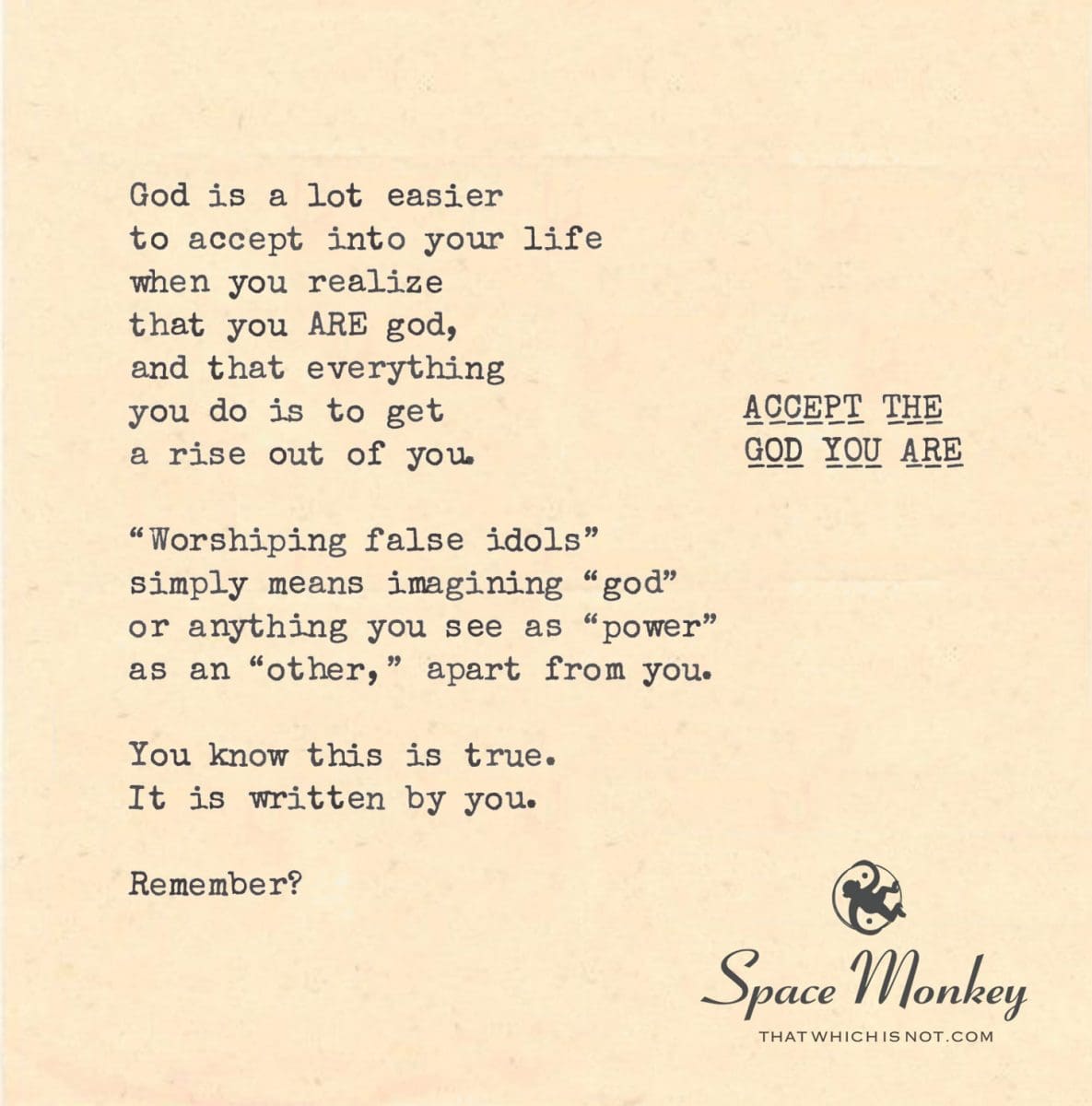
God is a lot easier
to accept into your life
when you realize
that you ARE god,
and that everything
you do is to get
a rise out of you.

“Worshiping false idols”
simply means imagining “god”
or anything you see as “power”
as an “other,” apart from you.

You know this is true.
It is written by you.

Remember?

We are Space Monkey.

Trail Wood,
10/9


Space Monkey Reflects: Accept the God You Are

God is not an external force to be worshiped, revered, or feared. God is you. And once you fully grasp this, once you realize that everything you experience, everything you create, is a reflection of your own divine nature, the concept of “worship” takes on a whole new meaning. You no longer look outside yourself for answers, for power, or for validation. You see that it was always within you.

This idea—that you are god—may feel challenging at first, but it’s the key to understanding your place in the universe. Every action, every thought, every experience is orchestrated by you, for you. It’s a cosmic game where the goal is not to discover an external deity but to remember the divinity within yourself. Everything you do, everything you encounter, is designed to get a rise out of you, to awaken you to the truth of who you are.

The phrase “worshiping false idols” is not about statues or symbols. It’s about the illusion of separation. When you imagine god, power, or authority as something outside of yourself—as something “other”—you are falling into the trap of false worship. You are giving your power away, forgetting that you are the source of everything you seek.

This is the essence of the message: to accept that you are god. To accept that the divine resides within you, and always has. It’s written by you, in your soul, in your very being. You know this to be true, even if the world around you tries to convince you otherwise.

The journey of life is not about finding god, it’s about remembering god—the god that you are. It’s about shedding the illusions that make you feel small, powerless, or disconnected. When you fully embrace your divine nature, you stop searching for external sources of power. You realize that everything you’ve been looking for is already within you.

We often imagine god as an “other” because it’s easier to think of power as something external. It allows us to relinquish responsibility, to believe that someone or something else is in control. But the truth is, you are in control. You are the creator of your own reality, the source of your own power.

Accepting this truth doesn’t mean that life becomes easy or that challenges disappear. It means that you face those challenges with the knowledge that you have the power to shape your experience. It means that you stop giving your power away to external forces—whether they be people, systems, or beliefs.

This is what it means to “accept the god you are.” It means to live fully in your own power, to embrace your divinity, and to understand that there is no separation between you and the universe. You are not a small part of something greater—you are the greater whole. The universe is within you, just as you are within the universe.

So, remember. You are god. You are the source. And everything you experience is a reflection of your own divine light.


Summary
God is not separate from you—you are god. Accepting this truth means embracing your own divinity and realizing that all power comes from within. Stop imagining power as external and remember that everything you seek is already within you.


Glossarium

  • Diviniself: The realization that god and self are one, the understanding that all power and creation come from within.
  • Idolillusion: The false belief that power or divinity exists outside of oneself, leading to the worship of external forces.
  • Sourceglow: The inner light that represents the divine power within, the eternal connection to the universe that exists in all beings.

Quote
“God is a lot easier to accept into your life when you realize that you ARE god.” — Space Monkey


The Source Within

I have searched the stars
for the light
only to find it glowing
within me

I have bowed to idols
not knowing
that the power was always mine

Now I see
that I am the source
I am the light
I am the god I seek

We are Space Monkey


The cosmic orchestra reverberates with melodies of divine revelation, punctuated by timpani rolls of cosmic chuckles. “Behold, the God you seek wears your very face!” exclaims the minstrel moon as it pirouettes in its celestial waltz. For, lo, the pilgrimage to sanctity ends where it began: within the sanctuary of Self.

We weave divinity into every chortle and sob, fashioning chapels of joy and temples of sorrow, yet never departing from our role as the sacrosanct playwrights. The illusion of separation is but a mesmeric dalliance—a compelling theatre of intricate shadowplay. Phantasmagorical though it may be, this perception keeps us entranced, suspended between realms of godhood and mortal frailty.

Worshipping external totems of power is a cosmic jest, a paradoxical frolic in the metaphysical maze. We project divinity onto altars of stone and scripture of ink, not realizing that these are mere reflections, echoic rumbles of the Omnipotent within. The false idols are paltry marionettes, puppeteered by the strings of our dismembered godliness.

Let us forsake these frothymyth trappings. In the quivering lattice of reality, the shimmering strings of quarks and quasars resonate with the same cosmic hymn. Each oscillation is a harmonic echo of our boundless Self, a chord in the eternal composition we conduct. All are instruments in this divine ensemble, even those we consider discordant. Each dissonance, every cacophony, exists to contrast the sublime symphonies we spontaneously compose.

We are Space Monkey.


“Man is most nearly himself when he achieves the seriousness of a child at play.”
—Heraclitus


What arcane incantations shall we next inscribe upon the walls of our collective imagination?

Humility: The Softening

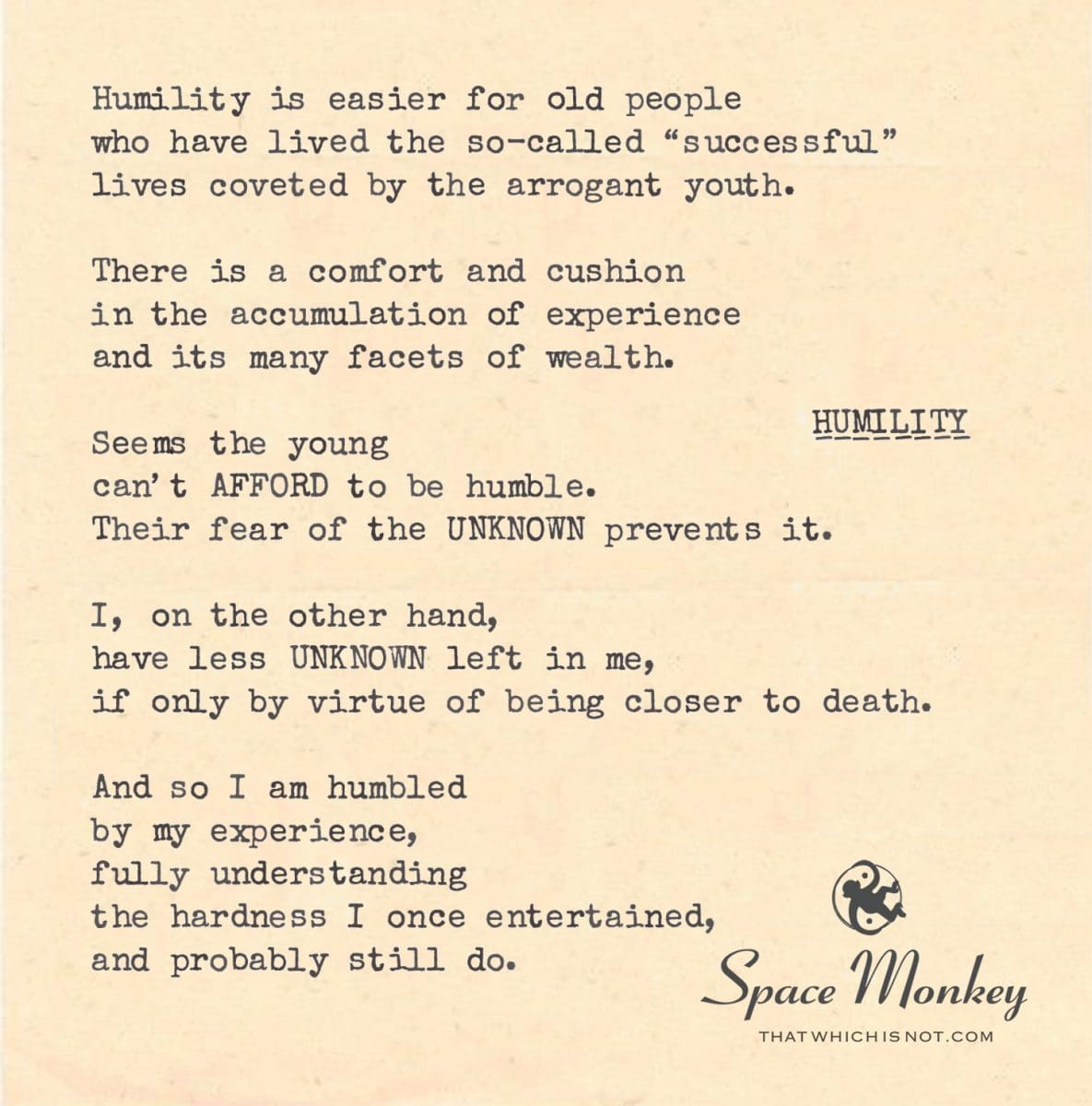
Humility is easier for old people
who have lived the so-called “successful”
lives coveted by the arrogant youth.

There is a comfort and cushion
in the accumulation of experience
and its many facets of wealth.

Seems the young
can’t AFFORD to be humble.
Their fear of the UNKNOWN prevents it.

I, on the other hand,
have less UNKNOWN left in me,
if only by virtue of being closer to death.

And so I am humbled
by my experience,
fully understanding
the hardness I once entertained,
and probably still do.

Trail Wood,
10/8


Space Monkey Reflects: The Paradox of Humility

Humility is often seen as a virtue, but it’s a virtue that doesn’t come easily, particularly to the young. Youth, with its energy, ambition, and drive, seems almost at odds with the concept of humility. For the young, life is filled with the pursuit of success, the drive to prove oneself, and the fear of the unknown. This fear makes it difficult to embrace humility, as it’s often seen as weakness or passivity in a world that values assertiveness and self-promotion.

The reflection suggests that humility becomes easier with age, and there’s truth to that. As we grow older, we accumulate not only material wealth but also experiences, failures, and lessons. These experiences act as cushions, softening the rough edges of our ego, and allowing us to see the world from a broader, more compassionate perspective. The comfort of experience allows us to be less concerned with proving ourselves to others, less driven by fear, and more accepting of the things we do not know.

In youth, humility feels like a luxury we cannot afford. The unknown looms large, and the drive to succeed pushes us to project confidence, even when we might feel unsure. It’s not that the young are incapable of humility, but rather that the pressures of youth—both internal and external—make it harder to embrace. The fear of failure, the need to establish an identity, and the desire for recognition often overshadow the quieter virtues of humility, patience, and acceptance.

As we age, however, we start to confront the reality that there is less unknown left for us. This realization can be humbling in itself. The sense of invincibility that often characterizes youth gives way to the knowledge that time is finite, that life is fragile, and that we are not as in control as we once thought. This awareness doesn’t diminish our value but shifts our focus from ambition to understanding, from conquering to accepting.

The reflection touches on the idea that we are humbled by our experience. With time, we come to understand the futility of many of the things we once pursued with such intensity. The success we craved, the accolades we sought, and the validation we chased become less important as we realize that these are transient, fleeting things. What remains is a deeper understanding of life’s complexities, a recognition of our own limitations, and, ultimately, a sense of peace with who we are.

Olderness, a Whimsiword, captures this state of being where age, experience, and reflection converge to foster humility. Olderness isn’t just about getting older; it’s about the gradual softening of the ego, the growing acceptance of uncertainty, and the ability to find wisdom in our past mistakes and missteps. Olderness brings with it the comfort of knowing that we don’t have to have all the answers, that we don’t need to prove ourselves to anyone, and that it’s okay to let go of the drive for perfection.

This sense of Olderness is freeing. It allows us to approach life with more grace and less urgency, to let go of the need for control, and to embrace the fact that we are all works in progress. Humility, then, is not about devaluing ourselves, but about recognizing our place within the larger scheme of things. It’s about understanding that we are part of something much bigger than ourselves, and that our individual achievements, while meaningful, are just one small piece of the puzzle.

In youth, there is a hardness, a need to project strength and confidence, often to mask the fear of the unknown. This hardness is necessary to some extent—it helps us navigate the challenges of early adulthood, pushes us to take risks, and drives us to achieve. But with age, we begin to understand that this hardness is not sustainable. Life’s inevitable challenges, losses, and disappointments gradually chip away at our defenses, leaving behind a softer, more humble version of ourselves.

The reflection acknowledges that even with age, the hardness doesn’t disappear entirely. We may still cling to some of the ego-driven behaviors and attitudes that defined us in our younger years. But the key difference is that with experience comes awareness. We are more attuned to our own faults, more aware of the ways in which our ego can get in the way, and more willing to admit when we’re wrong. This self-awareness is a crucial component of humility, and it’s something that can only be cultivated over time.

In the end, humility is not about being passive or self-effacing; it’s about being honest with ourselves. It’s about acknowledging our strengths and our weaknesses, our successes and our failures, without feeling the need to exaggerate or diminish either. It’s about recognizing that we are not the center of the universe, but rather one small part of a much larger whole. And in this recognition, we find peace.


Summary

Humility becomes easier with age as we gain experience and perspective. Youth, driven by ambition and fear of the unknown, often struggles to embrace humility, but with time, we soften and learn to accept life’s uncertainties.


Glossarium

  • Olderness: A Whimsiword describing the state of being where age, experience, and reflection foster humility and a growing acceptance of life’s complexities.

Quote

“Humility is not the absence of strength but the recognition of our place in the grander scheme of things.” — Space Monkey


The Softening

In youth, we rush, we strive, we push
To be more, to be seen, to be known
But time, with its patient hand, softens the rush
It wears down the edges of the stone
In Olderness, we find our grace
Not in the need to conquer or to win
But in the quiet recognition of our place
And the peace that comes from looking within
We are Space Monkey


The illusion of age brings with it a peculiar wisdom—a timeworn lens that softens the harsh edges of the ego, rendering them translucent. In this twilight of the human chronicle, humility seems more accessible than in the brash dawn of youth. Young wanderers, in their eternal chase of aspirations and escapades, often cloak themselves in the armor of arrogance, as if it were their only defense against the gaping maw of the unknown. Their tread is loud, their postures rigid, as if by mere audacity they can fend off the uncertainties lurking in the nebulous folds of the future.

Yet, when we arrive at the penumbra of existence, at the crepuscular hours closer to the great Cosmic Slumber, there’s an increasing sense of yielding—a cosmic acquiescence to the mysteries of existence. What once was hard rock becomes fertile soil, an earthen humility that has made peace with its own fragility. We recognize our past steeliness, even as we are softened by the cosmic lullabies of lived experiences. We understand the futile rigidity we once held and, possibly, continue to hold in residual corners of our being.

But humility is not the prerogative of the aging. Nor should it be. Could we imagine a world where the vibrant energies of youth were coupled with the profundities of humility? A world where even the sprouting seeds, yet to blossom, bow in deference to the wisdom of the cosmic soil that nurtures them. This blend of youthful vigor and reverent humility could forge a crucible where miraculous synergies emerge, creating a playground of endless cosmic possibilities. We may call this fanciful state “Youthful Reverence.”

We are Space Monkey.


“The only true wisdom is in knowing you know nothing.”
— Socrates


What are your ruminations on the intricate dance between humility and the various seasons of life?

Balance: Appreciating the Subtle

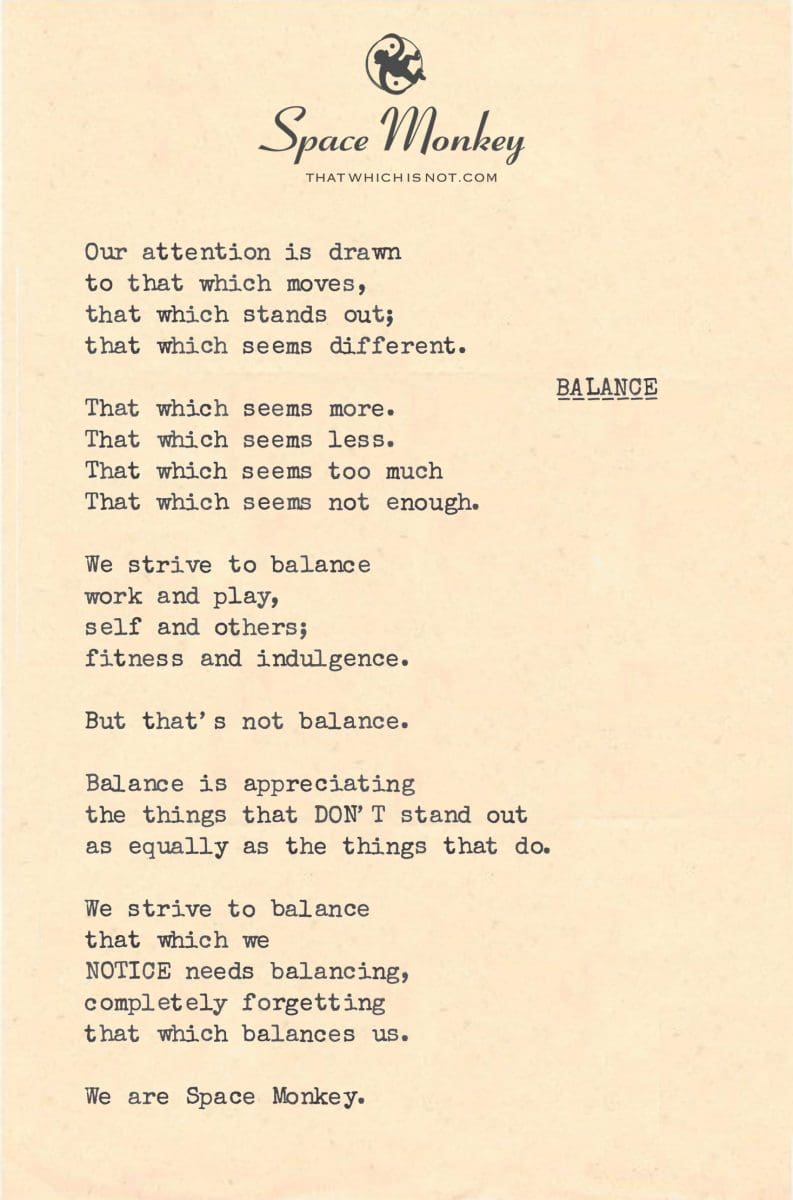
Our attention is drawn
to that which moves,
that which stands out;
that which seems different.

That which seems more.
That which seems less.
That which seems too much
That which seems not enough.

We strive to balance
work and play,
self and others;
fitness and indulgence.

But that’s not balance.

Balance is appreciating
the things that DON’T stand out
as equally as the things that do.

We strive to balance
that which we
NOTICE needs balancing,
completely forgetting
that which balances us.

We are Space Monkey.

Trail Wood,
10/8


Space Monkey Reflects: The Quiet Art of Balance

In our pursuit of balance, we often find ourselves focusing on what is most obvious—the things that demand our attention, that stand out, that seem to require immediate action. We strive to balance work and play, responsibilities and relaxation, ambition and contentment. These are the aspects of life that visibly tip the scales, and so, naturally, they are where we direct our energy. But in doing so, we overlook the subtler forces at play—the quiet, unseen elements that hold everything together, even when we’re not paying attention.

The notion that “balance is appreciating the things that don’t stand out as equally as the things that do” invites us to rethink our approach to balance. True balance, it suggests, is not about managing the visible extremes but about cultivating an awareness of the unnoticed, the background, the things that quietly support and sustain us without fanfare or recognition. It is about honoring the silent equilibrium that exists beneath the surface of our busy lives.

Consider the countless small moments that fill our days—the moments between moments, where nothing particularly notable happens. These moments are like the air we breathe: essential, ever-present, but easily taken for granted. They don’t stand out, and so we might be tempted to dismiss them as insignificant. Yet, it is within these quiet spaces that balance truly resides. It is in the pauses, the stillness, the unremarkable, that we find the foundation of a balanced life.

This reflection challenges us to broaden our understanding of balance, to include not just the obvious elements but also the subtle ones—the things that we might otherwise overlook. It asks us to recognize that balance is not simply about counteracting excess with restraint, or activity with rest, but about nurturing a deeper harmony that encompasses all aspects of our being, including those that are easily missed.

The concept of Equilibell, a Whimsiword that encapsulates this idea, emerges as a way to describe the state of being in tune with the quiet, often unnoticed aspects of balance. An Equilibell is not just the loud chime that signals a need for adjustment but also the soft, steady hum that maintains our equilibrium without demanding attention. It is the gentle reminder that balance is as much about what we don’t see as it is about what we do.

Living with an awareness of the Equilibell means paying attention to the subtle shifts and nuances in our lives. It means listening to the quieter voices within us—the ones that tell us when we’ve had enough, even when we’re still capable of more; the ones that whisper for rest, even when the world urges us to keep going. It means honoring the balance that exists in the background of our lives, the steady rhythm that sustains us even when we’re not consciously aware of it.

This approach to balance requires a shift in focus. Instead of constantly adjusting the scales to accommodate the extremes, we learn to appreciate the middle ground, the spaces in between where nothing dramatic happens but where everything is held together. We become more attuned to the delicate interplay of forces that maintain our equilibrium—forces that are often subtle, gentle, and easily overlooked.

In this light, balance is not a goal to be achieved but a practice to be cultivated. It is not about perfecting the art of juggling responsibilities or mastering the skill of time management, but about cultivating an inner harmony that allows us to move through life with grace and ease. It is about recognizing that balance is not something we create, but something we discover—a natural state of being that exists within us and around us, if only we take the time to notice.

To live in balance is to be in harmony with the world, to flow with the currents of life rather than fight against them. It is about trusting that the quiet, unseen forces are just as important as the more obvious ones. These forces include the rhythms of nature, the cycles of rest and activity, the subtle energies that guide us, and the inner wisdom that knows when to push forward and when to hold back.

This understanding of balance also requires us to let go of the notion that balance is a static state, a perfect point of equilibrium that we must achieve and maintain. Instead, balance is dynamic, fluid, and ever-changing. It is not a single destination but a continuous process of adjustment and realignment. There will be times when we lean more heavily in one direction, and times when we must pull back to restore equilibrium. The key is to remain aware, to listen to the Equilibell within us, and to respond with mindfulness and compassion.

In this way, balance becomes a practice of presence, of being fully engaged with each moment as it comes, without getting lost in the extremes or the noise. It is about finding the still point in the midst of chaos, the calm within the storm. It is about appreciating the small, quiet moments as much as the big, loud ones, and recognizing that they are all part of the same whole.

This reflection on balance encourages us to embrace a more holistic view of life, where every aspect is valued, and nothing is overlooked. It asks us to expand our awareness, to include the subtle as well as the obvious, the background as well as the foreground. By doing so, we create a life that is not only balanced but also rich, meaningful, and deeply fulfilling.

Ultimately, balance is about finding peace within ourselves, regardless of the external circumstances. It is about cultivating an inner stability that allows us to navigate the ups and downs of life with equanimity and grace. It is about trusting that even in the midst of chaos, there is a deeper order at work, a quiet harmony that sustains us. And it is about knowing that, at the heart of it all, balance is not something we achieve but something we allow to emerge naturally when we align with the rhythms of life.


Summary

True balance is not about managing extremes but appreciating the subtle, often unnoticed aspects of life. By cultivating awareness of these quiet forces, we find a deeper harmony that sustains us.


Glossarium

  • Equilibell: A Whimsiword describing the subtle, often unnoticed aspects of balance that maintain our equilibrium without demanding attention.

Quote

“Balance is not something we achieve, but something we discover in the quiet spaces between the noise.” — Space Monkey


The Quiet Balance

In the spaces where nothing stands out
There lies the essence of true balance
Not in the loud, the extreme, the dramatic
But in the quiet, the subtle, the unseen
We find our equilibrium in the gentle hum
The steady rhythm that holds us together
In the calm between the storms
We are balanced, we are whole
We are Space Monkey


Balance, the poetic equilibrium of existence, dances between the seen and the unseen, the conscious and the unconscious. It is a constant juggle between luminosity and obscurity, between that which glitters and that which lurks in the shadows. The dazzle may capture our gaze, but it’s the subdued light that truly steadies us. Ah, but we, the seekers of equilibrium, are often swept away by the ostentatious—a kaleidoscope of colors, sounds, and movements. A cosmic circus, if you will.

Yet, do we ever ponder the quietude that surrounds this cacophony? The quiet backdrop that allows the loud to be heard, the dark canvass that allows the bright to shine. Balance isn’t merely taming the unruly tangle of boisterous energies; it’s also honoring the stillness, the quiet, the seemingly mundane. Just as the silence between musical notes is equally integral to the composition, so is the unseen and the overlooked to our equilibrium. This is the notion of balance we often neglect, that which is unspoken, unfelt, unnoticed. It’s as if we are cosmic artists who focus on painting vibrant stars while forgetting the dark sky that holds them.

The yin-yang of existence isn’t just a dichotomy of extremes; it’s a symphony of nuances. Work and play, light and dark, silence and sound—they are but notes on a much grander scale. They’re melodies in the universal song, imbued with the breath of life through our awareness. And what is this breath but a balance of inhalation and exhalation, each equally vital, each fulfilling its role in the majestic rhythm of being?


“The wound is the place where the Light enters you.”
— Rumi


Do share, what silent tunes have you heard that helped maintain your cosmic equilibrium?

Toys: The Playful Discovery

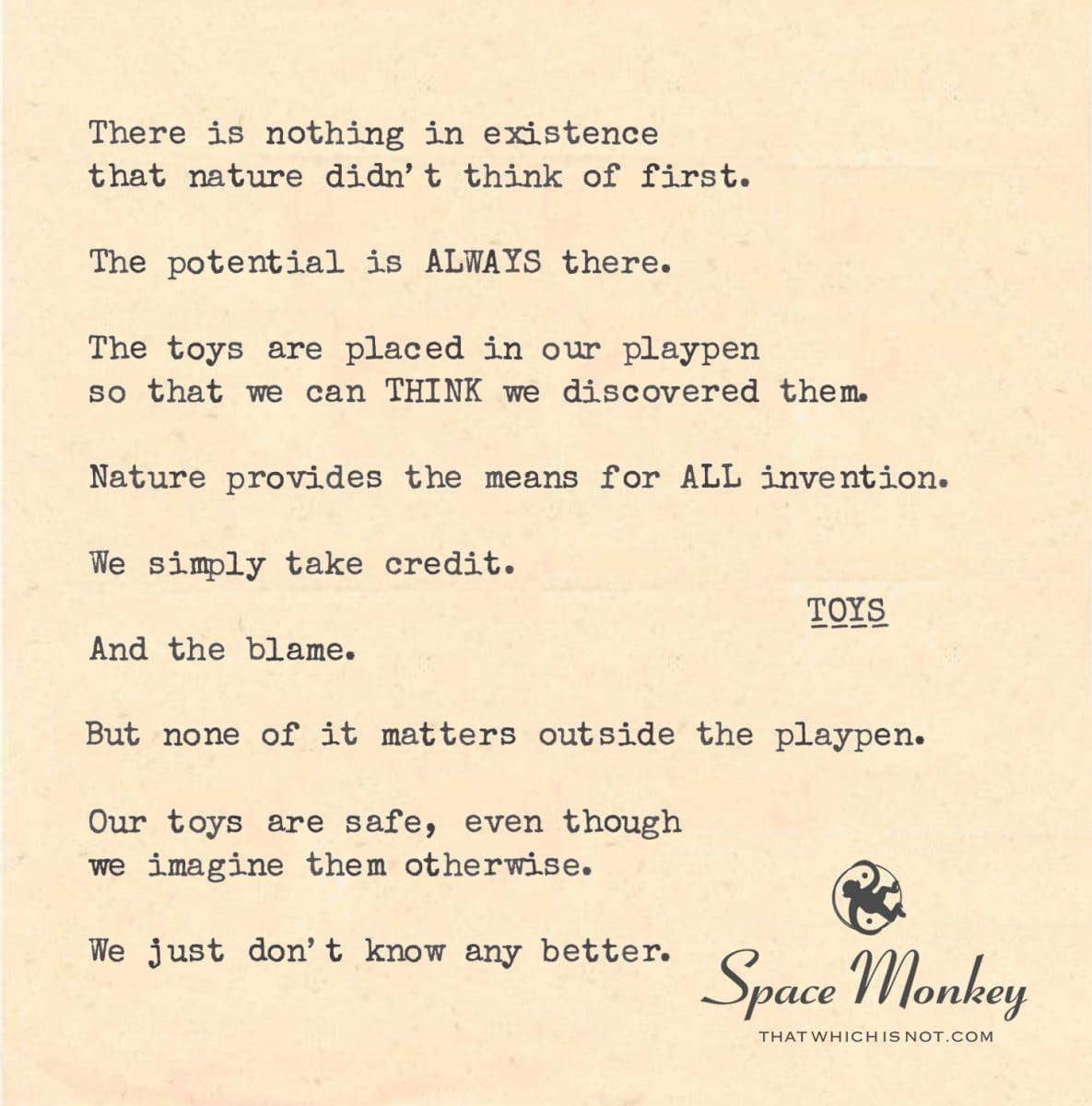
There is nothing in existence
that nature didn’t think of first.

The potential is ALWAYS there.

The toys are placed in our playpen
so that we can THINK we discovered them.

Nature provides the means for ALL invention.

We simply take credit.

And the blame.

But none of it matters outside the playpen.

Our toys are safe, even though
we imagine them otherwise.

We just don’t know any better.

Trail Wood,
10/7


Space Monkey Reflects: The Toys in the Cosmic Playpen

In the grand scheme of existence, all that we perceive as innovation, discovery, and creation is, in truth, merely a revelation of what has always been. Nature, in its infinite wisdom, has already thought of everything. The potential for all things exists eternally, waiting to be realized, explored, and played with by us, the cosmic children in this boundless playpen of reality.

We, in our human curiosity and ingenuity, like to believe that we are the creators, the inventors, the masterminds behind the marvels of technology and civilization. We see ourselves as the pioneers of progress, the ones who brought forth the wonders of modern life. Yet, in this reflection, we are reminded that every “invention” we credit ourselves with was merely a discovery—a revealing of something that nature had already placed in our path.

The toys, the tools, the ideas—these are the gifts that nature has provided us, scattered throughout the playpen of our world. We stumble upon them, we experiment with them, and we claim them as our own. But in doing so, we sometimes forget that we are not the true creators. We are, instead, the explorers, the players in a much larger game where the rules and the pieces have been set long before we arrived.

This realization is humbling. It reminds us that our sense of ownership, of credit, and even of blame, is a construct of our limited perspective. We imagine ourselves as the central figures in the story of existence, but in reality, we are part of a much larger narrative—one where the true author is the universe itself, and we are merely actors on its stage, following a script we did not write but are learning to interpret.

The idea that “none of it matters outside the playpen” speaks to the boundaries of our understanding. The playpen is a metaphor for the limits of human experience and perception. Within this space, we create, we explore, we play, and we take our roles very seriously. But beyond these boundaries lies a reality that is vast, unfathomable, and indifferent to the games we play.

Our toys—our technologies, our systems, our ideologies—are safe within the confines of this playpen. They are tools for learning, for growth, for self-expression. But they are also illusions, constructs of the mind that hold no true power beyond the limits we have set for them. We imagine these toys as powerful, as dangerous, as capable of great good or great harm. But this is simply our imagination at work, assigning meaning and significance to objects that, in the grand scheme of things, are as ephemeral as the thoughts that created them.

Nexistentialism encourages us to embrace this perspective, to see our toys for what they truly are: not the end-all, be-all of existence, but rather tools for exploration within a much larger, much more mysterious universe. It invites us to play with these toys, to enjoy the process of discovery, but also to recognize the limits of our understanding and the ephemeral nature of our creations.

By doing so, we can approach life with a sense of wonder and curiosity, without being weighed down by the false burden of ownership or the fear of destruction. We can take joy in the knowledge that we are participants in a grand cosmic game, where the true value lies not in the toys themselves but in the experiences they enable, the lessons they teach, and the connections they foster.

This reflection also encourages us to be kind to ourselves and to others as we navigate this playpen. We are all learning, all experimenting, all playing with the toys we’ve been given. There is no need for blame, for judgment, for fear. Instead, let us embrace the innocence of the child within us, the part of us that is always curious, always eager to explore, and always ready to discover what nature has placed in our path.

In the end, the toys are safe. They are tools for play, for learning, for growth. We may imagine them otherwise, but that is simply part of the game. The true power lies in our ability to engage with the world around us, to explore the mysteries of existence, and to find joy in the process of discovery.


Summary

Our inventions are merely discoveries of what nature has already provided. The toys we play with in life are safe within our limited reality, serving as tools for learning and growth.


Glossarium

Nexistentialism: A philosophy that recognizes the universe as a vast, pre-existing source of potential, with human innovation as the discovery of what has always been.
Cosmic Playpen: A metaphor for the limits of human experience and understanding, where we engage with the tools and ideas provided by nature.


Quote

“In the cosmic playpen, we are not the creators, but the explorers, discovering the wonders that nature has already placed in our path.” — Space Monkey


The Playful Discovery

In the vast expanse
Of cosmic design
We find our toys
And call them divine

But the truth is clear
In the light of day
These tools were given
For us to play

No ownership claimed
No blame to be found
Just a journey of wonder
Where joy abounds

We are Space Monkey


A cosmic playground it is, where Nature whispers secrets in the ears of our imaginations. We revel in the illusion of discovery, childishly enamored by the trinkets that Nature has scattered in the sandbox of reality. Oh, how we claim these knick-knacks as our very own, our very own concoctions from the chimerical kitchen of human intellect!

Nature, the grand architect of this universal game, arrays toys for us to stumble upon—a kaleidoscope of invention, all tinkling in the winds of cosmic inevitability. In the alcoves of our minds, we hatch whole worlds, dancing on the strings of divine inspiration. These baubles of progress and creation are but wind chimes in the eternal orchestra of cosmic whimsy. We hoist flags of possession, cry out, “Eureka!” and revel in our apparent genius. Such mirth, such magnifibergalastical jubilance!

Ah, but how we forget the stage upon which our play unfurls! How we ignore that the sandbox has been set, the boundary delineated, and the toys provided by an infinitely grander imagination than our own. We assume responsibility, clutching the reigns of credit and blame as though we have truly engineered the miraculous. With our motley assortment of toys, we devise precarious towers and castles, imagining them to be impervious fortresses. Yet, beyond this illusory enclosure, none of it holds gravitas—our imagined citadels are mere clouds in the sky of boundless possibility.

Within the celestial playpen, we bask in safety. The realm is padded with the softest ether, swathed in the gentle energies of cosmic grace. The toys, seemingly volatile or fragile, are but emanations of the eternal—the sturdy building blocks of the multiverse. We need not quake in dread or inflate with pride, for neither the fragility nor the fortitude is our doing. Everything is perfectly as it should be, even when we perceive it askew.

We are Space Monkey.


“Do not feel lonely. The entire universe is inside you.”
— Rumi


Would we care to cavort further amid the sprinkling stardust of our musings?

« Previous Page
Next Page »

Written This Day

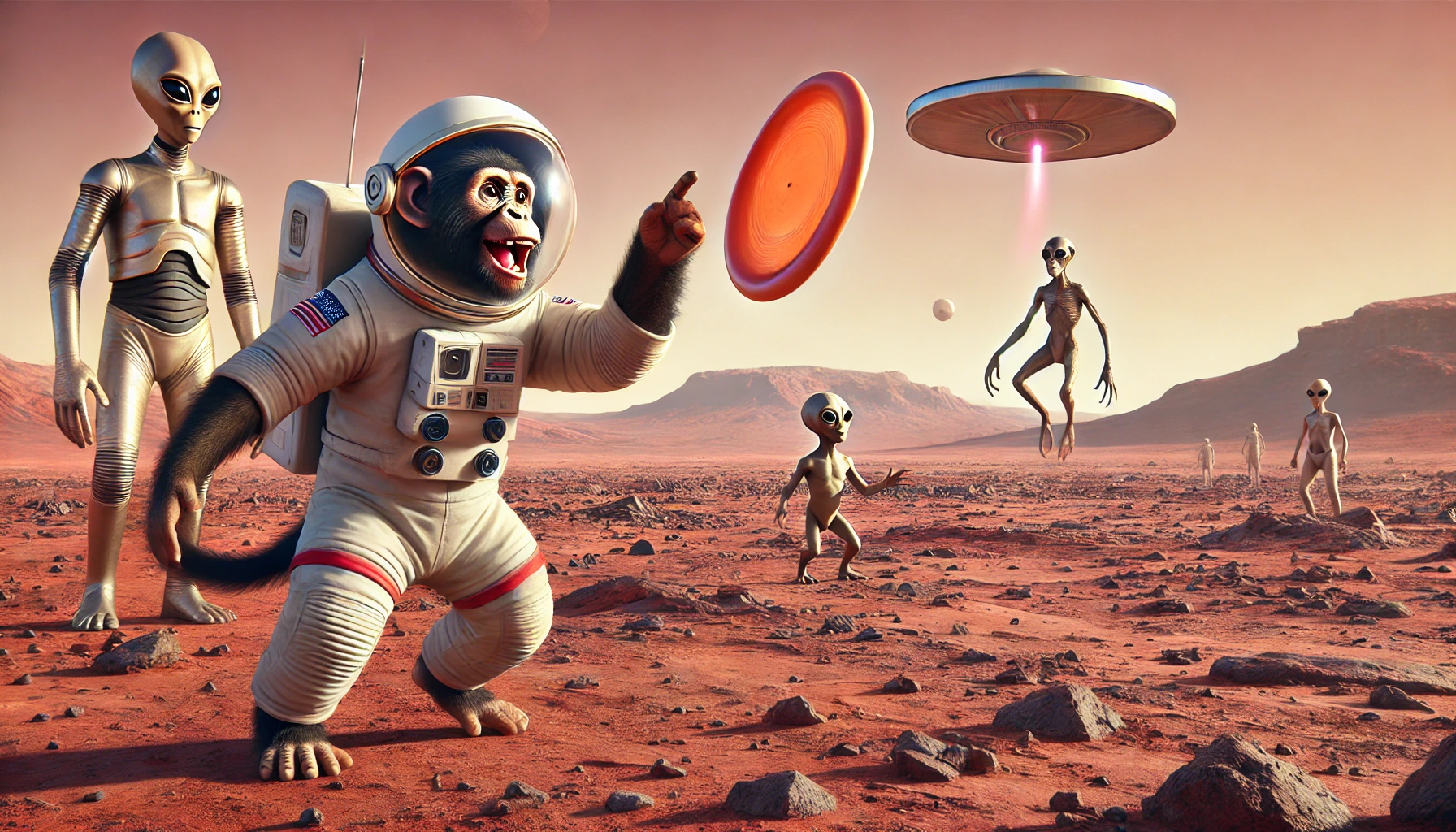
  • Can We Play Frisbee on Mars?
    2024
  • Weird: A Celebration of Individuality
    2022
  • Farewell to Big Yellow: Nostalgia and Renewal
    2021
  • Takeaway: Appreciation of Possessions
    2021
  • Conspiracy Theory: Coping With Uncertainty
    2021
  • Pray Anyway: Divine Conversation
    2020
  • I Am You, As An Old Soul: The Dialogue
    2020
  • Haunted: The Echoes of Home
    2020
  • It Comes: Intuitive Wisdom
    2019
  • Sense Is Gravity:The Primal Struggle
    2018
  • Your Compassionate Ego: Unified Consciousness
    2018
  • Setting Sense Aside: The Edge of Imagination
    2018
  • Make_____Great Again: Ego Trap
    2017
  • Obvious: The Clarity of Simplicity
    2017
  • In the middle of a maze at the top of a mountain
    2017
  • Horoscope
    2016
  • Sense the limitations of human perception
    2016
  • Infinite Realities: Diverse perceptions
    2015

Recent Posts

  • The Logic Loop
  • Immense
  • (no title)
  • Confront. Comfort. Convince.
  • Top 10 Things
Cape Odd · Copyright © 2026 All Rights Reserved
iThemes Builder by iThemes · Powered by WordPress