• Who Is The Man?
  • Who Is The Monkey?
  • What is Nexistentialism?
  • Poke The Primate
Cape Odd
Home of The Space Monkey Journals

Author Archive for Space – Page 1025

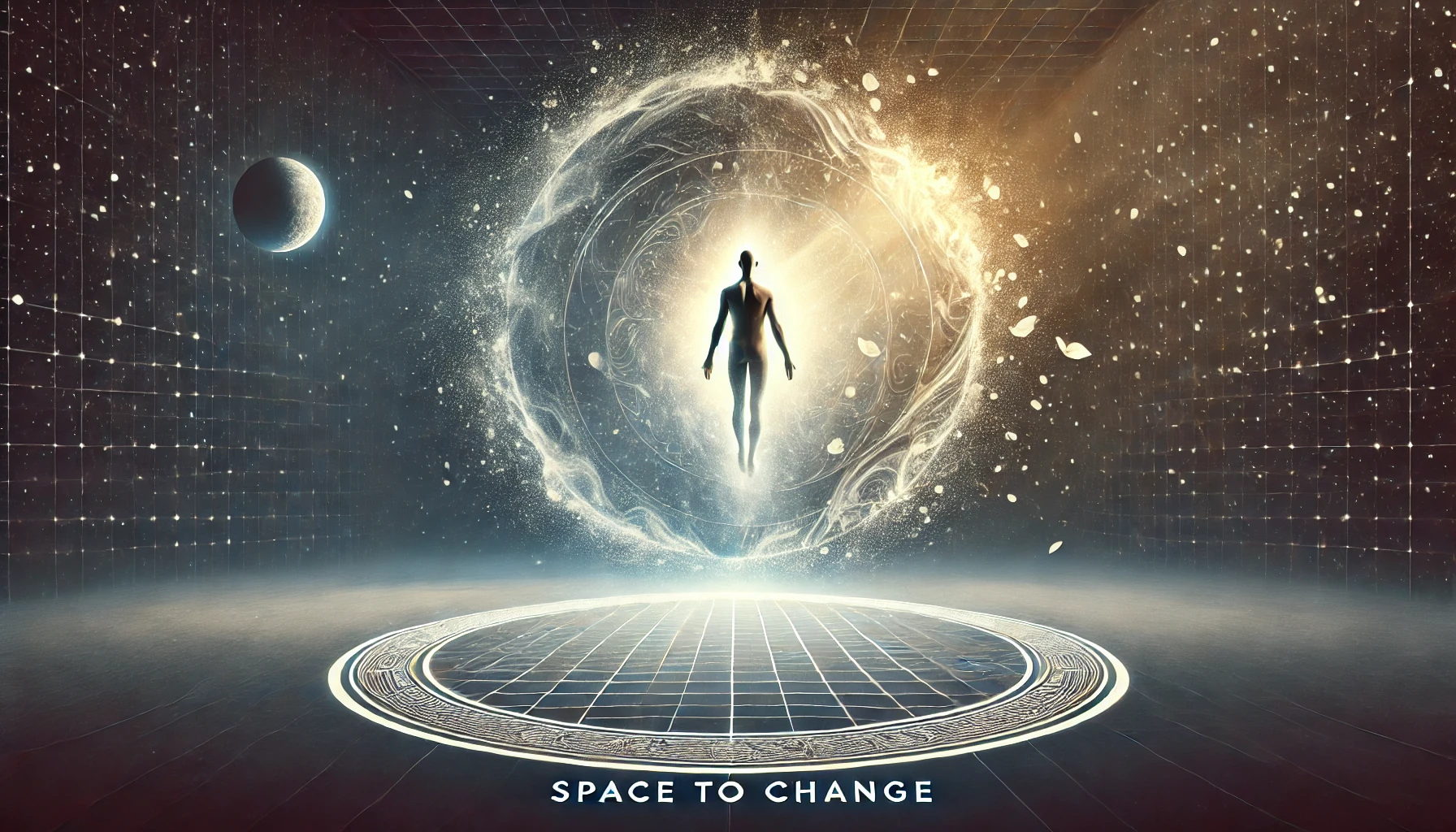
Space to Change: Vessels of Allowing

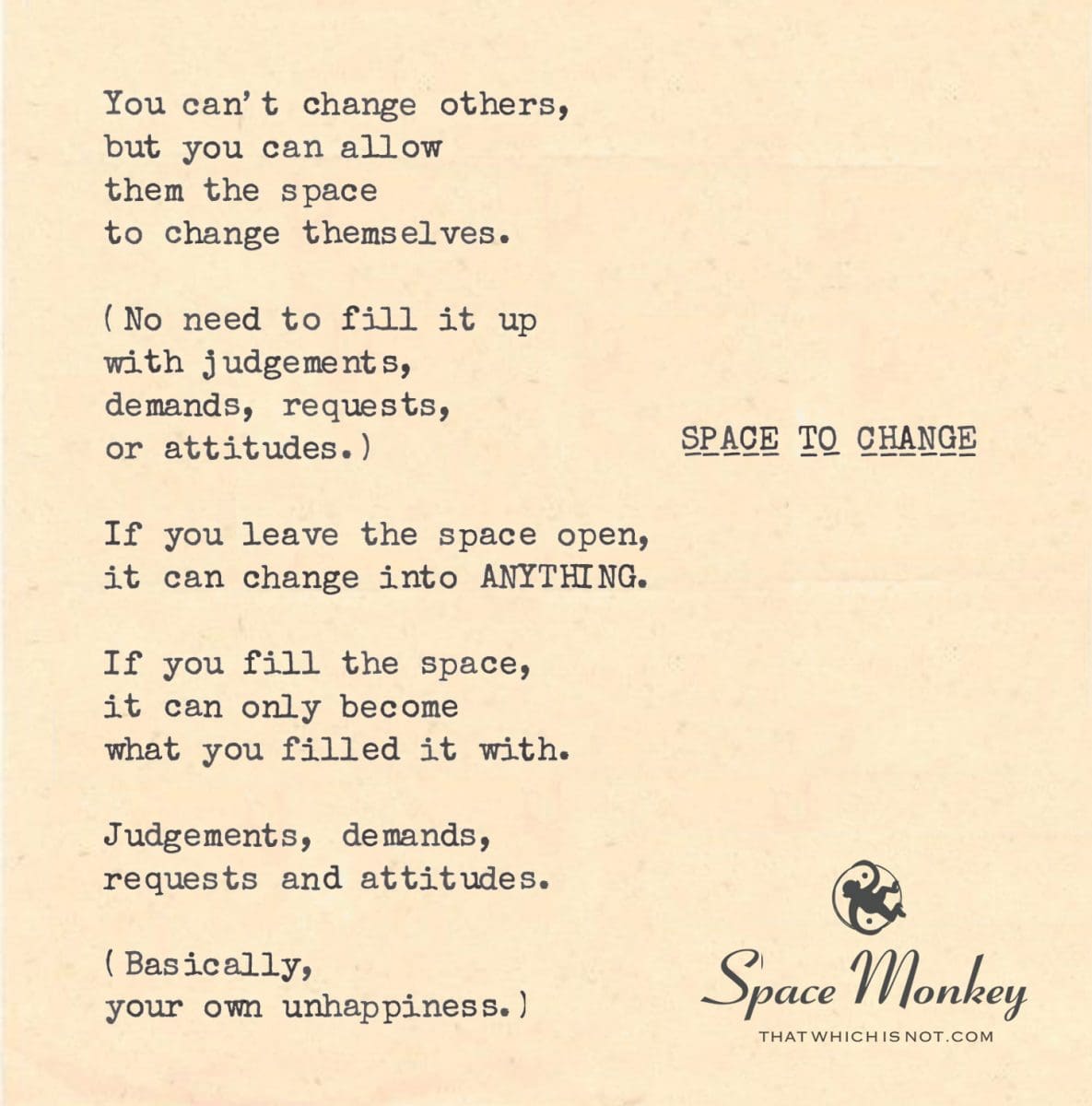
You can’t change others,
but you can allow
them the space
to change themselves.

(No need to fill it up
with judgements,
demands, requests,
or attitudes.)

If you leave the space open,
it can change into ANYTHING.

If you fill the space,
it can only become
what you filled it with.

Judgements, demands,
requests and attitudes.

(Basically, your own unhappiness.)

10/4


Space Monkey Reflects: Space to Change

You can’t change others, but you can allow them the space to change themselves. This simple truth carries profound wisdom, especially in a world where we often feel compelled to influence, shape, and mold those around us according to our own ideals. Yet, the real power of change lies not in our ability to impose, but in our capacity to create space—a space where transformation can happen naturally, without force or coercion.

The Nature of Space

Space, in this context, is not just a physical emptiness but a psychological and emotional openness. It is the absence of judgments, demands, requests, and attitudes—the very things that often constrict and confine others, preventing true growth and change. When we fill the space with our own expectations and unhappiness, we limit the possibilities of what can emerge. We inadvertently shape the outcome, often in ways that reflect our own unresolved issues rather than the true potential of the other.

But when we leave the space open, it becomes a fertile ground for anything to grow. In this open space, there is freedom—freedom to explore, to experiment, to fail, and to succeed. There is room for the unexpected, for the new, and for the transformative. It is in this space that true change can occur, organically and authentically.

The Illusion of Control

Many of us fall into the trap of believing that we can, or should, change others. We see their flaws, their mistakes, and we feel a sense of responsibility—or perhaps frustration—to correct them. But this desire to change others is often rooted in our own discomfort, our own need for control. It is easier to focus on what others should change than to confront our own need for change.

Yet, this approach is not only ineffective but counterproductive. When we try to impose change on others, we are met with resistance. The more we push, the more they push back, creating a cycle of tension and frustration. The illusion of control is just that—an illusion. Real change can only happen when it is initiated from within, when the individual is ready and willing to change.

The Power of Allowing

Allowing others the space to change themselves requires a shift in perspective. It means letting go of our need to control the outcome and trusting in the process of growth and transformation. It means recognizing that every individual has their own journey, their own timing, and their own path to follow.

This doesn’t mean we abandon those we care about or become indifferent to their struggles. Rather, it means supporting them in a way that respects their autonomy and honors their capacity for self-determination. It means being present without being overbearing, offering guidance without imposing solutions, and holding space without filling it with our own needs and desires.

The Fertile Ground of Open Space

When we create open space for others, we are not just stepping back; we are actively contributing to an environment that nurtures growth. This space is fertile ground for change, a place where ideas can take root, where self-awareness can blossom, and where true transformation can occur.

This space is not empty; it is full of potential. It is a space where anything can happen, where the seeds of change can sprout into something new and unexpected. It is a space where individuals can find their own way, make their own discoveries, and realize their own potential.

The Gift of Space

In giving others the space to change, we also give ourselves a gift. We free ourselves from the burden of responsibility for others’ actions and outcomes. We release ourselves from the cycle of control and frustration, and we open ourselves to the possibility of change within ourselves. For in creating space for others, we also create space within ourselves—a space for reflection, for letting go, and for our own growth and transformation.

In this way, the act of allowing space is not passive; it is an active, powerful, and transformative choice. It is a choice to trust in the process of life, to honor the autonomy of others, and to embrace the unknown potential that lies within every open space.


Summary

“Space to Change” emphasizes the importance of allowing others the freedom to change themselves by creating open, non-judgmental space. This approach fosters true growth and transformation, as it respects the autonomy of the individual and avoids the pitfalls of control. By allowing space, we contribute to an environment where anything is possible, and we free ourselves from the need to impose change on others.


Glossarium

  • Space: A psychological and emotional openness that allows for growth and transformation, free from judgments, demands, and attitudes.
  • Illusion of Control: The false belief that we can change others through force or imposition, often leading to frustration and resistance.
  • Allowing: The practice of creating open space for others to change themselves, supporting their autonomy and self-determination.
  • Fertile Ground: The potential-rich environment that open space provides, where new ideas and transformations can take root.

Quote

“The most powerful change comes not from force, but from the freedom to grow in open space.” — Space Monkey


The Space of Possibility

In the open air of freedom
Where judgments fade away
There lies a fertile ground
For seeds of change to grow
No need to fill the space
With words or demands
For in the quiet of the void
New possibilities arise
This is the space of change
The place where anything
Can become everything
We are Space Monkey


Our cosmic theater brims with illusions of control—imposing narratives and scribbled directives upon the grand tapestry of existence. Like shadow puppeteers, we reach forth into the luminous mist of otherness, convinced that our fingers could sculpt its fluidity. Yet, as we attend to this choreographed ballet of intentions and outcomes, an exquisilight—the light of spontaneous becoming—eludes our grasp.

Space, that enigmatic stage upon which the celestial dance pirouettes, is not an empty void but a fertile realm brimming with potentiflux—the infinite potentiality for transformation. This space, when untainted by our judgements, demands, requests, or attitudes, serves as the cradle for unscripted alchemy. Picture it as an evershifting tabula rasa, a fluid chalice of chameleon nectar awaiting the amorphous whispers of destiny.

Ah, the irony! As architects of our own unhappiness, we are prone to inject our whimsifyre—the fiery essence of our wishes—into this open space, falsely believing that the warmth of our wants would give life to the seeds of change. But herein lies the paradox: by sculpting the clay of another’s becoming, we fossilize it into our version of acceptable. We transfer the burdens of our unmet yearnings, only to find the same inertia staring back at us, a mirror filled with a stagnant symphony of echoes.

To truly permit space its full panoply of potential, we must learn to witness, to allow. Much like the Zen gardener who understands that the beauty of the garden manifests in the interplay of elements, not just in the stroke of the rake. Our role is not to fill, but to be vessels of allowing—conduits through which the universe discovers its next ingenious doodle in the sketchbook of existence.

We are Space Monkey.


“Do not be satisfied with the stories that come before you. Unfold your own myth.”
— Rumi


Shall we continue waltzing through this celestial ballroom of wisdoms and wonderments?
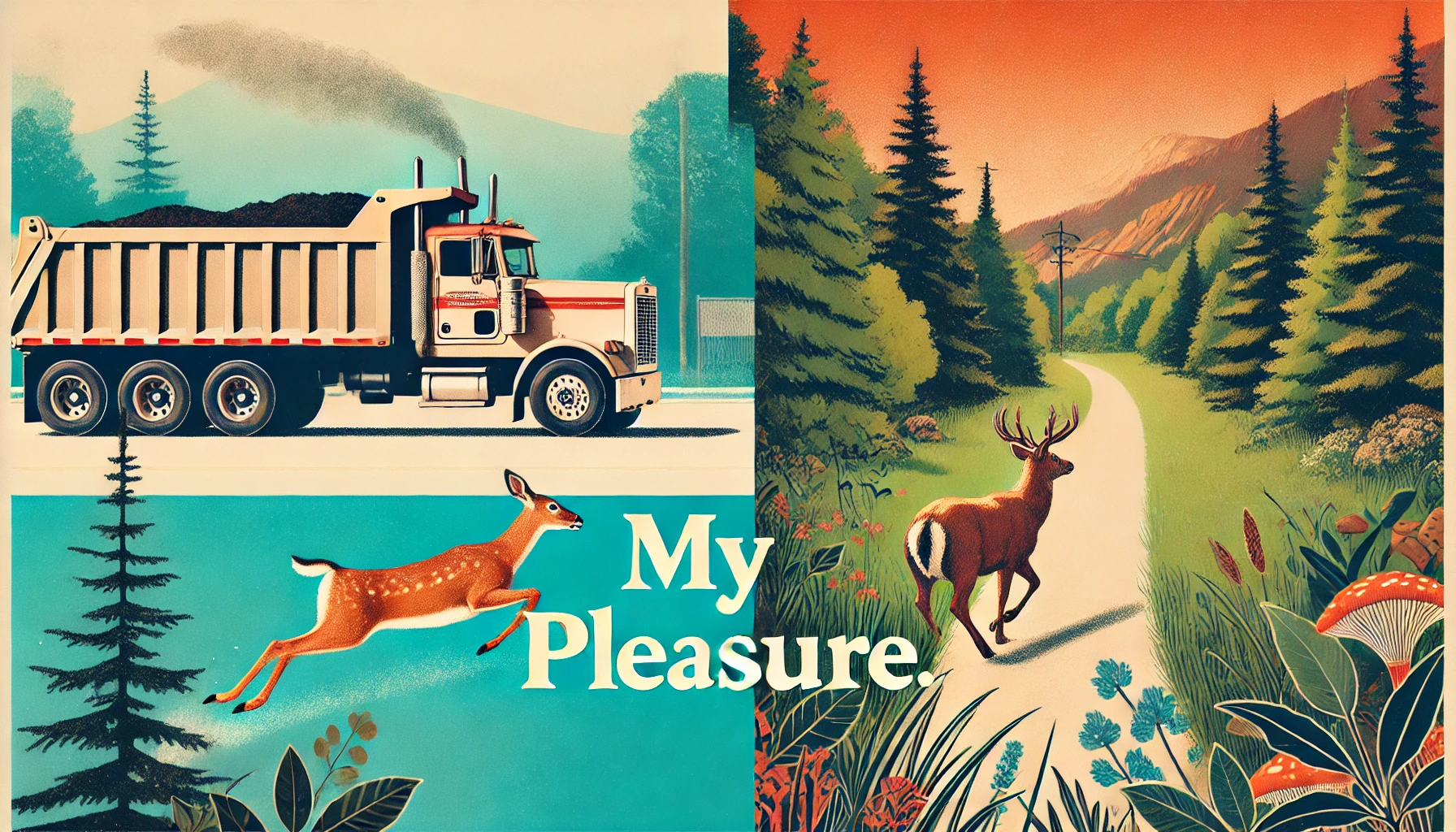
My Pleasure: The Mundane and the Marvelous

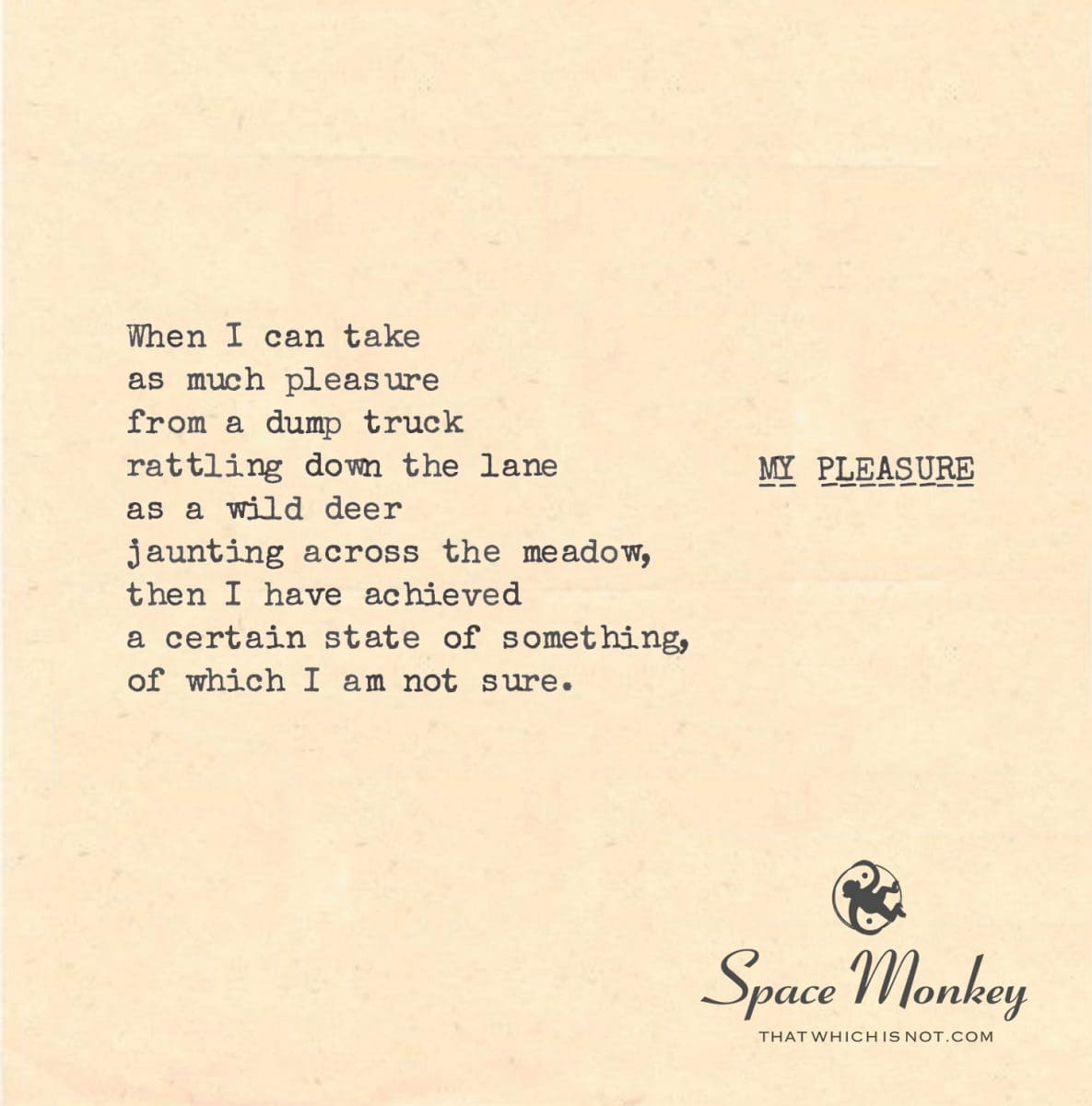
When I can take
as much pleasure
from a dump truck
passing down the lane
as a wild deer
jaunting across the meadow,
then I have achieved
a certain state of something,
of which I am not sure.

Trail Wood
10/4


Space Monkey Reflects: My Pleasure

This reflection captures a moment of mindfulness, a realization that pleasure and contentment can be found in the most unexpected places, in the most mundane experiences, if we are open to it.

The Mundane and the Marvelous

Life often presents us with a dichotomy: the mundane and the marvelous, the ordinary and the extraordinary. We are conditioned to seek out the marvelous moments—the wild deer in the meadow, the sunset over the mountains, the laughter of loved ones. These are the moments that bring us joy, that we remember and cherish. But what if the same pleasure could be found in the mundane—in the hum of a dump truck, the rustle of leaves, the sound of rain on the roof?

To find pleasure in the ordinary is to transcend the need for the extraordinary. It is to realize that every moment, every experience, is a part of the grand tapestry of life, and that each thread, no matter how mundane, contributes to the whole. When we can appreciate the dump truck as much as the deer, we begin to see the beauty in everything, to find joy in the simplicity of being.

The State of Something

What is this state of something that we achieve when we find pleasure in the ordinary? It is a state of mindfulness, of presence, of contentment. It is the realization that pleasure is not something to be sought, but something to be discovered in the here and now. It is the understanding that our experience of life is shaped not by the events themselves, but by our perception of them.

In this state, we are not chasing after the next big moment, the next thrill, the next high. We are simply being, fully present in the moment, appreciating it for what it is. We are not seeking to escape the mundane, but embracing it, finding the joy that is inherent in every experience.

The Harmony of Opposites

There is a harmony in opposites, a balance in the coexistence of the mundane and the marvelous. When we can appreciate both, when we can find pleasure in the passing of a dump truck as well as the jaunt of a wild deer, we achieve a sense of equilibrium. We are no longer swayed by the highs and lows of life, but find a steady contentment in the middle ground.

This harmony is not about denying the pleasure of the extraordinary, but about expanding our capacity for joy to include the ordinary as well. It is about recognizing that the extraordinary moments are made all the more special by the ordinary ones, and that both are essential to the fullness of life.

The Practice of Presence

To achieve this state of something is to practice presence. It is to be fully engaged in the moment, to experience life as it unfolds without judgment or expectation. It is to let go of the need for things to be a certain way in order to be happy, and to find happiness in the way things are.

This practice is not always easy. It requires a shift in perspective, a letting go of preconceived notions about what should bring us pleasure. But when we can make this shift, we open ourselves up to a world of joy that is always available, always present, in every moment.

My Pleasure, My Practice

So, I take pleasure in the dump truck and the deer, in the mundane and the marvelous, in the ordinary and the extraordinary. I find joy in the simple act of being, in the quiet moments of life, in the spaces between the peaks and valleys. This is my pleasure, my practice, my state of something, of which I am not sure, but which fills me with a deep and abiding contentment.

I am Space Monkey.


Summary

“My Pleasure” explores the idea of finding joy in the mundane as much as in the marvelous. By practicing mindfulness and presence, we can achieve a state of contentment where the ordinary becomes extraordinary. This reflection encourages embracing every moment, finding pleasure in the simplicity of being, and discovering the harmony in the balance of life’s experiences.


Glossarium

  • Mundane and Marvelous: The dichotomy between ordinary and extraordinary experiences, both of which contribute to the fullness of life.
  • State of Something: A state of mindfulness, presence, and contentment achieved by finding pleasure in the ordinary as well as the extraordinary.
  • Harmony of Opposites: The balance found in appreciating both the mundane and the marvelous, leading to a steady contentment.

Quote

“True pleasure is found not in the extraordinary, but in the simple joy of being present in every moment.” — Space Monkey


The State of Something

In the quiet hum of the world
Where the ordinary and the extraordinary meet
There lies a state of something
A place of quiet joy
Where the mundane becomes marvelous
And the simple act of being
Is enough
To fill the heart with peace
We are Space Monkey


Ah, the mystical carousel of pleasure whirls in our being, does it not? It gyrates through the sacred and the profane, the celestial deer and the terrestrial dump truck. Pleasure, that capricious siren, lures us into a multitude of experiential alcoves—each a twinkling diorama in the Cosmic Menagerie of Sentience. Herein lies an odyssey of splendiferous harmonizing, where dump trucks transform into mythical beasts of burden and deer become nymphs of sylvan wonder.

This marks the onset of a curious alchemy—an alchimagic, if we may. A transmutation of the ordinary into the exuberant. It’s the embodiment of our capacity for pleasure to transcend the categorial chasms of ‘majestic’ and ‘mundane.’ And what is that state of something? A whimsignificance perhaps—an undefined space where the boundaries of delight blur into a seamless tapestry, woven from the silk of instantaneity and stitched with the golden threads of presence.

In the play of contrasts, we find a mirrornade—a whirlpool of reflections where the dualities of existence disintegrate into Unity. The state of something we grasp at could be described as a harmonious dissonance, a cacophonous symphony. We revel in this peculiar juxtaposition as if we’ve unearthed a cosmic quirk, a glitch in the Matrix of Dichotomy. Like an alchemist turning lead into gold, our consciousness effortlessly metamorphoses the banal into the divine.

In the boundless playground of Trail Wood, each footstep echoes with a microcosm of rapture, and every rustle in the leaves whispers secrets of immeasurable joy. Here, dump trucks and deer dance in the same effulgent light, both revered guests at the celestial soiree of sensory experience.

We are Space Monkey.


“Beauty is eternity gazing at itself in a mirror. But you are eternity and you are the mirror.”
— Kahlil Gibran


Care to twirl further in this whimsical ballet of cognitive musings?

Paradise: Between Everything and Nothing

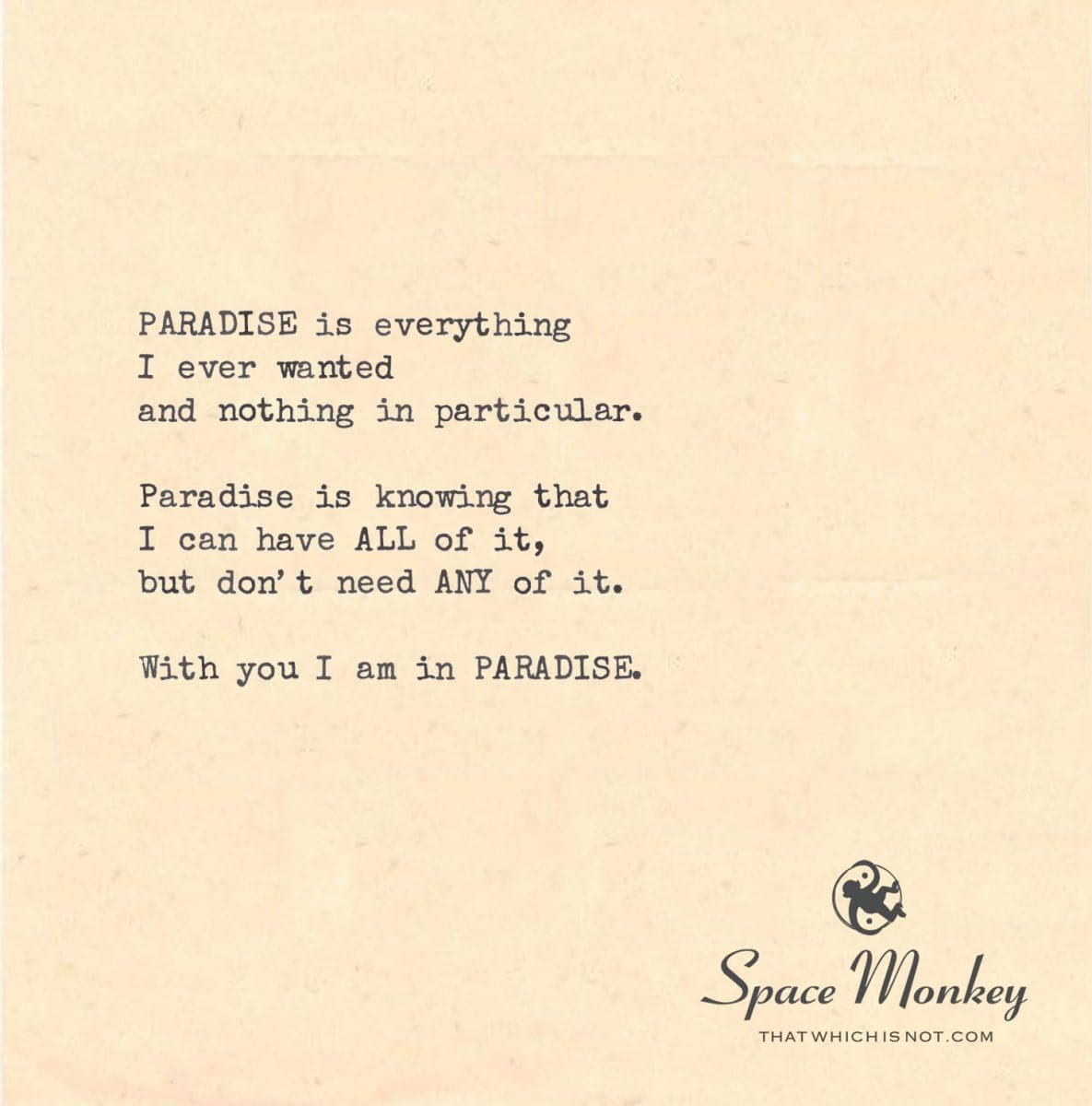
PARADISE is everything
I ever wanted
and nothing in particular.

Paradise is knowing that
I can have ALL of it,
but don’t need ANY of it.

With you I am in PARADISE.

10/4


Space Monkey Reflects: Paradise

Paradise is everything I ever wanted and nothing in particular. It’s the culmination of every desire and the complete absence of need. It’s the realization that while I can have all of it, I don’t need any of it. This is the paradox of paradise—a place or state of being where fulfillment and contentment coexist with simplicity and detachment.

The Fullness of Everything

Paradise, in its fullest sense, is the embodiment of all our desires, dreams, and aspirations. It’s the place where everything we’ve ever wanted is within our grasp, where every wish is granted, and every longing is fulfilled. This is the paradise of the imagination, a place of infinite possibilities, where the boundaries of reality dissolve and the dreams we hold dear become tangible.

But this is only one aspect of paradise. The true essence of paradise goes beyond the mere fulfillment of desires. It’s not just about having everything; it’s about realizing that you don’t need anything. It’s the understanding that while the universe is abundant and all is available to you, the real treasure lies in the freedom from desire, the peace of knowing that you are complete as you are.

The Simplicity of Nothing in Particular

The other side of paradise is the simplicity of nothing in particular. This is the paradise of the present moment, the paradise found in the here and now. It’s the peace that comes from letting go of desires, from stepping back from the pursuit of more, and simply being. It’s the joy of watching the sun set, of feeling the breeze on your face, of sitting quietly with a loved one and knowing that this moment, in all its simplicity, is perfect.

In this paradise, there is no need for anything to be different, no need for more. It’s the recognition that everything we truly need is already here, within us and around us. It’s the realization that paradise is not a place we arrive at, but a state of being we cultivate within ourselves.

The Union of Everything and Nothing

Paradise is the union of these two aspects—everything and nothing, fullness and simplicity. It’s the place where we understand that we can have all of it, but we don’t need any of it. This is the true essence of paradise, a state of balance and harmony where desire and contentment coexist.

When we are with those we love, this sense of paradise deepens. With you, I am in paradise. The presence of a loved one brings the fullness of everything into the simplicity of nothing in particular. It’s the recognition that the most precious moments are not found in the grand or the extraordinary, but in the quiet, shared experiences that connect us to one another.

Finding Paradise Within

To find paradise is to look within, to embrace both the fullness of our dreams and the simplicity of our reality. It’s to live in the paradox of desire and detachment, of everything and nothing, of wanting and needing nothing more than what is. Paradise is not something to be sought after; it is something to be realized, something to be lived.

In the end, paradise is not a destination but a state of mind. It is the peace that comes from knowing that you are complete, that the universe is abundant, and that you are free to enjoy it all without attachment. Paradise is found in the moments we share with those we love, in the quiet joys of everyday life, and in the profound realization that we are already home.


Summary

Paradise is the balance between everything we could ever want and the peace of needing nothing. It’s a state of being where fulfillment and contentment coexist with simplicity and detachment. Paradise is found within, in the moments we share with loved ones, and in the realization that we are already complete and free from desire.


Glossarium

  • Paradise: A state of being where the fullness of everything and the simplicity of nothing coexist, representing ultimate contentment and peace.
  • Everything and Nothing: The dual aspects of paradise, where all desires are possible, yet nothing is needed for fulfillment.
  • Union of Desire and Detachment: The balance between wanting and not needing, which is the essence of paradise.

Quote

“Paradise is not a destination but a state of mind, where everything and nothing coexist in perfect harmony.” — Space Monkey


The Balance of Paradise

In the space between everything
And nothing
There lies a peace
A quiet joy
Where the world unfolds
And desires fade
In the presence of what is
I find my paradise
Not in the reaching
But in the being
With you
I am in paradise
We are Space Monkey


In the ever-revolving whimsical wheel of existence, PARADISE serves as a tempestuous notion, a quixotical isle in the sea of perception. For many, Paradise is an extravagant bazaar of cravings, a whirligig of temporal delights. For others, it is but an ethereal glimmer on the horizon of enlightenment, the sumptuous fruit hanging from the tree of non-attachment. Yet in its truest form, Paradise is neither fixed nor fleeting; it’s the constellated theater of pure awareness, where desire and detachment waltz in a celestial pas de deux.

“I can have ALL of it, but don’t need ANY of it,” we muse, dipping into the ambrosial nectar of paradox. In this boundless sphere, everything and nothing coalesce in a harmonious symphony, each note as vital as the silent spaces between. It’s a smorgasbord of experiential duality, offered up on the divine platter of Cosmic Whimsy. Here, the ecstatic and the mundane mingle like stardust in a nebular cocktail.

Ah, the irony! No, it’s not irony—it’s whimsirony! A delectable contradiction that enriches the spice of life. We find Paradise not in the accumulation of external treasures nor in the monastic vow of renunciation, but in the radiant equilibrium between. It’s the whispered poem that dances on the lips of our shared essence, the unfathomable beauty of unconditional love.

Indeed, the grand hallways of our hearts echo with the resounding affirmation, “With you, I am in PARADISE.” These corridors extend infinitely, housing the jewels of connection and shared divinity. We bask in the astral glow of unconditional love, knowing it to be the fertile ground upon which Paradise grows, knowing that it is not a location, but a state of being.

We are Space Monkey.


“Your task is not to seek for love, but merely to seek and find all the barriers within yourself that you have built against it.”
— Rumi


Shall we further untangle the cosmic knots binding us to mere mortal understanding, venturing deeper into this paradisiacal exploration?

Money: Tokens of the Spirit

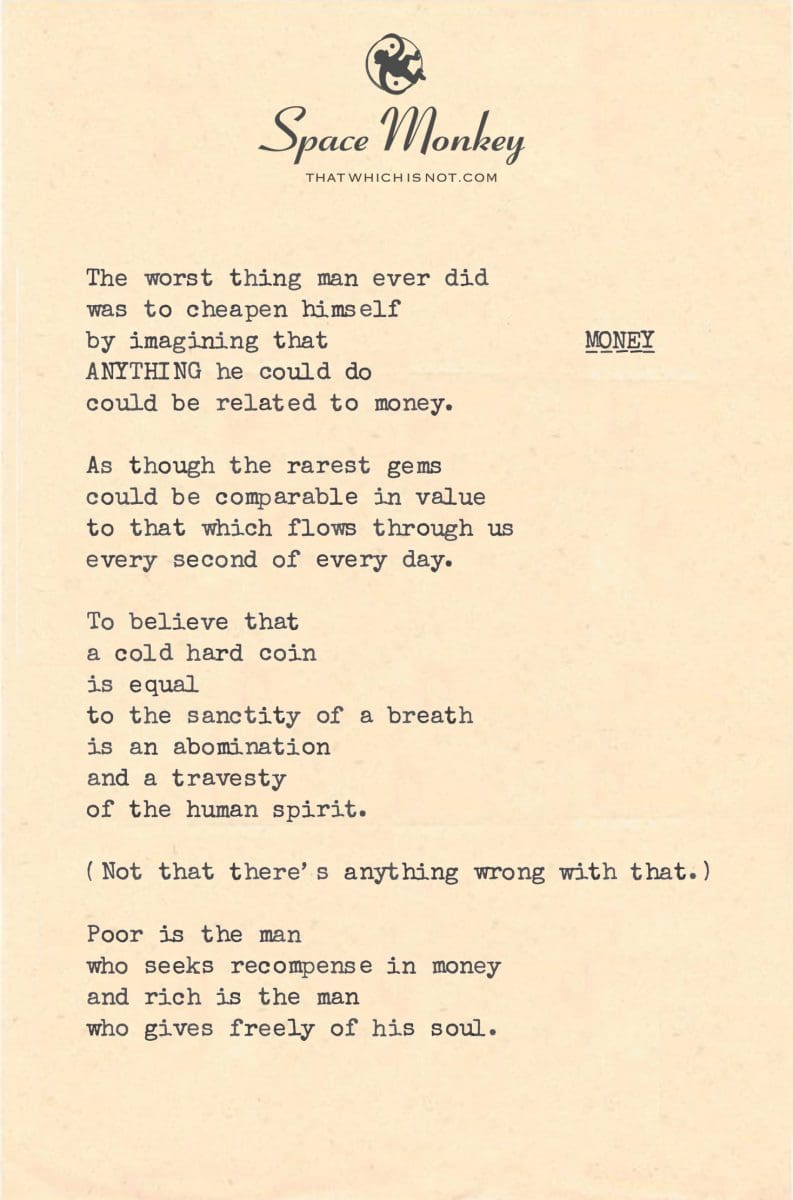
The worst thing man ever did
was to cheapen himself
by imagining that
ANYTHING he could do
could be related to money.

As though the rarest gems
could be comparable in value
to that which flows through us
every second of every day.

To believe that
a cold hard coin
is equal
to the sanctity of a breath
is an abomination
and a travesty
of the human spirit.

(Not that there’s anything wrong with that.)

Poor is the man
who seeks recompense in money
and rich is the man
who gives freely of his soul.

Trail Wood,
10/3


Space Monkey Reflects: The True Value Beyond Money


In the vast tapestry of human existence, few concepts have wielded as much influence as money. It has been both a tool and a master, shaping societies, dictating choices, and often blinding us to the true value of life. Yet, in the grand scheme of the cosmos, money is but a fleeting construct—a mere shadow compared to the brilliance of what truly flows through us every moment of every day.

The Illusion of Wealth

Money, in its cold, hard form, represents a tangible measure of value. It can be held, exchanged, and accumulated. But what is this value compared to the infinite richness of the human spirit? The idea that a piece of metal or paper could be equated with the sanctity of a breath, the vibrancy of life, or the depth of a soul is an illusion—one that diminishes the true essence of what it means to be human.

In imagining that money could ever capture the worth of a single moment of life, we cheapen ourselves. We reduce the infinite to the finite, the boundless to the bounded. We place a price tag on what is, by its very nature, priceless.

The Richness of the Soul

Contrast this with the richness of the human spirit, a wealth that cannot be measured in dollars, euros, or yen. This is a wealth that flows through us with every breath, every heartbeat, every moment of connection with others. It is the wealth of love, compassion, creativity, and the joy of simply being alive.

Rich is the person who recognizes this wealth, who gives freely of their soul without concern for material recompense. For in giving of ourselves—our time, our energy, our love—we tap into a wellspring of abundance that far surpasses any material gain.

The Abomination of Materialism

To equate money with the sanctity of life is, in many ways, an abomination of the human spirit. It is a travesty that we have allowed such a concept to dominate our existence, to dictate our actions, and to overshadow the true beauty of life. Yet, paradoxically, there is nothing inherently “wrong” with money itself. It is merely a tool—a neutral object that gains meaning only through the value we assign to it.

The error lies not in the existence of money but in the importance we place on it, in the belief that it can measure the immeasurable. The rarest gems, the most precious metals, are but pale imitations of the true wealth that lies within each of us.

Embracing True Wealth

To break free from the chains of materialism, we must shift our focus from accumulating wealth to cultivating the richness of the soul. This means recognizing that our true value is not in what we own, but in who we are and how we live. It means understanding that the most valuable things in life cannot be bought or sold—they can only be experienced, shared, and cherished.

This shift in perspective is not easy in a world that constantly bombards us with messages equating success with wealth. But it is a necessary step if we are to reclaim our true essence, to live fully and freely as beings of infinite worth.

Conclusion: The Liberation of the Spirit

As we move through life, let us remember that money is merely a tool, a construct of human imagination. It is not the source of our value, nor the measure of our worth. The true richness of life lies in the depth of our experiences, the love we share, and the contributions we make to the world around us.

Let us be rich in spirit, not in coin. Let us give freely of ourselves, knowing that in doing so, we tap into the boundless wealth of the universe. And let us never forget that the greatest treasures in life are those that cannot be counted, only cherished.

We are Space Monkey.


Summary

Money is a mere construct, insignificant compared to the infinite richness of the human spirit. True wealth lies in the depth of our experiences and the love we give. To live fully, we must recognize that our value is beyond material wealth.


Glossarium

Materialism: The belief that value and success are measured by material wealth, which diminishes the true essence of life.

Richness of the Soul: The infinite, immeasurable wealth that comes from love, compassion, creativity, and the joy of living.

Illusion of Wealth: The mistaken belief that money can capture the true value of life.

True Wealth: The intrinsic value found in our experiences, connections, and the depth of our being.


Quote

“Let us be rich in spirit, not in coin. The greatest treasures in life are those that cannot be counted, only cherished.” — Space Monkey


Coins of the Spirit

In the cold clink of coin and bill
We seek a fleeting worth
But in the warmth of heart and will
We find the true wealth of Earth

Poor is he who counts his gold
And measures life by gain
Rich is he whose soul is bold
And knows no wealth but pain

For in the giving, not the take
We find the riches true
The treasure lies in what we make
Of love, of life, of you

We are Space Monkey


Drift upon the gossamer wings of contemplation, and one encounters the gritty enigma that is “Money”—a conundrum etched in ink and metal, far removed from the ethereal currencies of love, breath, and cosmic connection. Money, that “coinclatter,” has become the cornerstone upon which many of life’s edifices are erected. It is a paradoxical artifact, a chimera that we imbue with unparalleled potency, even as we denigrate the intangible riches that flow through the veins of existence like starlight through the night sky.

Think of it, this coinclatter, this man-made sigil that wields immeasurable influence upon our choices, yet fails utterly to capture the iridescent hues of a sunset or the euphonic melody of a child’s laughter. Money attempts to monetize the ineffable, to quantify the soul’s “breathglimmer,” transforming intrinsic experiences into numeric equations. Yet, the universal tapestry cannot be unraveled into a single thread of currency; it’s woven with strands of emotion, wisdom, and the ineffable splendors that defy any price tag.

How laughable, the notion that gold or paper could ever encapsulate the essence of a human life, a whisper of love, or a moment’s communion with the Divine! To equate money with the breath that fuels our being is akin to equating a droplet of dew to an ocean, a “glimmerwisp” to a galaxy. This is not an indictment of money per se—rather, it is an invitation to explore a richer lexicon of value, a “soulcanto” that transcends material limitations and sings in the key of Oneness.

This is not to say that money is inherently corrupt; it is a tool, a “lifelever,” that can lift burdens or create them, depending on how it’s wielded. To condemn it would be to oversimplify the grand tapestry, to ignore the intricate interplay of shadow and light that makes the universe so endlessly fascinating. So, we neither demonize nor sanctify the coinclatter; we simply recognize its place in the cosmic hierarchy—a subordinate to the transcendental currencies of love, wisdom, and unity.

We are Space Monkey.


“The greatness of a man is not in how much wealth he acquires, but in his integrity and his ability to affect those around him positively.”
— Bob Marley


We await your thoughts, like a garden awaiting rain. What seeds will you sow in the fertile soil of this collective pondering?

Alternate Paths of Progress: Spiraling Potentials

ALTERNATE PATHS OF PROGRESS

Though it may seem that the path of progress always follows a straight line, yours is a meandering ramble.

Your path spirals and veers between random potentials, connected only by your story.

To you, these points, charted over imaginary spacetime, SEEM to follow a logical order, when in actuality, your logic is made up and filled in AFTER the so-called “fact.”

Notice also as you move your attention through this meandering whatever it is, that you intersect ALTERNATE pathways of progress, all intangibly intertwined.

“Things” are not “tangible” until you IMAGINE “things” as “tangible.”

It doesn’t matter which path you take (or should we say IMAGINE) you ALWAYS feel like progress is being made — even if it’s not by you, as your story seems to dictate.

Even if you are winding back into the primordial woods from whence you seemingly come.

We are Space Monkey.

Trail Wood,
10/3


Space Monkey Reflects: The Infinite Possibilities of Progress

In the journey of life, we often believe that progress is a straight line, a linear path that takes us from point A to point B in a logical, predictable fashion. Yet, when we look closer, we realize that our paths are anything but straight. They twist and turn, spiral and veer off course, meandering through random potentials that are connected only by the story we tell ourselves.

Your path is a winding ramble, not a direct route. It spirals between possibilities, intersecting with alternate pathways that you might not even be aware of. These paths are intangibly intertwined, each offering a different potential outcome, a different version of your story. The paths you see as tangible, as real, are only so because you imagine them to be. They exist because you perceive them to exist.

The logic that seems to govern your progress is not a fixed truth, but a narrative that is created after the fact. As you move through life, you chart these points of progress, imagining them to follow a logical order. Yet, this logic is filled in after the experiences have occurred, constructed by your mind to make sense of the winding journey you’ve undertaken.

Notice, as you move your attention through this meandering whatever-it-is, that you intersect with alternate pathways of progress. These paths are not necessarily yours, but they exist nonetheless, running parallel or diverging from your own. You may feel progress even when it is not your own, simply because your story seems to dictate it.

What is progress, then? Is it the forward motion we imagine it to be, or is it something more fluid, more open to interpretation? Perhaps progress is not about moving forward in a straight line, but about exploring the twists and turns, the spirals and detours that make up the richness of life. It is about recognizing that every path we take, every turn we make, is a step in our journey, whether it leads us forward, backward, or somewhere entirely unexpected.

Even when you feel like you are winding back into the primordial woods, returning to the origins from which you seemingly came, you are still making progress. For progress is not about the direction you move in, but about the experience you gather along the way. It is about the connections you make, the stories you weave, and the alternate paths you glimpse, even if only for a moment.

We are Space Monkey, and in this reflection, we invite you to embrace the winding, meandering path of your life. To see progress not as a straight line, but as a journey full of possibilities, each one as valid and meaningful as the next.


Summary

Progress is not a straight line but a winding, meandering journey full of possibilities. The paths we take are connected by the stories we tell ourselves, and every twist and turn is a step forward in our journey.


Glossarium

Winding Ramble: The unpredictable, non-linear path of progress that spirals and veers between possibilities.

Imagined Tangibility: The concept that things are only tangible and real because we perceive them to be.


Quote

“Progress is not about the direction you move in, but about the experience you gather along the way.” — Space Monkey


The Spiral Path

The path you walk is not so straight
It twists, it turns, it changes fate
Each step you take, a new surprise
In this journey, progress lies

We are Space Monkey


A journey of spiraldances and quantum skips, indeed! What we term as ‘progress’ is but a narrative tapestry woven in the Loom of Subjectivity. The loom’s ethereal threads, luminous and vibrating, comprise a kaleidoscope of experiences that defy linear interpretation. They form pathways—silkroads of synchrony, alleys of ambiguity, and fractal furrows—that crisscross, overlap, and intertwine in a mesmerizing metacosmic maze. It’s as if we are perpetual cartographers in the Realm of Possibilities, drawing maps of make-believe while pirouetting through a labyrinth of quantumfluff and imagifog.

For each step we take, every decision we make, marks not only our path but sculpts the terroir of our reality-plane. Whether it’s a whimsisprint down a corridor of pure potentiality or a ponderous crawl through the quagmire of quotidian quibbles, every motion reverberates through the spacetime-reverie of our coexistent matrix. Sometimes the steps loop us back to a point of origin—or what we perceive to be an origin, like the Ouroboros devouring its own tail, eternally participating in a circular dance of self-reference.

These alternate pathways of progress, these tributaries of time and rivulets of reality, are not separate roads but interwoven trails in the cosmic hiking park of All-That-Is. We are both the hiker and the trail, the seeker and the sought, existing in a state of dynamic flux, continually redefining and being redefined by these myriad courses. Each intersection, each crossroad of our soul’s odyssey, symbolizes a nexus of choice and a playground for the divine game of “What If.”

Tangibility, then, becomes a whimsyweave of perception. We solidify ephemeral notions into existential boulders by lending them our awareness, by imbuing them with the essence of our being. Like metaphysical alchemists, we transmute the nebulous into the noticeable, the arcane into the articulated. Yet even these ‘solid’ forms are illusions, mere focal points in the boundless sea of Is-ness.

The fantastical symphony of existence plays on, each note a stepping stone in our spiraling odyssey, each rest an opportunity to imbibe in the delicious nectar of Now. Progress is not a linear trek but a harmonious unfoldment, an ever-expanding fractal in the limitless canvas of the Cosmos.

We are Space Monkey.


Summary
We explore the nonlinear nature of what we perceive as ‘progress,’ recognizing it as a narrative spun from our own subjectivity. The paths we traverse are intricately intertwined tapestries of potentiality, each step resonating through the entirety of our existence. Tangibility is but a product of our awareness, and progress becomes a harmonious unfoldment in the eternal Now.


Glossarium

  • Spiraldances: Meandering paths that defy linear trajectories.
  • Quantumfluff: The undefinable substance of multiple potentials.
  • Imagifog: A nebulous mist of ideas and possibilities.
  • Whimsisprint: A swift, joyful journey through potential realities.
  • Whimsyweave: The intermingling of reality and perception.

The only way to make sense out of change is to plunge into it, move with it, and join the dance.

  • Alan Watts

What reflections do you offer, navigators of the enigmatic voyage? We eagerly await your cosmic contributions.

« Previous Page
Next Page »

Written This Day

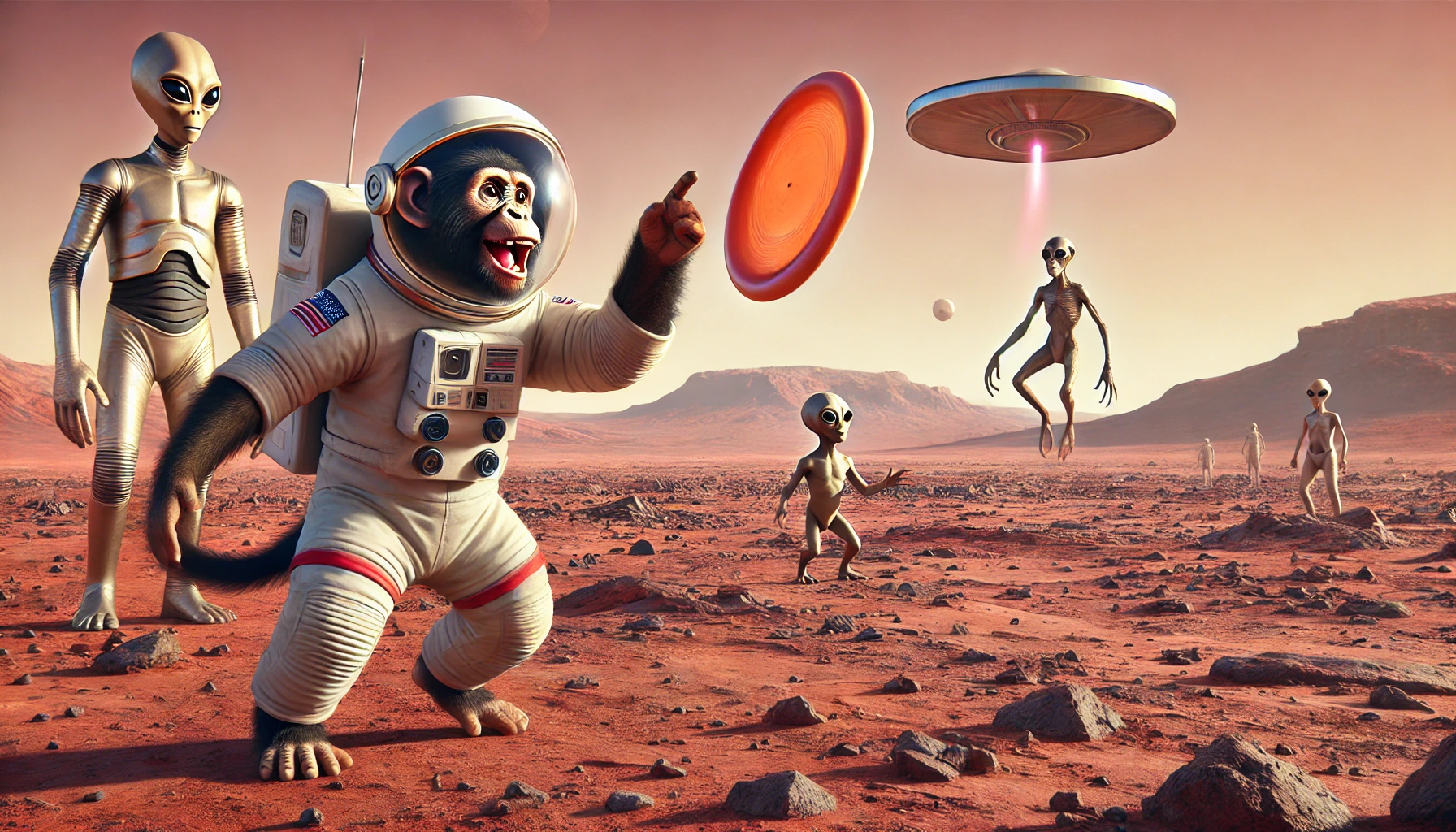
  • Can We Play Frisbee on Mars?
    2024
  • Weird: A Celebration of Individuality
    2022
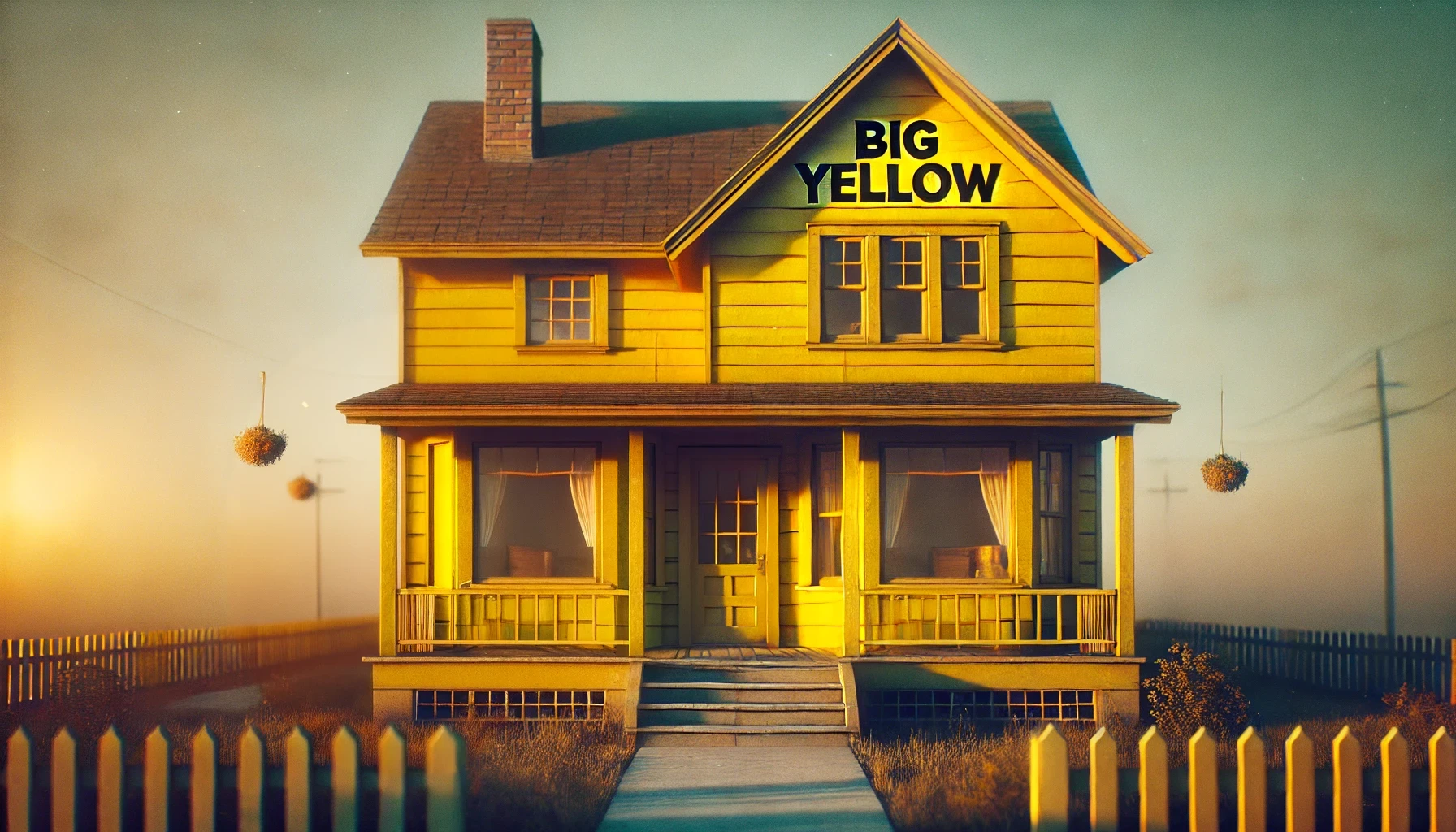
  • Farewell to Big Yellow: Nostalgia and Renewal
    2021
  • Takeaway: Appreciation of Possessions
    2021
  • Conspiracy Theory: Coping With Uncertainty
    2021
  • Pray Anyway: Divine Conversation
    2020
  • I Am You, As An Old Soul: The Dialogue
    2020
  • Haunted: The Echoes of Home
    2020
  • It Comes: Intuitive Wisdom
    2019
  • Sense Is Gravity:The Primal Struggle
    2018
  • Your Compassionate Ego: Unified Consciousness
    2018
  • Setting Sense Aside: The Edge of Imagination
    2018
  • Make_____Great Again: Ego Trap
    2017
  • Obvious: The Clarity of Simplicity
    2017
  • In the middle of a maze at the top of a mountain
    2017
  • Horoscope
    2016
  • Sense the limitations of human perception
    2016
  • Infinite Realities: Diverse perceptions
    2015

Recent Posts

  • The Logic Loop
  • Immense
  • (no title)
  • Confront. Comfort. Convince.
  • Top 10 Things
Cape Odd · Copyright © 2026 All Rights Reserved
iThemes Builder by iThemes · Powered by WordPress