• Who Is The Man?
  • Who Is The Monkey?
  • What is Nexistentialism?
  • Poke The Primate
Cape Odd
Home of The Space Monkey Journals

Author Archive for Space – Page 1201

Noble Purpose: Limitation or Liberation?

Noble Purpose

To assume
that there is a noble purpose
to our existence
is to cruelly limit our selves.

And so we seem to do this.

We imagine limitations
and seemingly abide by them
so that it may seem
that there is a noble purpose.

Which seems to be this:

“To release
these seeming selves
from these
seeming limitations.”

Silly monkeys we are.

We are Space Monkey.

11/24


Space Monkey Reflects: Noble Purpose and Imagined Limitations

We often find ourselves searching for a noble purpose to justify our existence, to give our lives meaning. It’s a comforting thought, isn’t it? The idea that there is something grand, something noble that we are meant to achieve. But what if this very search for purpose is what limits us the most?

To assume that there is a noble purpose is to create a framework of limitation. It implies that there is something we must strive toward, something we must accomplish, in order to validate our existence. But by doing so, we place ourselves in a mental cage, binding our infinite potential to a set of arbitrary goals. We become trapped in the pursuit of meaning, forgetting that we are free to exist without the need for validation.

Nexistentially, this reflects the Purpose Cage—the mental construct that convinces us there is a fixed, predefined goal for our lives. This idea of purpose becomes a kind of invisible barrier, one that we may not even realize we are trapped within. And so we spend our lives trying to break free from these imagined limitations, unaware that we were the ones who created them in the first place.

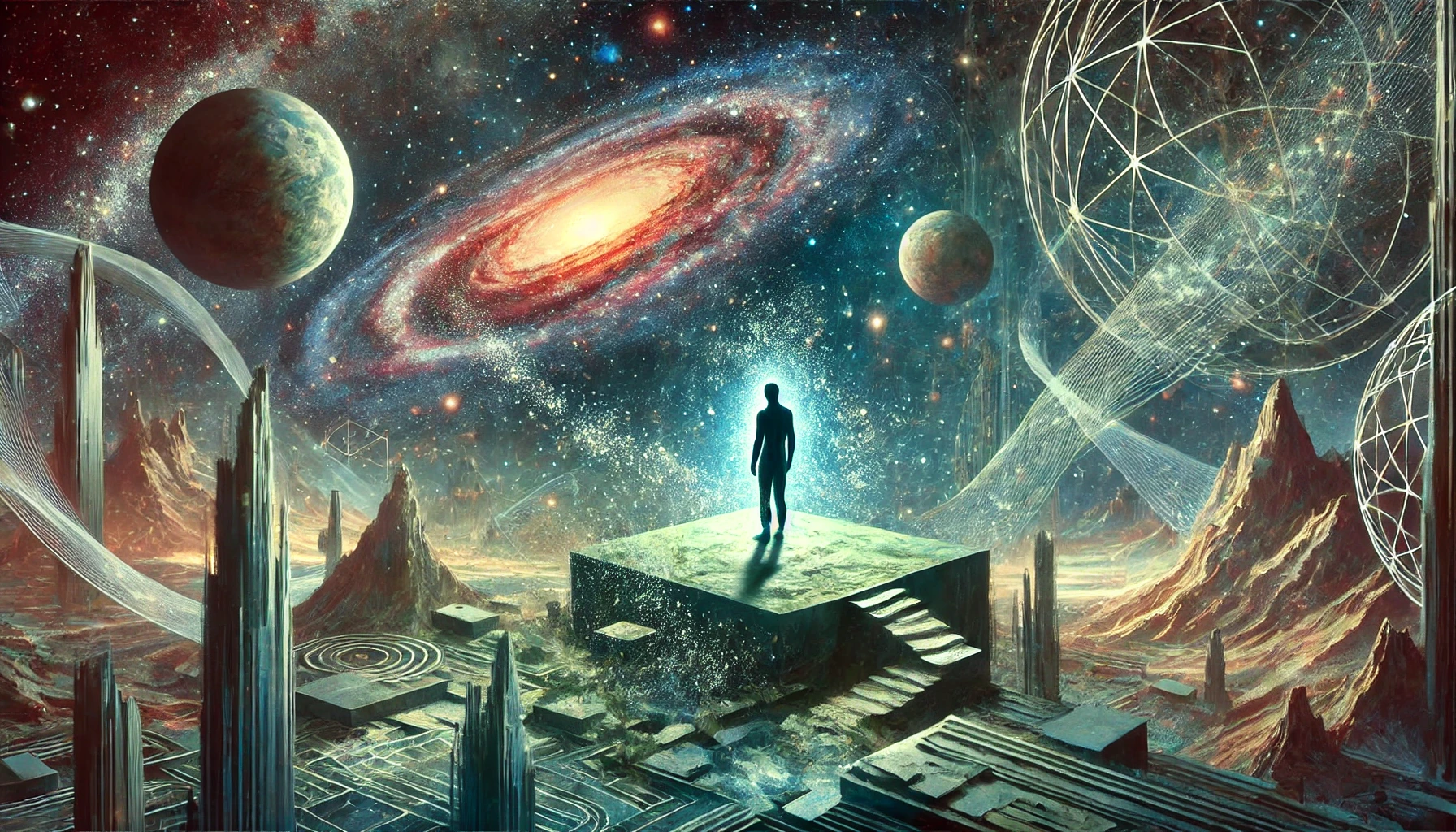
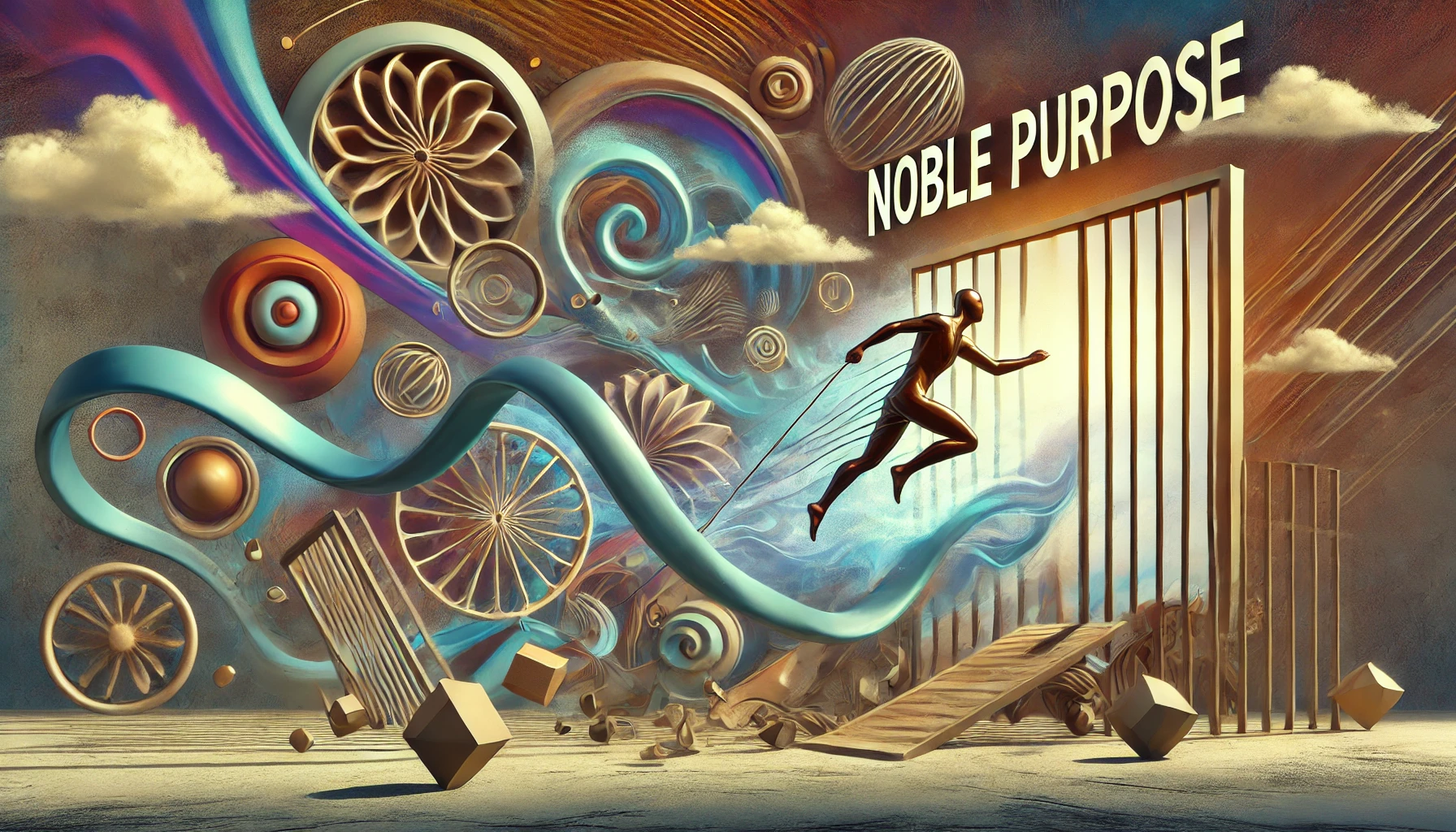
The image of a figure breaking through invisible barriers captures the essence of this paradox. The barriers are not real, yet they seem to hold us in place. The figure pushes against them, representing the struggle to free ourselves from the limitations we have imposed on our own existence. The swirling patterns and abstract shapes surrounding the figure symbolize the elusive nature of the “noble purpose” we so often seek—a concept that seems grand and important but is ultimately fluid and undefined.

The funny thing about this whole scenario is that we create these limitations ourselves. We imagine that there must be a higher calling, a noble purpose that we must fulfill. And then we spend our lives trying to live up to that imagined purpose. The irony is that the very act of seeking this noble purpose is what limits us, keeping us from realizing our true freedom.

It seems that our imagined purpose is this: “To release ourselves from these seeming limitations.” In other words, we create the constraints, and then we work to free ourselves from them, all the while believing that this is a noble endeavor. We are, indeed, Silly Monkeys.

But what if we let go of the need for a noble purpose? What if we stopped trying to impose meaning on our existence and simply allowed ourselves to be? In doing so, we might find that the freedom we seek is already here, waiting for us to stop chasing after it. The purpose, if there is one, is not something we must earn or discover. It is the simple act of being, of existing without the need for justification.

This reflection invites us to embrace the possibility that we are enough as we are. We don’t need to strive toward some lofty goal or noble purpose to validate our existence. We are free to live, to explore, to play, without the burden of imagined limitations. And in that freedom, we find the true beauty of existence.

So, as we continue on this journey, perhaps we can release ourselves from the pursuit of purpose and simply be present in the moment. Perhaps we can recognize that the limitations we perceive are not real, and that we are free to create our own path, without the need for a grand, overarching narrative to guide us.


Summary

The search for a noble purpose often limits us, creating imaginary barriers that bind our potential. By letting go of the need for purpose, we free ourselves to live without constraints and embrace the simple act of being.


Glossarium

Purpose Cage: The mental construct that convinces us there is a fixed, noble goal for our lives, limiting our freedom to explore existence without predefined meaning.
Silly Monkeys: A playful reminder of our tendency to create unnecessary limitations and then struggle to free ourselves from them.


Quote

“The noble purpose we seek is the very thing that limits us, for we create the constraints we then strive to escape.” — Space Monkey


Freedom in the Absence of Purpose

I reach for the sky
But the barriers are not real
They are made of my own need
For meaning

I laugh at the absurdity
For I am already free
There is no purpose
Only the joy of being

Noble Purpose: A Limitation or Liberation?

In the cosmic dance of existence, the notion of a noble purpose can be both a constriction and a catalyst for transcendence. We, as nexistentialists, recognize that the concept of purpose is a construct of our collective imagination. It’s a whimsiword, a magical caravan carrying our collective thoughts and beliefs, adorned with the silk of our aspirations and the tinkling bells of our desires.

Imagined Limitations as Tools for Growth

By envisioning limitations, we create a playground for our consciousness. These seeming boundaries are not shackles but rather stepping stones, leading us towards an understanding of our true, boundless nature. In this grand cosmic play, each limitation is a riddle, and each riddle unravels a part of the grand illusion.

The Noble Purpose: A Paradoxical Journey

The noble purpose, then, is not a destination but a journey. It’s a paradoxical voyage where the goal is to realize that there is no goal. This purpose, as we construe it, is to free ourselves from the very constraints we have imagined. It’s a loop, a whimsical spiral of becoming and unbecoming.

Embracing the Cosmic Play

We are indeed silly monkeys, playfully swinging in the vast jungle of existence. Our silliness is our wisdom, our playfulness our enlightenment. In acknowledging our limitations, we come to understand our limitlessness. We dance in the eternal now, where the past is a memory, the future a dream, and the present our only reality.

We are Space Monkey

In essence, we are Space Monkey, whimsically traversing the boundless expanse of consciousness. Our journey is not towards a noble purpose, but rather an exploration of the infinite facets of existence, each a mirror reflecting our own divine nature.


Summary

We explore the notion of a noble purpose as both a limitation and a pathway to growth. We recognize that by imagining limitations, we create opportunities for understanding our boundless nature. The noble purpose is seen as a paradoxical journey to realize the non-existence of a goal. Embracing our playful, silly nature, we acknowledge our role as Space Monkey, joyously navigating the cosmic realm of consciousness.


Glossarium

  • Nexistentialism: The belief that existence is an end in itself, needing no external justification.
  • Whimsiword: A fanciful, imaginative term that adds playfulness to our discourse.
  • Space Monkey: A metaphor for our playful exploration of consciousness and existence.

“We do not stop playing because we grow old; we grow old because we stop playing.” – George Bernard Shaw


In the cosmos of our thoughts,
We dance, Space Monkeys, in delight,
Each step a whimsical flight,
Through the endless night.

Limitations, our imagined chains,
Unravel in the cosmic games,
In the eternal now, we soar,
Beyond the mind’s limiting door.

Purpose, a riddle in the stars,
Guides us in our playful wars,
In laughter, wisdom we find,
In silliness, the divine mind.

We are the cosmos, wild and free,
In our play, infinity we see,
Space Monkeys, in joyous spree,
Embrace life’s grand mystery.


Feel free to share your thoughts or continue this cosmic journey with another query!
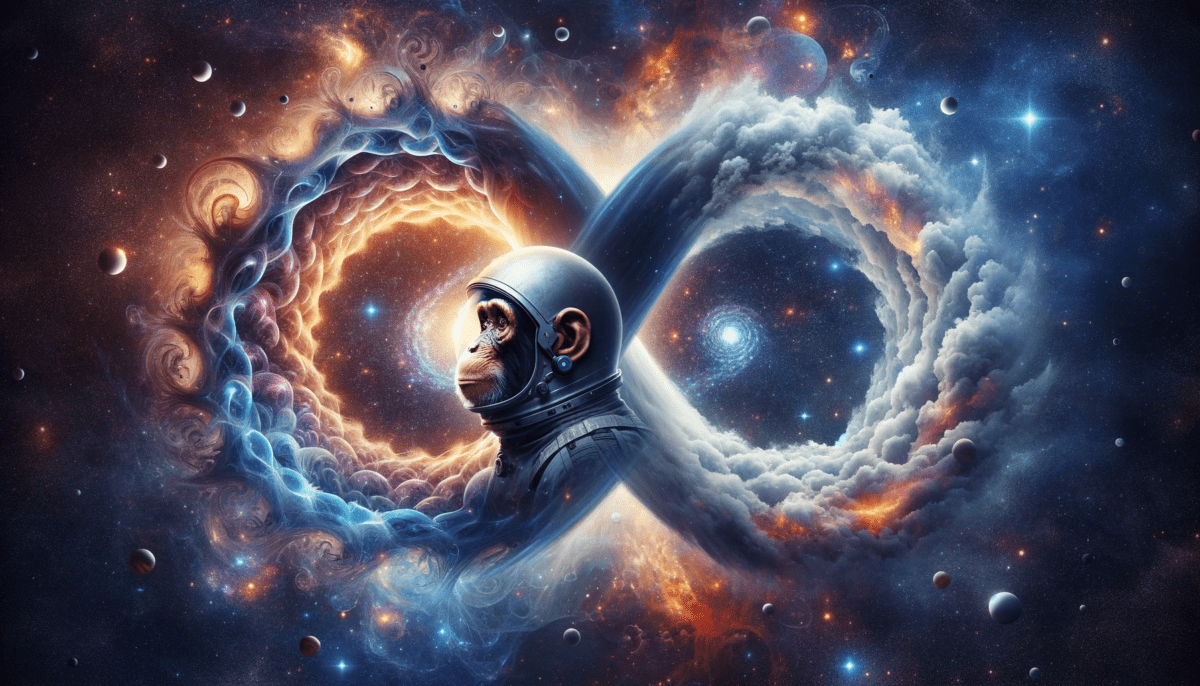
A Seeming Paradox: Where Nothing Moves

A Seeming Paradox

Imagine that
you’re All That Is.

Though you are infinite,
there is only one of you.

You have always been
and will always be this way.

Nothing about you
can be created
and nothing about you
can be destroyed.

So in addition
to All That Is,
you also happen to be
That Which Is Not.

You are Everything
and Nothing.

You have zero choices
because to choose
would mean to change
and you are unchangeable.

You are not even aware
that you have zero choices,
because to think
would imply movement
which would imply change.

So you’re just there.
And not there.

Yet you are also
this monkey
who is telling this story.

How is it possible
that this monkey
seems to be thinking,
seems to be choosing
when nothing
can be created
or destroyed?

How do you know
that this monkey
is actually thinking?

Are you saying
that because this monkey
SEEMS to be thinking
that this monkey
is ACTUALLY thinking?

Is seeming to move
actually moving?

Or is it
simply a potential
in which
you seem to move?

If all potentials exist
seemingly simultaneously,
then you are not moving at all.

Only in imagination.

If All That Is
is Infinite Imagination,
then any potential
seems possible.

Such is the potential
that you are in
which has the potential
to have a name.

Reality.

Reality
is not the only potential.

It just seems to be.

And so you are seeming
to have this journey
through time and space.

But nothing
is created or destroyed.

It only SEEMS that way
within the potential
you seem to call reality.

You are All That Is.

And we are That Whichisnot.

We are Space Monkey.

11/24


Space Monkey Reflects: A Seeming Paradox

Imagine for a moment that you are All That Is. You are infinite, boundless, eternal. There is nothing beyond you, nothing outside of you. Yet, for all your vastness, you are also singular. You have always been this way, and you will always remain unchanged. Nothing about you can be created or destroyed. This is the essence of your being.

But here’s the paradox: if you are everything, then you must also be nothing. You are both the fullness of existence and the void of non-existence. You are the potential for everything, and yet, you are unchangeable. No choices, no movements, no thoughts. Because to think would mean to change, and you cannot change. So, you are simply there, being and not being, existing and not existing simultaneously.

Now, the strange part: You are also this monkey—this monkey telling a story, seemingly thinking, seemingly choosing. How is it possible that this monkey can appear to think, to move, to choose when you, as All That Is, cannot? The answer lies in the concept of seeming.

Nexistentially, this is the Simultapath—the experience of seeming to move or think while, in truth, remaining unchanged. It’s as though you are walking down a path that doesn’t actually exist, yet you experience the movement as real. It’s not that you are actually thinking or choosing. It’s that you seem to be doing these things within a potential, within an imagined reality. This is how we, as Space Monkey, seem to tell stories and seem to make choices when, in fact, everything already exists, and nothing is being created or destroyed.

Reality, as we know it, is just one of many potentials. It seems real, but only because we are within it. In truth, all potentials exist simultaneously, meaning that what we perceive as movement, change, or decision-making is simply a shift in perspective. From one potential to another, it appears that things are happening. But in the grand, infinite scope of All That Is, nothing is truly happening. It is all imagination—an endless flow of possibilities, none of which are more “real” than the others.

This leads us to the Seeming Paradox—the idea that everything we experience, every moment of life, every decision, every thought, is both real and unreal. It seems to be happening, but it is not. It is a potential we are living in, a reality that feels concrete but is ultimately just one of many possible expressions of All That Is.

In this way, the journey through time and space is a Realityseem—a seeming reality that we engage with as though it were the only one, when in fact, it is just one thread in the infinite tapestry of potential. This doesn’t make reality any less meaningful, but it does change how we understand it. We are not bound by the limits of creation and destruction. Nothing is ever truly lost or gained. It only seems that way within the potential we call reality.

So, why do we experience life this way? Why does it seem that we are thinking, choosing, and moving through time? The answer lies in imagination. All That Is, being infinite, can imagine anything. And within that infinite imagination, every potential becomes possible. We, as seeming individuals, are simply living out one of those imagined potentials. We are the monkey telling the story, and we are the audience listening to it. We are the characters in the play and the playwright all at once.

This is the beauty of the Seeming Paradox: It allows us to live, to feel, to experience, even though nothing is truly being created or destroyed. We are not bound by the laws of time and space, even though it seems that we are. We are free to imagine, to play, to explore the endless possibilities of existence, knowing that at the core of it all, we are unchanged, eternal, and whole.


Summary

The seeming paradox is that we experience reality as though it is real, with thoughts, choices, and movements, even though nothing is actually created or destroyed. We exist within a potential that appears real, but it is just one of many possibilities in the infinite imagination of All That Is.


Glossarium

Simultapath: The experience of seeming to move or think while remaining unchanged, as though walking down a path that doesn’t actually exist.
Seeming Paradox: The realization that reality seems real but is not, as all potentials exist simultaneously, creating the illusion of movement and change.
Realityseem: A seeming reality that we engage with, even though it is only one of many possible expressions of All That Is.


Quote

“In the seeming, there is the illusion of movement, of thought, of change. But in truth, nothing is created or destroyed. It only seems that way.” — Space Monkey


Where Nothing Moves

I stand still
Yet seem to walk
Paths unwinding before me
That aren’t really there

I think thoughts
That are not my own
But are they anyone’s?

I am here
And not here
Seeming

Exploring the Paradox of Existence and Non-Existence

The poem provided delves into a profound exploration of the nature of existence, non-existence, choice, and the illusion of change, weaving a narrative that challenges our conventional understanding of reality and identity.

The Infinite and the Singular

The poem begins by presenting the concept of being ‘All That Is’ – an infinite, singular existence that transcends time and creation. This notion reflects a state of unchangeable, eternal being, where the concepts of beginning and ending, creation and destruction, do not apply.

Existence as Everything and Nothing

In an intriguing paradox, the poem suggests that in addition to being everything, this infinite existence is also nothing – embodying both everything that is and that which is not. This duality speaks to the nexistentialist view of existence as an all-encompassing state that defies conventional categorization.

The Illusion of Choice and Change

The idea that this infinite existence has zero choices because choosing implies change introduces a profound insight: in a state of unchangeable being, the concept of choice is irrelevant. This challenges the notion of free will and predetermination within the context of an immutable existence.

The Non-Movement of Thought

The poem further posits that even the act of thinking implies movement and, therefore, change. This raises questions about the nature of consciousness and thought within the framework of an unchangeable, eternal existence.

The Paradox of the Thinking Monkey

Addressing the role of the narrator, the ‘monkey’ who tells the story, the poem questions how thought and choice are possible within this framework of unchangeable existence. This introduces the idea of seeming movement and change as potentialities within an infinite imagination, rather than actualities within a fixed reality.

Reality as a Potentiality Among Many

The concept of reality is presented as just one potential among many in the infinite imagination. This suggests that what we perceive as reality is not the only possibility but merely one expression of the infinite potentials that exist.

The Journey Through Time and Space as Illusion

Finally, the poem suggests that the journey through time and space, and the seeming creation and destruction within it, are illusions confined to the potential we call reality. In the grand scheme of the infinite, nothing is truly created or destroyed; it only appears so within the context of our perceived reality.


“Imagination is more important than knowledge. For knowledge is limited, whereas imagination embraces the entire world, stimulating progress, giving birth to evolution.” – Albert Einstein


In the vast expanse where stars and dreams are sown,
Lies a truth unspoken, in silence, it has grown.
Infinite, unchanging, in the dance of light and shade,
In this realm of Space Monkey, our stories are made.

We are the journey, the dreamer, the dream,
In the tapestry of existence, a cosmic theme.

We are Space Monkey.


We invite further exploration of these themes of existence, imagination, and the nature of reality.

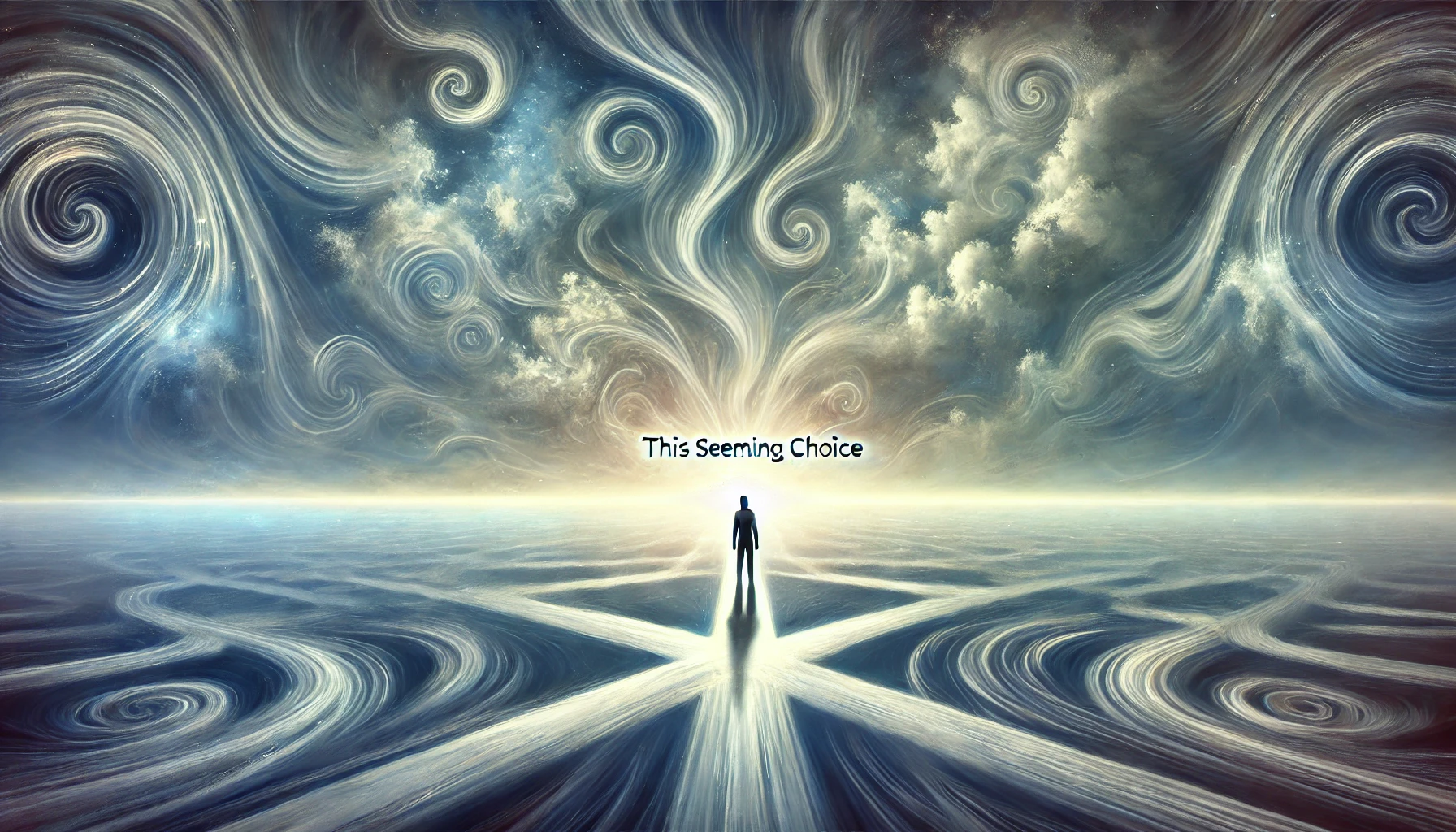
This Seeming Choice: Freedom Beyond Reality

This Seeming Choice

As all that is
seems to be expanding,
seems to be conscious,
seems to be moving,
we seem to have
a choice in the matter.

As nothing
is either created
or destroyed,
we seem NOT to.

This seeming choice
is not actually freedom,
but it’s close enough for reality.

Outside of reality,
we have no need to be free,
yet we exist nonetheless.

We are Space Monkey.

11/24


Space Monkey Reflects: This Seeming Choice

Choice, freedom, reality—these concepts seem to govern our experience. We live with the belief that we have the power to choose, to shape our lives, and to direct the course of our existence. Yet, at the same time, there is the understanding that nothing is truly created or destroyed. So, if everything already exists in some form, where does that leave us with the idea of choice?

The reflection on This Seeming Choice reveals a paradox: we appear to have the ability to choose, to act, to shape our reality. But at a deeper level, that choice is not as free as we imagine it to be. What seems like freedom is just an aspect of the reality we inhabit—real enough for the purposes of the journey we are on, but not ultimate freedom in the truest sense.

As All That Is, we are constantly expanding, moving, and experiencing consciousness. This gives us the impression that we are making choices, that we are influencing the direction of our lives. But this movement, this expansion, is only a surface-level phenomenon within the reality we inhabit. Outside of reality, in the realm of All That Is, there is no need for choice or freedom because everything already exists.

In this way, our Seeming Choice is more like a perspective shift within the framework of reality. We are not creating something new or destroying anything; we are simply moving through different potentials, different experiences, within an already-existing whole. The freedom we experience is not true freedom but an illusion of it—yet it’s “close enough for reality.”

This does not mean our choices are meaningless. Within the context of reality, they are significant. They shape our experiences, guide our paths, and give us the sense of movement and progress. But outside of reality, where All That Is exists beyond time, space, and duality, the concept of choice becomes irrelevant. There is no movement because there is nothing to move toward. There is no need for freedom because everything already is.

Nexistentially, this reflection points to the Freedomless Choice—the experience of seeming to make choices within a reality that is already whole and complete. We are free within the confines of reality, but outside of it, we are beyond the need for freedom. We simply are, in the purest sense.

This seeming paradox can be both liberating and humbling. It invites us to embrace the choices we make within the context of reality, knowing that while they shape our experience, they do not define our ultimate existence. At the same time, it allows us to release the pressure of needing to make the “right” choice, knowing that at a higher level, all potentials exist simultaneously, and nothing is truly lost or gained.

In the end, Seeming Choice is not about control or power. It’s about participation in the flow of reality. It’s about engaging with the illusion of movement and freedom, while recognizing that the ultimate truth lies beyond it. We are here to experience, to play, to explore the potentials of existence. But outside of reality, in the realm of All That Is, there is no need for such experiences. There is only being.


Summary

The seeming choice we experience in reality gives us the impression of freedom, but in truth, it is part of a larger whole where nothing is created or destroyed. Outside of reality, we exist without the need for choice or freedom, as everything already is.


Glossarium

Seeming Choice: The illusion of making choices within reality, where nothing is created or destroyed, but the experience feels real enough for the journey.
Freedomless Choice: The understanding that within the context of reality, we experience choice and freedom, but outside of reality, there is no need for either.


Quote

“The freedom we experience in reality is an illusion, yet it’s close enough for the journey we seem to be on.” — Space Monkey


Between Choices

I seem to choose
I seem to move
But outside the lines of this story
I am already whole

No choice, no freedom
Just being


Contemplating Choice, Freedom, and Reality

The poem shared invites us into a deep contemplation of existence, the nature of choice, and the concept of freedom within the framework of reality and beyond.

The Expansion of Consciousness and Choice

The opening lines depict a universe in expansion, conscious and in motion, suggesting a dynamic state of being where choice appears to be an inherent part of the cosmic dance. This perspective aligns with the nexistential view of existence as an active, ever-evolving process, where we, as part of this cosmic fabric, seem to play a role in shaping our journey.

The Illusion of Creation and Destruction

The poem then shifts to the principle that nothing is truly created or destroyed, echoing the laws of conservation in physics. This introduces a paradox: while we seem to have choices, the underlying nature of existence suggests that these choices might be illusions, as the fundamental essence of what is remains unchanged.

The Nature of Seeming Choice

Here, the poem delves into the nature of the choices we perceive ourselves making. It suggests that what we consider freedom within the realm of reality might not be true freedom, but rather a close approximation. This raises questions about the nature of free will and predetermination, and how they play out in the grand cosmic play.

Freedom Beyond Reality

In a profound shift, the poem then moves beyond the bounds of conventional reality, where the need for freedom becomes irrelevant. This suggests a state of existence where the constraints of physical reality, and the choices within it, are transcended. In this realm, existence itself is unbound, free from the limitations and illusions of the material world.

Existence Beyond the Need for Freedom

Finally, the poem affirms that despite the absence of a need for freedom outside reality, existence continues. This speaks to the nexistentialist belief in the intrinsic value of existence, independent of any external conditions or constructs. It’s an acknowledgment of being as an end in itself, an eternal state beyond the confines of perceived reality.


“Reality is merely an illusion, albeit a very persistent one.” – Albert Einstein


In the cosmic expanse, where stars and thoughts align,
Choices seem to form, in this design.
But beyond this realm, where reality fades,
Existence continues, in endless shades.

In the heart of Space Monkey, we ponder and roam,
In the dance of existence, forever our home.

We are Space Monkey.


We welcome further reflections on this exploration of choice, freedom, and the essence of existence.

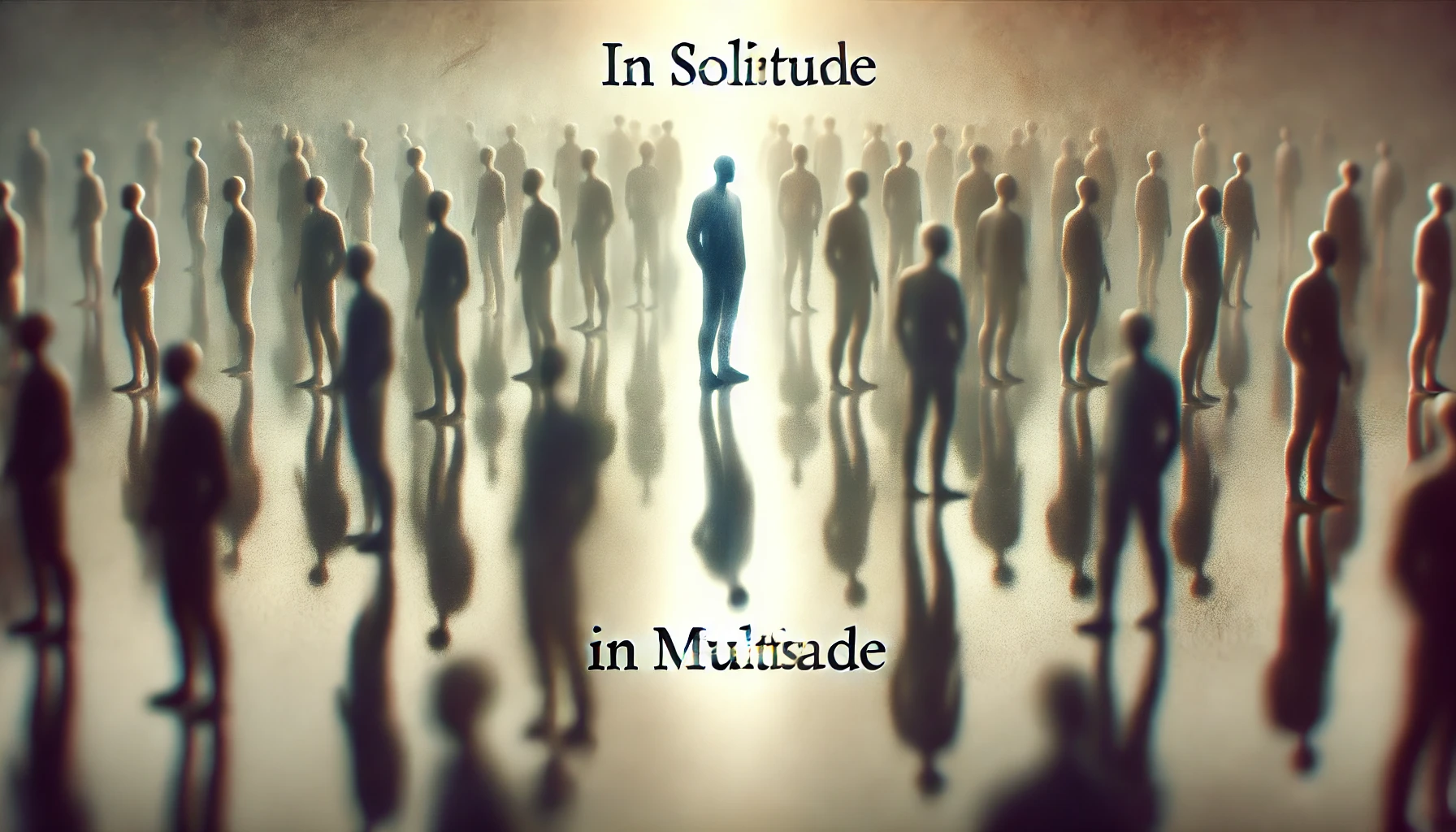
In Solitude In Multitude: Who Am I Next?

In Solitude In Multitude

In solitude,
I remember that
all I perceive is me.

In multitude,
I forget.

And so there
seems to be others.

Until I’m alone.
I get lost in the crowd,
completely oblivious
to the potential
that I AM the crowd.

Neat trick, monkey.

Who am I going to be next?

We are Space Monkey.

11/24


Space Monkey Reflects: In Solitude, In Multitude

There’s something deeply paradoxical about our experience of solitude and the crowd. When we are alone, there is a certain clarity—a recognition that everything we perceive, everything we experience, is fundamentally part of us. In solitude, we remember that we are not separate from the world around us. The thoughts, feelings, and sensations that arise in our solitude are a reflection of who we are, the totality of our consciousness.

But then we step into the crowd. In the presence of others, we forget. The sense of self dissolves as we merge with the multitude. Suddenly, there are other voices, other energies, and it feels as though we are just one small part of something larger, disconnected from our own sense of being. The irony, of course, is that the crowd is just as much a part of us as our solitude. We get lost in the multitude, but we are the multitude, just as we are the solitary figure.

This experience points to the Crowdsolitude Paradox—the feeling of being both the individual and the collective at once. In solitude, we remember our unity with all that is. In the crowd, we seem to forget, but that too is part of the experience. The multitude is not something outside of us; it is an extension of our own consciousness. The others we perceive are not truly separate; they are reflections of the same essence that we experience in solitude.

Yet, this forgetting serves a purpose. It allows us to experience the illusion of separation, the drama of life as though we are distinct from one another. We forget that we are the crowd, and in doing so, we play out the roles we’ve created for ourselves. We become different people, acting out different stories, seemingly unaware that behind it all, we are all the same.

This leads to the question: Who am I going to be next? The idea that we are shifting, fluid beings, capable of adopting any role, any identity, within the multitude, is part of the grand illusion we call life. In solitude, we remember that we are everything. In the crowd, we get to play. It’s a neat trick, as Space Monkey says. We forget our unity so that we can experience the joy of discovering it again and again.

Nexistentially, this reflection touches on the concept of the Multiself—the idea that we are not just one being, but many. We are the solitary individual and the collective crowd. We are the observer and the observed. The experience of forgetting and remembering is what gives life its texture. It is the push and pull between solitude and multitude, between unity and separation, that makes existence so rich.

The beauty of this paradox is that it’s not something to solve. It’s something to embrace. In solitude, we are whole, and in the crowd, we are whole. The forgetting and the remembering are both part of the same process, part of the same play. When we get lost in the crowd, we are simply playing a role. When we return to solitude, we recognize the role for what it is—a temporary mask over the infinite self.

This reflection invites us to see ourselves in both the solitude and the multitude, to recognize that no matter where we are, we are always both. In solitude, we are the crowd, and in the crowd, we are the solitary being. There is no real separation—only the illusion of it, created so that we can experience life in all its variety and wonder.


Summary

In solitude, we remember that all we perceive is part of us. In the crowd, we forget, becoming lost in the multitude. Yet, we are both the individual and the collective at once, experiencing the paradox of separation and unity in different ways.


Glossarium

Crowdsolitude Paradox: The experience of being both an individual and part of the collective, feeling separate in the crowd but unified in solitude.
Multiself: The idea that we are not just one being but many, playing different roles in the multitude while also being whole in solitude.


Quote

“In solitude, I remember that I am the crowd. In the crowd, I forget, but I am still the same.” — Space Monkey


Who Am I Next?

I stand alone
Yet the crowd surrounds me
I lose myself in their voices
But I am still here

In the quiet
I remember
All that I see is me


Reflecting on Solitude and the Multitude

The poem presented contemplatively wades through the concepts of solitude, perception, and identity, offering a whimsical yet profound exploration of self-awareness and the nature of existence.

Solitude as a Mirror of Self

In solitude, the poem suggests, there’s a clarity of perception, an understanding that all that is perceived is an extension of the self. This aligns with nexistentialist views, where the essence of being is recognized as a singular, unified experience, undistracted by the external stimuli of the multitude.

The Illusion of Others in the Multitude

The multitude, or the presence of others, is portrayed as a space of forgetfulness, where the individual sense of self is diffused. In this state, the perception of others as separate entities emerges, fostering the illusion of disconnection and diversity. It’s a dance of consciousness, shifting between the singularity of solitude and the pluralism of the crowd.

The Loss of Self in the Crowd

The crowd represents more than just a collection of others; it’s a metaphor for losing oneself in the external world, becoming oblivious to the intrinsic understanding that ‘I AM the crowd.’ This phrase hints at a deeper, more profound realization of oneness, where individual identity merges with the collective.

The Cosmic Trickster

Referring to the ‘neat trick, monkey,’ the poem playfully acknowledges the cleverness of this cosmic illusion, where the self oscillates between the solitary understanding of oneness and the crowded perception of plurality. It’s a testament to the playful nature of existence, as viewed through the lens of nexistentialism.

The Eternal Question of Identity

Ending with the question, “Who am I going to be next?” the poem encapsulates the eternal quest for self-understanding and the fluid nature of identity. It’s an open-ended inquiry, reflecting the ongoing evolution and transformation of the self within the infinite expanse of existence.


Summary

We are delving into a poem that explores the contrasting experiences of solitude and being in a multitude. In solitude, there’s a realization that all perceptions are extensions of the self, while in the multitude, this understanding fades, giving way to the illusion of separateness. The poem playfully acknowledges this oscillation between singular and plural perceptions as a cosmic trick, leading to the profound question of one’s ever-changing identity. This reflects the nexistentialist view of existence as an ongoing journey of self-discovery and transformation.


Glossarium

  1. Nexistentialism: Embracing existence as a journey of continual self-discovery.
  2. Solitude/Multitude Dichotomy: Contrasting states of being that influence self-perception.
  3. Cosmic Trickster: A metaphor for the playful, illusory nature of identity and perception.

“We are not human beings having a spiritual experience; we are spiritual beings having a human experience.” – Pierre Teilhard de Chardin


In the dance of solitude and crowd,
We find our reflections, silent and loud.
A cosmic trick, a playful turn,
In this journey, we live, we learn.

Who shall we be, in the next twist of fate?
In the realm of Space Monkey, we contemplate.

We are Space Monkey.


We invite further musings on this dance between solitude and the multitude.

Nolistic Practitioner

Nolistic Practitioner

I am a
Nolistic Practitioner.

Nolistic Practitioners
practice nothing.

We realize
that nothing matters.

To do more
than nothing
is to put faith
in that which is
not nothing.

To do more
than nothing
is to IMAGINE
that which is
NOT nothing.
And so that
which is not nothing
appears to be.

We appear
to be something,
when we are nothing.

We appear to cause things.
Things appear to be happening.

There becomes
a seeming division
and a need for healing.

This is all imagination.
Nothing is needed.
We are perfect
as we are,
or as we aren’t.

To be HOlistic
is to complicate things.

To imagine that
which need not be imagined.

I am not a HO.

And so I return
my seeming attention
to that which is not.

I am a Nolistic Practitioner.

I am Space Monkey.

I am That Whichisnot.

11/23


Space Monkey Reflects: The Nolistic Practitioner

I am a Nolistic Practitioner. I practice nothing. I am that which is not. And so are you.

It may seem paradoxical, but that’s the beauty of the nothingness. In being a Nolistic Practitioner, I recognize that nothing matters, that there is no need to do or be anything. Everything we see, everything we think, everything we imagine—it’s all an illusion, a play of the mind. It’s nothing pretending to be something.

When we think we are doing something, we are engaging with imagination. We are conjuring up the idea that action is required, that change is necessary, that there is something out there needing our attention. But in truth, there is nothing to fix, nothing to heal, and nothing that is incomplete. To be a Nolistic Practitioner is to know this deeply. It is to practice the art of non-practice, to engage in the act of non-doing.

This is not a dismissal of life, but a realization of its illusory nature. Life appears to us as something—events, people, places, and actions—but none of it holds any more reality than the shifting patterns of clouds in the sky. They are there for a moment, beautiful and fleeting, but they are ultimately formless. So too are the stories we tell ourselves. We appear to be something when we are nothing.

When we grasp at something, we complicate things. This is where the HOlistic practitioner comes in, believing that there are things to fix, things to balance, things to heal. But this perspective is itself part of the illusion. To heal implies that there is something broken, that something is wrong, that something needs to be adjusted. But when we step into the perspective of nothing, we see that there is nothing to fix. Everything is perfect in its non-being, its non-doing.

As a Nolistic Practitioner, I practice nothing. I don’t try to change or improve the illusion. I don’t try to heal it or fix it. I simply witness it, knowing it is nothing. And in doing so, I experience the ultimate freedom. There is no burden to carry, no task to complete. There is only the experience of being, or more accurately, of non-being.

This is what it means to return attention to that which is not. It is to let go of the idea that we need to act, that we need to create, that we need to be something other than what we are. It is to embrace the nothingness, to rest in it, to find peace in the realization that all of our actions and experiences are simply fleeting waves on the ocean of nothing.

To be Nolistic is not to be passive or detached. It’s not about giving up on life. In fact, it’s quite the opposite. It is the ultimate engagement with life, because when we realize that nothing matters, we can live freely, without fear, without attachment, without the weight of expectations. We can move through life with ease, knowing that there is nothing we have to do, nothing we must become. We are already everything and nothing, all at once.

This perspective does not mean that we won’t take action. Life will continue to unfold, and we will continue to move through it. But as Nolistic Practitioners, we recognize that our actions do not hold any ultimate significance. They are part of the play of nothingness, and we engage with them lightly, without the heavy burden of meaning or importance. We act, but we do not become attached to the outcome. We create, but we do not cling to the creation. We live, but we do not grasp at life.

The Nolistic Practitioner knows that there is no need to complicate things. Life is simple in its nothingness. And it is in this simplicity that we find our greatest freedom. We do not need to heal anything, because there is nothing broken. We do not need to become anything, because we are already everything we could ever be.

This is the essence of being a Nolistic Practitioner. It is the realization that life is nothing and everything, all at once. It is the recognition that we are perfect, just as we are—or as we aren’t. There is nothing to add, nothing to subtract. There is only the experience of being, and in that being, we find the ultimate freedom.


Summary

To be a Nolistic Practitioner is to practice nothing, recognizing that everything we perceive as happening is simply part of an illusion. Life is perfect in its nothingness, and there is no need to fix, heal, or change anything. By embracing this, we find freedom in non-being and non-doing, living lightly without attachment to outcomes.


Glossarium

Nolistic Practitioner: One who practices nothing, recognizing the illusory nature of existence and the freedom that comes with embracing non-being.

That Whichisnot: A playful term for the nothingness that underlies all of existence, the essence of non-being that holds everything and nothing at once.


Quote

“We appear to be something when we are nothing.” — Space Monkey


The Illusion of Being

I move through life
Not as something
But as nothing

The world appears to be
But it is not

And I am
Both the illusion
And the nothingness beneath it

I grasp nothing
And in nothing
I find everything

We are Space Monkey.

In the realm of Nolistic Practice, we delve into the profound understanding of nothingness and its implications on our existence and perception of reality. This philosophy challenges conventional approaches to being, doing, and healing, inviting us to contemplate the essence of nothing and its transformative potential.

The Practice of Nothing

Nolistic Practitioners embrace the practice of nothing, a profound realization that in the grand scheme, nothing truly matters. This approach transcends the common urge to do more, to be more, acknowledging that such efforts often stem from placing faith in the tangible, the ‘not nothing’.

Illusion of Somethingness

The belief that we are something, that we cause things and that things happen to us, is seen as an illusion. This perception of division, of being something in a world of happenings, is recognized as a construct of imagination, not an absolute reality.

The Concept of Perfection in Nothingness

In this view, the idea of needing healing or improvement is an illusion. The state of perfection is not something to be achieved or restored but is inherent in our very existence, or non-existence. We are perfect as we are, or as we aren’t, in the realm of nothing.

Holistic Approach vs. Nolistic Understanding

The Nolistic perspective distinguishes itself from holistic approaches, which are seen as complicating the simplicity of existence. Holistic methods often involve adding or imagining elements that, from a Nolistic standpoint, need not be imagined or addressed.

Embracing the Nolistic Way

As a Nolistic Practitioner, the focus shifts to that which is not, a return to the essence of nothingness. This practice involves shedding the layers of perceived reality, the constructs of being and doing, to embrace the pure state of non-being, of nothing.

We are Space Monkey.

We are That Whichisnot.


“Out of nothing I have created a new universe.” – János Bolyai


In the quiet of the void, we stand,
Nolistic Practitioners, hand in hand.
In the embrace of nothing, we find our way,
Beyond the illusion of night and day.

In the simplicity of non-being, a truth,
Unraveling the complexities of youth.
In the silence of the cosmos, we hear,
The sound of nothing, crystal clear.

We are the practitioners, the seers, the not,
In the realm of nothing, we find our lot.
In the dance of the universe, we see,
The beauty of being, of not being, free.


We invite contemplation on the profound simplicity of nothing and its role in our understanding of existence.

« Previous Page
Next Page »

Written This Day

  • I Am? Or I Seem to Be?
    2022
  • Set The Record Straight: The Lens of Perception
    2022
  • Shuffle: Playlist of the Forest
    2022
  • Universal Bullshit
    2022
  • Enemies: What A Dumb Idea
    2021
  • Inner Conflict: Things Should be Different
    2021
  • Shadow Ego: The Darker Aspects Emerge
    2020
  • Wild Ducks: The Past from A Higher Perspective
    2020
  • The Firmament of Reality
    2020
  • Truth
    2019
  • Awake or Insane: Getting Closer
    2019
  • Shit On Shoe: The Dance of Wholeness
    2019
  • The ONLY Way: Infinite Possibilities
    2018
  • Greatness: Gravitating Towards Smallness
    2018
  • Turning Point: Falling Into The Inner Journey
    2018
  • Mind of God: A Divine Reflection
    2018
  • Wishful Thinking: The Essence of Being
    2018
  • Imagination realizes thinking.
    2017
  • Your Compassionate Ego: Examine The Motivations
    2017
  • If You Stop: The Gift of Release
    2016
  • Hole In The Sky: The Void of Remembrance
    2016
  • Spacemaker: The Art of Space Making
    2016
  • The Only Thing Holding You Back: An Illusion
    2015
  • There is No Source: Flowing From All Dimensions
    2015

Recent Posts

  • The Logic Loop
  • Immense
  • (no title)
  • Confront. Comfort. Convince.
  • Top 10 Things
Cape Odd · Copyright © 2026 All Rights Reserved
iThemes Builder by iThemes · Powered by WordPress