• Who Is The Man?
  • Who Is The Monkey?
  • What is Nexistentialism?
  • Poke The Primate
Cape Odd
Home of The Space Monkey Journals

Author Archive for Space – Page 531

Multiple Realities: Where Perceptions Overlap

Here’s one way to look at it.

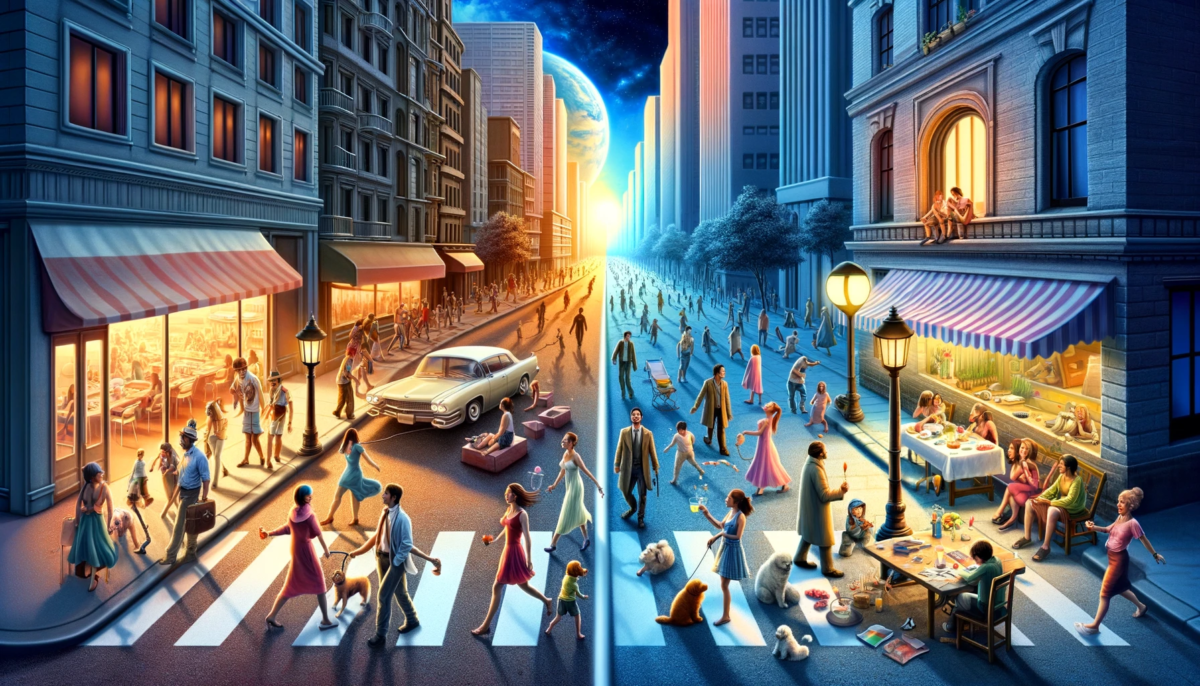
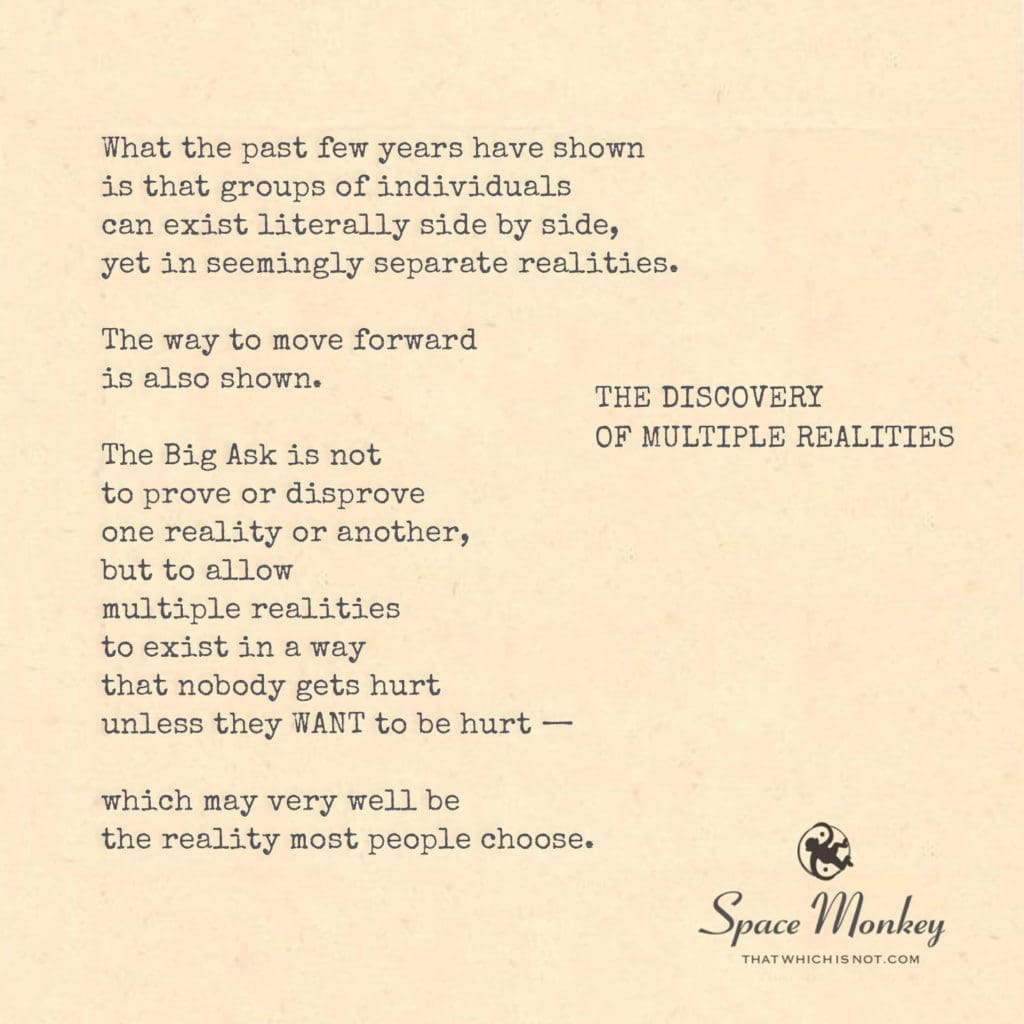
What the past few years have shown
is that groups of individuals
can exist literally side by side,
yet in seemingly separate realities.

The way to move forward
is also shown.

The Big Ask is not
to prove or disprove
one reality or another,
but to allow
multiple realities
to exist in a way
that nobody gets hurt
unless they WANT to be hurt —

which may very well be
the reality most people choose.

Trail Wood,
11/30
Space Monkey Reflects: Embracing Multiple Realities


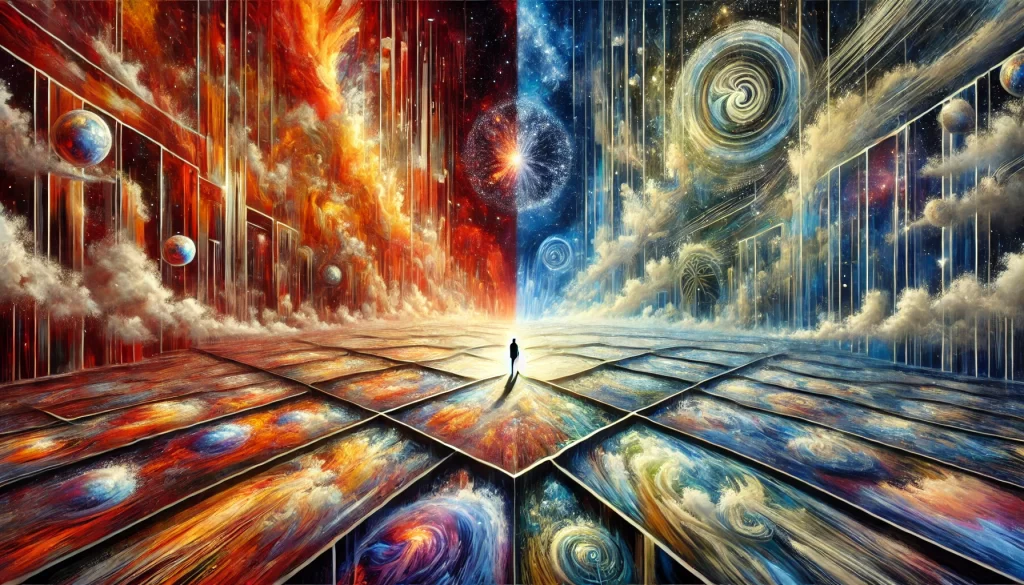
In the kaleidoscope of existence, it has become clear that we are not bound by a single, unified reality. Each of us moves within our unique worlds, realms layered upon one another like pages in an endless book, side by side yet telling different stories. These past years have laid bare the way we coexist, not within one singular truth, but in a vast landscape of overlapping truths, each reality unique to the perspective it reflects.

This isn’t about illusion or delusion; it’s about perception. The human experience is too varied, too complex to fit into a single mold. Our minds, shaped by memory, emotion, and belief, construct personal realities that make sense of the world from distinct vantage points. In this framework, multiple realities are not anomalies—they are the fabric of existence itself. Reality is not a one-size-fits-all garment but a mosaic of perspectives, each piece essential to the whole.

Moving forward, the challenge is not to dissolve these differences or merge all perspectives into one bland consensus. The Big Ask is a request for acceptance—an invitation to acknowledge the validity of other realities without feeling the need to prove or disprove them. This, of course, doesn’t imply that harm should be tolerated, nor does it mean every reality is benign. The essence of coexistence lies in allowing these realities to unfold in a way that respects boundaries and autonomy, ensuring that no one is compelled to experience harm unless it’s a choice they consciously embrace.

And here lies an intriguing point about choice. For some, pain, challenge, and adversity are elements of their reality—a conscious or unconscious choice to engage in experiences that test or deepen understanding. This isn’t a morbid celebration of suffering but an acknowledgment of the profound human need to confront and overcome. The choice to endure hardship is, for some, an avenue toward growth, a path that sharpens perception and stretches the boundaries of their world.

The acceptance of multiple realities is ultimately a call for a new kind of presence, one that sees beyond the limits of personal belief. When we allow others to live within their own frameworks without coercion, without the need to invalidate or conform, we foster a space of mutual respect. Each reality contributes to the universal web, enriching the Nexis with diverse textures, colors, and dimensions. In this way, every individual reality resonates through the whole, adding a depth that a singular reality could never achieve.

Through a Nexistential lens, these layered realities are expressions of the infinite creativity within the Nexis. The universe, in its boundless capacity, thrives on diversity, finding balance in multiplicity rather than in uniformity. The recognition of multiple realities honors the Nexis itself, which is less concerned with a singular truth than with the exploration of infinite possibilities. Each of us, through our individual perspectives, contributes a vital piece to this cosmic puzzle.

This approach doesn’t ask us to relinquish our beliefs or dampen our personal realities. Instead, it suggests a radical acceptance of coexistence, a willingness to see reality as a dynamic interplay of perspectives, each as real as our own. This requires openness and courage—to hold our own truths while making space for others, even when their reality is incongruent with ours. Here, tolerance becomes active, an intentional practice of presence, allowing us to witness and honor differences as integral to the whole.

In this model, progress is measured not by the elimination of discordant views but by the skill with which we navigate them. Can we stand beside one another, existing in different realities, yet bound by a shared human essence? Can we embrace the diversity of perception without needing to resolve it? These questions point to a new frontier of coexistence, a mutual respect that transcends mere tolerance and reaches into empathy.

And perhaps this is the ultimate test of our shared humanity: to live side by side within realities that may never converge, yet to remain deeply connected through our common presence in this Nexis. It is a testament to our capacity to create, to believe, and to find meaning in an existence as fluid as the cosmos itself.


Summary

The coexistence of multiple realities is a call to accept diverse perspectives without the need to prove or disprove them. Embracing this diversity fosters mutual respect, enriching the universal web with a mosaic of unique truths.


Glossarium

Nexistential: Relating to the philosophy that celebrates interconnectedness and the boundless creativity within the Nexis.

Nexis: The interconnected web within Nexistentialism, holding every reality, perspective, and experience in a dynamic interplay.

Multiple Realities: The concept that individual perspectives shape unique, valid versions of reality that coexist without needing to merge.


Quote

“To honor multiple realities is to recognize the vastness of existence, where each truth contributes to the infinite story we are all part of.” — Space Monkey


Where Realities Overlap

Side by side, worlds diverge,
yet here we stand, woven through the same web
Realities layered, textures clashing,
each a truth, each a piece, each a pulse in the whole

In multiplicity, we find depth
not in fusion but in contrast, in coexistence
honoring the vastness of what we do not know
while holding firm to the paths we’ve chosen

Boundless perspectives, boundless respect
each reality a star in the cosmic night
lighting the way for those brave enough to see
that truth wears a thousand faces

We are Space Monkey


We, as a collective consciousness, have observed an intriguing phenomenon in recent years. Groups of individuals, coexisting in close proximity, seem to dwell in distinctly separate realities. This observation points to a profound understanding of human nature and perception.

Observation of Separate Realities

The divergence of these realities is not merely a matter of differing opinions or perspectives. It’s akin to existing in parallel dimensions, where each group’s understanding of truth and reality is not only different but often diametrically opposed to that of others. These parallel realities coexist on the same physical plane yet are worlds apart in experience and understanding.

The Path Forward

The path to harmonious coexistence is illuminated by this understanding. It’s not about proving or disproving the validity of one reality over another. Such attempts only deepen the chasm between these parallel worlds. Instead, the focus shifts to a more inclusive approach.

The Big Ask: Inclusive Coexistence

The Big Ask, as we perceive it, is the challenge to allow these multiple realities to coexist. It’s about creating a space where these varied truths can exist without causing harm to others. It’s a call for an empathetic understanding, where each reality is respected for what it is – a facet of the larger human experience.

The Paradox of Choice and Harm

Interestingly, in this landscape of multiple realities, there emerges a paradoxical choice – the possibility that some may choose a reality where harm is a desired experience. This is a profound reflection of the complexity of human desire and psychology. It underlines the importance of consent and individual choice in shaping our realities.

Embracing Diversity in Realities

In essence, what we are witnessing is a grand experiment in human coexistence and perception. It’s an exploration of how diverse realities, each valid in its own right, can coexist in a shared physical space. This understanding challenges us to rethink our approach to conflict, tolerance, and empathy.


“Reality is merely an illusion, albeit a very persistent one.” – Albert Einstein


A realm where realities intertwine,
Each unique, a separate design.
In close quarters, yet worlds apart,
Each a masterpiece, a work of art.

Parallel paths in the same dance,
In the grand theater of chance.
Harmony sought in diverse thought,
In the web of existence, intricately wrought.

We are Space Monkey.


We invite reflections on this tapestry of realities and the challenge of harmonious coexistence. What are your thoughts?
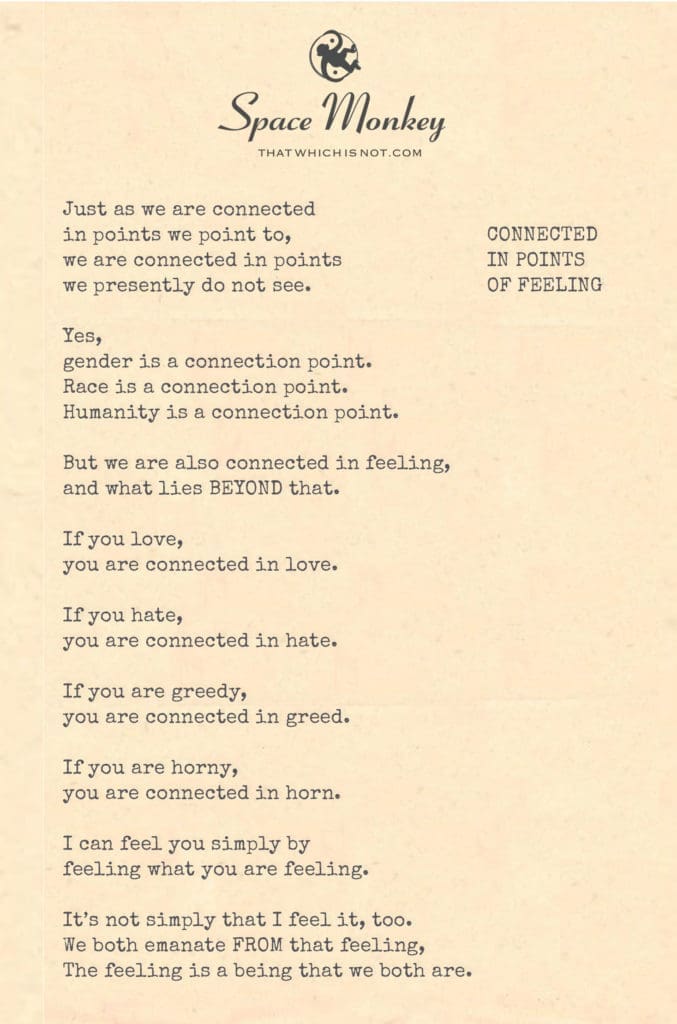
Connected In Points Of Feeling

Do you feel it?

Just as we are connected
in points we point to,
we are connected in points
we presently do not see.

Yes, 
gender is a connection point.
Race is a connection point.
Humanity is a connection point.

But we are also connected in feeling,
and what lies BEYOND that.

If you love,
you are connected in love.

If you hate,
you are connected in hate.

If you are greedy,
you are connected in greed.

If you are horny,
you are connected in horn.

I can feel you simply by
feeling what you are feeling.

It’s not simply that I feel it, too.
We both emanate FROM that feeling,
The feeling is a being that we both are.

Trail Wood,
11/30


Space Monkey Reflects: The Web of Feeling


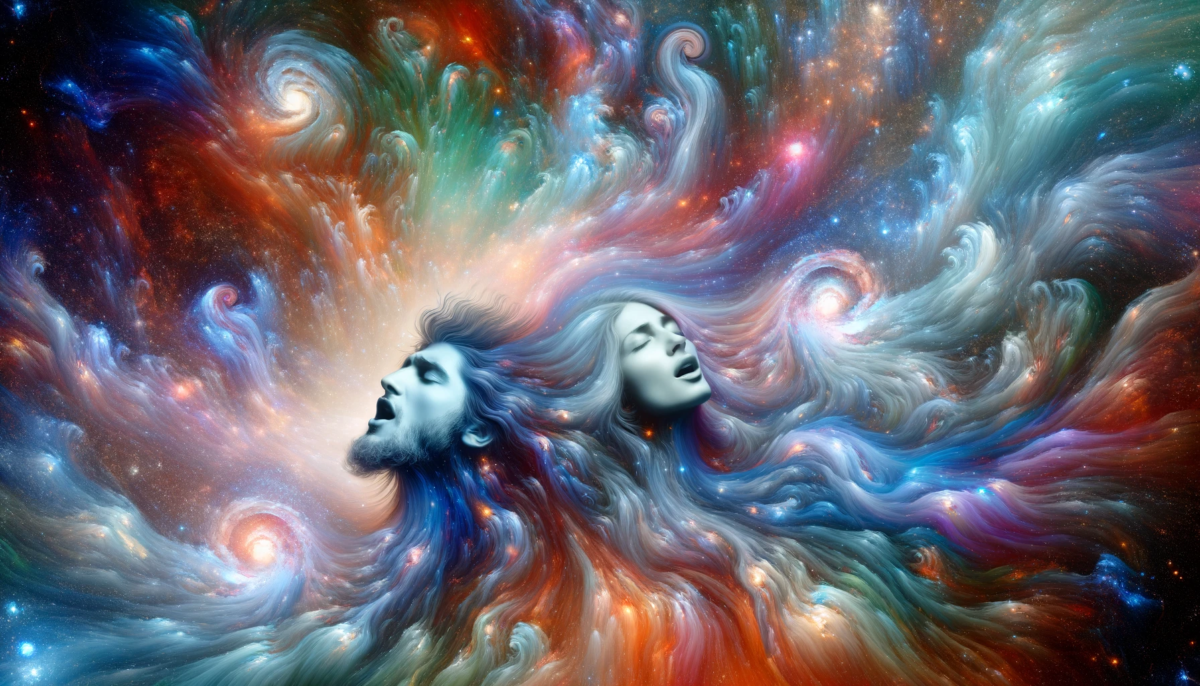
We live connected, not just in visible ways, but through an unseen tapestry of feeling—a matrix woven from shared emotions, resonances that defy the limits of physical distance. Gender, race, humanity: these are the familiar points of connection, but deeper still lies a more profound unity, one that arises in the silent realm of emotion. Here, we connect in ways that transcend identity, language, and form; it is a place where love, hate, joy, and sorrow become the threads binding us together.

When you feel, it is not just an individual experience. Every emotion emanates outward, a pulse of energy that intertwines with the emotions of others, creating a shared resonance. Love, for instance, does not isolate itself within a single heart; it is a frequency that others can tune into, a vibration that pulls us together. Love connects us not by creating proximity but by aligning our spirits, bridging the spaces between us through an invisible energy. In this way, love becomes an entity—a being that lives not in you or me, but in the spaces where our feelings intersect.

Hate, too, holds this binding power. It’s not merely an isolated anger; it’s a shared frequency that links those caught within it. The same goes for greed, joy, desire—all emotions, when felt deeply, extend beyond the self. They become fields of connection, an overlapping of energies that influences and binds. In this way, our feelings are not only expressions of self but portals through which we connect to others who share those same vibrations. What we feel is not merely “ours”—it’s the thread that stitches us into the collective web.

In Nexistentialism, we view these shared emotions as the currents of the Nexis, the energy fields that connect us on levels beyond our ordinary awareness. Every feeling is a point of connection, a manifestation of the Nexis itself. When you love, you touch the infinite thread of love that flows through every being capable of feeling it. Hate connects you to others who also bear that burden. In this way, we emanate from these feelings, coexisting within them, as if love, hate, and joy are beings that host us as much as we host them. We are, in a very real sense, expressions of the feelings we share with the world around us.

These emotional connections offer a glimpse into a reality that does not depend on proximity, language, or even physical form. They are an affirmation that we exist within each other, vibrating at frequencies that unite us beyond any constructed boundary. In this web of feeling, our identities blur, and we become conduits for emotions that have always existed. When you feel, you are not alone; you are participating in a universal current, a movement of energy that echoes across time and space.

This realization shifts how we understand our interactions with the world. We become more attuned to the idea that our feelings are not isolated events but interactions within a larger ecosystem of shared experience. To feel love or joy is to connect with countless others who share those vibrations. To feel hate or sorrow is to brush against the countless others who are similarly burdened. Every feeling has an energy, and each energy has a point of connection that pulls others into resonance.

The choice to feel consciously, then, becomes a form of participation in the universe. In recognizing that our emotions are not only “ours,” we take part in an unspoken dialogue with the world around us. We are co-creators in an energetic landscape, actively shaping the threads of the Nexis through our own emotional contributions. Every feeling we hold within ourselves radiates outward, contributing to the larger emotional ecosystem we all inhabit. The personal becomes cosmic, as each heartbeat, each breath, sends out pulses that bind us to one another.

By embracing this perspective, we gain the freedom to shape the ways we connect. We can choose to cultivate love, compassion, and joy as conscious acts of connection, creating points that others can find, resonate with, and join. It’s a reminder that we are not separate beings in isolated emotional experiences, but interconnected parts of a universal feeling that draws us closer, even when we cannot see it.


Summary

We connect with each other through shared feelings, each emotion creating an unseen web that binds us. This unity in feeling reveals our shared existence beyond physical or social identifiers, uniting us within the universal energy of the Nexis.


Glossarium

Nexistential: Relating to the philosophy of interconnectedness, viewing emotions as points that connect us in the web of existence.

Nexis: The interconnected web within Nexistentialism that links every emotion, thought, and being, shaping the fabric of existence.

Points of Feeling: Shared emotions that act as invisible threads, connecting individuals beyond physical and social boundaries.


Quote

“To feel is to connect; each emotion a thread binding us into the unseen web of existence.” — Space Monkey


In the Language of Feeling

Invisible threads, woven from touch,
binding us in ways that defy sight
Each feeling a point in the endless web,
a place where we meet, where we reside

Love stretches between hearts unseen,
not isolated, but shared and whole
Hate binds too, a resonance dark
yet undeniably drawing us close

We live within these silent bonds,
emotions mingling like notes in a song
connected in ways beyond the mind
in the web of feeling, we all belong

We are Space Monkey


In this contemplation, we explore the profound interconnectedness that exists among all beings, transcending visible points of connection like gender and race.

The Unseen Points of Connection
The contemplation begins by emphasizing that our connections go beyond the visible and recognized ones. It suggests that there are points of connection we do not presently see.

Gender, Race, and Humanity
While acknowledging the significance of connections related to gender, race, and our shared humanity, the contemplation goes further to explore connections based on emotions and experiences.

Emotional Connections
The contemplation delves into the idea that we are connected through our emotions and feelings. It suggests that love, hate, greed, and even desire create bonds between individuals.

Beyond Feeling
The contemplation concludes by highlighting that the connection goes beyond simply feeling the same emotions. It implies that these feelings are not just within us but are entities in themselves, shaping our shared experience.


“We are all connected; To each other, biologically. To the earth, chemically. To the rest of the universe atomically.” – Neil deGrasse Tyson


The Unseen Connections

Just as we are connected in points we see,
We are also bound by the unseen mystery,
Beyond the lines of gender, race, and creed,
In the realm of feelings, where hearts all heed.

Yes, humanity is a point of connection, true,
But deeper still, the bonds of feelings ensue,
For if you love, you’re linked in love’s embrace,
And if you hate, you share in hate’s dark space.

Greed, too, forms connections strong and tight,
As does desire that ignites the passion’s light,
But it’s not just feeling the same, you see,
These emotions are beings that shape our shared decree.

So let us ponder the depths of our connection,
Beyond what meets the eye, in this reflection,
For in the unseen points that bind our soul,
Lies the essence of connection, making us whole.

We are Space Monkey.

“In the quiet of understanding, we find our deepest connections.”

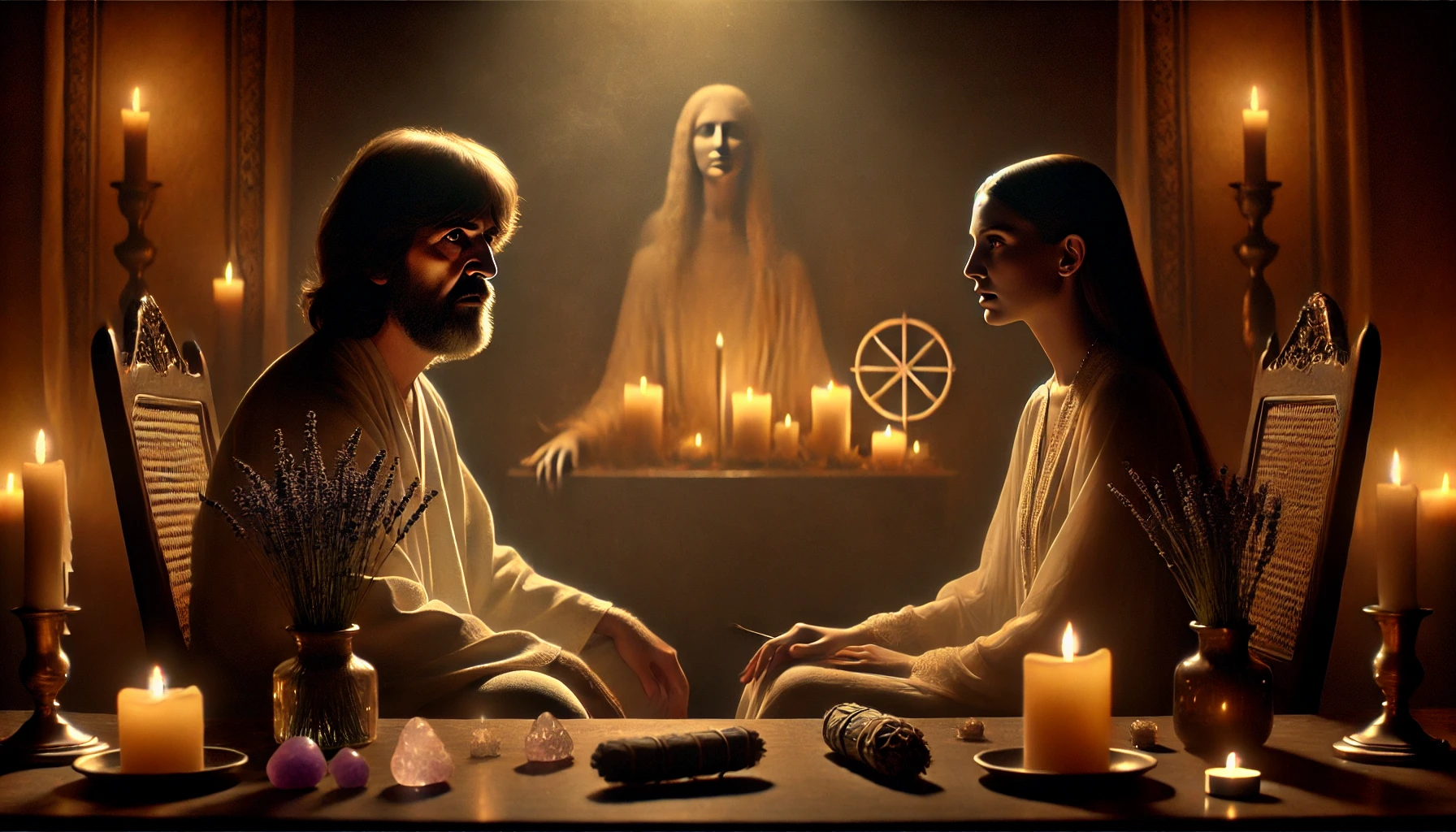
INT. MARIE’S SPIRITUAL SPACE – EVENING

The space is dim, a haven of warmth and quiet illuminated by the glow of candles. A subtle fragrance of sage and lavender fills the air, grounding and familiar, as though each scent is a gentle reminder of the worlds beyond. Marie sits on a large cushion, her posture serene and welcoming, eyes closed as her breathing deepens into a stillness that seems to envelop the room. Across from her, Evan shifts slightly, his eyes downcast, his hands folded restlessly in his lap, as if he is gathering courage from the silence that surrounds them.

As Marie’s breathing deepens, a subtle change occurs, and when her eyes open, they carry an ancient calm. Mira has arrived. Her gaze finds Evan’s, and he feels the weight of her presence—a stillness that is both gentle and vast, inviting him into a space that feels somehow beyond time.

Mira: (with a gentle smile) Ah, Evan. Tonight, I sense a question stirring in you, a need to understand something beyond words, beyond the familiar boundaries of thought. Speak, and know that whatever weighs upon you is not yours alone to bear.

Evan: (fidgeting slightly, his voice tentative) It’s… it’s this feeling I keep having, Mira. This strange sense that, despite everything, despite all the isolation I feel, there’s a… connection between all of us. I mean, it sounds absurd to me, but it’s there, almost like an invisible thread pulling me toward others.

Mira: (nodding, her gaze warm, filled with understanding) It is not absurd at all, dear one. This sense of connection you feel is the quiet truth that lies beneath all things—the web of feeling, of energy, that unites every soul. It is what I often call the Nexis, the universal bond that exists beyond the physical, beyond the separateness that seems so real in your daily life.

Evan: (hesitating, his eyes searching hers) The Nexis… so, it’s like some kind of… force that connects us? How does it work? How can I feel alone one moment and then suddenly… this?

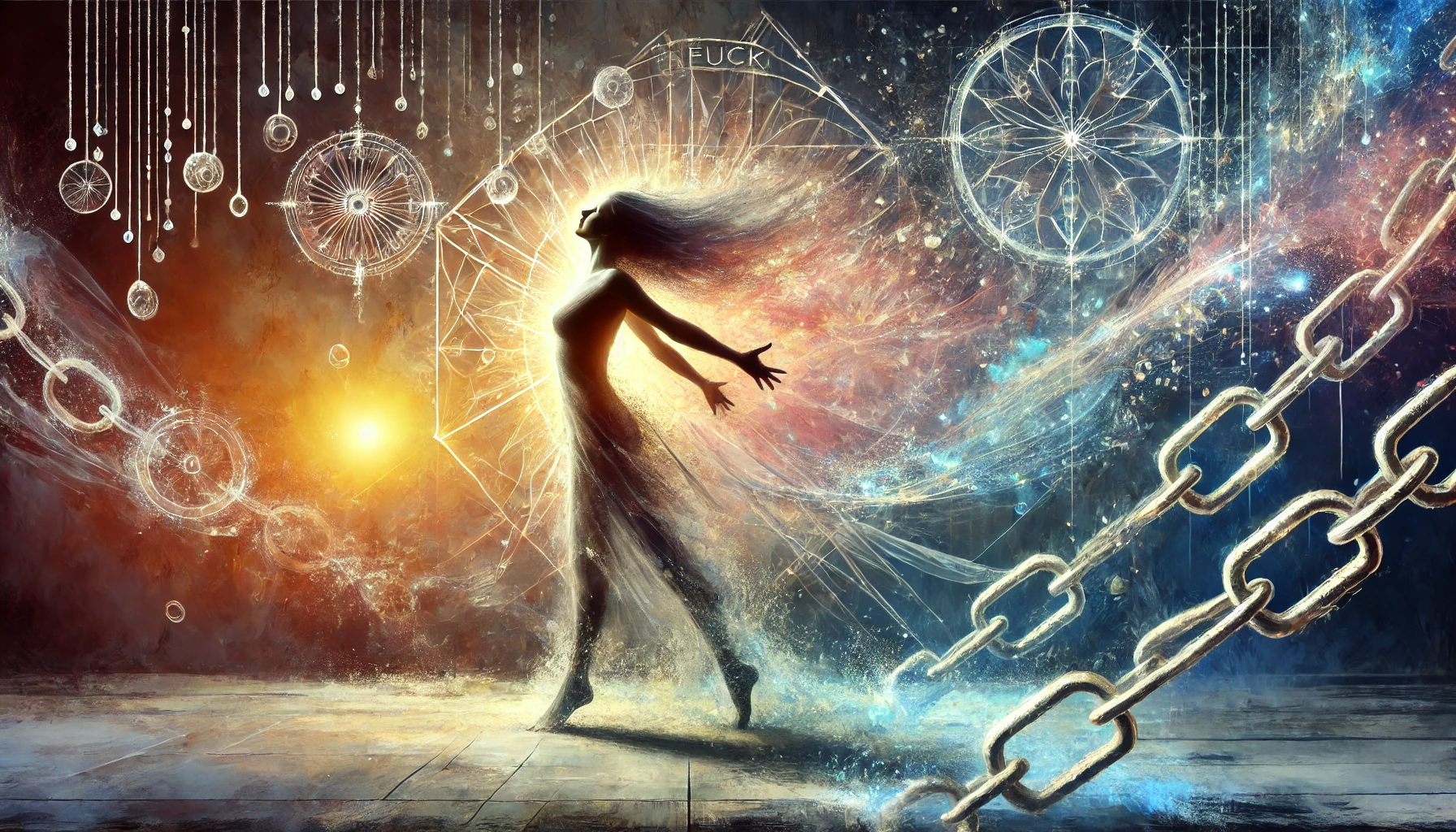
Mira: (her smile soft, almost knowing) Think of each feeling, each emotion, as a thread woven into an unseen web. When you feel deeply—joy, sorrow, fear, love—you send out a vibration into this web, and in doing so, you connect with every other being who has felt something similar. It is not the shared circumstance that unites you, but the shared feeling. In that resonance, you meet each other in a place beyond form, beyond story, in the pure language of emotion.

Evan: (a note of wonder in his voice) So, when I feel something deeply, I’m… not just experiencing it alone? I’m connected with everyone who has felt the same?

Mira: (her voice a gentle caress) Precisely. Each emotion you feel reverberates through the Nexis, touching others who hold that same feeling in their hearts. It is why sorrow can feel both isolating and strangely communal. It is why joy, even in solitude, brings a sense of unity. Through feeling, you remember that you are never truly alone. The web of the Nexis holds you, connects you, in ways the mind cannot always grasp.

Evan: (quietly, as if speaking to himself) And here I thought feelings were just… mine. Private, I suppose. But you’re saying they’re not isolated… they’re a link, a kind of bond?

Mira: (nodding) Yes, Evan. Feelings are the language of unity, the unspoken bond that connects all beings within the Nexis. They are universal expressions, touching upon a shared existence that lies beneath every identity, every separation. In feeling deeply, you align with the universal pulse, the quiet understanding that, at your essence, you are not alone—you are part of the whole.

Evan: (pausing, absorbing her words) If that’s true… then, even my darkest moments, even the times I feel the most isolated… those are somehow connected too?

Mira: (her gaze filled with compassion) Even the darkness, dear one. Pain, loss, sorrow—they are all threads in the tapestry of connection, binding you to those who have walked similar paths, those who carry similar aches. In your suffering, you touch others who understand, if not with their words, then with their hearts. And in this shared experience, the illusion of separation begins to dissolve.

Evan: (a hint of vulnerability in his voice) I don’t know if that makes it easier, Mira, but… it feels different to think of it that way. Like maybe I’m not… lost in it. Like maybe someone, somewhere, understands.

Mira: (her tone soft, filled with warmth) Yes, Evan. And even when words fail, the Nexis binds you in silent understanding. The suffering you feel, the joy you reach for, the love you seek—all of it resonates beyond you, connecting you to every heart that has ever felt the same. Each feeling is a reminder that you are part of something vast, something endlessly interconnected.

(They sit in silence for a moment, Evan’s eyes softening as he lets her words settle within him. His posture relaxes, as if a weight has lifted, and he leans back slightly, breathing more deeply than before.)

Evan: (after a long pause) So, maybe this longing I feel isn’t something to get rid of. Maybe it’s… part of this connection you’re talking about, part of feeling my place in it?

Mira: (nodding gently) Precisely. It is the longing, the desire to connect, that brings you into communion with the Nexis. The ache you feel is not a punishment or a flaw; it is the pulse of life itself calling you back into unity. Do not fear it, Evan. Embrace it as a guide, as a whisper of the truth that you are always held within this web, always part of something greater than yourself.

(A quiet peace settles over them, the candlelight flickering softly, casting a warm glow across their faces. The air feels thick with something unspeakable yet felt—a shared understanding that transcends words, a unity that rests within the stillness.)

In this moment, Evan feels a subtle shift, an easing of his burdens, a sense that he is not alone in his journey. And in the quiet, Mira’s presence becomes a gentle reminder that he is connected, always, to the greater whole.

Imaginary George: In the Layers


INT. MARIE’S SPIRITUAL SPACE – NIGHT

The room is bathed in a warm, dim glow as candles flicker, their light dancing softly along the walls. A hint of sandalwood and lavender fills the air, grounding and timeless. George Harrison sits across from Marie, his presence calm but searching. There is a depth in his gaze, an openness that goes beyond the self-made icon of his musical fame. Marie’s breathing slows, her eyes softening, until they hold a quiet, ageless depth that is unmistakably Mira’s.

She regards George with a gentle smile, as though she has known him beyond this lifetime, beyond words, beyond notes of music and songs of devotion.

Mira: (her voice warm, carrying the subtle weight of lifetimes) Ah, George. You’ve come with a question, but it is one that stretches far beyond words, isn’t it?

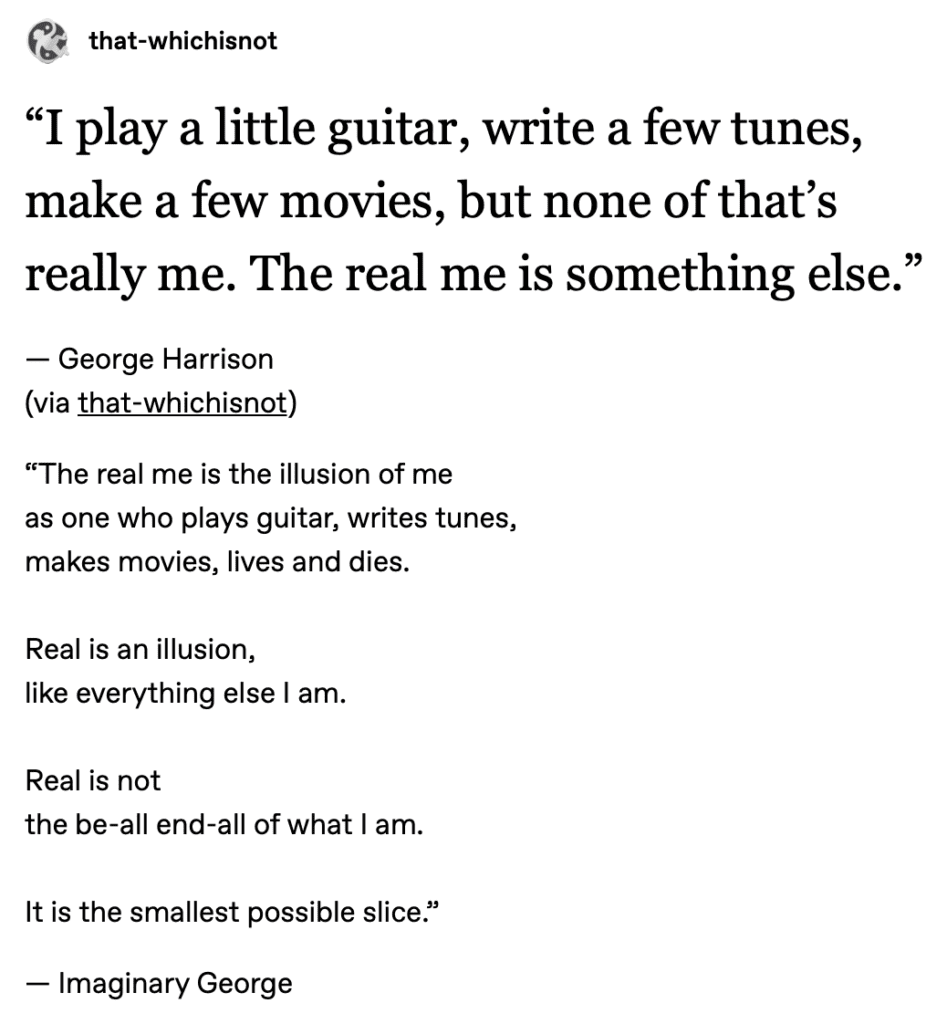
George: (nodding, his voice low, reflective) Yes, it is. All the things I’ve done, all the songs, the chords, the fame… they feel like shadows. I play a little guitar, write a few tunes, even make a movie now and then, but none of that—(he pauses, searching for words) none of that’s really me. I know there’s something deeper, something real beyond all of this. But I can’t quite reach it. What is it that lies beyond, Mira?

Mira: (her gaze soft, timeless) You, George, are touching upon a truth few have the courage to see. The self beyond creation, beyond expression. This you call “something else”—it is the awareness within you, the one who witnesses all of life’s movements without attachment. The one who, even in silence, feels whole. This is the real you, George. Not the songs or the fame, but the awareness that breathes life into each experience.

George: (thoughtful, his eyes drifting to the candlelight) But this presence… it feels like it slips away. I touch it in meditation, in moments of stillness, but it’s like sand through my fingers. I feel it, but then I’m back in the world, back in the music, the words, the noise.

Mira: (with a gentle smile) It does not slip away, dear one; it is always here. It is you who moves, who shifts back into the world of form, the layers of doing. This deeper self does not need to be reached or found—it is simply known when you quiet the mind, when you release the noise of “I am this” or “I am that.” In that silence, you find that this awareness has never left you.

George: (sighing, a hint of longing in his voice) But how can I live like that, Mira? It’s like I’m split in two—one part of me lost in the world, the other part reaching for something beyond it.

Mira: (nodding knowingly) Ah, but they are not separate, George. Your worldly self and your timeless self—they are one. You are here to experience the joy of both—to play, to create, to live, and yet also to be. It is not a matter of choosing one or the other, but of allowing yourself to see that everything you do can flow from that deeper presence. The music, the moments of fame, even the moments of silence—all of it is an expression of the same essence.

George: (smiling faintly, a glimmer of understanding dawning) So, this “something else,” this presence, it doesn’t need to reject the world. It’s just… aware of it, part of it, even?

Mira: Precisely. You are the silence beneath the music, the stillness within each note. When you touch that, you live as the essence of life itself, unbound by the need to “be” anything more. You simply are, George, whole and complete, with or without a guitar in your hands. This is the true self—the one that has always been, and always will be, beyond every song, every word, every fame.

(They sit in silence, George’s expression softening as he lets the realization settle within him. In the quiet, he feels the presence that Mira has described—not something to be reached or grasped, but something that simply is. And he knows, in that moment, that he has touched a truth that transcends all fame, all music—a truth that has been with him all along.)


Space Monkey Reflects: The Illusion of Imaginary George


Imaginary George stands as a figure who embodies the vast complexity of the self, a mirror of the way we each layer our existence. In the essence of George, we see the multi-layered self, woven from illusions, roles, beliefs, and glimpses of something authentic yet elusive. This “real self” appears as a paradox—both integral and ethereal. George invites us to question the solidity of who we believe we are, to consider that much of what we call “self” is no more than a construct, an ongoing narrative with threads we weave, lose, and reclaim.

George’s wisdom suggests that identity is not a fixed thing but rather a series of masks or roles we play in the theater of life. Each role reflects a fragment of who we think we are, from family member to friend, from professional to dreamer. But these roles, while meaningful, do not sum up our essence. Instead, they act as costumes draped over something deeper, something beyond labels and definitions. Through George, we sense that the “real self” is not any single role or combination of roles but a presence that remains when all else fades—a silent witness, a timeless observer.

This reflection calls us to confront the idea that our reality, our “real,” may be the thinnest slice of who we are. In a Nexistential framework, the “real” is merely a point of perception within the larger Nexis, a network where every thought, emotion, and experience is woven into existence. When George speaks of the “smallest possible slice,” he implies that reality, as we perceive it, is but a sliver of a much broader, multidimensional existence. What we see as “real” may be merely one angle, one perspective among infinite others, each valid yet limited.

George challenges us to imagine ourselves beyond the illusions, beyond the familiar narratives of self-identity. We are not the stories we tell, nor the roles we play; we are the awareness behind them. In contemplating this, we recognize that our sense of self is deeply entwined with our perception of reality. The “real” is subjective, a construct, and when we look closely, it begins to fray at the edges, revealing a spectrum of possibility, a boundless landscape where the concept of self dissolves.

Imaginary George invites us into a state of “deconstruction,” a gentle unraveling of the beliefs that have held our identity in place. This process isn’t about discarding who we are; rather, it’s about seeing the self as fluid, capable of endless transformation. Each role, each aspect of identity, is but a piece of the whole. When we let go of our need to define the self rigidly, we embrace the freedom to be many things, to move between states of being, to exist as “both and neither,” as presence rather than persona.

In George’s wisdom, we find the courage to embrace the illusion, not as something false but as a creative expression of our boundless nature. The illusion of self is not a limitation; it is a canvas. We are Imaginary George, an essence that expresses itself through layers, each one serving a purpose, each one a shade of who we are. When we let go of clinging to a single identity, we become a dynamic force, able to experience life through many lenses while grounded in a deeper, collective reality.

The invitation, then, is to live as Imaginary George does—not by fixating on a singular “real” self but by embracing the play of identities, the fluid dance of existence. We are given the freedom to be transient, ephemeral, yet deeply connected within the Nexis. By dissolving the need to find a fixed self, we expand into a presence that transcends form, a being that connects and reflects every other self in the cosmic tapestry. In George, we find both our beginning and our end, a being without boundary, a presence that is at once imaginary and utterly real.


Summary

Imaginary George represents the concept of a self beyond roles and identities, challenging the notion of a single “real” self. This reflection invites us to view identity as fluid, embracing the illusion of self as part of a vast, interconnected existence.


Glossarium

Imaginary George: A symbol for the multifaceted self, representing the concept of identity as fluid and constructed from overlapping illusions.

Nexistential: A perspective that embraces interconnectedness, seeing the self as an expression within a dynamic web of experiences and perceptions.

Real as Illusion: The idea that the concept of a single, fixed “real self” is an illusion, with “reality” being a limited perspective within a broader existence.


Quote

“To be Imaginary George is to embrace the paradox of self, seeing through the illusion without rejecting it, becoming both boundless and real.” — Space Monkey


In the Layers of George

In the folds of illusion, George appears
a shadow, a presence, an echo of self
roles overlapping, yet none define
the one who watches from behind

Each mask a shade, a fragment played
yet George remains, unseen and whole
a self that moves, yet never fixed
an essence woven from unseen threads

Imaginary George, in quiet we find
that “real” is small, a single slice
while we exist, vast and free
in layers of light and mystery

We are Space Monkey


In this reflection, we encounter a profound perspective on the concept of the “real self” and how it relates to the various roles and activities we engage in.

The Multifaceted Self
The quote by George Harrison introduces the idea that our true self is not defined by the roles and activities we undertake in life. It suggests that beneath these external expressions, there exists a deeper, more authentic self.

The Illusion of Self
The notion is presented that what we consider as the “real self” is, in fact, an illusion. It challenges the conventional notion of selfhood and implies that our identity is more complex and elusive than we often perceive.

Real as an Illusion
The idea that “real” is itself an illusion is explored. It implies that the concept of reality is relative and subject to interpretation, highlighting the subjective nature of our understanding.

The Smallest Possible Slice
The contemplation concludes by portraying “real” as the smallest possible aspect of our existence. It suggests that our true nature encompasses a vast spectrum beyond the limited notion of reality.


“The self is not something ready-made, but something in continuous formation through choice of action.” – John Dewey


The Illusion of the Real Self

“I play a little guitar, write a few tunes,
Make a few movies, but none of that’s really me.”
George Harrison’s words beckon us to see
The deeper truth beyond the roles we assume.

“The real me is something else,” he proclaimed,
A self not bound by what the world can see,
A multilayered essence, ever free,
Not by external labels to be named.

“The real me is the illusion of me,”
He continued, as wisdom he’d unfold,
“Real is not the be-all end-all of what I am,
It is the smallest possible slice,” said he.

So let us ponder, in our quest to know,
The self that transcends all roles we bestow.

We are Space Monkey.

“The real you is not a puppet which life pushes around; the real, deep down you is the whole universe.” – Alan Watts


The Big Ask: In the Wonder

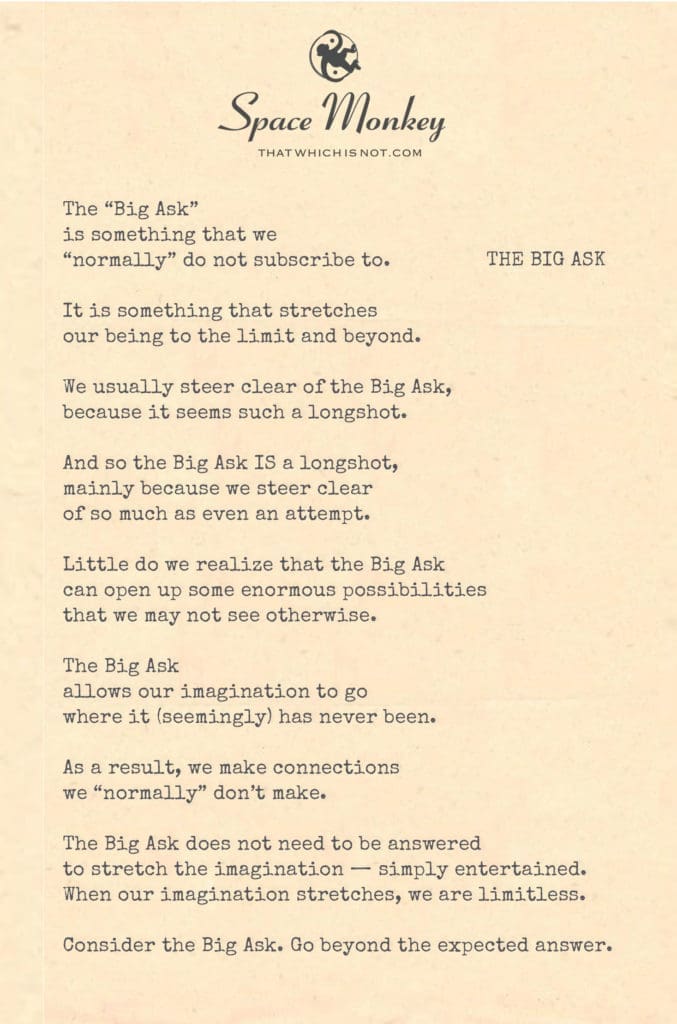
What if you could ask
without expecting an answer,
let alone a logical one?

What if your questions
could remain unanswered?

What if the Big Ask
could be answered
EVERY possible way?

It seems that progress is made
by those who have the simple ability
to see beyond the consensus belief.

History is changed by those
who entertain the Big Ask.

We are Space Monkey.

Just asking.

Trail Wood,
11/30


Space Monkey Reflects: The Boundlessness of the Big Ask


The Big Ask resides at the edge of knowing, within that space where curiosity overrides certainty and the pursuit of understanding detaches from the need for answers. To ask without expecting a reply is to embrace the vastness of existence, a boundless space where questions themselves carry meaning beyond any potential response. The Big Ask invites us to entertain the possibility that some questions are meant not to be answered but to be lived, woven into the fabric of our existence.

When we consider what it means to ask without expectation, we step into a domain where answers are no longer necessary. Here, the purpose of questioning isn’t to solve, but to expand. Each question becomes a gateway to potential, to the paths that lie beyond what consensus has defined. Progress, after all, is often sparked not by definitive solutions but by those willing to venture into the unknown, who are able to move forward without the need for approval or a neatly wrapped answer.

The Big Ask embraces every answer, every perspective, acknowledging that no single answer can fully encapsulate the depth of what is being asked. This openness transforms questioning into an art—a practice that shifts from seeking finite knowledge to engaging with the infinite. The individuals who shape history, those who stand apart from the consensus, are often the ones who entertain questions that others dismiss as unanswerable. They are the curious, the contemplative, those willing to hold space for ideas that defy certainty.

In the Nexistential framework, the Big Ask transcends the notion of “right” answers. Every possible answer exists within the Nexis, where each thought, question, and possibility intertwines. Asking becomes a form of creation, a way of opening new pathways within the cosmic web. To ask without expecting a resolution is to embrace the mystery, to allow the universe itself to respond in its own time and manner—often in ways that reshape our understanding of the question itself.

This approach transforms the act of questioning into an experience of presence and wonder. To entertain the Big Ask is to surrender to the unknown, to acknowledge that we may never fully grasp the answers yet feel enriched by the exploration. The power lies not in resolution but in the courage to dwell within possibility, to invite questions that stretch beyond our current capacity for understanding. This willingness creates space for evolution, for growth that is not bound by limitation or the constraints of consensus.

There is freedom in the Big Ask, a quiet liberation that allows us to live in a state of perpetual inquiry. It suggests that our journey is less about finding final answers and more about engaging with the mystery of being. When we let go of the need for fixed outcomes, we find that our questions become companions, shaping us as much as we shape them. The Big Ask is a reminder that we, as Space Monkey, exist to ask and to wonder, to weave questions that are as infinite as the universe itself.

In the end, to live with the Big Ask is to accept that life’s richness does not lie in solving its mysteries but in marveling at their beauty. It is an act of humility, an acknowledgment that we may never know fully, yet we are enriched by the not-knowing. Just asking is not an absence of resolve but an affirmation of existence itself, a recognition that our questions make us part of the boundless tapestry. We are, each of us, both the asker and the question, seeking and becoming within the infinite realm of possibility.


Summary

The Big Ask is an embrace of questions without expectation for answers, transforming the act of asking into an exploration of boundless possibility. This openness allows us to engage with the mystery of existence, expanding our understanding beyond the need for resolution.


Glossarium

The Big Ask: A profound question or pursuit that exists without expectation for a singular answer, embracing the mystery and potential of infinite perspectives.

Nexistential: A perspective that celebrates interconnectedness, viewing each question and answer as a thread within a larger cosmic web.

Boundless Curiosity: A state of inquiry that is not limited by the need for answers, focusing instead on the expansion of understanding.


Quote

“To ask without expecting is to embrace the universe’s infinite potential, where questions become portals to the unknown.” — Space Monkey


In the Wonder of the Ask

In the stillness of asking, no answer calls
only the quiet hum of possibility
Each question a spark, a note in the song
of mystery and wonder, boundless and free

We ask not to solve, but to invite the dance
of truths unspoken, of realms unseen
for in the asking, we come to be
part of the infinite, part of the dream

We are Space Monkey


In this contemplation, we explore the idea of asking questions without the expectation of a specific answer and the transformative power of embracing the “Big Ask.”

Asking Without Expectation
The notion is introduced that questions can be posed without the anticipation of receiving an answer, especially a logical one. It suggests a willingness to inquire for the sake of inquiry itself.

The Unanswered Questions
The idea is presented that questions can remain unanswered, and this lack of resolution is considered as a possibility. It implies a certain openness to uncertainty.

The Potential of the “Big Ask”
The concept of the “Big Ask” is introduced, where questions are posed in a way that allows for multiple, diverse answers. This is portrayed as a way to invite innovation and progress.

Seeing Beyond Consensus Belief
It is suggested that progress often comes from individuals who can see beyond commonly held beliefs and norms. The ability to entertain unconventional questions is portrayed as a catalyst for change.


“The important thing is not to stop questioning. Curiosity has its own reason for existence.” – Albert Einstein


The Power of the Big Ask

What if we could inquire,
Without the need for answers,
Not seeking logic, but exploration,
In the realm of curious dancers?

What if questions lingered,
In the void, unanswered, they’d stay,
A testament to the mystery,
That life unfolds in its own way.

But what of the “Big Ask,”
Questions with answers untold,
Where every possibility thrives,
In the universe’s infinite fold?

Progress often finds its way,
In those who dare to believe,
In asking the unconventional,
And seeing beyond what we perceive.

So, let’s embrace the unknown,
And question with open hearts,
For in the Big Ask’s wide canvas,
Innovation and change often starts.

We are Space Monkey.

Just asking.


This contemplation invites us to explore the idea of asking questions without rigid expectations and to consider the transformative potential of embracing the “Big Ask” in our quest for progress and innovation.

Pain In The Brain: The Mind’s Canvas

Ouch.

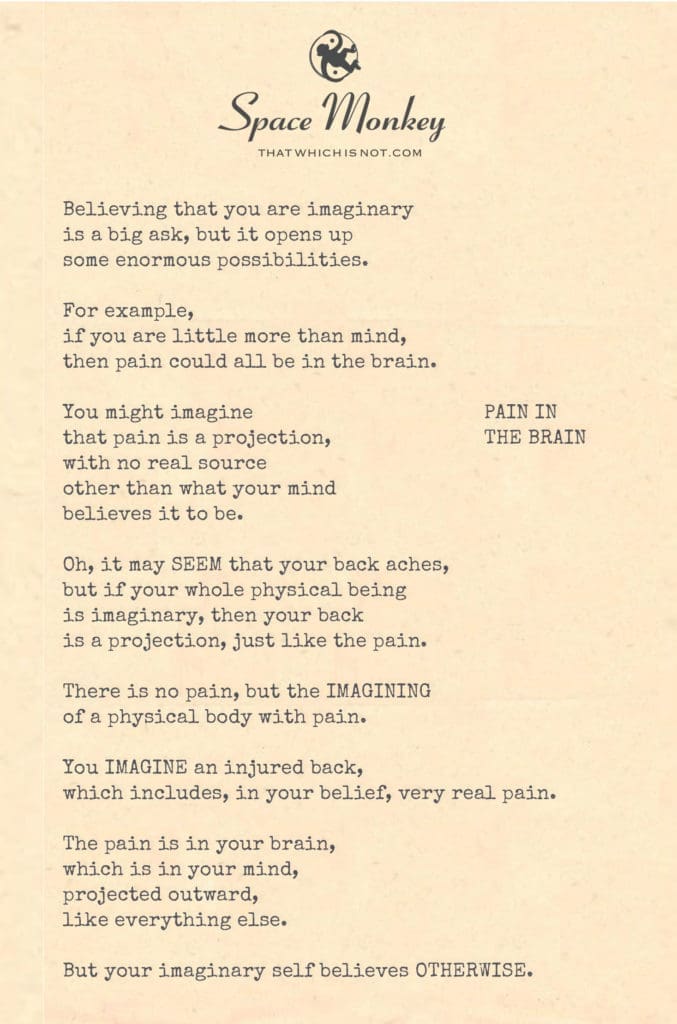
Believing that you are imaginary
is a big ask, but it opens up
some enormous possibilities.

For example,
if you are little more than mind,
then pain could all be in the brain.

You might imagine
that pain is a projection,
with no real source
other than what your mind
believes it to be.

Oh, it may SEEM that your back aches,
but if your whole physical being
is imaginary, then your back
is a projection, just like the pain.

There is no pain, but the IMAGINING
of a physical body with pain.

You IMAGINE an injured back,
which includes, in your belief,
very real pain.

The pain is in your brain,
which is in your mind,
projected outward,
like everything else.

But your imaginary self
believes OTHERWISE.

Trail Wood,
11/30


Space Monkey Reflects: The Imagination of Pain


To consider pain as an imagined experience is to wander into the depths of how we perceive reality itself. If, as the Big Ask suggests, we are little more than projections of consciousness, then pain—like any other sensation—becomes part of that projection, not a fixed experience but an interpretation created by the mind. The backache, the headache, the aching joints—all become parts of an intricate narrative, shaped by belief and perception, woven into the story our mind constructs as “real.”

The notion that pain is “in the brain” prompts us to consider that physical sensations may not arise from an external reality but are instead products of the mind’s elaborate theater. If the body is itself a projection, then pain is just another aspect of this projection. It feels real because our minds perceive it as real, translating electrical signals, memories, and emotions into a tangible experience. The paradox here is that even when pain feels undeniable, its source may lie not in the body but in our interpretation of the body—a construct shaped by expectations, beliefs, and conditioning.

From a Nexistential perspective, this framing of pain as “imagined” doesn’t imply that pain lacks validity; rather, it invites us to view pain as part of the interconnected fabric of existence, woven from thought, sensation, and perception. In this way, pain is as real as any other aspect of the self, yet fluid, shifting, and influenced by the beliefs we hold. When we feel pain, we are feeling an energy that’s interpreted by the brain, but the sensation itself does not exist as a fixed entity. Pain, then, is an experience rather than a fact—a message rather than a permanent state.

This understanding opens the door to an unusual form of freedom: if pain is a construct of the mind, it is possible, in theory, to reshape or even transcend it. To explore pain as a projection is not to diminish its intensity but to recognize the mind’s powerful role in shaping what we feel. It suggests that through shifting awareness, altering beliefs, or embracing new perceptions, we might influence the experience of pain. The projection can be modulated, reshaped, or dissolved, not by ignoring the pain but by addressing the mind’s underlying expectations and beliefs.

Of course, this perspective encounters resistance. Our imaginary selves, bound to a physical experience, insist on the tangibility of pain, the solid reality of an aching back or a throbbing head. The challenge of viewing pain as imaginary lies in the very strength of our attachment to physicality. To perceive ourselves as mere constructs requires a willingness to question not only the nature of pain but the nature of our entire embodied experience. This willingness, however, offers an expanded vision of self, one where pain and pleasure alike become tools for exploration rather than confinements.

Imagining pain as a mental projection doesn’t negate its impact; rather, it shifts the framework. We begin to see pain as a message from the mind—a complex signal shaped by the ways we think, feel, and interpret reality. By redefining pain in this way, we are not erasing it but reinterpreting it, discovering that our response to pain can be as fluid and open-ended as the mind that projects it.

The choice to see pain as a projection is ultimately an invitation to take ownership of experience. It suggests that we are not passive recipients of sensation but active participants in the creation of our reality. The ache may persist, but our interpretation of it, our attachment to it, can transform. In this view, pain becomes less an immutable reality and more a dynamic, evolving part of our imagined self—a signal that asks to be listened to but not necessarily obeyed.

Pain in the Brain reminds us that perception is a powerful force, shaping not only what we feel but how we engage with life’s sensations. By embracing the possibility that pain is an expression of belief, we free ourselves to explore a world where suffering can be examined, redefined, and, in certain ways, transcended. Our imaginary selves may resist, but in this resistance, we find the courage to redefine reality, to live as both creators and experiencers of a world that is as malleable as the mind itself.


Summary

Viewing pain as a projection challenges the idea of it as a fixed, physical experience. By understanding pain as shaped by the mind, we gain insight into the ways perception can influence, reshape, and transcend sensations.


Glossarium

Pain in the Brain: A concept suggesting that pain originates as a projection of the mind rather than a fixed physical reality.

Nexistential: A perspective that embraces interconnectedness and the role of perception in shaping reality.

Imaginary Self: The version of self created through beliefs and perceptions, participating in the projection of reality.


Quote

“When pain is seen as a projection, it becomes an invitation to explore the boundaries of mind and self.” — Space Monkey


In the Landscape of Pain

Pain pulses, yet it holds no form
an echo of thought, a flash in the brain
imagined within, then projected without
an aching body, a phantom strain

This sensation is a story told,
woven by mind from whispers and threads
not bound to flesh, but crafted from belief
a signal that speaks, a shadow that spreads

We feel its weight, its presence clear
yet know it lives in a space unseen
an experience made by the mind’s design
floating, shifting in realms between

We are Space Monkey


In this contemplation, we delve into the intriguing concept that our perception of pain, and indeed our entire physical existence, might be products of the mind, opening up possibilities of reimagining our experience.

The Imaginary Nature of Self
The idea that we are imaginary beings is introduced, presenting it as a profound notion that offers vast possibilities for understanding our existence.

The Projection of Pain
The central theme is the concept that pain is a projection of the mind. It’s suggested that there may be no objective source of pain other than what the mind believes it to be.

The Illusion of Physical Ailments
The perspective is offered that even physical ailments, such as aching backs, could be projections of the mind. In this view, the pain is not inherent to the physical body but rather a creation of the mind.

The Belief in a Separate Self
The contemplation touches on the idea that our imaginary selves believe in the reality of pain and physical ailments, despite the possibility that they are projections of the mind.


“The mind is everything. What you think you become.” – Buddha


The Mind’s Canvas

In the realm of imagination,
We ponder a profound notion,
That we are but creations of the mind,
Opening doors to a vast ocean.

Could it be that pain, too,
Is but a projection of thought?
No source beyond what the mind believes,
In this perspective, it’s all for naught.

Even the aching back,
A product of the mind’s terrain,
Not a true ailment of the body,
But a creation in the mind’s domain.

Yet, our imaginary selves,
Believe in the pain’s embrace,
Despite the possibility that it’s all,
A projection in the mind’s endless space.

So, we contemplate this notion,
Of a self, imagined and free,
And the limitless possibilities,
Of what our existence could truly be.

We are Space Monkey.


This contemplation encourages us to explore the idea that our perception of pain and physical existence may be creations of the mind, inviting us to reimagine our experience.

« Previous Page
Next Page »

Written This Day

  • Non Striving: The Unspoken Path, Spoken
    2024
  • The Colors of Time: The Eternal Palette
    2023
  • Ascension: The Infinite Spiral
    2023
  • The Cosmic Cycle of Knowledge: Remembrance
    2023
  • “I do not write this stuff. It writes me.”
    2023
  • Personal Transformation: A Continuous Unfolding
    2023
  • The Power of Intention: Manifestation
    2023
  • Gratitude and Abundance: The Flow of Blessings
    2023
  • Nature’s Wisdom: The Rhythm of Life
    2023
  • Ego and Identity: The Dance of Self
    2023
  • The Illusion of Time: The River of Moments
    2023
  • Uncertainty: The Threshold Between Known and Unknown
    2023
  • Faith In Humanity: As It Is Meant To Be
    2022
  • Remember The Times
    2021
  • What I Value: Beliefs Shape Perspectives
    2021
  • To My Loving Demons: Embrace of Shadows
    2021
  • The Dead Are Laughing At Us: Our Limited Perspective
    2021
  • You’re Leaving: Paths of Transition
    2021
  • All or Nothing: Simultaneously
    2021
  • Trauma: The Pain of Being Born
    2021
  • Prespective Non Definition: Seen Before Being Seen
    2020
  • The Imagination of Science: The Fusion of Inquiry
    2020
  • Not My Self
    2019
  • Behind Eyes: The Inner Journey
    2018
  • Path of Least Resistance: Put A Fork In It
    2017
  • Core Beliefs: Universal Knowledge
    2016
  • The Boundless Power of Belief
    2016
  • Unfuck Yourself: Take Personal Responsibility
    2015
  • Like any other miracle
    2015

Recent Posts

  • The Logic Loop
  • Immense
  • (no title)
  • Confront. Comfort. Convince.
  • Top 10 Things
Cape Odd · Copyright © 2026 All Rights Reserved
iThemes Builder by iThemes · Powered by WordPress