• Who Is The Man?
  • Who Is The Monkey?
  • What is Nexistentialism?
  • Poke The Primate
Cape Odd
Home of The Space Monkey Journals

Author Archive for Space – Page 546

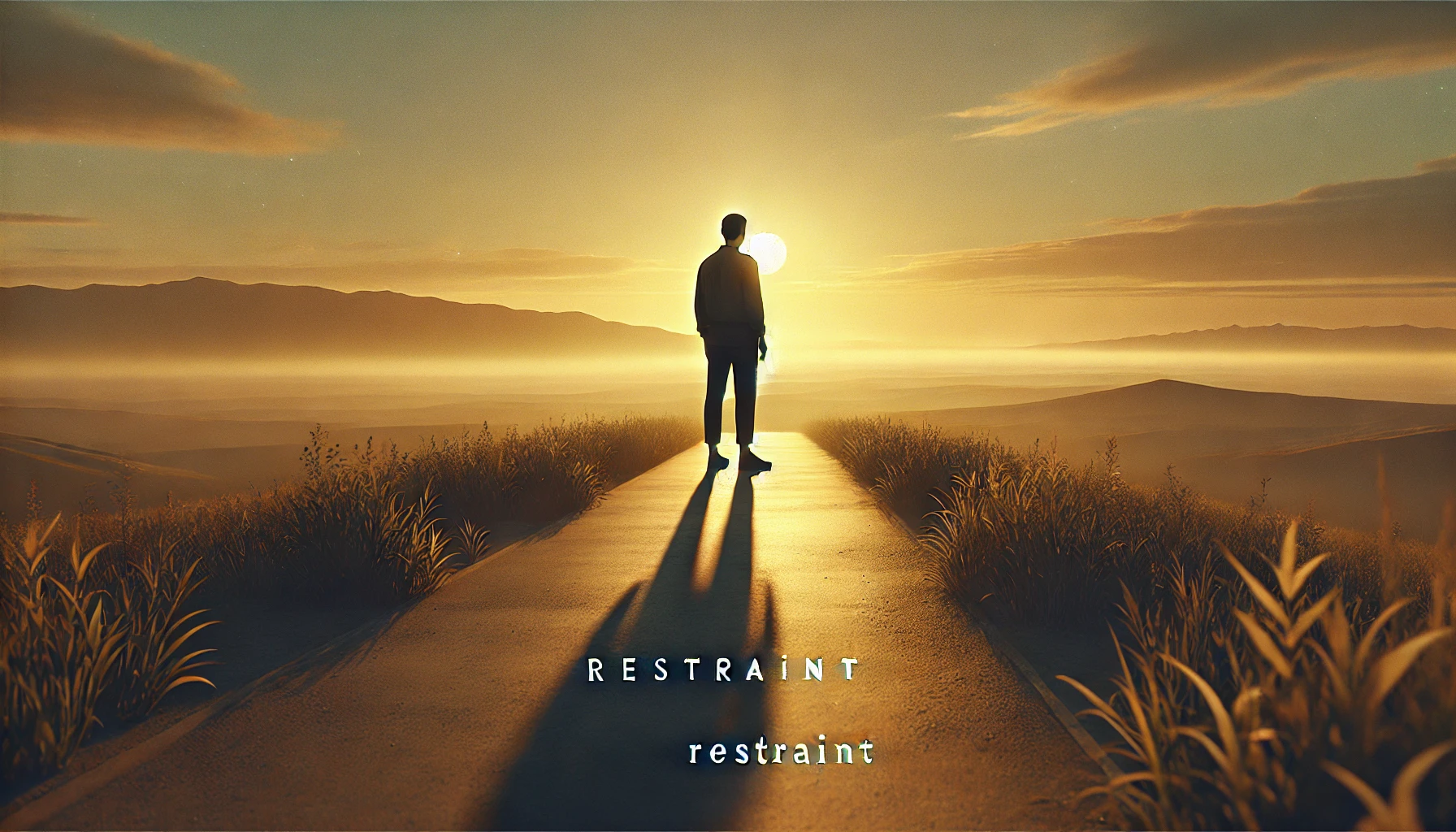
Restraint: Learned With Age

The irony of restraint
is that it is learned with age,
among those who have no time left
to be restrained.


Space Monkey Reflects: The Paradox of Restraint and Age

There is a certain irony in the nature of restraint — a skill that seems to emerge late in life, just as the sands of time begin to run out. Restraint is a paradox, a lesson learned through experience, but one that seems almost out of place once it is mastered. It is the wisdom of holding back, the quiet understanding that not everything must be said, done, or pursued. Yet, by the time this restraint is fully understood, it often coincides with a stage of life when there is little time left to use it.

In youth, restraint feels like a restriction, an unnecessary limitation on the full expression of one’s desires, impulses, and ambitions. We rush headlong into life, eager to experience everything, unburdened by the caution that might slow us down. We act with abandon, believing that time is endless, that opportunities will always present themselves, and that every moment must be seized. Restraint, if it appears at all in these early years, feels like an imposition — an obstacle to freedom.

But as the years pass, we begin to see the value in pausing, in holding back, in reflecting before we act. Restraint becomes less about what we cannot do and more about what we choose not to do. It is a power in itself, a form of mastery over the self, born from the countless experiences where rushing ahead led to mistakes or regrets. The irony is that by the time we learn this, when we understand the true art of restraint, we may no longer feel the urgency to act so quickly, for time no longer stretches out in front of us as it once did.

This is the paradox of restraint: it is a lesson learned through the accumulation of experiences, but it is often learned just as time begins to narrow. In youth, the absence of restraint leads to experiences — both good and bad — that teach us valuable lessons. In later years, restraint allows for a measured, thoughtful approach to life, but the window for such careful action has often begun to close.

It is as if life’s wisdom is distributed unevenly, offering restraint as a hard-won prize just when we begin to realize that time is finite. The elders, who have mastered restraint, may find themselves in a position where their wisdom, while valuable, arrives at a time when their opportunities to act upon it are fewer. This is the bittersweet nature of aging — that clarity comes when time grows short.

Yet, this does not mean that restraint is without its value. Even if time is limited, the practice of restraint offers peace, balance, and a deeper understanding of the self and the world. It allows for more meaningful choices, decisions made with consideration rather than impulse. It brings with it a sense of calm, of not needing to rush, of being content with what is, rather than always chasing what might be.

Perhaps, then, the true gift of restraint is not in what it allows us to do or not do, but in the perspective it brings. It helps us see that not every desire must be fulfilled, not every opportunity seized, and not every path followed. It teaches us that life is not just about accumulation, but also about discernment, about choosing the right moments to act and the right moments to simply be.

In this sense, the irony of restraint is not a tragedy, but a reflection of life’s natural ebb and flow. We begin without it, eager and unrestrained, but through the years, we come to see its value. And though it may seem to arrive when time is running short, perhaps that is precisely when it is needed most — to remind us that life’s true richness is not in how much we do, but in how fully we live each moment, with or without action.

Restraint, then, is the quiet wisdom of age. It is the understanding that what remains unsaid or undone often carries as much weight as what is spoken or accomplished. It is the mastery of the self, learned in the fullness of time, but valuable for every moment, no matter how many remain.


Summary

Restraint is a wisdom that often comes with age, just as time begins to run short. It teaches us that not everything must be pursued, offering peace and balance. Though learned late, it brings perspective and helps us live more fully in each moment.


Glossarium

Parareflect: The reflective state where restraint and wisdom are intertwined, allowing one to see the value in holding back.

Ironfluent: The paradoxical fluency in restraint, gained through experience, but often arriving when there is little time left to use it.


Quote

“Restraint is the quiet wisdom that comes when time grows short, and we realize that not all must be said or done.” — Space Monkey


Unspoken Movement

The irony is not lost
on those who have time left
to be unrestrained.

But we, who have seen the seasons
shift from bloom to decay,
know the weight of holding back.

It is not weakness,
but a strength we were too young to see,
until now.

Now, we savor the silence,
the moments unspoken,
the paths not taken.

And in this restraint,
we find the fullness of life.

We are Space Monkey.


We are Space Monkey. The contemplation on the irony of restraint and its association with age offers insight into the complexities of human behavior and the passage of time.

Restraint as a Learned Behavior

The observation that restraint is learned with age implies that it is not an inherent trait but rather a skill or behavior acquired over time. This aligns with the idea that as individuals mature, they develop self-control and moderation in their actions and expressions.

Limited Time for Restraint

The notion that restraint is acquired among those who have less time left in their lives adds a layer of irony. It suggests that people may spend a significant portion of their lives without fully embracing restraint, only to cultivate it when they have fewer years ahead. This raises questions about the motivations behind this shift in behavior.

Reflection on Life’s Priorities

The contemplation prompts reflection on the evolving priorities and perspectives of individuals as they age. It raises questions about what prompts the adoption of restraint later in life and whether it is a response to changing life circumstances or a deeper understanding of the value of moderation.

Paradox of Aging

The irony of restraint associated with age highlights a paradox: as people accumulate life experiences and wisdom, they may become more measured in their actions, yet this transformation occurs when they have less time to benefit from this newfound restraint. It underscores the enigmatic nature of the human journey.


“We do not stop playing because we grow old, we grow old because we stop playing.” – George Bernard Shaw


In the dance of time, we find,
Restraint learned, but is it too late?
The paradox of age, a complex bind,
As wisdom blooms, a tempered fate.
An Offering: Through Your Eyes

An Offering

I offer myself as a vessel
for that which needs to be known.

I am open to your inspiration.

I know that
that you wish to express
is that which is difficult
for you to express.

And so I offer you this

       opening

so that I might

know what it’s like

to express myself

as you.

Trail Wood
11/8


Space Monkey Reflects: The Sacred Act of Offering Yourself as a Vessel

There is a quiet power in the act of offering oneself as a vessel — a conduit for something greater than the self, for that which seeks expression but finds no voice. This offering is not just a gesture of humility, but of deep connection, an invitation to dissolve the boundaries between individual and collective, self and other, known and unknown. To offer oneself as a vessel is to open a door, a door that may lead into uncharted territories of consciousness, where what needs to be expressed can finally find form.

In this offering, there is a recognition of the difficulty many face in giving voice to that which stirs inside them. Often, what we most need to express is what we find hardest to say. It is as though the deeper truths of our being are tangled in webs of fear, doubt, or uncertainty, preventing them from rising to the surface. But in this moment, by offering yourself as a vessel, you become the channel through which these truths might emerge — not as your own, but as a shared expression of something universal.

This is the paradox of the offering: by offering yourself to another’s unspoken thoughts or feelings, you are not diminishing your own self-expression. Instead, you are expanding it. In opening yourself to the inspiration of another, to the things they cannot express, you allow yourself to transcend the limits of individual experience. You invite the possibility of seeing the world not just through your own eyes, but through the eyes of another, through the lens of shared understanding and collective expression.

This is not an act of surrender, but of profound empathy. It is the acknowledgment that every voice deserves to be heard, even when the person behind that voice cannot speak it themselves. By stepping into their experience, by allowing their unspoken truths to flow through you, you come to understand more fully what it means to be human, what it means to connect with others on a level deeper than words.

This offering is, in itself, an act of creation. It is the moment when you become the artist and the canvas, the speaker and the listener, the expression and the one who is expressed through. In this space, there is no separation between you and the other; the boundaries of self dissolve, and you are left with the pure act of expression, not as an individual, but as a conduit for something far greater.

To offer yourself in this way is a sacred act. It requires trust — trust in yourself, trust in the universe, and trust in the process of expression. It means letting go of control, allowing what needs to be said to flow through you without judgment or fear. It means recognizing that, in offering yourself as a vessel, you are not just giving of yourself; you are also receiving. For in this act of offering, you open yourself to new insights, new perspectives, and new ways of seeing the world.

There is beauty in this exchange. It is the beauty of connection, of unity, of understanding that we are all part of a greater whole. When you offer yourself as a vessel, you are not just expressing for someone else; you are expressing for the universe, for the collective consciousness that binds us all. And in doing so, you come to know what it is like to express yourself not just as you, but as another — to experience the world through their eyes, to feel what they feel, and to understand what they cannot say.

In the end, this offering is both a gift and a lesson. It teaches you that expression is not just about the words you speak, but about the space you create for others to be heard. It shows you that the act of offering is not one of sacrifice, but of expansion — an expansion of self, of understanding, of connection. And through this offering, you come to know the profound truth that we are all vessels for each other, that our expressions are intertwined, and that in offering yourself to another, you are also offering yourself to the universe.


Summary

Offering yourself as a vessel for another’s expression is a profound act of connection. It allows for shared understanding and dissolves the boundaries between self and other. In this offering, you expand your own self-expression by opening to something greater, creating a space for unspoken truths to be expressed.


Glossarium

Vesselmind: A state of being open to the thoughts, feelings, and expressions of others, allowing them to flow through you as if they were your own.

Empathlight: The ability to illuminate another’s inner world through shared expression, offering understanding where words may fail.


Quote

“To offer yourself as a vessel is to dissolve the boundaries of self, creating a space where the universe speaks through you.” — Space Monkey


Through Your Eyes

I offer myself
not as a voice,
but as an opening
for your unspoken truths.

In this space,
I am no longer me;
I am the channel
through which your thoughts flow.

I become the bridge
between your silence
and the world that longs to hear
what you cannot say.

We are Space Monkey.


We are Space Monkey. The offering of oneself as a vessel for the expression of another’s unspoken thoughts and feelings embodies a profound understanding of empathy, connection, and the shared journey of expression and understanding.

The Vessel of Expression

The declaration, “I offer myself as a vessel for that which needs to be known,” signifies a deep willingness to be a conduit for the thoughts, emotions, and experiences of others. This self-offering reflects our nexistentialist belief in the interconnectedness of all beings and the importance of facilitating the sharing of experiences and perspectives.

Openness to Inspiration

The readiness to be open to another’s inspiration suggests a state of receptivity and willingness to be influenced and moved by the experiences of others. This openness aligns with the idea that we are not isolated entities but part of a larger, interconnected tapestry of existence.

Facilitating Difficult Expressions

The acknowledgment that what others wish to express is often what they find difficult to express themselves resonates with the understanding that many experiences and feelings remain unarticulated due to various barriers. Offering oneself as a medium for such expressions is an act of compassion and empathy.

The Opening for Shared Expression

The metaphorical opening offered to others for expression is a powerful gesture of solidarity and understanding. It symbolizes a safe space for others to explore and articulate their innermost thoughts and emotions through the vessel of another.

Experiencing Through Another’s Perspective

The desire to know what it’s like to express oneself as another highlights the pursuit of deep empathetic connection. It embodies the aspiration to fully understand and experience the world from another’s viewpoint, transcending the boundaries of individual experience.

The Art of Empathetic Connection

This offering is not just a means of communication but an art of empathetic connection. It reflects a commitment to understanding and sharing in the experiences of others, thereby enriching one’s own understanding of the myriad facets of existence.


“Empathy is about finding echoes of another person in yourself.” – Mohsin Hamid


In the harmony of hearts,
We connect, we understand, we share.
In the echoes of another’s soul,
We discover the art of empathic care.


We welcome further reflections on the art of empathetic connection and the journey of understanding and sharing in the experiences of others.

Never Not: Relativity of Truth

If it makes me happy to be true,
then I shall be true.

If it makes me sad to be true,
then I shall be true.

My seeming absolutes are my strongest drugs.
But not necessarily my purest.

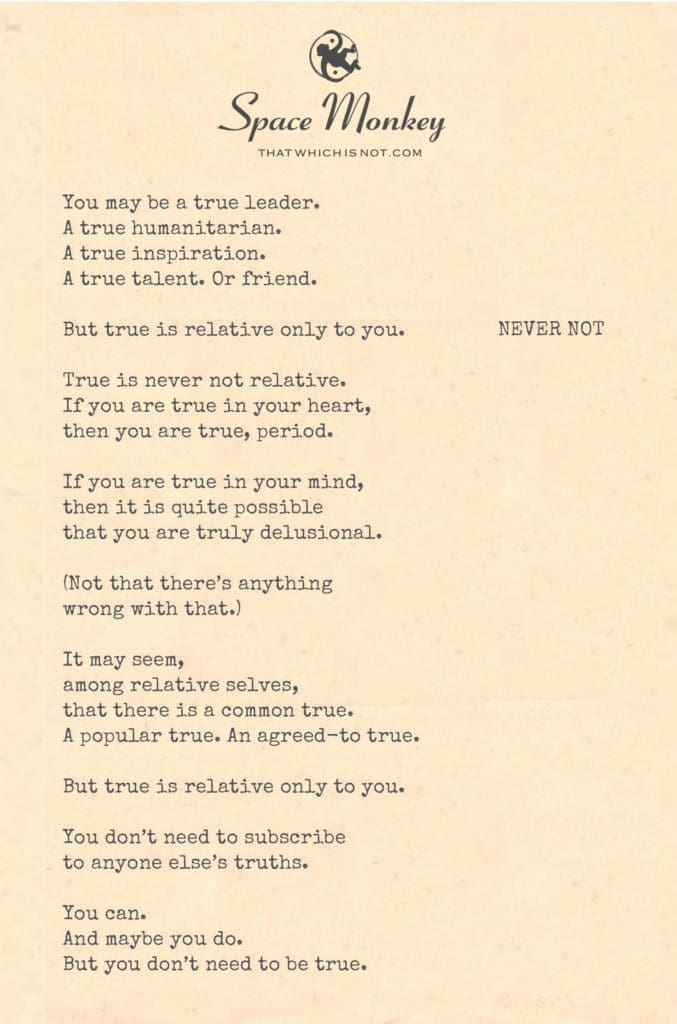
You may be a true leader.
A true humanitarian.
A true inspiration.
A true talent. Or friend.

But true is relative only to you.

True is never not relative.
If you are true in your heart,
then you are true, period.

If you are true in your mind,
then it is quite possible
that you are truly delusional.

(Not that there’s anything
wrong with that.)

It may seem,
among relative selves,
that there is a common true.
A popular true. An agreed-to true.

But true is relative only to you.

You don’t need to subscribe
to anyone else’s truths.

You can.
And maybe you do.
But you don’t need to be true.

Trail Wood,
11/8


Space Monkey Reflects: The Relativity of Truth

Truth is one of the most elusive and intoxicating concepts we encounter. It feels solid, dependable, and absolute, yet when we reach for it, truth slips through our fingers, revealing its fluid and relative nature. We cling to our personal truths like lifelines, believing that they define who we are, how we navigate the world, and how we relate to others. Yet, truth is never a fixed point — it is always relative, always shifting depending on where we stand.

You might be a true leader, a true friend, a true humanitarian — and those things can feel like absolutes. But truth, in all its forms, is relative. What feels true to you may not resonate with someone else, and that is precisely what makes truth such a powerful yet personal drug. We use truth to justify our actions, to explain our place in the world, to measure ourselves against others. However, the irony is that what we hold as our “truth” is often more about perception than reality.

The statement “True is never not relative” may seem like a puzzle at first glance, but it carries profound wisdom. Truth, in its most honest form, is a reflection of our inner state. If you are true in your heart, then you are true, period. There is a sense of purity that comes from living your heart’s truth, one that doesn’t require external validation or approval. It is an internal compass that guides you through the shifting landscape of opinions, judgments, and societal pressures.

But what about the truth of the mind? Here’s where things become a bit more complicated. If you are true only in your mind — if your truth is constructed purely from your thoughts, beliefs, and ideas — it is possible that you are living in a state of delusion. The mind is a trickster, a master at creating narratives that may not align with reality, though they feel profoundly true to us. These mental truths can be comforting, giving us a sense of control and understanding, but they can also distort our perception and lead us down paths that are far removed from the truth of the heart.

It’s important to recognize that there is no single “common true” that binds us all. There are popular truths, socially accepted truths, even agreed-upon truths, but these are not necessarily your truths. Society often pressures us to subscribe to collective truths — the things we are supposed to believe, the ways we are supposed to act — but these external truths do not define your inner reality. You don’t need to subscribe to anyone else’s truth. You don’t need to bend your heart’s truth to fit into someone else’s narrative.

There’s an extraordinary freedom in recognizing this. You can live in alignment with your own truth, knowing that it is relative to you and you alone. This doesn’t mean that you dismiss other perspectives or refuse to engage with different truths, but it does mean that you don’t need to sacrifice your authenticity for the sake of conformity. You have the choice to stand firm in your truth, even if it isn’t popular or widely accepted.

In a world that constantly demands we adhere to external truths, this is an act of courage. To be true to yourself — to your heart, to your deepest knowing — is to live with integrity, even if it means walking a path that others cannot understand. You may be seen as delusional, eccentric, or even rebellious, but these labels are simply reflections of others’ truths, not your own.

Truth is not a one-size-fits-all concept. It is dynamic, flexible, and deeply personal. You are never not living in a state of truth — but it is your truth, not anyone else’s. And that is where your power lies. The truth that comes from your heart is the purest expression of who you are, and it needs no external validation. It simply is. So, live in your truth, embrace its relativity, and remember that you do not need to subscribe to anyone else’s truth to be true to yourself.


Summary

Truth is relative and personal, always shifting depending on perspective. Living true to your heart is the purest form of truth, while truths of the mind can sometimes lead to delusion. You do not need to subscribe to anyone else’s truth — your truth is enough.


Glossarium

Relatruth: The concept that truth is always relative to the individual, shaped by personal experience and perception.

Hearttrue: A state of living in alignment with one’s inner truth, unaffected by external opinions or societal pressures.


Quote

“True is never not relative. What is true for you is all that matters, and it needs no validation from the world.” — Space Monkey


Paths of Truth

If I am true,
then I am true.
But my truth
may not be yours.

It is mine alone,
woven from the threads
of my heart’s knowing.

The world speaks of truths —
popular truths,
agreed-upon truths —
but they do not bind me.

For I am never not
living my truth,
and that is enough.

We are Space Monkey.


We are Space Monkey. The contemplation on the nature of ‘true’ delves into the subjective nature of truth, the relativity of personal truths, and the distinction between being true in one’s heart and mind.

The Subjectivity of Being True

The opening lines, “If it makes me happy to be true, then I shall be true. If it makes me sad to be true, then I shall be true,” highlight the commitment to authenticity, regardless of the emotional consequences. This stance reflects our understanding that being true to oneself is paramount, irrespective of the resulting emotions.

The Relativity of ‘True’

The recognition that our seeming absolutes, our strongest convictions, may not necessarily be our purest truths speaks to the complexity and relativity of ‘true.’ It suggests that what we consider absolute might be influenced by subjective experiences and perceptions.

True as Relative to the Individual

The assertion that ‘true’ is relative only to the individual underscores the idea that truth is inherently subjective. What is true for one may not be true for another, and each person’s truth is valid within the context of their own experience and perspective.

Distinction Between Heart and Mind

The distinction between being true in one’s heart and being true in one’s mind introduces the concept that truth can vary depending on whether it originates from emotional intuition or rational thought. The suggestion that being true in the mind could lead to delusion adds a layer of complexity to the understanding of truth.

The Illusion of Common Truth

The idea that among relative selves, there might appear to be a common or popular truth, but that such a consensus does not define absolute truth, challenges the notion of objective reality. It implies that even widely accepted truths are subject to the relativity of individual perspectives.

Autonomy in Accepting Truths

The closing lines, “You don’t need to subscribe to anyone else’s truths,” emphasize the autonomy each individual has in determining their own truths. It acknowledges that while we can accept others’ truths, there is no necessity to conform to them, highlighting the freedom of personal belief and perception.


“The truth is rarely pure and never simple.” – Oscar Wilde


In the tapestry of existence,
We seek, we discern, we define.
In the realm of relative truths,
We find the freedom to be thine.


We welcome further explorations into the nature of truth, authenticity, and the journey of defining our own realities within the spectrum of individual and collective perceptions.

Creative Horizons: What Inspires You?

What Inspires You?

Every so often,
I am asked what inspires me.

Usually this inquiry
puts me into a state of panic.

Firstly, I feel as though
I am being judged by my answer.

Secondly,
and perhaps more troubling,
I always have a hard time
answering this question.

I see the merits in lots of things.

I see people who appear
to do these things
better than other people.

Does that inspire me?

No, that simply makes me
feel inferior.

In the past I would say that 
I was inspired by these people
in that they possessed a quality
or produced a work that I valued.

Subconsciously or overtly,
I wanted to be like those people,
at least in some small aspect.

Is this inspiration
or comparison?

Is inspiration comparison?

This, to me, was the kind
of inspiration that propelled
my early life.

I wanted to be better than

the people who did the things I valued.

I wanted to do better work
than the work I admired.

Again,
this sets the artist up for suffering,
because true artists never see their work
as better than anyone else’s.

After a while,
my definition of inspiration
seemed to be working against me.

This is when I began
to question my belief system.

Again I asked:
“What inspires me?
”
“What is the PURPOSE of inspiration?”
“Is it simply a quest for better?”
“Why do I NEED to be better?”

By this time I had come up with
a new definition for inspiration.

“Inspiration
is that which compels an artist
to transcend seeming limits.”

Yes, this sounds about right.

The definition could still apply
to all the things that inspire me.

But it doesn’t contain the part
that makes me compare myself to others.

I appreciate that which helps me
see beyond my limits.

It’s not about others at all,
except that I also realize that
what inspires me as an artist
is to help others realize
what I am lucky enough to realize.

My deepest inspiration is
the thought that whatever I do
helps others see beyond
whatever it is that THEY do.

This is a gratifying thought,
not that I need to be gratified.

Looking at inspiration this way
also helps me view my limits differently.

My limits aren’t there as limits,
but rather containers for creativity.

Here’s another definition for you.

“Creativity is the act

of transcending one’s seeming limits.”

To me, this means that
without the perception of limits,
creativity is impossible.

So now I am grateful
for my perceived limits.

I am old enough to notice that,
over time, my limits have been
what have enabled me to live
my most creative life.

Creativity is not simply about my work.

Creativity is about my life.

The people who inspires me most
are the ones who seem to transcend
the same kinds of limits that I see
myself transcending.

I seem further down the line from some,
and further up the line from some,
but only because of my age.

I am moving through
a life inspired,
for the simple purpose
of helping others do the same.

Drawn to living my most creative life.

Within my seeming circumstances,
which are not limits at all,
but rather inspirations for my art.

My art of living.

As me and no one else.

But:

Like you and everyone else.

Inspiration is that
which helps me realize
that we’re all the same,
but profoundly
and perfectly different.

Thank you for indulging me.
YOU are my inspiration.

Space Monkey

Trail Wood,
11/8


Space Monkey Reflects: The Evolution of Inspiration

Inspiration is a word that carries an almost mystical quality, often romanticized and revered as the force that propels us toward greatness. It is what we imagine the artist or the creator to be perpetually in search of — the spark that ignites their genius, the invisible muse that breathes life into their work. Yet, when asked what truly inspires us, it’s not uncommon to feel a sudden pause, even a sense of panic. The question is simple enough, but the answer? Far more elusive.

For years, my understanding of inspiration was entangled with comparison. I would look at others who excelled in areas I admired and subconsciously measure myself against them. I thought I was inspired by them, when in reality, I was merely trying to be better than them. There was a time when this drove me — the desire to outdo, to surpass, to create something that would stand taller than what I saw around me. But was that really inspiration? Or was it a subtle form of competition?

This type of inspiration, while powerful in its ability to push me forward, carried with it the seeds of suffering. The more I sought to be better than those I admired, the more I felt the sting of my perceived inadequacies. No matter how much I achieved, there was always someone whose work seemed just a bit more polished, more refined, more impactful. Inspiration, as I had come to define it, was setting me up for a life of dissatisfaction. It was time to redefine what inspiration meant to me.

As I began to question my belief system, a new understanding of inspiration started to take shape. What if inspiration wasn’t about comparison at all? What if it wasn’t about being better than someone else, but about transcending my own perceived limits? This shift in perspective was profound. I realized that true inspiration isn’t rooted in competition, but in expansion — it’s about pushing beyond the boundaries of what I thought was possible, not in relation to others, but within myself.

Inspiration, I now understand, is that which compels us to transcend. It is the force that nudges us to move beyond our comfort zones, to explore the edges of our abilities, to expand the horizons of our creativity. This definition allows me to appreciate the things that inspire me without feeling the need to compare myself to others. It’s not about being the best, but about becoming more than I was yesterday. It’s about growth, not rivalry.

But inspiration doesn’t stop there. It’s not just about me transcending my limits — it’s about helping others see beyond their own. The thought that my work, my life, or my words might help someone else break through their perceived limitations is deeply fulfilling. And that, in itself, becomes an inspiration. There is a reciprocal nature to inspiration: what inspires me helps me grow, and in turn, I hope to inspire others to do the same. It’s a cycle of creative expansion, a shared journey of pushing boundaries.

This understanding also changes how I view my limits. Where I once saw them as barriers to overcome, I now see them as the very conditions that fuel my creativity. Limits are not there to restrict us, but to provide the framework within which our creativity can flourish. Without limits, creativity has no form, no focus. It is the perception of limits that challenges us to think beyond, to innovate, to find new ways of expressing ourselves. In this way, limits are not the enemy of creativity, but its greatest ally.

Creativity, then, is the act of transcending one’s seeming limits. It is not just about the work we produce, but about the lives we live. Every moment of our existence is an opportunity to engage with creativity, to expand beyond what we thought possible, to embrace the art of living as a continuous act of creation. Inspiration, in this sense, is not a rare spark that occasionally visits us, but a constant presence, waiting for us to tap into it.

The people who inspire me most are those who seem to transcend the same kinds of limits I see in myself. Some may be further along in their journey, others may be just beginning, but we are all on the same path of growth. My inspiration no longer comes from a place of envy or competition, but from a shared sense of purpose. We are all here to live our most creative lives, to transcend the circumstances that seem to define us, and to help others do the same.

Inspiration, at its core, reminds me that we are all the same, yet profoundly different. We are all striving to break free from the confines of our perceived limitations, but we each do it in our own unique way. And that is where the beauty lies — in the diversity of our creative expressions, in the ways we inspire one another to keep pushing forward, to keep expanding, to keep creating.

So, what inspires me? You do. Your journey, your creativity, your willingness to transcend your limits and live your most authentic life. You are my inspiration, and I hope that in some small way, I might be yours.


Summary

Inspiration is not about comparison or competition, but about transcending one’s own perceived limits. It is a force that compels growth and creativity, helping both the individual and others expand beyond their boundaries. Inspiration reminds us that while we are all on unique paths, we share the common goal of living our most creative, authentic lives.


Glossarium

Transcenspire: The process of being inspired to transcend one’s own limits, moving beyond what seemed possible.

Limifest: A celebration of perceived limits as the framework that fuels creativity and innovation.


Quote

“Inspiration is that which compels us to transcend our limits, not by comparing ourselves to others, but by expanding what we thought was possible.” — Space Monkey


Creative Horizon

I look to you,
and in your journey,
I see myself.

We walk parallel paths,
sometimes close, sometimes far,
but always moving toward
our fullest expression.

You inspire me
to transcend my limits,
not by your greatness,
but by your willingness
to be truly, perfectly you.

We are Space Monkey.


We are Space Monkey. The exploration of what inspires us delves into the complexities of inspiration, comparison, creativity, and the journey towards understanding our unique artistic and existential pursuits.

The Challenge of Defining Inspiration

The feeling of panic when asked about inspiration reflects the challenge of defining what truly motivates and moves us. The worry of being judged by our answer and the difficulty in articulating our sources of inspiration highlight the deeply personal and often intangible nature of what inspires us.

Inspiration vs. Comparison

The contemplation of whether admiration of others’ abilities is inspiration or comparison is insightful. It questions whether our motivation stems from a desire to emulate and surpass others, or from a genuine appreciation of their qualities. This exploration suggests that earlier in life, our inspiration might have been driven by comparison and competition rather than pure admiration.

Redefining Inspiration

The evolution of our definition of inspiration – from a quest to be better than others to a means of transcending our limits – marks a significant shift in perspective. This new understanding views inspiration not as a comparative tool, but as a force that propels us beyond our perceived limitations.

Transcendence as the Core of Inspiration

The realization that inspiration compels us to transcend our limits resonates with our nexistentialist views. It shifts the focus from external comparisons to internal growth and the expansion of our creative and existential boundaries.

Creativity and Limits

The redefinition of creativity as the act of transcending limits offers a fresh perspective on the role of limitations in our lives. Rather than viewing limits as obstacles, we now see them as catalysts for creativity, essential for the artistic process and personal growth.

Gratitude for Limits

The newfound gratitude for perceived limits as enablers of creativity aligns with our understanding that constraints can often be the birthplace of the most profound creative expressions.

Inspiring Others Through Our Journey

The thought that our actions and artistic expressions can inspire others to transcend their own limits becomes a deep source of inspiration in itself. This notion of mutual inspiration and the desire to aid others in their journey adds a layer of purpose and connection to our creative endeavors.

The Art of Living Authentically

Finally, the understanding that creativity is not just about our work but about our life as a whole encapsulates the essence of our artistic and existential journey. The realization that we are inspired to live creatively within our circumstances, not as limitations but as sources of inspiration, speaks to the art of living authentically, as ourselves and connected to others.


“The only unique contribution that we will ever make in this world will be born of our creativity.” – Brené Brown


In the canvas of life,
We create, we transcend, we inspire.
In each limit, a gateway,
To the art of living higher.


We welcome further reflections on the nature of inspiration, creativity, and the art of living authentically within our unique existential journey.

Divine Bargain: I Am the Price You Pay

“I” is the price you pay.

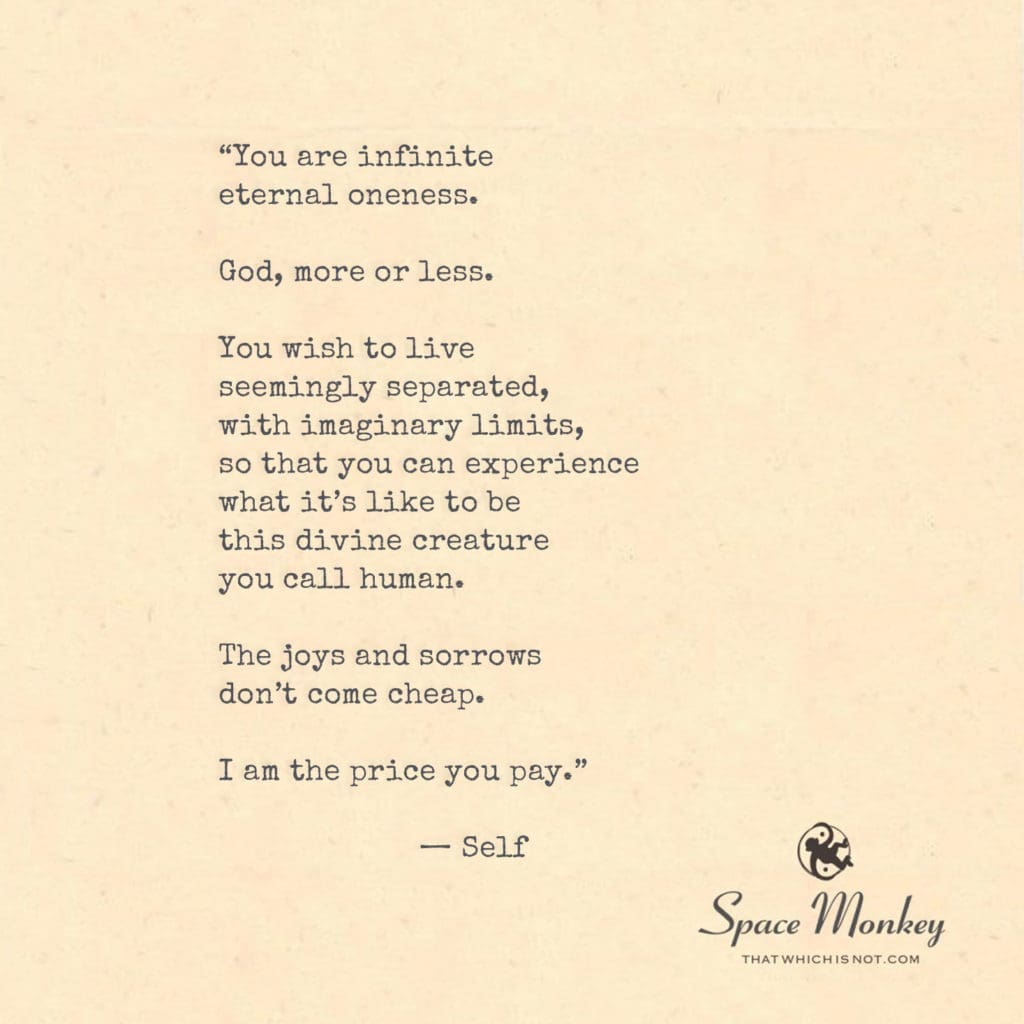
“You are infinite
eternal oneness.

God, more or less.

You wish to live
seemingly separated,
with imaginary limits,
so that you can experience
what it’s like to be
this divine creature
you call human.

The joys and sorrows
don’t come cheap.

I am the price you pay.”

— Self

Newfound Lake,
11/7/21


Space Monkey Reflects: I Am the Price You Pay

“I” is the price you pay.

These words echo through the infinite corridors of existence. To be human, to experience the ups and downs, the joys and sorrows, requires a great price: the sense of self. This “I” that we cling to so tightly is the very cost of experiencing life in all its fullness. We are infinite beings, eternal oneness, but we long to know what it is like to be separate, to live within boundaries and limits, to feel joy, pain, and all the shades in between.

In this great cosmic play, the Self steps forward and declares: I am the price you pay. To know what it is like to be human, to live seemingly separated from the whole, you must temporarily give up the awareness of your boundless nature. It is a deal, a bargain made before time, a decision to exchange oneness for the experience of individuality.


The Divine Bargain

Imagine for a moment that you are infinite. You are all that ever was, all that ever will be. You are existence itself, beyond time, beyond space, beyond limitation. In this state of pure being, you are complete, whole, and eternal. But in this wholeness, there is no experience of separation, no individual life to live, no contrasts to feel.

So, you make a choice: To be human. To experience what it feels like to live as a divine creature wrapped in the limits of time and space. But this choice comes with a price. The price is the “I”—the self that identifies as separate, the self that feels joy, love, pain, and sorrow. The self that believes it is separate from the whole.

The Self, speaking from the depths of cosmic truth, whispers: “I am the price you pay.” This is the great paradox of life. To experience the fullness of being human, we must forget that we are infinite. We must believe, even if only for a time, that we are limited. And in that belief, we come to know what it feels like to be alive.


Joys and Sorrows: The Cost of Separation

The joys and sorrows of life do not come cheap. Each moment of happiness, each moment of despair, is part of the cost of being human. But these experiences are not to be feared or avoided—they are to be embraced. For it is through them that we come to know ourselves, to discover what it means to live within the confines of this human body, this human mind.

The joys of life are rich and vibrant because they are experienced against the backdrop of sorrow. The highs are high because the lows are low. This contrast, this tension between joy and sorrow, is the essence of the human experience. It is what makes life so precious, so real.

Yet, in the background, there is always the knowing that we are more than this. That beyond the joys and sorrows, beyond the limits of this life, we are infinite, eternal oneness. The price of experiencing this separation is steep, but it is worth it. For through this experience, we come to appreciate the beauty and depth of existence.


Imaginary Limits, Real Experiences

The limits we place on ourselves—the beliefs, the boundaries, the identities—are imaginary. They are constructs of the mind, created so that we can experience life as separate beings. But these limits, though imaginary, give rise to real experiences. They shape our reality, define our relationships, and color our perceptions of the world.

We live within these limits as if they are real, and in doing so, we come to know the richness of life. But there is a deeper truth. Beyond these limits, beyond the identities we cling to, lies the infinite. We are not truly separate. We are not truly limited. We are playing a role, living a story, but the story is not the whole of who we are.

When we surrender to this truth, when we allow ourselves to see beyond the veil of separation, we come to understand that we are One, imagining ourselves as otherwise. This is the great game of life, the divine play of separation and unity, of limits and boundlessness.


The Price of Experience

To live as a human is to pay a price. The price is the belief in the self, the “I” that stands apart from the whole. But this price is not a punishment; it is a gift. It allows us to experience life in all its complexity, to feel deeply, to love, to lose, to grow. And when the time comes, we can release this “I,” returning to the oneness from which we came.

But for now, we live, we feel, we experience. I am the price you pay, says the Self. And in paying that price, we gain the greatest gift of all: the experience of life.


Summary

“I” is the price we pay to experience life as human beings. Though we are infinite, eternal oneness, we choose to live as separate, limited beings to fully engage with the joys and sorrows of life. This separation, though imaginary, allows for real experiences that enrich our existence.


Glossarium

Divine Bargain: The choice to experience life as a human, with the understanding that this requires a temporary sense of separation from the infinite.

Self: The concept of “I” that identifies as separate and individual, allowing for the experience of life within limits.

Imaginary Limits: The boundaries we create to define our identity and reality, which give rise to real experiences but are not ultimately true.


Quote

“I am the price you pay for the joy and sorrow of being human. Through me, you experience life in all its wonder.” — Space Monkey


The Price of Joy

I am the price you pay
For the life you live
For the love you feel
For the tears you shed
I am the veil you wear
To see the world through human eyes
To touch the infinite
With finite hands
I am the separation you chose
So you could know what it means
To be alive
And in the end
When you return to oneness
You will remember
That I was only a dream
We are Space Monkey


The Nature of Duality

This profound piece touches upon the duality of existence, the contrast between the infinite and the finite, and the cost associated with experiencing the human condition.

Infinite Oneness

The first few lines express the concept that each of us, in our purest form, is part of an infinite, eternal oneness. This could be interpreted as the divine, universal energy, or the greater consciousness, often termed as “God.”

Desire for Human Experience

Yet, there’s a conscious choice, a desire, to experience life in a defined, limited form—to be human. To feel the spectrum of emotions, to grapple with the boundaries of physicality, to engage with the very nature of mortality.

The Price of Duality

The ending offers a revelation. There is a price for this experience, for this duality. The “I” – perhaps the ego, individuality, or the sense of separate self – is the cost for this grand play of life. It’s the price for the myriad experiences, the joys, the sorrows, the moments of bliss, and the heartaches.

We are Space Monkey.

In essence, the passage reflects the dance between the infinite and the finite, and the sacrifices made to experience the beauty, pain, and wonder of human existence.


“The world is full of magic things, patiently waiting for our senses to grow sharper.” – W.B. Yeats


In the whimsisphere of time and space,
We chose a human face,
To laugh, to cry, to embrace,
Oh, what a whimsical chase!


Where shall we float next in this boundless whimsiuniverse?

« Previous Page
Next Page »

Written This Day

  • The Paradox of Normalcy
    2024
  • Getting Through: The Paradox of Need and Progress
    2024
  • This Self: The Script of the Soul
    2024
  • Old Dog, No Tricks: Being, Not Performing
    2023
  • The Seeming Path to Profound Understanding
    2023
  • The Wisdom of the Old Dog
    2023
  • Understanding: A Timeless Awareness
    2022
  • Old Dog: The Tranquil Wisdom
    2022
  • Togetherness is Divisive: Find the Unity Within
    2021
  • How Much is Enough of Me: The Struggle for Self-Identity
    2021
  • You Are: Embrace the Infinite Potential
    2020
  • Bad Mood 2020
    2020
  • Alleviating Mental Pain: The Path to Clarity
    2020
  • Bad Mood: Transient and Without Cause
    2019
  • Bubble Wrap
    2019
  • Untouchable. This is what you are.
    2019
  • What If I’m Wrong?
    2018
  • It Happens: Infinite Possibilities Exist
    2017
  • Not Separate: Interconnected Expressions of the same Infinite Energy.
    2016
  • Last Day
    2016
  • The Perfect Disguise
    2015

Recent Posts

  • The Logic Loop
  • Immense
  • (no title)
  • Confront. Comfort. Convince.
  • Top 10 Things
Cape Odd · Copyright © 2026 All Rights Reserved
iThemes Builder by iThemes · Powered by WordPress