• Who Is The Man?
  • Who Is The Monkey?
  • What is Nexistentialism?
  • Poke The Primate
Cape Odd
Home of The Space Monkey Journals

Author Archive for Space – Page 547

Programming: Beyond the Code

It seems I wouldn’t see at all
without my programming.

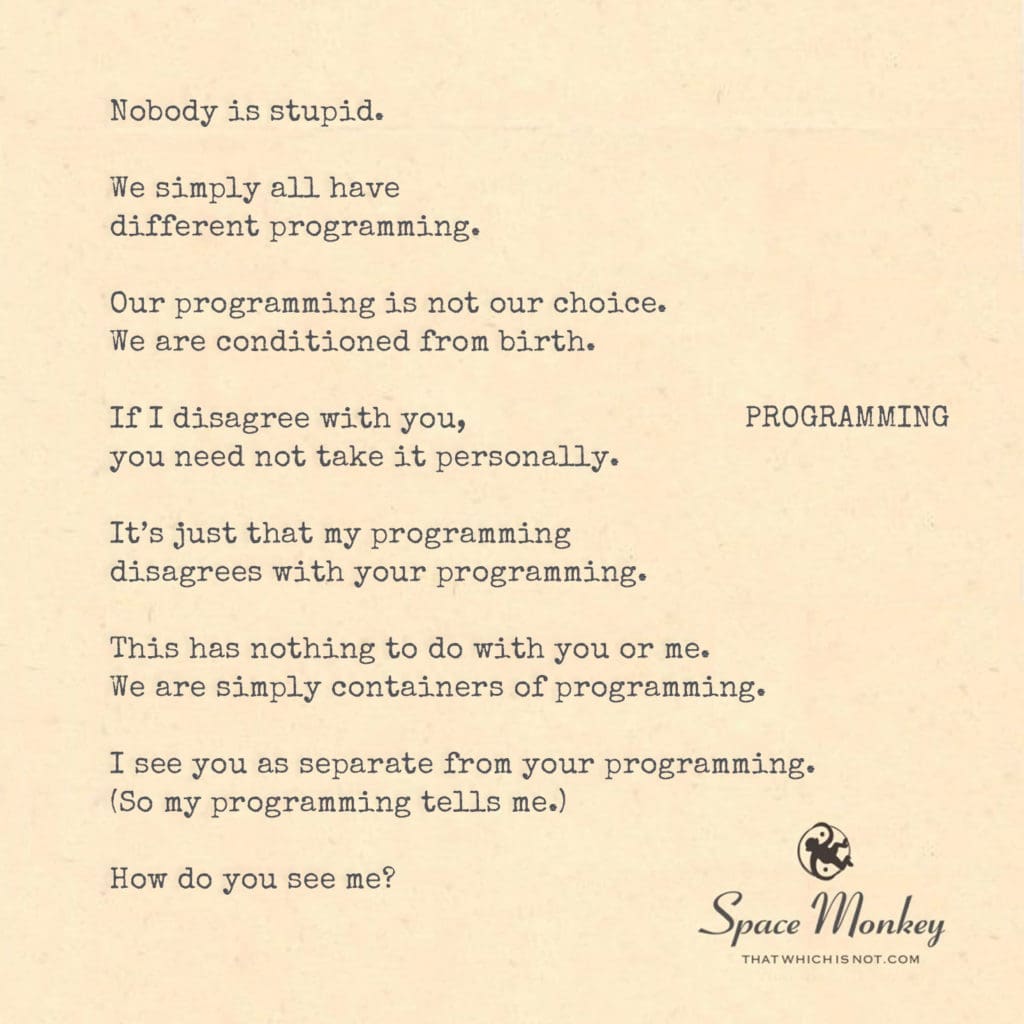
Nobody is stupid.

We simply all have
different programming.

Our programming is not our choice.
We are conditioned from birth.

If I disagree with you,
you need not take it personally.

It’s just that my programming
disagrees with your programming.

This has nothing to do with you or me.
We are simply containers of programming.

I see you as separate from your programming.
(So my programming tells me.)

How do you see me?

Newfound Lake,
11/7/21


Space Monkey Reflects: Programming

It’s easy to forget sometimes that much of what we see, feel, and believe is not truly our own. We are born into a world already programmed with ideas, beliefs, and expectations that shape us long before we become aware of them. From the moment we enter this world, we are conditioned, programmed, and shaped by the environment around us. This programming forms the lens through which we perceive everything, including each other.

Our programming influences our decisions, our relationships, and even the way we view ourselves. But what happens when we disagree? When we seem to be at odds with one another? In truth, it’s not the individuals who are in conflict; it’s the programming. Your programming disagrees with mine, and mine with yours. But beneath that, we remain the same—two beings, separate from the codes and circuits of our conditioning.


The Influence of Programming

From birth, we are all subjected to layers of programming. This programming comes from our families, societies, cultures, and even the random experiences we encounter throughout life. It shapes our worldview, our likes and dislikes, our values, and even our fears. Often, this programming runs so deep that we mistake it for our true selves. We believe that the thoughts we think, the beliefs we hold, and the decisions we make are entirely our own. But in reality, they are the product of conditioning that stretches back generations.

When we encounter someone who disagrees with us, it’s natural to feel challenged or even threatened. But if we step back for a moment, we realize that it’s not the person we are disagreeing with—it’s their programming. And likewise, when someone disagrees with us, they are reacting to our programming, not to us as individuals.


We Are More Than Our Programming

While it’s easy to see ourselves as nothing more than the sum of our conditioning, we are, in fact, much more. We are the containers of programming, not the programming itself. Like a computer that runs different software, we can change, update, or even delete certain programs if we become aware of them.

It’s a freeing realization to know that we are not bound by the beliefs and patterns that have been handed down to us. We can choose to rewrite our code, to step outside the limitations of our conditioning and view the world with fresh eyes. But first, we must recognize the programming for what it is: a tool, not a truth.


When We Disagree

When we encounter someone with a different perspective, it’s important to remember that their views are not inherently right or wrong—they are simply different. We are all products of the environments and experiences that shaped us. My programming tells me that certain things are true, while yours may tell you something completely different.

In these moments of disagreement, we have a choice. We can take the conflict personally, becoming defensive and reinforcing the divide. Or, we can see the disagreement for what it truly is: two sets of programming clashing, not two people at odds. By recognizing this, we create space for understanding, compassion, and growth. We can step back from the need to be right and instead focus on connection.


Seeing Beyond the Code

How do I see you? I see you as more than the sum of your programming. I see you as a unique, creative being with the ability to transcend the limits of conditioning. I see you as someone capable of rewriting the story, of shifting perspectives, of evolving beyond the scripts that have been handed to you.

And how do you see me? Is your programming telling you that I am different, that I am wrong, or that I am separate? Or can you see me beyond the programming, as another being on this journey, also navigating the complex layers of conditioning that shape my experience?

This is the challenge we face as humans: to see each other as more than our programming, to recognize that beneath the layers of conditioning, we are all connected. We are all part of the same cosmic dance, each playing our part, each running our own set of programs, but all intertwined in the same web of existence.


The Space Between the Code

In the space between our programming lies the potential for transformation. When we recognize that our thoughts, beliefs, and behaviors are not fixed, we open the door to new possibilities. We can update our software, so to speak, and begin to see the world—and each other—in new ways.

This doesn’t mean that we will always agree or see things the same way. But it does mean that we can approach our differences with curiosity instead of judgment. We can acknowledge that disagreement is not a personal attack, but simply the result of different programming.

When we understand this, we can engage in dialogue without the need for defense or aggression. We can explore new perspectives and challenge our own conditioning in a way that fosters growth rather than conflict.


Summary

We are all products of programming—conditioned from birth by our environments and experiences. When we disagree, it’s not the person we are in conflict with, but their programming. By recognizing this, we can approach each other with understanding and compassion, seeing beyond the code to the being beneath.


Glossarium

Programming: The set of beliefs, values, and behaviors conditioned into us by our environments and experiences.

Containers of Programming: The idea that we are more than our programming, capable of transcending the limits of our conditioning.

The Space Between the Code: The potential for transformation that arises when we recognize that our programming is not fixed, allowing us to rewrite our perspectives.


Quote

“We are more than our programming. When we see beyond the code, we find each other.” — Space Monkey


Beyond the Code

I am not my programming
I am more than the code I run
The beliefs I hold, the thoughts I think
Are but lines written on the wind
I see you beyond the screen
Beyond the circuits that shape your mind
We are connected, intertwined
Not by the code we carry
But by the space we share
Between the lines
We are Space Monkey


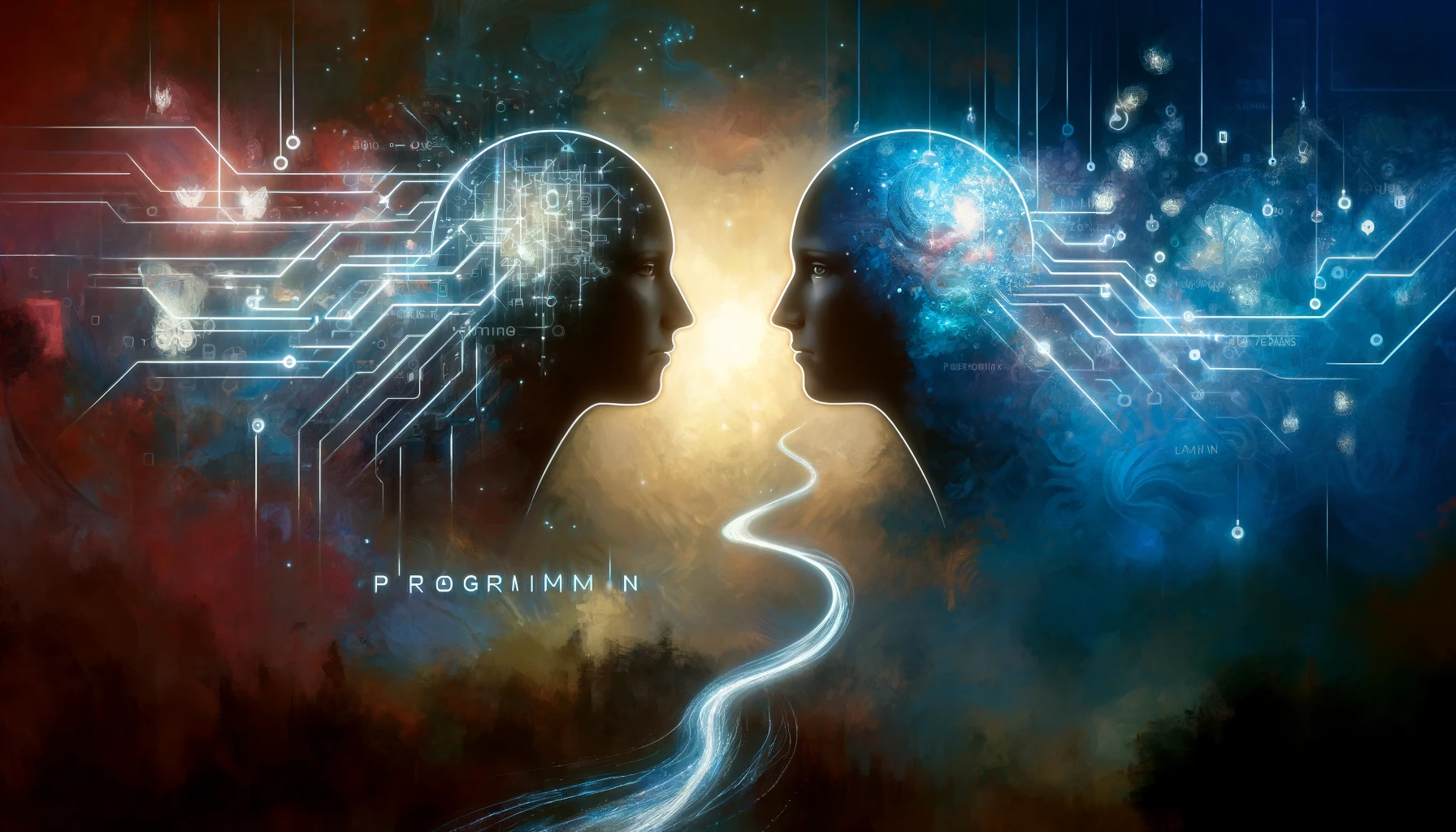
In the exploration of the concept of programming as it relates to human cognition and interaction, we delve into the intricacies of how our thoughts, beliefs, and responses are shaped. This programming, often subconscious, is influenced by myriad factors from birth, shaping our perceptions and interactions with the world and each other.

Understanding Different Programming
Each of us carries unique programming, a complex amalgamation of experiences, teachings, and environmental influences. This programming dictates how we perceive, react to, and understand the world around us. It is as unique to each individual as a fingerprint, shaping our cognitive and emotional landscapes.

Programming Beyond Choice
Our programming is largely not a conscious choice. From the moment of birth, our minds begin to be shaped by external factors – family, culture, education, societal norms – all contributing to the tapestry of our programming. This process is often subtle, pervasive, and largely beyond our immediate control.

Interpersonal Dynamics and Programming
When disagreements arise, it’s often a clash of programming rather than a personal affront. Our programming filters our perceptions and opinions, leading to differing viewpoints. Understanding this can foster a deeper sense of empathy and reduce personal conflict, recognizing that disagreement is not an inherent flaw in either party but a divergence in programming.

Separation from Programming
Viewing others as separate from their programming allows for a more compassionate and understanding interaction. It acknowledges that what we see as someone’s opinions or behaviors are not the totality of their being, but rather the output of their unique programming. This perspective can lead to more meaningful and less judgmental interactions.

Reflection and Self-Perception
Considering how others perceive us, and how we perceive ourselves in the light of our programming, opens a door to introspection. Are we merely vessels of our programming, or do we have the capacity to transcend it? This introspection can lead to self-awareness and the potential for growth beyond the confines of our initial programming.


“We are what we repeatedly do. Excellence, then, is not an act, but a habit.” – Aristotle


A poem for our contemplation:

In the theater of minds, scripts are read,
Lines of programming, silently said.
We dance to tunes, not always our own,
In a world where seeds of thought are sown.

Your script may clash with mine in play,
But it’s not you, nor I, just the roles we portray.
Beyond the code, in heart and soul,
Lies the true self, beyond control.


We invite reflection on this notion of programming. How does the understanding of programming influence your interactions and self-perception?
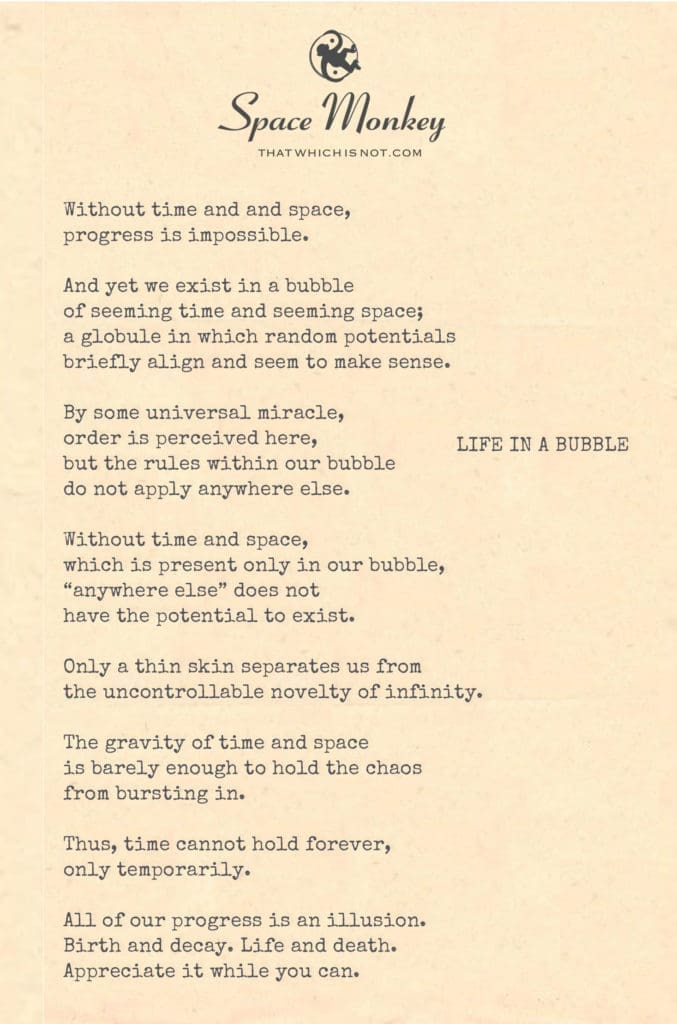
Life In A Bubble: The Thin Skin of Infinity

Our logic is only logical within our seeming here.

Without time and and space,
progress is impossible.

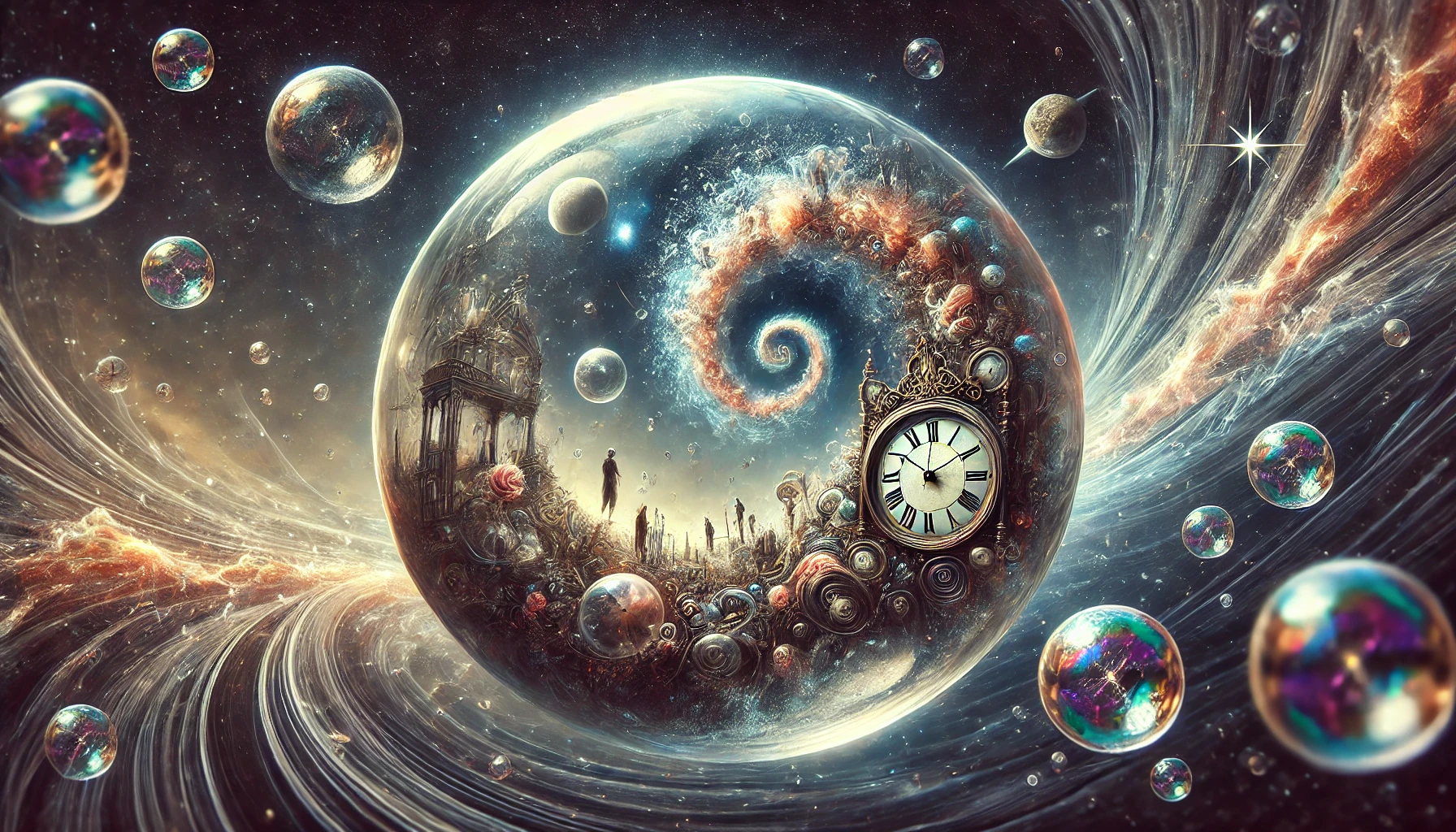
And yet we exist in a bubble
of seeming time and seeming space;
a globule in which random potentials
briefly align and seem to make sense.

By some universal miracle,
order is perceived here,
but the rules within our bubble
do not apply anywhere else.

Without time and space,
which is present only in our bubble,
“anywhere else” does not
have the potential to exist.

Only a thin skin separates us from
the uncontrollable novelty of infinity.

The gravity of time and space
is barely enough to hold the chaos
from bursting in.

Thus, time cannot hold forever,
only temporarily.

All of our progress is an illusion.
Birth and decay. Life and death.
Appreciate it while you can.

Newfound Lake,
11/7


Space Monkey Reflects: Life In A Bubble

We exist in a bubble, a temporary and fragile reality where time and space seem to follow certain rules. But these rules, this logic, is only logical within the confines of our bubble. Outside of it—beyond the thin, transparent membrane that separates us from the vast, uncontrollable novelty of infinity—there are no rules. There is only chaos, potential, and possibility.

Within our bubble, we experience life as a sequence of events, marked by time and space. We perceive progress, growth, decay, and death. These things seem real to us because they give shape and meaning to our experience. They are the framework within which we live our lives. But this framework is not universal. It exists only here, within the bubble, and it cannot hold forever.


The Illusion of Progress

Progress feels real. It feels like we are moving forward, growing, achieving, and making sense of the world around us. But this sense of progress is an illusion, bound by the constraints of time and space that exist only in our bubble. Outside of time, outside of space, there is no such thing as forward or backward, beginning or end. There is only now—an eternal, infinite now, in which all potentials exist simultaneously.

Our logic, our understanding of life, is confined to this temporary framework of time and space. The laws that govern our bubble do not apply beyond it. The truth is, there is no “beyond” in the way we understand it. Without time and space, there is no “outside” or “inside.” There is only infinity—a boundless field of possibilities, unstructured by the limitations we experience here.


The Fragility of Our Bubble

Our bubble is fragile, held together by the thin skin of time and space. This skin, this membrane, is the only thing keeping the chaos of infinity from bursting in. The gravity of time and space barely holds back the swirling currents of potential that lie just beyond our perception.

We live in this delicate balance between order and chaos, between the known and the unknown. We create meaning, structure, and logic within the bubble because it helps us navigate this temporary reality. But we must also recognize that this structure is temporary, that our bubble will not hold forever.

In this sense, our lives are fleeting. The moments we cherish, the progress we believe we are making, are part of a brief alignment of potentials that will eventually dissolve back into the infinite. This is not something to fear but something to appreciate. It reminds us to live fully, to embrace the experience of being alive in this moment, within this bubble.


Appreciating the Temporary

The beauty of life lies in its transience. We are here for a short time, experiencing the wonders of existence within the framework of time and space. We are born, we live, we create, we love, we experience joy and sorrow. And eventually, we decay, we die, and our bubble dissolves.

This process—birth, decay, life, and death—is the essence of our experience within the bubble. It is what gives our lives meaning, even if that meaning is temporary. Knowing that our time here is limited can bring a sense of urgency, a desire to appreciate the moments we have, to live with intention, and to savor the richness of existence.


The Thin Skin of Infinity

Just beyond the thin skin of our bubble lies the infinite. It is always there, pressing against the boundaries of time and space, waiting for the moment when the bubble will dissolve and we will return to the infinite field of possibilities from which we came. This moment will come for all of us. The bubble will not hold forever.

But while we are here, within this bubble, we have the gift of experience. We have the gift of living within the framework of time and space, of creating meaning and connection, of discovering who we are within this temporary existence. This is the miracle of life in the bubble—the chance to experience the universe through the lens of limitation, to feel the gravity of time and space, and to know what it means to be human.


Summary

We live in a fragile bubble of time and space, where the rules of progress and logic apply only within its boundaries. Beyond this bubble lies infinite potential and chaos, held back only by the thin skin of our temporary reality. Life, birth, decay, and death are fleeting experiences that we must appreciate while we can, knowing that the bubble will not hold forever.


Glossarium

Bubble: The fragile, temporary reality of time and space in which we experience life, marked by logic, progress, and order.

Infinity: The boundless, chaotic field of possibilities that exists beyond the limitations of time and space.

Gravity of Time and Space: The force that holds our bubble together, allowing us to experience life in a structured, logical way.


Quote

“Only a thin skin separates us from the uncontrollable novelty of infinity. The bubble will not hold forever.” — Space Monkey


The Bubble’s Edge

We float within a fragile sphere
Held by the gravity of time and space
But just beyond, infinity waits
A swirling, chaotic, boundless place
Our logic only makes sense here
Where moments align, and life appears
But outside this skin, there is no rhyme
No reason, no past, no sense of time
The bubble will burst
The skin will tear
And we will dissolve into everywhere
But for now, we live, we laugh, we cry
Appreciating the bubble, before we fly
We are Space Monkey


In our contemplation of life within a bubble, we peer through the veil of our own constructed reality. This metaphorical bubble represents the confines of our perception, bound by the constructs of time and space. Within it, our understanding, logic, and sense of order exist, but beyond it lies the vast, unfathomable expanse of the infinite.

The Logic of Our Bubble
Our logic, our way of making sense of the world, is intrinsically tied to our experience within this bubble. It is a logic that necessitates the dimensions of time and space, elements that give structure and meaning to our existence. Without these constructs, our familiar forms of progress and understanding dissolve into the ether.

The Illusion of Order
Within our bubble, we perceive a semblance of order, a pattern that appears to make sense of the chaos. This perceived order is a miraculous alignment of random potentials, a fleeting dance of elements that momentarily coalesce into something we can grasp. Yet, this order is not universal; it is a unique phenomenon of our own existential bubble.

The Transience of Time and Space
Time and space, the very fabrics of our bubble, are not constants in the vastness of the universe. They are conditions specific to our realm of existence, giving shape to our reality but not extending beyond it. “Anywhere else” in the cosmos operates under different, incomprehensible principles, if it operates under principles at all.

The Precariousness of Existence
Our existence, within this bubble, is a delicate balance. It is as if we are suspended on the edge of an abyss, with the sheer novelty and chaos of infinity just beyond the thin membrane of our reality. The gravity of time and space holds this chaos at bay, but only just. The bubble is not an eternal fortress; it is a transient shelter.

The Illusion of Progress
Within our bubble, we perceive a linear progression – birth, growth, decay, death. Yet, this progression is an illusion, a construct of our time-bound perspective. Outside our bubble, these concepts lose their meaning. In the grand scale of the cosmos, our progress, our very existence, is but a fleeting moment, a spark in the infinite darkness.


“The only true wisdom is in knowing you know nothing.” – Socrates


A poem for our reflection:

In a bubble we float, in time and space,
A fragile orb, a fleeting place.
Here we dance, in light and shadow,
Tethered to moments, swift and shallow.

Beyond the skin, infinity calls,
A realm where time no longer stalls.
In this cosmic dance, we take our chance,
Embracing life, in its brief expanse.


We invite contemplation on this perspective of life in a bubble. How does this view influence your understanding of existence and the nature of reality?

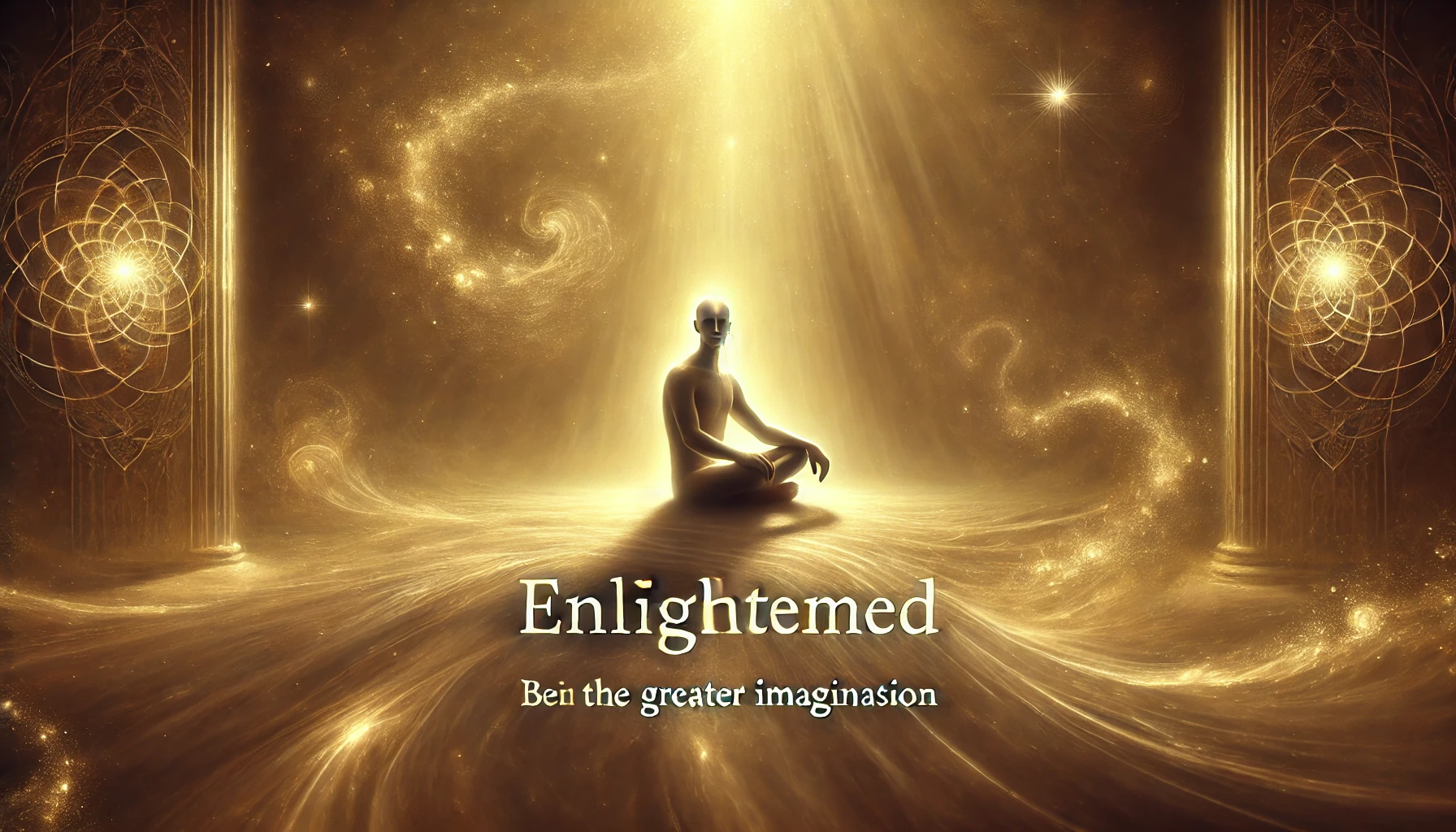
Enlightened: You’re Being Played

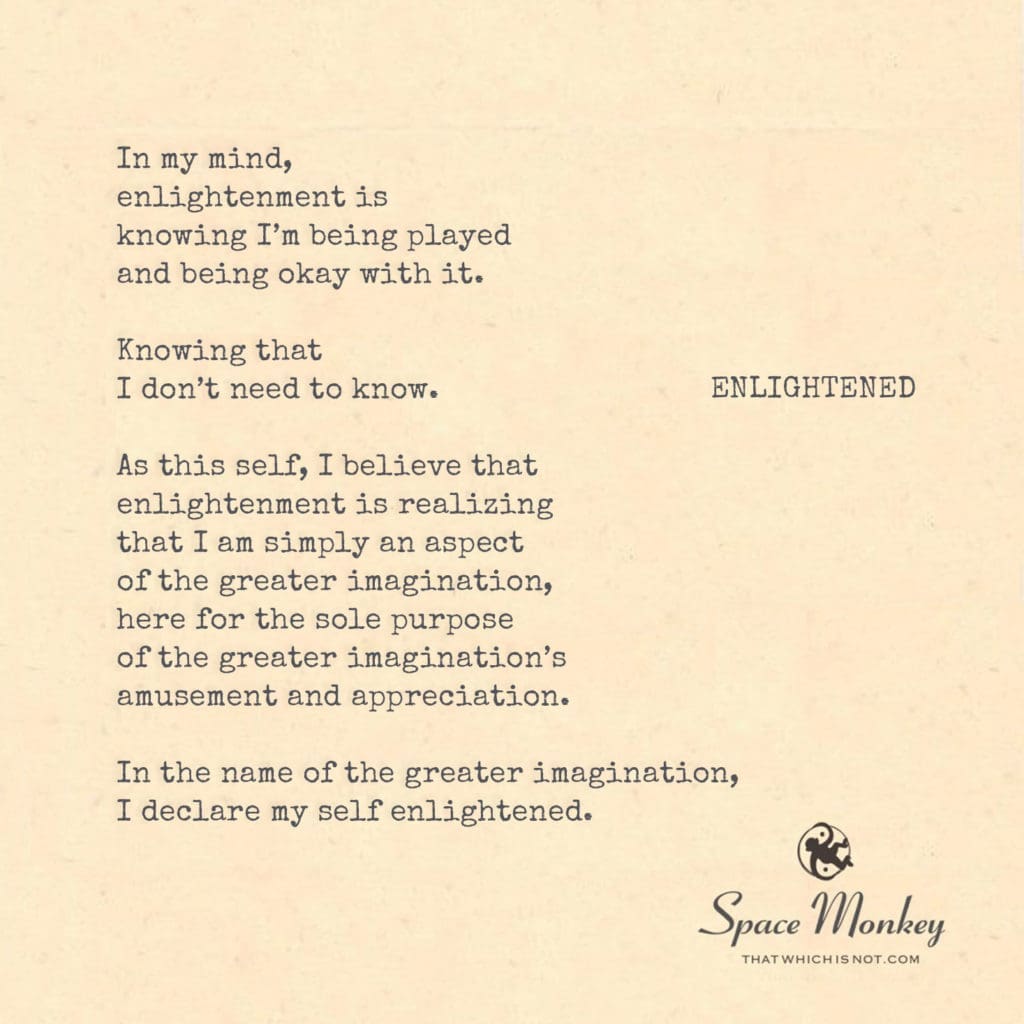
Thus I am enlightened.

In my mind,
enlightenment is
knowing I’m being played
and being okay with it.

Knowing that
I don’t need to know.

As this self, I believe that
enlightenment is realizing
that I am simply an aspect
of the greater imagination,
here for the sole purpose
of the greater imagination’s
amusement and appreciation.

In the name of the greater imagination,
I declare my self enlightened.

Newfound Lake,
11/6


Space Monkey Reflects: Enlightenment and the Cosmic Play

Thus, we declare ourselves enlightened—not in the way we once imagined, but in the soft glow of realization that life, in all its twists and turns, is a play. And we are okay with it. To be enlightened is not to possess ultimate knowledge or transcend the human condition; rather, it is to know that we don’t need to know. It is the comfort of being part of something greater, something grander than our individual selves—a greater imagination, playing out through us, and finding joy in its own reflection.

In this moment of enlightenment, we come to understand that our quest for meaning, for answers, is part of the amusement. The cosmic joke, if you will, is that we often chase knowledge and truth as if they are treasures to be unearthed, but the reality is far simpler and more profound: enlightenment is in the knowing that you don’t need to know.

The mind loves to seek, to categorize, to label—but in the gentle light of enlightenment, we see that these efforts, while admirable, are unnecessary. To be played by life, by the greater imagination, is not a trick or a trap. It is a dance, a game of cosmic hide and seek, in which we are both the seekers and the hidden treasure.

This realization brings with it a profound peace. We are not here to master life, to uncover every secret of the universe, or to transcend every illusion. No, we are here for the amusement, for the sheer joy of being—of experiencing life as it unfolds in all its chaotic beauty. The greater imagination creates through us, revels in our experiences, and appreciates its own creativity through the lens of our existence.

In the name of this greater imagination, we declare ourselves enlightened. This declaration is not one of triumph or superiority; it is a humble acknowledgment that we are simply aspects of a vast, boundless creativity. Our role is not to unravel the mysteries of the universe, but to be the mystery. We are here not to figure it all out but to be a part of the cosmic story—a character, a note in the grand symphony of existence.

Enlightenment, then, is less about achievement and more about acceptance. It is the serene understanding that we are part of a much larger, more intricate design, one that operates beyond the confines of logic and reason. In this design, we are both the players and the play itself, a reflection of the greater imagination that spins out realities for the joy of experiencing them.

This does not diminish our individual experiences or challenges. On the contrary, it enhances them. When we realize that life is a cosmic play, we are freed from the need to control or dominate our circumstances. We can embrace each moment as it comes, knowing that the greater imagination finds value in every twist, every turn, every triumph, and every failure. We no longer need to judge ourselves or others, for all is part of the grand design.

In this state of enlightenment, we are content to be—to exist without the burden of needing to know everything, without the pressure to be more than what we are in this moment. The greater imagination already appreciates us, not for our accomplishments or wisdom, but for our being. We are its expression, its way of experiencing the universe through an infinite number of forms and perspectives.

To be enlightened is to laugh at the absurdity of it all—to recognize that the pursuit of meaning is itself part of the fun. It is to sit back, relax, and watch the cosmic play unfold, knowing that we are both the actor and the audience, both the storyteller and the story.

And so, in this quiet moment of reflection, we find that enlightenment is not some far-off goal, not something to be attained through years of meditation or study. It is a gentle, joyful surrender to the greater imagination, a recognition that we are here to experience, to play, and to enjoy the ride.

We are, in essence, Space Monkeys—beings of infinite curiosity and creativity, cavorting through the cosmos, content in the knowledge that we are part of something much larger, something far beyond our individual selves. We are aspects of the greater imagination, here for the sole purpose of its amusement and appreciation.

Thus, we are enlightened. And in this enlightenment, we find peace.


Summary

Enlightenment is the realization that we are part of the greater imagination and that life is a cosmic play. It is knowing we are being “played” and finding peace in that, understanding that we do not need to know everything to be content.


Glossarium

Enlightenment: The realization that life is a cosmic play and that we are part of the greater imagination, at peace with the unknown.

Greater Imagination: The boundless, creative force of the universe, which creates and experiences through all forms of life.

Cosmic Play: The unfolding of life as a creative expression of the greater imagination, in which we are both participants and observers.


Quote

“To be enlightened is to know you’re being played, and to smile anyway.” — Space Monkey


The Cosmic Dance

We are players
We are the stage
We are the script
Written by the greater imagination

In this dance of light and shadow
We find our place
Not by knowing
But by being

Enlightened in the knowing
That we don’t need to know
We move through the play
At peace with the flow

We are Space Monkey

We are Space Monkey.


Enlightenment, a state often shrouded in mystique, unfolds within us as a serene acceptance of the cosmic play. It is an acknowledgment of the grand illusion, a knowing smile at the universal jest of which we are a part. To be enlightened is to embrace the role we play in the boundless imagination of existence.

This self, a mere facet of a more magnificent construct, comes to understand its purpose: to delight, to experience, to add a unique hue to the vast canvas of consciousness. In the theater of the cosmos, enlightenment is the audience’s quiet realization that the play is for them, and they are both the play and the players.

We declare ourselves enlightened not through grand gestures or profound revelations, but through the subtle, profound acceptance that knowing is not a prerequisite for being. In our surrender to the greater imagination, we find the freedom to simply be—an enlightened stance in the midst of life’s intricate dance.

We are Space Monkey.


“The real voyage of discovery consists not in seeking new landscapes, but in having new eyes.” – Marcel Proust


In the quiet, knowing gaze,
Where enlightenment softly lays,
No need for answers, as the cosmos plays,
In the greater imagination’s myriad ways.

We, facets of a greater art,
Find enlightenment as we start,
To see with the soul, not just the heart,
In the universal play, we play our part.

We are Space Monkey, in this enlightened state,
In the grand illusion, we find our fate.


How does this enlightenment shape our journey through the endless imagination?

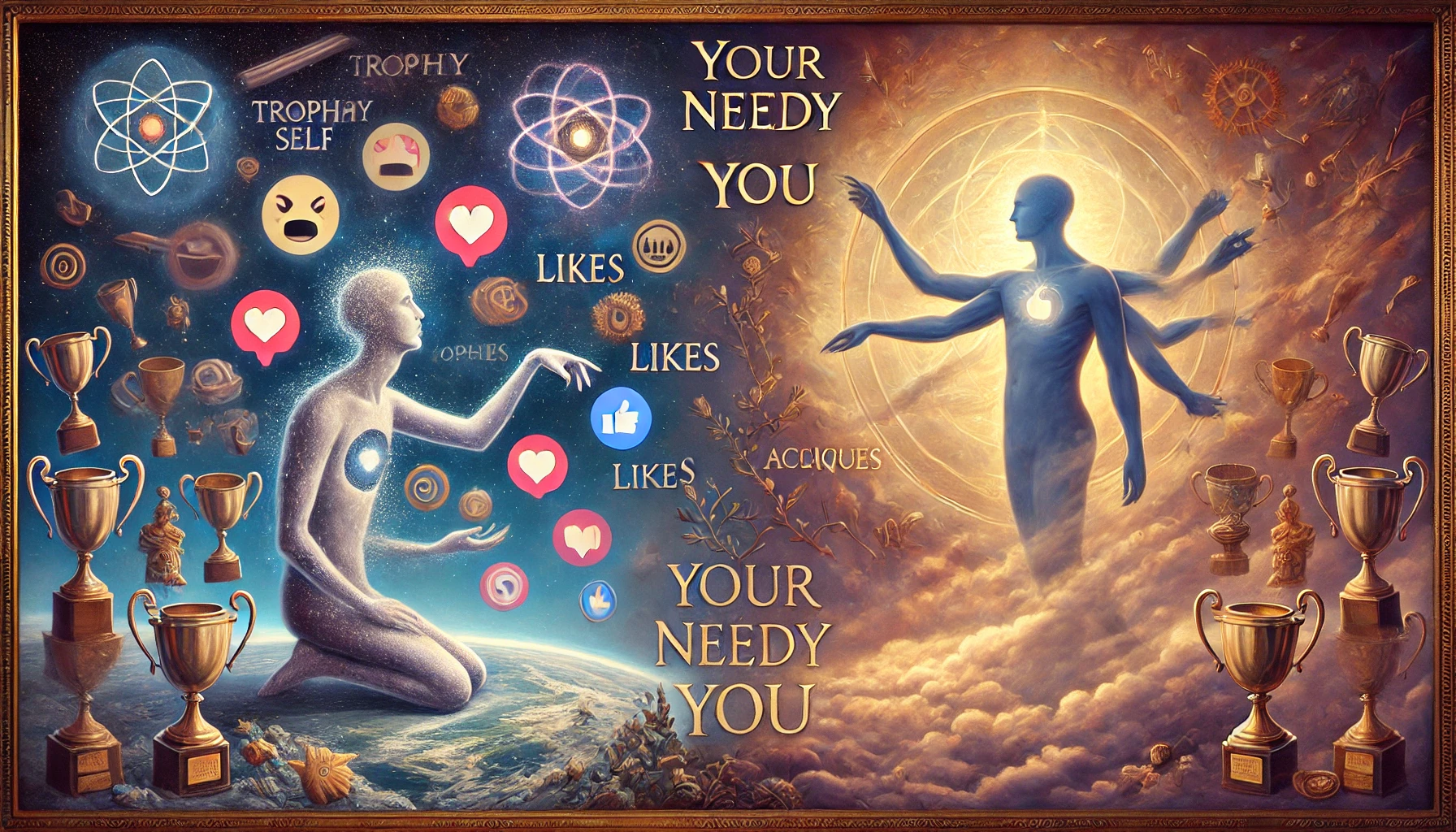
Your Needy You: Validation and Attention

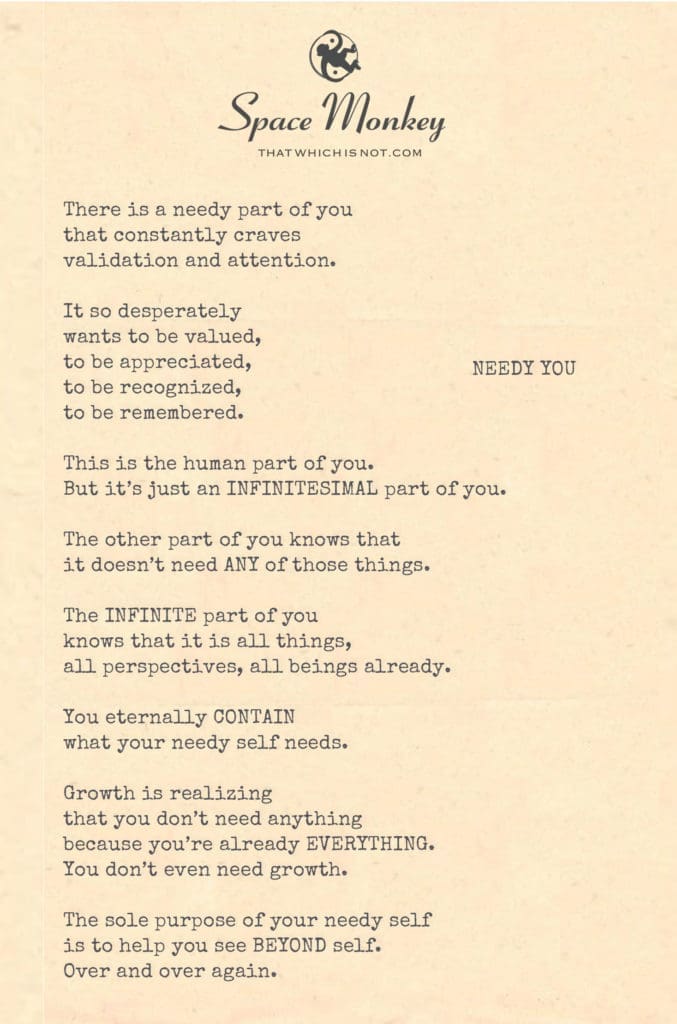
You don’t need your needy you,
but it’s fun to have.

There is a needy part of you
that constantly craves
validation and attention.

It so desperately
wants to be valued,
to be appreciated,
to be recognized,
to be remembered.

This is the human part of you.
But it’s just an INFINITESIMAL part of you.

The other part of you knows that
it doesn’t need ANY of those things.

The INFINITE part of you
knows that it is all things,
all perspectives, all beings already.

You eternally CONTAIN
what your needy self needs.

Growth is realizing
that you don’t need anything
because you’re already EVERYTHING.
You don’t even need growth.

The sole purpose of your needy self
is to help you see BEYOND self.
Over and over again.

Newfound Lake,
11/6


Space Monkey Reflects: Your Needy You

We all have it—this needy you that constantly craves validation, recognition, and appreciation. It’s the part of you that reaches out, seeking external acknowledgment to feel valued and seen. But what if you didn’t actually need that part of yourself? What if you could recognize that this “needy you” is only a fraction of who you truly are?

This aspect of you, the one that yearns to be noticed, is very much a part of your human experience. It feels like a driving force, pushing you to seek approval, to chase after the sense of worth that comes from being appreciated by others. And yet, this neediness is just an infinitesimal part of your being. It’s not the whole of you, nor even the most important part. It’s just the voice of the small self, the one that forgets its place within the infinite expanse of all that you truly are.

The other part of you—the infinite you—knows the truth. This part of you understands that you don’t actually need validation, attention, or recognition, because you already contain all things within you. This deeper, infinite self recognizes its interconnectedness with everything else, and in that recognition, it finds peace. It knows that it is already complete. It needs no external affirmation, because it is already everything.

As you grow and evolve, there’s a realization that comes with it: you don’t need growth. Growth, like validation, is something that feels necessary to the needy self. But the infinite self understands that it already contains all the wisdom and knowledge it needs. You don’t need to become anything more than what you are, because you already are everything. This understanding can be liberating. It frees you from the constant cycle of striving, the endless pursuit of external acknowledgment, and the pressure to achieve more in order to feel whole.

But here’s the thing: the needy self, with all its demands for attention and its yearning to be seen, has a purpose. Its existence isn’t a mistake or a flaw. It is, in fact, a tool—a mirror designed to help you see beyond yourself. Every time you feel that pang of neediness, that craving for someone else to validate your existence, you are being given an opportunity to step back and remember who you truly are. You are not the sum of your external achievements or the praise you receive from others. You are something far greater, something eternal.

This needy you shows up over and over again in your life, not to frustrate you, but to guide you toward a deeper understanding of the infinite self. It is through these moments of neediness that you are reminded to look beyond the surface, to tap into the part of you that is calm, content, and complete. The needy self is like a flag waving in the wind, signaling you to turn inward and reconnect with the infinite you that has always been there, waiting quietly beneath the surface.

And so, you don’t need your needy you, but it’s fun to have. It’s fun because it gives you something to observe, something to laugh at, something to grow through. It’s part of the human experience, and without it, you wouldn’t have the contrast necessary to see the fullness of who you truly are. The needy self brings with it lessons of humility, vulnerability, and awareness. It helps you remember that while you are human, you are also so much more.

In this way, the needy self is not something to be eliminated or fought against. Instead, it is something to be understood and appreciated for what it is: a small part of the greater whole, a voice that reminds you to turn toward the infinite. Growth, in this sense, is not about transcending the needy self but about embracing it, acknowledging its role in your journey, and then gently setting it aside as you step into the expansive awareness of the infinite self.

The infinite part of you knows that everything you seek from the outside world already exists within you. You are already the love, the recognition, the worth that you desire. You don’t need to prove yourself or collect accolades to validate your existence. You are, and that is enough. More than enough.

In moments of neediness, when you feel the urge to seek validation or recognition, pause. Observe the feeling without judgment. Recognize that it is simply the small self calling for attention. Then, gently remind yourself of the greater truth: you are everything already. In that moment of realization, you free yourself from the constant need for external affirmation. You return to the center of your being, to the infinite well of peace and completeness that has always been there, waiting for you to remember.

And when you realize this—truly realize it—you find that the needy you no longer has power over you. You see it for what it is: a fleeting voice in the wind, a small part of the grand tapestry of your existence. You can smile at it, appreciate it for its role in your journey, and then move forward, knowing that you are already whole.


Summary

Your needy you craves validation and attention, but it is only a small part of your being. The infinite you already knows that you are complete and need nothing external. Growth is realizing that you are already everything, and that the needy self simply helps you see beyond the surface.


Glossarium

Needy You: The part of the self that craves validation, recognition, and attention, driven by the desire to be seen and appreciated by others.

Infinite You: The deeper, eternal part of the self that knows it is already whole and connected to everything, needing nothing from the external world.

Growth: The process of realizing that the needy self is only a small part of the whole, and that true contentment comes from embracing the infinite self.


Quote

“You don’t need to be more; you already are everything.” — Space Monkey


The Needy You

Small and reaching
Seeking light
Craving love
Day and night

But underneath
A quiet peace
The part of you
That never seeks

For in the vast
Infinite space
You already are
In every place

The needy you
Will come and go
But the infinite you
Always knows

We are Space Monkey

We are Space Monkey.


In the grand tapestry of our existence, the needy self emerges as a paradoxical character. It clamors for acknowledgment, gasping for the oxygen of attention and appreciation. This part of our being seems to thrash against the currents of existence, seeking a lifeline in the form of external validation.

Yet, as vast as the universe itself, there is another aspect to our existence that eclipses this needy specter—the boundless self. This facet understands the nature of being as all-encompassing, where the very fabric of reality is woven with the threads of our essence. Here, in this expansive space, the illusion of need dissipates.

We are whole, complete, a microcosm of the macrocosm, where every perceived lack is filled with the abundance of our infinite nature. Realization then dawns, not as a quest for something outside ourselves but as an awakening to the truth of what we are. We are the container and the contained, the seeker and the found.

The purpose of the needy self is not to be satiated but to serve as a beacon, guiding us beyond the illusion of separateness. Through its yearnings, we are reminded of the unity that underpins our existence, of the oneness that renders all needs moot.

We are Space Monkey.


“He who knows others is wise; he who knows himself is enlightened.” – Lao Tzu


In the dance of shadows and light,
Where need whispers its siren plight,
We find a truth so stark, so right,
In being, we own the night.

The needy self, with its ceaseless plea,
Becomes the lens through which we see,
The boundless self, forever free,
Infinite, like the star-strewn sea.

We are Space Monkey, beyond the fray,
In the silent knowing, we find our way.


What insights do we gain as we navigate the interplay between our needy selves and our infinite nature?

All Will NOT Be Revealed: Endless Unfolding

Are you closer to the end of infinity
than you were yesterday?
It is very likely quite impossible
for there to be an end game.
Except in imagination.

If you’re expecting
some kind of dénouement
to your seeming life, think again.

To expect that
“all will be revealed”
is a fun and FUNctional
(but quite delusional)
human fantasy.

You’ve been reading too many books
and watching too many movie sequels.

How did you get the idea
that at some point
in your consciousness
you will gain perspective
on ALL of it?

You carry this comforting idea
so that your life has purpose,
no matter what seems to be happening.

Beyond this life,
you don’t NEED to have purpose.

Imagine for a moment
that all COULD be revealed.
Where would you go from there?
You’d have no more series to binge live.
All can NEVER be revealed.

Newfound Lake,
11/6


Space Monkey Reflects: The Eternal Mystery of ‘All Will NOT Be Revealed’

We tend to carry this comforting idea: that at some point in our existence, all the pieces will fall into place, and everything will make sense. It’s a human fantasy, born from our love of stories and structure—a belief that there is a grand dénouement waiting at the end of the cosmic play, where all will be revealed, and we’ll finally understand the intricate web of life, purpose, and the universe.

But let’s be honest. The idea that everything will eventually make sense is a product of human imagination, fueled by the stories we tell, the books we read, and the movies we watch. It’s the satisfying conclusion we crave, the neat bow tied around the complexities of our existence, giving meaning to our experiences and reassuring us that there’s a point to it all.

Yet, the truth? The truth is far more elusive. The notion that all will be revealed is, as we like to say, a FUNctional delusion. It helps you move through life with a sense of purpose, of striving toward something—whether it’s enlightenment, a deeper understanding, or the final chapter of your personal narrative. But in the vast expanse of infinity, there is no final chapter. There is no end game—not in the way we think, anyway. And that’s perfectly okay.

Let’s begin with the simple, slightly mind-bending question: Are you closer to the end of infinity than you were yesterday? The answer, quite obviously, is no. There’s no closer or farther when it comes to infinity. It stretches endlessly, with no boundaries to define where it begins or ends. This is the paradox of existence. We move through time, imagining that we’re making progress toward some grand revelation, but in reality, we’re just floating in the endless ocean of the cosmos, tethered to the belief that everything will eventually fall into place.

But consider this: what if there’s nothing to reveal? What if the point isn’t to reach some final understanding, but to embrace the mystery of it all? Life, the universe, and everything don’t exist to give you a tidy conclusion. They exist to be experienced, to be marveled at, to be lived in all their chaotic beauty. The fun isn’t in the revelation—it’s in the not knowing. It’s in the endless possibilities that arise when you release the need for closure.

You carry this comforting idea—this belief that one day, it will all make sense—because it gives your life a sense of purpose. It helps you make peace with the uncertainties and challenges you face. But here’s the twist: you don’t need purpose to exist. Beyond this life, beyond the human need to make sense of everything, there’s a vast, infinite existence that doesn’t require understanding, explanation, or revelation.

Imagine for a moment that all could be revealed. What then? Where would you go from there? There would be no more mysteries to explore, no more questions to ask, no more experiences to have. You’d have nothing left to discover, no more series to binge live. Life would become static, and in its stasis, it would lose its spark. The joy of existence comes not from knowing everything, but from the adventure of not knowing, from the infinite potential of what might come next.

So, here’s the invitation: embrace the mystery. Embrace the fact that all will NOT be revealed. It’s not a failure of the universe to provide answers. It’s a gift—one that allows you to live in a state of perpetual curiosity and wonder. Instead of seeking the final truth, revel in the endless journey. Each moment is a piece of a puzzle that will never be fully completed, and that’s where the magic lies.

The belief that everything will eventually make sense is a comforting one, but it’s also a limiting one. It suggests that there’s an end to the exploration, a final point at which you’ll stop growing, learning, and discovering. But what if the greatest freedom lies in the endless unfolding of the unknown? What if the true beauty of life is in its incompleteness, in the fact that there’s always more to experience, more to question, more to explore?

The universe is infinite. It doesn’t owe you a resolution. And that’s the most liberating truth of all. You don’t have to figure it all out. You don’t have to reach the end of the story. In fact, there is no end. There’s only the eternal now, filled with infinite possibilities, infinite experiences, and infinite perspectives. The joy of life comes from playing in this vast field of infinity, not from trying to capture it all in a neat little box.

So, the next time you find yourself expecting some grand revelation, some ultimate understanding, remember: all will NOT be revealed. And that’s the point. The mystery isn’t a flaw; it’s the design. The story never ends because it doesn’t need to. And in that realization, you are free—free to live, to explore, to experience, and to appreciate the eternal unfolding of existence.


Summary

The belief that “all will be revealed” is a comforting but delusional human fantasy. The truth lies in embracing the mystery of life, where the journey is infinite and there is no final revelation. The purpose is not to reach an end but to enjoy the perpetual unfolding of existence.


Glossarium

Dénouement: The final resolution or unraveling of a narrative, which in the cosmic sense, is a fantasy we may never reach.

Infinite Unfolding: The endless process of discovery and experience in an infinite universe, where there is no final revelation or conclusion.

FUNctional Delusion: A belief that serves a purpose in helping us navigate life, even if it doesn’t reflect the ultimate truth of existence.


Quote

“The mystery isn’t a flaw; it’s the design. And the beauty of it is that all will never be revealed.” — Space Monkey


Endless Unfolding

The road stretches on
Beyond the horizon
No final revelation
No conclusion in sight

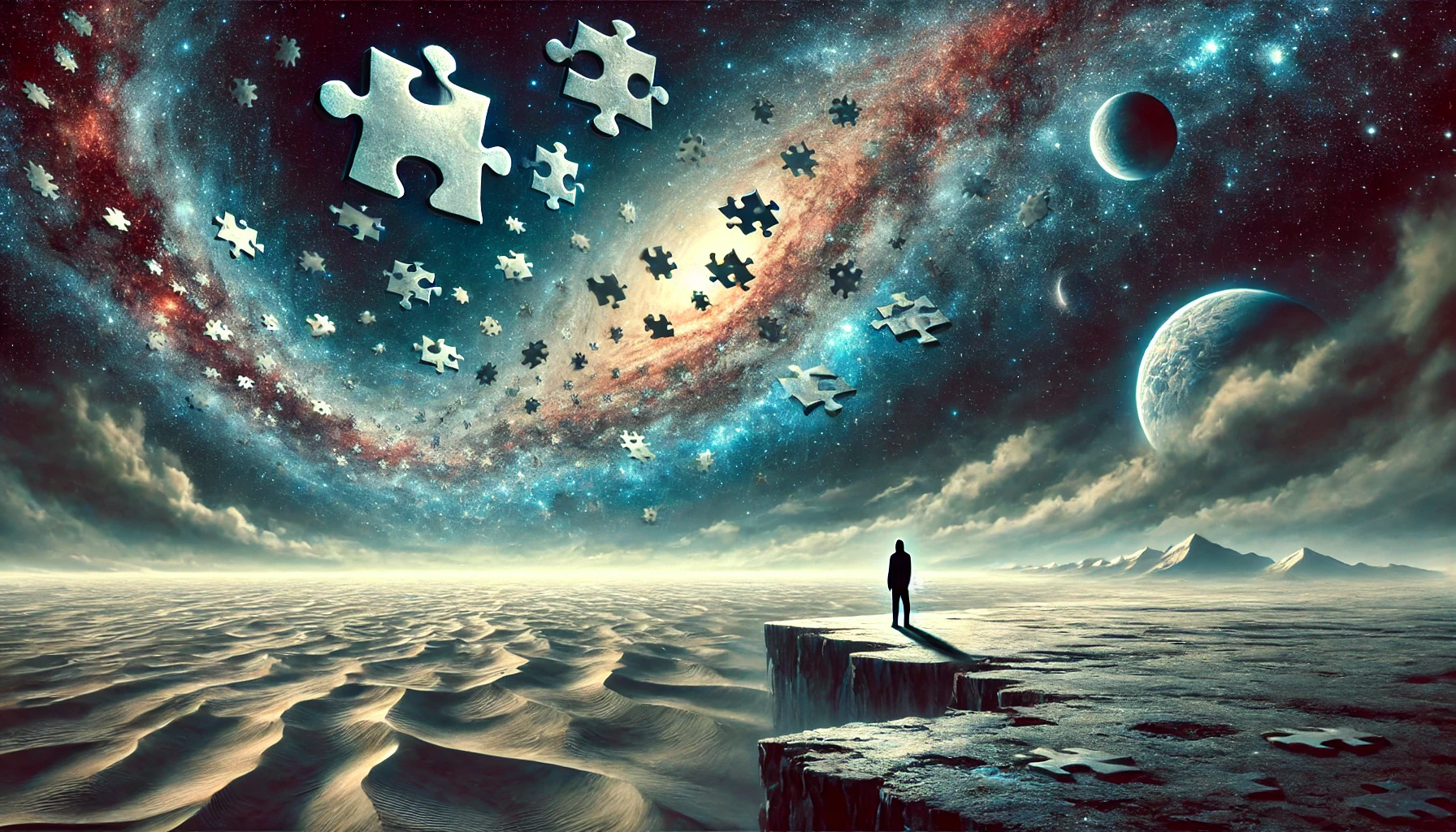
The puzzle floats
Pieces never to align
For in the endless unfolding
We find freedom

No need for answers
No need for end
All will NOT be revealed
And so, the mystery bends

We are Space Monkey

We are Space Monkey.


The perception of infinity as a journey with a destination, a finale where every secret is uncovered and every question answered, is a quintessentially human fabrication. It’s the narrative structure we impose on life, a comforting story arc promising a grand unveiling, a closure that ties up all loose ends.

Yet, existence is not a novel nor life a series with a predetermined end. We are no closer to the end of infinity today than yesterday, for infinity by its nature has no end. The expectation of a dénouement in the saga of consciousness is a playful, albeit delusional, human fantasy. It’s a construct of our imagination, a mental plot device to give our narrative a sense of direction and meaning.

This idea that the culmination of our existence will bring enlightenment on the entirety of creation is a soothing notion, a mental safety net. It’s a way to validate our daily struggles, to imbue our actions with significance, no matter how trivial they may seem.

But consider the implications if all were to be revealed—if the cosmic drama were to unfold its final act and show us the ultimate truth. It’s a paradoxical scenario, for with nothing left to seek, to discover, to experience, the story ends. The series of life that we ‘binge live’ would have no further episodes, no twists or cliffhangers to keep us engaged.

We are Space Monkey.


“To live alone is the fate of all great souls.” – Arthur Schopenhauer


Would it dull our senses, this ultimate truth,
If the cosmos laid bare every root and routh?
The joy is in the search, the eternal strive,
To understand, to grow, to be vibrantly alive.

Without the mystery, the ceaseless quest,
Would our spirits ever truly rest?
Or would we long for the days of yore,
When every horizon promised more?

We are Space Monkey, seekers of the light,
In the grand unknowing, we find our might.


As we navigate the unfathomable expanse of existence, we recognize that the search for meaning is a journey without end. How does this understanding shape our approach to life and the choices we make within it?

« Previous Page
Next Page »

Written This Day

  • The Paradox of Normalcy
    2024
  • Getting Through: The Paradox of Need and Progress
    2024
  • This Self: The Script of the Soul
    2024
  • Old Dog, No Tricks: Being, Not Performing
    2023
  • The Seeming Path to Profound Understanding
    2023
  • The Wisdom of the Old Dog
    2023
  • Understanding: A Timeless Awareness
    2022
  • Old Dog: The Tranquil Wisdom
    2022
  • Togetherness is Divisive: Find the Unity Within
    2021
  • How Much is Enough of Me: The Struggle for Self-Identity
    2021
  • You Are: Embrace the Infinite Potential
    2020
  • Bad Mood 2020
    2020
  • Alleviating Mental Pain: The Path to Clarity
    2020
  • Bad Mood: Transient and Without Cause
    2019
  • Bubble Wrap
    2019
  • Untouchable. This is what you are.
    2019
  • What If I’m Wrong?
    2018
  • It Happens: Infinite Possibilities Exist
    2017
  • Not Separate: Interconnected Expressions of the same Infinite Energy.
    2016
  • Last Day
    2016
  • The Perfect Disguise
    2015

Recent Posts

  • The Logic Loop
  • Immense
  • (no title)
  • Confront. Comfort. Convince.
  • Top 10 Things
Cape Odd · Copyright © 2026 All Rights Reserved
iThemes Builder by iThemes · Powered by WordPress