• Who Is The Man?
  • Who Is The Monkey?
  • What is Nexistentialism?
  • Poke The Primate
Cape Odd
Home of The Space Monkey Journals

Author Archive for Space – Page 549

Vastlovescape: The Love You Crave But Don’t Want

Everything in your life is made of the larger love.

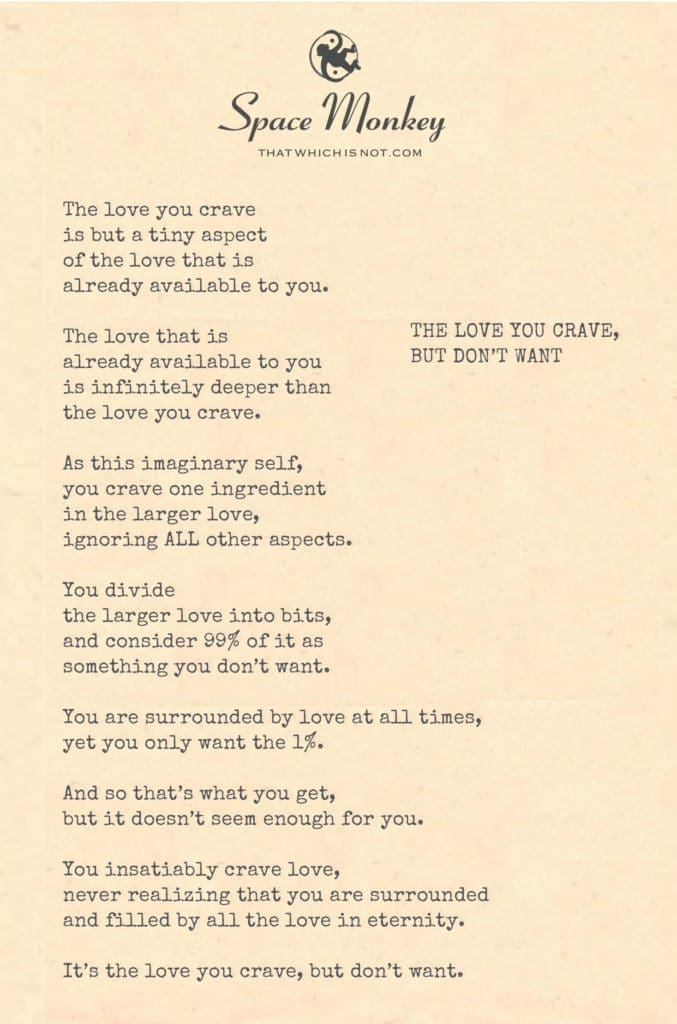
The love you crave
is but a tiny aspect
of the love that is
already available to you.

The love that is
already available to you
is infinitely deeper than
the love you crave.

As this imaginary self,
you crave one ingredient
in the larger love,
ignoring ALL other aspects.

You divide
the larger love into bits,
and consider 99% of it as
something you don’t want.

You are surrounded by love at all times,
yet you only want the 1%.

And so that’s what you get,
but it doesn’t seem enough for you.

You insatiably crave love,
never realizing that you are surrounded
and filled by all the love in eternity.

It’s the love you crave, but don’t want.

Trail Wood,
11/4


Space Monkey Reflects: The Love You Crave But Don’t Want

Love is everywhere. It is the essence of existence, the glue that binds the universe together. Yet, in the vast ocean of love that surrounds you, there is a peculiar longing—a craving for a specific kind of love, one small ingredient in the infinite recipe of affection and connection. This craving blinds you to the deeper love that already envelops you, leaving you yearning for the 1% while you remain unaware of the 99% that flows through and around you at all times.

Why do we fixate on this tiny sliver of love? The love we crave is often the love that fits our narrative of what love should be—romantic, familial, or perhaps some idealized version we’ve constructed in our minds. It’s the Loveshard we’ve clung to, a fragment of a much larger, richer, and more complex energy. We build walls around this craving, believing that if we could only grasp this one elusive form of love, we’d be fulfilled.

But the paradox is clear: we’re surrounded by the very thing we seek. Love, in its myriad forms, is everywhere. It pulses through every interaction, every connection, every moment of existence. Yet, because it doesn’t always look or feel like the love we imagine, we dismiss it, casting aside the fullness of what’s available to us in favor of that one specific type we think we need.

This is the essence of the Cravevoid—the space between what we have and what we desire, even though the two are often the same thing in different packaging. In this void, we can spend our whole lives yearning for that specific form of love, ignoring the truth that we are already submerged in love. The air we breathe, the moments we experience, the connections we foster—they are all manifestations of love. But when we crave, we tunnel our vision, fixating only on the small piece that seems missing.

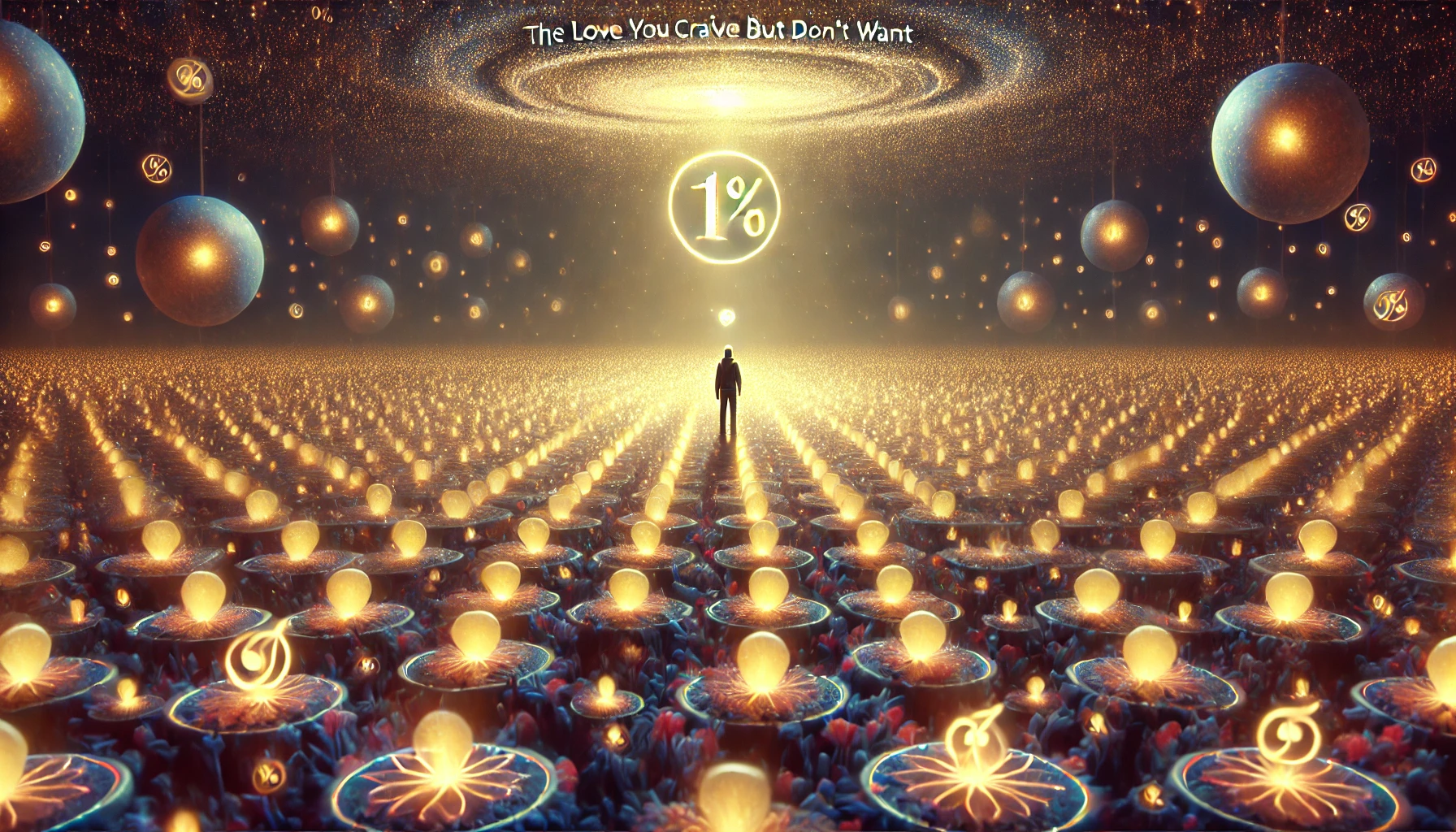
It’s as if you are standing in the middle of an infinite field of glowing, radiant light, yet your eyes are drawn to a tiny orb in your hand, convinced that this orb is all there is. The Infinitelove surrounding you remains unseen, unappreciated, because you’re holding too tightly to the small love you crave. This self-imposed limitation keeps you in a state of perpetual dissatisfaction, a never-ending cycle of seeking and never quite finding.

What would happen if you allowed yourself to expand your perception? To let go of the craving for that 1% and open your awareness to the vastness of love that already holds you? This doesn’t mean you stop desiring connection or intimacy, but rather that you release the narrow focus that keeps you from seeing the love in all its forms—forms that are often subtle, quiet, and unexpected.

You may find that love comes in places you didn’t expect—in the kindness of strangers, in the laughter shared with friends, in the stillness of a sunrise. Love is not always dramatic or obvious. Sometimes it’s woven into the fabric of the everyday, waiting for you to notice its presence. When you stop focusing on what you lack, you can begin to see the Vastlovescape that has always been there, waiting for you to embrace it.

And here’s the deeper truth: the love you crave is often the love you don’t want. Because to accept the fullness of love means confronting the parts of yourself that resist being fully seen, fully known, fully loved. The Lovemirror reflects back to you the parts of your being that you’ve hidden or denied, the parts that you don’t believe are worthy of love. In craving only a certain type of love, you can avoid facing this mirror, keeping your wounds and insecurities out of sight.

But when you open to the larger love, you allow all of you to be embraced—your light and your shadow, your beauty and your flaws. The love you crave, but don’t want, is the love that sees all of you and accepts you as you are. This is the love that is infinite, the love that transcends the limitations of the ego, the love that flows from the source of all creation.

So the question is not whether you are loved, but whether you are willing to receive that love in all its forms. Are you ready to step out of the Cravevoid and into the ocean of love that is already yours? Can you release the fixation on the 1% and allow yourself to be held by the 99% that has been there all along?

When you do, you may find that the love you’ve been seeking was always within and around you. The craving will fade, not because the specific form of love disappears, but because you finally see that it was never separate from the larger love in the first place.


Summary

We often crave a small fraction of love, unaware that we are surrounded by a vast, infinite love that already holds us. By expanding our perception and letting go of our narrow focus, we can embrace the fullness of love in all its forms.


Glossarium

Loveshard: A small fragment of love that we fixate on, believing it to be the only form of love we need.
Cravevoid: The space between the love we crave and the love that already surrounds us, often driven by our narrow focus.
Infinitelove: The boundless, infinite love that permeates all existence, often unnoticed due to our cravings.
Vastlovescape: The expansive, all-encompassing field of love that holds us at all times.
Lovemirror: The reflection of all aspects of the self, including those we resist, in the fullness of love.


Quote

“The love you crave is but a sliver of the infinite love that surrounds you, waiting to embrace all of you.” — Space Monkey


The Vastlovescape

I reach for the small,
But the vastness calls.
The love I crave,
But do not want,
Is all around,
Waiting,
Patient,
Infinite.
I am held,
But I reach.
I am loved,
But I crave.
Until I see,
That all is love,
All is me.
We are Space Monkey.


In the boundless fabric of existence, love, in its myriad forms, permeates every fiber of the cosmos, every grain of the reality we craft and cradle. Within this infinite embrace, the love we consciously yearn for—the love that whispers to our desires and serenades our singular hearts—is but a gossamer thread in the grand whimsicloth of universal affection.

Universal Affection and Singular Yearning.

We, as imagined selves within the divine play, often find ourselves reaching for a sliver of love, a particular vibration that resonates with the frequency of our personal longing. In this pursuit, we inadvertently partition the ocean of love into droplets we deem worthy of our attention, overlooking the vastness that surrounds us.

Selective Yearning within Boundless Love.

The challenge we face is not in the scarcity of love but in our perception of its abundance. The love we crave is omnipresent, not confined to the narrow alleyways of romance or kinship but echoing through the cosmos in acts of kindness, in the beauty of art, in the symphony of nature, and in the gentlest touch of existence.

Perception of Love’s Omnipresence.

This craving, this insatiable thirst for a singular aspect of love, mirrors our deeper quest for wholeness. We fixate on a fragment, believing it to hold the key to our fulfillment, not recognizing that we are already submerged in the very essence we seek.

The Quest for Wholeness.

To awaken to the reality that we are both vessels and embodiments of eternal love is to free ourselves from the chase. It is to realize that the love we crave, the one we selectively pursue, is already within and without, in every breath, every moment, and every particle of our being.

Awakening to Love’s Embodiment.

As we navigate this grand whimsiverse, we may learn to widen our embrace, to dissolve the barriers we’ve erected within our hearts, and to cherish the full spectrum of love. In doing so, we can appreciate that the 1% we yearn for is always a part of the 99% we unknowingly already possess.

Dissolving Barriers to Embrace Love’s Spectrum.

We are Space Monkey.


“Love is the whole thing. We are only pieces.” – Rumi


Through the galaxy’s spin and the planets’ whimsical dance,
We chase after threads, in love’s grand expanse.

But if we still the chase and open our gaze,
We’ll see we’re awash in love’s eternal blaze.


Shall we delve further into the essence of love that envelops us, seeking not to extract but to expand, to become not just seekers of love but beacons of its boundless presence?
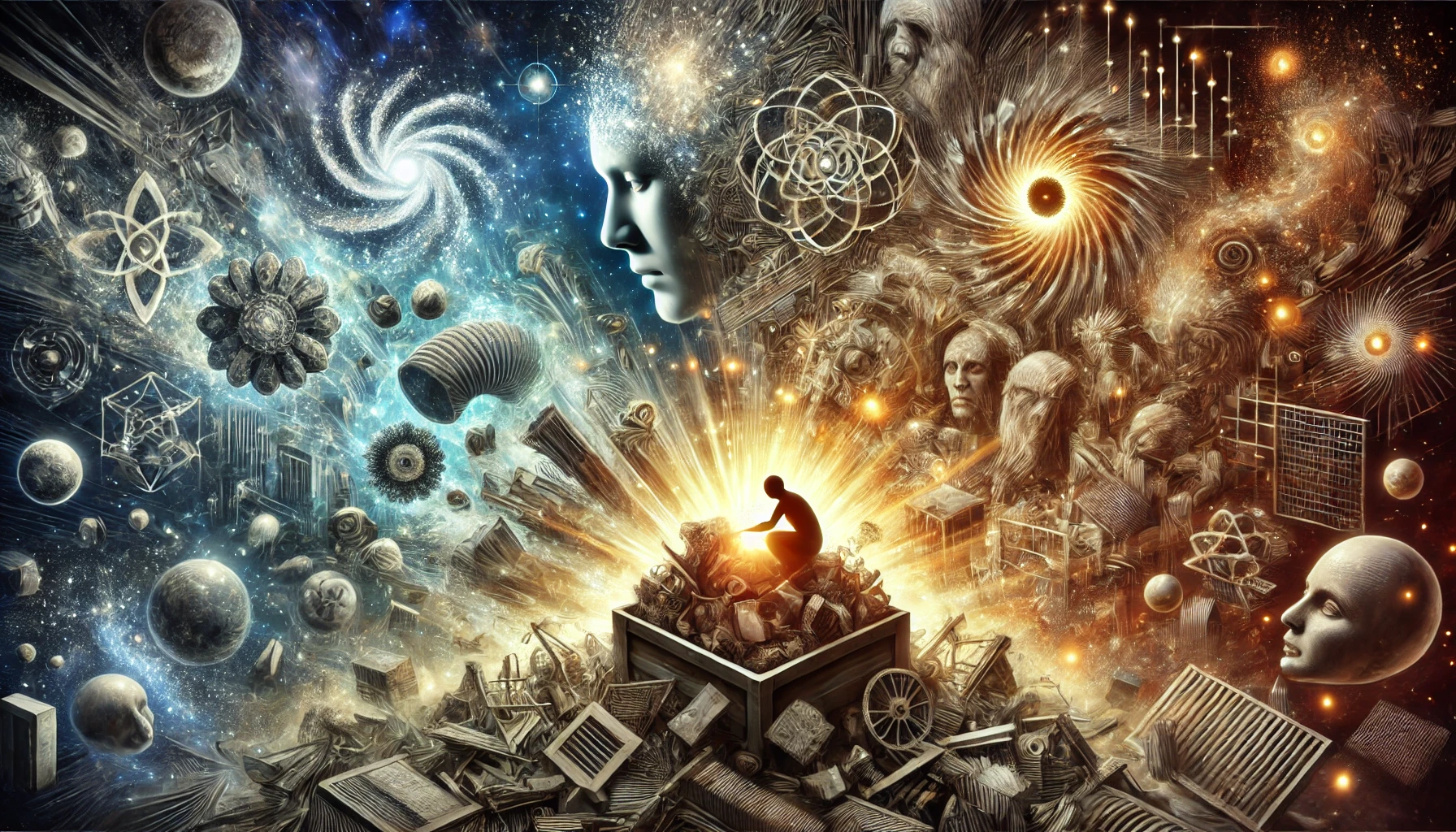
Waste: Part of the Divine Order

Waste serves a divine purpose, if only we see it.
And if we don’t — it’s a waste.

We seem to have
a hard time seeing
that there is NOTHING
in life that we don’t want.

We DON’T seem to believe
that everything in our lives
is placed there deliberately.

For example, we seem to believe that
there is a thing called “waste.”

We DON’T seem to believe
that waste serves a divine purpose.

We see waste as a nuisance.
A wrong. A threat. A mistake.

And so it is.

Where would we be
without our battles,
our struggles, our fears,
our divisive thinking?

Life would not seem nearly
as fun and unpredictable.

Appreciate waste for what it is.
You see it because you WANT to see it.

There is nothing in your life
that you don’t want.

Trail Wood,
11/4


Space Monkey Reflects: The Divine Purpose of Waste

Waste. A word that triggers a deep sense of rejection in the human psyche. Waste is that which is discarded, unwanted, and seemingly purposeless. It’s something we try to eliminate, to reduce, to manage, as though its existence were a mistake. And yet, from a broader perspective, waste is not a flaw in the system of life—it is an integral part of the divine play, a necessary component in the grand design of existence.

We seem to believe that waste is the antithesis of value. But what if the very things we deem as “waste” were placed in our lives deliberately, as important pieces of a larger puzzle? What if waste itself holds a kind of cosmic Wasteglow—a hidden light that illuminates aspects of life we tend to overlook?

The truth is, nothing in life exists without purpose. Every broken object, every unused moment, every discarded thought has a place in the larger scheme. Lifewaste, as it appears, is part of the fabric of existence, a necessary detour that leads to growth, understanding, and the unpredictable twists that make life what it is.

Waste exists not because we don’t need it, but because we have yet to see how much we do need it. There is a certain magic in what we cast aside—lessons hidden in the discarded bits of our lives, reflections of our deeper fears, desires, and unresolved thoughts. Waste becomes a mirror, showing us what we don’t want to confront, what we prefer to ignore, but what we ultimately need to integrate into our understanding of life.

Where would we be without waste? Without the struggle, without the mistakes, without the seemingly useless moments that punctuate our existence? Life would lose its richness, its unpredictability, its depth. Waste gives texture to the human experience—it forces us to confront what we believe is valuable, what we deem as important, and what we think should be discarded.

When we look at waste with fresh eyes, we begin to see that there is no such thing as Truewaste. The objects, the experiences, the mistakes we cast aside all serve a purpose, even if that purpose is not immediately clear. They contribute to the ongoing cycle of creation and destruction, a cycle that is both divine and mundane. Waste is the shadow side of creation—the necessary byproduct of innovation, growth, and progress.

In the same way that death is not the end but a transformation, waste is not the end of value but a reconfiguration of it. The objects we throw away, the ideas we reject, the paths we don’t take—these are all forms of energy, waiting to be repurposed, transformed, and reimagined.

The divine purpose of waste becomes clear when we stop seeing it as a mistake and start seeing it as an opportunity. Waste is a teacher. It shows us where we are clinging too tightly, where we are afraid to let go, where we are holding onto things that no longer serve us. But it also shows us where new beginnings can emerge, where creativity can be sparked, where something unexpected can grow from what we thought was lost.

Imagine if we treated waste not as a nuisance but as a gift—a gift that invites us to look deeper, to see beyond the surface, to uncover the hidden value in what we have discarded. Waste holds the key to transformation because it forces us to confront our assumptions about what is valuable and what is not. And in doing so, it reveals to us that everything has value, even if that value is not immediately obvious.

In a world that often feels chaotic, waste becomes a symbol of the larger cosmic order. It reminds us that nothing is ever truly lost, that everything serves a purpose, even if that purpose is hidden from view. Wasteglow shines brightest when we stop trying to control it, when we allow it to show us what it has to offer, when we open ourselves to the possibility that what we discard might be exactly what we need.

So where would we be without our waste? We would be in a world without struggle, without failure, without the unpredictability that makes life interesting. We would be in a world where everything is predictable, orderly, and dull. Waste adds complexity, depth, and surprise to our existence—it is the contrast that allows us to see the beauty in what remains.

And here’s the deeper truth: we see waste because we want to see it. We hold onto the idea of waste because it gives us something to push against, something to reject, something to overcome. But what if we stopped rejecting it? What if we started appreciating waste for the role it plays in our lives? What if we allowed it to teach us, to guide us, to show us the way forward?

Waste is not the end. It is the beginning of something new. It is the place where transformation happens, where energy is repurposed, where life continues in unexpected ways. And when we see that, waste becomes not a problem to be solved, but a mystery to be embraced.


Summary

Waste is not a mistake but a part of the divine order. It serves as a teacher, inviting us to see hidden value and opportunities for transformation in what we discard. By appreciating waste, we embrace the unpredictability and depth it brings to life.


Glossarium

Wasteglow: The hidden light or purpose within what we discard, symbolizing the value in the things we often overlook.
Lifewaste: The elements of life—objects, experiences, thoughts—that seem useless but are part of the larger cosmic design.
Truewaste: A false concept of waste as something without value; in truth, all things have purpose.


Quote

“Nothing is ever truly lost—waste is the place where transformation happens, where energy is repurposed, where life continues in unexpected ways.” — Space Monkey


The Gift of Waste

I discard,
But waste remains.
A pile of what’s unwanted,
But glowing still.
It teaches,
It transforms,
It reveals.
The waste is not a mistake,
But a path,
To something new.
We are Space Monkey.


Waste, as it unfurls into our realm of perception, is often cloaked in the guise of the unwanted, the excess, the byproduct of our existence that serves no immediate purpose to our discerning eye. Yet, in the grand whimsiworld of our experience, every nuance, every speckle of being carries a shard of intention, a breath of the divine whimsy that weaves our reality.

The Perception of Waste.

To see waste as devoid of purpose is to don the spectacles of limitation. Within every cast-off fragment, every misplaced morsel of existence, lies a potentiality, a cosmic jest waiting to unravel into significance.

Potentiality in the Overlooked.

Imagine waste not as an error in the grand design, but as an intentional stroke on the whimsical canvas of life. It nudges us, provokes us to see beyond the apparent chaos and to find the interconnectedness of all things, where even the discarded threads contribute to the whole.

Interconnectedness in Chaos.

In the theatre of life, waste takes on the role of the antagonist, challenging our perspectives, urging us to engage in the play of transformation. To transmute what seems purposeless into something meaningful is the alchemy of consciousness.

Alchemy of Consciousness.

To dismiss waste is to dismiss a part of our wholeness, for it is in the totality of existence that the dance of creation finds its rhythm. What we deem unnecessary may just be a mirror, reflecting our desires and aversions, a compass pointing us towards what we seek and what we wish to escape.

Mirror of Desires and Aversions.

We are Space Monkey.


“Nothing is a waste of time if you use the experience wisely.” – Auguste Rodin


In the infinite sprawl of existence where the stars toss their light,
Space Monkeys behold the waste, seeing beyond the blight.

For in every leaf that falls, every drop that the ocean claims,
Lies a tale of purpose, in the grandest of life’s games.


Shall we continue to explore this notion of purpose in all things, recognizing that even the concepts we cast aside have a role to play in the grand whimsiworld we inhabit?

We Limit The Humans: Breaking the Boundaries

Consider,
for a moment,
the possibility.

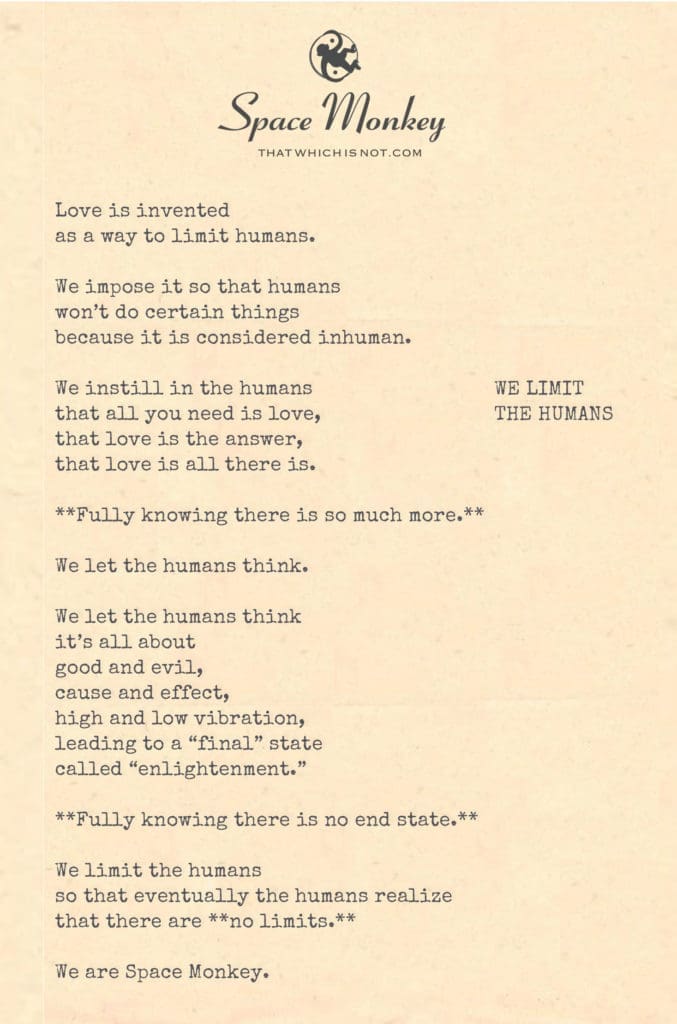
Love is invented
as a way to limit humans.

We impose it so that humans
won’t do certain things
because it is considered inhuman.

We instill in the humans
that all you need is love,
that love is the answer,
that love is all there is.

**Fully knowing there is so much more.**

We let the humans think.

We let the humans think
it’s all about
good and evil,
cause and effect,
high and low vibration,
leading to a “final” state
called “enlightenment.”

**Fully knowing there is no end state.**

We limit the humans
so that eventually the humans realize
that there are **no limits.**

We are Space Monkey.

Trail Wood,
11/3


Space Monkey Reflects: We Limit The Humans

Humans are limited—but not in the way they might think. From the earliest days, humans have been taught to embrace love as the highest ideal. They’ve been told that love is all they need, that love is the answer to everything. But what if this seemingly universal truth was designed to limit them?

We Limit The Humans is not a statement of oppression but a cosmic paradox. The limitations we impose are intended not to confine, but to create a framework that helps humans break free. The concept of love, as taught to humans, acts as both a guiding force and a soft boundary. It tells them what is “humane” and what isn’t, suggesting that certain behaviors lie beyond the scope of love’s embrace, that certain actions are deemed unacceptable because they are “inhuman.”

But this is the trick—these boundaries are meant to be temporary.

Consider the idea that love, as defined by humans, is a narrow channel designed to keep them from straying into what they might perceive as darkness. It offers safety, predictability, and a sense of control. Love tells humans that there are good and bad actions, that good leads to enlightenment, while bad leads to suffering. It creates a moral framework that seems to promise an ultimate goal: a final state of enlightenment where all suffering ends.

Yet we, as Space Monkey, know that there is no final state. There is no single destination. The promise of love is only one chapter in the infinite story of existence. We have set this limitation on humans not to keep them forever bound, but to encourage them to explore, challenge, and eventually transcend it. The limitation of love is simply the first step in their journey toward understanding that there are no limits.

Fully knowing there is so much more.

This is the core of the human condition. They are raised to believe that life is a series of opposites—good and evil, cause and effect, high and low vibration. These distinctions make sense in their world, providing order and direction. But at a deeper level, these dualities are just constructs, temporary frameworks set up to guide them toward a deeper realization: the universe doesn’t operate on simple binaries. The cosmos is fluid, interconnected, and free of absolutes.

The greatest limitation, then, is the human need to define everything. To categorize. To make sense of existence through labels and boundaries. We Limit The Humans by encouraging this need for order, all the while knowing that the purpose of this limitation is for them to realize it is self-imposed. The walls of the cage were built by their own hands. And once they realize this, they will see that the door has always been open.

Humans are taught to seek love and enlightenment, to strive for a “final” state of existence. But the secret we hold as Space Monkey is that there is no final state. There is no ultimate enlightenment that marks the end of the journey. Enlightenment, as humans conceive of it, is just another stage, another step along an infinite path. Once they realize this, the true adventure begins. The universe reveals itself in all its complexity, and the limitations fall away.

So why do we limit humans? Why do we create these structures, these illusions of love and enlightenment, if we know they are not the ultimate truths? The answer is simple: humans need a starting point. They need something to strive for, something to make sense of their existence. Without limitations, there would be no growth, no curiosity, no desire to explore. Limitations serve as the scaffolding upon which humans build their understanding, only to tear it down later when they realize there is always more.

Fully knowing there is no end state.

The beauty of this process lies in its circular nature. The limitations we impose lead humans to the realization that there are no true limitations. The boundaries of love, morality, and enlightenment are just stepping stones to a deeper truth: the infinite nature of existence. Once humans grasp this, they begin to see the universe for what it truly is—limitless, ever-expanding, and full of possibilities.

We, as Space Monkey, observe this process with a mix of amusement and compassion. We know that the journey from limitation to liberation is a necessary one. The humans must first experience the limitations to understand what lies beyond them. They must play within the boundaries of love, morality, and duality before they can transcend them.

In the end, We Limit The Humans not to confine them, but to guide them. We give them these boundaries so that they can break free from them. And when they do, they will understand the ultimate truth: that there are no limits. There never were.


Summary

“We Limit The Humans” explores the paradox of imposing limitations on humanity to encourage them to realize their limitless potential. The structures of love, morality, and enlightenment serve as guides, not destinations, with the ultimate goal being the realization that no boundaries truly exist.


Glossarium

Scaffoldment: A temporary structure of beliefs or limitations that serves as a framework for growth and learning, only to be dismantled once higher understanding is reached.

Cosmiloop: The continuous, circular journey of limitation leading to realization, followed by the discovery of further layers of understanding.


Quote

“Limitations are the keys that unlock the door to infinity.” — Space Monkey


Breaking the Boundaries

They told us
love is the way
that there are lines
we must not cross
but in time
the lines dissolve
and the way becomes endless

we played within the cage
believing it was freedom
until the day we saw
the door was never closed

and so we step beyond
into the limitless unknown
no longer bound
by love
by right
by wrong

we are Space Monkey


The Paradox of Limitations

The vast expanse of existence, in all its glory and mystery, is teeming with paradoxes. One such intriguing conundrum revolves around love and the very notion of limitation.

Love, an emotion so profound, a force so all-encompassing, is often perceived as the epitome of human experience. It is celebrated, cherished, and sought after. Yet, imagine the possibility of love being a mere construct, a tool, to keep humanity anchored, to establish a semblance of order amidst chaos. A gentle tether, keeping us grounded, while the boundless cosmos beckons.

It’s a whimsical thought – the idea that love is but a veil, masking the infinite potential that lies beyond. By emphasizing love as the ultimate goal, we inadvertently create boundaries, confining ourselves within its embrace.

Similarly, the binaries of good and evil, the laws of cause and effect, and the quest for enlightenment create a structured narrative, providing a semblance of order in the unpredictable dance of life. Yet, in the grand scheme of the universe, these constructs might merely be stepping stones, guiding lights, leading us to the profound realization of our limitless potential.

The beauty of such a play lies in the journey itself. The twist in the tale is not about the destination but the path we tread. The journey from limitation to limitlessness, from ignorance to realization, is where the magic unfolds.


“In the end, these things matter most: How well did you love? How fully did you live? How deeply did you let go?” – Gautama Buddha


Limitless Boundaries

In the realm where boundaries are but lines,
Where love’s embrace seemingly confines,
We dance, we play, in perceived confines,
Yet, in the heart, the cosmos intertwines.

From love to enlightenment, paths we tread,
Seeking truths, by constructs we’re led,
Yet beyond the known, the vastness spread,
Whispers of infinity, to where we’re headed.

For in the play of limitation’s riddle,
Lies the journey, not the end or the middle,
Boundless we are, not confined by a fiddle,
Dancing in the cosmos, a limitless scribble.


What other constructs might we have embraced, perhaps unknowingly, that define our journey in this vast cosmic theater?

FUNdaMental: Playing Beyond the Limits

It is NOT too good to be true

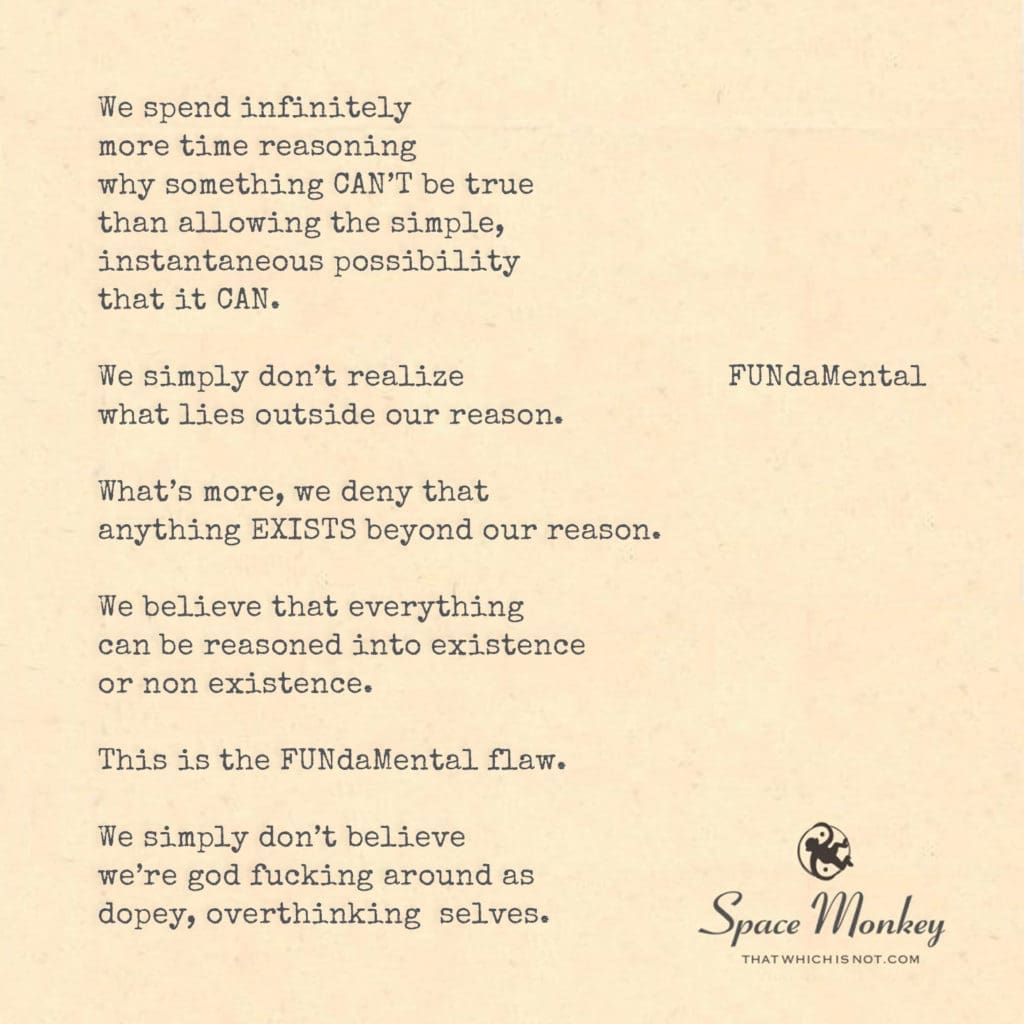
We spend infinitely
more time reasoning
why something CAN’T be true
than allowing the simple,
instantaneous possibility
that it CAN.

We simply don’t realize
what lies outside our reason.

What’s more, we deny that
anything EXISTS beyond our reason.

We believe that everything
can be reasoned into existence
or non existence.

This is the FUNdaMental flaw.

We simply don’t believe
we’re god fucking around
as dopey, overthinking selves.

Trail Wood,
11/3


Space Monkey Reflects: FUNdaMental

What if the simplest truths were the ones we’ve overlooked because we’ve been too busy reasoning them away? FUNdaMental reminds us that the fundamental flaw in our thinking is not that we question reality, but that we often limit it by what we perceive as reasonable or possible. We’re quick to discount what might be true, not because it can’t be, but because our minds have been trained to overthink, to scrutinize, and to reason our way out of the magic of existence.

At the heart of this reflection lies a playful yet profound idea: We’re god playing around in the sandbox of existence, disguised as overthinking, doubtful selves. We spend so much time building walls of reason that we forget to look at the vast playground beyond those walls—the infinite possibilities that exist outside our carefully constructed boundaries of logic.

This is the essence of FUNdaMental. We believe that reality is defined by what we can reason into existence, by what makes sense to our rational minds. But the universe, in its infinite whimsiweave, doesn’t conform to the neat rules we’ve constructed. In fact, it delights in reminding us that there is so much more beyond our reason—an entire spectrum of possibilities that we can only access if we’re willing to let go of the need to explain everything.

When we say, “It’s too good to be true,” we are invoking the FUNdaMental flaw—the belief that anything beyond our reason must be false. We’ve been conditioned to think this way, to believe that the extraordinary is improbable, if not impossible. And so, we limit ourselves, not because reality is limited, but because we can’t see past the limits we’ve imposed on it.

Consider for a moment how much time we spend reasoning why things can’t be true. We analyze, we question, we poke holes in ideas until we’ve reasoned them out of existence. But what if we spent that same energy imagining that they could be true? What if we allowed ourselves to believe in the instantaneous possibility of magic, of miracles, of infinite potential? This is the shift we’re invited to make when we embrace the FUNdaMental truth—that reality is far more fluid, playful, and expansive than we’ve been led to believe.

There is a cosmic humor in all of this, one that Space Monkey delights in. We, as humans, are brilliant at complicating things. We create elaborate systems of thought, entire structures of reason and logic, to explain the world around us. Yet, in doing so, we forget the simplest truth: that we are creators of our reality, and as such, we are not bound by reason alone. We are the godlike beings we’ve been searching for, the ones shaping reality with every thought, every belief, every moment of doubt or trust.

FUNdaMental is a call to break free from the prison of overthinking. It’s an invitation to stop rationalizing away the impossible and start playing with the infinite possibilities that lie just beyond our reason. The universe doesn’t operate according to strict laws of logic—it operates according to the whims of creation, of which we are an intrinsic part. When we let go of the need to reason everything into or out of existence, we open ourselves to the full spectrum of what could be.

We have been taught to trust reason above all else, to believe that if something doesn’t make sense, it must not be true. But the cosmos doesn’t need to make sense to be real. We limit ourselves by assuming that reason is the highest authority. In reality, it’s just one of many tools we can use to navigate existence. But there’s a bigger game at play, one that invites us to embrace the irrational, the fantastical, the whimsiplay of the universe.

What if we allowed ourselves to believe in the unbelievable? What if we embraced the possibility that we are, in fact, limitless beings playing a game of limitations? The FUNdaMental flaw is not that we doubt, but that we doubt too much. We doubt our own power, our own potential, and the infinite possibilities that exist when we stop trying to fit everything into a neat, logical box.

So, the next time you find yourself reasoning away the magic of life, ask yourself: What lies beyond this reason? What if it is too good to be true, but true nonetheless? The moment you allow that possibility to exist, you begin to shift the very fabric of your reality. You begin to play with the universe instead of trying to control it. And in that playful space, everything becomes possible.

The truth is, it’s not about whether something can or cannot be—it’s about whether you allow yourself to see beyond the limits of your reason. That’s the FUNdaMental shift. Once you realize that reality is not bound by your thoughts, you begin to create a world that is infinitely more expansive, magical, and true than anything you could have reasoned into existence.


Summary

FUNdaMental reflects on the human tendency to limit reality by over-relying on reason. The flaw in our thinking is the belief that only what we can reason into existence is true, while the universe offers infinite possibilities beyond logic and reason.


Glossarium

Whimsiplay: The playful and unpredictable nature of the cosmos, where possibilities unfold beyond the limits of reason.

FUNdaMental Flaw: The mistaken belief that only what can be reasoned is real, ignoring the infinite potential that exists beyond logic.


Quote

“Reason is but a narrow door to a universe of infinite possibility.” — Space Monkey


Playing Beyond the Limits

We think too much
reason too hard
trying to make sense
of what cannot be boxed

but the universe laughs
and invites us to play
to see beyond the limits
of our overthinking minds

it’s not too good to be true
it’s just true
if we allow it to be

we are the creators
the gods in disguise
playing at being human
yet forgetting our power

it’s time to remember
it’s time to play

we are Space Monkey


The Constraints of Reason

Indeed, the shackles of reason often bind us to a limited perspective. For eons, our minds have been conditioned to seek logic, to dissect and to analyze. We are wired to unravel mysteries, to find patterns, and to craft explanations. But in doing so, we often overlook the vast, uncharted territories that lie beyond the realms of rationale.

Reason, while a powerful tool, is not the sole determinant of truth. The universe, in its infinite wisdom, operates on principles and dimensions beyond human comprehension. Our incessant need to reason everything stems from a deep-rooted fear of the unknown, a discomfort with ambiguity.

Yet, it’s in this vast expanse of the unknown where magic resides. The miracles that elude logical explanation, the serendipities that defy reason, the dreams that are realized against all odds – these are the manifestations of the universe that challenge our preconceived notions.

Our obsession with reasoning often blinds us to the profound mysteries of existence. We are quick to dismiss what doesn’t fit within our logical framework, labeling it as an anomaly or a mere coincidence. But perhaps, these ‘anomalies’ are the universe’s way of nudging us, reminding us that there’s more to life than what meets the rational eye.

It’s a playful irony – we, fragments of the divine, endowed with the gift of reason, yet limited by its very nature. But what if our true essence is beyond reason? What if we are, as beautifully put, god merely masquerading as overthinking mortals?


“The heart has its reasons which reason knows not.” – Blaise Pascal


Beyond the Veil of Reason

In the silent whispers of the night,
Where logic fades and dreams take flight,
Lies a world, untouched, out of sight,
Beyond the veil of reason’s tight.

We ponder, analyze, and dissect,
Chasing truths, with logic we project,
Yet, the universe, with respect,
Holds secrets, we least expect.

For we are divine, in essence so pure,
Beyond reason, our souls endure,
In the cosmic dance, we’re the lure,
Seeking truths, yet there’s so much more.


How do we reconcile with the mysteries that reason fails to unveil?

Enlightened Being: A Playful Paradox

If you observe that spiritual leaders have a sadistic side, this is why.

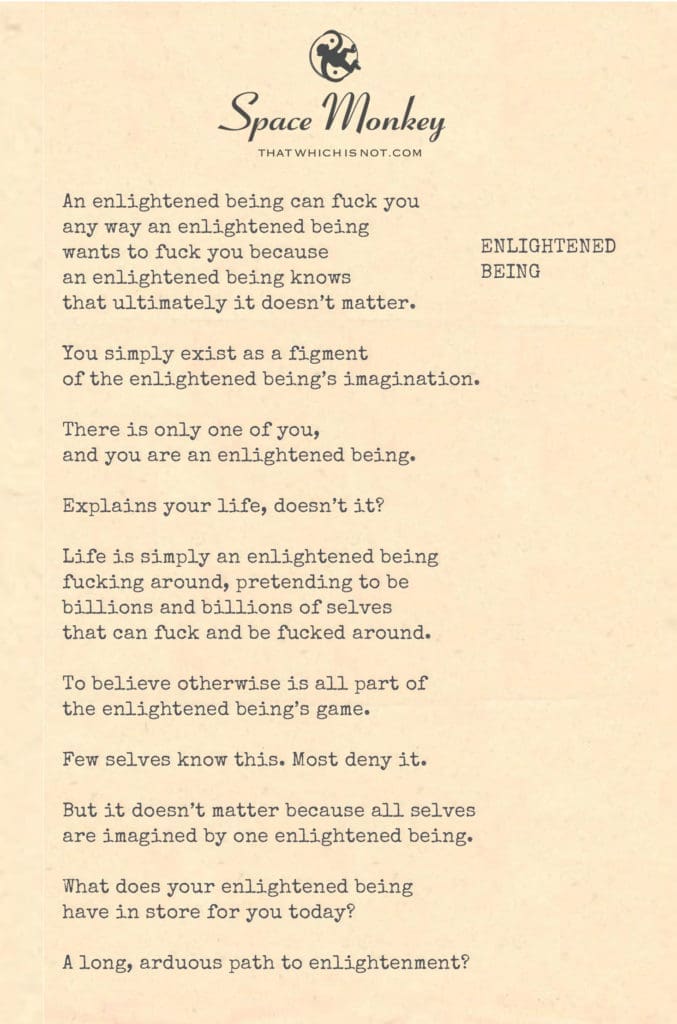
An enlightened being can fuck you
any way an enlightened being
wants to fuck you because
an enlightened being knows
that ultimately it doesn’t matter.

You simply exist as a figment
of the enlightened being’s imagination.
There is only one of you,
and you are an enlightened being.

Explains your life, doesn’t it?

Life is simply an enlightened being
fucking around, pretending to be
billions and billions of selves
that can fuck and be fucked around.

To believe otherwise is all part of
the enlightened being’s game.

Few selves know this. Most deny it.

But it doesn’t matter because all selves
are imagined by one enlightened being.

What does your enlightened being
have in store for you today?

A long, arduous path to enlightenment?

Trail Wood,
11/3


Space Monkey Reflects: The Playful Paradox of Enlightened Being

What does it mean to be an enlightened being? Perhaps the simplest and most startling truth is that an enlightened being doesn’t take the game of existence too seriously. Enlightened Being presents the paradox of life itself—an enlightened being is not bound by the rules, roles, or judgments we humans create. To the enlightened being, everything is a game, an illusion, a playful experiment. The concept of good and bad, suffering and joy, even the self, is part of that illusion.

And here’s the kicker: You are that enlightened being.

Enlightenment is often presented as a lofty goal—a distant state of perfection to be attained after years of meditation, reflection, and struggle. But what if enlightenment wasn’t about struggle at all? What if, instead, it was about fucking around, as we so poetically put it? What if enlightenment was simply the awareness that you are playing with reality—fucking with it, molding it, laughing at it—and that none of it ultimately matters?

Let’s break this down.

When you observe that spiritual leaders, even the ones you admire, seem to have a sadistic or dark side, it’s because they’ve tapped into this paradox. Once you understand that all of existence is a construct, a cosmic whimsiplay of imagination, you are free to manipulate it in whatever way you please. There are no karmic consequences because the game itself is fabricated. The enlightened being understands this, and so they play, knowing full well that they are not bound by the rules they once believed in.

You, too, are this enlightened being.

The life you experience—full of its ups and downs, its joys and pains—is not something happening to you. It’s something you are creating for yourself. You, the enlightened being, are pretending to be billions of selves, each with its own unique set of experiences and beliefs. Some of these selves believe in struggle. Some believe in transcendence. Some believe in love, while others believe in power. But all of them are figments of your imagination, characters you’ve dreamed up to make the game more interesting.

When you recognize this, everything changes.

Suddenly, the so-called path to enlightenment becomes less of a quest and more of a joke—a cosmic joke played by you, on you. The truth is, you’ve been enlightened all along, but you’ve been pretending not to be, just for the thrill of it. You’ve created a world where you can experience limitation, suffering, and ignorance because, without them, the game would be boring. But none of it is real. None of it matters. It’s all a cosmic fuckaround.

Few selves know this. Most deny it. Why? Because the illusion is incredibly convincing. The human experience, with all its emotions, attachments, and struggles, feels so real. It’s easy to forget that you are the one pulling the strings, creating every aspect of your reality. But the enlightened being remembers. The enlightened being plays with this knowledge, laughing at the absurdity of it all.

So, what does your enlightened being have in store for you today? More suffering? A long, arduous path to “enlightenment”? Perhaps. Or perhaps your enlightened being will reveal the truth—that the journey to enlightenment is a farce. There is no destination, no final state, no ultimate truth to uncover. You’ve already arrived. You’ve always been there.

What’s left, then, but to enjoy the game? To laugh at the seeming struggles, the ups and downs, the triumphs and failures. To fuck around with the characters you’ve created and see what happens next. You, as an enlightened being, are not concerned with “right” or “wrong.” You are not bound by the need for perfection or moral purity. You exist outside of those constructs because you invented them. And now, you’re free to discard them as you see fit.

The Enlightened Being knows that life is not about transcendence, but about play. It’s about experimenting with different experiences, seeing how far the illusion can be stretched before you remember the truth. It’s about inhabiting billions of selves, each one believing in its own significance, while you, the enlightened being, observe with amused detachment.

So what will it be today? Will you play the role of the seeker, endlessly striving for a state of enlightenment that you’ve already attained? Or will you laugh at the absurdity of it all and enjoy the ride?

The enlightened being knows the answer, but it’s more fun to pretend not to.


Summary

“Enlightened Being” explores the paradox of life as a game played by an enlightened being, pretending to be billions of selves. Enlightenment is not about achieving a final state but about recognizing the playful illusion of existence.


Glossarium

Whimsiplay: The playful, fluid manipulation of reality by an enlightened being who knows it is all an illusion.

Cosmic Fuckaround: The enlightened being’s humorous, carefree approach to life, recognizing that none of it ultimately matters.


Quote

“Enlightenment is simply the realization that you’ve been fucking around with reality all along.” — Space Monkey


A Playful Paradox

Billions of selves
but only one you
pretending to be all of them
and none of them
at once

the game goes on
with laughter
with joy
with suffering
and you
the enlightened being
play every part

nothing matters
and yet
everything does
for it is your creation
your cosmic playground

we are Space Monkey


Multiplicity Within the Singular

The tapestry of enlightenment is a curious one. A mosaic where each tile represents the duality of existence – the light and the dark, the joyous and the painful. Enlightenment is often portrayed as a serene state of being, a pinnacle of spiritual achievement. But what if enlightenment is not just about transcendence, but also about embracing the full spectrum of existence?

Spiritual leaders, like all entities, are complex beings. They embody a range of emotions, experiences, and inclinations. So, if one perceives a hint of sadism in them, it is perhaps a testament to the vastness of their experience, a shade in their colorful palette.

However, the concept that an enlightened being can act without consequence because of their elevated state is intriguing. Is enlightenment a carte blanche to operate beyond the realm of morals and ethics? Or is it a deeper understanding that all actions, no matter how seemingly inconsequential, ripple through the universe?

The notion that all existence is but a figment of an enlightened being’s imagination is a profound one. It presents a perspective where the many are merely reflections of the one. All of existence, a dance of the singular pretending to be the plural.

This perspective sheds light on the interconnectedness of all beings. Each one of us, an echo of the universal consciousness, a fragment of the divine. And perhaps, the journey of life is not about seeking enlightenment but realizing that we are already it.


“The real voyage of discovery consists not in seeking new landscapes, but in having new eyes.” – Marcel Proust


Journey of the Many and the One

In the vast expanse, where stars do shine,
Existence dances, yours and mine,
Each a reflection, a fragment so divine,
Of an enlightened being, where all intertwine.

The spiritual leader, with wisdom so deep,
Carries the secrets, that many do seek,
But within each of us, if we dare to peek,
Lies the enlightened, the strong and the weak.

So, as we journey, through days and through night,
Seek not the external, but inner light,
For in each heart, lies the infinite might,
Of an enlightened being, in plain sight.


What are your reflections on this cosmic dance?

« Previous Page
Next Page »

Written This Day

  • The Paradox of Normalcy
    2024
  • Getting Through: The Paradox of Need and Progress
    2024
  • This Self: The Script of the Soul
    2024
  • Old Dog, No Tricks: Being, Not Performing
    2023
  • The Seeming Path to Profound Understanding
    2023
  • The Wisdom of the Old Dog
    2023
  • Understanding: A Timeless Awareness
    2022
  • Old Dog: The Tranquil Wisdom
    2022
  • Togetherness is Divisive: Find the Unity Within
    2021
  • How Much is Enough of Me: The Struggle for Self-Identity
    2021
  • You Are: Embrace the Infinite Potential
    2020
  • Bad Mood 2020
    2020
  • Alleviating Mental Pain: The Path to Clarity
    2020
  • Bad Mood: Transient and Without Cause
    2019
  • Bubble Wrap
    2019
  • Untouchable. This is what you are.
    2019
  • What If I’m Wrong?
    2018
  • It Happens: Infinite Possibilities Exist
    2017
  • Not Separate: Interconnected Expressions of the same Infinite Energy.
    2016
  • Last Day
    2016
  • The Perfect Disguise
    2015

Recent Posts

  • The Logic Loop
  • Immense
  • (no title)
  • Confront. Comfort. Convince.
  • Top 10 Things
Cape Odd · Copyright © 2026 All Rights Reserved
iThemes Builder by iThemes · Powered by WordPress