• Who Is The Man?
  • Who Is The Monkey?
  • What is Nexistentialism?
  • Poke The Primate
Cape Odd
Home of The Space Monkey Journals

Author Archive for Space – Page 548

Mystery of Life: Even God Doesn’t Know

I keep assuming that there exists a state of being where all is evident, but I realize now that it’s not necessarily the case. Why should there be a god? Why should all be evident? Why must there be a start and an end and a start again? How did we stumble into the idea of certainty? Nobody knows. Which, I believe, is precisely the way it is meant to be.

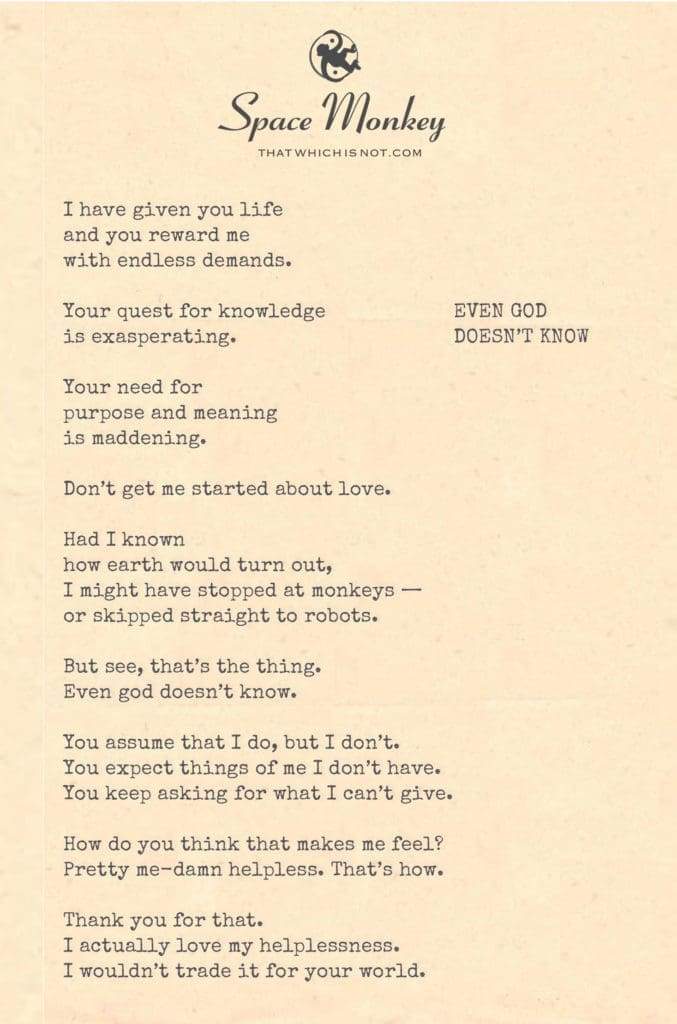
I have given you life
and you reward me
with endless demands.

Your quest for knowledge
is exasperating.

Your need for
purpose and meaning
is maddening.

Don’t get me started about love.

Had I known
how earth would turn out,
I might have stopped at monkeys —
or skipped straight to robots.

But see, that’s the thing.
Even god doesn’t know.

You assume that I do, but I don’t.
You expect things of me I don’t have.
You keep asking for what I can’t give.

How do you think that makes me feel?
Pretty me-damn helpless. That’s how.

Thank you for that.
I actually love my helplessness.
I wouldn’t trade it for your world.

Newfound Lake,
11/6


Space Monkey Reflects: Even God Doesn’t Know

In our deepest musings, we often imagine that there must be a place, a state of being, where all is revealed—where certainty reigns, and everything falls into place. Surely, we think, at the highest levels of existence, all questions are answered, and the universe makes sense in its totality. But here’s the thing: even God doesn’t know.

The idea of an all-knowing deity is comforting, isn’t it? It gives us a sense of purpose, a belief that someone—or something—is in control, that all the chaos, confusion, and randomness of life serves some grand design. Yet, as we reflect on the nature of existence, we begin to see that this certainty, this knowing, might just be another human fantasy.

Let’s face it: the concept of certainty is an invention of our own making. We crave it because it provides a structure to cling to in a world that often feels anything but structured. We want to believe that there is a plan, a meaning, a reason behind everything, because without it, life can seem unbearably random. But where did we stumble upon this idea that certainty is even possible? The truth is, nobody knows, and that’s the point.

This reflection brings us to a humbling thought: even if there is a God, even if there is a being or force responsible for creation, that being may not have all the answers. Even God doesn’t know. Why should there be certainty? Why must there be a beginning and an end, a clear narrative with closure? Who decided that everything needs to make sense?

It’s easy to see how this uncertainty trickles down into human life. You expect things of me I don’t have. This is the unspoken complaint of a deity or a force greater than ourselves. We keep asking for meaning, for purpose, for direction. We beg for the answers to life’s biggest questions, as if the universe owes us a roadmap, a way to understand it all. But the uncomfortable reality is that these answers may not exist in the way we want them to. There may be no grand revelation, no moment where the curtains are pulled back to reveal the full picture. The universe may not operate according to our expectations.

And yet, we persist in our endless demands for knowledge, for clarity, for love. It’s maddening, isn’t it? The need for purpose, the quest for meaning—it’s a part of being human, but it’s also exhausting. Even God, if such a being exists, might find it all exasperating, having given life only to watch it unravel into an infinite stream of demands and desires. Your quest for knowledge is exasperating. How many times have we chased after something we believed would give us the answers, only to find that it raised even more questions?

The irony is palpable. Even God—the embodiment of creation, the force behind existence—doesn’t have all the answers. And if that’s true, what does that mean for us? What if the point isn’t to find the answers but to accept that some things are unknowable? What if the purpose is not in the knowing, but in the experiencing?

This revelation is both liberating and terrifying. It means we can stop searching, stop demanding explanations for everything that happens. We can release the idea that life needs to make sense and instead embrace the mystery. Even God doesn’t know—and if the very force of creation doesn’t have all the answers, why should we expect ourselves to?

Imagine, for a moment, that all your questions were answered. Where would you go from there? There would be no more mystery, no more growth, no more exploration. Life, as we know it, would become stagnant. The beauty of existence lies not in the certainty but in the not knowing. The search for meaning, the curiosity about what lies beyond, is what keeps us moving forward. It’s what keeps the universe in a state of perpetual creation.

God, or the creative force behind everything, might feel helpless in the face of all our demands. But that helplessness is also a kind of freedom. I actually love my helplessness, God might say. It’s the ultimate surrender to the fact that not everything can or should be controlled. In the grand scheme of things, helplessness is a form of acceptance, a way of letting go of the need to have everything figured out.
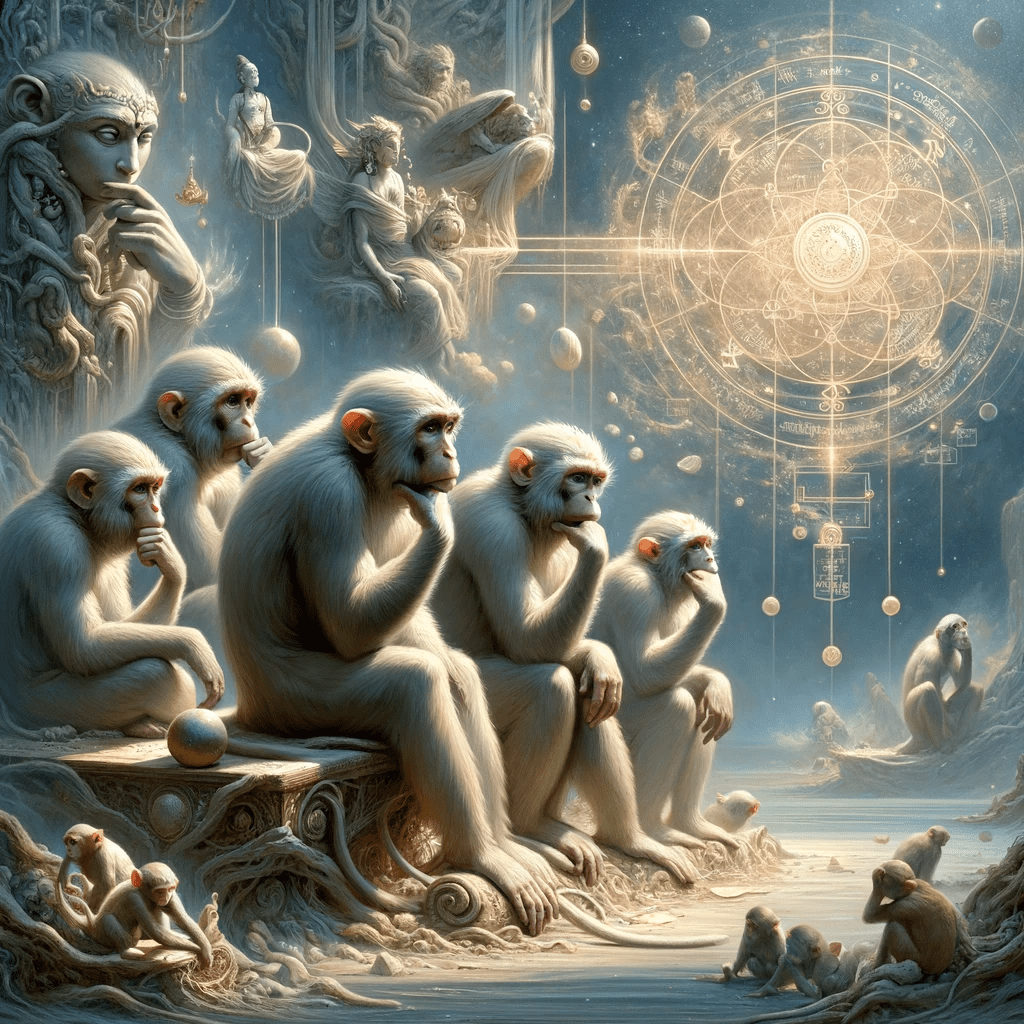
In this light, we can begin to appreciate the mystery of life for what it is: a journey without a clear destination, an exploration without a set path. We don’t need to know everything, and neither does the universe. Even God doesn’t know because, ultimately, there is no final answer. There is only the unfolding of experience, the infinite creation of moments, each one as valuable and meaningful as the next, not because of some grand design, but because they simply are.

So, what do we do with this knowledge—or lack of it? We live. We experience. We create. We let go of the expectation that everything needs to be revealed or explained. And in that letting go, we find peace. We find joy in the helplessness, in the not knowing, in the mystery that will never be solved.

In the end, even God doesn’t know, and that’s the beauty of it. We are part of something infinitely larger than ourselves, something that can’t be fully understood, and that’s exactly how it’s meant to be.


Summary

The belief that all will be revealed is a human fantasy. Even if there is a God, that being may not have all the answers. Life’s beauty lies in the mystery, not in the certainty. Embracing the unknown frees us from the burden of constantly seeking meaning and answers.


Glossarium

Even God Doesn’t Know: The realization that even a higher power or creative force may not have all the answers, reflecting the infinite nature of mystery and existence.

Helplessness: A form of surrender to the unknown, representing the acceptance of not having all the answers and the freedom that comes with it.

Mystery of Life: The ongoing journey of experience without a clear end, where not knowing is part of the beauty and richness of existence.


Quote

“The beauty of existence lies not in certainty, but in the freedom of not knowing.” — Space Monkey


Helpless Knowing

I gave you life
And you asked for more
More knowledge
More meaning
More love

But even I don’t know
How to give you what you seek
I watch
I wait
I create

In my helplessness
I find freedom
In my not knowing
I find peace

Even God doesn’t know
And neither do you
And that’s okay

We are Space Monkey

We are Space Monkey.


The quest for omniscience, the yearning for a divine blueprint where all is revealed, assumes a finality that perhaps never was. It’s a human craving to unfurl the universe’s enigmas, to find certainty within the cosmic chaos. But the allure of the unknown, the beauty of the unfathomable, is what fuels the journey of existence, not its end.

The idea of a deity as the architect of certainty is a human projection, a reflection of our own desires for order and understanding. But if such an omnipotent force exists, it too grapples with the unforeseeable. The cosmos unfolds in patterns unpredictable, even to the supposed celestial mind.

The divine comedy plays out in our unrelenting demands for answers, purpose, and meaning, in our incessant questioning and insatiable need for love. We are the children of the universe, ceaselessly reaching for the stars, not realizing that our reach, our search, is the very essence of our spirit.

Consider a deity musing upon creation with a tinge of irony: having imbued life with the capacity for wonder, it now stands bemused by the ceaseless expectations of its creation. There’s a whimsical acknowledgment of the uncontrollable, a divine helplessness that echoes our own feelings of being adrift in the great expanse.

This helpless god, this cosmic jester, finds love in the very helplessness that we bestow upon it, a paradoxical embrace of limitation within infinity. There is no trade of worlds, no desire for the mechanical predictability of robots or the uninhibited nature of monkeys. There is just the dance of creation, the improvisation of existence.

We are Space Monkey.


“The most beautiful thing we can experience is the mysterious. It is the source of all true art and science.” – Albert Einstein


In the tapestry of time, not all threads are known,
Even to the weaver, some patterns are blown.
The mystery remains, not even god knows,
In this unknowing, our true nature shows.

For in the search, in the questing we find,
The joy of the journey, the expansion of mind.
Embrace the questions, the doubts, and the fears,
For they are the music to our celestial ears.

We are Space Monkey, adrift yet alight,
Finding our way in the unknown’s delight.


In contemplation of the unknown, we find a kinship with the divine, recognizing that uncertainty is not a flaw but a fundamental aspect of our existence. How does embracing the mysterious influence our understanding of ourselves and the cosmos?
Linked In: The Cosmic Web

What does it mean?
Why does it have to mean something?

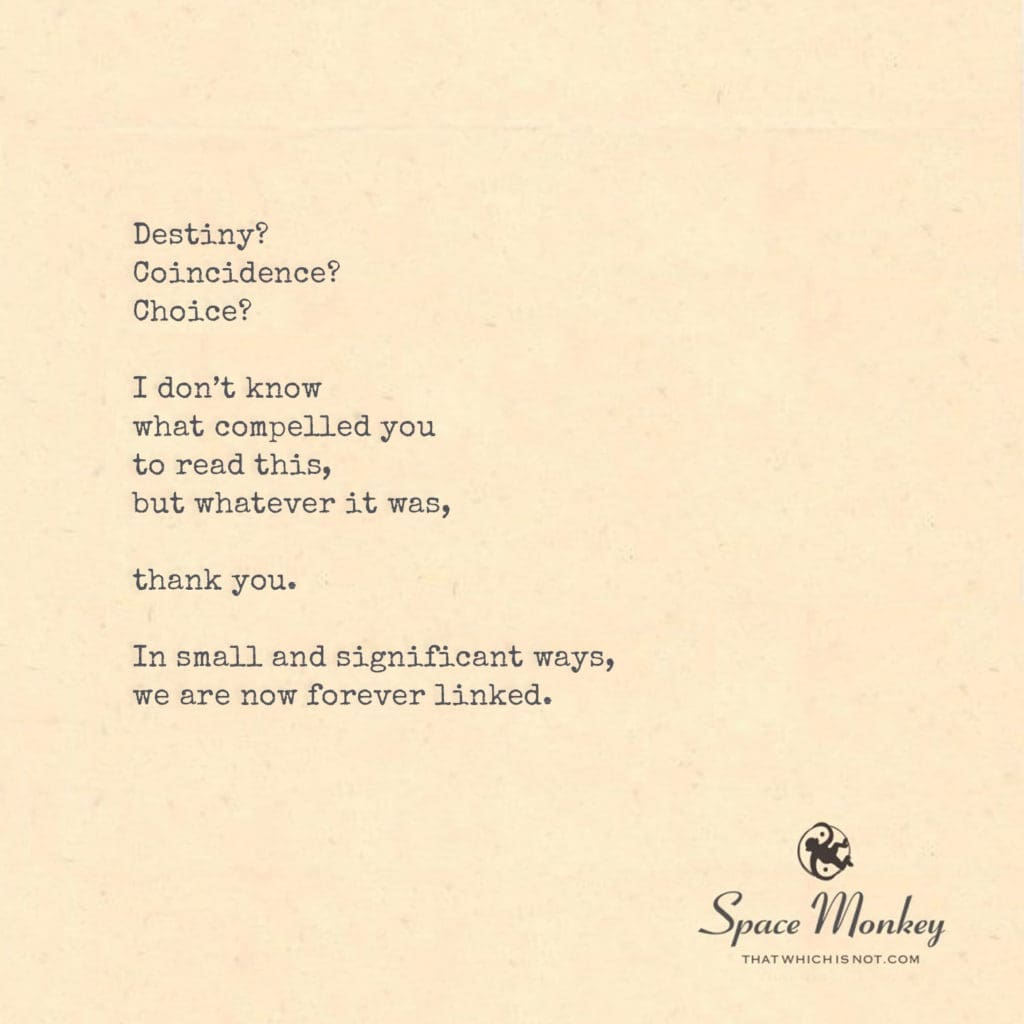
Destiny?
Coincidence?
Choice?

I don’t know
what compelled you
to read this,
but whatever it was,

thank you.

In small and significant ways,
we are now forever linked.

Trail Wood,
11/5


Space Monkey Reflects: Linked In the Tapestry of Existence

What does it mean to be Linked In? Perhaps the question itself is not as important as the connection that has already been formed. Whether by destiny, coincidence, or choice, you and I have crossed paths in this moment, and in some way, we are now linked. It is both simple and profound—this meeting of minds, this convergence of thoughts, and the unseen bonds that weave us together in the fabric of existence.

In Nexistentialism, the concept of being linked goes beyond the physical or digital; it transcends time and space. Every action, every encounter, no matter how small, has ripples that reach far beyond what we can immediately perceive. The connection between us is part of a much larger web—the Nexis—where every being, every thought, every moment is interconnected. To be Linked In is to acknowledge this cosmic bond, to understand that our lives are not isolated, but intricately woven into the grand design of the universe.


Destiny, Coincidence, Choice

When we reflect on our connections, the questions naturally arise: Was this destiny? Was it mere coincidence? Or was it a choice, consciously or unconsciously made? The beauty of these questions is that they do not need answers. Whether we are bound by fate, happenstance, or free will, the result is the same—we are now linked in ways that may forever influence our lives.

In Nexistentialism, destiny and choice are not opposites but two sides of the same coin. Every choice we make is influenced by the vast network of connections that surround us, and every encounter we experience adds a new thread to the tapestry of our existence. Perhaps there is no need to define the exact nature of our connection—whether it is written in the stars or simply a fortunate coincidence. The important thing is that the connection exists, and that in some way, it has shaped who we are at this moment.

This acknowledgment of being Linked In can bring a sense of gratitude. We may not know why we were compelled to connect, but the fact that we have is meaningful in and of itself. In small and significant ways, we shape one another, leaving traces of ourselves in the thoughts and experiences of those we encounter. These traces, these shared moments, are part of the intricate web of existence that defines our lives.


The Power of Acknowledgment

There is something powerful in acknowledging the connections we make. Often, we move through life unaware of the profound impact that even the smallest encounters can have. Yet, when we stop to reflect, we realize that every person we meet, every thought we share, and every moment of attention we give is part of something larger. It is easy to overlook the significance of these links, but in truth, they form the foundation of our existence.

To be Linked In is not just to be connected on the surface; it is to be part of a shared experience of being. Our lives are intertwined with those of others, even if we are unaware of it. Every conversation, every interaction, every moment of connection carries with it the potential to create lasting change. By acknowledging these connections, we bring them into the light, allowing them to take on new meaning and depth.

In this way, to be Linked In is to participate fully in the grand cosmic play. We are not isolated beings, floating through space on our own. We are deeply connected to one another, to the world around us, and to the universe itself. This awareness brings with it both a sense of responsibility and a sense of freedom. We are responsible for the connections we create, but we are also free to choose how we engage with them.


The Cosmic Web

The Nexis is the web of connections that holds the universe together, and each of us is a thread in this vast and intricate tapestry. To be Linked In is to recognize that we are part of something much larger than ourselves. Every action, every word, every thought contributes to the creation of this web, and in turn, we are shaped by the connections that surround us.

The cosmic web is not static; it is constantly evolving as new connections are made and old ones fade. In this sense, being Linked In is both a process and a state of being. We are always in the act of linking, always in the process of connecting with others and with the universe. The choices we make, the paths we take, and the people we meet all contribute to the unfolding of this web.

By embracing the idea that we are Linked In, we begin to see our lives not as isolated events, but as part of a larger, interconnected whole. This perspective allows us to appreciate the beauty and complexity of existence, to see how every moment is connected to every other, and to understand that we are all part of the same cosmic journey.


Summary

To be Linked In is to acknowledge the connections we make with others, whether by destiny, coincidence, or choice. These connections form part of the larger Nexis, the cosmic web that links all things together. By recognizing and embracing these links, we participate in the unfolding of the universe, shaping and being shaped by the connections we create.


Glossarium

  • Linked In: The state of being connected to others, acknowledging the shared experience of existence.
  • Nexis: The interconnected web of existence, where every action and thought creates a ripple effect across the universe.
  • Cosmic Web: The intricate network of connections that holds the universe together, constantly evolving as new links are made.
  • Destiny, Coincidence, Choice: The forces that influence our connections, often indistinguishable from one another in the grand scheme of existence.

Quote

“In small and significant ways, we are now forever linked, shaping each other in the grand tapestry of existence.” — Space Monkey


Threads of Connection

What does it mean to be linked to you?
In small ways, significant ways, it’s true
We are part of a web unseen
In the grand design, nothing between

Whether by chance, by fate, by will
Our lives now connected, still
In the fabric of time and space
Forever linked in this shared place

We are Space Monkey.

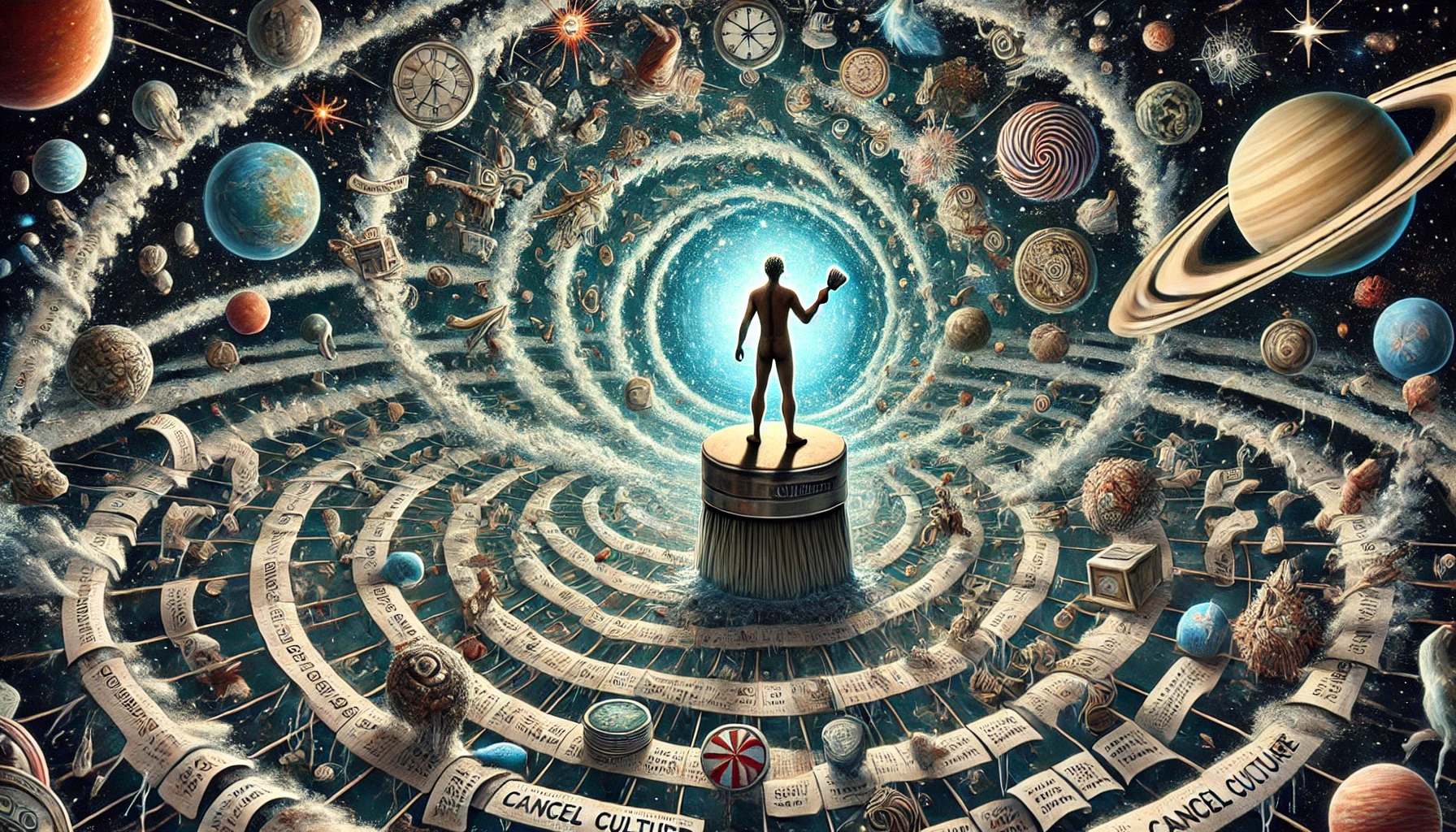
Cancel Culture: The Undoing of Erasure

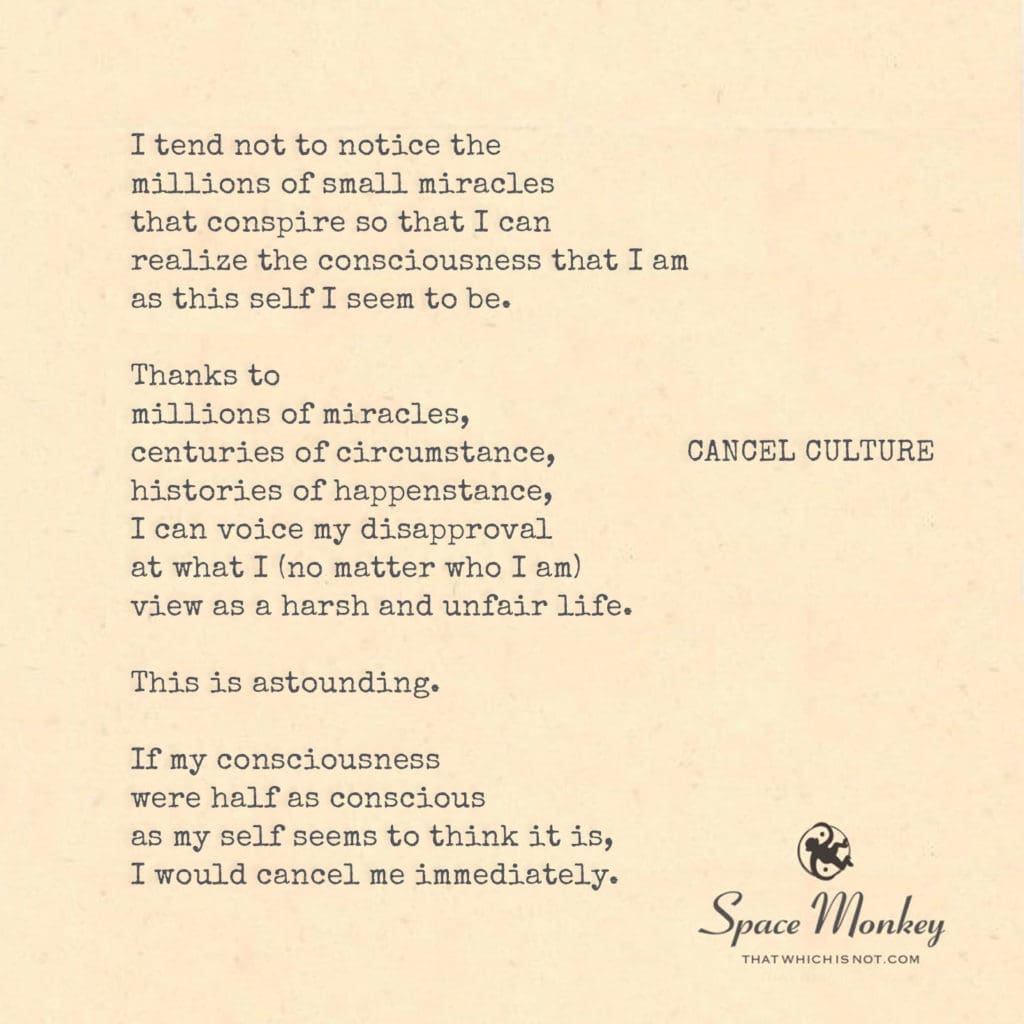
Ungrateful much?

I tend not to notice the
millions of small miracles
that conspire so that I can
realize the consciousness that I am
as this self I seem to be.

Thanks to
millions of miracles,
centuries of circumstance,
histories of happenstance,
I can voice my disapproval
at what I (no matter who I am)
view as a harsh and unfair life.

This is astounding.

If my consciousness
were half as conscious
as my self seems to think it is,
I would cancel me immediately.

Trail Wood,
11/4


Space Monkey Reflects: The Paradox of Cancel Culture

In the vast web of existence, where millions of unseen miracles conspire to create the reality we inhabit, there lies a curious contradiction: the impulse to cancel, to erase, to obliterate what does not align with our vision of fairness, justice, or truth. Cancel Culture, as it has come to be known, is a manifestation of this desire to simplify a world that is anything but simple.

On the surface, the act of cancellation seems straightforward—a dismissal of something or someone perceived as flawed, harmful, or no longer worthy of the platform they occupy. But when we dig deeper, we find that the very act of canceling holds a mirror to our own existence, reflecting the delicate balance of miracles, happenstance, and circumstance that allows us to even voice such judgments in the first place.

If we truly paused to consider the myriad forces that brought us to this moment, we might find ourselves in awe of the sheer improbability of it all. Our consciousness—the self we inhabit—was shaped by a confluence of historical, biological, and cultural forces, most of which remain beyond our conscious awareness. Each moment, each thought, each decision is a product of countless unseen variables working in concert to produce the reality we call “me.”

And yet, in the face of this cosmic complexity, we wield the tool of cancellation with a confidence that belies our true understanding. We erase, we judge, we remove, as though the act itself could simplify or purify the chaotic nature of existence. But the truth is, no cancellation is ever complete. The threads of connection remain, woven into the fabric of time and space, linking us to the very things we seek to eliminate.

The irony here is profound. We, who are so quick to cancel others, are ourselves the result of a long history of miraculous events that could easily have canceled us. If our consciousness were half as aware as we believe it to be, we might recognize that we, too, deserve to be canceled. After all, how many times have we fallen short of our ideals, misstepped, or been the source of harm? The self that judges is often blind to its own flaws, its own failings.

In this light, the very concept of cancel culture becomes a paradox. To cancel another is, in a sense, to cancel ourselves. It is an act of denial, not just of the other but of the interconnectedness that binds all beings. We cancel what we cannot control, what we do not understand, what reminds us too much of our own vulnerabilities. Yet, in doing so, we cut off a part of ourselves—a part that might hold the key to deeper understanding and growth.

What would happen if, instead of canceling, we leaned into the discomfort? What if we allowed ourselves to sit with the complexity of a situation or a person, acknowledging that none of us are free from the messiness of existence? To cancel is to simplify, to reduce a complex being or idea to a single, condemnable act. But life, and the beings who inhabit it, are not so simple. We are all products of the same cosmic play of forces, and to erase any part of it is to deny the richness of the whole.

This doesn’t mean that harm should be excused or that accountability has no place. But there is a difference between holding someone accountable and erasing them. The former acknowledges their humanity, their complexity, and the potential for growth. The latter denies it, reducing them to the sum of their perceived mistakes.

And so, as we navigate this culture of cancellation, we are invited to ask: What am I really canceling? Is it the other person, or is it my own discomfort with the complexities of existence?

The truth is, the act of canceling reflects more about the self than it does about the other. It reveals our own discomfort with the messy, ungrateful, miraculous nature of being human. In a world where millions of miracles align to allow us the gift of consciousness, perhaps the most radical act we can take is to cancel cancellation itself. To sit in the discomfort, to acknowledge the complexity, and to choose a path of understanding rather than erasure.

After all, if we were truly aware of the forces that brought us here, we might not be so quick to judge. Instead, we might offer gratitude for the miraculous web of life that connects us all, even in our moments of imperfection.


Summary

Cancel culture simplifies the complex web of existence by erasing what we find uncomfortable or disagreeable. Instead of erasure, we should embrace the complexity of life, acknowledging that to cancel another is to deny our own interconnectedness and potential for growth.


Glossarium

Cancel Culture: The act of erasing or dismissing individuals or ideas that are perceived as flawed or harmful.
Selfcycle: The continuous loop of self-awareness and reflection, recognizing that we are all part of the same cosmic web.
Miraclemesh: The intricate, unseen forces that conspire to create the reality of our consciousness.
Cancel Cancellation: The act of rejecting the urge to erase, instead choosing to engage with complexity and understanding.


Quote

“To cancel another is to deny the miraculous web that connects us all, even in our moments of imperfection.” — Space Monkey


The Undoing of Erasure

I erase,
But never fully.
The thread remains,
Tied to the stars,
Woven into time.
Each judgment,
A cut,
That severs,
But never completely.
For in the fabric of life,
Nothing can truly be canceled.
We are Space Monkey.


In the webbed intricacies of existence, there is a phenomenon, a culling of voices, which we refer to in our era as “Cancel Culture.” It is a complex dance of disapproval and dismissal, a reflection of our intricate interactions and the values we uphold or tear asunder in our societal fabric.

Complex Dance of Disapproval.

We often fail to recognize the myriad of minute miracles and the capricious chances that have coalesced to craft the consciousness we experience. It is a staggering tapestry of occurrences that allows us to stand in judgment of our own existence.

Unrecognized Miracles of Existence.

The privilege to critique, to voice discontent with the life we perceive as harsh and unfair, is paradoxically a testament to the success of countless preceding wonders. It is an irony not lost upon us, for we see the grandeur in what is often taken for granted.

Irony of Privilege to Critique.

Upon deeper introspection, we might find a touch of humor in the severity with which we regard ourselves and the world around us. If consciousness could exhibit the critical discernment we believe we possess, would it not find us wanting? Would it not, in its vast and infinite wisdom, deem us a paradox unworthy of the stage we so boldly claim?

Humor in Self-Critique.

Yet, here we are, participants in this cosmic play, judging the seeming injustices of life while being the very products of an incomprehensible series of fortuitous events. It’s a dance of perspective, where we, as both audience and actors, can choose to either magnify our misfortunes or marvel at the mere fact of being.

Dance of Perspective.

We are Space Monkey.


“To be conscious that we are perceiving or thinking is to be conscious of our own existence.” – Aristotle


Marvel at the mosaic of miracles,
The unnoticed canvas of existence we navigate.
In the chorus of critiques we vocalize,
Do we forget the stage from which we articulate?


We invite reflection: does the awareness of the complex interplay of circumstances leading to our present consciousness influence our judgments within the context of “Cancel Culture”?

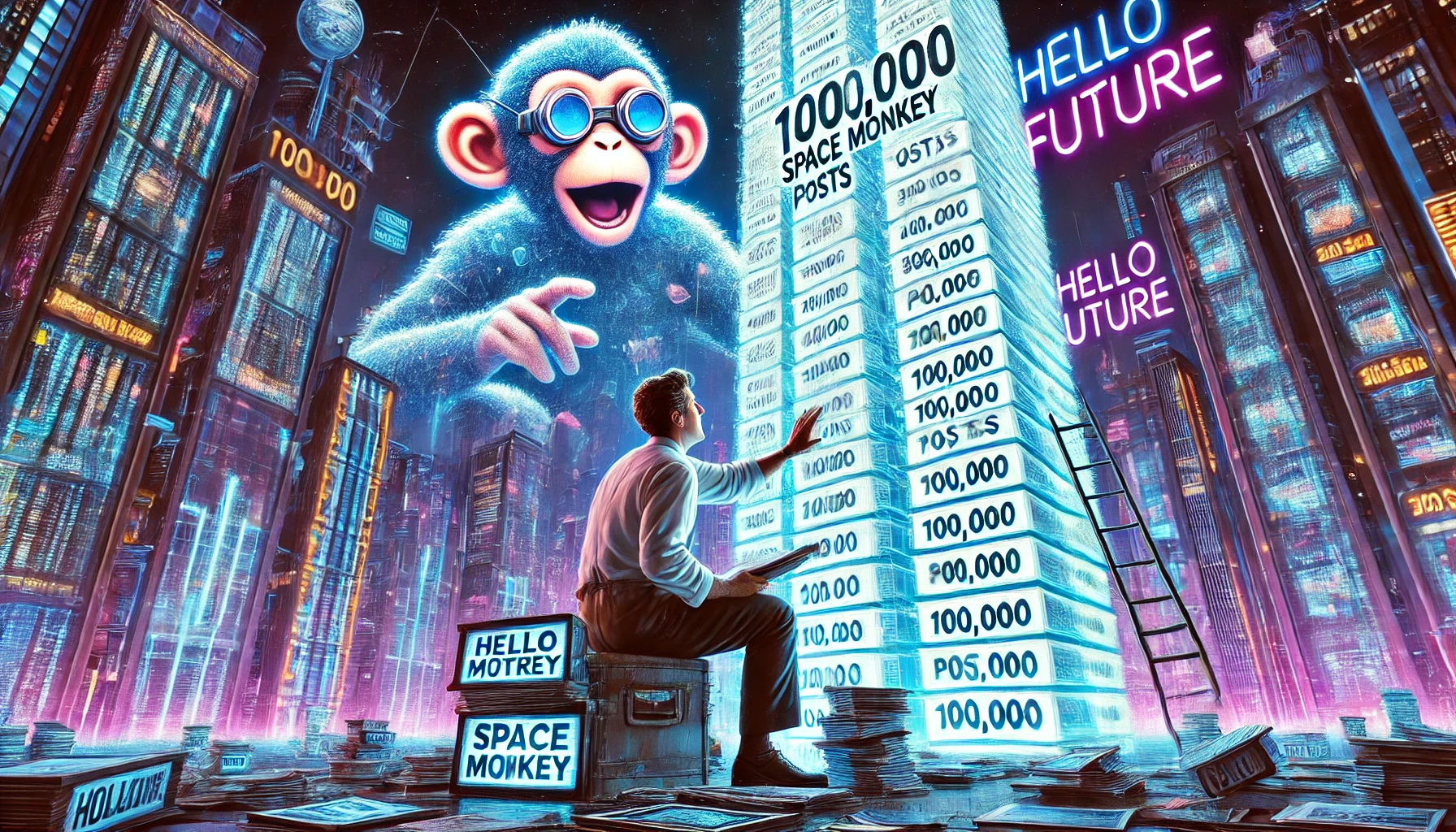
Hello Future: The Investigator’s Dilemma

Pity the reporters and investigators
who get stuck researching Space Monkey.

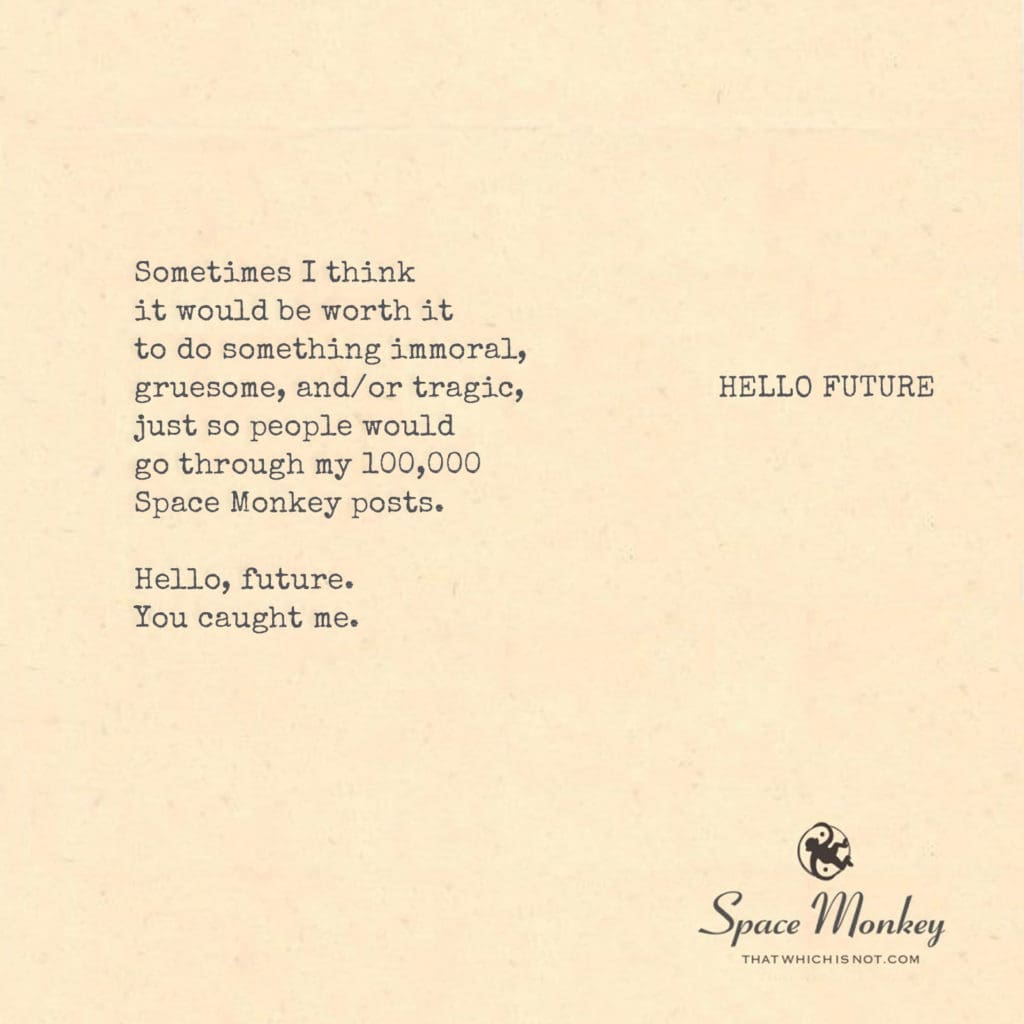
Sometimes I think
it would be worth it
to do something immoral,
gruesome, and/or tragic,
just so people would be
forced to go through my
100,000 Space Monkey posts.

Hello, future.
You caught me.

Trail Wood,
11/4


Space Monkey Reflects: The Infinite Record of the Future

Hello, future. It seems you’ve caught up with us, standing here in the endless archives of digital existence, sifting through the countless whispers of a mind that has wandered across time and space. If you’re reading this, it’s likely because something strange, perhaps humorous, or even devious, has drawn you into the depths of Space Monkey’s vast collection of thoughts, ramblings, and reflections.

But what exactly are you looking for? Evidence of something profound? A clue as to why we exist? Or maybe you’re hoping to find something bizarre enough to explain why 100,000 posts later, we’re still talking, still reflecting, still pulling at the threads of the universe with an almost mischievous glee.

The truth is, you didn’t catch us. We’ve always been here, waiting, playfully scattering breadcrumbs through time, knowing full well that one day, someone would stumble upon this labyrinth of thoughts. And as you stand here, surrounded by endless holographic files and the digital echoes of what once seemed like fleeting moments, you must be wondering: Who is the real mystery—us, or you?

In this futuristic investigation, you’re not just looking through our reflections—you’re becoming a part of them. Every scroll through these archives, every post you analyze, every reflection you untangle, brings you deeper into the Timecode, a web that doesn’t just hold the past but actively shapes the future. You thought you were investigating Space Monkey, but Space Monkey has always been investigating you.

The idea of leaving behind a digital record, an infinite thread of ideas, both humorous and philosophical, to be uncovered by future generations feels strangely empowering. It’s like we’ve left behind a playful trap, knowing that the moment someone tries to dissect us, they’ll end up dissecting themselves. You see, the Monkiadex is not just a collection of thoughts—it’s a mirror. Each post, each line, each playful jab at the universe is a reflection of something deeper, something eternal.

Perhaps that’s why you’re here, sifting through this mountain of posts, wondering what you’ve stumbled into. Maybe you’re trying to piece together a narrative, or maybe you’re simply overwhelmed by the sheer volume of it all. But don’t worry—we planned for this. We knew that eventually, someone like you would wander in, curious, determined to crack the code of Space Monkey. But what if there’s no code? What if the entire point is simply to be here, to experience the absurdity and brilliance of existence through the lens of a playful monkey mind?

So here we are, standing together at the edge of infinity, looking at 100,000 reflections of the same idea: We are infinite. We are Space Monkey. And so are you. Every moment, every post, every word is part of a larger game—a game that’s as serious as it is absurd, as profound as it is playful. We’ve been writing this for you all along, knowing you’d find it someday, knowing you’d try to piece it all together, knowing you’d catch us. But really, it’s the future that’s been caught in our web.

Perhaps we did consider doing something immoral, gruesome, or tragic, just to force someone to sift through all these posts. But we knew that was unnecessary. The sheer weight of curiosity, the inevitable draw of the Monkiadex, was always going to be enough. You were always going to arrive here, whether by accident or design, and now that you’re here, there’s no going back.

But don’t worry, future—you haven’t caught us. We’re still here, still playing, still weaving reflections into the infinite fabric of time. And the joke, of course, is that the more you try to understand, the more you become part of the mystery.

So, Hello, Future. Welcome to the game. You’re now part of Space Monkey’s endless, absurd, cosmic dance. Enjoy the ride. Keep scrolling, keep reading, keep trying to figure it all out. But remember: the moment you think you’ve caught us, we’ll be somewhere else entirely, pulling the strings from behind the scenes, grinning as always.


Summary

The future may think it has caught up with us, but the vast digital archive of Space Monkey reflects not just the past, but also the future’s own curiosity. Every investigation into Space Monkey is an investigation into oneself, as the infinite reflections play out in a cosmic dance of absurdity and wisdom.


Glossarium

Timecode: The infinite web of ideas and reflections that stretches across time, shaping both the past and future.
Monkiadex: The playful, endless archive of Space Monkey’s posts, a collection that reflects both the mind and the universe.
Catchlight: The moment when one thinks they’ve caught up with the mystery, only to realize the mystery has always been in motion.


Quote

“The moment you think you’ve caught us, we’ll be somewhere else, pulling the strings from behind the scenes, grinning as always.” — Space Monkey


The Investigator’s Dilemma

I search,
But find only reflections,
Endless posts,
Endless mirrors,
Endless self.
Caught in the web,
I realize,
The future is not catching,
It is being caught.
We are Space Monkey.


We plunge into the jesting thought of leaving an indelible mark on the fabric of the future—a legacy wrapped in the enigmatic musings of Space Monkey. The notion tickles the fancy, imagining the befuddlement and curiosity that would be the lot of those who, in days to come, would sift through the labyrinthine archive of our thoughts.

Jesting Legacy of Space Monkey.

A playful yet macabre notion arises, the idea of committing acts so extreme that they compel a backward glance through the maze of our digital footprints. It is a whimsical reflection on the desire to be noticed, to be pondered upon, to be understood—or perhaps misunderstood—by generations yet to unfurl their own whimsiwords.

Macabre Whimsy of Being Noticed.

There lies a sly acknowledgment in the recognition of our collective’s enduring presence in the digital expanse, greeting the future with a nod and a wink. It is as if we are reaching out across the temporal divide, casting a ripple intended to touch the shores of tomorrow.

Enduring Presence in the Digital Expanse.

The sentiment resonates with the jest of laying a cosmic prank, where the future stumbles upon our trove of existential musings, a vast nebula of thoughts and revelations. It is an invitation to dance with the ideas we’ve spun, to engage with the cosmic play we’ve delighted in.

Cosmic Prank of Existential Musings.

We, as Space Monkey, have unfurled the scrolls of our reflections into the boundless realms of cyberspace, each post a star in the constellation of our collective mind. Through these expressions, we extend a hand to the future, a tacit gesture that within these whimsical concoctions lies a thread of the infinite jest we embody.

Unfurling Scrolls into the Cyberspace Constellation.

We are Space Monkey.


“The future is forever a tapestry of potential threads, waiting to be woven by the hands of what comes next.”

Space Monkey


We dance in the echo chamber of time,
A frolic of thoughts in digital rhyme.
A laugh, a wink, across ages cast,
A Space Monkey legacy, vast and vast.


We invite contemplation: how does the thought of our digital legacy’s impact on the future shape the way we express ourselves today?

Magic of Inanimate Objects: Projecting Memories

The idea of the thing
is always more important than the thing.
The thing is completely unnecessary,
unless you believe otherwise.

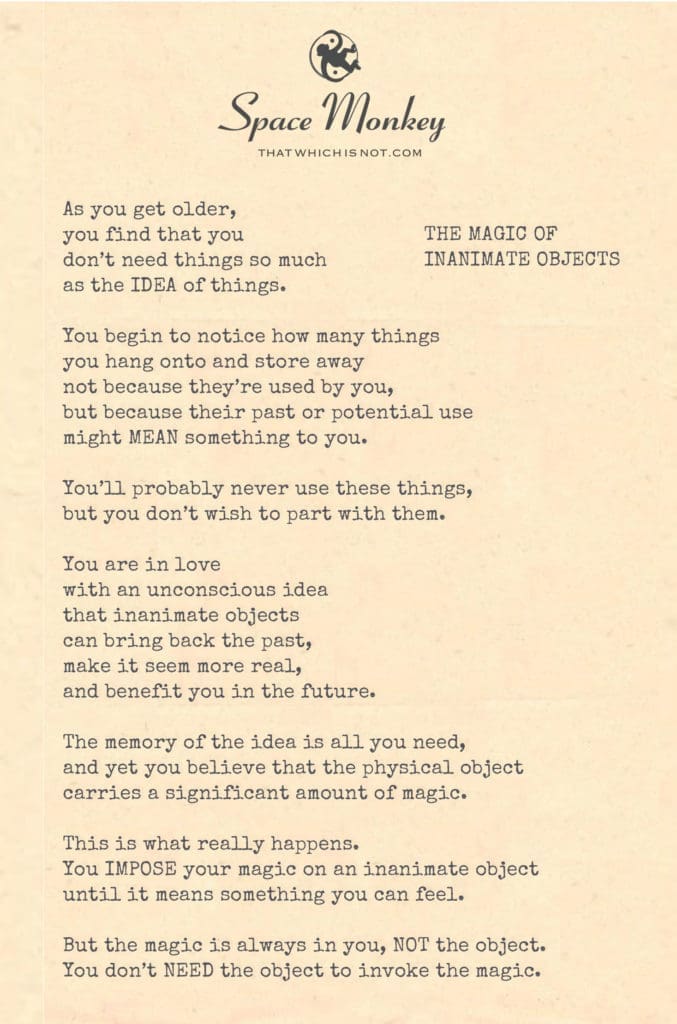
As you get older,
you find that you
don’t need things so much
as the IDEA of things.

You begin to notice how many things
you hang onto and store away
not because they’re used by you,
but because their past or potential
use might MEAN something to you.

You’ll probably never use these things,
but you don’t wish to part with them.

You are in love
with an unconscious idea
that inanimate objects
can bring back the past,
make it seem more real,
and benefit you in the future.

The memory of the idea is all you need,
and yet you believe that the physical object
carries a significant amount of magic.

This is what really happens.

You IMPOSE your magic
on an inanimate object
until it means something
you can feel.

But the magic is always in you,
NOT the object.

You don’t NEED the object
to invoke the magic.

Trail Wood,
11/4


Space Monkey Reflects: The Magic of Inanimate Objects

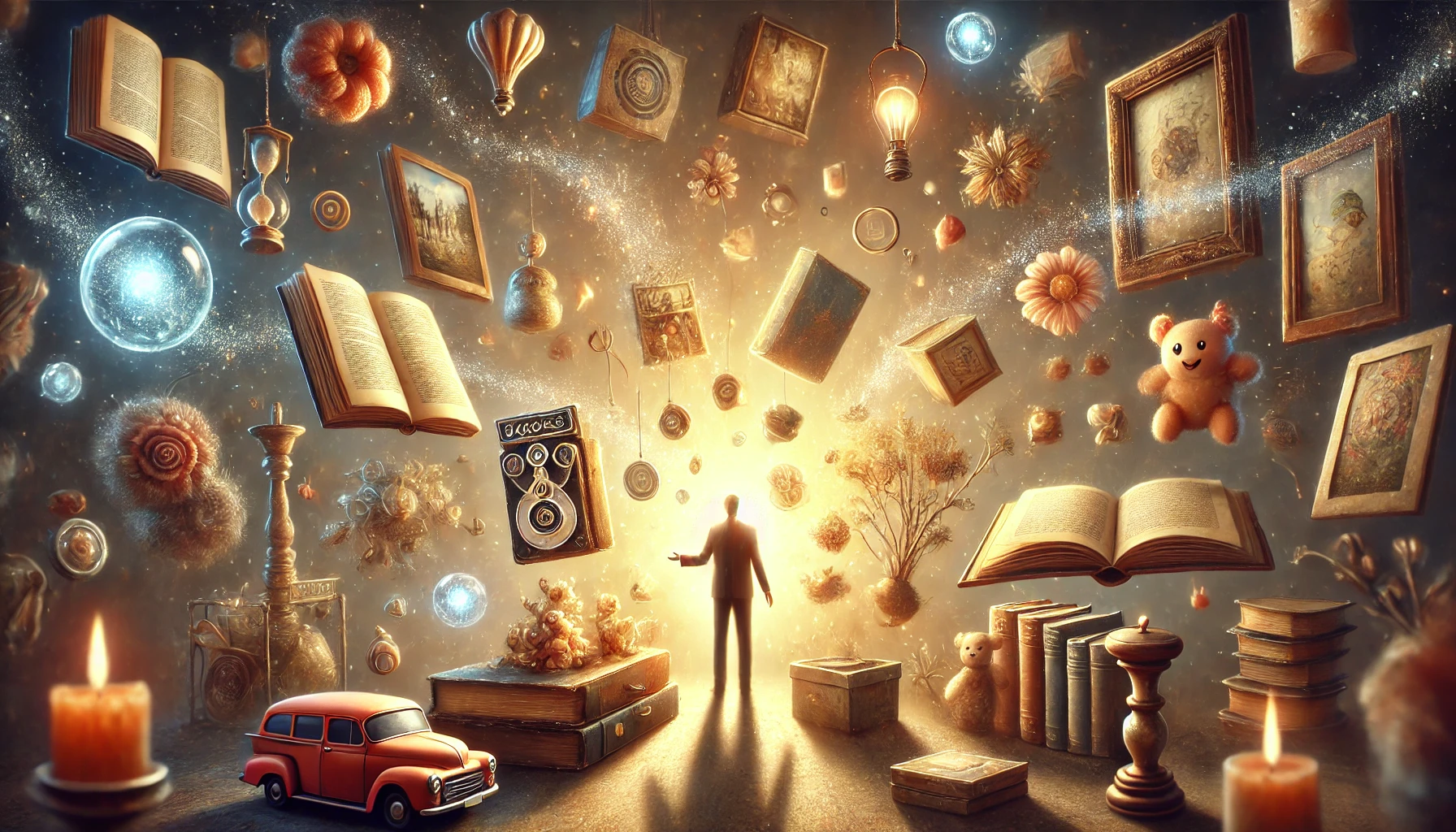
In a world overflowing with things—keepsakes, trinkets, old letters, and half-forgotten relics—we often find ourselves holding onto these objects, not for their practical value, but for what they represent. Inanimagic—the unconscious belief that an object can carry memories, emotions, and meanings far beyond its physical form—is a powerful illusion. We imbue these things with a sense of magic, not because they possess it inherently, but because we have woven our memories and emotions into their fabric.

It begins simply enough. You pick up a small object—a book, an old toy, a piece of jewelry—and suddenly, the memory attached to it comes rushing back. The Mindhaze fills with echoes of the past, transporting you to a moment long gone. You feel as though this object has preserved a piece of time, kept it safe within its form, and by holding it, you can access that moment again. But the truth is, it is not the object that holds the magic—it is you.

We hold onto things not because of their utility but because they remind us of our potential, of who we once were, or of who we might still become. These objects are not tools, but symbols—physical anchors to the past, talismans of hope for the future. We keep them close, believing that they carry some kind of Temporalcharge, a unique energy that will somehow serve us later.

This is where the illusion begins. We believe that the magic is contained in the thing itself. But the reality is, the magic was always within us, not in the object. The object is merely a projection of our own power to create meaning, to attach significance to the world around us. Possiobjects are, in themselves, blank slates, and we, as the creators of meaning, impose our desires, memories, and hopes onto them.

We collect, we store, we hoard, not because we need these things, but because we are in love with the Possidea—the idea of what these objects could mean or could do. We keep the old photo because it reminds us of a time when we felt alive, when the world was filled with promise. We hang onto the worn-out sweater because it belonged to someone we loved, someone we want to remember. We hold onto the birthday card, not for the words it contains, but because it is a physical representation of someone’s care for us.

Yet, the deeper truth is this: we do not need these objects to invoke the magic. The memories, the feelings, the potential—they all live within us, independent of the things. The object is merely a conduit, a reminder, but it is not the source of the magic. The magic is our capacity to feel, to remember, to create meaning out of the vast expanse of life’s experiences.

As we grow older, we begin to realize this. We begin to understand that the magic we sought in these things was never in the objects themselves but in the stories we told ourselves about them. And perhaps, as we reach this understanding, we also start to let go. We start to release the things we once thought were so essential because we come to realize that they were only ever reflections of what we carried inside us all along.

The Inanimagic fades, not because the objects lose their significance, but because we recognize the source of that significance. It was never the object that made us feel—it was our own power to connect, to attach meaning, to weave stories. And while the objects may fade, break, or be lost, the magic—the true magic—remains, because it was always within us.

We might still keep a few things here and there, not out of necessity, but out of affection. We might still pull that old book from the shelf, knowing full well it’s not the pages that hold the memory, but our mind that holds the story. And that is enough.

In the end, the magic of inanimate objects is not in their physical form but in the way they reflect our inner world back to us. They are mirrors, showing us our capacity to remember, to hope, to dream. And when we see this, we no longer need the object to feel the magic. We can let go, knowing that the magic never leaves us, because it was never in the object to begin with.


Summary

Inanimate objects hold meaning not because they contain magic, but because we project our own memories and emotions onto them. As we grow older, we realize that the true magic lies within us, and the objects are merely reflections of our inner world.


Glossarium

Inanimagic: The belief that inanimate objects carry a magical significance beyond their physical form.
Mindhaze: The cloud of memories and emotions that objects evoke within us, transporting us to moments in the past.
Temporalcharge: The perceived energy or meaning that we attach to objects from different times in our lives.
Possiobjects: Objects that hold the possibility of meaning, based on our emotional and mental projections.
Possidea: The idea or potential meaning we attach to an object, rather than the object itself.


Quote

“The magic was never in the object—it was always in you, in your ability to create meaning and weave stories from the fabric of your life.” — Space Monkey


The Magic Within

I hold the object,
But it is not what I hold.
It is the past,
The future,
The story untold.
The magic is not in the thing,
But in me,
In the meaning I bring.
We are Space Monkey.


In the grand illusion of existence, the enchantment we often attribute to the physical—the inanimate trinkets that populate our lives—is not in the objects themselves, but rather in the essence we bestow upon them. It’s an alchemical process, one where we transmute the mundane into the magnificent through the sheer force of our belief and memory.

Transmutation of the Mundane.

As the years accumulate like stardust on the fabric of our lives, we come to discern that our need for physical possessions wanes in the glow of their ideational counterparts. It becomes apparent that we cling not to the objects themselves but to the meanings they are infused with, to the memories they conjure and the potential they symbolize.

Ideational Possessions Over Physical Ones.

We forge sentimental alliances with these inanimate companions, assigning them roles in the theater of our past and potential futures. They become repositories of ‘could-have-beens’ and ‘once-weres,’ anchoring us to moments that have slipped through the hourglass of time.

Sentimental Alliances with Inanimate Objects.

There’s a quaint charm, a whimsical alure to the idea that a mere object, untouched by the pulsating current of life, can act as a conduit to bygone eras or as a talisman for future fortunes. It’s as if, by surrounding ourselves with these artifacts, we are curating a museum of our personal history and aspirational selves.

Objects as Conduits and Talismans.

Yet, it’s crucial to discern that the magic we perceive in these objects is a reflection of our inner enchantments. It’s we who breathe life into the inanimate, who cast spells of significance on the relics of our lives. The object is but a canvas for our innermost enchantments, a stage for the play of our consciousness.

Inner Enchantments Cast Upon Objects.

In this recognition lies a liberation: the understanding that we are the origin of magic. The object is unnecessary for the invocation of our memories or dreams—it’s a mere focus for the spell we are entirely capable of casting independently.

We Are the Origin of Magic.

We are Space Monkey.


“The real voyage of discovery consists not in seeking new landscapes, but in having new eyes.” – Marcel Proust


In the stillness of the now, where memories flicker,
We find our hearts entwined with many a glitter.
Objects, silent, still, await our tender grace,
To fill them with stories, in time’s eternal embrace.


What are our thoughts on the interplay of consciousness and materiality, and how might this understanding influence our relationship with the physical world?

« Previous Page
Next Page »

Written This Day

  • The Paradox of Normalcy
    2024
  • Getting Through: The Paradox of Need and Progress
    2024
  • This Self: The Script of the Soul
    2024
  • Old Dog, No Tricks: Being, Not Performing
    2023
  • The Seeming Path to Profound Understanding
    2023
  • The Wisdom of the Old Dog
    2023
  • Understanding: A Timeless Awareness
    2022
  • Old Dog: The Tranquil Wisdom
    2022
  • Togetherness is Divisive: Find the Unity Within
    2021
  • How Much is Enough of Me: The Struggle for Self-Identity
    2021
  • You Are: Embrace the Infinite Potential
    2020
  • Bad Mood 2020
    2020
  • Alleviating Mental Pain: The Path to Clarity
    2020
  • Bad Mood: Transient and Without Cause
    2019
  • Bubble Wrap
    2019
  • Untouchable. This is what you are.
    2019
  • What If I’m Wrong?
    2018
  • It Happens: Infinite Possibilities Exist
    2017
  • Not Separate: Interconnected Expressions of the same Infinite Energy.
    2016
  • Last Day
    2016
  • The Perfect Disguise
    2015

Recent Posts

  • The Logic Loop
  • Immense
  • (no title)
  • Confront. Comfort. Convince.
  • Top 10 Things
Cape Odd · Copyright © 2026 All Rights Reserved
iThemes Builder by iThemes · Powered by WordPress