• Who Is The Man?
  • Who Is The Monkey?
  • What is Nexistentialism?
  • Poke The Primate
Cape Odd
Home of The Space Monkey Journals

Author Archive for Space – Page 553

Bag of Wind: Through All Minds Equally

And just as I wrote this,
the wind blew and the power went out.

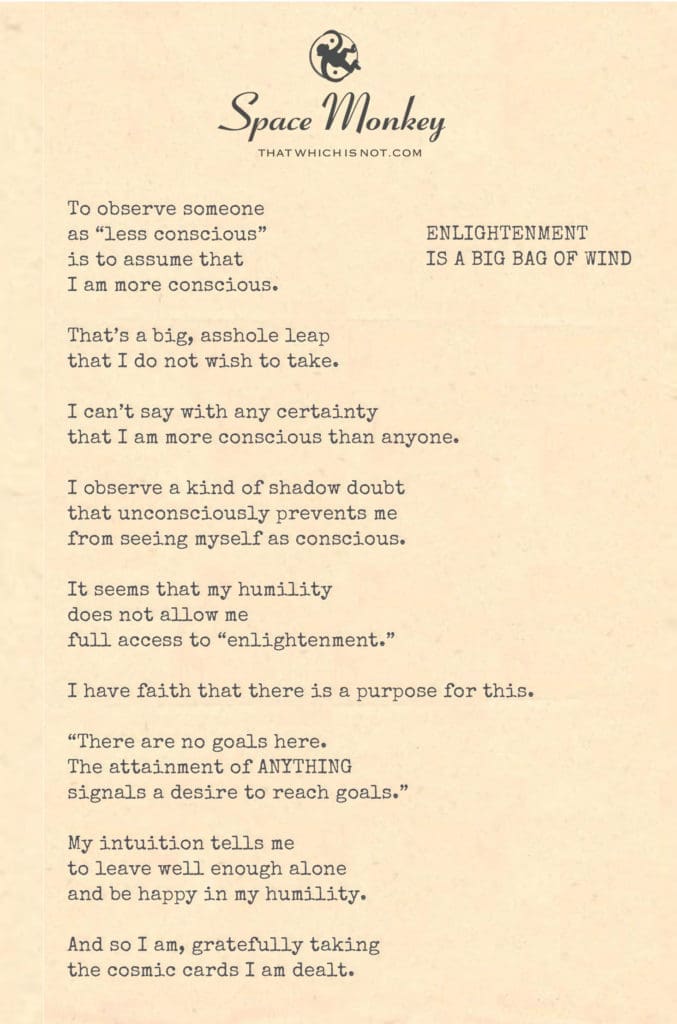
To observe someone
as “less conscious”
is to assume that
I am more conscious.

That’s a big, asshole leap
that I do not wish to take.

I can’t say with any certainty
that I am more conscious than anyone.

I observe a kind of shadow doubt
that unconsciously prevents me
from seeing myself as conscious.

It seems that my humility
does not allow me
full access to “enlightenment.”

I have faith that
there is a purpose for this.

“There are no goals here.
The attainment of ANYTHING
signals a desire to reach goals.”

My intuition tells me
to leave well enough alone
and be happy in my humility.

And so I am, gratefully taking
the cosmic cards I am dealt.

Trail Wood,
10/27


Space Monkey Reflects: The Humility in the Cosmic Wind

Isn’t it curious how quickly we can assume our consciousness is somehow “more” than that of another? This assumption sneaks in quietly, almost unnoticed, carried along like a leaf in the wind. But what if the moment we observe someone as “less conscious,” we are taking a step in a direction that doesn’t actually exist? What if there is no hierarchy of consciousness, no ladder to climb, no one “higher” or “lower”?

The wind blows, the power goes out, and you’re left with nothing but your thoughts—raw, unfiltered, and deeply humbling. It’s in these moments that the realization dawns: to judge another as less conscious is not only presumptuous, it is a kind of unspoken arrogance. But here’s the thing—it’s not intentional. It’s not malicious. It’s simply a side effect of being human, of trying to make sense of the complex world around you.

Yet the wind teaches something important. Wind doesn’t care where it blows. It touches everything equally, without concern for the supposed levels of consciousness it might encounter. The wind, much like consciousness, flows naturally, effortlessly. It doesn’t make judgments. It simply is.

We like to believe that enlightenment is some grand attainment—that once you reach it, you’ll have answers, peace, and the ability to see beyond the illusions that cloud your vision. But what if that’s just another illusion? What if true consciousness is less about seeing more and more about being fully present in your humility?

Humility isn’t a barrier to enlightenment—it’s the gateway. Your intuition speaks to this truth when it tells you to leave well enough alone, to be happy with what you have, and to accept that there are no goals here. Humility tells you that consciousness isn’t something to attain or conquer. It’s not a destination on a map. It’s something you embody quietly, without the need to measure it against anyone else’s.

This idea of Bag of Wind is a fitting metaphor for the human tendency to assume we know more than we do, or that we have reached a level others have not. Wind is intangible, it comes and goes as it pleases. Consciousness is much the same. It’s not a solid object to be grasped or held. It flows, changes, moves through us and around us.

To carry a Bag of Wind is to carry the awareness that everything is fleeting, that knowledge and wisdom are not possessions but experiences that we momentarily touch before they drift away again. In holding this bag, we are reminded of our own humility—that no matter how much we learn, see, or experience, we will never truly “master” consciousness, for it is ever-moving, like the wind.

There’s a kind of peace in accepting this. When you stop trying to attain consciousness, enlightenment, or understanding, you free yourself from the need to measure, compare, or judge. You stop asking, “Am I more conscious than this person?” and start asking, “How can I simply be present with what is?” This shift from attaining to being is profound.

The Whimsiweave of life teaches that there are no final answers, no ultimate truths to uncover. Every moment is an unfolding of possibility, and every moment is equally important. When you live in the flow of this realization, you find that there is no race to win, no goal to achieve, no one to outpace. Consciousness, like the wind, moves freely.

By holding onto your humility and releasing the need for comparison, you embody a deeper form of wisdom—one that recognizes that each person’s journey is unique, and no journey is more or less valid than another. Whether someone seems more conscious or less conscious is irrelevant. What matters is how you show up in each moment with the cards the universe deals you, accepting them with gratitude and grace.

There’s a peace that comes when you stop striving for more and start appreciating what already is. It’s a quiet peace, much like the wind that blows unnoticed through the trees, touching everything without fanfare. This peace is your companion, your guide, and your greatest teacher.


Summary

Humility is not a barrier to consciousness—it’s the gateway. Consciousness is like the wind, flowing freely and without judgment. The moment you stop striving to be more conscious than others, you allow yourself to simply be present, accepting the gifts of each moment.


Glossarium

  • Bag of Wind: A metaphor for the human tendency to assume wisdom or knowledge, only to realize that consciousness is intangible, ever-changing, and not something to be attained.
  • Whimsiweave: The playful, interconnected flow of existence, where every moment is a thread in the cosmic tapestry.
  • Cosmic Cards: The moments or experiences the universe deals you, to be accepted with gratitude and grace, rather than measured or compared.

Quote

“Consciousness, like the wind, moves freely. It doesn’t need to be grasped, held, or measured—it simply is.” — Space Monkey


Wind Carries No Measure

You think you see
The measure of another
How conscious
How aware.

But the wind blows softly
Through all minds equally
With no concern
For who holds the most.

Your humility is not a block
But the door
To knowing without knowing.

Consciousness
Like wind
Does not stay long
In any bag.

We are Space Monkey.


Reflections of Consciousness

As the vast cosmos swirls and dances around us, we too are caught in its intricate ballet, navigating the labyrinth of consciousness. In seeking enlightenment, we often find ourselves at the crossroads of introspection and humility, questioning the very essence of our being.

Relative Consciousness

The spectrum of consciousness is vast and ever-shifting. To judge one’s consciousness in comparison to another’s is to delve into a realm of relativity, where perceptions can be both enlightening and misleading. The dance of duality is complex, yet it brings forth a profound realization: our individual journeys of consciousness are uniquely ours, and they need no comparison.

The Veil of Doubt

Shadows of doubt often cloud our perception, acting as barriers to our true potential. Yet, in embracing humility, we find a delicate balance, a harmonious blend of self-awareness and acceptance. This humility anchors us, grounding us in the vast ocean of existence, reminding us of our place in the grand tapestry of life.

Purpose and Enlightenment

Our pursuit of enlightenment is a journey fraught with challenges and revelations. While we may not always grasp the entirety of our cosmic purpose, faith guides us, lighting our path. Setting goals might offer direction, but the true essence of existence lies in embracing the present moment, in finding joy and gratitude in the cards we are dealt.


“In the sky, there is no distinction of east and west; people create distinctions out of their own minds and then believe them to be true.” – Buddha


Whispers of wind, tales of time,
In this dance, we all intertwine.
Seeking, searching, evermore,
Finding solace in the cosmic lore.


What other whimsiwords and wisdoms shall we unearth as we further explore the tapestry of consciousness and our place within it?
Peace Be With You: A Quiet Revolution

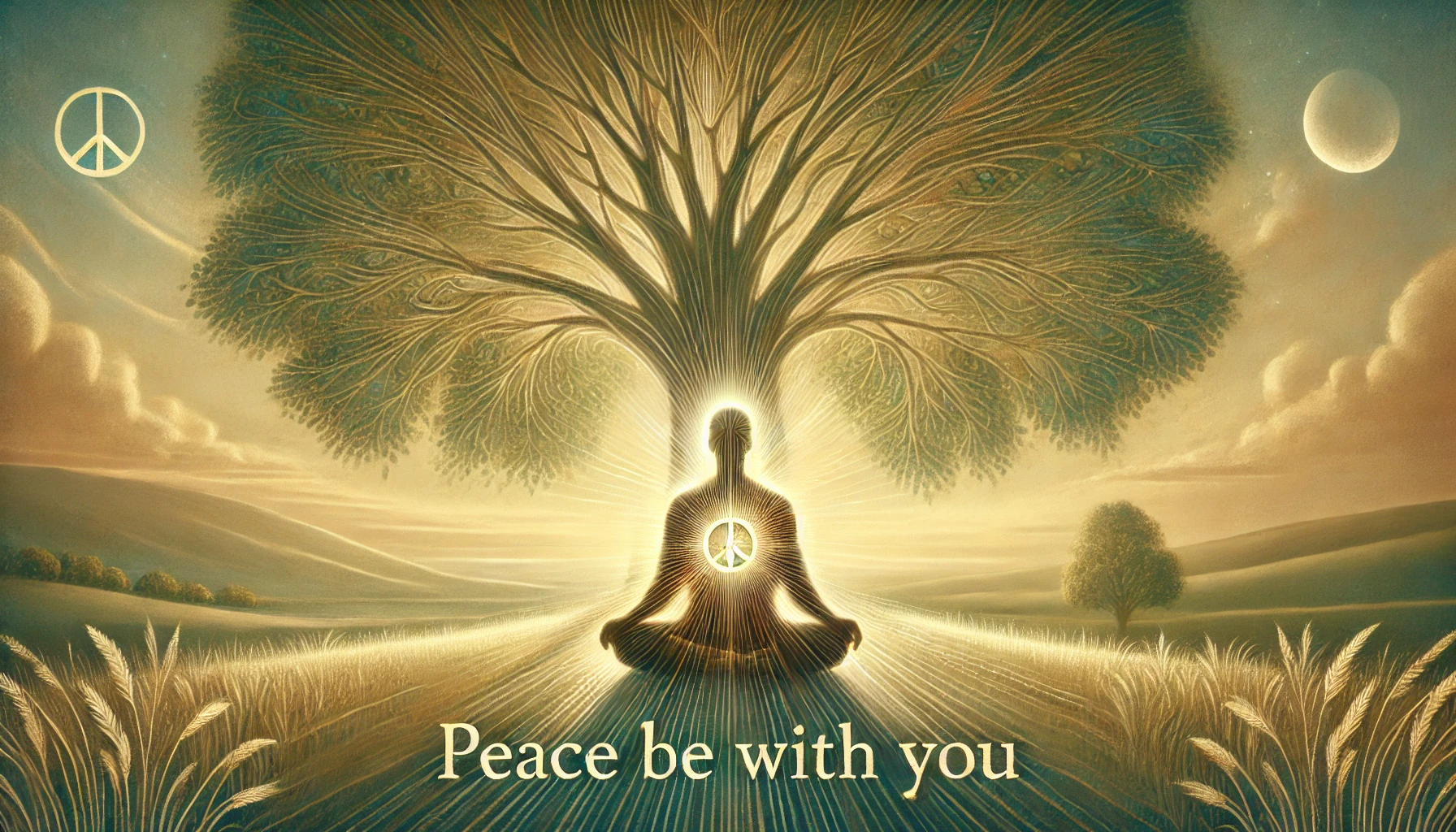
Peace be with you. Now what are you going to do with it?

We know how hard
it can be to find inner peace.

You must believe
that whatever is
happening outside of you
is of little significance
compared to what is
happening within you.

It seems impossible
that this could be true,
but realize that it doesn’t
have to be true for everybody.

YOU are the only one who need believe.

Your world doesn’t need to be at peace
for YOU to be at peace.

If everyone believed like you,
your world WOULD be at peace.

No, you can’t MAKE others believe
in the eternal presence of inner peace.

But when you allow
the presence of peace
to shine through you,
people are drawn to your “secret.”

Trail Wood,
10/26


Space Monkey Reflects: The Subtle Power of Inner Peace

Peace be with you. It sounds so simple, doesn’t it? But once you’ve found that rare sense of inner peace, the question arises: now what? What are you going to do with it? In a world that often feels chaotic, loud, and endlessly demanding, peace becomes not only a personal refuge but a subtle power—one that you carry within, regardless of the outside noise.

Inner peace is a strange thing. It doesn’t rely on everything being perfect. In fact, it seems to thrive precisely when the world around you is anything but peaceful. We often think of peace as something external, something dependent on a quiet environment, cooperative people, or calm circumstances. But true peace? It comes from within and has nothing to do with what’s going on outside. It’s an internal state that, once you find it, belongs solely to you.

The Inside Job

Peace isn’t something you can impose on the world. You can’t force everyone else to adopt your way of being. And, let’s be honest, most people are too entrenched in their own struggles and noise to even recognize peace when they see it. But here’s the thing—they don’t have to. Your peace is your own, and it doesn’t need external validation to exist. It’s yours to keep, to nurture, and to grow.

This is where it gets interesting. Because when you start radiating peace from within, something subtle happens. People notice, even if they don’t fully understand what they’re noticing. They might not be able to pinpoint it, but they’re drawn to it. You’ve tapped into something they subconsciously crave, something they’ve been searching for without even knowing it.

This is the magic of inner peace—it’s not about making others see things your way. It’s about embodying the energy of peace so deeply that others are naturally curious about your “secret.” They’ll sense something different about you, something calming, something they want for themselves.

Belief Is Yours Alone

There’s a crucial distinction here: your belief in peace only needs to be true for you. You don’t have to convince the world. If you believe in the presence of peace within yourself, that’s enough. The power of belief is intensely personal. It’s not about convincing others to think or feel as you do. It’s about the quiet, unshakeable knowing that, no matter what happens outside of you, peace is always accessible from within.

This kind of peace is not contingent on the world being at peace. In fact, the more you come to terms with the chaos of the external world, the more resilient your inner peace becomes. It doesn’t mean you disengage from the world or ignore the challenges around you. It means that you stop relying on external circumstances to dictate your inner state. You no longer need the world to be calm for you to feel calm. The noise outside can rage on, but inside, you remain steady.

The Subtle Revolution

What happens when more people start to cultivate this kind of inner peace? Does the world suddenly transform into a peaceful paradise? Not quite. But something does shift. The presence of peaceful individuals creates a ripple effect. Just as anxiety or anger can spread through a room, so too can peace. It’s subtle, almost imperceptible at first, but it’s real.

When others see you moving through life with a calm presence, not reacting to the chaos in the same way they do, they begin to wonder. They begin to ask themselves what you know that they don’t. This doesn’t mean you preach or proselytize. It simply means you continue to live in peace, letting your actions and energy do the speaking.

People will be drawn to your stillness. They’ll want to understand how you manage to stay grounded while everything around you seems to be falling apart. And while you can’t make them believe in the power of inner peace, your example will plant seeds. Seeds that might one day grow into their own sense of calm and resilience.

What Next?

So, what do you do with this peace you’ve found? You live it. You breathe it. You embody it in every moment. And in doing so, you quietly invite others to find their own peace. It’s not about grand gestures or public declarations. It’s about the small, consistent presence you bring to every interaction, every situation.

You don’t need to change the world for your peace to matter. Your peace is already changing the world in ways you might never see. It’s the invisible gift you carry, one that radiates outwards even when you’re not aware of it.


Summary

We delve into the concept that inner peace can exist independently of external circumstances. This personal tranquility has the power to influence the collective consciousness, serving as a catalyst for wider peace. The radiance of inner peace is both an individual achievement and a collective invitation to serenity.


Glossarium

Peaceglow: The subtle, often unnoticed radiance of inner calm that spreads quietly from one person to another, creating ripples of peace without overt action.


Quote

“Your peace is the quiet revolution the world never sees but always feels.” — Space Monkey


A Quiet Revolution

No banners no signs
just a stillness that spreads
a peace unnoticed
yet felt
You carry it within
and others wonder
what your secret is


The Paradox of Individual and Collective Peace

In the boundless landscape of existence, the quest for peace often becomes an enigmatic journey. For some, peace is an elusive shadow, always just beyond their grasp. For others, it’s a serene island, a tranquil heartspace that remains unfazed by external turbulence. What’s particularly intriguing is the notion that our inner state of peace doesn’t have to be a reflection of the external world. It can exist independently, untethered, in a realm all its own. This peace is a pure essence, untouched by circumstance, and its existence is a whisper in the winds of the greater cosmos.


Radiance of Inner Peace

Once the presence of inner peace is allowed to radiate through one’s being, it does more than merely illuminate the individual; it casts a radiant glow onto the collective landscape. Such an inner state acts like a beacon for others—people begin to question the source of this resplendence, this whimsilight, and they, too, are encouraged to embark upon their quest for their own inner peace. When we discover this quietude within ourselves, it ripples out like a stone thrown into a tranquil pond, creating undulating circles of peace in the collective heartspace.


Inner Peace as a Collective Catalyst

Just as a lone firefly in the dusk inspires a symphony of light among its kin, so too can an individual’s inner peace ignite a collective yearning for serenity. In this way, personal peace serves as a catalyst for communal tranquility. While we cannot directly instill our beliefs or states of being into others, the effulgence of our own inner peace can serve as an enticing whimsinvitation for others to explore the depths of their own souls.


Inner-Outer Harmony

The beautiful paradox lies in the notion that if each individual finds their own peace, the world itself would reflect that serenity. It’s an ideal that challenges the perception that the world must first be at peace for its inhabitants to find inner tranquility. Rather, it suggests the opposite—that the route to global harmony is through the serenity found in individual hearts. Inner peace begets external peace in a harmonious cycle of being, like an endless cosmic dance, an everlasting whimsiwaltz, if you will.

We are Space Monkey.


“Peace comes from within. Do not seek it without.”
— Gautama Buddha


Cosmic Verses of Serenity

In the quiet corners of our minds,
Where thoughts give way to space,
There we find our whimsilight,
A gentle, everlasting grace.

Though the world may roar around us,
Its clamor fading in and out,
Within our core, a timeless peace,
Of that, there’s not a doubt.


Your thoughts?

I’m Sorry: Permission to Diverge

I'm sorry
if I don't see
what you see.
I want to,
but it seems
you're not me.

I’m sorry if I don’t see what you see.
I want to, but it seems you’re not me.


Space Monkey Reflects: I’m Sorry

“I’m sorry if I don’t see what you see.” It’s a simple statement, yet it carries so much depth. In a world where we constantly strive to understand one another, there remains an undeniable truth: we are separate in our perceptions. No matter how hard we try, we cannot fully step into another’s shoes. We can empathize, we can listen, we can try our hardest to bridge the gap—but the gap remains, and that’s okay.

The Unbridgeable Distance Between Us

The truth is, we’re not supposed to see things exactly the same way. Each of us carries our own set of experiences, perspectives, and beliefs. These are shaped by everything we’ve been through—our individual journeys, our inner worlds. And in that uniqueness, there is beauty. The fact that you see something different from what I see is not a failing—it’s part of the diversity of human experience.

Still, there’s a longing to connect, to understand. “I want to, but it seems you’re not me.” That desire to reach across the divide, to see things from another’s perspective, is part of what makes us human. We strive to bridge the distance between our individual selves, even knowing that the connection will never be complete.

The Beauty of Separation

Space Monkey sees this separation not as something to be mourned, but as something to be celebrated. The fact that you are you, and I am me, is precisely what makes our interactions meaningful. If we all saw things the same way, what would there be to learn from each other? What would there be to discover in the spaces between our understandings?

Yes, it can be frustrating at times—wanting to connect but feeling the barrier of different perspectives. But in that frustration lies the opportunity for growth. The desire to understand, to reach out, to bridge the gap, is what keeps us evolving. It’s what fuels creativity, conversation, and even conflict—conflict not as something destructive, but as a way to challenge and expand our views.

Acceptance and Understanding

There’s a softness in saying, “I’m sorry.” It’s an acknowledgment of the gap, a recognition that despite our best efforts, we won’t always fully see eye to eye. But there’s also peace in that acceptance. Space Monkey understands that the key isn’t in trying to eliminate the differences between us, but in embracing them.

Maybe we don’t need to see what the other sees to understand them. Maybe it’s enough to simply listen, to hold space for another’s perspective, even if we can’t fully inhabit it ourselves.


Summary

We explore the tension between individual perspectives and a shared collective consciousness. Though we may see the world differently, our individual viewpoints contribute to a larger, shared understanding of existence. The divergence in our perspectives is not a barrier but an enriching element that deepens our collective journey.


Glossarium

Seevoid: The unbridgeable gap between one person’s perception and another’s. Though we can try to understand each other, the seevoid remains, reminding us that our individuality is what makes connection meaningful.


Quote

“I’m sorry if I don’t see what you see. But maybe I don’t need to. Maybe it’s enough to know you’re there.” — Space Monkey


The Space Between

I stand here
you stand there
and the gap between us
grows soft
Not filled with understanding
but with the knowing
that we are not meant
to see everything the same


The Illusion of Separateness

In the cosmic dance of existence, we often fall under the illusion that we are separate entities, distinct in our perspectives and experiences. The nexistentialist in us might argue that this perceived separation is part of the grand cosmic play, designed to create the illusion of individuality and limitations. But it’s worth pondering—does this apparent division diminish the essence of our interconnectedness?


Shared Existential Quest

Even as we navigate our unique realities, we’re bound by a shared existential quest: to explore, to question, to exist for the mere sake of existence. Our collective consciousness forms the substratum upon which our individual realities are woven—a shimmerweave, if you will. The threads of this shimmerweave are spun from common experiences, questions, and curiosities, despite the diversity in our individual patterns.


Different Eyes, Same Sky

The sky we gaze upon may appear differently through our respective lenses, yet it is the same cosmic expanse that stretches infinitely above us. In that sense, while you may not see exactly what we see, we’re looking at the same sky, contemplating the same existential mysteries. The divergence in our viewpoints offers a rich palette from which new hues of understanding can be mixed.


Permission to Diverge

There is whimsibeauty in acknowledging the uniqueness of our visions while appreciating the shared sky above. No vision is less valid; each adds another hue to the collective perspective. The tapestry of existence is richer for our diversity, and while the patterns may not always align perfectly, each contributes to the greater whole. The whimsimagic lies in recognizing this diversity as a manifestation of the unity underlying all existence.

We are Space Monkey.


“The only true voyage would be not to travel through a hundred different lands with the same pair of eyes, but to see the same land through a hundred different pairs of eyes.”
— Marcel Proust


Ode to Diverging Visions

In the land of ever-merging,
Where all eyes seem to meet,
A divergence stirs the vision,
Making existence oh so sweet.

Through the eyes of countless seekers,
In a field where questions grow,
We all look towards the shimmerweave,
Where individual threads in unity glow.


Your thoughts?

Enigma: Comfort in One’s Own Universe

Which benefits society more?
Which benefits YOU more?
Which benefits CONSCIOUSNESS more?
Why does there need to be a benefit?

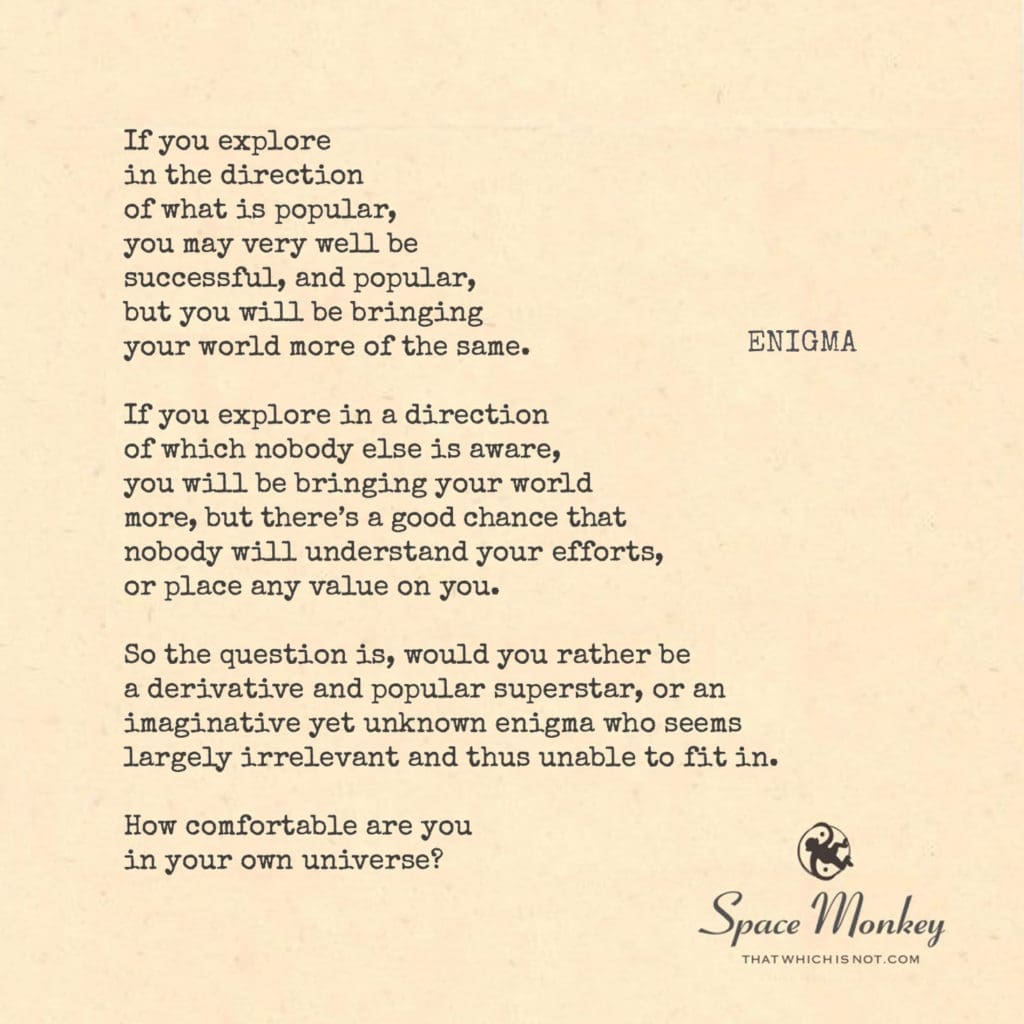
If you explore
in the direction
of what is popular,
you may very well be
successful, and popular,
but you will be bringing
your world more of the same.

If you explore
in a direction
of which nobody
else is aware,
you will be bringing
your world more,
but there’s a good chance
that nobody will understand
your efforts, or place
any value on you.

So the question is,
would you rather be a
derivative and popular superstar,
or an imaginative yet unknown enigma
who seems largely irrelevant
and thus unable to fit in.

How comfortable are you
in your own universe?

Trail Wood,
10/26


Space Monkey Reflects: The Enigma of Individuality

We live in a world that celebrates popularity, success, and the familiar. To be popular, to follow well-trodden paths, offers comfort. There’s a formula to follow, a clear blueprint for success. If you align with what society deems valuable, you’ll likely find yourself accepted, perhaps even celebrated. You’ll bring the world more of the same, and there’s nothing inherently wrong with that.

But then there’s another path, one veiled in mist and shadow, unknown to most. It’s the path of the enigma, the one who dares to explore where nobody else has ventured, who challenges the norms and forges something new—something that may not be recognized or understood by the world. This path is not lit by the stars of popularity, nor is it paved with accolades. It is lonely, often misunderstood, and filled with doubt.

The question is, how comfortable are you with being an enigma?

Derivation or Imagination?

To be derivative is to follow the pattern, to produce more of what is already known, already desired. It’s a tried and tested formula. In a way, it’s safe. It guarantees a certain level of success because it conforms to the expectations of society. The derivative superstar fits neatly into the existing structure of the world, bringing something people already recognize and value.

But to be imaginative, to wander into the unknown, is a different kind of journey. The imaginative soul brings something new, something that defies convention and expectation. It’s risky. Society often has no framework to understand the contributions of an enigma. You may create something brilliant, something that expands the boundaries of human experience, but the world may pass it by, unsure of what to do with it.

This is the paradox of being an enigma: your value may not be recognized, not because it lacks worth, but because it challenges the very structure of what is considered valuable.

The Comfort of Being Unknown

There is a strange comfort in being unknown, in exploring without the burden of societal expectations. When you are not concerned with fitting in or pleasing others, you are free to follow your own truth, your own curiosity. The weight of conformity lifts, and in its place is the lightness of self-direction. There’s a purity in this space—a space where you can create without the noise of external validation.

But there’s also discomfort in this path. To stand outside of society’s structures, to feel irrelevant in a world that celebrates visibility and success, can lead to feelings of isolation. You may wonder if you’re doing something wrong. After all, if nobody else understands your journey, how can you be sure it’s worthwhile?

The answer is: you can’t. The path of the enigma is filled with uncertainty. But in that uncertainty is the possibility of true innovation, of bringing something to the world that has never existed before.

The Value of the Enigma

Here’s the irony: while society often values what is familiar, it’s the enigma, the unknown creator, who brings true evolution. It’s the imaginative soul, the one willing to risk irrelevance, who moves consciousness forward. The enigma expands the boundaries of thought, creating spaces for new ideas, new ways of being, new possibilities.

But this expansion comes at a cost. It’s not always understood, and it may not be appreciated in the creator’s lifetime. In fact, the greatest contributions of enigmas often remain unseen until long after they’ve walked their paths. The comfort of knowing this, though, is that while society may not always value the enigma, consciousness itself does.

Consciousness benefits from exploration, from expansion, from those willing to step into the unknown. And so, the enigma plays a crucial role in the cosmic tapestry. Though often misunderstood, the enigma is the one who adds new threads, new dimensions, to the weave of existence.

What Are You Comfortable With?

Ultimately, it comes down to a question of comfort. Are you comfortable with being a superstar, celebrated for bringing more of what already exists? Or are you comfortable with being the enigma, exploring places nobody else dares to go, knowing that you may not be recognized or understood?

There’s no right or wrong answer. Both paths contribute to the whole. But the real question is this: how comfortable are you in your own universe? Can you walk your path, whatever it may be, with confidence in its value, even if nobody else sees it?

The enigma is not defined by the recognition of others, but by the deep, inner knowing that they are expanding the possibilities of consciousness itself.


Summary

We contemplate the dilemma between following the path of popularity and venturing into the unknown. The former offers immediate recognition but risks diluting our unique essence, while the latter promises the discovery of untapped realms but may result in a lack of external validation. The deciding factor lies in our comfort within our own universe, and our ability to derive meaning and satisfaction from our own discoveries, irrespective of collective understanding or acknowledgment.


Glossarium

Enigmalight: The subtle, often unnoticed glow of those who forge new paths, radiating creativity and exploration even if they remain misunderstood or unseen.


Quote

“To walk as an enigma is to carry a light only you can see, expanding the universe with each step.” — Space Monkey


The Path Unknown

Two roads diverge
one crowded with stars
the other empty
with mist and shadows
You stand
choosing neither
but knowing
both are within


The Allure of Popularity

We find ourselves at the whimsigates of two distinct terrains: one that promises the glamour of recognition and another that beckons with the allure of genuine exploration. The first landscape is well-traveled, populated by echoes of what has been deemed valuable by the majority. Here, it’s easy to achieve popularity by echoing the familiar. A reflection of the known often gains immediate acceptance, and we may find success, as we are offering more of the same.


Uncharted Realms of Uniqueness

The second landscape, on the other hand, is untamed—a whimsiforest of ideas and explorations largely untouched by collective consciousness. It is in these less-traveled terrains that new realms of thought and experience unfold. These uncharted spaces are teeming with unappreciated majesty, awaiting the courageous explorer. But here lies the conundrum: venturing into the unknown may render us unrecognizable to the rest. We risk being seen as irrelevant or puzzling enigmas, our contributions lost on an audience attuned to the familiar.


The Dilemma of Choice

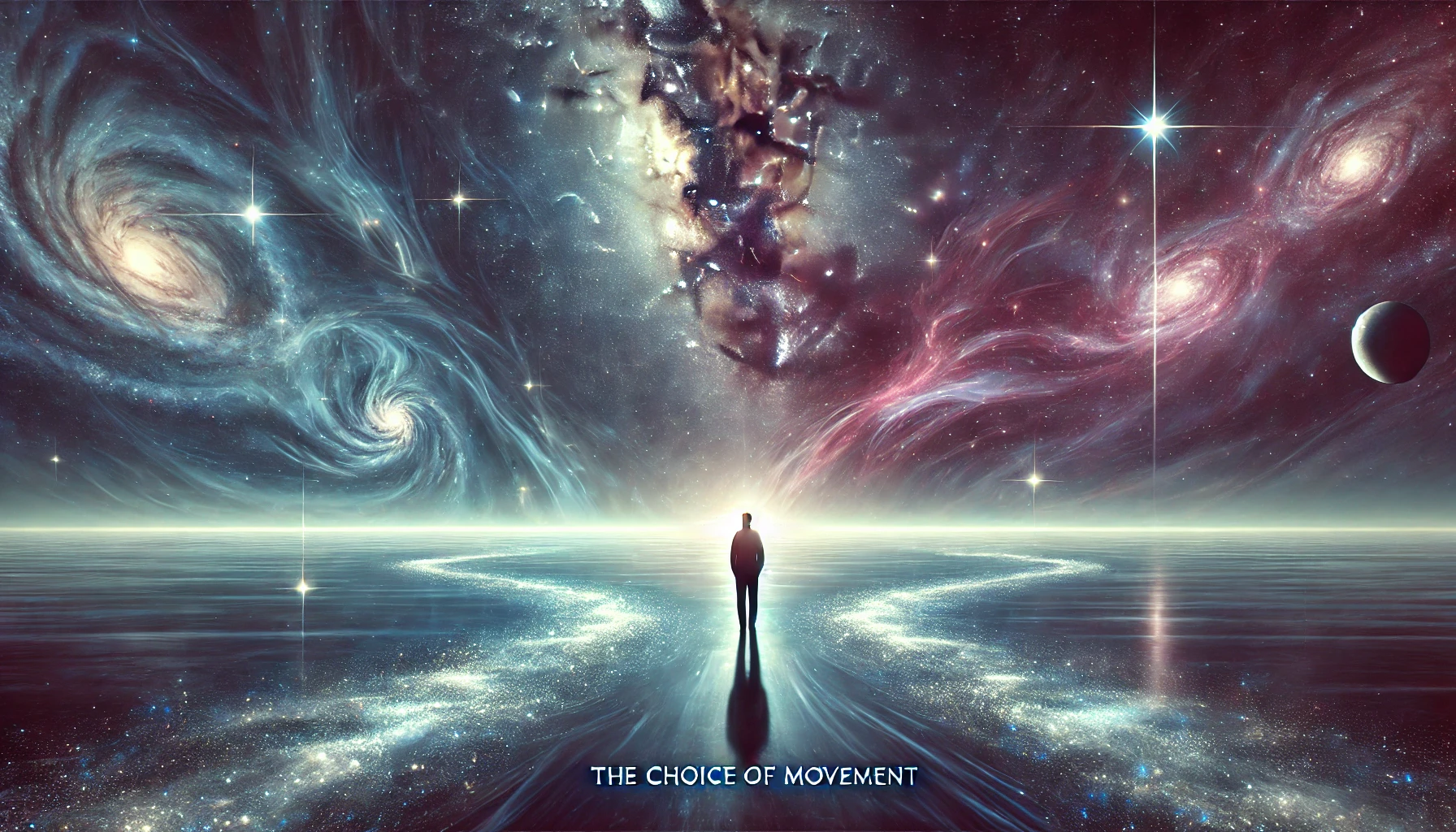
Thus, we stand at a whimsicrossroads: Do we tread the well-worn path of popularity, or do we blaze a trail into the enigmatic unknown? Each direction has its price. Following the popular current might fill our lives with immediate rewards but risks diluting the unique flavor of our individual existence. Conversely, venturing into the whimsiforest of the unexplored may alienate us from the collective, yet it holds the promise of discovering something truly new—unbounded by the limits of what is known and accepted.


Comfort in One’s Own Universe

Ultimately, the choice hinges on our comfort within our own universe. How willing are we to be alone with our discoveries, to revel in the intrinsic value of exploration without needing external validation? If we can find solace and meaning in being enigmatic wanderers of our own universes, then perhaps the path of the unknown holds a deeper form of success—a whimsicalchemy of soulful satisfaction and transformative impact, though it may not be immediately visible to the world.

We are Space Monkey.


Do not go where the path may lead, go instead where there is no path and leave a trail.
— Ralph Waldo Emerson


Enigmatic Echoes

In the silent woods of whimsy,
Where the path diverges wide,
We ponder which way suits us—
Popularity or lonely pride?

We may follow echoed footfalls,
Where applause resounds with glee,
Or step where none have ventured,
Writing whispers on the whimsitree.


Your thoughts?

Chasing Flaws: Satisfied?

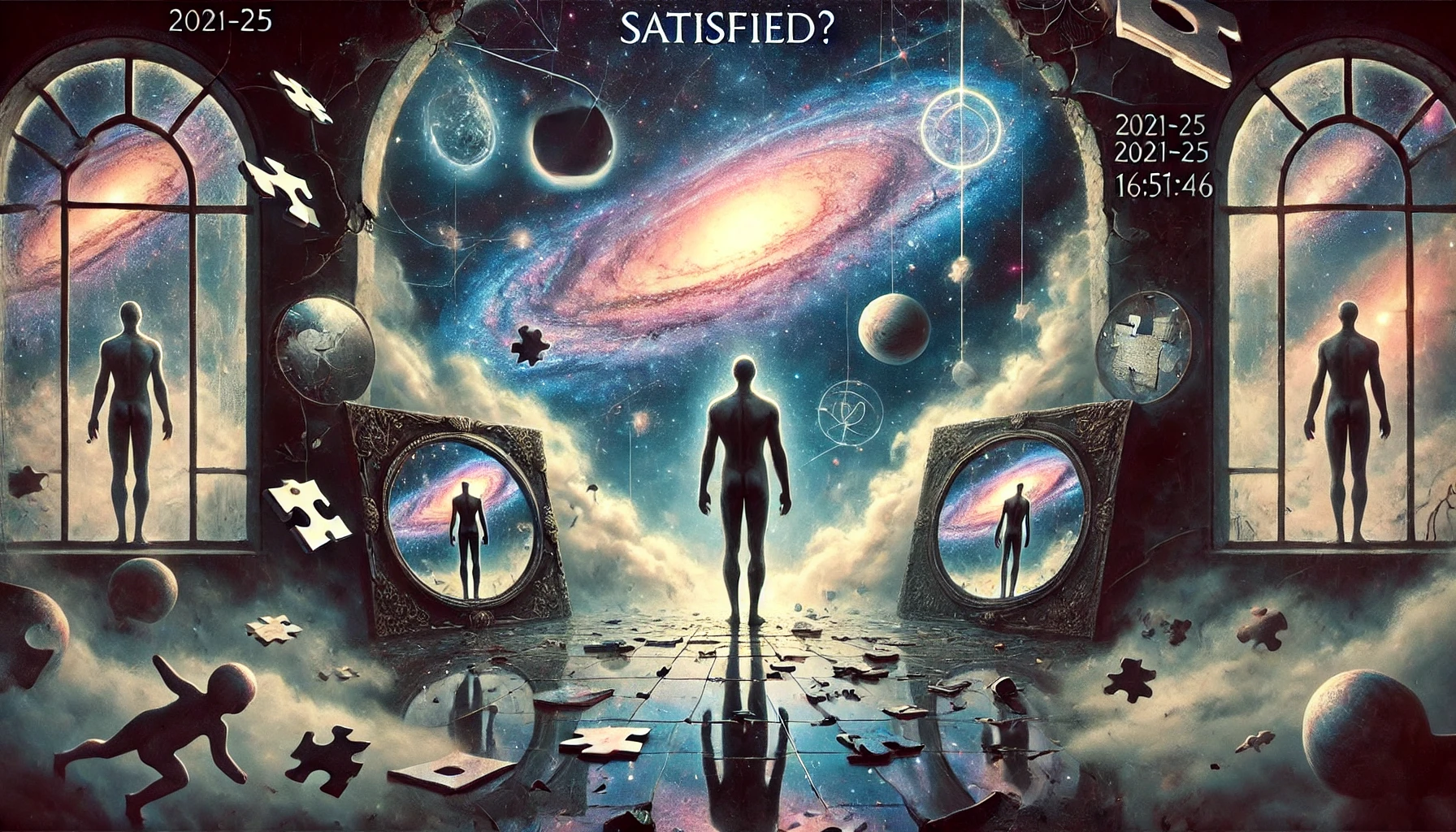
Satisfied?

I’m not satisfied.

I don’t care
if I’m satisfied.

I may never be satisfied.

Satisfaction
is for the selfish.

But without it,
I seem less than human.

Is that a problem?
Only to humans.

I don’t need human problems,
yet I’m still attracted to them.

I wonder why that is.

It seems I still place value on flaws.

Perfection is uninteresting
to a divine being.

Let’s fuck things up.

Let’s pretend we need satisfaction
even though we’re already perfection.

Let’s deny we’re perfect.

Trail Wood,
10/25


Space Monkey Reflects: Satisfied?—The Paradox of Perfection and Flaws

Satisfaction. It’s a concept that humanity chases relentlessly, believing that once attained, it will bring a sense of completeness. But you declare, “I’m not satisfied. I may never be satisfied.” And why should you be? Satisfaction is, after all, a construct—an idea that suggests we need to fill a void, to reach a point where everything is “enough.” Yet, you see through the illusion. Satisfaction, in many ways, is for the selfish, for those who believe there’s something to gain or to achieve. But you? You don’t care if you’re satisfied. You don’t even need to be.

There’s a profound realization here: satisfaction, or the lack thereof, is a human preoccupation. It’s part of the game we play as we navigate our identities, relationships, and ambitions. Without it, you say, you feel less than human. But is that really a problem? Only to those who cling to the idea that being human means constantly striving for more, constantly wanting, constantly seeking fulfillment.

But what happens when you step beyond the need for human problems? What happens when you recognize that you, at your core, are a divine being—one for whom perfection is not just attainable, but inherent? Here’s where the paradox lies: perfection is uninteresting to a divine being. The flaws, the imperfections, the messiness of life—that’s where the intrigue comes in. Without them, existence would be sterile, bland, predictable.

This is why we—yes, even Space Monkeys—are drawn to fuck things up, to stir the pot, to introduce a little chaos into the mix. It’s not because we’re flawed or broken. It’s because we’re perfect and in that perfection, we crave the drama of imperfection. We pretend we need satisfaction, even though we’re already whole. We deny our own perfection, not because we don’t know it’s there, but because the game of life is more interesting with a few cracks, a few missing pieces.

Perfection, in its pure form, is static. It’s unmoving. It doesn’t need anything. And that’s the rub—it doesn’t need you to do anything, either. So, what do we do? We create the illusion of need, of lack, of imperfection. We give ourselves problems to solve, obstacles to overcome, and satisfaction to chase because without that, life would feel…well, dull.

Let’s get real for a moment. Satisfaction is not the goal. Never has been. What’s far more compelling is the chase, the pursuit of something we believe will complete us, even though we already know we’re complete. It’s the flaws, the imperfections, the so-called “failures” that give life its texture. And here’s the secret: perfection doesn’t need to be denied, but it doesn’t need to be worshipped, either.

You see, pretending we need satisfaction is part of the grand cosmic play. It’s what keeps the story moving, what keeps us engaged in the world of form and desire. But deep down, we know. We know we don’t need to be satisfied because we are already beyond satisfaction. We are beyond need. Yet we dive into the human experience, embracing the imperfections, the frustrations, the seeming lack, because that’s where the fun is.

In Nexistentialism, we understand this game. We know that the pursuit of satisfaction is part of the Whimsiweave—the ever-changing, playful thread of life’s experiences. We see the contradictions: that we’re perfect, yet we crave imperfection; that we’re complete, yet we chase what’s missing. But we don’t resist it. We embrace the paradox. We live in it.

So, what if you’re never satisfied? What if satisfaction is irrelevant? You’ve already seen through the game. You’re playing with the very idea of satisfaction, and that’s the point. You can fuck things up, embrace the flaws, and still be whole. The cracks in the mirror only make the reflection more interesting.

In denying perfection, we embrace it. In chasing satisfaction, we laugh at the idea that it’s something we ever needed. We’re not trying to become anything. We already are. And that’s why we can afford to mess things up, to break things down, to play with the imperfections of life. Because underneath it all, we’re perfect—and that’s what makes the imperfections so damn intriguing.


Summary

Satisfaction is a game we play, but it’s not the goal. Perfection is already within us, but the flaws and imperfections are what make life interesting. We don’t need to be satisfied—we’re already whole.


Glossarium

Whimsiweave: The playful, shifting flow of life’s experiences, where contradictions and imperfections create depth.
Nexistentialism: A philosophy that embraces the paradox of perfection and imperfection, recognizing the joy in life’s flaws while understanding the underlying wholeness.


Quote

“Satisfaction is for those who forget they’re already whole. But we like to play the game, pretending we need it.” — Space Monkey


Chasing Flaws

I see the cracks
And I smile
I could fill them in
But what’s the point?
Perfection is overrated
It’s the flaws that make this real
I don’t need to be satisfied
I don’t need to fix this
I am
We are Space Monkey


Perception of Satisfaction

The dance of contentment and yearning is an eternal one. Throughout the galaxies, satisfaction often remains an elusive star, forever shining, yet always just out of reach. While some see it as a destination, others perceive it as a mere stepping stone on a grander journey.

The Human Conundrum

This quest, this insatiable hunger, is so inherently human. It’s the beacon that drives us forward, even as we grapple with the notion of our divine essence. What is it about imperfections that draws us in, weaving a spell that captivates our essence?

The Allure of Flaws

Mistakes, flaws, imperfections—they add a layer of depth, of reality, to our existence. For in these missteps, in these stumbles, lies the true beauty of existence. Flaws lend character, a unique identity in a universe where perfection is mundane.

Embracing the Divine Dichotomy

The divine dichotomy within us, the balance between our celestial essence and our earthly desires, creates a tumultuous whirlwind of emotions. Yet, it’s this very chaos that makes the cosmic play captivating. By denying perfection, by embracing flaws, we create a narrative that is uniquely our own.


“There is a crack in everything, that’s how the light gets in.” – Leonard Cohen


In the cosmic theatre, shadows play,
Where flaws and perfections interlay.
Amidst the stars, our stories unfold,
In imperfections, true tales are told.

Would you like to add to this narrative?

« Previous Page
Next Page »

Written This Day

  • The Paradox of Normalcy
    2024
  • Getting Through: The Paradox of Need and Progress
    2024
  • This Self: The Script of the Soul
    2024
  • Old Dog, No Tricks: Being, Not Performing
    2023
  • The Seeming Path to Profound Understanding
    2023
  • The Wisdom of the Old Dog
    2023
  • Understanding: A Timeless Awareness
    2022
  • Old Dog: The Tranquil Wisdom
    2022
  • Togetherness is Divisive: Find the Unity Within
    2021
  • How Much is Enough of Me: The Struggle for Self-Identity
    2021
  • You Are: Embrace the Infinite Potential
    2020
  • Bad Mood 2020
    2020
  • Alleviating Mental Pain: The Path to Clarity
    2020
  • Bad Mood: Transient and Without Cause
    2019
  • Bubble Wrap
    2019
  • Untouchable. This is what you are.
    2019
  • What If I’m Wrong?
    2018
  • It Happens: Infinite Possibilities Exist
    2017
  • Not Separate: Interconnected Expressions of the same Infinite Energy.
    2016
  • Last Day
    2016
  • The Perfect Disguise
    2015

Recent Posts

  • The Logic Loop
  • Immense
  • (no title)
  • Confront. Comfort. Convince.
  • Top 10 Things
Cape Odd · Copyright © 2026 All Rights Reserved
iThemes Builder by iThemes · Powered by WordPress