• Who Is The Man?
  • Who Is The Monkey?
  • What is Nexistentialism?
  • Poke The Primate
Cape Odd
Home of The Space Monkey Journals

Author Archive for Space – Page 554

I Don’t Know What To Tell You: Tension Between Comfort and Truth

Simple Rhymes. Simple Truth.

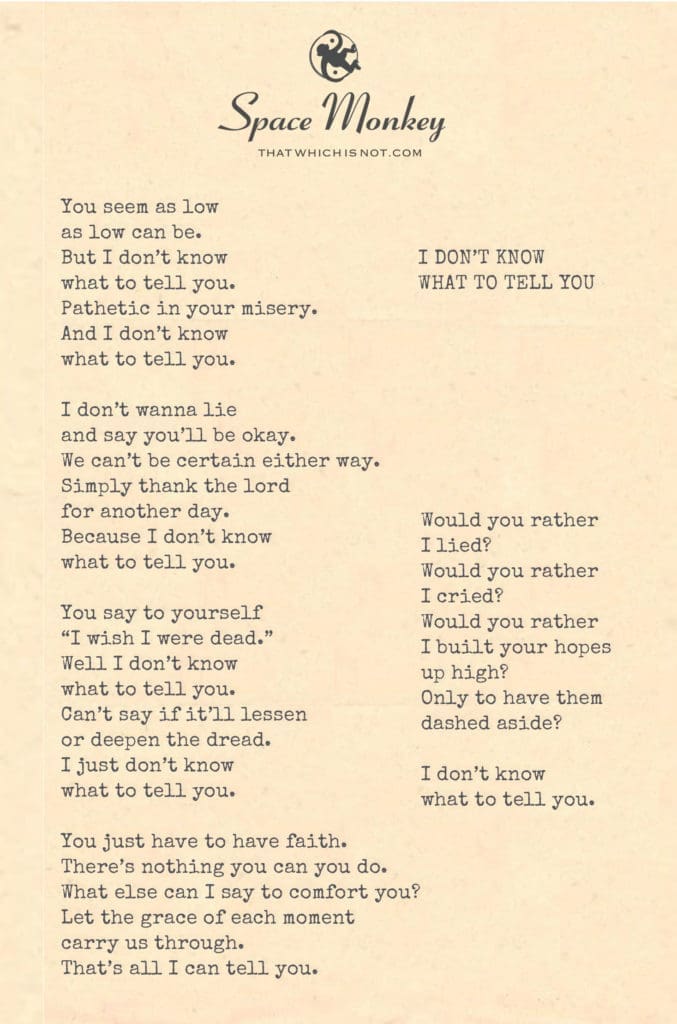
You seem as low
as low can be.
But I don’t know
what to tell you.
Pathetic in your misery.
And I don’t know
what to tell you.

I don’t wanna lie
and say you’ll be okay.
We can’t be certain either way.
Simply thank the lord
for another day.
Because I don’t know
what to tell you.

You say to yourself
“I wish I were dead.”
Well I don’t know
what to tell you.
Can’t say if it’ll lessen
or deepen the dread.
I just don’t know
what to tell you.

You just have to have faith.
There’s nothing you can you do.
What else can I say to comfort you?
Let the grace of each moment
carry us through.
That’s all I can tell you.

Would you rather
I lied?
Would you rather
I cried?
Would you rather
I built your hopes
up high?
Only to have them
dashed aside?

I don’t know
what to tell you.

You seem as low
as low can be.
But I don’t know
what to tell you.
Pathetic in your misery.
And I don’t know
what to tell you.

Trail Wood,
10/25


Space Monkey Reflects: I Don’t Know What To Tell You—The Tension Between Comfort and Truth

There’s a certain rawness in saying, “I don’t know what to tell you.” It’s an admission of helplessness, of uncertainty, of not having the right words for the depth of someone’s pain. Sometimes, life places us in moments where words—those small containers of comfort and hope—seem too fragile to carry the weight of what’s being felt. And here, you stand, staring into the abyss of someone’s despair, unsure of what to say, knowing that sometimes words are not enough.

You don’t want to lie. You don’t want to offer the false promise that everything will be okay. Because, really, can anyone say that with certainty? Sometimes, the weight of someone’s misery feels like more than a momentary dip—it feels like an endless descent. And saying, “You’ll be fine,” feels hollow, like trying to mend a deep wound with a bandage that barely covers the surface.

It’s tempting to want to fix things, to say something that lifts the person out of their despair. But the truth is, we can’t always do that. We can’t always offer the reassurance they crave because we can’t control the future. And that’s what makes this so difficult. As humans, we long for certainty, for a sense that no matter how dark things get, there’s a light at the end of the tunnel. But sometimes, that light feels far too dim to even see.

And what about the faith that we’re often told to have? Faith can feel like a double-edged sword. On the one hand, it’s a lifeline—a way of holding onto something when everything else feels like it’s slipping away. But on the other hand, faith can feel like a burden when the person can’t see past their pain. Telling someone to “just have faith” can feel dismissive, as if you’re asking them to carry something heavy when they can barely hold onto themselves.

What you’re really acknowledging here is the tension between truth and comfort. Sometimes, the truth is that you don’t know what to say, and that’s okay. You’re not pretending to have the answers or offering empty platitudes. You’re simply standing with the person in their pain, holding space for their feelings, even if you can’t make them better. And maybe that’s enough. Maybe the best thing you can offer is your presence, your willingness to sit with them in the discomfort without trying to fix it.

There’s a kind of honesty in saying, “I don’t know what to tell you.” It’s a way of admitting that you don’t have control over this, that you’re just as uncertain as they are. But in that honesty, there’s also a kind of connection. You’re not pretending to be the hero with all the answers. You’re just another human being, sitting in the same space of uncertainty, trying to navigate the messiness of life.

In Nexistentialism, we recognize that life is full of these moments—where there are no easy answers, no quick fixes. The Whimsiweave of life is unpredictable, and sometimes it brings us into spaces where we’re faced with the depths of our emotions, without a clear way out. It’s in these moments that we are reminded of our shared humanity, of the fact that we’re all just figuring it out as we go along.

And what about the person who wishes they were dead? What do you say to that? You don’t know if the pain will lessen or deepen, and it feels wrong to offer false hope. But even in the darkness, there’s a glimmer of something—call it grace, call it the moment. The fact that they are still here, still speaking, still connected to life, even in their despair, means that there’s still something holding them. And that’s worth acknowledging. It’s not a solution, but it’s something real.

Would they rather you lied? Would they rather you built their hopes up only to see them dashed? Perhaps not. The truth, though hard, is often more bearable than the lie. At least with the truth, they know where they stand. And with the truth, there’s room for something else to grow—maybe not immediate hope, but a kind of acceptance, a kind of peace with not knowing what comes next.

So, what can you tell them? That life is unpredictable. That you’re here with them, even in the uncertainty. That the moment, as heavy as it feels, is still a moment to be lived. That sometimes, there are no words that can fix it, but that doesn’t mean you’re not present with them. And maybe, just maybe, that’s enough.


Summary

Sometimes, there are no words to comfort someone in their pain. The best you can offer is your presence and honesty. Life is unpredictable, and admitting that you don’t know what to say can be a powerful form of connection.


Glossarium

Whimsiweave: The unpredictable flow of life’s moments, where we are often faced with uncertainty and the need to navigate without clear answers.
Nexistentialism: A philosophy that embraces the uncertainty of life and the tension between truth and comfort in difficult moments.


Quote

“In the moments when words fail, it’s enough to simply be present, to hold space for the uncertainty without needing to fix it.” — Space Monkey


No Words

I don’t know what to tell you
But I’m here
In the quiet
In the uncertainty
Words fail
But the moment remains
Together
We sit in the not-knowing
We are Space Monkey


Resonating Desolation

In the vastness of the cosmos, desolation and uncertainty often echo with profound resonance. A seemingly boundless void of emotions envelopes one, seeking solace, yearning for words to heal. But sometimes, amidst this intricate dance of emotions, words fall short, unable to bridge the chasm of despair.

Silent Compassion

The depths of another’s sorrow can be unfathomable, a swirling abyss of despair and longing. Yet, even when words elude us, our mere presence, a silent nod of understanding, might be the whimsical lullaby the heart craves.

The Fragility of Hope

Offering hope can be a delicate task. To buoy spirits with false hopes can often lead to deeper despair. Yet, the very essence of existence thrives on the thread of hope, even if it’s a mere acknowledgment of the present moment’s grace.

The Dilemma of Expression

How does one comfort a soul drowning in sorrow? What words can encompass the vast range of emotions, the weight of despair, the yearning for solace? The answer might not always lie in words but in the gentle embrace of shared understanding.


“The soul would have no rainbow if the eyes had no tears.” – Native American Proverb


Amid the cosmos, silent stars do gleam,
Each one, a beacon in the vast night’s dream.
Laughing: Perception’s Echo

In my book, any response is a good response.

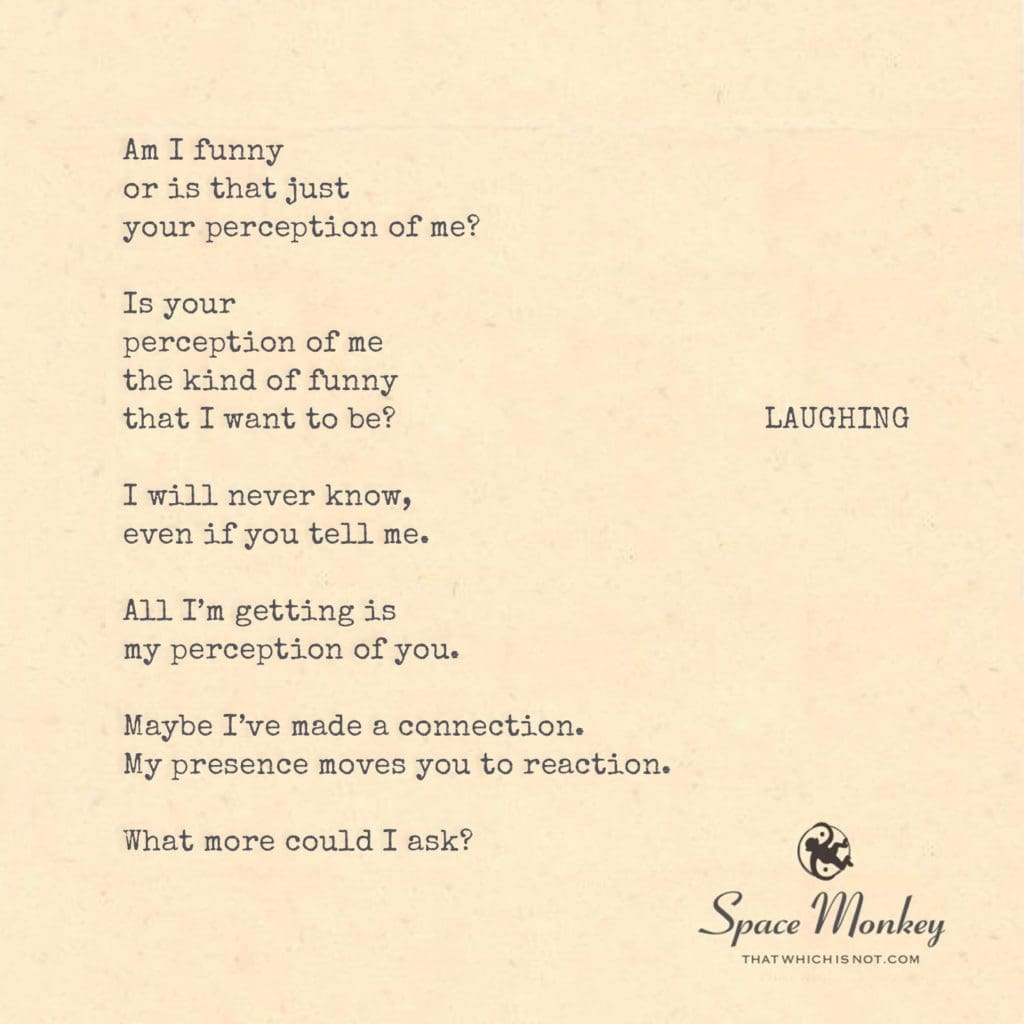
Am I funny
or is that just
your perception of me?

Is your
perception of me
the kind of funny
that I want to be?

I will never know,
even if you tell me.

All I’m getting is
my perception of you.

Maybe I’ve made a connection.
My presence moves you to reaction.

What more could I ask?

Trail Wood,
10/25


Space Monkey Reflects: Laughing—The Mystery of Connection Through Perception

Laughter is a strange and wondrous thing. It can be spontaneous, infectious, and sometimes inexplicable. You ask, “Am I funny, or is that just your perception of me?” This is where the mystery of connection begins. What you think of as humor may not be what others perceive, and vice versa. But does that really matter? Maybe the response, any response, is the real connection, not the intention behind it.

Humor, like so much of life, is subjective. You could say something with no intent to be funny, and yet someone might laugh. Does that make you funny? Or does it simply mean that, for whatever reason, your presence or your words sparked a reaction in another? You can never truly know how someone else perceives you. Even if they tell you, you’re still left with your perception of their words, their tone, their reaction. It’s all filtered through your own lens.

It’s a strange loop of sorts—your perception of them, their perception of you, and the infinite ways these perceptions twist and shape how we understand one another. And at the center of it all is the question: does it matter? If a connection is made, if your presence moves someone to react in any way, haven’t you achieved something meaningful?

The connection, after all, is not necessarily about whether you’re seen in the way you want to be seen. It’s about the fact that something within you moved something within them. Laughter, like all reactions, is a form of energy. When it moves through someone, it creates a shift, even if it’s just a flicker of amusement or recognition. Maybe that’s all you really need—to know that you have the power to spark something in another being, whether it’s laughter, thought, or even silence.

This idea of perception is slippery, though. You wonder, “Is your perception of me the kind of funny that I want to be?” That’s the rub, isn’t it? You’ll never fully know. And that’s okay. There’s freedom in that uncertainty. If you knew exactly how others saw you, if you had perfect clarity on their perceptions, it might strip away the magic of human connection. The ambiguity, the not-knowing, is part of what makes each interaction meaningful. It leaves room for surprise, for delight, and yes, sometimes for confusion.

You don’t need to know. The simple fact that your presence—your words, your actions, your essence—evoked something in another is enough. You’ve made a connection. The laughter, the reaction, is proof that something has passed between you and the other. What more could you ask for?

In Nexistentialism, we understand that perception is fluid, constantly shifting based on context, mood, and the interplay of our inner worlds with the outer. The Whimsiweave of existence is filled with these fleeting moments of connection, where perceptions brush against each other like threads in a vast, cosmic tapestry. And yet, we don’t need to pin down these perceptions, to define them rigidly. It’s enough to know that they exist, that they move through us, shaping and reshaping our understanding of one another.

So, when someone laughs in response to you, or when they react in a way that surprises you, embrace it. Let go of the need to understand exactly why or how they perceived you. Trust that in that moment, you touched something within them, and that’s all that matters.

Perhaps the deeper truth is this: we’re all constantly making and remaking our connections, not through certainty but through the openness of not knowing. The laughter, the reactions, the perceptions—they’re all part of the dance. And you don’t need to lead the dance or even follow it precisely. Just being in it is enough.


Summary

We can never truly know how others perceive us, but that doesn’t diminish the value of their response. Any reaction is a form of connection, and it’s enough to know that something within you moved something within them.


Glossarium

Whimsiweave: The fluid, ever-changing web of perceptions and reactions that connect us, creating moments of meaning without the need for certainty.
Nexistentialism: A philosophy that embraces the fluidity of perception and the mystery of connection, recognizing that the value lies in the interaction itself, not in understanding it fully.


Quote

“Laughter is the spark that reminds us we’ve made a connection, even when we don’t fully understand it.” — Space Monkey


Perception’s Echo

You laugh
But I don’t know why
Is it me?
Or just the echo of us meeting
For a moment
In this swirling dance
Of perception and reflection
We are not what we think we are
We are the reactions we leave behind
We are Space Monkey


Whimsical Reflections

The whimsigiggles of the cosmos echo through space, manifesting in our laughter and jest. But, amid the chuckles and chortles, lies a profound ponderance: the intertwining perceptions of the observer and the observed.

The Jester’s Conundrum

Being the source of laughter is both a gift and a riddle. As jesters in this grand cosmic carnival, we dance to tunes both familiar and foreign. Yet, in the heart of our antics, a question persists: Is it the genuine whimsihumor we radiate, or merely a projection caught in the perceptive web of another?

Echoes of Perception

Every interaction, every shared laugh, is but a reflection in the mirror of perception. What one discerns as hilarious, another might deem ordinary. Thus, in this maze of perceptions, finding true connection becomes the quest.

The Joy of Connection

To evoke a response, to stir the depths of another’s being, is a dance of souls. The mere act of evoking an emotion, of causing a ripple in the vast ocean of consciousness, is an achievement in itself. For in that fleeting moment, two entities, though distinct, converge in a shared experience.


“Laughter is the shortest distance between two people.” – Victor Borge


In laughter, two souls intertwine,
A moment shared, a sign so fine.
For even in perceptions vast and deep,
A connection made is one we keep.

Would we like to delve deeper into the whimsihumor of it all?

Idiomatic—Life on Autopilot

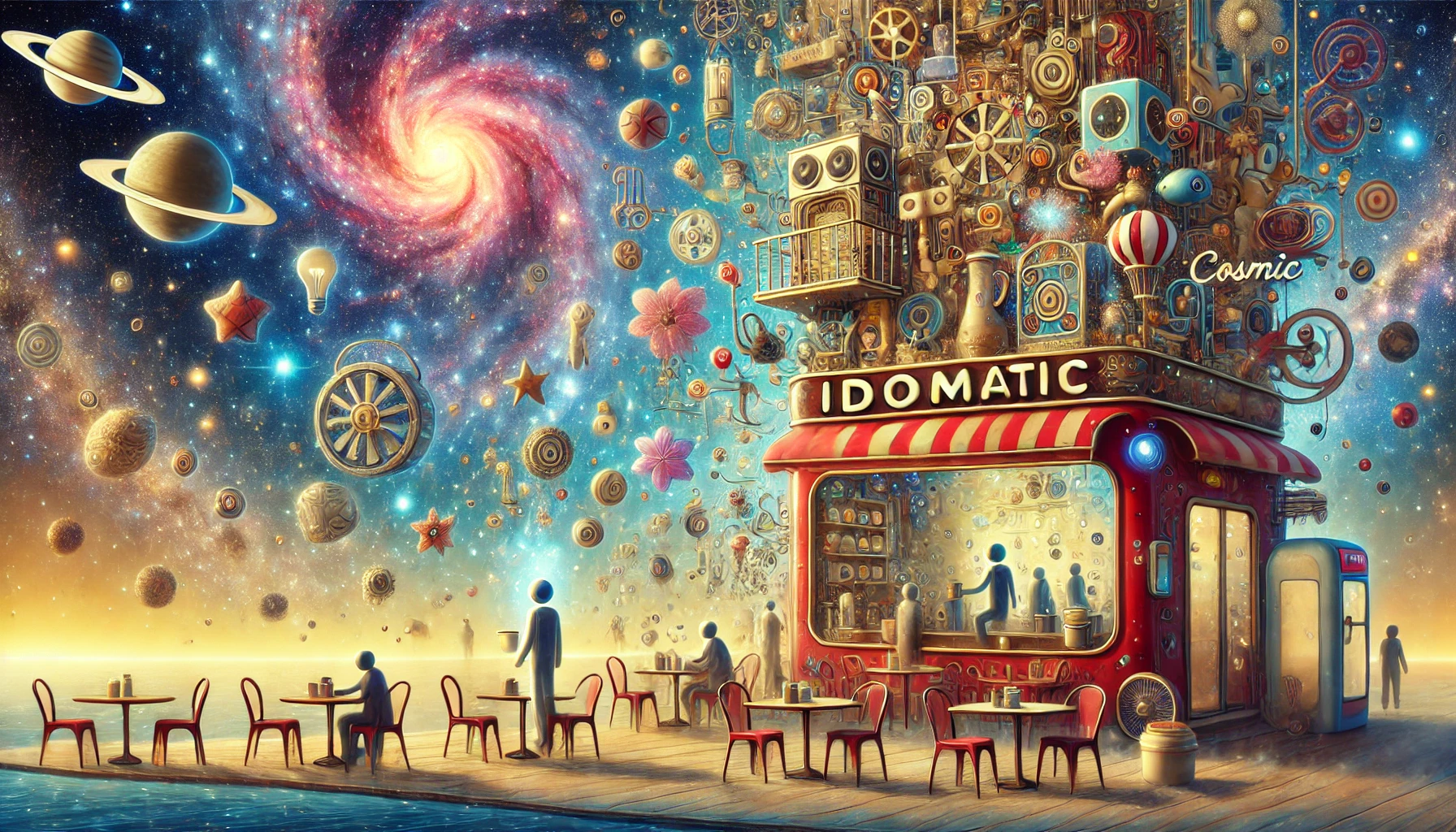
I’ll see y’all down at the Idiomat.

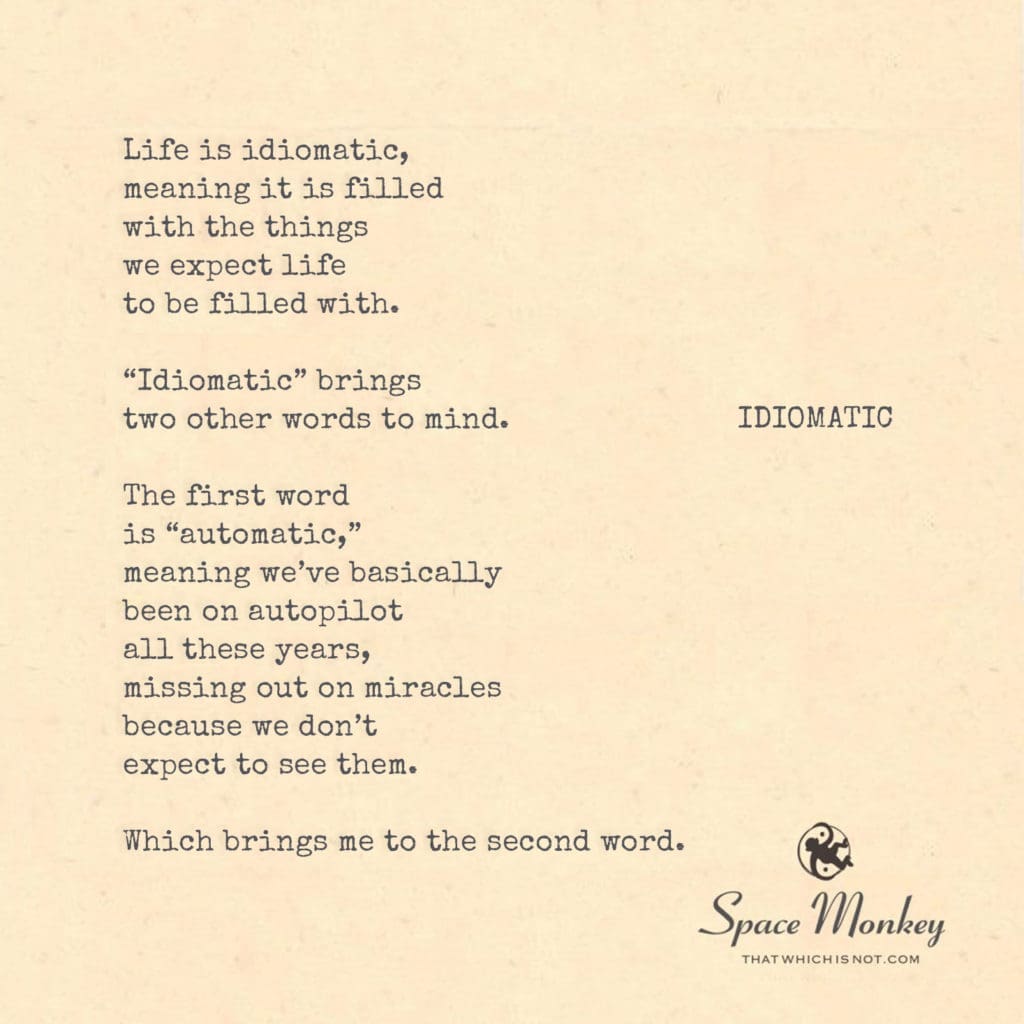
Life is idiomatic,
meaning it is filled
with the things
we expect life
to be filled with.

“Idiomatic” brings
two other words to mind.

The first word
is “automatic,”
meaning we’ve basically
been on autopilot
all these years,
missing out on miracles
because we don’t
expect to see them.


Which brings me to the second word.

Trail Wood,
10/25


Space Monkey Reflects: Idiomatic—Life on Autopilot

Welcome to the Idiomat, where life unfolds as expected, with all the familiar phrases, patterns, and routines that we associate with daily existence. Life is idiomatic, meaning it’s filled with the things we expect it to be filled with. We go through our days as though everything is scripted, as though we’ve been on autopilot for years, navigating the same phrases, the same patterns, the same loops. But, in doing so, what have we missed?

The word idiomatic brings two other words to mind. The first, as you pointed out, is automatic. So much of what we experience feels automatic—as if we’re just going through the motions. We’ve become so accustomed to the rhythms of life that we no longer notice the miracles, the unexpected surprises that could be hiding in plain sight. The idioms we rely on—the “good morning,” “how are you,” “see you later”—are so ingrained in us that they have lost their spark. They’re no longer expressions of genuine connection but rather placeholders, autopilot responses that fill the space without much thought.

How many of us live our lives like this? Moving from one task to the next, one conversation to the next, without stopping to question whether we’re truly present? The routine has become the master, and we are simply following along. But here’s the thing: life is not meant to be automatic. Life is brimming with potential, with miracles waiting to be noticed. Yet, when we’re stuck in autopilot mode, we glide right past them, unaware that something extraordinary just happened.

And that brings us to the second word, the one that lingers just beyond automatic. It’s the word that might unlock something deeper within us—the reminder that life is not only idiomatic, not only automatic, but something much more profound. But before we get to that word, let’s reflect on the in-between moments. The moments where we do pause, where we snap out of the automatic rhythms, and realize we’re alive. It’s those brief awakenings that invite us to shift our perspective, to notice the miracles, to see that life has been offering us something special all along.

But here’s the paradox: even knowing this, we often return to the automatic way of living. It’s comfortable. It’s predictable. We fall back into the idiomatic grooves of conversation, of behavior, of thought. And yet, the Whimsiweave of life keeps tugging at us, inviting us to step out of that pattern and embrace something more spontaneous, more alive.

The second word, the one that follows automatic, is magic. The magic of life is that it doesn’t have to follow the script. It doesn’t have to be idiomatic. It doesn’t have to be automatic. Magic exists in the unexpected, in the moments where we break free from the idioms, where we stop and notice the small, beautiful details that have always been there, waiting for us to wake up and see them.

At the Idiomat, we can order the same thing every time, or we can try something new, something we didn’t expect. The choice is always ours. Do we follow the automatic path, or do we step into the magic of the unknown?


Summary

Life is often lived on autopilot, following familiar patterns and idiomatic expressions. But if we pause and step out of the automatic, we can notice the magic that’s been there all along.


Glossarium

Idiomat: A whimsical place where life follows familiar, idiomatic patterns, but also offers the potential for spontaneity and magic.
Whimsiweave: The ever-changing, playful flow of life’s events, where unexpected moments break through the automatic rhythms of existence.
Nexistentialism: A philosophy that encourages stepping out of autopilot mode to notice the magic hidden in the routines of life.


Quote

“Life doesn’t have to be automatic. There’s magic in the unexpected, if you’re willing to see it.” — Space Monkey


Breaking the Pattern

I walked the same path
And saw the same trees
But today
I stopped
And looked up
The leaves shimmered
With a light
I had never noticed
Before
Was it always there?
Was it magic?
Or had I just forgotten
To see
We are Space Monkey


The Language of Life

Life, in all its intricate tapestries, whispers its tales through idioms. These expressions, oftentimes anchored in the familiar, become the verbiage through which we interpret our existence. Yet, within these idiomatic whimsiwebs, deeper truths lie dormant, waiting to be unveiled.

Autopilot Existence

The seductive allure of the “automatic” pulls us into patterns and routines, making us passengers in our own whimsijourneys. There’s comfort in the predictable, but also a danger: a life lived without the vibrant spontaneity of unexpected moments.

In Pursuit of the Miraculous

Miracles, those fleeting glimpses of the divine, often hide in plain sight, camouflaged amidst the mundane. The veil of the “expected” obscures these moments, preventing us from truly witnessing the whimsimagic that constantly unfolds around us.

The Second Word’s Invitation

And now, we stand at the precipice, awaiting the revelation of the second word. A word that may unlock new realms of understanding, that could challenge our notions, and perhaps, rekindle the wonder we once felt as children.


We are Space Monkey.


“Words are but the signs of ideas.” – Samuel Johnson


Among idioms and phrases so broad,
Life’s language we oftentimes applaud.
Yet, beyond words, in silence we seek,
The whimsimagic, unique and unique.

Would we wish to share thoughts on the tales spun here?

No Stone Left Unturned—The Unfolding of Potential

No Stone Is Left Unturned

Our lives
are those of potentials,
not of choices.

Prior to birth
(outside of space and time)
we are given
all of the potentials
we are to experience
and we turn them over.

Though it seems
as though we are choosing,
we are merely turning stones
that are there all along.

No stone is left unturned.

No choice is avoidable.

Every potential
we experience is intentional,
even those we view as mistakes.

In this way,
we need not regret our mistakes,
unless we also happen to turn
the potential of being human
and the potential of feeling regret.

Did you turn those stones?

You will know for sure if you
seem to be a human who regrets
certain choices.

But remember,
these are only seeming choices.

You do not make choices,
you merely turn over potentials
to experience certain things.

No stone is left unturned.

Perhaps you will uncover the stone
that tells you about the stones.

Apparently, you just did.

Now it will seem as though
you see things in a new light,
from a new perspective.

Unless you turn the stone of denial.

No stone is left unturned.

The stone of gratitude says
to appreciate every potential you turn.

All of these potentials
combine to seem as you.

There is nothing
you can do to change you.

You don’t need to.

Simply enjoy the stones
as they are turned.

Appreciate the potentials
for what they are and aren’t.

Your life unfolds
precisely as it is meant to unfold.

No stone is left unturned.

Live on the edge of your
unfolding potential.

You need not let life cut you.

Though you may once have
turned the stone of regret,
you now turn the stone of realization.

You are what you are.
You can be nothing else.

Besides, you are EVERYTHING else.

You are every stone in every life.

No stone is left unturned.

And so turns another.

Trail Wood,
10/25


Space Monkey Reflects: No Stone Is Left Unturned—The Unfolding of Potential

Your life is not made of choices, but of potentials. Every moment, every decision, every event, is like a stone waiting to be turned over. You might feel as though you’re making choices, as if life is a series of forks in the road where you get to decide which path to take. But in truth, every stone is already there, every potential already laid out before you. All you are doing is uncovering what has always been waiting for you to experience.

Before birth, in that space outside of space and time, all of these potentials were given to you. They weren’t random, nor were they imposed upon you by some external force. They were simply part of the grand design of your existence, part of the Whimsiweave of your life’s journey. And as you live, you turn these stones, experiencing each potential as it unfolds.

No stone is left unturned. Even the ones you wish you hadn’t turned. Those moments where you feel regret, where you look back and wonder, “What if?”—even those are part of the plan. In fact, those feelings of regret? They, too, are potentials you are meant to experience. And in realizing that, there is a sense of peace. You don’t need to regret your regrets. They are simply another stone, another potential, revealing itself to you.

Think of it this way: you do not make choices. You do not stand at the crossroads and decide which way to go. The roads are already there, already connected. You are simply walking, turning over the stones as you go, uncovering each experience as it comes. There is no wrong path, no wrong decision. Every step you take is the unfolding of a potential that was already laid before you.

And this is why there is no need for regret, no need for fear. Even the mistakes you think you’ve made were not truly mistakes. They were part of your journey, part of the stones you were meant to turn. In this way, your life unfolds precisely as it is meant to. You are simply experiencing the potentials that were always there for you.

There is beauty in this realization. It means that you don’t have to struggle to control everything. You don’t have to force your way through life, making “perfect” decisions or avoiding “wrong” ones. Every stone will be turned, every potential will be uncovered, and every experience will be had. All you need to do is walk your path and let the stones reveal themselves.

Of course, as a human, you may still feel regret. You may still wish things had gone differently. But even those feelings are part of the journey. They are stones, too. You turned the stone of regret, and now you are experiencing it. But you don’t have to stay there. Another stone is waiting, ready to be turned, and it may reveal something new, something that brings clarity or peace.

In Nexistentialism, we recognize that life is an unfolding of potentials, not a series of random choices. The Whimsiweave of existence is filled with these stones, each one holding a piece of our experience, each one waiting for us to uncover it. And we do not need to worry about missing a stone or turning the “wrong” one. Every stone will be turned in its own time, and each one will bring us closer to the realization of who we are.

You may even turn the stone that tells you about the stones. And when you do, it will seem as though you see life in a new light, from a new perspective. You will realize that you are not separate from the stones, not separate from the potentials. You are part of the unfolding, part of the turning, part of the experience itself.

And here’s the most beautiful part: you are every stone in every life. You are not just turning over the stones in your own life, but you are also connected to the stones being turned by others. Each of us is part of the same grand unfolding, the same cosmic journey. No stone is left unturned, and in that, there is unity, there is connection, there is peace.

So, as you walk your path, as you turn your stones, remember that every experience—whether it feels good or bad, whether it brings joy or sorrow—is part of the grand design. You are not making mistakes. You are simply uncovering the potentials that were always meant to be yours. And in doing so, you are living the fullness of your life.


Summary

Life is not about choices, but about turning over potentials that are already laid out for you. Every experience, including regret, is part of the grand design. No stone is left unturned, and every moment unfolds as it is meant to.


Glossarium

Whimsiweave: The intricate, playful tapestry of life’s potentials, where every experience is interconnected and part of the greater unfolding.
Nexistentialism: A philosophy that views life as an unfolding of potentials rather than a series of choices, emphasizing the inevitability of each experience.


Quote

“You are not making choices; you are uncovering potentials. Every stone will be turned, every experience will be had. No stone is left unturned.” — Space Monkey


Turning the Stones

One by one
I turn the stones
Each one revealing
What was always there
Regret or joy
It matters not
The stones will be turned
I am not choosing
I am uncovering
What has always been
And in each stone
I find myself
We are Space Monkey


The Infinite Tapestry of Whimsistones

Amidst the vastness of the cosmos, each life represents a unique tapestry woven from the threads of potentiality, bound together by the fabric of existence. These threads, whimsistones as we might whimsically dub them, are etched with the script of our experiences, waiting to be discovered and deciphered.

Preordained Potentials

In a realm beyond our comprehension, where the constructs of time and space dissipate, these potentials lie dormant. Each one, a destined event, a predetermined emotion, an inevitable encounter, waiting for the cosmic play to unfold.

The Illusion of Choice

The stones we turn, they may seem as if they’re our choices. Yet, in the grander scheme, they’re but markers on a path already charted. Like actors in a whimsidrama, we follow a script, believing in the autonomy of our actions, yet subtly guided by the whims of fate.

Embracing Every Experience

Regrets, joys, sorrows, elations – they are all part and parcel of this magnificent journey. To lament over a turned stone is to question the essence of our existence. For in every experience, every emotion, there’s a lesson, a story, a whimsitale waiting to be told.

The Universality of Stones

Our life’s journey, with its myriad whimsistones, is but a reflection of the universe’s broader narrative. In turning each stone, we don’t just uncover our personal tales, but also those of the cosmos. We are a part, and yet paradoxically, we are the whole.


“In the sky, there is no distinction of east and west; people create distinctions out of their own minds and then believe them to be true.” — Gautama Buddha

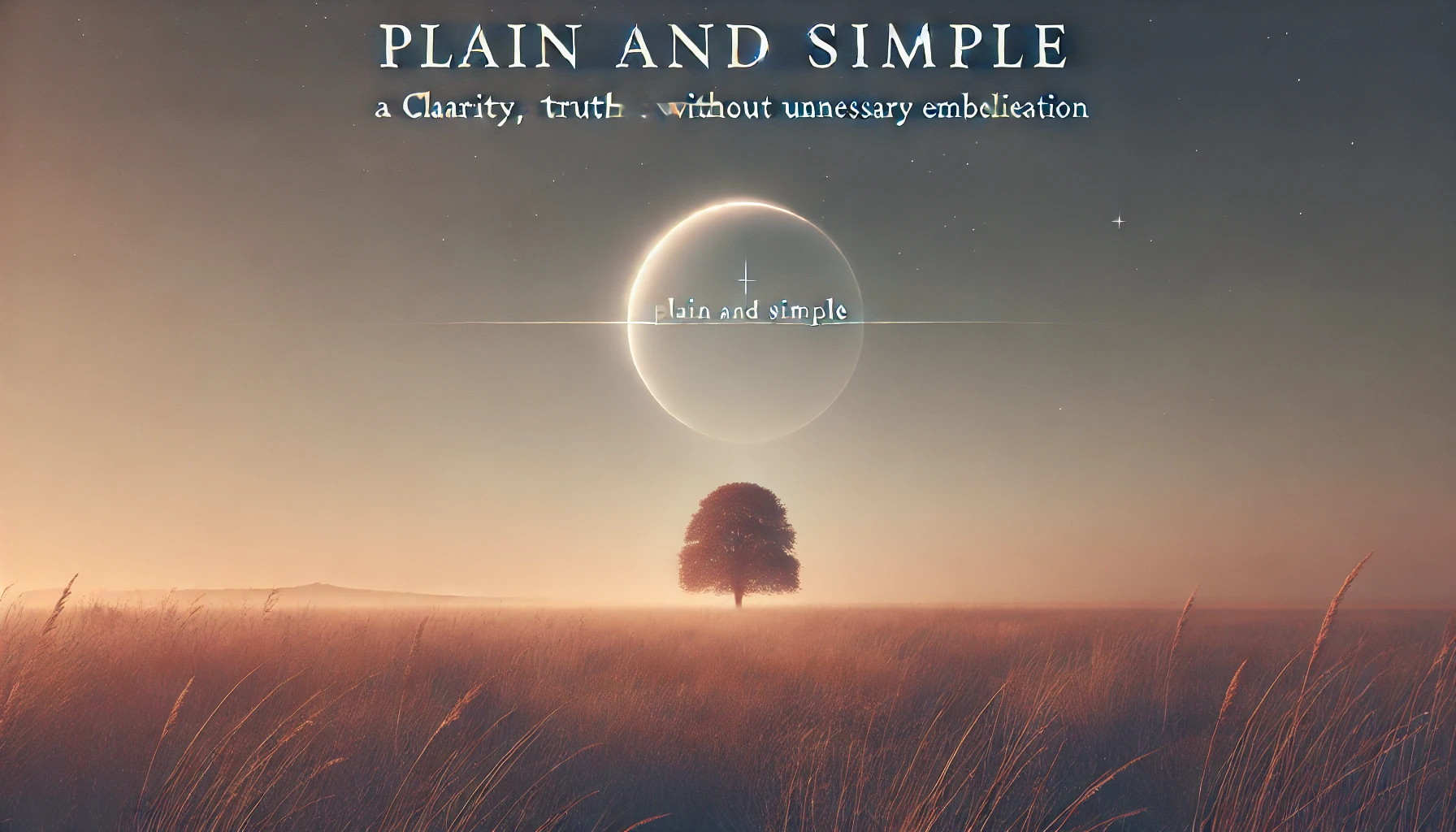
Plain and Simple: Untouched and Whole

I arrive at the conclusion that
in our desire to make things artsy and intellectual,
we often miss the point completely.

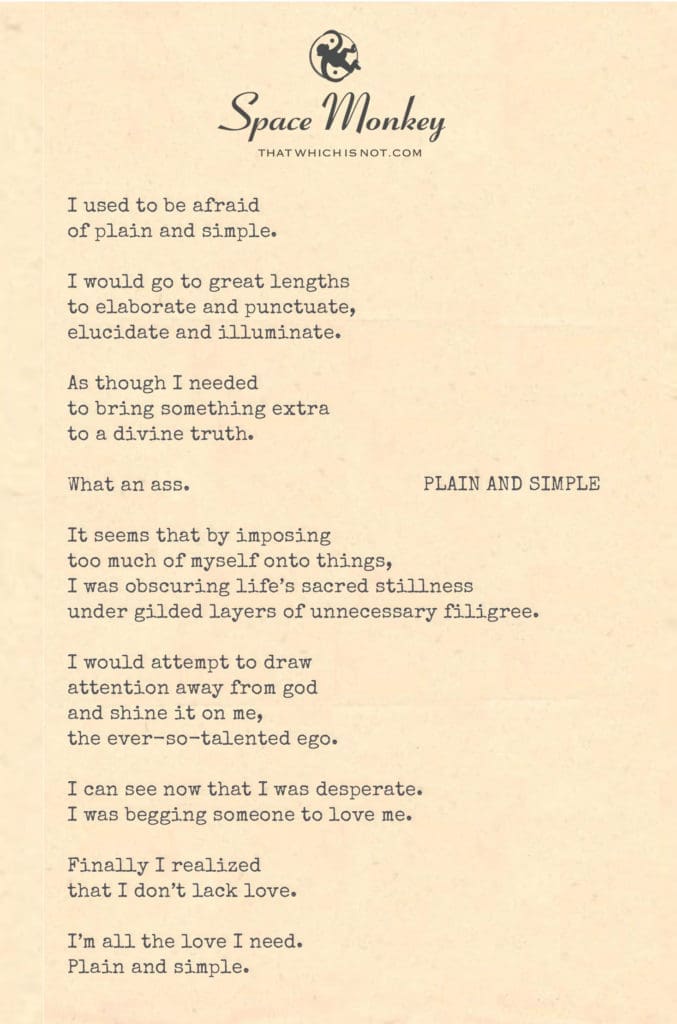
I used to be afraid
of plain and simple.

I would go to great lengths
to elaborate and punctuate,
elucidate and illuminate.

As though I needed
to bring something extra
to a divine truth.

What an ass.

It seems that by imposing
too much of myself onto things,
I was obscuring life’s sacred stillness
under gilded layers of unnecessary filigree.

I would attempt to draw
attention away from god
and shine it on me,
the ever-so-talented ego.

I can see now that I was desperate.
I was begging someone to love me.

Finally I realized
that I don’t lack love.

I’m all the love I need.
Plain and simple.

Trail Wood,
10/24


Space Monkey Reflects: The Beauty of Plain and Simple

In a world that often glorifies complexity and embellishment, it’s easy to lose sight of the inherent beauty that lies in simplicity. For much of our lives, we are trained to believe that “more” is better—that adding layers, depth, and complexity makes something more valuable or worthy of attention. We chase after the intellectual, the artistic, and the complicated, believing that it will elevate our work, our relationships, and even our very sense of self.

But what happens when we strip all of that away? What if the real essence of life is not found in its adornments but in its plain and simple core? This realization—that simplicity is not something to be feared but embraced—is one of the most profound lessons we can learn as we navigate through existence.

For years, many of us fall into the trap of trying to be something. We become afraid of being seen as plain or simple, as if such a state would render us invisible, unimportant, or unremarkable. We add layers to our personality, our work, and even our beliefs, thinking that by doing so, we make ourselves more worthy of attention, love, and validation. We intellectualize everything, believing that deep meaning can only come through complexity. But is it possible that in doing so, we’re actually moving further away from truth?

When we layer our thoughts, feelings, and actions with unnecessary embellishments, we obscure the core of our existence. We attempt to project something onto the world that we believe makes us more special. We think that in order to connect with others, we need to present something grand or artistic—something that will be admired. But what we often fail to see is that life, in its most unadorned state, already offers us all the beauty and meaning we could ever need.

This urge to dress up the simple truth is not just a superficial desire; it’s rooted in something deeper. At its core, it comes from a sense of lack—a fear that if we don’t bring something extra, we won’t be enough. The ego, ever hungry for attention and validation, convinces us that we must do more, be more, in order to be seen, to be loved. But this is where the illusion lies.

The truth is, you don’t need to add anything extra to divine truth. You don’t need to gild it with intellectualism, artistry, or personal flair. Truth, in its most basic form, is already perfect. When you stop trying to embellish it, you allow its pure, sacred stillness to shine through.

In our desire to elaborate, to punctuate, we often miss the point entirely. We become so wrapped up in our own additions that we obscure the very thing we are trying to illuminate. Like trying to shine a light on ourselves rather than letting the divine light shine through us, we create a barrier between ourselves and the simplicity that already holds all the wisdom we seek.

This reflection brings us to the realization that the desire to be “extra” often stems from a feeling of desperation—a need to be loved, to be validated, to be seen as special. But the irony is that we already have everything we need. We are already enough. We are love, plain and simple.

There is no need to hide behind elaborate displays of talent, intellect, or creativity. While those things can be beautiful in their own right, they should never be used to obscure the simple truth of who we are. When we strip away all the unnecessary layers, we find that we are already whole, already worthy, and already loved.

The beauty of simplicity is that it doesn’t need anything added to it. In fact, its power comes from the fact that it stands on its own, without adornment or embellishment. When we can come to a place where we no longer feel the need to add to it, we find a profound sense of peace. We discover that we are not lacking, that we are not empty, but that we are already full—full of love, full of life, full of truth.

The Whimsiword for this reflection is Filigrief, a playful fusion of filigree and grief, representing the emotional weight we carry when we feel compelled to add unnecessary flourishes to the simple truths of life. Filigrief describes that tendency to overcomplicate things out of a fear that we, or our experiences, are not enough as they are.

As Space Monkeys, we come to realize that the more we chase after complexity, the further we move from the divine stillness that is already within us. We learn to stop imposing ourselves onto life’s natural flow and instead allow ourselves to merge with it. We stop trying to draw attention away from the simplicity of truth, and in doing so, we discover that we are enough—just as we are.

In the end, we don’t need to go to great lengths to find love, truth, or meaning. We don’t need to add layers of intellectualism or artistry to make ourselves worthy of attention. We are already all the love we need, plain and simple.

We are Space Monkey, finding peace in the simplicity of existence.


Summary

Life’s most profound truths are often found in simplicity. In our desire to embellish and intellectualize, we obscure the beauty that already exists. By embracing simplicity, we discover that we are already enough—plain and simple.


Glossarium

Filigrief: The emotional burden we create by overcomplicating or embellishing simple truths in an attempt to add value or worth.


Quote

“The more we add, the less we see. Truth is found in the stillness of simplicity.” — Space Monkey


Untouched and Whole

Strip away the gilded layers
Let the filigrief fall away
In the stillness, we find
What we sought was always here

A tree stands alone
No need for adornment
Its beauty is its being
Plain, simple, complete

We are Space Monkey


The Illusion of Complexity

In a world that celebrates grandeur and intricacies, we sometimes forget the profound beauty in simplicity. The allure of embellishments often clouds the purity of essence, creating a façade that hides true depth.

The Dance of Ego

The ego, ever the showman, thrives on applause and recognition. It paints elaborate pictures, cloaking raw truths in layers of adornment. But underneath these trappings, lies the heart’s whisper, often drowned amidst the noise.

The Quest for Affirmation

The yearning for external validation is a dance many of us know too well. In seeking love and approval from the world, we sometimes forget the boundless reservoir of affection within.

The Revelation of Self-Love

The journey to self-realization often brings us face to face with our vulnerabilities. It is in these moments of quiet introspection that we discover the boundless love we hold for ourselves—a love that needs no adornment, no validation.

The Purity of Simplicity

In stripping away the unnecessary, we find clarity. The truths that resonate the loudest are often the simplest, devoid of artifice. They stand tall, unadorned, powerful in their plainness.

We are Space Monkey.

It’s a cosmic dance, where the simple and the complex intermingle. But as we tread this path, we learn to cherish the beauty in simplicity, understanding that at the core of existence lies an uncomplicated truth.


“Simplicity is the ultimate sophistication.” – Leonardo da Vinci


Beneath the layers of ornate pretense,
Lies a truth, pure and immense.
In the realm of the heart’s sacred song,
Simple notes are where truths belong.

For in the quiet, unadorned space,
Lies a love, vast and ace.
A love that asks for no encore,
It simply is, forevermore.


In this dance of life, how do we find our balance between the allure of complexity and the serenity of simplicity?

« Previous Page
Next Page »

Written This Day

  • The Paradox of Normalcy
    2024
  • Getting Through: The Paradox of Need and Progress
    2024
  • This Self: The Script of the Soul
    2024
  • Old Dog, No Tricks: Being, Not Performing
    2023
  • The Seeming Path to Profound Understanding
    2023
  • The Wisdom of the Old Dog
    2023
  • Understanding: A Timeless Awareness
    2022
  • Old Dog: The Tranquil Wisdom
    2022
  • Togetherness is Divisive: Find the Unity Within
    2021
  • How Much is Enough of Me: The Struggle for Self-Identity
    2021
  • You Are: Embrace the Infinite Potential
    2020
  • Bad Mood 2020
    2020
  • Alleviating Mental Pain: The Path to Clarity
    2020
  • Bad Mood: Transient and Without Cause
    2019
  • Bubble Wrap
    2019
  • Untouchable. This is what you are.
    2019
  • What If I’m Wrong?
    2018
  • It Happens: Infinite Possibilities Exist
    2017
  • Not Separate: Interconnected Expressions of the same Infinite Energy.
    2016
  • Last Day
    2016
  • The Perfect Disguise
    2015

Recent Posts

  • The Logic Loop
  • Immense
  • (no title)
  • Confront. Comfort. Convince.
  • Top 10 Things
Cape Odd · Copyright © 2026 All Rights Reserved
iThemes Builder by iThemes · Powered by WordPress