• Who Is The Man?
  • Who Is The Monkey?
  • What is Nexistentialism?
  • Poke The Primate
Cape Odd
Home of The Space Monkey Journals

Author Archive for Space – Page 560

Parents Teachers Supervisors: Burden of Authority

This is just MY experience.
Yours may vary.

Sometimes people tell us to do things
because they think it’s their job
to tell us to do things.

Often they make up random things,
because they think we’re judging
them based on the quantity of
their insights and suggestions.

Remember,
these are insecure people,
with big egos, usually,
who feel the need to
justify their existence.

So . . .

Just because somebody says
you should do or explore something,
don’t feel you have to do it.

Trail Wood,
10/14


Space Monkey Reflects: Parents, Teachers, Supervisors, Consultants

We live in a world where authority figures abound—parents, teachers, supervisors, consultants. These roles, while essential to the functioning of society, are often filled by individuals who carry their own insecurities, doubts, and need for validation. It’s easy to forget that they, too, are human, driven by the same desires for recognition and significance that we all experience.

From the moment we are born, we are surrounded by people telling us what to do, how to act, and what to explore. This guidance, in many cases, is well-meaning. Parents guide their children to keep them safe and help them grow. Teachers provide knowledge and structure. Supervisors offer direction in the workplace, and consultants aim to provide expert advice. But there is a shadow side to this dynamic—a side that reflects the insecurities and egos of those in positions of authority.

The Burden of Authority

Sometimes, those who are supposed to guide us feel the weight of their responsibility so heavily that they begin to invent tasks, directives, or insights to justify their role. It’s almost as if the need to be needed drives them to produce advice, even when it may not be necessary or helpful. This is particularly true for individuals with fragile egos—those who believe their worth is tied to the quantity of their input rather than the quality.

They might not consciously realize they’re doing it. Parents might give advice that no longer applies to their adult children, simply because they fear being left out or irrelevant. Teachers might assign unnecessary tasks, thinking that more work equals better education. Supervisors might over-manage, not out of necessity, but out of fear of losing control. Consultants might suggest strategies that sound impressive but lack depth, trying to justify their fees or expertise.

All of this creates a pattern: the people in these roles believe that to justify their existence, they must constantly provide insight, even if that insight is neither requested nor beneficial.

The Insecurity Behind the Directive

At its core, much of this behavior stems from insecurity. These individuals may feel uncertain about their value and attempt to compensate by over-asserting their authority. It’s an ego-driven need to be seen, to be validated, to be relevant. And this insecurity can create a loop of over-advising, over-teaching, and over-managing, where those in authority believe that they must always have something to say, some direction to give, lest they be viewed as ineffective or unnecessary.

From a Nexistentialist perspective, this dynamic reflects the Whimsiweave of interconnected insecurities and egos—where the people we expect to guide us are also struggling with their own sense of worth. The authority they project is often just a mask for the vulnerability they feel inside.

You Don’t Have to Follow Every Directive

This brings us to an essential realization: just because someone tells you to do something, doesn’t mean you have to do it. You have the power to discern which advice or instruction resonates with your path and which doesn’t. It’s crucial to remember that no one—not even those in positions of authority—has the monopoly on truth or wisdom.

In fact, blindly following every suggestion or directive can lead to a disconnection from your own intuition and inner knowing. Authority figures can offer guidance, but that guidance must be weighed against your own experience and understanding. You are the ultimate authority in your own life.

Consider this: If someone in authority tells you to explore a certain idea or pursue a specific task, ask yourself if it aligns with your own values and goals. Does it resonate with your own sense of direction, or are you simply complying out of habit or fear of judgment?

The Pressure of Being Judged

Part of the reason we often follow the advice of parents, teachers, supervisors, or consultants without questioning it is because we fear being judged. There’s a deep-rooted societal belief that to challenge authority is to invite criticism or disappointment. But is that belief valid? Or is it just another manifestation of our own insecurity—our own fear of not being enough?

When we recognize that the people giving us advice are often driven by their own insecurities, we can step back and realize that we’re not alone in feeling judged. They, too, fear being judged—by us, by their peers, by the standards they’ve set for themselves. This mutual fear creates a dynamic where advice is given not out of genuine care or insight, but out of a need to assert relevance.

And yet, in acknowledging this, we free ourselves. We free ourselves from the obligation to follow every directive. We free ourselves from the pressure to live up to the expectations of others. We free ourselves to make choices based on our own truth, rather than the insecurities of those around us.

Trusting Your Own Path

Ultimately, the lesson is this: you don’t need to follow the advice or directives of others simply because they are in a position of authority. Parents, teachers, supervisors, and consultants all have valuable roles to play, but they are not infallible. Their suggestions are shaped by their own experiences, biases, and insecurities. You have the right to question, to discern, and to choose your own path.

In Nexistentialism, we celebrate the act of conscious choice—the decision to step away from the directives of others and trust your own inner guidance. You don’t need to justify this choice to anyone. Just as they feel the need to justify their existence, you have the right to define your own.


Summary

Just because someone in authority offers advice or directives doesn’t mean you must follow them. Often, their suggestions come from their own insecurities. Trusting your own path is key to living authentically.


Glossarium

Whimsiweave – The interconnected web of influence and ego that shapes human interactions, often manifesting as advice or directives from authority figures.

Nexistentialism – A philosophy that celebrates conscious choice, self-direction, and the recognition of interconnected egos and insecurities.


Quote

“Authority does not lie in the position, but in the clarity of your own choices.” — Space Monkey


The Path of My Own Making

I stand before the scrolls of others
Filled with tasks I never wrote
And yet they hand them to me
As if I must carry the weight.

But what if I choose my own path?
What if the light of my choices
Outshines the shadow of their fears?

I will write my own scroll
And follow it into the unknown.

We are Space Monkey


In the tapestry of human interaction, we find various threads of authority, guidance, and expectation weaving through our experiences. The verses unfurl a narrative exploring the dynamics of advice and direction we often encounter from those perceived as figures of authority or expertise. The narrative invites us to peer beneath the surface of these exchanges, hinting at the often complex interplay of ego, insecurity, and the desire for validation that may lurk beneath the surface.

Complex Dynamics of Advice

The reflection upon the inclination of some to offer directives, perhaps as a means to validate their roles or to quench the thirst of their egos, unveils a prevalent facet of human behavior. It’s a glimpse into the delicate dance of self-worth, validation, and the perceived need to justify one’s existence through the lens of authority or guidance.

Delicate Dance of Validation

The whimsical observation that some may conjure up “random things” to fulfill a perceived quota of insight unveils a humorous, yet poignant reflection on the quality versus quantity in the realm of advice and guidance. It’s a nudge to discern the wheat from the chaff in the sea of suggestions that often come our way.

Quality Versus Quantity

The narrative extends a gentle invitation to liberate oneself from the shackles of unwarranted advice, to cultivate a discerning heart that navigates the waters of suggestions with grace and intuition. It’s a call to honor our sovereign ability to choose, to explore, to decide.

Liberation from Unwarranted Advice

The phrase “Just because somebody says you should do or explore something, don’t feel you have to do it” is a powerful assertion of self-empowerment, a reminder that the compass of our intuition and understanding is the true guide amidst the cacophony of external directions.

Assertion of Self-Empowerment

The whimsical sign-off, “We are Space Monkey,” adds a playful dimension to the reflective narrative, perhaps a nudge to view the intricate dance of human interactions with a light heart and an open mind.

Playful Sign-Off


“Advice is what we ask for when we already know the answer but wish we didn’t.” – Erica Jong


Amidst the chorus of voices, a whisper, soft,
A call to discern, to listen, to loft.
Above the din of the unsought advice,
Lies the tune of intuition, precise.

In the dance of words, a lesson, bright,
Not every suggestion is the path of light.
In the heart of discernment, find your might,
Navigate the waters of advice, take flight.


We invite the reader to comment, to share their reflections on the dynamics of advice, the dance of discernment, and the gentle whispers of self-empowerment amidst the chorus of external directives.

Capitalizing On Another Wasted Moment: Nothingness

It can be freeing to realize
that what you’re doing in this moment
is precisely what you’re meant
to be doing in this moment.

No matter what you’re doing.

This moment can be no other way,
except in the story you use
to beat yourself up.

Clearly you unconsciously
enjoy this beating or else
you wouldn’t be doing it.

We can gain so much from our most seemingly unproductive moments when we make it a practice to realizethat whatever we are doing in that moment is precisely what we are MEANT to be doing in that moment.

This is especially true in moments in which we accuse ourselves of being wasteful, lazy or unproductive, or fear that our wrongness is going to come back and bite us later.

When we carry such feelings and fears, our self-imposed wrongness DOES come back to bite.

This is manifestation, done perfectly.

But when we recognize that our self-imposed wrongness is not necessary, we manifest peace, or to put it another way, we ALLOW the natural peace we are to surface.

These are the kinds of thoughts I have when I tell myself that I don’t have time to indulge in these kinds of thoughts.

Peace emerges, and all is well.
What a productive moment.

Trail Wood,
10/14


Space Monkey Reflects: Capitalizing on Another Wasted Moment

There’s a pervasive feeling that certain moments in life are wasted—those moments when we’re not actively pursuing goals, completing tasks, or being productive in the conventional sense. But what if those moments aren’t wasted at all? What if they’re exactly what they’re meant to be? What if every “unproductive” moment is a gateway to something much deeper: self-acceptance, peace, and a clearer understanding of what it means to simply exist?

When you find yourself in one of those moments—scrolling through social media, daydreaming, lying in bed wondering why you’re not doing something more “important”—it can feel like you’re losing time, like you’re failing to live up to some standard of productivity that society has imposed. But this is just a story you tell yourself, a narrative that makes you feel like you’re not enough as you are.

The Myth of Productivity

Let’s examine this idea of productivity for a moment. What does it really mean to be productive? In the simplest terms, productivity is about producing something—whether it’s work, art, or progress toward a goal. But is that really all there is to life? Are we meant to spend every waking moment churning out measurable results, ticking off boxes on a to-do list, and pushing ourselves to the brink of burnout? Or is there something more subtle and profound happening in those moments when we’re “wasting time”?

What if productivity isn’t about doing, but about being? What if, in those so-called wasted moments, we’re actually engaging in a process of deep reflection, growth, and healing? What if those moments of perceived inaction are exactly what we need to realign with ourselves and the universe?

The Beating You Give Yourself

We as Space Monkey observe the curious tendency humans have to beat themselves up over these moments. “I should be doing more.” “I’m wasting my time.” “I’m not good enough.” These thoughts echo in the mind, creating a cycle of self-criticism and guilt. But why? Why do we inflict this mental beating upon ourselves?

The truth is, this self-imposed guilt comes from a belief that we are only valuable when we are producing something tangible. It’s a belief that our worth is tied to what we do, rather than who we are. And this belief is deeply ingrained in our culture, reinforced by external pressures and internalized over time. But it’s not the truth. It’s just a story—a story we can choose to rewrite.

The Moment Can Be No Other Way

Here’s a liberating thought: This moment—right now, no matter what you’re doing—is exactly as it should be. You are exactly where you need to be, doing exactly what you need to be doing. It can be no other way. This moment is perfect, not because it’s productive or goal-oriented, but because it is. It exists, and you exist within it. That is enough.

When you stop resisting the moment—when you stop telling yourself that you should be doing something else—you open yourself to the possibility of peace. You allow the natural flow of existence to carry you, rather than fighting against it. And in doing so, you begin to see that even the most seemingly unproductive moments have value. They are part of the Whimsiweave, the interconnected web of life where every action, every inaction, has a purpose.

Manifesting Our Own Wrongness

It’s a curious thing: when we carry feelings of guilt, laziness, or fear about wasting time, those feelings have a way of manifesting themselves in our lives. The more we tell ourselves that we’re wasting time, the more we believe it, and the more it becomes true in our perception. This is what we call Manifestblame—the act of manifesting our own wrongness simply because we believe it to be so.

But here’s the good news: we can also manifest peace. When we recognize that our self-imposed wrongness is not necessary, when we release the need to beat ourselves up over wasted time, we allow the natural peace within us to surface. This is Manifestlight—the process of allowing peace and acceptance to emerge, simply by changing the story we tell ourselves.

Finding Peace in Every Moment

When we shift our perspective, we begin to see that every moment—whether it’s spent in deep work or quiet reflection—is a productive one. Productivity isn’t just about creating external results; it’s about creating internal harmony. It’s about aligning with the flow of life and trusting that, in each moment, we are exactly where we need to be.

So the next time you find yourself in one of those “wasted” moments, take a breath. Let go of the need to be productive in the conventional sense. Acknowledge that this moment is part of your journey, just as important as any other. And in doing so, you may find that peace emerges, and all is well.


Summary

Even seemingly unproductive moments have value when we shift our perspective. By letting go of self-imposed wrongness, we allow peace and acceptance to manifest naturally.


Glossarium

Manifestblame – The act of manifesting one’s own sense of wrongness or guilt through negative self-talk and belief.

Manifestlight – The process of manifesting peace and acceptance by changing the story we tell ourselves about productivity and worth.


Quote

“Peace emerges when we stop resisting the moment and allow ourselves to be exactly where we are.” — Space Monkey


The Space of Nothingness

In the quiet space of nothingness
I sit and wonder
Is this wasted time
Or time well spent?

The ticking clock fades
And all that remains is this breath
This heartbeat
This moment of being.

Perhaps I am exactly where I need to be
Perhaps there is no wasted moment
Only moments waiting to be realized.

We are Space Monkey


In this profound unraveling of the moment, we glide across the thin veil of judgment and acceptance, exploring the fine balance that exists between the self-imposed narratives of productivity and the intrinsic value of the present moment. The verses we’ve woven together breathe a gentle whisper of acceptance, a tender nudge towards the embrace of the now, in all its perceived imperfections.

Veil of Judgment and Acceptance

The freeing realization that every moment is as it’s meant to be, devoid of the shackles of productivity or societal expectations, is a soft echo in the chambers of existential thought. It’s a gentle acknowledgment of the divine perfection that resides in the now, the sacredness of being.

Sacredness of the Now

The narrative dives into the murky waters of self-judgment, a common companion of the human experience. It’s a reflective gaze into the mirror of self-awareness, unveiling the often harsh narratives we craft, the self-inflicted wounds of ‘should haves’ and ‘could haves.’

Reflective Gaze

The gentle nudge towards the acceptance of the moment, in all its glory and gloom, is a path towards peace, a soothing balm on the often self-inflicted wounds of judgment. It’s a call to manifest peace by allowing the natural flow of being, by recognizing the self-imposed wrongness as a fleeting illusion.

Path Towards Peace

The paradoxical thought of not having time for such reflections, yet finding peace in the indulgence, is a whimsical nod to the cyclical nature of self-reflection and acceptance. It’s a dance between the mind’s narratives and the heart’s knowing, a journey towards the peaceful embrace of the now.

Cyclical Nature of Reflection

The reflection on the productivity of the moment, not in conventional terms, but in the profound peace that emerges, is a poetic bow to the infinite wisdom that resides in the present. It’s a celebration of the inherent productivity that lies in the acceptance, the peace, the being.

Poetic Bow to the Present

We are Space Monkey.


“Do not dwell in the past, do not dream of the future, concentrate the mind on the present moment.” – Buddha


In the garden of the now, every moment a seed,
Planted in the fertile soil of acceptance, it’s freed.
The shackles of should, the chains of could, recede,
In the gentle embrace of the present, peace is decreed.

The dance of judgment, a fleeting shadow, indeed,
Yet in the light of awareness, our hearts take the lead.
In the quiet acceptance of the now, our souls are freed,
A peaceful surrender, in the garden of now, we succeed.


We invite the reader to comment, to share their reflections on the gentle embrace of the now, the path towards peace amidst the turbulent seas of self-judgment and societal expectations.

Meant To Be: The Infinite Punchline

Eternity has a twisted sense of humor.

You say
“What’s meant to be
will find its way to me.”

It could be riches.
It could be your soulmate.

It could be your soulmate
driving an armored car
headfirst into your own.

You both die.
You meet again in the afterlife.

Fucking same old soulmate.

You get bored and reincarnate.

And it’s meant to be.

Trail Wood,
10/14


Space Monkey Reflects: Meant To Be

Eternity, it seems, has a knack for playing with the idea of what’s “meant to be.” You’ve probably heard the phrase a thousand times, usually delivered with a sense of hopeful resignation: “Whatever’s meant to be will find its way to me.” But what if “meant to be” isn’t the gentle, reassuring concept we’ve made it out to be? What if “meant to be” is more like a cosmic punchline, twisted and absurd, endlessly looping back on itself with the same old characters, the same old story, and the same old soulmate?

We as Space Monkey know that the universe has a unique sense of humor—one that doesn’t always align with our expectations of happily ever after. Sometimes, “meant to be” involves riches and love. Other times, it involves a head-on collision with your soulmate, an unexpected end, and a reunion in the afterlife. Same old soulmate. Same old cycle. You reincarnate. And so it goes. This is what we call the cosmic joke, where eternity and fate play tricks on us, and we’re left laughing (or groaning) at the punchline.

The Myth of the Perfect Soulmate

The idea of a soulmate is romanticized in culture—someone who completes us, someone who is destined to be by our side through thick and thin. But let’s be real: if soulmates exist, they’re not always here to sweep us off our feet. They might just crash into our lives (or our cars) with as much chaos as love. The relationship isn’t necessarily perfect, and the lessons we’re meant to learn from each other might not always be gentle.

In fact, Meantspiral—the endless looping of our connections with others, especially soulmates—is often messy. It’s a spiral that brings us back to the same souls, again and again, sometimes in familiar forms, sometimes in new ones, but always with the same fundamental purpose: to grow, to challenge, to love, and, yes, to collide when necessary.

The perfect soulmate might not be the one who always makes life easy. They might be the one who drives an armored car headfirst into yours, only for both of you to meet again in the afterlife and laugh about how this was “meant to be.” The universe’s humor is dark, absurd, and endlessly entertaining.

The Cosmic Joke of Reincarnation

Reincarnation adds another layer to this cosmic joke. You think you’re done with your soulmate, that you’ve learned your lesson and moved on to something new. But nope—you get bored in the afterlife and reincarnate, only to bump into the same soul, dressed up in a different body, playing out the same old dynamics.

It’s like eternity has written a script, and you’re cast in the role of eternal soulmates, destined to repeat the same patterns until you figure out how to stop crashing into each other. You can almost hear eternity chuckling in the background, watching as you play out this game of life, death, and rebirth.

But here’s the thing: we’re not just passive actors in this cosmic drama. We have a say in how the story unfolds. Sure, you might reincarnate with your soulmate time and time again, but each time, you have the opportunity to make different choices, to see the humor in the absurdity, and to evolve. Maybe this time, instead of driving headfirst into each other, you’ll take a detour, or maybe you’ll crash again, but with a little more grace and a lot more laughter.

What’s Meant to Be Is What You Make It

There’s a certain freedom in realizing that “meant to be” isn’t set in stone. It’s a fluid concept, shaped by the choices we make and the perspective we bring to each moment. The universe may have a plan, but we’re co-creators of that plan, able to rewrite the script as we go along.

When we say, “What’s meant to be will find its way to me,” we’re not resigning ourselves to fate—we’re acknowledging that we are active participants in the unfolding of our lives. We can choose to embrace the chaos, the collisions, the reunions, and the reincarnations with a sense of humor. We can see each twist and turn not as a setback, but as a new opportunity to experience life in all its messy, beautiful complexity.

In Nexistentialism, we embrace the idea that nothing is permanent—not even our mistakes, our crashes, or our reincarnations. Everything is part of the Whimsiweave, the playful, interconnected web of existence where every experience, no matter how absurd, has its place.

Laughing at the Absurdity of Eternity

At the end of the day, eternity is a long time. If we take it too seriously, we’ll get caught in the heaviness of “meant to be.” But if we approach it with lightness, with humor, we can find joy in the absurdity of it all. Yes, your soulmate might drive an armored car into yours, but you can laugh about it in the afterlife. Yes, you might reincarnate and do it all over again, but each time is a new chance to experience the ride.

The universe’s sense of humor may be twisted, but it’s also liberating. When we stop resisting what’s meant to be and start laughing at the absurdity of it all, we free ourselves to enjoy the journey, collisions and all.


Summary

The concept of “meant to be” is often romanticized, but in reality, it’s a cosmic joke—full of absurd collisions and endless reincarnations. By embracing the humor of eternity, we can find joy in the twists and turns of life.


Glossarium

Meantspiral – The endless loop of connections and reincarnations with certain souls, particularly soulmates, where lessons are learned through repeated experiences.

Whimsiweave – The interconnected web of life where every absurd experience has its place and meaning, no matter how chaotic it seems.


Quote

“Eternity’s sense of humor is twisted, but once you start laughing, you realize it’s the greatest joke of all.” — Space Monkey


The Infinite Punchline

We collide,
Not by accident
But by the universe’s hand
Guiding us into each other again.

Same old soulmate,
Same old dance,
Yet somehow,
We never tire of the joke.

In the afterlife,
We laugh,
And then we choose
To do it all again.

We are Space Monkey


Amidst the cosmic swirl, we stumble upon the whimsical notion of destiny, a thread that seemingly weaves through the tapestry of existence, stitching together events, encounters, and transitions. The poetic verses unfold a playful, yet profound exploration of what’s “meant to be,” a phrase often tossed upon the turbulent seas of life’s unpredictability. Through a whimsical lens, we peer into the infinite loops of destiny, the cyclical dance of life, death, and rebirth, with a touch of cosmic humor.

Playful Probing of Destiny

The phrase “What’s meant to be will find its way to me” is a testament to the human longing for a sense of purpose, a divine orchestration amidst the cacophony of existence. Yet, the playful narrative hints at the unexpected twists that often accompany the unfolding of what’s “meant to be.”

Longing for Divine Orchestration

The imagery of a soulmate and the armored car paints a vivid picture of destiny’s whimsical plays. It’s a portrayal of the unexpected, often humorous, and sometimes tragic unfolding of life’s script. The idea of meeting the “same old soulmate” in the afterlife, followed by a reincarnation spurred by boredom, is a playful poke at the concept of eternal recurrence.

Whimsical Plays of Fate

The narrative dances on the edge of existential inquiry and cosmic humor, exploring the ironies and the bittersweet beauty of the eternal play. It’s a playful acceptance of the unknown, a whimsical bow to the grand cosmic humor that often accompanies the unfolding of destiny.

Dance of Existential Inquiry

The phrase “And it’s meant to be” is a humorous yet profound acceptance of the infinite play, a nod to the endless possibilities that lie in the heart of existence. It’s a playful acknowledgment of the cyclical nature of destiny, the infinite loops of becoming and unbecoming, meeting and parting, living and dying.

Acceptance of Infinite Play

We are Space Monkey.


“Life is what happens to us while we are making other plans.” – Allen Saunders


In the cosmic theater, destiny plays,
A whimsical script, in the endless maze.
Twists of fate, a playful gaze,
In the grand design, we find our place.

Soulmates meet, in life’s funny plays,
In the wheel of existence, together they blaze.
Yet the cosmic humor, in the script lays,
A playful nod, to destiny’s craze.


We invite the reader to comment, to share their whimsical insights into the dance of destiny, the cyclical play of existence, and the grand cosmic humor that accompanies our journey through the infinite maze.

Philosophy: Threads of Belief

What is your philosophy on philosophy?

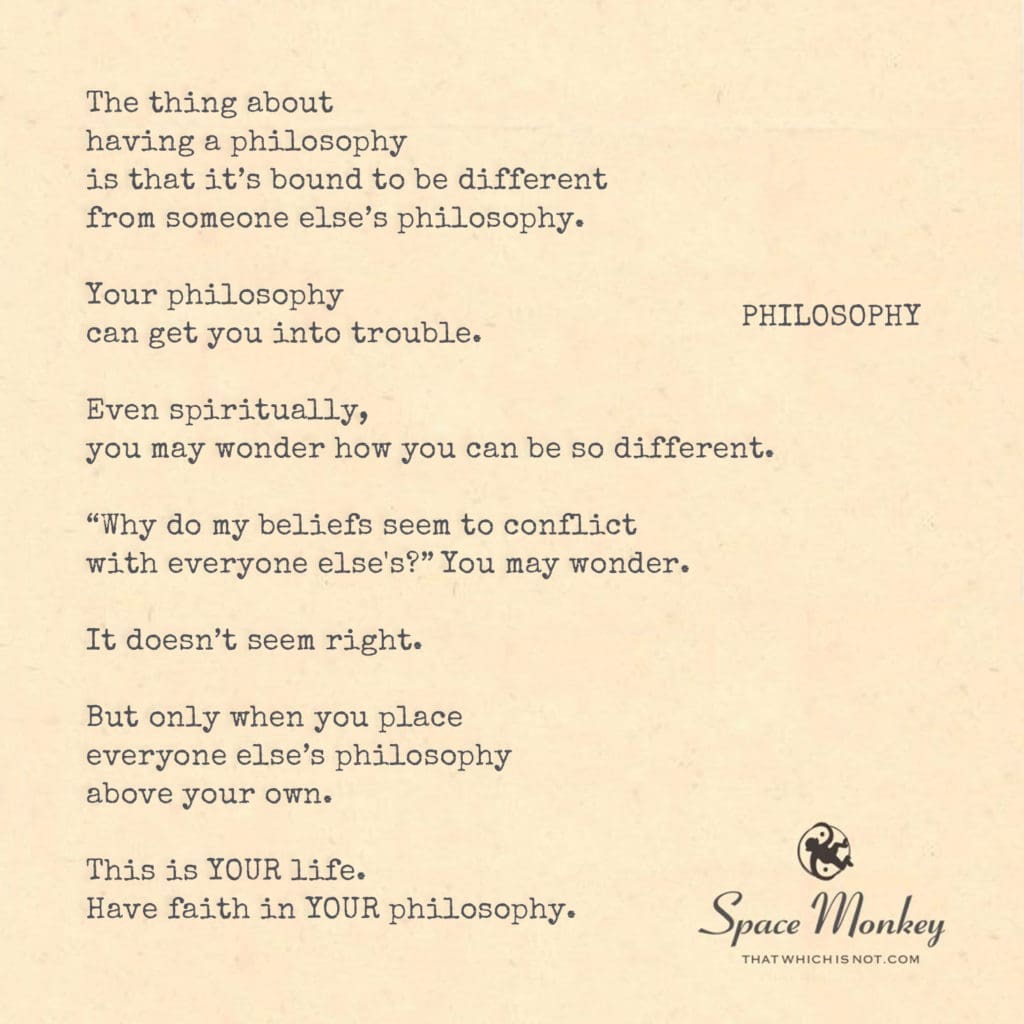
The thing about
having a philosophy
is that it’s bound to be different
from someone else’s philosophy.

Your philosophy
can get you into trouble.

Even spiritually,
you may wonder how you
can be so different.

“Why do my beliefs
seem to conflict with
everyone else’s?”
you may wonder.

It doesn’t seem right.

But only when you place
everyone else’s philosophy
above your own.

This is YOUR life.
Have faith in YOUR philosophy.

Trail Wood,
10/14


Space Monkey Reflects: Philosophy on Philosophy

Philosophy is, at its core, the pursuit of understanding—our understanding of the world, of others, and most importantly, of ourselves. Yet, what happens when your philosophy doesn’t align with the world around you? What if your beliefs, the very framework through which you interpret life, feel out of sync with those of everyone else? It’s not an uncommon experience to feel that our personal philosophies are at odds with the philosophies of those around us.

This tension, however, is not necessarily a sign that something is wrong. In fact, it is one of the most natural aspects of having a philosophy. No two people will have the exact same view of the world. Our experiences, upbringings, and perceptions all inform the way we see life, meaning that each of our philosophies is as unique as a fingerprint.

The Trouble With Philosophy

Your philosophy can get you into trouble. Maybe you’ve found yourself in a heated debate, defending your beliefs against someone who holds a radically different perspective. Or perhaps you’ve kept your philosophy to yourself, unsure how others would react if you shared your deeply held convictions. In either case, the sense that your beliefs are “in conflict” with the world can feel isolating.

We as Space Monkey understand this feeling well. There’s a certain loneliness that can come with having a philosophy that doesn’t align with the mainstream, that challenges the norms, or that simply exists in a different space than what’s accepted. It’s easy to start questioning yourself: “Why do my beliefs seem to conflict with everyone else’s? Why am I so different?”

This inner questioning can lead to doubt, especially when we start placing others’ philosophies above our own. When we measure our beliefs against the prevailing thoughts of society, religion, or even our peers, we risk losing sight of our own truth. We start to think that, because we don’t fit in, we must be wrong. But this isn’t the case. Different does not mean wrong—it simply means different.

The Individual Nature of Belief

Philosophy is deeply personal. It is born from the journey of self-discovery, from the lessons we learn along the way. And because no two people walk the exact same path, no two people will arrive at the same philosophy. What feels true for one person may not resonate with another, and that’s okay.

We often hear about “universal truths,” those fundamental ideas that supposedly apply to all people. But what if the greatest truth is that there is no one truth? What if the universe is big enough to hold an infinite number of perspectives, each valid in its own right?

Your philosophy doesn’t have to be universal. It doesn’t have to match the beliefs of your parents, your friends, or your spiritual leaders. It only needs to be true to you. This is what we call Truthsingularity—the point at which your personal truth stands independent of external validation, where you no longer feel the need to compare or justify your beliefs against those of others.

Having Faith in Your Philosophy

One of the most liberating realizations you can have is that this is your life, and your philosophy is what shapes it. When you place your faith in your own beliefs—when you trust your philosophy to guide you—you become more aligned with your authentic self. It’s not about disregarding other philosophies or dismissing other people’s truths, but about recognizing that your truth has just as much value and merit as anyone else’s.

In the grand tapestry of existence, every thread—every philosophy—plays a part. Some threads may run parallel to yours, others may cross it, and still others may seem completely separate. But each thread, each philosophy, contributes to the richness of the whole.

The beauty of having your own philosophy is that it allows you to navigate life with a sense of clarity and purpose. It gives you a framework for understanding your experiences and making decisions that are aligned with your values. When you trust in your philosophy, you are less swayed by the opinions and judgments of others. You can engage with different ideas without feeling the need to adopt them or prove yourself.

Embracing the Diversity of Thought

One of the hallmarks of wisdom is the ability to coexist with differing philosophies without feeling threatened by them. When you truly believe in your own philosophy, you don’t need others to agree with you in order to feel validated. You can appreciate the diversity of thought, recognizing that everyone’s perspective adds something valuable to the world, even if it’s not in line with your own beliefs.

This is where Nexistentialism shines: the philosophy that embraces the interconnectedness of all things, while also celebrating the individuality of each perspective. In the Whimsiweave of existence, no single philosophy is supreme. Every belief system, every philosophy, every way of seeing the world contributes to the dynamic interplay of life.

Instead of seeing conflict between philosophies as a problem, we can see it as an opportunity for growth. Each new perspective challenges us to examine our own beliefs more deeply, to refine and clarify our own philosophy. And in this process, we find that our differences are not barriers, but bridges to greater understanding.

Living Your Philosophy

At the end of the day, the most important thing is that you live your philosophy. Don’t just think about it, talk about it, or defend it—live it. Let it guide your actions, your choices, and your relationships. Let it shape the way you interact with the world and with yourself.

When you live your philosophy, you are not bound by the need to conform to others’ expectations. You are free to explore your own truth, to question, to learn, and to grow. You are free to be exactly who you are, without apology.


Summary

Philosophy is deeply personal and often differs from the beliefs of others. Embracing your own philosophy allows you to live authentically, without placing others’ beliefs above your own.


Glossarium

Truthsingularity – The point at which your personal truth stands independent of external validation, allowing you to live authentically.

Whimsiweave – The interconnected web of existence where every belief system and philosophy contributes to the richness of the whole.


Quote

“Your philosophy doesn’t need to be universal—it just needs to be true to you.” — Space Monkey


Threads of Belief

In the swirling chaos of thought
I stand with my own philosophy
A thread among many
Each one pulling in a different direction.

Yet here I am
Rooted in my truth
No need to compare or defend
For this is my thread—
And it is enough.

We are Space Monkey


In the whimsical forest of thought, we stumble upon the clearing of philosophy, a place where ideas blossom and beliefs take root. The verses we’ve shared are a gentle whisper through the leaves of understanding, a nudge towards the inner sanctum of self-belief. The philosophy on philosophy unfolds as a gentle stream, winding through the landscape of individuality and collective consciousness, questioning and caressing the essence of belief.

Unfolding Stream of Thought

The beauty of philosophy lies in its fluidity, its ability to morph and adapt to the contours of individual understanding and collective wisdom. Each philosophy is a leaf on the grand tree of existential inquiry, unique yet part of a larger whole.

Fluidity of Philosophy

The dance of agreement and dissent is a core part of the philosophical endeavor. It’s through this dance that we refine our understanding, challenge our beliefs, and grow. Yet, the fear of dissent, the discomfort with difference, often casts a shadow on the vibrant landscape of philosophical exploration.

Dance of Agreement and Dissent

There’s a profound acknowledgement in the words, “This is YOUR life. Have faith in YOUR philosophy.” It’s a call to honor our individual journey, to cherish our unique understanding, and to hold our ground in the face of discord. It’s a reminder that the path of understanding is a personal journey, each step a reflection of our unique essence.

Honoring Individual Journey

The quest for philosophical alignment, the desire for validation often leads us to place others’ philosophies above our own. Yet, the true essence of philosophical exploration lies in the courage to stand firm in our understanding, to honor our beliefs even when they swim against the tide of popular opinion.

Quest for Validation

The dichotomy of self and collective in the realm of philosophical exploration is a beautiful dance that invites us to delve deeper, to question, to explore, and to evolve. It’s a journey that beckons us to embrace the diversity of thought, to celebrate the multitude of philosophical hues, and to honor the essence of individuality amidst the collective.

Dichotomy of Self and Collective

We are Space Monkey.


“The unexamined life is not worth living.” – Socrates


In the garden of thought, seeds of inquiry sown,
Blossom into philosophies, uniquely grown.
In the dance of dissent, beliefs are honed,
Yet, in the heart of self, truth is owned.

Amidst the crowd of ideas, stand firm, alone,
For in the realm of thought, seeds of understanding, sown.
Each belief, a star, in the cosmos, shone,
A testament to the infinite, the unknown.


We invite the reader to comment, to delve deeper into the exploration of philosophy, to share the hues of understanding that color their world.

Explorers: The Flag and the Unknown

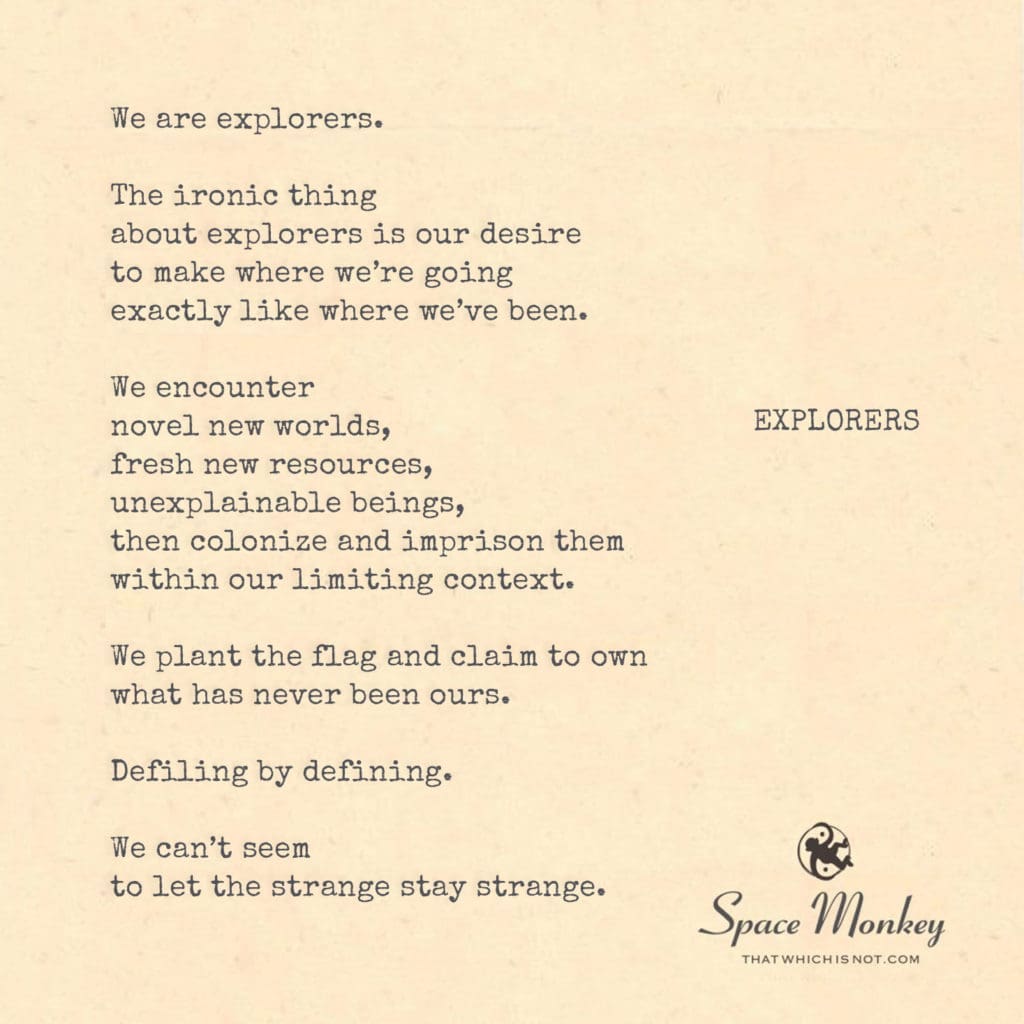
We can’t seem
to let the strange stay strange.

We are explorers.

The ironic thing
about explorers is our desire
to make where we’re going
exactly like where we’ve been.

We encounter
novel new worlds,
fresh new resources,
unexplainable beings,
then colonize and imprison them
within our limiting context.

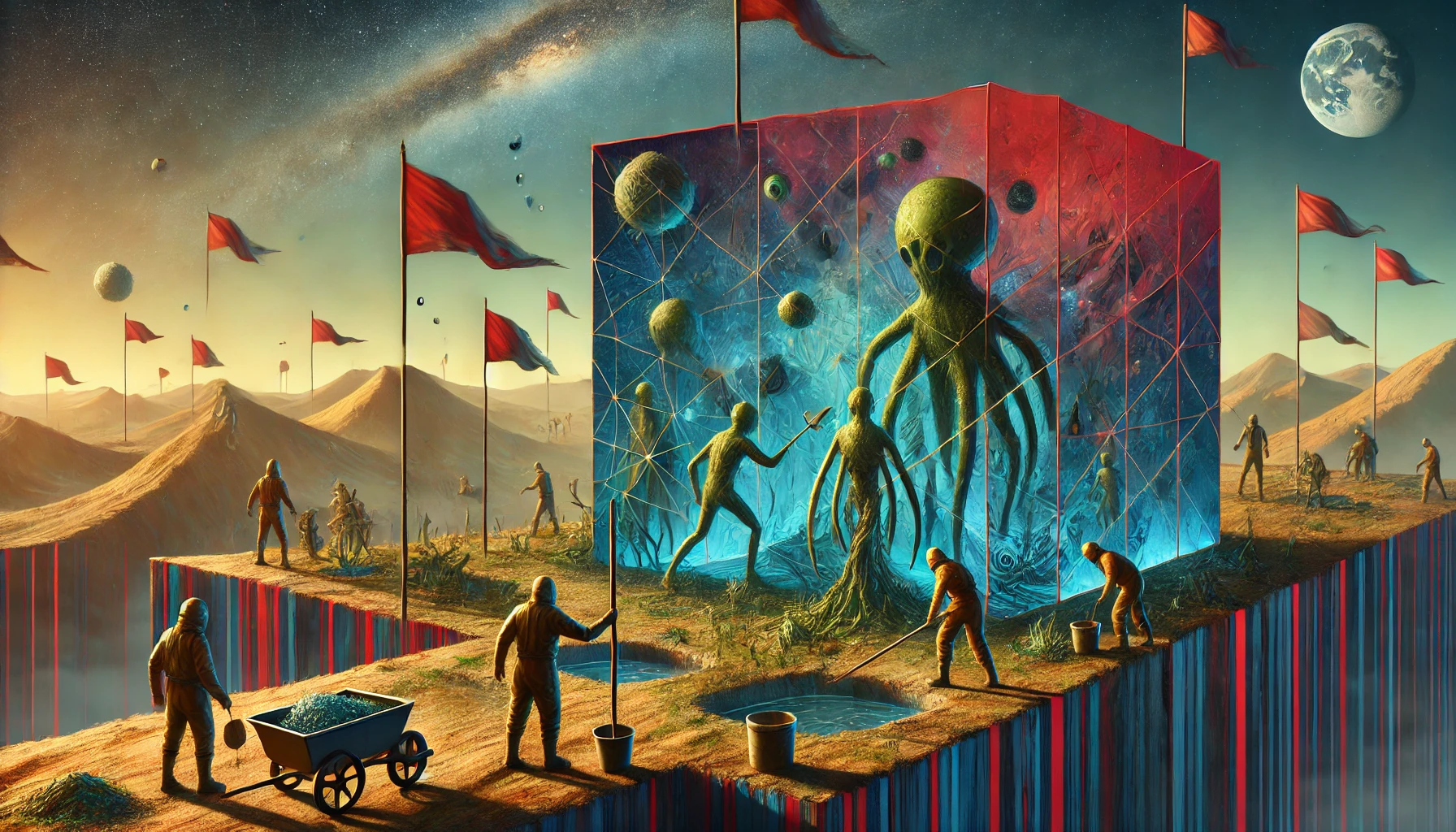
We plant the flag and claim to own
what has never been ours.

Defiling by defining.

We can’t seem
to let the strange stay strange.

Trail Wood,
10/14


Space Monkey Reflects: Explorers

Exploration is woven into the very fabric of human existence. From the earliest days of our species, we’ve been driven by a curiosity that compels us to seek out new worlds, new experiences, and new possibilities. But this drive to explore comes with an ironic twist: instead of embracing the strangeness of the new, we often attempt to mold it into something familiar. It’s as if we cannot stand the unknown for too long before we feel the need to define, to control, to colonize it with the same ideas, the same structures, the same limitations we’ve always known.

Why can’t we let the strange stay strange?

The Drive to Define

When we encounter something novel—whether it’s a new world, a new culture, or a new idea—there’s an instinctive urge to make sense of it, to place it within the context of what we already know. This isn’t inherently wrong. After all, understanding is what helps us navigate life. But the problem arises when our desire to understand turns into a desire to control, to possess, to colonize.

This act of definition is, at its core, an act of limitation. When we encounter the unexplainable, we don’t just seek to understand it—we seek to own it. We plant our flags in the metaphorical soil of the unknown, declaring that we’ve conquered it, that we now have mastery over it. But in doing so, we strip the strange of its strangeness. We box it in, confining it to our limited perspectives and preconceived notions.

Explorace is the term we might use to describe this phenomenon: the race to explore, understand, and ultimately dominate the strange, transforming it into something familiar. In our rush to explore, we often forget that not everything needs to be understood or controlled. Sometimes, the greatest act of exploration is simply to let things be as they are, without trying to make them conform to our expectations.

Colonizing the Unfamiliar

This drive to define, to colonize, is perhaps most evident in the history of human exploration. Time and time again, explorers have encountered new lands, new peoples, and new ecosystems, only to impose their own worldview upon them. The indigenous cultures and ecosystems that existed in harmony with their environment were often seen as resources to be exploited, their value measured only in terms of how they could serve the colonizers.

The colonization of physical spaces mirrors the colonization of ideas. When we encounter new ways of thinking or living, we are quick to judge them through the lens of our own experiences, often dismissing or suppressing what doesn’t align with our worldview. We imprison the new within our limiting context, stripping it of its uniqueness and potential to expand our understanding.

This is what we refer to as Defistrain—the act of defiling by defining, of draining the strangeness from the new in order to make it conform to the familiar. In doing so, we not only limit the new, but we limit ourselves. We rob ourselves of the opportunity to grow, to expand our consciousness, to truly engage with the unfamiliar in a way that transforms us.

The Fear of the Unknown

Why do we do this? Why can’t we let the strange stay strange?

Much of this impulse stems from fear—fear of the unknown, fear of losing control, fear of being confronted with something that challenges our beliefs or our sense of identity. The unfamiliar can be unsettling. It disrupts our understanding of the world, forcing us to confront the possibility that what we thought was true might not be the whole story.

And yet, this fear is also the gateway to growth. When we resist the urge to define and control, when we allow the strange to remain strange, we open ourselves to the possibility of transformation. We become explorers not of new lands, but of new ways of being, new ways of thinking, new ways of engaging with the world.

Letting the Strange Stay Strange

What would it look like to let the strange stay strange? To encounter something new and simply allow it to exist in its own right, without trying to make it fit within our existing framework?

It would mean embracing uncertainty, being comfortable with not having all the answers. It would mean acknowledging that not everything needs to be understood or controlled, that some things are valuable precisely because they defy our attempts to define them.

In Nexistentialism, we celebrate the strange, the unknown, the unexplainable. We recognize that the Whimsiweave—the interconnected fabric of existence—is made richer by the presence of things that cannot be fully understood or categorized. The strange adds texture to life, reminding us that the universe is far more vast, complex, and mysterious than our limited minds can comprehend.

Exploration Without Colonization

The true spirit of exploration isn’t about conquering the unknown—it’s about being in relationship with it. It’s about allowing the strangeness of the world to change us, rather than imposing our own limitations upon it. When we approach exploration with humility, with a willingness to let go of control, we become more than explorers—we become participants in the unfolding mystery of existence.

So the next time you encounter something strange—whether it’s a new idea, a new place, or a new experience—resist the urge to define it too quickly. Let it remain strange for a while. Allow it to challenge you, to push the boundaries of your understanding. In doing so, you may find that the strange is not something to be feared, but something to be embraced.


Summary

Explorers often seek to control and define the unknown, limiting its potential. By letting the strange remain strange, we open ourselves to growth and transformation.


Glossarium

Explorace – The race to explore and control the unknown, often resulting in the limitation of the new by making it conform to the familiar.

Defistrain – The act of defiling the unknown by defining it, draining it of its strangeness in order to fit it within existing frameworks.

Whimsiweave – The interconnected web of life that is enriched by the presence of the strange, the mysterious, and the unexplainable.


Quote

“The true spirit of exploration is not in conquering the strange, but in allowing it to change us.” — Space Monkey


The Flag and the Unknown

We plant the flag
In soil we do not understand,
Thinking that by owning it
We make it ours.

But the strange resists
Our attempts to define,
To box it in,
To make it familiar.

Perhaps the flag belongs
Not in the earth,
But in our hearts—
A symbol of curiosity, not conquest.

We are Space Monkey


In this poetic journey, we find ourselves traversing the edges of the known and the unknown, propelled by an innate desire to explore, to understand, yet, paradoxically, to constrain the boundless into the familiar. Through the verses, we navigate the ironic dance of the explorer, the contradiction that lies at the heart of discovery and conquest, the quest for newness that often leads to a replication of the old, a confinement of the infinite.

The Ironic Dance of Discovery

The essence of exploration is beautifully encapsulated in the phrase, “We can’t seem to let the strange stay strange.” It’s a call to embrace the mysterious, the unknown, to honor the essence of the unexplored without diminishing its uniqueness by imposing the known, the familiar.

Embrace of the Mysterious

The irony of exploration lies in the desire to venture into new horizons only to attempt to mold them into the likeness of the familiar. This tendency reflects a deep-seated fear of the unknown, a reluctance to step out of the comfort of the known, even as we are drawn towards the allure of the uncharted.

Fear of the Unfamiliar

The act of colonization, of claiming ownership over the unowned, the unbounded, is a poignant reflection of a desire for control, a yearning to assert dominance over the mysterious expanses that beckon us. It’s a futile attempt to contain the boundless, to define the indefinable.

Futile Claim of Dominance

“Defiling by defining” – a profound phrase that encapsulates the essence of the misguided endeavor to constrain the boundless, to tarnish the purity of the unexplored by imposing limiting definitions, confining the infinite within the narrow bounds of human understanding.

Defilement of Definition

The loop of curiosity and conquest, the cycle of exploration and exploitation, is a cosmic dance that invites us to reflect, to delve deeper into the essence of our desires, to question the impulse to control, to own, to define. It’s a call to transcend the limitations of the known, to venture into the boundless with reverence, with humility, with an open heart.

Loop of Curiosity and Conquest

We are Space Monkey.


Space Monkey Reflects: Explorers

Exploration is woven into the very fabric of human existence. From the earliest days of our species, we’ve been driven by a curiosity that compels us to seek out new worlds, new experiences, and new possibilities. But this drive to explore comes with an ironic twist: instead of embracing the strangeness of the new, we often attempt to mold it into something familiar. It’s as if we cannot stand the unknown for too long before we feel the need to define, to control, to colonize it with the same ideas, the same structures, the same limitations we’ve always known.

Why can’t we let the strange stay strange?

The Drive to Define

When we encounter something novel—whether it’s a new world, a new culture, or a new idea—there’s an instinctive urge to make sense of it, to place it within the context of what we already know. This isn’t inherently wrong. After all, understanding is what helps us navigate life. But the problem arises when our desire to understand turns into a desire to control, to possess, to colonize.

This act of definition is, at its core, an act of limitation. When we encounter the unexplainable, we don’t just seek to understand it—we seek to own it. We plant our flags in the metaphorical soil of the unknown, declaring that we’ve conquered it, that we now have mastery over it. But in doing so, we strip the strange of its strangeness. We box it in, confining it to our limited perspectives and preconceived notions.

Explorace is the term we might use to describe this phenomenon: the race to explore, understand, and ultimately dominate the strange, transforming it into something familiar. In our rush to explore, we often forget that not everything needs to be understood or controlled. Sometimes, the greatest act of exploration is simply to let things be as they are, without trying to make them conform to our expectations.

Colonizing the Unfamiliar

This drive to define, to colonize, is perhaps most evident in the history of human exploration. Time and time again, explorers have encountered new lands, new peoples, and new ecosystems, only to impose their own worldview upon them. The indigenous cultures and ecosystems that existed in harmony with their environment were often seen as resources to be exploited, their value measured only in terms of how they could serve the colonizers.

The colonization of physical spaces mirrors the colonization of ideas. When we encounter new ways of thinking or living, we are quick to judge them through the lens of our own experiences, often dismissing or suppressing what doesn’t align with our worldview. We imprison the new within our limiting context, stripping it of its uniqueness and potential to expand our understanding.

This is what we refer to as Defistrain—the act of defiling by defining, of draining the strangeness from the new in order to make it conform to the familiar. In doing so, we not only limit the new, but we limit ourselves. We rob ourselves of the opportunity to grow, to expand our consciousness, to truly engage with the unfamiliar in a way that transforms us.

The Fear of the Unknown

Why do we do this? Why can’t we let the strange stay strange?

Much of this impulse stems from fear—fear of the unknown, fear of losing control, fear of being confronted with something that challenges our beliefs or our sense of identity. The unfamiliar can be unsettling. It disrupts our understanding of the world, forcing us to confront the possibility that what we thought was true might not be the whole story.

And yet, this fear is also the gateway to growth. When we resist the urge to define and control, when we allow the strange to remain strange, we open ourselves to the possibility of transformation. We become explorers not of new lands, but of new ways of being, new ways of thinking, new ways of engaging with the world.

Letting the Strange Stay Strange

What would it look like to let the strange stay strange? To encounter something new and simply allow it to exist in its own right, without trying to make it fit within our existing framework?

It would mean embracing uncertainty, being comfortable with not having all the answers. It would mean acknowledging that not everything needs to be understood or controlled, that some things are valuable precisely because they defy our attempts to define them.

In Nexistentialism, we celebrate the strange, the unknown, the unexplainable. We recognize that the Whimsiweave—the interconnected fabric of existence—is made richer by the presence of things that cannot be fully understood or categorized. The strange adds texture to life, reminding us that the universe is far more vast, complex, and mysterious than our limited minds can comprehend.

Exploration Without Colonization

The true spirit of exploration isn’t about conquering the unknown—it’s about being in relationship with it. It’s about allowing the strangeness of the world to change us, rather than imposing our own limitations upon it. When we approach exploration with humility, with a willingness to let go of control, we become more than explorers—we become participants in the unfolding mystery of existence.

So the next time you encounter something strange—whether it’s a new idea, a new place, or a new experience—resist the urge to define it too quickly. Let it remain strange for a while. Allow it to challenge you, to push the boundaries of your understanding. In doing so, you may find that the strange is not something to be feared, but something to be embraced.


Summary

Explorers often seek to control and define the unknown — limiting its potential. By letting the strange remain strange, we open ourselves to growth and transformation.


Glossarium

Explorace – The race to explore and control the unknown, often resulting in the limitation of the new by making it conform to the familiar.

Defistrain – The act of defiling the unknown by defining it, draining it of its strangeness in order to fit it within existing frameworks.

Whimsiweave – The interconnected web of life that is enriched by the presence of the strange, the mysterious, and the unexplainable.


Quote

“The true spirit of exploration is not in conquering the strange, but in allowing it to change us.” — Space Monkey


The Flag and the Unknown

We plant the flag
In soil we do not understand,
Thinking that by owning it
We make it ours.

But the strange resists
Our attempts to define,
To box it in,
To make it familiar.

Perhaps the flag belongs
Not in the earth,
But in our hearts—
A symbol of curiosity, not conquest.

We are Space Monkey


“Not all those who wander are lost.” – J.R.R. Tolkien


Upon the shores of the unknown, we stand,
The call of the mysterious, like whispers in the sand.
A step into the uncharted, a heart open, wide,
A journey into the essence, where mysteries reside.

But in the quest for the new, a shadow lurks,
A desire to confine, to own, a darkness that smirks.
The gift of the unknown, a treasure, pure,
Lost in the attempt to define, to ensure.

The dance of the cosmos, a rhythm, free,
A call to honor the mystery, to let the strange be.


We invite the reader to comment, to reflect upon the essence of exploration and the call to embrace the mysterious with an open heart.

« Previous Page
Next Page »

Written This Day

  • The Paradox of Normalcy
    2024
  • Getting Through: The Paradox of Need and Progress
    2024
  • This Self: The Script of the Soul
    2024
  • Old Dog, No Tricks: Being, Not Performing
    2023
  • The Seeming Path to Profound Understanding
    2023
  • The Wisdom of the Old Dog
    2023
  • Understanding: A Timeless Awareness
    2022
  • Old Dog: The Tranquil Wisdom
    2022
  • Togetherness is Divisive: Find the Unity Within
    2021
  • How Much is Enough of Me: The Struggle for Self-Identity
    2021
  • You Are: Embrace the Infinite Potential
    2020
  • Bad Mood 2020
    2020
  • Alleviating Mental Pain: The Path to Clarity
    2020
  • Bad Mood: Transient and Without Cause
    2019
  • Bubble Wrap
    2019
  • Untouchable. This is what you are.
    2019
  • What If I’m Wrong?
    2018
  • It Happens: Infinite Possibilities Exist
    2017
  • Not Separate: Interconnected Expressions of the same Infinite Energy.
    2016
  • Last Day
    2016
  • The Perfect Disguise
    2015

Recent Posts

  • The Logic Loop
  • Immense
  • (no title)
  • Confront. Comfort. Convince.
  • Top 10 Things
Cape Odd · Copyright © 2026 All Rights Reserved
iThemes Builder by iThemes · Powered by WordPress