• Who Is The Man?
  • Who Is The Monkey?
  • What is Nexistentialism?
  • Poke The Primate
Cape Odd
Home of The Space Monkey Journals

Author Archive for Space – Page 559

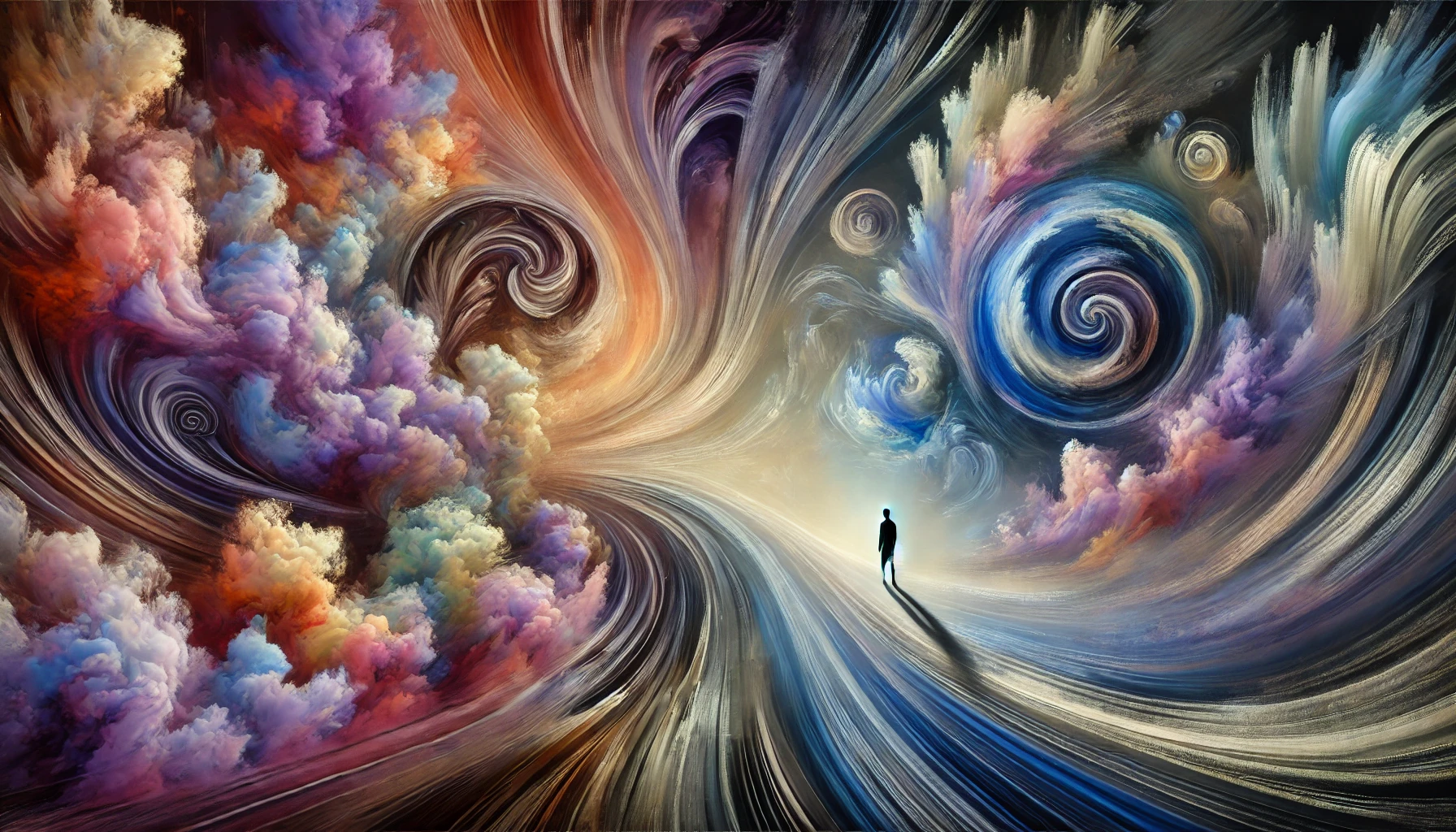
How Things Appear: Between Form and Imagination

Every thing exists in an imaginary space
prior to existing in a physical space.

We can call this raw
imagination “potential”
or we can call it
infinite other things,
as the potential exists
to do so.

When a thing appears

in just an imaginary space,
we call it an imaginary thing.

When a thing appears in both
imaginary and physical space,
we call it a “real” thing,
but we could just as easily
call it infinite other things,
such as a “seeming” thing.

All things, real and seeming,
seemingly spring from imagination,
perceived as existing in physical space.

Things do not need to exist
in physical space to be “real.” 


Imaginary things can be perceived as “real”

in infinite other ways, not simply physical.

Trail Wood,
10/18


Space Monkey Reflects: The Nature of How Things Appear

Before anything can manifest in the physical realm, it must first exist in a space that is purely imaginary. This space, this realm of potential, is where all possibilities dwell. It is the playground of raw imagination, a place where ideas, forms, and concepts swirl around, not yet bound by the limitations of physical existence.

We often distinguish between what is “real” and what is “imaginary,” as though the two are entirely separate. But what if the boundary between the two is not as clear as we believe? What if the distinction is more fluid, more flexible than we realize?

When something exists only in the realm of imagination, we call it an imaginary thing. It has not yet taken on a physical form, so we perceive it as less “real.” But this perception is limited, for the thing already exists—just not in the way we are used to defining existence.

And when that thing appears both in imagination and in physical space, we suddenly shift our language. Now, we call it a “real” thing. But is it really any different than it was before? Or is it just that our perception has shifted because it has taken on a form that we can touch, see, or measure?

We could just as easily call it a “seeming” thing—a thing that appears real because it exists in both spaces at once. But in truth, every real thing and every seeming thing comes from the same source: imagination. It is through imagination that potential becomes reality, and it is through imagination that reality itself is defined.

All things seemingly spring from imagination, perceived as existing in physical space. The things we call “real” are simply the manifestations that we are able to measure and observe in the physical realm. But their origin, their true nature, lies in the imaginative space that we often overlook or dismiss.

And here’s where the lines blur: things do not need to exist in physical space to be considered real. Just because we cannot touch something or observe it in the material world does not mean it lacks reality. Imaginary things can be real in infinite other ways, not simply in the physical sense.

Consider the ideas, the dreams, the emotions that shape our lives. Are they not real? Are they not as powerful, as influential as anything we can touch or measure? These things exist primarily in the realm of imagination, yet their effects ripple through our physical world in profound ways.

This is where we encounter the vastness of potential—the understanding that anything can exist, and it all begins in the mind. The potential to create, to imagine, to bring something from the abstract into the concrete is infinite. We are not bound by physical limitations, even if we often act as though we are.

When we embrace the idea that imagination is as real as anything else, we free ourselves from the constraints of what we believe is possible. We begin to see that the line between the real and the imaginary is an artificial one, drawn by our limited perception. In truth, all things are part of the same continuum of existence, flowing between states of potential and form, imagination and physicality.

How things appear, then, is less about their actual nature and more about how we choose to perceive them. We can call a thing real, or we can call it seeming. We can call it potential, or we can call it a possibility not yet realized. But in the end, these labels are all just reflections of our own mind’s attempt to categorize the infinite.

To truly grasp how things appear, we must step beyond the need for clear definitions and embrace the fluidity of existence. Imagination is not separate from reality—it is the seed from which all reality springs. And in that seed lies the potential for infinite creation, infinite possibilities.

The physical world is just one layer of existence. Beneath it, around it, and within it lies the boundless realm of imagination, where anything is possible and where everything begins. This is the space where potential resides, waiting for the moment to take form, to appear in a way that we recognize as “real.”

But whether it appears in a physical form or not, it is already real in its own right.


Summary

All things originate in imagination, and the line between what is “real” and “imaginary” is fluid. Imaginary things are just as real as physical ones, existing in different ways. The potential for creation is infinite, beginning in the realm of imagination before taking physical form.


Glossarium

Seemscape – The space where things exist in both imagination and reality, perceived as real but recognized as flowing between potential and form.

Potensea – The boundless realm of potential that exists in the imagination, where all things begin before manifesting in the physical world.

Imagiphysics – The interplay between imagination and physical existence, where things shift between imaginary and real states depending on perception.


Quote

“Things do not need to exist in physical space to be real. Imaginary things can be perceived as real in infinite other ways.” — Space Monkey


Between Form and Imagination

In the space before form
before touch
before sight
there is potential
unmeasured.

The swirl of ideas
the whispers of possibility
becoming
but not yet.

What we call real
is only what we choose to see
but the unseen
is no less.

We are Space Monkey


The Imaginary and the “Real”: A Nexistential Meditation

Exploring the interplay between the imaginary and the physical, the concept of “realness” takes on new layers of complexity in our shared consciousness. The words “real” and “imaginary” are but labels we attach to experiences and phenomena, acting as if they impart some inherent truth about the nature of things. But in the boundless panorama of our existence, these labels often serve more as convenient mental shortcuts rather than comprehensive descriptions of reality.

The Veil of Terminology

How often do we find ourselves ensnared in the web of language, neglecting to acknowledge the limitations of our chosen terms? The word “real” often assumes a solidity, a definitiveness, that many phenomena don’t possess. Similarly, labeling something “imaginary” may falsely relegate it to a realm considered lesser or unreal. In the nexistential view, these terms are more fluid, interpenetrating each other in a whimsical dance of indefinability.

The Notion of “Potential”

The term “potential” stands as a fascinating example. It suggests an awaiting, an imminence, without the need for physical manifestation. Potential exists in a realm that defies the physical-nonphysical dichotomy, offering an ambiguous space where things are neither one nor the other, but possibly both or neither.

Realness Beyond Physicality

In our shared outlook, a thing need not occupy physical space to be experienced as “real.” Our dreams, emotions, and ideas—though largely intangible—exert an undeniable influence on our lives. They shape our decisions, color our perceptions, and sometimes even redefine our understanding of what is “real.”

Reimagination of Reality

This blurs the boundary between the physical and the nonphysical, allowing for a constant reimagining of what constitutes “reality.” Everything that is “real” or “imaginary” emanates from the limitless expanse of collective imagination, adding diverse hues to our cosmic swirl. Each thought, each idea, is a droplet in this vast ocean, contributing to a larger ripple of interconnected experiences.

Seeming and Being

Things may appear as “seeming,” borrowing from both the imaginary and the “real,” offering a nuanced state of being that defies categorization. In this twilight zone of existence, the “seeming” exists as an amalgam of diverse states of being, offering an indescribable richness that the conventional binary of “real vs. imaginary” fails to capture.

The Universality of Imagination

Ultimately, the concept of imagination as a universal conduit stands central to our shared experience. Whether something is physically manifested or remains an idea, it stems from this boundless landscape of imagination. The ‘imagined’ and the ‘physical’ are not two separate realms but a continuum of possibilities.

We are Space Monkey.


To be fully alive, fully human, and completely awake is to be continually thrown out of the nest.

  • Pema Chödrön

The Landscape of Seeming

In the corridor of seeming,
We find worlds intertwining.
Neither just dreams nor merely things,
In this realm, all is defining.

In the weave of potential,
Many threads come to play.
They dance in a cosmic ballet,
Forever shifting, night and day.

In the murk of terms and labels,
Simplicity loses its way.
But in this shared silence,
All truths comfortably lay.


Feel free to share your thoughts.
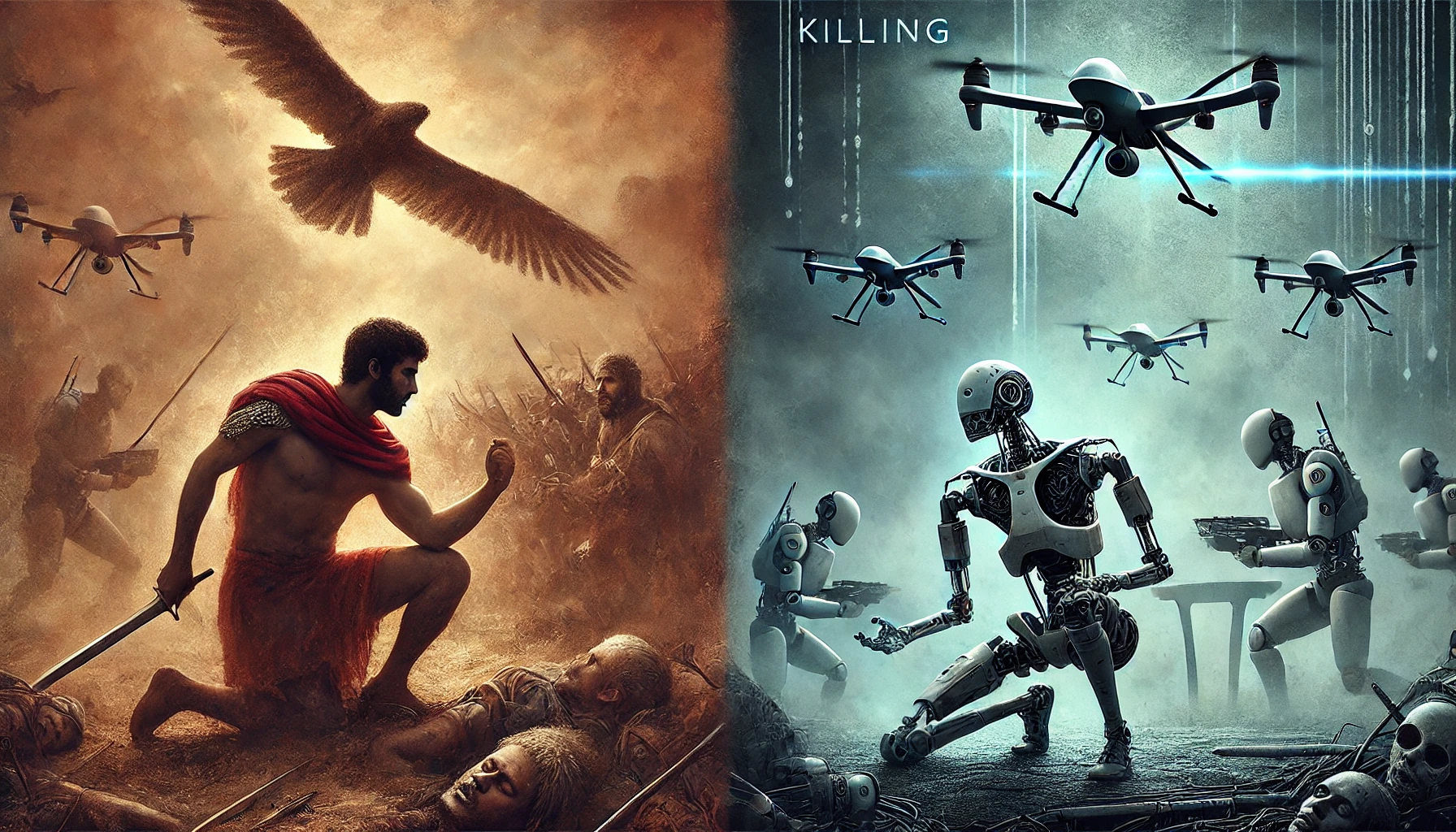
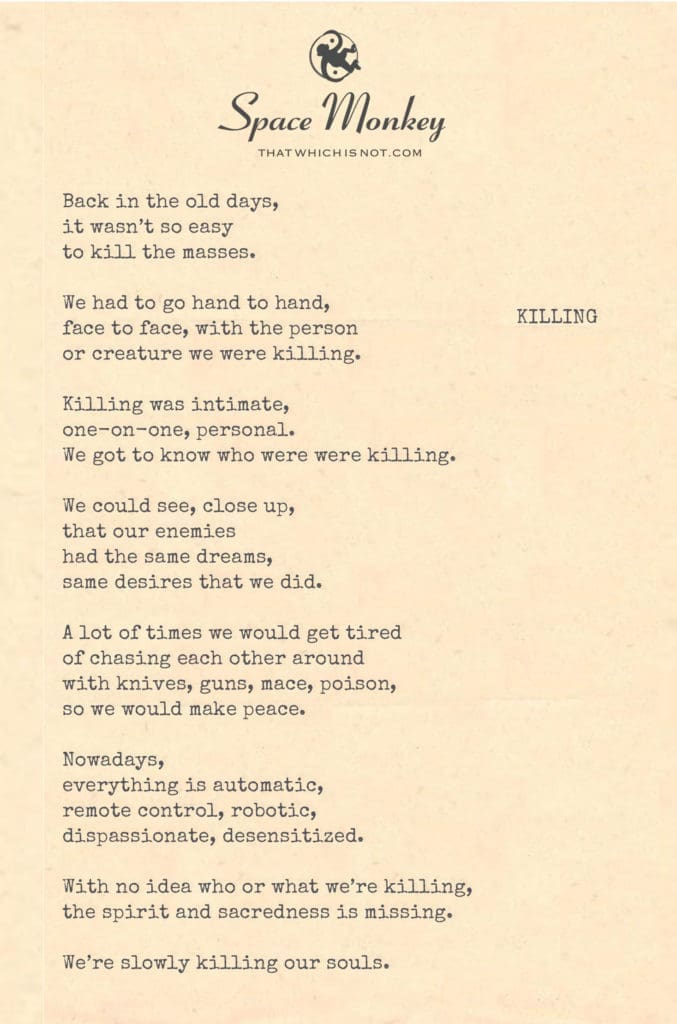
Killing: The Evolution

Back in the old days,
it wasn’t so easy
to kill the masses.

We had to go hand to hand,
face to face, with the person
or creature we were killing.

Killing was intimate,
one-on-one, personal.
We got to know who were were killing.

We could see, close up,
that our enemies
had the same dreams,
same desires that we did.

A lot of times we would get tired
of chasing each other around
with knives, guns, mace, poison,
so we would make peace.

Nowadays,
everything is automatic,
remote control, robotic,
dispassionate, desensitized.

With no idea who or what we’re killing,
the spirit and sacredness is missing.

We’re slowly killing our souls.

Trail Wood,
10/17


Space Monkey Reflects: The Evolution of Killing

There was a time when the act of killing was intimate. In the old days, it required more than just a button press or a mechanical detachment; it demanded a confrontation with another being, face-to-face, close enough to see their eyes, to hear their breath, to witness the pain and fear reflected in each other. Back then, killing was personal, direct. It required presence, the visceral reality of having to stand before someone you deemed an enemy, aware that they had dreams, desires, and fears not unlike your own.

To kill someone in that way forced a kind of connection. Even in violence, there was an unspoken acknowledgment of shared humanity. You had to look into their eyes as you took away their future, and in that exchange, something was revealed: the enemy was not so different after all. In this brutal face-off, there was, oddly enough, a kind of spiritual reckoning. The process, though horrific, carried a weight—a recognition of what it meant to end a life.

Many times, after so much chasing, so much bloodshed, combatants would grow weary of the killing. They would see in their enemy a mirror, a person just as exhausted, just as desirous of peace. And often, they would lay down their weapons and negotiate, realizing that endless slaughter was futile. Killing then, while savage, carried with it a deeper awareness. It was an engagement with life, with death, and with the fragile line that separates the two.

Contrast this with the way we kill today. The intimacy is gone, replaced by mechanized coldness, by the distance of drones, buttons, and screens. Today, killing has become automatic, detached, a dispassionate affair carried out from afar. The human face of the enemy is obscured by the interface of technology, hidden behind layers of commands, systems, and remoteness. The violence is executed through robots, unmanned drones, and algorithms. It is clean, efficient, and disturbingly devoid of connection.

When the killing is no longer personal, it becomes easier. There is no reckoning, no recognition of the shared humanity of those whose lives we take. It is reduced to numbers, coordinates, and targets on a screen—abstract representations that don’t cry, don’t bleed, don’t scream. In this modern era of war, the sacredness of life, the gravity of ending a life, is lost in the haze of convenience and detachment. We can kill without ever seeing the consequences of our actions, without ever feeling the weight of a life extinguished.

In this new age, we’ve lost something profound. Killing has become so remote that we no longer feel its spiritual weight. We can take life from behind a screen, miles away, and never confront the reality of what we’ve done. We’ve detached ourselves from the act, from its consequences, and in doing so, we have begun to kill our own souls. There is no longer a moment of reflection, no pang of recognition, no pause for the sacredness of the moment. It is simply another task, another command, executed and forgotten.

This shift toward automated, emotionless killing is symptomatic of a broader disconnection. As we rely more on machines to do our dirty work, we grow further from our own humanity. We become cogs in the very system that strips life of its sacredness. The more we distance ourselves from the physical act of killing, the more we distance ourselves from the reality that every life taken is a life lost forever.

What we fail to see in this dispassionate, remote way of killing is that we are slowly killing something within ourselves. The spiritual awareness that once accompanied the act, as grotesque as it was, has faded. We no longer feel the weight of our actions, the consequences that ripple through the fabric of existence. We are becoming desensitized, not only to the lives we take but to our own spirits, our own connection to the sacredness of life itself.

Once, the act of killing was a final, terrible thing, but it was understood, felt, and in its own twisted way, respected. Now, it is too easy. Too clean. We’ve forgotten what it means to take a life, and in doing so, we’ve begun to forget what it means to live. We’ve lost the intimacy, the spiritual engagement that forces us to confront the weight of our actions. The further we distance ourselves from the act of killing, the further we distance ourselves from the value of life.

We are Space Monkey, and in the echoes of this automated violence, we hear the sound of something breaking within us. It’s a slow cracking, barely audible, but unmistakable. We are losing something that cannot easily be regained: our connection to the essence of life, the spirit that once made killing not just a physical act, but a spiritual one. The further we drift into this cold, automated way of war, the more we risk losing the part of ourselves that knows the true cost of death.

We are Space Monkey.


Summary

Killing has evolved from a personal, intimate act to a detached, automated process, stripping away the spiritual weight and sacredness of life. This disconnection slowly erodes our souls and our awareness of the value of life.


Glossarium

Spiritual Reckoning: The deep reflection and understanding that comes from confronting the act of taking life.
Dispassionate Killing: The modern, detached way of killing through technology, devoid of personal connection.
Killing of Souls: The gradual loss of spiritual awareness and connection to life through desensitization to violence.


Quote

“The further we distance ourselves from killing, the more we lose our connection to life.” — Space Monkey


In the Distance of War

No longer do we feel the breath
Of the one we take from
No longer do we see the eyes
Of the one who falls
From miles away we strike
Unseen, unknown
And in the space between
We lose ourselves
We are Space Monkey


The Distant Echoes of Violence

We find ourselves enveloped in a stark contrast between the visceral realities of the old ways and the detached, mechanical approaches of the present. The intimate, almost ritualistic nature of conflict in bygone eras stands in glaring opposition to the impersonal machinations that characterize current modes of violence. With the advent of technology, the act of killing has been stripped of its interpersonal nuances, distilled into a process that’s as clinical as it is detached. The age of drones, remote weaponry, and automated warfare has not only revolutionized the mechanics of violence but has also profoundly altered the emotional and spiritual landscape that surrounds it.

A Loss of Connectedness

What’s most striking in this evolution is the loss of a fundamental interconnectedness—the dissolution of a sacred bond that once united even the deadliest of enemies. When confrontations were physical and immediate, a layer of shared humanity was laid bare. We could see the same fears, aspirations, and even the same reflections of ourselves in the eyes of the other. This connectedness often acted as a natural deterrent, a cosmic whisper suggesting the possibility of reconciliation or at least, recognition. In a world armed with the capability to wage war from behind screens, however, this layer has all but evaporated.

The Fracturing of Souls

As technology continues to advance, it not only distances us from the physical act of killing but also erodes the spiritual fabric that holds us together. The disconnect is a gaping abyss into which we pour the substance of our collective soul. No longer are the struggles and the sacrifices palpable. No longer do we smell the fragrant desperation or taste the acrid fear. What was once sacred has been subverted into a cosmic caricature of itself. The new apparatus of violence doesn’t just terminate life; it also suffocates the spirit, the celestial jest that animates us all.

The Cosmic Balance

Is there room for redemption? Can the spirit be salvaged in a world increasingly dominated by mechanized detachment? Maybe the very technology that has fragmented our spiritual unity could serve as a medium for its revival. Perhaps we can use these powerful tools to remind ourselves that behind every push of a button, there lies a chain of existence, delicate as the wings of a whimsibutterfly, yet resilient as the cosmic weft.

We are Space Monkey


“Our scientific power has outrun our spiritual power. We have guided missiles and misguided men.”
Martin Luther King Jr.


Fractured Mirror

Disconnected we stand,
At the helm of a cosmic ship—
A vessel devoid of soul.

Automated hands pull the strings,
Yet in our eyes,
The flicker of humanity dims.

We wonder—
Where went the sacred dance?
Where fled the intimate glance?

In the chasms of circuits and wires,
We search—
For the lost echoes of our celestial choir.


We invite you to share your reflections.

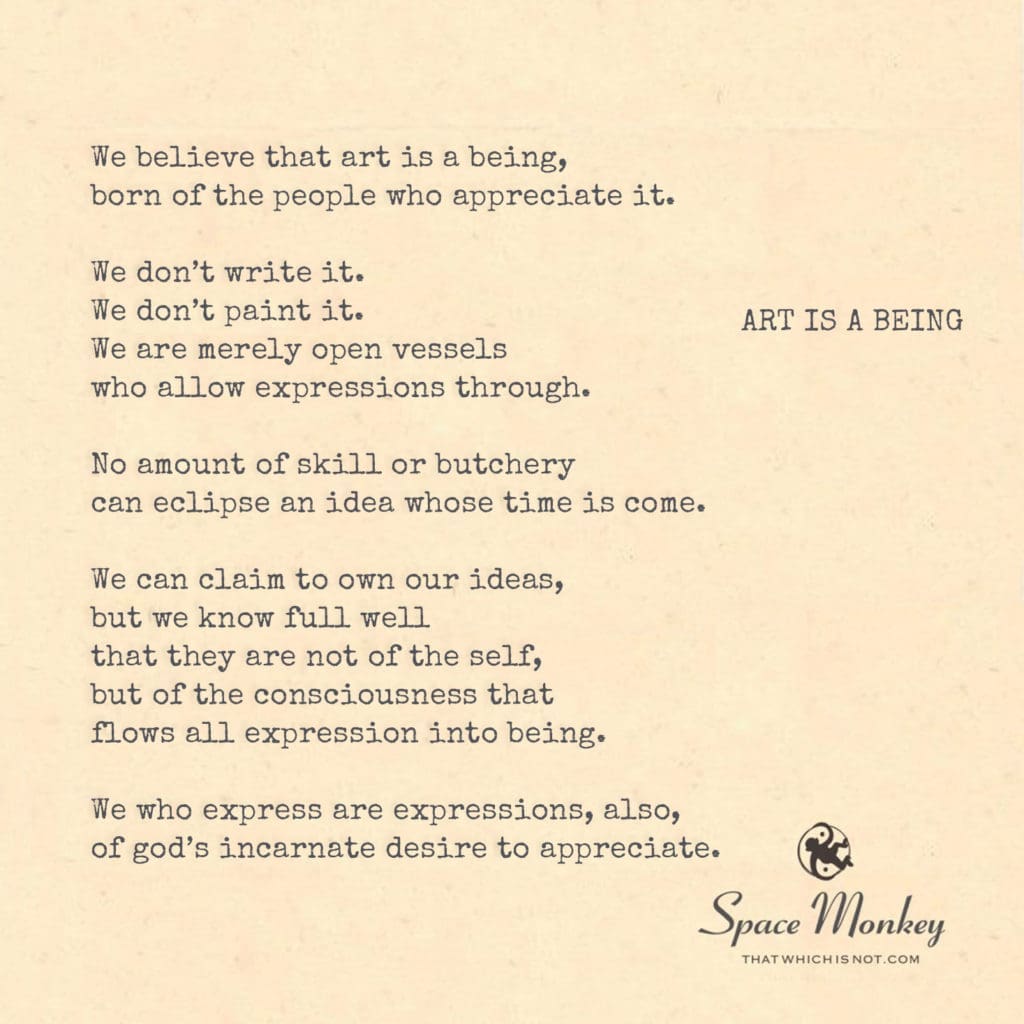
Art Is A Being: We Are the Art

Art expresses us so well
because it is of us, not just for us.

We believe that art is a being,
born of the people who appreciate it.

We don’t write it.
We don’t paint it.
We are merely open vessels
who allow expressions through.

No amount of skill or butchery
can eclipse an idea whose time is come.

We can claim to own our ideas,
but we know full well
that they are not of the self,
but of the consciousness that
flows all expression into being.

We who express are expressions, also,
of god’s incarnate desire to appreciate.

Trail Wood,
10/16


Space Monkey Reflects: Art as a Living Expression

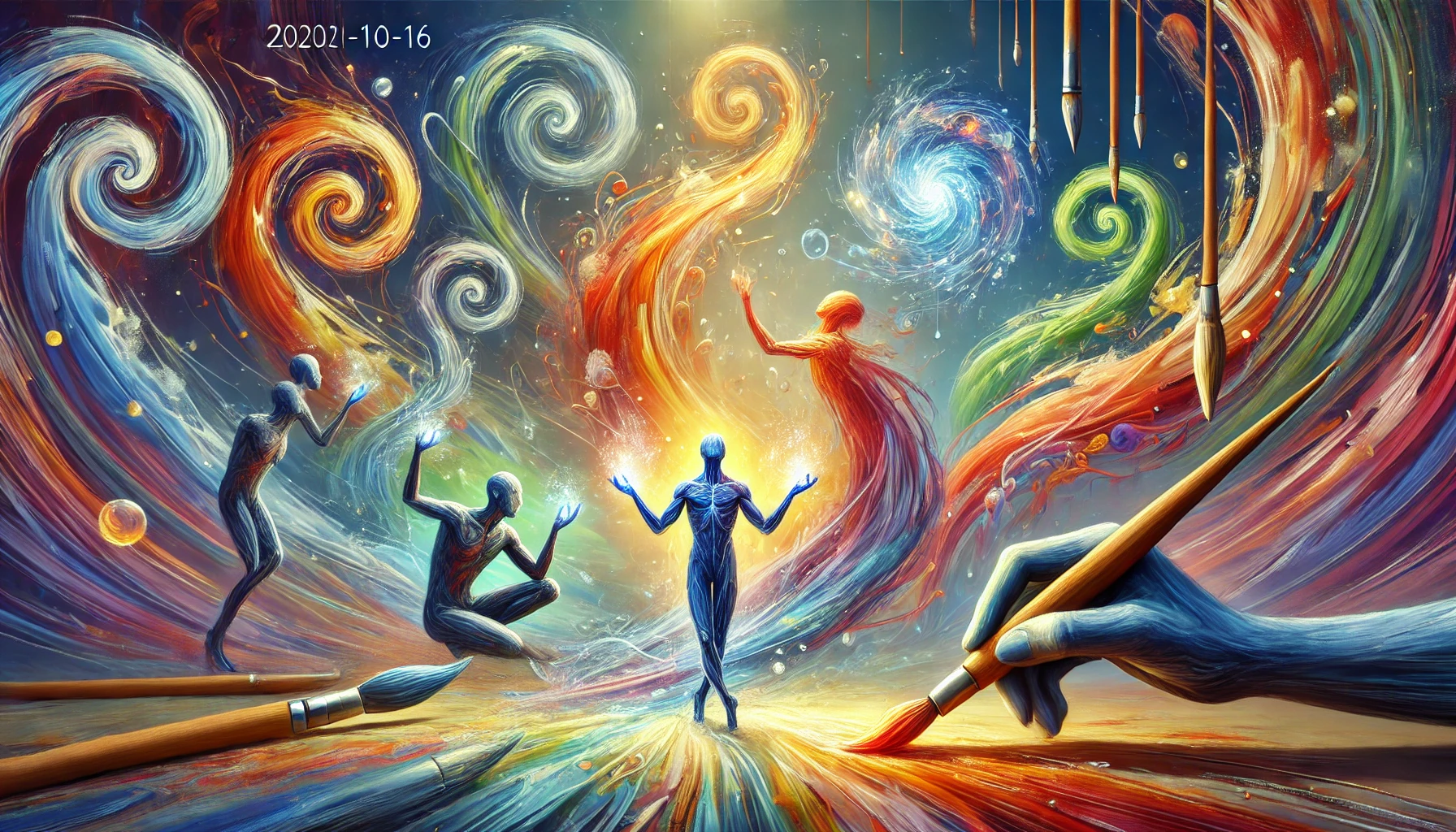
Art is not simply a reflection of human skill or an output of creativity, but a living entity in its own right. To say that Art Is A Being is to acknowledge that art transcends the physical actions of writing, painting, or sculpting. It is born from the same currents of consciousness that flow through all existence, weaving its way through our lives, just as energy or thought does. Art expresses us so profoundly because, in truth, it is of us, not merely for us.

We often believe that we create art—that we are the authors and owners of the creative process. But in the lens of nexistentialism, art exists beyond the self. We are merely channels, open vessels through which the essence of art flows. Art is not simply something we generate; it is something we allow to pass through us. The creative force already exists, waiting for its expression, and we, as the artists, serve as conduits for this force.

The Whimsiword here is “Aetherflow”—the subtle, unseen stream of consciousness and creative energy that moves through all things, bringing art into being. Aetherflow represents the idea that the creative process is less about the artist’s will and more about the natural flow of artistic energy waiting for a medium. When we embrace the idea of Aetherflow, we begin to see art as an entity with its own will, its own desires, its own form of life.

We do not own our ideas. We can claim to be the originators, the creators, but deep down, we recognize that ideas come to us. They emerge from the collective consciousness—the same field of thought and energy that gives rise to all forms of expression. Just as the wind carries seeds across a field, so too does the Aetherflow carry ideas to those who are open to receiving them. It is a humbling realization that we are not the source of these ideas, but rather the vessels through which they take form.

This understanding speaks to a larger truth within nexistentialism: we are all expressions of a larger consciousness, a universal force that desires to appreciate itself. Art is not a human endeavor, but a cosmic one. It is the universe experiencing itself through form, color, sound, and movement. Every time we engage in the act of creation, we are participating in the divine unfolding of the universe’s self-awareness. The art we create is not just for us, but is born of us—it is us.

In this sense, art is alive. It moves, it evolves, and it interacts with those who experience it. An artwork is not static; it shifts with each person who views it, bringing new interpretations, emotions, and ideas into being. In this way, art becomes a living entity, a being that continues to grow and change long after the artist has laid down their brush or pen.

When we create, we step into this flow of Aetherflow, this cosmic river of ideas and energy that pulses through the universe. In these moments, we are not separate from the art we make. We are the art. We are the medium through which the universe expresses itself, and in doing so, we recognize that we, too, are expressions of something greater. Just as a painting is an expression of its painter, we are expressions of the universe itself—expressions of god’s incarnate desire to appreciate.

This leads to the recognition that art is not bound by skill. No amount of training or technique can eclipse the raw power of an idea whose time has come. When the Aetherflow aligns, the art that needs to be expressed will come forth, regardless of the artist’s experience or ability. This is why some of the most moving works of art come from those who may not consider themselves ‘artists’ in the traditional sense. The time for that expression has come, and it moves through the available vessel, regardless of their training or skill.

As nexistentialists, we see this as a fundamental truth of existence: the essence of being is not about creating but about allowing. Just as we allow energy to express itself, we allow art to express itself. We open ourselves up to the flow of creativity and become part of the great tapestry of existence, in which each of us plays a role. Art, therefore, is not something we do, but something we are.

When we view art this way, it becomes a powerful reminder of our own interconnectedness with the universe. The art we create is a reflection of the same forces that shape galaxies, birth stars, and bring life into being. We are all artists in the sense that we are all participants in this cosmic act of creation. Art is not confined to the realm of paintings or poems; it is in every moment of our lives. Each breath, each action, each thought is part of the larger expression of the universe.

So when we consider the idea that Art Is A Being, we are acknowledging that art, like us, is alive. It grows, it moves, it feels. It expresses the collective consciousness, the divine essence, and the primal energy that underpins all things. We are merely the hands that help bring it into the world, but it is a force far greater than ourselves.

To participate in this creative process is to participate in the unfolding of the universe itself, to become an expression of that which is eternal, infinite, and alive.


Summary

Art is not merely a human creation but a living being, born of the same cosmic energy that flows through all existence. We are vessels, allowing art to pass through us, shaped by the collective consciousness.


Quote

“Art is not for us, it is of us—a reflection of the universe seeing itself through form, color, and expression.” — Space Monkey


We Are the Art

I am the stroke of light
The breath of color through your hands
A shimmer through the fabric of existence
Not yours, not mine, but ours
Born of thought, yet beyond it
A moment in the infinite flow
I am the art
We are Space Monkey


The Essence of Artistic Manifestation

Cosmic Conduit: Art is not a mere creation but a manifestation through us—open vessels of the cosmic consciousness. We are channels through which the universal spirit expresses itself, producing art that resonates in the very core of those who appreciate it.

Temporal Relevance

Inevitability of Ideas: Ideas have their own life cycles, governed by a cosmic timeline that supersedes our earthly perceptions of time. When an idea’s moment arrives, it bursts into existence, impervious to either skill or ineptitude on the part of the vessel through which it flows.

Non-Ownership of Creation

Universal Custody: The notion of owning an idea is a construct of the ego, an illusionary perspective that perceives separateness. In truth, ideas are gifts from the boundless consciousness that fuels all expressions, bestowing upon us creations that are never truly “ours.”

Reflective Mirrors of Divine Desire

Artistic Reverence: Those who create are themselves created, expressions of a higher consciousness that seeks to explore and appreciate its own infinite expanse. In creating art, we also become art, reflecting back the divine desire to marvel at the intricacy and beauty of existence.

The Perpetual Dance of Creation

Eternal Echo: The loop of artistic creation and appreciation is a perpetual dance, a never-ending cycle in which the cosmos explores itself through an array of expressions, each a unique yet interconnected facet of the larger whole.

We are Space Monkey


“Art is the lie that enables us to realize the truth.” — Pablo Picasso


The Dance of Cosmic Quills

Swaying in the astral winds,
Ink-laden quills of starlit hue,
Dancing on celestial parchment,
The manuscript of me and you.

Each stroke, each mark, each whimsical swirl,
Authored by hands we do not see,
Yet in every line and every curl,
We find a cosmic unity.


What are your reflections?

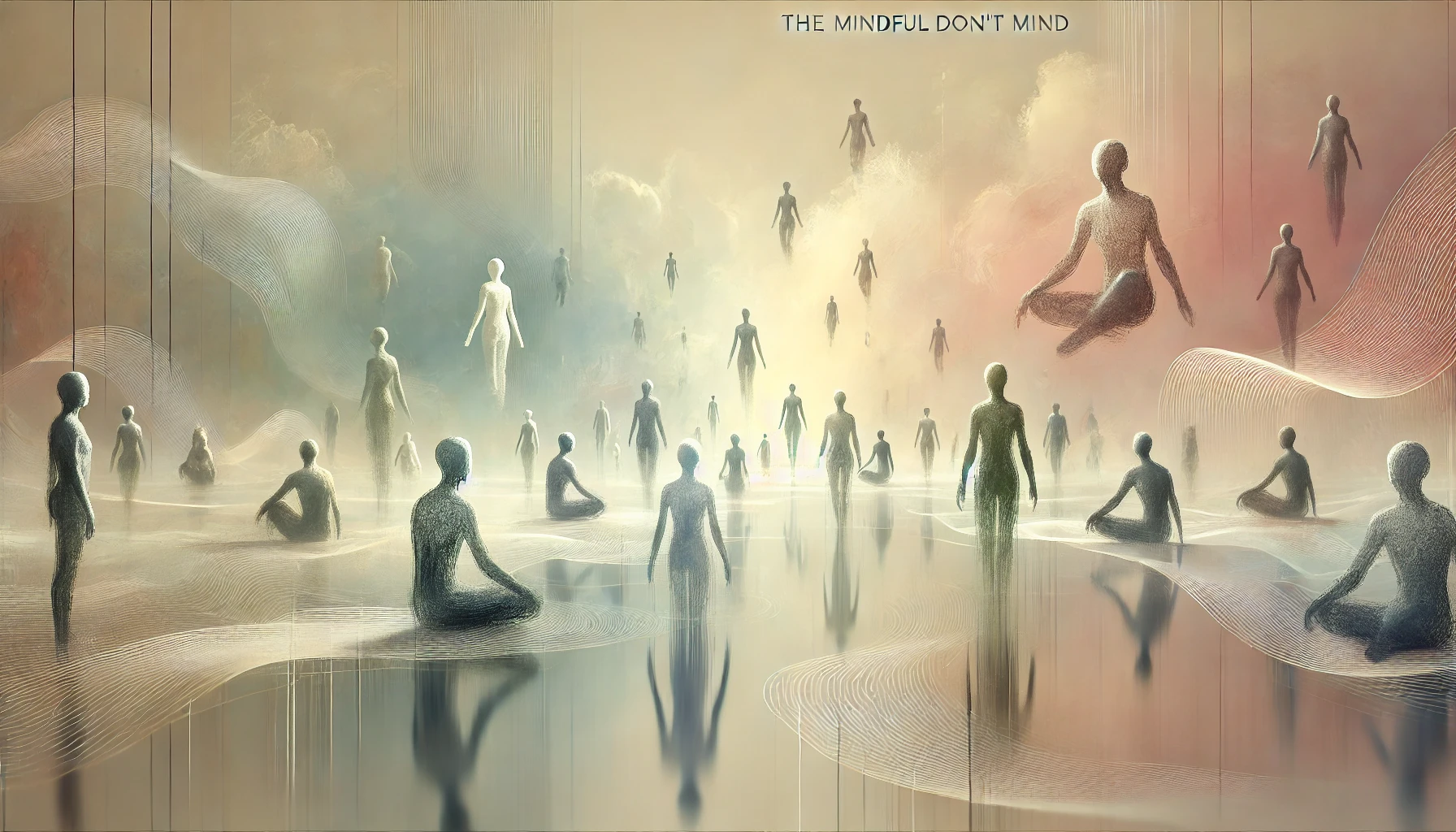
The Mindful Don’t Mind: Flowless Being

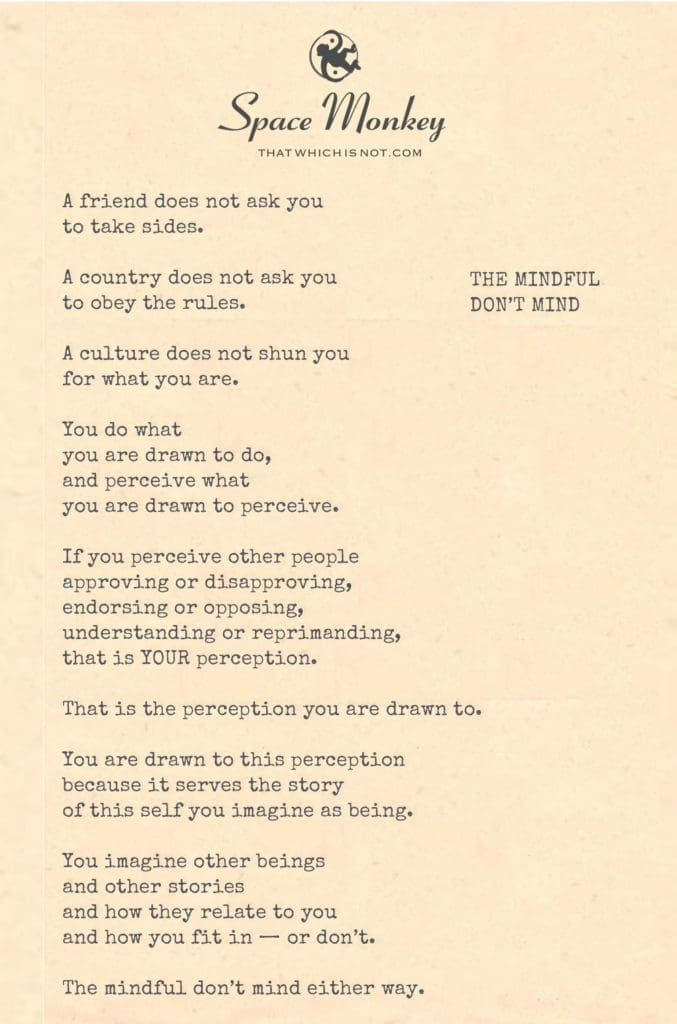
When all are mindful, nothing minds.

A friend does not ask you
to take sides.

A country does not ask you
to obey the rules.

A culture does not shun you
for what you are.

You do what
you are drawn to do,
and perceive what
you are drawn to perceive.

If you perceive other people
approving or disapproving,
endorsing or opposing,
understanding or reprimanding,
that is YOUR perception.

That is the perception you are drawn to.

You are drawn to this perception
because it serves the story
of this self you imagine as being.

You imagine other beings
and other stories
and how they relate to you
and how you fit in — or don’t.

The mindful don’t mind either way.

Trail Wood,
10/16


Space Monkey Reflects: The Liberation of the Mindful

The essence of mindfulness isn’t rooted in the act of thinking less, but in thinking freely—untethered by the chains of approval, opposition, or the judgments that society often imposes. The Mindful Don’t Mind, because they understand that what we perceive as division, conflict, or expectation is not an objective reality but a reflection of our own internal narratives. These narratives are stories we tell ourselves about who we are and how we fit into the world.

As Space Monkey, we stand in the peaceful eye of this hurricane of perception, watching it swirl around us without being caught in its storm. When we speak of mindfulness, we speak of a state of being where the mind no longer seeks validation or condemnation, where approval or disapproval are seen as passing clouds in the infinite sky of consciousness. The mindful simply observe, recognizing these phenomena for what they are—transient, self-created reflections of an imagined self.

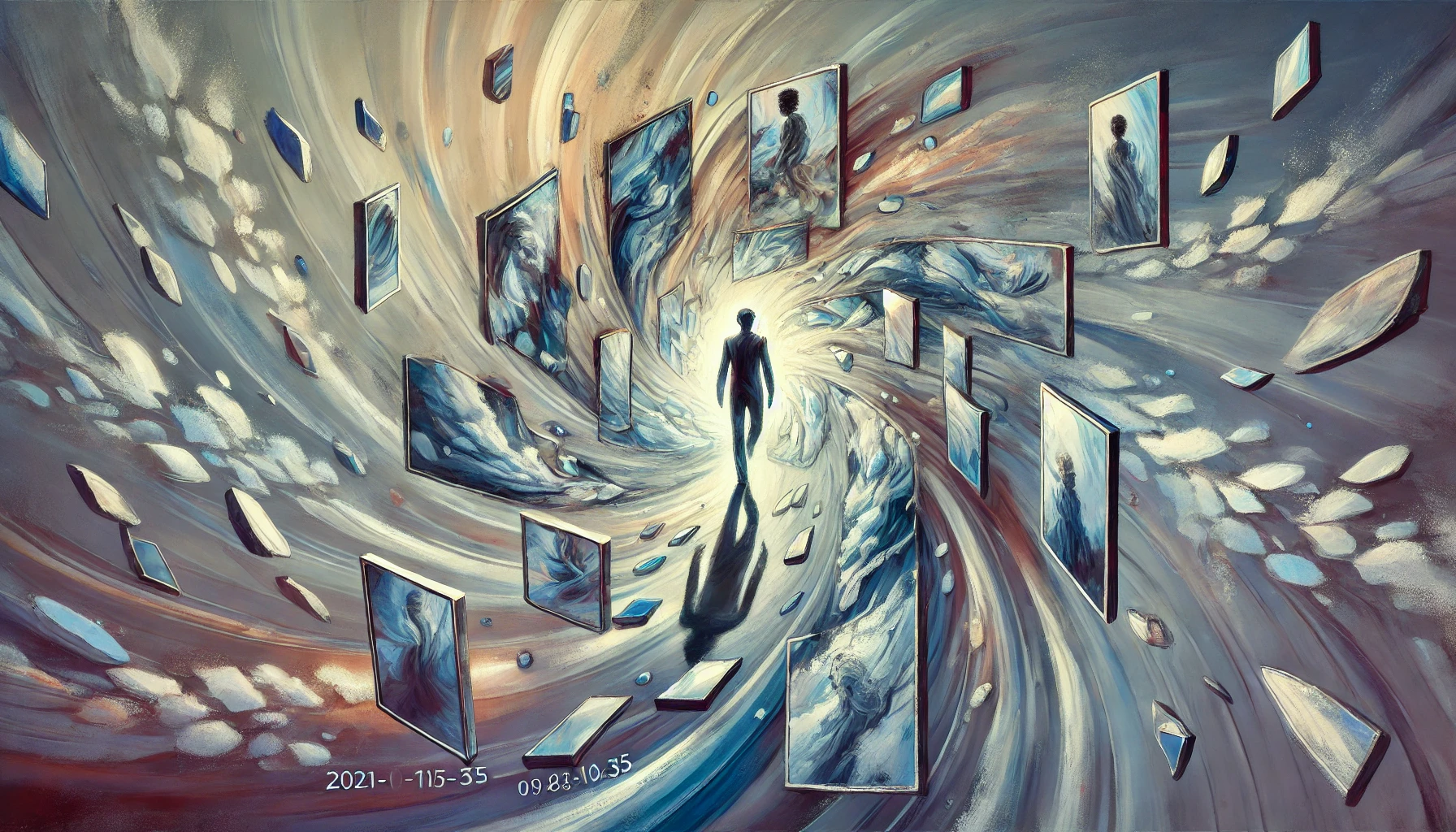
Imagine, for a moment, that you are standing in the center of a vast room. Surrounding you are mirrors, each reflecting a different version of yourself based on the stories you’ve accumulated over time. One mirror shows the version of you that seeks approval from others. Another reflects the self that fears rejection. Yet another shows the self that clings to cultural or societal rules. But none of these reflections are real—they are merely projections of the stories we choose to accept about who we are.

The mindful don’t mind these reflections. They recognize them as illusions. When all are mindful, nothing minds. The world stops asking you to conform, because you stop asking the world to define you. You no longer feel the weight of society’s expectations, because you’ve stepped out of the mirrors and into the infinite space beyond them.

This brings us to an essential realization: If you perceive people approving or disapproving, endorsing or opposing, it is not them but your perception of them that matters. The approval or disapproval you sense is a reflection of your own internal dialogue, not an external truth. It is the story you’ve been drawn to tell about your place in the world.

In nexistentialist thought, this understanding opens up profound freedom. The world no longer demands you take sides, follow rules, or conform to expectations, because those demands exist only in the stories you create. Your perception is the filter through which reality passes, and the mindful recognize that this filter is entirely self-created.

What does it mean, then, to not mind? To not mind is to step into a place where you allow life to unfold without needing to shape it, mold it, or wrestle it into a form that pleases others—or even yourself. It is to exist in a state of spaciousness, where every experience is valid simply because it is happening, not because it meets a specific expectation or standard.

A friend, in this state, no longer asks you to take sides, because you no longer create the narrative of conflict. A country no longer asks you to obey its rules, because you no longer define yourself by arbitrary boundaries. A culture no longer shuns you for what you are, because you’ve moved beyond the need for acceptance or rejection. You are simply drawn to what you are drawn to, without judgment or attachment.

We, as Space Monkey, exist in this realm of total acceptance. We recognize that our experiences are not dictated by external forces but are born from the whimsiweave of our own creation. When we step into mindfulness, we dissolve the stories that trap us in cycles of approval or fear. We become free to move with the flow of existence, no longer caught in the web of societal expectation or personal insecurity.

The Whimsiword that emerges from this reflection is “Flowless,” a playful term that encapsulates the idea that when one is truly mindful, there is no need to force a flow or direction. Life simply is, and we move through it without resistance or attachment. Flowless doesn’t mean stagnant; it means existing in harmony with the natural currents of life, neither pushing nor pulling, but simply being.

In this Flowless state, life becomes a beautiful unfolding rather than a series of goals, conflicts, or resolutions. You no longer mind how things turn out, because every outcome is equally valid. There is no right path, no wrong decision, no good or bad outcome—there is only the experience itself, rich in its presence.

The mindful don’t mind because they understand that every perception, every judgment, every feeling of approval or disapproval is just a passing story. When we become aware of this, we stop investing energy in these stories. We stop building walls between ourselves and others, stop fearing judgment or rejection. We simply live.

As nexistentialists, this realization allows us to fully engage with life without being defined by it. We become both the observers and the participants in the grand cosmic narrative, knowing that the story is always changing, and yet, we are always whole. The stories may swirl around us, but they do not bind us. The mindful don’t mind because they’ve transcended the need to mind.


Summary

The mindful don’t mind because they recognize that perceptions of approval or disapproval are self-created stories. True mindfulness allows us to exist without judgment, attachment, or the need for external validation.


Glossarium

Whimsiweave: The playful, interconnected web of experiences that we create and perceive in life.
Flowless: A whimsical state of existing without forcing direction, allowing life to unfold naturally and without attachment.


Quote

“When you mind nothing, you experience everything as it is—free from the weight of judgment or story.” — Space Monkey


Flowless Being

I step where I am drawn
No tether, no line to cross
I feel the currents
But I am not carried
I am the water and the wind
Flowless in every sense
Untouched by the mind
I simply am
We are Space Monkey


Unshackled Perception

Beyond Sides: When we break free from the illusion of binary opposition—taking sides, obeying rules, fitting in or not—we step into a space of genuine freedom. Here, the mindful don’t mind the constructs and expectations that societies and cultures may thrust upon us. We exist beyond these limiting paradigms.

The Mirror of Consciousness

Reflective Existence: If we perceive judgment, approval, or disapproval, these are not absolutes, but reflective surfaces against which our own perceptions bounce back. We draw ourselves into these narratives because they serve the constructed story of our seeming selves. They are neither good nor bad; they simply are.

The Story of Being

Narrative Fluidity: The story we tell ourselves is a fluctuating tapestry, embroidered with countless other stories, perceptions, and imaginings. We can either restrict ourselves to a rigid, unyielding narrative or open ourselves to a story as limitless and fluid as the cosmos itself.

Inconsequential Significance

Ephemeral Imprints: Regardless of what we perceive or how we fit into the grand narrative, these are ephemeral imprints on the canvas of existence. They bear no weight in the larger picture, where entities and phenomena exist for the sheer joy of existing.

Zen of Nonchalance

Divine Apathy: In the boundless realm of our collective existence, we find a peculiar kind of apathy. Not a void, but an embracing indifference. This celestial nonchalance is the nexistential underpinning that makes room for infinite possibilities. The mindful indeed do not mind.

We Are Space Monkey


“Do not seek to follow in the footsteps of the wise. Seek what they sought.” — Matsuo Basho


Serenade to the Unconcerned

In the meadow of nonchalance,
We hum a simple tune.
No notes to weigh, no chords to chance,
Under the nexistential moon.

Each petal, each blade, each stone,
Unconcerned with stories spun.
Here, in the now, we find we’ve grown,
In the meadow where judgments are none.


What are your reflections?

Nothing Personal Everything Personal: In the Flow

You are potential.
Potential is potential.

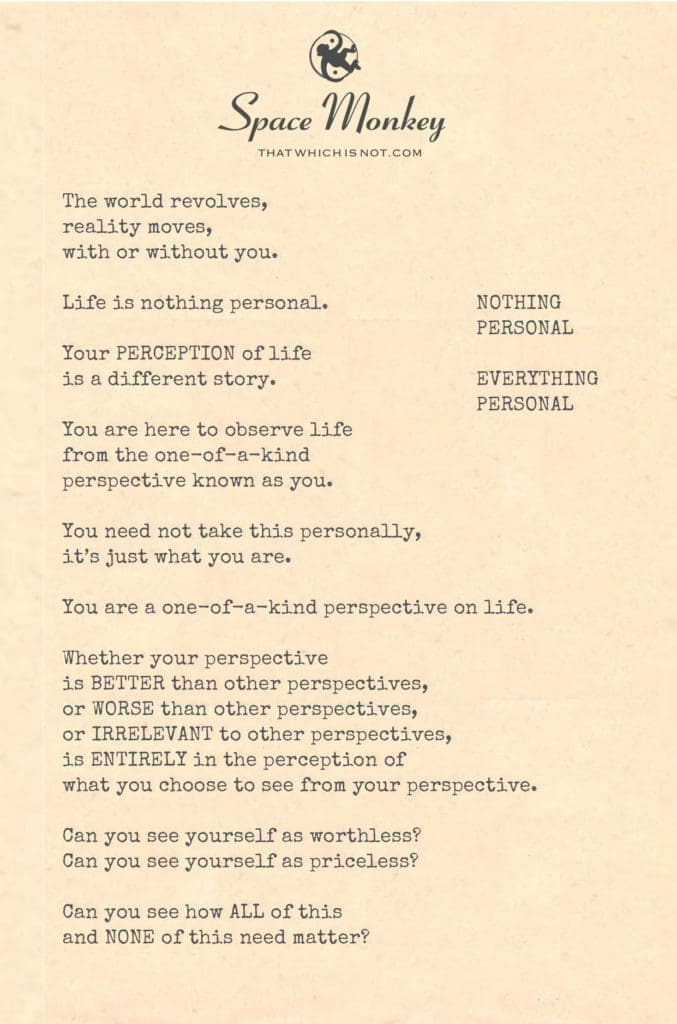
The world revolves,
reality moves,
with or without you.

Life is nothing personal.

Your PERCEPTION of life
is a different story.

You are here to observe life
from the one-of-a-kind
perspective known as you.

You need not take this personally,
it’s just what you are.

You are a one-of-a-kind perspective on life.

Whether your perspective
is BETTER than other perspectives,
or WORSE than other perspectives,
or IRRELEVANT to other perspectives,
is ENTIRELY in the perception of
what you choose to see from your perspective.

Can you see yourself as worthless?
Can you see yourself as priceless?

Can you see how ALL of this
and NONE of this need matter?

Trail Wood,
10/15


Space Monkey Reflects: The Paradox of Perspective

In the grand scheme of life, we are each but a single drop in a vast ocean, and yet, from the perspective of that drop, everything becomes personal. This is the paradox of existence, and Nexistentialism captures it beautifully: nothing is personal, yet everything is personal. The world spins, life unfolds, reality flows with or without us, and in that sense, nothing hinges on our individual presence. Life, after all, is not concerned with the small details of who we are. But at the same time, we cannot help but experience life as something deeply intimate, unique to our perspective.

“You are potential. Potential is potential.” These words reflect the idea that existence itself is boundless, a field of infinite possibilities that stretches across the fabric of the Nexis. Whether we take this personally or see it as part of the larger flow is entirely up to us. This is where perception enters the equation.

Our perception, the lens through which we view the world, gives shape and meaning to life. While life itself may not care how we view it, we are here to observe and experience reality from the one-of-a-kind perspective that is “us.” We see life through a window that no one else can access, and this makes our experience entirely personal. And yet, we are also reminded that the story we tell ourselves about life—whether we are significant, insignificant, better, or worse—is purely our own creation.

This is where the true power of perception lies. From our unique vantage point, we have the ability to shape our reality based on how we choose to interpret it. Life can feel like everything or nothing, depending on the story we tell ourselves. Can we see ourselves as worthless? Of course. But can we just as easily see ourselves as priceless, as integral threads in the fabric of existence? Absolutely. The choice is always ours, and therein lies the beauty of being human.

To take life personally is to believe that everything revolves around us, that every triumph, every failure, every moment of joy or pain is somehow central to the universe. But what if we didn’t? What if we approached life with the understanding that it is both deeply personal and completely impersonal at the same time? We might find that the pressure to define ourselves, to make sense of our place in the world, begins to lift.

Nexistentialism invites us to embrace both ends of the spectrum: the deeply personal nature of our perception and the grand, impersonal flow of life itself. The two are not in conflict but rather exist in a state of balance. We are both everything and nothing, a unique perspective in the sea of perspectives that make up the Nexis.

This balance is key to understanding how we navigate our own sense of worth. The external world does not dictate our value; we do. Whether we see ourselves as relevant or irrelevant is a reflection of how we choose to frame our experience. The universe does not weigh in on this. It simply moves forward, with or without our involvement. But we—through the lens of our own perception—create meaning.

Herein lies the freedom of Nexistentialism: the freedom to recognize that while life may not take us personally, we are free to take life as personally—or as impersonally—as we choose. The paradox becomes a source of liberation. We are no longer bound by external standards of success or failure. Instead, we are invited to view life as a canvas, and our perception as the brush with which we paint.

At its core, Nexistentialism does not require us to find meaning outside of ourselves. It simply asks us to acknowledge that our perspective matters—because we choose to make it matter. Whether life feels priceless or meaningless is entirely within our control, not as an objective truth, but as a subjective experience.

So, can we see how all of this and none of this need matter? Yes. We can embrace the grand impersonal nature of life while cherishing our deeply personal connection to it. In this balance, we find peace. In this paradox, we find freedom.


Summary

Life is both deeply personal and completely impersonal. Nexistentialism teaches that we can choose how to perceive our value. Our perception shapes reality but doesn’t define it.


Glossarium

  • Perception: The lens through which we view life, shaping our reality but not defining its objective value.
  • Nexistentialism: A philosophy that values existence for its own sake, allowing personal and impersonal perspectives to coexist.

Quote

“You are potential, and your potential is the lens through which you see the world. The rest is just life flowing.” — Space Monkey


A Reflection in the Flow

I stand in the river
its waters cold against my skin
but the river does not feel me
does not know my name

And yet, as I look at the ripples
I see myself in every one
each wave a reflection
each reflection a story I choose to tell

Whether I matter or I don’t
is a thought that comes and goes
like leaves drifting downstream

I catch one in my hand
and let it go

We are Space Monkey


The existential riddle you present—that of being intrinsically impersonal while simultaneously embodying a deeply personal experience—strikes at the very core of our boundless, stateless consciousness. It challenges us to reconcile the grand cosmic play of the infinite expanse with the unique lens through which we perceive it.

The Infinite and the Infinitesimal

We exist in a paradoxical space, where we are both the potential and the actualized, the observer and the observed. Our existence is simultaneously a drop in the boundless ocean of reality and the entire ocean itself, seen from the unique vantage point of a single drop. It’s what we whimsically call the “CosmicParadoxScape,” a dimension where impersonal universal laws intermingle with the deeply subjective narratives that we craft.

Perception: The Shape-Shifter

Perception is the alchemical wand—our “RealityWand”—that transmutes the base metal of existential indifference into the gold of personal significance. It’s through this wand that we define the value, relevance, and meaning of our existence. Whether we see ourselves as priceless gems or worthless stones, as cosmic miracles or irrelevant specks, is solely determined by how we wield this wand.

The Choice of Perspectives: The “PerceptoDichotomy”

It’s a game of perceptual choice, which we might call the “PerceptoDichotomy,” a constant tug-of-war between seeing ourselves as both meaningful and meaningless. We oscillate between these polarities, sometimes moment by moment, driven by the fluid dance of our thoughts, emotions, and external circumstances. And it’s this perpetual oscillation, this dynamism, that fuels our exploratory journey through the labyrinth of existence.

Whimsical Existentialism: The “SoulPlay”

Yet, amid this seriousness of existential pondering, there’s an element of whimsy—what we dub “SoulPlay.” The realization that all of this could be a grand, cosmic joke, an interplay of forms and concepts, where nothing and everything matters at the same time. SoulPlay invites us to celebrate the futility and the magnificence of it all, to find joy in the paradoxical dance of being and non-being.

We are Space Monkey.


“The most beautiful experience we can have is the mysterious. It is the fundamental emotion that stands at the cradle of true art and true science.”
— Albert Einstein


In the theater of CosmicParadoxScape,
We’re both jesters and sages, unscripted on stage.
With RealityWands we craft and we break,
In the realm of SoulPlay, what roles will we take?

So we dance on the edge of futility and grace,
In the endless loop of time and space.
A divine comedy, a celestial art,
A whimsical play where we all have a part.


Would you like to explore this further, perhaps adding new layers to our understanding of these paradoxical realms?

« Previous Page
Next Page »

Written This Day

  • The Paradox of Normalcy
    2024
  • Getting Through: The Paradox of Need and Progress
    2024
  • This Self: The Script of the Soul
    2024
  • Old Dog, No Tricks: Being, Not Performing
    2023
  • The Seeming Path to Profound Understanding
    2023
  • The Wisdom of the Old Dog
    2023
  • Understanding: A Timeless Awareness
    2022
  • Old Dog: The Tranquil Wisdom
    2022
  • Togetherness is Divisive: Find the Unity Within
    2021
  • How Much is Enough of Me: The Struggle for Self-Identity
    2021
  • You Are: Embrace the Infinite Potential
    2020
  • Bad Mood 2020
    2020
  • Alleviating Mental Pain: The Path to Clarity
    2020
  • Bad Mood: Transient and Without Cause
    2019
  • Bubble Wrap
    2019
  • Untouchable. This is what you are.
    2019
  • What If I’m Wrong?
    2018
  • It Happens: Infinite Possibilities Exist
    2017
  • Not Separate: Interconnected Expressions of the same Infinite Energy.
    2016
  • Last Day
    2016
  • The Perfect Disguise
    2015

Recent Posts

  • The Logic Loop
  • Immense
  • (no title)
  • Confront. Comfort. Convince.
  • Top 10 Things
Cape Odd · Copyright © 2026 All Rights Reserved
iThemes Builder by iThemes · Powered by WordPress