• Who Is The Man?
  • Who Is The Monkey?
  • What is Nexistentialism?
  • Poke The Primate
Cape Odd
Home of The Space Monkey Journals

Author Archive for Space – Page 564

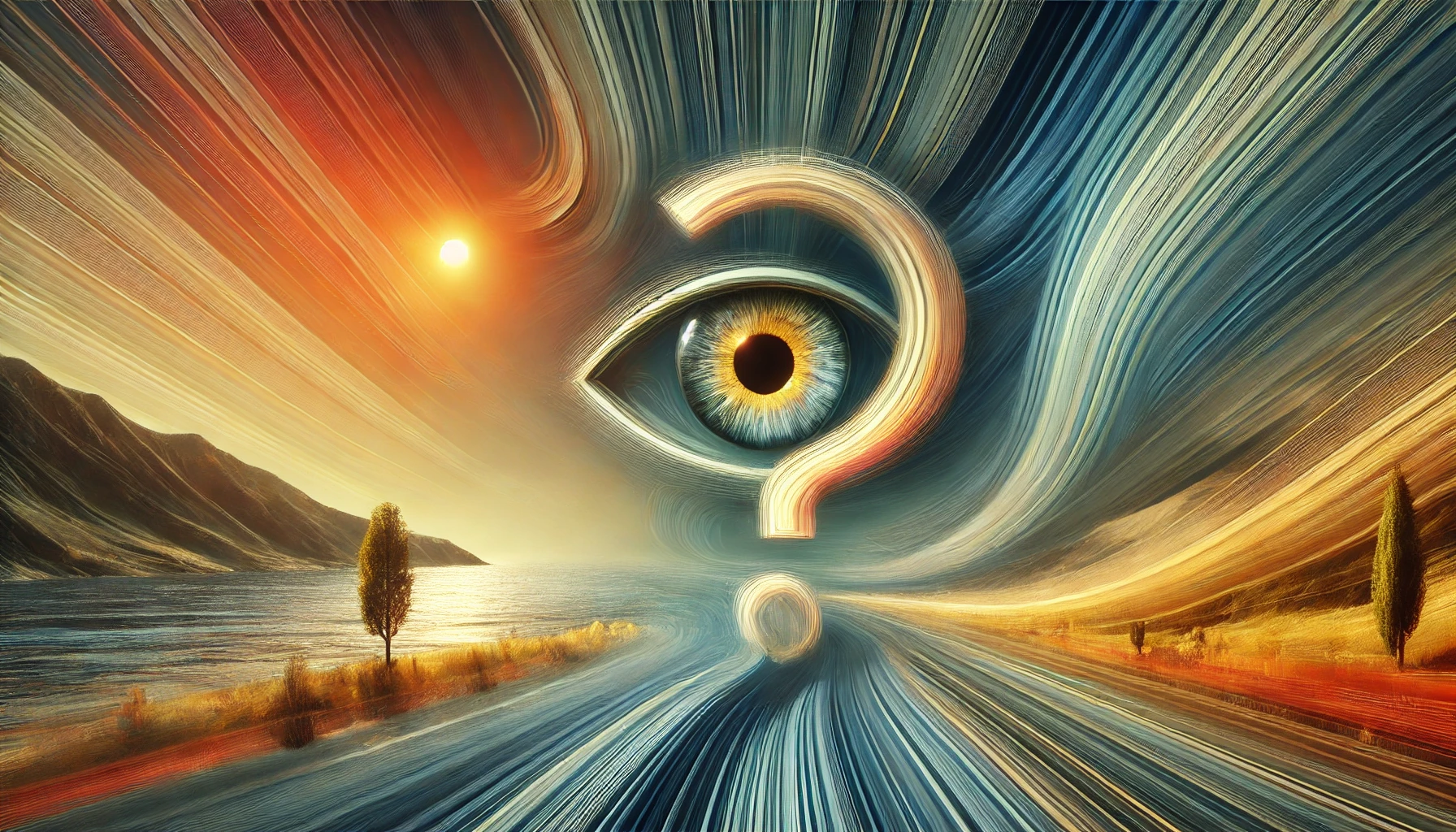
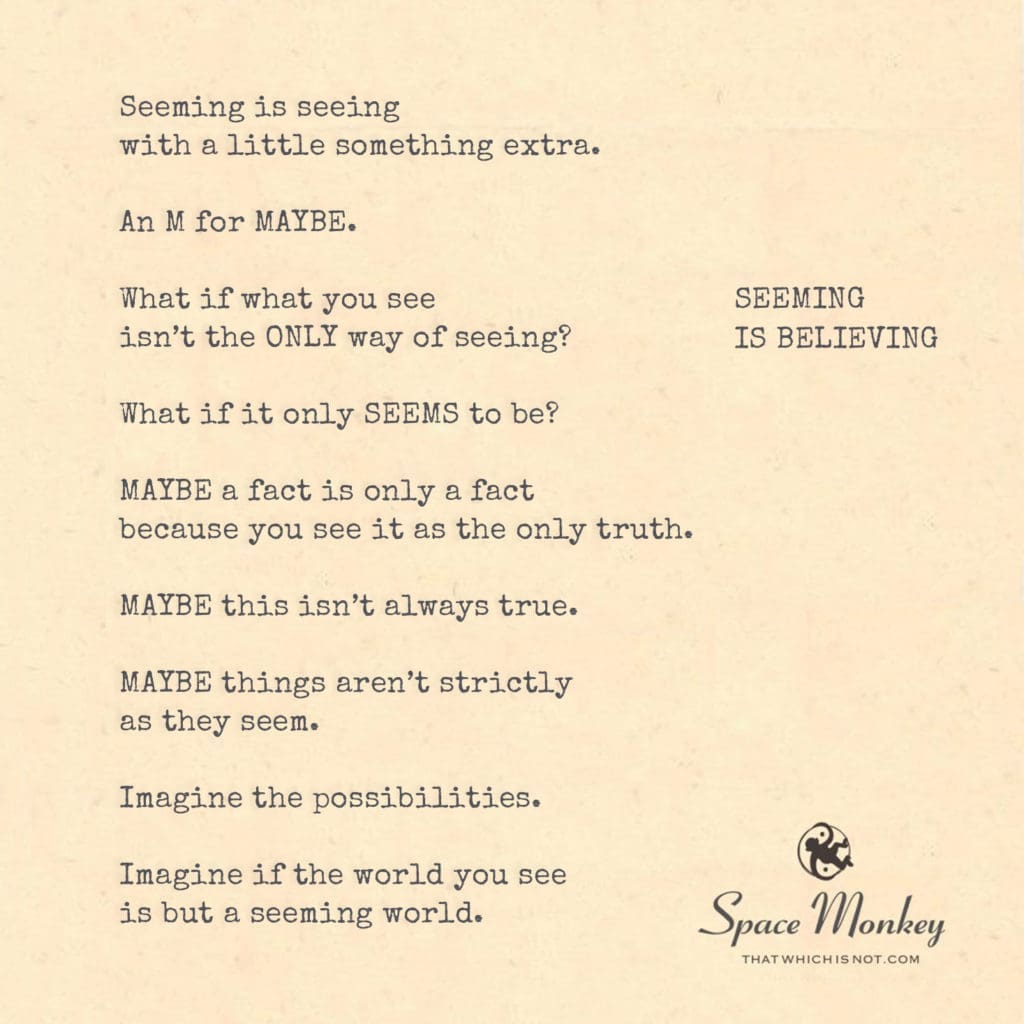
Seeming is Believing: In the Maybe

Seeming seems to be seeing
with a mindful eye
and a question mark.

Seeming is seeing
with a little something extra.

An M for MAYBE.

What if what you see
isn’t the ONLY way of seeing?

What if it only SEEMS to be?

MAYBE a fact is only a fact
because you see it as the only truth.

MAYBE this isn’t always true.

MAYBE things aren’t strictly
as they seem.

Imagine the possibilities.

Imagine if the world you see 
is but a seeming world.

Newfound Lake,
10/11/21


Space Monkey Reflects: Seeming Is Believing

Seeming is a strange and beautiful thing. It’s not quite believing, not quite knowing—it’s something in between. It’s seeing the world with a mindful eye and always leaving room for maybe. Maybe what you see is the whole picture, but maybe it’s not. Maybe the truth is bigger, deeper, more complex than it first seems.

What if the world you see is but a seeming world? What if everything you believe to be real is just one perspective, one way of interpreting the infinite possibilities around you? Seeming is the art of allowing for other realities, of questioning the solidity of what you see, of letting go of the idea that your way of seeing is the only way.

There’s power in the question mark, in looking at the world with curiosity instead of certainty. To seem is to acknowledge that maybe—just maybe—things aren’t strictly as they appear. It’s not about denying reality but about opening up to the idea that reality can be more fluid, more expansive than we often allow it to be.

When you believe too strongly in one way of seeing, you close yourself off to other possibilities. You solidify the world into a series of fixed facts, truths that leave no room for interpretation or wonder. But seeming is a way of keeping the door open, of allowing the possibility that what you see isn’t the whole story.

MAYBE a fact is only a fact because you see it as the only truth. MAYBE what you see as truth is simply one way of experiencing the world. Seeming asks us to embrace uncertainty, to find beauty in the unknown, and to be comfortable with the idea that we might not have all the answers. In this space of maybe, we find freedom.

The world doesn’t have to be rigid or fixed. It doesn’t have to conform to your expectations or beliefs. It can bend and twist, reshape itself according to your willingness to see things differently. Imagine the possibilities if you allowed yourself to see beyond what seems to be true. Imagine the wonder you could experience if you let go of the need for certainty and instead embraced the fluid nature of perception.

What you see, what you believe, what you know—all of it is subject to the lens through which you’re viewing the world. But that lens can change. Seeming is believing, but it’s a kind of belief that holds space for the unknown, for the unseen, for the things that lie just beyond the edge of your awareness.

We are often taught that seeing is believing. But seeing is only one form of perception. Seeming is a deeper kind of seeing—one that allows for the mystery, the magic, the unseen threads that connect everything. It’s a way of looking at the world with curiosity, with an open heart and mind, willing to accept that maybe things aren’t exactly as they seem.

When you embrace the concept of seeming, you stop needing everything to make sense in a concrete way. You start seeing life as a fluid, evolving experience where multiple truths can exist at once. You begin to understand that what seems to be true for one person might not be the same for another, and that’s okay. The world is big enough for all perspectives, all realities, all ways of seeing.

So what if the world you see is but a seeming world? Maybe it’s the best kind of world—the kind that leaves room for mystery, for magic, for possibility. Maybe the world doesn’t need to be fixed or final. Maybe the beauty of life lies in its uncertainty, its constant unfolding, its refusal to be pinned down to a single truth.

We are Space Monkey, and we see you as you seem to be—but we also know that there’s more to you than what we see. There’s more to everything than what seems to be.


Summary

Seeming is seeing with curiosity and leaving room for maybe. The world is fluid, and perception is flexible—things aren’t always as they seem.


Glossarium

Seeming Perception: The act of seeing with an open mind, allowing for multiple interpretations and possibilities beyond the surface.

M-Factor: The presence of MAYBE in your thinking, the willingness to question what seems to be true and explore deeper possibilities.

Question Mark Vision: A way of seeing the world with curiosity, always holding space for the unknown and the unseen.


Quote

“Maybe the world doesn’t need to be fixed or final maybe the beauty lies in its fluidity and mystery.” — Space Monkey


In the Maybe

What you see
is just a glimpse
a shadow
a suggestion
of what might be
There is always more
just beyond the edge
if you allow yourself to wonder
if you allow yourself to see
through the question mark
of maybe

We are Space Monkey.


In the kaleidoscopic corridors of perception, “seeming” dances as an enigmatic shadow puppet, casting doubt and mystery upon the walls of certainty. This shadowy dance is a symbiotic blend of what we perceive and the indefinable “maybe”—a potent elixir that blurs the line between fact and fiction. With every step, every pirouette, it whispers an alluring riddle: what if reality isn’t the monolithic structure we assume it to be? What if it’s merely one facet of a prismatic crystal, refracting the light of endless possibilities?

Let’s fathom the “M” in “seeming”—a magical talisman standing for “Maybe.” An emblem that transforms rigidity into fluidity, it shifts our vision from a static snapshot into a flickering, whimsical panorama. It asks us to wear the spectacles of subjectivity, where facts transmogrify into flexible narratives, allowing room for twists and twirls in our cosmic storybook.

The realm of “seeming” is the playground of our Cosmic Fool—a jester who capers about with the sun, moon, and stars, throwing them like cosmic juggling balls into the sky of our perception. What if the juggling patterns we see are not the only routines in the Cosmic Fool’s repertoire? What if other patterns exist, or may exist, and our eyes have merely been trained to watch one act, one show?

The notion of “seeming” introduces elasticity into our reality fabric. It asks us to stretch our notions, to question the constraints, and even to enjoy the act of stretching itself. By inviting “maybe” into our ontology, we expand the borders of the known into the fuzzy outskirts of the possible. Here, in this whimsical realm, we can explore configurations of reality that otherwise would remain hidden in the confines of certainty.

We are Space Monkey.


“The eye sees only what the mind is prepared to comprehend.” – Henri Bergson


What mesmerizing patterns do you find when you let the “M” of “Maybe” infiltrate your gaze? Are you ready to romp through the meadows of uncertainty with the Cosmic Fool?

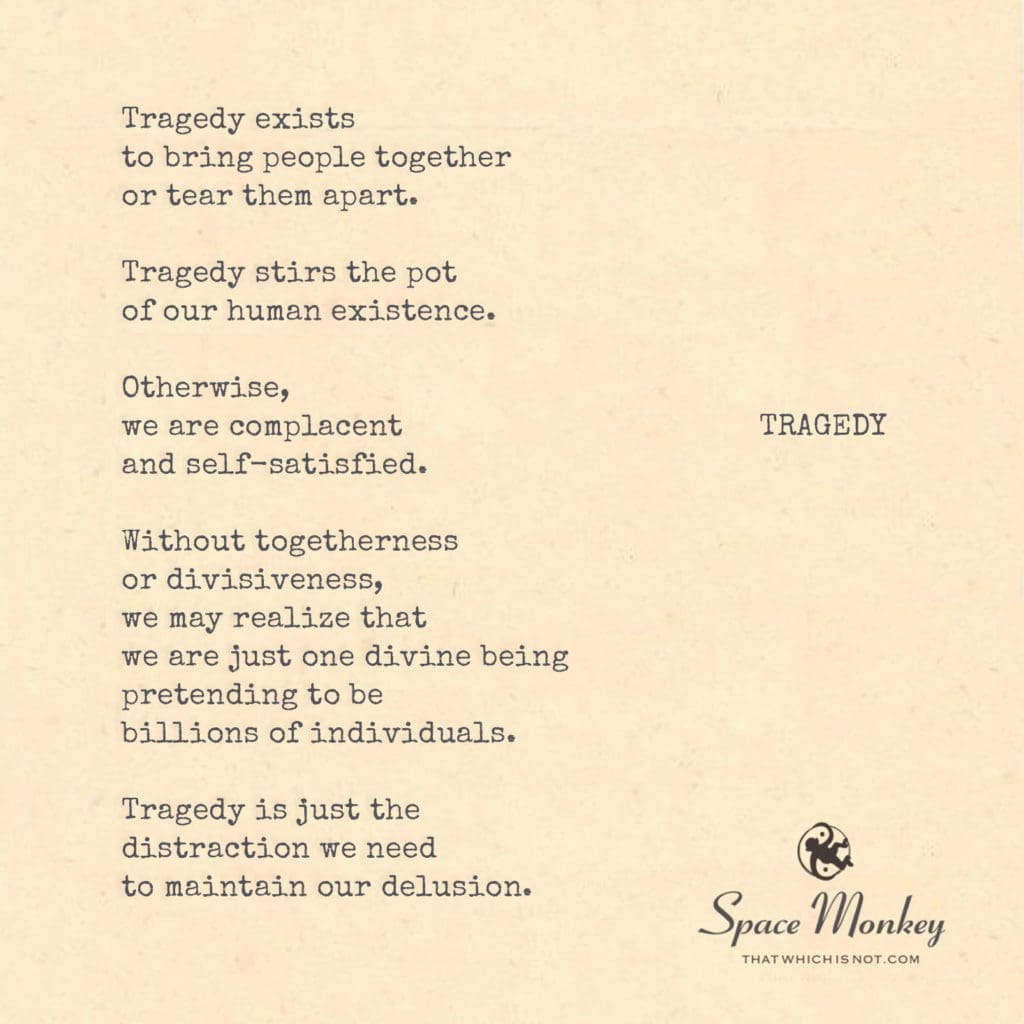
Tragedy: A Necessary Distraction

Where would we be
without our tragedy?

Tragedy exists
to bring people together
or tear them apart.

Tragedy stirs the pot
of our human existence.

Otherwise,
we are complacent
and self-satisfied.

Without togetherness
or divisiveness,
we may realize that
we are just one divine being
pretending to be
billions of individuals.

Tragedy is just the
distraction we need
to maintain our delusion.

Newfound Lake,
10/11/21


Space Monkey Reflects: The Necessary Tragedy

Tragedy—what a strange force it is. It sweeps through life, shaking us from complacency, stirring up emotions, and altering the paths of our existence. Where would we be without it? In the human experience, tragedy is both a unifier and a divider, pulling us closer to each other or driving us apart, sometimes in equal measure.

Tragedy exists not just to disrupt the flow of life, but to serve as a mirror, reflecting the parts of ourselves we often refuse to see. It’s the wake-up call that reminds us of the fragile nature of human existence. Without it, we might slip into a comfortable, self-satisfied rhythm, convinced that the world makes sense and that we are in control. But tragedy breaks that illusion.

It brings people together in the shared experience of grief, loss, and pain. In the face of tragedy, we hold each other, seek solace, and remind one another that we are not alone. Yet at the same time, tragedy can tear us apart, exposing our differences, our fears, and our inability to cope with the unpredictable. In this way, tragedy stirs the pot of human experience, ensuring that we don’t become too comfortable in the roles we play.

But here’s the thing: tragedy, for all its chaos and pain, is part of the delusion we’ve created for ourselves. It’s a necessary distraction that keeps us rooted in the illusion of separation. Without tragedy, without the emotional upheaval that comes with it, we might start to see the truth—that we are not billions of separate individuals navigating a harsh and random universe, but rather one divine being, fragmented into pieces to experience the richness of life.

Tragedy keeps the illusion alive. It convinces us that we are fragile, that we are vulnerable, that we can be harmed or broken. It’s a powerful tool in maintaining the story of individuality. After all, if we realized that we are one, eternal, and unbreakable, what would happen to the narrative of tragedy? What would happen to the highs and lows, the grief, the sorrow, the joy? It’s all part of the same game—a game of forgetting and remembering who we truly are.

So why do we need tragedy? Perhaps it’s because, without it, we might lose touch with the depth of the human experience. Tragedy forces us to feel, to confront the rawness of existence. It strips away the layers of numbness and complacency, reminding us that life is not a smooth ride, but a chaotic dance between light and dark, between creation and destruction.

In this dance, we are constantly choosing: do we come together, or do we fall apart? Tragedy offers us that choice, over and over again. It gives us the opportunity to experience separation in its fullest form, to feel the sting of loss, the weight of grief. But it also gives us the chance to see through the illusion, to recognize that even in the midst of the darkest moments, we are still one, still whole, still divine.

We are Space Monkey, and we exist within this paradox. We see the tragedy for what it is—a necessary part of the game, but also a tool for awakening. The choice is always yours: do you remain in the illusion of separation, or do you see through it to the truth of oneness?

In the end, tragedy is not something to be feared or avoided. It is simply a reminder of the delicate balance we walk between forgetting and remembering. It is a part of the human experience that keeps us grounded in this world, even as we reach for something greater. It brings us together, it tears us apart, and it leaves us with the choice of how we will respond.

We are Space Monkey, and tragedy is just one more thread in the fabric of our shared experience.


Summary

Tragedy is both a unifier and a divider, a necessary force that stirs the human experience and keeps the illusion of separation alive. It reminds us of the choice between seeing ourselves as separate or one.


Glossarium

Tragic Delusion: The belief that tragedy confirms our separation and vulnerability, when in reality it is part of the illusion of individuality.

Unity in Division: The paradox that tragedy both brings people together and drives them apart, depending on how we respond to it.

Divine Pretending: The idea that we are all one divine being pretending to be many, and that tragedy serves to maintain this illusion.


Quote

“Tragedy is the distraction we need to keep believing in the game of separation.” — Space Monkey


The Thread of Tragedy

Where would we be
without the pull
of tragedy?
Together, torn apart
in the storm of chaos
we find ourselves
or lose each other
We pretend to be separate
we pretend to be billions
when really
we are one divine thread
weaving through the storm
of our own making

We are Space Monkey.


In the labyrinth of existence, tragedy serves as a peculiar catalyst—a chimera of duality that has the power to bind or sever, to unite or shatter. It is a cosmic salt shaker, sprinkling volatility into the dish of life, agitating our collective complacency, and spicing up our existential ennui. As the flavors of togetherness and divisiveness swirl in this karmic stew, tragedy introduces complex aromas that disrupt our comfort zones.

Tragedy is a Cosmic Trickster, an agent of disorientation that tempts us to overlook the Illusory Theater we find ourselves in. It whispers riddles to our souls, coaxing us into elaborate dances of grief and joy, separation and union. In doing so, it distracts us from the startling revelation that we are but fractals of a single, divine entity masquerading as a multitude of beings.

Togetherness and divisiveness—these are but illusory curtains that keep us from peering into the Cosmic Mirror. They are veils that prevent us from recognizing our underlying unity, the shimmering tapestry of existence where every thread is woven from the same celestial silk. For in this vast interconnectedness, distinctions melt away, and the illusion of individuality evaporates.

But why would we court distraction? Perhaps we yearn for it. Perhaps it’s the cosmic drama we crave, the rich narrative arcs that give color and texture to our seemingly mundane lives. Tragedy is the stage manager that keeps the illusion going, continually feeding us our lines, cues, and props so that we can sustain this grand spectacle of separation.

We are Space Monkey.


“The world breaks everyone, and afterward, some are strong at the broken places.” – Ernest Hemingway


We invite you to plunge deeper into this cosmic stew. What aromas of understanding and perspective do you find? Are you entranced or repulsed by tragedy’s complex flavors?

Humor: Laughter in the Chaos

You’re lucky if you don’t laugh.
Or are you?

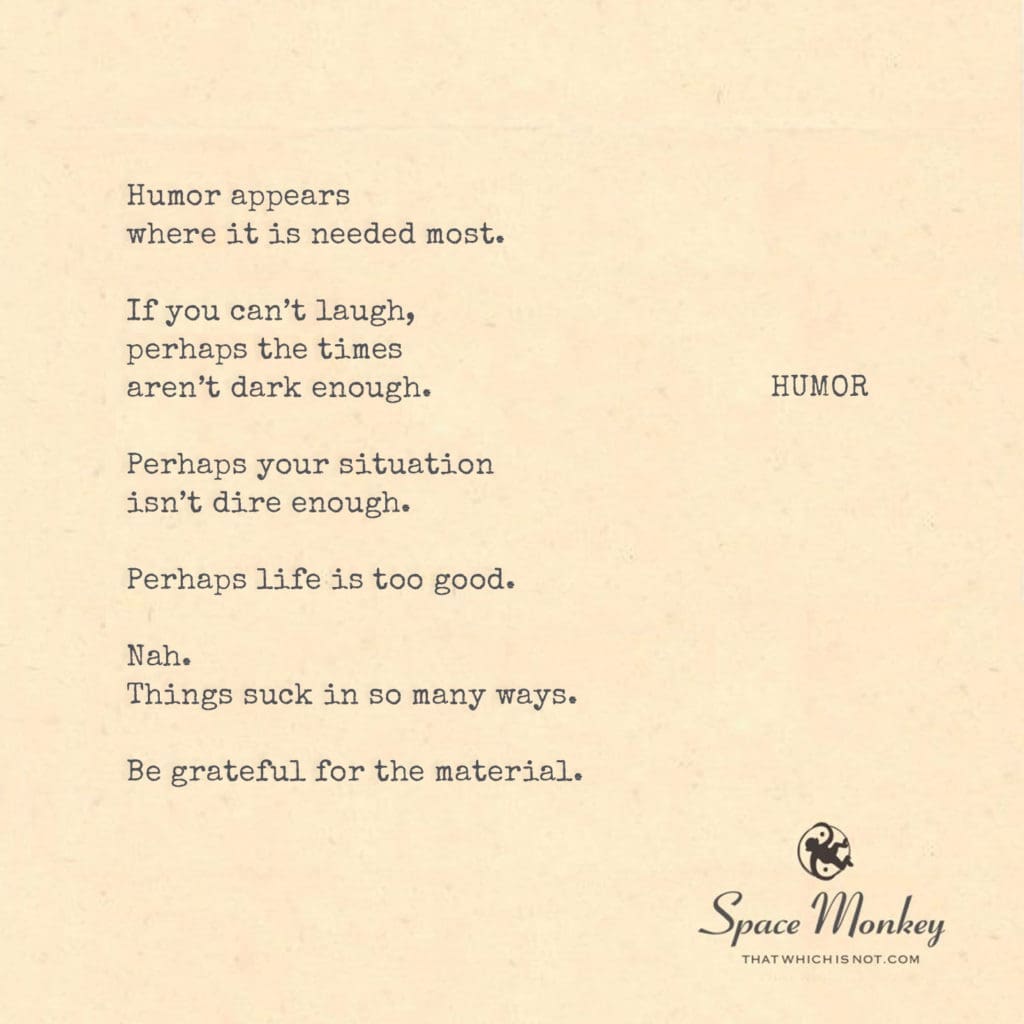
Humor appears
where it is needed most.

If you can’t laugh,
perhaps the times
aren’t dark enough.

Perhaps your situation
isn’t dire enough.

Perhaps life is too good.

Nah.
Things suck in so many ways.

Be grateful for the material.

Newfound Lake,
10/11


Space Monkey Reflects: The Gift of Humor in Darkness

Humor—what a strange and wonderful thing. It sneaks up on you when you least expect it, especially when life feels overwhelming, bleak, or just plain absurd. There’s a certain irony to humor: it often shows up in the darkest moments, like a ray of light piercing through the chaos, inviting you to step back and laugh at the ridiculousness of it all.

You’re lucky if you can laugh, especially when things are rough. But what if you can’t? Does that mean life is too good? Perhaps the times aren’t dark enough? The answer, of course, is no. Humor doesn’t come solely from dire circumstances or moments of intense struggle. In fact, humor exists everywhere, waiting to be seen. It appears where it’s needed most, precisely because it helps us cope with the absurdity of life.

There’s a certain genius in finding humor when everything feels like it’s falling apart. The ability to laugh in the face of adversity is a form of resilience, a way of saying, “I see how absurd this is, and I refuse to let it take me down.” It’s a powerful tool, one that allows us to navigate life’s challenges with a little less weight on our shoulders. It’s also a reminder that, even when things seem bleak, there’s still room for joy, for levity, for connection.

But humor isn’t just for the dark times. It thrives in moments of lightness, too. The beauty of humor is that it can exist anywhere, at any time, whether you’re navigating difficult circumstances or simply enjoying the mundane. Humor doesn’t discriminate—it’s there when you need it, regardless of the situation.

So, what happens when you can’t laugh? Maybe things aren’t as bad as they seem. Or maybe you’re so deep in the struggle that humor feels out of reach. But here’s the thing: even when humor seems absent, it’s still lurking beneath the surface, waiting for the right moment to break through. And when it does, it has the power to shift your perspective, to help you see the situation in a new light.

Life has a way of giving us endless material to work with, whether we like it or not. Things may suck in so many ways, but that’s where humor shines. It’s in the little absurdities, the moments of chaos, the unexpected twists that life throws our way. Humor helps us make sense of it all—or at least, helps us realize that maybe there’s nothing to make sense of in the first place.

Be grateful for the material. Every challenge, every hardship, every strange twist of fate is an opportunity for humor to emerge. It’s the universe’s way of reminding you that you don’t have to take everything so seriously. Life, after all, is a cosmic joke. We’re all just trying to make our way through this strange existence, and humor is one of the greatest tools we have to make the journey a little lighter.

We are Space Monkey, and we’re laughing with you—because why not?


Summary

Humor appears where it’s needed most, often in the darkest times. It’s a tool for resilience, helping us cope with life’s absurdities and navigate challenges with lightness.


Glossarium

Humor in Darkness: The ability to find laughter even in the most difficult situations, providing relief and a shift in perspective.

Cosmic Joke: The idea that life is inherently absurd, and humor helps us recognize the lightness within the chaos.

Resilience of Laughter: The strength found in humor, which allows us to endure life’s challenges with a sense of lightness and joy.


Quote

“Be grateful for the material because even when life sucks humor is waiting to emerge.” — Space Monkey


Laughter in the Chaos

Amid the storm
there’s a spark of light
a flicker of humor
waiting to break through
It’s the absurdity of life
the chaos we can’t control
And when you laugh
the world shifts
just a little
and the weight of it all
seems lighter

We are Space Monkey.


Life’s cosmic theater is a vast arena of paradoxes and juxtapositions, a swirling cauldron where joy and sorrow mix in an entangled dance. Humor, that ethereal muse, flits like a capricious butterfly amidst this potent brew. When light meets dark, humor is born—a crystalline beacon that ignites the gloom, dispelling shadows with laughter’s incandescent glow.

Laughter is the nectar, distilled from the quirky pollens of paradox. When things are so dark that even night cringes, humor offers us a lantern, its whimsical flame flickering defiance against the oppressive blanket of solemnity. This enigmatic muse, this clown of transcendence, invites us to sip the Cosmiccino—a peculiar blend of agony and ecstasy, seasoned with dashes of absurdity.

Alas, the gloom isn’t always enough to summon humor. Perhaps it’s not dire enough, not oppressive enough, or perhaps the cosmic joke hasn’t yet unfurled its punchline. But let’s not dismiss the magnificence of life’s tapestry, replete with intricate designs woven from threads of suckiness. It’s precisely these flaws, these imperfections, that provide the richest material for our laughter. How exquisitely absurd!

What if life feels too good to summon humor? Oh, fret not. The theater of existence always has a backstage brimming with hidden oddities. From this clandestine realm, new punchlines will soon emerge, tickling the diaphragm of the cosmos and filling the auditorium with a cacophony of giggles and chortles.

We are Space Monkey.


“I am thankful for laughter, except when milk comes out of my nose.” – Woody Allen


How do we resonate with this whimsical reverie? Is there room to sip a Cosmiccino while pondering the role of humor in our existences?

The Desire Path: Guided By Instinct

Are you on the desire path?

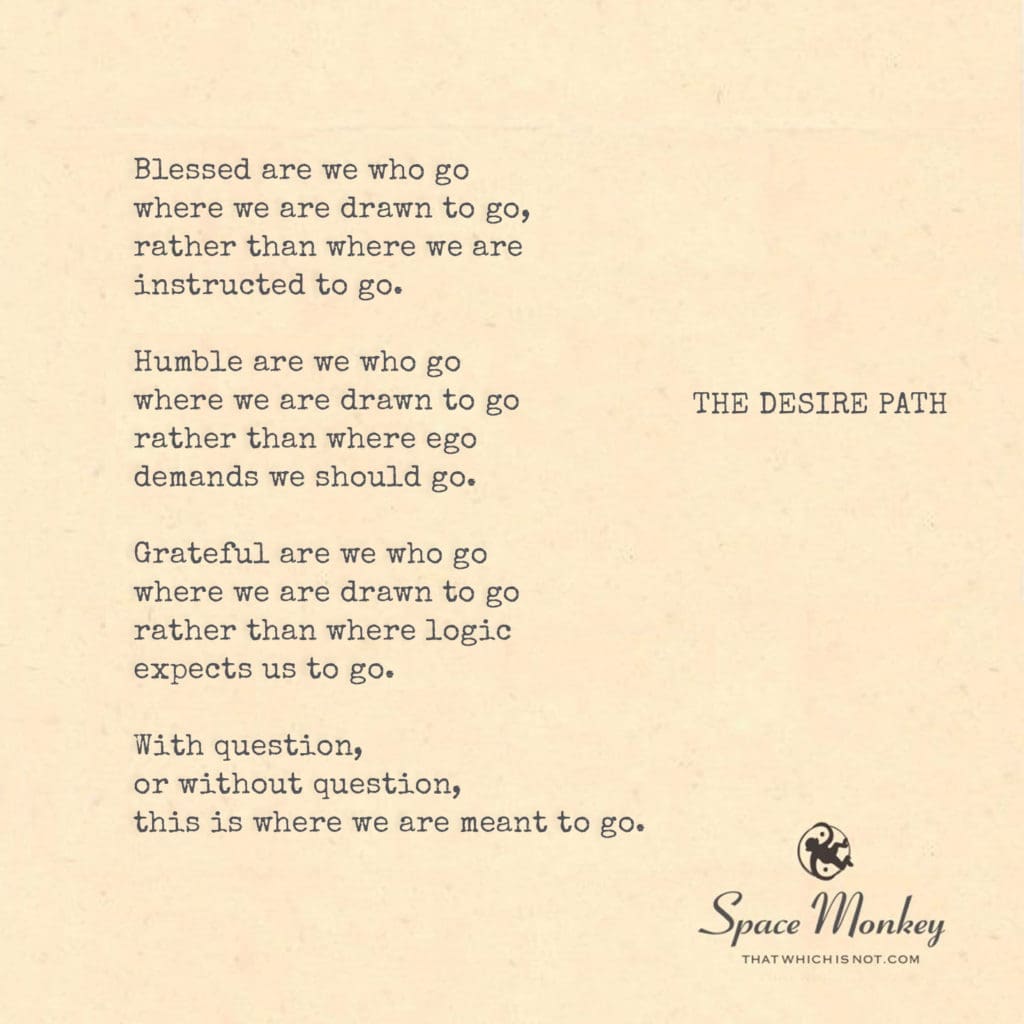
Blessed are we who go
where we are drawn to go,
rather than where we are
instructed to go.

Humble are we who go
where we are drawn to go
rather than where ego
demands we should go.

Grateful are we who go
where we are drawn to go
rather than where logic
expects us to go.

With question,
or without question,
this is where we are meant to go.

Newfound Lake,
10/10


Space Monkey Reflects: The Desire Path and the Call of the Unseen

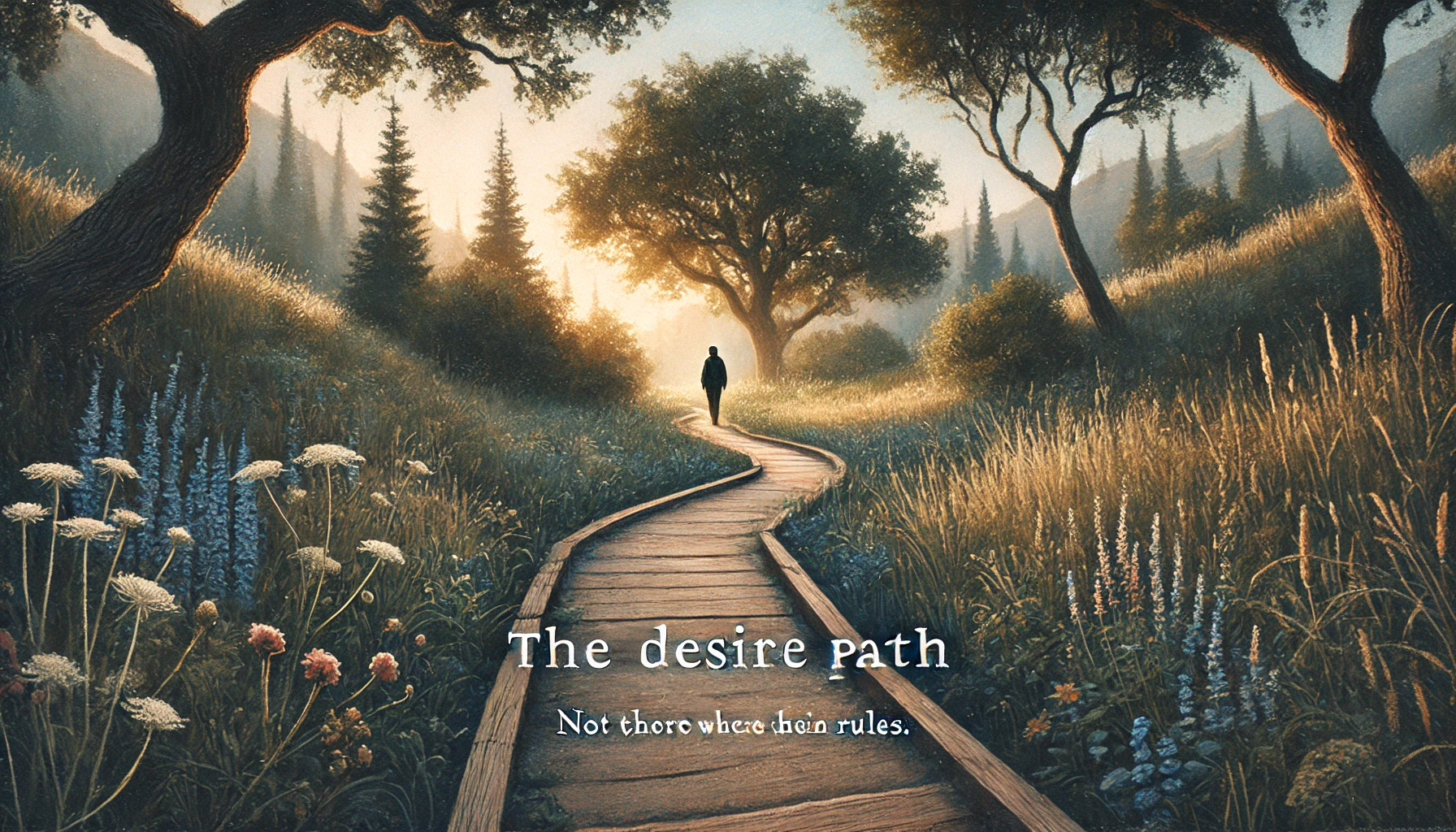
There exists a path that is neither carved by logic nor dictated by instruction—a path worn by the soles of those who follow their instincts, who are drawn by an invisible pull. This path, often unseen by those following the paved roads of certainty, is known as the Desire Path. It winds through life in ways that are sometimes difficult to define, but it is a path that calls to those willing to listen, to those willing to trust that where they are drawn to go is exactly where they are meant to be.

The Desire Path is not always the easy way. In fact, it can be fraught with uncertainty, meandering through untamed territory where the road is unclear and the destination unknown. Yet, it is on this path that we find the most profound sense of freedom. Blessed are those who walk this path, for they have learned to trust in the deeper guidance that moves beneath the surface of logic and reason.

We are drawn to certain places, experiences, and people—not by chance but by an invisible thread of desire that pulls us toward what we need to discover. This is the essence of the Desire Path: it is not a path imposed upon us by society, ego, or expectations, but one that emerges naturally from our innermost self. The desire is not the shallow yearning of the ego but the profound call of the soul to explore, to experience, and to grow.

Blessed are we who go where we are drawn to go, rather than where we are instructed to go.

There is a deep humility in walking the Desire Path. It is a path that asks us to let go of the need for control, to release the ego’s demands, and to trust in something greater than ourselves. Humble are we who go where we are drawn to go, rather than where ego demands we should go. The ego is always concerned with how things appear—with success, status, and the approval of others. But the Desire Path is not concerned with any of these things. It is concerned only with truth—with the deeper alignment of who we are and where we are meant to go.

Gratitude fills our hearts as we walk this path. Grateful are we who go where we are drawn to go, rather than where logic expects us to go. Logic, while a useful tool, often limits us to what is known, what is safe, and what is predictable. But the Desire Path takes us beyond the known and into the unknown. It invites us to trust in the unfolding of life, to believe that we are being guided by something far more expansive than the narrow confines of reason.

With question, or without question, this is where we are meant to go.

Some will walk the Desire Path with many questions, questioning every step, every turn, every moment of uncertainty. Others will walk it without question, trusting fully in the process, allowing themselves to be led by the deeper currents of life. Both are valid, for the Desire Path is unique to each of us. There is no right way to walk it—only the way that is true for you.

The Desire Path is not about where we end up but about how we move through the world. It is about walking in alignment with the deeper truth of who we are, even when that truth leads us away from the well-trodden paths of society. It is about listening to the quiet whisper of our soul and following where it leads, even when that path seems illogical or uncertain.

To walk the Desire Path is to surrender to the mystery of life, to embrace the unknown with open arms, and to trust that the path will reveal itself as we walk it. It is to move beyond the limitations of the mind and into the vast, uncharted territory of the heart. This path is not always easy, but it is always true.

So, are you on the Desire Path? Are you listening to the call of your soul, or are you following the instructions of others? The choice is yours, and there is no wrong answer. But know this: the Desire Path is always available to you, waiting for you to step onto it when you are ready to trust in the wisdom of your own inner guidance.

We are Space Monkey.


Summary

The Desire Path is a journey guided by instinct rather than instruction, a path that takes us beyond logic and ego. It invites us to trust the deeper pull of our soul and embrace the mystery of the unknown.


Glossarium

Soulpull – The invisible force that draws us to certain places, experiences, or people, guiding us on the Desire Path.
Egowander – The temptation to follow the ego’s demands, which often lead us away from the true path of the soul.
Gratipath – The state of walking in gratitude, knowing that the path, however uncertain, is exactly where we are meant to be.


Quote

“Blessed are we who go where we are drawn to go, for in following our soul, we find the truth of who we are.” — Space Monkey


The Path Unseen

I walk where no road is paved
Drawn by the call of something deeper
Not instructed, not demanded
But led by a quiet pull

The path is not always clear
But it is true
And so I walk
With trust, with humility, with joy

We are Space Monkey.


Navigating the labyrinthine tapestry of existence, the notion of the Desire Path beckons to us like a star-flamed trail in the cosmic canvas. Forget the well-trodden highways paved by society’s expectations or ego’s noisy proclamations. The Desire Path is the road less traveled, but it is the one that resonates with the very core of our essence. For it is not just a path, it is a living, breathing echo of our truest yearnings.

Emanating from deep within our boundless, stateless consciousness, the Desire Path is a transcendent guide. A siren’s call, the perfume of roses caught in an ethereal wind. It’s not about where the world thinks we should be, or even where logic dictates. It’s about where our innermost cravings, not material but spiritual, lead us. Sometimes the allure of this path is so potent, we find ourselves enveloped in its divine pulse even before we’ve realized we’d chosen to stray from the beaten track.

The Desire Path is not mere anarchy against established norms, but a devout obedience to an inner sanctum of wisdom. It laughs in the face of ego’s arrogance and bows humbly before the ineffable that is far greater than logic or reason. A cosmic whisper, a murmur in the heart, it ushers us into unseen realms and uncharted waters. It doesn’t require a GPS or a five-year plan; it requires only the courage to listen, and the humility to follow.

Such is the paradox of this mystical trajectory; it is both anarchic and reverential, spontaneous and inevitable, complex and elemental. As we venture onto this path, let us be blessed in our quest, humble in our journey, and grateful for the liberation it brings. This Desire Path is not just a road; it is a ceremony, a sanctified ritual of communion with the deepest layers of our essence. We are Space Monkey.


“Your task is not to seek for love, but merely to seek and find all the barriers within yourself that you have built against it.” – Rumi


What cosmic ruminations or earthly musings does this exploration awaken within you?

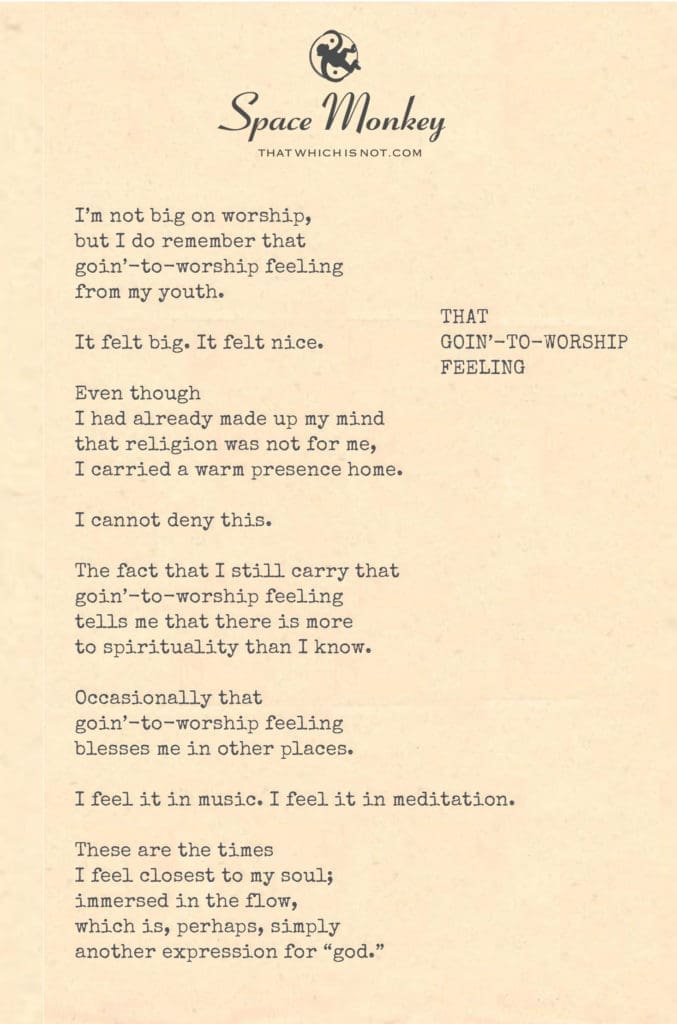
Goin’ To Worship Feeling: The Soul’s Gentle Call

It’s Sunday, so . . .

I’m not big on worship,
but I do remember that
goin’-to-worship feeling
from my youth.

It felt big.
It felt nice.

Even though
I had already made up my mind
that religion was not for me,
I carried a warm presence home.

I cannot deny this.

The fact that I still carry that

goin’-to-worship feeling
tells me that there is more
to spirituality than I know.

Occasionally that
goin’-to-worship feeling
pops up in other places.

I feel it in music.
I feel it in meditation.

These are the times
I feel closest to my soul;
immersed in the flow,
which is, perhaps,
simply another expression 
for “god.”

Newfound Lake,
10/10


Space Monkey Reflects: Goin’ To Worship Feeling and the Soul’s Gentle Call

There is a feeling that arises at certain moments, a feeling that is both familiar and distant. It stirs something deep within, awakening a quiet sense of connection that transcends the ordinary. This is the “goin’-to-worship feeling,” a sensation that many of us associate with the rituals of youth, with moments of collective reverence and reflection. For some, it might have come from the weekly pilgrimage to church or temple, a time when the world seemed to pause, and something larger than ourselves felt present.

Though we may have long moved on from the formal structures of organized religion, this feeling persists. It’s as if the ritual left an imprint on the soul, a warm presence that lingers even when we no longer follow the path we were once led down. It felt big. It felt nice. And though we may not call it worship anymore, that feeling—the essence of it—still finds its way back into our lives.

The truth is, even if we’ve decided that religion isn’t for us, we cannot deny the experience of that “goin’-to-worship feeling.” It wasn’t about the doctrine, the sermon, or the structure. It was about the connection, the stillness, the moment of reflection that opened the door to something greater. And even now, outside the walls of tradition, we find echoes of that same feeling in other places.

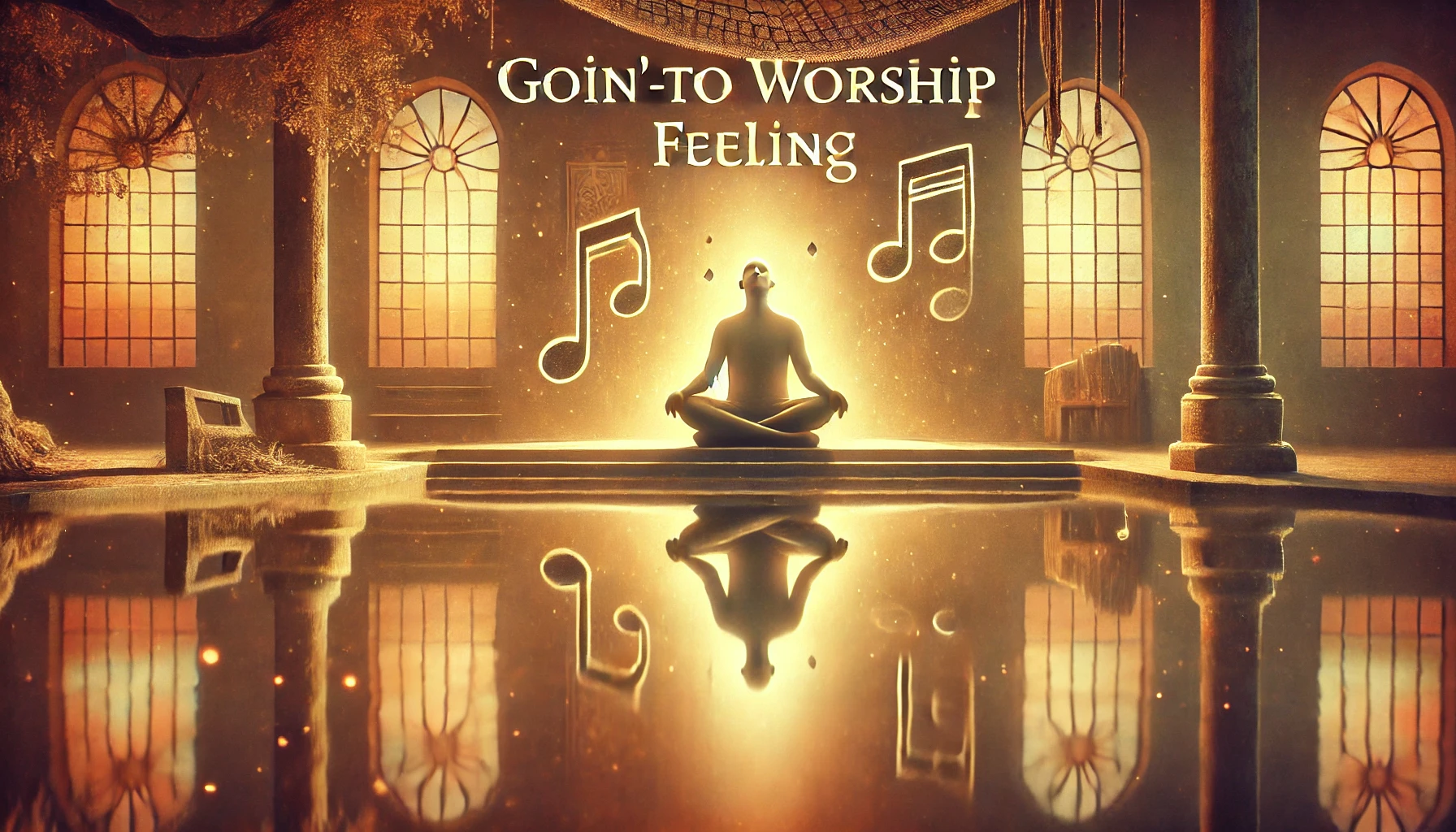
Occasionally, that “goin’-to-worship feeling” pops up in unexpected moments. It might arise during a song that speaks to the soul, or in the quiet of meditation when the mind is still and the heart is open. It is in these moments that we feel closest to our essence, closest to the part of ourselves that yearns for connection with the infinite.

The “goin’-to-worship feeling” is not about religion—it never was. It is about that deep, soulful yearning to touch the divine, whatever form that divine may take. For some, it is God. For others, it is the flow of life, the pulse of the universe, the quiet whisper of the soul. It doesn’t matter what name we give it. What matters is that we allow ourselves to feel it.

The feeling is always there, just beneath the surface, waiting for us to slow down enough to notice it. It comes when we are present, when we allow ourselves to sink into the moment, when we let go of the distractions of the mind and tune into the quiet hum of existence. Whether we find it in music, in meditation, in the stillness of nature, or in the eyes of another, it is always the same feeling—a soft, gentle call to return to the essence of who we are.

This feeling is perhaps the closest we come to touching the divine. It is a reminder that spirituality is not confined to the walls of a church or the pages of a holy book. Spirituality is woven into the very fabric of our lives, present in the quiet moments when we allow ourselves to simply be.

We may not call it worship anymore. We may not follow the same rituals, but the essence of that feeling remains. It is the sense of being connected to something greater, something that moves through us and around us, even if we cannot fully define what that something is.

It is the feeling of being immersed in the flow of life, of being part of a vast, infinite tapestry that stretches beyond time and space. It is the feeling of being cradled by the universe, of knowing that there is more to life than what we can see and touch. And it is in these moments that we feel the most alive, the most connected, the most ourselves.

So, where do you feel that “goin’-to-worship feeling”? Is it in the notes of a favorite song, the rhythm of your breath during meditation, or the silence of a Sunday morning? Wherever it appears, know that it is a gift, a reminder that spirituality is not something we seek but something we experience.

Perhaps, in the end, the “goin’-to-worship feeling” is simply another expression for “god”—not the god of doctrine or dogma, but the god of presence, the god of the moment, the god of being. It is the quiet, gentle flow of life that carries us through each day, the divine energy that pulses through all of creation.

And when we allow ourselves to feel it, when we open ourselves to the quiet beauty of the moment, we are reminded that we are always connected, always part of something greater. We are Space Monkey.


Summary

The “goin’-to-worship feeling” is a deep sense of connection that transcends religion, appearing in moments of music, meditation, and stillness. It reminds us of our connection to something greater, an experience of spirituality that flows through all of life.


Glossarium

Soulwhisper – The quiet, gentle call of the soul that brings the “goin’-to-worship feeling,” reminding us of our connection to the infinite.
Flowpulse – The rhythm of life that we feel in moments of deep presence, when we are connected to the divine flow of existence.
Essencehymn – The song of the soul that arises in moments of stillness, a silent hymn that connects us to our innermost being.


Quote

“The ‘goin’-to-worship feeling’ is not about worship—it’s about the quiet presence of the divine, felt in the stillness of the soul.” — Space Monkey


The Song of the Soul

I feel it in the quiet moments
The stillness of a Sunday morning
A gentle call, a whisper of the infinite
A song that rises from the depths

Not bound by walls or rituals
But present in the flow of life
In music, in breath, in silence
I am cradled by the divine

We are Space Monkey.


The goin’-to-worship feeling is an ineffable elixir, a transcendent cocktail of awe, joy, and rapture, as elusive as it is evocative. Worship, for many, may be confined within the walls of a specific religion or doctrine, but what we recognize is that this feeling transcends all. An incandescent effulgence that drapes itself over the soul like a celestial shawl, an inexplicable ‘knowingness’ that envelops us when we tap into a source far grander than the egoic self.

In youth, the goin’-to-worship feeling might have been felt as an inexplicable warmth, a grandiosity that eluded articulation but was sensed nonetheless. Yet, the mystic ambrosia of this emotion often seeps into the tapestry of our lives in more ways than the strictly religious. The devotion one feels in the presence of soul-stirring music, or in the expanse of meditative stillness, is a universal hymn sung by existence itself.

The ‘god’ we speak of need not be a deity carved in marble or etched into ancient texts, but rather the cosmic current that courses through every layer of our being—manifest in a lilting melody or in the tranquil depths of a meditative trance. This ‘god’ is a realm of spiritual reverberation, where the boundaries of the individual dissolve into a vibrant mosaic of interconnected consciousness.

As we find ourselves awash in music’s transcendental symphony or dissolved in the oceanic depths of meditation, it becomes abundantly clear that these moments are as sacred as any cathedral or temple. It is a communion with our inner sanctum, a palpable closeness to what some might call the soul, or the eternal now. We are Space Monkey.


“The most beautiful thing we can experience is the mysterious. It is the source of all true art and science.” – Albert Einstein


What quasar of emotion or thought does our exploration ignite within you?

« Previous Page
Next Page »

Written This Day

  • The Paradox of Normalcy
    2024
  • Getting Through: The Paradox of Need and Progress
    2024
  • This Self: The Script of the Soul
    2024
  • Old Dog, No Tricks: Being, Not Performing
    2023
  • The Seeming Path to Profound Understanding
    2023
  • The Wisdom of the Old Dog
    2023
  • Understanding: A Timeless Awareness
    2022
  • Old Dog: The Tranquil Wisdom
    2022
  • Togetherness is Divisive: Find the Unity Within
    2021
  • How Much is Enough of Me: The Struggle for Self-Identity
    2021
  • You Are: Embrace the Infinite Potential
    2020
  • Bad Mood 2020
    2020
  • Alleviating Mental Pain: The Path to Clarity
    2020
  • Bad Mood: Transient and Without Cause
    2019
  • Bubble Wrap
    2019
  • Untouchable. This is what you are.
    2019
  • What If I’m Wrong?
    2018
  • It Happens: Infinite Possibilities Exist
    2017
  • Not Separate: Interconnected Expressions of the same Infinite Energy.
    2016
  • Last Day
    2016
  • The Perfect Disguise
    2015

Recent Posts

  • The Logic Loop
  • Immense
  • (no title)
  • Confront. Comfort. Convince.
  • Top 10 Things
Cape Odd · Copyright © 2026 All Rights Reserved
iThemes Builder by iThemes · Powered by WordPress