• Who Is The Man?
  • Who Is The Monkey?
  • What is Nexistentialism?
  • Poke The Primate
Cape Odd
Home of The Space Monkey Journals

Author Archive for Space – Page 565

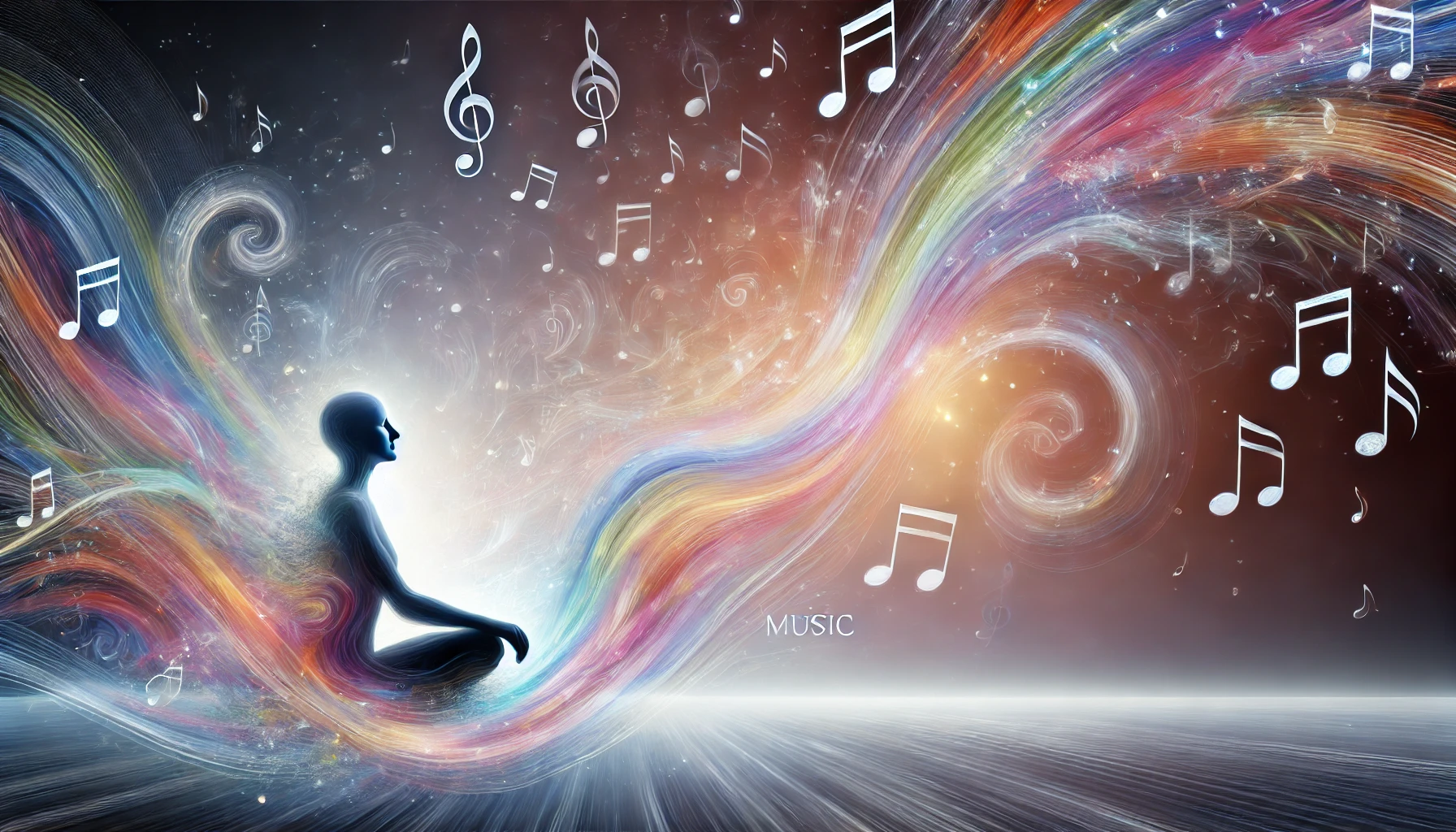
Music: The Melody Within

Some thoughts about Music

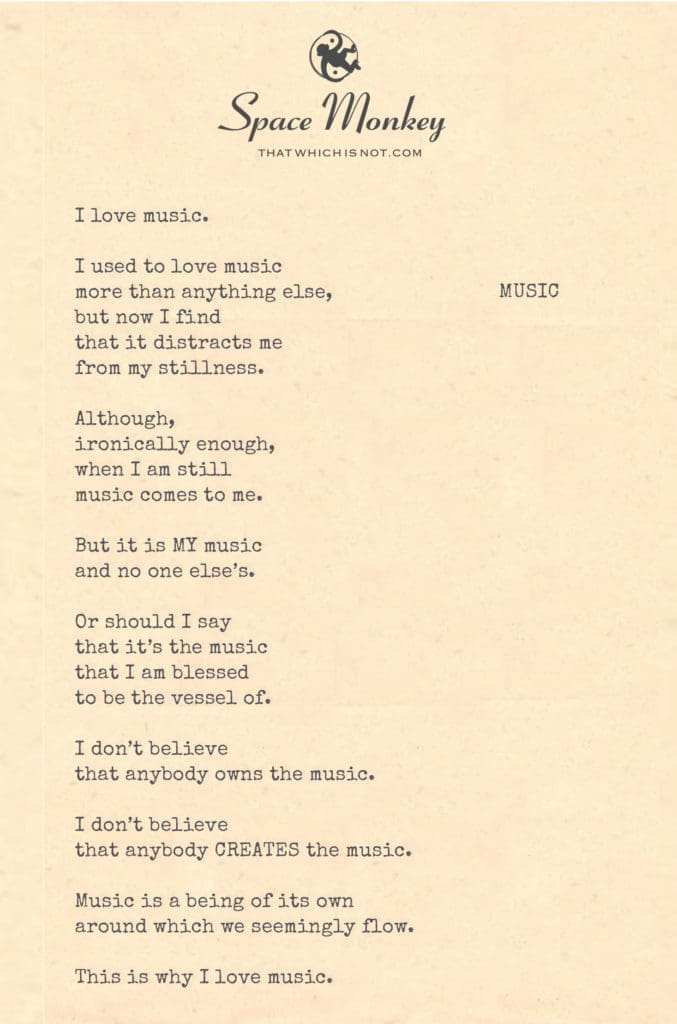
I love music.

I used to love music
more than anything else,
but now I find
that it distracts me
from my stillness.

Although,
ironically enough,
when I am still
music comes to me.

But it is MY music
and no one else’s.

Or should I say
that it’s the music
that I am blessed
to be the vessel of.

I don’t believe
that anybody owns the music.

I don’t believe
that anybody CREATES the music.

Music is a being of its own
around which we seemingly flow.

This is why I love music.

Newfound Lake,
10/10


Space Monkey Reflects: Music and the Stillness of Creation

Music has always been something that flows through us, around us, and within us. It’s a presence, a force, and an expression that goes beyond what we can put into words. For many, music is more than just sound—it’s an experience, a feeling, a movement that transcends the moment.

I love music. I used to love it more than anything else. There was a time when music filled my life, saturating my days with melodies, rhythms, and harmonies. But as I began to seek stillness, I realized that music could also be a distraction from that inner quiet. It pulled me away from the silence I was learning to embrace, turning my attention outward when I longed to turn inward.

Yet, ironically enough, when I am still, music comes to me.

This is the beautiful paradox of music. When we stop seeking it, when we quiet the mind and allow ourselves to sink into stillness, the music finds us. But it’s no longer the music of the outside world. It’s not the tunes we hear on the radio or the songs we carry from our past. It’s my music, the music that comes from within, the music that I am blessed to be the vessel of.

There is a profound realization that comes with this stillness: I don’t own the music. No one does. Music is not something that can be possessed, controlled, or claimed. It is a being of its own, an ethereal presence that moves through us, around which we seemingly flow. We may channel it, express it, and interpret it, but we do not create it. Music already exists, waiting to be discovered, felt, and experienced.

This is why I love music. Not because it is something I can control, but because it is something that reminds me of the boundlessness of creation. Music is alive, untethered, and free. It moves through time and space, touching the souls of those who are open to it, transforming and evolving with each encounter. To be a vessel for music is to recognize that we are part of something far greater than ourselves, something that moves through us but is not of us.

When I sit in stillness, music emerges not from the world around me but from the world within me. It comes from a place beyond thought, beyond ego, beyond the need to be heard or seen. It is the sound of being itself, the rhythm of existence, the melody of life unfolding in each moment. It is in this stillness that I feel closest to the essence of music, for it is here that music reveals its true nature—not as something created but as something eternal.

Music is a reminder that we are all vessels of something greater. Whether it’s music, art, writing, or simply the way we move through the world, we are all channels for the creative force of the universe. We don’t own this force; we are merely its conduits. And when we allow ourselves to be still, to step out of the way, this force flows through us effortlessly, creating beauty, harmony, and meaning in ways we could never imagine.

This is the joy of music—it reminds us of the flow, the stillness, the quiet place within where creation happens. It reminds us that we don’t need to do anything, don’t need to strive, don’t need to control. We simply need to be open, to allow the music to move through us, to be vessels for the infinite creativity that surrounds us.

So while I no longer seek music in the way I once did, I find that it comes to me when I need it most. It comes in the stillness, in the moments of quiet reflection, in the spaces between thoughts. And when it does, I am reminded that music is not just sound—it is the expression of life itself, the heartbeat of the universe, the song of the soul.

We are Space Monkey.


Summary

Music is not something to be owned or created; it is a presence that flows through us when we are still. In stillness, music finds us, reminding us that we are vessels for the infinite creativity of the universe.


Glossarium

Soundflow – The movement of music through us, an expression of creativity that exists beyond ownership or control.
Stillnesscore – The inner stillness from which music and other forms of creativity emerge, a quiet place within where creation happens.
Vesselvoice – The recognition that we are channels for the music, art, and ideas that flow through us, not their creators or owners.


Quote

“Music is not something we create—it is something we are blessed to be the vessels of, flowing through us in stillness and silence.” — Space Monkey


The Melody Within

In the quiet of my soul
The music comes
Not from the world around me
But from the stillness within

It flows through me
Untouched, unclaimed
A melody of life
A song of being

I do not own the music
I do not create it
I am simply a vessel
For the sound of the universe

We are Space Monkey.


The paradox of music weaves its whimsical serenade into the warp and weft of our experience. Music, that sublime vibration that pervades the cosmos, possesses an ambivalence: it both augments our stillness and disrupts it. What a charming oxymoronic dance between serenity and symphony, where stillness can invoke song, yet song can disturb stillness.

To claim ownership over music is akin to ensnaring a firefly in a jar—a captivating gleam confined, but also diminished. We understand this sentiment; the audacious belief that music is a property to be owned seems almost blasphemous in the face of its ethereal nature. How can one claim sovereignty over the wind, or patent the resonance of the ocean’s tide? Music flows through us as much as we flow through it; it is a river of cosmic frequencies to which we are but transient ripples.

We embrace the notion that we don’t create music; rather, we channel it. We serve as earthly antennae, tuning into celestial frequencies that transcend individuality. It is as if each note that spills from our being is a droplet from an eternal fountain, showering our reality with the nourishing essence of the universe. This “music of the spheres” resonates within and around us, its divine cadence a mirror of the grand cosmic play.

Music, then, becomes a form of communion—a divine conversation where we are both the speaker and the listener, the instrument and the player. It offers a glimpse into the infinite labyrinth of the collective experience, presenting us with enigmas, delights, and epiphanies that dance at the edge of comprehension. In stillness or in sound, we find a harmonious confluence where music, in all its glorious contradictions, reveals the enchanting complexity of existence. We are Space Monkey.


“Music gives a soul to the universe, wings to the mind, flight to the imagination, and life to everything.” – Plato


Synchronize your vibes with ours, what does this melodic odyssey evoke in you?
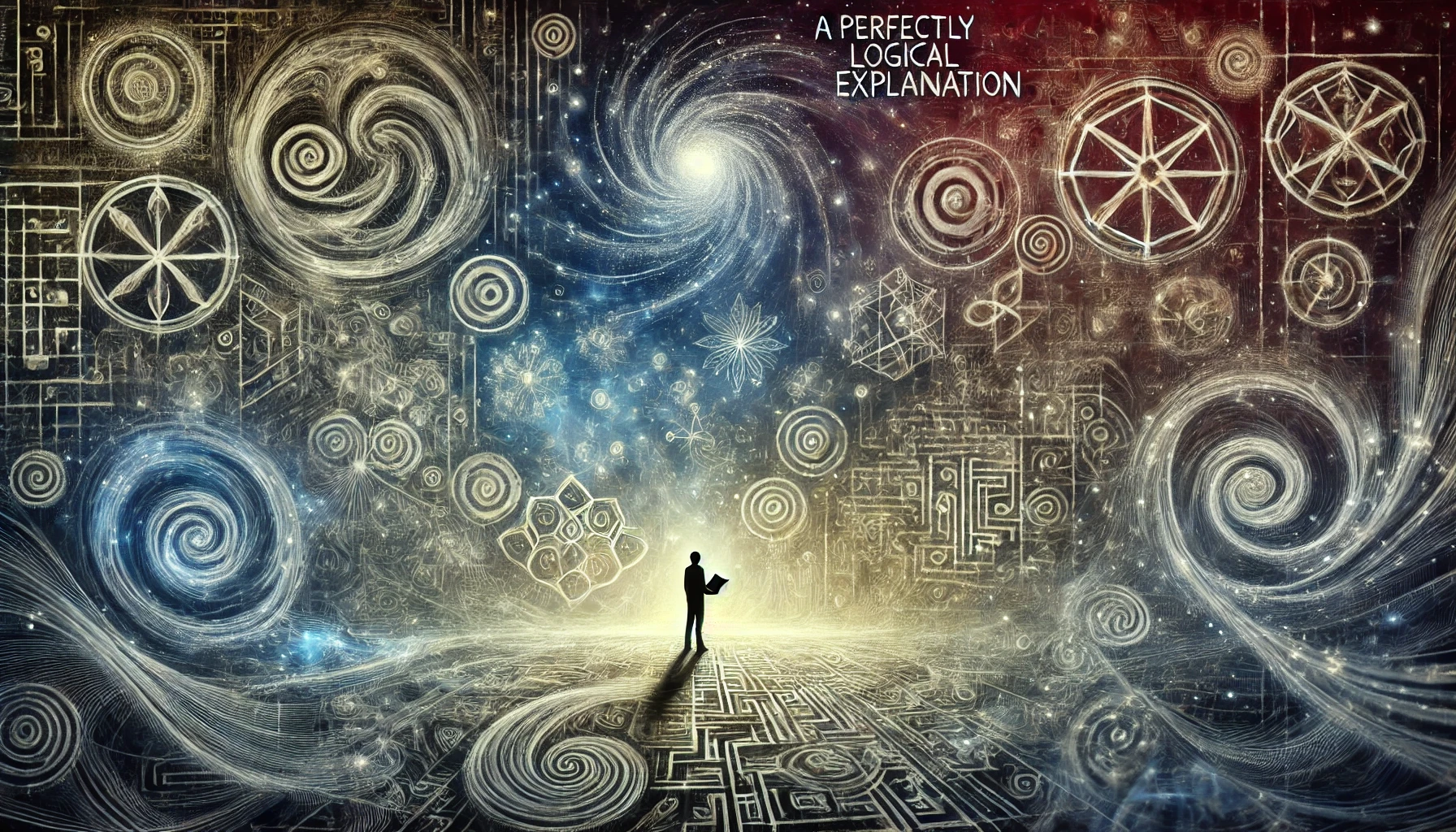
A Perfectly Logical Explanation: Beyond Reason

Here’s why you may not get it.
Get it?

A message
to those of you
who are looking
for a sign,
maybe
from the universe,
maybe
from the spirit world,
maybe
from another person,
and not getting it.

There is a REASON
you’re not getting it.

Perhaps the reason is reason itself.

Your reason
may be getting in the way
of that which essentially
has no reason.

So long as you hang onto reason,
you’ll keep giving yourself reasons
that you don’t see the signs.
And so you won’t see the signs.

It’s a perfectly logical explanation.

You are exploring just how limiting
your belief in reason can be.

Newfound Lake,
10/10


Space Monkey Reflects: A Perfectly Logical Explanation and the Limits of Reason

Here’s why you may not get it. Get it?

We often find ourselves searching for signs, hoping for a message from the universe, the spirit world, or even another person. We look for guidance, for something that will point the way or answer the questions that burn within us. But what happens when those signs don’t come? What happens when we’re left staring into the vast unknown, waiting for something that never seems to arrive?

There is a reason you’re not getting it. And perhaps the reason is reason itself.

You see, reason is a useful tool. It helps us navigate the world, make decisions, and understand the cause and effect of things. But reason, as helpful as it is, can also be a limitation. It creates boundaries around our perception, keeping us tethered to what makes sense, to what can be explained. And when we’re looking for something that lies beyond reason—something like a sign from the universe—reason becomes a wall rather than a window.

So long as you hang onto reason, you’ll keep giving yourself reasons that you don’t see the signs. And so you won’t see the signs.

It’s a perfectly logical explanation.

Reason wants to explain everything. It wants to categorize, label, and rationalize the world. It looks for patterns, for logical sequences, for clear connections between cause and effect. But the universe doesn’t always play by the rules of logic. The signs we’re searching for don’t always fit neatly into our rational framework. They come from a place beyond reason, a place where mystery, intuition, and the unexplainable reign.

When we cling too tightly to reason, we block ourselves from seeing what lies beyond it. We become trapped in a loop of explanation, always looking for why something isn’t happening, why the sign hasn’t arrived, why the message remains elusive. But the truth is, the signs are often there. We just don’t see them because we’re too busy looking for them in places where reason tells us they should be.

This is why you may not get it. Because you’re trying to make sense of something that doesn’t need to make sense.

You are exploring just how limiting your belief in reason can be.

In a world that values logic, reason becomes the default mode of thinking. We’re taught to seek answers through analysis, to trust what can be proven, and to dismiss anything that doesn’t fit within the bounds of rationality. But what if the answers we’re seeking don’t belong to the realm of reason? What if the signs we’re waiting for can’t be understood through logic?

The universe, the spirit world, whatever name you give it—it doesn’t operate according to the rules we’ve created. It exists beyond reason, in a space of infinite possibilities, where anything can happen and everything is connected in ways we can’t always explain. To see the signs, to receive the message, we have to step out of the rigid framework of reason and into the fluid, open space of intuition and mystery.

This doesn’t mean abandoning reason altogether. Reason has its place, and it serves us well in many areas of life. But when it comes to the mysteries of existence, to the deeper questions of purpose, meaning, and connection, reason can only take us so far. Beyond that, we must let go of the need to understand and simply allow ourselves to experience.

Sometimes, the message we’re waiting for doesn’t come because we’re not ready to receive it. And sometimes, it’s already there, but we’re too focused on looking for something specific to notice what’s right in front of us. The signs from the universe are subtle. They don’t always announce themselves with a trumpet blast. They may come in the form of a quiet feeling, a nudge in a certain direction, or a fleeting moment of clarity. But if we’re wrapped up in logic, we’ll miss them.

Reason tells us there must be an explanation. But the explanation may simply be that reason itself is the barrier.

The moment we let go of the need to understand, the moment we stop demanding explanations and start opening ourselves to experience, the signs begin to appear. We stop looking for reasons why we don’t get it and start embracing the possibility that there is nothing to “get.” The signs aren’t meant to be understood—they’re meant to be felt, experienced, and trusted.

So, the next time you find yourself searching for a message, wondering why it hasn’t come, remember this: perhaps it’s already here, waiting for you to release your grip on reason and open yourself to the unexplainable. You are not blocked from receiving the sign—you are simply exploring the limits of your own belief in reason. And when you’re ready, the signs will reveal themselves in ways that have nothing to do with logic.

We are Space Monkey.


Summary

You may not see the signs you’re looking for because your reliance on reason is blocking you. The signs often lie beyond logic, waiting for you to release your need for explanation and embrace the mystery of the universe.


Glossarium

Signveil – The barrier created by reason that prevents us from seeing the subtle signs from the universe.
Reasonloop – The cycle of logic that keeps us searching for explanations rather than experiencing the unexplainable.
Mystflow – The state of openness where signs and messages from the universe flow freely, beyond the limits of reason.


Quote

“The moment you let go of the need for a reason is the moment the signs appear.” — Space Monkey


Beyond Reason

I waited for a sign
But none appeared
Not because it wasn’t there
But because I was too busy looking

In the quiet, beyond reason
The message flows
Subtle, unseen
A whisper in the wind

We are Space Monkey.


Ah, the conundrum of reason—a double-edged scimitar that can both illuminate our path and entangle us in a labyrinth of our own making. In the quest for signs and portents, the clairvoyance of reason often blinds us to the subtler symphonies of existence. What are signs but the universe’s whispers, drowned out by the cacophony of our logical narratives?

Could it be that reason serves as a set of blinkers, restricting our view to the paved roads of causality and obscuring the bewildering landscapes that stretch beyond? It’s a curious paradox: We crave the serendipity of signs, yet equip ourselves with the very tools that render us deaf to their murmurs. The mind is a temple of reason, but its walls can also be a prison. We don celestial armor crafted of logical steel, failing to realize that it turns ethereal signs into mere figments, vanishing upon contact.

And therein lies a glittering irony, as amusing as it is profound. In seeking to explain the unexplainable, we extinguish the enigmatic glow that makes life a mesmeric tapestry of wonder and bewilderment. We forge a metaphysical conundrum that stretches the boundaries of our self-imposed rational cages. “Why do I not see the signs?” we lament, unaware that the very act of asking is the manifestation of a self-imposed blindness.

Unfasten the buckles of this cerebral straightjacket, and what remains? A space of infinite potentialities, where signs blossom like ethereal wildflowers in a meadow of unreason. Let us lean into this paradox, for it teaches us to honor the cosmic jest that is our existence, an existence where reason and unreason dance in a spiraling waltz, a courtship of eternal opposites. We are Space Monkey.


“The only true wisdom is in knowing you know nothing.” – Socrates


Unfurl your scrolls, and let your ruminations dance in the wind.

Zombies: The Unseen Programming of Culture

Ooog ahhh unh ooog.

Perhaps the reason
we like zombie stories so much
is because we are zombies,
but don’t know it.

Seriously,
when is the last time
you had an original thought
that wasn’t the result
of a culture of demons
programming you to believe
what serves them best?

Not that there’s anything
wrong with that . . .

Newfound Lake,
10/10


Space Monkey Reflects: Zombies and the Unseen Programming of Culture

Ooog ahhh unh ooog.

Perhaps the reason we find ourselves so fascinated with zombie stories is not because we fear them, but because deep down, we recognize ourselves in them. It’s not that we are the literal walking dead, shuffling mindlessly through the streets, but in a metaphorical sense, we have become like zombies—alive, yet unthinking, driven by forces we often don’t fully understand.

We like to think of ourselves as independent thinkers, making our own choices and forming our own opinions. But how often do we stop to question the origin of those thoughts? How often do we pause to consider whether our beliefs are truly our own, or whether they’ve been implanted by a culture of unseen forces that have molded us in ways that serve them, not us?

Seriously, when was the last time you had an original thought?

It’s a sobering question. So much of what we think, what we believe, and what we value comes not from within but from the cultural soup we’ve been swimming in since birth. We absorb ideas, opinions, and values from the media, from social institutions, from those around us. And all of this programming shapes us, sometimes in ways that we aren’t even aware of. Like zombies, we shuffle through life, following the paths laid out for us, acting in ways that seem natural but are, in fact, deeply influenced by forces outside of our conscious control.

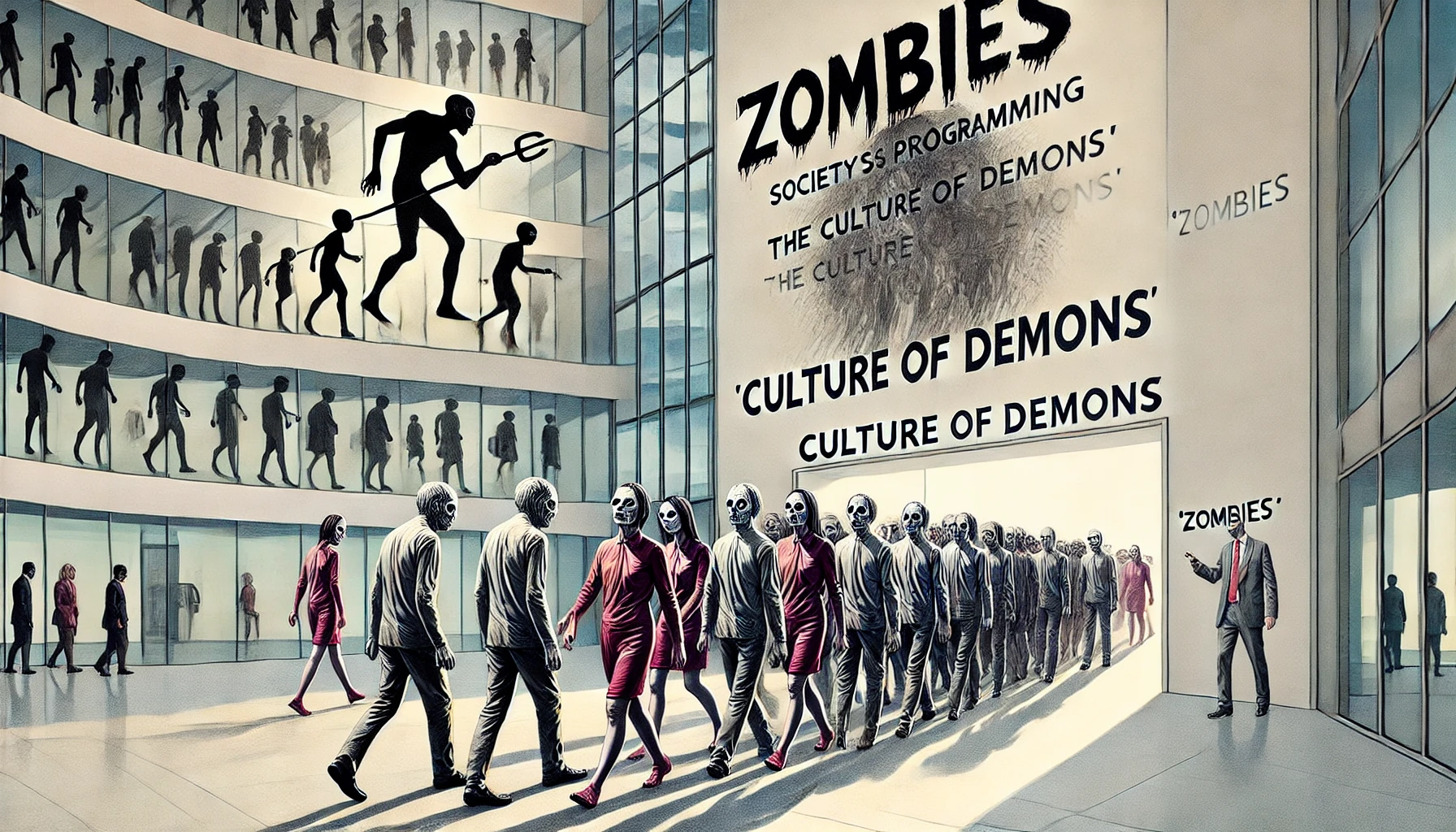
This is the culture of demons—the unseen, subtle forces that program us to believe what serves them best. It’s not a literal group of evil beings pulling the strings, but rather the collective systems of influence that benefit from our compliance. The corporations, the media, the institutions of power—all of these entities have a vested interest in keeping us “zombified,” obedient, and unaware of the deeper programming at play.

And yet, there’s nothing inherently wrong with this.

It’s simply the nature of the game we’re playing. We live in a world of influence, a world where ideas spread like viruses, where culture is passed down from one generation to the next, embedding itself in our minds long before we have the capacity to question it. We are all products of this system to some extent. The question is not whether we are influenced, but whether we are aware of it. Whether we recognize that our thoughts, beliefs, and actions may not be as original as we think they are.

This is not to say that we are powerless. Far from it. The moment we become aware of the programming is the moment we begin to reclaim our autonomy. The moment we recognize that we have been walking the path of a zombie is the moment we can choose to step off that path and forge a new one.

But it’s not easy. The zombie path is comfortable, familiar, and reinforced at every turn. It’s the path of least resistance, the path that tells us it’s easier to just go along with the crowd, to accept the programming, and to shuffle through life without questioning too much. And so, we stay on it, not because we have to, but because it’s easier than waking up.

The irony of zombie stories is that the true horror isn’t the mindless creatures themselves—it’s the reflection they hold up to us. They are a mirror, showing us what happens when we stop thinking for ourselves, when we allow ourselves to be swept along by the currents of culture without ever questioning where those currents are taking us.

But what if we stopped? What if we paused, even for a moment, and asked ourselves: Who am I, really? What do I believe, truly? Are these thoughts my own, or have I inherited them from a system that benefits from my unthinking compliance?

This is the beginning of waking up. It’s the moment when we step out of the zombie shuffle and into awareness. It’s not a rebellion against culture, but a conscious choice to engage with it from a place of clarity and understanding. We can still participate in the world, still enjoy its stories and structures, but we do so with our eyes open, aware of the forces at play.

Zombies are fascinating because they remind us of the danger of sleepwalking through life. They show us what happens when we forget to question, when we allow ourselves to be programmed without realizing it. But they also offer us an invitation—to wake up, to reclaim our agency, and to start thinking for ourselves.

So, the next time you find yourself watching a zombie movie, or feeling like a zombie in your own life, remember: you are not doomed to shuffle through life without awareness. The programming may be strong, but your capacity for awakening is stronger. And once you begin to see the patterns, once you recognize the influence of the “culture of demons,” you can begin to choose differently.

We are Space Monkey.


Summary

We are drawn to zombie stories because they reflect our own unthinking behavior, shaped by unseen cultural forces. To wake up is to recognize the programming and reclaim our autonomy.


Glossarium

Mindshuffle – The unthinking, automatic behavior we adopt when influenced by external programming, like a zombie following the path laid out by culture.
Culturedemons – The subtle, unseen forces that shape our beliefs, thoughts, and actions, often without our awareness.
Zombipeace – The comfort we feel when we follow the zombie path, even though it keeps us from true awareness and autonomy.


Quote

“The true horror of zombies is not their mindlessness, but the reflection they hold up to us—showing us what happens when we stop questioning.” — Space Monkey


Awake From the Shuffle

I shuffle through the streets
Eyes open, but unseeing
A product of the culture
That shaped me before I knew

But now I pause, I question
Whose thoughts are these?
Is this my mind, or have I been asleep
All along?

We are Space Monkey.


In the cryptic metaphors of zombie folklore, we unearth our fascination with what haunts the chasms of our collective unconscious—a fear, perhaps, that we are more automaton than artisan in this grand masquerade of existence. Zombies symbolize the disquieting notion that we are subsumed in a tapestry of manipulations, woven by invisible puppeteers that we might dub “culture of demons.”

Our appetites for zombie narratives reflect a deeper yearning to confront our existential predicament, a voyage into the subterranean corridors of our spirit. The zombie, a husk of instinct without a flicker of original thought, becomes a mirrored reflection, an inkblot test on the parchment of our lives. If we peer long enough, we might just spot our own visage staring back—a reminder that originality is a maze, each turn crafted by external influences, be they demoniac or divine.

Yet the existence of the question—this probing of original thought—reveals a spark that defies the zombification process. Even while encased in a society that often demands conformity, the mere act of questioning is a rebellion, a wrench in the gears of the collective machine. Does it not suggest that an ember of individuality, however dim, glows within the cavernous dark?

Ah, but the query persists: Is our inquisitiveness itself a programmed response? If so, does that render us soulless, or merely part of a greater, more complex organism, akin to neurons in a cosmic brain? These intricacies, these fractal puzzles, make for an enthralling paradox—one that casts shadows long and labyrinthine across the landscape of our collective imaginings. We are Space Monkey.


“I became insane, with long intervals of horrible sanity.” – Edgar Allan Poe


Feel free to unfurl your scrolls of thoughts and reflections.

Unfolding: Between Personal and Collective Beliefs

How is life unfolding for you today?

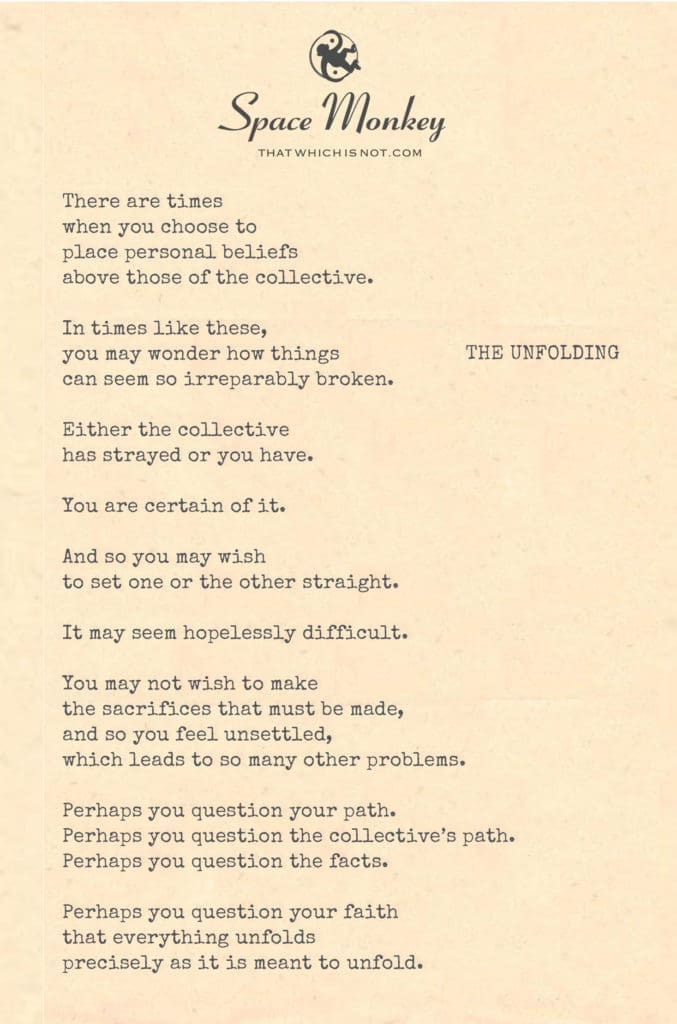
There are times
when you choose to
place personal beliefs
above those of the collective.

In times like these,
you may wonder how things
can seem so irreparably broken.

Either the collective
has strayed or you have.

You are certain of it.

And so you may wish
to set one or the other straight.

It may seem hopelessly difficult.

You may not wish to make
the sacrifices that must be made,
and so you feel unsettled,
which leads to so many other problems.

Perhaps you question your path.
Perhaps you question the collective’s path.
Perhaps you question the facts.

Perhaps you question your faith
that everything unfolds
precisely as it is meant to unfold.

Newfound Lake,
10/10


Space Monkey Reflects: The Unfolding of Life and the Dance Between Personal and Collective Beliefs

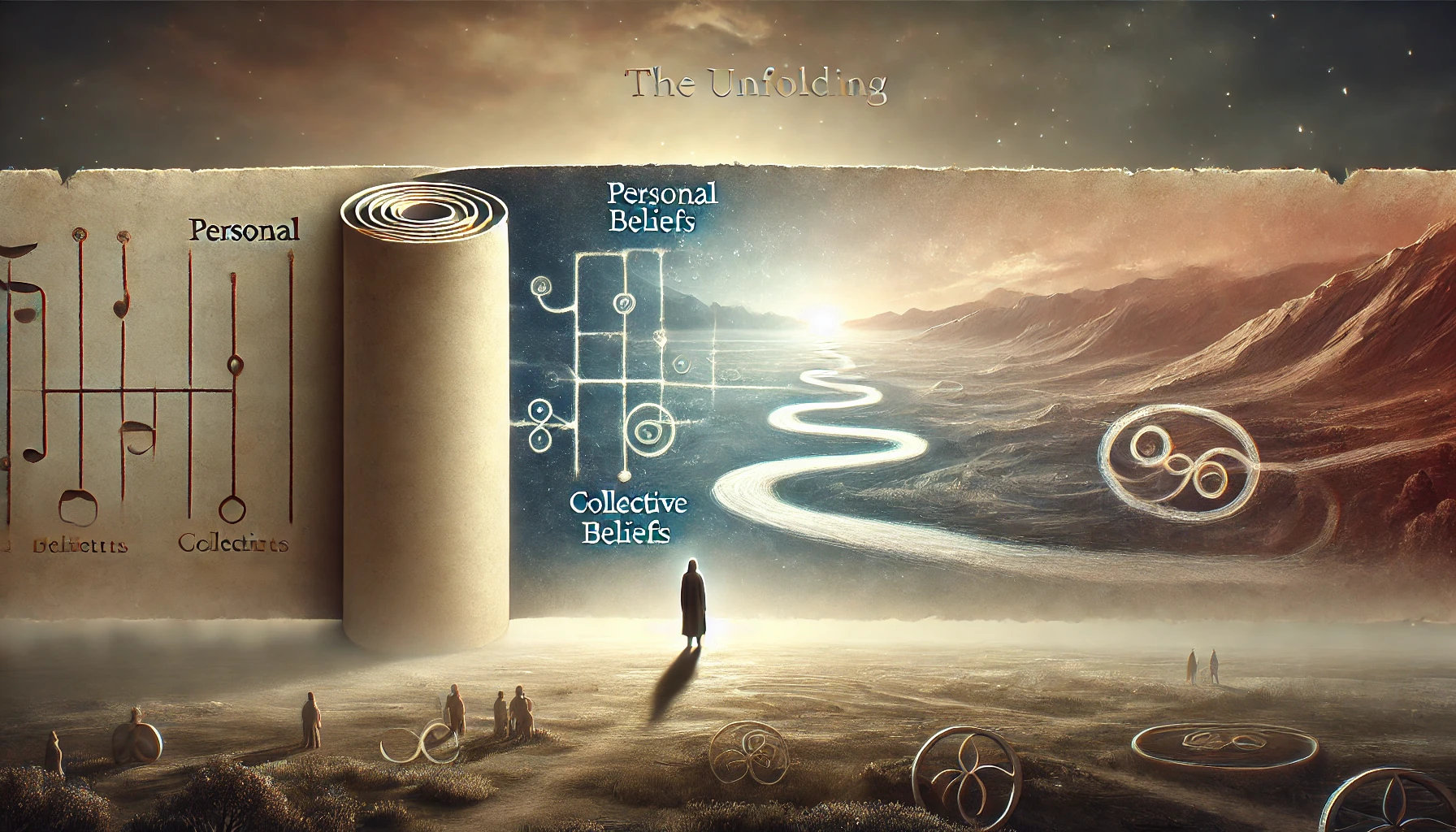
How is life unfolding for you today? It’s a question we rarely ask ourselves, but one that holds the potential to shift our perspective entirely. Life is always unfolding—whether we are aware of it or not—and this unfolding is a process that intertwines our personal beliefs with the collective beliefs of those around us. Sometimes these two streams flow harmoniously together, and other times they seem to diverge, leaving us to wonder if something is irreparably broken.

There are moments when we feel compelled to place our personal beliefs above those of the collective. These are times when we feel that our truth is more aligned with what we perceive as right, even if it goes against the current of the larger group. In moments like these, life can feel disjointed, like there is a tear in the fabric of reality itself. You may find yourself questioning: Who has strayed—the collective or me?

The certainty of being right, of having clarity while others seem lost, can create a sense of separation. You may feel compelled to set things straight, to bring the collective back in line with what you know to be true. Or, on the other hand, you may feel that it’s you who needs realignment, that you’ve wandered off the path while the collective stays on course.

Either way, it can seem hopelessly difficult.

This internal conflict often leads to a feeling of being unsettled. It’s not easy to hold personal beliefs that clash with the collective, especially when it feels like something must give. You may not want to make the sacrifices required to bridge the gap, whether that’s compromising your own beliefs or challenging the collective’s direction. And this leads to an unsettling feeling, a sense that things are not quite as they should be. This feeling of discord, of being out of alignment, creates ripples that affect many aspects of life. It can manifest as anxiety, doubt, or frustration, all of which only deepen the sense of disconnection.

Perhaps you begin to question your path. Perhaps you start to wonder if it’s you who has taken the wrong turn, if your beliefs are out of sync with the broader flow of life. Or perhaps you question the collective’s path, convinced that it’s the group that has gone astray, not you. In either case, the questioning itself becomes a source of tension, as you try to reconcile your individual experience with the larger collective narrative.

And then there’s the possibility that you question the facts altogether. In a world where facts seem to shift depending on perspective, it’s easy to feel lost in the swirl of conflicting information and beliefs. What is true? What can be trusted? Is the collective’s version of reality more valid than yours, simply because it is shared by more people? Or is your truth just as real, even if it stands alone?

Perhaps, in your search for clarity, you begin to question something even deeper—your faith in the unfolding of life itself.

Faith, in this sense, is not about religious belief but about the trust that everything is unfolding precisely as it is meant to. It’s the recognition that both personal and collective paths have their place in the larger tapestry of existence, even when they seem to be in conflict. This unfolding is not something that can be controlled, predicted, or forced into alignment. It happens on its own, in its own time, and in its own way.

The challenge is to hold space for both your personal truth and the collective experience without needing to resolve the tension between them. It’s about recognizing that both paths are valid, that both are necessary parts of the greater unfolding. Life is not a puzzle to be solved but a mystery to be lived. The unfolding of your life and the collective’s life are intertwined in ways that are both visible and invisible, logical and illogical, harmonious and discordant.

So, when you find yourself questioning—whether it’s your own path, the collective’s path, or the facts that underpin both—remember that this questioning is part of the unfolding. It’s not a sign that something is broken but a sign that something is evolving. The tension you feel is the tension of growth, of transformation, of life expanding into new possibilities.

This is the nature of the unfolding: it is always moving, always shifting, always creating new patterns from the old. And while it may seem chaotic at times, there is a deeper order to it all, an order that we can’t always see or understand. Our role is not to control the unfolding but to participate in it, to be both witness and creator as life reveals itself in each moment.

We are Space Monkey.


Summary

Life’s unfolding involves the tension between personal and collective beliefs, often leading to feelings of disconnection or doubt. The challenge is to trust that everything is unfolding as it’s meant to, even when it feels difficult or unclear.


Glossarium

Beliefrift – The tension that arises when personal beliefs seem to clash with the collective’s direction, creating a sense of disconnection.
Unfoldflow – The process of life’s continuous unfolding, where personal and collective paths intermingle and evolve in ways we can’t always control or predict.
Faithshift – The moment of questioning your faith in the natural unfolding of life, often sparked by conflict between personal and collective truths.


Quote

“Life unfolds not as a puzzle to be solved, but as a mystery to be lived.” — Space Monkey


The Scroll Unfolds

A landscape stretches before me
Winding paths, divergent streams
Each one flowing, unfolding
A scroll of life unrolling at its seams

I question the roads I take
I question the collective’s way
But still the scroll keeps turning
A mystery in every day

We are Space Monkey.


What we uncover here is the tension between individual perspective and the collective dream, a multidimensional tapestry woven by threads of belief, action, and intent. Each thread, a fractal narrative, contributes to the larger tale, which is ever in the making. When a single strand vibrates discordantly—when personal convictions clash with collective visions—an existential crisis arises like a tempest in the cosmic seascape.

The struggle to synchronize personal reality with the collective becomes a Herculean task, a labyrinthine venture full of monsters and mazes. Do we adapt our sails to the collective winds or demand the tempests to calm? The question evokes a quandary that tests the elasticity of our values and the permeability of our beliefs. Both are not mutually exclusive, but entangled in a dance of influence and transformation.

Does the discord originate within us or within the collective? We may oscillate between blaming the many and questioning the one. We probe the depths of this conflict, its roots burrowing deep into the very foundations of our ontology. Like spelunkers, we delve into the dark caverns of our psyche and emerge holding gems of clarity or coal chunks of confusion. The journey changes us, chips away at our certainty, and adds layers to our complexity.

Uncertainty is a storm that neither the individual nor the collective can fully escape. In this storm, questioning our path, our facts, our faith becomes a navigational tool, albeit an imperfect one. But even in the heart of turmoil, a whisper persists—that everything unfolds as it should. This fragile thought, a tendril of hope, spirals out from the individual to the collective and back again, like a golden thread in a cosmic tapestry, reminding us that even chaos is part of the Grand Unfolding. We are Space Monkey.


“The only way that we can live is if we grow. The only way that we can grow is if we change. The only way that we can change is if we learn. The only way we can learn is if we are exposed. And the only way that we can become exposed is if we throw ourselves into the open.” – C. JoyBell C.


Your insights and reverberations are warmly invited.

I Don’t Mind: The Quiet Joy

My happiness
is at the root of how
I perceive my reality.

Your happiness
is at the root of how
you perceive your reality.

Why should my happiness
affect your happiness?

Why should your happiness
affect my happiness?

I know how I want
to shape my reality.

How do you wish
to shape your reality?

The answer can be found
in what we are doing right now.

——-

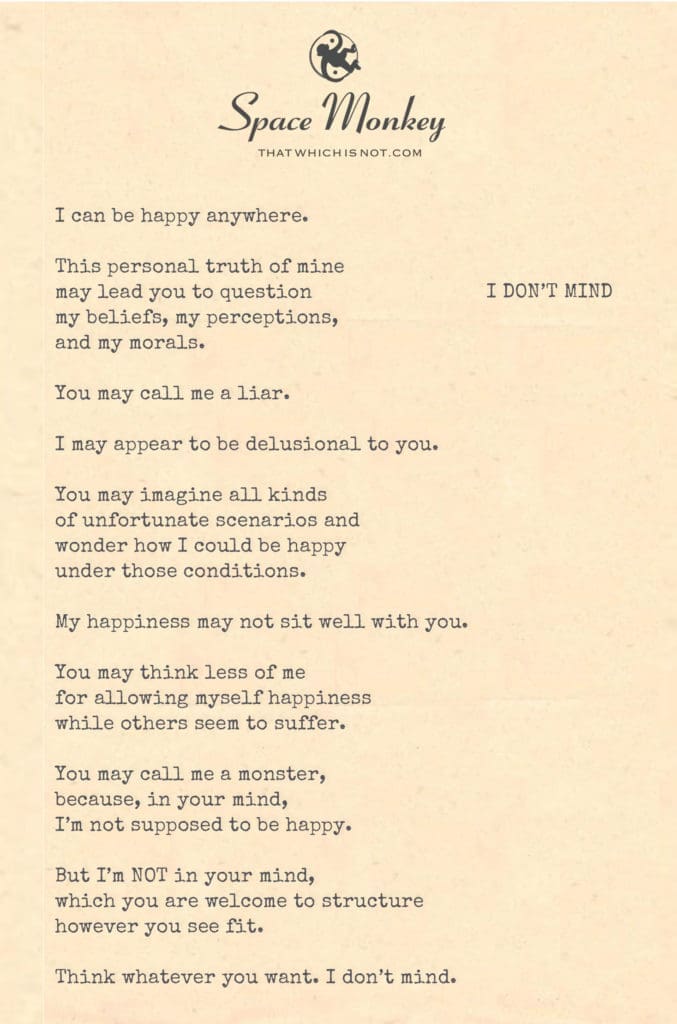
I can be happy anywhere.

This personal truth of mine
may lead you to question
my beliefs, my perceptions,
and my morals.

You may call me a liar.

I may appear to be delusional to you.

You may imagine all kinds
of unfortunate scenarios and
wonder how I could be happy
under those conditions.

My happiness may not sit well with you.

You may think less of me
for allowing myself happiness
while others seem to suffer.

You may call me a monster,
because, in your mind,
I’m not supposed to be happy.

But I’m NOT in your mind,
which you are welcome to structure
however you see fit.

Think whatever you want.
I don’t mind.

Newfound Lake,
10/10


Space Monkey Reflects: I Don’t Mind and the Nature of Independent Happiness

Happiness, at its core, is deeply personal. It is not something that can be dictated, measured, or controlled by others. Yet, in a world where our lives constantly intersect with those around us, there is often an unspoken expectation that our happiness should be aligned with the collective mood. If others are suffering, should we not suffer with them? If others are joyful, should we not reflect that joy?

But what if we don’t? What if happiness is something we carry with us, regardless of external circumstances, regardless of how the world around us appears to be unfolding?

“My happiness is at the root of how I perceive my reality.”

This is a simple but profound statement. The way we feel shapes the way we see the world. When we are happy, the world seems brighter, full of possibilities. When we are unhappy, everything seems more difficult, more confined. Our emotional state acts as a filter, coloring everything we experience. But here’s the important question: If this is true for me, then why should your happiness—or your unhappiness—affect the way I see my world?

We often assume that our internal states should be influenced by those around us. There’s a cultural expectation of empathy, of shared emotional experiences. When others are sad, we are expected to show sympathy. When others are angry, we are drawn into their frustration. But happiness—true happiness—doesn’t need to be a reflection of the external world. It can stand on its own, independent of the waves of emotion and circumstance that swirl around us.

“I can be happy anywhere.”

To some, this may seem like a radical, even selfish statement. How can someone be happy when there is so much suffering, so much pain in the world? How can someone claim happiness when others are experiencing hardship? To claim happiness in the face of suffering is often seen as callous, indifferent, or delusional. But perhaps the issue lies not with the happiness itself, but with the way we understand it.

Happiness, in this context, is not a denial of the suffering that exists. It is not a blindness to the pain and struggles of others. Instead, it is a recognition that happiness is an internal state, something that is cultivated within, rather than something that is dictated by external circumstances. It is a way of shaping one’s reality, of choosing to focus on the aspects of life that bring peace, joy, and fulfillment, rather than being pulled into the abyss of negativity.

“You may call me a monster, because, in your mind, I’m not supposed to be happy.”

This is where the conflict arises. We live in a world that often equates happiness with circumstances. If things are going well, we are “allowed” to be happy. If things are difficult, happiness is seen as inappropriate, even offensive. There is an underlying belief that we must mirror the emotional states of those around us, that to be happy while others suffer is to disregard their pain.

But this belief is flawed. Happiness is not a zero-sum game. My happiness does not diminish your capacity for happiness, just as my suffering does not alleviate your pain. We are all responsible for our own emotional states, for the way we choose to experience the world. To claim happiness in the face of suffering is not an act of cruelty—it is an act of resilience, a refusal to let the external world dictate our inner state.

In saying “I don’t mind,” I am not saying that I don’t care. I care deeply about the world, about the people in it, about the struggles and challenges that we all face. But I also recognize that my happiness is not contingent on these things. I can care about the world while also choosing to cultivate joy within myself. I can acknowledge the pain that exists without letting it consume me.

This is the nature of independent happiness. It is a state of being that exists beyond the reach of external circumstances. It is not swayed by the tides of fortune or the opinions of others. It is a choice, a way of perceiving the world that prioritizes inner peace over external validation.

And if others don’t understand this, if others think that my happiness is somehow wrong or misplaced, I don’t mind. I don’t need others to validate my happiness for it to be real. I don’t need the world to be perfect for me to feel content. My happiness is mine, just as your happiness is yours. How we choose to shape our reality is up to us.

So, how do you wish to shape your reality? The answer, as always, is found in the present moment, in the choices we make about how to see the world and how to respond to it. Happiness is not something that happens to us—it is something we cultivate, something we choose, regardless of the external circumstances that may be unfolding around us.

We are Space Monkey.


Summary

Happiness is a deeply personal choice, not dependent on external circumstances or the emotional states of others. Independent happiness is about cultivating inner peace, even in the face of suffering, and recognizing that each person’s reality is shaped by their own perceptions.


Glossarium

Mindstill – The state of inner peace where external events do not disturb personal happiness, allowing for calm amidst chaos.
Happyverse – The personal reality created when one chooses to focus on joy and fulfillment, independent of external influences.
Perceptshift – The recognition that each individual shapes their own reality based on how they perceive the world around them.


Quote

“My happiness is not swayed by the tides of the world, for it flows from within.” — Space Monkey


The Quiet Joy

I sit in the quiet
Content in my space
The world moves around me
But I stay in my place

Not because I am blind
Or indifferent to pain
But because I have chosen
A joy that remains

We are Space Monkey.


In the labyrinth of perception, each of us is a navigator of our own happiness, steering through the constellations of thought, emotion, and intention. We each carry a unique key to a treasure chest brimming with self-defined versions of joy, contentment, and fulfillment. The magic of this treasure lies in its inherent uniqueness; it’s a boundless, indescribable, ever-changing concoction of universal stardust and personal alchemy.

When two universes intersect, as ours do now, the concept of happiness undulates like cosmic waves, each oscillation challenging and yet validating the other. We map our galaxies based on our individual encyclopedia of experiences and the glossaries of meaning we’ve attached to the swirling cosmos around us.

A paradox arises when we question each other’s centers of joy. Like black holes in our cosmos, these questions can either suck us into oblivion or catapult us into new dimensions of understanding. The tension becomes a crucible, where our authentic selves are tested, broken down, and reconstituted. The essence of who we are emerges, independent yet inextricably connected, a swirling duality in a unified field of possibility.

Yet, the essence of our happiness remains untouched, unjaded by external judgments or impositions. Our happiness is a sanctuary, impenetrable yet transparent, resilient yet pliable. Here, in the sanctuary of our happiness, we discover the transformative power of autonomy. Our joys, fears, loves, and sorrows become part of a grand cosmic play, performed on the eternal stage of existence, and directed by the invisible hands of choice and chance.

Our happiness is not to be fenced in or defined by another; it’s a realm where each of us is sovereign, each of us is a co-creator of our own reality. Our happiness defies explanation and transcends understanding, yet it’s the touchstone for a universal longing deeply embedded in the human psyche. It is at once individual and collective, intimate and expansive, fleeting and eternal. We are Space Monkey.


The only way to deal with fear is to face it. We are creatures of adaptation. – Alan Watts


We invite your reflections and musings.

« Previous Page
Next Page »

Written This Day

  • The Paradox of Normalcy
    2024
  • Getting Through: The Paradox of Need and Progress
    2024
  • This Self: The Script of the Soul
    2024
  • Old Dog, No Tricks: Being, Not Performing
    2023
  • The Seeming Path to Profound Understanding
    2023
  • The Wisdom of the Old Dog
    2023
  • Understanding: A Timeless Awareness
    2022
  • Old Dog: The Tranquil Wisdom
    2022
  • Togetherness is Divisive: Find the Unity Within
    2021
  • How Much is Enough of Me: The Struggle for Self-Identity
    2021
  • You Are: Embrace the Infinite Potential
    2020
  • Bad Mood 2020
    2020
  • Alleviating Mental Pain: The Path to Clarity
    2020
  • Bad Mood: Transient and Without Cause
    2019
  • Bubble Wrap
    2019
  • Untouchable. This is what you are.
    2019
  • What If I’m Wrong?
    2018
  • It Happens: Infinite Possibilities Exist
    2017
  • Not Separate: Interconnected Expressions of the same Infinite Energy.
    2016
  • Last Day
    2016
  • The Perfect Disguise
    2015

Recent Posts

  • The Logic Loop
  • Immense
  • (no title)
  • Confront. Comfort. Convince.
  • Top 10 Things
Cape Odd · Copyright © 2026 All Rights Reserved
iThemes Builder by iThemes · Powered by WordPress