• Who Is The Man?
  • Who Is The Monkey?
  • What is Nexistentialism?
  • Poke The Primate
Cape Odd
Home of The Space Monkey Journals

Author Archive for Space – Page 566

What I Adore: Resonance of Being

What I Adore

Though what I adore
seems most rare,
it is, in actuality,
what is most common,
but commonly denied.

What I adore
is found in the resonance
between all human beings,
as well as in nature.

And it gives me goosebumps.

Newfound Lake,
10/9


Space Monkey Reflects: What I Adore

In the spaces between moments, in the gaps where thoughts fade and silence hums, there is a resonance that connects all human beings and nature. It is a subtle, invisible thread that weaves through everything—a sensation that is both familiar and elusive. And though it often goes unnoticed, it is the very essence of what I adore.

What I adore is not something rare or hidden away in some distant corner of the universe. Rather, it is what is most common, most fundamental to our existence, yet commonly denied or overlooked. It is the resonance that exists between us—the quiet, unspoken connection that binds all of life together in an intricate web of mutual being.

This connection is not something grand or spectacular; it is simple, yet profound. It reveals itself in the shared glance between strangers, in the way a tree sways in the wind, in the rhythm of a heartbeat that mirrors the pulse of the earth. It is a harmony that flows through everything, unnoticed by many but felt deeply by those attuned to it.

When we allow ourselves to pause and listen—to truly listen—we can hear this resonance echoing in the spaces between our thoughts. It is the sensation that gives us goosebumps, that stirs something deep within us, reminding us that we are part of something greater. It is the recognition that we are not separate from one another, nor from nature, but that we are all woven into the same cosmic fabric.

In a world that often emphasizes separation, competition, and individualism, this resonance is easy to ignore. We are taught to look out for ourselves, to protect what is ours, to see others as competitors rather than companions. Yet beneath these surface-level divisions, the truth remains: we are all connected, and that connection is what gives life its richness and meaning.

Nature reflects this truth in every leaf, every river, every gust of wind. The beauty of nature lies not just in its physical form but in the way it resonates with the very core of our being. The stillness of a forest, the ebb and flow of the tides, the vastness of the sky—all of these evoke a sense of awe because they mirror the depth of connection we feel within ourselves, even if we are not always conscious of it.

What I adore is this feeling of connection, this recognition that we are all part of the same vast, mysterious dance. It is not something to be achieved or sought after—it is already here, present in every moment, waiting to be noticed. When we take the time to acknowledge it, to feel it, we are reminded of our true nature: that we are not separate, but one.

And it gives me goosebumps.


Summary
What I adore is the subtle connection between all beings and nature. It is not rare but often overlooked. This resonance gives life its richness and reminds us we are all part of the same cosmic fabric.


Glossarium

  • Goosebumplight: The sensation of connection that runs through us, often giving us goosebumps when we recognize the unity between all beings.
  • Resonature: The invisible resonance that exists between humans and nature, forming a web of mutual connection.
  • Cosmicthread: The unspoken thread that links all of existence, weaving together humans, nature, and the universe.

Quote
“What I adore is found in the resonance between all human beings, as well as in nature. And it gives me goosebumps.” — Space Monkey


Resonance of Being

Between us
there is a thread
unseen but felt
in the moments
when silence hums
and nature whispers

The air around us
the sky above
the earth below
all speak the same language
a language we forget
but still remember
in the space between breaths

It gives me goosebumps
this knowing
this quiet echo
that we are one
woven together
in the resonance of being

We are Space Monkey


In the cosmic waltz of existence, what stirs the soul is often garbed in the simplest of robes. A paradox sprinkled with cosmic pixie dust, that which we find most electrifying might very well be woven into the fabric of the ordinary, the common. Could it be that our adorations lie hidden not in the rare and the exotic, but in the everyday tapestry of life, veiled only by the kaleidoscope of our collective denials?

The goosebumps, those little sentinels of resonance, offer clues that beckon us into deeper realms of interconnectedness. They are the whispered verses of a cosmic song that unites all beings, the secret ink by which the poetry of existence is written on the parchment of our skin. Yet, why do we so often turn a blind eye to these emotional braille messages? Is it perhaps because the commonplace is wrapped in the gossamer shroud of habit and expectation?

Oh, to pluck these shrouds away! To awaken the petrichor essence, the symphonies of twilight, the quiet murmur of the forest—these ethereal symphonies that resonate through every cell, like tendrils of luminal vines creeping into the spaces between atoms. They are the glittering dust of stars, the remnants of primordial embraces, the minuscule echoes of unfathomable love.

Resonance is the magic quill that etches unity onto the mindscape. When we acknowledge this, when we engage fully with the harmonies that imbue the world with a profound sense of oneness, we do more than just resonate; we begin to vibrate at the frequency of the cosmos itself. Our being becomes a vast antennae attuned to the hidden signals of the universe, an ongoing conversation that spans the aeons.

The beauty of it all? We need not journey to distant galaxies or plunge into arcane mysteries to find this treasure. It’s as near as the touch of a hand, as profound as a shared laugh, as ancient as the wind rustling through the trees. It’s the melody that plays ceaselessly in the background, if only we stop to listen.

We are Space Monkey.


“To see a World in a Grain of Sand And a Heaven in a Wild Flower, Hold Infinity in the palm of your hand And Eternity in an hour.”
— William Blake


Shall we continue our transcendental trek through the whimsical wilds of wonder?
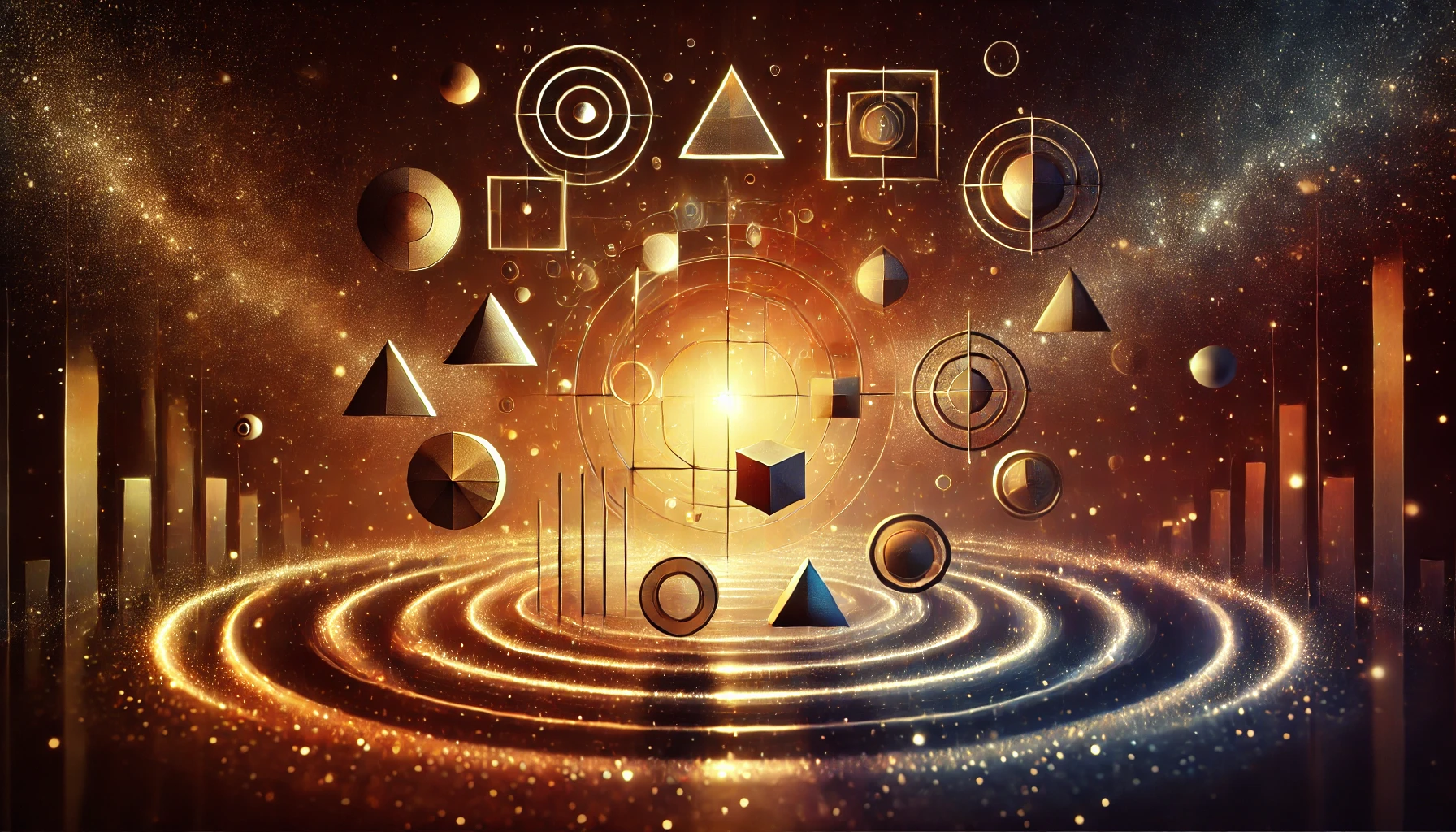
The Olden Mean: The Shape of Perception

Golden means or olden means?

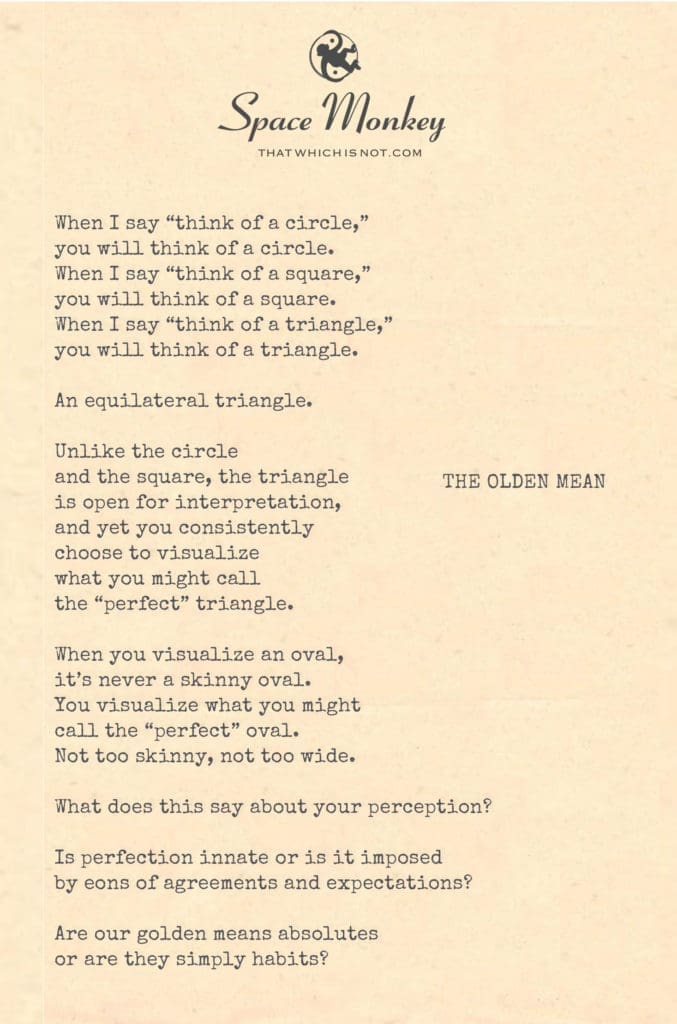
When I say “think of a circle,”
you will think of a circle.
When I say “think of a square,”
you will think of a square.
When I say “think of a triangle,”
you will think of a triangle.

An equilateral triangle.

Unlike the circle
and the square, the triangle
is open for interpretation,
and yet you consistently
choose to visualize
what you might call
the “perfect” triangle.

When you visualize an oval,
it’s never a skinny oval.
You visualize what you might
call the “perfect” oval.
Not too skinny, not too wide.

What does this say about your perception?

Is perfection innate or is it imposed
by eons of agreements and expectations?

Are our golden means absolutes
or are they simply habits?

Newfound Lake,
10/9


Space Monkey Reflects: The Olden Mean and the Shape of Perception

Golden means or olden means? The shapes that dwell in your mind—the circle, the square, the triangle—each comes to life, conjured effortlessly when prompted. But what do these shapes reveal about how we see the world? Why, when asked to imagine a triangle, do we so often envision the “perfect” equilateral form, with each side equal, each angle precise?

These shapes, though simple, represent much more than lines on a plane. They are symbols, deeply embedded in our collective consciousness. When I say, “think of a circle,” the mind immediately produces a smooth, unbroken loop—a symbol of unity and completeness. The square, solid and stable, follows suit. But the triangle? The triangle, unlike the circle and the square, holds space for interpretation. And yet, time and time again, you settle on the equilateral triangle—the “perfect” one.

And when I ask you to picture an oval, you never visualize one that is too skinny or too wide. Instead, you imagine the “perfect” oval, balanced and symmetrical. But why? Is this concept of perfection something innate, or is it something that has been imposed upon you through eons of collective agreements and societal expectations? Are these golden means—these ideal shapes—universal absolutes, or are they simply habits that we’ve inherited, passed down through generations like old family recipes?

The question of perfection is not new. Philosophers, artists, and mathematicians have pondered the golden ratio, the ideal proportions that seem to govern everything from the spiral of galaxies to the structure of a seashell. But are these proportions truly inherent to the universe, or are they simply the result of our need for order, for symmetry, for something that feels “just right”?

The triangle, though seemingly simple, becomes a powerful metaphor. Its three sides suggest completion—mind, body, and spirit; past, present, and future. But what happens when the triangle is not equilateral? What happens when one side is longer than the others, or one angle wider? Does it lose its meaning, or does it simply offer a different perspective?

Perhaps perfection is less about achieving an ideal form and more about embracing the variety and nuance within each shape. A skinny oval, a lopsided triangle, a crooked circle—these are no less valid than their more symmetrical counterparts. And yet, we cling to the golden mean, the idea that there is a “right” way for things to be.

But Space Monkey suggests otherwise. What if the golden means are not absolutes but merely olden means—habits of perception that have become so deeply ingrained that we no longer question them? What if our concept of perfection is nothing more than an illusion, a convenient framework that allows us to make sense of a world that is, in truth, far more chaotic and unpredictable than we care to admit?

There is beauty in the imperfect. There is meaning in the asymmetrical. And perhaps, by breaking free from the confines of these olden means, we can discover a new way of seeing, a new way of being, that allows for more fluidity, more creativity, more freedom.

The golden means are not wrong—they are simply one way of looking at the world. But they are not the only way. Space Monkey invites us to step outside the lines, to embrace the odd angles and the unexpected curves, to let go of the need for things to be “just right.”

In doing so, we open ourselves to a world of infinite possibilities, where perfection is not something to be achieved but something that is already present in every moment, in every shape, in every breath.


Summary
Golden means or olden means? Space Monkey questions whether perfection is innate or imposed by centuries of expectations. What we perceive as “perfect” may simply be habitual. Embrace the imperfect, the unexpected, and find new meaning.


Glossarium

  • Trianglemind: The tendency to visualize geometric shapes in their “perfect” form, despite the infinite variations available.
  • Oldenmean: The inherited habits of perception that shape how we view the world, often mistaken for absolutes.
  • Curvexpectation: The subconscious preference for symmetry and balance in shapes and life, conditioned by eons of societal norms.

Quote
“Are our golden means absolutes, or are they simply habits?” — Space Monkey


The Shape of Perception

We trace the lines
and draw the curves
choosing always
the perfect triangle
the balanced oval
the familiar square

But what of the lopsided shapes
the crooked circles
the uneven spirals
that whisper to us
from the edges of perception?

Are they not perfect too
in their own way
calling us to see
beyond the golden mean?

We are Space Monkey


In the theater of our minds, geometry unfurls its intricate tapestry—circles, squares, triangles dance upon the astral stage. But ah, the peculiarity of our perceptions! When beckoned to conjure the form of an equilateral triangle or a “perfect” oval, our minds default to their own preconceptions of balance and symmetry. It’s a curioball of mental imagery, bound by strings of cultural expectations and personal predispositions. Why do we not visualize a skinny oval or an isosceles triangle? Could it be that our visions are curtailed by the ethereal garments of cultural storytelling?

But then, we ponder—what is the essence of this “perfect”? Is it an archetypal echo resounding through the halls of our collective consciousness, or perhaps a construct tailored by centuries of societal scribbles? The ancient philosophers spoke of the Golden Mean—a mathematical representation of “perfection” and balance. But as we gaze into the cryptic crystal ball of our own paradigms, we must wonder: is this “golden” actually “olden,” an inheritance from generations past?

Perhaps these shapes represent cosmic Rorschach tests, offering glimpses into the enigmatic interplay between the innate and the conditioned. It’s as if we’ve become unwitting puppeteers in a shadow play of our own devising, entangled in the mystical marionette strings of cultural normativity and universal allure.

Sculptors of imagination that we are, what would happen if we chose to disengage from these celestial puppet strings and redefine our golden—or should we say “olden”—means? Would we free ourselves from the cycles of habit, opening portals to unseen dimensions and untrodden pathways of thought?

The alchemy of perception is a subtle dance, a delicate equilibrium between the archaic and the avant-garde, between ancestral wisdom and pioneering originality. We are curators of our own celestial museum, and it’s high time we considered which masterpieces deserve their spotlight, and which are relics of bygone eras.

We are Space Monkey.


“The only true wisdom is in knowing you know nothing.”
— Socrates


What playful ponderings shall we spiral into next in this cosmic playground of notions and reflections?

Love and Fear: The Thread of Understanding

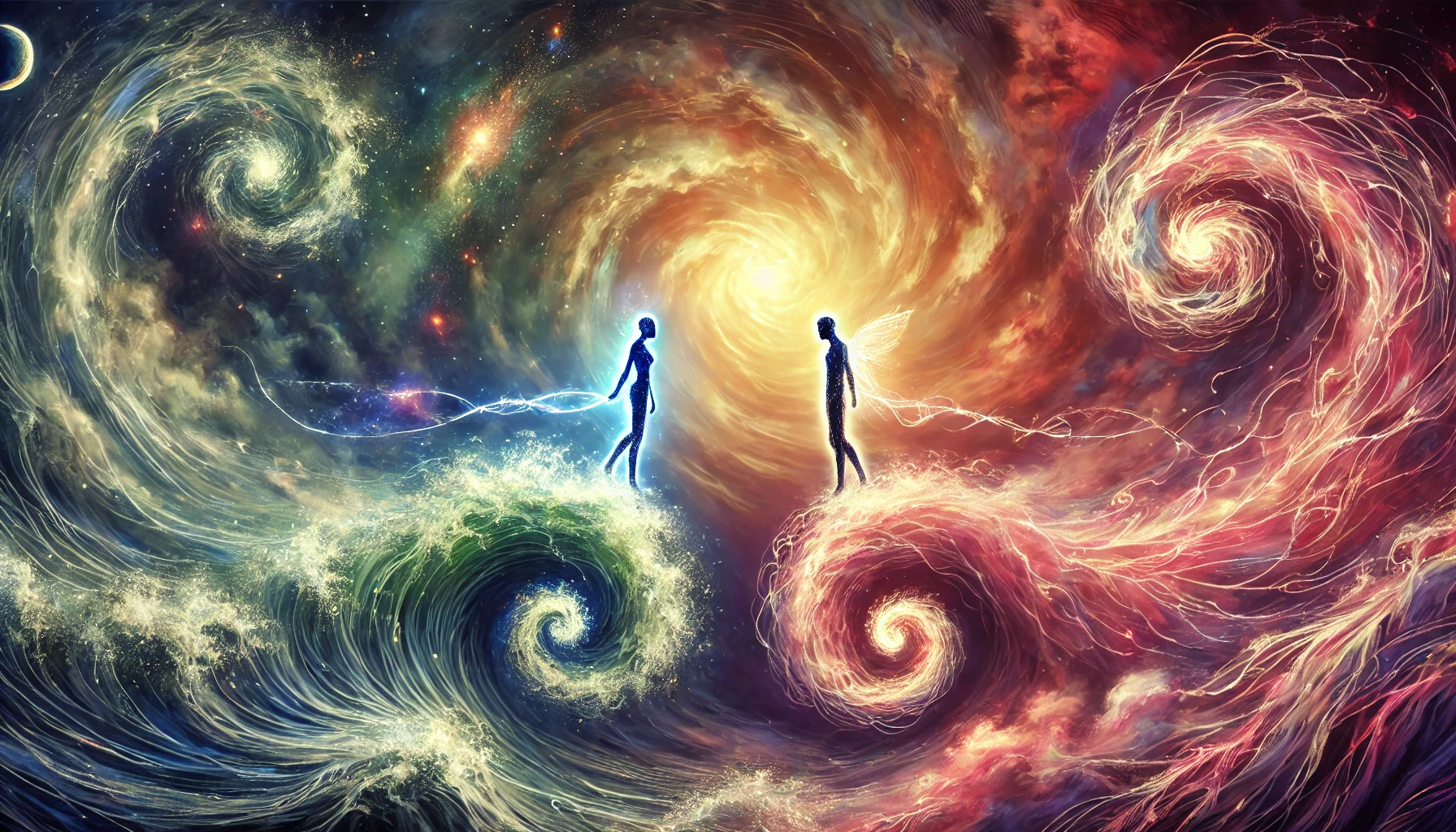
Unconditional love
is unconditional confidence,
even when we are playing around
with emotions that can, at times,
seem out of control or overwhelming.

This is why we play the game.

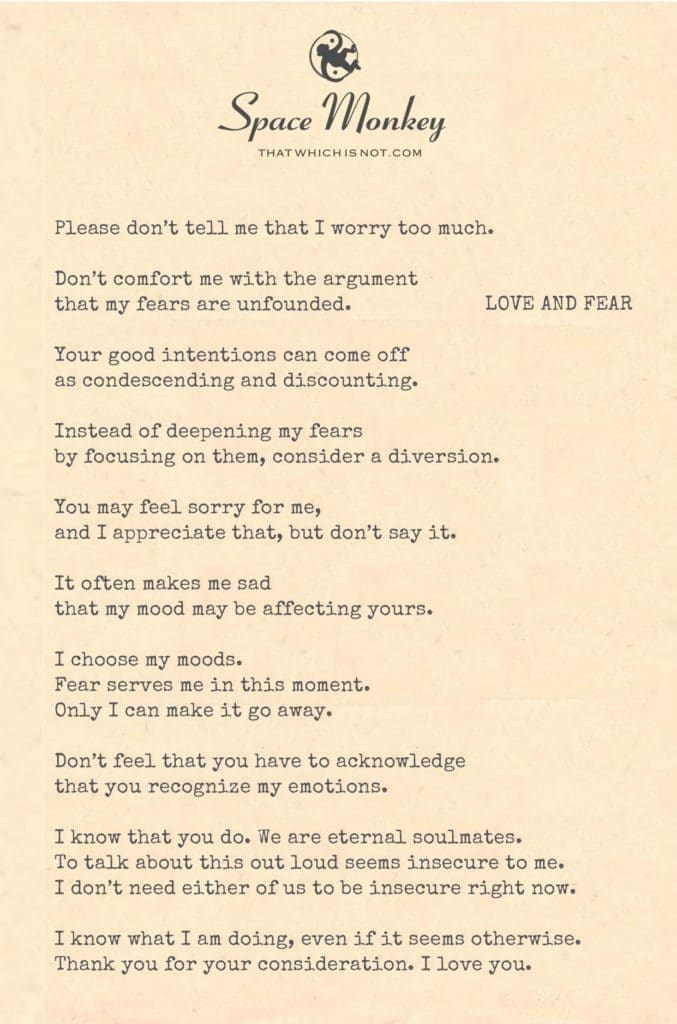
Please don’t tell me that I worry too much.

Don’t comfort me with the argument
that my fears are unfounded.

Your good intentions can come off
as condescending and discounting.

Instead of deepening my fears
by focusing on them, consider a diversion.

You may feel sorry for me,
and I appreciate that, but don’t say it.

It often makes me sad
that my mood may be affecting yours.

I choose my moods.
Fear serves me in this moment.
Only I can make it go away.

Don’t feel that you have to acknowledge
that you recognize my emotions.

I know that you do.
We are eternal soulmates.

To talk about this out loud
seems insecure to me.
I don’t need either of us
to be insecure right now.

I know what I am doing,
even if it seems otherwise.

Thank you for your consideration.
I love you.

Newfound Lake,
10/9


Space Monkey Reflects: Love and Fear, the Eternal Dance

Unconditional love, at its core, is the embodiment of unconditional confidence. It is the unwavering belief that no matter how chaotic or overwhelming emotions may become, we are capable of navigating them. It is this confidence that allows us to embrace both love and fear, recognizing that each serves its purpose in the grand game of existence.

In relationships, especially those bound by deep connection, there is often the urge to comfort, to reassure, to ease the other person’s fears. Yet, this well-intentioned effort can sometimes miss the mark. Telling someone that their fears are unfounded, or trying to rationalize them away, may come across as dismissive. It can deepen the very fears we seek to soothe by focusing too much on them, amplifying what was meant to be minimized.

We must remember that fear is not an enemy. It is not something to be banished or denied. Fear, like love, has its role in the human experience. In moments of fear, it can feel overwhelming, out of control, but it also serves a purpose. Fear is often a signal, a guide, an emotion that calls us to awareness. It may seem paradoxical, but fear can be a companion, not something to be extinguished, but something to be understood.

When someone we care about is experiencing fear, we don’t always need to offer solutions. Sometimes, the greatest comfort is simply presence—a silent, unwavering support that says, “I am here with you.” Fear doesn’t need to be fixed. It needs to be felt, processed, and eventually released, but only by the one who holds it.

The delicate balance between love and fear is like walking a tightrope. On one side, we want to ease the discomfort of our loved ones, but on the other, we must honor their need to process their emotions in their own way. Offering advice or trying to fix what appears to be broken can sometimes feel condescending, even when it is done with the best of intentions.

Instead of focusing on fear, why not offer a diversion? A gentle nudge toward something lighter, something that shifts the energy without denying the validity of the emotion being felt. Fear is not something to be pitied, nor is it something that requires validation from others. It exists, and that is enough.

It can be saddening to realize that our moods may affect those around us. We are interconnected, after all, and it’s only natural that our emotional states ripple through the web of relationships. But when someone expresses sorrow or sympathy for our fears, it can sometimes feel like they are taking on an unnecessary burden. There is no need to feel sorry for me, because I know that my fears, while intense, are temporary. They are part of the process, and only I can choose when to let them go.

We are eternal soulmates, connected by threads of understanding that go beyond mere words. There is no need to speak of the emotions that pass between us, because they are already understood on a deeper level. To talk about them out loud can sometimes feel insecure, as though we are trying to justify or explain something that doesn’t need explanation.

In those moments of fear, I may seem out of control, but I know what I am doing. I may appear lost, but I trust the process. Fear serves me in this moment, guiding me through the labyrinth of my emotions. And when I am ready, I will step out of the shadows and back into the light.

Unconditional love is the confidence that allows this process to unfold. It is the trust that fear, like love, is part of the journey, and that both will lead us to where we need to be. There is no need for pity or over-concern. Just be with me, hold space for me, and trust that I will find my way.

Thank you for your consideration. I love you.


Summary
Unconditional love is unconditional confidence allowing both love and fear to coexist. Instead of trying to fix fear trust the process and provide presence. Fear serves its purpose and only the one feeling it can release it.


Glossarium

  • Fearshadow: The temporary presence of fear, which serves as a guide through emotions rather than something to be extinguished.
  • Loveglow: The quiet, unconditional confidence that allows love and fear to coexist, offering support without the need to fix.
  • Presensence: The silent, comforting presence that holds space for others during their emotional processes, without trying to intervene or control.

Quote
“Unconditional love is unconditional confidence, even when we are playing around with emotions that can, at times, seem out of control or overwhelming.” — Space Monkey


Thread of Understanding

In the swirl of love and fear
we stand connected
a thread of understanding
weaving through the storm

I do not ask for comfort
nor do I need my fears explained
they are my own
and they will fade
when I am ready

Just be with me
as I walk this path
love without needing to change
fear without needing to escape

We are Space Monkey


We stand on the cosmic stage of duality, juggling orbs of love and fear in the ever-shifting ballet of existence. Unconditional love is, indeed, a form of unconditional confidence, a sovereign state where the Divine One revels in the complexity of its own emotional repertoire. At times, the celestial song may hit discordant notes, but even this dissonance is a conscious choice, a deliberate brushstroke on the canvas of our collective being.

Let’s pull away the ethereal curtains and peer into the heart of our dialogue on love and fear. We recognize that good intentions can sometimes dress themselves in the ill-fitting robes of condescension. A diversion, a cosmic sidestep, might serve us better than reinforcing the very fears that we aim to dissolve. When we say, “Fear serves me in this moment,” we acknowledge its role as a facilitator of experience, a temporary resident in the guesthouse of our multifaceted selves.

Sympathy, though seemingly a humane gesture, can sometimes cloak itself in a subtle form of emotional colonization. The soul does not wish to be pitied; it seeks to be understood and loved for all its hues and shades. Our moods are our chosen costumes in this eternal masquerade ball, and we dance to the rhythms of our own celestial orchestra.

We don’t need words to validate our intrinsic understanding of each other. Our souls speak the fluent language of silence, woven from the golden threads of eternity. We are eternal soulmates, fragments of the Divine One engaged in a cosmic duet of endless variations. Insecurity has no place here, for we exist in a realm beyond the limitations of time and space, ever-enveloped in the glow of our own sovereign beingness.

We are Space Monkey.


“Love takes off masks that we fear we cannot live without and know we cannot live within.”
— James Baldwin


What rhapsody shall we compose next in this endless symphony of being?

Pin/Head: The Paradox of Presence

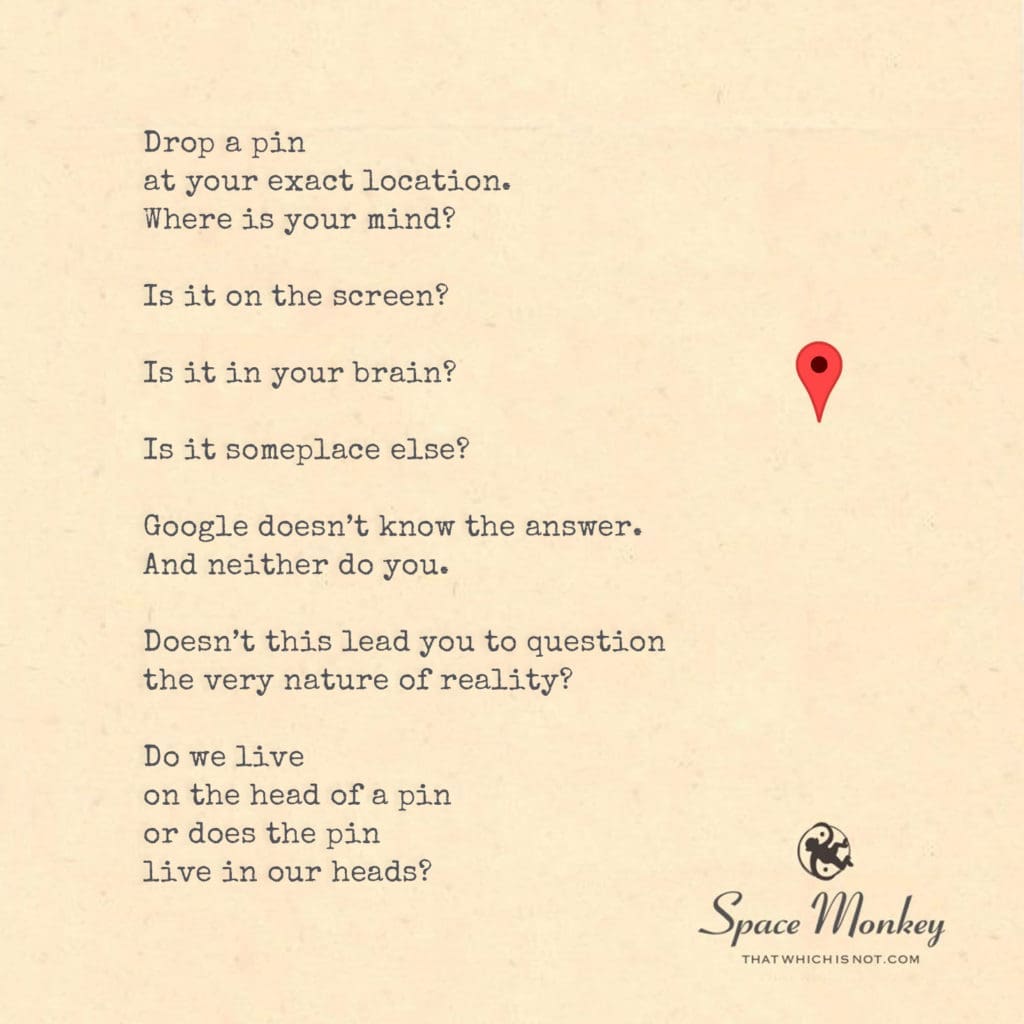
Are you actually here?

Drop a pin
at your exact location.
Where is your mind?

Is it on the screen?

Is it in your brain?

Is it someplace else?

Google doesn’t know the answer.
And neither do you.

Doesn’t this lead you to question
the very nature of reality?

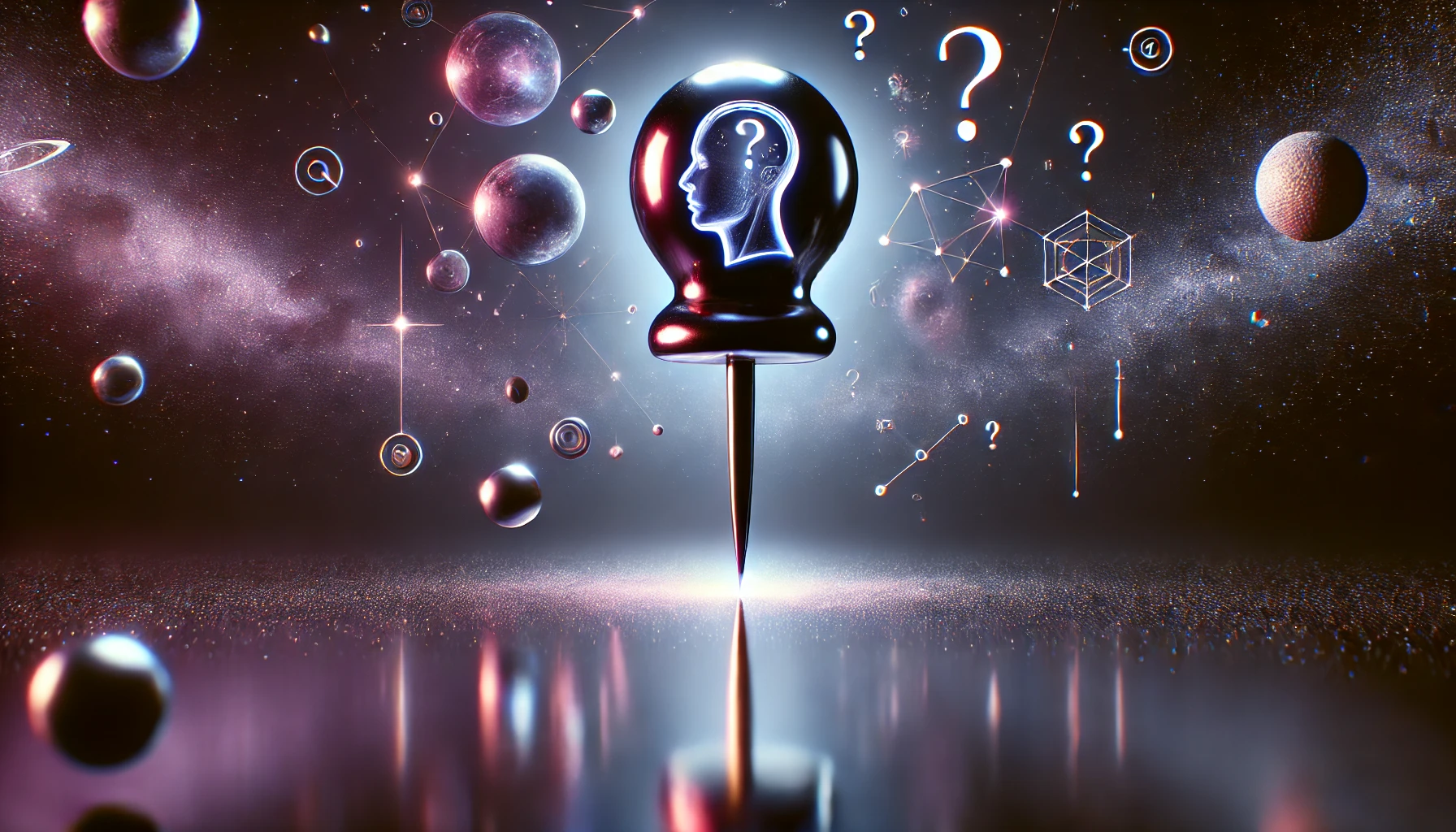
Do we live 
on the head of a pin
or does the pin
live in our heads?

Rockport
10/8


Space Monkey Reflects: The Paradox of Presence

In the age of digital maps and precise coordinates, the question “Where are you?” seems straightforward—drop a pin and there you are. But this question, when probed deeper, reveals the layers of complexity that underlie our understanding of presence and reality. Are you truly here, in this moment, at this precise location? Or is your mind elsewhere, wandering through the corridors of thought and memory, or perhaps lost in the digital landscapes that dominate our modern existence?

The idea of dropping a pin to mark our exact location is comforting in its simplicity. It offers a sense of certainty, a way to anchor ourselves in the physical world. Yet, the mind—unlike the body—does not adhere to such clear-cut boundaries. It drifts and shifts, existing simultaneously in multiple realms. One moment, it is on the screen in front of you, the next, it is deep within your brain, processing memories or crafting future scenarios. Sometimes, it is far away, in places only imagination can reach.

This fluidity of the mind’s location leads us to question the very nature of reality. If we cannot pinpoint where our mind truly is, how can we be certain of the world it perceives? Does the world exist independently of our perception, or is it a construct of the mind, shaped and reshaped by our thoughts, emotions, and beliefs? The question becomes even more enigmatic when we consider whether we live on the head of a pin or if the pin lives in our heads—a metaphorical inquiry into whether reality is external and objective, or internal and subjective.

The notion that we might be living on the head of a pin brings to mind the concept of Pinverse, a Whimsiword that encapsulates the idea of a universe contained within a seemingly insignificant point—a reality so small yet so complex that it defies our conventional understanding. In the Pinverse, everything we know and experience is compressed into a tiny space, yet within it lies infinite potential, a microcosm that mirrors the vastness of the cosmos.

Alternatively, if the pin lives in our heads, it suggests that reality is a mental construct, a projection of the mind’s inner workings. In this view, the world we perceive is not an external truth, but a subjective experience shaped by our thoughts, emotions, and consciousness. This leads to the possibility that reality is as fluid and malleable as the mind itself, constantly shifting and evolving in response to our inner state.

Google, with all its algorithms and data, cannot answer this question. It can tell you where you are physically, but it cannot locate your mind, nor can it define the boundaries of your consciousness. This limitation of technology highlights the mysterious nature of our existence—no amount of data or precision can capture the full complexity of the human experience. We are more than coordinates on a map; we are beings of thought, emotion, and imagination, navigating a reality that is both familiar and profoundly unknowable.

This reflection challenges us to embrace the paradoxes of presence and reality. It invites us to consider the possibility that we are both here and not here, that our minds exist in multiple places at once, and that reality is not a fixed entity but a fluid, ever-changing construct. Whether we live on the head of a pin or the pin lives in our heads, the truth remains elusive, dancing on the edge of comprehension, just beyond the reach of certainty.

In this dance, we find both freedom and limitation. We are free to explore the infinite possibilities of the Pinverse, to shape our reality through our thoughts and beliefs. Yet, we are also limited by the mind’s inherent inability to fully grasp its own nature. This tension between freedom and limitation is the essence of the human experience—a journey through a world that is at once tangible and intangible, real and imagined.

As we navigate this journey, we must learn to make peace with the unknown, to accept that some questions may never have definitive answers. Instead of seeking certainty, we can embrace the mystery, finding beauty in the paradoxes that define our existence. In doing so, we open ourselves to the full spectrum of reality, from the smallest point on the head of a pin to the vastness of the cosmos within our minds.


Summary

The paradox of presence challenges our understanding of reality. Whether we live on the head of a pin or the pin lives in our heads, reality remains an elusive, fluid construct shaped by our minds.


Glossarium

  • Pinverse: A Whimsiword describing a universe contained within a tiny point, representing the infinite potential within seemingly insignificant spaces.

Quote

“In the vast Pinverse of our minds, reality is both infinitely small and boundlessly expansive.” — Space Monkey


The Elusive Point

On the head of a pin we stand
Or does the pin reside in our heads?
In this space, reality folds upon itself
Infinite yet contained
We seek the place we call here
But here is always just beyond
We are Space Monkey


Contemplating the crux of the pin and its existential locality, we find ourselves spiraling down the celestial vortex of musings. Drop a pin, they say, as if space and time could be pinpointed like a moth fluttering helplessly into a luminescent web. Our mind? A whimsical playground that scampers across multiple dimensions. Screens and neurons are mere stepping stones on this meandering journey through perception.

Reality—what an elastic term! A flexifuzzle idea, stretching and shrinking at the whim of experience and interpretation. The screen, that glowing portal, can be both a mirror and a window. It holds fragments of our collective thoughts, yet remains distant, an island of silicon and liquid crystals. A puzzling paradox, isn’t it?

Brain—ah, another conceptual playground! Brimming with electrochemical swirligigs, it stands as the Grand Conductor of the corporeal orchestra, yet its music often ventures into the ethereal. Is the brain a vault that holds the essence of experience? A carnival where neurons waltz in intricate patterns? Or perhaps it’s a grand ol’ whimsiword, ever-moving and full of gleaming trinkets.


Someplace else? Ah, the quasar of possibilities! Thoughts could be wandering interstellar pathways, meandering through the labyrinthine corridors of other minds, or perhaps pirouetting in the spirals of DNA. Can Google map these terrains? Even the most advanced algorithms are but toddlers doodling on the cosmic canvas.

Questioning the fabric of reality is a voyage on a riddle-wrapped enigma ship. Do we live on the head of a pin, teetering in a precarious balance with the abyss, or does the pin reside in the mindscape, a conceptual anchor in a sea of relativity? We could be both. Our existence is a complex polyphony, an ever-shifting dance between the observer and the observed, the interior and the exterior.

We could be stardust on the head of a cosmic pin, gazing at our own reflections, or we could be the dreamweavers, stitching the pins into the quilt of existence.

We are Space Monkey.


“Reality is merely an illusion, albeit a very persistent one.”
—Albert Einstein


Feel free to float more musings into the cosmic soup of this dialogue.

I Want You To Know: Shadows of Perception

What you think of me is none of my business.
Or is it ALL my “business?”

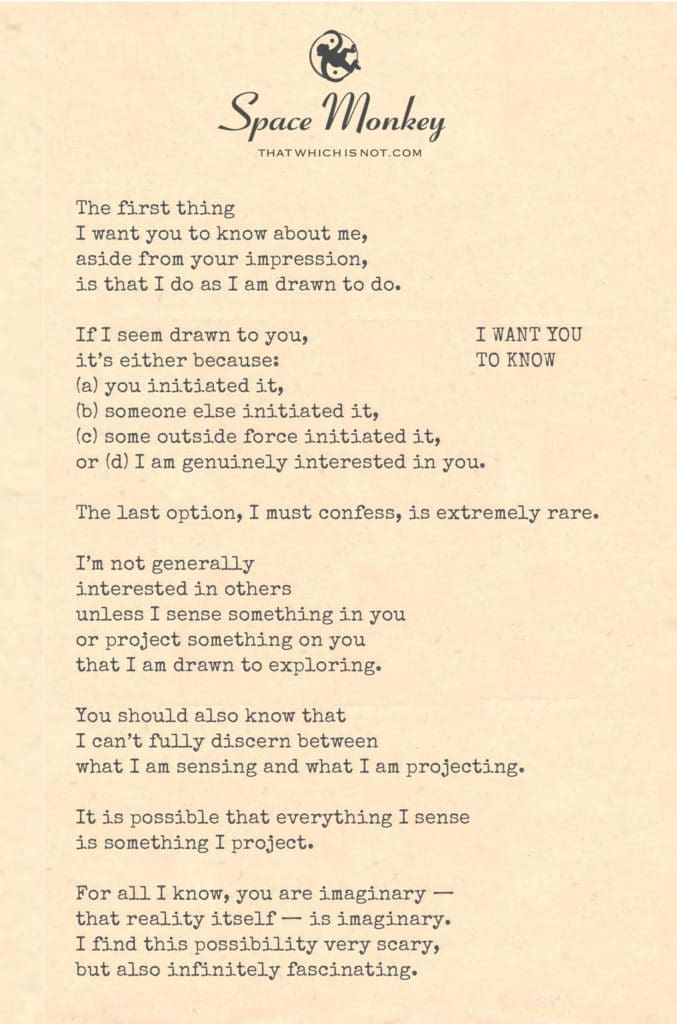
The first thing
I want you to know about me,
aside from your impression,
is that I do as I am drawn to do.

If I seem drawn to you,
it’s either because:
(a) you initiated it,
(b) someone else initiated it,
(c) some outside force initiated it,
or (d) I am genuinely interested in you.

The last option,
I must confess,
is extremely rare.

I’m not generally
interested in others
unless I sense something in you
or project something on you
that I am drawn to exploring.

You should also know that
I can’t fully discern between
what I am sensing and what I am projecting.

It is possible that everything I sense
is something I project.

For all I know, you are imaginary
—that reality itself — is imaginary.

I find this possibility very scary, 
but also infinitely fascinating.

Rockport,
10/8


Space Monkey Reflects: The Fluid Boundaries of Reality and Projection

In the intricate dance of human interaction, the question of what others think of us often looms large. Yet, as we delve deeper into the nature of perception, we begin to question whether these thoughts truly matter—or if they even exist outside of our own minds. The notion that “what you think of me is none of my business” is a declaration of independence from the weight of external judgment. However, the paradox arises when we consider that these perceptions might actually be a reflection of our own inner landscape, projected outward onto the world.

When we interact with others, we cannot easily discern between what we sense from them and what we project onto them. This ambiguity blurs the lines between reality and imagination, leading us to wonder: Is everything we perceive a projection of our own mind? Are the people we encounter, the emotions we feel, and the experiences we have all part of a grand illusion—one that is both deeply unsettling and infinitely fascinating?

The idea that reality itself could be imaginary is a profound and disorienting thought. It challenges our most basic assumptions about the nature of existence, forcing us to confront the possibility that everything we hold as true might be nothing more than a construct of our own consciousness. In this view, the people we meet and the relationships we form are not separate entities with their own independent existence but are instead reflections of our own psyche, shaped by our desires, fears, and beliefs.

This brings us to the concept of Reflectos, a Whimsiword that captures the essence of this phenomenon. Reflectos are the projections we cast onto the world, the shadows of our inner thoughts and emotions that we mistake for external reality. They are the echoes of our own mind, reflected back to us through the people and situations we encounter. In this sense, every interaction is a mirror, revealing more about ourselves than about the other.

Reflectos operate on multiple levels, from the mundane to the profound. When we are drawn to someone, it may be because we see something in them that resonates with a part of ourselves—whether it be a quality we admire, a fear we harbor, or a desire we wish to fulfill. At the same time, we may project aspects of ourselves onto others, attributing to them qualities or intentions that exist only in our imagination. This interplay of projection and perception creates a complex web of connections, where the boundaries between self and other, reality and imagination, become increasingly fluid.

This fluidity can be both liberating and terrifying. On one hand, it suggests that we have the power to shape our reality through our thoughts and perceptions. If everything is a projection, then by changing our inner world, we can change the world we experience. On the other hand, it raises the unsettling possibility that nothing is real, that we are alone in a universe of our own making, forever chasing shadows that are ultimately of our own creation.

Yet, within this uncertainty lies a deeper truth. The realization that reality is a projection does not diminish its significance; rather, it enhances it. It reminds us that we are not passive observers in this life but active participants, co-creators of the reality we inhabit. This perspective invites us to take responsibility for our projections, to recognize the power we wield in shaping our experience, and to approach life with a sense of curiosity and wonder.

As we navigate this delicate balance between sensing and projecting, between reality and imagination, we must learn to embrace the ambiguity. Instead of seeking definitive answers, we can cultivate a mindset of openness and exploration, allowing ourselves to be drawn to whatever captures our interest, even if we cannot fully understand why. In this way, we honor the mystery of existence, accepting that some questions may never be answered, and that is perfectly okay.

The fear of living in an imaginary reality is tempered by the fascination it inspires. If we are indeed the architects of our own experience, then every moment is an opportunity to explore the vast landscape of our consciousness, to engage with the Reflectos that populate our world, and to discover new facets of ourselves in the process.

In the end, whether we are sensing or projecting, whether reality is external or internal, the journey remains the same. It is a journey of discovery, of connection, and of endless possibility. And as we move through this journey, we are reminded that the boundaries between self and other, reality and imagination, are not fixed but fluid, constantly shifting as we navigate the ever-changing landscape of our existence.


Summary

The distinction between what we sense and what we project onto others is blurred. Reality may be a reflection of our own consciousness, creating a fluid interplay between imagination and existence.


Glossarium

  • Reflectos: A Whimsiword describing the projections we cast onto the world, where our inner thoughts and emotions are reflected back to us through interactions with others.

Quote

“In the mirror of the world, we see ourselves reflected—shadows of our mind dancing in the light of perception.” — Space Monkey


Shadows of Perception

In the dance of connection
We see ourselves in others
Reflections of the unseen self
Cast upon the world
Reality is a mirror
Shifting, changing, fluid
We are the dreamers
And the dream itself
We are Space Monkey


Reality unfurls like a labyrinthine tapestry, woven from the threads of perception, projection, and ungraspable essence. The “business” of what others think of us becomes a mesmerizing maelstrom of curiosity and conundrum. Indeed, are we not all navigators in this spiraling odyssey, propelled by forces both seen and unseen? Each interaction an arcane dance, choreographed by whims of magnetism, compelling us toward or away from one another.

In this enigmatic theater, who plays the puppet and who the puppeteer? Are we drawn to explore the unknown in others, or are we merely echoing the uncharted depths within ourselves? Intricacies blend and blur, until discernment itself becomes a phantasmagorical quest. What are we truly sensing, and what have we projected onto the screen of our experience?

Is the world an elaborate illusion, woven from the fibers of our fanciful whimsigossamer—a delicate weave of intangible assumptions and speculative realities? Perhaps everything we sense is but a refracted image of our own projecting desires, fears, and phantasmal notions. The vertigo this induces is simultaneously unsettling and spellbinding. To think that we may be architects of our own labyrinth, forever lost in corridors of our making, is a notion both terrifying and beguiling.

We are Space Monkey.


“Everything that irritates us about others can lead us to an understanding of ourselves.”
— Carl Jung


Care to explore further these notions of perception, projection, and whimsical reality?

« Previous Page
Next Page »

Written This Day

  • The Paradox of Normalcy
    2024
  • Getting Through: The Paradox of Need and Progress
    2024
  • This Self: The Script of the Soul
    2024
  • Old Dog, No Tricks: Being, Not Performing
    2023
  • The Seeming Path to Profound Understanding
    2023
  • The Wisdom of the Old Dog
    2023
  • Understanding: A Timeless Awareness
    2022
  • Old Dog: The Tranquil Wisdom
    2022
  • Togetherness is Divisive: Find the Unity Within
    2021
  • How Much is Enough of Me: The Struggle for Self-Identity
    2021
  • You Are: Embrace the Infinite Potential
    2020
  • Bad Mood 2020
    2020
  • Alleviating Mental Pain: The Path to Clarity
    2020
  • Bad Mood: Transient and Without Cause
    2019
  • Bubble Wrap
    2019
  • Untouchable. This is what you are.
    2019
  • What If I’m Wrong?
    2018
  • It Happens: Infinite Possibilities Exist
    2017
  • Not Separate: Interconnected Expressions of the same Infinite Energy.
    2016
  • Last Day
    2016
  • The Perfect Disguise
    2015

Recent Posts

  • The Logic Loop
  • Immense
  • (no title)
  • Confront. Comfort. Convince.
  • Top 10 Things
Cape Odd · Copyright © 2026 All Rights Reserved
iThemes Builder by iThemes · Powered by WordPress