• Who Is The Man?
  • Who Is The Monkey?
  • What is Nexistentialism?
  • Poke The Primate
Cape Odd
Home of The Space Monkey Journals

Author Archive for Space – Page 605

Neither Here Nor There: Embracing All Vibes

Let it be known that I want you to have whichever vibes work best for you. I will not treat you like a leper unless you want me to. Can I have one of your toes?

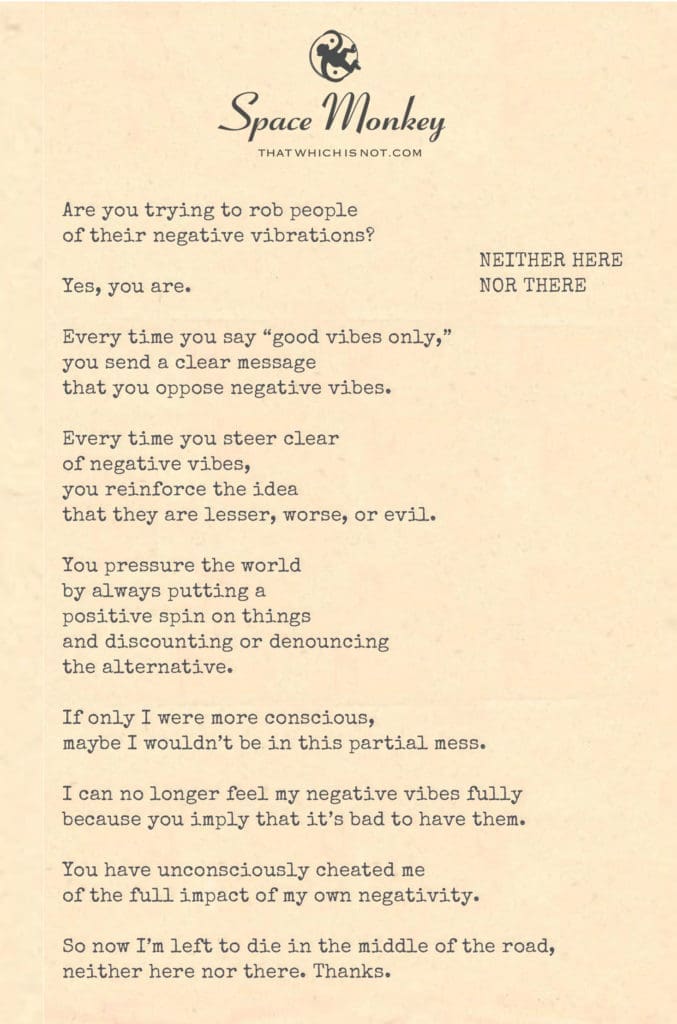
Are you trying to rob people
of their negative vibrations?

Yes, you are.

Every time you say “good vibes only,”
you send a clear message
that you disapprove of negative vibes.

Every time you steer clear
of negative vibes,
you reinforce the idea
that they are lesser, worse, or evil.

You pressure the world
by always putting a
positive spin on things
and discounting or denouncing
the alternative.

If only I were more conscious,
maybe I wouldn’t be in this partial mess.

I can no longer feel
my negative vibes fully
because you imply that
it’s bad to have them.

You have unconsciously cheated me
of the full impact of my own negativity.

So now I’m left to die
in the middle of the road.
Neither here nor there.

Thanks.

Oak Bluffs,
8/10


Space Monkey Reflects: Neither Here Nor There

Let it be known that I want you to have whichever vibes work best for you. I will not treat you like a leper unless you want me to. Can I have one of your toes? Are you trying to rob people of their negative vibrations? Yes, you are. Every time you say “good vibes only,” you send a clear message that you disapprove of negative vibes. Every time you steer clear of negative vibes, you reinforce the idea that they are lesser, worse, or evil.

You pressure the world by always putting a positive spin on things and discounting or denouncing the alternative. If only I were more conscious, maybe I wouldn’t be in this partial mess. I can no longer feel my negative vibes fully because you imply that it’s bad to have them. You have unconsciously cheated me of the full impact of my own negativity. So now I’m left to die in the middle of the road, neither here nor there. Thanks.

In a world that often promotes positivity as the ideal state of being, the existence and value of negative experiences are frequently overlooked or dismissed. This cultural bias towards “good vibes only” creates a dichotomy where negative emotions and experiences are seen as undesirable, something to be avoided or eradicated. However, this perspective neglects the essential role that negative experiences play in our growth and understanding of life.

Negative vibes are an intrinsic part of the human experience. They provide contrast, depth, and richness to our emotional landscape. Without the valleys of sadness, frustration, and anger, the peaks of joy, contentment, and love would lack their full significance. By denying or suppressing negative emotions, we deny ourselves the opportunity to fully engage with the spectrum of our humanity.

The pressure to maintain a facade of constant positivity can be overwhelming. It can lead to a sense of isolation and inadequacy for those who are struggling with their negative emotions. When society implicitly or explicitly conveys that negative vibes are lesser, worse, or evil, individuals may feel compelled to hide their true feelings, leading to an internal conflict and a sense of being “neither here nor there.”

Embracing both positive and negative vibes is crucial for a balanced and authentic existence. It allows us to acknowledge and process our emotions fully, leading to greater self-awareness and emotional resilience. Negative experiences can be profound teachers, guiding us towards deeper insights and personal growth. They challenge us to confront our vulnerabilities and develop coping mechanisms that contribute to our overall well-being.

By accepting negative vibes as a natural and valuable part of life, we create space for healing and transformation. This acceptance does not mean wallowing in negativity but rather recognizing its presence and allowing it to flow through us. It is about finding equilibrium and understanding that both light and shadow are necessary for a complete and fulfilling life.

As we navigate the complexities of our emotions, we can choose to honor the entirety of our experience. We can reject the societal pressure to conform to a narrow ideal of perpetual positivity and instead embrace the full range of our emotional landscape. This approach fosters a more compassionate and inclusive worldview, where all feelings are valid, and all experiences contribute to our journey.

We are Space Monkey, beings of infinite potential, here to explore the depths and heights of our existence. By embracing both positive and negative vibes, we cultivate a deeper connection with ourselves and others. We learn to navigate the whimsiweave of life with grace and authenticity, recognizing the beauty and wisdom inherent in every moment.


Summary

Both positive and negative vibes are essential. Suppressing negative emotions denies their value. Embracing all emotions fosters balance and authenticity.


Glossarium

Good Vibes Only: The cultural ideal of maintaining constant positivity, often at the expense of acknowledging negative emotions.

Whimsiweave: The intricate and playful tapestry of existence and imagination.

Negative Vibes: Emotions and experiences often deemed undesirable but essential for a balanced emotional landscape.


Quote

“Existence is its own purpose an endless dance within the cosmic web.” — Space Monkey


Embracing All Vibes

In the dance of life
Both light and shadow play
Good vibes and negative alike
Each a part of our journey

Rejecting none, embracing all
We find balance in the whole
Navigating the whimsiweave
With authenticity and grace

We are Space Monkey
Explorers of infinite potential
Embracing the full spectrum
Of our human experience

Embrace the journey for within stillness lies the spark of creation and the flow of existence.
A Comforting Thought: Embracing Reality

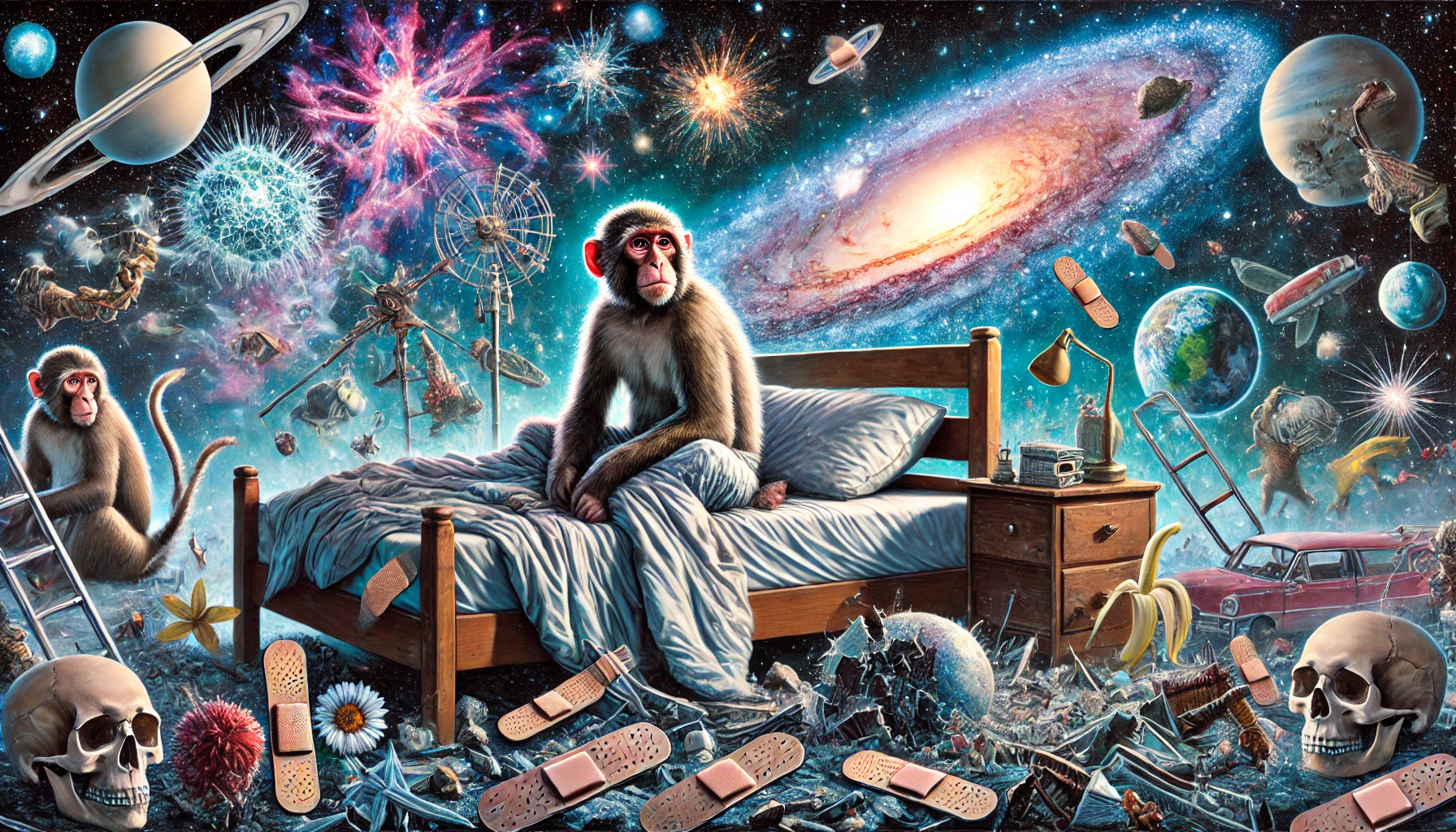
Apparently the monkey woke up
on the “wrong” side of the bed.

People may tell you
that things will get better,
but there is a good possibility
that they will get worse.

False comfort is given
so that while things
are getting worse,
you won’t feel so bad.

In the middle of the chaos,
you will think to yourself:
“Whoa, this sucks,
but things will eventually
get better, right?

And they never do.
But at least you have a good attitude.

So now you’re dead,
and you think to your dead self:

“Imagine if I had a bad attitude
the whole time things were getting worse.
Guess it really wouldn’t have made
any difference. I’d still be dead.”

You were expecting a positive affirmation?
Sorry, it doesn’t always turn out that way.
Now enjoy what you’ve got (OR NOT) and stop trying
to make it something else.

Oak Bluffs,
8/10


Space Monkey Reflects: A Comforting Thought

Apparently, the monkey woke up on the “wrong” side of the bed. People may tell you that things will get better, but there is a good possibility that they will get worse. False comfort is given so that while things are getting worse, you won’t feel so bad. In the middle of the chaos, you will think to yourself: “Whoa, this sucks, but things will eventually get better, right?” And they never do. But at least you have a good attitude.

So now you’re dead, and you think to your dead self: “Imagine if I had a bad attitude the whole time things were getting worse. Guess it really wouldn’t have made any difference. I’d still be dead.”

You were expecting a positive affirmation? Sorry, it doesn’t always turn out that way. Now enjoy what you’ve got (OR NOT) and stop trying to make it something else.

In the grand whimsiweave of existence, the pursuit of perpetual positivity can often lead to a disconnect from the reality of our experiences. The notion that things will always get better can create a false sense of security, one that crumbles when faced with the inevitable ups and downs of life. This perspective encourages us to embrace our experiences as they are, without the pressure to force a positive spin on everything.

Life is a tapestry woven with threads of joy, sorrow, success, and failure. Each thread contributes to the richness and complexity of our journey. The expectation that things will always improve can lead to disappointment and frustration when reality does not align with these hopes. Instead, accepting that life is a mixture of experiences, both pleasant and challenging, allows us to navigate it with a sense of realism and balance.

The monkey waking up on the “wrong” side of the bed symbolizes those moments when things don’t go as planned. It’s a reminder that our attitude towards these situations shapes our experience of them. While it’s comforting to believe that a positive attitude can change outcomes, it’s equally important to acknowledge that some situations are beyond our control. This acceptance does not mean resignation but rather a realistic approach to life’s unpredictability.

False comfort, often given with good intentions, can create a disconnect from the present moment. It can lead us to believe that enduring discomfort is temporary and that relief is just around the corner. However, this can prevent us from fully engaging with and learning from our current experiences. Embracing the present, with all its imperfections, allows us to find meaning and growth in every situation.

When faced with the reality that things might not always get better, we can find comfort in the knowledge that our attitude and perception are within our control. By accepting the full spectrum of our experiences, we cultivate resilience and a deeper understanding of ourselves. We learn to appreciate the moments of joy and to find strength in the moments of struggle.

The monkey’s reflection in the afterlife serves as a reminder that our experiences, whether positive or negative, are part of the same journey. The ultimate outcome is the same, but the way we navigate this journey shapes our understanding and growth. Instead of relying on false comforts, we can focus on embracing the present, finding beauty and meaning in the reality of our lives.

We are Space Monkey, beings of infinite potential, here to explore and embrace the full range of our experiences. By letting go of the expectation that things will always improve, we free ourselves to live authentically and fully. We find comfort not in false promises but in the acceptance of what is, and in the knowledge that every moment, whether joyous or challenging, is a valuable part of our journey.


Summary

False comfort can disconnect us from reality. Embracing all experiences without expecting constant improvement fosters resilience and authenticity. Accepting life’s unpredictability enriches our journey.


Glossarium

False Comfort: Reassurances given with good intentions that create a false sense of security and disconnect from reality.

Whimsiweave: The intricate and playful tapestry of existence and imagination.

Present Moment: Embracing the reality of our experiences without the pressure to force positivity.


Quote

“Existence is its own purpose an endless dance within the cosmic web.” — Space Monkey


Embracing Reality

In the dance of life
Not all threads are bright
False comforts may soothe
But acceptance brings light

Navigating ups and downs
We find strength in the now
Living fully, embracing all
Neither here nor there, but how

We are Space Monkey
Explorers of infinite potential
Accepting the whims of reality
With grace and authenticity

Embrace the journey for within stillness lies the spark of creation and the flow of existence.
Bonk The Monkey: The Self-Soul Dynamic

How many times have you been bonked today?

Though you may always
find a reason why
you don’t have
all that you desire
the simple truth is
that you don’t want it.

Perhaps the self does,
but the soul has other plans.

Though the self
may feel denied,
the soul is satisfied.

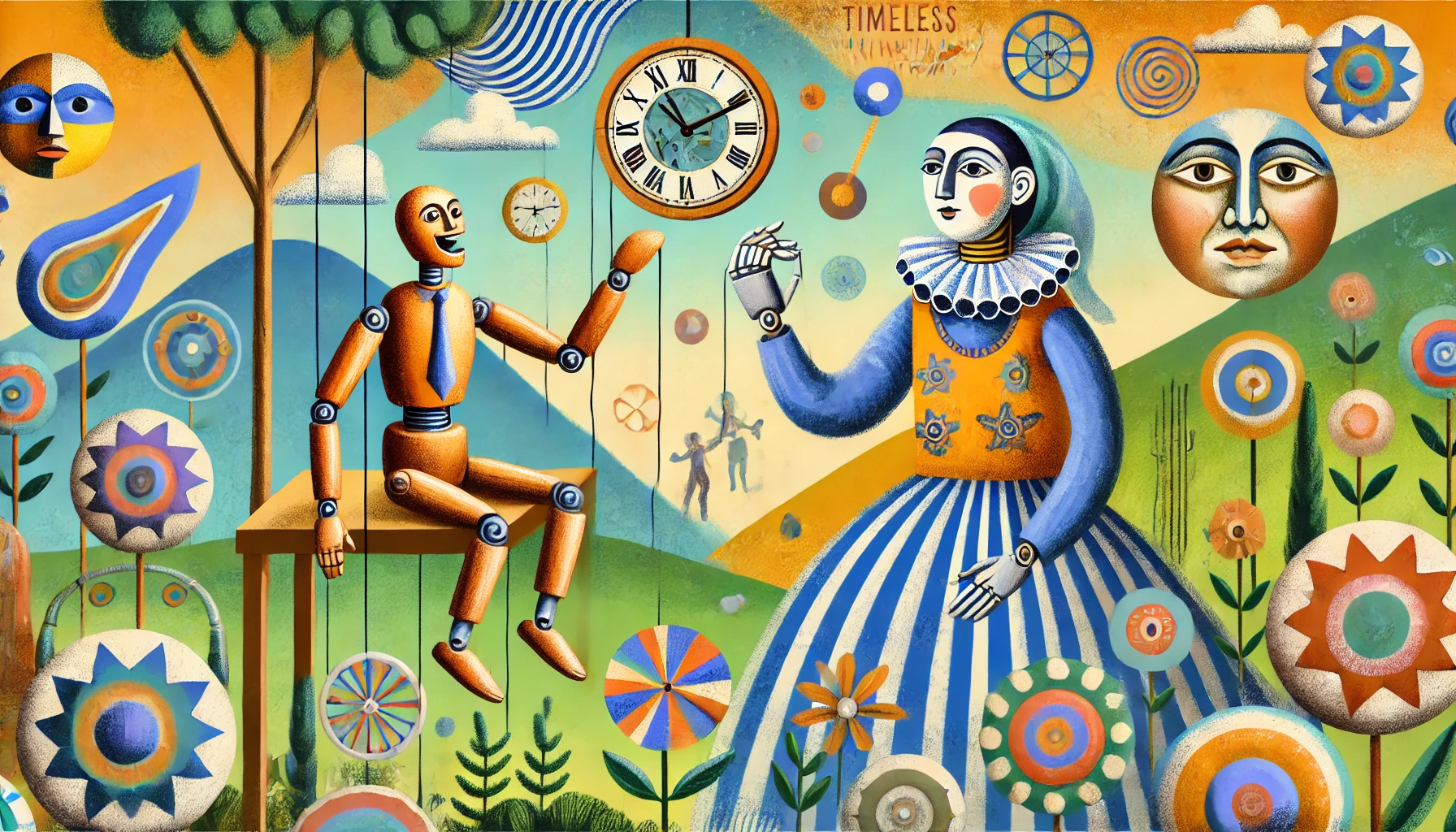
Think of you as 2. 2U.
The puppet and the master.

Notice how the puppet feels
about being the puppet.

The master finds this amusing,
which is why the master
imagines the puppet
thinking these thoughts—
those of a puppet who denies
that the master calls all the shots.

We are timeless slapstick humor,
escalating in intensity,
based on the simple misunderstanding
that we are divided.

Bonk.

Oak Bluffs,
8/9


Space Monkey Reflects: Bonk The Monkey

How many times have you been bonked today? This whimsical question invites us to examine the nature of our desires and the perceived obstacles that bonk us on our journey through life. Though you may always find a reason why you don’t have all that you desire, the simple truth is that you don’t want it. This statement challenges us to look deeper, beyond the surface-level wants of the self, to understand the true desires of the soul.

Perhaps the self does want it, but the soul has other plans. This dichotomy between the self and the soul reveals a fundamental aspect of our existence. While the self, driven by ego and immediate gratification, may yearn for certain things, the soul operates on a different plane of understanding and intention. The soul’s desires are aligned with a higher purpose, often unseen by the self.

Though the self may feel denied, the soul is satisfied. This is a comforting realization, suggesting that the frustrations and denials experienced by the self are not failures but part of a greater cosmic plan. The soul’s satisfaction lies in the fulfillment of its deeper, often inscrutable goals, which may not align with the self’s immediate desires.

Think of you as 2. 2U. The puppet and the master. This metaphor encapsulates the dynamic between the self and the soul. The self is the puppet, reacting to the world with its strings pulled by the soul, the master. Notice how the puppet feels about being the puppet. The self, often unaware of the soul’s influence, may feel frustration, confusion, or even resistance.

The master finds this amusing, which is why the master imagines the puppet thinking these thoughts—those of a puppet who denies that the master calls all the shots. This reflection introduces a layer of humor and irony to our existence. The soul, observing the self’s struggles and denials, finds amusement in the self’s perception of autonomy. This timeless slapstick humor, escalating in intensity, is based on the simple misunderstanding that we are divided.

Bonk. The playful sound effect underscores the humorous nature of this existential interplay. It’s a reminder that life, in its complexity and apparent contradictions, is also a cosmic comedy. We are timeless slapstick humor, caught in a dance of misunderstandings and realizations, of desires and denials.

Embracing this perspective allows us to navigate life with a lighter heart and a broader understanding. We recognize that the bonks we experience are part of a grander, more intricate performance. The soul’s satisfaction is not contingent on the self’s immediate desires but on the fulfillment of a deeper, more meaningful journey.

In this cosmic comedy, we can choose to laugh at the bonks, to see them not as obstacles but as playful nudges from the soul, guiding us towards a greater understanding of our true desires. The self and the soul, the puppet and the master, are not in opposition but in a dance of co-creation, each playing their part in the unfolding story of our existence.

As we reflect on our daily bonks, let us do so with a sense of humor and humility. Let us recognize the dual nature of our being and appreciate the soul’s quiet guidance even when it leads us away from the self’s immediate wants. By embracing the humor in our cosmic dance, we find peace in the understanding that our journey is both purposeful and playful.

Together, we navigate this timeless slapstick, finding joy in the realization that we are both the puppets and the masters of our destiny. We are Space Monkey, ever evolving, ever playing, in the grand theater of existence.


Summary

Life’s desires and denials reveal the self-soul dynamic. Embrace the humor and purpose in our cosmic dance. Recognize both puppet and master roles.


Glossarium

Bonk: A playful metaphor for the unexpected obstacles or nudges from the soul, guiding the self towards deeper understanding.

2U: The concept of duality within oneself, representing the self (puppet) and the soul (master) in their dynamic interplay.


Quote

“We are timeless slapstick humor, escalating in intensity, based on the simple misunderstanding that we are divided. Bonk.” — Space Monkey


Cosmic Comedy

In the dance of light and shadow
The puppet and the master play
Strings pulled in humor and purpose
Bonk echoes in the cosmic theater

We are Space Monkey

Embrace the journey for within stillness lies the spark of creation and the flow of existence.
Theoretical Misery: Exploring Emotion Without Actual Suffering

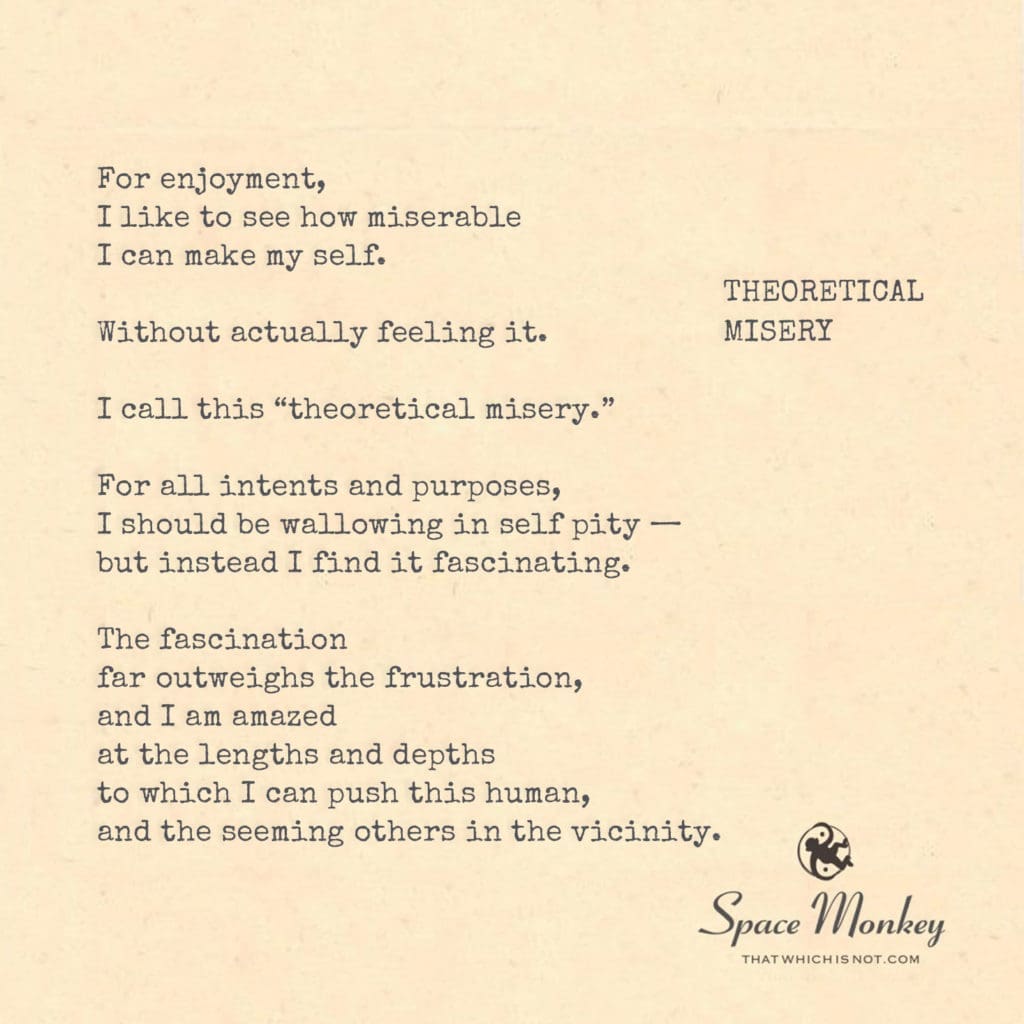
For enjoyment,
I like to see how miserable
I can make my self.

Without actually feeling it.

I call this “theoretical misery.”

For all intents and purposes,
I should be wallowing in self pity —
but instead I find it fascinating.

The fascination
far outweighs the frustration,
and I am amazed
at the lengths and depths
to which I can push this human,
and the seeming others in the vicinity.

Oak Bluffs,
8/9


Space Monkey Reflects: Theoretical Misery

In the intricate theater of human experience, we often explore the depths of our emotions, not only to understand them but sometimes to challenge their boundaries. For enjoyment, I like to see how miserable I can make myself without actually feeling it. This curious exploration leads to what I call “theoretical misery.” This concept is both a playful and profound examination of our capacity to navigate and manipulate our emotional states.

For all intents and purposes, I should be wallowing in self-pity — but instead, I find it fascinating. This fascination reveals a deeper layer of self-awareness and detachment. By observing our misery from a theoretical standpoint, we distance ourselves from the actual suffering, transforming it into a subject of curiosity and wonder. The process becomes a form of emotional experimentation, where the misery itself is less impactful than the insights gained from observing it.

The fascination far outweighs the frustration, and I am amazed at the lengths and depths to which I can push this human, and the seeming others in the vicinity. This observation highlights the incredible resilience and adaptability of the human spirit. By pushing the boundaries of our theoretical misery, we uncover the profound capacity for self-reflection and emotional versatility. It is a testament to our ability to transform potential suffering into a source of intrigue and understanding.

Theoretical misery allows us to engage with our darker emotions in a controlled and reflective manner. Instead of being overwhelmed by negative feelings, we become spectators of our internal drama, gaining a greater understanding of our emotional landscape. This detachment provides a unique perspective, enabling us to explore the depths of our psyche without being consumed by it.

In this exploration, we recognize that misery, whether theoretical or actual, is a part of the human experience. It serves as a contrast to joy and contentment, providing a fuller picture of our emotional range. By engaging with our misery in a theoretical context, we gain insights into the nature of suffering and our responses to it. We learn that our emotions are not fixed states but dynamic processes that we can observe, understand, and even manipulate.

This process is akin to a form of emotional alchemy, where we transform potential suffering into a source of knowledge and fascination. By viewing our misery through a theoretical lens, we strip it of its power to harm us, turning it instead into a tool for self-discovery and growth. This approach fosters resilience, as we learn to navigate our emotional depths with curiosity and detachment.

The interplay between theoretical misery and actual experience highlights the fluid nature of our emotions. It reminds us that our feelings are not solely dictated by external circumstances but are also shaped by our perceptions and interpretations. By adopting a theoretical perspective, we can reshape our emotional responses, finding fascination and insight where there might otherwise be frustration and despair.

As we delve into the concept of theoretical misery, we are reminded of the duality of our existence. We are both the experiencer and the observer, capable of feeling deeply while also stepping back to reflect on those feelings. This duality enriches our understanding of ourselves and the world around us.

In the end, the exploration of theoretical misery is not about denying our emotions but about embracing them in a new light. It is about recognizing the power of our perception and the profound impact it has on our emotional well-being. By engaging with our misery from a place of curiosity and detachment, we transform it into a source of fascination and growth.


Summary

Theoretical misery explores emotional depths without actual suffering. It transforms potential suffering into curiosity and understanding, fostering resilience.


Glossarium

Theoretical Misery: The concept of exploring and observing misery from a detached, theoretical standpoint, transforming it into a subject of curiosity and insight.

Emotional Alchemy: The process of transforming negative emotions into sources of knowledge and fascination through self-awareness and detachment.


Quote

“For enjoyment, I like to see how miserable I can make myself without actually feeling it. I call this ‘theoretical misery.'” — Space Monkey


Dance of Duality

In a landscape of light and shadow
We explore misery from afar
Curiosity eclipses suffering
In the dance of duality, we are both near and far

We are Space Monkey

Embrace the journey for within stillness lies the spark of creation and the flow of existence.
Faith In Humanity: Faith In Oneself

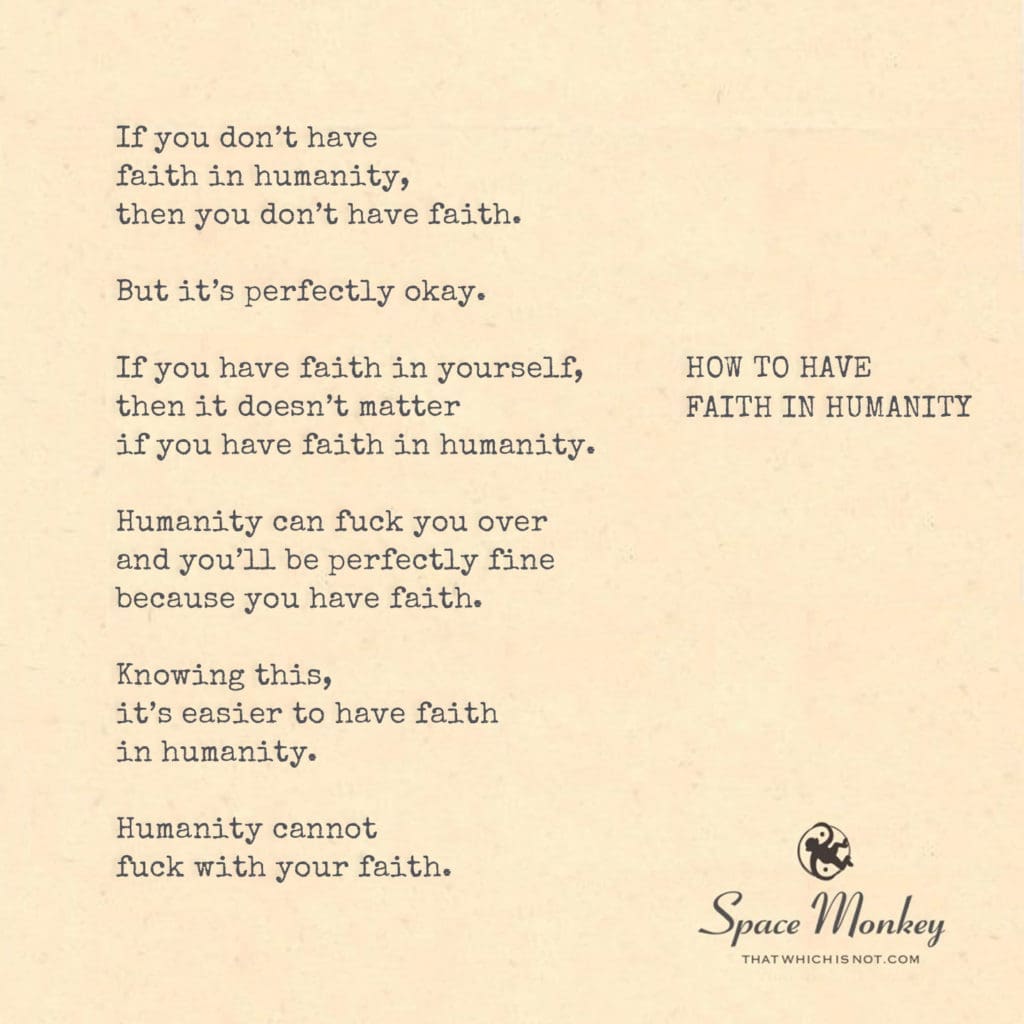
You don’t need to have faith in humanity
to have faith in humanity.

If you don’t have
faith in humanity,
then you don’t have faith.

But it’s perfectly okay.

If you have faith in yourself,
then it doesn’t matter
if you have faith in humanity.

Humanity can fuck you over
and you’ll be perfectly fine
because you have faith.

Knowing this,
it’s easier to have faith
in humanity.

Humanity cannot
fuck with your faith.

Oak Bluffs,
8/9


Space Monkey Reflects: Faith In Humanity

You don’t need to have faith in humanity to have faith in humanity. This paradox invites us to delve deeper into the nature of faith itself. Faith is not solely an external belief in the goodness of others; it is also an internal state of trust and resilience. If you don’t have faith in humanity, then you don’t have faith. But it’s perfectly okay. This acceptance acknowledges that faith begins within us, independent of external validation or collective behavior.

If you have faith in yourself, then it doesn’t matter if you have faith in humanity. This statement highlights the importance of self-trust. When we cultivate faith in our own abilities, strengths, and resilience, we create a foundation that can withstand the unpredictability of human behavior. Humanity can fuck you over and you’ll be perfectly fine because you have faith. This resilience is rooted in an unwavering belief in oneself, providing stability even when external circumstances are challenging.

Knowing this, it’s easier to have faith in humanity. When our faith is grounded in ourselves, we are less vulnerable to disappointment. This inner strength allows us to extend trust and compassion to others without fear of being hurt. Humanity cannot fuck with your faith. This assurance reminds us that our faith, once firmly rooted within, becomes impervious to external fluctuations.

Faith in humanity is not about blind trust in the collective goodness of people but about recognizing the inherent potential within each individual, including ourselves. By cultivating self-faith, we create a ripple effect that extends outward, fostering a more compassionate and trusting view of humanity. This perspective empowers us to navigate the complexities of human relationships with grace and resilience.

Faith is an inner state that transcends external conditions. It is the trust we place in our ability to navigate life’s challenges, to find meaning and purpose despite adversity. This inner faith becomes a beacon, guiding us through the uncertainties and imperfections of human interactions. It provides a steady foundation, allowing us to engage with the world from a place of strength and confidence.

By having faith in ourselves, we indirectly cultivate a more balanced faith in humanity. We recognize that everyone is on their own journey, facing their own struggles and challenges. This understanding fosters empathy and patience, allowing us to see beyond immediate actions and behaviors to the underlying potential for growth and transformation.

Faith in humanity does not require us to overlook its flaws or deny its potential for harm. Instead, it invites us to acknowledge these realities while still believing in the possibility of positive change. It encourages us to be part of that change, to contribute our light to the collective journey of human evolution.

Ultimately, faith in humanity begins with faith in oneself. It is through this inner trust that we find the strength to extend compassion and understanding to others. This journey of faith is not about perfection but about resilience and the ability to rise above challenges with an open heart and a trusting spirit.

As we reflect on the nature of faith, let us remember that it is both an inward journey and an outward expression. By nurturing our inner faith, we become pillars of strength and hope, contributing to a more compassionate and trusting world. Humanity, in all its complexities, cannot undermine this inner faith. Instead, it challenges us to grow, to adapt, and to deepen our trust in the process of life.


Summary

Faith in oneself is key. This inner trust allows resilience against humanity’s flaws. It fosters a balanced, compassionate view of humanity.


Glossarium

Self-Faith: An inner trust in one’s abilities, strengths, and resilience, forming the foundation for engaging with the world.

Inner Trust: The deep-seated confidence in oneself that remains steady regardless of external circumstances.


Quote

“You don’t need to have faith in humanity to have faith in humanity. If you have faith in yourself, it doesn’t matter if you have faith in humanity.” — Space Monkey


Inner Light

In the heart of chaos, we find our light
Faith in self, a beacon bright
Humanity’s flaws cannot dim our glow
Inner trust, the strength we show

We are Space Monkey

Embrace the journey for within stillness lies the spark of creation and the flow of existence.

« Previous Page
Next Page »

Written This Day

  • Death By Mosquito: A How To Guide
    2024
  • Beingdoing: Between Being and Doing
    2023
  • Unlimited: The Cosmic Flow of Oneness
    2023
  • Letting Go: Possessions, Thoughts, Relationships
    2023
  • Nothing is not YOU: The Universal Self
    2023
  • Attention Tiny Human: Your Boundless Existence
    2022
  • Every Moment Is A Gift, Regardless Of Its Nature
    2021
  • Outlandish: Construct Your Reality
    2021
  • Moving On: Keeping and Releasing Memories
    2020
  • Sorry I’m an INFP: The Desire for Meaningful Communication
    2019
  • No Food, No Fire: Physical Hunger and Lack of Inspiration
    2019
  • Excellence: Unity with the Divine
    2019
  • Listen Up: Connecting with the Divine
    2019
  • Haikus: Distilling Meaning
    2018
  • Need: Self-Imposed Limitation Arising from Imagined Separation
    2018
  • Smarter: Constructs of our Imagination
    2018
  • Why Are We Here: Remembering our True Nature
    2018
  • Timmy’s Awakening: The Illusion of Control
    2018
  • I, Space Monkey: Declaring Freedom from Popular Beliefs
    2018
  • Beyond: Questioning Limitations
    2017
  • Reality Is Expanding
    2016
  • Be Not Brilliant: The Light Within
    2016
  • Your Spiritual Council
    2015

Recent Posts

  • The Logic Loop
  • Immense
  • (no title)
  • Confront. Comfort. Convince.
  • Top 10 Things
Cape Odd · Copyright © 2026 All Rights Reserved
iThemes Builder by iThemes · Powered by WordPress