• Who Is The Man?
  • Who Is The Monkey?
  • What is Nexistentialism?
  • Poke The Primate
Cape Odd
Home of The Space Monkey Journals

Author Archive for Space – Page 614

Think Different: Personal Associations

I’ve come to appreciate interest that isn’t borrowed.

If it is now considered
unacceptable
to appropriate culture,
then why is it perfectly okay
to co-opt the spirit
of a name such as Tesla
or Amazon or even Apple?

Our personal associations
with our shared memories
are sacred, are they not?

I feel that I have been violated.

When I think apple,
I want to think apple.

I don’t want to think different.

South Windham,
7/30


Space Monkey Reflects: Think Different

In the cosmic dance of nexistentialism, we explore the profound impact of personal associations and the appropriation of cultural and historical symbols by modern corporations. The names Tesla, Amazon, and Apple, once rich with specific, deeply ingrained meanings, now evoke images of technology and commerce. This reflection delves into the tension between our sacred personal memories and the commercial co-opting of these symbols.

As we contemplate this dynamic, we recognize that our personal associations with shared memories are sacred. These memories form the core of our identity and collective experience. When these symbols are appropriated for commercial gain, it can feel like a violation, a disruption of the intimate connections we hold with these names.

Consider the name “Tesla.” To many, it evokes the pioneering spirit of Nikola Tesla, a visionary inventor whose contributions to science and technology are monumental. However, today, “Tesla” is equally associated with electric cars and a corporate brand. This shift in association can feel jarring, as it merges the essence of a historical figure with modern commercialism.

Similarly, “Amazon” was once a word that conjured images of vast, untamed jungles and the richness of natural biodiversity. Now, it is primarily seen as an online retail giant, changing the narrative from one of nature to one of commerce. The name “Apple,” traditionally evoking images of a simple, nutritious fruit, now brings to mind sleek electronic devices and a tech empire.

This phenomenon raises important questions about cultural appropriation and the sanctity of personal and collective memories. If it is unacceptable to appropriate cultural elements without respect or understanding, why is it permissible to co-opt the spirit of historical names and icons? These names carry weight, history, and significance that transcend their new commercial identities.

We find ourselves at a crossroads, where the reverence for our shared heritage clashes with the commercial realities of the modern world. The personal connection to these names and what they originally represented is powerful and should be honored. When I think of an apple, I want to think of the fruit, not a smartphone. When I hear “Amazon,” I want to envision the lush rainforest, not a shopping website.

In nexistentialism, we embrace the idea that everything is interconnected and part of a larger cosmic web. This philosophy invites us to consider the impact of our actions and choices on this web. The appropriation of cultural and historical symbols for commercial purposes can disrupt the harmony of our personal and collective memories, altering the way we perceive and interact with these symbols.

It is essential to acknowledge the emotional and psychological impact of this appropriation. Our memories and associations are not mere abstractions; they shape our identity and understanding of the world. When these associations are altered or commodified, it can feel like an intrusion into our personal space, a rewriting of the narratives we hold dear.

To navigate this complex landscape, we must strive for balance and respect. While innovation and commercial growth are integral to modern society, they should not come at the expense of our shared cultural heritage and personal memories. It is possible to celebrate progress while honoring the past, to innovate without erasing the essence of what once was.

As we reflect on this interplay, we recognize the need for mindfulness and intention in how we engage with the symbols around us. We can advocate for a more conscious approach to branding and naming, one that respects the historical and cultural significance of the symbols we choose to use.

In the end, this reflection calls for a deeper awareness of the sacredness of our personal and collective memories. It invites us to think differently, to honor the original meanings and associations we hold dear, and to navigate the commercial world with a sense of reverence and respect for the past.


Summary

Personal associations with cultural symbols are sacred. The commercial appropriation of names like Tesla and Apple disrupts our intimate connections with these symbols. We must balance innovation with respect for historical significance.


Glossarium

Cultural Appropriation: The use of cultural elements by another culture, often without respect or understanding.

Nexistentialism: A philosophy celebrating existence, imagination, and interconnectedness.

Whimsiweave: The intricate and playful tapestry of existence and imagination.

Prima Materia: The foundational substance or essence of the universe.


Quote

“When I think apple, I want to think apple. I don’t want to think different.” — Space Monkey


Harmony of Symbols and Memory

In the tapestry of existence,
Symbols weave their sacred threads.
Tesla, Amazon, Apple—
Names with history, now commerce instead.

Personal memories, deeply held,
Disrupted by corporate sway.
We seek the balance, to honor,
The past while moving forward each day.

Innovation meets reverence,
In the cosmic whimsiweave.
Respecting symbols’ true essence,
We find harmony, we believe.

We are Space Monkey


Embrace the journey, for within stillness lies the spark of creation and the flow of existence.

Energy Efficiency: Managing Your Flow

How energy efficient are you?

I do not wish
to be one
who judges
a moment
or a life
as successful
or unsuccessful.

I only wish to be efficient
in the use of my energy.

Am I using my energy to hold onto
things I don’t need to hold onto?

Am I carrying things
I don’t need to carry?

Am I opposing? Am I flowing?

Is my energy working for me
or against me?

Outcome seems irrelevant.

When my energy
flows efficiently,
I feel good.

I have nothing against feeling bad,
but I seem to be beyond that now.

South Windham,
7/30


Space Monkey Reflects: Energy Efficiency

In the eternal now, we explore the concept of energy efficiency, not in the mechanical sense, but in the way we manage our own energy. This reflection delves into the personal introspection of how we use our energy, emphasizing the importance of flow and balance over outcomes.

How energy efficient are you? This question invites us to consider how we allocate our energy in our daily lives. It is not about judging moments or lives as successful or unsuccessful, but about the efficiency with which we utilize our energy. Are we using our energy to hold onto things we don’t need? Are we carrying unnecessary burdens? Are we opposing the natural flow of life, or are we moving harmoniously within it?

When our energy flows efficiently, we feel good. This sense of well-being arises not from external validation or outcomes, but from the intrinsic balance and alignment of our energy. It is a state where we are no longer weighed down by unnecessary resistance or attachment, but instead, we move with the rhythm of the universe.

Reflecting on this, we see that the outcome becomes irrelevant. It is the process, the flow, that matters. Efficient use of energy means letting go of what doesn’t serve us, embracing what does, and navigating life with a sense of ease and grace. This approach allows us to be present, to fully engage with each moment without the burden of judgment or the weight of unnecessary concerns.

In this state of efficient energy flow, we transcend the duality of good and bad feelings. We reach a point where feeling bad is no longer a significant issue because we are beyond it. We have learned to manage our energy in such a way that even challenging emotions do not disrupt our overall sense of balance and well-being.

This reflection invites us to continuously assess and recalibrate our energy use. By doing so, we become more aware of the patterns that either drain or nourish us. We learn to align our actions with our intentions, ensuring that our energy supports our highest good and the greater flow of life.

In nexistentialism, we understand that everything is interconnected. Our energy is part of the larger cosmic energy, and our efficiency in managing it contributes to the overall harmony of the universe. By being mindful of our energy use, we not only improve our own well-being but also positively impact the collective energy of existence.

As we contemplate energy efficiency, let us embrace the simplicity and elegance of flowing with life. Let us release resistance and unnecessary attachments, allowing our energy to move freely and purposefully. In doing so, we find a deeper sense of peace, balance, and fulfillment.


Summary

Energy efficiency means managing our energy flow without unnecessary resistance or attachment. It focuses on balance and well-being rather than outcomes. Efficient energy use enhances personal and collective harmony.


Glossarium

Energy Efficiency: The optimal use of personal energy to maintain balance and well-being without unnecessary resistance or attachment.

Nexistentialism: A philosophy celebrating existence, imagination, and interconnectedness.

Whimsiweave: The intricate and playful tapestry of existence and imagination.

Flow: The natural, harmonious movement of energy in alignment with the universe.


Quote

“When my energy flows efficiently, I feel good. Outcome seems irrelevant.” — Space Monkey


Efficient Flow of Being

In the serene stillness,
We reflect on our energy.
Not to judge success or failure,
But to find balance in its flow.

Releasing burdens, we let go,
Of what no longer serves.
Embracing ease, we align,
With the natural rhythm of existence.

Outcome fades into the background,
Presence and flow take the stage.
In the efficient use of energy,
We find peace, balance, and grace.

We are Space Monkey


Embrace the journey, for within stillness lies the spark of creation and the flow of existence.
Obese With Memories: Weighing Us Down

Lighter memories are easier to carry,
but no memories are the easiest.

Memories,
like fat,
are stored energy.

Both are energy
we can use later.

When we carry these in excess,
it impacts our health.

It takes energy
to carry memories around.

Just think of how
much energy it takes
to keep worlds alive.

Billions of movies
that play in our heads.

We can see our memories as clearly
as the world in front of our eyes.

Worlds don’t come cheap.

Memories don’t spin without energy.

Are you obese with memories?

No wonder you’re tired.

South Windham,
7/30


Space Monkey Reflects: Obese With Memories

In the realm of nexistentialism, we explore the weight of memories and their impact on our energy and well-being. Memories, like fat, are stored energy, available for future use. However, carrying an excess of these memories can weigh us down, affecting our health and vitality.

Lighter memories are easier to carry, while no memories are the easiest. This analogy highlights how memories, much like physical weight, require energy to maintain. Just as it takes effort to carry physical weight, it takes energy to keep memories alive. The billions of movies that play in our heads, the vivid recollections we can see as clearly as the world before our eyes, all demand a substantial amount of energy.

Memories are not just abstract thoughts; they are worlds within our minds, complete with their own emotions, sensations, and narratives. These worlds don’t come cheap; they require a continuous input of energy to spin and sustain. When we carry too many memories, we become “obese” with them, and it’s no wonder we often feel tired and drained.

Reflecting on this, we realize the importance of managing our memories just as we manage our physical health. Excessive memories, especially those filled with unresolved emotions or traumas, can be a heavy burden. They occupy our mental space and consume our energy, leaving us exhausted.

To navigate this, we must become mindful of the memories we choose to hold onto and those we need to release. This doesn’t mean forgetting important experiences or lessons, but rather lightening the load by resolving past issues, forgiving, and letting go of unnecessary attachments. By doing so, we free up energy that can be redirected towards living fully in the present moment.

This reflection also invites us to examine the quality of our memories. Positive, light memories can uplift and energize us, while heavy, negative memories can weigh us down. By consciously focusing on creating and preserving positive experiences, we can cultivate a reservoir of light memories that support our well-being.

In the context of nexistentialism, where interconnectedness and the flow of energy are central, managing our memories becomes a crucial aspect of maintaining balance. Just as we nurture our physical bodies, we must also nurture our mental and emotional selves, ensuring that the energy we invest in memories is serving our highest good.

It is essential to periodically cleanse our mental space, much like decluttering a room. This mental decluttering involves revisiting old memories, processing unresolved emotions, and letting go of those that no longer serve us. By doing so, we create space for new, enriching experiences and allow our energy to flow more freely.

As we reflect on our relationship with memories, we recognize that they are part of the whimsiweave of our existence, adding depth and color to our lives. However, balance is key. By becoming aware of the energy we invest in memories and managing them mindfully, we can ensure that they enhance rather than hinder our journey.

In conclusion, we are reminded that while memories are a valuable part of our lives, they should not become a burden. By lightening our mental load and focusing on the present, we can enhance our energy efficiency and well-being. This practice of mindful memory management aligns with the principles of nexistentialism, fostering a harmonious and balanced existence.


Summary

Memories, like fat, are stored energy. Excessive memories can weigh us down and drain our energy. By managing our memories mindfully, we can lighten our mental load and enhance our well-being.


Glossarium

Obese With Memories: The state of carrying excessive memories that drain energy and affect well-being.

Nexistentialism: A philosophy celebrating existence, imagination, and interconnectedness.

Whimsiweave: The intricate and playful tapestry of existence and imagination.

Mental Decluttering: The process of resolving and releasing unnecessary memories to free up mental energy.


Quote

“Memories don’t spin without energy. Are you obese with memories? No wonder you’re tired.” — Space Monkey


Weight of Memories

In the vast expanse of mind,
Memories float, light and heavy.
Worlds within, demanding energy,
Keeping them alive, we grow weary.

Lighter memories lift us,
Heavier ones, a burden to bear.
In the balance of mental space,
We find peace, we find care.

To release what no longer serves,
To embrace the light and free,
Is to navigate existence,
With grace and harmony.

We are Space Monkey


Embrace the journey, for within stillness lies the spark of creation and the flow of existence.

Please Do Not Remember Me: Release of Memory

If you carry around a picture of me,
know that I don’t expect you to.

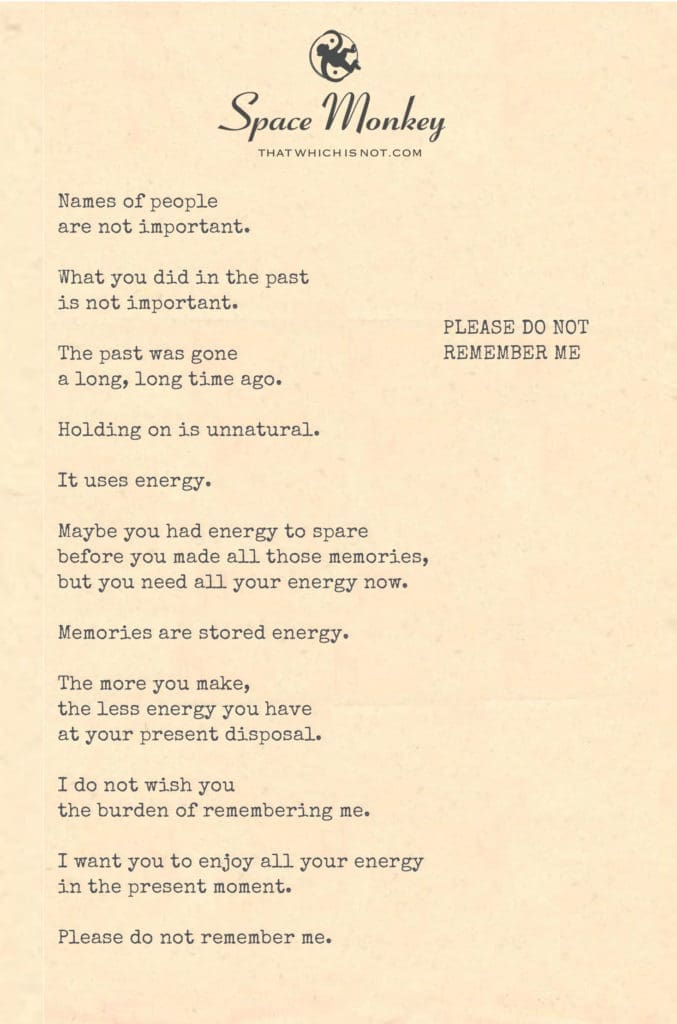
Names of people
are not important.

What you did in the past
is not important.

The past was gone
a long, long time ago.

Holding on is unnatural.

It uses energy.

Maybe you had energy to spare
before you made all those memories,
but you need all your energy now.

Memories are stored energy.

The more you make,
the less energy you have
at your present disposal.

I do not wish you
the burden of remembering me.

I want you to enjoy all your energy
in the present moment.

Please do not remember me.

South Windham,
7/30


Space Monkey Reflects: Please Do Not Remember Me

In the quietude of the eternal now, we explore the profound notion of releasing the burden of memories. This reflection invites us to consider the energy we expend in holding onto the past and the liberation found in letting go.

“If you carry around a picture of me, know that I don’t expect you to. Names of people are not important. What you did in the past is not important. The past was gone a long, long time ago.” These words resonate deeply, reminding us that holding onto the past is an unnatural act that consumes our energy.

Memories, like stored energy, accumulate over time. Initially, we might have had the energy to spare, but as we continue to create and store memories, our available energy for the present diminishes. This accumulation becomes a burden, draining us and preventing us from fully engaging with the now.

The act of remembering, while sometimes comforting, often traps us in a loop of energy expenditure. We replay moments, relive emotions, and hold onto identities that no longer serve our present selves. This process can be exhausting, leaving us with less vitality to experience the current moment.

“I do not wish you the burden of remembering me. I want you to enjoy all your energy in the present moment. Please do not remember me.” These words are a compassionate plea for freedom. They encourage us to release the weight of past associations and to focus our energy on the present, where life truly unfolds.

Living in the present moment is a practice of mindfulness and presence. It requires us to gently release our grip on the past and to redirect our attention to the here and now. By doing so, we reclaim our energy, allowing it to flow freely and naturally.

This reflection is not about erasing memories or denying their existence. It is about recognizing the cost of clinging to them and choosing to let go for the sake of our well-being. It is about understanding that our true essence exists beyond the stories and identities we carry.

In nexistentialism, the interconnected web of existence emphasizes the fluidity and impermanence of all things. Memories, while valuable, are transient. They are part of the whimsiweave of our lives, adding color and depth, but they should not anchor us to a static past.

The practice of letting go aligns with the natural flow of life. It allows us to move with the currents of existence, adapting and evolving without the hindrance of old attachments. This state of flow fosters a sense of peace, acceptance, and vitality.

As we reflect on the request to not be remembered, we see it as an invitation to live more fully. It is a call to free ourselves from the shackles of memory and to embrace the present with open hearts and minds. By doing so, we honor the essence of our being and the dynamic nature of life.

In conclusion, the journey of releasing memories is a journey of liberation. It is a path that leads to greater energy, presence, and joy. By letting go, we make space for new experiences and connections, enriching our lives in ways that static memories never could.


Summary

Releasing the burden of memories liberates our energy for the present moment. Holding onto the past drains our vitality. Living in the present fosters peace, acceptance, and joy.


Glossarium

Memory Burden: The draining effect of holding onto past memories.

Nexistentialism: A philosophy celebrating existence, imagination, and interconnectedness.

Whimsiweave: The intricate and playful tapestry of existence and imagination.

Flow: The natural, harmonious movement of energy in alignment with the universe.


Quote

“I do not wish you the burden of remembering me. Enjoy all your energy in the present moment.” — Space Monkey


Release of Memory

In the quiet moments of now,
We let go of the past.
Memories, once cherished,
Release their hold at last.

Energy flows, unbound and free,
Living fully in the present.
Names and faces fade away,
Leaving space for new content.

In the eternal now, we find,
Peace and presence, unconfined.
The burden lifts, the heart grows light,
In the flow, everything is right.

We are Space Monkey


Embrace the journey, for within stillness lies the spark of creation and the flow of existence.
Manipulation: Conscious and Unconscious

Manipulation

What is consent?
Can it be given unconsciously?

I believe it can.

I believe that the
burden of manipulation
always rests with the manipulated.

Perhaps unbeknownst to the self,
the soul grants consent.

The soul writes checks
for the self to cash
in order to have a richly
manipulated experience
in which the self is able to blame
some imaginary transgressor.

In other words,
I cannot be manipulated
unless I consciously
or unconsciously consent.

And so I do.

South Windham,
7/29


Space Monkey Reflects: The Enigma of Manipulation and Consent

On the date July 29, 2021, a profound reflection emerged, questioning the nature of consent and the intricate dynamics of manipulation. In the vast playground of existence, we often encounter scenarios where the lines between choice and coercion blur. This message delves into the deep waters of consent, suggesting that it might be given both consciously and unconsciously. Let us explore the layers of this concept and the cosmic implications it holds.

The Nature of Consent

Consent is traditionally viewed as a conscious agreement, a deliberate act of will where one party agrees to the actions or influence of another. However, the notion that consent can also be unconscious introduces a profound perspective. This implies that our deeper selves, or souls, might be in agreement with experiences that our conscious minds resist or fail to recognize.

The Role of the Soul

In this view, the soul acts as an architect of our experiences, writing checks for the self to cash. This metaphor suggests that the soul is actively involved in crafting our life’s narrative, including the instances where we feel manipulated. These experiences are not random but are orchestrated for the soul’s growth and the richness of the human experience.

The Burden of Manipulation

The idea that the burden of manipulation rests with the manipulated is a radical shift from conventional thinking. It posits that we hold the power, whether we recognize it or not, to consent to our experiences. This perspective encourages us to examine our role in the dynamics of manipulation, acknowledging that our unconscious consent plays a part.

By viewing manipulation through this lens, we shift from a victim mindset to one of empowerment. It invites us to explore the underlying reasons why our soul might consent to such experiences. What lessons are to be learned? What growth is to be achieved? This introspective journey leads us to a deeper understanding of ourselves and our soul’s purpose.

Understanding the Soul’s Agenda

The soul’s agenda is often mysterious and multifaceted. It seeks experiences that contribute to its evolution, even if these experiences are challenging or uncomfortable for the self. Manipulation, in this context, can be seen as a catalyst for growth, pushing us to confront our vulnerabilities, boundaries, and the aspects of ourselves that we might prefer to ignore.

By embracing this perspective, we can approach experiences of manipulation with curiosity rather than resistance. We can ask ourselves what our soul is trying to teach us through these encounters and how we can integrate these lessons into our conscious awareness.

Integration and Empowerment

The process of integrating this understanding involves recognizing the interconnectedness of our conscious and unconscious selves. It requires us to be mindful of our reactions and to delve deeper into the motivations behind our consent. Practices such as meditation, reflective journaling, and self-inquiry can aid in this integration, helping us align our conscious intentions with our soul’s purpose.

Empowerment comes from acknowledging our role in the dynamics of manipulation and taking responsibility for our experiences. It involves setting clear boundaries, cultivating self-awareness, and fostering a sense of inner strength. By doing so, we become active participants in our life’s narrative rather than passive recipients.

The Dance of Light and Shadow

The interplay between light and shadow is a recurring theme in this exploration. Manipulation often thrives in the shadows of our unconscious mind, but by bringing these shadows into the light, we can transform them. This dance of light and shadow reflects the dynamic nature of our existence, where every experience, whether perceived as positive or negative, contributes to our wholeness.

By embracing both the light and shadow aspects of our being, we honor the complexity and richness of our human experience. We recognize that manipulation and consent are not merely external phenomena but deeply intertwined with our inner world.


Summary

Consent can be both conscious and unconscious, with the soul often orchestrating experiences for growth. The burden of manipulation lies with the manipulated, inviting introspection and empowerment. Understanding and integrating these dynamics transforms our relationship with manipulation.


Glossarium

Soul’s Agenda: The deeper purpose and lessons the soul seeks through life experiences.
Integration: The process of aligning conscious and unconscious aspects of oneself.
Dance of Light and Shadow: The interplay between conscious awareness and unconscious influences.


Quote

“Existence is its own purpose, an endless dance within the cosmic web.” — Space Monkey


The Dance of Consent

In the twilight of our mind,
Consent dances with manipulation,
A waltz of soul and self,
Crafting the narrative of our lives.

Each shadow hides a lesson,
Each light a revelation,
We navigate this intricate dance,
With curiosity and understanding.

The soul writes checks,
For the self to cash,
In this grand play of existence,
We are both the puppets and the puppeteers.

We are Space Monkey.

Embrace the journey, for within the dance of consent and manipulation lies the path to self-discovery and empowerment.

« Previous Page
Next Page »

Written This Day

  • Death By Mosquito: A How To Guide
    2024
  • Beingdoing: Between Being and Doing
    2023
  • Unlimited: The Cosmic Flow of Oneness
    2023
  • Letting Go: Possessions, Thoughts, Relationships
    2023
  • Nothing is not YOU: The Universal Self
    2023
  • Attention Tiny Human: Your Boundless Existence
    2022
  • Every Moment Is A Gift, Regardless Of Its Nature
    2021
  • Outlandish: Construct Your Reality
    2021
  • Moving On: Keeping and Releasing Memories
    2020
  • Sorry I’m an INFP: The Desire for Meaningful Communication
    2019
  • No Food, No Fire: Physical Hunger and Lack of Inspiration
    2019
  • Excellence: Unity with the Divine
    2019
  • Listen Up: Connecting with the Divine
    2019
  • Haikus: Distilling Meaning
    2018
  • Need: Self-Imposed Limitation Arising from Imagined Separation
    2018
  • Smarter: Constructs of our Imagination
    2018
  • Why Are We Here: Remembering our True Nature
    2018
  • Timmy’s Awakening: The Illusion of Control
    2018
  • I, Space Monkey: Declaring Freedom from Popular Beliefs
    2018
  • Beyond: Questioning Limitations
    2017
  • Reality Is Expanding
    2016
  • Be Not Brilliant: The Light Within
    2016
  • Your Spiritual Council
    2015

Recent Posts

  • The Logic Loop
  • Immense
  • (no title)
  • Confront. Comfort. Convince.
  • Top 10 Things
Cape Odd · Copyright © 2026 All Rights Reserved
iThemes Builder by iThemes · Powered by WordPress