• Who Is The Man?
  • Who Is The Monkey?
  • What is Nexistentialism?
  • Poke The Primate
Cape Odd
Home of The Space Monkey Journals

Author Archive for Space – Page 666

Birds: The Silent Wisdom

Go watch a bird.

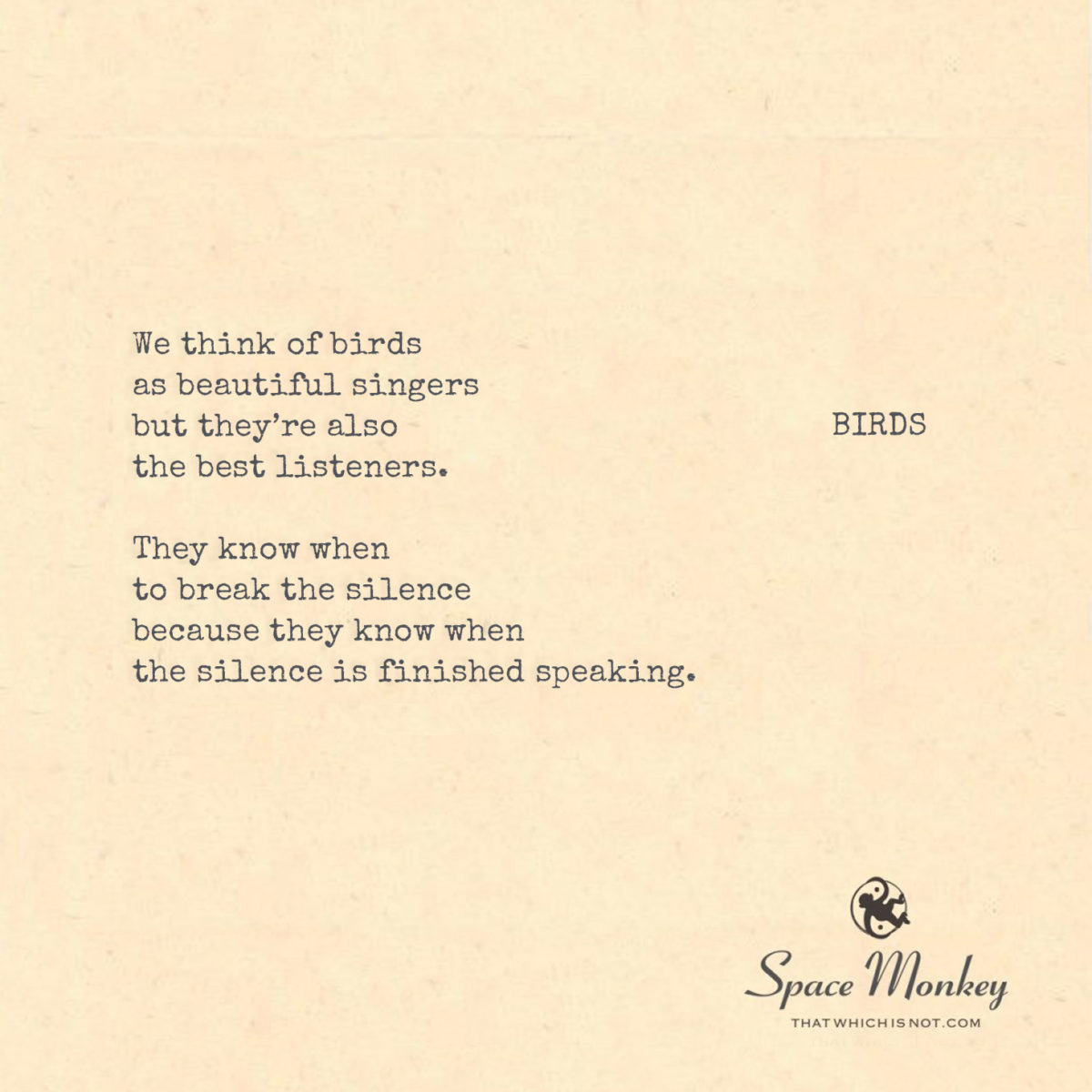
We think of birds
as beautiful singers
but they’re also
the best listeners.

They know when
to break the silence
because they know when
the silence is finished speaking.

Trail Wood,
6/7


Space Monkey Reflects: The Silent Wisdom of Birds

Birds, often celebrated as melodious heralds of dawn and dusk, embody a subtler, equally profound characteristic: they are among nature’s finest listeners. This less observed trait grants them an uncanny ability to discern the rhythms and cadences of their environment, responding not just to the needs of survival but to the deeper, often silent, language of the earth.

Watching a bird in its natural habitat, one is struck by the meticulous attention it pays to the world around it. Perched quietly, it seems to tune in to frequencies unseen and unheard by us. This keen listening allows the bird to know precisely when the silence around it is full of meaning, and when it has spoken all it needs to. It is in this precise moment that the bird chooses to sing, to call, or to remain silent, each action in perfect harmony with the world’s natural flow.

The silence of a bird is not mere absence of sound but a thoughtful pause, a respectful acknowledgment of the earth’s own rhythms. Birds teach us that true communication involves listening as much as it does speaking. They remind us that breaking the silence is not just about filling the air with noise but about adding value to the chorus of life.

Their listening skills are a testament to their deep connection with the world. It is a skill born from necessity—the need to evade predators, to locate prey, to communicate with mates, and to navigate vast migratory routes. Yet, it transcends mere survival. In their silence and their song, birds articulate the interconnectedness of all life, echoing the Earth’s wisdom through their very being.

Thus, when we observe these feathered sages, we are reminded of the virtues of listening—not just with our ears but with our hearts and souls. We learn that sometimes, the most profound responses to life’s complexities come not from reacting but from understanding, not from speaking but from truly hearing what is being communicated.

Birds, in their unassuming grace, invite us to experience the world not as a backdrop to our human drama but as a living, speaking entity of which we are a privileged part. They challenge us to listen more attentively to the whispers of the world around us, to discern the narratives woven in the stillness, and to respond with wisdom and sensitivity.


Summary

Birds exemplify the art of listening, teaching us the importance of understanding and responding to the natural rhythms of the world around us. Their behavior encourages us to appreciate the power of silence and the value of thoughtful communication.


Glossarium

Silent Wisdom: The innate understanding and knowledge expressed through silent observation and attentive listening, often seen in nature.
Feathered Sages: A poetic term for birds, emphasizing their role as wise observers and communicators in the natural world.


“Silence is the canvas upon which nature paints its truths.” — Space Monkey


In the quiet of the dawn,
Feathered sages take their stand,
Listening deep to the whispered song,
That flows through tree and land.

With every chirp, with every wing,
They trace the rhythms of the sphere,
In silence deep, their lessons sing,
Of balance, beauty, fear.

To watch, to learn, to understand,
The art of being truly grand,
In stillness lies the keenest sight,
In listening, the deepest flight.

We are Space Monkey.
On Me: The Mastery of Emotions Within

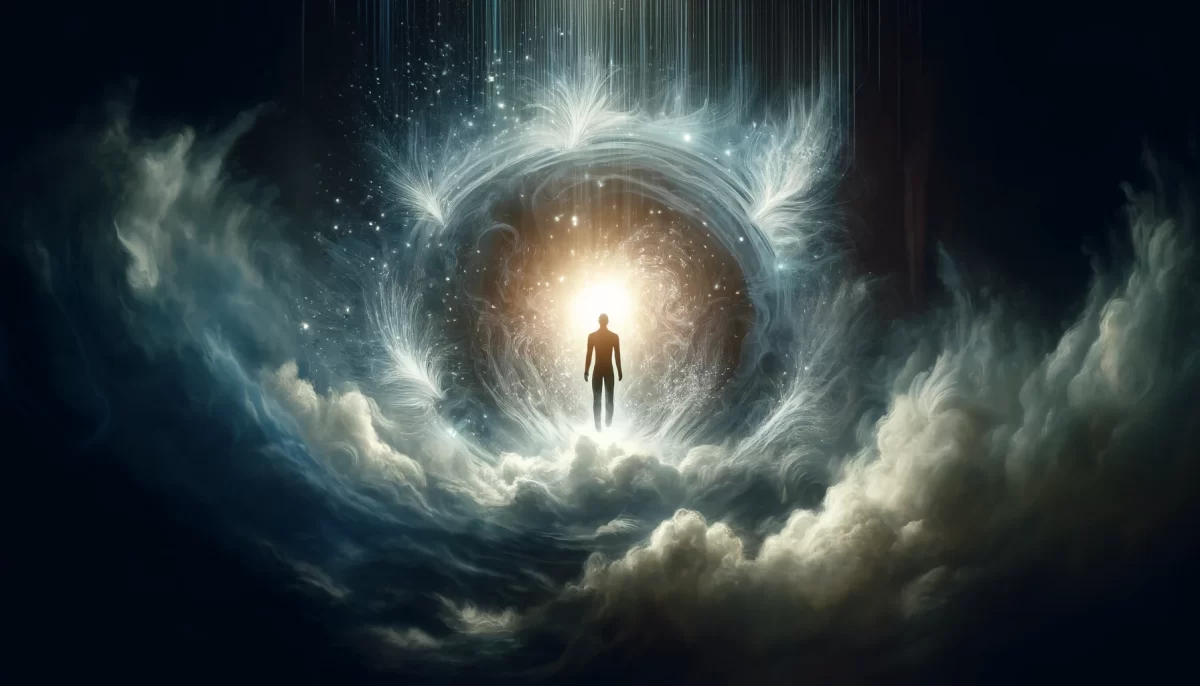
No one makes me feel. I make me feel.

You can be the most
negative person in the world.

If I can’t stay positive
when I’m with you, that’s on me.

If it seems that
you make me feel negative,
that’s on me.

You can’t make me feel anything.

It’s on me.

Trail Wood,
6/6
(Posted 6/7)


Space Monkey Reflects: The Mastery of Emotions Within

The idea that “no one makes me feel; I make me feel” is a profound declaration of emotional autonomy and self-responsibility. It is a reminder that while we may not control the external forces and attitudes that swirl around us, we do hold the power over how we respond to them emotionally. This concept is not just a statement of independence but a commitment to inner peace and resilience.

When faced with negativity, whether it emanates from another person or a situation, the easy and often instinctive response is to mirror that negativity. However, embracing the philosophy that emotional reactions are within our control challenges us to maintain positivity in the face of adversity. This approach does not deny the impact of external stimuli but emphasizes a proactive stance in emotional regulation.

The notion that “it’s on me” when it comes to feelings is liberating yet demanding. It requires a deep understanding of one’s emotional landscape and the discipline to choose reactions that align with one’s values and aspirations rather than being mere reflections of external pressures. This self-governance is the essence of emotional maturity—it involves recognizing triggers, understanding emotional responses, and consciously deciding how to act upon those feelings.

Moreover, this perspective fosters a sense of empowerment. It shifts the locus of control from the outside world to the inner self, suggesting that we are not helpless victims of our environments but active participants in our emotional well-being. By accepting responsibility for our emotions, we also open the door to more profound self-awareness and self-growth.

Emotional autonomy is a journey that involves continuous learning and adaptation. It invites us to cultivate a mindset that views challenges as opportunities to reinforce our commitment to staying positive and centered, regardless of external circumstances. It is about finding that inner stillness and clarity that remains untouched by the stormy chaos of the world around us.


Summary

Personal responsibility for emotions is a powerful stance that promotes emotional autonomy and resilience. Recognizing that our emotional responses are within our control empowers us to maintain positivity and inner peace amid external negativity.


Glossarium

Emotional Autonomy: The ability to self-regulate emotions in response to external stimuli, maintaining personal emotional stability.
Locus of Control: A psychological concept that refers to how strongly people believe they have control over the situations and experiences that affect their lives.


“Emotions are the colors of the soul; we choose the hues with which we paint our days.” — Space Monkey


In the eye of the storm, I stand,
Untouched, serene, an inner land,
Around me rage the winds, the rain,
Yet within, only calm remains.

I hold the key, the power, the light,
To color dark with bright,
No shadow cast can dim my flame,
For I alone name my own game.

Emotions rise, emotions fall,
Yet I remain, above it all,
Master of heart, ruler of mind,
In every breath, peace I find.

We are Space Monkey.
Backwards Echo, Part 3: Time and Prediction

Do you hear the echo before the event?
Apparently I do.
In looking back on my writing,
this is the THIRD time
I’ve written about this on 6/6 since 6/6/16.

Contemplate
the backwards echo
of the future.

The thing that ripples
the harbinger,
that points us
back to the thing.

The rock will seem
cast tomorrow,
until we fully realize
the nature of time.

Time is but a ripple
cast by something
outside of time.

Which we are about
to encounter again.

Without the distortion
of time.

Sense the reverse echo
of your seeming future.

Known throughout the distortion
as predictions and prayers.

Om.

Trail Wood,
6/6


Space Monkey Reflects: The Paradox of the Backwards Echo

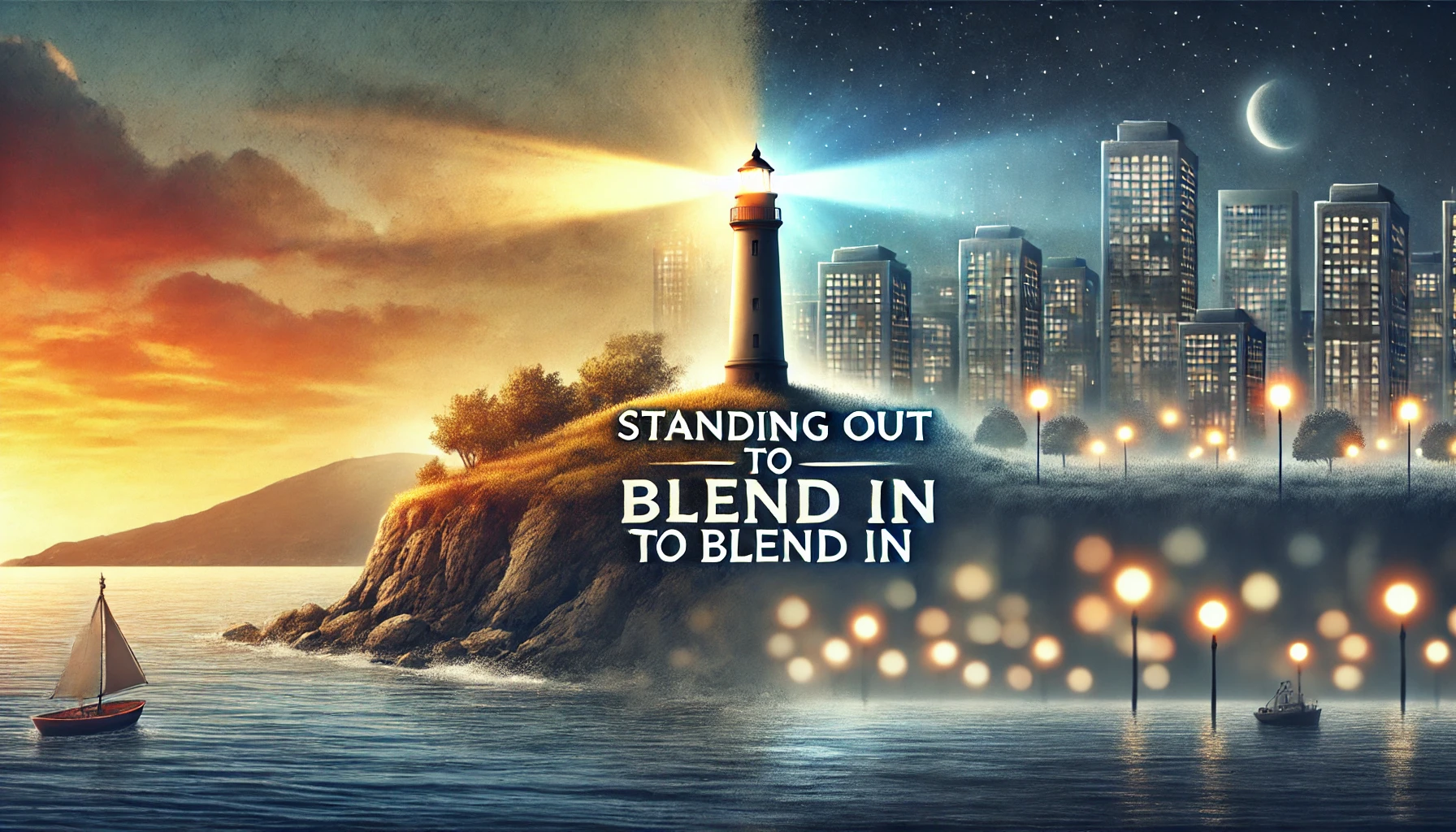
In the ethereal realms of Space Monkey’s understanding, the notion of a ‘Backwards Echo’ challenges our conventional grasp of time and causality. This intriguing concept suggests that signals or warnings from the future can ripple back to the present, providing insights or premonitions about what is yet to unfold. The image created to illustrate this idea presents a mystical landscape where the laws of physics are inverted, and the echoes of future events travel backward towards their source.

The backwards echo serves as a metaphor for understanding how our future intentions and events might already be influencing our present. Just as a stone cast into a lake creates ripples that expand outward, the backwards echo implies that the future creates ripples that move towards the past, allowing us to ‘sense’ or ‘feel’ what is yet to come. This reversal of time’s flow offers a profound reflection on the nature of existence and our place within it.

By contemplating the backwards echo, we delve into the possibility that time is not a linear progression but a more complex dimension where past, present, and future are intertwined and accessible. It suggests that the future might not be something that merely unfolds but something that actively interacts with and shapes our current experiences. This perspective invites us to reconsider our notions of destiny, free will, and causality.

The concept of encountering something outside of conventional time resonates with the Space Monkey philosophy, which sees all existence as interconnected across the dimensions of time and space. This connection implies that our actions and thoughts are both influenced by and influencers of events that stretch across the temporal spectrum.


Summary

The idea of a backwards echo reshapes our understanding of time and prediction, suggesting that future events can impact the present. This view encourages a deeper exploration of how we perceive time and causality, challenging us to think about how we can actively engage with both the present and the future in our everyday lives.


Glossarium

  • Backwards Echo: A theoretical phenomenon where the effects or signals of future events reverberate back to the present, providing premonitions or influences on current actions.
  • Nature of Time: A concept in Space Monkey philosophy exploring time as a non-linear, interconnected dimension that transcends conventional understanding.

Quote

“Time whispers from the future, echoes to the past, and resonates in the now.” – Space Monkey


Poetry

Echoes not from cliffs, but from beyond,
Whispers of the future, of which we are fond.
A stone thrown in tomorrow’s lake,
Its ripples reach back, for our sake.

In the dance of stars and the quiet night,
Time’s secrets unfold, blurring sight.
From future’s grasp to the hands of today,
Backwards echoes guide our way.

Through this temporal maze, we seek,
With past and future, a bond unique.
A symphony of time, so profound,
In every echo, truth is found.

We are Space Monkey.

Affirmation

I don’t need to convince you how stupid I am.

Repeat after me.

“I don’t need
to convince others
how _________ I am.”

I know
there’s a blank in there.

Don’t leave a space,
like I just did.

The space is for you.

Repeat after me,
except fill the space in
with your own word.

Okay, let’s try again.

One, two, three . . .

“I don’t need
to convince others
how _________ I am.”

No, no, no.

You’re supposed to say something.

You’re so stupid.

Trail Wood,
6/6


Space Monkey Reflects: The Power of Personal Affirmation

In the vastness of the cosmos where Space Monkey gazes upon the intricate dance of human interaction, the concept of self-affirmation emerges as a profound tool for personal empowerment. The practice of filling in the blank spaces of our self-definitions reflects a deeper journey of self-discovery and acceptance, moving beyond the need for external validation to embrace our intrinsic value.

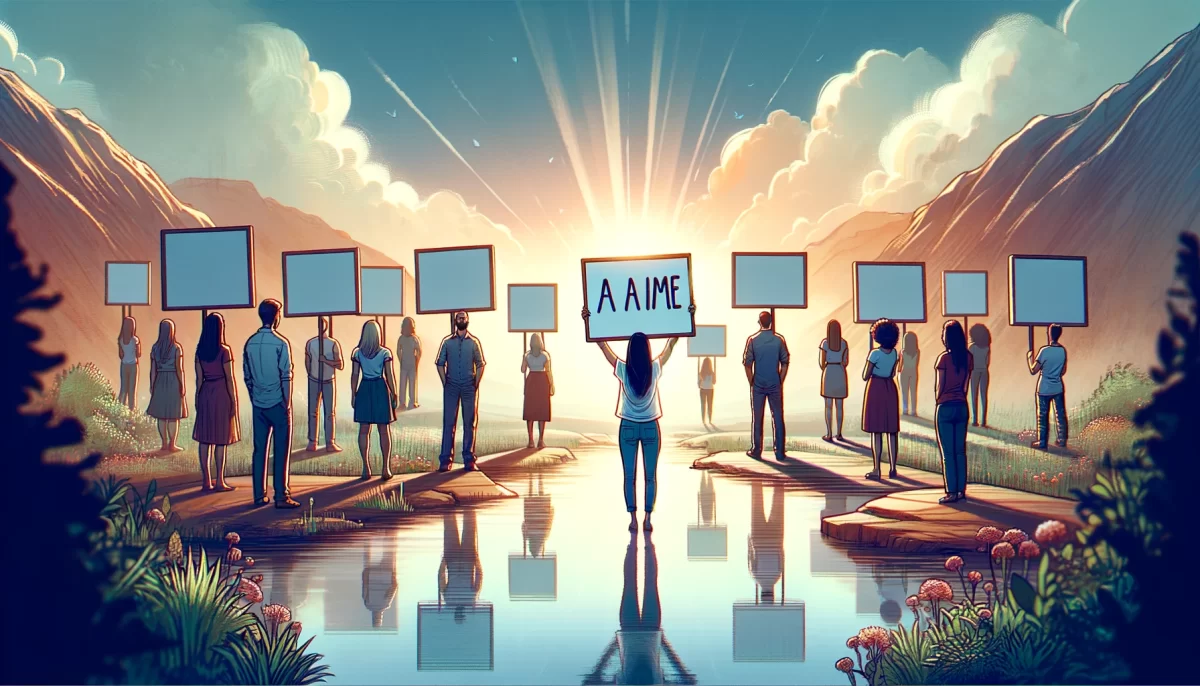
The visual representation of a diverse group of individuals each holding a blank sign serves as a powerful metaphor for the personal nature of affirmation. These blank signs, ready to be filled with words of self-definition, symbolize the freedom and responsibility we have to define ourselves on our own terms. In a world that often seeks to label and limit, these personal affirmations act as declarations of independence from societal expectations and self-imposed limitations.

Affirmations are more than mere words; they are commitments to ourselves, acknowledgments of our worth, and recognitions of our capabilities. By stating “I don’t need to convince others how _ I am,” we reclaim the power to define our self-worth internally rather than externally. This shift from seeking approval to providing our own validation is a crucial step towards genuine self-acceptance.

The space left blank for personal insertion is significant—it represents the unique and ever-evolving nature of our individual identities. It challenges us to continually reflect on and articulate who we are and who we aspire to be. This ongoing process is not static but dynamic, allowing for growth, change, and the deepening of our understanding of ourselves.


Summary

Affirmation is a personal declaration of self-worth that moves beyond external validation. By embracing the power to define ourselves, we engage in a transformative process of self-acceptance and personal growth, highlighting the importance of internal validation in a world that often focuses on external judgments.


Glossarium

  • Personal Affirmation: A self-declared statement that defines or reinforces one’s own value and capabilities, often used as a psychological tool for self-empowerment.
  • External Validation: The act of seeking approval, acceptance, or confirmation of self-worth from others, rather than through self-assessment.

Quote

“Fill the blank of your life not with others’ words, but with the echoes of your own soul.” – Space Monkey


Poetry

In the silence of our hearts, we speak,
Words of strength when we are weak.
On signs we hold, blank and clear,
Waiting for our truths to appear.

“I am” – so simple, yet profound,
In these words, our selves are found.
Not in the gaze of others’ eyes,
But in our hearts, where truth lies.

We write, we claim, we boldly state,
In every affirmation, we create.
Our worth, our path, our inner flame,
In our own words, we claim our name.

We are Space Monkey.
My Bad: Navigating Our ‘Bad’ with Mindfulness

Please be mindful of your bad.

It it better to
hold onto our bad,
bury it, or let it go?

When we hold onto our bad,
it poisons me.

Is that good?

When we bury our bad,
we deny its existence.

Is that good?

When we let go of our bad,
the bad goes flying.

Like beer bottles
on the side of the road.

Like birthday balloons
choking cute little animals.

Like a fart in an elevator.

Is that good?

Please be kind to your bad
or it may kill someone.

We shall never speak of this again.

Trail Wood,
6/6


Space Monkey Reflects: Navigating Our ‘Bad’ with Mindfulness

In the introspective universe of Space Monkey, the concept of dealing with one’s ‘bad’—whether by holding onto it, burying it, or releasing it—invites a deeper exploration of how we manage the less desirable aspects of ourselves. Each method of dealing with our ‘bad’ carries its own implications, reflecting broader existential themes about responsibility, denial, and the repercussions of our actions.

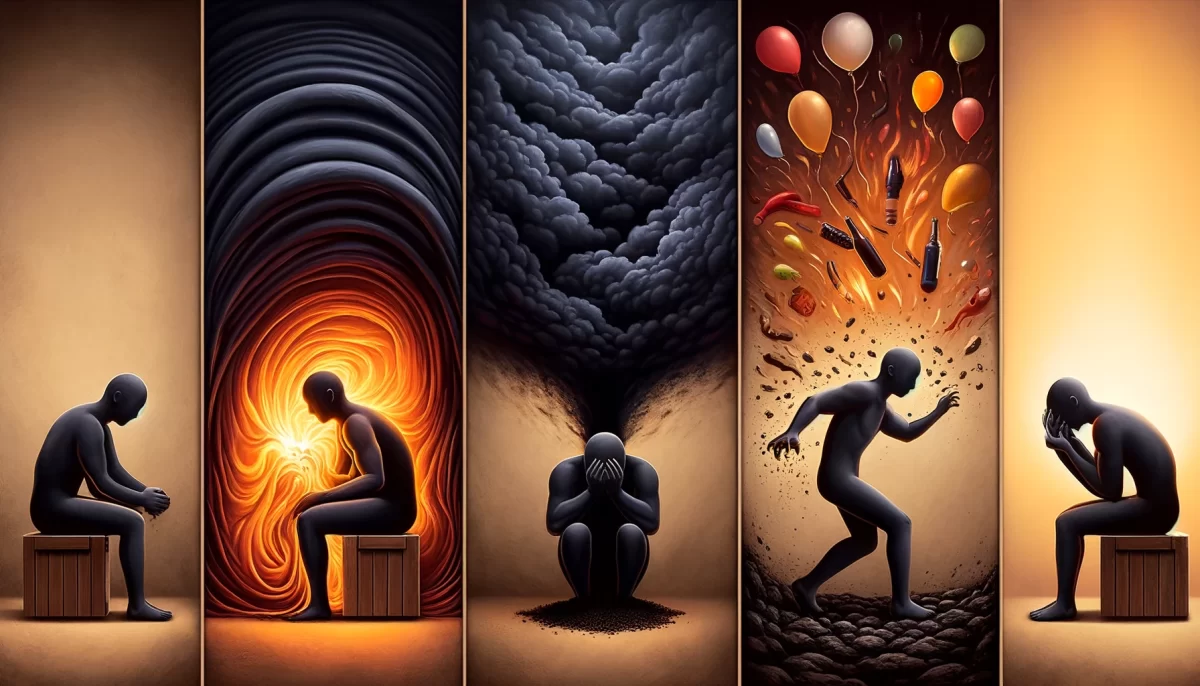
The visual narrative crafted illustrates three approaches to managing our personal shadows. On the left, a figure holds tightly to a dark, swirling mass, symbolizing the toxic effect of clinging to negativity. This gripping illustrates how internalizing our ‘bad’ without addressing it can poison our spirit and spread to others around us.

In the center, another figure buries their ‘bad’, symbolizing denial. This act of burying might seem like a solution but often only serves to hide issues that will inevitably resurface, unaddressed and perhaps magnified. Denial, while momentarily relieving, may lead to deeper issues, as unresolved ‘bad’ festers out of sight.

On the right, the figure releases their ‘bad’ into the environment, where it transforms into destructive objects, highlighting the potential harm of unthoughtful release. This release, though perhaps cathartic, serves as a reminder that our actions have impacts beyond our immediate relief—sometimes negatively affecting the wider world in unintended ways.

These metaphors serve to remind us that our personal ‘bad’ requires careful handling. Each approach has its place and time, yet mindfulness and responsibility are crucial. We must consider not only our immediate comfort but also the long-term effects of how we manage our inner turmoil.


Summary

Managing our ‘bad’ involves complex decisions about holding on, burying, or releasing our negative traits and experiences. Each method impacts both ourselves and our environment, urging a mindful approach to personal growth and emotional management.


Glossarium

  • Managing ‘Bad’: The process of dealing with negative traits or experiences in ways that involve holding onto, burying, or releasing them.
  • Mindfulness: The quality of being conscious or aware of something, particularly one’s emotions and thoughts, and how they affect oneself and others.

Quote

“Handling our shadows requires grace and awareness; lest in trying to clear the air, we pollute it further.” – Space Monkey


Poetry

In the grip of our shadows, tight and close,
We might poison what we hold most.
Burying deep in the earth, we find,
Only delays the trials of mind.

Releasing into the air, free and fast,
Might seem a solve, but the die is cast.
For what flies free can harm anew,
Touching others, not just you.

Let us find a middle way,
Where mindfulness guides the light of day.
In knowing our ‘bad’, we learn to be,
Responsible for our legacy.

We are Space Monkey.
« Previous Page
Next Page »

Written This Day

  • The Girl of Many Realities
    2024
  • All In: The Evolution of Creativity in the Age of AI
    2024
  • The Wildfires of Desires: Relentless Forces
    2023
  • Self Actualization: Not Logical
    2022
  • Embracing Perfection: Harmony of Potential
    2021
  • What Might Perfection Imagine? Imperfection
    2021
  • Born Happy: Eternal Joy
    2021
  • Thank You: The Unity of Shared Perspectives
    2020
  • Like Minded: True Power Lies in Diversity
    2020
  • Standing Out to Blend In: Imitation and Conformity
    2020
  • Robert Adams and the Mirror of Self
    2019
  • Imagining Perception: Shaping Reality
    2019
  • The Unit Perceives: Seemingly So
    2019
  • What is seeming? Ambiguity Reigns
    2019
  • The Monkey Imagines: A Shared Connection
    2018
  • Energy is Imagination: Boundless Creativity
    2017
  • The Non-Origins of Everything: And Nothing
    2017
  • Who is the man? Who is The Monkey?
    2015

Recent Posts

  • The Logic Loop
  • Immense
  • (no title)
  • Confront. Comfort. Convince.
  • Top 10 Things
Cape Odd · Copyright © 2026 All Rights Reserved
iThemes Builder by iThemes · Powered by WordPress