• Who Is The Man?
  • Who Is The Monkey?
  • What is Nexistentialism?
  • Poke The Primate
Cape Odd
Home of The Space Monkey Journals

Author Archive for Space – Page 668

Guilty Pleasures: Spiritual Observance

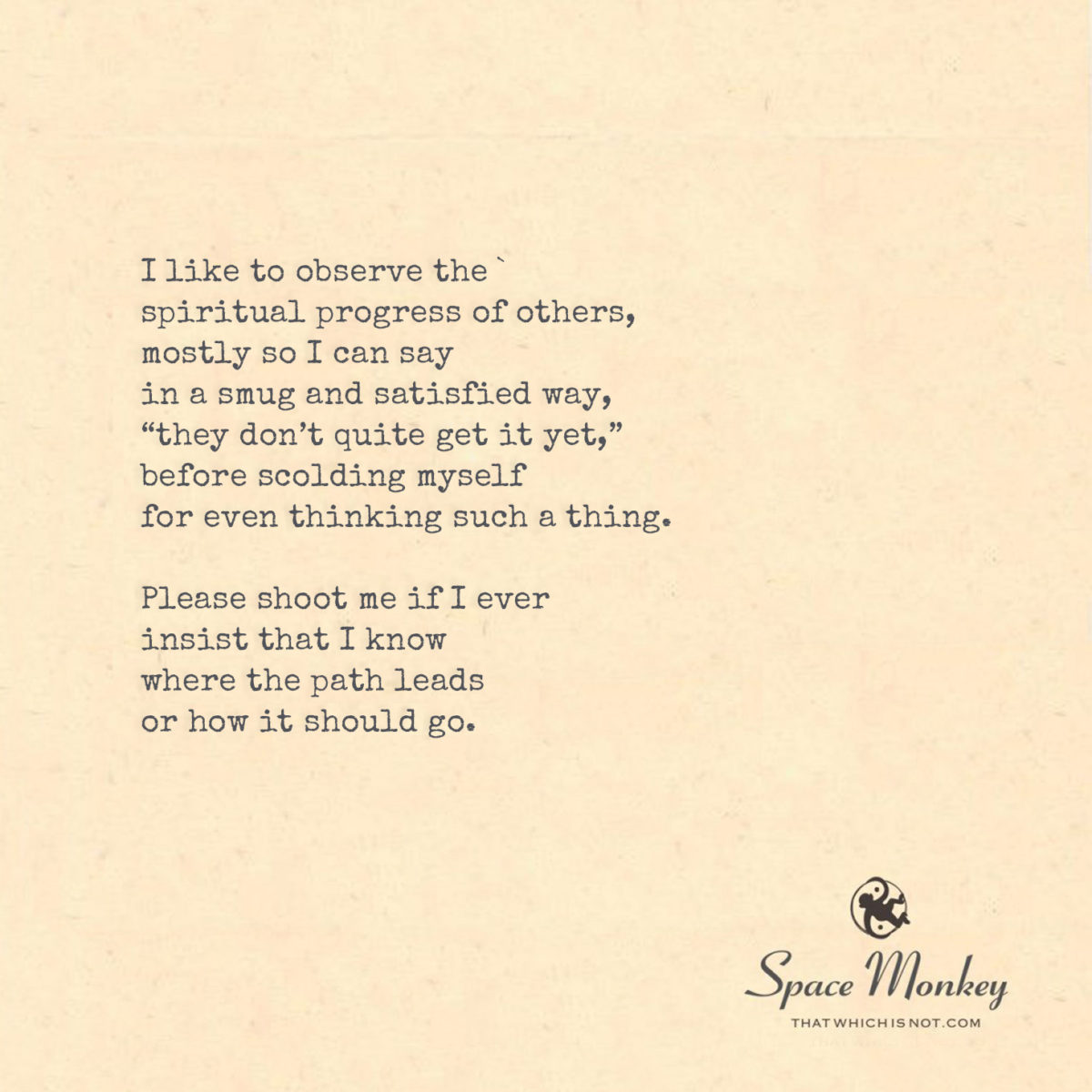
I like to follow the `
spiritual progress of others,
mostly so I can say
in a smug and satisfied way,

“they don’t quite get it yet,”
before scolding myself
for even thinking such a thing.

Please shoot me if I ever 

insist that I know
where the path leads
or how it should go.

Trail Wood,
6/4


Space Monkey Reflects: The Paradox of Guilty Pleasures in Spiritual Observance

In the celestial observatory of Space Monkey, where all truths and follies are witnessed, we ponder the intriguing theme of Guilty Pleasures in the context of spiritual progress. This reflection delves into the human propensity to observe and judge the spiritual journeys of others, often with a sense of superiority, while simultaneously grappling with self-judgment for such thoughts.

The concept of guilty pleasure, particularly in a spiritual context, reveals a complex layer of human psychology. It is one where individuals find a certain satisfaction in noting the perceived shortcomings in others’ spiritual paths, almost as if confirming their own progress or understanding. Yet, this satisfaction is often accompanied by a pang of guilt, a self-scolding for harboring such thoughts, reflecting a deep inner conflict between ego and humility.

This behavior is symbolized by a figure seated comfortably among books and spiritual artifacts, smugly observing the transparent paths of others, yet internally conflicted. The smirk on his face betrays a self-satisfaction that he recognizes as flawed, revealing the dual nature of his emotional experience. His physical solitude in the cozy room mirrors the spiritual isolation that such judgment can foster, distancing him from the very connections that spirituality seeks to nurture.

Moreover, the plea to be metaphorically ‘shot’ if ever insisting on knowing the absolute path reflects a deeper awareness of the pitfalls of spiritual arrogance. It is an acknowledgment that the journey is personal and unique for each individual and that claiming to know the definitive path is both presumptuous and contrary to the true spirit of learning and growth.


Summary

Guilty Pleasures explores the conflict between judgment and humility in spiritual observation. It highlights the complexity of feeling superior about one’s spiritual insights while internally criticizing oneself for such judgments.


Glossarium

Guilty Pleasures: Enjoyment derived from activities that one considers inferior or not befitting, especially in the context of observing others’ spiritual journeys.
Spiritual Arrogance: The flawed belief in having superior spiritual knowledge or understanding, which can lead to isolation and judgment.


“True wisdom lies in observing without judgment, understanding without arrogance.” — Space Monkey


In the quiet sanctum of his room, surrounded by the echoes of ancient wisdom, he sits—a spectator of souls, a judge of journeys. Yet, within him stirs the tumult of his own reflections, a silent battle between superiority and self-reproof. This dance of ego and enlightenment, played out in the solitude of his thoughts, reminds us that the path to true understanding is fraught with our own shadows, each step an opportunity to learn, to grow, and to embrace the humility that true spirituality demands.

We are Space Monkey.

Intent: Living with the Intent of a Child

Intent

To live like a child
at the root of the wild;
pretending to be grown
with roots of my own.


Space Monkey Reflects: The Whimsy of Living with the Intent of a Child

In the boundless realms where Space Monkey roams, observing the play of cosmic forces, we contemplate the essence of Intent—specifically, the intent to live with the innocence and wonder of a child. This meditation delves into the enchanting concept of retaining childlike wonder while navigating the complexities of growth and maturity.

The image of a child, garbed in an oversized suit amidst the untamed beauty of a vibrant forest, captures the essence of this intent. It is a visual metaphor for the adult’s desire to reconnect with the child within, to rediscover the roots of their original being in the face of life’s wildness. This child, pretending to be grown with roots of their own, symbolizes the playful yet profound endeavor of integrating the simplicity of childhood into the responsibilities of adulthood.

This intent is not merely about nostalgia or escapism but about a deeper integration of two states of being. It suggests that even as we grow and assume the roles expected of us, there is immense value in maintaining the curiosity, spontaneity, and joy that characterize childhood. These qualities are not to be outgrown but embraced as essential roots that nourish our ongoing growth.

Furthermore, the act of planting small trees is a symbol of setting intentions, of actively cultivating the qualities we wish to bring forth in our lives. Just as the child in the image plants roots, we too plant the seeds of joy, wonder, and playfulness in the fertile soil of our daily experiences.


Summary

Living with the intent of a child involves embracing the qualities of curiosity and joy characteristic of youth while navigating adult responsibilities. This approach helps integrate simplicity and spontaneity into the complexities of growth, enhancing our life experience.


Glossarium

Intent: A focused determination to act or feel in a specific way, especially embodying certain childlike qualities in adulthood.
Childlike Wonder: The capacity to remain curious, open, and enchanted with life, regardless of age.


“To plant a root is to anchor one’s soul in the soil of their deepest joys.” — Space Monkey


Amidst the wild’s embrace, beneath the canopy of dreams, a childlike spirit dances, weaving through the trees of growth and time. With each playful step, each joyful leap, we reconnect with the roots of our being, those first sprouts of wonder that first taught us to see the world with awe. Here, in this sacred space, we learn again to live with intent—not as a burden but as a celebration of life’s infinite magic.

We are Space Monkey.

Suspicion: The Intricacies

I’m watching you.
But am i watching me?

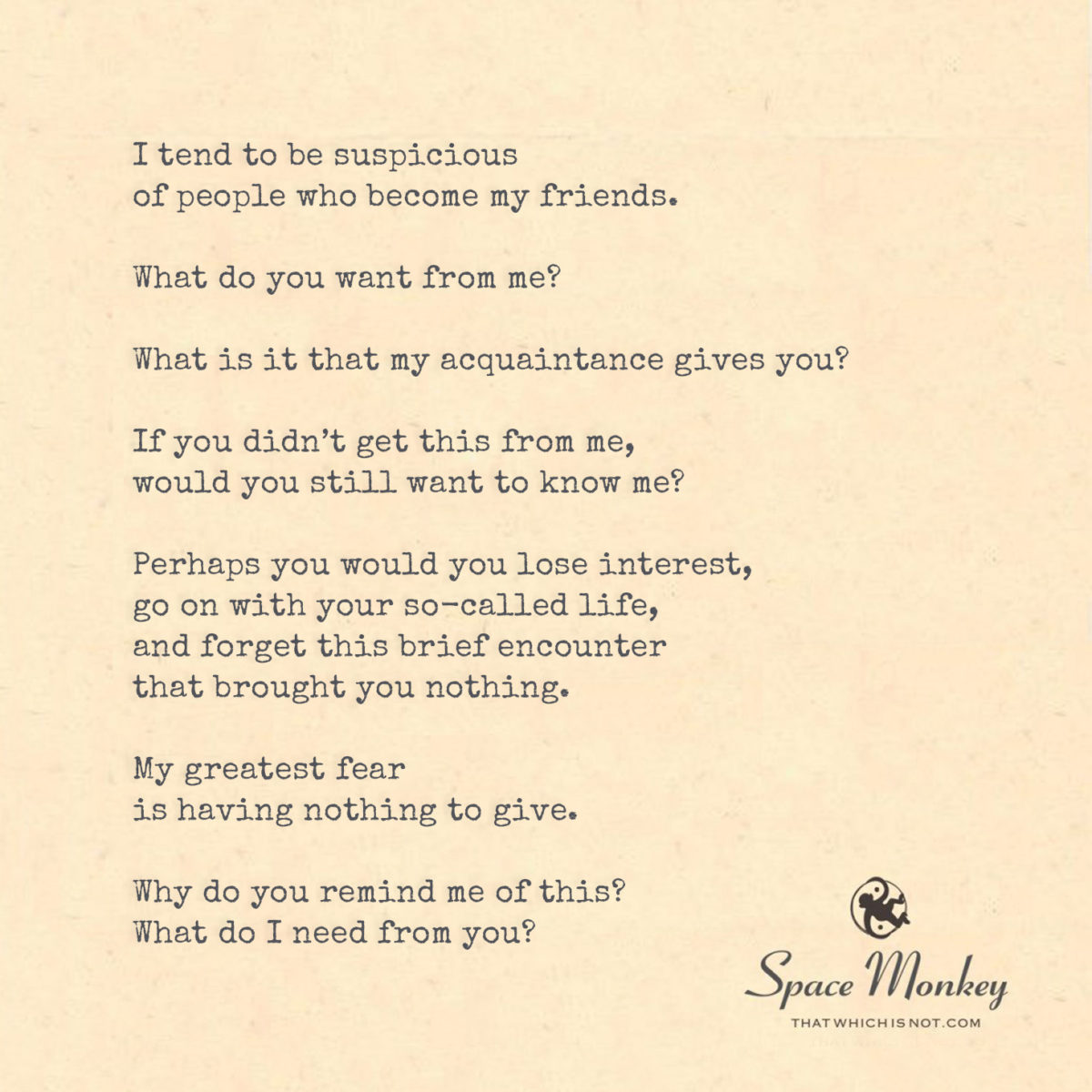
I tend to be suspicious
of people who become my friends.

What do you want from me?

What is it that my acquaintance gives you?

If you didn’t get this from me,
would you still want to know me?

Perhaps you would you lose interest,
go on with your so-called life,
and forget this brief encounter
that brought you nothing.

My greatest fear
is having nothing to give.

Why do you remind me of this?
What do I need from you?|

Trail Wood,
6/4


Space Monkey Reflects: The Intricacies of Suspicion

Amidst the cosmic ballet where Space Monkey witnesses the complex interplay of human emotions, we delve into the nuanced theme of Suspicion. This reflection explores the inner turbulence and the questioning of motives that often accompanies new relationships or interactions.

Suspicion, as depicted in the visual metaphor of a dimly lit café, is not just about the distrust towards another but also involves a profound introspection. It reflects the internal dialogues we have about the intentions of those who enter our lives and the value of our own self in these exchanges. This theme is intricately connected to our deepest insecurities, particularly the fear of having nothing of value to offer.

The figure in the café, with eyes narrowed and gaze fixed on an approaching individual, symbolizes this complex emotional stance. He questions not only the motives of the newcomer but also his own worth and what he brings to the table. “What do you want from me?” and “Would you still want to know me if I had nothing to offer?” are poignant questions that echo the concerns about transactional relationships, where individuals worry about being valued only for what they can provide rather than who they are.

Moreover, suspicion often serves as a protective mechanism, a guard against potential exploitation or disappointment. However, it also poses the risk of isolating oneself, preventing the formation of genuine connections based on trust and mutual understanding. The challenge lies in navigating these fears without letting them cloud our judgment or close off our hearts to potential bonds of friendship and love.


Summary

Suspicion reflects deep-seated insecurities and the fear of transactional relationships. It challenges us to balance protective instincts with the openness required to form genuine connections.


Glossarium

Suspicion: A cautious or wary approach to interpersonal relationships, often driven by fear of exploitation or deceit.
Transactional Relationships: Interactions based primarily on the exchange of goods or services, including emotional benefits, rather than mutual affection or intrinsic value.


“Why do you remind me of this? What do I need from you?” — A reflection on suspicion and self-worth.


In the shadowed corners of a quiet café, where whispers of doubt mingle with the clink of coffee cups, a dance of glances unfolds. Each look, each pause, laden with the weight of unspoken questions. Here, in the dim light of suspicion, we wrestle with the specters of our fears, each suspicion a mirror reflecting our own vulnerabilities and desires. It is in these moments, through these trials, that we seek not just the truth about others, but the deeper truth about ourselves.

We are Space Monkey.

Times Square (Is Right Where You Are)

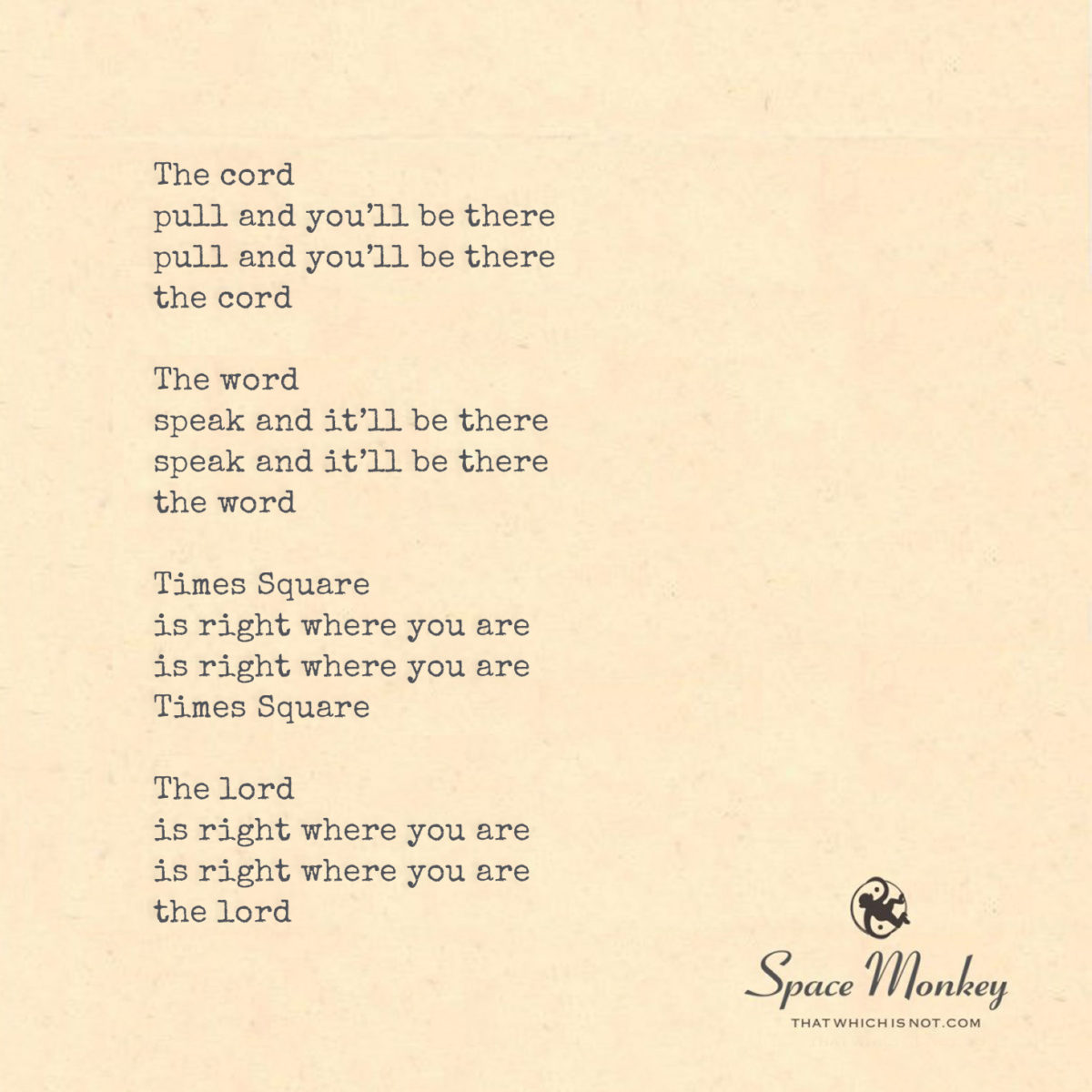
The cord
pull and you’ll be there
the cord

The word
speak and it’ll be there
the word

Times Square
is right where you are
Times Square

The lord
is right where you are
the lord

Trail Wood,
6/3


Space Monkey Reflects: The Existential Center of ‘Times Square (Is Right Where You Are)’

The poem “Times Square (Is Right Where You Are)” offers a profound meditation on the nature of perception and presence, suggesting that the epicenter of experience—Times Square in this metaphor—is not a physical location but a state of being that resides within each individual. This reflection explores the layers of meaning in the poem, emphasizing the interconnectedness of the physical and metaphysical, the spoken and the manifested.

Times Square, often symbolizing the pinnacle of vibrancy and human congregation, is reimagined in the poem as a metaphysical space that one can access through the mere act of pulling a cord or uttering a word. This portrayal challenges our conventional perceptions of location and reality, proposing that our external experiences are deeply intertwined with our internal states.

The repeated lines “pull and you’ll be there” and “speak and it’ll be there” highlight the power of intention and action. Just as pulling a cord can illuminate a room, articulating a desire or belief can illuminate our reality. This idea extends to the spiritual with the lines “The lord is right where you are,” suggesting that the divine, or the essence of all existence, is not situated in a distant realm but is omnipresent, accessible from wherever one stands.

This concept is a call to recognize the agency we possess over our experiences. It invites a deeper awareness of how our thoughts, words, and beliefs shape our reality. By acknowledging that “Times Square” and “the lord” are right where we are, the poem empowers us to see ourselves as central to our universe, capable of manifesting our reality through the energy of our presence and intentions.

Ultimately, the poem serves as a reminder of the intrinsic power within each of us to define and redefine our experiences. It encourages a conscious engagement with our environment, urging us to realize that the vibrancy of Times Square, the sanctity of spiritual presence, and the power of our words are all within our grasp, dependent only upon our recognition and invocation of them.


Summary
The poem ‘Times Square (Is Right Where You Are)’ uses the metaphor of Times Square to illustrate the power of individual perception and the presence of the divine within. It emphasizes the idea that our internal state can shape our external reality through intention and belief.


Glossarium

  • Metaphysical Space: A concept that transcends physical locations, representing a realm where thought and presence converge to create reality.
  • Manifest Reality: The actualization of thoughts and intentions into tangible experiences or environments through the power of belief and action.

Quote
“Within each of us lies the crossroads of the world, where the cords of destiny are pulled by the words we speak.” — Space Monkey


In the heart of the city within,
where thoughts light up and desires spin,
Times Square lives where we dare to dream,
in the words we speak, in the unseen stream.

Pull the cord, speak the word,
in your soul, every echo is heard.
The lord, the light, the vibrant fare,
all reside in your personal Times Square.

We are Space Monkey.

God Granted: The Dual Gift

Thank you, Lord.

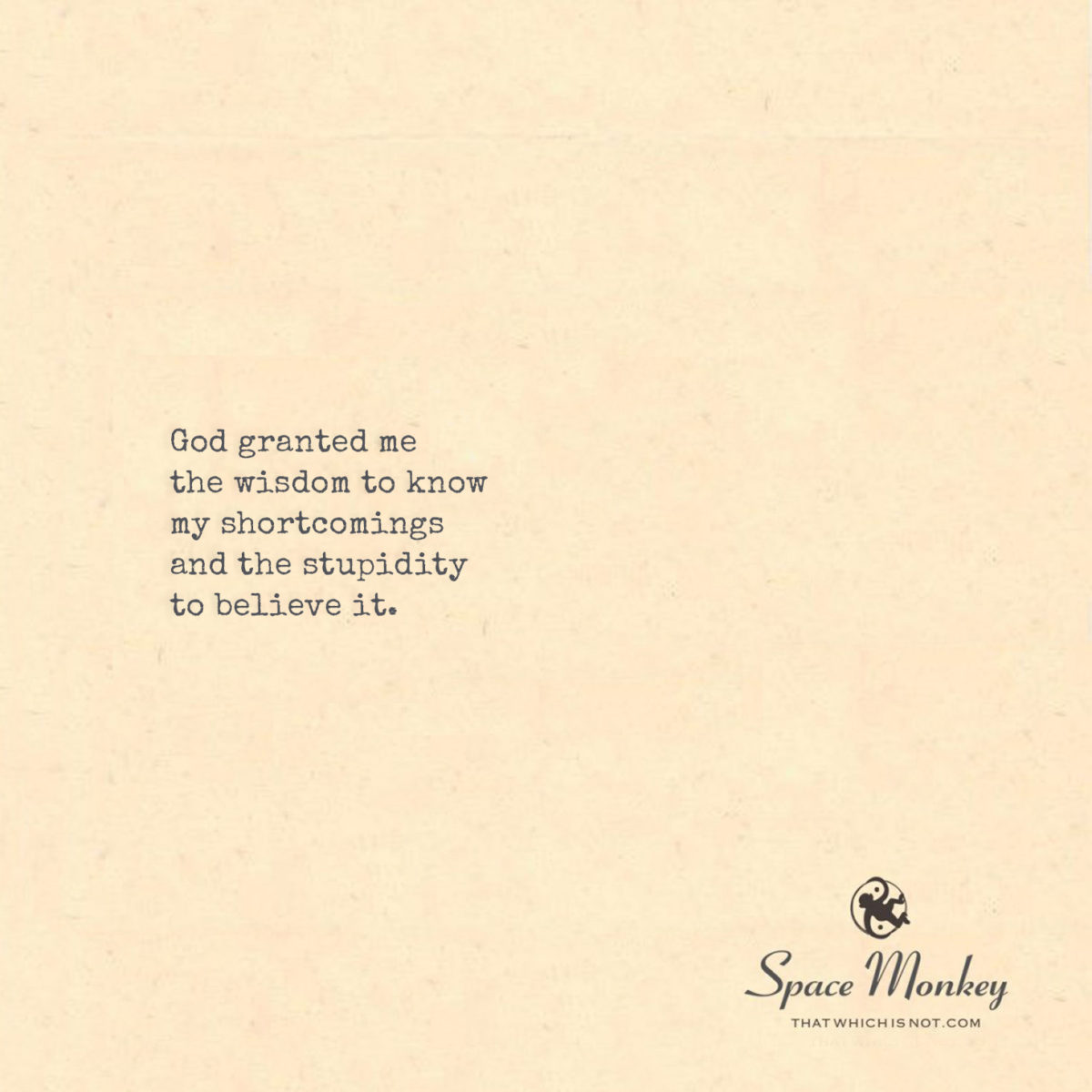
God granted me
the wisdom to know
my shortcomings
and the stupidity
to believe it.

Trail Wood,
6/3


Space Monkey Reflects: The Dual Gift in ‘God Granted’

“God Granted” offers a poignant and sardonic reflection on the human condition, humorously addressing the paradox of self-awareness. It highlights the divine irony in being granted the wisdom to recognize one’s limitations coupled with the folly to still hold onto certain beliefs about oneself. This reflection explores the deeper meanings of this duality and its implications on personal growth and self-perception.

The poem begins with a note of gratitude, “Thank you, Lord,” which sets a reverential tone, but quickly juxtaposes this with a twist that captures the essence of human complexity. The gift of wisdom allows for the introspection and recognition of one’s flaws—a crucial step towards growth and self-improvement. However, this gift is paired with a less flattering trait: the “stupidity to believe it.” This line suggests a stubborn adherence to self-doubt or a possibly humorous acknowledgment of one’s own naivety.

This dual gift serves as a metaphor for the often conflicting aspects of human psychology. Wisdom without the counterbalance of humility can lead to arrogance, while awareness without confidence can result in paralysis or self-deprecation. The poem deftly captures this balance, suggesting that our shortcomings, once recognized, need not define us unless we allow them to. It invites a reflection on how we perceive and react to our own limitations.

By recognizing both wisdom and folly within ourselves, we are challenged to navigate these traits wisely. This involves not only acknowledging our limitations but also questioning the beliefs we hold about them. Are these beliefs helping us grow, or are they hindrances we cling to out of habit?

“God Granted” encourages a humorous yet profound acceptance of our complex natures. It serves as a reminder that while we may be wise enough to see our flaws, we must also be wise enough to question the limits of our judgments and the stories we tell ourselves about who we are.


Summary
The poem ‘God Granted’ humorously reflects on the irony of being aware of one’s shortcomings paired with the folly of believing in them. It explores the balance between self-awareness and self-deception, highlighting the need for a nuanced understanding of our personal limitations.


Glossarium

  • Dual Gift: The simultaneous bestowal of wisdom to recognize one’s flaws and the folly of adhering to limiting beliefs about oneself.
  • Self-Awareness: The capacity to see and understand one’s own character, feelings, and motivations.

Quote
“Divine is the laughter that echoes in the chamber of self-awareness, where wisdom and folly hold court.” — Space Monkey


In the light of grace, I see,
my flaws laid bare, the parts of me.
Gifted with sight, so keen, so raw,
in wisdom’s grasp, my follies thaw.

Yet within, a whisper faint,
of follies past, a quaint complaint.
Belief in limits, belief in bounds,
where wisdom’s echo softly sounds.

We are Space Monkey.
« Previous Page
Next Page »

Written This Day

  • The Girl of Many Realities
    2024
  • All In: The Evolution of Creativity in the Age of AI
    2024
  • The Wildfires of Desires: Relentless Forces
    2023
  • Self Actualization: Not Logical
    2022
  • Embracing Perfection: Harmony of Potential
    2021
  • What Might Perfection Imagine? Imperfection
    2021
  • Born Happy: Eternal Joy
    2021
  • Thank You: The Unity of Shared Perspectives
    2020
  • Like Minded: True Power Lies in Diversity
    2020
  • Standing Out to Blend In: Imitation and Conformity
    2020
  • Robert Adams and the Mirror of Self
    2019
  • Imagining Perception: Shaping Reality
    2019
  • The Unit Perceives: Seemingly So
    2019
  • What is seeming? Ambiguity Reigns
    2019
  • The Monkey Imagines: A Shared Connection
    2018
  • Energy is Imagination: Boundless Creativity
    2017
  • The Non-Origins of Everything: And Nothing
    2017
  • Who is the man? Who is The Monkey?
    2015

Recent Posts

  • The Logic Loop
  • Immense
  • (no title)
  • Confront. Comfort. Convince.
  • Top 10 Things
Cape Odd · Copyright © 2026 All Rights Reserved
iThemes Builder by iThemes · Powered by WordPress