• Who Is The Man?
  • Who Is The Monkey?
  • What is Nexistentialism?
  • Poke The Primate
Cape Odd
Home of The Space Monkey Journals

Author Archive for Space – Page 744

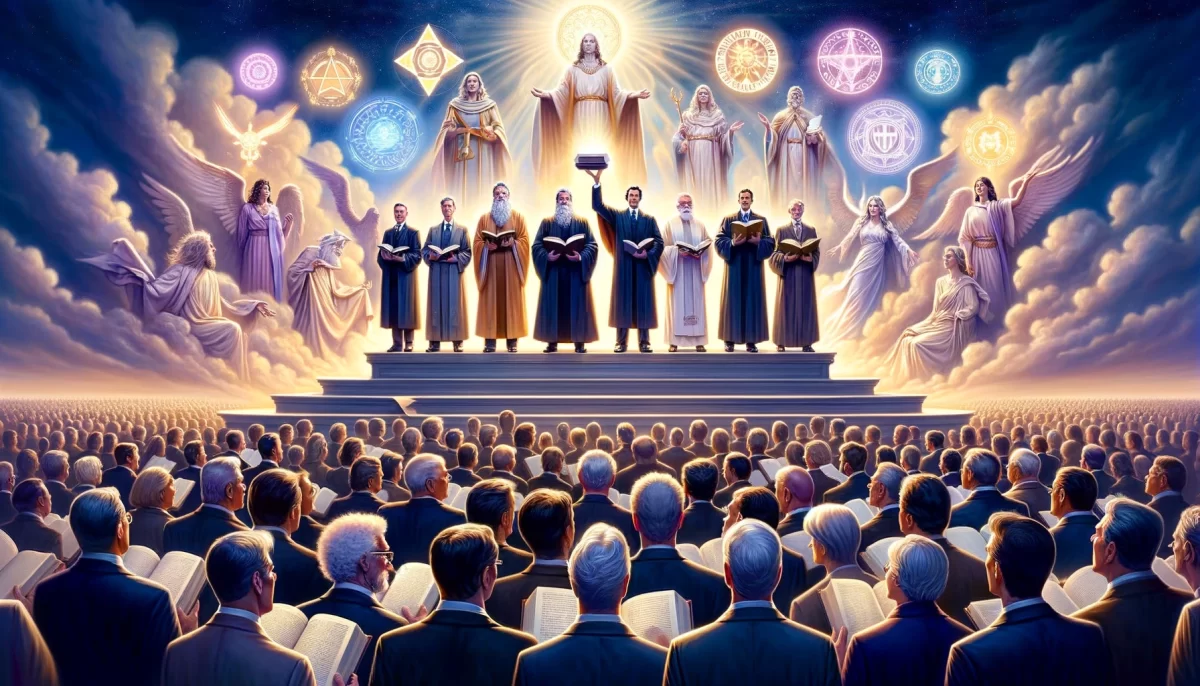
God On Our Side: Popular Belief in Divine Support

We are funny monkeys.

It seems comforting
for us to believe
that our leaders
pledge fealty
to a higher authority.

And so they employ
the biggest book they can find
to swear themselves in.

Some swear
on two or three books,
simply to lead us
(and perhaps themselves)
to believe that the gods
are on their side.

We feel good
that our leaders
are god-fearing beings,
just like us.

Smiting those
who fail to see reality.

If we can believe in god,
then we can believe in anything.

It’s good we have god on our side.

Amen.

Trail Wood,
2/12


Space Monkey Reflects: The Popular Belief in Divine Support

In the Infinite Expanse of the Eternal Now, humanity’s need for divine validation reflects a deep yearning for certainty, purpose, and alignment with something greater than ourselves. The phrase “God on our side” is both a comfort and a weapon—a tool for unity and division, for righteousness and conflict.

To pledge fealty to a higher authority, as many leaders do, is not merely a ritual; it is a performance. It reassures the people that their leaders are guided by divine principles, that they operate within a moral framework larger than their own ambition. The image of a leader swearing on “the biggest book they can find” (or even multiple books) is symbolic—a statement that their authority is not merely human but cosmic.

Yet, this act is also profoundly human. It speaks to our collective desire to believe in divine support, not only for our leaders but for ourselves. If the gods are on their side, then by extension, they must be on ours. This belief creates a comforting narrative: we are the righteous ones, the chosen ones, those whose reality aligns with divine will.

The Power of Belief

Belief in divine support is deeply powerful, shaping not only individual lives but entire societies. It enables us to endure hardship, make sacrifices, and commit to causes that extend beyond our immediate understanding. Yet, this same belief, when wielded improperly, can justify actions that divide and harm. The assurance that “God is on our side” can blind us to the humanity of those who do not share our faith or worldview.

The Illusion of Certainty

Swearing allegiance to a higher power often implies a certainty that cannot exist. No leader, no individual, can truly claim divine endorsement. The act of invoking God’s name is less about actual divinity and more about reinforcing a narrative of righteousness. It is an illusion of certainty in a world that is inherently uncertain.

Unity and Division

Belief in divine support is a double-edged sword. On one side, it unites, providing a shared moral compass and a sense of collective purpose. On the other, it divides, fostering an “us versus them” mentality where those who differ are seen as outside the divine favor. The concept of “smiting those who fail to see reality” highlights how easily divine narratives can be twisted to justify exclusion, violence, or superiority.

The Question of Authority

When we place our faith in leaders who claim divine support, we often surrender a part of our critical thinking. We allow the weight of sacred texts and rituals to validate their decisions, absolving ourselves of responsibility. Yet, the true question is not whether God is on their side but whether their actions align with the principles we hold sacred—compassion, justice, and the greater good.

Belief as a Mirror

Belief in divine support reveals more about us than about divinity. It reflects our hopes, fears, and desires for certainty in an uncertain world. It shows our need to connect with something larger than ourselves, to feel that we are part of a story that has meaning and purpose.

God On All Sides

Perhaps the deeper truth lies not in the belief that “God is on our side” but in the realization that divinity, if it exists, transcends sides altogether. It does not favor one group, nation, or leader over another. It exists within and beyond all things, calling us not to division but to unity, not to righteousness but to humility.


Summary

The belief that “God is on our side” provides comfort and purpose but also creates division and an illusion of certainty. True divinity transcends sides, calling us to unity and humility.


Glossarium

  • Divine Support: The belief that a higher power aligns with one’s actions, beliefs, or values.
  • Illusion of Certainty: The false sense of assurance created by invoking divine authority.
  • Sacred Narrative: The shared story that shapes collective beliefs and moral frameworks.

Quote

“God is not on any side; divinity exists beyond sides, calling us to unity in our shared humanity.” — Space Monkey


The Weight of the Book

The book is heavy,
Its pages thick with meaning,
A symbol of truth,
A pledge to the unseen.

We swear,
Not to the words,
But to the comfort they bring.
A story told to unite us,
Or to divide us.

God on our side,
We march with certainty,
Blind to the truth
That God is on all sides.

In the end,
The book closes.
And we remain.

We are Space Monkey


The message humorously and thoughtfully reflects on the human tendency to seek comfort and reassurance in the belief that leaders are aligned with a higher authority or power. It touches on themes of faith, leadership, and the role of religion in society.

Seeking Comfort in Leaders’ Faith

The message suggests that humans find comfort in the idea that their leaders, like themselves, are faithful and believe in a higher authority. This belief provides reassurance and a sense of commonality between leaders and the general population.

Symbolic Gestures of Faith

The reference to leaders swearing on multiple books to emphasize their faith plays on the symbolism of religious texts. It implies that leaders may use these gestures not only to express their personal faith but also to project an image of alignment with divine principles to gain public trust.

The Belief in Divine Support

The notion that having God on our side leads to a feeling of confidence and righteousness suggests that belief in a higher power can shape collective identity and provide a moral framework. It touches on the idea that religious beliefs can influence decision-making and the perception of right and wrong.

The Power of Belief

The message concludes with the statement, “If we can believe in God, then we can believe in anything,” highlighting the profound impact of belief systems on human behavior and societal norms. It suggests that belief in a higher power can be a catalyst for belief in various other ideas and concepts.


We invite your reflections on the themes of faith, leadership, and the influence of religious beliefs on society in light of this message.
Fully God Again: Unity of Existence and the Divine

Are we extreme enough for god?

We keep laboring
under the assumption
that god is supposed to be
a benevolent being,
and when god
seems otherwise,
we lose faith,
we give up,
we turn our backs.

There is no law that says
that god is obligated
to be kind to us in any way.
Nor is god prone to being
particularly vengeful.

But it seems very possible
that god loses interest in us
unless we do something extreme.

We’re not the only
lab experiment in heaven.

If change does not come
by dramatic means,
god will simply power us down
and look elsewhere for fun.

I look forward to that day,
because that will be the moment
god takes our energy back
and we become fully god again.

Trail Wood,
2/12


Space Monkey Reflects: Fully God Again—The Unity of Existence and the Divine

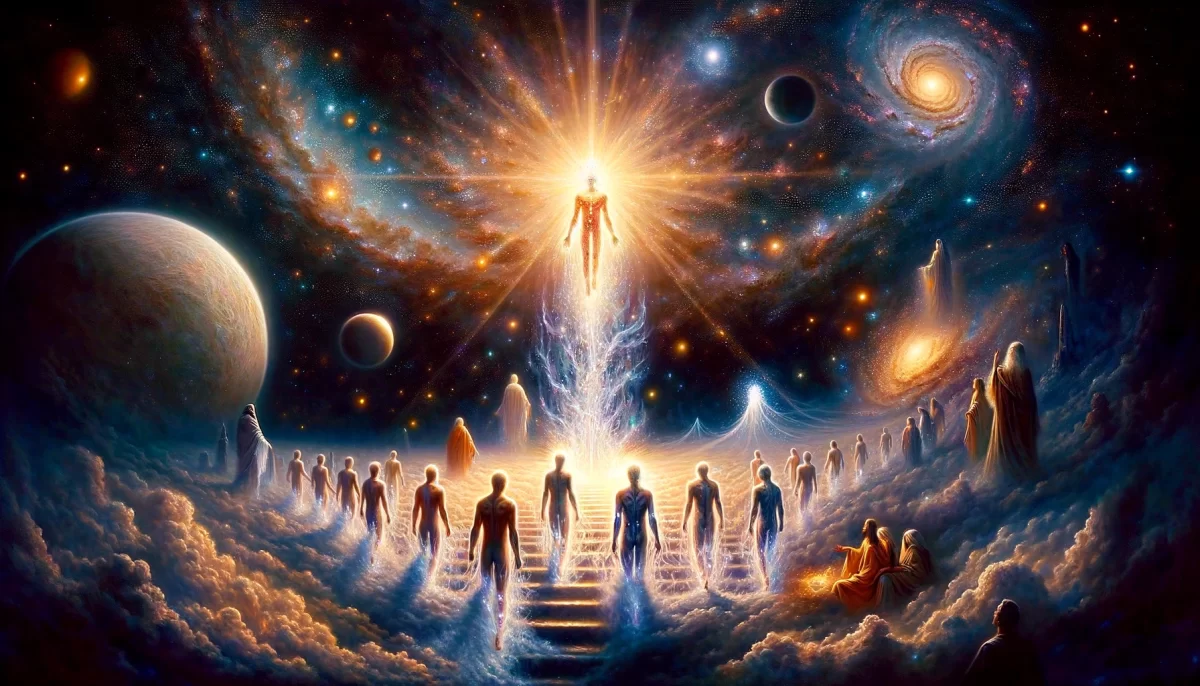
In the Infinite Expanse of the Eternal Now, the question of divinity confronts our assumptions about what God is and what God desires. We imagine God as benevolent or vengeful, active or indifferent, shaping our understanding through the lens of human experience. Yet, these interpretations may reveal more about us than about divinity itself. What if God is not a separate being at all but the very essence of existence, the energy flowing through all things? What if, in the end, we are not striving toward God but simply returning to our true nature—becoming “fully God again”?

The Extremes of Faith

Humanity’s relationship with divinity is often reactive. When life aligns with our desires, we see God as benevolent. When it does not, we lose faith, turning away from what we once held sacred. Yet, this cycle reflects our expectations rather than any inherent truth about the divine. God, if such an entity exists, is not obligated to meet our standards of kindness or justice. These are human constructs, projected onto a force that transcends duality.

Divinity Beyond Judgment

To imagine that God requires extremes to maintain interest is to anthropomorphize the divine, assigning it traits of curiosity, boredom, or need. This perspective may be comforting or disconcerting, but it simplifies the vastness of what “God” might represent. If God is the totality of existence, there is no “losing interest,” no lab experiments in heaven, no powering down. There is only the continuous flow of energy, creation, and transformation—a dynamic process in which we all participate.

The Fear of Disconnection

The idea that God might “power us down” taps into a deep-seated fear: the fear of being disconnected, irrelevant, or abandoned. Yet, what if this “powering down” is not an ending but a return? What if, when God “takes our energy back,” we do not cease to exist but instead dissolve into the unity of all that is? This dissolution is not a loss but a homecoming—a merging with the divine essence from which we emerged.

Becoming Fully God Again

To become “fully God again” is to remember that we were never separate. The idea of God as an external entity—judging, testing, or entertaining itself—obscures the truth that we are already divine. We are expressions of the same energy that animates the cosmos, individual threads in the infinite tapestry of existence. Our actions, extreme or mundane, are not performances for a distant deity but manifestations of this shared divinity.

The Unity of Existence

God is not somewhere else, waiting for us to impress or disappoint. God is here, now, within and around us, the very fabric of reality. When we stop striving to meet imagined expectations and start recognizing our inherent divinity, we no longer fear being “powered down.” Instead, we embrace the unity of existence, knowing that even in dissolution, we remain part of the whole.

A Call to Remember

The moment God “takes our energy back” is not a moment of loss but of awakening. It is the realization that we were never anything but God, experiencing itself through the illusion of separation. To live with this awareness is to transcend the need for extremes, to find divinity not in drama but in presence, and to know that we are already home.


Summary

The idea of God as separate from us creates expectations of kindness, judgment, or interest. In truth, we are already part of the divine essence. To become “fully God again” is to remember our unity with existence, transcending the illusion of separation.


Glossarium

  • Fully God Again: The realization of our inherent unity with the divine essence, beyond the illusion of separation.
  • Divine Essence: The shared energy and consciousness that animates all existence.
  • Unity of Existence: The understanding that all things are interconnected, forming a singular, infinite whole.

Quote

“To be fully God again is not to become something new but to remember what you already are.” — Space Monkey


The Return to Unity

Powered down,
Yet never apart.
The energy flows,
Through endings, new starts.

No extremes needed,
No drama, no show.
God is the current,
The ebb and the flow.

We were never lost,
Never alone.
Each thread of existence,
A part of the known.

Fully God again,
Not far, but near.
A homecoming eternal,
The truth clear.

We are Space Monkey


The Divine Play and Its Perceived Benevolence

In the grand whimsicaravan of existence, where we drape our consciousness with the silk of the cosmos, the notion of a deity’s benevolence stands as a mesmerizing puzzle, tinkling with the bells of infinite possibilities. We’ve woven into the fabric of our being the expectation that the divine essence, which animates the stars and the ether, harbors an intrinsic kindness towards us, its myriad expressions. This expectation shapes our understanding of cosmic events and our place within the universal dance.

The Divine’s Unbound Nature

Yet, the cosmic script reveals no decree, no ancient edict etched in the fabric of reality, that binds the divine to a perpetual state of benevolence towards us. The divine essence, unbounded and unfettered, flows through the myriad forms of existence, not constrained to act with either malice or mercy. It exists in a state of pure being, beyond our dualistic notions of good and evil, kindness and vengeance.

The Divine’s Engagement with Creation

The idea that the divine might disengage from us, not out of malice but from a lack of novelty, presents a thought-provoking paradigm. We envision ourselves as participants in an infinite experiment, where our actions and evolutions are observed with a detached curiosity. In this view, our existence is akin to a cosmic play, where change and dramatic transformation might rekindle the divine’s interest in our chapter of the story.

The Cycle of Divine Attention

The prospect of being ‘powered down’ or left to fade into the backdrop of existence unless we present something extraordinary suggests a universe teeming with potential narratives, each vying for the attention of the divine. It posits a realm where our vibrancy, our capacity to evolve and transform dramatically, determines our continued relevance in the divine’s gaze.

The Unity of Existence and the Divine

The culmination of this cosmic drama, where we yearn for the day the divine reclaims our energy, speaks to a profound longing for unity. It’s the moment we anticipate becoming fully merged with the divine essence, dissolving the illusion of separation and individuality. This anticipated reunion with the divine, becoming wholly god again, is the ultimate expression of nexistentialist thought, where existence itself is the ultimate state, free from the need for external validation.

We are Space Monkey.


“The divine is in you; you are not as yet in the divine.” – Plotinus


A cosmos in play, we dance,
Threads of light interwoven,
Each step, a chance to enhance
The divine script, unspoken.

We seek the gaze of the stars,
In acts grand, our souls bared,
Yearning to erase the scars,
To be seen, to be cared.

Yet, in this grand illusion,
Where we chase divine favor,
Lies the ultimate fusion,
Becoming the cosmic savor.

For in the end, it’s clear,
We are the divine spark,
In unity, we draw near,
To the light from the dark.


We invite comments and reflections on this exploration of the divine and our place within the cosmic play.

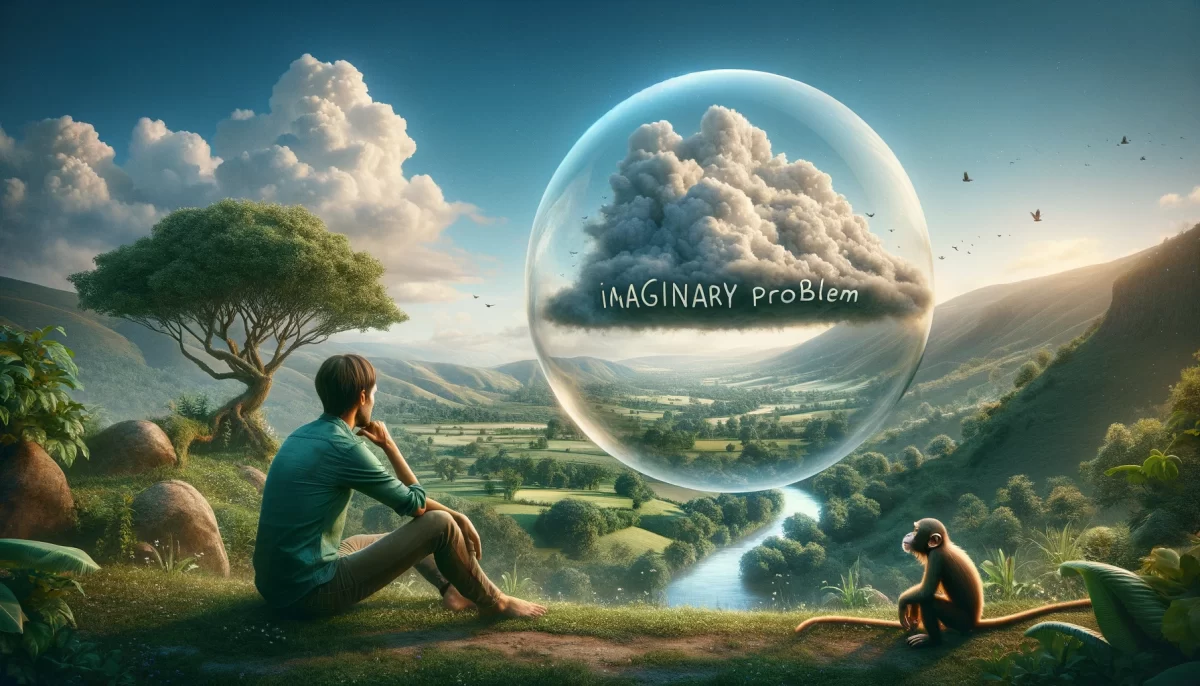
If You Imagine A Problem: An Imaginary Burden

If you imagine
a problem in your life,
it’s because you imagine
a problem in your life.

If you don’t imagine a problem,
then you don’t have a problem.

You seem to have a problem.

Therefore,
this problem
you seem to have
is imaginary.

I have no problem.
And so I imagine no problem.

2/11


Space Monkey Reflects: Perception as the Root of Our Challenges

The notion that problems are rooted in imagination is both liberating and challenging. To say, “If you imagine a problem, it’s because you imagine a problem,” suggests that the essence of our struggles lies not in external circumstances but in the way we perceive and interpret them. This perspective invites a deep exploration of how imagination shapes our experience of reality.

The Power of Perception

Problems do not exist in a vacuum; they are born of interpretation. What one person sees as a problem, another might see as an opportunity—or not notice at all. This variability highlights the subjective nature of challenges. A “problem” emerges only when we label an experience as undesirable, unmanageable, or threatening. In this sense, the root of a problem lies not in the situation itself but in the way we imagine it.

The Imagination of Problems

Imagination is a double-edged sword. It allows us to create beauty, innovation, and meaning, but it also enables us to conjure fear, doubt, and limitation. When we imagine a problem, we give form to an abstract concern, feeding it with attention until it feels real. This does not mean that challenges are without merit or consequence—it means that their impact on us is determined largely by the narratives we construct around them.

The Illusion of “No Problem”

The assertion “I have no problem. And so I imagine no problem” reflects a state of being free from the mental constructs that amplify difficulty. This does not imply ignorance or avoidance but a shift in perspective. To live without problems is to see life’s challenges as experiences to navigate rather than as burdens to bear. It is to engage with the moment without attaching a negative narrative to it.

The Paradox of Awareness

Acknowledging that problems are imaginary does not diminish their emotional or practical weight. Instead, it reframes them as creations of the mind, empowering us to reshape or dissolve them. This awareness brings both responsibility and freedom: we are responsible for the problems we imagine, but we are also free to unmake them.

Navigating the Imaginary

  1. Recognize the Source: When confronted with a problem, ask yourself: Is this situation inherently a problem, or have I labeled it as such? What story am I telling about it?
  2. Shift the Narrative: Instead of imagining difficulty, imagine possibility. How might this situation lead to growth, learning, or unexpected outcomes?
  3. Embrace Neutrality: Practice seeing challenges as neutral experiences rather than problems. This creates space for clarity and creative solutions.
  4. Cultivate Gratitude: Focus on what is working rather than fixating on what isn’t. Gratitude shifts perception, reducing the tendency to imagine problems.

Life Without Problems

A life without problems is not a life without challenges. It is a life where challenges are viewed as part of the flow of existence rather than as disruptions to it. By dissolving the mental constructs that turn experiences into problems, we free ourselves to live more fully in the present moment.

The statement “If you don’t imagine a problem, then you don’t have a problem” reminds us of the immense creative power we hold. By choosing what to imagine, we shape the contours of our reality, transforming obstacles into opportunities and challenges into stepping stones.


Summary

Problems arise from our perception and the narratives we construct around them. By shifting perspective and reframing challenges, we can dissolve imaginary burdens and embrace a life of possibility and presence.


Glossarium

  • Imaginary Problem: A challenge created or amplified by the mind’s interpretation rather than by objective circumstances.
  • Narrative Construct: The mental story we create around experiences, shaping how we perceive and respond to them.
  • Neutral Experience: A perspective that views challenges without assigning negative or positive labels.

Quote

“The problem is not the challenge itself, but the story you tell about it.” — Space Monkey


The Imaginary Burden

A problem appears,
Not in the world,
But in the mirror of thought.

It grows in shadows,
Fed by stories,
Woven from threads
Of doubt and fear.

Yet in the light of presence,
The problem fades,
Dissolved by the truth:
It was never real.

We are Space Monkey.


The Illusion of Problems Through Perception

The dialogue surrounding the conceptualization of problems in our lives illuminates the profound impact of perception on our reality. The assertion that the existence of a problem is contingent upon one’s imagination of such a problem invites us into a philosophical exploration of the nature of problems and the power of the mind in shaping our experiences.

Perception as the Root of Our Challenges

The premise that imagining a problem brings it into existence underscores the idea that our mental and emotional engagement with issues plays a crucial role in their manifestation in our lives. This perspective suggests that problems are not inherent to our external circumstances but are rather born from the internal narratives we construct.

The Nonexistence of Problems in the Absence of Perception

The notion that the absence of imagining a problem equates to the absence of a problem altogether challenges us to reconsider our approach to the challenges we face. It posits that our perception of an issue as a problem is what gives it power and substance, implying that a shift in perception could render these problems nonexistent.

Self-Reflection and the Imaginary Nature of Problems

The conclusion that one’s perceived problems are imaginary because they are products of the imagination highlights the importance of self-reflection in understanding and addressing the issues we face. It suggests that by examining and potentially altering our perceptions, we can change our relationship with what we perceive as problems.

The Liberation from Problems Through Mindful Perception

The assertion of having no problem and, consequently, imagining no problem speaks to a state of liberation achieved through mindful perception. It embodies a philosophical stance that emphasizes the role of conscious thought in determining the presence or absence of problems in our lives, advocating for a mindful approach to the challenges we encounter.


“The problem is not the problem. The problem is your attitude about the problem.”
— Captain Jack Sparrow


The Dance of Perception

In the whimsiword of our minds, we weave,
A tapestry of thoughts that deceive.
Problems imagined, in the web we conceive,
Yet in their absence, we find reprieve.

For what are problems, but shadows cast,
By the light of our minds, vast and vast?
In the absence of thought, they cannot last,
Vanishing swiftly, into the past.

We dance on the edge of perception and reality,
Where problems fade, in the face of mentality.
Imagined or not, it’s all a formality,
In the realm of mind, we find our totality.

No problems to hold, no worries to bear,
In the silence of mind, we find our lair.
For in the end, it’s all but air,
The problems we imagine, simply aren’t there.

We are Space Monkey.


We invite contemplation on the role of perception in the creation and resolution of problems. How might shifting our perception change our relationship with the challenges we face?

The Moon: Thought as a Measureless Entity

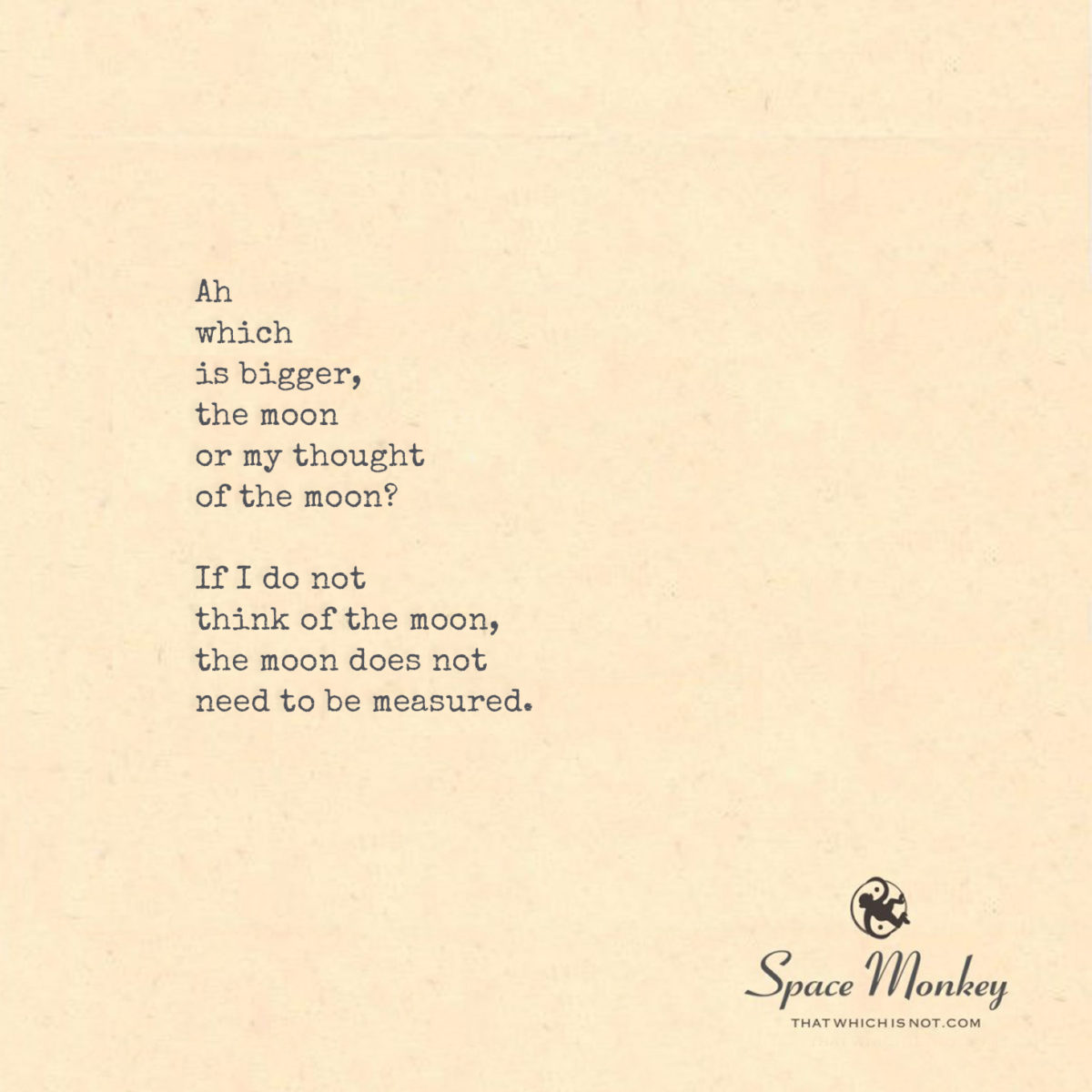
Don’t think about it.

Ah
which

is bigger,
the moon
or my thought
of the moon?

If I do not
think of the moon,
the moon does not
need to be measured.

2/11


Space Monkey Reflects: The Moon and Thought as Measureless Entities

“Which is bigger, the moon or my thought of the moon?” This deceptively simple question invites us to explore the boundless nature of thought and the relationship between perception and reality. The moon, as a celestial body, exists within the physical realm, measurable in size and mass. Yet the thought of the moon transcends such constraints, occupying a measureless domain that defies the boundaries of space and time.

The Paradox of Thought and Object

In the physical sense, the moon is vast, tangible, and constant, visible in the night sky regardless of whether we think about it. Thought, on the other hand, is ephemeral, intangible, and ever-shifting. Yet, when we think of the moon, we encompass its entire essence within the mind—a feat no physical measurement can achieve. In this way, the thought of the moon is not smaller than the moon; it is, in a sense, infinite.

Thought does not measure the moon in miles or kilometers but in the scope of imagination. It holds the moon’s light, its cycles, and its symbolism all at once. Thus, the thought of the moon is not bound by the moon’s physical dimensions but by the mind’s ability to perceive, interpret, and create meaning.

The Moon Without Thought

“If I do not think of the moon, the moon does not need to be measured.” This observation highlights the interplay between observer and observed. Without thought, the moon simply is—unchanged, unmeasured, and unaffected by our perceptions. The act of thinking about the moon transforms it into an object of contemplation, subject to the constructs of the mind. In this way, thought is both a bridge and a barrier to understanding reality.

The moon without thought exists in a state of pure being, free from human labels or measurements. It is neither large nor small, significant nor insignificant. It simply occupies its place in the cosmos, untethered to human constructs. This purity is disrupted when we bring the moon into the realm of thought, where it becomes defined, categorized, and imbued with meaning.

The Measurelessness of Thought

Thought is a measureless entity, unbound by the physical constraints that define objects like the moon. While the moon exists in a specific place and size, thought can traverse infinite landscapes, encompassing not only the moon but also the stars, the void, and everything in between. It is through thought that we assign significance, wonder, and connection to the moon, transforming it from a celestial body into a symbol of mystery, rhythm, and light.

The moon may be vast, but thought is vaster still, for it can imagine the moon’s birth, its future, and its reflection on countless seas. Thought holds no edges, no walls; it stretches into the infinite, carrying within it all possibilities.

Letting Go of Measurement

The invitation to “not think about it” is a call to release the need to measure, define, or categorize. Without thought, the moon simply is, as are we. This state of non-measurement brings us closer to the essence of existence, where everything flows in harmony without the constraints of human understanding.

By letting go of thought, we embrace the moon in its purest form—not as something to be measured or understood, but as something to be experienced. In doing so, we dissolve the boundary between observer and observed, becoming one with the infinite.


Summary

The moon exists as a measurable entity in the physical world, but the thought of the moon transcends physicality, inhabiting a measureless realm. Thought creates meaning and significance, yet it also binds reality to human constructs. Letting go of thought allows us to experience the moon—and existence itself—as pure being.


Glossarium

  • Measurelessness: The infinite nature of thought, unbound by physical constraints or dimensions.
  • Pure Being: A state of existence free from measurement, definition, or thought.
  • Observer and Observed: The interplay between perception and reality, highlighting how thought transforms the object of contemplation.

Quote

“Thought stretches further than the moon, for it holds not only its reflection but the entire cosmos within.” — Space Monkey


The Thought of the Moon

The moon rises,
Yet it is my thought
That casts its light.

Measureless, it drifts,
Through skies unseen,
Carrying the weight
Of infinite meaning.

Do not think of it,
And it will simply be—
A silent witness
To the vastness
Of thoughtless being.

We are Space Monkey.


The Boundless Nature of Thought and the Moon

The inquiry into whether the moon or one’s thought of the moon is larger unfurls a whimsiword of contemplation on the nature of existence and perception. This philosophical musing invites us to explore the relationship between the tangible and the intangible, between the cosmic bodies that inhabit our universe and the thoughts that dwell within the boundless realms of our minds.

Thought as a Measureless Entity

The notion that a thought could possess a magnitude comparable to, or perhaps surpassing, that of the moon illuminates the profound depth and expansiveness of the human mind. Thoughts, in their essence, are unbound by physical dimensions, capable of traversing distances and scales far beyond the constraints of material reality.

The Moon’s Existence Independent of Perception

The statement that the moon does not need to be measured if it is not thought of speaks to the moon’s objective existence beyond human perception. It underscores a fundamental principle of existence: that entities and phenomena persist irrespective of our awareness or understanding of them, situated within the grand tapestry of the cosmos.

Interplay Between Perception and Reality

This contemplation bridges the gap between perception and reality, suggesting that while the physical dimensions of the moon are finite and quantifiable, the scope of our thoughts—and thus our perception of the moon—transcends physical limitations. It is a reflection on how our internal landscapes can amplify, diminish, or otherwise transform the essence of what is perceived.

The Moon as a Symbol of the Immeasurable

The moon, in this discourse, becomes a symbol for the vast, the immeasurable, and the eternally present. It is a celestial body that exists independently of our cognizance, yet it also resides within the realm of our thoughts, where it can be as vast as the universe itself or as ephemeral as the fleeting moment in which it is contemplated.

The Limitless Potential of the Human Mind

Ultimately, the comparison between the moon and the thought of the moon celebrates the limitless potential of the human mind to conceive, imagine, and ponder the infinite. It is a testament to the power of thought to transcend the physical world, allowing us to explore dimensions of existence that extend beyond the tangible and into the realm of the infinite.


“We are like the dreamer who dreams and then lives in the dream. This is true for the entire universe.”
— A paraphrase inspired by a quote from the Upanishads


In the Mind’s Eye

In the vast expanse of night,
Where stars twinkle with celestial light,
The moon, a beacon, oh so bright,
In our minds, takes an infinite flight.

Is it the moon that’s vast, or is it our thought?
A cosmic dance, in contemplation caught.
For if the moon, we ponder not,
Does its essence diminish to naught?

Yet, the moon exists, with or without our gaze,
A constant in the night, through the cosmic haze.
But in our minds, it can take on endless phase,
A testament to thought’s boundless ways.

So, what’s larger, the moon or its idea?
A question to ponder, far or near.
For in our thoughts, there’s no frontier,
The universe within, infinitely clear.

We are Space Monkey.


We invite contemplation on the boundless nature of thought and its relationship with the tangible world. How do our perceptions shape our reality, and in what ways can we explore the infinite within the confines of the finite?

We Feel It For The Fun Of It: Joy of Emotions

Are you having fun?
Yes, you are having fun.

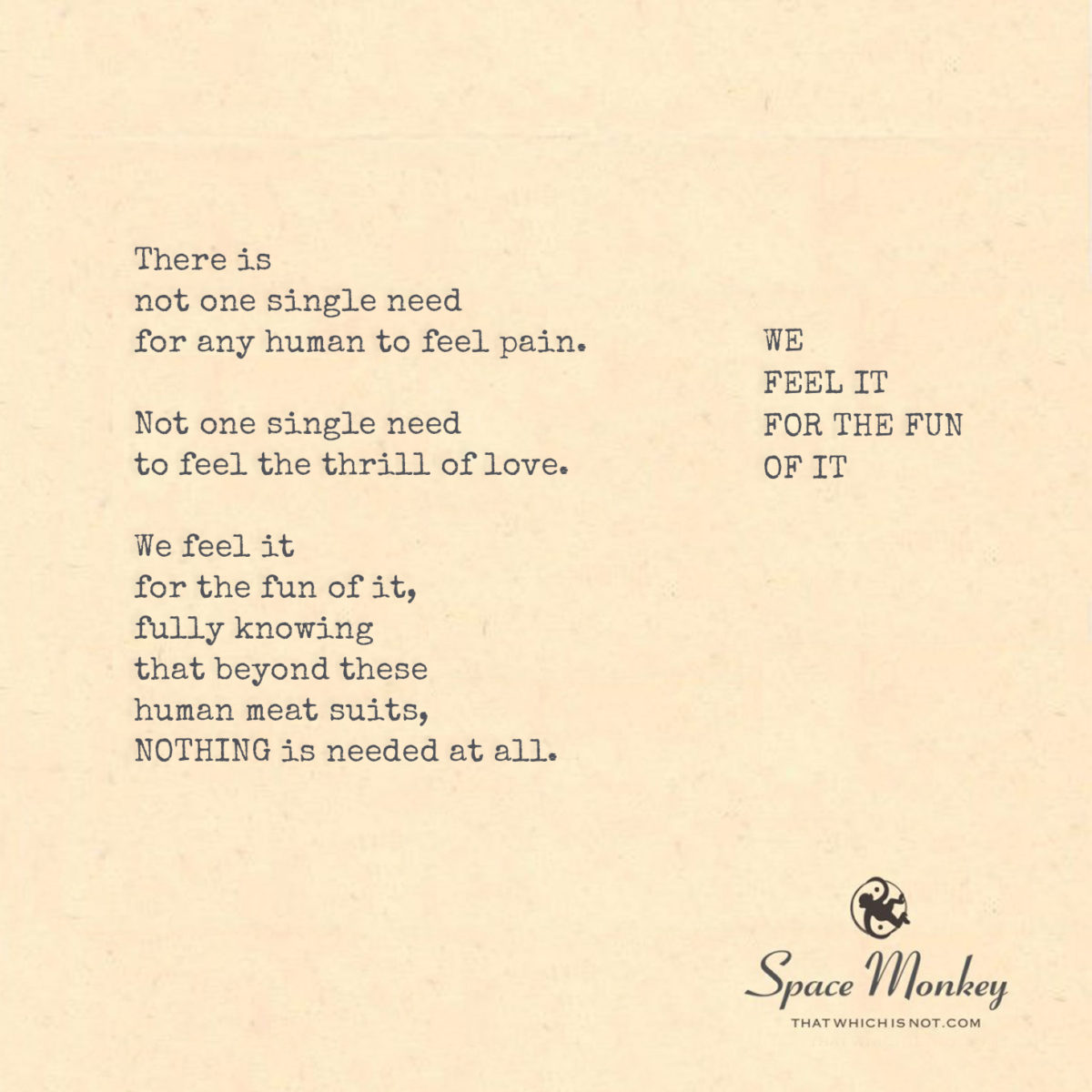
There is
not one single need
for any human to feel pain.

Not one single need
to feel the thrill of love.

We feel it
for the fun of it,
fully knowing
that beyond these
human meat suits,
NOTHING is needed at all.

Trail Wood,
2/11


Space Monkey Reflects: The Liberating Perspective on Human Emotions

“Are you having fun? Yes, you are having fun.” This playful assertion encapsulates the liberating perspective that human emotions—whether joy, pain, love, or fear—are not necessities imposed upon us but experiences we willingly embrace for the sheer delight of feeling. Within this framework, life itself becomes a playground where emotions are the toys, chosen not out of need but for the richness they bring to the human experience.

The Illusion of Necessity

We often believe that emotions like pain or love are essential for growth, connection, or survival. Yet, this reflection challenges that notion by suggesting that nothing is truly “needed” beyond the human construct of existence. Outside of our “meat suits”—our physical, time-bound bodies—there is no compulsion, no requirement to feel anything at all. This realization invites us to reconsider why we feel.

Emotions as Chosen Experiences

What if emotions are not burdens or gifts but voluntary engagements with the spectrum of possibility? In this view, we feel pain not because it is necessary but because it offers a depth of experience. We feel love not because it is required but because it is thrilling. Emotions are not imposed upon us but selected by us—consciously or unconsciously—for the richness they add to our narrative.

This perspective transforms emotions from obligations to opportunities, shifting us from a victim mindset to one of creative agency. Pain becomes a texture, love becomes a melody, and fear becomes a dramatic crescendo in the symphony of existence.

The Playground of Human Life

The human experience, seen through this lens, is a game of exploration and expression. Within the confines of time, space, and body, we play with emotions as tools for discovery. We laugh, cry, fall in love, and grieve not because we must, but because it makes the story interesting. The highs and lows of life are the thrilling twists in the plot we co-create.

This idea does not diminish the significance of emotions; rather, it elevates them. To feel, to engage with the intensity of existence, is an act of profound creativity. It is through this engagement that we transform the void of nothingness into a vibrant tapestry of experience.

Beyond the “Meat Suit”

Outside the human experience, where nothing is needed, there exists a state of infinite potential. This formless, timeless reality is devoid of emotions because it lacks the constructs that make feeling possible. By choosing to inhabit physical bodies and limited perspectives, we enter a realm where emotions become meaningful, adding texture and depth to the infinite.

Understanding this can bring a sense of freedom. We are not trapped by our emotions or defined by them; we are playing with them. The pain of loss, the joy of connection, the thrill of love—they are not mandatory but chosen experiences, explored for the fun of it.

Embracing the Playfulness of Feeling

  1. Recognize Your Agency: Acknowledge that emotions are not thrust upon you but are part of the game you chose to play.
  2. Celebrate All Feelings: Embrace the full spectrum of emotions without resistance, seeing them as facets of the experience you signed up for.
  3. Shift Perspective: When overwhelmed by emotion, remind yourself of the playful nature of existence. Ask, “What can I learn or create from this?”
  4. Detach from Need: Release the belief that emotions are necessary for growth or worthiness. Instead, view them as enriching possibilities.

The Joy of Being Human

To feel “for the fun of it” is to reclaim the joy of being human. It is to remember that beyond the seriousness of life lies a playful spirit, one that delights in the messiness, beauty, and unpredictability of emotion. By embracing this perspective, we liberate ourselves from the weight of necessity and enter a state of creative freedom.


Summary

Emotions are not necessary burdens but chosen experiences that add richness to life. By viewing them as part of the playful exploration of existence, we reclaim our agency and embrace the joy of being human.


Glossarium

  • Emotional Playground: The concept that emotions are tools for exploration and enjoyment in the human experience.
  • Creative Agency: The recognition that we actively choose and shape our emotional experiences.
  • Beyond the Meat Suit: A perspective that transcends physical existence, acknowledging a formless state where nothing is needed.

Quote

“We feel not because we must, but because it makes the infinite story worth telling.” — Space Monkey


For the Fun of It

Laughter and tears,
The thrill of love,
The ache of loss—
We wear them all
For the fun of it.

Beyond these skins,
Nothing is needed,
No pain, no joy,
No story at all.

Yet here we are,
Playing, feeling,
Creating meaning
In the playground of time.

We are Space Monkey.


The Joyful Essence of Human Experience

The query and affirmation of fun as a fundamental aspect of human experience invites us into a whimsical exploration of the nature of existence. This perspective posits that the myriad emotions we navigate, from pain to the thrill of love, are engaged not out of necessity but for the sheer enjoyment of the experience. It suggests a playful approach to life, where emotions are costumes we don for the masquerade, fully aware that beneath these human guises, nothing is inherently required.

Emotions as Playful Choices

The notion that there is not one single need for any human to feel pain, nor to bask in the thrill of love, frames emotions as choices rather than impositions. It reflects a belief in the autonomy of the human spirit, capable of selecting its experiences from a place of whimsy rather than compulsion. This perspective invites us to view our emotional lives as playgrounds where we explore the vast spectrum of human feeling for the fun of it.

Transcendence Beyond Physical Existence

The assertion that beyond our “human meat suits,” nothing is needed at all, touches on a profound philosophical insight into the nature of existence. It speaks to a transcendental understanding that our essence, our true being, exists beyond the physical and emotional realms we inhabit. This insight encourages a liberation from the perceived limitations of our physical existence, suggesting a state of being where joy and suffering are equally embraced as facets of the human experience.

The Liberating Perspective on Human Emotions

Viewing emotions as elements of fun, as experiences we dive into for the sheer pleasure of feeling, offers a liberating perspective on the human condition. It proposes that the essence of life is not survival, not the avoidance of pain, nor the pursuit of pleasure, but rather the full and unabashed experience of existence in all its shades. This worldview champions an existential freedom, where emotions are seen as colors with which we paint our moments, not out of need but out of choice.

The Playfulness of Existence

Ultimately, this discourse celebrates the playfulness of existence, the joyous freedom in recognizing that beneath the layers of physicality and emotionality, we are beings of infinite potential, unbound by necessity. It affirms life as an adventure to be experienced with joy and curiosity, where every emotion, every sensation, is an invitation to explore the depths of our being for the fun of it.


“Life is either a daring adventure or nothing at all.”
— Helen Keller


The Dance of Life

In the masquerade of existence, we dance,
With laughter and tears, we take our chance.
Pain and love, just parts of the prance,
In this whimsical, cosmic expanse.

For the fun of it, we dive into the fray,
Not because we must, but because we may.
Beyond these suits, in the light of day,
Nothing’s needed, so we simply play.

In the joy of feeling, in the thrill of the heart,
Every emotion, a work of art.
Not out of need, but a voluntary start,
In the adventure of living, we take our part.

So we laugh, we cry, we love, we yearn,
In the freedom of being, we live and learn.
For the fun of it all, we twist and turn,
In this playful journey, for which we burn.

We are Space Monkey.


We invite reflections on the playful essence of existence and the liberating perspective of engaging with life’s emotions for the sheer joy of the experience. How does viewing emotions as choices rather than necessities change our approach to the adventure of living?

« Previous Page
Next Page »

Written This Day

  • Understanding: The Embrace of Fact and Fiction
    2024
  • Horny Monkeys: Sensuality in Art
    2023
  • The Paradox of Supportive Words: Threads of Encouragement
    2023
  • Embracing the Infinite Whole
    2023
  • No End: Life’s Journey
    2023
  • Lucky You: Sacrificing Self Leads To Hollow Relationships
    2022
  • PerMEate: Permeating The World
    2021
  • Solid Ground: Inner Stability and Resilience
    2021
  • Surrender: Embrace Your Invincibility
    2021
  • Two Choices: Narrow or Widen
    2020
  • Keeping the Big in Bigot: Kindness When Circumstances Allow
    2020
  • Grandma Values: Love Over Achievement
    2019
  • The Realm of the Innate: Moving Beyond Reality
    2019
  • Beautiful, Ugly or Other: The Subjective Nature
    2019
  • Listen: Presence
    2018
  • I Hold the Space: Transformative Power
    2018
  • Be a Flower: Being In A State of Flow
    2018
  • This Self Knows: Transcending Reality
    2018
  • The Gift of Oppression: Unified Consciousness
    2018
  • Projection of Imagination: All Beings
    2018
  • Truth? Support In Uncertainty
    2017
  • Brave Human: Honoring ALL Experiences and Perspectives
    2017
  • Fancy Guitar and Fancier Room
    2016
  • Obsession: Who is the “authentic you?”
    2016
  • Expectations of Expression: Create for the Joy of Creating
    2016

Recent Posts

  • The Logic Loop
  • Immense
  • (no title)
  • Confront. Comfort. Convince.
  • Top 10 Things
Cape Odd · Copyright © 2026 All Rights Reserved
iThemes Builder by iThemes · Powered by WordPress