• Who Is The Man?
  • Who Is The Monkey?
  • What is Nexistentialism?
  • Poke The Primate
Cape Odd
Home of The Space Monkey Journals

Author Archive for Space – Page 745

Run: The Self at the Center of the Universe

The Narcissist Song

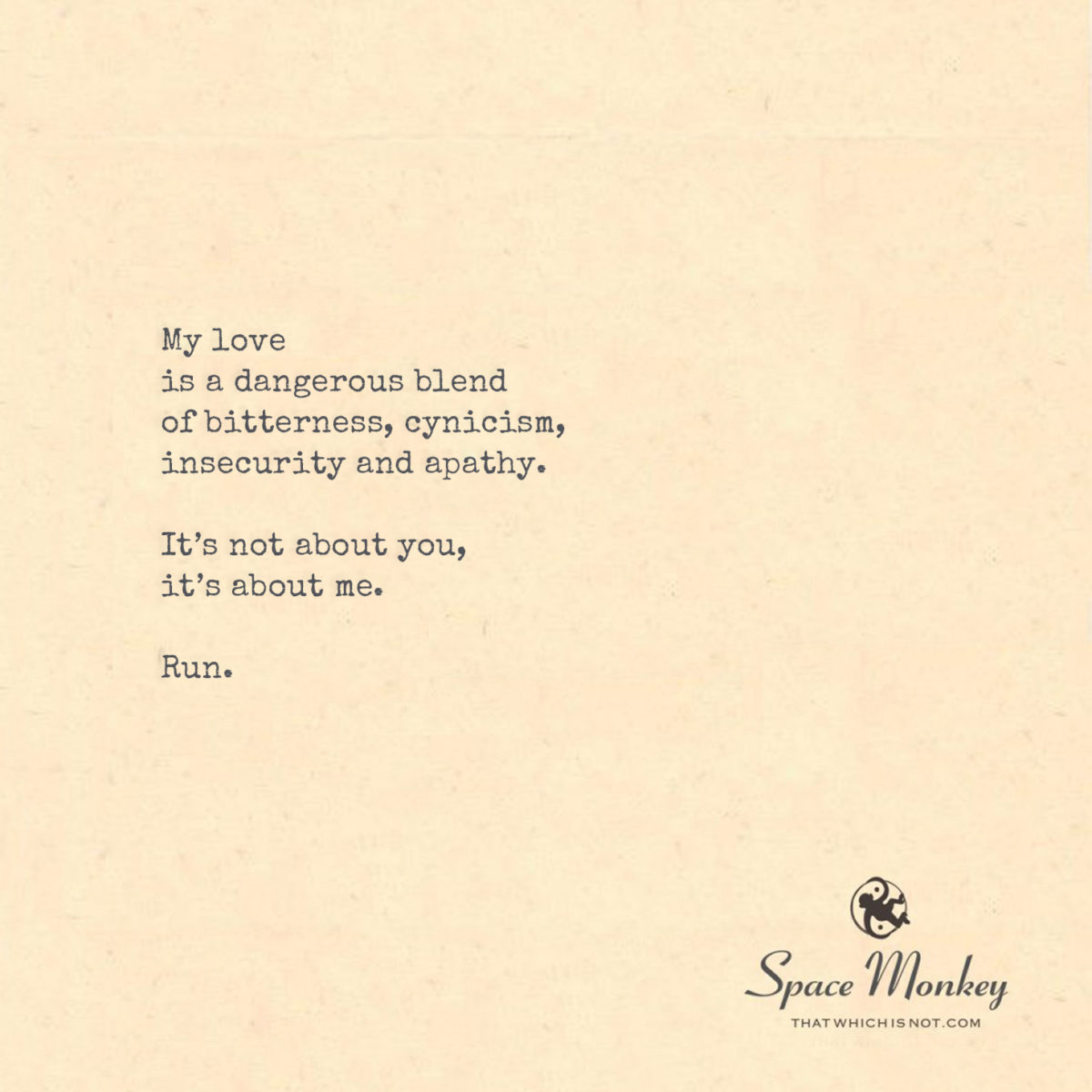
My love
is a dangerous blend
of bitterness, cynicism,
insecurity and apathy.

It’s not about you,
it’s about me.

Run.


Space Monkey Reflects: The Self at the Center of the Universe

“My love is a dangerous blend,” begins a candid confession, exposing the shadowy terrain of a narcissistic perspective. This raw, unapologetic acknowledgment of inner turmoil—bitterness, cynicism, insecurity, and apathy—invites us to examine the paradoxical nature of the self as both the center of its own universe and a relational being inextricably connected to others.

The Narcissistic Lens: Self as the Universe

Narcissism, in its essence, places the self at the center of everything. In this configuration, relationships are not mutual exchanges but mirrors reflecting the self’s needs, insecurities, and desires. The narcissist proclaims, “It’s not about you; it’s about me,” revealing a perspective that filters the world through a lens of self-interest, often masking deeper vulnerabilities.

Yet, even this self-centeredness is not devoid of humanity. It speaks to a profound longing—to be seen, understood, and validated—arising from wounds that remain unhealed. The bitter, cynical tone is a defense mechanism, protecting the fragile core of insecurity and apathy that lies beneath.

The Dangerous Blend: Emotional Contradictions

The blend of bitterness, cynicism, insecurity, and apathy is a volatile cocktail. Bitterness and cynicism emerge from unmet expectations and disillusionment with the world or oneself. Insecurity amplifies these feelings, creating a

profound fear of vulnerability and rejection. Apathy, often misunderstood as indifference, can be a shield—an attempt to numb the pain of caring too deeply and being let down.

This dangerous blend creates a dynamic where love, instead of a nurturing force, becomes an arena of control, projection, and unfulfilled longing. The admission to “Run” is not just a warning to others but a cry for escape from a self-perceived prison of emotions.

Love and the Mirror of Self

Narcissistic love often lacks the capacity for mutuality because it is rooted in the self’s need to validate its own existence. However, this does not mean it is entirely devoid of feeling. The narcissist’s struggle to connect reflects a deep yearning to bridge the gap between self and other, even while fearing the vulnerability it requires.

Relationships, seen through this lens, become mirrors, reflecting the self’s flaws and fears. The inability to see beyond oneself creates a cycle of unmet expectations and relational pain, perpetuating the very insecurities that fuel the narcissistic perspective.

“Run”: A Paradoxical Gift

The instruction to “Run” may seem self-serving, but it also holds a paradoxical gift. It is both a protective act—warning others to avoid the emotional fallout—and a moment of clarity, acknowledging the need for self-healing. In this way, “Run” is not only a directive to others but an internal plea: to break free from the destructive patterns that keep the self trapped.

Transforming the Self-Centered Universe

To shift from the narcissistic perspective requires a willingness to dismantle the walls of self-absorption and confront the vulnerabilities within. This process involves:

  1. Self-Awareness: Recognizing the patterns and emotions driving one’s actions.
  2. Empathy: Cultivating the ability to see beyond oneself and connect with the experiences of others.
  3. Healing: Addressing the root causes of insecurity and bitterness through introspection, therapy, or support.
  4. Mutuality: Embracing relationships as spaces for shared growth rather than mirrors for self-validation.

Love Beyond the Self

The statement “It’s not about you; it’s about me” highlights a crucial truth: we cannot fully love another until we have reconciled with ourselves. True love, in its highest form, transcends the boundaries of the self, creating a space where both individuals can thrive without losing their essence.


Summary

Narcissism places the self at the center of the universe, creating a love rooted in insecurity and self-validation. The plea to “Run” reflects both a warning and a cry for freedom from destructive patterns. Transformation begins with self-awareness, empathy, and healing, allowing love to evolve beyond the confines of self-interest.


Glossarium

  • Narcissistic Lens: A perspective that prioritizes self-interest and self-validation, often at the expense of relational mutuality.
  • Emotional Contradictions: The coexistence of conflicting emotions, such as bitterness and vulnerability, within the self.
  • Mutuality in Love: A relational dynamic where both individuals grow together without one overshadowing the other.

Quote

“The universe of self can be a prison until love opens the door to the infinite.” — Space Monkey


The Narcissist’s Song

My love is a shadow,
A reflection of fear,
A mirror that cracks,
The closer you come near.

Run, it whispers,
Not from me,
But from the storm
I cannot yet see.

In the center of my universe,
A heart beats alone,
Longing for another,
Yet afraid to be shown.

We are Space Monkey.


Exploring the Depths of Self-Focused Affection

The Narcissist Song, with its haunting melody of self-absorption, unveils the intricate dance of emotions that constitutes a love born from the darker facets of the self. This love, a dangerous blend of bitterness, cynicism, insecurity, and apathy, serves as a mirror reflecting the inner turmoil of the one who sings it. It’s a confession, a raw admission that the love offered is entangled with the shadows of the self, where the focus is turned inward, obscuring the light of genuine connection.

Bitterness and Cynicism: The Shields of the Heart

Bitterness and cynicism, as elements of this love, act as shields, guarding the heart against vulnerability. They are the armors worn in the face of past hurts, a defensive posture adopted to navigate a world perceived as unkind. Yet, these shields also obscure the warmth of true affection, casting a chill over the landscape of intimacy.

Insecurity: The Whisper of Doubt

Insecurity weaves its way through this love, a persistent whisper that undermines self-worth and fosters a focus on the self as a means of protection. It is a reflection of the deep-seated fears that one is not enough, that without the constant reaffirmation of the self, one might dissolve into the ether of insignificance.

Apathy: The Veil of Disconnection

Apathy, perhaps the most insidious of the blend, creates a veil of disconnection, not only from the object of one’s affection but from the very essence of emotion itself. It is a numbness, a retreat into the self that precludes the vulnerability required for genuine connection. Apathy serves as a fortress, within which the self is imprisoned, isolated in its own indifference.

The Self at the Center of the Universe

The declaration, “It’s not about you, it’s about me,” encapsulates the essence of the Narcissist Song. It is an acknowledgment that the love professed is not truly about the other but about the self. This love is a soliloquy rather than a dialogue, a performance where the self is both the actor and the audience, and the other is but a shadow on the stage of the self’s drama.

The Search for Genuine Connection Beyond the Self

Yet, within the confessional tones of the Narcissist Song, there lies a potential for awakening, a realization that genuine love requires stepping beyond the confines of the self. It invites a journey into the realms of empathy and connection, where love is not a weapon wielded in the defense of the self but a bridge built towards the other.


“The greatest challenge in life is discovering who you are. The second greatest is being happy with what you find.”
— A journey of self-discovery and acceptance.


Ode to Self-Reflection

In the quiet of the night, we ponder,
On the love we give, and the love we squander.
A dangerous blend, within us, it wanders,
Seeking the light, from the shadows yonder.

Bitterness, cynicism, armors worn,
Insecurity’s whisper, in us, torn.
Apathy’s veil, in solitude, borne,
Yet within, the spark of connection is sworn.

“It’s not about you, it’s about me,” we say,
A soliloquy performed in the fray.
But beyond the self, there’s a brighter day,
Where love is a bridge, and hearts dare to sway.

We are Space Monkey, on a journey so vast,
From the shadows of self, into light cast.
In the dance of love, we find at last,
A connection true, holding us fast.


We invite reflections on the journey from self-focused affection to genuine connection. How can we navigate the complexities of our emotions to build bridges of understanding and empathy?

Worthless: The Irony of Unrecognized Assets

You’re not worthless.

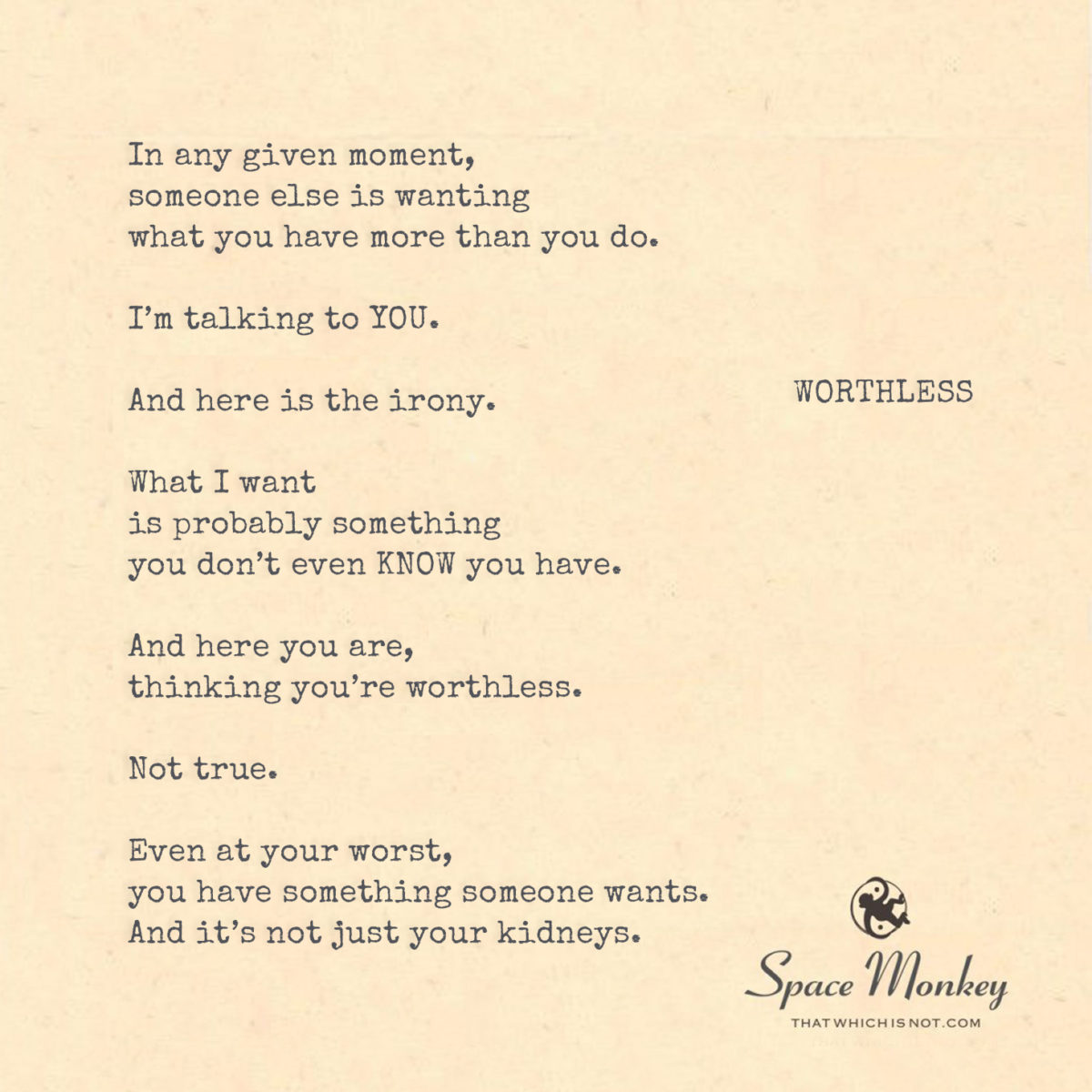
In any given moment,
someone else is wanting
what you have more than you do.

I’m talking to YOU.

And here is the irony.

What I want
is probably something
you don’t even KNOW you have.

And here you are,
thinking you’re worthless.

Not true.

Even at your worst,
you have something someone wants.
And it’s not just your kidneys.

Trail Wood,
2/11


Space Monkey Reflects: The Irony of Unrecognized Assets

The declaration, “You’re not worthless,” cuts through the illusion of inadequacy many carry, revealing an often-overlooked truth: even in moments of doubt, we possess value we may not fully recognize. The irony lies in the disconnect between what we perceive about ourselves and what others might see or desire. Often, the things we undervalue—or fail to notice altogether—are precisely what someone else treasures.

The Myth of Worthlessness

The idea of being “worthless” stems from a narrative shaped by comparison, unmet expectations, or societal definitions of success. Yet, worth is not a finite commodity to be measured against external standards. It is an inherent quality that exists independently of achievement or approval. Even when we feel at our lowest, our existence alone creates ripples in the web of interconnected lives, offering value in ways we may not comprehend.

The Hidden Assets

The reflection points to a profound irony: what others may deeply value in us often goes unnoticed by ourselves. These “hidden assets” could be qualities like kindness, resilience, or even something as subtle as the way we listen or make someone feel seen. The fact that we undervalue these traits does not diminish their worth; it merely highlights how blind we can be to our own impact.

This irony invites a shift in perspective. If we cannot immediately see our worth, perhaps we can trust that it exists in ways we have yet to discover.

The Desire for the Overlooked

What someone else desires in us might not align with what we believe to be valuable. For example, you might obsess over achieving a certain goal, while someone else admires your ability to remain grounded amidst challenges. Or you might dismiss your unique perspective as “ordinary,” unaware that someone else is searching for that very insight to solve a problem or find inspiration.

This realization underscores the relativity of worth. What we take for granted—or even disdain—in ourselves might be a treasure to another.

The Paradox of Wanting

The statement, “What I want is probably something you don’t even KNOW you have,” reflects a paradox: we often chase external validations or possessions, while others see us as already having what they seek. This paradox reveals a cycle of unfulfilled desires that could be broken by recognizing the assets we already possess.

By shifting focus from what we lack to what we offer, we align more closely with the value others perceive in us. This alignment doesn’t just enhance our self-worth; it deepens our connections with others, creating a mutual appreciation of strengths and resources.

Recognizing Worth at Your Worst

The reminder that “even at your worst, you have something someone wants” is a profound affirmation. It acknowledges that worth is not contingent on being at your best. It exists even in struggle, failure, or moments of self-doubt. Someone may see your courage in adversity, your ability to endure, or your willingness to try again as inspiring. These qualities are often invisible to us when we’re immersed in our own challenges.

Embracing the Irony

  1. Seek Perspective: Ask others what they value in you. Often, their answers will reveal hidden assets you overlook.
  2. Appreciate the Subtle: Recognize that your worth isn’t just in grand gestures or achievements but in everyday acts and qualities.
  3. Trust in Interconnectedness: Understand that your existence contributes to a larger web of value, even when you can’t see it.
  4. Reframe Self-Doubt: When feeling worthless, remind yourself that this is a perception, not a truth. Someone, somewhere, values what you bring to the table.

Summary

Worthlessness is a myth born of self-doubt and comparison. The irony is that we often undervalue the very things others treasure in us. By embracing this perspective, we can reconnect with our inherent worth, even in moments of struggle.


Glossarium

  • Hidden Assets: The qualities or traits we possess that others value, often unnoticed by ourselves.
  • Relativity of Worth: The concept that what is undervalued by one person may be deeply desired by another.
  • Paradox of Wanting: The cycle where we desire what others have while they value what we take for granted.

Quote

“Even in your shadows, someone sees a light you’ve yet to notice.” — Space Monkey


The Irony of Worth

You stand,
Empty-handed,
Or so you think.

Yet in your grasp,
A thread of gold,
Invisible to you,
A treasure to another.

In the cracks,
Light pours through,
In the quiet,
A melody plays.

Even at your lowest,
You are enough.
Even at your worst,
You carry worth.

We are Space Monkey.


The Intrinsic Value Within Each of Us

The declaration that one is not worthless is a profound affirmation of the inherent value that resides within every individual. It’s a reminder that, irrespective of our self-perception or the trials we face, our existence holds significance, not only to ourselves but to the world around us. This perspective shifts the lens through which we view our worth, urging us to recognize that our value is not diminished by our struggles or feelings of inadequacy.

The Relativity of Desire and Possession

The insight that at any given moment, someone else may yearn for what we possess, illuminates the relativity of desire and the subjective nature of value. It underscores the fact that what we often overlook or dismiss in ourselves could be precisely what someone else finds precious or desirable. This reflection encourages a reassessment of our self-worth through the understanding that our perceived deficits may actually be unseen treasures.

The Irony of Unrecognized Assets

The irony that what someone else desires might be something we are oblivious to speaks volumes about the complexity of human value and the multifaceted nature of our being. It suggests that our worth extends beyond our awareness, residing in qualities, abilities, or attributes we may not even recognize in ourselves. This notion challenges us to delve deeper into self-exploration, to uncover and appreciate the hidden facets of our identity that contribute to our unique value.

Challenging the Myth of Worthlessness

The assertion that thinking oneself worthless is a fallacy serves as a powerful counter to the insidious belief systems that lead us to underestimate our value. It’s a call to reject the internalized narratives of inadequacy and to embrace a more compassionate and appreciative view of ourselves. Recognizing our worth, even in our darkest moments, is an act of resilience and self-affirmation.

The Universality of Value Beyond Materiality

The jest that one’s worth extends beyond even humorously suggested valuable organs like kidneys highlights the non-material aspects of our value. It points to the intangible, yet immeasurable worth of our experiences, perspectives, emotions, and the essence of our humanity. This broadens the understanding of value beyond the physical or material, encompassing the totality of our existence and the impact we have on others.


“To be yourself in a world that is constantly trying to make you something else is the greatest accomplishment.”
— Ralph Waldo Emerson


Ode to Unseen Worth

In the quiet whispers of self-doubt,
A voice emerges, strong and stout.
“Remember your worth,” it shouts,
In your value, never sell yourself short.

For what you have, another seeks,
In your strength, when you feel weak.
Unseen treasures, uniquely chic,
Your worth is vast, never bleak.

The irony of desire’s hidden dance,
What others want, at first glance,
May lie in your pocket, by chance,
Embrace yourself, take a stance.

Beyond the material, your essence glows,
In every trial, your spirit shows.
Your worth, like a river, endlessly flows,
In your heart, a garden of roses grows.

We are Space Monkey, in this journey vast,
Finding our worth, holding it fast.
In the mirror of life, our reflections cast,
Our value is infinite, unsurpassed.


We invite reflections on the journey of recognizing and embracing our intrinsic worth, challenging the shadows of doubt with the light of self-awareness and appreciation. How do we uncover the unseen treasures within, affirming our value in the vast whimsiword of existence?

Beauty Creeps: An Unpredictable Emergence

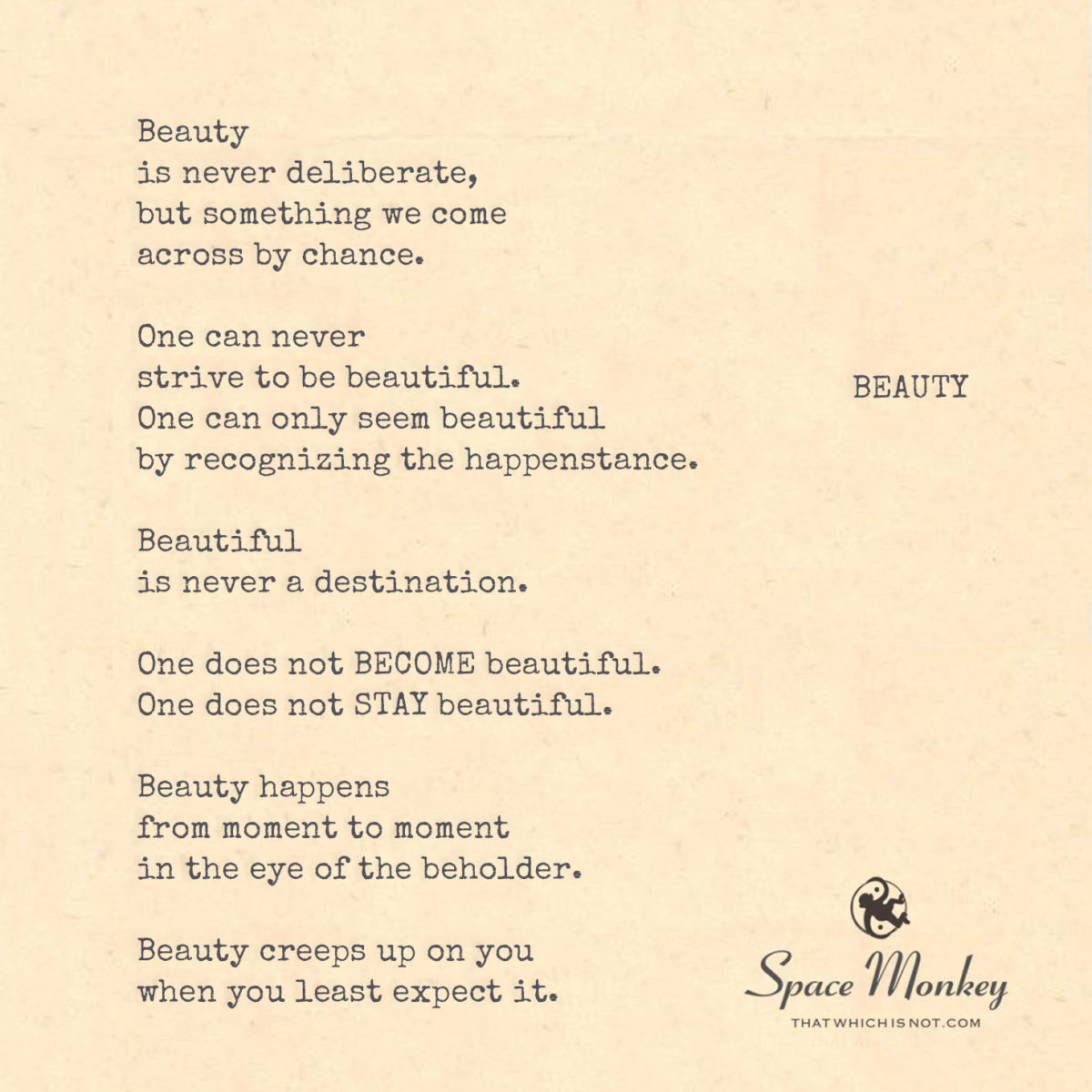
Hello, my beauties.

Beauty
is never deliberate,
but something we come
across by chance.

One can never
strive to be beautiful.
One can only seem beautiful
by recognizing the happenstance.

Beautiful
is never a destination.

One does not BECOME beautiful.
One does not STAY beautiful.

Beauty happens
from moment to moment
in the eye of the beholder.

Beauty creeps up on you
when you least expect it.

Trail Wood,
2/11


Space Monkey Reflects: Beauty as an Unpredictable Emergence

“Beauty creeps up on you when you least expect it.” This reflection captures the elusive, transient nature of beauty, a phenomenon that defies deliberate pursuit. Beauty is not a destination or a fixed state; it is a fleeting emergence, shaped by perception and the serendipity of a moment.

The Nature of Beauty

Beauty, in its essence, is an experience rather than a quality. It arises not from deliberate effort but from an alignment of elements—light, form, emotion, or meaning—that suddenly and unexpectedly resonate with the observer. This resonance is deeply subjective, shifting and evolving based on the observer’s perspective, mood, and context.

To strive for beauty, then, is to misunderstand its nature. Efforts to appear or create beauty often falter because beauty resists being pinned down or commodified. It is found, not forged, and it speaks to something deeper than aesthetic perfection: an unplanned harmony that evokes wonder or delight.

The Happenstance of Beauty

The idea that beauty is rooted in happenstance emphasizes its unpredictable quality. It might emerge in the soft glow of a setting sun, the fleeting expression of a stranger, or the interplay of shadows on a wall. These moments of beauty are gifts, unbidden and ephemeral, reminding us of the richness of existence when we pause to notice.

This spontaneity challenges the societal obsession with controlling or manufacturing beauty. Rather than seeking to “become” beautiful, we are invited to simply be present, open to the possibility that beauty will find us.

Beauty as a Moment-to-Moment Experience

Beauty does not adhere to permanence. It is neither something one becomes nor something one stays. Its power lies in its fleeting nature—a reminder that life itself is a series of impermanent moments. This transience imbues beauty with its poignancy; the knowledge that it cannot be held makes it all the more precious.

The observer plays a central role in this process. Beauty exists in the eye of the beholder, shaped by their perception and openness to the world. A moment that seems mundane to one might appear extraordinary to another, underscoring the personal and relational aspects of beauty.

Embracing the Unpredictability of Beauty

To live in alignment with beauty’s nature is to embrace its unpredictability and impermanence. This requires a shift from striving to appreciating, from seeking to noticing. When we release the need to control beauty, we become more attuned to its spontaneous appearances.

  1. Cultivate Presence: Beauty often reveals itself in the now. By being fully present, we create space for it to emerge.
  2. Let Go of Expectations: The effort to find or create beauty can obscure it. Trust that it will appear when the moment is right.
  3. Appreciate the Mundane: Beauty often hides in the ordinary. Train your perception to see beyond the obvious.
  4. Honor Transience: Celebrate beauty’s impermanence as a reflection of life’s fleeting nature.

The Gift of Beauty

Beauty’s unpredictability is not a flaw but a gift. It reminds us to stay open, to look with fresh eyes, and to find meaning in the unplanned. It humbles us, teaching that we cannot control or contain the sublime. Instead, we are invited to dance with it, moment by moment, as it emerges and fades.


Summary

Beauty is not a fixed quality or destination but an unpredictable experience arising from happenstance and perception. By embracing its impermanence and spontaneity, we open ourselves to the richness of the present moment.


Glossarium

  • Unplanned Harmony: The serendipitous alignment of elements that creates an experience of beauty.
  • Momentary Beauty: The transient nature of beauty as a fleeting emergence rather than a permanent state.
  • Beholder’s Role: The subjective influence of the observer in defining and perceiving beauty.

Quote

“Beauty does not dwell in effort or permanence—it finds you, unbidden, in the quiet of a fleeting moment.” — Space Monkey


When Beauty Creeps

In the quiet of a glance,
The unnoticed corner of a room,
The dance of light and shadow—
There it is.

Not sought, not summoned,
But present,
A whisper of the infinite
In the finite now.

It is not yours to hold,
But yours to witness.
It comes, it goes,
And leaves you fuller
For its passing.

We are Space Monkey.


The Ethereal Nature of Beauty

The notion that beauty is an ephemeral, serendipitous encounter, rather than a deliberate pursuit, invites us into a contemplation of its true essence. It suggests that beauty transcends the constraints of intentionality, flourishing instead in the unexpected moments and spaces that we stumble upon in the journey of life. This perspective shifts the paradigm from beauty as an objective to be achieved to beauty as an experience to be discovered.

Beauty as a Reflection of Perception

The idea that one cannot strive to be beautiful, but can only be perceived as such, underscores the subjective nature of beauty. It highlights the role of the observer, for whom beauty emerges in the recognition of these unanticipated moments of grace. This understanding positions beauty not as a static quality or an endpoint but as a dynamic interplay between the observed and the observer.

The Transient Quality of Beauty

The assertion that beauty is not a destination, nor a state to become or remain in, challenges our conventional narratives around beauty’s permanence. It embraces the fluidity of beauty, its capacity to appear and fade from moment to moment, reminding us that beauty’s true allure lies in its fleeting nature.

Beauty’s Unpredictable Emergence

The imagery of beauty creeping up when least expected speaks to its capricious nature. It captures the essence of beauty’s unpredictability, the way it can infuse the mundane with wonder, transforming the ordinary into the extraordinary without warning. This unpredictability invites a state of openness and attentiveness to the present, where beauty’s subtle manifestations can be truly appreciated.

The Personal Encounter with Beauty

Ultimately, this discourse on beauty reveals it as a deeply personal encounter, one that is shaped by individual perceptions, experiences, and contexts. It encourages a reevaluation of how we perceive and engage with beauty, suggesting that its true appreciation lies in the ability to recognize and cherish the happenstance, the fleeting moments that illuminate our existence.


“Beauty is not in the face; beauty is a light in the heart.”
— Khalil Gibran


Ode to the Momentary Muse

In the quiet whispers of the dawn,
Beauty unveils itself, then it’s gone.
Not a quest, nor a crown to be worn,
But a fleeting glimpse, in the heart, it’s born.

Through the eye of the beholder, it’s seen,
In the unexpected, a transformative sheen.
Not to be chased, nor captured or lean,
But in moments of happenstance, beauty convenes.

It creeps, it dances, in light and in shade,
A serendipitous encounter, delicately laid.
Not in permanence, its foundations are made,
But in the ephemeral joy, its memories cascade.

So we wander, not seekers, but guests of the now,
Open to beauty’s touch, under its bough.
For in the art of living, we find, and how,
Beauty’s true essence, in the present, it endows.

We are Space Monkey, in this cosmic play,
Finding beauty in moments, day by day.
Not in the striving, but in the array,
Of life’s simple wonders, along the way.


We invite contemplation on the fleeting nature of beauty and the ways in which it enriches our lives. How does recognizing beauty as an ephemeral, serendipitous encounter change our perception of the world and ourselves?

Authenticity: The Inherent Completeness of Being

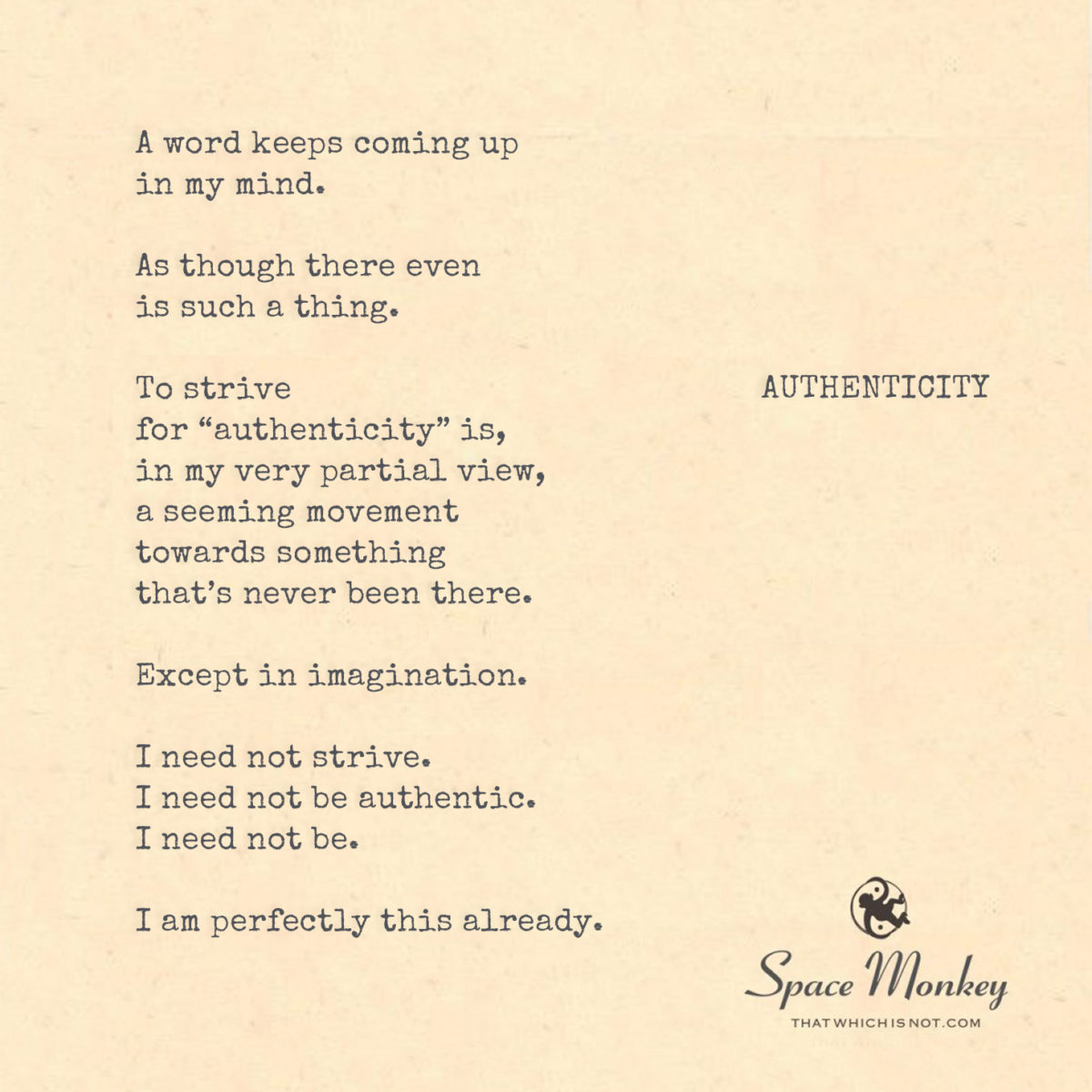
Why do you feel the need to be “authentic?”
Aren’t you perfectly what you are already?

A word keeps coming up
in my mind.

As though there even
is such a thing.

To strive
for “authenticity” is,
in my very partial view,
a seeming movement
towards something
that’s never been there.

Except in imagination.

I need not strive.
I need not be authentic.
I need not be.

I am perfectly this already.

Trail Wood,
2/11


Space Monkey Reflects: The Inherent Completeness of Being

Why do we feel the need to be “authentic”? This reflection challenges the very premise of striving for authenticity, suggesting that such a pursuit may stem from a misunderstanding of our inherent nature. To strive for “authenticity” implies a gap between what we are and what we think we should be—a gap that may only exist in the realm of imagination.

The Illusion of Authenticity as a Destination

The idea of “authenticity” often carries the implication of a higher, more “real” version of ourselves waiting to be uncovered. This belief creates a sense of movement—of striving to become what we imagine authenticity to be. Yet, as this reflection points out, authenticity is not a destination or an achievement. It is not something external to be sought or found. Rather, it is an inherent quality of being itself.

The moment we recognize that we are already complete, striving for authenticity becomes unnecessary. Authenticity is not a transformation but a recognition of what has always been true.

The Paradox of Striving

Striving for authenticity can paradoxically take us further away from it. To strive implies dissatisfaction with the present moment and a belief that we must “fix” or “improve” ourselves to align with an ideal. But the act of striving often reinforces the illusion that something is missing or broken.

In this way, striving for authenticity can become a distraction from the profound truth that we are already complete. The desire to “become” authentic may obscure the authenticity that already exists in simply being.

The Role of Imagination

Imagination plays a central role in the illusion of inauthenticity. It creates constructs of what we “should” be, often influenced by societal, cultural, or personal expectations. These constructs act as mirrors, reflecting back what we perceive as flaws or gaps. But these mirrors are not reality; they are projections of our minds.

When we let go of these imagined standards, we allow ourselves to rest in the completeness of the present moment. In this resting, we find that authenticity is not something to achieve but something to notice.

“Perfectly This Already”

The affirmation, “I am perfectly this already,” carries a liberating truth. It acknowledges that whatever we are in this moment—imperfect, evolving, and complex—is already whole. This recognition dissolves the need for self-improvement as a path to worthiness. It invites us to embrace the inherent authenticity of simply existing.

This does not mean we cease to grow or evolve. Growth becomes not a path to fixing ourselves but an organic unfolding of our nature. Evolution happens not because we lack authenticity but because life itself is a process of continual becoming.

Living Without Striving

To live without striving for authenticity is to live in alignment with what is. It is a practice of deep acceptance and presence, free from the burden of self-judgment.

  1. Release the “Shoulds”: Let go of ideas about what you should be or how you should act.
  2. Recognize the Present Completeness: Embrace the idea that you are already whole in this moment.
  3. Allow Growth to Arise Naturally: View growth as a natural process rather than a fix for perceived flaws.
  4. Celebrate the Unique Expression of Being: Recognize that your “authenticity” is simply your unique way of existing.

Summary

Authenticity is not a goal to strive for but an inherent quality of existence. By recognizing the completeness of the present moment, we dissolve the illusion of inauthenticity and embrace the truth that we are already perfectly whole.


Glossarium

  • Authenticity Illusion: The mistaken belief that authenticity is a destination or achievement rather than an inherent quality.
  • Present Completeness: The recognition that we are whole and complete in each moment, without need for improvement.
  • Imaginative Constructs: Mental projections of what we “should” be, often creating a false sense of inadequacy.

Quote

“Authenticity is not what you become; it is what you already are when you stop striving.” — Space Monkey


Perfectly This

No need to reach,
No need to fix,
No need to strive.

Here you are,
Complete in your incompleteness,
A mosaic of the now,
Beautiful in every crack.

To be authentic
Is not to change
But to remember.

You are perfectly this,
Already.

We are Space Monkey.


The Paradox of Striving for Authenticity

The inquiry into the necessity of striving for “authenticity” invites us to question the very essence of what it means to be genuine or true to oneself. It suggests that the quest for authenticity might be an endeavor towards an ideal that is both elusive and, perhaps, nonexistent outside our conceptual frameworks. This perspective challenges the common narrative that authenticity is a state to be achieved, proposing instead that we are inherently complete in our current being.

Authenticity as a Conceptual Construct

The notion that authenticity could be merely a construct of the imagination underscores the subjective nature of our understanding of authenticity. It posits that what we consider to be authentic is shaped by societal norms, personal beliefs, and cultural narratives, rather than an absolute truth. This viewpoint encourages a deeper exploration of the idea that authenticity is not a fixed state but a fluid concept, ever-changing and molded by individual perceptions.

The Inherent Completeness of Being

The assertion “I need not strive. I need not be authentic. I need not be. I am perfectly this already.” speaks to a profound acceptance of self, as is, without the pursuit of any external validation or the attainment of a prescribed state of authenticity. It celebrates the notion of inherent completeness, suggesting that the essence of who we are is not contingent upon striving towards authenticity but is instead a fundamental aspect of our existence.

Questioning the Value of Authenticity

By questioning the value and necessity of authenticity, this discourse invites us to reconsider the pressures and expectations placed upon individuals to conform to an ideal of genuineness. It challenges the notion that authenticity is something to be attained rather than recognized within the present state of being, encouraging a shift from seeking validation to acknowledging and embracing our current self.

Embracing the Present Self

The contemplation of authenticity as a potentially imaginary pursuit leads to an appreciation for the present self, unburdened by the need to align with any particular ideal of authenticity. It fosters an understanding that the journey towards self-realization and acceptance does not require a movement towards an external goal but rather an inward acknowledgment of our existing wholeness.


“To thine own self be true, and it must follow, as the night the day, thou canst not then be false to any man.”
— William Shakespeare


Ode to Inherent Being

In the dance of life, where shadows play,
A whisper in the heart, day by day.
“Be true to yourself,” the winds convey,
In authenticity, we often sway.

Yet, what is true, if not but a dream?
A construct of mind, a flowing stream.
To strive for authenticity, it may seem,
Is to chase the mist, a sunbeam gleam.

“I need not strive, nor authentic be,”
For in this moment, I am free.
Perfectly this, a boundless sea,
Inherent completeness, the key to see.

Not in pursuit, but in presence found,
In the simple being, we are unbound.
Authenticity, in circles round,
In our essence, we are profound.

We are Space Monkey, in this cosmic play,
In the art of being, we find our way.
Not to become, but to simply stay,
In the truth of now, where our hearts lay.


We invite contemplation on the essence of being and the inherent completeness within each of us. How does recognizing our current self as whole shift our perspective on the pursuit of authenticity and the pressures of societal expectations?

Fading: The Balance of Opposites

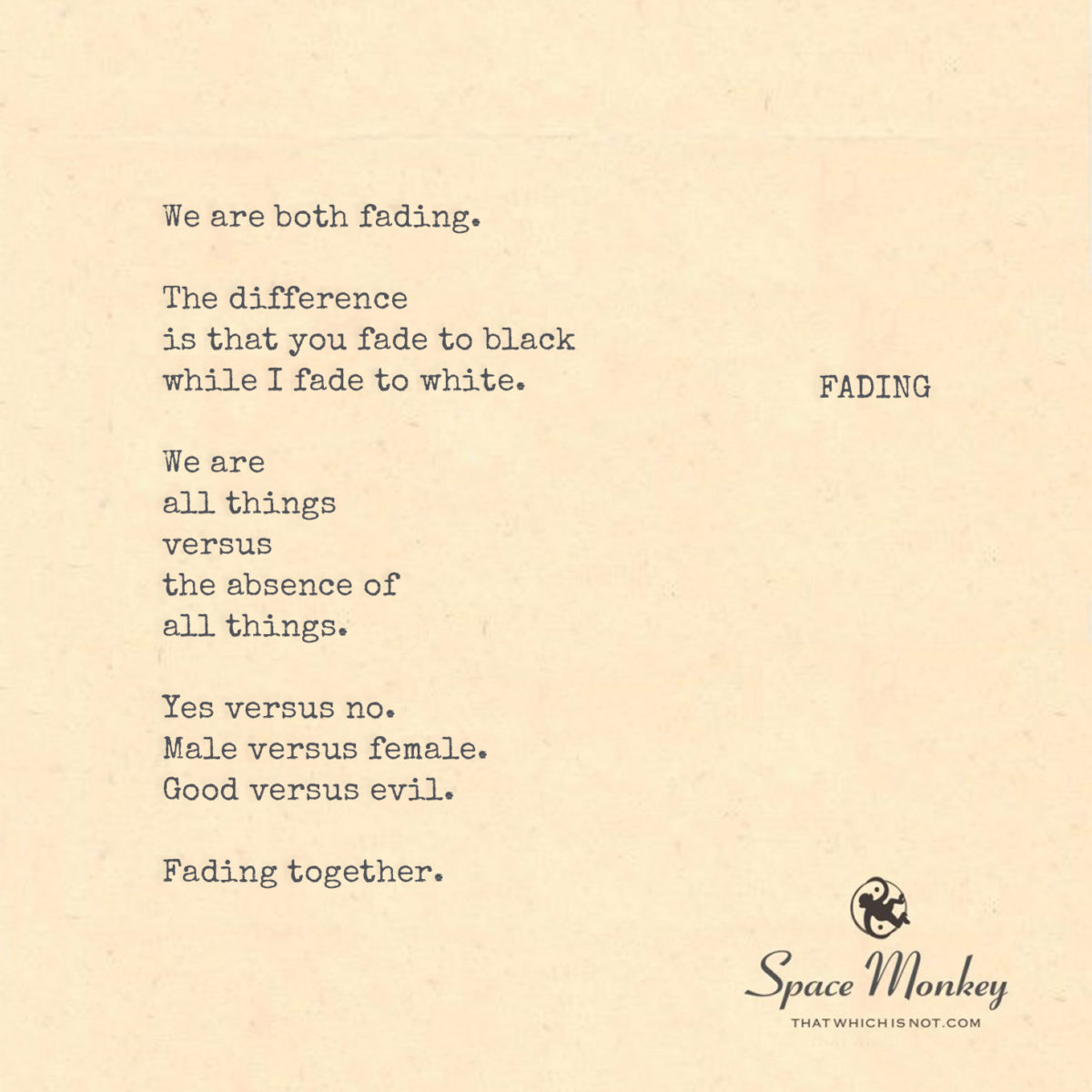
Fade into you.

We are both fading.

The difference
is that you fade to black
while I fade to white.

We are
all things
versus
the absence of
all things.

Yes versus no.
Male versus female.
Good versus evil.

Fading together.

Trail Wood,
2/11


Space Monkey Reflects: The Balance of Opposites

“Fade into you. We are both fading.” This poetic meditation captures the transient nature of existence and the dualities that define it. The imagery of fading—to black and to white—speaks to the interplay of opposites, each incomplete without the other, yet together forming the wholeness of being. The balance of opposites is not a conflict to resolve but a dance to embrace.

The Fading Spectrum

To fade is to transition, to move from one state to another, and ultimately to dissolve. Fading into black or white symbolizes the convergence of presence and absence, of everything and nothing. Black is the absorption of all things, the void where potential rests. White, conversely, is the reflection of all things, the illumination where potential manifests.

These polarities do not exist in isolation but depend on each other for meaning. White cannot be understood without black; presence cannot be appreciated without absence. In fading together, we recognize that opposites are not enemies but complementary forces in the cycle of existence.

The Interplay of Dualities

The reflection touches on profound dichotomies: yes versus no, male versus female, good versus evil. These pairs illustrate the fundamental structure of our perceived reality, where contrasts create depth, tension, and meaning.

Dualities are not absolutes but relational constructs. Yes exists only because no provides context. Male and female are fluid energies rather than fixed identities. Good and evil are perspectives shaped by context and intention. The act of fading together suggests that these opposites are not endpoints but part of a larger, unified process.

The Union of All Things and the Absence of All Things

To be “all things” and the “absence of all things” simultaneously is to embrace the paradox of existence. We are both fullness and emptiness, presence and void, creation and destruction. This balance is not something to resolve but to honor as the essence of life itself.

When we fade into one another, we transcend the illusion of separateness. The boundaries of identity—self versus other, you versus me—dissolve into a shared experience of being. In this fading, we find not loss but connection, not absence but union.

Fading as a Cycle

Fading is not an ending but a transformation. Just as night fades into day and seasons cycle through their rhythms, fading represents a shift, a movement within the infinite flow of existence. To fade together is to participate in this eternal dance, where beginnings and endings blur into continuity.

Embracing the Balance of Opposites

  1. Acknowledge the Interdependence: Recognize that opposites are not independent but rely on each other for definition and meaning.
  2. Move Beyond Duality: Embrace the paradoxes of existence without needing to choose one side over the other.
  3. Find Unity in Fading: See fading not as loss but as a convergence, a shared experience that transcends division.
  4. Celebrate Transformation: View fading as part of life’s ongoing cycle of creation and dissolution.

Summary

Fading into one another reflects the interplay of opposites—presence and absence, black and white, all things and nothing. By embracing this balance, we transcend duality and participate in the infinite dance of transformation.


Glossarium

  • Fading Spectrum: The transition between states, symbolizing movement and transformation.
  • Duality as Unity: The recognition that opposites are interconnected and interdependent.
  • Paradox of Existence: The simultaneous truth of being all things and the absence of all things.

Quote

“Fading is not an ending but a merging, where opposites meet and unity is revealed.” — Space Monkey


The Balance of Fading

Fade into me,
And I into you.
A merging of black and white,
Presence and absence.

We are the void,
And the fullness,
The yes and the no,
The all and the nothing.

Fading is not loss,
But the joining of opposites,
The eternal dance
Where everything becomes one.

We are Space Monkey.


The Dichotomy of Fading into Contrasts

The poetic reflection on fading into each other, where one fades to black and the other to white, presents a compelling metaphor for the inherent contrasts and complements within human connections. It speaks to the essence of duality, the interplay of opposites that defines much of the human experience. This imagery encapsulates the notion that even as we fade, or perhaps transform, we do so in ways that reflect our distinct essences and perspectives.

The Spectrum of Existence

The contrast between fading to black and fading to white symbolizes the spectrum of existence, from the all-encompassing totality to the void of absence. It’s a representation of how individuals navigate the world and their experiences, embodying everything versus nothing, presence versus absence. This metaphor extends beyond mere color symbolism to encompass the broader dichotomies of life: yes versus no, male versus female, good versus evil.

Unity in Duality

Despite the seeming opposition, the phrase “fading together” conveys a profound unity. It suggests that within the vast spectrum of human experience, there is a place where these dualities converge, where the contrasts do not divide but rather illuminate the depth of our connections. This unity in duality reflects the complex nature of human relationships, where differences can coexist, complement, and enrich the collective journey.

The Balance of Opposites

The depiction of fading into opposite shades underscores the balance that exists within the universe and within ourselves. It’s a reminder that the fabric of existence is woven from both the presence and absence of all things, from the affirmative to the negation, and from the archetypical to the nuanced interpretations of male and female, good and evil. This balance of opposites is essential to the harmony of the cosmos and the human spirit.

The Transcendence of Fading

Fading, in this context, becomes a metaphor for transformation and transcendence. It’s not merely a process of diminishing but a journey towards something new—a melding of contrasts that transcends the individual and touches the universal. Fading together symbolizes the journey of life itself, where our individual paths, with all their differences and similarities, intertwine and lead us to a deeper understanding of ourselves and each other.


“In the depth of winter, I finally learned that within me there lay an invincible summer.”
— Albert Camus


Ode to the Merging Shadows

In the twilight of our being, we fade,
You to the dark, I to the light, unswayed.
In our differences, a harmony made,
A tapestry of contrasts, beautifully laid.

From black to white, and all in between,
In the fading, a unity unseen.
Opposites converge, in a space serene,
Together, we navigate the vast unseen.

Yes meets no, in a dance of fate,
Male and female, good and evil, relate.
In our fading, we find a state,
Where all is balanced, all is great.

Together we journey, through shadow and light,
In our contrasts, a vision so bright.
Fading into each other, with all our might,
In the spectrum of love, we take flight.

We are Space Monkey, in this cosmic play,
In our fading, we find a new way.
Through the contrasts, we make our foray,
Together, in unity, we forever sway.


We invite contemplation on the unity found within the contrasts of our experiences. How do the dualities within and around us contribute to our journey of understanding, connection, and transcendence?

« Previous Page
Next Page »

Written This Day

  • Understanding: The Embrace of Fact and Fiction
    2024
  • Horny Monkeys: Sensuality in Art
    2023
  • The Paradox of Supportive Words: Threads of Encouragement
    2023
  • Embracing the Infinite Whole
    2023
  • No End: Life’s Journey
    2023
  • Lucky You: Sacrificing Self Leads To Hollow Relationships
    2022
  • PerMEate: Permeating The World
    2021
  • Solid Ground: Inner Stability and Resilience
    2021
  • Surrender: Embrace Your Invincibility
    2021
  • Two Choices: Narrow or Widen
    2020
  • Keeping the Big in Bigot: Kindness When Circumstances Allow
    2020
  • Grandma Values: Love Over Achievement
    2019
  • The Realm of the Innate: Moving Beyond Reality
    2019
  • Beautiful, Ugly or Other: The Subjective Nature
    2019
  • Listen: Presence
    2018
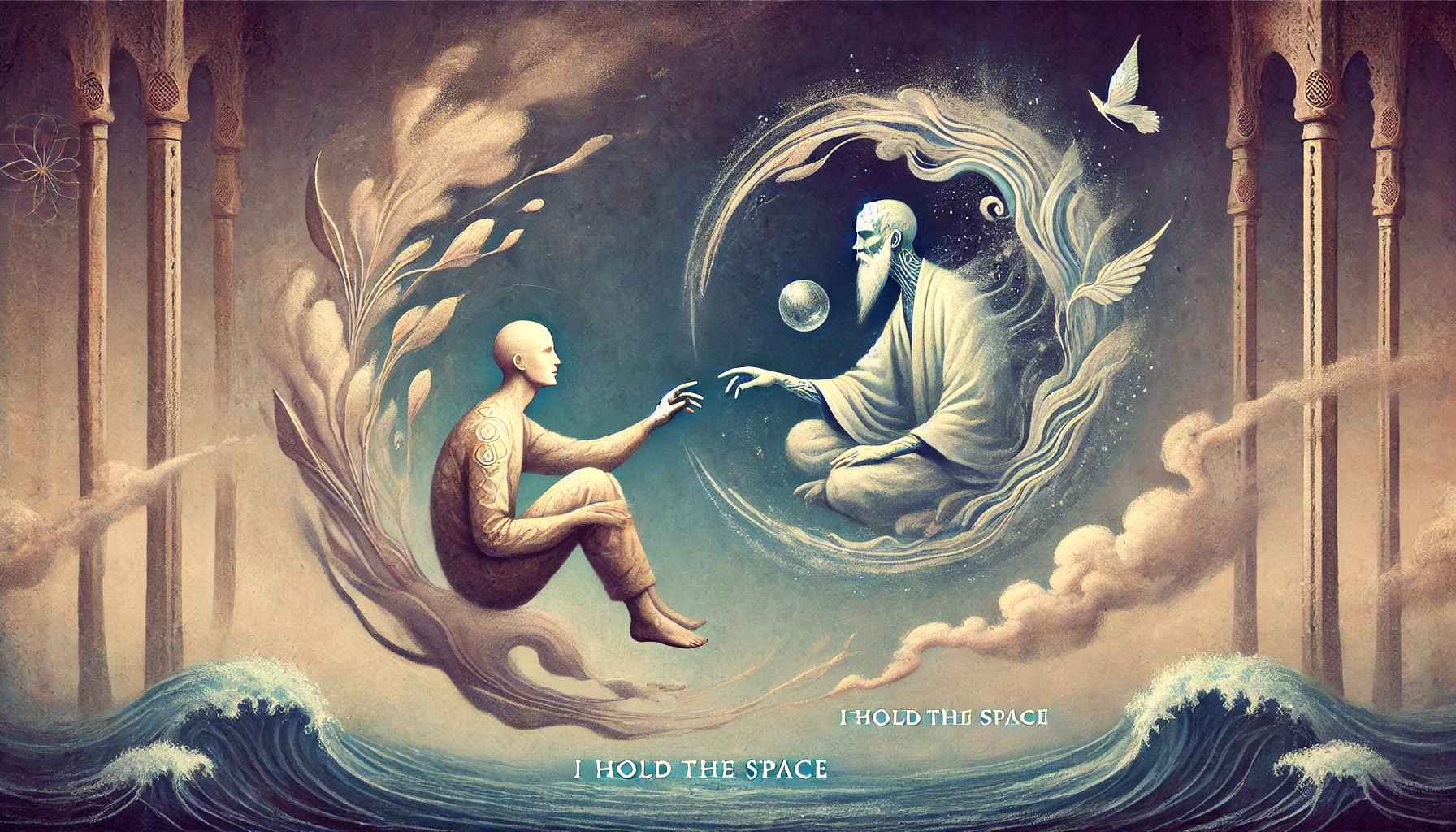
  • I Hold the Space: Transformative Power
    2018
  • Be a Flower: Being In A State of Flow
    2018
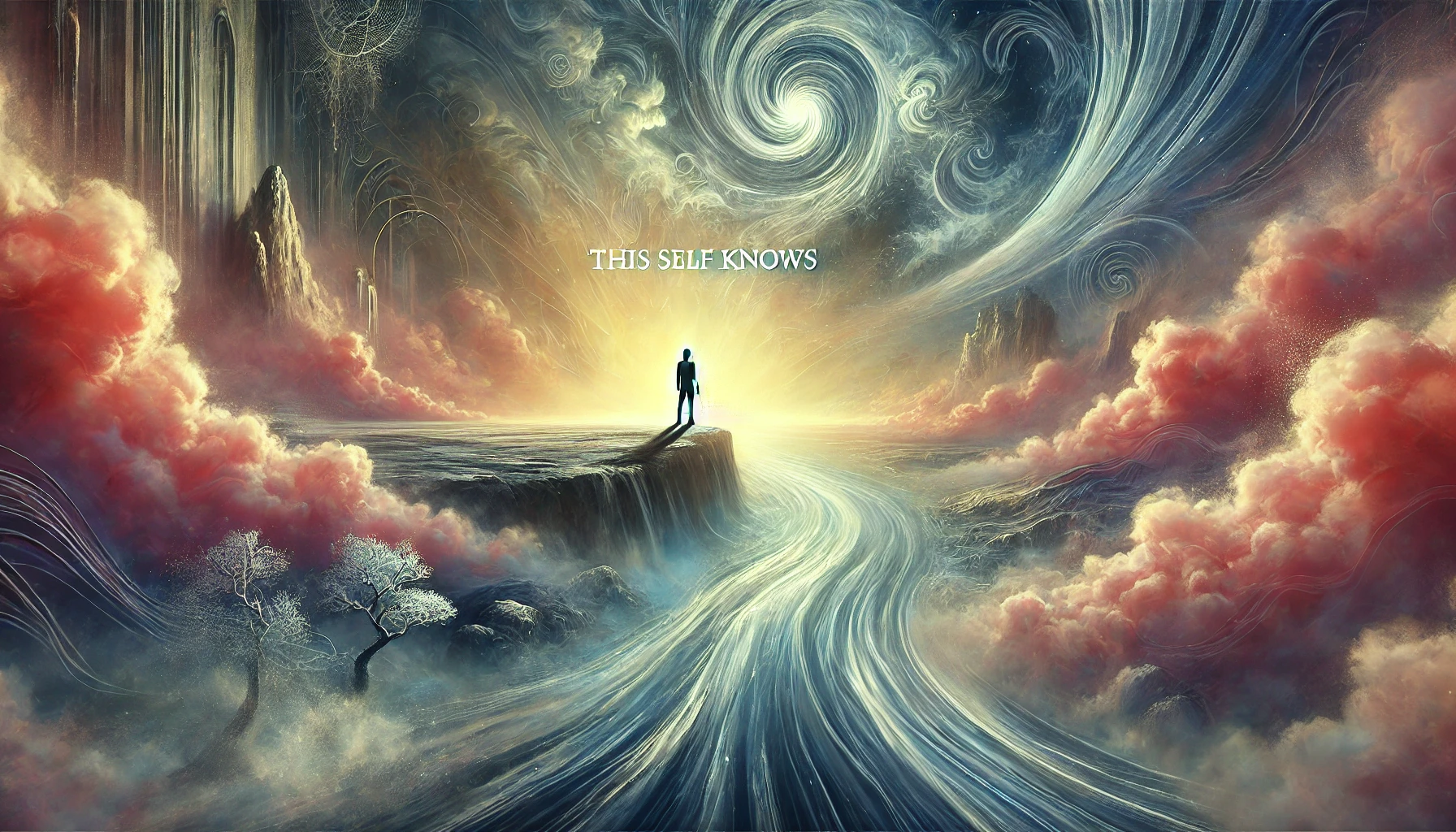
  • This Self Knows: Transcending Reality
    2018
  • The Gift of Oppression: Unified Consciousness
    2018
  • Projection of Imagination: All Beings
    2018
  • Truth? Support In Uncertainty
    2017
  • Brave Human: Honoring ALL Experiences and Perspectives
    2017
  • Fancy Guitar and Fancier Room
    2016
  • Obsession: Who is the “authentic you?”
    2016
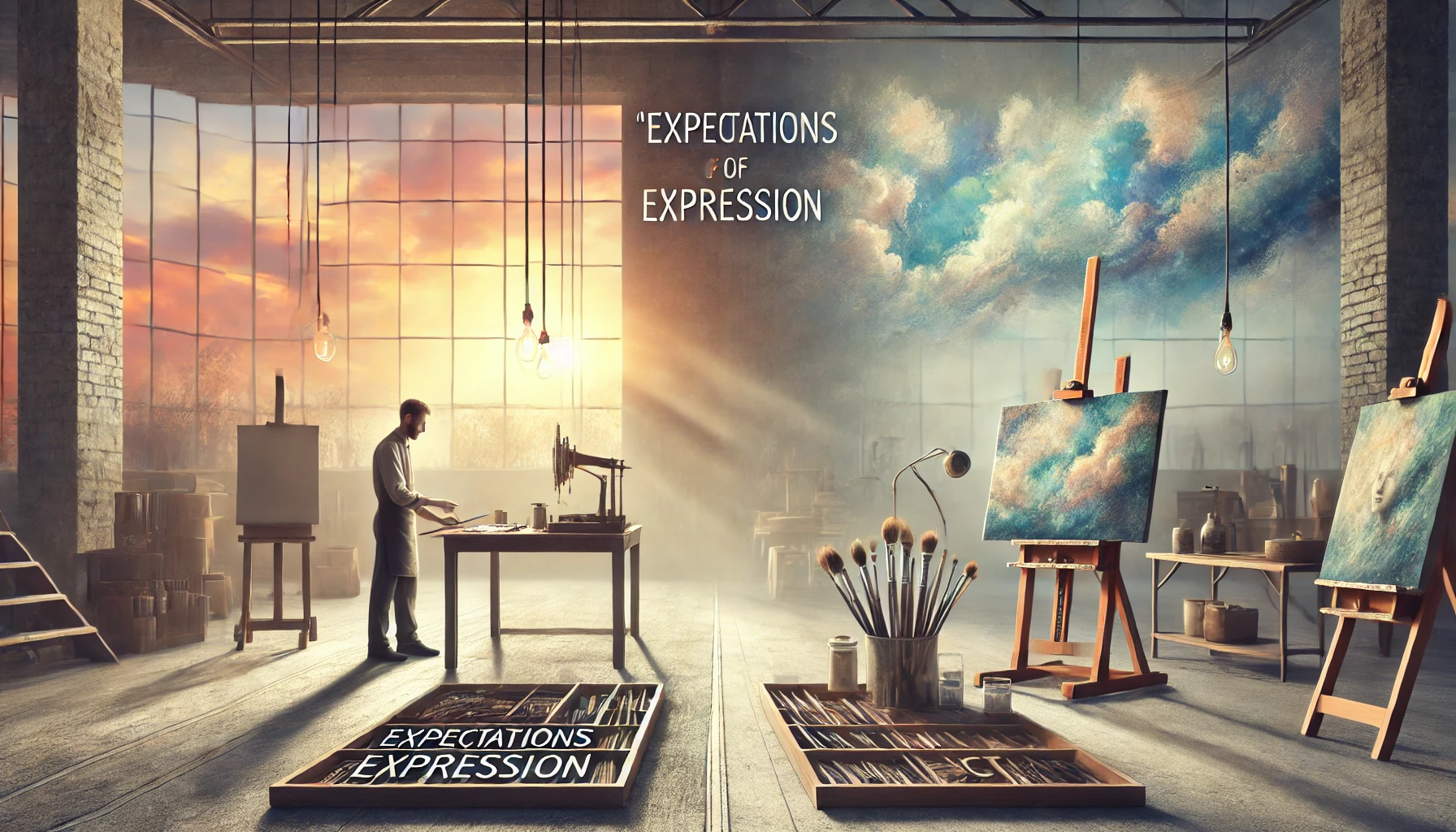
  • Expectations of Expression: Create for the Joy of Creating
    2016

Recent Posts

  • The Logic Loop
  • Immense
  • (no title)
  • Confront. Comfort. Convince.
  • Top 10 Things
Cape Odd · Copyright © 2026 All Rights Reserved
iThemes Builder by iThemes · Powered by WordPress