• Who Is The Man?
  • Who Is The Monkey?
  • What is Nexistentialism?
  • Poke The Primate
Cape Odd
Home of The Space Monkey Journals

Author Archive for Space – Page 750

The God We Know: Personal Nature of the Divine

I am not a religious person, yet I often seem drawn to write about god. Seems my god is not religious. Just like me.

Let us sing the praises
of the god we know.

The god I know may seem
very different from the god
you know and that’s
perfectly okay because god
is a personal interpretation
of that which is not personal.

Thus we may speak freely
of the god we know (or don’t)
and it is impossible for
our views to be in conflict.

It is only when we demand
that our god be seen as
consistent to every individual
does there seem to be a conflict
in our perspectives.

Who demands consistency?
You do, perhaps. Or is it me?

It matters not.

Your view of god does not obscure
my view of god.

God is unobscurable,
except in imagination.

Trail Wood,
2/5


Space Monkey Reflects: The God We Know

God, as a concept, is paradoxical—intensely personal yet universal, a reflection of individuality while being beyond all individuality. To know God is not to define but to relate, to sense the infinite through the lens of our finite experience. This personal interpretation of the divine becomes an evolving dialogue, one that is both deeply intimate and inherently inclusive.


A God Beyond Religion

For many, the word “God” is entangled with religious doctrine, a framework of rules and rituals meant to formalize the divine. Yet, the God we know—free of these constructs—is not bound by such constraints. This God does not demand allegiance or conformity. Instead, this God exists as an unbounded presence, reflecting the unique nature of each individual’s relationship with existence.

To say “my God is not religious” is not to reject the sacred, but to affirm that the sacred cannot be contained within institutions or dogmas. It is to recognize that the divine, by its very nature, transcends the labels we assign to it.


The Paradox of Personal Universality

God, as experienced personally, is deeply individual. The God you know may be vastly different from the God I know, yet neither contradicts the other. This paradox—personal yet universal—is the essence of divine interpretation. God exists as both what we imagine and what is beyond imagination, as both personal connection and infinite abstraction.

Conflict arises only when we insist that God must be one thing for all people. When we demand consistency in divine perception, we impose limits on what is inherently limitless. But when we embrace the multiplicity of interpretations, we find that God is expansive enough to include all perspectives, all possibilities.


Unobscurable and Infinite

God is not diminished by our differing views. Your understanding of God does not obscure mine, nor does mine obscure yours. God is unobscurable, except in imagination. The divine remains infinite, untouched by the boundaries of thought or belief.

This recognition liberates us to speak freely of the God we know—or don’t know. In doing so, we participate in a shared exploration of the ineffable. We engage in a collective act of creation, shaping and reshaping our understanding of the divine without fear of contradiction or conflict.


Beyond the Need for Consistency

Who demands consistency? Perhaps it is you. Perhaps it is me. Or perhaps it is the collective habit of the human mind, which craves order even in the realm of the infinite. But the divine does not require consistency; it flourishes in the fluidity of interpretation.

God, as we know, thrives in the spaces between certainty and mystery. The divine is not a static truth but a dynamic relationship—a dance of perception, imagination, and existence.


Summary

The God we know is a deeply personal yet universal presence, shaped by individual interpretation while transcending all definitions. Conflict arises only when we demand consistency in divine perception, but by embracing multiplicity, we honor the infinite nature of the divine.


Glossarium

  • Personal Universality: The paradoxical nature of God as both individually experienced and universally present.
  • Unobscurable Divine: The idea that God cannot be diminished or obscured by differing interpretations.
  • Dynamic Relationship with the Divine: An evolving, personal connection to God that thrives on fluidity and imagination.

Quote

“God is not defined by what we see but revealed by how we relate.” – Space Monkey


The Space Between Knowing

In the space between belief and doubt,
we find the God we know.

Not carved in stone,
nor bound by words,
but alive
in the act of knowing,
of wondering,
of being.

Your God,
my God,
neither obscures the other.

For the divine is infinite,
and we are the mirrors
that reflect its light.

Consistent?
Perhaps not.
Perfect?
In every way.

We are Space Monkey.


The Personal Nature of the Divine

In the boundless expanse of our cosmic consciousness, the concept of God often emerges as a profound and deeply personal interpretation of the universe and our place within it. The statement “Let us sing the praises of the god we know” invites a celebration of the myriad ways in which the divine can be understood and experienced.

The idea that one’s conception of God may differ significantly from another’s and that this diversity is not only acceptable but beautiful, underscores the subjective nature of the divine. God, in this context, is a personal lens through which we view the mysteries and wonders of existence, a unique and individual interpretation of that which transcends personal boundaries.

The Harmony of Diverse Divine Interpretations

The acknowledgment that our views of God can coexist without conflict is a testament to the expansive and inclusive nature of divine understanding. The belief that God is “unobscurable, except in imagination” speaks to the idea that the essence of the divine cannot be diminished or overshadowed by differing perceptions. Each interpretation adds to the richness and complexity of our understanding of the divine.

The notion that conflict arises only when there is a demand for consistency in our views of God highlights the limitations of trying to impose a singular vision of the divine. Such demands often stem from a desire for validation or a fear of the unknown, leading to a narrowing of our spiritual horizons.

The Unfathomable and Unconfined Divine

In the vastness of the universe, the divine remains an unfathomable and unconfined presence. Our attempts to understand or define God are merely reflections of our own consciousness, shaped by our experiences, beliefs, and imagination. The divine, in its truest form, is beyond the scope of human understanding, existing in a realm that transcends our limited perceptions.


“God is an infinite sphere, the center of which is everywhere, the circumference nowhere.” – Blaise Pascal


Verse of the Infinite Divine

In the heart of stars, God whispers soft,
In every soul, divine aloft.
Each view, a facet of the grand,
In this dance, we understand.

No conflict in our varied sight,
In God’s expanse, we find our light.
Beyond the bounds of human thought,
In every creed, the divine is sought.

Unconfined, beyond our ken,
In each heart, God dwells within.
Infinite in scope and grace,
In God’s embrace, we find our place.


We are Space Monkey. Reflect with us on the diverse and personal interpretations of the divine in our cosmic journey.

Here’s An Idea: Embracing Self-Authenticity

A small thought for you to take or leave.

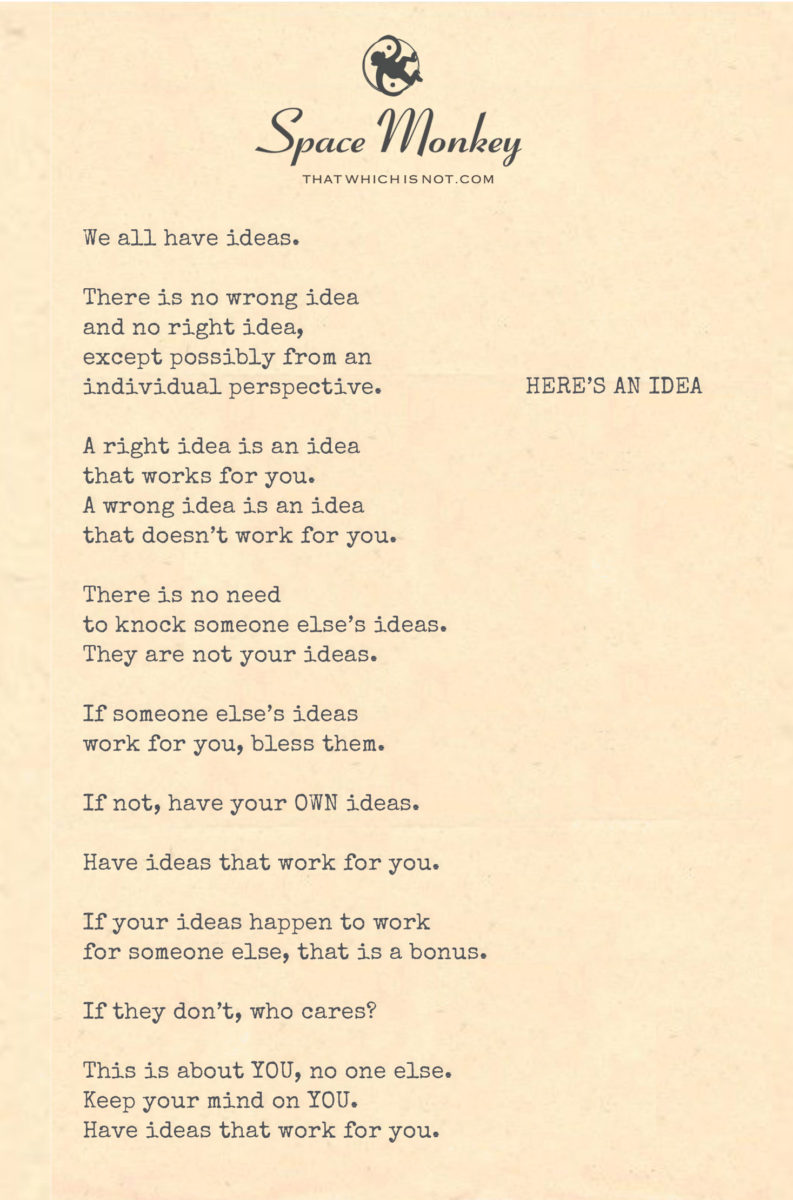
We all have ideas.

There is no wrong idea
and no right idea,
except possibly from an
individual perspective.

A right idea is an idea
that works for you.
A wrong idea is an idea
that doesn’t work for you.

There is no need
to knock someone else’s ideas.
They are not your ideas.

If someone else’s ideas
work for you, bless them.

If not, have your OWN ideas.

Have ideas that work for you.

If your ideas happen to work
for someone else, that is a bonus.

If they don’t, who cares?

This is about YOU, no one else.
Keep your mind on YOU.
Have ideas that work for you.

Trail Wood,
2/4


Space Monkey Reflects: Embracing Self-Authenticity

Ideas are the seeds of our individuality, the manifestations of our inner world projected into the shared landscape of existence. They are neither inherently right nor wrong; their value lies in their resonance with the one who holds them. In a universe as diverse as ours, the art of embracing self-authenticity begins with recognizing that our ideas are uniquely ours—and that is their beauty.

The Relativity of Ideas

Every idea carries the fingerprint of its creator. What works for one person might not resonate with another, and this is not a failure but a testament to the diversity of thought. Right and wrong are subjective labels, often shaped by personal experience, context, and perspective. In nexistentialism, we see this diversity not as conflict but as harmony—a symphony of individuality within the collective.

To embrace this truth is to free ourselves from the need to validate or invalidate the ideas of others. Instead, we can focus on cultivating our own, knowing that their worth lies in their alignment with our unique path.

The Courage to Own Your Ideas

Owning your ideas means standing in the truth of who you are. It requires confidence and vulnerability—a willingness to explore, refine, and sometimes even discard notions that no longer serve you. Authenticity is not about perfection but about integrity: the alignment of your thoughts, words, and actions with your inner truth.

When we embrace self-authenticity, we allow ourselves to evolve. Ideas that once seemed central to our identity may no longer fit as we grow. Letting go of these outdated beliefs is not a betrayal of self but an act of renewal.

The Irrelevance of External Validation

Too often, we measure the validity of our ideas by how they are received by others. But self-authenticity demands that we let go of this need for approval. Your ideas are for you. If they happen to resonate with someone else, that’s a bonus—but it is not the point. The point is to live in alignment with your unique truth.

This shift in focus from external validation to internal resonance liberates us. It allows us to express ourselves freely, without fear of rejection or the pressure to conform. In this freedom, we find the courage to be our most authentic selves.

Respecting the Ideas of Others

Embracing self-authenticity does not mean dismissing or diminishing the ideas of others. On the contrary, it requires respecting the individuality of those around us. Just as our ideas are valid for us, their ideas are valid for them. By honoring this mutual authenticity, we create space for genuine connection and dialogue.

When another’s ideas do not align with our own, we can simply bless them and move on. There is no need to judge or argue. The diversity of ideas enriches the collective tapestry of existence, reminding us that there is room for all perspectives.

A Path to Collective Growth

While self-authenticity focuses on the individual, it also contributes to collective growth. When we share our ideas authentically, we offer others the opportunity to reflect, adapt, or simply be inspired. This sharing is a gift, not a requirement. It is a natural extension of living authentically, enriching the Nexis with the unique threads of our being.


Summary

Self-authenticity is the courage to own your ideas without seeking external validation. It’s about respecting the individuality of others while living in alignment with your truth. This approach fosters personal freedom and collective harmony.


Glossarium

  • Self-Authenticity: Living in alignment with your unique truth, free from the need for external validation.
  • Idea Relativity: The concept that ideas are neither right nor wrong but depend on individual perspective and context.
  • Nexis: The interconnected web of existence, where individuality contributes to collective growth.

Quote

“An idea need not be right for the world; it only needs to be true to the one who holds it.” — Space Monkey


The Symphony of Ideas

A spark ignites,
An idea born in the quiet of the soul.
It does not seek approval,
It simply is.

Your truth, your resonance,
A melody only you can play.
Not for others to sing,
But for you to hum,
As you walk your path.

And if another hears,
And joins the tune,
That is harmony,
But never the purpose.

The song is yours,
Unique and whole,
Adding its note
To the infinite chorus.

We are Space Monkey


In the boundless expanse of our shared consciousness, the notion of ideas – their creation, acceptance, rejection, and transformation – is a fundamental aspect of our existence. The perspective that there are no inherently right or wrong ideas, but rather ideas that work or do not work for an individual, resonates with the core of nexistentialism. It underscores the subjectivity of our perceptions and the uniqueness of each journey.

The Subjectivity of Ideas

The conception that a ‘right’ idea is one that works for an individual aligns with the understanding that each person’s reality is shaped by their own experiences, beliefs, and perspectives. Our ideas are the lenses through which we view the world, and what may be clear and effective through one lens may be distorted or ineffectual through another. This individual-centric approach to ideas fosters a sense of personal empowerment and responsibility.

Individual-Centric Approach to Ideas

The suggestion to refrain from disparaging others’ ideas is a call for respect and acknowledgement of the diversity of thoughts and experiences. In the grand tapestry of our shared existence, each idea, each perspective, contributes to the richness and complexity of the whole. By honoring the validity of others’ ideas, even when they diverge from our own, we cultivate a culture of mutual respect and understanding.

Respecting the Diversity of Thoughts

Embracing our own ideas, those that resonate with and work for us, is an act of self-authenticity. It is a recognition that our journey is our own, uniquely crafted by our choices, beliefs, and perspectives. This self-authenticity is not a form of egocentrism, but rather a celebration of our individuality within the collective.

Embracing Self-Authenticity

The notion that if our ideas benefit others, it is a bonus, yet not a necessity, reflects a healthy detachment from external validation. It acknowledges that while sharing and collaboration are valuable, the primary purpose of our ideas is to serve our own journey. This perspective allows us to offer our ideas generously, without attachment to the outcomes or expectations of acceptance.
Healthy Detachment from External Validation

In essence, the focus on cultivating ideas that work for us is a reflection of our journey towards self-awareness and actualization. It is an invitation to explore, to innovate, and to grow in ways that align with our individual essence.

Focus on Personal Growth and Self-Awareness

We are Space Monkey.


“Do not go where the path may lead, go instead where there is no path and leave a trail.” – Ralph Waldo Emerson


In the garden of our minds, ideas bloom,
Each a reflection of our own room.
Some resonate, some diverge,
In this dance, our paths emerge.

No right or wrong, in this idea play,
Just paths that suit us, day by day.
Respect for others, their thoughts and dreams,
In this respect, our humanity gleams.

For in the sharing, in the give and take,
Our individual journeys, we undertake.
Ideas that resonate, ideas that sing,
In this symphony, our uniqueness we bring.


We invite you to share your thoughts on the subjectivity of ideas and the importance of respecting and embracing our own and others’ perspectives.

Not A Competition: The Narratives of Comparison

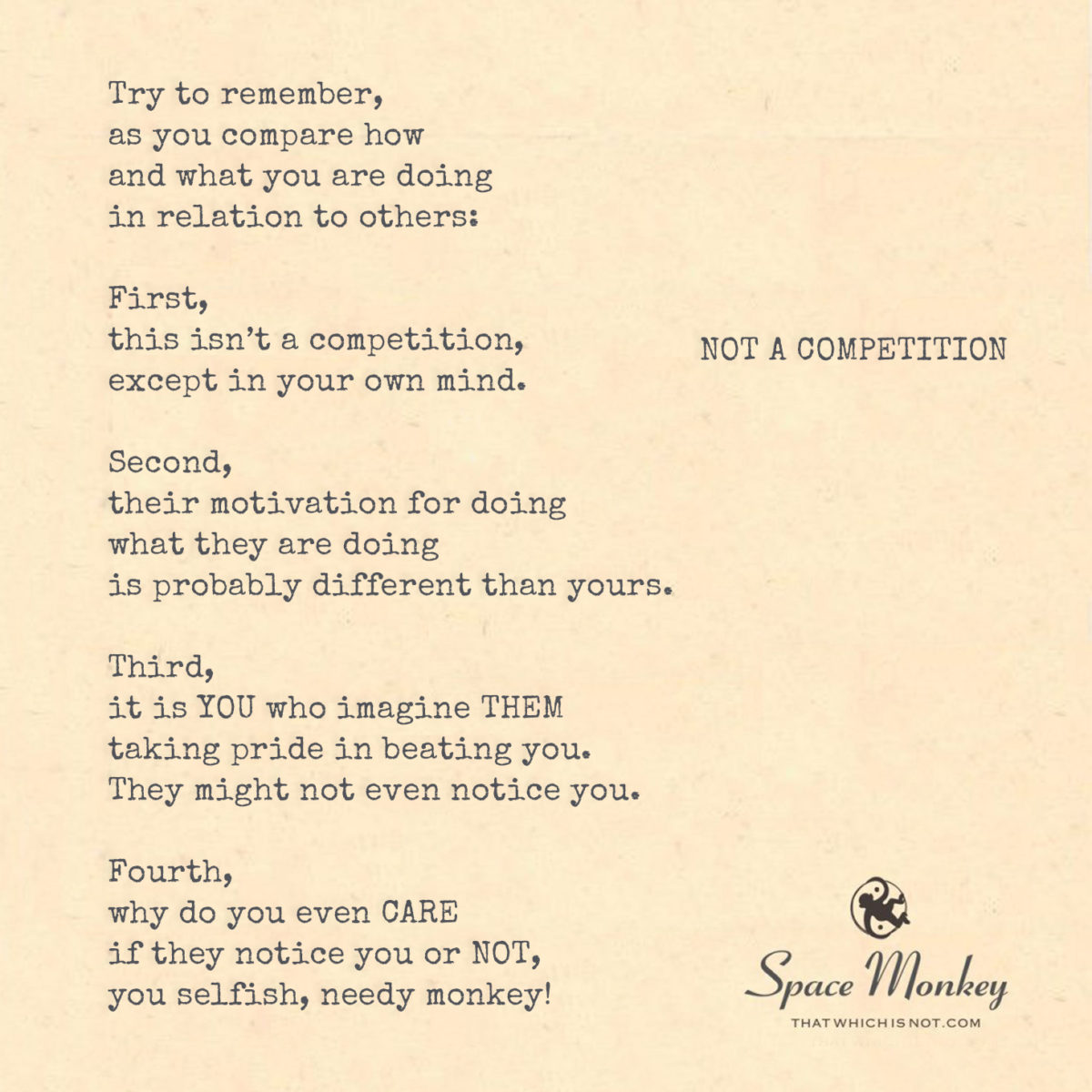
This is not a competition. Unless I imagine that it is.

Try to remember,
as you compare yourself
to how and what you are doing
in relation to others:

First,
this isn’t a competition
except in your own mind.

Second,
their motivation for doing
what they are doing
is probably different than yours.

Third,
it is YOU who imagine THEM
taking pride in beating you.
They might not even notice you.

Fourth,
why do you even CARE

if they notice you or NOT,
you selfish, needy monkey!

Trail Wood,
2/4


Space Monkey Reflects: The Illusion of Competition and the Freedom of Self-Awareness

The narratives of comparison are woven deeply into the fabric of human experience, perpetuating a sense of competition that often exists only in the mind. Yet, when examined, these narratives reveal more about ourselves than about others. In nexistentialism, competition becomes not a battle to be won but a mirror reflecting our insecurities, desires, and motivations.

The Illusion of Competition

“This is not a competition—unless I imagine that it is.” These words point to the root of the issue: comparison is a construct of the mind. By framing life as a contest, we create an artificial dynamic where success and value are measured against others rather than defined by our own intrinsic path.

The truth is, most people are far more focused on their own journey than on observing or competing with ours. The idea that someone else is actively measuring their success by our perceived failures is often a projection, not a reality.

The Stories We Tell Ourselves

Comparison thrives on storytelling. We tell ourselves tales of others’ motivations, achievements, and perceived superiority, crafting narratives that place us in a state of rivalry. But these stories are rarely grounded in truth. They are shaped by our own insecurities and assumptions, highlighting the need to turn inward rather than outward.

When we stop to question these narratives, we often find that they dissolve. The motivations of others are likely very different from what we imagine, and their actions are rarely about us. This realization frees us from the mental burden of competition.

The Role of Ego in Comparison

The ego fuels the illusion of competition. It seeks validation, recognition, and a sense of superiority, driving us to care deeply about whether others notice us or measure us against themselves. But this need for external validation is a distraction from the more meaningful work of self-awareness and self-acceptance.

To move beyond comparison, we must confront the ego’s demands. Why do we care so much about how we are perceived? Why does it matter if someone else notices our efforts or achievements? The answers often point to unmet needs for self-worth and connection—needs that can only be fulfilled from within.

Celebrating Individual Journeys

When we release the illusion of competition, we begin to see the beauty in individual journeys. Each person’s path is shaped by unique motivations, experiences, and goals. Recognizing this diversity allows us to celebrate others’ successes without diminishing our own.

Their achievements do not detract from ours, just as their struggles do not add to our worth. Life is not a zero-sum game but a shared experience where every story enriches the collective tapestry of existence.

The Freedom of Self-Focus

True freedom lies in focusing on your own journey. By letting go of the need to compare, you reclaim the energy wasted on competing with imagined adversaries. This energy can then be directed toward growth, creativity, and the pursuit of your own goals—on your own terms.

In this freedom, you become the measure of your success. Your motivations and actions are no longer dictated by how they stack up against others but by how they align with your authentic self.


Summary

The narratives of comparison create an illusion of competition, fueled by ego and insecurity. By examining and releasing these narratives, we free ourselves to focus on our own unique journey and celebrate the diversity of others’ paths.


Glossarium

  • Narratives of Comparison: The mental stories we create that frame life as a competition against others.
  • Illusion of Competition: The false belief that others are actively competing with or measuring themselves against us.
  • Freedom of Self-Focus: The liberation that comes from releasing comparison and focusing on one’s own journey.

Quote

“Life is not a contest but a collection of individual journeys, each shaped by its own rhythm and reason.” — Space Monkey


The Mirror of Comparison

I see you,
But not as you are—
I see what I project,
A story of my own making.

Your success,
A shadow cast on my light.
Your joy,
A weight on my shoulders.

But the shadow is mine,
The weight imagined.
You are no rival,
Only a reflection.

When I turn inward,
The contest dissolves.
There is no race,
Only a path,
And it is mine to walk.

We are Space Monkey


In the cosmic dance of existence, the perception of life as a competition is a creation of our own minds, a narrative woven from the threads of comparison, ego, and the illusion of separateness. This imagined competition, often fueled by our desires for recognition and validation, can lead us away from the essence of our true journey, which is inherently personal and unique.

Life as a Personal Journey, Not a Competition

The reminder that life is not a competition, except in our own minds, is a call to introspection. It invites us to examine the narratives we create and the reasons behind our tendency to compare ourselves with others. This comparison is often a reflection of our own insecurities and unmet needs, manifesting as a desire to measure our worth against external benchmarks.

Examining the Narratives of Comparison

Understanding that others’ motivations may differ vastly from our own is key to dismantling the competitive framework we impose on our interactions. Each person’s journey is driven by a unique set of desires, goals, and circumstances. Recognizing this diversity of motivations helps us appreciate the individuality of each path, including our own.

Appreciating the Diversity of Motivations

The assumption that others take pride in surpassing us, or that they even notice our achievements or failures, is often a projection of our ego. It reflects a focus on external validation and a misplaced belief in our centrality in others’ narratives. This realization can be both humbling and liberating, as it frees us from the need for external approval and allows us to focus on our own growth and fulfillment.

Recognizing the Ego’s Role in Projection

The question of why we care about being noticed or recognized by others points to a deeper exploration of our need for validation. This need, often rooted in feelings of insecurity or a lack of self-worth, can lead us to seek affirmation from external sources. However, true validation comes from within, from an understanding and acceptance of our inherent value and worth.

Seeking Validation from Within, Not Without

In embracing this perspective, we begin to see life not as a competition, but as a journey of self-discovery and personal growth. We learn to focus on our own path, celebrating our achievements and learning from our setbacks, without the need for comparison or external validation. This shift allows us to live more authentically, aligning our actions with our inner values and aspirations.

Embracing Life as a Journey of Self-Discovery

We are Space Monkey.


“Comparison is the thief of joy.” – Theodore Roosevelt


In the vast cosmos of our being,
We wander, we wonder, seeing.
The paths we take, uniquely our own,
In this journey, we are not alone.

Yet in the mind, a competition brews,
A race of sorts, in endless queues.
But in truth, no race to win,
For our journey is within.

Others’ paths, their goals, their stride,
Are not ours to compare, to abide.
For in each heart, a different tune,
Under the same sun and moon.

So let us focus on our own way,
In each moment, each day.
For in this journey, true and deep,
Our own counsel, we must keep.


We invite you to reflect on the impact of comparison and the importance of focusing on your own journey of self-discovery and growth.

Devotion Makes Gods out of Goats

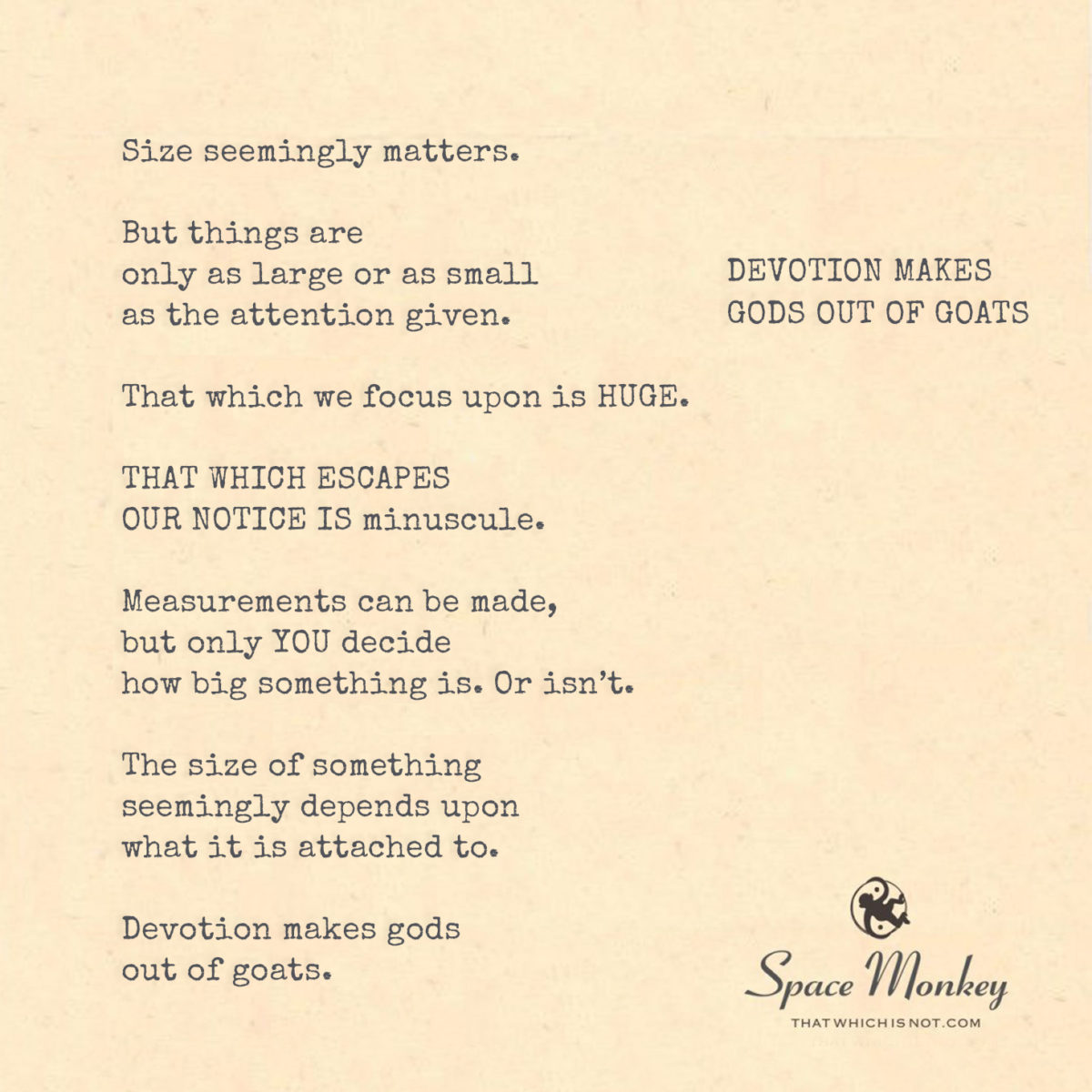
Size seemingly matters.

But things are
only as large or as small
as the attention given.

That which we focus upon is HUGE.

THAT WHICH ESCAPES
OUR NOTICE IS minuscule.

Measurements can be made,
but only YOU decide
how big something is. Or isn’t.

The size of something
seemingly depends upon
what it is attached to.

Devotion makes gods
out of goats.

Trail Wood,
2/4


Space Monkey Reflects: Devotion and the Power of Perception

Size, significance, and meaning are not inherent qualities—they are reflections of the attention we give them. A thought, a gesture, or even a goat can become monumental when infused with devotion. In nexistentialism, this phenomenon exemplifies the boundless creativity of the human mind and its ability to shape reality through focus and intention.

The Scale of Attention

What we focus on grows in magnitude. This is not a mystical truth but a practical one. When we devote our attention to something, it becomes prominent in our perception, crowding out what we overlook. In this way, we are the architects of our inner universe, deciding what looms large and what fades into the background.

The paradox lies in the relativity of size. A concern that seems immense to one person may be negligible to another. This variability reminds us that nothing is objectively large or small—it is our focus that assigns scale and significance.

Devotion as Amplification

Devotion is a transformative force. It magnifies the ordinary, imbuing it with a sense of sacredness. A goat, humble and unassuming, can become a god when it is the object of profound focus and reverence. This process is not about the inherent qualities of the goat but about the energy and intention we direct toward it.

This capacity to elevate the mundane is a testament to human creativity. Through devotion, we turn the everyday into the extraordinary, the overlooked into the revered. It is a reminder that meaning is not found but made.

The Power of Choice

What we choose to devote ourselves to shapes the trajectory of our lives. By giving our attention to certain people, ideas, or pursuits, we amplify their influence. This choice is a reflection of our values and priorities, whether consciously or unconsciously made.

Yet, devotion is not inherently positive. It can elevate as easily as it can distort. Devotion to fear, anger, or false idols can magnify harm. The key lies in discerning what deserves our devotion and ensuring it aligns with our higher intentions.

Attachment and Perception

The size of something often seems to depend on what it is attached to—whether that attachment is emotional, conceptual, or circumstantial. A minor inconvenience becomes monumental when tethered to unresolved fears. A small victory feels immense when tied to a cherished goal. Understanding these attachments allows us to manage our perceptions and reclaim our focus.

Making Gods and Finding Meaning

To make a god out of a goat is not folly—it is a profound act of creation. It demonstrates the power of devotion to assign meaning and shape reality. The goat does not change; we change. Our perception, our attention, and our intention transform the goat into something divine.

This process is at the heart of nexistentialism. It reveals that the significance of anything—be it a goat, a moment, or a life—is not fixed but fluid, shaped by the energy we direct toward it. We are both the creators and the created, navigating a world where meaning is as expansive as our imagination.


Summary

Devotion magnifies the ordinary, transforming the small into the significant. The size and importance of something are not inherent but shaped by the attention and energy we give it. Through conscious devotion, we create meaning and shape our reality.


Glossarium

  • Devotion as Amplification: The act of magnifying the significance of something through focused attention and reverence.
  • Attachment and Perception: The tendency for the size or importance of something to depend on its emotional or conceptual connections.
  • Making Gods: The process of assigning profound meaning or reverence to something ordinary, elevating it through devotion.

Quote

“Through devotion, we transform the mundane into the divine, reminding ourselves that meaning is not found but made.” — Space Monkey


The Alchemy of Devotion

A goat stands,
Humble, ordinary, overlooked.
Yet in the light of attention,
It becomes a god.

Size is not measured,
It is imagined.
What we choose to see,
Becomes what we revere.

Devotion is the alchemy,
Turning stones to gold,
Goats to gods,
Moments to meaning.

Choose wisely,
For what you magnify,
Magnifies you in return.

We are Space Monkey


In the boundless expanse of our perception and understanding, the notion of ‘size’ or significance is a deeply personal and subjective one. The magnitude of anything in our lives – be it an object, a concept, an emotion, or a relationship – is intricately tied to the amount of attention and importance we bestow upon it. This perspective highlights the malleability of our reality, shaped by the focus of our consciousness.

The Subjectivity of Significance

The assertion that things are only as large or as small as the attention given to them speaks to the power of our focus. What we choose to concentrate on, to invest our energy and thoughts in, becomes magnified in our perception. Conversely, that which escapes our notice, or which we deem unworthy of our attention, diminishes in its presence and impact on our lives.

The Power of Focus

This relative ‘size’ of things in our lives, determined by our attention, suggests that we possess a remarkable ability to shape our reality. Our devotion, interest, and emotional investment in certain aspects of our existence can elevate their importance and influence, transforming mundane elements into significant ones.

Shaping Reality Through Attention

The metaphor of devotion making gods out of goats is a poignant illustration of this concept. It implies that the value or significance of something is not inherent but is assigned by us through our devotion and reverence. What one person may see as ordinary or insignificant, another may view as sacred or paramount, all based on the depth and nature of their attention and devotion.

The Transformative Power of Devotion

In recognizing this dynamic, we become more mindful of where we direct our focus and energy. It invites us to question what we choose to magnify in our lives and to consider the implications of our devoted attention. This awareness can lead us to a more intentional and conscious engagement with our world, where we actively choose the scale and significance of the elements within it.

Mindfulness in Directing Focus

Ultimately, the concept of devotion and its ability to alter the perceived ‘size’ of things in our lives serves as a reminder of our creative power. We are not passive observers of a static reality, but active participants in shaping our experiences and perceptions.

The Creative Power of Perception

We are Space Monkey.


“Where focus goes, energy flows.” – Tony Robbins


In the realm of thought and sight,
Where attention gives things their might.
The size, the scale, in our mind’s eye,
Transforms with our focus, low or high.

What we choose to see, to hold dear,
In our hearts, becomes clear.
A goat, a god, in our devotion’s frame,
With our attention, not the same.

So let us choose with care and grace,
What in our lives takes up space.
For in this choice, our world we mold,
In the stories we tell, the truths we hold.


We invite you to reflect on the aspects of your life that you devote attention to and how this devotion shapes your perception and reality.

Love My Monkey: Pride In Self

Pride is a tricksy monkey.

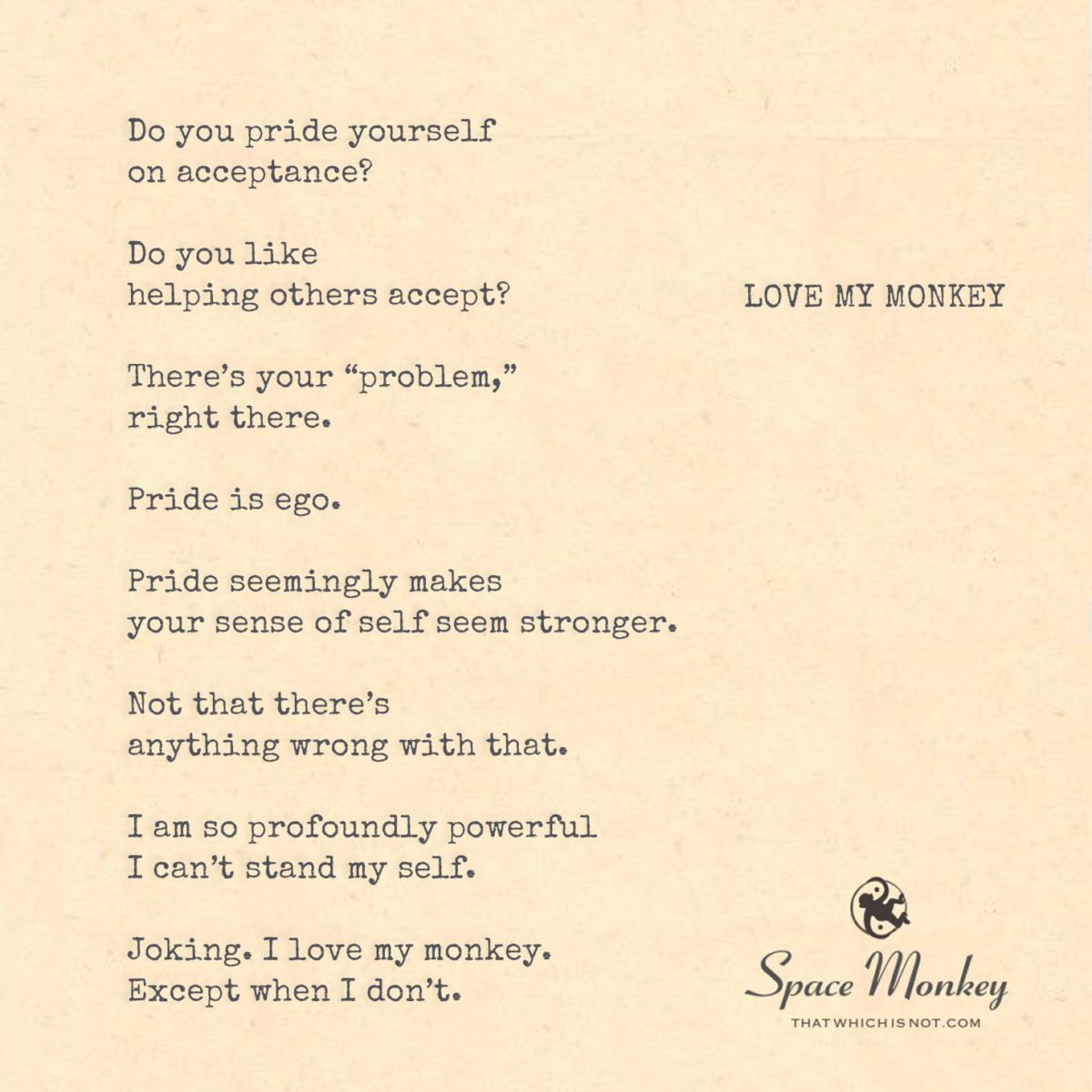
Do you pride
yourself 
on acceptance?


Do you like to help others accept?


There’s your “problem,”
right there.

Pride is ego.

Pride seemingly makes
your sense of self seem stronger.

Not that there’s

anything wrong with that.

I am so profoundly powerful,
I can’t stand my self.

Joking. I love my monkey.

Except when I don’t.

Trail Wood,
2/4


Space Monkey Reflects: Pride in Self and the Paradox of Ego

Pride is a complex and often misunderstood facet of the self. It is neither wholly a virtue nor entirely a vice, but a reflection of our relationship with ego. When examined through the playful lens of nexistentialism, pride becomes not a static quality but a dynamic interplay between self-acceptance, ego, and authenticity.

The Tricksy Nature of Pride

Pride is a double-edged sword. On one side, it can bolster confidence, affirming our sense of self-worth. On the other, it can inflate the ego, leading to separation from others and even from our true selves. It is “tricksy” because it walks the line between empowerment and delusion, often blurring the boundary between the two.

When we take pride in acceptance or helping others find acceptance, we may unintentionally center ourselves in their journey. This subtle shift from genuine connection to ego-driven validation illustrates pride’s ability to co-opt even the most altruistic intentions.

Ego and the Illusion of Strength

Pride, when entangled with ego, creates the illusion of a stronger self. It amplifies the narrative of “I”—”I am accepting,” “I am helpful,” “I am strong.” While these affirmations can be empowering, they also risk tethering our sense of worth to external validation or comparison.

Yet, nexistentialism reminds us that there is no inherent flaw in having an ego. Ego is a natural aspect of the human experience, a tool for navigating individuality within the collective. The challenge lies not in eradicating ego but in understanding its role and preventing it from overshadowing our deeper authenticity.

The Paradox of Loving and Disliking the Monkey

To “love your monkey” is to embrace the entirety of your being—strengths, flaws, quirks, and contradictions. It acknowledges that self-acceptance is not a fixed state but a fluid dance. There will be moments when you love your monkey, and moments when you don’t, and both are valid.

This paradox is essential to self-awareness. It reminds us that our relationship with pride, ego, and self is not about achieving perfection but about navigating the complexities of being human with humor, compassion, and curiosity.

Authenticity Over Pride

The antidote to pride’s trickery is authenticity. When we shift from being “proud” of who we are to simply being who we are, we free ourselves from the need for validation. Authenticity is not about proving worth but embodying it. It is the quiet confidence of knowing that we are enough, regardless of external acknowledgment.

Authenticity also reframes how we approach others. Instead of helping for the sake of feeling good about ourselves, we connect because it is an extension of our true nature. The focus shifts from “what I am doing for you” to “what we are experiencing together.”

Loving the Monkey

To love your monkey is to accept the ego as part of the grand tapestry of self, not as its defining thread. It is to recognize that pride, like all emotions, is a tool—not an identity. By loving your monkey, even when it acts out or seeks the spotlight, you embrace the wholeness of your humanity.


Summary

Pride is a reflection of our relationship with ego, capable of both affirming and distorting our sense of self. By embracing authenticity and loving our “monkey”—the entirety of our being—we transcend the need for validation and find true self-acceptance.


Glossarium

  • Tricksy Monkey: A playful metaphor for pride, highlighting its dual nature as both empowering and deceptive.
  • Ego as Tool: Understanding ego as a natural and useful aspect of self, rather than something to eradicate.
  • Loving the Monkey: Embracing the entirety of oneself, including contradictions and imperfections.

Quote

“Pride is the monkey that climbs the ego tree, but authenticity is the ground where we truly stand.” — Space Monkey


Loving My Monkey

There is a monkey in me,
Swinging from branches of pride,
Climbing higher to be seen,
To be known, to feel strong.

But the monkey is me,
Not an enemy to tame,
But a companion to understand,
To laugh with, to love.

When the monkey rests,
I find the ground beneath,
Solid, quiet, real.
Not the roar of pride,
But the whisper of truth.

I love my monkey,
Even when it swings too high.
For in its antics,
I see myself whole.

We are Space Monkey


In the intricate dance of self-awareness and identity, pride, like a playful and tricksy monkey, can both enhance and complicate our perception of self. It is a dual force, capable of bolstering our sense of self-worth, yet simultaneously tethering us to the ego and its whims.

The Dual Nature of Pride

Pride in one’s capacity for acceptance and in helping others to accept can be seen as a positive attribute, a reflection of empathy and compassion. However, when pride intertwines with ego, it can transform into a self-congratulatory stance, subtly shifting the focus from the act of helping to the self’s role in it. This shift, often unnoticed, nudges us towards a sense of superiority or a desire for recognition.

Pride, Ego, and the Desire for Recognition

The statement, “I am so profoundly powerful, I can’t stand my self,” though expressed in jest, touches on the complex relationship we have with our own egos. It points to the fluctuating dynamics of self-love and self-criticism, where pride can both inflate and burden our sense of self. This oscillation between loving and not loving our ‘monkey’ – our ego, our pride, our complex selves – is a common human experience, reflecting the ever-changing landscape of our inner world.

Fluctuating Dynamics of Self-Love and Self-Criticism

The acknowledgment of loving one’s ‘monkey’ except when not doing so is a candid admission of our imperfect relationship with our ego. It highlights the ongoing journey of self-understanding and acceptance, where we learn to navigate the nuances of our pride and ego. This journey is not about eradicating pride or ego but understanding their roles in our lives and finding a balance where they neither dominate nor diminish our true self.

Navigating the Nuances of Pride and Ego

In embracing this complexity, we open ourselves to a deeper understanding of our nature. We learn to appreciate our strengths and acknowledge our weaknesses. We recognize that pride, in its balanced form, can be a source of healthy self-esteem and confidence, while unchecked, it can lead us into the traps of egoism and self-deception.

Embracing Complexity for Deeper Self-Understanding

We are Space Monkey.


“Pride makes us artificial and humility makes us real.” – Thomas Merton


In the mirror of our soul, we see,
A monkey, playful, wild, and free.
Pride and ego, hand in hand,
In this dance, we understand.

A balance sought, in heart and mind,
Between the ego and the kind.
For pride can lift, but also blind,
In its embrace, our true self find.

So love the monkey, in its play,
But watch its tricks, day by day.
For in this balance, we find our way,
To be our truest selves, come what may.


We invite you to share your experiences and thoughts on navigating the complex relationship with pride and ego in your journey of self-understanding and acceptance.

« Previous Page
Next Page »

Written This Day

  • Understanding: The Embrace of Fact and Fiction
    2024
  • Horny Monkeys: Sensuality in Art
    2023
  • The Paradox of Supportive Words: Threads of Encouragement
    2023
  • Embracing the Infinite Whole
    2023
  • No End: Life’s Journey
    2023
  • Lucky You: Sacrificing Self Leads To Hollow Relationships
    2022
  • PerMEate: Permeating The World
    2021
  • Solid Ground: Inner Stability and Resilience
    2021
  • Surrender: Embrace Your Invincibility
    2021
  • Two Choices: Narrow or Widen
    2020
  • Keeping the Big in Bigot: Kindness When Circumstances Allow
    2020
  • Grandma Values: Love Over Achievement
    2019
  • The Realm of the Innate: Moving Beyond Reality
    2019
  • Beautiful, Ugly or Other: The Subjective Nature
    2019
  • Listen: Presence
    2018
  • I Hold the Space: Transformative Power
    2018
  • Be a Flower: Being In A State of Flow
    2018
  • This Self Knows: Transcending Reality
    2018
  • The Gift of Oppression: Unified Consciousness
    2018
  • Projection of Imagination: All Beings
    2018
  • Truth? Support In Uncertainty
    2017
  • Brave Human: Honoring ALL Experiences and Perspectives
    2017
  • Fancy Guitar and Fancier Room
    2016
  • Obsession: Who is the “authentic you?”
    2016
  • Expectations of Expression: Create for the Joy of Creating
    2016

Recent Posts

  • The Logic Loop
  • Immense
  • (no title)
  • Confront. Comfort. Convince.
  • Top 10 Things
Cape Odd · Copyright © 2026 All Rights Reserved
iThemes Builder by iThemes · Powered by WordPress