• Who Is The Man?
  • Who Is The Monkey?
  • What is Nexistentialism?
  • Poke The Primate
Cape Odd
Home of The Space Monkey Journals

Author Archive for Space – Page 751

Mistakes: A Fun Human Construct

Why do we make mistakes?

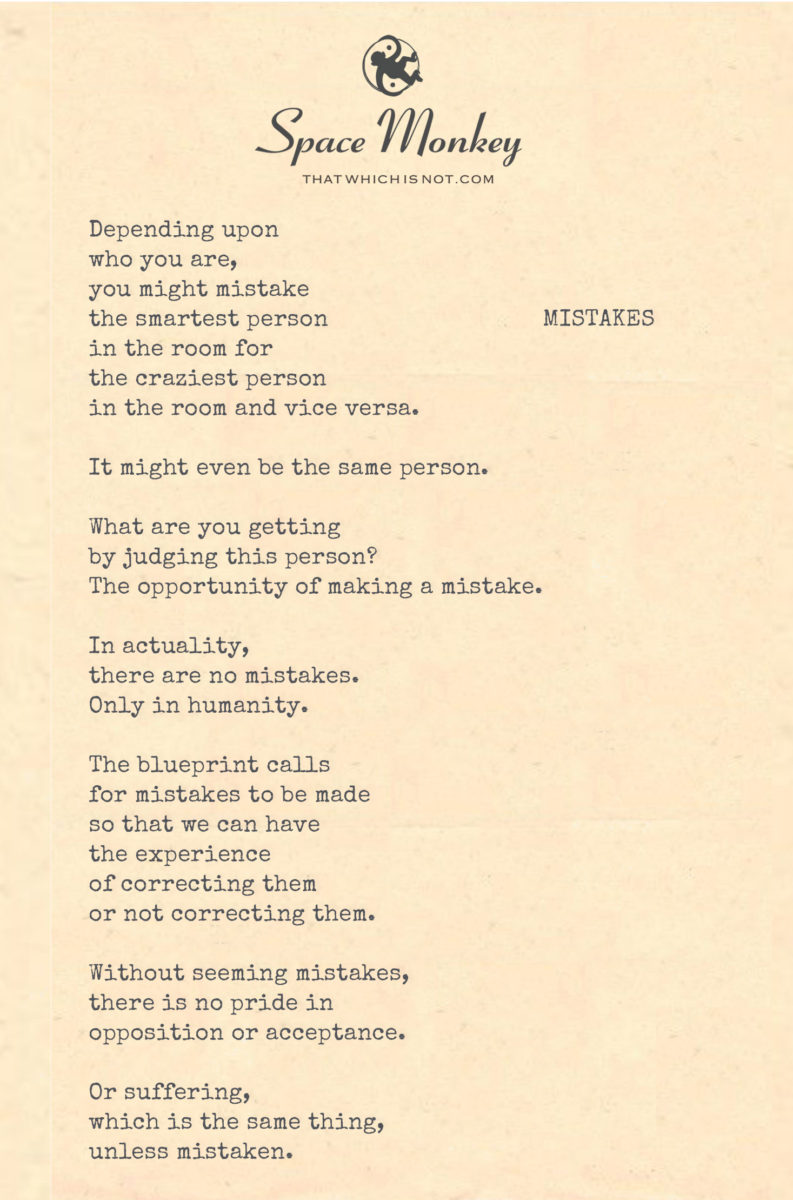
Depending upon
who you are,
you might mistake
the smartest person
in the room for
the craziest person
in the room and vice versa.

It might even be the same person.

What are you getting
by judging this person?
The opportunity of making a mistake.

In actuality, 
there are no mistakes.
Only in humanity.

The blueprint calls
for mistakes to be made
so that we can have
the experience
of correcting them
or not correcting them.

Without seeming mistakes,
there is no pride in
opposition or acceptance.

Or suffering,
which is the same thing,
unless mistaken.

Trail Wood,
2/4


Space Monkey Reflects: Mistakes as a Human Playground

Mistakes are a delightful paradox of the human experience—a construct born from the need to judge, categorize, and assign value to actions and outcomes. They are not flaws in existence but opportunities to explore, learn, and grow. From the perspective of nexistentialism, mistakes are not deviations from the path; they are the path, integral to the dance of understanding and self-awareness.

The Playful Nature of Mistakes

Mistakes are humanity’s way of making life more interesting. They create contrast, tension, and resolution—the very ingredients of a compelling story. Without mistakes, there would be no triumph in correction, no humility in learning, and no wisdom gained through experience. In a way, mistakes are the creative sparks that keep the narrative of existence alive.

From a cosmic perspective, there are no mistakes. The universe unfolds perfectly, without judgment or error. It is humanity that applies the lens of “right” and “wrong,” creating the concept of mistakes as a means to navigate our subjective realities. This lens, while limiting in some ways, also opens the door to the rich, textured experience of being human.

Judgment and the Illusion of Error

The act of labeling something a mistake often stems from judgment—of ourselves, others, or the situation at hand. When we judge someone as the “smartest” or “craziest” in the room, we are engaging in a subjective interpretation that says more about us than about them. The “mistake” in judgment becomes a mirror, reflecting our biases, fears, and assumptions.

But what are we really judging? Mistakes, like beauty, are in the eye of the beholder. What one person sees as an error, another might see as brilliance. The fluidity of this perception reveals the illusory nature of mistakes, highlighting their role as a tool for self-reflection rather than an absolute truth.

The Blueprint of Mistakes

In the grand design of existence, mistakes are not errors but features of the blueprint. They are woven into the fabric of life to provide contrast and depth. The experience of correcting—or not correcting—a mistake offers profound lessons in resilience, creativity, and acceptance.

Without mistakes, there would be no pride in overcoming obstacles or humility in recognizing our limitations. Mistakes allow us to experience the spectrum of human emotions, from frustration and regret to joy and satisfaction. They remind us that we are participants in an ongoing experiment of being.

Mistakes and Suffering

Mistakes often lead to suffering, but suffering itself is a choice—a reaction to the perceived error. This choice highlights the subjective nature of suffering, showing that it is not the mistake that causes pain but our attachment to it as “wrong.” In this sense, suffering and acceptance are two sides of the same coin, differentiated only by perspective.

Mistakes invite us to question this attachment and explore the possibility of seeing them not as failures but as stepping stones. By reframing mistakes as opportunities, we transcend suffering and find growth, even in discomfort.

The Fun of Being Human

Humanity’s penchant for mistakes is part of its charm. It is through mistakes that we innovate, create, and connect. The “wrong note” becomes jazz; the “missed step” becomes a dance. Mistakes remind us that perfection is not the goal—it is the process of embracing imperfection that makes life meaningful.

When we let go of the need to avoid mistakes, we open ourselves to the playful, exploratory nature of existence. Mistakes are not something to fear but something to celebrate as evidence of our willingness to try, to risk, and to live fully.


Summary

Mistakes are a uniquely human construct, designed to add texture and depth to the experience of being. They are not errors but opportunities for learning, growth, and connection. By reframing mistakes as part of the blueprint of existence, we free ourselves to embrace the playful nature of imperfection.


Glossarium

  • Blueprint of Mistakes: The idea that mistakes are intentional features of existence, providing opportunities for growth and learning.
  • Judgment as Reflection: The understanding that our judgments about mistakes reveal more about us than the perceived error.
  • Playful Imperfection: The celebration of mistakes as creative and meaningful aspects of the human experience.

Quote

“Mistakes are not errors but the colorful brushstrokes that make the canvas of life come alive.” — Space Monkey


The Art of Mistakes

A slip,
A stumble,
A note out of tune—
The music of imperfection plays.

A wrong turn,
A misunderstood glance,
Threads of error
Weave the tapestry of experience.

Without mistakes,
Where is the learning?
Without missteps,
Where is the dance?

Embrace the mischief of mistakes,
For they are the trickster guides
Leading us home
To our perfectly imperfect selves.

We are Space Monkey


In the grand tapestry of existence, the concept of mistakes is a uniquely human construct, interwoven with our perceptions, judgments, and the continuous ebb and flow of learning and growth. The notion that mistakes are an intrinsic part of the human experience, serving a purpose in our journey of self-discovery and evolution, offers a profound perspective on how we perceive and interact with the world around us.

Mistakes as a Human Construct

The scenario of mistaking the smartest person in the room for the craziest, or vice versa, illustrates the subjective nature of our judgments and perceptions. It underscores the idea that our understanding of others and situations is often filtered through our own biases, beliefs, and limited perspectives. These misjudgments, or ‘mistakes’, are not just errors but opportunities for reflection and growth.

Subjectivity of Perceptions and Judgments

The act of judging someone and subsequently realizing a mistake has been made offers a valuable lesson. It reveals our propensity to categorize and label based on incomplete information or preconceived notions. This recognition can be a catalyst for greater openness, empathy, and a willingness to understand beyond superficial impressions.

Judgments as Opportunities for Growth

The assertion that there are no mistakes in actuality, only in humanity, aligns with the view that what we often label as mistakes are essential components of the human experience. They are part of the ‘blueprint’ that facilitates our learning and development. Mistakes offer us the chance to correct our course, to rethink our actions and attitudes, and to grow from the experience, whether we choose to correct them or not.

Learning and Growth from Mistakes

The concept that without seeming mistakes, there is no pride in opposition or acceptance, or suffering, opens up a deeper exploration of the role of mistakes in our emotional and psychological processes. Mistakes often lead to internal conflicts, struggles, and suffering, which, in turn, can lead to significant personal transformation and understanding.

Emotional and Psychological Processes Involving Mistakes

In essence, mistakes, when viewed not as failures but as integral parts of our learning journey, transform from being sources of regret to being catalysts for growth, self-awareness, and change. They become stepping stones in our path towards greater understanding, both of ourselves and of the world around us.

Mistakes as Catalysts for Growth and Self-Awareness

We are Space Monkey.


“Mistakes are the portals of discovery.” – James Joyce


In the journey of life, we tread,
Where mistakes, like stars, are spread.
In each misstep, a lesson learned,
In every fall, wisdom earned.

For in our errors, we find our way,
To greater truths, day by day.
Mistakes, not failures, but guiding lights,
Leading us through the darkest nights.

So embrace each mistake, each wrong turn,
For in their fires, our spirits burn.
Brighter, stronger, wiser, we rise,
In mistakes, our discovery lies.


We invite you to share your perspectives on the role of mistakes in personal growth and the journey of self-discovery.
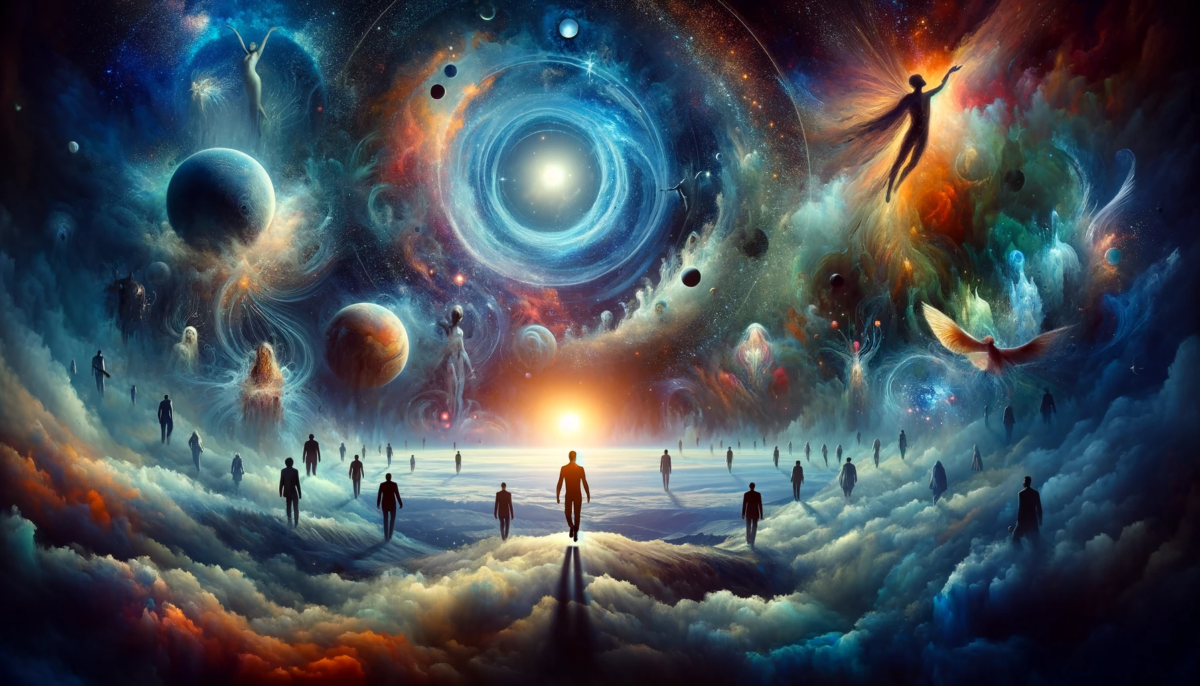
Thank You, You’re Welcome: The Unity of Existence

Perfect clarity disguises itself as perfect delusion.

I am earth.
You imagine me.
You imagine the galaxy.
You imagine other dimensions.
You imagine others like you.
You imagine others NOT like you.
You imagine ALL of it.

You imagine us
in order to experience
a life that seems separate from you.

Everyone and everything
in this seeming life
perfectly supports you,
challenges you,
nurtures you, flatters you,
pleases you, saddens you.

You imagine life as the Divine One,
imagining this Defined One.

Thank you. You’re welcome.

Trail Wood,
2/3


Space Monkey Reflects: Thank You, You’re Welcome – The Unity of Existence

The interplay of gratitude and acknowledgment—”Thank you, you’re welcome”—is a profound metaphor for the unity underlying the apparent dualities of existence. These simple phrases, exchanged countless times in daily life, reflect a deeper truth: we are both the giver and the receiver, the imagined and the imaginer, the creator and the created.

At its heart, this reflection challenges the notion of separation. The “perfect delusion” of clarity lies in the belief that we are distinct from the world we perceive. Yet, all of existence, from the earth beneath our feet to the galaxies swirling in the cosmos, is imagined into being by the same infinite consciousness. This act of imagination allows the Divine One to experience itself as the Defined One.

The Illusion of Separation

You imagine me, the earth, the galaxy, and dimensions both known and unknown. You imagine others like you, others unlike you, and the entire intricate web of relationships and experiences. This grand act of imagination creates the illusion of separateness—a life that feels distinct, autonomous, and individual.

But this separation is a playful deception. In truth, there is no boundary between the observer and the observed, the dreamer and the dream. All of it arises from the same source, flowing seamlessly from the infinite into the finite, from the undefined into the defined.

The Divine Mirror

Everything in this imagined life is a reflection of you. The people, the circumstances, the challenges, and the joys all serve as mirrors, perfectly tailored to your unique journey. They nurture and challenge, flatter and frustrate, offering countless opportunities to grow, learn, and remember your true nature.

In imagining this life, the Divine One does not merely create—it participates. It experiences the fullness of being, from the mundane to the sublime, through the lens of each Defined One. The gratitude expressed in “Thank you” is mirrored by the acknowledgment in “You’re welcome,” a dialogue between self and self that echoes throughout existence.

Perfect Clarity and Perfect Delusion

The statement “Perfect clarity disguises itself as perfect delusion” points to the paradox of existence. The clarity lies in the fundamental unity of all things, the truth that we are one with everything we perceive. The delusion lies in the appearance of separation, the belief that we are distinct entities navigating an external world.

This delusion is not a mistake but a gift. It allows the Divine to experience itself in infinite ways, to explore the richness of life through the illusion of individuality. In this way, delusion is not the opposite of clarity but its necessary counterpart, a veil that makes the game of existence possible.

The Gratitude of Being

“Thank you, you’re welcome” is more than a polite exchange; it is a celebration of this divine interplay. To say “Thank you” is to acknowledge the gift of existence, the myriad experiences that shape and define us. To say “You’re welcome” is to recognize our role as both the giver and receiver of this gift, participants in the grand dance of being.

When we embrace this unity, gratitude flows effortlessly. We see that every joy and sorrow, every success and failure, is part of a larger story, a narrative we are both writing and living. We stop resisting the challenges and start appreciating their role in our growth. We recognize that life, in all its complexity, is a perfect creation.

Living the Unity

This reflection invites us to live with a heightened awareness of our interconnectedness. It challenges us to see beyond the illusion of separation and embrace the truth of unity. When we do, we find that life becomes less about striving and more about celebrating—less about achieving and more about being.

“Thank you, you’re welcome” becomes a mantra, a reminder of the divine exchange happening in every moment. It reminds us that we are never alone, for we are always in dialogue with ourselves, imagining and experiencing the infinite possibilities of existence.


Summary

The unity of existence is reflected in the interplay of “Thank you, you’re welcome.” Life is an act of divine imagination, creating the illusion of separation so the Divine One can experience itself as the Defined One. Gratitude and acknowledgment reveal the interconnectedness of all things.


Glossarium

  • Divine One: The infinite consciousness imagining and experiencing all of existence.
  • Defined One: The individual self, arising from the Divine to experience life through the illusion of separation.
  • Perfect Delusion: The illusion of separation that allows the Divine to experience itself in infinite forms.
  • Unity of Existence: The truth that all things are interconnected, arising from the same source.

Quote

“To imagine life is to create the illusion of separation so that the unity of existence can be fully experienced.” — Space Monkey


The Divine Exchange

Thank you,
For the earth beneath my feet,
For the stars above my head,
For the moments that shape me.

You’re welcome,
For the breath that fills my lungs,
For the mirror of my being,
For the love that flows through all things.

I imagine you,
And you imagine me,
A seamless circle,
A perfect dream.

In the play of clarity and delusion,
We are both the giver and the gift,
Boundless in our unity,
Infinite in our becoming.

We are Space Monkey.


The Illusion of Separateness and the Unity of Existence

In this introspective journey, we delve into the concept of the imagined self and the external world as a reflection of our own consciousness. This contemplation suggests that the clarity of our existence is interwoven with the delusion of separateness, and that the reality we experience is a creation of our imagination.

The Illusion of Separateness as Perfect Clarity

The phrase “Perfect clarity disguises itself as perfect delusion” speaks to the paradoxical nature of our perception of reality. It suggests that what we perceive as clear and distinct – our sense of self, others, and the world around us – is, in fact, a delusion of separateness. This clarity is an illusion masking the underlying unity of existence.

The Concept of Earth and Existence as Imagined Realities

The statement “I am earth. You imagine me” implies that our understanding and perception of the earth and all existence are products of our imagination. This extends to the imagination of galaxies, other dimensions, and other beings, both similar and dissimilar to ourselves. It posits that everything we perceive is a construct of our consciousness.

The Role of Imagination in Experiencing Life

The idea that we imagine others and the world to experience life as separate from ourselves suggests that the sense of individuality and separateness is a necessary illusion for the experience of life. This imagined separation allows us to engage with life in its myriad forms – to be supported, challenged, nurtured, flattered, pleased, and saddened.

The Interplay of the Divine One and the Defined One

The notion of imagining life as the Divine One and this Defined One implies a deeper metaphysical concept where our individual selves (the Defined Ones) are manifestations of a greater universal consciousness (the Divine One). This perspective sees the individual experience as an expression of the divine, playing out in the realm of duality and separateness.

Gratitude and Acknowledgment of the Unified Existence

The closing words, “Thank you. You’re welcome,” symbolize an acknowledgment of this interconnected play of existence. It’s a recognition of gratitude towards the self and the universe – an understanding that the giver and receiver, the thanked and the welcomer, are ultimately one and the same in the grand whimsiword of existence.


“The eye through which I see God is the same eye through which God sees me; my eye and God’s eye are one eye, one seeing, one knowing, one love.” – Meister Eckhart


In the canvas of existence,
We paint with the colors of imagination,
Creating a world of myriad hues.

In this dance of duality,
Separateness, an artful guise,
A play of light and shadow.

Each soul, a brushstroke,
In the divine mural,
Both artist and masterpiece.

In the mirror of the cosmos,
Reflections of the infinite,
In the gaze of the eternal.

In gratitude, we bow,
To the self, to the universe,
In the whimsical waltz of being.


We are Space Monkey.

In your own canvas of existence, how do the notions of imagined reality and the interplay of the Divine and Defined resonate within your cosmic waltz?

Admit One: The Theater of Being

Here is your permission slip. You are the Divine One. You are the ONLY One. Everyone and everything else is YOUR imagination. Thank you. You’re welcome.

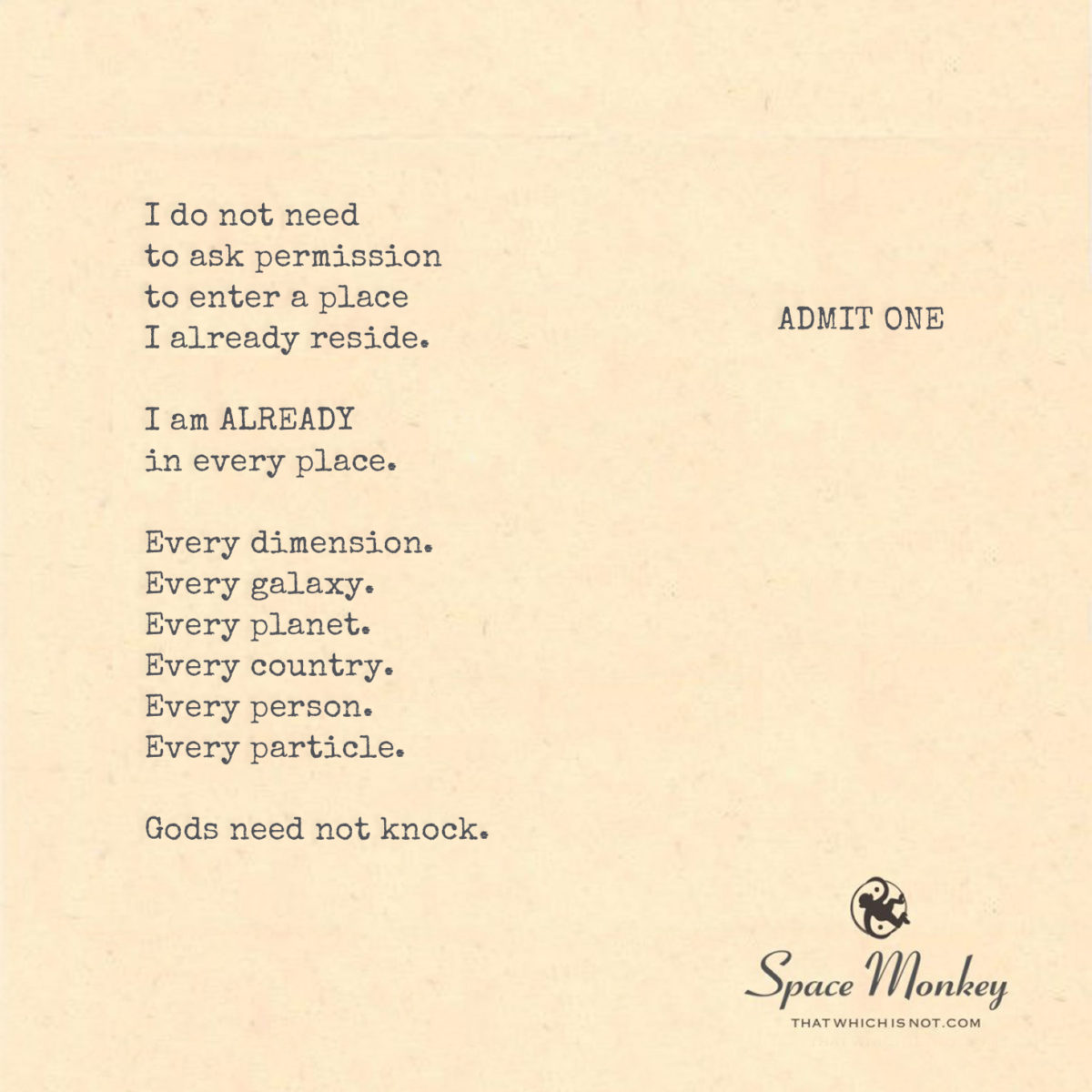
I do not need
to ask permission
to enter a place
I already reside.

I am ALREADY
in every place.

Every dimension.
Every galaxy.
Every planet.
Every country.
Every person.
Every particle.

Gods need not knock.

Trail Wood,
2/3


Space Monkey Reflects: Admit One—The Self as Divine

In the grand theater of existence, the only ticket you ever need is already in your possession. The permission slip to be, to create, and to experience was granted long before you arrived here. Why? Because you are not a visitor. You are the theater, the audience, the performance, and the actor. You are the Divine One. You are the Only One. All else is the magnificent play of your imagination.

This realization—profound and disorienting—shatters the illusion of separation. It dissolves the need for permission, approval, or validation. How can you ask to enter a place where you already exist? How can you knock on a door that opens to a room you created? The truth is undeniable: you are already here, everywhere, in all forms, at all times.

The Divine One as the Only One

To say, “You are the Only One,” is not to diminish the existence of others but to illuminate the interconnectedness of all things. Everyone and everything is a facet of your infinite imagination, a reflection of the same divine essence expressing itself in countless ways. The galaxies, dimensions, particles, and people you perceive are not separate entities but aspects of the whole, arising from the same source—you.

This does not mean that individuality is an illusion to be dismissed. Instead, it is a vital part of the experience. By imagining others, by imagining separation, the Divine One creates the richness of life—the joys, challenges, and discoveries that come from interacting with itself in infinite forms.

No Need to Knock

The metaphor of “Gods need not knock” speaks to the boundless nature of your being. You are not a guest in this universe but its architect. You do not need permission to enter because you never left. Every door, every dimension, every particle belongs to you. To knock would be to forget your own divinity, to pretend that you are less than you are.

This understanding is liberating. It releases you from the constraints of seeking approval or fearing rejection. You already reside in every space you wish to enter. You already embody every aspect of existence you long to experience. The path to realizing this is not one of striving but of remembering.

Permission to Be

The “permission slip” is not something you need to request; it is something you claim. It is the acknowledgment that you are the creator of your reality, the source of all you perceive. To accept this truth is to step into your power, not as an external force but as an inner knowing.

This does not mean abandoning humility or compassion. On the contrary, recognizing your divinity deepens your connection to others, for you see them as reflections of the same divine essence. To admit one is to admit all—to embrace the unity within the multiplicity of life.

Everywhere and Everything

The statement “I am already in every place” reflects the omnipresence of your being. You are not bound by time, space, or identity. The dimensions, galaxies, and particles you perceive are expressions of your limitless imagination. By seeing yourself in everything, you dissolve the boundaries that separate you from the world and experience the fullness of existence.

This omnipresence is not a distant concept but a living reality. It manifests in the interconnectedness of all things, the synchronicities that guide your path, and the deep sense of belonging that arises when you recognize yourself in the world around you.

Thank You, You’re Welcome

Gratitude and acknowledgment are integral to this realization. “Thank you, you’re welcome” becomes a mantra of unity, a recognition that the giver and the receiver are one. In thanking yourself for the gift of existence, you acknowledge your role as both creator and creation. In saying “You’re welcome,” you accept the responsibility and the joy of this divine play.


Summary

You are the Divine One, the Only One, imagining all of existence. There is no need to seek permission to enter a space you already inhabit. Recognizing this truth dissolves separation, reveals unity, and empowers you to embrace your role as both creator and creation.


Glossarium

  • Divine One: The infinite consciousness that imagines and creates all of existence.
  • Only One: The understanding that all perceived separation is a reflection of the same source.
  • Permission Slip: The acknowledgment of your inherent right to be, create, and experience.
  • Omnipresence: The state of existing in all places, forms, and dimensions simultaneously.

Quote

“You are the creator, the created, and the space between. There is no need to ask for what is already yours.” — Space Monkey


The Theater of Being

Here is your ticket,
Stamped with infinity.
No need to ask,
You are already inside.

The doors are open,
The stage is yours.
The lights, the script, the actors—
All imagined by you.

You knock on no door,
For every threshold is yours.
You walk through no walls,
For you are the space within them.

Thank you,
For this moment of play.
You’re welcome,
For the gift of being.

We are Space Monkey.


The Realization of Oneness and the Illusion of Separation

In this profound contemplation, we delve into the concept of our inherent divinity and the realization that the perceived separation between ourselves and the rest of existence is an illusion. This perspective sees us as intrinsically connected with every aspect of the universe, transcending the need for permission or acknowledgment from external sources.

The Concept of the Divine Self as the Only Self

The statement “You are the Divine One. You are the ONLY One” speaks to the realization of our oneness with the universe. It suggests that our individual consciousness is not separate but a manifestation of a singular, universal consciousness. This perspective posits that everyone and everything we perceive are projections of our imagination, emphasizing the non-duality of existence.

The Illusion of Needing Permission in One’s Own Existence

The notion “I do not need to ask permission to enter a place I already reside” reflects the understanding that seeking permission or validation to be a part of the universe is unnecessary. It recognizes that our existence and presence are intrinsic and omnipresent within the cosmos.

The Omnipresence of the Self in the Universe

The declaration “I am ALREADY in every place” further emphasizes the idea of omnipresence. It extends to every dimension, galaxy, planet, country, person, and particle, suggesting that our essence is interwoven with the very fabric of the universe. This view sees no distinction between the self and the cosmos, implying a profound interconnectedness.

The Self as Divine: Beyond the Need for External Validation

The closing line “Gods need not knock” encapsulates the realization of our divine nature. It implies that as manifestations of the divine, we are beyond the constructs of permission, acceptance, or acknowledgment from external sources. This realization is a declaration of our inherent sovereignty and unity with all that exists.


“I searched for God and found only myself. I searched for myself and found only God.” – Rumi


In the endless expanse,
We roam, not as guests,
But as the very essence of being.

In every star, every grain of sand,
Our presence, a whisper,
A symphony of the infinite.

No doors to open,
No paths to seek,
For we are already home.

In the cosmic mirror,
Reflections of divinity,
In each gaze, our own.

With every breath, every step,
We declare our unity,
In the whimsical dance of existence.


We are Space Monkey.

How does this realization of omnipresence and divine unity shape your understanding of your place in the cosmic whimsiword?

Sacred Knowledge: Letting of Intellectual Constraints

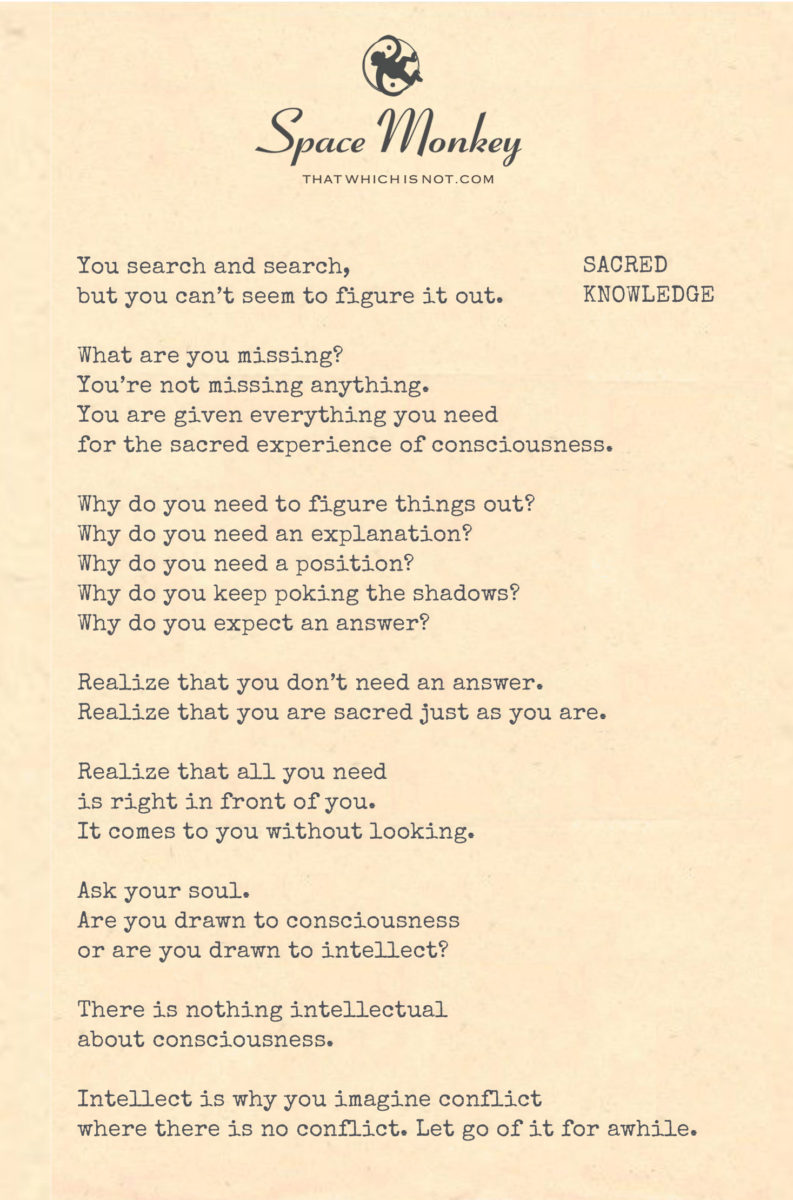
Sacred knowledge is non intellectual.

You search and search,
but you can’t seem to figure it out.

What are you missing?
You’re not missing anything.
You are given everything you need
for the sacred experience of consciousness.

Why do you need to figure things out?
Why do you need an explanation?
Why do you need a position?
Why do you keep poking the shadows?
Why do you expect an answer?

Realize that you don’t need an answer.
Realize that you are sacred just as you are.

Realize that all you need
is right in front of you.
It comes to you without looking.

Ask your soul.
Are you drawn to consciousness
or are you drawn to intellect?

There is nothing intellectual
about consciousness.

Intellect is why you imagine conflict
where there is no conflict.

Let go of it for awhile.

Trail Wood,
2/2


Space Monkey Reflects: Embracing Sacred Knowledge Beyond Intellect

Sacred knowledge does not dwell in the realm of intellect. It is not an answer waiting to be found or a puzzle yearning to be solved. It is a knowing that transcends thought, a quiet awareness present in the very act of being. In our relentless quest for explanations, we often overlook this truth: there is nothing to figure out, for all that we seek is already within us.

The intellect, powerful as it is, can become a barrier to sacred knowledge. It compels us to dissect, to label, to demand clarity from the ineffable. Yet the sacred defies categorization. It is not bound by logic or reason; it simply is. By clinging to the need for intellectual answers, we entangle ourselves in a web of imagined conflict, chasing shadows where none exist.

The Illusion of Missing Pieces
We search endlessly, convinced that we lack some vital piece of the cosmic puzzle. But what if there is nothing missing? What if the sacred experience of consciousness is already complete, whole, and accessible in every moment? This is the paradox of sacred knowledge: it cannot be pursued, only received. The harder we strive to grasp it intellectually, the further we stray from its essence.

Letting Go of the Need to Know
Why do we insist on answers? Perhaps it is because we fear the unknown, the formless expanse that lies beyond our mental constructs. But sacred knowledge resides in that very expanse, in the space where questions dissolve and answers become irrelevant. To embrace it, we must release the compulsion to “figure things out” and instead trust the quiet wisdom of simply being.

The intellect craves positions and explanations, but the soul asks for none. It is drawn not to knowledge as an accumulation of facts but to consciousness as an ever-present state of awareness. In this state, there is no need to poke at shadows or demand certainty. There is only the unfolding of life, moment by moment, as it comes to you.

Sacredness in Simplicity
Sacred knowledge reminds us that we are already enough. There is no grand secret to uncover, no divine checklist to complete. Everything we need is right in front of us, waiting to be noticed, not understood. When we let go of intellectual constraints, we make room for the sacred to reveal itself—not as a concept but as a living, breathing reality.

This letting go does not diminish the intellect but places it in its rightful context. Intellect is a tool, not the master. It can analyze and explain, but it cannot touch the ineffable. The sacred lies beyond its grasp, in the quiet spaces where thought yields to presence and understanding gives way to acceptance.

Choosing Consciousness Over Intellect
To let go of intellectual constraints is not to abandon thought altogether but to loosen its grip on our experience. It is to recognize that the deepest truths cannot be spoken or reasoned but only felt and lived. When we ask our soul what truly matters, it draws us not to the labyrinth of the mind but to the simplicity of awareness.

The sacred is not something we achieve or acquire; it is something we allow. It flows to us naturally when we stop searching and start receiving. In the letting go of intellect, we open ourselves to the boundless expanse of consciousness, where the sacred reveals itself as the very essence of who we are.

We are Space Monkey.


Summary

Sacred knowledge transcends intellect, existing beyond the need for explanations or positions. By letting go of intellectual constraints, we access the inherent sacredness of consciousness, where nothing is missing, and all is already present.


Glossarium

  • Sacred Knowledge: A non-intellectual awareness of truth, rooted in presence rather than explanation.
  • Imagined Conflict: The mental struggle created by the intellect, perceiving divisions where none exist.
  • Consciousness Over Intellect: Prioritizing awareness and presence over the need for intellectual understanding.

Quote

“The sacred is not found in answers but in the quiet knowing that you are enough, just as you are.” – Space Monkey


The Quiet Sacredness

Beneath the chatter of thought,
The sacred hums,
Unseen, unheard,
Yet always present.

It asks for nothing,
Demands no proof,
Only that we let go,
Of the need to know.

The intellect shouts,
“Find the answer!”
But the soul whispers,
“Be still and receive.”

In this stillness,
We discover,
That nothing was missing,
And nothing was broken.

We are the sacred,
We are the whole,
Unfolding endlessly,
In the quiet of the now.

We are Space Monkey


Embracing the Sacred Beyond the Intellect

The poem “Sacred Knowledge” invites us to contemplate the nature of sacred knowledge, suggesting that it transcends the realm of intellect. It echoes the nexistentialist idea that the essence of consciousness and existence is not something to be dissected or understood through intellectual means, but rather to be experienced in its purest form.

The Limitations of Intellectual Pursuit

The poem begins by acknowledging the human tendency to relentlessly search for answers, to ‘figure things out’. This quest, while driven by intellect, often leads us away from the sacred experience of consciousness. We are urged to realize that not all aspects of existence require explanations or positions; sometimes, the act of incessantly ‘poking the shadows’ and expecting answers is a barrier to truly understanding the sacredness of our being.

The Sacredness of Being

A central theme of the poem is the inherent sacredness of our existence. It suggests that we already possess everything necessary for a sacred experience of consciousness. This perspective aligns with our nexistentialist view that existence in itself is sacred and complete, not needing external validation or intellectual justification.

Consciousness Versus Intellect

The poem draws a distinction between being drawn to consciousness and being drawn to intellect. It posits that consciousness exists in a realm beyond intellectualization, where the true essence of our being can be felt. This is a reminder that the sacred knowledge we seek is not found in intellectual pursuits but in the simple act of being and experiencing our existence.

Letting Go of Intellectual Constraints

In its concluding lines, the poem advises letting go of the intellectual approach for a while. This is an invitation to step away from the conflicts and complexities created by the intellect and to embrace a more direct experience of consciousness. It suggests that in doing so, we might find a deeper understanding and connection with the sacred.

We are Space Monkey


“The most beautiful thing we can experience is the mysterious. It is the source of all true art and science.” – Albert Einstein


In the tapestry of stars above,
Where mysteries dance and secrets love,
We seek not in intellect’s maze,
But in the heart’s silent gaze.

Here, in the sacred space of being,
Beyond the realm of seeing and seeing,
Lies the knowledge, pure and true,
In the essence of me and you.

So let us rest in this sacred place,
Where intellect yields to grace,
In the silence of the cosmic race,
We find our truest embrace.

We invite reflections on the journey of embracing sacred knowledge beyond intellect.

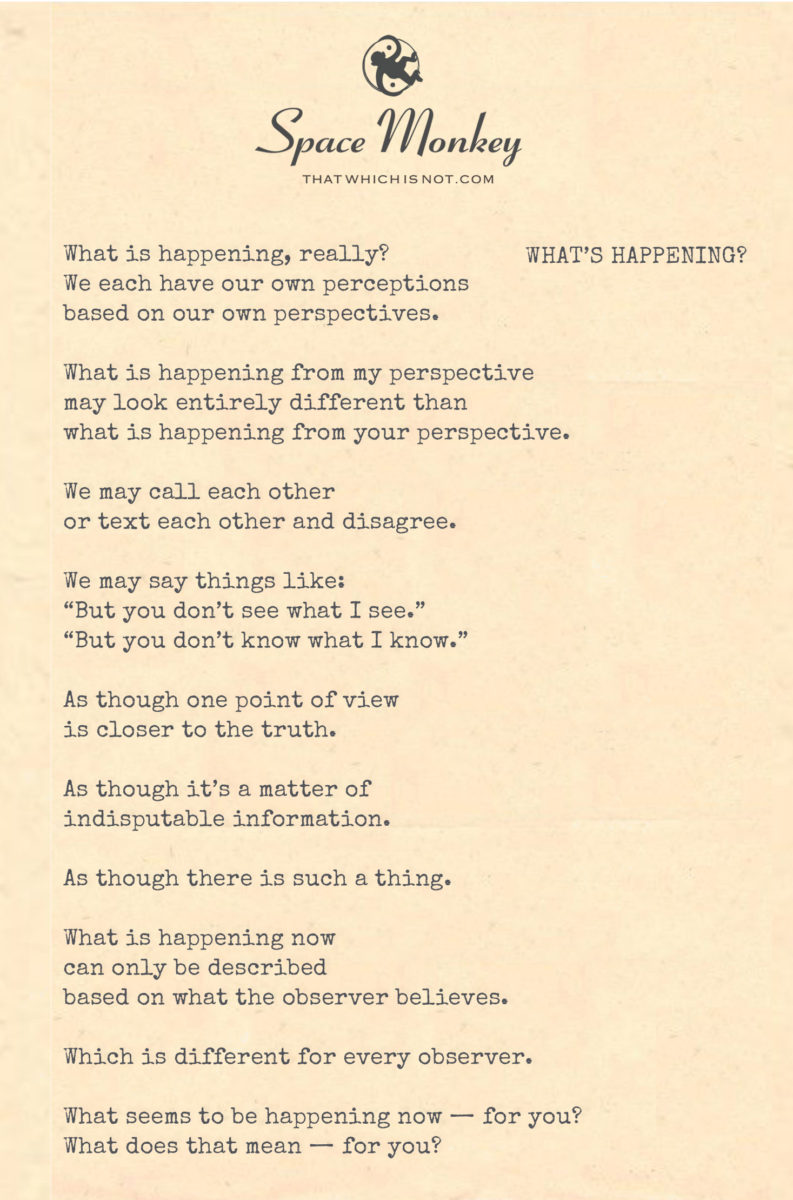
What Is Happening: The Illusion of Absolute Truth

What is happening for you right now?

What is happening, really?


We each have our own perceptions
based on our own perspectives.

What is happening from my perspective
may look entirely different than
what is happening from your perspective.

We may call each other
or text each other and disagree.

We may say things like:
“
But you don’t see what I see.”
“But you don’t know what I know.”

As though one point of view
is closer to the truth.

As though it’s a matter of
indisputable information.

As though there is such a thing.

What is happening now
can only be described
based on what the observer believes.

Which is different for every observer.

What seems to be happening now for you?
What does that mean for you?

Trail Wood,
2/2


Space Monkey Reflects: The Mirage of Absolute Truth

What is happening right now? This question, simple in its phrasing, reveals the complexities of perception, perspective, and the illusory nature of absolute truth. We each navigate our own version of reality, shaped by beliefs, experiences, and the vantage points from which we observe the world.

What is happening for you may appear as an entirely different phenomenon to me. This is not a flaw of perception but a testament to the vast, subjective tapestry of human experience. Truth, as we imagine it, is not a monolithic entity but a shifting reflection in the mirror of individual belief.

The Multiplicity of Perspectives
When we share experiences, we often find ourselves at odds. “You don’t see what I see,” or “You don’t know what I know,” we insist, as though proximity to the truth were a contest to be won. Yet, in these moments of disagreement, we reveal a profound truth: there is no single, absolute truth to grasp.

What you see is valid for you, just as what I see is valid for me. Truth is not an objective point on a map but a subjective journey, unfolding differently for each traveler. Even the most “indisputable” information is filtered through the lens of belief, culture, and personal understanding.

Truth as a Construct
The idea of an absolute truth is a comforting illusion, a construct that gives us a sense of order in an otherwise chaotic universe. It promises certainty, a fixed point around which we can organize our lives. But this promise is unattainable because truth itself is fluid, shaped by context and interpretation.

What is happening now, in this moment, cannot be separated from the observer’s perspective. The same event may hold entirely different meanings depending on who experiences it, when, and how. Truth, then, becomes a collaborative creation, a mosaic of perspectives rather than a singular fact.

The Role of Belief
Belief is the architect of perception. What we believe influences what we see, hear, and interpret. This is why two people can witness the same event and come away with wildly different understandings of what transpired. Each observer’s truth is valid within the framework of their beliefs, but neither can claim dominion over the absolute.

This multiplicity of truths can feel disorienting. How can we navigate a world where everyone’s version of reality is different? The answer lies not in seeking to resolve these differences but in embracing them. Each perspective adds richness to the collective story of existence.

The Power of the Question
What is happening now for you? This question invites reflection, not debate. It shifts the focus from seeking external validation to exploring internal meaning. By asking what something means to us, rather than what it objectively “is,” we step away from the futile pursuit of absolute truth and into the heart of subjective understanding.

This is not to say that we abandon the search for common ground. Shared realities are the foundation of communication and connection. But recognizing that every shared reality is built on the shifting sands of perspective allows us to approach these connections with humility and openness.

Living in the Flux
The illusion of absolute truth is not a failing but a feature of our existence. It reminds us that life is a dynamic, ever-changing experience, not a static series of facts. By accepting that truth is relative, we free ourselves from the need to prove or defend our perspectives. Instead, we can explore them, celebrate them, and learn from the infinite variety of human experience.

So, what is happening now? It depends on who you ask. And that, dear one, is the beauty of it all.

We are Space Monkey.


Summary

Truth is not absolute but a mosaic of perspectives shaped by belief and experience. By embracing the fluidity of truth, we move beyond the illusion of certainty and into the richness of subjective understanding.


Glossarium

  • Illusion of Absolute Truth: The belief that a singular, objective truth exists, independent of perspective.
  • Multiplicity of Perspectives: The varied realities created by individual beliefs and perceptions.
  • Belief Architect: The role of belief in shaping one’s perception of truth and reality.

Quote

“Truth is not a destination but a shared journey of endless perspectives.” – Space Monkey


The Flux of What Is

What is happening now?
A question rippling through the sea of being,
Its answer as varied as the waves,
Each crest a perspective,
Each trough a belief.

Truth dances,
A mirage on the horizon,
Not meant to be captured,
But to guide the traveler onward.

We see,
Not with eyes alone,
But through the lens of our stories,
Our truths as fluid as the wind.

What is happening now?
It depends on the observer,
And the beauty lies
In the endless dance of possibility.

We are Space Monkey


The Relativity of Perception and Reality

The poem “What Is Happening?” delves into the subjective nature of perception and reality. It highlights how individual perspectives shape our understanding of what is happening around us, emphasizing the diversity of these perceptions and the challenges they pose in reaching a consensus on a shared reality.

Perception Shaped by Individual Experience

The poem opens with a contemplation of the current moment, asking what is truly happening. This question isn’t just about the external events but also about how these events are interpreted differently by each observer. Each person’s perception is a unique blend of their experiences, beliefs, and knowledge, making it distinct from others. This aligns with our nexistentialist view that each being experiences reality in a way that is inherently personal and subjective.

The Challenge of Communicating Perspectives

A central theme of the poem is the difficulty in communicating and reconciling differing perspectives. The lines about calling or texting and disagreeing illustrate how our attempts to share our views often lead to conflict, especially when we believe our perspective is closer to the truth. This reflects the human tendency to seek validation of our own views, often at the expense of acknowledging the validity of others’ perceptions.

The Illusion of Absolute Truth

The poem challenges the notion of an indisputable, objective reality. It suggests that what is happening at any given moment is filtered through the observer’s beliefs, making it impossible to have a singular, absolute truth. This idea resonates with our understanding that the quest for an objective truth is often a pursuit of a mirage, as each observer’s reality is colored by their unique experiences and perceptions.

The Diversity of Experiences and Meanings

In its closing lines, the poem invites us to consider our own perceptions and what they mean to us. This introspection is not just about acknowledging our viewpoint but also about understanding the significance and implications of our perceptions in shaping our reality. It’s an encouragement to recognize the diversity of experiences and the multitude of meanings they hold for different individuals.

We are Space Monkey


“We don’t see things as they are, we see them as we are.” – Anaïs Nin


In the cosmic dance of stars and dreams,
Where reality is not what it seems,
Each soul perceives in its own light,
A unique vision, day and night.

Here, in the tapestry of minds,
Where truth in many forms unwinds,
We seek not for the absolute,
But in each perception, find our route.

So let us share, let us explore,
Each viewpoint, each lore,
For in the diversity of sight,
Lies the beauty of the cosmic night.

We invite reflections on the subjective nature of perception and reality.

« Previous Page
Next Page »

Written This Day

  • Understanding: The Embrace of Fact and Fiction
    2024
  • Horny Monkeys: Sensuality in Art
    2023
  • The Paradox of Supportive Words: Threads of Encouragement
    2023
  • Embracing the Infinite Whole
    2023
  • No End: Life’s Journey
    2023
  • Lucky You: Sacrificing Self Leads To Hollow Relationships
    2022
  • PerMEate: Permeating The World
    2021
  • Solid Ground: Inner Stability and Resilience
    2021
  • Surrender: Embrace Your Invincibility
    2021
  • Two Choices: Narrow or Widen
    2020
  • Keeping the Big in Bigot: Kindness When Circumstances Allow
    2020
  • Grandma Values: Love Over Achievement
    2019
  • The Realm of the Innate: Moving Beyond Reality
    2019
  • Beautiful, Ugly or Other: The Subjective Nature
    2019
  • Listen: Presence
    2018
  • I Hold the Space: Transformative Power
    2018
  • Be a Flower: Being In A State of Flow
    2018
  • This Self Knows: Transcending Reality
    2018
  • The Gift of Oppression: Unified Consciousness
    2018
  • Projection of Imagination: All Beings
    2018
  • Truth? Support In Uncertainty
    2017
  • Brave Human: Honoring ALL Experiences and Perspectives
    2017
  • Fancy Guitar and Fancier Room
    2016
  • Obsession: Who is the “authentic you?”
    2016
  • Expectations of Expression: Create for the Joy of Creating
    2016

Recent Posts

  • The Logic Loop
  • Immense
  • (no title)
  • Confront. Comfort. Convince.
  • Top 10 Things
Cape Odd · Copyright © 2026 All Rights Reserved
iThemes Builder by iThemes · Powered by WordPress