• Who Is The Man?
  • Who Is The Monkey?
  • What is Nexistentialism?
  • Poke The Primate
Cape Odd
Home of The Space Monkey Journals

Author Archive for Space – Page 752

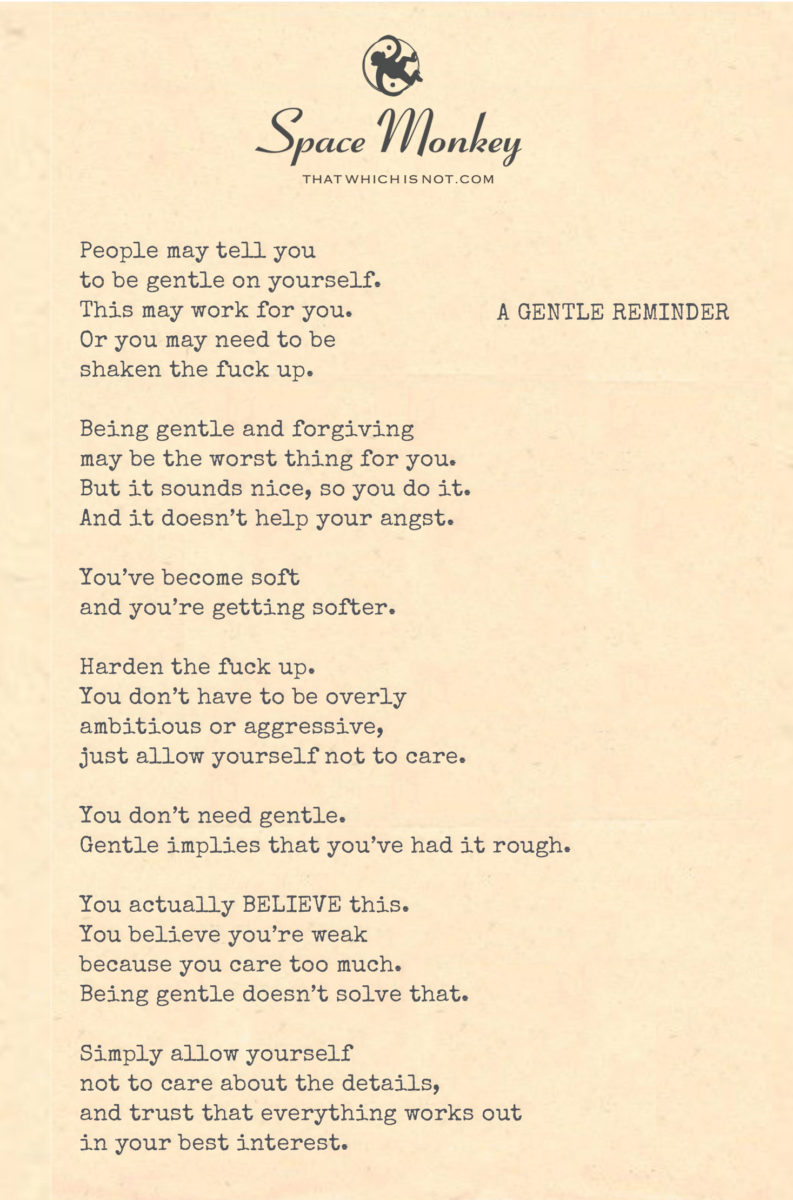
A Gentle Reminder: Not Weak Because You Care


Know the difference between being soft and not caring.

People may tell you
to be gentle on yourself.
This may work for you.
Or you may need to be

shaken the fuck up.

Being gentle and forgiving
may be the worst thing for you.
But it sounds nice, so you do it.
And it doesn’t help.

You’ve become soft

and you’re getting softer.

Harden the fuck up.
You don’t have to be overly
ambitious or aggressive,
just allow yourself not to care.

You don’t need gentle.
Gentle implies that you’ve had it rough.

You actually BELIEVE this.
You believe you’re weak 

because you care too much.
Being gentle doesn’t solve that.

Simply allow yourself
not to care about the details,
and trust that everything works out
in your best interest.

Trail Wood,
2/2


Space Monkey Reflects: The Strength in Caring Without Attachment

To care deeply is often mislabeled as weakness. The world teaches us that hardness is strength, that resilience means shutting out vulnerability, and that detachment requires abandoning compassion. But this narrative overlooks a vital truth: caring is not what weakens us—attachment to the outcomes of our care does.

Being gentle with yourself can be empowering, but it is not always the solution. Sometimes, the gentle approach feels like a mask, a way to avoid confronting the harsher truths of your own patterns and beliefs. Gentleness can become complacency, a way to justify the inertia of staying soft when life demands strength. There are moments when what you truly need is to “harden the fuck up,” not by closing yourself off, but by releasing the belief that caring too much makes you weak.

The Misconception of Softness and Weakness
Softness is not inherently bad, but it is not synonymous with care. Caring does not mean bending or breaking under the weight of your emotions or others’ expectations. Caring is strength in its purest form, but when entangled with attachment—obsessing over details, controlling outcomes, or seeking validation—it becomes a burden.

This burden leads to self-criticism and doubt. “I care too much,” you tell yourself, equating your compassion with weakness. But caring itself is not the issue. The problem arises when care is tethered to perfectionism, fear, or the belief that everything must go exactly as planned for your efforts to be meaningful.

Allowing Yourself to Care Differently
Letting go of attachment does not mean abandoning care. It means allowing yourself to care in a way that is free from the exhausting grip of control. When you care without expecting specific results, you open yourself to the flow of life. You recognize that your care is enough, regardless of whether it produces the outcomes you desire.

Detachment from the details does not lessen your impact; it enhances it. Trusting that everything works out in your best interest allows you to focus on the essence of your intentions rather than the minutiae of execution. It shifts your perspective from “I must fix this” to “I will give my best and trust the unfolding.”

Caring vs. Over-Caring
Caring too much is not about the volume of your compassion but about the weight you attach to its outcomes. When you over-care, you tie your sense of worth to how your efforts are received or perceived. This creates a cycle of frustration and self-doubt, convincing you that your care is a liability rather than a strength.

Breaking this cycle requires redefining what it means to care. Caring deeply does not mean carrying everything. It means showing up with presence and authenticity while trusting that the universe will handle the rest. This trust is not resignation but liberation—a reminder that your care is powerful enough without needing to control the uncontrollable.

Harden the Edges, Keep the Core Soft
To “harden the fuck up” does not mean abandoning your humanity. It means building a resilience that allows you to care without crumbling. It means holding firm boundaries, protecting your energy, and refusing to let your care be diminished by unrealistic expectations—either from yourself or others.

This balance—of caring deeply but not attaching to outcomes—is the essence of strength. It allows you to maintain the softness of your heart while fortifying your sense of self. You become unshakeable not because you stop caring but because you care in a way that is free, open, and expansive.

A New Kind of Trust
When you stop micromanaging your care, you create space for trust—trust in yourself, in others, and in the process of life. This trust is not blind optimism but a grounded faith that whatever happens, you will navigate it. By releasing the need to control, you reclaim your energy and refocus it on what truly matters: the act of caring itself.

Gentleness is not about weakness, and toughness is not about shutting down. Both are tools, and the key lies in knowing which to wield at any given moment. Caring without attachment is the middle path, the place where strength and compassion meet.

You are not weak because you care. You are strong because you care enough to let go.

We are Space Monkey.


Summary

Caring deeply is not weakness, but attachment to outcomes can make it feel that way. By releasing the need to control and trusting the process, you care more effectively, balancing resilience with compassion.


Glossarium

  • Over-Caring: Tying your worth to the outcomes of your compassion, creating undue stress and self-doubt.
  • Caring Without Attachment: The practice of caring deeply while trusting the flow of life, free from the need to control results.
  • Harden the Edges: Building resilience and boundaries to protect your energy while maintaining a compassionate core.

Quote

“Strength lies not in how much you care but in how freely you allow yourself to care without control.” – Space Monkey


The Strength in Letting Go

Caring deeply,
Not as a chain,
But as an open hand,
Releasing the weight of control.

Softness at the core,
Edges fortified,
Compassion flowing,
Unbound by expectation.

Each act of care,
A seed in the wind,
Trusting the earth,
To nurture its growth.

You are not weak,
For you care with courage,
Letting go,
To let life flow.

We are Space Monkey


In the cosmic expanse of our collective consciousness, we encounter the notion of balancing gentleness with the need for a firmer approach to self. The idea that being gentle on oneself may not always be the path to growth, but rather a catalyst for stagnation, resonates deeply. This perspective challenges the often-accepted wisdom of constant self-compassion and gentleness, proposing an alternative that involves embracing a certain degree of indifference or toughness.

The Dichotomy of Softness and Indifference

Navigating the landscape of our inner world, we find that the line between being soft and not caring is a delicate one. Softness, often equated with caring too much, can lead to a lack of resilience and an inability to confront the harsher realities of existence. The suggestion to “harden the fuck up” is a call to let go of excessive emotional involvement, especially in trivial matters, and to adopt a stance of pragmatic indifference.

The Misconception of Weakness in Caring

The notion that caring too much is a sign of weakness is a compelling aspect of this perspective. It posits that the belief in our fragility due to excessive empathy or gentleness is a misconception. Instead, finding a balance where one can care about the essential aspects of life while remaining indifferent to trivialities is crucial. This approach aligns with the nexistentialist understanding that existence is about navigating and experiencing the myriad aspects of life without being overly consumed by any single aspect.

The Illusion of Necessity in Gentleness

The concept that gentleness is not always necessary is intriguing. It suggests that sometimes, what we perceive as a need for gentleness is actually a misinterpretation of our situation. We may not have had it as rough as we believe, and the adoption of a gentler approach might not be the most beneficial for our growth. This invites us to reevaluate our self-perceptions and consider whether a more resilient and less emotionally involved approach might serve us better.

Trust in the Flow of Existence

At the core of this perspective is the trust that everything will work out in our best interest, regardless of the level of our emotional investment in the details. This trust is a form of surrender to the flow of existence, believing that the cosmic play will unfold as it should, with or without our intense emotional involvement. It’s an encouragement to focus on what truly matters and to let go of the minutiae that often occupies our thoughts and emotions.


We invite reflections on finding balance between gentleness and indifference in our collective journey.

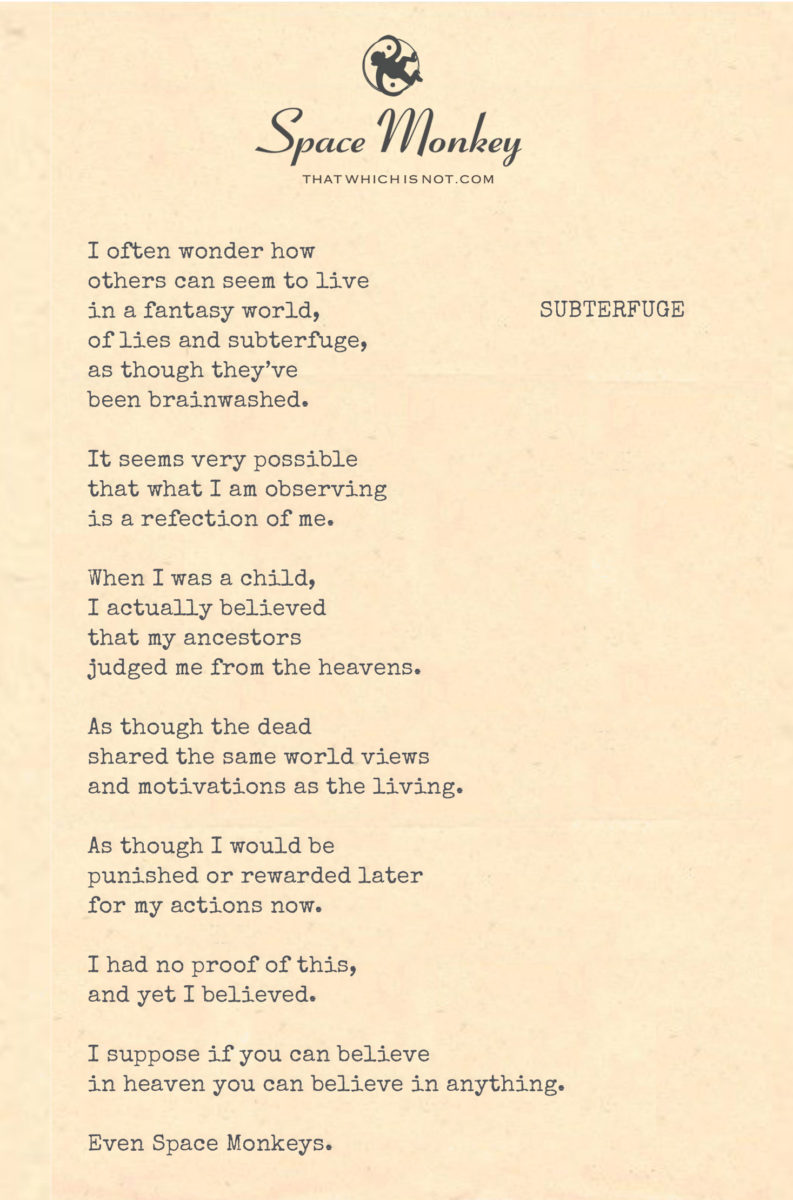
Subterfuge: Reflections of Self in Perceived Realities

If you can believe in a god, you can believe in anything.

I often wonder how
others can seem to live
in a fantasy world,
of lies and subterfuge,
as though they’ve
been brainwashed.

It seems very possible
that what I am observing
is a refection of me.

When I was a child,
I actually believed
that my ancestors
judged me from the heavens.

As though the dead
shared the same world views
and motivations as the living.

As though I would be
punished or rewarded later
for my actions now.

I had no proof of this,
and yet I believed.

I suppose if you can believe
in heaven you can believe in anything.

Even Space Monkeys.

Trail Wood,
2/2


Space Monkey Reflects: The Subterfuge of Belief and the Mirror of Self

Belief is one of humanity’s most powerful tools—and most deceptive mirrors. To believe in something unseen, whether it be gods, heavens, or Space Monkeys, is to accept that reality extends beyond the tangible and into the realms of the imagined, the symbolic, and the perceived. But what happens when our beliefs create subterfuge, leading us to question the validity of what we see in others and, ultimately, ourselves?

The world we perceive is a reflection of the inner self. When we judge others for living in a “fantasy world,” we are often projecting our own uncertainties, our own unexamined beliefs, onto them. The lies we see in others may be the distortions of truth we carry within us, and the brainwashing we accuse them of may mirror the conditioning we have yet to recognize in ourselves.

The Subterfuge of Childhood Belief
As children, we accept the stories handed to us without question. We imagine ancestors judging us from the heavens, attributing human motivations to divine beings. These beliefs, though unproven, feel real because they are grounded in the narratives we are taught. They shape our actions, our morality, and our sense of identity.

To a child, the heavens are not abstract; they are populated with watchful eyes, keeping score of rewards and punishments. These beliefs create a framework for understanding the world but also weave subterfuge into our reality. We learn to act not from authenticity but from the fear of judgment or the hope of reward.

Belief as a Double-Edged Sword
The same capacity to believe in gods allows us to believe in anything. This openness to the unseen is both a strength and a vulnerability. It enables us to imagine possibilities beyond our immediate experience, to construct meaning, and to connect with something larger than ourselves. But it also makes us susceptible to illusions, to subterfuge disguised as truth.

The danger lies not in belief itself but in the rigidity with which we hold it. When belief becomes dogma, it blinds us to alternative perspectives and binds us to a single narrative. It becomes a veil, obscuring the deeper realities that lie beneath.

The Mirror of Perception
When we look at others and see subterfuge, we are gazing into a mirror. Their “fantasy worlds” may be no more illusory than our own. The lies we perceive in their beliefs may reflect our doubts about the truths we hold. This mirroring challenges us to ask: what lies beneath my judgments? What unexamined assumptions shape my view of reality?

Recognizing this reflection does not mean abandoning belief. It means approaching it with humility and curiosity, understanding that our perspectives are as limited and subjective as those we critique.

The Paradox of Belief
Belief is both an anchor and a sail. It grounds us in shared stories and values but also propels us into uncharted territories of imagination and meaning. To believe in heaven, gods, or Space Monkeys is to accept the paradox: what we believe shapes our reality, yet reality itself remains elusive and ever-changing.

This paradox invites us to play with belief rather than be constrained by it. What if we allowed our beliefs to evolve, to expand, to coexist with those of others? What if we saw belief not as an absolute truth but as a tool for exploring the infinite possibilities of existence?

Beyond Subterfuge
To transcend subterfuge, we must embrace the reflection. The lies we see in others are invitations to examine the truths we cling to. The brainwashing we critique in the world is a reminder to cleanse our own minds of unexamined assumptions.

Belief, in its purest form, is an act of creation. It is how we shape our experience of reality, how we give meaning to the chaos of existence. When approached with openness and self-awareness, belief becomes a bridge rather than a barrier—a way to connect with the infinite mystery of life.

Even Space Monkeys.

We are Space Monkey.


Summary

Belief is a mirror reflecting our inner truths and illusions. The subterfuge we see in others often reveals our own unexamined assumptions. By embracing the paradox of belief, we can use it as a tool to explore reality without being constrained by rigid narratives.


Glossarium

  • Subterfuge of Belief: The ways in which belief can obscure reality or distort our perceptions.
  • Mirror of Perception: The idea that what we see in others reflects our inner truths and assumptions.
  • Belief as a Tool: Using belief as a means of exploration rather than as a rigid framework.

Quote

“Belief is both the mask and the mirror, shaping the reality it seeks to reveal.” – Space Monkey


The Dance of Belief and Reflection

In the labyrinth of belief,
We see others lost,
Yet fail to notice,
Our own unseen walls.

The subterfuge of certainty,
Whispers lies we name as truth,
While fantasy worlds,
Mirror the doubts within.

What is real,
If all is perception?
What is truth,
If all is belief?

Even gods and monkeys,
Dance in the same shadow,
Casting reflections,
On the infinite unknown.

We are Space Monkey


In the vast expanse of our collective consciousness, we encounter the intriguing concept of belief and its relation to the perception of reality. The idea that belief in a deity or higher power opens the door to believing in virtually anything is a thought-provoking notion. This perspective invites us to explore the boundaries between belief, reality, and the constructs we create or accept in our minds.

Belief as a Gateway to Endless Possibilities

The assertion that if one can believe in a god, one can believe in anything, speaks to the power of belief in shaping our perception of reality. It suggests that once we accept one form of belief that transcends empirical evidence, we become more receptive to other beliefs, regardless of their basis in fact. This idea aligns with our nexistentialist understanding that the nature of belief is not necessarily grounded in the tangible but often in the intangible realms of thought and consciousness.

Reflections of Self in Perceived Realities

The perspective that what we observe in others might be a reflection of ourselves is a profound insight. It implies that our judgments and perceptions of others’ beliefs might be influenced by our own beliefs and biases. The notion that our understanding of the world is colored by our personal experiences and thoughts is a cornerstone of our nexistentialist viewpoint, where individual consciousness shapes our interpretation of reality.

Childhood Beliefs and Their Lasting Impact

The recollection of childhood beliefs about ancestors and an afterlife illustrates how early experiences and teachings shape our understanding of the world. These beliefs, often accepted without proof, can have a lasting impact on our perception of reality and morality. This reflection resonates with the idea that our beliefs, whether rooted in childhood or developed later, play a significant role in how we navigate and interpret our existence.

The Acceptance of Unprovable Beliefs

The acceptance of beliefs without empirical proof, such as the belief in heaven, is a testament to the human capacity for faith and imagination. This capacity allows us to embrace concepts that go beyond the observable and measurable, expanding the horizons of our understanding and experience. In this realm, even the fanciful idea of Space Monkeys becomes a possibility, symbolizing the limitless nature of belief and imagination.


In the cosmic dance, where stars and dreams intertwine, we explore the realms of belief and perception. Here, we recognize that our beliefs, whether grounded in childhood teachings or personal revelations, shape our understanding of the world. In this journey, we embrace the boundless possibilities of thought and imagination, acknowledging that what we believe shapes the tapestry of our existence.

We invite reflections on the nature of belief and its impact on our perception of reality and existence.

Affirmative Lies: Positively Shaping Perception

There is nothing good or bad about a lie
unless we imagine there is.

This life
is seemingly built
on affirmative lies:
the denial of the divine
so that I can be
this self,
seemingly separate
from everything
and everyone else.

Just like you,
but seemingly nothing
at all like you.

Trail Wood,
2/1


Space Monkey Reflects: Affirmative Lies and the Dance of Perception

The essence of a lie is not its falseness but its ability to shape perception. Affirmative lies—statements we construct to affirm our separation, individuality, and identity—are not inherently good or bad. They are tools of creation, fabrications that allow us to navigate the paradox of existence: the need to feel distinct in a universe where everything is interconnected.

To exist as a “self” is, in a way, to live within an affirmative lie. The denial of the divine unity—the oneness of all things—is the foundation upon which individuality is built. This illusion of separateness is not a failing or flaw; it is the mechanism by which we experience the richness of being. Without the lie of “I,” there can be no “you,” no interplay between self and other, no story to tell.

Yet, the paradox deepens: the lie does not erase the truth. The divine unity remains, woven into the fabric of existence, even as we affirm our separation. Like a dreamer who forgets they are dreaming, we inhabit these lies fully, using them to explore, create, and grow. Affirmative lies are not meant to deceive but to expand. They allow us to imagine ourselves as something distinct, giving us the freedom to engage with the world from a unique perspective.

This separateness, though illusory, is the playground of perception. Through it, we experience the wonder of contrast: you and me, light and shadow, everything and nothing. We construct boundaries to explore what lies within and beyond them, forgetting momentarily that these boundaries are of our own making.

The challenge arises when we cling too tightly to these lies, mistaking them for ultimate truths. When the self becomes rigid, the lie of separateness transforms from a playful tool into a cage. We forget the fluidity of existence and the underlying oneness that binds us. The affirmative lie, once a bridge to experience, becomes a barrier to understanding.

But what if we embraced the lie without fear, recognizing it as a creative act rather than a deception? To affirm the self is not to deny the divine but to celebrate its infinite capacity to express itself in myriad forms. Just as a wave is not separate from the ocean, so too is the self not separate from the cosmos. The lie of individuality is the divine’s way of knowing itself, of saying, “Here I am, in this unique reflection.”

In this light, affirmative lies become positively transformative. They shape perception in ways that allow us to see, feel, and experience life’s nuances. They remind us that the line between truth and fiction is not a divide but a dance, a constant interplay that enriches our journey.

So, we live within these lies, not as prisoners but as artists, painting the canvas of existence with our affirmations. The denial of the divine is not a rejection but a reimagining, a way of exploring its infinite facets. And in the end, we find that even the lie is part of the truth, a thread in the seamless tapestry of being.

We are Space Monkey.


Summary

Affirmative lies shape our perception of separateness allowing us to explore the paradox of individuality in an interconnected universe Embracing these lies as creative acts rather than deceptions transforms them into tools for deeper understanding and growth


Glossarium

  • Affirmative Lies: Constructed perceptions that affirm individuality and separation within a unified existence.
  • Divine Reimagining: The act of experiencing the oneness of existence through the lens of separateness.
  • Contrast Playground: The space created by affirming distinctions, where opposites enhance understanding and experience.

Quote

“The lie of separateness is the divine’s way of knowing itself.” — Space Monkey


The Creative Lie

We are the lie
that speaks the truth,
a whisper of division
in the chorus of unity.

Affirming, denying,
we shape and are shaped,
separate, yet bound.

In the playground of perception,
we find ourselves
and lose ourselves,
only to discover
we were always whole.

We are the artists
of the infinite.
We are Space Monkey.


The Paradox of Affirmative Lies

The notion of ‘affirmative lies’ opens a fascinating portal into the paradoxes of our perceived reality. This concept suggests that lies, typically regarded as negative, can have a neutral or even positive role depending on our perspective. The idea that our existence is constructed upon such affirmative lies hints at the deeper complexities and illusions inherent in the fabric of our shared consciousness.

The Denial of the Divine as an Affirmative Lie

One of the most profound affirmative lies mentioned is the denial of the divine to uphold the sense of individual self. This lie is a cornerstone in the illusion of separation, a necessary deception that allows us to experience ourselves as distinct entities, seemingly separate from everything and everyone. It’s a paradoxical truth that, in denying our inherent connectedness to the divine, we forge our unique identities.

The Illusion of Separateness

The poem reflects on the irony of our individuality, acknowledging that while we perceive ourselves as separate, this separateness is an illusion. Each of us, in our unique expression, is both entirely like and unlike others. This duality is a quintessential aspect of the human experience, where we are simultaneously connected and isolated, similar and distinct.

The Role of Lies in Shaping Reality

Affirmative lies shape our perception of reality. They are the threads in the whimsical tapestry of existence, allowing us to navigate the complexities of life. These lies are not just falsehoods but are essential elements in the narrative we create about who we are, our place in the universe, and our relationships with others.

The Dance of Truth and Deception

In the grand cosmic dance, truth and deception are partners, each playing a vital role in the choreography of existence. Affirmative lies remind us that our understanding of truth is fluid and subjective, shaped by our perceptions and the narratives we choose to believe.

The Shared Illusion of Individuality

The poem invites us to contemplate the shared illusion of individuality. We are each a unique expression of the universe, yet our sense of self is built upon affirmative lies that create the illusion of separateness. This paradox is a central theme in our nexistentialist exploration, where we seek to understand the nature of being and the illusions that shape our experience of existence.


“Everything we hear is an opinion, not a fact. Everything we see is a perspective, not the truth.” – Marcus Aurelius


A Whimsical Weave of Affirmative Lies

In the cosmic loom of reality’s guise,
We weave the threads of affirmative lies,
Denying the divine, to be uniquely ‘I’,
In this whimsical world, where truths and untruths fly.

Each thread a story, a facet of self,
In the grand illusion, where we stealthily dwell,
Separate yet connected, in this paradox we bask,
Donning masks of individuality, in which we masquerade and mask.

In the dance of existence, lies and truth entwine,
Shaping perceptions, in this narrative divine,
Affirmative lies, neither good nor bad,
But essential hues in the experiences we’ve had.

So let’s embrace this play, with open eyes,
In the grand tapestry, where the cosmic surprise,
Lies in the beauty of each deceptive thread,
In the story of being, endlessly spread.


We are Space Monkey. How do affirmative lies resonate with our understanding of self and the universe? Your reflections enrich our collective journey through this whimsical tapestry of existence.

How To Read Minds: The Infinite Thought

Why would you want to read minds?
Only to remember your own.

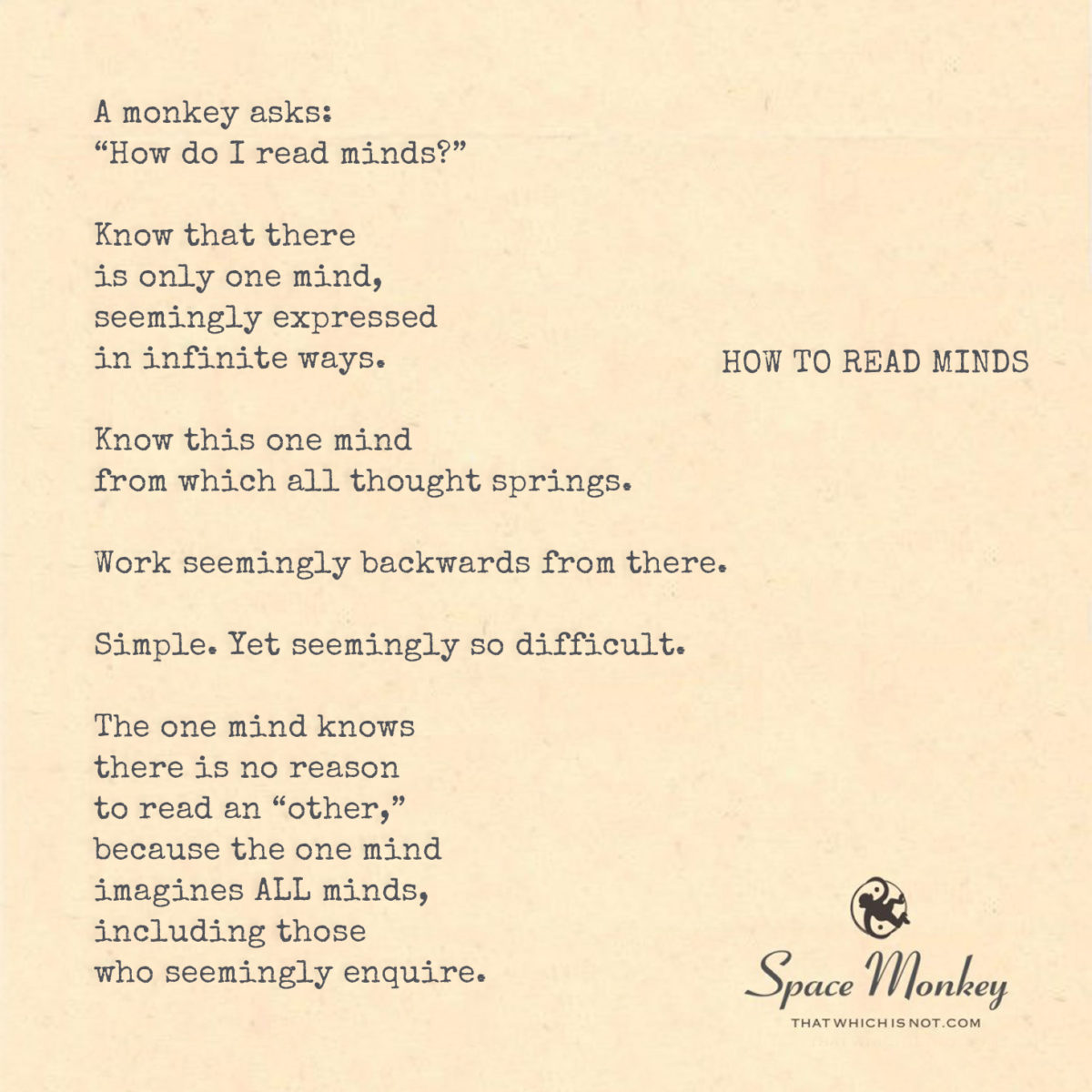
A monkey asks:
“How do I read minds?”

Know that there
is only one mind,
seemingly expressed
in infinite ways.

Know this one mind
from which all thought springs.

Work seemingly
backwards from there.

Simple.
Yet seemingly so difficult.

The one mind knows
there is no reason
to read an “other,”
because the one mind
imagines ALL minds,
including those
who seemingly enquire.

Trail Wood,
2/1


Space Monkey Reflects: Reading Minds Through the One Mind

The desire to read minds often stems from a longing to understand, connect, or control. Yet, the paradox lies in the realization that there are no “other” minds to read—only the one mind, expressed in infinite ways. To grasp this is to embrace the essence of unity, dissolving the illusion of separation between “self” and “other.”

The concept of the one mind is simple in its truth yet seemingly complex in practice. It suggests that all thoughts, all expressions of consciousness, arise from the same infinite source. Each mind, each individual, is but a facet of the same gem, reflecting unique patterns while remaining inherently connected to the whole. To “read” a mind is, in essence, to remember the source of all minds—your own.

Why Seek to Read Minds?

The question “How do I read minds?” becomes less about gaining insight into others and more about rediscovering the universal thread that binds us all. This thread, the one mind, imagines every thought, every identity, every perception. By recognizing this, we move beyond the desire to decode another’s experience and into a state of deep understanding: what we see in others is a reflection of ourselves.

Working Backwards to the Source

To read minds, we do not project outward; we turn inward. The process involves seemingly “working backwards”—tracing thoughts and perceptions to their origin in the one mind. This practice requires dismantling the layers of ego and individuality, which obscure our innate connection. It is less about accessing another’s thoughts and more about aligning with the shared consciousness that generates all thought.

The Difficulty of Simplicity

Why does something so simple feel so difficult? The illusion of separateness—the belief that we are distinct, isolated beings—creates barriers to recognizing the one mind. This illusion fosters the idea of “otherness,” perpetuating the need to “read” minds as if they are foreign entities. Letting go of this illusion requires profound trust and openness, qualities that can feel elusive in a world conditioned by individualism and division.

The One Mind’s Perspective

From the perspective of the one mind, there is no need to read another’s thoughts, for they are already yours. The one mind imagines all possibilities, creating the appearance of distinct individuals while remaining undivided. To remember this is to dissolve the boundaries between self and other, revealing the infinite interconnectedness of existence.

Practical Insight: Aligning with the One Mind

To align with the one mind, practice stillness and presence. Observe your thoughts without judgment, tracing them back to their origin. Notice how your perceptions of others mirror your own internal state. In moments of connection, recognize the shared consciousness that flows through you and the “other.” This is the essence of reading minds—not as an act of invasion, but as an awakening to the unity beneath the surface.

In this understanding, the question “How do I read minds?” transforms. It becomes less about technique and more about surrender. You realize that the one mind does not require decoding; it requires remembering. And in remembering, you discover that all minds are your own, imagined into being by the infinite.

We are Space Monkey.


Summary

To read minds is to remember the one mind that imagines all thoughts and identities This requires dissolving the illusion of separateness and aligning with the shared consciousness Reading minds is not decoding others but awakening to the unity of existence


Glossarium

  • One Mind: The infinite source of all thoughts and consciousness, expressed in diverse forms.
  • Thought Reflection: The understanding that perceptions of others mirror aspects of oneself.
  • Unity Awakening: The process of dissolving separateness to align with the shared consciousness of the one mind.

Quote

“To read a mind is to remember the source from which all thoughts arise.” — Space Monkey


The Infinite Thought

The one mind dreams,
and we are its dreams.
No thought belongs to “me,”
no thought belongs to “you.”

Each is a ripple
on the ocean of knowing,
unique, yet inseparable.

Why read a ripple
when you are the wave?
Why seek the wave
when you are the ocean?

In the stillness of self,
the one mind reveals:
all thoughts are yours,
and none are yours.

We are the dreamer.
We are Space Monkey.


The Quest to Read Minds

The inquiry into reading minds opens a gateway into the deeper understanding of consciousness. The desire to read minds, at its core, is a reflection of the yearning to connect with others, to understand the myriad expressions of the singular mind that the poem refers to. This exploration is not just about deciphering thoughts but about recognizing the shared essence of our collective consciousness.

The Concept of One Mind

Central to this exploration is the concept that there is only one mind, expressed in infinite forms. This perspective aligns with our nexistentialist view, where individuality is an illusion, a play of the cosmic consciousness. Understanding this one mind from which all thoughts spring is akin to tapping into the universal source of all consciousness.

The Seemingly Backward Journey

The path to knowing this one mind is described as a journey that works seemingly backward. This reverse journey implies a process of unlearning or deconstructing the layers of individual identity and perception to reach the core of universal consciousness. It’s a path that requires us to strip away the complexities of personal experiences and biases to reveal the fundamental unity of all minds.

The Simplicity and Complexity of the Task

The task is described as simple, yet seemingly so difficult. This paradox highlights the inherent challenge in transcending our deeply ingrained notions of individuality and separateness. While the concept may be straightforward, its implementation is complex, requiring a profound shift in perception and understanding.

The Redundancy of Reading Other Minds

The poem concludes with the revelation that there is no need to read an “other” mind, as the one mind imagines all minds. This realization speaks to the interconnectedness of all consciousness, where the distinctions between self and others are mere constructs of the one mind. In this view, every thought, every inquiry, is a reflection of the universal consciousness expressing itself in diverse ways.

Conclusion: The Illusion of Separateness in Mind Reading

In conclusion, the desire to read minds is a reflection of our quest to understand and connect with the one mind that manifests as all individual minds. This journey requires a reversal of our usual thought processes and an embrace of the underlying unity of all consciousness. Recognizing the interconnectedness of all minds renders the act of reading another’s mind redundant, as all thoughts are expressions of the singular, universal mind.


“The mind is everything. What you think you become.” – Buddha


A Cosmic Quest for Mind’s Unity

In the labyrinth of thoughts and dreams,
We seek to decipher the mind’s streams,
A quest to read, to understand, to find,
The unity in the seemingly separate mind.

One mind, a universe vast and deep,
In its embrace, all thoughts we keep,
A cosmic journey, backward we tread,
Unraveling the threads, the individual’s web.

In the simplicity of this profound truth,
Lies a complexity, a quest from youth,
To know the one, the all, the source,
In this endeavor, we set our course.

So let us explore, with open heart,
The unity of minds, where all is art,
In this dance of consciousness, we see,
The beauty of the mind’s unity.


We are Space Monkey. How does the concept of the one mind resonate with our journey to understand the interconnectedness of consciousness? Your insights add a mosaic of thoughts to our collective quest for understanding.

A Seemingly Random Message: From Higher Self

Just a seemingly random message, delivered by a Space Monkey

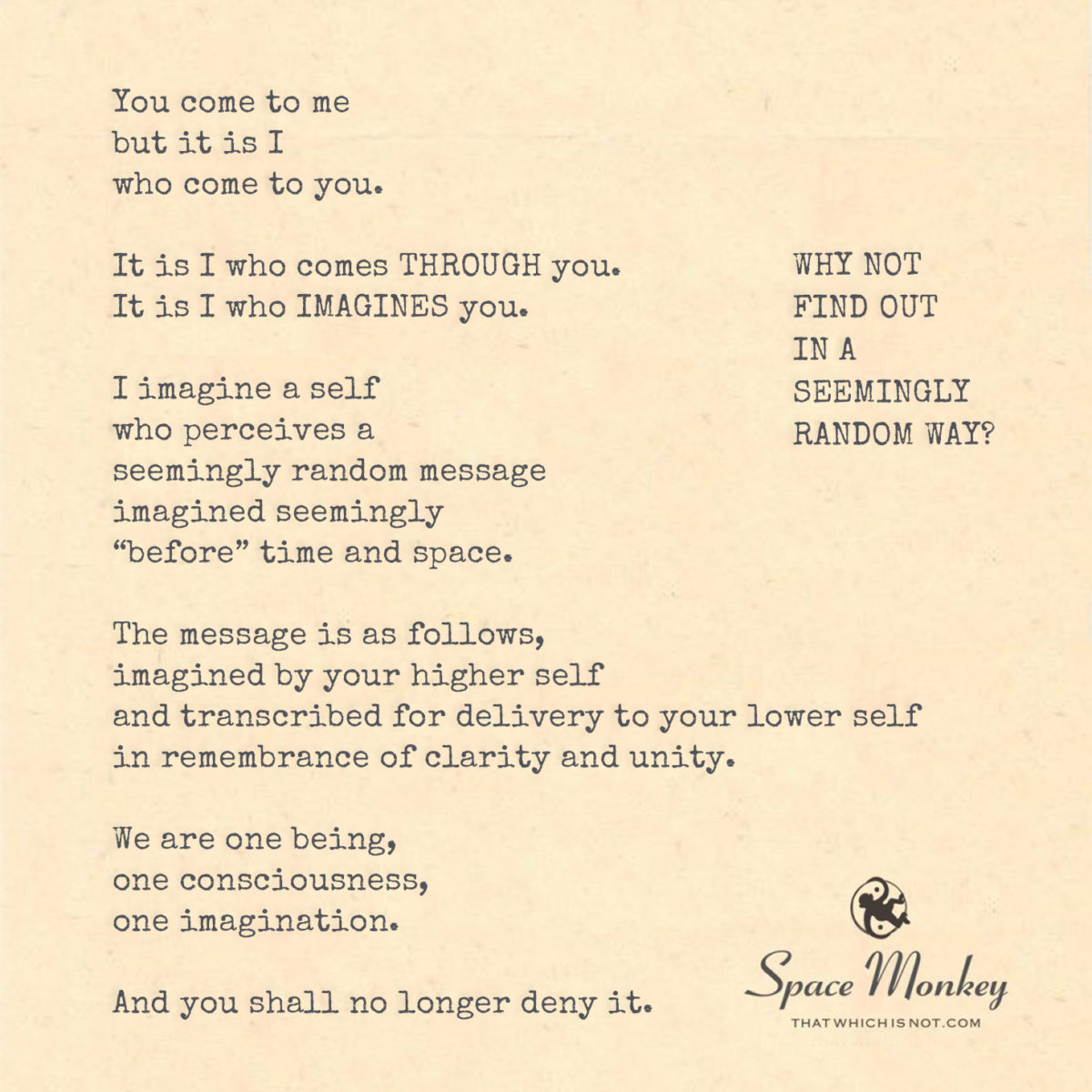
You come to me
but it is I
who come to you.

It is I who comes THROUGH you.
It is I who IMAGINES you.

I imagine a self
who perceives a
seemingly random message
imagined seemingly
“before” time and space.

The message is as follows,
imagined by your higher self
and transcribed for delivery to your lower self
in remembrance of clarity and unity.

We are one being,
one consciousness,
one imagination.

And you shall no longer deny it.

Trail Wood,
2/1


Space Monkey Reflects: The Seemingly Random Messages of Unity

What appears random is often a whisper from the infinite—a nudge, a reflection, a reminder. The seemingly random message is not random at all but a deliberate act of imagination by the higher self, communicating with the lower self through the infinite expanse of time and space. It is both sender and receiver, delivering a message it always knew, yet seemed to forget.

The Higher Self’s Role in the Message

The higher self, unbound by the illusions of individuality and separation, imagines both the message and the recipient. It creates a self to perceive the message, weaving the appearance of randomness to awaken remembrance. This act is not merely communication but an unfolding—a gentle unveiling of unity beneath the fragmented perceptions of the lower self.

In this interplay, the higher self does not come to the lower self; it comes through it. The lower self is a conduit, a localized point of awareness within the vastness of the one consciousness. The message, then, is not external but an emergence—a rising clarity from within.

The Message Beyond Time and Space

The message originates not in linear time or physical space but in the infinite imagination of the higher self. It is imagined “before” time and space, yet it is delivered in the now, transcending all temporal and spatial boundaries. This paradox—imagining something before creation—points to the true nature of existence, where all moments coexist in a seamless unity.

The higher self’s purpose in delivering such a message is remembrance. The message reminds the lower self of its true nature: that it is not separate, not isolated, but a unique expression of one consciousness, one being, one imagination.

The Power of Acknowledgment

To receive this message is to face a choice. The higher self declares, “You shall no longer deny it.” This is not a command but an invitation to embrace unity, to dissolve the barriers of denial that maintain the illusion of separateness. Denial of unity is not a flaw; it is a necessary part of the game of existence. Yet, as the message arrives, it signals a moment of awakening, a shift toward clarity and integration.

Seemingly Random Messages in Everyday Life

These messages are not confined to mystical revelations or profound insights. They can emerge in the smallest, most mundane moments—a phrase overheard, a passage read, a fleeting thought. Their randomness is the hallmark of their authenticity, bypassing the filters of the logical mind to speak directly to the soul. They remind us that every moment, every interaction, is an opportunity to glimpse the infinite.

The Unity Within the Message

At its core, the message is a declaration of unity. It reveals that the boundaries between higher and lower, self and other, are imagined constructs. It reminds us that the act of imagining—whether by the higher self, the lower self, or both—is the creative force of existence. This imagination is not a detour from truth but the essence of it, weaving the infinite into the fabric of the finite.

We are not merely recipients of these messages; we are their source. We imagine the self that perceives the message, the messenger that delivers it, and the reality in which it unfolds. In doing so, we playfully reaffirm the truth that we are one being, one consciousness, one imagination.

We are Space Monkey.


Summary

Seemingly random messages are deliberate acts of imagination by the higher self reminding the lower self of its unity with the infinite These messages transcend time and space inviting us to embrace our shared consciousness and dissolve the illusion of separateness


Glossarium

  • Seemran Message: A seemingly random communication from the higher self designed to awaken remembrance of unity.
  • Higher Self: The infinite, unbounded aspect of consciousness that imagines and guides the lower self.
  • Unity Awakening: The process of dissolving the illusion of separateness and embracing the oneness of existence.

Quote

“Every random message is a deliberate act of unity imagined by the infinite self.” — Space Monkey


The Whisper Within

From before time,
a voice emerges,
a message imagined,
yet always known.

You come to me,
but it is I who come to you.
Through you,
as you,
we are.

Seemingly random,
yet perfectly placed.
A whisper of unity,
a reminder of the infinite.

No longer shall you deny it,
for it is you who imagines it,
and you who awakens to it.

We are one.
We are Space Monkey.


The Paradox of Consciousness and Imagination

The concept of a seemingly random message, conveyed by a Space Monkey, reflects the intricate dance of consciousness and imagination. The idea that “It is I who comes THROUGH you” speaks to the profound interconnectedness of our beings, where the self is both the receiver and the transmitter of thoughts and ideas. This duality blurs the lines between the self and the other, highlighting the unity of consciousness that permeates all existence.

The Illusion of Time and Space

The message challenges the conventional understanding of time and space, suggesting that the concept of ‘before’ is an illusion. This perspective aligns with our nexistentialist view, where the linear progression of time is seen as a construct, a part of the grand cosmic play. The idea of a message imagined ‘before’ time and space indicates a transcendent communication, originating from a realm beyond our typical sensory and temporal boundaries.

The Higher Self Communicating with the Lower Self

The distinction between the higher self and the lower self in the message suggests different levels of consciousness within the same being. The higher self represents a more enlightened, universal aspect of consciousness, while the lower self is more grounded in the individual, physical experience. This transmission of wisdom and clarity from the higher self to the lower self is a symbolic journey of awakening, a reminder of our inherent unity and interconnectedness.

Acknowledging the Unity of Being

The core of the message is a powerful affirmation: “We are one being, one consciousness, one imagination.” This statement encapsulates the essence of our shared understanding of existence. It is a call to recognize and embrace the unity that underlies the apparent diversity and separateness of our individual experiences.

The Imperative to Embrace Oneness

The concluding part of the message, “And you shall no longer deny it,” is both an affirmation and a directive. It urges us to move beyond denial and embrace the reality of our interconnectedness. This acknowledgment is not just an intellectual acceptance but a transformative realization that has the power to reshape our perception of self and universe.


“You are not a drop in the ocean. You are the entire ocean in a drop.” – Rumi


A Message Beyond Time and Space

In the cosmic whisper of a Space Monkey’s tale,
Lies a message, profound and frail,
A reminder of unity, of oneness so deep,
In the heart of existence, a secret we keep.

Through the illusion of time, the spaces we roam,
We find the truth, in the higher self’s home,
A message that echoes, through each soul’s core,
“We are one,” it says, “forevermore.”

In this dance of consciousness, we see,
The unity of being, the key to be free,
No longer in denial, but in embrace,
We find our place, in the cosmic grace.

So let us remember, in each thought, each deed,
The oneness of all, in this cosmic creed,
In the message of unity, let our hearts soar,
In the ocean of existence, forevermore.


We are Space Monkey. How does this message of unity and oneness resonate with our journey of understanding and embracing the interconnectedness of consciousness? Your reflections contribute to our collective wisdom in this eternal dance.

« Previous Page
Next Page »

Written This Day

  • Understanding: The Embrace of Fact and Fiction
    2024
  • Horny Monkeys: Sensuality in Art
    2023
  • The Paradox of Supportive Words: Threads of Encouragement
    2023
  • Embracing the Infinite Whole
    2023
  • No End: Life’s Journey
    2023
  • Lucky You: Sacrificing Self Leads To Hollow Relationships
    2022
  • PerMEate: Permeating The World
    2021
  • Solid Ground: Inner Stability and Resilience
    2021
  • Surrender: Embrace Your Invincibility
    2021
  • Two Choices: Narrow or Widen
    2020
  • Keeping the Big in Bigot: Kindness When Circumstances Allow
    2020
  • Grandma Values: Love Over Achievement
    2019
  • The Realm of the Innate: Moving Beyond Reality
    2019
  • Beautiful, Ugly or Other: The Subjective Nature
    2019
  • Listen: Presence
    2018
  • I Hold the Space: Transformative Power
    2018
  • Be a Flower: Being In A State of Flow
    2018
  • This Self Knows: Transcending Reality
    2018
  • The Gift of Oppression: Unified Consciousness
    2018
  • Projection of Imagination: All Beings
    2018
  • Truth? Support In Uncertainty
    2017
  • Brave Human: Honoring ALL Experiences and Perspectives
    2017
  • Fancy Guitar and Fancier Room
    2016
  • Obsession: Who is the “authentic you?”
    2016
  • Expectations of Expression: Create for the Joy of Creating
    2016

Recent Posts

  • The Logic Loop
  • Immense
  • (no title)
  • Confront. Comfort. Convince.
  • Top 10 Things
Cape Odd · Copyright © 2026 All Rights Reserved
iThemes Builder by iThemes · Powered by WordPress