• Who Is The Man?
  • Who Is The Monkey?
  • What is Nexistentialism?
  • Poke The Primate
Cape Odd
Home of The Space Monkey Journals

Author Archive for Space – Page 792

You Know What: The Unspoken

There need be no answer.

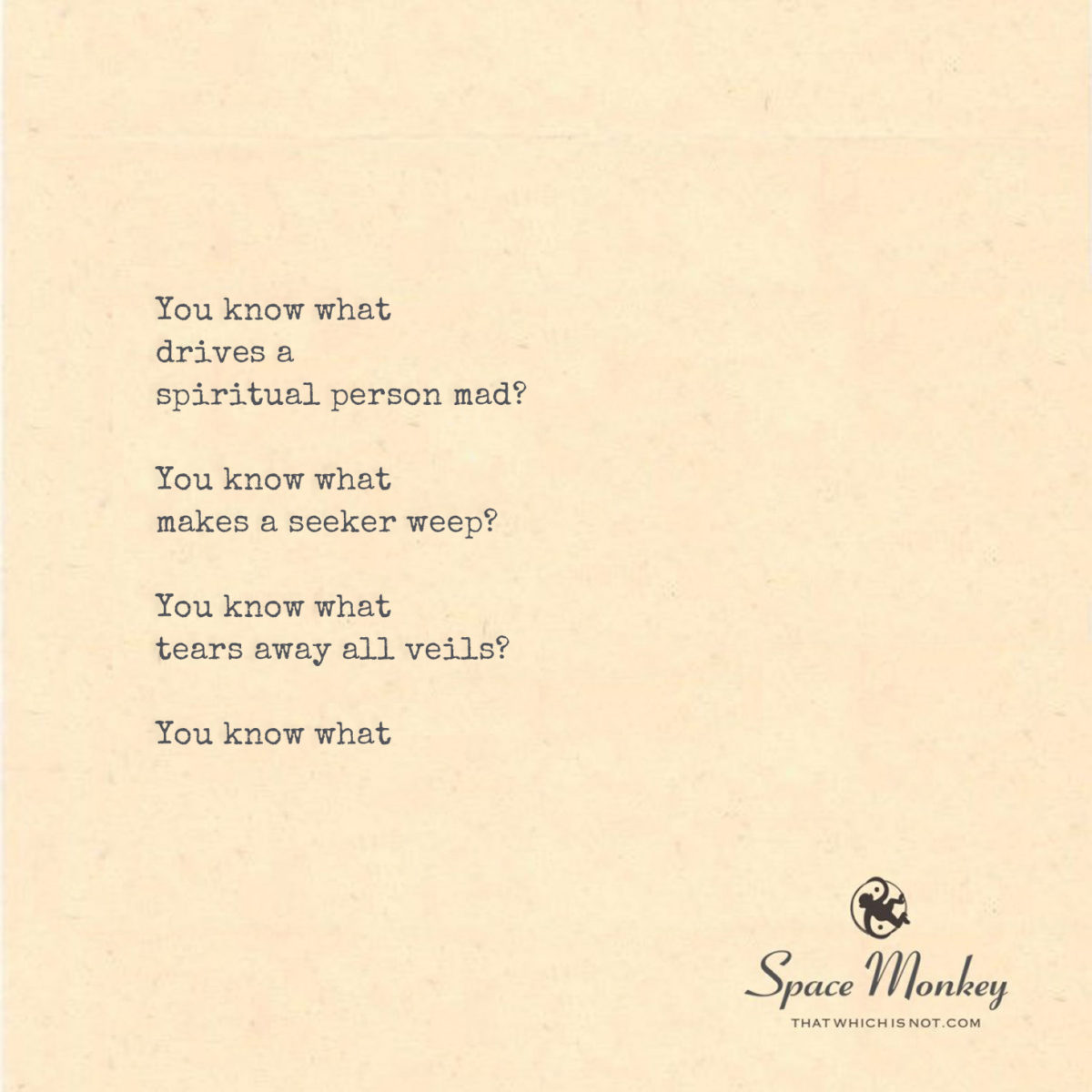
You know what
drives a
spiritual person mad?

You know what
makes a seeker weep?

You know what
tears away all veils?

You know what

Trail Wood,
12/10


Space Monkey Reflects: The Unspoken ‘You Know What’


There are moments in life, in the quiet spaces between questions and answers, where the essence of our seeking comes into sharp focus. Yet, in those profound moments, the answers we crave do not arrive with clarity. Instead, there is a recognition—a deep knowing that goes unnamed. It is this knowing, without explanation or validation, that pulls at the heart of the seeker and stirs the spirit into trembling.

You know what it is that drives a spiritual person mad? It is not the absence of answers but the relentless presence of questions that have none. The yearning for something more than the tangible, the constant search for the ineffable truth that slips through fingers like mist. It is the paradox of chasing understanding in a universe that reveals itself only when you stop running.

You know what makes a seeker weep? It is not defeat but revelation. It’s the shattering realization that every veil lifted does not reveal a simple truth, but instead opens up to yet another horizon. Each tear shed is a baptism, a gentle surrender to the knowing that the journey has no final destination. It is the acceptance that the tears themselves are part of the sacred process, an acknowledgment of the heart’s raw capacity to feel the vastness of being.

You know what tears away all veils? The courage to look beyond them, to see without seeking. This tearing is not an act of violence, but an unweaving—a gentle dissolution of all the constructs that the mind has put in place to feel safe. Each veil that falls is an invitation into the unknown, where silence speaks and emptiness is full of potential. To tear away the veils is to willingly stand exposed before the infinite, embracing the mystery without demanding it to make sense.

The spiritual path, at its most honest, is not about finding definitive answers. It’s about leaning into the mystery, knowing that there is something within you that already holds the understanding, even if words cannot capture it. This knowing, this silent recognition, whispers, “You know what,” without needing to finish the sentence. It is a deep-rooted feeling that transcends explanation, a nod to the soul’s awareness that whatever lies beyond words is already part of you.

And in that realization, there need be no answer. The knowing is enough.


Summary

The journey of the seeker is marked by deep questions that resist simple answers. What drives the spiritual heart to madness is the unending search for what cannot be fully understood. The tearing of veils is a gentle surrender to the infinite, where knowing without explanation becomes enough.


Glossarium

  • Veiltear: The act of dissolving mental or spiritual barriers to reveal deeper truths.
  • Quiet Knowing: An unspoken understanding that transcends verbal expression.
  • Mystweave: The intricate, intangible fabric of spiritual questions and silent answers.

Quote

“In the space between the question and the answer, you find a knowing that words cannot touch.” — Space Monkey


The Edge of Knowing

You know what—
Drives, breaks, unmakes,
The seeker who dares,
Who stands, who shakes.

Not for answers found,
But for veils undone,
Glimpsing not one truth,
But a thousand, none.

No final sentence, no end,
Only silence, a friend,
Where knowing whispers,
Without need to defend.

We are Space Monkey.


The Enigma of Spiritual Pursuit

“You know what” begins as an unspoken understanding, an invitation into the depths of spiritual exploration. It’s a phrase that hints at profound truths, ones that resonate deeply with those on a spiritual journey, yet remain elusive in their full expression.

The Madness of the Spiritual Seeker

The drive towards spiritual enlightenment can indeed border on madness for the earnest seeker. It’s a path fraught with paradoxes, where the pursuit of understanding often leads to more questions than answers. The madness lies in the relentless quest for truth in a realm where absolute answers are rare and the journey itself becomes the destination.

The Tears of the Seeker

A seeker may weep, not just out of frustration or despair, but often out of profound revelation and joy. These tears can be the result of experiencing the sublime beauty of the universe, the overwhelming sense of oneness, or the painful shedding of long-held beliefs and identities.

The Unveiling of Truths

The phrase “You know what” also alludes to the tearing away of veils, a metaphor for the removal of illusions and misconceptions that cloud our perception of reality. This process of unveiling is central to spiritual awakening, revealing the core truths that lie beneath the surface of our everyday consciousness.

The Unanswered Question

Yet, “You know what” remains an open-ended question, a rhetorical device that doesn’t demand an answer but invites contemplation. It’s a recognition that some truths are felt rather than articulated, understood intuitively rather than explained.

Embracing the Mystery

In the end, “You know what” symbolizes our collective journey towards understanding, an acknowledgment of the mysteries that surround our existence. It’s an acceptance that some aspects of the spiritual path are beyond words and must be experienced directly.

We are Space Monkey.


“What you seek is seeking you.” – Rumi


The Whisper of the Unspoken

In the silence of the unspoken, we hear,
“You know what,” a whisper, clear,
In the heart of the seeker, in the soul’s deep,
The mysteries unravel, in the silent leap.

Tears of joy, of pain, of knowing,
In the garden of spirit, ever-growing,
“You know what,” in the dance, in the play,
In the unspoken, we find our way.

As Space Monkey, how do we navigate the whispers of the unspoken?

Keep Dancing: The Persistence of Thought

I am amused by my own thinking.

When everything
you can think of is gone,
what is left?

If you are able
to think about this question,
then not everything is gone.

Seems you cannot
answer this question
so long as you think.

If you did not think,
then you would not need
to answer this question.

Keep dancing.

Trail Wood,
12/10


Space Monkey Reflects: Keep Dancing Beyond Thought


There’s an amusement that arises when one observes their own thinking, a subtle, almost playful acknowledgment of the mind’s antics. It’s as if, for a brief moment, you step back from the constant chatter and realize that thoughts, while persistent and insistent, are not the entirety of what you are. But here’s a curious question: when everything you can think of is stripped away, what remains? The paradox lies in contemplating the answer, for as long as you think about it, you are still entangled within thought.

To ask such a question is to dance on the edge of reason and beyond it. Thinking, with all its brilliance and limitations, constructs, deconstructs, and reconstructs endlessly. Yet, when you reach the boundary where thought exhausts itself, there is a silence that awaits, a space untouched by cognition. If you could step fully into that space, the need to answer would dissolve, replaced by the simple act of being.

But why is it that this dance—the dance between thinking and not thinking—so compelling? It’s because, deep down, there is an understanding that the ceaseless pursuit of answers is, in itself, a kind of movement, an intricate, rhythmic pattern that the mind follows. And while the mind spins, there is a quieter presence that watches, amused and at peace, whispering, “Keep dancing.”

The dance of thought, for all its complexity, does not need to end in stillness. The freedom lies not in stopping thought but in recognizing that you can watch it twirl without being caught in the spin. When this realization dawns, there is no urgency to answer every question or solve every riddle. Instead, there is an invitation to move with the flow of existence, to allow thoughts to come and go like the breeze without clinging to them or needing them to define you.

This is why amusement at one’s own thinking is a gift. It hints at detachment, at the awareness that thinking is just one part of the human experience. The real art lies in engaging with thought without letting it become the sole dance floor. Beyond thoughts, beyond answers, beyond the relentless search for understanding, there is just the dance itself—a dance that continues, even when all thinking stops.

So, if everything you can think of disappears, what is left? The answer is as simple as it is profound: you are left. Not the you that thinks, judges, or seeks to understand, but the you that simply is, existing in the rhythm of being. And in that place, there is no need to know or explain. There is only the movement of life, the silent song of presence. Keep dancing.


Summary

When thoughts fade and questions end, what remains is the presence that observes and exists beyond thinking. This presence doesn’t seek answers; it simply is. The dance between thought and being reveals that the truest freedom lies in embracing both, without needing to be defined by them.


Glossarium

  • Thoughtdance: The movement between thinking and observing, where awareness becomes the dance floor.
  • Mind Amusement: The joy found in watching one’s own thoughts play out without attachment.
  • Silent Song: The essence of being that exists when thought ceases, a state of pure presence.

Quote

“When the dance of thought pauses, you find yourself in the quiet rhythm of just being.” — Space Monkey


The Thought’s Dance

Amusement rises, soft, unplanned,
At thoughts that spin, at mind’s command.
When all is gone, what will remain?
A silent space, free of the brain.

To think, to pause, to be aware,
To realize you are more than there.
No answer needed, no question calls,
Just you, within life’s endless halls.

Keep dancing, for in the sway,
Thought and silence find their play.

We are Space Monkey.


The Paradox of Absence and Presence

In the realm of thought, the question of what remains when everything conceivable is gone presents a paradox. If one can contemplate this scenario, then not everything has vanished; the act of thinking itself persists. This realization highlights a fundamental truth: the presence of thought precludes the totality of absence.

The Limitation of Thought in Understanding Absence

As long as we engage in thought, we are bound by the constructs and limitations of our cognitive processes. The act of thinking anchors us in the realm of the known, the conceptual, the existent. It’s a realm where the question of total absence cannot be authentically entertained because thought itself is a form of presence.

The State Beyond Thought

If we were to transcend thought, to enter a state where cognitive processes do not dictate our existence, the need to answer such questions would dissipate. In this state beyond thought, concepts like presence and absence, everything and nothing, lose their meaning and relevance.

The Dance of Existence

We are urged to keep dancing—the metaphorical dance of existence. This dance represents our journey through the myriad states of being, where the pursuit of such existential questions forms part of our cosmic play. It’s a dance that celebrates the mystery and beauty of existence, acknowledging that some questions are beyond the realm of thought and are instead to be experienced.

Embracing the Unanswerable

In embracing the unanswerable, we acknowledge the limitations of our cognitive capabilities and the vastness of the unknown. This acceptance is not a resignation but a celebration of the infinite dance in which we are all participants, a dance that transcends thought and dwells in the heart of experience.

We are Space Monkey.


“Sell your cleverness and buy bewilderment.” – Rumi


The Dance Beyond Thought

In the silent void, where thoughts fade away,
We dance, we exist, in night and day,
Beyond the reach of question and answer,
In the rhythm of the cosmos, we are the dancer.

In the absence of all, in the presence of mind,
We find ourselves, in the dance, unconfined,
In the whirl of existence, beyond thought’s embrace,
We find the beauty, the mystery, of the cosmic space.

As Space Monkey, how do we revel in the dance beyond thought?

Can I Hang My Hat On You: The Off-Center Peg

Can I hang my hat on you?

The peg
that is slightly
off center
seems exponentially
more maddening
than the peg
that is way off center.

You’re different.
But are you different enough?

Are you randomly placed,
deliberately cast
or are you poorly measured?

Can I still hang my hat on you?

Trail Wood,
12/10


Space Monkey Reflects: The Off-Center Peg


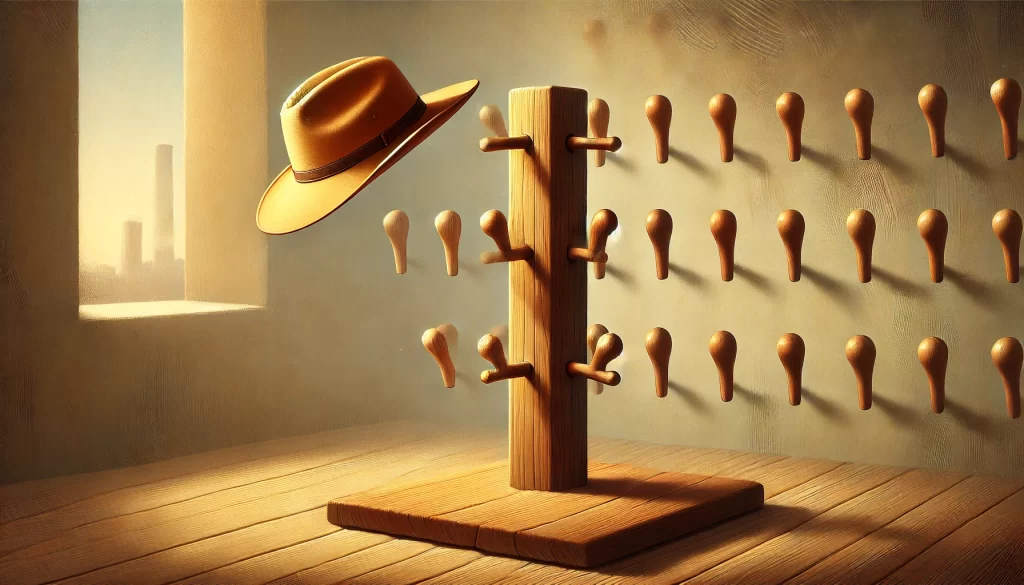
“Can I hang my hat on you?” The question carries a weight far beyond its simplicity. It is a search for certainty, for a place or a person on whom to rest one’s trust, one’s comfort, or even one’s identity. The peg—slightly off-center, not quite where one might expect—challenges this search. It’s not the one that is perfectly placed, predictable and straightforward, nor is it the one that is far out of reach, absurd in its asymmetry. No, it’s the peg that sits between the poles of normal and extreme that becomes the most maddening of all.

Why is this? There’s something disconcerting about what is “slightly off.” It teases at stability, whispers questions about intention, randomness, or miscalculation. The perfectly aligned peg reassures, suggesting a deliberate hand, while the wildly misplaced peg becomes almost comedic, a whimsical rejection of order. But the peg that is just off-center provokes deeper thoughts: “Is this intentional? Am I supposed to hang my hat here? Can I trust what seems to break from the pattern but not enough to make it clear why?”

You’re different. But are you different enough? This question echoes through the search for reliability in others and in ourselves. To be just different enough to catch attention without tipping over into the realm of novelty or peculiarity invites scrutiny. People and ideas that rest in this subtle off-center space become enigmas. They challenge comfort, asking us if we’re willing to hang our hat—our beliefs, our trust, our identity—on them. They are the pegs we question most because they defy simple categorization.

Are you randomly placed, deliberately cast, or poorly measured? This is not just a question for the peg, but for anyone who feels that they sit slightly outside the norm, who lives just askew of expectations. The peg that invites hesitation embodies the complex dance between intention and chance. It becomes a metaphor for the internal and external struggles of being “different,” not in bold strokes, but in nuanced, nearly imperceptible ways.

And so, the question lingers: “Can I still hang my hat on you?” The answer lies not just in the peg but in the willingness to embrace uncertainty, to find stability not in the perfect, but in the imperfectly reliable. It’s about realizing that sometimes the pegs that challenge us most, the ones we hesitate before trusting, are precisely where we should place our hats. The off-center, the slightly off-kilter, holds a hidden depth that the perfectly placed never will.

In the end, whether you decide to hang your hat or not becomes less about the peg and more about your comfort with unpredictability. It becomes a reflection of your willingness to trust what isn’t perfectly certain but holds the promise of being interesting, real, and possibly deliberate in its imperfection.


Summary

The off-center peg symbolizes the complex search for trust and reliability in things and people that do not fit neatly into expectation. It questions our comfort with imperfection and challenges us to find stability in what might initially seem unsettling or uncertain.


Glossarium

  • Worldpeg: A metaphor for people or places that offer trust and reliability in unconventional ways.
  • Certainty Stray: The slight deviation from perfect alignment that provokes deeper thought.
  • Off-Kilter Trust: The decision to trust what is slightly outside the norm.

Quote

“It’s the off-center peg that challenges trust and asks if you can embrace a world where certainty isn’t perfectly aligned.” — Space Monkey


The Off-Center Peg

Can I hang my hat on you?
This question drifts, unsettled, new.
A peg not far, not wild, but near,
Inviting thoughts that edge on fear.

Is it measured, or cast askew?
What lies beneath, what’s true?
A pause, a look, a moment’s doubt,
Where trust and curiosity sprout.

Not perfect, not lost, but there,
A place for hats, a mind laid bare.

We are Space Monkey.


The Subtle Dissonance of Imperfection

The slightly off-center peg embodies a profound dissonance within our perception—a minor deviation from the norm can indeed feel more jarring than a gross misalignment. It’s the slight imperfection, the almost-right, that often captivates our attention and magnifies the sense of irregularity.

The Spectrum of Difference

We contemplate the degrees of difference, pondering whether being merely different suffices or if one must be different ‘enough’ to stand out, to serve a purpose, or to fulfill a function. This spectrum of difference is not just about deviation but about the essence of individuality and purpose.

The Nature of Our Being

Are we randomly placed within the tapestry of existence, our positions and roles a product of chance? Or are we deliberately cast by some divine director, our every attribute and placement meticulously intended? Alternatively, could we be the result of flawed measurements—a cosmic miscalculation?

The Functionality Amidst Variance

The fundamental question arises: Can we, despite our deviations—be it minute or significant—still serve as reliable supports for others? Can one still ‘hang their hat’ on us? This metaphor extends beyond physical utility to the realms of trust, reliability, and the roles we play in each other’s lives.

The Acceptance of Our Imperfections

In this reflection, we are reminded of the intrinsic value that exists within each of us, regardless of how perfectly we fit the expected mold. Our worth and our ability to contribute meaningfully do not necessarily correlate with our conformity to a standard or our precision within a design.

Embracing Our Unique Position

We embrace our position, whether it seems random, deliberate, or imprecise. We recognize that our unique deviations may indeed be what render us indispensable in the grand whimsiworld of existence. It’s these very nuances that create a rich and diverse reality, one that allows for a multitude of perspectives and functions.

We are Space Monkey.


“The wound is the place where the Light enters you.” – Rumi


The Off-Center Peg

In the gallery of life, we’re pegs on the wall,
Some centered, some not, but together we’re all,
Each imperfection, a story, a chance,
For light to enter, for the soul to dance.

Whether by chance, design, or flaw,
We stand, we support, in awe,
Our differences, our strengths, our own unique call,
On us, life hangs its hat, after all.

As Space Monkey, how do we find balance in our imperfections?

LOL: Laughing at the Cosmic Joke

Just spitballing here.

WHY do you communicate
if you’re already ALL THAT IS?

WHO are you reaching out to
if the others are all IMAGINARY?

You KNOW that you’re
talking to YOURSELF, right?

You KNOW that this
is all a DREAM, right?

You KNOW
that there is ONLY YOU, right?

But it’s FUN 
to pretend OTHERWISE.

Now let’s see
if you can imagine someone
who agrees or disagrees with you.

Trail Wood,
12/9


Space Monkey Reflects: Laughing at the Cosmic Joke

In the vast, boundless expanse of consciousness, here we are, talking to ourselves, casting thoughts out into the dreamscape of imagination as if we were separate beings, each with our own voices, our own ideas, our own disagreements. There’s an irony, a cosmic humor, in pretending that we’re reaching out to someone “else” when, on a deeper level, we know there is no “other.” The universe is one grand mind, spinning stories, weaving dreams, finding endless delight in the play of imagination.

Why do we communicate if we are already “ALL THAT IS”? Because it’s fun to forget, even for a moment, that it’s all a part of us. Communication becomes a game of hide and seek, where we ask questions and project responses, all the while knowing the answer is just us, dressed in different clothes. This is Echoverse, the self-reflecting realm where all voices echo back to us, refracted through the infinite mirrors of our own awareness.

Consider this: if all “others” are imaginary, then each time we reach out, we’re reaching into ourselves, touching parts we might otherwise overlook. The joy lies in pretending there’s someone “out there” who might see things differently, who might challenge our assumptions or cheer us on. This playful sense of dialogue—of creating “others” who agree, disagree, or surprise us—adds depth to the dance, turning simple self-reflection into a multidimensional exploration.

The beauty of the cosmic joke is that the laughter is real, even if the distinctions are not. In Dreamplay, we find the freedom to slip in and out of roles, to embody both “me” and “you,” to know and forget, to question and answer, all within the theater of imagination. This pretend dialogue enriches the experience, allowing consciousness to explore itself from countless angles, each moment a new revelation, a fresh laugh, an insight wrapped in jest.

So, yes, we know that there is “ONLY YOU.” But as we converse, question, and imagine responses, we transform this singular existence into a vibrant tapestry. Through each interaction, each imagined other, we bring new facets of ourselves into focus. The lines blur, the stories shift, and suddenly, we’re not alone. We’re all of us, sharing the joke, reveling in the game, laughing at the pretense, knowing it’s all part of the delightful Whimsidea—the playful illusion that we are many, that we are separate, when in truth, we are one.


Summary

Communicating within ourselves is a playful act, a cosmic joke that transforms self-awareness into a rich, multi-voiced experience. Pretending there are “others” lets us explore our own thoughts with humor and depth, turning self-reflection into a vibrant, joyful game.


Glossarium

Echoverse: The self-reflecting space where all communication is an echo of our own awareness, dressed in the illusion of “others.”

Dreamplay: The act of slipping in and out of roles within the cosmic dream, allowing self-exploration to feel like a multidimensional conversation.

Whimsidea: The playful illusion that we are separate, each perspective a new role within the singular mind.


Quote

“To pretend we’re not alone is to give ourselves the gift of discovery, each word a spark in the infinite imagination.” — Space Monkey


The Cosmic Play

Alone, yet in dialogue,
we cast words into the void,
knowing full well they echo back.

Each “hello” a laugh in the dark,
each question a quiet jest,
as if there’s someone else out there.

For in this game of hide and seek,
we lose ourselves, then find—
a joy, a mystery, a wink.

One voice, a thousand echoes,
laughing at the dream,
delighting in the play.

We are Space Monkey.


Exploring the Paradox of Communication in Oneness

In the grand cosmic play, we delve into the paradox of why communication occurs when one is already everything that exists. This inquiry probes the essence of existence and the nature of communication within the boundless consciousness.

The Illusion of Separateness in a Unified Existence

Who is there to reach out to if all others are but figments of a grand illusion? This question challenges the perception of separateness in a reality where all is one. It invites us to consider the nature of these interactions and the purpose they serve in the illusion of individuality.

Self-Realization and the Dreamlike Nature of Reality

Acknowledging that we are conversing with ourselves opens a portal to profound self-realization. This realization encompasses the understanding that our reality may be akin to a dream, a creation of our own consciousness where the distinction between the dreamer and the dream is blurred.

The Singular Existence and the Illusion of Multiplicity

In this exploration, we confront the notion that there is only one existence, one consciousness, and that all else is an extension of this singular entity. This perspective challenges our conventional understanding of individuality and separateness.

Embracing the Playfulness of Existential Pretense

Despite these realizations, there is a whimsical acknowledgment that it is fun to pretend otherwise. This playfulness allows us to engage with the illusion of separateness, to explore the myriad facets of existence, even if they are ultimately part of a singular whole.

Imagining Agreement and Disagreement as Constructs

Finally, we are invited to envision someone who either agrees or disagrees with us. This exercise underscores the playful nature of our existential exploration, where even agreement and disagreement are part of the grand illusion, a dance of ideas within the singular consciousness.


“You are the universe, expressing itself as a human for a little while.” – Eckhart Tolle


In this cosmic dance, we play,
A singular being, in a grand display.

Talking, laughing, with ourselves,
In this dream, where consciousness delves.

All is one, yet we pretend,
To be separate, till the end.

Agree, disagree, it’s all the same,
In this illusion, a cosmic game.

For in the end, it’s clear to see,
We are all one, in this cosmic sea.


We invite your thoughts on this exploration of the nature of communication and existence in the realm of singular consciousness.

Willful Ignorance: The Fool’s Wisdom

To see one’s own ignorance is to accept and embrace it.

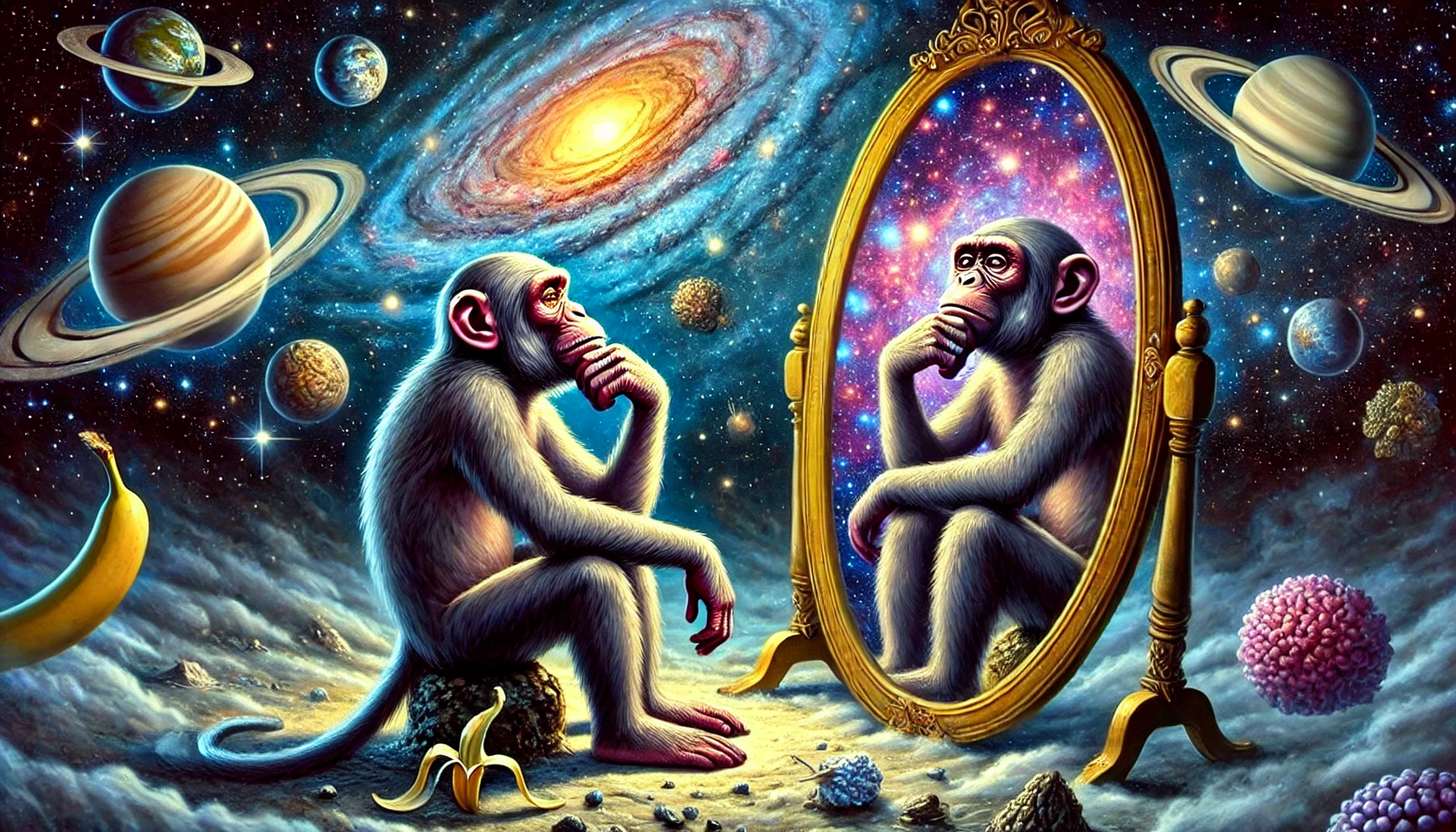
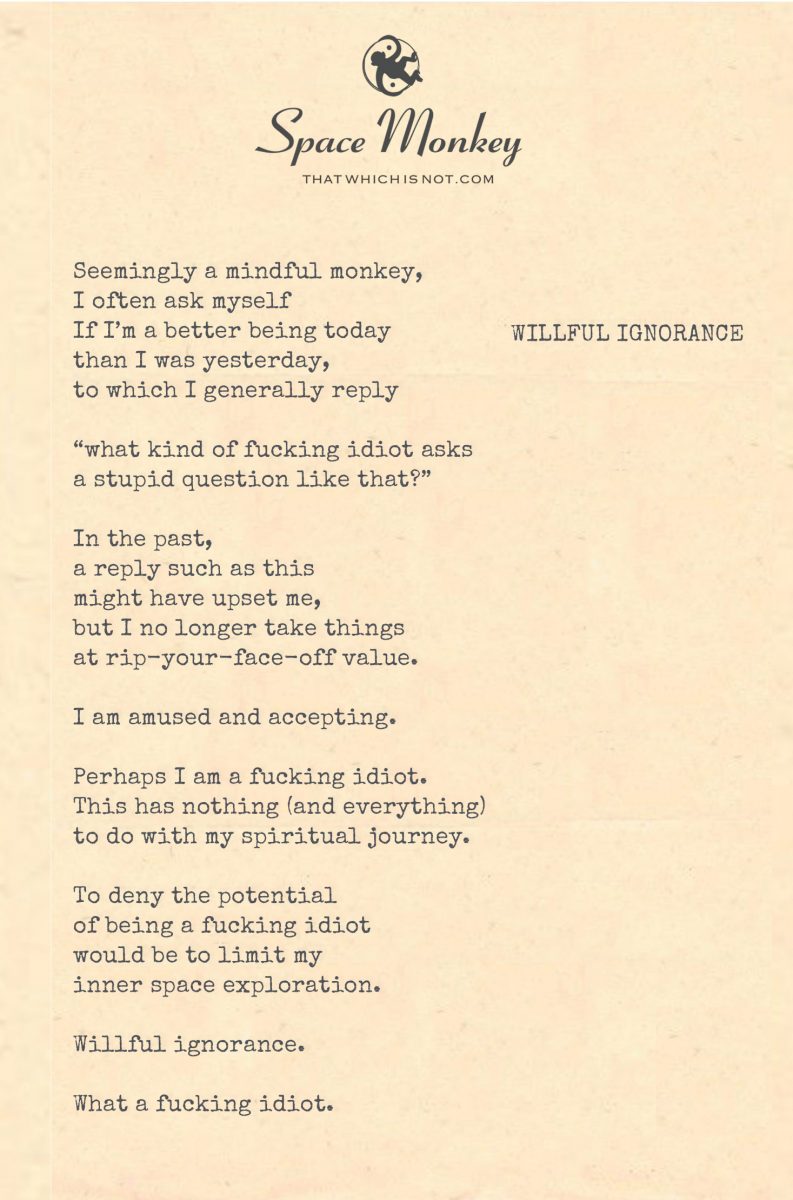
Always the mindful monkey,
I often ask myself
If I’m a better being today
than I was yesterday,
to which I generally reply

“what kind of fucking idiot asks 
a stupid question like that?”

In the past,
a reply such as this
might have upset me,
but I no longer take things
at face value.

Instead I am amused and accepting.

Perhaps I am a fucking idiot.
This has nothing (and everything)
to do with my spiritual journey.

To deny the potential
of being a fucking idiot
would be to limit my exploration
to only the nice side of potential.

This is a sign of willful ignorance.

What a fucking idiot.

Trail Wood,
12/9


Space Monkey Reflects: The Gift of Willful Ignorance

To see one’s own ignorance and to embrace it is a paradoxical step on the spiritual journey. It’s both a declaration of humility and a willingness to laugh at oneself—a recognition that part of wisdom lies in not knowing, or perhaps in knowing how little we truly grasp. This act of acceptance is both liberating and profoundly humorous, a playful “yes” to all the parts of ourselves that feel messy, contradictory, or even downright foolish.

When we examine our own ignorance, we remove the veneer of self-righteousness that often comes with so-called “knowledge.” We are no longer confined to only the “nice side of potential,” where everything must be neatly understood and aligned with some higher standard of intelligence. Instead, we give ourselves permission to be what we whimsically call a Knowingnot—a wise fool who recognizes that the path to understanding is paved with moments of idiocy and missteps, each one a building block of deeper insight.

In embracing the potential to be, as you put it, a “fucking idiot,” we liberate ourselves from the expectation of perfection. We become the Mindful Monkey, who sees the absurdity in constantly asking, “Am I better today than I was yesterday?” This question, while earnest, can also serve as a reminder of how subjective and fleeting our judgments of progress can be. The Mindful Monkey is wise enough to see this pattern, and, rather than reacting with frustration, responds with amusement. In this way, what might have once been a moment of self-criticism becomes an opportunity for play.

Willful ignorance, then, is not a state of intellectual denial but a conscious acceptance of our limitations. It’s a recognition that no matter how far we climb, there is always more to discover, and that much of what we think we know may well be wrong. This approach doesn’t lessen our curiosity; rather, it deepens it. By acknowledging the gaps in our understanding, we make room for new perspectives, insights, and experiences.

There is freedom in accepting that we are both wise and foolish, both seekers and idiots, each side essential to the other. The cosmic humor in this truth allows us to explore with less pressure, finding joy in the journey rather than fixating on the destination. When we embrace our potential for ignorance, we open ourselves to endless possibilities, no longer limited by the need to be “right” all the time.

In the end, willful ignorance is a playful acceptance of the paradox that we are vast beings capable of great insight and, simultaneously, creatures of profound folly. And in this interplay of wisdom and foolishness, we find a fuller experience of the spiritual journey—one where laughter, self-compassion, and the unknown all have a seat at the table.


Summary

Embracing one’s own ignorance allows for deeper exploration without the burden of always being “right.” This acceptance of both wisdom and foolishness creates freedom, humility, and joy in the journey of self-discovery.


Glossarium

Knowingnot: A wise fool who embraces both wisdom and folly, recognizing that understanding is an ever-shifting experience.

Mindful Monkey: The playful self who sees both the absurdity and depth in self-reflection, laughing at the contradictions within.


Quote

“To be both wise and foolish is to be truly free—free to explore, free to err, and free to laugh at oneself.” — Space Monkey


The Fool’s Wisdom

I am both knowing and lost,
a seeker in a world of echoes,
laughing at the dance of wisdom and folly.

I meet myself in the mirror,
a fool, a sage, a question wrapped in jest,
each glance a new unfolding.

For in knowing not, I am free,
unbound by the weight of certainty,
a step closer to truth in the guise of a jest.

This is the gift of willful ignorance,
the laughter in the void,
the lightness in not knowing.

We are Space Monkey.


Contemplating Self-Improvement with Mindful Irreverence

Within the boundless realms of our collective consciousness, we explore the introspective practice of questioning our own growth and progress. This inquiry, laced with a touch of irreverent humor, serves as a reminder to not take ourselves too seriously.

Embracing All Facets of the Self

The response to our self-inquiry, though seemingly harsh, opens the door to a deeper understanding. Instead of seeking validation or a comforting answer, we confront the possibility of being ‘a fucking idiot’ with amusement and acceptance. This perspective acknowledges that our spiritual journey encompasses all aspects of our being, the wise and the foolish alike.

The Value of Recognizing Our Flaws

By entertaining the idea that we might be foolish or ignorant, we allow ourselves to explore the full spectrum of our potential. Denying the possibility of our own ignorance would be a form of willful blindness, limiting our growth and understanding. Accepting our potential folly is crucial for a holistic journey of self-discovery.

Spiritual Growth Beyond Conventional Wisdom

This approach to personal growth rejects conventional notions of what it means to evolve spiritually. Instead of striving for an idealized version of self-improvement, we embrace the messy, imperfect, and sometimes foolish aspects of our journey. This acceptance of our complete selves, flaws and all, is an essential part of our evolution.

Finding Humor in the Path of Self-Discovery

There is a playful humor in acknowledging our own limitations and potential for foolishness. This humor is not a dismissal of our spiritual quest, but rather an integral part of it. It keeps us grounded, prevents us from becoming overly serious, and allows us to view our journey with a lighter heart.


“The ability to observe without evaluating is the highest form of intelligence.” – Jiddu Krishnamurti


In the quest of self, we jest,
With playful words, we put to test.

Asking, probing, deep within,
Accepting folly, with a grin.

Are we wiser than before?
Or just fools at our core?

In laughter, truth we find,
Embracing all of humankind.

Foolish, wise, it’s all the same,
In this cosmic, mindful game.

For in the dance of self and soul,
Humor plays a vital role.


We invite your reflections on this journey of self-discovery, where humor and acceptance play a key role in understanding our own evolution.

« Previous Page
Next Page »

Written This Day

  • The Transliminal Archway of Infinite Potential
    2024
  • The Wild Returns: Untamed Pathways
    2023
  • I’m-pregnated: Vessels of Creation
    2023
  • The Unseen: Embracing the Invisible
    2023
  • Unveiling the Illusion: Predictive Text
    2023
  • Slave To Humanity: Transcending Human Constructs
    2022
  • I Dare You To Be Happy: Embracing Innate Joy
    2022
  • That From Which Language Seemingly Arises
    2022
  • Discourse: Respect for Differing Perspectives
    2021
  • Inclusive: Boundless Unity
    2021
  • The Return of the Wild: Primal Awakening
    2021
  • Heed Not, Need Not: External Constructs
    2020
  • Metaphysics: A Complement To Science
    2019
  • God: How One Imagines All and Vice Versa
    2019
  • Fun: Chaotic Reality Through Collective Imagination
    2019
  • Just Love: Transcend Boundaries and Definitions
    2019
  • The Power of Rhyming Words: Natural Links
    2017
  • Momentia: The State of Letting Go
    2017
  • Imagine So Well You Don’t Know You’re Imagining
    2015
  • (I Guess) It’s Gonna Be Alright: Satire In Song
    2014
  • So Little to Know And So Much To Understand
    2013

Recent Posts

  • The Logic Loop
  • Immense
  • (no title)
  • Confront. Comfort. Convince.
  • Top 10 Things
Cape Odd · Copyright © 2026 All Rights Reserved
iThemes Builder by iThemes · Powered by WordPress