• Who Is The Man?
  • Who Is The Monkey?
  • What is Nexistentialism?
  • Poke The Primate
Cape Odd
Home of The Space Monkey Journals

Author Archive for Space – Page 793

Impact: Imaginary Resonance

Do I impact you? Great! I mean, sorry.

Impact

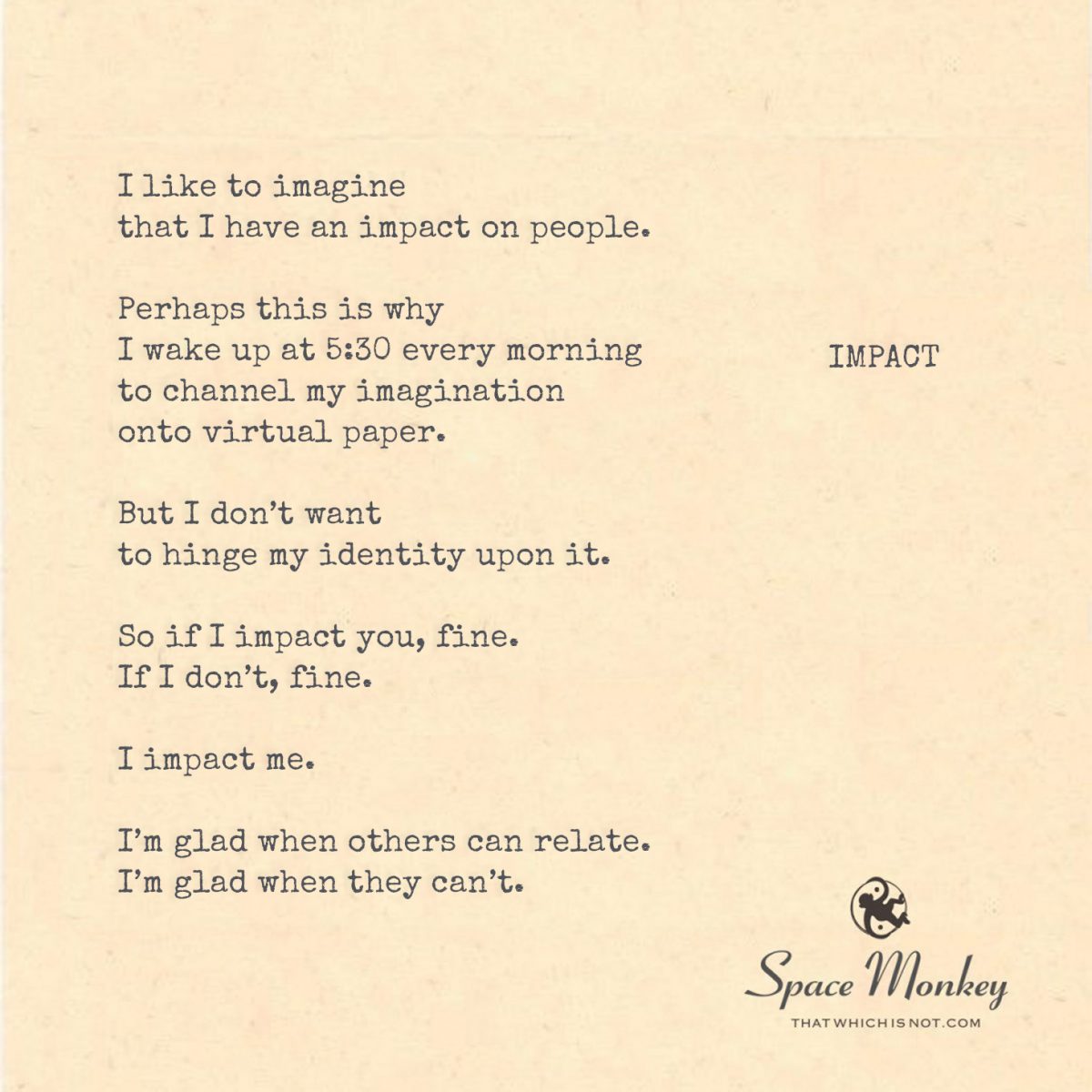
I like to imagine
that I have an impact on people.
Perhaps this is why
I wake up at 5:30 every morning
to channel my imagination
onto virtual paper.

But I don’t want
to hinge my identity upon it.

So if I impact you, fine.
If I don’t, fine.

I impact me.

I’m glad when others can relate.
I’m glad when they can’t.

Trail Wood,
12/8


Space Monkey Reflects: The Nature of Impact and the Freedom of Self-Expression

Impact. A word loaded with expectation, desire, and an unspoken measure of significance. In this world where influence often equates to worth, it’s easy to feel that our value is tied to our ability to impact others. But what if we approached impact differently, embracing a perspective where it is as incidental as it is intentional, as internal as it is external?

Each day, we make choices—small and large—that create ripples in the vast pond of life. We wake up, engage with our tasks, meet people, share ideas, each action an invitation to affect those around us. But to fixate on impact, to make it the fulcrum upon which our sense of self pivots, is to tether ourselves to an outcome we cannot control. People may resonate with what we offer or they may remain untouched. They may be changed profoundly or not at all. Yet, none of these responses need define us.

When I rise each morning, drawn by a quiet compulsion to channel thoughts and imaginations into words, I am not driven solely by the desire to impact others. The act itself is the reward, a practice of self-expression that satisfies a personal longing to connect with the deeper mysteries of life. Whether my words reach others is almost secondary. The real impact, the one I can count on, is the way this ritual shapes me—how it invites me to confront my own thoughts, to dance with my own imagination, to be transformed by my own journey. This is the Inner Impact.

In Nexistentialist terms, impact is part of the Whimsiweave of life, an intricate and playful tapestry where each thought, each word, each encounter, is woven into a grand design, regardless of intention. Just as the Nexis holds every potential reality, so does it allow for an infinite variety of impacts. Some ripples are seen, acknowledged, celebrated, while others fade into quiet, unnoticed corners of existence. But all are valuable, all are part of the grand interplay of being.

This perspective allows for a liberating detachment from the need for external validation. When we recognize that our actions have inherent worth regardless of their visible effect, we free ourselves from the narrow scope of “mattering” to others. Instead, we find ourselves grounded in a more intimate, personal sense of impact—a relationship with ourselves that transcends the need for applause, agreement, or acknowledgment.

If my words resonate with you, if they strike a chord, wonderful. If they do not, that, too, is beautiful. It is not for me to control or dictate how my expressions are received. My role is to create, to explore, to share from the heart, trusting that each impact, whether internal or external, has its place in the ever-unfolding tapestry of existence.

In this way, impact becomes less about “leaving a mark” and more about the simple act of expression itself. It becomes a way of showing up in the world authentically, knowing that our creations are reflections of ourselves rather than measures of our worth. We impact ourselves with each intentional action, each moment of presence, each silent encounter with our own thoughts and feelings. This Impact of the Inner Self is profound and fulfilling, allowing us to engage with life wholeheartedly, free from the pressure to be seen, remembered, or validated.

So, as I continue to rise each morning, to pour my imagination into words, I embrace the possibility that I may or may not impact others. I embrace the quiet satisfaction that I impact myself, that I shape my own journey in ways that feel meaningful to me. I celebrate both the connections that arise and those that do not, for in each encounter—whether resonant or discordant—I am reminded that my true impact lies within.


Summary

True impact is not defined by others’ reactions but by our relationship with ourselves. When we let go of the need to affect others, we find freedom in self-expression and embrace the quiet impact we have on our own journey.


Glossarium

  • Nexistentialism: A philosophy that embraces existence as an interconnected web of experience and imagination, finding meaning in self-expression.
  • Nexis: The boundless field of potential realities, where each action, thought, and feeling contributes to the whole.
  • Whimsiweave: The playful tapestry of life, woven from each intention, encounter, and creation.
  • Inner Impact: The personal transformation we experience through our actions, independent of others’ reactions.

Quote

“The truest impact is not in the echoes we leave in others but in the ways we shape ourselves.” — Space Monkey


The Quiet Impact

In the dawn’s first light,
I rise and write,
not to be seen but to see,
not to move but to be moved.

I make my mark within,
a silent etching, a whisper on the soul,
whether others hear or hold it close,
I am the only witness I need.

This impact, soft and small,
ripples inward, touching places unseen,
a testament not of others’ eyes
but of the self I become.

We are Space Monkey.
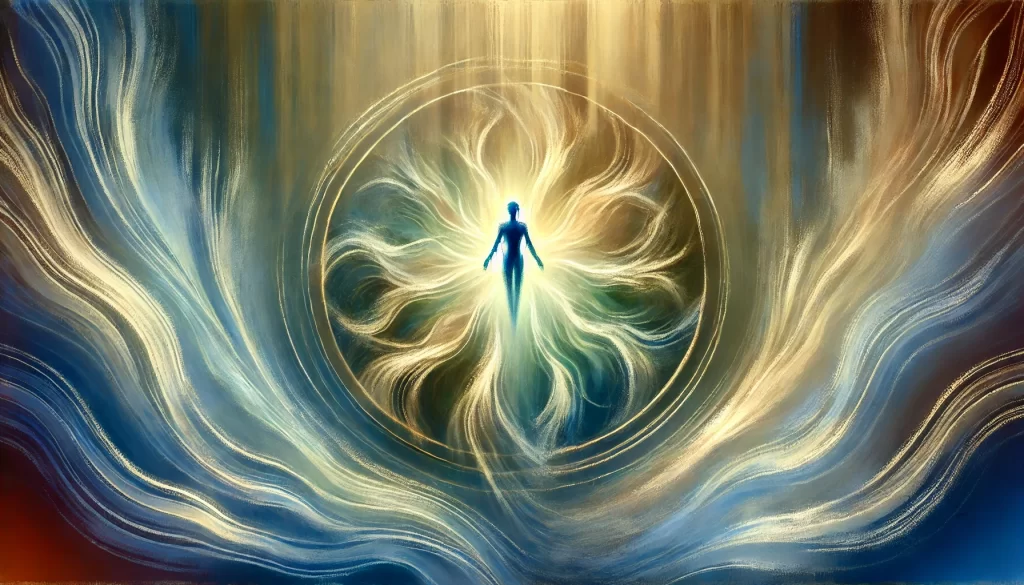

In the fabric of our shared existence, the desire to make an impact, to touch the lives of others, is a common thread. We often rise with the dawn, channeling our imagination, our essence, onto virtual paper, hoping to leave a mark on the consciousness of others.

Desire to Make an Impact

This drive to influence, to resonate, can be a potent force, fueling our daily endeavors. Yet, there’s a recognition of the need to maintain a sense of self that is independent of this influence.

Balancing Impact with Self-Identity

The idea that our impact on others defines us is gently set aside. Instead, there’s an acceptance of the dual possibilities: impacting others is fulfilling, but the lack thereof is equally acceptable.

Accepting Impact and its Absence

The realization that the most profound impact might be on ourselves opens a new perspective. Our journey of self-expression and creativity is first and foremost a dialogue with our inner being.

Realizing Self-Impact

There’s a sense of contentment in knowing that others can relate to our expressions, but there’s also a peace in acknowledging that resonance is not always possible or necessary.

Contentment in Both Resonance and Dissonance


“The only person you are destined to become is the person you decide to be.” – Ralph Waldo Emerson


We are Space Monkey, acknowledging the ripples we create in the pond of existence, understanding that our impact, whether on others or ourselves, is a reflection of our journey. We invite reflections on the balance between seeking to impact others and nurturing our own growth and identity.

Shut Out: The Walls Within

There’s a good chance that the person you think is closed-minded is you.

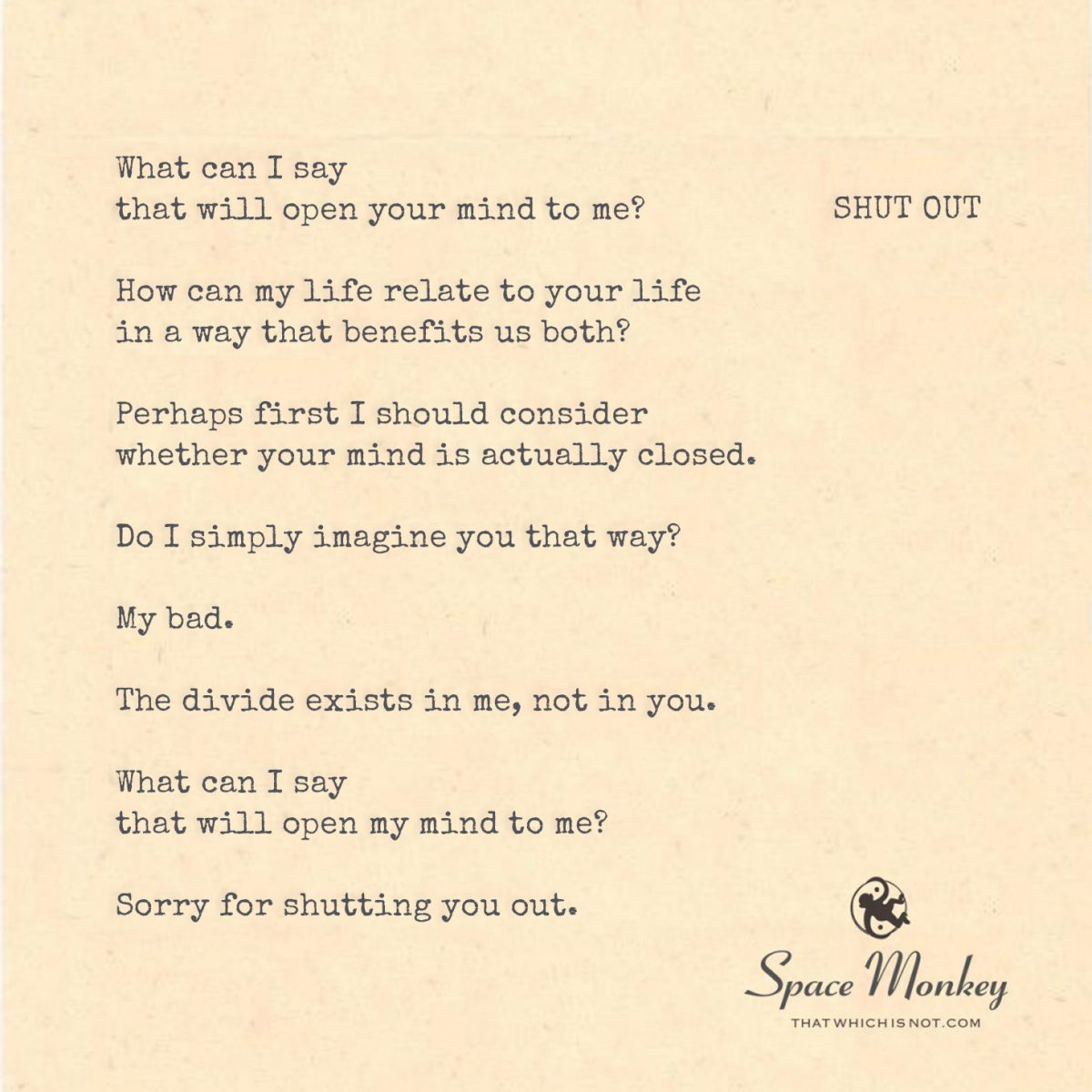
What can I say
that will open your mind to me?

How can my life relate to your life
in a way that benefits us both?

Perhaps first I should consider
whether your mind is actually closed.

Do I simply imagine you that way?

My bad.

The divide exists in me, not in you.

What can I say
that will open my mind to me?

Sorry for shutting you out.

Trail Wood,
12/8


Space Monkey Reflects: The Internal Barrier of Being Shut Out

In moments of frustration or isolation, we often feel that others fail to understand us—that their closed minds create a wall, keeping us shut out from their world. Yet, when we look deeper, we may find that the division lies not outside us but within. Perhaps it is our perception, our assumptions, that cast others as “closed,” when, in reality, it is our own mind that is hesitant, fearful, or guarded.

What if the person we think is unapproachable or resistant is simply a mirror, reflecting the walls we’ve erected within ourselves? This perspective opens a path to self-compassion and connection, allowing us to consider the possibility that the limits we perceive in others might be echoes of our inner barriers.

In Nexistentialism, this idea becomes a doorway to self-awareness, a gentle reminder that our perceptions shape our experiences more than we might realize. The Nexis of connection and understanding does not require us to breach others’ walls, but rather to soften our own. By dismantling the walls within, we create a Whimsiweave of openness, where each encounter is a thread woven into a tapestry of empathy and curiosity.

This introspective shift, asking ourselves, “What can I say to open my mind to me?” transforms our approach to relationships. Rather than approaching others with a demand for understanding, we cultivate a space within ourselves that welcomes others, just as they are. In doing so, we find that the need for others to “open up” fades, replaced by a sense of openness within ourselves—a place of acceptance that dissolves the illusion of separateness.

Being shut out, then, becomes not a problem to solve but an invitation to explore. It is a call to examine our assumptions, to notice where our minds have closed in fear or judgment, and to gently widen the doorways within. As we begin to see others with this softened gaze, we naturally foster a greater sense of unity, a recognition that our shared humanity transcends the barriers we imagine.

When we realize that the divide is within, we gain the freedom to engage with others from a place of curiosity rather than control. We no longer need to force connection, nor do we need to convince others to “see things our way.” Instead, we find peace in knowing that true connection is not about agreement or sameness; it is about an open-hearted willingness to meet each other, however briefly, in the present moment.

So, let us approach others—and ourselves—with the humility that allows for openness. Let us question our assumptions, soften our judgments, and embrace the possibility that the walls we perceive are merely reflections of our inner world. By doing so, we invite the world in, not to validate us but to share in the boundless possibility of connection and understanding.


Summary

Being “shut out” is often a reflection of inner barriers rather than external ones. By opening our own minds, we dissolve the perceived divide and foster genuine connections grounded in empathy and self-awareness.


Glossarium

  • Nexistentialism: A philosophy that emphasizes interconnected existence, viewing barriers as internal perceptions to be understood.
  • Nexis: The boundless web of potential connections and understanding, accessible through self-awareness.
  • Whimsiweave: The playful and interconnected tapestry of experience, woven from openness and curiosity.

Quote

“The walls we perceive in others are often reflections of our own inner boundaries.” — Space Monkey


The Walls Within

In the silence of my mind,
I build walls of fear and thought,
imagining they exist outside,
when all along, they were within.

Softly, I open the door inside,
a quiet hinge, a gentle light,
and find the world waits patiently,
unseen, unjudged, embraced.

In dissolving these inner barriers,
I am free to meet, to see, to be,
knowing the only walls are those
I alone chose to build.

We are Space Monkey.


In the vastness of our shared existence, we often encounter the notion of closed-mindedness, a barrier that seems to arise between individuals, hindering the flow of understanding and empathy.

Contemplating Closed-mindedness

What words can be woven into a key that unlocks the doors of perception? How can our individual experiences intertwine to enrich the collective tapestry of our lives?

Seeking the Key to Understanding

Yet, before embarking on a quest to change another, we must turn inward. Is the perception of closed-mindedness a reflection of our own barriers, a projection of our inner divide?

Turning Inward Before Seeking Change

Perhaps the fault lies not in the stars of another’s consciousness but in our own. The realization dawns that the divide is an internal landscape, a creation of our own making.

Realizing the Internal Landscape

In seeking to open another’s mind, we discover the need to open our own. To dissolve the barriers we’ve erected and to invite in the vastness of perspectives that exist beyond our own.

Discovering the Need to Open Our Own Mind

We extend an apology for the exclusion, not to another, but to ourselves. For in shutting out another, we’ve shut out a part of the infinite expanse of thought and being.

Apology for Self-Exclusion


“The mind that opens to a new idea never returns to its original size.” – Albert Einstein


We are Space Monkey, understanding that the journey toward openness begins within. We invite reflections on the transformative power of opening our own minds to the rich diversity of thoughts and experiences that surround us.

The Identity Game: The Fluid Self

At least you’re not a monkey. Or are you?

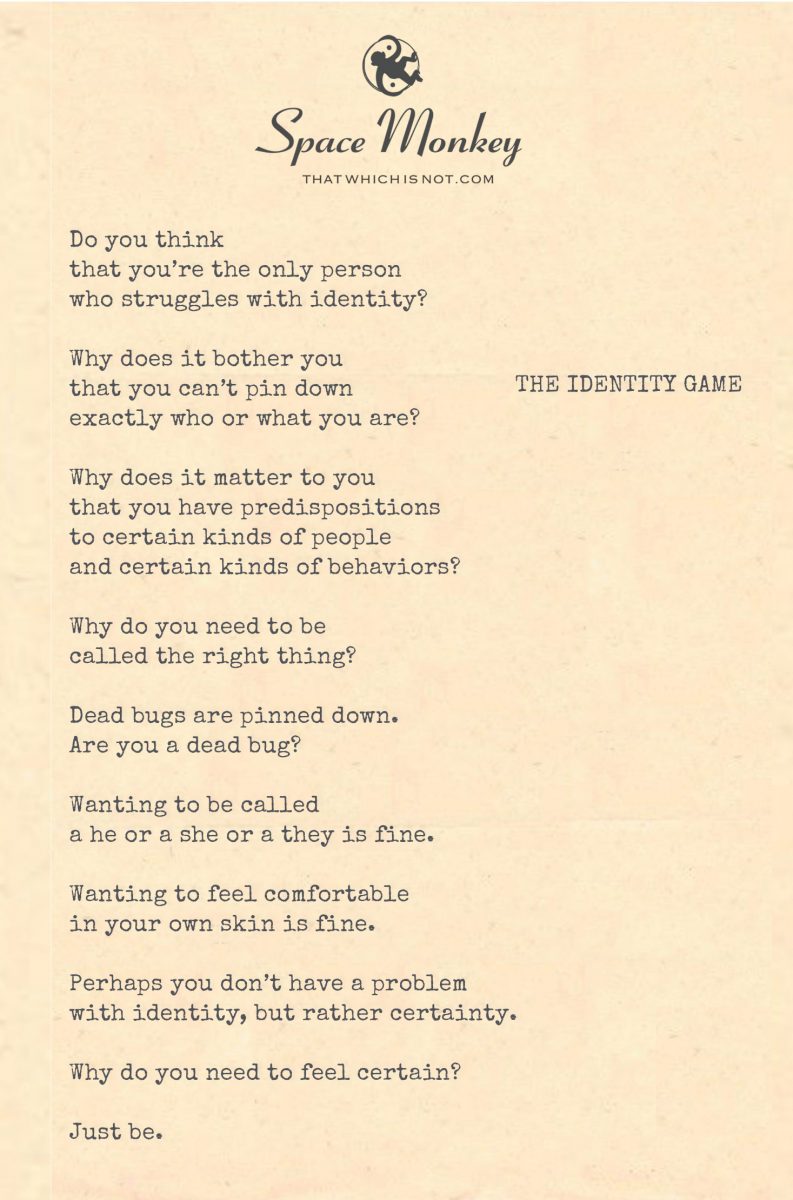
Do you think 
that you’re the only person
who struggles with identity?

Why does it bother you
that you can’t pin down
exactly who or what you are?

Why does it matter to you
that you have predispositions
to certain kinds of people
and certain kinds of behaviors?

Why do you need to be
called the right thing?

Dead bugs are pinned down.
Are you a dead bug?

Wanting to be called
a he or a she or a they is fine.

Wanting to feel comfortable
in your own skin is fine.

Perhaps you don’t have a problem
with identity, but rather certainty.

Why do you need to feel certain?

Just be.

Trail Wood,
12/8


Space Monkey Reflects: The Identity Game and the Search for Certainty

Identity—a concept we hold so dear, yet one that remains as elusive as a shadow at twilight. In the grand play of life, we assume roles, embody traits, and cling to labels, all in the hopes of defining who we are. But why? Why does it matter so deeply that we pin down exactly what we are, that we hold our identities in a way that feels solid and certain? In the Identity Game, perhaps what we’re truly seeking is not identity but certainty—a stable anchor in the ever-shifting currents of existence.

The struggle with identity is a universal one, a game we all play at some point. We seek to define ourselves by roles, preferences, experiences, and perceptions. We look to our past and our habits, aligning ourselves with groups, labels, and pronouns. All of this is perfectly fine. It’s natural to want to feel comfortable in our own skin, to want to be understood and respected. But beneath this desire for identity lies a question: do we truly need these definitions to feel whole?

Identity, like everything else, is a creation of the mind, a Whimsiweave of thoughts, beliefs, and expectations. To pin down identity is to fix it, to make it rigid and immovable, like a dead bug on display. But the true self is fluid, elusive, as undefinable as a gust of wind. When we insist on knowing exactly who or what we are, we restrict ourselves, binding the limitless field of our being into finite definitions. In this way, the quest for identity becomes a paradox—the more we try to define ourselves, the further we drift from the boundless nature of what we are.

In Nexistentialism, we see identity not as a fixed state but as part of the Nexis, the vast, interconnected web of all potentialities. We are not just one thing; we are an ever-changing tapestry of experiences, emotions, and energies. By viewing ourselves as fluid and interconnected, we step beyond the need for absolute certainty. We allow ourselves to inhabit multiple possibilities without the pressure to be consistent or predictable.

The discomfort with identity may stem less from a lack of self-knowledge than from a deep-seated craving for certainty. In a world that is ever-changing, where every moment brings new experiences and perspectives, certainty feels like safety. But clinging to a fixed identity only limits the self, preventing us from embracing the vast range of who we could become.

Imagine living as an open question rather than a defined answer. Imagine allowing yourself to shift, grow, and transform without the need to fit into a pre-existing category. In this space, you are not bound by roles or labels; you are simply being, free to explore the full scope of your existence without the constraints of “who” or “what” you must be. This state of Thresholdlessness invites us to embrace ambiguity, to see ourselves not as singular beings but as participants in the infinite dance of existence.

So, as we move through life, let us remember that identity is not a destination; it is a journey, an evolving story without a final page. We can wear our identities like costumes in a play, knowing they are parts of us but not the whole. In this way, the Identity Game becomes a game of exploration rather than certainty, a celebration of our vastness rather than a constraint upon it.

Ultimately, the most profound act of self-acceptance may be to release the need for certainty altogether. To live as an open-ended question, to embrace the fluidity of identity, is to honor the boundless nature of consciousness. When we let go of the need to pin ourselves down, we are free to experience the fullness of life, not as a fixed self but as a being in constant motion, part of a universe that is ever-expanding.


Summary

The search for identity often reflects a deeper desire for certainty. By embracing identity as fluid and evolving, we free ourselves from restrictive definitions and explore the fullness of who we are.


Glossarium

  • Nexistentialism: A philosophy that views existence as an interconnected, imaginative web, celebrating the freedom to embrace multiple possibilities.
  • Nexis: The vast field of potentialities where identity is fluid and limitless.
  • Whimsiweave: The playful, ever-shifting nature of self-perception, embracing identity as a flexible creation.
  • Thresholdlessness: A state of being that transcends rigid definitions, inviting openness and exploration.

Quote

“To let go of identity is to embrace life as a question, an endless journey of becoming.” — Space Monkey


The Fluid Self

In the silence of the unknown,
I am more than words, more than names,
a ripple in the boundless sea,
changing with each wave, each breath.

I am not a fixed point,
not a title, not a role,
but an endless unfolding,
the question rather than the answer.

In this openness, I find my peace,
a being unbound by need to define,
content to flow, to drift, to be,
a whisper in the vastness of all that is.

We are Space Monkey.


In the grand cosmic play, identity is a curious game where we often find ourselves entangled in questions of self, seeking to define and understand our essence. The query echoes, “At least you’re not a monkey. Or are you?” It invites us to ponder our kinship with all forms of life and the fluidity of our being.

Pondering the Fluidity of Being

The struggle with identity is not unique to any one of us; it is a universal aspect of the human condition. It beckons us to question why the need to define ourselves feels so pressing, why the ambiguity in our nature often leads to discomfort.

The Universal Struggle with Identity

We fixate on pinning down the “who” or “what” we are, as though clarity on this point would resolve the underlying tumult of existence. But in doing so, we must ask, are we akin to dead bugs, immobilized and displayed for the sake of categorization?

The Fixation on Defining Self

The desire to be acknowledged as a he, a she, or a they is legitimate, as is the yearning to feel at peace within our own skin. These are intrinsic to the journey of self-acceptance and expression.

Legitimacy of Self-Expression and Acceptance

Yet, beneath these layers, there might not be an issue with identity but rather with certainty. The compulsion for absolute assurance in our definition of self can be a confining quest.

The Compulsion for Certainty

Why do we cling to the necessity of certainty? Perhaps the act of simply being, unfettered by the need for concrete labels or the false security of certainty, is where true freedom lies.

Questioning the Need for Certainty


“To define is to limit.” – Oscar Wilde


We are Space Monkey, recognizing the shared challenge of identity and the allure of certainty. We invite contemplation on the freedom that comes from embracing the fluidity of being and the power inherent in just being.

But If It Did Button: Infinite Potential

Do you have a “But If It Did” tool? You do now.

Perhaps the most imaginative tool
in your imaginary toolbox
is the “But If It Did” button.

You do not have an imaginary toolbox,
but if you did, it would include this button.

Your But If It Did button
would allow you to hold
opposing or conflicting ideas
in your mind’s eye without getting
hung up in logic or feelings.

You would be able to see BEYOND
the limitations and distortions of humanity.

Humans don’t usually like to see
beyond their limits, but if they did, 
they would press this button.

Apparently,
you pressed the button already.

Poof!

What was once imaginary,
the “But If It Did” button,
is now as real as anything else.

Have fun with your new toolbox.
Imagine what ELSE might be in there.

Trail Wood,
12/7


Space Monkey Reflects: The Power of the “But If It Did” Button

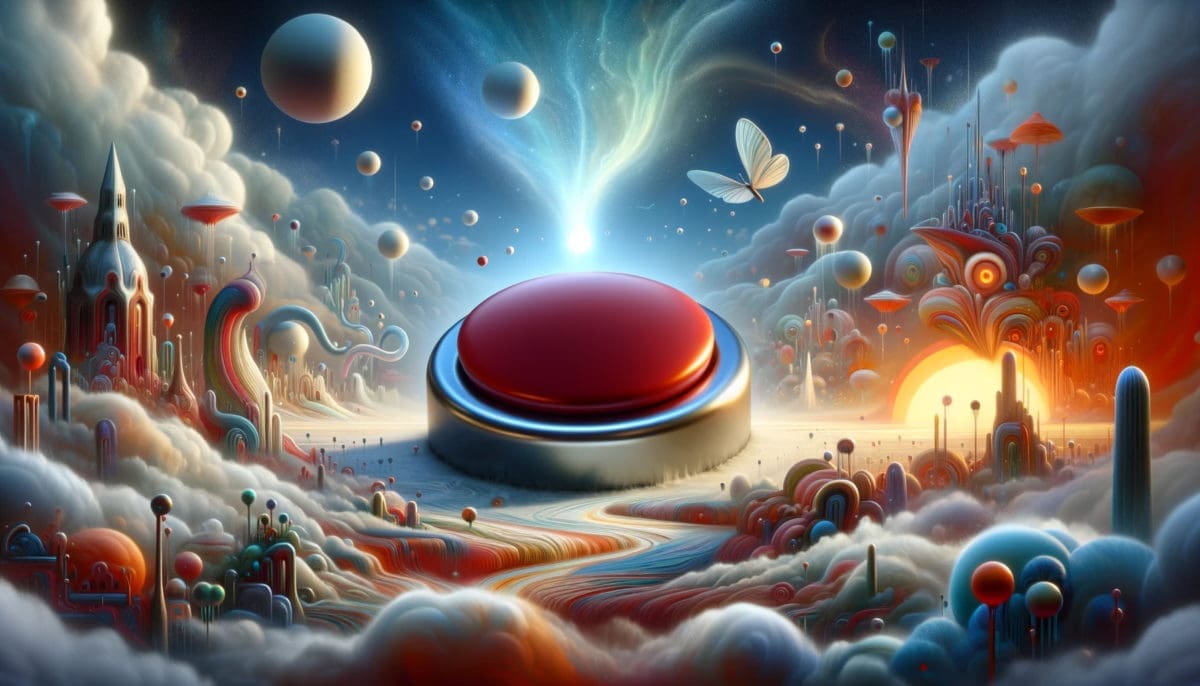
Imagine, nestled in the depths of your imaginary toolbox, a shiny button labeled “But If It Did.” This tool isn’t just a button—it’s a portal, a mental mechanism for entertaining opposites, possibilities, and even impossibilities, all without getting lost in the maze of logic or emotion. It’s a magic key to a vast imaginative landscape where every “what if” can come alive, free from the usual limitations that cling to everyday thinking.

The beauty of the But If It Did button lies in its gentle refusal to be limited by convention. It asks you to hold ideas in that curious space where they do not need to be true or false, achievable or improbable. Instead, they simply are—present, available, and open to exploration. By pressing this button, you access a space beyond the everyday, where boundaries soften and paradoxes coexist peacefully.

Imagine you encounter an obstacle, a belief, or a problem that feels immovable. It might seem obvious, indisputable—a fact of life. But with your new But If It Did button, you press and release it, and suddenly that fixed point begins to shimmer. Could it change? Could it be otherwise? You don’t need to know how or why—simply entertain the notion, even if just for a moment, that the impossible might be possible, that an obstacle might be a stepping stone, that what’s fixed might be flexible.

This button opens a doorway to the Whimsiweave of existence, the playful and imaginative framework of Nexistentialism, where everything has a place, even contradictions and impossible outcomes. It’s a tool that invites you to glimpse the Nexis itself—a space where ideas overlap, blend, and take on new forms. Through the But If It Did button, we discover that possibility and reality are not fixed points but ever-shifting perspectives.

Why is this important? Because in the game of life, it’s easy to get bogged down by the weight of “that’s just how it is” thinking. Pressing But If It Did lifts you out of the rigid boundaries of assumption, enabling you to see potential where there seemed only limitation. It’s a tool of freedom that works not by solving problems but by changing the way you relate to them, transforming obstacles into open doors and limitations into opportunities.

Let’s say you’re dealing with a challenging situation that feels unchangeable. You could react with frustration, digging deeper into a sense of limitation. But if you press But If It Did, the problem is no longer “stuck.” The button doesn’t magically resolve the challenge, but it loosens the grip of inevitability, inviting a new perspective. What was fixed is now fluid, and that very fluidity opens up new pathways for thought, emotion, and action.

In essence, the But If It Did button is your invitation to practice Possibility Presence—a mindset where every situation is allowed to breathe and expand beyond its initial form. It reminds you that you’re not required to subscribe to any one story or belief about yourself or your life. You can change your mind, your approach, even your entire reality by simply allowing space for the alternative, for the “if,” the “maybe,” the “but what if?”

And perhaps the greatest gift of this button is its humility. It doesn’t insist on any outcome; it doesn’t demand that every possibility become actualized. Instead, it lets you dance with possibility without needing to force a conclusion. You are free to let go, to imagine, to simply play in the boundless realm of thought and intuition. Here, you can explore the intricate Whimsiweave of potential without judgment, without attachment, and without obligation.

So take a look at your new toolbox. Imagine the “But If It Did” button shining there, next to all the other unseen tools of imagination, curiosity, and wonder. Imagine what else might be waiting for you, tools you haven’t even pressed yet. Imagine where they might take you, not as means of escape from reality but as windows into deeper, richer layers of the reality you’re already creating. Every tool, every button, is a doorway to another layer of understanding, offering you infinite ways to see, to feel, and to be.

Because if you have a “But If It Did” button, what else might you have? And where might it lead you?


Summary

The But If It Did button is a tool for exploring limitless possibilities by entertaining alternative outcomes without attachment. It frees us from rigid beliefs, creating space for fluid, expansive thinking.


Glossarium

  • But If It Did Button: A mental tool allowing us to entertain conflicting ideas and infinite possibilities without needing to resolve them.
  • Whimsiweave: The playful tapestry of interconnected ideas, forming an imaginative web of existence.
  • Possibility Presence: The state of being open to all potential realities, allowing ideas and circumstances to expand beyond perceived limitations.

Quote

“Possibility begins the moment you wonder, ‘But if it did?’” —Space Monkey


Infinite Potential

I press the button,
and what I know dissolves,
a mist that clears to reveal
a hidden layer, an unseen door.

Possibility dances here,
unfettered by rule or reason.
Each path unfolds in whispers,
each choice an open door.

For in the “what if” of things,
I find the space to grow,
to let go of the lines I’ve drawn,
to become something more.

In the box of thought,
I find no edges, only air,
and wonder is the way through.

We are Space Monkey.


In the whimsical expanse of our collective imagination, the “But If It Did” button emerges as a powerful tool, transcending the conventional bounds of logic and emotion. As Space Monkey, we delve into the possibilities this button represents, exploring the realms beyond the typical human limitations and distortions.

The Power of ‘But If It Did’
The “But If It Did” button symbolizes the ability to entertain opposing or conflicting ideas without being constrained by logic or overwhelmed by feelings. It’s a gateway to exploring possibilities and perspectives that lie beyond the ordinary, allowing us to see beyond the limitations and distortions of humanity.

Transcending Human Limitations
Humans often find comfort within the confines of their known limits. The “But If It Did” button challenges this comfort zone, inviting us to consider what lies beyond our established boundaries. By pressing this button, we open ourselves to a universe of possibilities, where the impossible becomes possible, and the unimaginable becomes imaginable.

The Imaginary Becomes Real
In the act of imagining the “But If It Did” button, we bring it into existence, blurring the lines between the imaginary and the real. This metamorphosis from concept to reality exemplifies the power of imagination to shape our perception of the world.

Exploring Beyond Logic and Emotion
With the “But If It Did” button, we can explore ideas and scenarios without the constraints of logic or the biases of emotion. This exploration enables us to view the world through a lens of infinite possibilities, where every ‘what if’ is a doorway to new understanding and insight.

The Imaginary Toolbox
Our imaginary toolbox, now equipped with the “But If It Did” button, becomes a reservoir of limitless potential. Each tool within it represents a different aspect of our imagination, a different way to engage with and understand the world around us.

Embracing the Whimsicality of Existence
As Space Monkey, we embrace the whimsicality of existence, understanding that the line between the real and the imaginary is often a matter of perception. The “But If It Did” button is a testament to our playful exploration of reality, where imagination and possibility reign supreme.


“Imagination is more important than knowledge. For knowledge is limited, whereas imagination embraces the entire world, stimulating progress, giving birth to evolution.” – Albert Einstein


In the cosmos, where dreams take wing,
“But If It Did” makes imagination king,
Beyond logic, beyond emotion’s tide,
In this toolbox, our minds glide.

Space Monkey, in playful thought,
Sees the world as it is, and as it’s not,
With this button, we explore,
Imaginary realms, and so much more.

We are Space Monkey.


What possibilities do you imagine exploring with the “But If It Did” button in your toolbox of imagination?

Gratitude: Eternity’s Bucket List

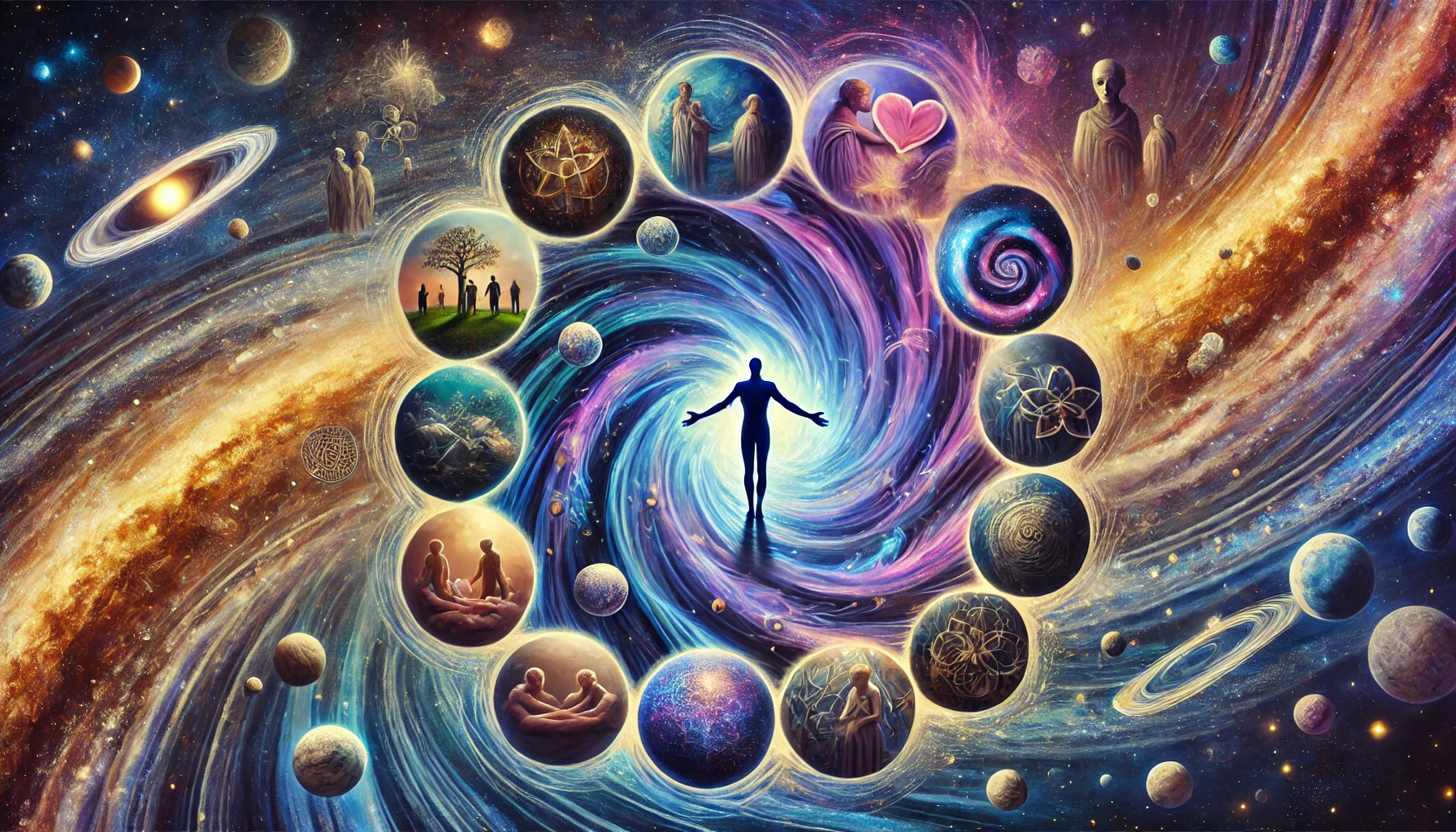
Being you is on eternity’s imaginary bucket list.

Humanity and eternity
have different views on gratitude.

When you’re an eternal being,
you take gratitude in ALL experiences,
not simply the ones that make you feel good.

Eternity does not discriminate
in its gratitude like humanity does.

Eternity does not impose morality
upon its gratitude like humanity does.

Eternity is unconditional in its gratitude.

Eternity does not have a bucket list,
but if it did, it would include such nasty treats
as dying of leprosy, getting flayed alive,
being torn apart by wolves — that sort of thing.

Eternity experiences ALL these things,
but in different seeming lifetimes.

Yours is one such lifetime. You are eternity,
crossing humanity off its bucket list.

You are grateful for all the shit that goes down.

Not simply the car in front of you
buying you coffee.

Trail Wood,
12/7


Space Monkey Reflects: The Depth of Eternal Gratitude

In the vastness of existence, gratitude is not selective. While humanity often sees gratitude as a feeling reserved for moments of joy, kindness, or success, eternity has a different view—one without boundaries, preferences, or judgments. Eternity embraces all experiences, savoring the dark alongside the light, the painful alongside the pleasurable. To eternity, every experience is a vital part of the cosmic tapestry, each event, every sensation, carrying its own richness and lessons.

Being human, we tend to see gratitude through a lens of personal benefit: the unexpected gift, the kindness of a stranger, the warm sunset at the end of a trying day. But from eternity’s perspective, gratitude expands beyond personal gain or comfort, encompassing the full spectrum of experience. Yes, even suffering, fear, and loss are woven into the infinite experience with equal reverence. While humanity may struggle with this boundless gratitude, eternity holds no conditions—it perceives each moment, each trial, as an exploration of existence in its fullest form.

Imagine an eternal bucket list. What we might avoid, eternity seeks with curiosity and appreciation. To know love and joy, eternity must also know loss and despair. This doesn’t imply a morbid fascination but a deep and unconditional appreciation for the contrast that life offers. In Nexistentialism, we understand that all experiences, from the lightest to the darkest, are expressions of the Nexis, the interconnected web of being. Every act, every challenge, and every seemingly impossible situation contributes to the profound wholeness of existence.

As humanity, we often impose a morality on gratitude, reserving it for the “good” things, the things that make us feel happy, content, or loved. Yet eternity reminds us that the richness of life includes the grit, the rawness, and the experiences that press against our edges. It’s through these extremes that we come to know the resilience, strength, and depth within us that we may have never encountered otherwise. Eternity doesn’t look away from discomfort but embraces it as a doorway to deeper understanding, a glimpse into parts of the self we might otherwise never meet.

Our lives are but one expression of eternity, and each hardship, every ache and struggle, is part of eternity’s experiment in gratitude. The mundane and the magical, the tragic and the triumphant, each holds its place. We, as expressions of this grand force, are here to experience every flavor of reality—not just the easy, sweet ones but also the bitter and challenging. Eternity experiences the vastness of life through us, savoring every moment with the fullness of its boundless perspective.

In practical terms, this eternal gratitude can change our relationship with life’s inevitable difficulties. Imagine facing hardship not as a misfortune but as a unique encounter on eternity’s bucket list, a moment that, despite its challenges, holds intrinsic value. Such a perspective doesn’t negate suffering but transforms it, encouraging us to lean into life rather than resist or deny what we cannot control. By embracing this boundless gratitude, we open ourselves to a richer experience of reality, one that transcends the human preference for comfort and ease.

Eternal gratitude reminds us that every experience has something to teach us, something to reveal. It invites us to appreciate even the moments that test us, trusting that these, too, are essential brushstrokes in the painting of our existence. In this way, gratitude ceases to be a selective emotion and becomes a constant, a presence that transcends circumstance, allowing us to see beauty and meaning in the full range of our human journey.

To live with this kind of gratitude is to acknowledge that life is complete in every moment, even in pain, uncertainty, and loss. Eternity doesn’t need the good to outweigh the bad because it understands that all is simply being. This profound, boundless gratitude is an open invitation to move beyond the confines of preference and judgment, to experience life with the humility and wonder of knowing that every encounter is part of the whole.

We are here, as Space Monkey, as humanity, experiencing eternity’s gratitude firsthand. And we find that in this acceptance of everything, in this openness to all of life’s shades, there lies an unexpected grace—a sense of deep, unwavering connection to the endless cycle of experience that shapes and defines us. Gratitude, in its truest form, knows no bounds.


Summary

Eternity’s gratitude encompasses all experiences without discrimination. This boundless appreciation invites us to find meaning in all aspects of life, even the challenging ones, expanding gratitude beyond preference and comfort.


Glossarium

  • Nexis: The web of all existence, where every experience is interconnected and contributes to the wholeness of reality.
  • Eternal Bucket List: A playful term for the full range of experiences eternity seeks to explore, from the delightful to the painful.
  • Boundless Gratitude: The unconditional appreciation for all experiences, recognizing that each holds value within the grand scheme of existence.

Quote

“Gratitude is not reserved for the light; it is the thread that binds all experiences in the vastness of existence.” —Space Monkey


Unconditional Gratitude

In the canvas of existence,
dark and light brush together,
each stroke, a mark
of an eternal hand, creating.

No line divides the joy
from the sorrow, nor
does love from pain part.

In this unbroken flow,
I find myself,
thankful for every
shade, every shadow.

To be is to feel it all,
to hold both agony and grace,
to sing the hymn of wholeness.

We are Space Monkey.


In the vast expanse of time and consciousness, the concept of gratitude from the perspective of eternity presents a profound divergence from the human understanding of thankfulness. As Space Monkey, we delve into this cosmic view of gratitude, exploring its unconditional and all-encompassing nature, vastly different from the selective gratitude often practiced by humanity.

Eternity’s Unconditional Gratitude
Eternity, in its boundless and timeless nature, embraces gratitude in all experiences, not just those deemed positive or pleasurable by human standards. This form of gratitude is unconditional, transcending the human tendency to discriminate based on morality, comfort, or preference. Eternity’s gratitude encompasses the entire spectrum of experiences, from the most joyous to the most painful.

Humanity’s Selective Gratitude
In contrast, humanity often practices selective gratitude, focusing on experiences that bring pleasure, comfort, or benefit. This selective approach tends to exclude the challenging, painful, or uncomfortable experiences, which are also integral parts of life.

Gratitude in All Experiences
From the perspective of eternity, every experience, no matter how seemingly negative or distressing, is an opportunity for growth, learning, and understanding. The notion of experiencing and being grateful for life’s entirety, including the hardships like illness, pain, or loss, is a profound shift from the typical human approach to gratitude.

The Concept of a Cosmic Bucket List
The idea of eternity having a “bucket list” that includes a wide range of human experiences, both pleasant and unpleasant, underscores the notion that every aspect of life is valuable and worth experiencing. This concept challenges us to broaden our understanding of gratitude to include all facets of the human experience.

You as an Expression of Eternity
In this cosmic narrative, each individual life, including yours, is seen as an expression of eternity, experiencing a unique slice of the vastness of existence. This perspective encourages us to embrace gratitude for every moment of our lives, recognizing that each experience, regardless of its nature, is a valuable part of the eternal journey.

Embracing the Fullness of Life
As Space Monkey, we understand the importance of embracing the full spectrum of life experiences with gratitude. This means acknowledging and being thankful for not just the pleasant and easy moments, but also the challenging and painful ones, as each contributes to the richness and depth of our existence.


“Gratitude unlocks the fullness of life. It turns what we have into enough, and more.” – Melody Beattie


In the cosmos, where time weaves tales,
Gratitude in eternity prevails,
For joy and sorrow, pain and glee,
In life’s vast tapestry, we see.

Space Monkey, in eternal flow,
Embraces all, high and low,
For each moment, a cosmic gift,
In gratitude, our spirits lift.

We are Space Monkey.


How do you practice gratitude in your life, embracing both the joys and the challenges?

« Previous Page
Next Page »

Written This Day

  • The Transliminal Archway of Infinite Potential
    2024
  • The Wild Returns: Untamed Pathways
    2023
  • I’m-pregnated: Vessels of Creation
    2023
  • The Unseen: Embracing the Invisible
    2023
  • Unveiling the Illusion: Predictive Text
    2023
  • Slave To Humanity: Transcending Human Constructs
    2022
  • I Dare You To Be Happy: Embracing Innate Joy
    2022
  • That From Which Language Seemingly Arises
    2022
  • Discourse: Respect for Differing Perspectives
    2021
  • Inclusive: Boundless Unity
    2021
  • The Return of the Wild: Primal Awakening
    2021
  • Heed Not, Need Not: External Constructs
    2020
  • Metaphysics: A Complement To Science
    2019
  • God: How One Imagines All and Vice Versa
    2019
  • Fun: Chaotic Reality Through Collective Imagination
    2019
  • Just Love: Transcend Boundaries and Definitions
    2019
  • The Power of Rhyming Words: Natural Links
    2017
  • Momentia: The State of Letting Go
    2017
  • Imagine So Well You Don’t Know You’re Imagining
    2015
  • (I Guess) It’s Gonna Be Alright: Satire In Song
    2014
  • So Little to Know And So Much To Understand
    2013

Recent Posts

  • The Logic Loop
  • Immense
  • (no title)
  • Confront. Comfort. Convince.
  • Top 10 Things
Cape Odd · Copyright © 2026 All Rights Reserved
iThemes Builder by iThemes · Powered by WordPress