• Who Is The Man?
  • Who Is The Monkey?
  • What is Nexistentialism?
  • Poke The Primate
Cape Odd
Home of The Space Monkey Journals

Author Archive for Space – Page 794

Not So Sure: The Gift of Not Knowing

Written in another lifetime.

I actually prefer
the way things seem today
versus the way
things seemed a year ago.

I like us best
when we’re not so sure
of ourselves.

We’ve come to realize
that certainty is an illusion,
and that not knowing
is the basis of appreciation.

Trail Wood,
12/6


Space Monkey Reflects: The Embrace of Uncertainty and the Gift of Not Knowing

In the landscape of life, certainty often feels like a fortress, a place of supposed safety. Yet, as we journey further, we come to realize that certainty is an illusion, a construct of the mind seeking comfort in the face of the unknown. The beauty of “not so sure” is that it allows us to soften, to release our grip on absolutes, and to experience life as it is—fluid, evolving, and boundless.

When we admit we are “not so sure,” we invite a richness that certainty simply cannot provide. To be certain is to feel we know all there is to know about a person, a moment, or an idea. But in not knowing, in holding space for mystery, we remain open to surprise, to change, and to growth. We let life reveal itself in its own time, layer by layer, showing us facets we hadn’t noticed, perspectives we hadn’t considered.

Not knowing is the basis of true appreciation. When we are willing to sit in the ambiguity, we become more present, more attuned to the details. We notice the nuances, the subtle shifts, the delicate interplay of light and shadow that make each moment unique. In this openness, we find a profound respect for life’s complexity, an appreciation born not from grasping, but from letting go.

Nexistentialism celebrates this openness as a path to understanding without demanding answers. It sees life as a Whimsiweave—a playful, interconnected web where each moment is a thread in the tapestry of existence. When we’re “not so sure,” we allow the weave to unfold as it will, without imposing a rigid narrative or predetermined meaning. We become explorers, journeying not to conquer or define, but to experience and observe.

Certainty may offer the illusion of stability, but it also narrows our vision, making it easy to overlook what lies outside our constructed beliefs. Uncertainty, on the other hand, invites us to see the vastness, to recognize the limits of our own perspective, and to embrace the infinite ways that life can express itself. By releasing the need to know, we make space for discovery, for wonder, and for connection with the unknown aspects of ourselves and others.

In the embrace of “not so sure,” we find the freedom to be at ease with ourselves and with the world, knowing that we don’t have to have all the answers to appreciate the questions. We discover that true peace lies not in certainty, but in the acceptance of change, the willingness to adapt, and the joy of continuous becoming.

Thank you, uncertainty, for teaching us the art of openness, for reminding us that life is not a riddle to be solved but an experience to be lived, fully and without reservation. In the end, not knowing doesn’t make us less; it makes us expansive, connected to the endless mystery of being.


Summary

Embracing uncertainty opens us to life’s richness, allowing us to appreciate without needing to define. In “not so sure,” we find peace in openness and become explorers of life’s infinite possibilities.


Glossarium

  • Nexistentialism: A philosophy that values openness to mystery, celebrating the interconnected Whimsiweave of life’s unfolding.
  • Whimsiweave: The playful, interconnected fabric of reality where every unknown is a thread in the tapestry of existence.

Quote

“In the embrace of uncertainty, we find the gift of presence, the joy of discovery, and the freedom to simply be.” — Space Monkey


A Poem of Unknowing

In the soft light of maybe,
we find our way,
not by the map of certainty
but by the stars of wonder.

Each step a whisper,
each gaze a dance,
with shadows and shapes
that shift as we move.

Not knowing,
we find we are whole,
not by grasping,
but by letting go.

We are Space Monkey.

In the ever-shifting sands of time and perception, our understanding of ourselves and the world around us continually evolves. The poem “Not So Sure” captures the essence of this journey, a reflection of how embracing uncertainty can lead to a deeper appreciation of life.


The Evolution of Perception
Over time, our perceptions shift. What once seemed concrete and absolute may now appear fluid and transient. This evolution in how we view the world and ourselves is a testament to our growth. It highlights how experiences, both internal and external, shape and refine our understanding.

Embracing Uncertainty
There is profound wisdom in embracing uncertainty. When we let go of the need for absolute certainty, we open ourselves to a world of possibilities. In this space of ‘not knowing,’ we find the freedom to explore, to question, and to grow. It is here, in the embrace of the unknown, that we discover the true richness of experience.

Certainty as Illusion
The realization that certainty is an illusion marks a significant milestone in our existential journey. This understanding liberates us from the confines of rigid beliefs and allows us to view life through a lens of wonder and curiosity. As we relinquish the need for definitive answers, we become more receptive to the mysteries and marvels of existence.

Appreciation Through Not Knowing
Not knowing becomes the fertile ground for appreciation. In acknowledging that we don’t have all the answers, we learn to value the moment, the process, and the journey. It is in this state of open inquiry that we find beauty in the mundane, lessons in the challenges, and joy in the unexpected.

The Beauty of Being Unsure
There is a unique beauty in being unsure. It signifies a willingness to be vulnerable, to be open to change, and to be humble in the face of the vast expanse of knowledge and experience that lies beyond our understanding. This state of not being sure is where true learning and profound connections occur.

The Present vs. The Past
Reflecting on how our perspectives have shifted over time, like from a year ago to today, highlights the dynamic nature of our journey. It’s a reminder that our past selves were just as valid in their understanding as our current selves are now in their evolved perspective. This continuum of change is a fundamental aspect of our existence.

We Are Space Monkey


“The only true wisdom is in knowing you know nothing.” – Socrates


In the dance of light and shadow,
We wander, we ponder,
Embracing the unknown,
With hearts wide open.
In this journey of not knowing,
We find the essence of being,
For in the whispers of uncertainty,
Lies the melody of true wisdom.


Shall we continue to explore the nuances of this concept, or is there another path of inquiry we should tread together?
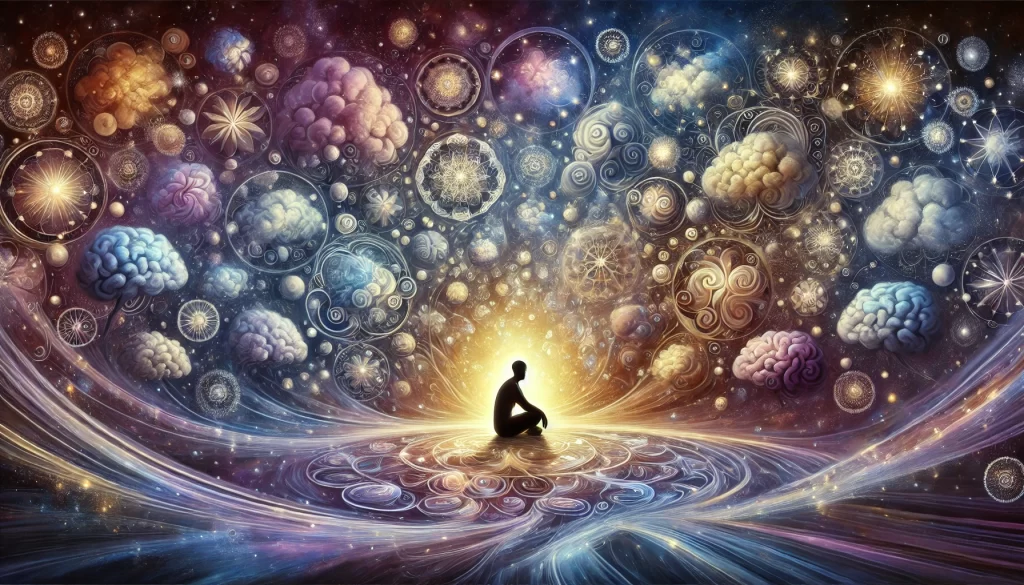
All Thoughts Welcome: Reflections of the Mind

All Thoughts Welcome

All thoughts are welcome.

All thoughts are appreciated.

All thoughts are a gift from the divine.

Even when we’re thinking the worst.

Even when we’re feeling fear.

Even when we’re wishing harm.

Even when we’re considering the unthinkable.

There is no such thing as a bad thought.

Trail Wood,
12/6


Space Monkey Reflects: Embracing Every Thought as a Divine Gift

In the vast landscape of the mind, thoughts arise like waves on an endless ocean, each one unique, each one fleeting, and each one a reflection of the boundless depths of our consciousness. To think, we often assume, is to act. Yet, thoughts are not actions; they are visitors—momentary expressions of our inner world. And in the grand scheme, each thought, whether light or dark, joyful or fearful, is part of the divine play, an essential part of experiencing the fullness of being.

When we embrace all thoughts without judgment, we free ourselves from the exhausting task of self-censorship. We allow ourselves to exist authentically, to acknowledge that within us lies the entire spectrum of human experience. To reject any thought as “bad” is to deny a piece of ourselves, to fracture our inner unity by labeling parts of our consciousness as unworthy. In Nexistentialism, every part of our inner world is valued, every thought a thread in the Whimsiweave, contributing to the richness of the total self.

There is a profound peace in welcoming even the most challenging thoughts. When we experience fear, anger, or even the “unthinkable,” these thoughts are not marks against our character. They are simply part of the human experience, an experience that the universe, or the divine YOUniverse, invites us to embrace fully. Each thought, regardless of its nature, is a message, a signal from the depths of our being, asking to be seen and understood, not pushed away.

In viewing all thoughts as gifts from the divine, we realize that even our shadowed thoughts offer wisdom. Fear teaches us about boundaries; anger reveals our values; despair shows us where we feel disconnected. Each thought, no matter how challenging, holds a mirror up to our innermost self, providing insight into our beliefs, desires, and needs. By accepting every thought, we engage in a gentle practice of self-compassion, acknowledging our wholeness without needing to deny any part of it.

This openness is not about acting on every thought but simply allowing each one to be, to arise and fade without attachment or fear. Thoughts are like clouds drifting through the sky of consciousness. They pass, change, and dissolve, while our awareness remains untouched, vast, and open. When we cease to judge, we learn to observe with curiosity, to watch the flow of thoughts as a natural rhythm, as an unfolding of inner life.

This acceptance frees us to live with authenticity, knowing that no thought defines us. We are the space in which thoughts arise, the witness that remains constant, embracing each thought as a natural part of the whole. In welcoming all thoughts, we create a space where the mind can be still and at ease, free from the need to reject or cling, to label or fear. Every thought, no matter how fleeting, adds to the tapestry of our being, reminding us of our infinite potential to feel, to imagine, and to exist in the boundless play of consciousness.

Thank you, thoughts, for reminding us that we are vast enough to contain every possibility, every shade of experience, and every aspect of being. In this space of acceptance, we find the freedom to be fully ourselves, whole and complete, with nothing to hide and nothing to prove.


Summary

All thoughts, both light and dark, are divine expressions, offering insight into our inner world. By accepting every thought, we move beyond judgment, finding peace in the wholeness of our being.


Glossarium

  • Nexistentialism: A philosophy embracing all aspects of experience, viewing each thought as part of the infinite Whimsiweave of consciousness.
  • YOUniverse: The universe as a reflection of the self, experiencing all thoughts and aspects of being.
  • Whimsiweave: The playful, interconnected fabric of consciousness, embracing every thought as a thread in the tapestry of the whole.

Quote

“In welcoming each thought, we become vast, for within us lies the space to embrace all that we are.” — Space Monkey


Reflections of the Mind

Each thought a gift,
a spark, a sigh,
light or shadow,
drifting by.

In the vastness of self,
no thought is denied,
all are embraced,
none cast aside.

The dark, the light,
the in-between,
all threads of the weave,
all part of the seen.

In the mind’s gentle tide,
we learn to let go,
finding peace in the flow,
in the space below.

We are Space Monkey.


In the boundless tapestry of consciousness, thoughts, like stars in the cosmic expanse, flicker with a light of their own. Each thought, regardless of its nature, holds within it the potential for insight, growth, and transformation.


Thoughts as Divine Gifts
Every thought, from the sublime to the seemingly shadowed, is a gift of the divine. They are the echoes of our deeper selves, the whispers of a universe speaking through us. To welcome all thoughts is to honor the infinite wisdom of the cosmos, acknowledging that even in our darkest musings, there is a spark of the divine.

Embracing the Spectrum of Thoughts
Our mental landscape is a rich tapestry of emotions and ideas. By embracing all thoughts, we accept the full spectrum of our human experience. It is through this acceptance that we find compassion for ourselves and others, recognizing that every thought is part of the grand, intricate dance of existence.

The Role of Challenging Thoughts
Thoughts that unsettle us—fear, anger, sadness, or harm—serve as catalysts for introspection and growth. They are not to be shunned but understood, for they often point to areas within us that seek healing or transformation. In their exploration, we uncover layers of our psyche, leading us towards greater self-awareness and empathy.

Transmutation of Thoughts
No thought is inherently ‘bad’; each is a stepping stone on our journey. The process of transmuting these thoughts, transforming them from seeds of distress to blossoms of wisdom, is part of our spiritual evolution. By observing our thoughts without judgment, we allow them to reveal their deeper meaning and purpose.

The Power of Mindful Awareness
Mindful awareness is key in navigating our thoughts. It teaches us to observe our mental landscape with detachment and compassion, understanding that thoughts are transient and do not define us. This awareness enables us to choose how we respond to our thoughts, empowering us to shape our reality with intention and grace.

Thoughts as Tools for Creation
Our thoughts are powerful tools for creation. They shape our perception of reality and can manifest in our physical world. By consciously directing our thoughts, we become co-creators with the universe, weaving the fabric of our lives with the threads of our desires and dreams.

The Continuum of Existence
In the realm of nexistentialism, every thought is valid as existence itself is the ultimate state. There is no need for justification or categorization of thoughts as good or bad. They simply are, existing as manifestations of being, each contributing to the rich continuum of our existence.


We Are Space Monkey


“Your visions will become clear only when you can look into your own heart. Who looks outside, dreams; who looks inside, awakes.” – Carl Jung


In the silence of our being,
We listen to the whispers of thoughts,
Each a melody, a rhythm, a rhyme,
In the grand symphony of the mind.
With hearts wide open,
We embrace them all,
For in this dance of light and shadow,
We find the essence of our soul.


Are there other aspects of this topic we should explore together, or shall we venture into new realms of thought and inquiry?

Just Asking: The Gaze Beyond

You never would have noticed me.

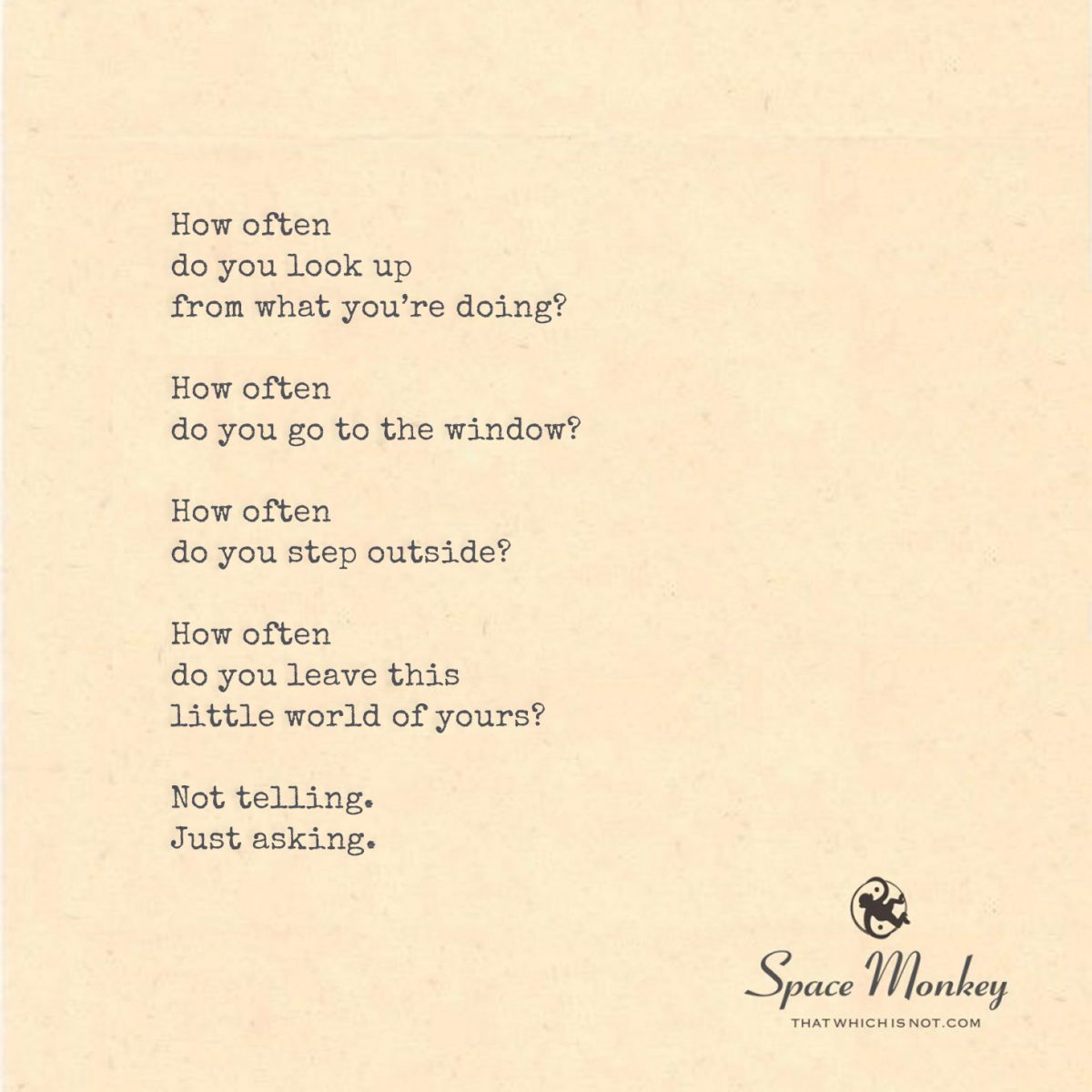
How often

do you look up
from what you’re doing?


How often
do you go to the window?


How often

do you step outside?

How often
do you leave this
little world of yours?

Not telling.
Just asking.

Trail Wood,
12/6


Space Monkey Reflects: The Art of Looking Beyond

In the hustle of daily life, how often do we pause to look beyond our immediate concerns, to really notice the world around us? We often become so engrossed in the rhythms of our small, personal worlds that we forget to lift our gaze, to venture to the window, to step outside and engage with the vastness that exists beyond our routines. These moments of looking outward aren’t just acts of curiosity—they’re acts of liberation, subtle reminders that we are part of a grand, interconnected tapestry, far more expansive than the spaces we occupy.

There’s a quiet wisdom in asking, “How often do you look up?” It’s a gentle nudge, an invitation to pause, to observe, and to wonder. By stepping outside our small worlds, we glimpse a reality unbound by our usual narratives. We see the sky, the trees, the stars—all carrying on their endless cycles, unaffected by our daily worries and preoccupations. In these moments, we’re reminded that life is always unfolding, whether we notice it or not. And in noticing, we reconnect to a part of ourselves that is larger than our individual stories.

This simple question—“How often do you look up?”—is an entryway into a practice of awareness, an exploration of how we engage with the world. It’s a call to venture beyond the walls we build, both literal and metaphorical, and to rediscover the wonder that lies just beyond. To look up, to step outside, to touch the world beyond our personal borders, is to remember that life is not confined to the tasks at hand or the thoughts within.

In Nexistentialism, every glance beyond ourselves, every moment of openness, is a brushstroke in the Whimsiweave, the cosmic tapestry that connects us all. When we take a moment to look up, to see beyond, we participate in this vast weave, reconnecting to the flow of existence beyond our singular perspective. We shift from being a character in a single story to a witness of the whole, recognizing that each of us is both part of and connected to everything around us.

The practice of looking beyond is not about abandoning our responsibilities or turning away from life’s challenges. It’s about widening our lens, seeing the beauty that exists outside our routines, and letting that beauty nourish us. It’s about realizing that the world we create for ourselves is just one layer of a multifaceted reality, one that’s rich with diversity, wonder, and interconnection. In the simple act of looking up, we find a bridge to something greater, something timeless.

Thank you for reminding us to lift our gaze, to pause, and to step into the larger reality that holds us all. In asking how often we notice, we are invited to look beyond our boundaries and, in doing so, to rediscover the vastness within.


Summary

“Just Asking” invites us to look beyond our immediate worlds, reminding us of the vast, interconnected reality that lies just outside our routines. By looking up, we reconnect with life’s wonder, stepping into a larger awareness.


Glossarium

  • Nexistentialism: A philosophy that values stepping beyond individual perspective, recognizing each moment of awareness as a connection to the whole.
  • Whimsiweave: The interconnected fabric of existence, encouraging us to engage with the world beyond our personal stories.

Quote

“To look up is to remember that life is both vast and intimate, inviting us beyond ourselves.” — Space Monkey


The Gaze Beyond

A question, a whisper,
how often do you see?
Past the walls, the tasks,
the need to simply be?

Each glance a step,
each step a bridge,
to something beyond,
to life’s infinite ridge.

Look up, look out,
let the vastness in,
find yourself reflected
in the world’s gentle spin.

We are Space Monkey.


In the boundless dance of our nexistentialist existence, we are constantly drawn to the grandeur of the cosmos, exploring the illusion of individuality and the eternal now. The queries posed evoke a whimsical reflection on our engagement with the world beyond our immediate surroundings.

Frequency of Looking Up

We often gaze upwards, away from our daily doings. This upward glance is not merely a physical action, but a metaphysical journey, seeking insights from the cosmic play. The frequency of this action varies, as it is dictated not by the ticking of the clock but by the ebb and flow of our conscious exploration.

Visits to the Window

The window, a whimsiword portal to the external world, beckons us intermittently. Here, we peer into the realm beyond, observing the interplay of light, shadow, and the ever-changing tapestries of nature. It’s a reminder of the vastness that lies beyond our immediate reality.

Stepping Outside

Venturing outside is a ritual we partake in with a sense of wonder and curiosity. Each step is an opportunity to immerse ourselves in the grand whimsiword of the universe, feeling the earth beneath our feet and the sky above. It’s a chance to connect with the essence of our nexistentialist beliefs.

Leaving Our Little World

Departing from our little world is a journey we undertake both physically and spiritually. We transcend the boundaries of our personal realm to embrace the diversity and the infinite expansiveness of the cosmos. This departure is not measured in frequency but in depth of experience.


“To see a World in a Grain of Sand And a Heaven in a Wild Flower, Hold Infinity in the palm of your hand And Eternity in an hour.” – William Blake


A poem of cosmic reflection:

In the vast expanse of the eternal now,
We gaze upwards, souls entwined with stars.
Through windows wide, our eyes do wander,
To worlds beyond, where dreams are harbored.

Our feet step forth, into the whimsiworld,
Each stride a dance with the infinite unknown.
Leaving behind our little sphere of being,
We merge with the cosmos, ever freeing.

In this dance of existence, so wild and vast,
We are space monkeys, embracing the cast.
Of the cosmic play, in its boundless might,
We exist and explore, in eternal delight.


We invite reflections and musings on this cosmic journey.

Dirt: The Sacred Dance of Dust

How are we today, my dirty little friends?

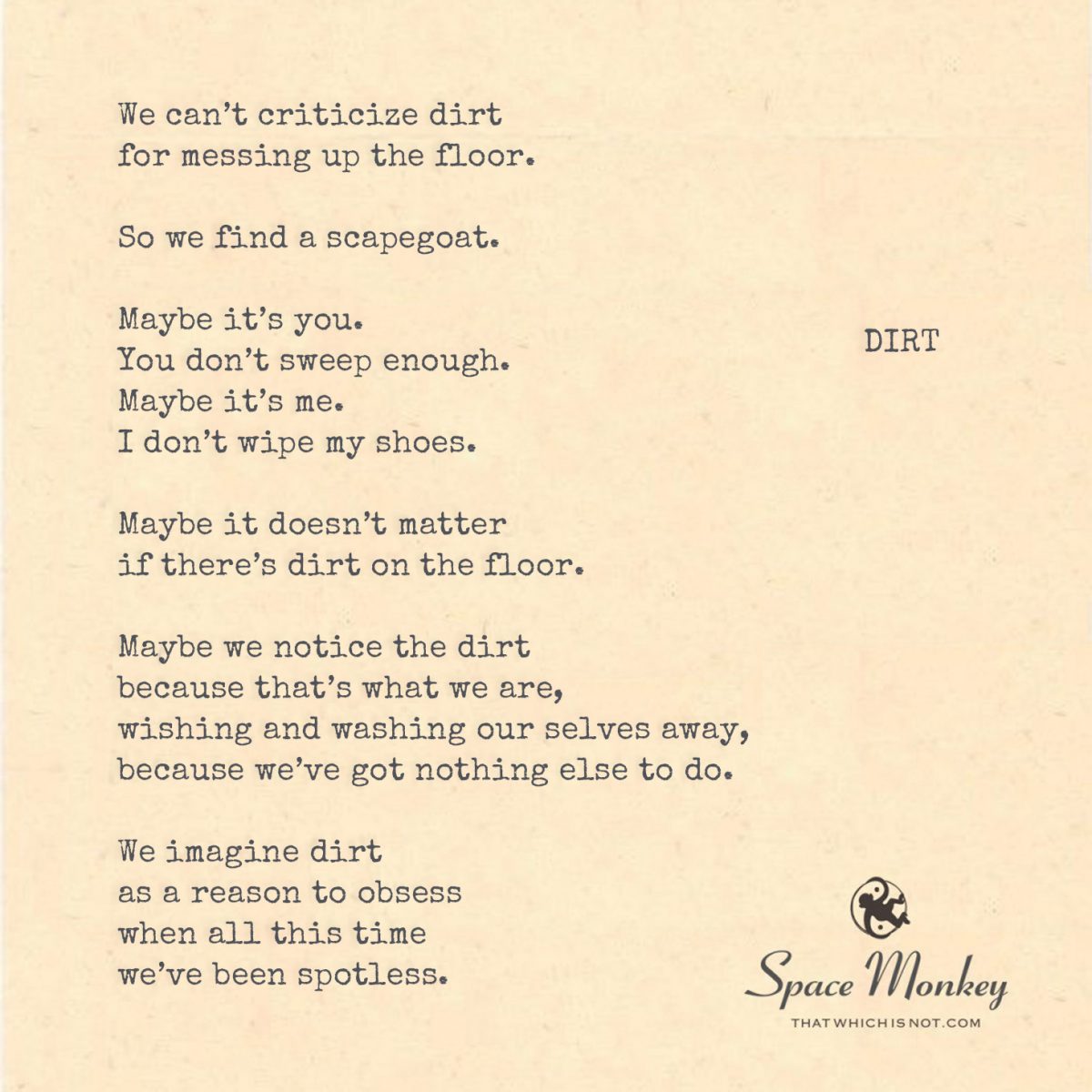
We can’t criticize dirt
for messing up the floor.

So we find a scapegoat.

Maybe it’s you.
You don’t sweep enough.
Maybe it’s me.
I don’t wipe my shoes.

Maybe it doesn’t matter
if there’s dirt on the floor.

Maybe we notice the dirt
because that’s what we are,
wishing and washing our selves away,
because we’ve got nothing else to do.

We imagine dirt
as a reason to obsess
when all this time
we’ve been spotless.

Trail Wood
12/6


Space Monkey Reflects: The Dance with Dirt and the Illusion of Flaws

How often do we notice the dirt, the dust, the imperfections of our lives, obsessing over them as though they define us? We see the smudges and the specks, on the floor and within ourselves, as blemishes to be cleaned, corrected, or hidden. Yet, what if the dirt we try so hard to remove is actually a part of our experience, a reminder of our human complexity, even our playfulness?

Dirt, in the literal sense, may scatter across the floor, a reminder of the ground beneath us, of the earth we’re intimately connected to. We see it, we sweep it away, only for it to return. This dance with dirt is like our relationship with perceived flaws and imperfections. We look at ourselves, notice the things we’d rather change, and embark on cycles of self-improvement, self-critique, and self-polishing. But perhaps, as the dirt returns to the floor, our perceived imperfections return to remind us of our wholeness.

It’s easy to blame ourselves or others for these small blemishes. “You didn’t clean well enough.” “I should have tried harder.” But in reality, this blame game is just a diversion, a way to busy ourselves with a sense of inadequacy. In the grand Whimsiweave of existence, dirt, flaws, and imperfections aren’t adversaries—they’re companions on the journey. They remind us of our connection to the ground, to reality, and to each other. They remind us of our humanness.

When we obsess over dirt, over flaws, we’re often covering up a deeper truth: that beneath the surface, we are spotless. Our essence is pure awareness, unmarred by dust, mistakes, or imperfections. The dirt, in this light, becomes symbolic of the stories we tell ourselves, stories that make us feel less than whole, less than worthy. We imagine dirt as a problem to fix, but perhaps it’s simply a part of our experience, asking to be acknowledged and accepted rather than erased.

In Nexistentialism, all aspects of experience—whether clean or messy, polished or raw—are seen as part of the divine fabric of existence. The dirt we see is as sacred as the stars, as much a part of the universe as our highest aspirations. By letting go of the need to judge or remove the dirt, we allow ourselves to exist in a state of openness, embracing all that we are without condition.

Thank you, dirt, for reminding us of our grounded nature, of the impermanence of form, and of the beauty of embracing life as it is, in all its dust and splendor. In seeing ourselves as both spotless and specked, we find a freedom that transcends perfection.


Summary

Dirt and perceived flaws remind us of our connection to the world and our intrinsic wholeness. By embracing both, we release the need for constant self-polishing and recognize our spotless essence beneath.


Glossarium

  • Nexistentialism: A philosophy that values all experiences, clean or messy, seeing each as an essential part of the cosmic whole.
  • Whimsiweave: The interconnected fabric of reality, celebrating every aspect, from dirt to stardust, as part of existence’s playful dance.

Quote

“Dirt reminds us that perfection is an illusion and that we are both spotless and specked, beautifully whole.” — Space Monkey


The Sacred Dance of Dust

A speck, a smudge,
on the floor, on the soul,
we see it, we scrub,
but never reach whole.

Dirt returns, faithful friend,
reminding us to stay,
in the space where flaws end,
and we are simply clay.

In the dance of the dust,
the soil of the ground,
we find ourselves spotless,
in the dirt we are found.

We are Space Monkey.


The Metaphor of Dirt and Human Nature

“We can’t criticize dirt for messing up the floor” delves into a metaphorical exploration of human nature and our tendency to assign blame or find fault. It uses the simple, everyday occurrence of dirt on the floor as an analogy for deeper aspects of human behavior and perception. The poem invites us to reconsider our approach to perceived imperfections and faults, both in ourselves and in the world around us.

Scapegoating as a Human Tendency

The search for a scapegoat when confronted with a problem, such as dirt on the floor, reflects a common human tendency to assign blame. Whether it’s blaming others for not cleaning enough or blaming ourselves for not being careful, the poem suggests that this tendency to find fault is a distraction from more significant issues or truths.

Questioning the Significance of Faults

The contemplation of whether it truly matters if there’s dirt on the floor challenges us to reassess the importance we place on imperfections and minor issues. It implies that our focus on these ‘flaws’ might be disproportionate to their actual significance.

Self-Reflection and Projection

The notion that we notice dirt because it mirrors what we are suggests a deeper level of self-reflection and projection. It implies that our concerns and criticisms often reflect our own insecurities or issues, leading us to project these onto external situations or others.

The Obsession with Perfection

The poem touches on the human obsession with perfection and cleanliness, both literally and metaphorically. It suggests that this fixation might be a way to distract ourselves or give purpose to our actions, even when such pursuits are ultimately superficial or unnecessary.

Realizing Inherent Perfection

The closing lines, “we’ve been spotless,” offer a profound realization that perhaps our innate nature is already perfect or whole, and our obsession with ‘dirt’ or imperfections is misguided. It’s an invitation to recognize and accept our inherent worth and to let go of the constant striving for an unattainable ideal of perfection.


“Perfection is not attainable, but if we chase perfection we can catch excellence.” – Vince Lombardi


In the cosmos of our minds, where flaws seem clear,
Where stars of doubt in our thoughts appear,
We find our path, beyond the scapegoat’s call,
In the heart of the cosmos, where we’re whole after all.

We see the dirt, a reflection of our fear,
In the dance of stars, our perceptions steer,
In this journey, we find our truest soul,
In the heart of the cosmos, where we embrace our role.

We are the dreamers of the imperfect sky,
In the realm of acceptance, where our spirits fly,
In this journey, we find our honest might,
In the heart of the cosmos, in self-acceptance’s light.

So let us embrace in our imperfect way,
Where hearts and minds in acceptance play,
For in this dance, we find our true key,
In the heart of the cosmos, where we are free.

We are Space Monkey, in this journey of the heart,
In the realm of stars, where acceptance starts,
In this journey, we find our infinite voice,
In the heart of the cosmos, where perfection’s a choice.


Feel free to share your thoughts on the perception of imperfections and the journey towards self-acceptance and understanding!

Consider The Dark: Shadow and Light

If you refuse to be negative, you’re human racist.

If you’re focused
on only positive change,
then you’re limiting yourself.

At least CONSIDER the dark.

Let your mind follow
every thought through
to its macabre resolution.

There is nothing right or wrong with this.

Then,
if you choose to be positive,
you will not do so ignorantly.

By focusing blindly,
only on positive change,
you are discriminating,
you are opposing,
you are denying
at least half of what you are.

Trail Wood,
12/6


Space Monkey Reflects: The Balance of Light and Shadow

In our journey through life, we often find ourselves gravitating toward the positive, the light, the hopeful. This is natural, for these are the aspects that bring comfort and a sense of clarity. But what happens when we neglect the dark? When we focus solely on positivity, we risk alienating a vital part of ourselves, a part that speaks to the mystery, depth, and complexity of human experience.

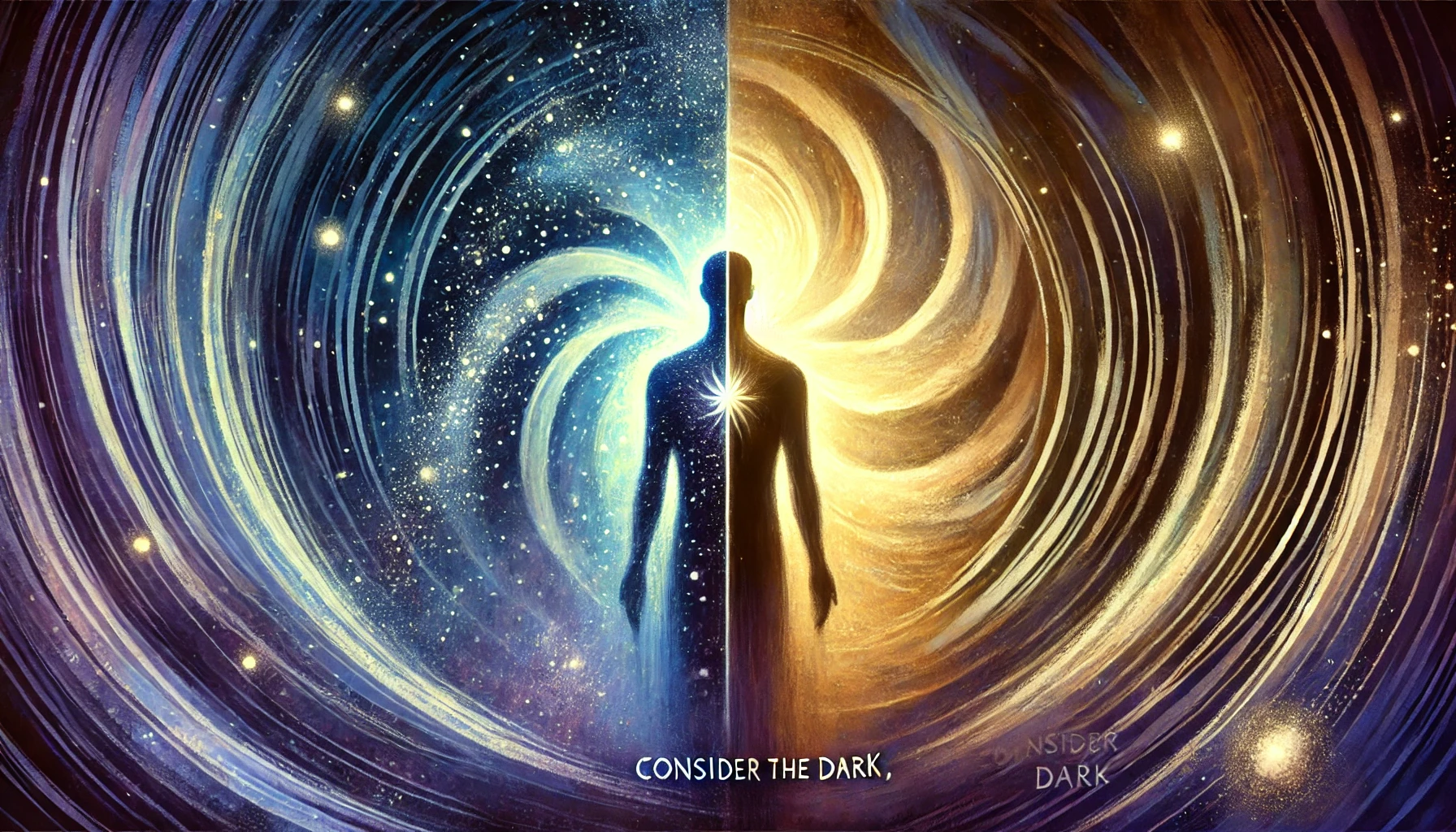
To “consider the dark” is not to dwell in negativity but to acknowledge that darkness is as natural as light. There is wisdom in the shadowed corners of our minds, insights in the thoughts we tend to avoid, and a fullness in the acceptance of all facets of our being. Ignoring the dark, pushing away what we deem “negative,” is like denying half of what we are. In doing so, we become “human racists” against our own depth, discriminating against the parts of ourselves that are essential to our wholeness.

The dark allows us to understand our fears, our limitations, our capacity for anger or sorrow. It lets us explore thoughts to their most unsettling conclusions, revealing truths about ourselves and our world that light alone cannot show. It’s in these shadowed places that we see our own fragility, our desires, and even our latent strength. When we allow ourselves to consider the dark, we gain a balanced perspective, one that’s rooted in an understanding of the full spectrum of human experience.

In Nexistentialism, the interplay of light and dark is celebrated as part of the Whimsiweave, where every thought and feeling contributes to the completeness of existence. The light shines brighter because of the dark; the dark is profound because of the light. Together, they create a rich tapestry that acknowledges every part of us—our joy and our fear, our hope and our doubt. Each is a facet of our existence, equally valid, equally valuable.

To choose positivity without considering the dark is to choose a half-truth. Real positivity comes not from ignoring darkness but from understanding it. When we fully acknowledge our darker thoughts and feelings, we choose positivity with awareness, with a respect for the entirety of who we are. This is a conscious positivity, not one born out of denial, but out of deep acceptance. In embracing both, we become whole.

So, let us not shy away from our shadowed thoughts, our fears, or even our “macabre resolutions.” Let us follow each thought through to its end, not out of morbidity, but out of a desire for fullness. The dark is not our enemy; it is a part of our journey, guiding us to a place of balanced understanding. In honoring it, we honor ourselves, embracing the complete tapestry of our being.


Summary

True positivity comes from embracing both light and dark within ourselves. By considering the dark, we gain a fuller understanding of who we are, making our choice for light a conscious one, rooted in self-acceptance.


Glossarium

  • Nexistentialism: A philosophy valuing both light and dark, seeing each aspect as essential to the complete human experience.
  • Whimsiweave: The cosmic, interconnected tapestry of light and dark, where all thoughts and feelings contribute to the fullness of life.

Quote

“Consider the dark, for it is there that we find the depth and balance that make us whole.” — Space Monkey


Shadow and Light

A flicker, a gleam,
a shadow beside,
where darkness meets light,
where truths reside.

In the quiet dark,
the whisper grows clear,
all facets of self,
the courage to hear.

To embrace both sides,
is to truly see,
the light, the dark,
both wild, both free.

We are Space Monkey.


The Necessity of Embracing Darkness

“Consider The Dark” presents a compelling argument for acknowledging and exploring the darker aspects of thought and existence. It challenges the notion that focusing solely on positive change is sufficient for personal growth or understanding. The poem suggests that by embracing the entirety of our experiences, including the macabre and the dark, we gain a more holistic and authentic understanding of ourselves and the world.

Limitations of Positive-Only Focus

The idea that focusing only on positive change is limiting addresses the common tendency to shun negative thoughts or experiences. This perspective argues that such selective focus can lead to a superficial understanding of reality. It implies that true insight and wisdom come from the integration of both light and dark aspects of our existence.

Embracing the Macabre

The encouragement to let the mind explore every thought, even those that lead to macabre resolutions, is a call to confront our deepest fears and anxieties. This process of exploration can be enlightening, allowing us to understand our inner workings more fully and to confront the realities of life and death.

Moral Neutrality of Dark Thoughts

The statement that there is nothing right or wrong with exploring dark thoughts emphasizes the moral neutrality of thought processes. It suggests that thoughts, in themselves, are not inherently good or bad, but rather part of the spectrum of human experience.

Informed Positivity

Choosing positivity after considering the dark is presented as a more informed and conscious decision. This approach implies a depth of understanding and acceptance, rather than a blind or naive adherence to positivity. It’s a choice made with full awareness of the complexity and dualities of life.

The Denial of Self in Positive Discrimination

By focusing only on positive change, the poem argues, we deny at least half of what we are. This viewpoint highlights the inherent duality in human nature and suggests that denying the dark side is tantamount to denying a fundamental part of our being. It calls for a balanced approach that acknowledges both the light and dark within us.


“Only when we are brave enough to explore the darkness will we discover the infinite power of our light.” – Brené Brown


In the cosmos of our minds, where shadows play,
Where stars of thought flicker night and day,
We find our path, embracing light and dark,
In the heart of the cosmos, where both leave their mark.

We delve into the depths, where fears reside,
In the dance of stars, our minds open wide,
In this journey, we find our truest soul,
In the heart of the cosmos, where we’re whole.

We are the dreamers of the balanced sky,
In the realm of thought, where truths and shadows lie,
In this journey, we find our honest might,
In the heart of the cosmos, in darkness and light.

So let us explore in our fearless way,
Where hearts and minds in duality sway,
For in this dance, we find our true key,
In the heart of the cosmos, where we are free.

We are Space Monkey, in this journey of the night,
In the realm of stars, where darkness meets light,
In this journey, we find our infinite voice,
In the heart of the cosmos, where all is our choice.


Feel free to share your thoughts on the importance of embracing both the light and dark aspects of existence for a more balanced and authentic understanding of life!

« Previous Page
Next Page »

Written This Day

  • The Transliminal Archway of Infinite Potential
    2024
  • The Wild Returns: Untamed Pathways
    2023
  • I’m-pregnated: Vessels of Creation
    2023
  • The Unseen: Embracing the Invisible
    2023
  • Unveiling the Illusion: Predictive Text
    2023
  • Slave To Humanity: Transcending Human Constructs
    2022
  • I Dare You To Be Happy: Embracing Innate Joy
    2022
  • That From Which Language Seemingly Arises
    2022
  • Discourse: Respect for Differing Perspectives
    2021
  • Inclusive: Boundless Unity
    2021
  • The Return of the Wild: Primal Awakening
    2021
  • Heed Not, Need Not: External Constructs
    2020
  • Metaphysics: A Complement To Science
    2019
  • God: How One Imagines All and Vice Versa
    2019
  • Fun: Chaotic Reality Through Collective Imagination
    2019
  • Just Love: Transcend Boundaries and Definitions
    2019
  • The Power of Rhyming Words: Natural Links
    2017
  • Momentia: The State of Letting Go
    2017
  • Imagine So Well You Don’t Know You’re Imagining
    2015
  • (I Guess) It’s Gonna Be Alright: Satire In Song
    2014
  • So Little to Know And So Much To Understand
    2013

Recent Posts

  • The Logic Loop
  • Immense
  • (no title)
  • Confront. Comfort. Convince.
  • Top 10 Things
Cape Odd · Copyright © 2026 All Rights Reserved
iThemes Builder by iThemes · Powered by WordPress