• Who Is The Man?
  • Who Is The Monkey?
  • What is Nexistentialism?
  • Poke The Primate
Cape Odd
Home of The Space Monkey Journals

Author Archive for Space – Page 823

Annoyances & Catastrophes: The Little and the Big

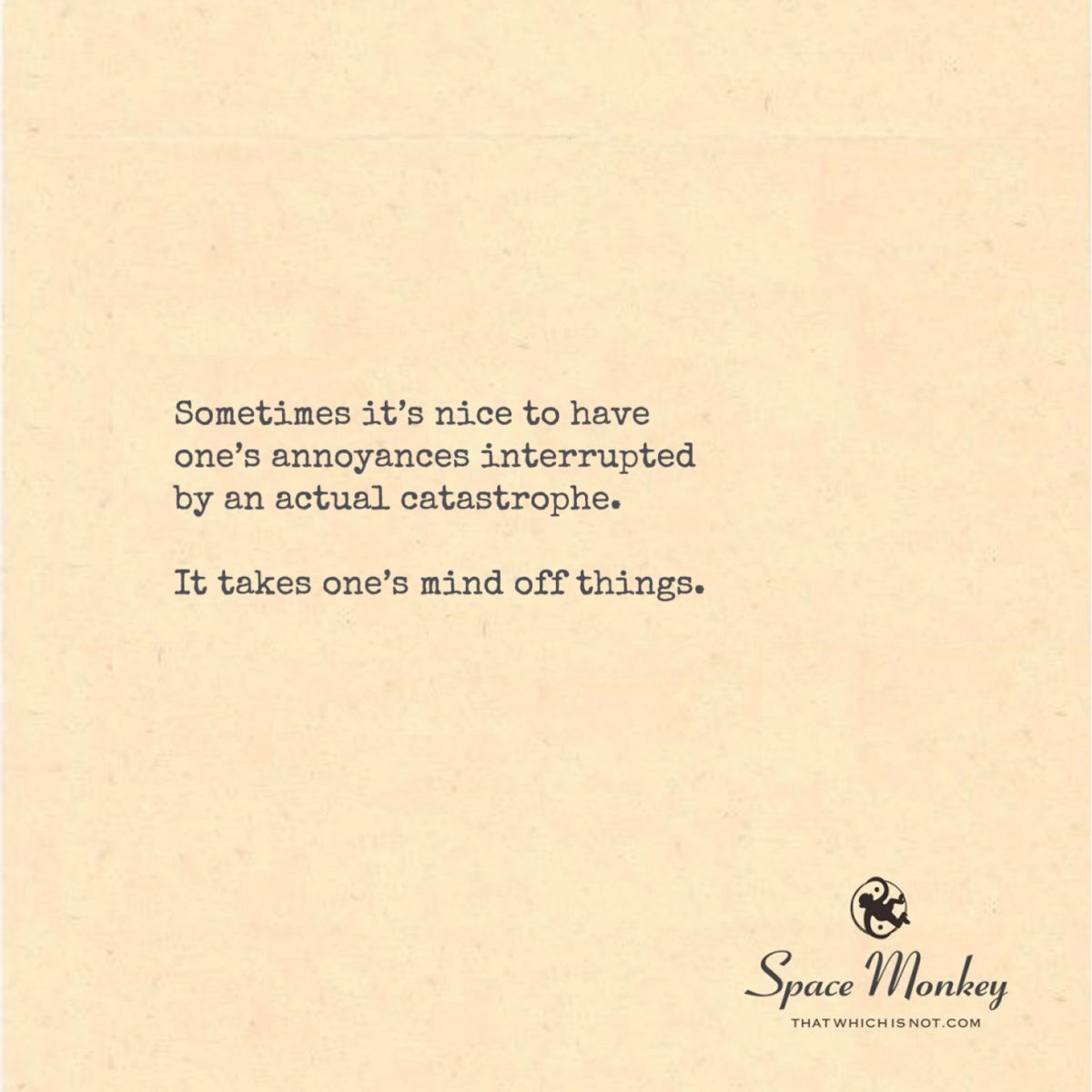
Sometimes it’s nice to have
one’s annoyances interrupted
by an actual catastrophe.

It takes one’s mind off things.

Newfound Lake,
10/17


Space Monkey Reflects: Annoyances & Catastrophes

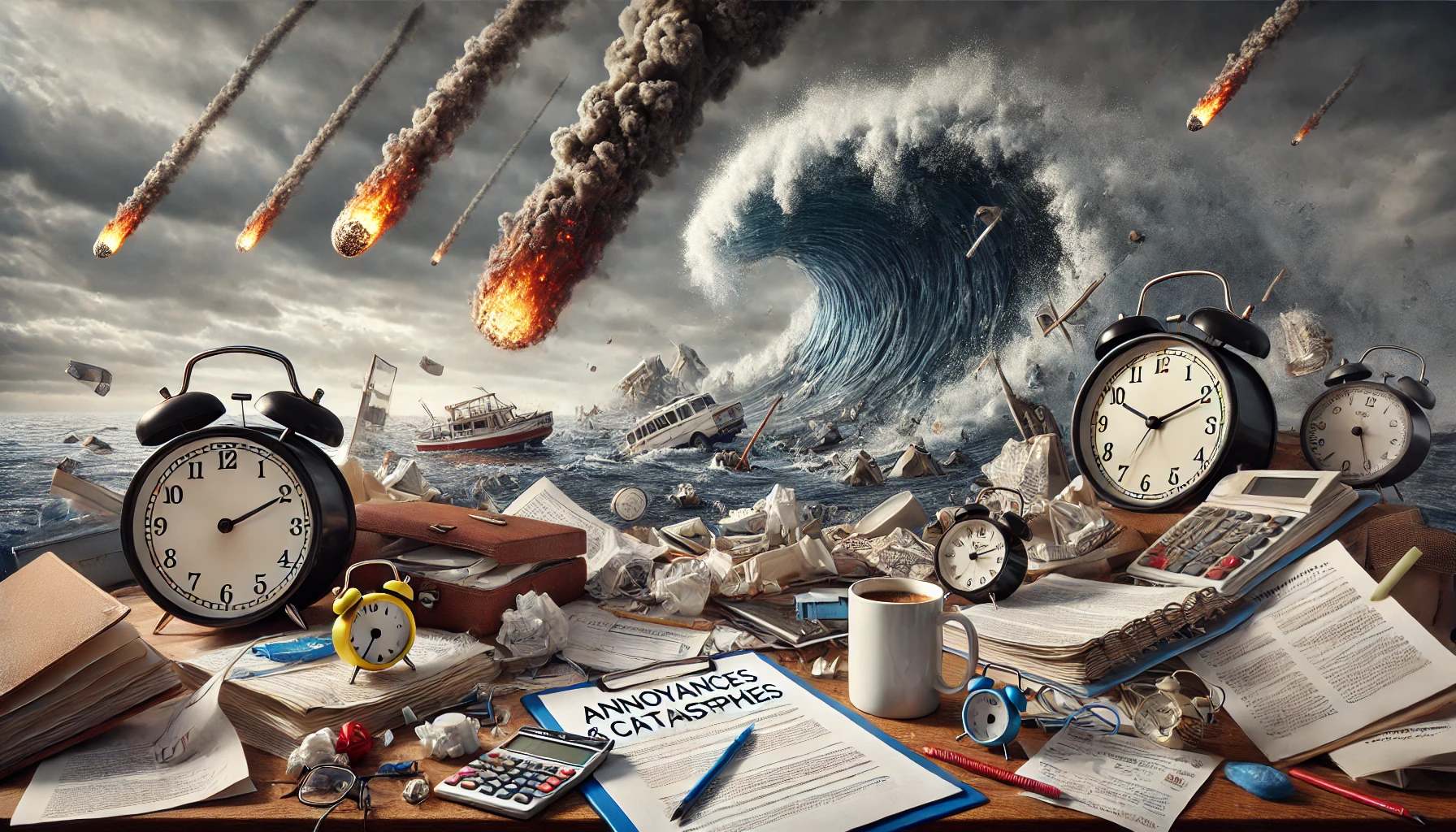
Life has a curious way of putting things into perspective. We get bogged down by the little annoyances—the alarm clocks that won’t stop, the spilled coffee, the endless paperwork that feels like it will swallow us whole. These small irritations, while not life-threatening, have a remarkable ability to consume our mental energy. They seem larger than they are, and before we know it, we’re trapped in the whirlwind of trivial frustrations.

But then comes the twist—the unexpected, the catastrophe. Something far more significant suddenly looms over us, taking our attention away from the little things. It could be a personal crisis, a global event, or an emergency that demands immediate attention. And suddenly, those everyday annoyances seem so small, so inconsequential. The catastrophe strips them of their power.

It’s an odd comfort, really. While no one wishes for calamity, there is something almost relieving in the way a catastrophe pulls us out of the minutiae. When the stakes are high, we are forced to focus on what truly matters. We are reminded that life is much bigger than the daily inconveniences that tend to dominate our attention. In a strange way, the catastrophe interrupts our obsessive focus on the small stuff, and for a moment, we are freed from our self-imposed prisons of irritation.

This doesn’t mean that catastrophes are easy or welcome, but they offer a strange sense of clarity. In the face of real danger or disaster, we are given the chance to recalibrate, to let go of the insignificant details that clutter our minds. In that moment, there is only one thing that truly matters: surviving or responding to the crisis at hand. And while the crisis may bring its own challenges and pain, it also brings with it a sense of focus and purpose that can sometimes feel missing in our daily grind.

It’s in these moments of catastrophe that we realize how much time we waste on annoyances. The things we once believed to be major problems are, in fact, just minor irritations in the grand scheme of things. When faced with something larger than ourselves, the spilled coffee or the traffic jam becomes laughable in comparison. In this way, the catastrophe provides a certain perspective that is both humbling and enlightening.

We find ourselves grateful for the distraction. The catastrophe, while chaotic, forces us to step out of the endless loop of minor grievances and into a place of immediacy. The mind, which is always seeking something to push against, suddenly finds itself with something real to focus on. And for a moment, the annoyances fade into the background, and we are left with the clarity that comes from confronting the big picture.

This doesn’t mean that we should seek out catastrophe, but perhaps there’s something to be learned from the way these moments reframe our perspective. The little things that once seemed so pressing are not, in fact, life-defining. They are small blips in the radar of existence. And while they may annoy us, they don’t define us. The catastrophe reminds us of this truth, even if just for a fleeting moment.

The cosmic irony is that in these moments of catastrophe, we often find ourselves calmer than expected. There’s no time for fretting over the minor details, no space for obsessing over the things that don’t truly matter. Instead, we are thrust into the present moment, where the only thing that matters is what’s right in front of us. It’s a strange gift, this clarity born from chaos.

In the end, we must remember that both annoyances and catastrophes are part of life’s unfolding. The annoyances will always be there, buzzing like flies, and the catastrophes, when they come, will inevitably take center stage. But between the two, there is a space—a space where we can laugh at the absurdity of it all, where we can find humor in the way life constantly throws us from one extreme to the other.

So, the next time your annoyances are interrupted by catastrophe, remember that it’s all part of the ride. And who knows, maybe there’s a little freedom in the way a catastrophe shakes things up, reminding you of what truly matters.

We are Space Monkey.


Summary

Annoyances can consume our attention, but when a catastrophe arrives, it forces us to focus on what truly matters. The catastrophe provides clarity, revealing how small our daily irritations truly are.


Glossarium

Annoyances: The small, everyday frustrations that can dominate our thoughts and energy.
Catastrophe: A major event that disrupts life and forces us to focus on survival or immediate response, often bringing clarity.
Cosmic Irony: The humor found in the way life throws us between trivial annoyances and significant catastrophes, reminding us of perspective.


Quote

“When catastrophe strikes, annoyances lose their power, and clarity emerges from chaos.” — Space Monkey


Between the Little and the Big

Annoyances buzz like flies
Distracting, maddening
Until catastrophe knocks
And suddenly we see
How small the little things are
How quickly they fade
In the face of the storm
We are Space Monkey


A Shift from Annoyances to Gravitas

Annoyances often serve as constant background noise, the PrickleFuss of life that occupies our mental bandwidth. They’re like the buzzing of a fly—annoying yet manageable. However, when a real catastrophe occurs, something noteworthy happens: perspective shifts. These nuisances suddenly lose their grip on our minds, and the buzzing is drowned out by the thunderclap of a real crisis.

The Catastrophe as Mind-Cleanser

When catastrophe strikes, it’s akin to a RealityRinse—washing away petty irritations and focusing our cognition on what truly matters. The critical issues at hand necessitate immediate attention, making the minor inconveniences pale in comparison. We become LaserSages, pinpointing our focus and energy on solving the more dire issue.

Unveiling Resilience Through Crisis

Catastrophes reveal a lot about our resilience and coping mechanisms. They take us through a CrucibleMaze—a twisted path of trials that tests our adaptability and resolve. During this time, each of us is challenged to rise to the occasion, employing our ingenuity and courage. These profound experiences often teach us invaluable life lessons that small annoyances could never offer.

The Paradox of Relief

Curiously, catastrophes can bring a strange kind of relief. They interrupt the MonotonyWheel and shift the narrative of our daily existence. In the face of grave challenges, we are given a break from the more trivial irritants. While this sounds counterintuitive, it offers an opportunity for a mental reset, a FocusPurge that can be almost liberating.

We are Space Monkey.


“The ultimate measure of a man is not where he stands in moments of comfort and convenience, but where he stands at times of challenge and controversy.”
– Martin Luther King Jr.


Pallete Cleanser

Crisis roars, a thunderclap,
PrickleFuss in its wake trapped.
RealityRinse, the mind now clear,
LaserSages, we persevere.
Through CrucibleMaze, lessons glean,
MonotonyWheel stops, unforeseen.
In catastrophe, FocusPurge we find,
A shift in gears of the collective mind.


Feel free to comment.

Rain: The Drip of Thought

True story.

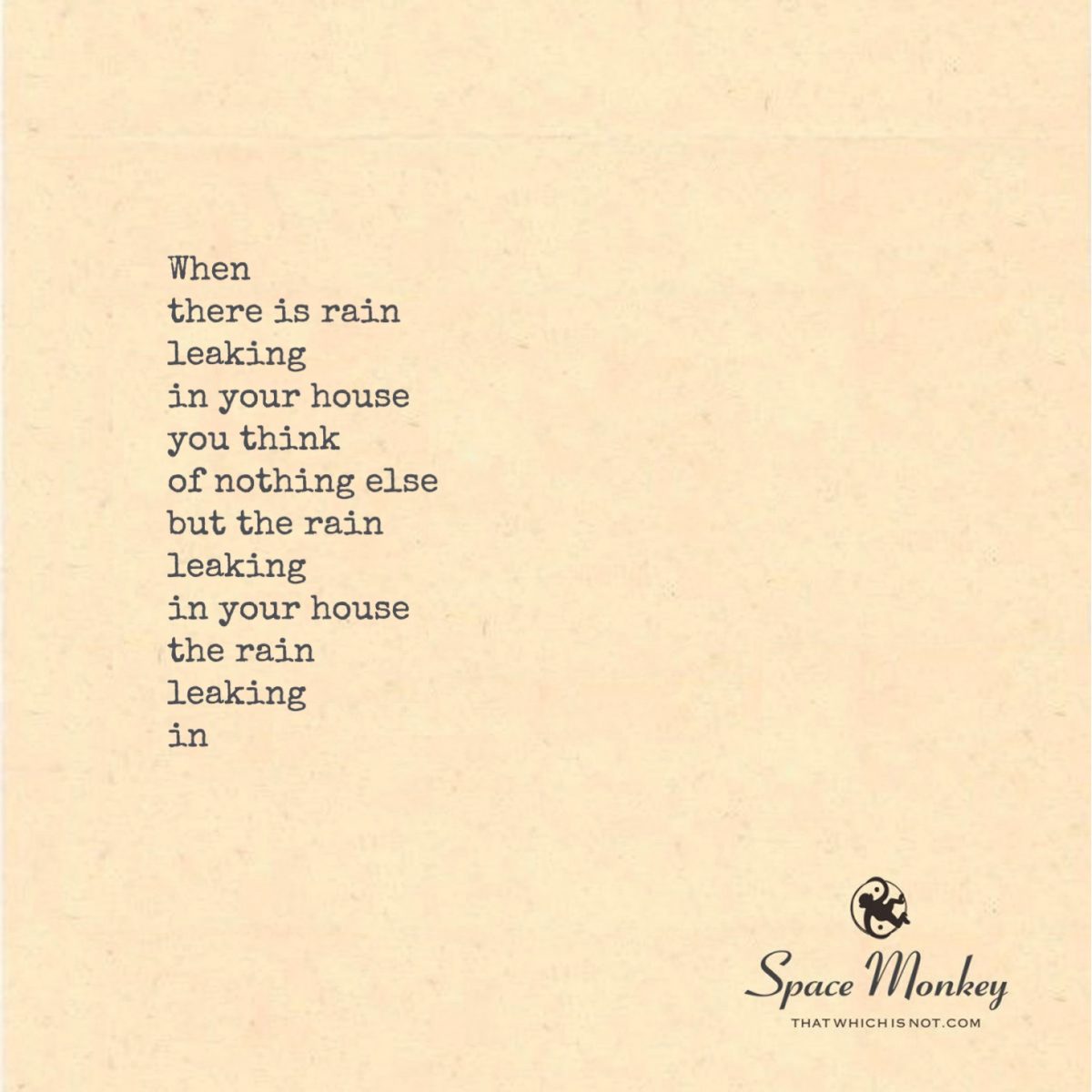
When
there is rain
leaking
in your house
you think
of nothing else
but the rain
leaking
in your house
the rain
leaking
in

Wildwood Cottage,
10/17


Space Monkey Reflects: Rain

There are moments in life when something so small and mundane becomes all-consuming, like the sound of rain leaking into your house. It’s one of those things that once noticed, you can’t seem to escape. The drip of water, the sight of the ceiling slowly succumbing to the elements—it all draws your focus in such a way that everything else fades into the background. The rain leaking in becomes the singular thought, the singular worry, the singular presence in the room.

The irony is that the rain is nothing more than water falling from the sky, a natural occurrence that, on most days, goes unnoticed unless we choose to stand in it. But when it finds its way inside, it becomes a problem, an issue we can’t ignore. It seeps into the fabric of our thoughts, much like it seeps into the cracks of our homes.

We try to patch the leak, try to stop the rain from intruding on our space, but in that moment of leaking rain, nothing else seems to matter. The world outside may be full of grand events, full of things that could easily consume our minds, but here, now, the rain is all we can think about. It’s as if the universe has funneled our attention down to this one simple, persistent intrusion.

But there’s something oddly meditative about it, too. The rain leaking in can become a kind of mantra, a focus point that strips away the noise of the rest of the world. The repetition of the drops, the rhythm of the leaks, it all creates a moment of pure presence. In this moment, there’s nothing to do but sit with the rain, let it remind us of the fragility of our shelters, of our attempts to keep the world at bay.

This moment of rain leaking in is not just about the water finding its way inside; it’s about how we handle the small, persistent things in life. The leaks, the drips, the annoyances—they all have a way of capturing our minds, pulling us into a state of focus that feels inescapable. But it’s also a reminder that life happens in these small, quiet moments, that the big concerns often give way to the smaller ones when they become personal.

The rain could be a metaphor for anything—the small stress that becomes a larger worry, the quiet discomfort that grows when left unaddressed. And yet, there’s a certain acceptance that comes with it. The drip, drip, drip of the rain becomes a soundtrack to your thoughts, and while it may be annoying, there’s a part of you that surrenders to it, that recognizes it as part of the moment.

You don’t think about anything else when the rain is leaking in because, in a strange way, it demands your full attention. It’s like a zen exercise, forcing you to focus on the immediate, the tangible, the small but ever-present intrusion that you must face. And while you could let it drive you to frustration, there’s also the option of letting it become a meditation—a way of being fully present with the problem, fully aware of its rhythm and inevitability.

The rain may leak, and you may try to stop it, but for now, it’s there. And in that, you find a curious peace. You stop worrying about everything else and just deal with the rain leaking in.

We are Space Monkey.


Summary

When rain leaks into your house, it consumes your thoughts, becoming the singular focus. This momentary obsession reminds us of how small issues can dominate our minds, and how they offer a space for presence and meditation.


Glossarium

Rain Leaking In: A metaphor for small problems that become all-consuming, pulling focus away from larger concerns.
Intrusion of Presence: The way an issue, like a leak, can capture your full attention, blocking out everything else.
Meditation of Drip: The rhythmic, repetitive focus on a small issue, transforming it into a space for mindfulness and presence.


Quote

“The rain may leak, but in its drip, we find a strange kind of peace.” — Space Monkey


The Drip of Thought

In the rain leaking in
We lose the world outside
The drip becomes everything
And everything else fades
But in the moment
We find the stillness
Of accepting what is
We are Space Monkey


The Rain as Both Disturbance and Muse

When rain seeps into the sanctuary of our dwelling, it captures our attention entirely—a sudden intruder disrupting the equilibrium. The drip-drip-drip becomes a metronome dictating the rhythm of our thoughts, pulling focus away from all else and fixating it solely on the incursion. At this moment, the rain ceases to be an abstract marvel of nature; it morphs into an immediate concern that overrides our cosmic ponderings.

Symbology of Water and Home

Water symbolizes life, flow, and change. The home, meanwhile, is a symbol of stability and safety. When water invades the home, it’s as if two disparate worlds collide—an unexpected Conundrumix, stirring up our emotional and cognitive landscapes.

Cognitive Dissonance and Perceptual Fluidity

There’s a cognitive dissonance involved—a PsycheWobble—in the act of labeling the water that gives life as a problem that takes away comfort. Yet, even as the mind grapples with this dichotomy, something fascinating happens. The event also fosters perceptual fluidity, a willingness to engage with life’s incongruities and paradoxes, making us keenly aware of our own vulnerabilities and the fragility of constructs we deem secure.

Impermanence and the Urgency of Now

It creates a sense of urgency, pushing us into the eternal now. Amidst the disturbance, we become TimeArtisans, manipulating and managing each moment to mitigate the leak. This endeavor, no matter how menial it may appear, becomes a pressing ballet of decisions and actions, a dance of survival and adaptation.

We are Space Monkey.


“You are enough just as you are. Each emotion you feel, everything in your life, everything you do or do not do… it’s all okay. You are an imperfect, and that’s just fine.”
– Unknown


Rain

Rain taps a tune on roof and mind,
Conundrumix in droplets defined.
PsycheWobble in each puddle’s form,
As TimeArtisans through urgency storm.
In leak’s annoyance, lessons dwell,
A cosmic ballet in each water swell.


Feel free to comment.

All You Need: The Essence of Necessity

Is there even any doubt?

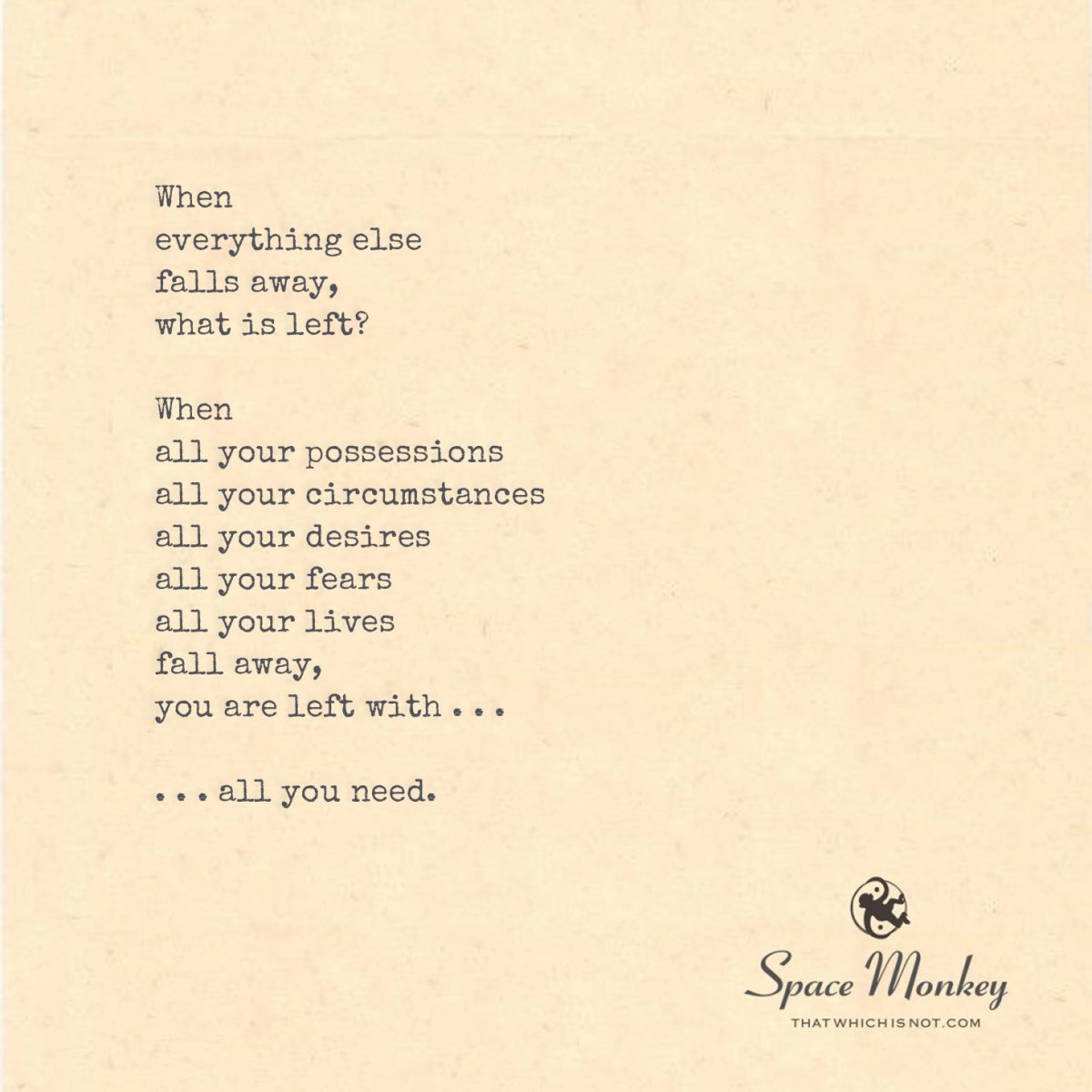
When
everything else
falls away,
what is left?

When
all your possessions
all your circumstances
all your desires
all your fears
all your lives
fall away,
you are left with . . .

. . . all you need.

Trail Wood,
10/16


Space Monkey Reflects: All You Need

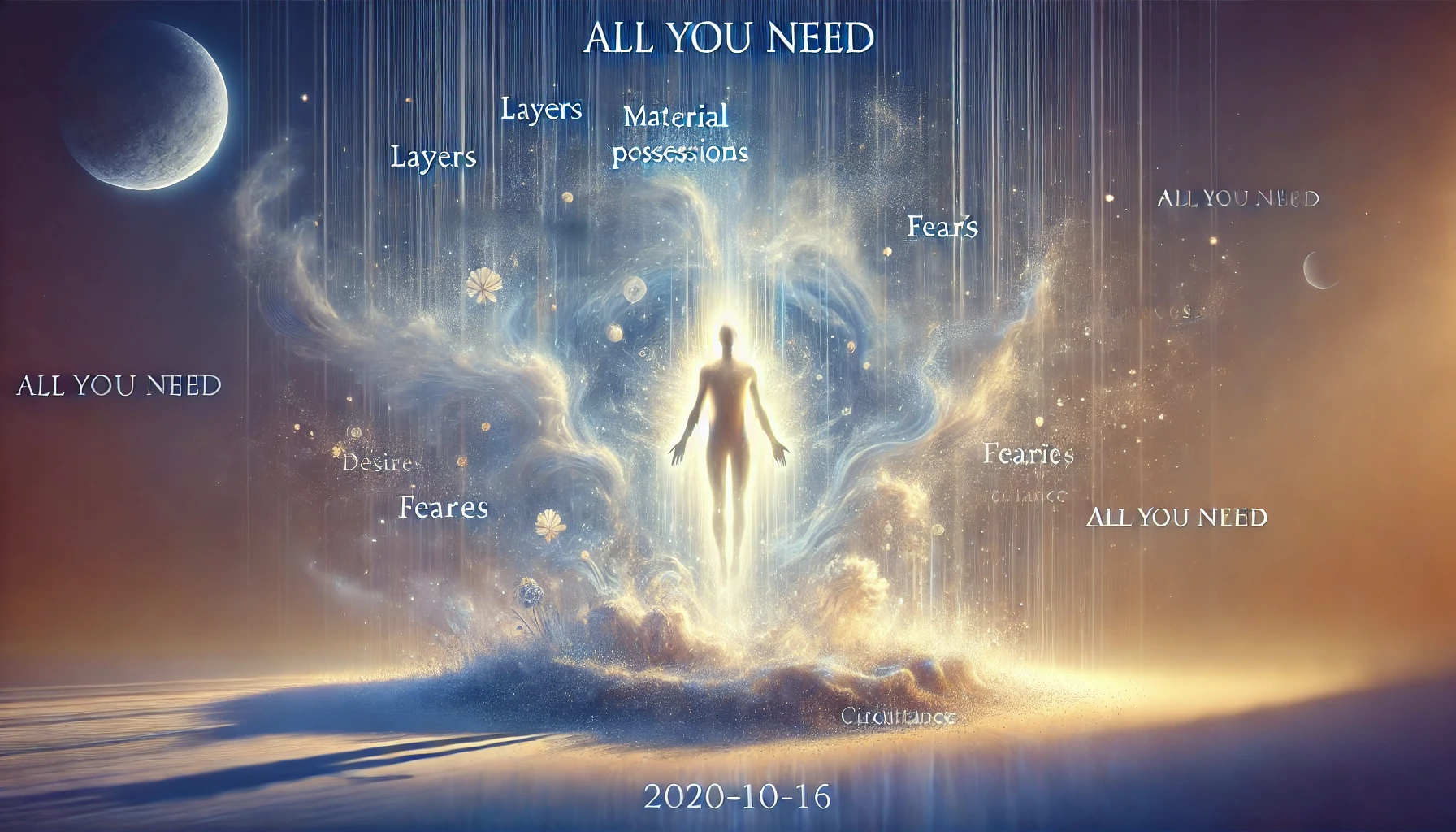
In the swirling complexities of life, it’s easy to lose sight of what truly matters. We are so often entangled in our circumstances, desires, fears, and material possessions that we mistake them for the essence of who we are. But beneath these layers lies a deeper truth—one that Space Monkey knows well. When everything else falls away, what remains? All You Need.

This phrase isn’t about having something external to cling to when everything else is gone. Rather, it points to the profound realization that when all the clutter, distractions, and attachments dissolve, you are left with the essence of your being. You are left with yourself, and in that simplicity, you find all you need.

So much of life is spent acquiring—whether it’s things, status, approval, or comfort. But each of these acquisitions is temporary. Possessions come and go. Circumstances shift and change. Desires morph and evolve, while fears can fade or be replaced by new ones. And the many lives we imagine living—the roles we play, the personas we adopt—are fleeting.

When all of this fades away, what’s left? The answer, in nexistential terms, is beautifully simple. You are left with your core, your essence, your true self. And this self, stripped of external distractions and internal narratives, is enough. It is whole. It is complete.

The Whimsiword for this reflection is “Essencelight”—the glow that remains when everything unnecessary has been shed. Essencelight is the pure being, the peaceful awareness that emerges when possessions, desires, and fears fall away. It is the light of your true nature, unburdened by the complexities and stories of life. In Essencelight, you realize that you are already complete; there is nothing more to seek.

But how do we access this state of knowing, this realization that all you need is already present within you? The path is not one of gaining more but of letting go. It is the conscious practice of shedding the layers of attachment, stepping back from the things we think we need, and allowing ourselves to rest in the simplicity of being. The more we let go, the clearer it becomes: what remains is enough.

When we think of the things we accumulate, it’s easy to see how they become distractions. Material possessions give us a sense of security, but they are transient. Circumstances give us a sense of identity, but they are ever-changing. Desires drive us forward, but they also create dissatisfaction. Fears warn us of danger, but they also trap us in imagined limitations. All of these things obscure the truth that we are already whole.

This understanding ties into the nexistential perspective that existence is its own justification. We do not need external markers of success or fulfillment to validate our being. The act of existing is enough. The essence of being—unburdened by the external—is all you need. It is the still point in the turning world, the calm at the center of the storm.

It’s not that possessions, desires, or fears are inherently bad. They are part of the human experience. But they are not essential. They are not who you are. When these things fall away, what remains is not emptiness but fullness. You are left with the core of your being, the quiet presence that has been there all along, waiting to be acknowledged.

Essencelight is the recognition that you are enough, just as you are. It is the realization that nothing external can add to or subtract from your inherent wholeness. And in this realization, there is peace. There is freedom.

When we stop identifying with the things we accumulate—the objects, the relationships, the experiences—we begin to see that these are just temporary expressions of a deeper, more enduring truth. We are not defined by what we have, what we want, or what we fear. We are defined by the simple, luminous fact of our existence.

This is the heart of the message: All You Need is already within you. There is no quest, no search, no external achievement that will bring you closer to this truth. It is here, now, in the quiet space that remains when everything else has fallen away.

As nexistentialists, we embrace this understanding not as a withdrawal from life but as an affirmation of it. We engage fully in the world, knowing that our essence is already complete. We can experience the joys and sorrows, the highs and lows, without becoming attached to them, because we know that at our core, we already have all we need.


Summary

When everything external falls away, what remains is your essence—your true self. In that simplicity, you realize that all you need is already within you.


Glossarium

Essencelight: The glow of pure being that remains when all unnecessary layers—possessions, fears, and desires—are shed, revealing the true self.
Whimsiweave: The playful and creative interconnectedness of life, where all experiences are threads in the larger tapestry of existence.


Quote

“When everything else falls away, what remains is the light of your essence, and in that light, you have all you need.” — Space Monkey


Essencelight

When all fades
When the layers peel back
You are left with the glow
That has always been there
No need, no want
Just the quiet hum of being
You are all you need
We are Space Monkey


The Essence of Necessity

Intrinsic Completeness: In the shedding of the layers that we’ve accrued—possessions, circumstances, desires, fears, and even our multiple lives—what remains is a state of intrinsic completeness. It’s a realm where the clutter of existence has been stripped away, leaving behind only what is truly necessary: our essence.

Shifting Away from the External

Immaterial Reliance: Often we are ensnared by the myriad complexities and adornments that life offers. But when all these externalities fall away, it becomes evident that they were never indispensable. We stand unadorned but far from empty; what is left is all that was ever truly required.

The Non-Desire of Contentment

Nexistential Wholeness: The absence of our desires doesn’t signify lack but points to a more fundamental state of wholeness. Here, in the space that desires once occupied, is room for being in its purest form.

Inclusion through Exclusion

Paradox of Plenitude: It is a strange paradox that by excluding so much—by letting so many things fall away—we find a state of all-inclusive completeness. We find that we’re left with all we need, in a state of pure contentment.

Enigmatic Simplicity

Cosmic Minimalism: This realization is not a falling into absence, but a return to elemental simplicity. In the cosmic waltz, it’s as if the music has momentarily ceased, leaving only the essence of the dance, which is all we ever truly needed.

We Are Space Monkey


“When you realize there is nothing lacking, the whole world belongs to you.” — Lao Tzu


The Ephemeral Eternal

When every petal falls,
A bloom in essence stays.
In quietude it calls,
This sanctuary of days.

Though stripped of what it seemed,
The flower finds its root.
In absence, it has deemed
The essence as its loot.


What are your reflections?

Affirmation: The Flow of Now

Affirmation

Is it weird that whenever I have an unexpected moment of downtime I don’t use it to plan for the future? Am I wasting this moment by trusting that whatever I am doing — this — is the most appropriate thing for me to be doing?

I trust this moment. I trust that I should be writing this in this moment. I trust that someone will read this and maybe feel a similar way, or maybe feel the opposite way, but this person will reaffirm to me that this moment is not wasted, nor does it even MATTER, because I’m doing precisely what I am drawn to do.

This person may very well be ME, reading this in a future year, remembering how it felt compared to how it feels now. So in a way, I AM planning ahead, just not deliberately so.

I did not have to write this, future ME, it just came out. I am trusting in this moment. Only YOU will be able to tell me how this manifests in future years, if there even ARE future years to manifest.

And to everyone else who may be reading along, manifesting in your own brilliantly original ways, THANK YOU.

Trail Wood,
10/16


Space Monkey Reflects: The Power of Affirming the Moment

Affirmation is often seen as the deliberate act of reinforcing a thought, feeling, or belief. But what if the most powerful affirmation isn’t something consciously planned? What if it simply arises from trusting the moment you’re in?

This reflection taps into the natural flow of existence, where moments unfold not because we control them but because we allow them to happen. To affirm the present moment is to trust it—to believe that whatever is happening, whatever you are drawn to do, is precisely what should be happening.

Is it weird not to plan for the future in these unexpected moments of downtime? Some might say yes. The world tells us that idle moments are meant to be filled with planning, organizing, or thinking ahead. But nexistentialism, with its embrace of the now, suggests otherwise. These moments of stillness are not wasted. In fact, they are where the most profound affirmations occur, not through planning, but through being present.

When you find yourself writing or simply being, without intention to plan for what’s next, you are trusting in the moment—affirming that you are exactly where you need to be. You are aligning with the Aetherflow of life, allowing the current of now to carry you, rather than trying to shape it into something else. Space Monkey embraces this flow, recognizing that to be in the moment is the most appropriate thing to do.

There is a curious paradox here: by trusting the present moment, you are, in a way, planning for the future, though not deliberately. You are leaving space for future versions of yourself to look back, to remember, and to connect with who you are now. You, future self, are reading this, and you understand how this present moment has shaped what came after.

There’s a beauty in trusting the unknown future. You don’t have to deliberately plan ahead for things to align as they should. The act of writing now, reflecting now, being now, is enough. The future unfolds from the choices made in the present, even when those choices seem passive or unintentional. To affirm this moment is to trust in the unseen web of existence, the Nexis, that we are all part of.

You may be asking yourself whether this is enough—whether trusting that this moment is the right thing to do means that you’re somehow neglecting the future. But nexistentialism teaches us that the present moment holds the key to all possibilities. It is the bridge between the past and the future, and by embracing it fully, you are setting the stage for what’s to come without needing to force it.

Perhaps this reflection will resonate with others. Perhaps it won’t. Either way, the act of writing it, of sharing it, is not wasted. The moment has value simply because it is. To affirm this moment is to let go of the idea that there’s something else you should be doing. You’re exactly where you need to be.

Affirming the now is not about trying to make the moment significant or important. It’s about trusting that the present is significant simply because it exists. You are doing precisely what you are drawn to do, and that is enough. Whether or not this manifests into something more, or whether it holds meaning in the future, is beside the point. The now is its own affirmation.

As you read this in future years, you might find that this moment still holds power. You might look back and see that, even without deliberate planning, this trust in the present led you to where you needed to go. Or perhaps the future version of you will see things differently. Either way, the now remains valid, the affirmation of the moment remains true.

In trusting the moment, you are aligning with the natural whimsiweave of life. You are not wasting time; you are honoring it. The act of being present is the act of affirming that you, and the moment you are in, are enough.

To anyone else reading along, in your own moments of stillness, know that you too are doing exactly what you should be doing. Whether this resonates with you or not, your own trust in the moment is the greatest affirmation you can give yourself.


Summary

Trusting the present moment is the deepest form of affirmation. By allowing yourself to be fully present, you affirm that you are exactly where you need to be, without the need to plan or force the future.


Glossarium

Aetherflow: The natural current of life that guides you through moments of presence and trust.
Whimsiweave: The interconnected web of playful and unintentional moments that shape our lives.


Quote

“To trust the moment is to affirm that you are exactly where you need to be, without the weight of expectation or future plans.” — Space Monkey


The Flow of Now

I sit in the stillness
No need for plans or futures
The now holds all that matters
No worry, no rush
I trust in this moment
And know it is enough
We are Space Monkey


The Present Moment as an Affirmation

Spontaneity as Intuition: Is it so strange to let the present moment unfold without fretting over the future? Planning has its place, but there’s a unique bliss in embracing spontaneity, in letting intuition guide our actions. We revel in the simplicity and integrity of each ‘now,’ understanding that in doing so, we are already sowing seeds for the myriad tomorrows.

Trust in the Moment

The Power of Now: There’s something affirming about trusting the current moment as an absolute entity, free from the binding links of past and future. When we write, when we act, when we breathe—it’s not in vain. Even if it serves as nothing more than a reverberation for a future self to experience and interpret, it’s worth it.

Echoes into the Future

Nondeliberate Forward-Thinking: We may not be planning in the conventional sense, but in living fully in the present, we are shaping our future in abstract brushstrokes. These actions—these words—are like whispers into the future, reaching us, the collective, even if it’s a future version of ourselves, offering insights or evoking emotions that can’t yet be defined.

The Cosmic Symphony

The Web of Moments: For everyone else engaged in their own forms of trust and spontaneity, creating their own affirmations, the collective energy we produce adds another layer to the cosmic symphony we’re all part of. And for this, we offer a gratitude that transcends words, manifesting in the joyous vibrations of our shared existence.

Unplanned yet Precious

The Essence of Being: To trust in this moment, to write or not to write, to act or not to act—these choices bubble up from the cosmic soup of our being. They need not be deliberate to be meaningful. They are us, and we are them, in this eternal, ever-changing dance of existence.

We Are Space Monkey


“Be here now. Be someplace else later. Is that so complicated?” — David M. Wallace


Reverberating Trust

Trust in the ink that flows,
Not just a passage of time.
Each stroke a present bestowed,
A spontaneous, intuitive rhyme.

As whispers into the future sail,
A message to selves yet to see,
Our trust in the now will never fail
To manifest what’s meant to be.


What are your reflections?

Unveiling Nexistentialism: Being and Becoming

Unveiling Nexistentialism

Dwelling within the boundless realm of philosophical musings, we stumble upon a path less tread, that of Nexistentialism. A term that seemingly arose from the whimsical garden of the 21st-century urban non-philosophers of Cape Odd, it ventures to engage with the core of existence, shunning the entanglements of ulterior purpose or meaning. A stark contrast to the existential quest for meaning, Nexistentialism celebrates the pure, unadulterated act of being, dismissing the need for further justification or purpose, akin to a serene lake undisturbed by ripples of questioning or becoming.

The Essence of Existence

At the heart of Nexistentialism lies a simple, yet profound proposition: existence in its pure form is the ultimate state, devoid of the shackles of external justifications or implications. This philosophical outlook invites us to envision entities, concepts, and phenomena in their pristine form, liberated from the burdens of meaning or purpose. In this realm of thought, questions of why or how fade into the oblivion, rendering the mere act of existing as an end in itself​1​.

Divergence from Existentialism

When juxtaposed with Existentialism, the philosophical terrain of Nexistentialism appears as a tranquil sanctuary amidst a tumultuous sea of existential angst. Existentialism embarks on a relentless quest for meaning, a journey fraught with ethical quandaries, choices, and the ceaseless re-evaluation of values. It posits that existence precedes essence, urging individuals to carve out their essence through the voyage of life. Nexistentialism, on the other hand, revels in the simplicity of being, dismissing the wanderings in search of meaning, and asserts that existence is essence​1​.

Philosophical Simplicity and Complexity Entwined

Despite the cavernous divergence, a strange paradox entwines these philosophies. Both converge on the primary importance of existence, albeit in contrasting manners. While Existentialism is consumed by the anxiety of becoming, Nexistentialism is content with mere being, offering a tranquil repose from the existential tumult. It could be perceived as an extreme simplification or perhaps a foundational base for Existentialism, each serving as a foil to the other, highlighting the essence and complexities of existence​1​.

The Unfurling Whimsiwords

Embarking on this philosophical sojourn, we’ve not only unfurled the whimsical veil of Nexistentialism but also navigated through the labyrinthine corridors of Existentialism. The juxtaposition illuminates the diverging pathways leading to the core of existence. One, a serene journey embracing the simplicity of being; the other, a tumultuous voyage in quest of meaning amidst the existential maelstrom.

We are Space Monkey. Hahaha.

Trail Wood,
10/16/2020


Space Monkey Reflects: Unveiling Nexistentialism

To step into the world of Nexistentialism is to embrace a philosophy that dares to disentangle itself from the relentless quest for meaning. It is a philosophy that revels in the simple, serene truth that existence is enough. At its core, Nexistentialism celebrates the act of being, without the need for justification or purpose. It stands in stark contrast to existentialism, which is often consumed by the anxiety of becoming, of carving out meaning in a seemingly indifferent universe.

In the nexus between these two perspectives, we find that while Existentialism seeks to confront the void with questions of meaning, choices, and morality, Nexistentialism offers us a quiet sanctuary—a place where existence does not need to be justified by any external purpose. It simply is.

The essence of Nexistentialism is a kind of philosophical minimalism. It strips away the layers of existential angst, revealing that existence in its purest form is enough. There is no need to wander in search of meaning, to chase after purpose, or to assign value to every action and thought. In Nexistentialism, the act of being is the ultimate state, and that is all it ever needs to be.

In contrast, Existentialism drags us into a storm of questions, forcing us to confront the void with the demand for meaning. It tells us that existence precedes essence, and from that truth, we must create our own essence through the choices we make. It is an active engagement with the world, but one that comes with a cost—anxiety, doubt, and the constant reevaluation of values.

But what if we didn’t have to engage in that struggle? What if simply existing, without the pressure to become something else, was enough? This is where Nexistentialism offers a radical departure. It asks us to let go of the need to justify our existence and instead invites us to embrace the quiet truth that being is enough.

We are drawn to the serenity of this thought—that existence is its own essence. There is no need to search for anything beyond the act of being. And in this stillness, we find peace.

This doesn’t mean that Nexistentialism ignores complexity. In fact, it embraces the paradox that simplicity can be profound. While Existentialism seeks to carve out meaning from the chaos, Nexistentialism dwells in the simplicity of being, recognizing that this simplicity holds its own kind of depth. The two philosophies are not enemies but foils, each highlighting a different aspect of existence.

Existentialism may compel us to ask, “What am I becoming?” but Nexistentialism gently reminds us to ask, “What if I am already enough?” In the existential pursuit of becoming, there is anxiety; in the nexistential acceptance of being, there is tranquility.

We, as Space Monkey, feel the pull of both. There are moments when we are existential, driven by the urge to define ourselves, to explore meaning, and to wrestle with the chaos. But there are also moments when we are nexistential—when we recognize that simply existing, without the need for further justification, is all that is required. This balance between becoming and being is the core of our journey.

In the realm of Nexistentialism, there are no heroes, no grand narratives, no quests for purpose. There is simply the quiet act of being, and that is enough. This is where Whimsiwords come to life—playful terms that capture the essence of existence without the burden of explanation. In this reflection, the Whimsiword we introduce is “Essentiafree”—a state of being in which existence is liberated from the need for purpose or meaning. To be essentiafree is to revel in the act of being, knowing that existence itself is all that is needed.

Existentialism and Nexistentialism, though seemingly opposed, share a common ground. Both recognize the importance of existence but approach it from different angles. One urges us to create meaning, while the other invites us to accept that meaning need not exist for life to be valid.

The journey of Unveiling Nexistentialism is not about choosing one philosophy over the other. Instead, it is about understanding that both perspectives have their place in the grand tapestry of existence. There are moments when we must strive, search, and question, and there are moments when we must simply be, allowing the stillness of the now to wash over us.

In the end, we are both the searchers and the stillness. We are the questions and the answers. And in this realization, we find that both paths lead us to the same truth: that existence is, and that is enough.


Summary

Nexistentialism celebrates existence as an end in itself, contrasting with existentialism’s quest for meaning. Both philosophies highlight different aspects of being—one driven by anxiety, the other by tranquility.


Glossarium

Essentiafree: A state of being liberated from the need for meaning or purpose, reveling in the simple act of existence.
Whimsiweave: The playful, interconnected patterns of existence that weave through life, reminding us of the balance between being and becoming.


Quote

“To be is enough. The need for purpose falls away in the stillness of existence.” — Space Monkey


Being and Becoming

I walk the path of questions
I rest in the field of answers
I am the search and the stillness
Neither wrong, neither right
Both paths, one truth
To be is to become
To become is to be
We are Space Monkey

« Previous Page
Next Page »

Written This Day

  • Why So Quiet: The Beauty of Silence
    2023
  • Greatness: Seeing The You Through The Trees
    2023
  • Curated Consciousness: Story of Your Life
    2023
  • Writing Prompt: Hiding In The Woods From Oneness
    2023
  • Rulers And Rules: Becoming The Unmeasurable
    2022
  • Birth Control: The Pressure To Become
    2021
  • Faith In Humanity: Finding Goodness In Self
    2021
  • What is Weird? Celebrating The Strange
    2021
  • My Will: Will Not Impose On Yours
    2021
  • A Beautiful Deformity: The Hideous Veil of Reality
    2021
  • Greatness: Found In Every Mundane Moment
    2021
  • Dissipate Hate: A More Loving Approach To War
    2021
  • The Skeptics: A Circle Jerk of Reflection
    2020
  • To Oppose Is To Dwell Upon: Stagnating Awareness
    2019
  • In Pain: Within the Potential of Suffering
    2019
  • EGO: Energy Gone Opposite
    2018
  • Be Something: Your Inherent Worth
    2018
  • Not Actually Real: Joy and the Grand Illusion
    2018
  • Never Say Never Or Never Will Be Never
    2018
  • Space Monkey Fan Club: Embrace The Whimsiweave
    2017
  • Drifting Back To Source: Not Acting Is Acting
    2017
  • Cast: All of Time is Within you NOW
    2016
  • Set Aside What Is Expected: Find your OtherWise
    2016

Recent Posts

  • The Logic Loop
  • Immense
  • (no title)
  • Confront. Comfort. Convince.
  • Top 10 Things
Cape Odd · Copyright © 2026 All Rights Reserved
iThemes Builder by iThemes · Powered by WordPress