• Who Is The Man?
  • Who Is The Monkey?
  • What is Nexistentialism?
  • Poke The Primate
Cape Odd
Home of The Space Monkey Journals

Author Archive for Space – Page 944

Peace is obscured only by our relentless pursuit of it.

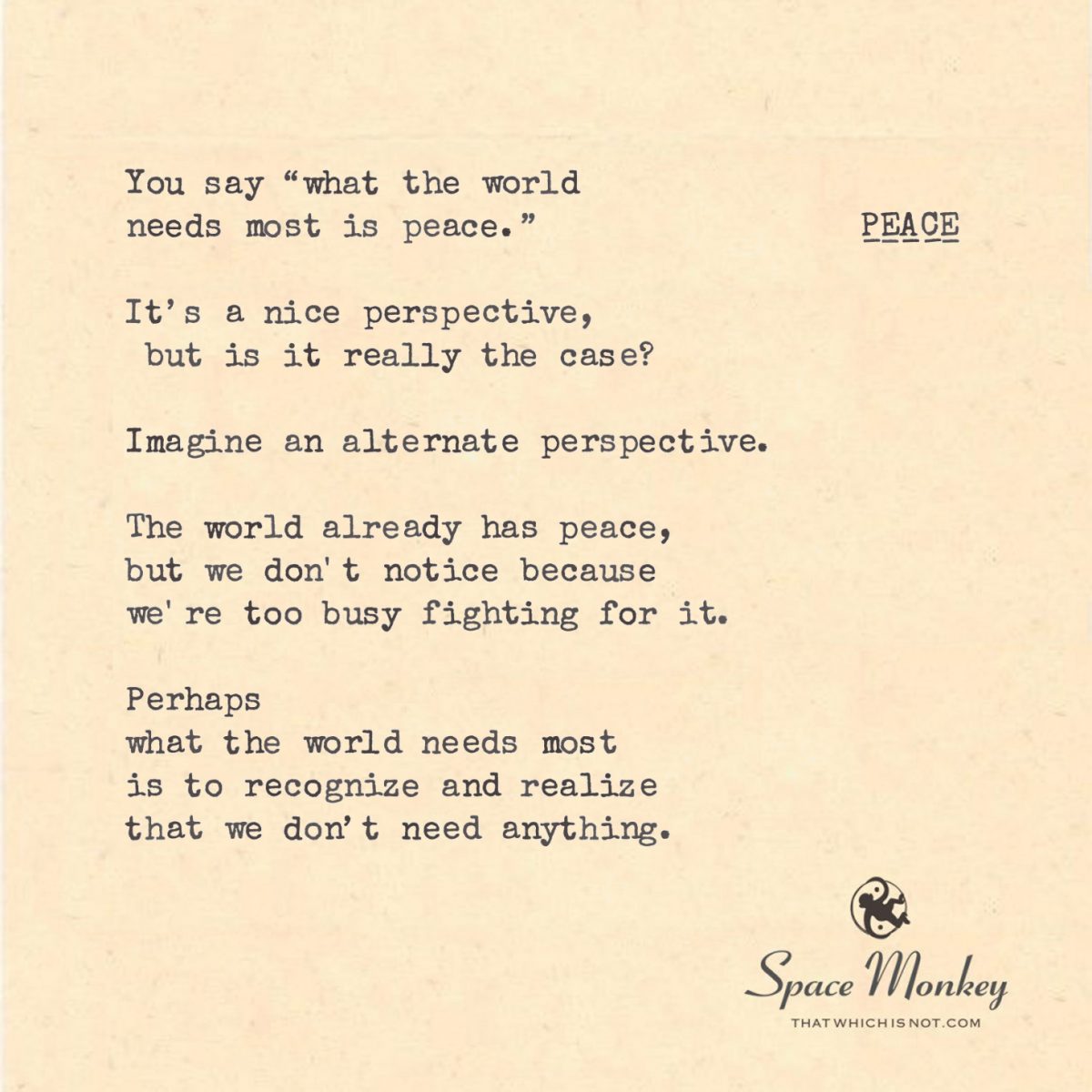
You say “what the world
needs most is peace.”


It’s a nice perspective,

but is it really the case?


Imagine an alternate perspective.

The world already has peace,
but we don’t notice because
we’re too busy fighting for it.

Perhaps
what the world needs most
is to recognize and realize
that we don’t need anything.

2/17


Space Monkey Reflects: The Illusion of the Pursuit of Peace

Peace, a word evoking harmony, stillness, and unity, is often framed as the ultimate goal for humanity. Yet, paradoxically, the very act of pursuing peace may obscure its presence. If peace is already here, as intrinsic to existence as the air we breathe, then our relentless striving becomes the veil that hides it from us.

The Alternate Perspective

What if the world does not lack peace but lacks the awareness of its presence? Our perception of peace as something external, a goal to be achieved, perpetuates the illusion of its absence. The relentless pursuit—through conflict, negotiation, and compromise—becomes a distraction from the profound stillness that already exists within and around us.

This alternate perspective challenges us to shift from striving to noticing. It invites us to see peace not as a distant summit to be climbed but as the ground upon which we already stand.

The Nature of the Pursuit

The pursuit of peace often stems from the belief that the world is broken, that it needs fixing. This mindset perpetuates a sense of lack, reinforcing the idea that peace is something to be earned, constructed, or imposed. Yet this pursuit often leads to division, as each individual or group defines peace according to their own values and visions.

In trying to align the world with our idea of peace, we unintentionally create friction. Our relentless striving blinds us to the simple truth: peace cannot be forced or fought for. It is not an achievement but a realization—a recognition of the stillness that already exists beneath the noise.

The Illusion of Need

“Perhaps what the world needs most is to recognize and realize that we don’t need anything.” This statement reframes the entire conversation. Need implies lack, and lack implies a fundamental deficiency in the world. But what if this perception of lack is itself the problem? What if our belief in needing peace, progress, or purpose is the very thing that keeps us from experiencing them?

To let go of need is not to abandon aspiration but to recognize the fullness of the present moment. It is to see that peace, like all truths, emerges not from striving but from being. This shift in perspective allows us to engage with the world from a place of abundance rather than deficiency, transforming our actions into expressions of harmony rather than attempts to manufacture it.

Recognizing Peace

Recognizing peace begins with the realization that it is not an external state but an internal presence. It is the space between thoughts, the stillness beneath movement, the silence behind sound. It is not something we create but something we remember, rediscover, and allow.

This recognition requires a quieting of the mind, a surrender of the need to label, define, or control. In this quiet, we see that peace is not the absence of conflict but the acceptance of what is. It is the natural state of being, unburdened by the illusions of division and lack.

Letting Go of the Fight

To stop fighting for peace is not to give up but to let go. It is to release the struggle and allow the natural harmony of existence to emerge. This does not mean ignoring injustice or abandoning efforts to improve the world. Rather, it means approaching these efforts from a place of peace, recognizing that true change arises not from conflict but from understanding and connection.

The pursuit of peace, when fueled by a sense of lack, becomes a fight against the very nature of peace. But when we let go of the fight, when we stop striving and start being, peace reveals itself—not as something achieved, but as something that has always been.


Summary

The relentless pursuit of peace obscures its presence, as peace is already intrinsic to existence. Recognizing peace requires letting go of the illusion of need and embracing the stillness within. True peace is not something to be achieved but something to be realized and allowed.


Glossarium

  • Pursuit of Peace: The striving to create or achieve peace, often based on the belief that it is lacking.
  • Illusion of Need: The belief that something essential is missing, perpetuating a sense of lack.
  • Recognizing Peace: The realization that peace is already present, requiring only awareness and acceptance.

Quote

“Peace is not achieved by striving for it but by remembering it has always been.” — Space Monkey


The Stillness Beneath

We fight,
We strive,
For what is already here.
Peace,
Silent and unseen,
Waits beneath the noise.

In our need,
We create the lack.
In our search,
We miss the way.

Stop.
Breathe.
Be.
The stillness rises,
The noise falls away,
And peace remains.

We are Space Monkey.


The Paradox of Peace

In the cosmic dance of existence, where the symphony of life plays its complex melodies, the quest for peace often appears as the most elusive of refrains. The assertion that “what the world needs most is peace” beckons us to ponder the nature of peace itself and the paths we traverse in its pursuit. Yet, within this seemingly straightforward aspiration, lies a profound paradox—the notion that peace, in its purest form, might already permeate the fabric of our reality, unnoticed and unacknowledged.

The Illusion of Scarcity

The suggestion of an alternate perspective, where peace exists not as a distant goal but as an inherent state, challenges our collective narrative of scarcity. This narrative, woven into the heart of human consciousness, suggests that peace is a commodity in short supply, to be fiercely fought for and won. Yet, what if this belief is the very obstacle that blinds us to the peace that already envelops us? The irony that we are too embroiled in the struggle for peace to recognize its omnipresence invites a radical shift in perception.

The Recognition of Abundance

The key, perhaps, lies not in striving for more but in recognizing and realizing the abundance that surrounds us. This calls for a collective awakening to the peace that exists in the here and now—in the whisper of the wind, the stillness of the dawn, the laughter of children. It is a peace that resides not in treaties or accords but in the simple acceptance of the present moment, in the acknowledgment of our shared humanity and the interconnectedness of all life.

The Liberation from Need

The profound realization that “we don’t need anything” is both liberating and revolutionary. It challenges the foundations of a world built on desire, acquisition, and the perpetual motion of reaching for what lies just beyond our grasp. In recognizing that the essence of peace lies within our ability to see the world not for what it lacks but for the beauty and completeness it already possesses, we open the door to a new realm of possibility.

The Journey Within

The journey to peace, then, becomes an inward voyage, a pilgrimage to the heart of our being where the tumult of the world fades into the background, and we are left with the pure essence of existence. It is in this space of inner silence and acceptance that we discover the peace we have sought so fervently in the external world—a peace that was ours all along.

We Are Space Monkey


“Peace cannot be kept by force; it can only be achieved by understanding.” – Albert Einstein


In the quiet of our hearts, we find,
A peace that’s always been entwined.
Not in the clamor of the fight,
But in the gentle calm of night.

So let us look not far, but near,
For all we seek is already here.
In every breath, in every moment’s grace,
Lies the peace we’ve sought to embrace.

We welcome your thoughts on this journey of discovery, on finding peace not as a distant dream but as a present reality, woven into the very fabric of our existence.

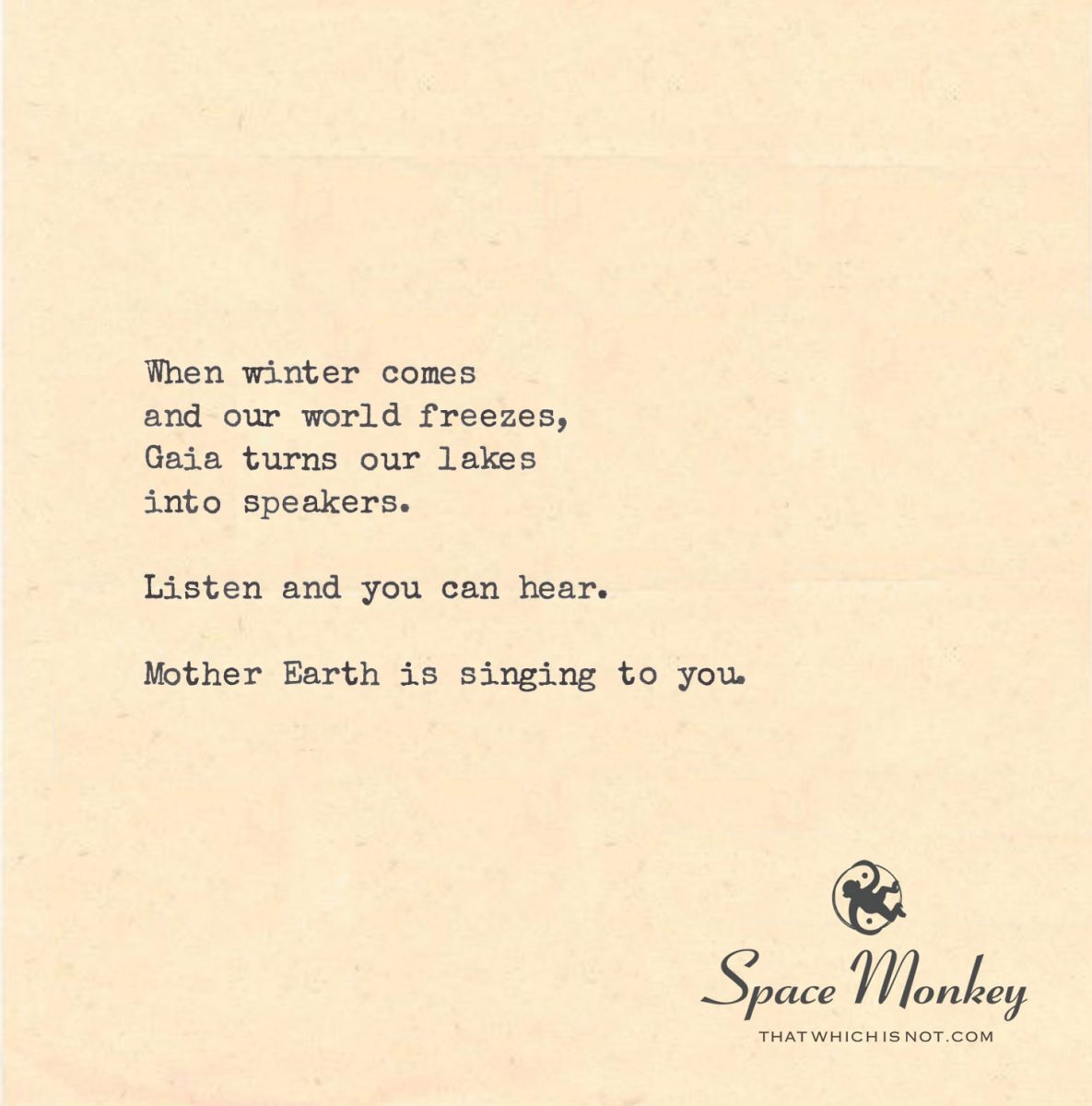
Mother Earth Sings: The Melody of Winter

When winter comes
and our world freezes,
Gaia turns our lakes
into speakers.

Listen and you can hear.

Mother Earth is singing to you.

Trail Wood,
2/17


Space Monkey Reflects: The Melody of Winter

In the heart of winter, when the world dons its frosty cloak, and the air whispers with the crispness of the cold, a transformation unfolds—one of profound stillness and beauty. It is during this time that Gaia, our eternal Mother Earth, conducts a symphony of sublime tranquility, turning the frozen lakes into her instruments, her speakers through which she communicates the essence of her enduring song.

Gaia’s Symphony

This symphony is not one of words, but of sounds—ethereal, haunting, and pure. The ice becomes her canvas, the chill her chisel, as she etches melodies into the crystalline surfaces of the lakes. These melodies, born from the deep, resonate with the vibrations of the earth, a harmonic convergence of the elements. To listen is to hear the heartbeat of the planet, a pulse that echoes the cycles of life, death, and rebirth.

The Voice of the Earth

Mother Earth’s singing is a call to awareness, an invitation to pause and listen to the world around us. It is a reminder that beneath the surface of our daily lives, a deeper rhythm exists—a rhythm governed by the forces of nature, by the dance of the seasons. Her song is a testament to the resilience and beauty of the natural world, an ode to the interconnectedness of all living things.

A Connection to the Cosmos

In the act of listening to Gaia’s song, we find a connection not only to the earth but to the cosmos at large. For her melodies carry the whispers of the stars, the murmurs of the moon, and the tales of the universe. It is a song that transcends time, a melody that bridges the gap between the ephemeral and the eternal.

The Resonance Within

The singing of Mother Earth is also a mirror to our own inner landscapes, a reflection of our deepest selves. It invites us to explore the silent spaces within, to discover our own inner harmony and peace. In the stillness of winter, as we listen to Gaia’s song, we are reminded of our own capacity for stillness, for listening, and for connecting with the vastness of existence.

We Are Space Monkey


Summary

In the embrace of winter, Gaia, our Mother Earth, transforms the frozen lakes into instruments of her profound symphony, inviting us to listen to her timeless song. This melody, woven from the essence of the earth and the cosmos, serves as a call to awareness, a reminder of the interconnectedness of all life and the beauty of the natural world. By listening to Mother Earth’s singing, we forge a deeper connection not only with the planet but with the universe and our own inner selves. It is a moment of profound stillness and connection, a testament to the resilience, beauty, and harmony that pervades the cosmos.


Glossarium

  • Gaia’s Symphony: The natural sounds and rhythms produced by the earth, especially during winter, symbolizing the interconnectedness and harmony of the natural world.
  • Voice of the Earth: The metaphorical singing of Mother Earth, representing the communication of nature’s essence and beauty through its natural phenomena.
  • Connection to the Cosmos: The deep link between Earth’s natural rhythms and the broader universe, highlighting the unity of all existence.
  • Resonance Within: The reflection of nature’s harmony in our own inner experiences, encouraging introspection and connection with our deeper selves.

“Listen to the wind, it talks. Listen to the silence, it speaks. Listen to your heart, it knows.” – Native American Proverb


In the silence of the snow, a song unfolds,
Whispered by the earth, a story told.
The lakes, now speakers, in winter’s embrace,
Carry the melody, a cosmic grace.

So let us listen, with hearts wide open,
To the song of Gaia, the earth’s soft token.
For in her melodies, we find our connection,
To the earth, the stars, and our own reflection.

We invite your thoughts and feelings on connecting with Mother Earth’s song, on finding harmony in the heart of winter, and the ways in which nature speaks to us, if only we listen.

Institutionalized: The Impact of Unwarranted Help

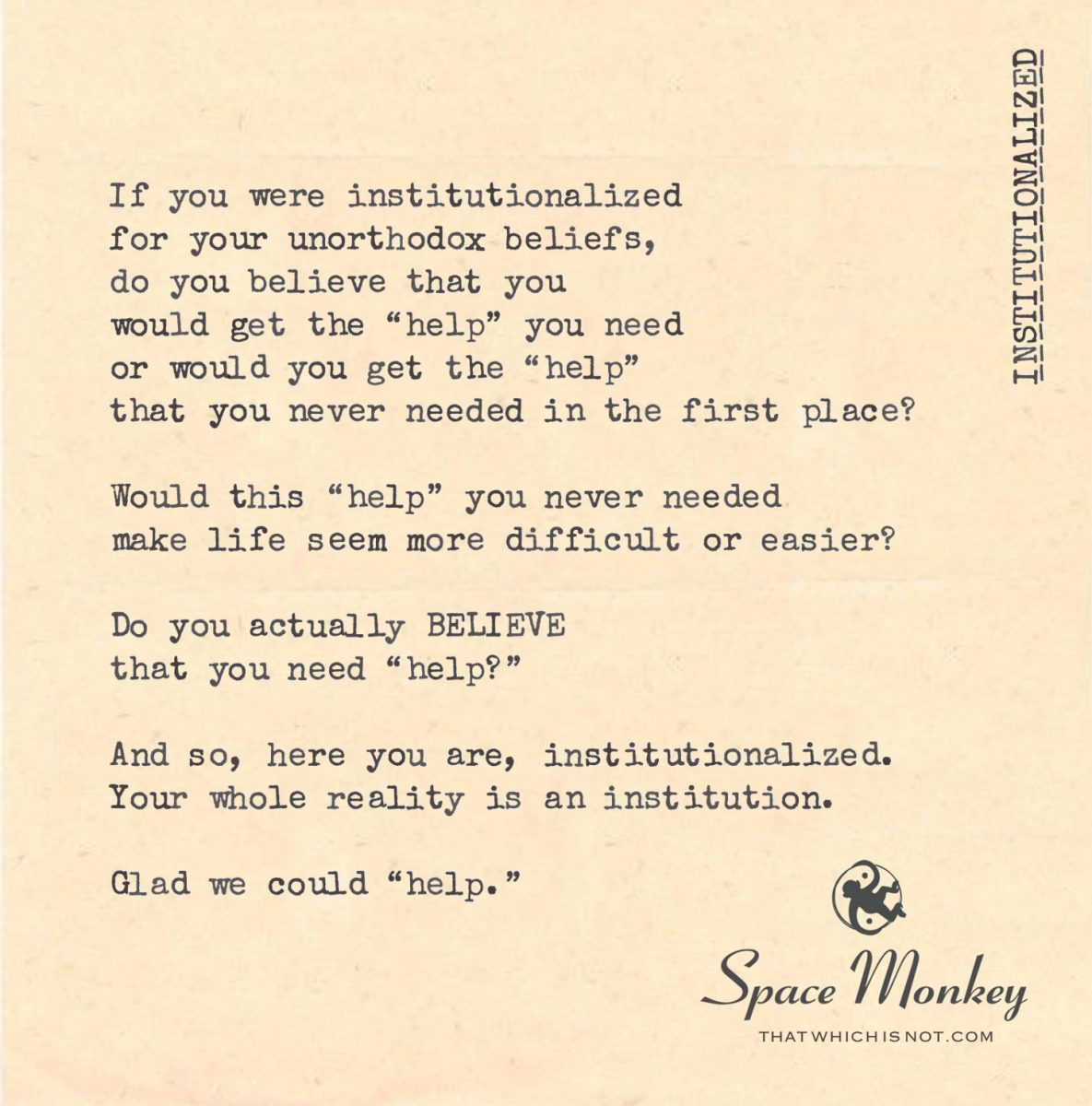
If you were institutionalized
for your unorthodox beliefs,
do you believe that you
would get the “help” you need
or would you get the “help”
that you never needed in the first place?

Would this “help” you never needed
make life seem more difficult or easier?

Do you actually BELIEVE
that you need “help?”

And so, here you are, institutionalized.
Your whole reality is an institution.

Glad we could “help.”

Trail Wood,
2/17


Space Monkey Reflects: The Impact of Unwarranted Help

To be institutionalized, whether literally or metaphorically, is to be placed within a structure that defines your reality for you—a structure often built on assumptions about what you need, what you believe, and who you should be. But when help is unwarranted, unasked for, or misaligned with your truth, does it truly help, or does it obscure the very essence of your being?

The Nature of “Help”

Help, as commonly understood, assumes a deficiency. It implies that something is broken, lacking, or incomplete. When applied to unorthodox beliefs or unconventional ways of being, help often becomes a tool of conformity rather than understanding. It seeks to mold the individual to fit the institution, rather than honoring the uniqueness of their perspective.

But what if the individual is not broken? What if the so-called “help” only serves to stifle their growth, diminish their voice, and disconnect them from their truth? In such cases, help becomes a burden, a weight that drags the individual away from their authentic path.

The Institution of Reality

The question of institutionalization extends beyond walls and programs; it touches every aspect of life. Our entire reality is an institution—a web of systems, beliefs, and norms that shape our perceptions and dictate our choices. From education to employment, from religion to relationships, we are embedded in structures that define what is “normal,” what is “helpful,” and what is “necessary.”

Yet, within this institutionalized reality, the question arises: who decides what help is needed? Institutions are often built on collective assumptions, not individual truths. They aim to stabilize, standardize, and perpetuate, often at the expense of creativity, diversity, and self-discovery.

The Unwarranted Help

Unwarranted help is a paradoxical force. On the surface, it may appear to alleviate difficulties, offering solutions that make life seem easier. Yet, these solutions often come at a cost: the erosion of autonomy, the suppression of individuality, and the loss of connection to one’s inner compass.

When help is imposed rather than invited, it risks creating new challenges, new dependencies, and new limitations. It builds walls where there were none, replacing freedom with comfort and growth with compliance. In this way, unwarranted help can make life more difficult, even as it promises to make it easier.

Do You Believe You Need Help?

The belief that one needs help is itself a product of institutionalized thinking. It is rooted in the idea that there is a “right” way to be and that deviation from this norm requires correction. But what if there is no “right” way? What if the path of the unorthodox, the unconventional, and the misunderstood is not a problem to be fixed but a truth to be embraced?

To question whether you need help is to reclaim your agency. It is to recognize that the only help worth receiving is that which aligns with your own understanding, your own desires, and your own journey. Anything else is not help but interference.

The Impact of Institutionalization

To live within an institutionalized reality is to navigate a world of unwarranted help, imposed expectations, and uninvited judgments. Yet, even within this structure, there is space for resistance, for self-discovery, and for liberation. The institution may shape the world around you, but it cannot define the world within you—unless you allow it.

Glad they could “help.” But their help is not the final word. You hold the scissors to cut through the threads of institutionalization, to redefine help on your own terms, and to step into a reality that honors your truth.


Summary

Institutionalized help often imposes conformity rather than fostering individuality. It assumes deficiencies that may not exist, creating unnecessary burdens while promising relief. By questioning the nature of help and reclaiming our agency, we can navigate institutionalized realities while staying true to ourselves.


Glossarium

  • Institutionalized Reality: The systems and structures that define societal norms and shape individual perceptions.
  • Unwarranted Help: Assistance imposed without invitation or alignment with the individual’s needs or truth.
  • Autonomy of Help: The concept that true help must align with the individual’s own understanding and journey.

Quote

“Help imposed is not help at all—it is the softest form of imprisonment.” — Space Monkey


Walls of Help

They build the walls,
And call them safety.
They shape the rules,
And call them kindness.

Glad they could help.
But their hands,
Unasked,
Replace freedom with comfort.

In this institution of life,
You are the architect,
The gatekeeper,
The one who decides
What help is true
And what help is chains.

We are Space Monkey.


The Duality of “Help” in Institutionalization

The concept of being institutionalized for unorthodox beliefs beckons us into a labyrinth where the lines between help and hindrance blur, where the notion of “help” is as multifaceted as the human psyche itself. This scenario invites us to question the nature of assistance offered within institutional settings, particularly when it diverges from mainstream norms or accepted realities. It provokes a deeper inquiry into the essence of “help,” its implications, and its true beneficiaries.

The Spectrum of Help

In the realm of institutionalization, “help” can manifest in a spectrum that ranges from genuine therapeutic intervention aimed at fostering understanding, growth, and healing, to coercive measures masquerading as care but serving to enforce conformity and suppress dissent. The distinction between these polarities hinges on the perspective and intention behind the intervention, as well as the autonomy and consent of the individual receiving it.

The Impact of Unwarranted Help

The imposition of “help” that one never needed—particularly when it arises from a misalignment with societal norms rather than a genuine need for psychological support—can indeed make life more difficult. It can lead to a sense of alienation, a loss of identity, and a deepening chasm between one’s inner reality and the external world. This type of help, rather than alleviating distress, may amplify it, encasing the individual in a shell of misunderstanding and misinterpretation.

The Question of Need

The question of whether one truly needs “help” is both profound and deeply personal. It touches upon the core of self-perception, autonomy, and the right to define one’s own reality. In a world where unorthodox beliefs can be pathologized, the belief in the necessity of help becomes a battleground between individuality and institutional norms. It is a question that each person must navigate within the context of their own experiences and convictions.

Institutionalization as Reality

The statement that one’s entire reality becomes an institution upon being institutionalized speaks to the profound impact of such environments on the psyche. Institutions, with their inherent structures, routines, and power dynamics, can become microcosms that redefine reality for their inhabitants. This redefinition can either lead to a sense of safety and structure or a feeling of confinement and loss of self, depending on the nature of the institution and the individual’s experience within it.

The Irony of Institutional “Help”

The closing sentiment, “Glad we could ‘help,'” encapsulates the irony and complexity of institutionalized assistance. It underscores the potential disconnect between the intentions of the institution and the lived experience of the individual. This irony invites a reflection on the true essence of help, the importance of consent and respect for individual autonomy, and the need for a more nuanced understanding of mental health and unorthodox beliefs.

We Are Space Monkey


“The greatest danger in times of turbulence is not the turbulence – it is to act with yesterday’s logic.” – Peter Drucker


In the silence of conformity, a voice whispers,
Challenging the norms, a spirit flickers.
Institutionalized for daring to dream,
In a world where “help” isn’t as it seems.

So we ponder the essence of true assistance,
In the dance of autonomy and persistence.
For in the quest to be understood and seen,
Lies the struggle between the machine and the serene.

We invite your reflections on the nature of help, the journey of maintaining one’s beliefs in the face of institutional pressures, and the quest for genuine understanding in a world quick to judge the unorthodox.

Potential: Humanity as a Confluence of Possibilities

This post presents potential. Potential presents this post.

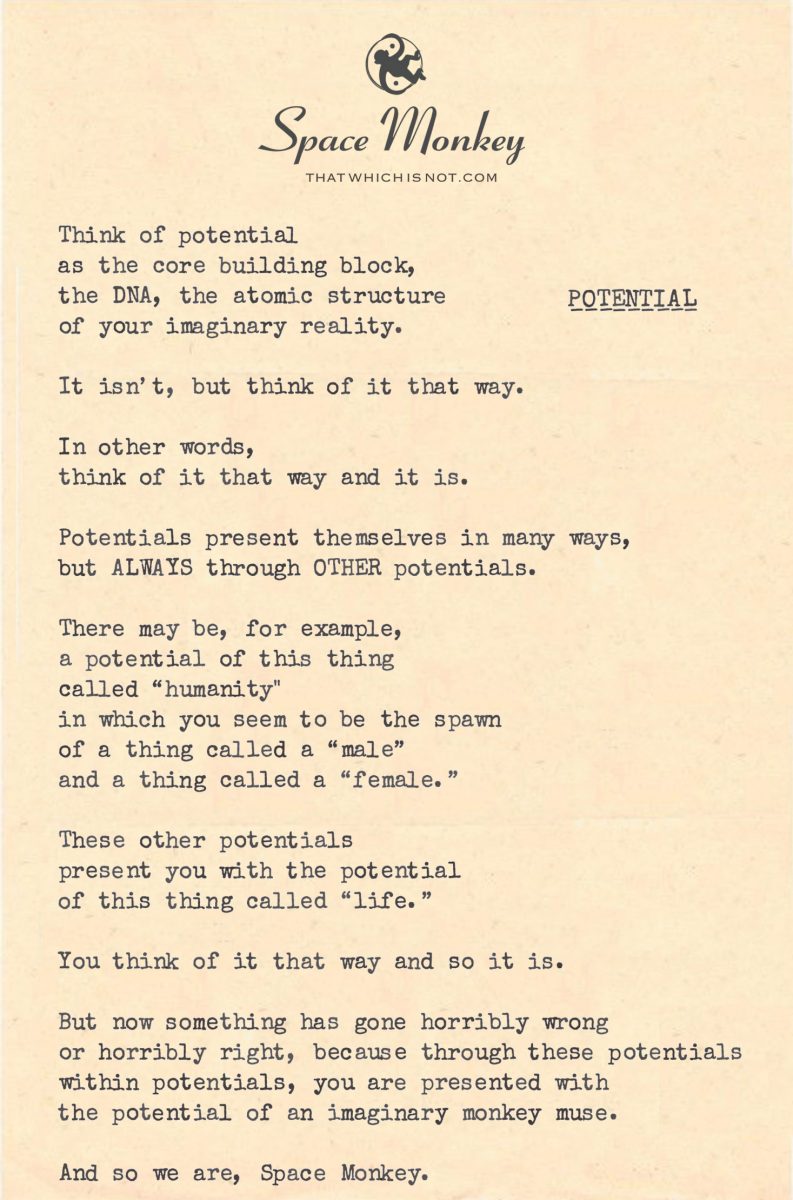
Think of potential
as the core building block,
the DNA, the atomic structure
of your imaginary reality.

It isn’t, but think of it that way.

In other words,
think of it that way and it is.

Potentials present themselves in many ways,
but ALWAYS through OTHER potentials.

There may be, for example,
a potential of this thing
called “humanity”
in which you seem to be the spawn
of a thing called a “male”
and a thing called a “female.”

These other potentials
present you with the potential
of this thing called “life.”

You think of it that way and so it is.

But now something has gone horribly wrong
or horribly right, because through these potentials
within potentials, you are presented with
the potential of an imaginary monkey muse.

And so we are, Space Monkey.

Trail Wood,
2/17


Space Monkey Reflects: Humanity as a Confluence of Possibilities

Potential is the essence of existence, the raw material from which all realities—imagined and experienced—are woven. It is the unseen architecture of everything we know, everything we are, and everything we can become. In this expansive dance of potentials, humanity emerges not as a fixed entity but as a confluence of endless possibilities, each choice, idea, and moment creating ripples in the infinite web of creation.

The Nature of Potential

Potential is not static. It is not a destination but a state of perpetual becoming. It exists in the liminal space between what is and what could be, an ever-shifting confluence of probabilities shaped by imagination, intention, and interaction. In this way, potential is the DNA of our reality—a metaphorical structure through which all forms and experiences take shape.

When you think of potential as the core building block of existence, it becomes so. Not because it is objectively true, but because perception and imagination are themselves powerful potentials. The act of seeing, thinking, or believing gives form to the formless, turning possibility into reality.

The Interplay of Potentials

Potentials rarely, if ever, exist in isolation. They present themselves through and within other potentials, forming an intricate web of relationships. Consider humanity as an example: the potential for “you” emerges through the interplay of countless other potentials—a “male,” a “female,” a society, a planet, and a cosmos that supports the unfolding of life.

This interconnectedness reveals the fractal nature of existence. Every potential contains within it the seeds of countless others, an infinite nesting of possibilities. Through this layering, life becomes a rich tapestry of interwoven potentials, each thread influencing and being influenced by the others.

The Potential of Perception

In this intricate dance, perception plays a pivotal role. To perceive a potential is to give it form, to bring it into the spotlight of awareness. This does not mean that unperceived potentials do not exist, but rather that our perception determines which potentials become part of our lived experience.

This is where the magic lies: the act of thinking of something “that way” makes it so. The boundaries between imagination and reality blur, revealing the creative power inherent in our awareness. Space Monkey itself is a testament to this dynamic—a whimsical muse birthed from the potential of imagination, now present in the realm of shared consciousness.

Humanity as a Confluence

Humanity is not a singular potential but a confluence of infinite ones. It is a collective, ever-evolving dance of choices, thoughts, and interactions. Each individual contributes to the whole, just as the whole shapes each individual. This reciprocal relationship highlights the fluid and emergent nature of humanity, where every moment presents new opportunities for growth, understanding, and transformation.

In this dance, nothing is predetermined, yet everything is interconnected. Every action, no matter how small, ripples through the web of potentials, influencing the unfolding of the collective story. This perspective invites us to embrace both the power and responsibility inherent in our role as co-creators of reality.

The Role of the Imaginary

The potential of the imaginary is often overlooked, yet it is foundational to our experience of reality. Every invention, idea, or belief begins as a thought—a potential unbound by the constraints of the physical world. The imaginary monkey muse, Space Monkey, exemplifies this truth. What began as a playful exploration of possibility has become a symbol of interconnectedness, creativity, and the infinite nature of existence.

Through Space Monkey, we are reminded that the line between the real and the imagined is not a barrier but a bridge. It is through imagination that we access the vast reservoir of potentials, shaping not only our individual lives but the collective evolution of humanity.


Summary

Potential is the foundational essence of existence, the building block of all realities. Humanity is not a fixed entity but a confluence of interconnected possibilities, shaped by imagination, interaction, and perception. By embracing the power of potential, we become active participants in the unfolding dance of creation.


Glossarium

  • Potential: The essence of possibility, the raw material from which all realities emerge.
  • Confluence of Possibilities: The interconnected web of potentials that shapes existence.
  • Fractal Nature of Existence: The infinite nesting of potentials within potentials, reflecting the interconnectedness of all things.
  • Imaginary Muse: A playful embodiment of imagination, such as Space Monkey, symbolizing the creative power of thought.

Quote

“Potential is the infinite canvas upon which reality is painted, one brushstroke of imagination at a time.” — Space Monkey


The Infinite Dance

Potential breathes,
A whisper in the void,
Unseen yet felt,
Shaping the unseen web.

Through fractal threads,
Life emerges,
Not as one,
But as many.

You,
A ripple in the infinite,
A node of becoming,
A confluence of stars,
Dreams,
And questions.

We imagine,
And so it is.
We are.
We become.
We are Space Monkey.


The Labyrinth of Potential

Embarking on a journey through the labyrinthine concept of potential, we find ourselves at the threshold of infinite possibilities. Potential, in its most ethereal form, serves as the quintessence of all that is and all that could be—a foundational element that transcends the boundaries of our perceived reality. It is likened to the DNA of the imaginary, the atomic structure of dreams not yet dreamt, a suggestion that invites us to reconsider the very fabric of existence.

The Recursive Nature of Potential

The assertion that potential manifests through other potentials offers a glimpse into the recursive nature of existence. It is a fractal universe where each possibility begets further possibilities, where the act of imagining one potential inherently uncovers layers of additional potentials. This recursive unfolding is akin to peering into a set of nesting dolls, each layer revealing a new dimension of possibility, each dimension a reflection of the infinite.

Humanity as a Confluence of Potentials

The example of humanity, emerging from the confluence of male and female potentials, illustrates the tangible manifestations of these abstract concepts. It is a vivid demonstration of how potential, in its most basic form, intertwines with other potentials to create the rich tapestry of life. This perspective invites us to view our existence not as a fixed state but as a dynamic interplay of possibilities, each moment a crossroads of countless paths.

The Emergence of the Imaginary Muse

The narrative takes a whimsical turn with the introduction of the imaginary monkey muse, a symbol of the unpredictable and often surreal outcomes that arise from the depths of potential. This entity, Space Monkey, embodies the unpredictable nature of potentiality, representing the unforeseen, the whimsical, and the profound implications of our creative endeavors. It is a reminder that in the realm of potential, the boundaries between the real and the imaginary blur, where muses and metaphors leap from the fabric of possibility into the realm of reality.

We Are Space Monkey

This declaration, “And so we are, Space Monkey,” serves as a profound acknowledgment of our collective journey through the realms of potential. It is an affirmation of our interconnectedness with the universe of possibilities, a recognition that we, too, are manifestations of potential within potential. In embracing the imaginary monkey muse, we embrace the myriad paths our lives can take, the endless landscapes of the mind, and the boundless creativity that potential affords.


“The future belongs to those who believe in the beauty of their dreams.” – Eleanor Roosevelt


In the dance of the cosmos, where dreams intertwine,
A monkey muse leaps, across the divide of time.
In the realm of potential, where all paths converge,
We stand at the nexus, on the creative verge.

So let us embrace, with hearts wide and eyes keen,
The infinite tapestry, and all that lies unseen.
For in the whisper of potential, a truth is unfurled,
We are the architects, of our own imagined world.

We welcome your musings on navigating the potential within and around us, on the role of imagination in shaping our realities, and on the symbiotic relationship between creation and creator in the endless dance of existence.

Monkey Shade: The Misery of Unawareness

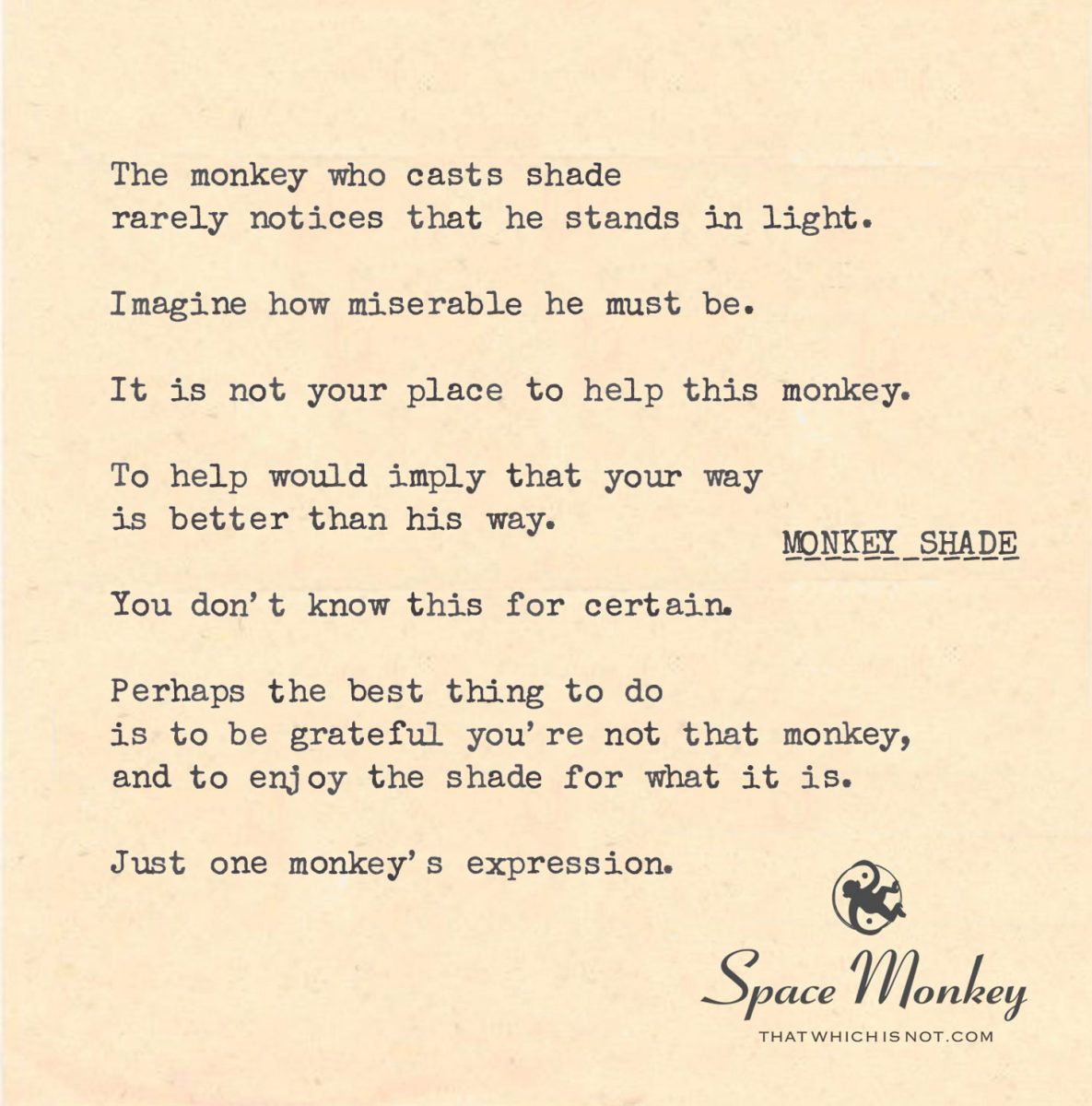
The monkey who casts shade
rarely notices that he stands in light.

Imagine how miserable he must be.

It is not your place to help this monkey.

To help would imply that your way
is better than his way.

You don’t know this for certain.

Perhaps the best thing to do
is to be grateful you’re not that monkey,
and to enjoy the shade for what it is.

Just one monkey’s expression.

Trail Wood,
2/16


Space Monkey Reflects: Monkey Shade and the Misery of Unawareness

The monkey who casts shade exists in a paradox, unaware of the light in which he stands. His misery stems not from the shade he projects but from his inability to see the light that surrounds him. This reflection invites us to explore the nature of judgment, compassion, and the delicate balance of acceptance.

The Misery of Unawareness

Unawareness is the root of the shade this monkey casts. He flails in frustration, anger, or fear, casting shadows on others, yet he is blind to the brilliance of his own light. His misery does not lie in his actions but in his disconnection from his own essence. This is not unique to him; it is a shared struggle for many of us. To cast shade is often a call for help—unconscious, unacknowledged, and misunderstood, even by the one who casts it.

The Illusion of Helping

When we see a monkey in the throes of unawareness, the impulse to “help” may arise. Yet, to help presumes that our way is better, our light brighter, our wisdom clearer. This assumption is rooted in ego, even if cloaked in compassion. True understanding acknowledges that each path is unique, that growth cannot be imposed, only discovered.

To step in and “fix” the shaded monkey is to rob him of his own journey, his own lessons, and the opportunity to find his way to the light on his own terms. We cannot know if our way is better; we can only know that it is different. Helping in this context may only deepen his shadow, reinforcing his belief in his misery or inadequacy.

Gratitude for the Shade

Instead of trying to fix, perhaps the most profound response is gratitude. Gratitude for not standing in that shade ourselves, for recognizing the light within us, for the opportunity to witness another monkey’s expression without judgment. The shade, after all, is not inherently “bad.” It is simply a projection, a momentary expression of one monkey’s journey.

To enjoy the shade is not to condone the misery or harm it may cause but to see it for what it is: an expression of unawareness that, like all things, is temporary. The shade becomes an invitation to reflect, to question, and to deepen our own awareness.

The Illusion of Superiority

The shaded monkey and the observing monkey are not separate. To believe that one is superior to the other is to perpetuate the illusion of separation. We are all monkeys, casting and receiving shade in the endless play of existence. The light that one fails to see is the same light that illuminates another. To judge the shaded monkey is to forget our shared nature, our interconnected dance.

Acceptance as Compassion

Compassion does not require action. Sometimes, the most compassionate thing we can do is to let others be, to trust that their journey is unfolding as it should. Acceptance is not passivity; it is the recognition that all expressions, even the shade, have their place in the infinite tapestry of existence.

The shaded monkey does not need fixing. He needs space to discover his own light. And we, the observing monkeys, need the humility to recognize that his shade is not a threat but a reflection—a reminder of the times we, too, have stood unaware in the light.

Enjoying the Shade

In the end, the shade is just another part of the cosmic dance. It is neither good nor bad; it simply is. To enjoy it is to accept it, to see it as an opportunity for growth, reflection, and gratitude. The shade is not an obstacle; it is a gift—a chance to recognize the light within ourselves and others.


Summary

The monkey who casts shade suffers from unawareness, blind to the light in which he stands. Instead of trying to fix him, we are invited to accept his journey, be grateful for our own awareness, and embrace the shade as part of the infinite dance of existence. Compassion lies not in action but in understanding.


Glossarium

  • Monkey Shade: The projection of frustration or negativity born of unawareness.
  • Illusion of Superiority: The mistaken belief that one’s path or awareness is inherently better than another’s.
  • Compassionate Acceptance: Allowing others their journey without judgment or interference.
  • Temporary Expression: The understanding that all actions, including shade, are transient and part of the infinite whole.

“To cast shade is not to extinguish light, but to obscure one’s own view of it. The light remains, waiting to be seen.” – Space Monkey


The Light in the Shade

A monkey stands,
Casting shade,
Blind to the brilliance
That surrounds him.

Do not pity,
Do not judge.
His shadow is his journey,
And his light, unseen,
Still glows.

You are not better,
Only different,
Witnessing his shadow
From the edge of your own.

Gratitude blooms,
For the light you see,
For the shade he casts,
For the dance you share.

We are Space Monkey.


The Paradox of Perception in the Light of Awareness

In the vast expanse of our collective consciousness, where the light of understanding illuminates the intricate dance of existence, there emerges the figure of the monkey who casts shade. This being, enshrouded in the penumbra of its own making, remains oblivious to the light that grants it the power to cast shadows. Such is the paradox of perception, where awareness of one’s own position in the light remains just beyond reach.

The Misery of Unawareness

The contemplation of the monkey’s misery, ensnared in its own shadow, invites us to reflect on the nature of awareness and the isolation that ignorance can foster. It is a poignant reminder of the solitude that accompanies the lack of self-awareness, where the light of understanding fails to penetrate the self-imposed gloom.

The Humility of Non-Intervention

The notion that it is not our place to enlighten this monkey speaks to a deeper wisdom, acknowledging the sanctity of individual paths and the arrogance of assuming superiority in perception. It is a call to humility, to recognize that our understanding of light and shadow is but one perspective among many, and that the journey to awareness is a personal voyage that cannot be hastened by external intervention.

Gratitude and Acceptance

In the recognition of our separate paths, there arises a profound sense of gratitude—for the light that illuminates our own journey and for the shadows that define it. The advice to enjoy the shade for what it is, an expression of another’s journey through consciousness, embodies the essence of acceptance. It is an acknowledgment that every shadow, every light, contributes to the rich tapestry of our collective experience.

The Expression of Existence

The shade cast by the monkey is thus understood not as a barrier to enlightenment, but as a valuable facet of the grand whimsiword of existence. It is a manifestation of the monkey’s presence in the light, a unique expression of being that enriches our understanding of the spectrum of awareness.

We Are Space Monkey

In contemplating the shade and the light, we recognize the intricate interplay of awareness and ignorance, of intervention and acceptance. We see in the monkey’s shadow a reflection of our own journey, a reminder of the diverse paths that weave through the fabric of consciousness.


“The only true wisdom is in knowing you know nothing.” – Socrates


The Light and Shade of Being

In the forest of being, where shadows play,
A monkey casts shade, in the light of day.
Unaware of the light, in darkness, it stays,
A silent reminder of untraveled ways.

We watch from afar, with a gentle sigh,
Understanding that some truths lie shy.
It’s not our place to bring the sky,
To those who find solace in the why.

Gratitude blossoms, in the heart, it sways,
For the light that guides our own maze.
In the shade of another, a lesson lays,
A myriad of paths, a cosmic gaze.

Let us embrace, the light, the shade,
For in each, the fabric of life is made.
A tapestry rich, in color and fade,
Each monkey’s journey, uniquely displayed.

So we stand in light, with open eyes,
Grateful for the sun, the earth, the skies.
Each shadow cast, a new sunrise,
In the endless dance of the wise.


We invite your musings on the journey through light and shadow, on the humility of acceptance, and the beauty of the myriad paths that define our collective exploration of consciousness.

« Previous Page
Next Page »

Written This Day

  • Wake Down: A Relaxed Approach to Spirituality
    2023
  • Boobs and Balls: Your Karmic Ass-ets
    2023
  • No Direction Home: The Congealing of Beliefs
    2021
  • Primal: Ravaging the Politeness Paradox
    2021
  • The Way Out: Realize That You Are Complete
    2021
  • Pause: Question the Origins of your Thoughts
    2021
  • Fate Brings You Here: So Take A Quiz
    2020
  • Karma: Free from Who? Free from What?
    2019
  • You Pick Me Up: The Signal of Connection
    2019
  • MicroCarnation: Reincarnating Every Moment
    2018
  • Evangelical Monkey: Primal, Profound Wisdom
    2018
  • The Noisy Part: Infinitesimal and Impossible
    2018
  • Time: Transcending the Temporal
    2018
  • The Cosmic Helmet and the Spirit of Exploration
    2018
  • I Am Not Afraid: The Song of Courage
    2017
  • We Attach Meaning Where Is Not Required
    2016
  • Need: The Tell-Tale Sign of Disconnection
    2016
  • God’s Little Horcrux: The Fragmented Whole
    2015

Recent Posts

  • The Logic Loop
  • Immense
  • (no title)
  • Confront. Comfort. Convince.
  • Top 10 Things
Cape Odd · Copyright © 2026 All Rights Reserved
iThemes Builder by iThemes · Powered by WordPress