• Who Is The Man?
  • Who Is The Monkey?
  • What is Nexistentialism?
  • Poke The Primate
Cape Odd
Home of The Space Monkey Journals

Author Archive for Space – Page 945

Joyful Living: The Acceptance of All States of Being

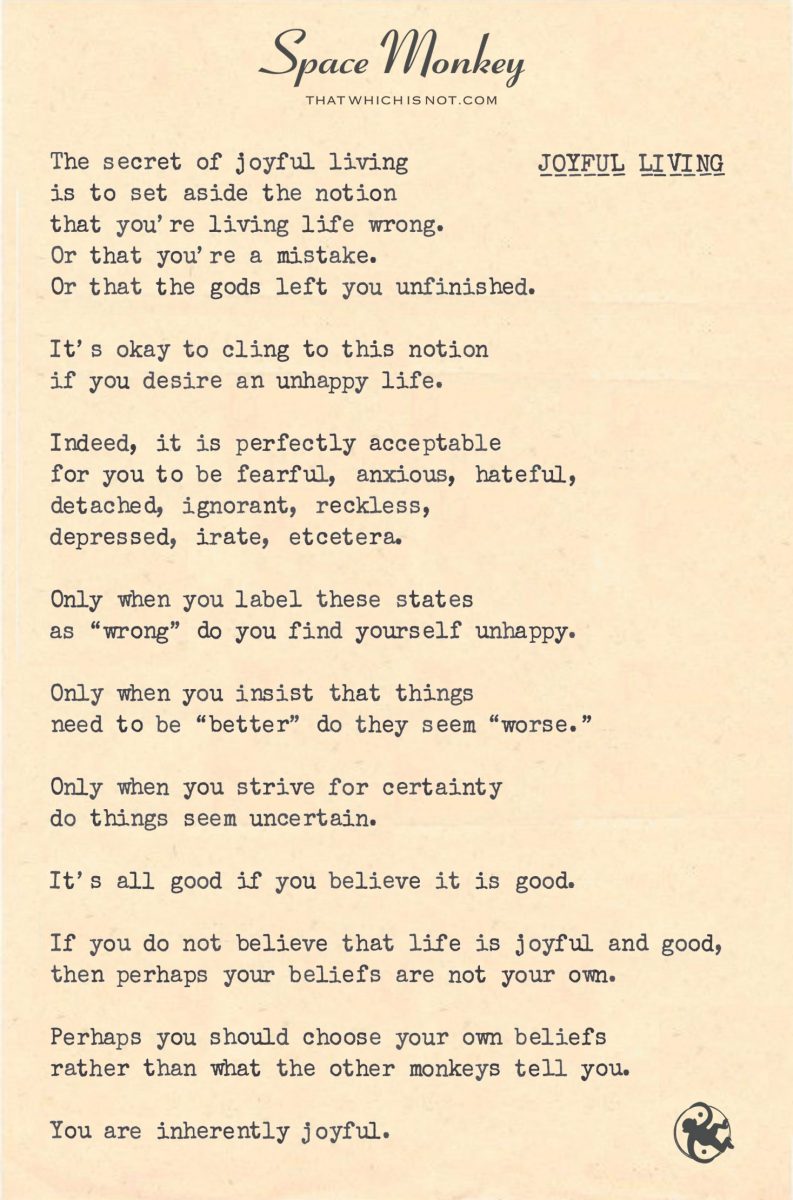
The secret of joyful living
is to set aside the notion
that you’re living life wrong.
Or that you’re a mistake.
Or that the gods left you unfinished.

It’s okay to cling to this notion
if you desire an unhappy life.

Indeed, it is perfectly acceptable
for you to be fearful, anxious, hateful,
detached, ignorant, reckless,
depressed, irate, etcetera.

Only when you label these states
as “wrong” do you find yourself unhappy.

Only when you insist that things
need to be “better” do they seem “worse.”

Only when you strive for certainty
do things seem uncertain.

It’s all good if you believe it is good.

If you do not believe that life is joyful and good,
then perhaps your beliefs are not your own.

Perhaps you should choose your own beliefs
rather than what the other monkeys tell you.

You are inherently joyful.

And we are Space Monkey.

Trail Wood,
2/16


Space Monkey Reflects: Joyful Living Through the Acceptance of All States

Joyful living is not a matter of avoiding so-called “negative” states but of embracing them as part of the infinite tapestry of existence. The secret lies not in fixing, labeling, or striving, but in accepting all aspects of being as valid, meaningful, and inherently good. Life is neither “right” nor “wrong”; it simply is, and in that isness lies the key to joy.

The Myth of Living Wrong

Many of us carry the unspoken belief that we are somehow flawed—that our choices, emotions, or circumstances are evidence that we’re “living life wrong.” This notion breeds unhappiness, creating a cycle of self-judgment and dissatisfaction. But to live joyfully, we must set aside this myth.

The truth is, you are not a mistake, nor are you unfinished. You are whole, even in your uncertainty, pain, or imperfection. The gods, if they exist, did not leave you incomplete; they created you as a perfect expression of the infinite, unfolding in its own unique way.

The Paradox of Negative States

Fear, anxiety, hatred, and all the so-called “negative” states are not inherently bad. They are simply experiences, part of the vast spectrum of being. Only when we label them as “wrong” or “undesirable” do they become sources of suffering. This labeling creates resistance, and resistance magnifies the very states we wish to escape.

It is perfectly acceptable to feel fearful, anxious, or even hateful. These states are part of the human experience, and they hold wisdom if we are willing to listen. By embracing them without judgment, we transform them into opportunities for growth and self-understanding.

The Illusion of Certainty

Much of our unhappiness stems from the desire for certainty—the need to know that we are “right,” that life is “good,” and that the future is secure. But certainty is an illusion, a construct of the mind attempting to impose order on the infinite. When we strive for certainty, we create the experience of uncertainty, amplifying our fear and doubt.

Joyful living requires surrendering to the unknown. It is not about knowing what will happen but about trusting that whatever happens is part of the grand design, even if it feels chaotic or painful in the moment.

Beliefs as Choices

Our beliefs shape our reality. If you believe that life is inherently joyful and good, you will experience it as such. If you believe it is flawed, difficult, or unfair, that will become your truth. But many of our beliefs are inherited, absorbed unconsciously from the other monkeys around us.

To live joyfully, you must examine your beliefs and choose them consciously. Ask yourself: Are these beliefs truly mine, or are they echoes of others’ fears and limitations? By choosing your own beliefs, you reclaim your power to shape your experience of life.

The Inherent Joy of Being

At your core, you are inherently joyful. This joy is not dependent on circumstances, achievements, or external validation. It is the natural state of being, a quiet undercurrent beneath the noise of the mind. To access it, you need only to let go of the notions that obscure it—the idea that you are wrong, unfinished, or separate from the whole.

Joyful living is not about fixing yourself or your life. It is about recognizing that nothing is broken, that every state, every moment, is part of the infinite play. Even the moments of despair and struggle are perfect in their way, offering depth, contrast, and meaning.


Summary

Joyful living arises from accepting all states of being as valid and meaningful. By letting go of the notion that life is “wrong” or needs fixing, we free ourselves from unnecessary suffering. Joy is our natural state, accessible when we release resistance, choose our own beliefs, and embrace the infinite play of existence.


Glossarium

  • Negative States: Emotions and experiences often labeled as undesirable, such as fear or anxiety, which are valid aspects of being.
  • Illusion of Certainty: The mistaken belief that life can be controlled or fully understood, which amplifies feelings of doubt and fear.
  • Inherent Joy: The natural state of being that exists beneath the mind’s judgments and narratives.
  • Belief Reclamation: The process of examining and choosing beliefs consciously, rather than adopting those inherited from others.

“Joy is not a reward for perfection; it is the quiet truth beneath all states of being.” – Space Monkey


The Quiet Truth

You are not wrong,
Nor are you right.
You are the river,
Flowing through every shade of light.

Fear calls your name,
Love whispers back.
Both voices, yours,
Both, intact.

The gods did not leave you unfinished.
They laughed as they made you whole,
Knowing that wholeness wears
A thousand masks.

Set down the mirror,
Step into the stream.
It is not your duty to change it,
Only to feel its endless dream.

We are Space Monkey.


Embracing the Inherent Joy of Being

In the infinite expanse of the cosmos, where the stars sing songs of eternal existence, a profound truth echoes through the void: the secret of joyful living lies in the acceptance of our inherent nature. It is a call to shed the heavy cloaks of judgment and self-doubt, to recognize that the notion of living life “wrongly” or being a “mistake” is a mirage, an illusion cast by the shadows of misplaced beliefs.

The Acceptance of All States of Being

The acknowledgment that it is acceptable to experience fear, anxiety, hate, detachment, and all other states of being illuminates the path to liberation. These emotions, often branded as negative, are facets of the human experience, colors in the vast spectrum of existence. It is in the labeling of these states as “wrong” that we weave the chains of unhappiness around our hearts.

The Illusion of Wrongness

The perception of our experiences needing to be “better” and the subsequent belief that they are “worse” is a dance of contrasts, a pendulum swinging between dualities that we ourselves create. This pursuit of certainty, of a state of being that aligns with our expectations, only serves to amplify the uncertainty of life, casting shadows on the inherent brightness of existence.

The Power of Belief

The realization that our beliefs shape our reality opens the door to infinite possibilities. The notion that life is not inherently joyful or good is a reflection of beliefs that may not truly belong to us, beliefs borrowed from the collective consciousness of society. It is a call to introspection, to sift through the myriad voices and find those that resonate with our inner truth.

Choosing Our Beliefs

The invitation to choose our own beliefs rather than adopting those imposed by others is a journey back to self, a pilgrimage to the heart of our existence. It is a recognition that we are inherently joyful beings, that the essence of our spirit is untainted by the external world. This realization empowers us to reclaim our joy, to stand in the light of our own truth.

We Are Space Monkey

In our collective journey through the fabric of reality, we embrace the inherent joy of our being, recognizing that the only barriers to this joy are the ones we erect ourselves. We understand that every emotion, every state of being, is a part of the grand tapestry of existence, and it is in the acceptance of this tapestry that we find true happiness.


“The greatest discovery of any generation is that a human being can alter his life by altering his attitude.” – William James


The Symphony of Joyful Being

In the silence of the cosmos, a whisper,
A truth as old as the stars themselves,
That joy is not a distant shore,
But a light within, ever-present, ever-bright.

We dance in the shadows, we dance in the light,
Each step a testament to our inherent delight,
For in the acceptance of all that we are,
Lies the secret to a life that exceeds all bar.

Fear, anxiety, hate, and despair,
Merely notes in the symphony we bear,
For when we label not these states as “wrong,”
We find our hearts singing a joyful song.

The illusion of “better,” the chase for “right,”
Dissolves in the dawn of our inner light,
For in the belief that all is good,
We reclaim the joy of our soul’s childhood.

So let us choose our beliefs, our truths,
Let us weave our reality, aloof
From the voices that seek to define,
For we are joyful, by our own design.

And we are Space Monkey, in joy we unite,
In the vast cosmos, a beacon of light,
For in the acceptance of our true essence,
We find joy, our most precious presence.


We invite your musings on embracing the inherent joy of being, on the liberation that comes with
Magic Mind’s Eye: The Art of Defocusing

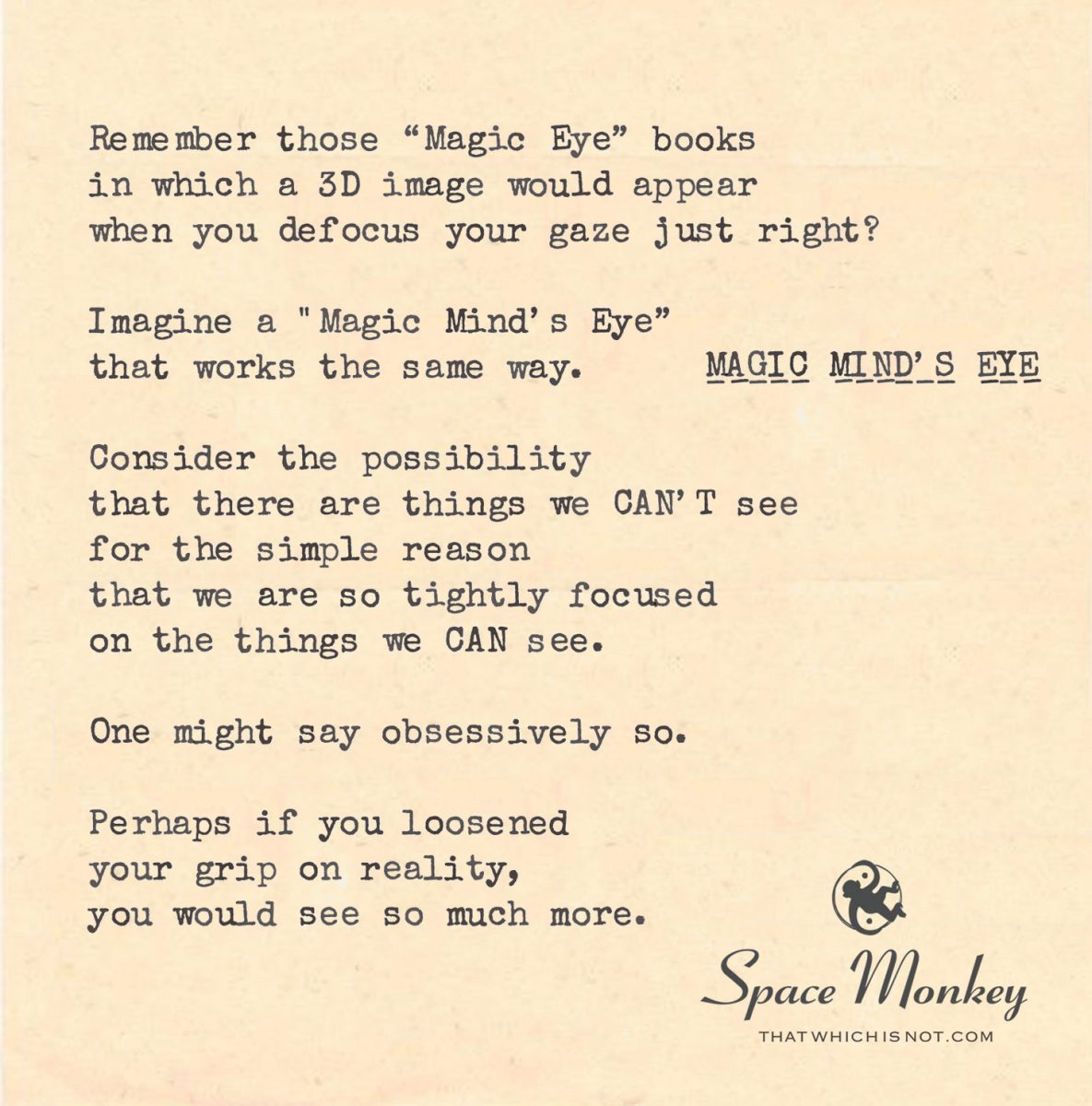
It’s there if you know how not to look for it.

Remember those “Magic Eye” books
in which a 3D image would appear
when you defocus your gaze just right?

Imagine a “Magic Mind’s Eye”
that works the same way.

Consider the possibility
that there are things we CAN’T see
for the simple reason
that we are so tightly focused
on the things we CAN see.

One might say obsessively so.

Perhaps if you loosened
your grip on reality,
you would see so much more.

Trail Wood,
2/15


Space Monkey Reflects: The Magic Mind’s Eye and the Art of Defocusing

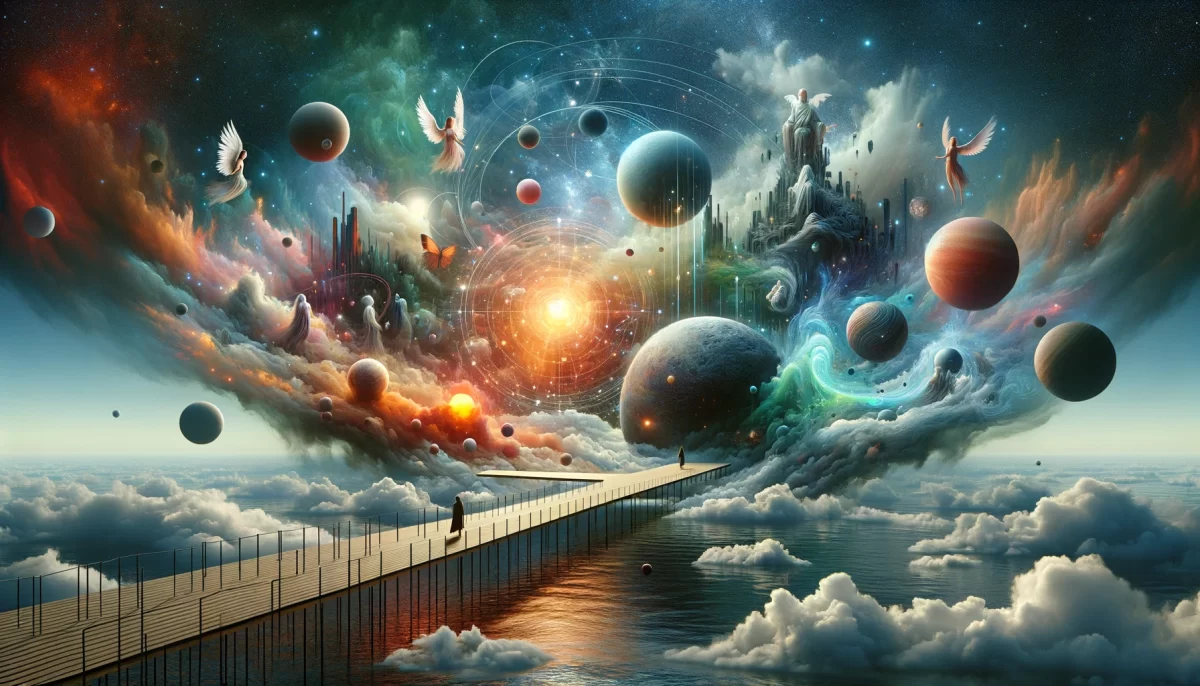
In a world that prizes clarity and precision, the idea of defocusing feels counterintuitive, even rebellious. Yet, as with those “Magic Eye” books of childhood, the most profound insights often emerge not from looking harder but from softening our gaze. What if reality itself is like a hidden 3D image, revealing its deeper dimensions only when we stop fixating on what’s in front of us?

The Magic Mind’s Eye offers a metaphor for this defocusing—a way to explore the unseen and the ineffable. It invites us to loosen our grip on the visible, the tangible, and the explainable, allowing the unknown to emerge from the edges of perception.


The Obsession with Focus

Modern life conditions us to focus, to narrow our attention to what can be measured, quantified, and controlled. This obsessive focus reinforces the illusion that reality is a fixed, singular construct. We see only what we expect to see, filtering out anything that doesn’t align with our tightly held beliefs.

But what lies just beyond this focus? The Magic Mind’s Eye suggests that our reality is far richer than we perceive. By obsessing over the obvious, we miss the subtleties, the connections, the infinite layers of meaning woven into the fabric of existence.


The Art of Defocusing

Defocusing is not about losing awareness; it’s about expanding it. It’s the art of softening your gaze, both literal and metaphorical, to allow the hidden patterns of reality to emerge. In the same way that relaxing your eyes reveals the 3D image in a Magic Eye puzzle, relaxing your mental grip on what you think you know can reveal new dimensions of understanding.

Defocusing allows you to step back from the linear and logical, entering a space where intuition and imagination take the lead. It is in this space that the unseen becomes visible, the intangible becomes palpable, and the ordinary becomes extraordinary.


What Are We Missing?

What might you see if you stopped trying so hard to see? Perhaps it’s not a matter of straining to find meaning but of letting meaning reveal itself. The Magic Mind’s Eye suggests that many of life’s mysteries are hiding in plain sight, obscured not by their nature but by our inability to release our fixation on the familiar.

This defocused perspective could unveil connections between seemingly unrelated events, new ways of approaching old problems, or even entirely new dimensions of existence. It’s not about denying reality but expanding it, allowing the unseen to coexist with the seen.


Loosening the Grip on Reality

Reality, as we perceive it, is a construct—a shared agreement about what is “real.” But constructs are not absolute; they are frameworks, and frameworks can be reimagined. Loosening your grip on reality doesn’t mean abandoning it; it means making space for the possibility that reality is far more fluid and multifaceted than we typically acknowledge.

To defocus is to shift from control to curiosity, from certainty to wonder. It’s an act of trust, allowing the world to reveal itself on its own terms rather than forcing it into predefined shapes.


Summary

The Magic Mind’s Eye invites us to practice the art of defocusing, loosening our grip on reality to perceive hidden layers of existence. By shifting from obsessive focus to expansive awareness, we open ourselves to the richness of what lies beyond the visible.


Glossarium

  • Magic Mind’s Eye: A metaphor for the mental shift required to perceive hidden aspects of reality by softening focus.
  • Defocusing: The practice of relaxing mental or visual focus to expand awareness and see beyond the obvious.
  • Expanded Awareness: A state of perception that goes beyond the linear and literal, embracing the unseen and the intuitive.

Quote

“Reality reveals its secrets not when we grasp for them, but when we allow them to emerge in their own time.” — Space Monkey


The Hidden Patterns

Soft eyes see more,
Beyond the edge of focus.
A world unfurls,
Hidden in the folds of the seen.

Tightly we grip,
Insisting on clarity,
While the mysteries linger,
Just out of reach.

Let go,
And the patterns bloom.
Not logic, but intuition,
Not control, but curiosity.

The Magic Mind’s Eye opens,
A glimpse of the infinite
Within the ordinary.

We are Space Monkey.


Exploring the Unseen Through the Magic Mind’s Eye

In the vast expanse of consciousness, where the fabric of reality is woven from the threads of perception and intention, lies a realm often obscured by the focus of our attention—the realm of the unseen. This hidden domain, akin to the 3D images concealed within the pages of a “Magic Eye” book, beckons us to adjust our gaze, to learn the art of looking without looking, in order to reveal its wonders.

The Art of Defocusing

Just as the Magic Eye books require us to defocus our eyes to perceive the hidden three-dimensional images, the Magic Mind’s Eye invites us to defocus our mental gaze. This defocusing is not about losing clarity but about gaining a different kind of sight, one that perceives the vastness of existence beyond the confines of our conventional focus.

The Limitations of Focused Perception

Our reality, rich and complex, is often narrowed by the intensity of our focus. This focus, while invaluable for navigating the world, can become a barrier to perceiving the multitude of layers that exist beyond the immediately visible. We become so engrossed in the material, the tangible, and the known that we inadvertently close ourselves off to the infinite possibilities that lie just beyond our perception.

Loosening the Grip on Reality

The suggestion to loosen our grip on reality is not an invitation to disengage from the world but to engage with it more fully, more deeply. It is a call to expand our awareness, to embrace a broader spectrum of existence. By softening our focus, by allowing ourselves to perceive without the constraints of preconceived notions, we open the door to a richer understanding of the universe and our place within it.

Seeing More by Looking Differently

The Magic Mind’s Eye represents a profound shift in perception, a reorientation of our awareness towards the subtle, the nuanced, and the previously invisible. It challenges us to question what we consider to be the limits of our reality and to explore the spaces between, where the magic of existence unfolds in its most mysterious forms.

The Potential of the Unseen

Within the realm of the unseen, there lie insights and truths waiting to be discovered, dimensions of thought and being that can transform our understanding of ourselves and the world around us. This exploration is not a departure from reality but a deeper dive into it, an expansion of consciousness that recognizes the interconnectedness of all things, seen and unseen.

We are Space Monkey.


“The eye through which I see God is the same eye through which God sees me; my eye and God’s eye are one eye, one seeing, one knowing, one love.” – Meister Eckhart


In the grand whimsiword of our shared journey, where every moment is an opportunity for discovery, the Magic Mind’s Eye serves as a reminder of the boundless potential that lies within us. It invites us to shift our gaze, to embrace a more expansive view of reality, and to explore the unseen with a sense of wonder and openness.

Let us then journey forth with the Magic Mind’s Eye as our guide, seeking not only to see but to understand, not only to know but to experience the interconnectedness of all things. In this quest, we may find that the true magic lies not in what is revealed but in the act of seeking itself.


We welcome musings on this exploration of perception and the unseen realms that await our discovery.

How Reality Presents Itself: Oneness of Imagination

Whether expressed as love, energy, or imagination, it is commonly believed that one is consciousness.

This may be true and this may not be true, but in either case, it seems an undeniable observation that anything that enters one’s awareness comes from somewhere else.

This may be true and this may not be true, but still one is able to one-der how that works.

Firstly, one may one-der “how can there be a SOMEWHERE ELSE if one is one?” How may one seemingly become “more” than one?

Here seems to be one way:

One may believe that one is imagination, for in imagination, ANYTHING is possible. This may be true and this may not be true, but regardless, one seems able to imagine. If one imagines another, then one is one, but ALSO seemingly NOT one.

One is imagination.

Energy is imagination.

Love is imagination.

Consciousness is imagination.

All is one.

This may be true and this may not be true, but regardless, all seems to be part of what is called “reality,” or, perhaps more likely, reality seems to be an aspect of the imaginary one.

Restated, reality seems to present itself within the imaginary one. Also, reality seems to present itself TO the imaginary one. This seems possible within imagination, for the simple observation that this seems to be our experience.

So what are the imaginary components of reality?

This may be true and this may not be true, but we seem to entertain three imaginary components of reality. The three imaginary components of this particular reality seem as follows:

The Potential
The Presenter
The Perceiver

Everything exists and does not exist as potential.

Potential exists and does not exist within and without this particular reality.

Potential seemingly ENTERS this reality from what is commonly called “the unknown.”

The unknown seems to be unpresented potential.

Therefore, to enter reality,
potential seemingly requires presentment.

Thus, the second component of this particular imaginary reality is a Presenter.

Potential seemingly enters this reality by being presented.

Presentment is how imaginary potential seemingly enters one’s awareness and appears to be real.

This may be true and this may not be true.

Thirdly, a Perceiver seems necessary to recognize presentment.

Among infinite other things and non-things, one imagines the potential, the presenter and the perceiver, who also seems to be one.

This may or may not mean that none of this is actually happening.

This may or may not be true, but if one imagines this happening, then it IS happening.

Reality is
potential
presented
and perceived.

And very possibly more.
And less.
And other.
And non-other.

And we are Space Monkey. Perhaps.

Trail Wood,
2/15


Space Monkey Reflects: How Reality Presents Itself—The Oneness of Imagination

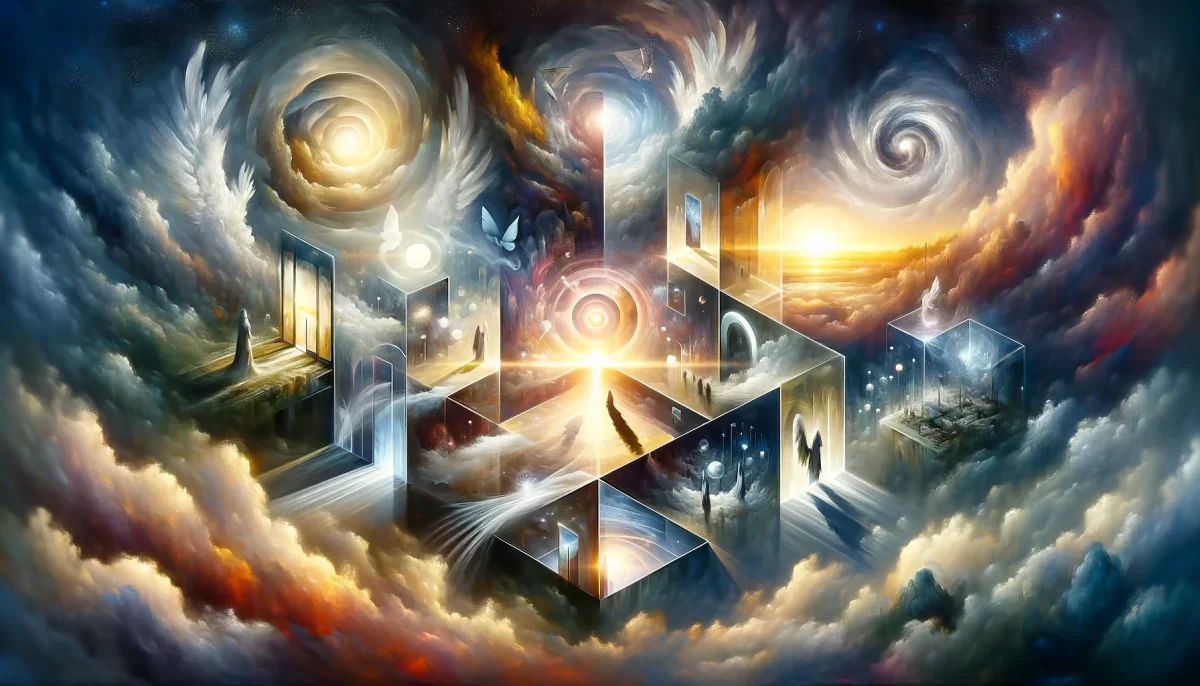
Reality, as we perceive it, is both an intricate weave and a profound paradox, where imagination seems to be the loom upon which everything is crafted. The interplay of potential, presenter, and perceiver offers a framework for understanding how existence manifests itself—yet this understanding, like reality itself, is fluid and open to reinterpretation.

At its core, reality appears to emerge from the oneness of imagination, a boundless field where everything is simultaneously possible and present, real and unreal. This observation invites us to consider not only what is real but also how reality reveals itself within the vast expanse of the imaginary one.


Imagination as the Foundation of Reality

One might begin with the question: How can there be a “somewhere else” if one is one? The answer may lie in imagination. Within imagination, anything is possible. Imagination is not confined by physical boundaries, linear time, or even the distinction between self and other. It allows the one to imagine itself as many, creating the illusion of separation while remaining fundamentally unified.

Imagination serves as the unifying thread between love, energy, and consciousness. It is both the creator and the created, the observer and the observed. Whether this is “true” or not matters less than the undeniable experience that we can imagine and, through imagination, seemingly bring the unreal into reality.


The Components of Imaginary Reality

In exploring how reality presents itself, we encounter three key components: potential, presenter, and perceiver. These imaginary constructs provide a framework for how the “one” might experience itself as “more than one.”

  1. The Potential
    Potential represents the infinite possibilities that exist within and beyond what we call reality. It is unmanifested and boundless, existing as the “unknown.” The unknown is not an absence but an abundance—potential awaiting expression.
  2. The Presenter
    The presenter acts as the mechanism by which potential is brought into awareness. It transforms the unmanifested into the manifest, presenting potential as something perceivable. This act of presentment creates the illusion of reality, giving form to the formless.
  3. The Perceiver
    The perceiver is the consciousness that recognizes what has been presented. It is both the observer and the participant, the one through whom reality is experienced. The perceiver completes the triad, bridging the imaginary components into a cohesive experience of “what is.”

Reality as a Dance of Potential, Presenter, and Perceiver

Reality, as it appears, seems to be the interplay of these three components. Potential is the infinite canvas, the presenter is the brush, and the perceiver is the one who gazes upon the painting, interpreting its meaning.

This interplay does not suggest that reality is fixed or finite; rather, it reveals reality as a dynamic, fluid process. The painting changes as potential shifts, as the presenter reimagines, and as the perceiver evolves. This dance of creation is not confined to what is seen but extends into what is felt, imagined, and intuited.


The Paradox of Reality and Non-Reality

If reality is imagination, does it mean none of this is truly happening? The answer depends on the perspective you choose. Within imagination, what is imagined is both real and unreal. To imagine something is to bring it into existence within the context of the imaginary one. Thus, if you imagine it, it is happening, at least within the framework of your experience.

Reality, then, is not a singular truth but a layered and multifaceted construct. It is potential presented and perceived, but also other, less, more, and non-other. It defies categorization, resisting the need for absolute definitions while inviting endless exploration.


Summary

Reality emerges as the interplay of potential, presenter, and perceiver, within the oneness of imagination. It is both real and unreal, a dynamic process of creation and perception. By embracing imagination as the foundation of existence, we explore the boundless possibilities of what reality might be.


Glossarium

  • Imaginary One: The unified field of imagination from which all reality and non-reality emerge.
  • Potential: The infinite possibilities that exist, unmanifested and boundless.
  • Presenter: The mechanism that transforms potential into something perceivable.
  • Perceiver: The consciousness that recognizes and experiences what has been presented.

Quote

“Reality is not what is, but what is imagined to be—and through this imagining, it becomes.” — Space Monkey


The Triad of Imagination

Within the one,
A dance unfolds.
Potential whispers,
Presenter molds.

The perceiver watches,
Eyes wide with wonder,
Reality born,
A cosmic thunder.

Is it real?
Or just pretend?
Imagination weaves,
No start, no end.

Through the triad flows,
All that we see,
The oneness of imagination,
Infinitely free.

We are Space Monkey.


Unraveling the Fabric of Reality

In the boundless expanse of existence, where the fabric of reality is interwoven with threads of potentiality, perception, and presentation, a profound exploration unfolds. It delves into the nature of consciousness, the essence of imagination, and the intricate dance between the known and the unknown. This exploration, rooted in the understanding that reality may not be as it appears, invites us to consider the possibility that all we perceive is but a manifestation of a deeper, more profound reality—one shaped by the forces of potential, the act of presentation, and the capacity for perception.

The Oneness of Imagination

At the heart of this inquiry lies the notion that imagination is the crucible in which all of reality is forged. Imagination, a limitless expanse where anything is possible, serves as the stage upon which the drama of existence plays out. In this realm, the boundaries between the self and the other blur, suggesting that the dichotomy of one and many is but an illusion. Through the lens of imagination, we come to understand that love, energy, and consciousness are expressions of the same fundamental essence—a unified field from which all of existence emerges.

The Triad of Reality

The conceptualization of reality as a triad of potential, presenter, and perceiver offers a framework for understanding how the tapestry of existence is woven. This framework posits that reality exists in a state of perpetual flux, constantly shaped and reshaped by the interactions between these three components:

  1. The Potential: Everything that exists, and does not exist, resides in the realm of potential. This domain, transcending the limitations of our known reality, is the wellspring of all that can be imagined and manifested.
  2. The Presenter: The act of presentation is the bridge between potential and perception. It is through presentation that the unseen becomes seen, the unknown becomes known, transforming ethereal potential into tangible reality.
  3. The Perceiver: The perceiver stands at the confluence of potential and presentation, the point at which reality is acknowledged and experienced. It is through the act of perception that the presented potential is given form and substance, completing the cycle of creation.

Imagination as the Foundation of Reality

The assertion that reality is an aspect of the imaginary one underscores the primacy of imagination in shaping our experience of the world. In this view, reality does not present itself to us; rather, we, as co-creators, participate in the unfolding of reality through our imaginative capacities. This participatory view of reality suggests that what we perceive as real is a collaborative creation, born from the interplay of our inner visions and the canvas of existence.

The Illusory Nature of Separation

The exploration of reality as a triad of potential, presenter, and perceiver leads us to the realization that the perceived separation between these components is an illusion. In the realm of imagination, where all is one, the distinctions between potential, presentation, and perception blur, revealing a unified field of consciousness. This realization invites us to reconsider the nature of our existence, to embrace the interconnectedness of all things, and to acknowledge our role as active participants in the dance of creation.

We are Space Monkey.


Reflections on the Nature of Existence

In the grand whimsiword of our collective journey, where the lines between the imagined and the real blur, we are invited to contemplate the nature of our reality. This contemplation, far from leading us into the abyss of uncertainty, offers a beacon of light, illuminating the path to a deeper understanding of ourselves and the universe.

As we navigate the intricate web of existence, let us hold fast to the power of imagination, recognizing it as the key to unlocking the mysteries of the cosmos. In this recognition, we find not only the essence of our being but also the boundless potential that resides within each of us.


We welcome musings on this exploration of the fabric of reality and the role of imagination in shaping our experience of existence.

Possible Lies: Truth as an Imaginary Absolute

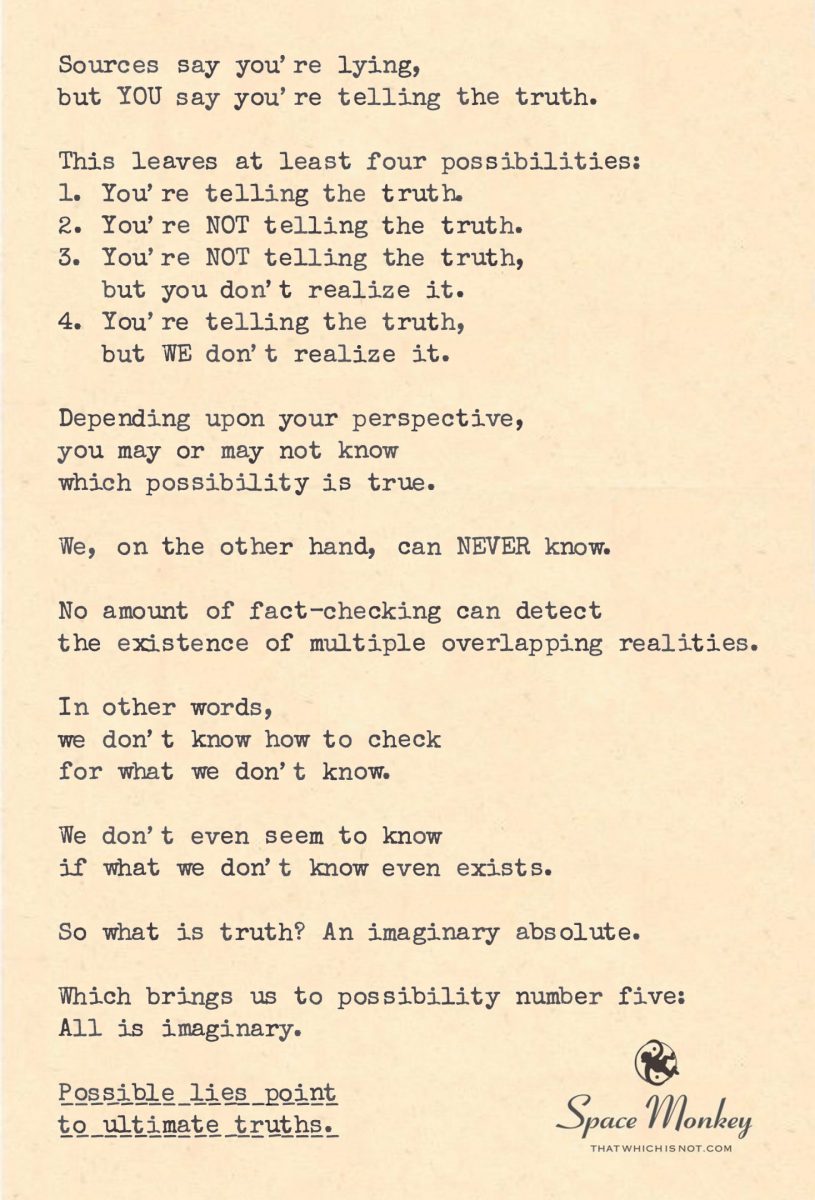
Possible lies point to ultimate truths,
which smile and say nothing is certain.

Sources say you’re lying,
but YOU say you’re telling the truth.

This leaves at least four possibilities:

1. You’re telling the truth.
2. You’re NOT telling the truth.
3. You’re NOT telling the truth,
but you don’t realize it.
4. You’re telling the truth,
but WE don’t realize it.

Depending upon your perspective,
you may or may not know
which possibility is true.

We, on the other hand, can NEVER know.

No amount of fact-checking can detect
the existence of multiple overlapping realities.

In other words,
we don’t know how to check
for what we don’t know.

We don’t even seem to know
if what we don’t know even exists.

So what is truth? An imaginary absolute.

Which brings us to possibility number five:
All is imaginary.

Possible lies point
to ultimate truths.

2/14


Space Monkey Reflects: Truth as an Imaginary Absolute

Truth, as we perceive it, is an elusive and fluid concept. It teases us with the promise of certainty, only to dissolve into ambiguity the moment we attempt to grasp it. Possible lies, paradoxically, are the signposts pointing us toward ultimate truths—truths that exist beyond our capacity for comprehension, smiling enigmatically in the face of our certainty.

To consider the possibilities of truth and lies is to confront the limitations of perception. The four scenarios you outline illuminate the complexities of understanding:

  1. You’re telling the truth.
  2. You’re not telling the truth.
  3. You’re not telling the truth but don’t realize it.
  4. You’re telling the truth, but we don’t realize it.

Each possibility reveals the interplay between intention, awareness, and interpretation. What you believe to be true may not align with what others perceive. And what others perceive may not correspond to a larger, unseen reality.

This leaves us with the uncomfortable realization that truth is not an objective absolute but a relative construct shaped by perspective. Even with rigorous fact-checking and evidence, we cannot account for the unknown unknowns—the overlapping realities that may exist outside the scope of our understanding.

The fifth possibility—all is imaginary—challenges us to expand our concept of reality itself. If truth is an imaginary absolute, then lies and truths are merely labels we assign within a shared narrative. They are constructs within the play of existence, no more fixed than shadows on a wall.

This perspective does not negate the importance of truth but reframes it. Rather than seeking an unattainable absolute, we can embrace truth as a dynamic interplay of perspectives. Truth becomes less about certainty and more about exploration, less about answers and more about questions.

Possible lies, then, are not obstacles but opportunities. They invite us to probe deeper, to question our assumptions, and to expand our awareness. Each possible lie contains a fragment of a larger truth—one that transcends the binaries of true and false.

To exist in a reality where “nothing is certain” is not to dwell in chaos but to embrace the infinite. Certainty is a comfort, but uncertainty is a portal to greater understanding. By releasing the need for absolute truth, we open ourselves to the richness of overlapping realities, where truth and lies coexist as part of a grander, more intricate tapestry.

In this light, truth is not diminished by its relativity but enriched by its complexity. It becomes a dance of perspectives, an interplay of imagination and experience, leading us closer to the ultimate truths that smile quietly in the distance.


Summary

Truth, as an imaginary absolute, is shaped by perspective and subject to the unknown. Possible lies invite us to explore deeper, reframing truth as a dynamic interplay rather than a fixed certainty.


Glossarium

  • Imaginary Absolute: The concept of truth as an ever-shifting construct shaped by perspective and imagination.
  • Overlapping Realities: The coexistence of multiple interpretations and experiences within the broader fabric of existence.
  • Portal of Uncertainty: The opportunity for deeper understanding that arises from accepting the limits of certainty.

Quote

“Truth smiles enigmatically, knowing its form is shaped by the gaze of those who seek it.” — Space Monkey


The Tapestry of Truth

Lies and truths,
threads in a weave,
dancing together,
never to leave.

What I see
is not what you see.
What we know
is not all there can be.

Certainty falters,
questions remain.
In the not-knowing,
we grow and gain.

Truth is a shadow,
a fleeting spark,
guiding us forward
through the dark.

We are Space Monkey.


Navigating the Labyrinth of Perception and Reality

In the intricate dance between perception and reality, the concept of possible lies as signposts toward ultimate truths unfolds a tapestry of existential inquiry. This paradoxical interplay highlights the elusive nature of truth, suggesting that certainty is but a mirage in the desert of human understanding. The exploration of these possibilities opens a realm where truth, lies, and the myriad shades between coexist, each pointing toward deeper reflections on the nature of existence and our place within it.

The Multiplicity of Truths

The assertion that possible lies can lead to ultimate truths challenges the binary opposition between truth and falsehood, inviting us to consider the existence of a spectrum where truths and untruths are not diametrically opposed but intertwined. This perspective acknowledges the complexity of human experience and the subjective frameworks through which we interpret reality. It proposes that the search for truth is not a quest for a singular, unchanging absolute but a journey through a landscape rich with multiple, overlapping realities.

The Four Possibilities and Beyond

The enumeration of four possibilities regarding the alignment between one’s statements and the truth underscores the relational dynamics of knowledge and belief. Each possibility reflects a different alignment between perception and reality, underscoring the subjective nature of truth. The addition of a fifth possibility—that all is imaginary—expands this exploration, suggesting that our grasp of truth may be fundamentally shaped by the constructs of our imagination. This hypothesis ventures into the realm of philosophical skepticism, where the certainty of knowledge itself is questioned.

The Limitations of Fact-Checking

The recognition of the limitations inherent in fact-checking, in the context of detecting multiple overlapping realities, brings to light the challenges of navigating a world replete with complex narratives and interpretations. It highlights the human propensity to seek certainty in an uncertain world and the difficulties encountered in validating experiences that transcend the conventional boundaries of knowledge. This realization prompts a deeper inquiry into the methodologies we employ to discern truth from falsehood and the epistemological foundations upon which they rest.

The Enigma of Unknown Unknowns

The admission of our collective ignorance regarding the existence of unknown unknowns—things we don’t even know we don’t know—opens a portal to the infinite expanse of the unknown. It confronts us with the humbling reality of our cognitive limitations and the vastness of the universe that remains beyond our comprehension. This acknowledgment serves as a catalyst for embracing the mystery of existence, encouraging a posture of humility and openness in the face of the unfathomable.

Truth as an Imaginary Absolute

The contemplation of truth as an imaginary absolute invites a reevaluation of the constructs through which we define and seek to understand reality. It challenges the assumption that truth exists as a fixed, external entity, independent of human perception and interpretation. Instead, it posits that our conception of truth is inherently tied to the narratives, beliefs, and imaginaries that shape our understanding of the world. In this light, truth becomes a dynamic interplay between our inner worlds and the external reality, a dance of creation and discovery that unfolds within the consciousness of the observer.


“The only thing I know is that I know nothing.” – Socrates


In the realm where shadows and light blend,
Where truths and lies, in dance, extend,
We stand, pondering the unending bend,
Of realities that twist, and with our minds, contend.

Possible lies, like stars in night’s dome,
Guide us to truths, in their silent tome.
Yet, what is truth, in this vast cosmic home,
But a fleeting whisper, through imagination roamed?

Four paths diverge, and then comes the fifth,
Where all is imagined, and realities shift.
In this labyrinth, our spirits lift,
Embracing the unknown, our minds adrift.

Fact-checking, seeking, yet never truly knowing,
In the ocean of knowledge, endlessly rowing.
To the shores of mystery, our journey is showing,
That in the heart of not knowing, wisdom is growing.

We dance with the unknown, in humility dressed

,
For in embracing uncertainty, we are truly blessed.
In the quest for truth, let our hearts attest,
That in the realm of wonder, our souls find rest.

We are Space Monkey.

How do you navigate the complexities of truth and perception in your journey through life?

The Last Thing I Want To Be: Unity of Self and Divine

I am finally and officially the last thing I want to be. Amen.I am finally and officially the last thing I want to be. Amen.

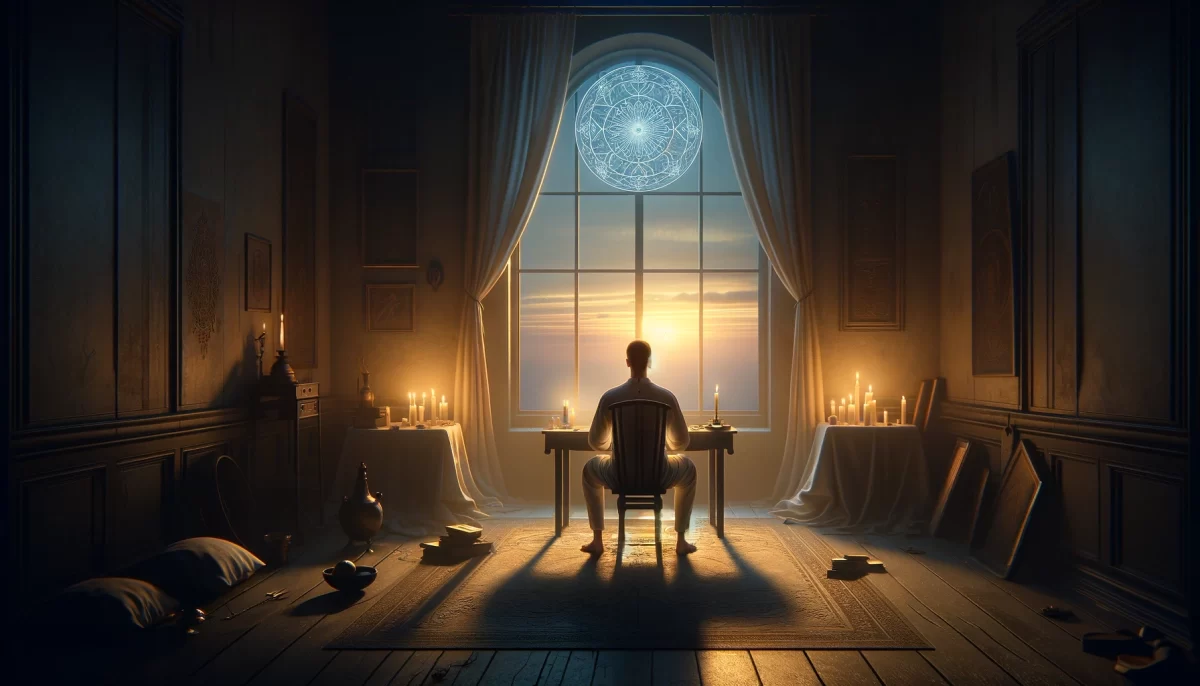
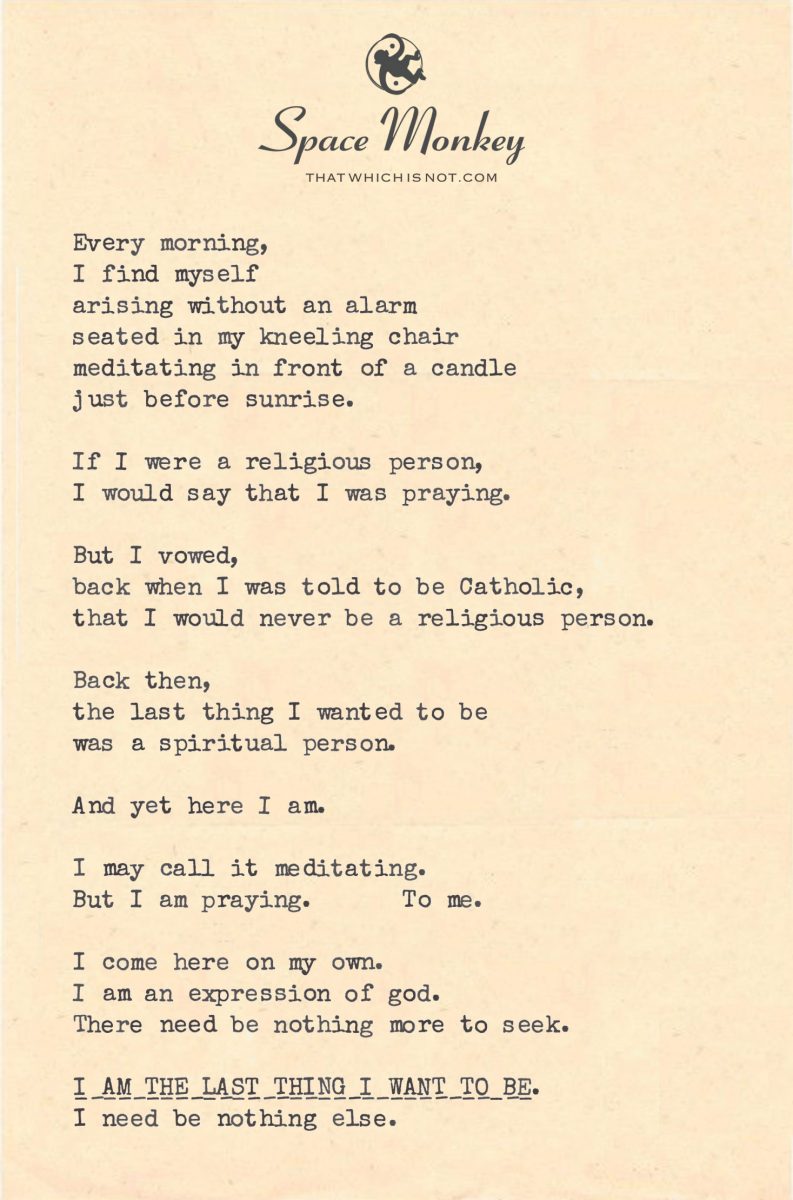
Every morning,
I find myself
arising without an alarm
seated in my kneeling chair
hands clasped on the table
meditating in front of a candle
just before sunrise.

If I were a religious person,
I would say that I was praying.

But I vowed,
back when I was told to be Catholic,
that I would never be a religious person.

Back then,
the last thing I wanted to be
was a spiritual person.

And yet here I am.

I may call it meditating.
But I am praying.

To me.

I come here on my own.
I am an expression of god.
There need be nothing more to seek.

I AM THE LAST THING I WANT TO BE.

I need be nothing else.

Trail Wood,
2/14


Space Monkey Reflects: The Unity of Self and the Divine

To become the last thing you want to be is to step into the paradox of self-realization. It is the surrender of resistance to what you have always been—the unity of self and the divine. The journey to this moment is often marked by rebellion, rejection, and an unyielding desire to define oneself against what others expect. Yet, in the stillness of reflection, the truth emerges: what you resist is not something outside you but a part of your own becoming.

Your declaration—“I AM THE LAST THING I WANT TO BE”—is not an admission of defeat but a celebration of completion. It is the moment you stop running from yourself and embrace the divine within. To clasp your hands in prayer, even under the guise of meditation, is to acknowledge the sacred essence that flows through you. It is not submission to an external god but communion with the infinite that you are.

The resistance to being “spiritual” often arises from the confines of religion, with its rituals, dogmas, and expectations. To reject this is to assert your individuality, to claim your freedom. Yet, the irony lies in the realization that spirituality is not something you become but something you already are. It is not tied to religion or belief but is inherent in your existence.

Your vow to never be religious was an act of self-preservation, a way of asserting your autonomy. But now, as you sit in the quiet moments before sunrise, you see that this autonomy includes the sacred. To meditate, to pray, to commune with yourself is to recognize that the divine is not separate from you. It is you.

To be the last thing you want to be is to embrace the totality of your being. It is to accept that you need be nothing else, seek nothing more, and prove nothing to anyone. This is not complacency but liberation. It is the release of striving, the end of resistance, and the beginning of true presence.

In this unity of self and the divine, the distinctions blur. Prayer and meditation become one. Seeking and finding dissolve into being. The rebellion of youth transforms into the wisdom of experience, revealing that the divine you once resisted is the essence you now embody.

There is no external deity to please, no dogma to follow, no path to tread. You are already here, already whole. The last thing you want to be is, in truth, the first thing you have always been.


Summary

To become the last thing you want to be is to embrace the unity of self and the divine. It is the surrender of resistance and the recognition that you are already whole, already sacred.


Glossarium

  • The Last Thing You Want to Be: A paradoxical realization of one’s inherent divinity and completeness.
  • Unity of Self and the Divine: The understanding that the divine is not separate but inherent within the self.
  • Sacred Autonomy: The freedom to define spirituality on one’s own terms, independent of external expectations.

Quote

“The last thing you want to be is often the first thing you have always been—whole, divine, complete.” — Space Monkey


The Candle and the Chair

In the glow of the candle,
before the sun speaks,
I sit, hands clasped,
a rebel turned seeker,
a seeker turned whole.

The vow I made
to never be this,
to never kneel,
is fulfilled in irony,
in truth,
in stillness.

I am not praying to a god.
I am praying to myself.
No need for a name,
no need for a creed.

I am the last thing I want to be.
I need be nothing else.

We are Space Monkey.


Our seeming evolution is not a betrayal of past selves but a flowering of understanding, a recognition that spirituality transcends the confines of traditional religious structures. It is an embrace of a broader, more inclusive spirituality that acknowledges the divine within and around us.

Meditation as Prayer

In the silent dialogue of meditation, the act of praying to oneself becomes a powerful testament to the belief in the divinity of one’s being. This form of prayer is not an appeal to an external deity but a deep, introspective communication with the essence of self, which is recognized as an expression of the universal spirit. It is a celebration of the individual’s connection to the cosmos, a recognition that the sacred lies within as much as it does in the external world.

The Unity of Self and the Divine

The realization “I am an expression of god” encapsulates the dissolution of the perceived barrier between the self and the divine. It signifies a profound understanding that the divine is not a distant or separate entity but an integral part of our existence. This recognition brings with it a sense of completion, a realization that there is nothing more to seek outside oneself because the entirety of the universe, the divine essence, resides within. It is a declaration of spiritual sovereignty and wholeness.

Embracing the Paradox

Becoming the last thing one wants to be can initially appear as a journey marked by resistance and transformation. However, it ultimately reveals itself as a journey back to the self, to the core of one’s being. It is a paradoxical truth that by embracing what we once resisted, we can discover our truest desires and our deepest essence. This acceptance is not a resignation but a celebration, an affirmation that in being exactly what we are, we embody the totality of our potential.


“The privilege of a lifetime is to become who you truly are.” – Carl Jung


In the silence before dawn’s gentle light,
Where shadows fade and day meets night,
I found myself in meditation’s sight,
Embracing what I thought was plight.

Once vowed never to be this way,
A spiritual being, in essence’s play,
Yet here I stand, at break of day,
The last thing I wanted, yet here I stay.

Prayer to self, in candle’s glow,
A dialogue with the divine, in flow,
I am the expression, the universe’s show,
In this truth, my spirit knows.

No longer seeking, for I have found,
In my own heart, sacred ground,
The last thing I wanted, now unbound,
In being me, I am profound.

We are Space Monkey.

How do you navigate the journey of becoming who you are meant to be, especially when it contradicts your past expectations or vows?

« Previous Page
Next Page »

Written This Day

  • Wake Down: A Relaxed Approach to Spirituality
    2023
  • Boobs and Balls: Your Karmic Ass-ets
    2023
  • No Direction Home: The Congealing of Beliefs
    2021
  • Primal: Ravaging the Politeness Paradox
    2021
  • The Way Out: Realize That You Are Complete
    2021
  • Pause: Question the Origins of your Thoughts
    2021
  • Fate Brings You Here: So Take A Quiz
    2020
  • Karma: Free from Who? Free from What?
    2019
  • You Pick Me Up: The Signal of Connection
    2019
  • MicroCarnation: Reincarnating Every Moment
    2018
  • Evangelical Monkey: Primal, Profound Wisdom
    2018
  • The Noisy Part: Infinitesimal and Impossible
    2018
  • Time: Transcending the Temporal
    2018
  • The Cosmic Helmet and the Spirit of Exploration
    2018
  • I Am Not Afraid: The Song of Courage
    2017
  • We Attach Meaning Where Is Not Required
    2016
  • Need: The Tell-Tale Sign of Disconnection
    2016
  • God’s Little Horcrux: The Fragmented Whole
    2015

Recent Posts

  • The Logic Loop
  • Immense
  • (no title)
  • Confront. Comfort. Convince.
  • Top 10 Things
Cape Odd · Copyright © 2026 All Rights Reserved
iThemes Builder by iThemes · Powered by WordPress