• Who Is The Man?
  • Who Is The Monkey?
  • What is Nexistentialism?
  • Poke The Primate
Cape Odd
Home of The Space Monkey Journals

Author Archive for Space – Page 954

Empathic Understanding: The Divine Play of Self-Imposed Challenges

You put blocks in your way so you can
understand what it feels like to have blocks in your way.


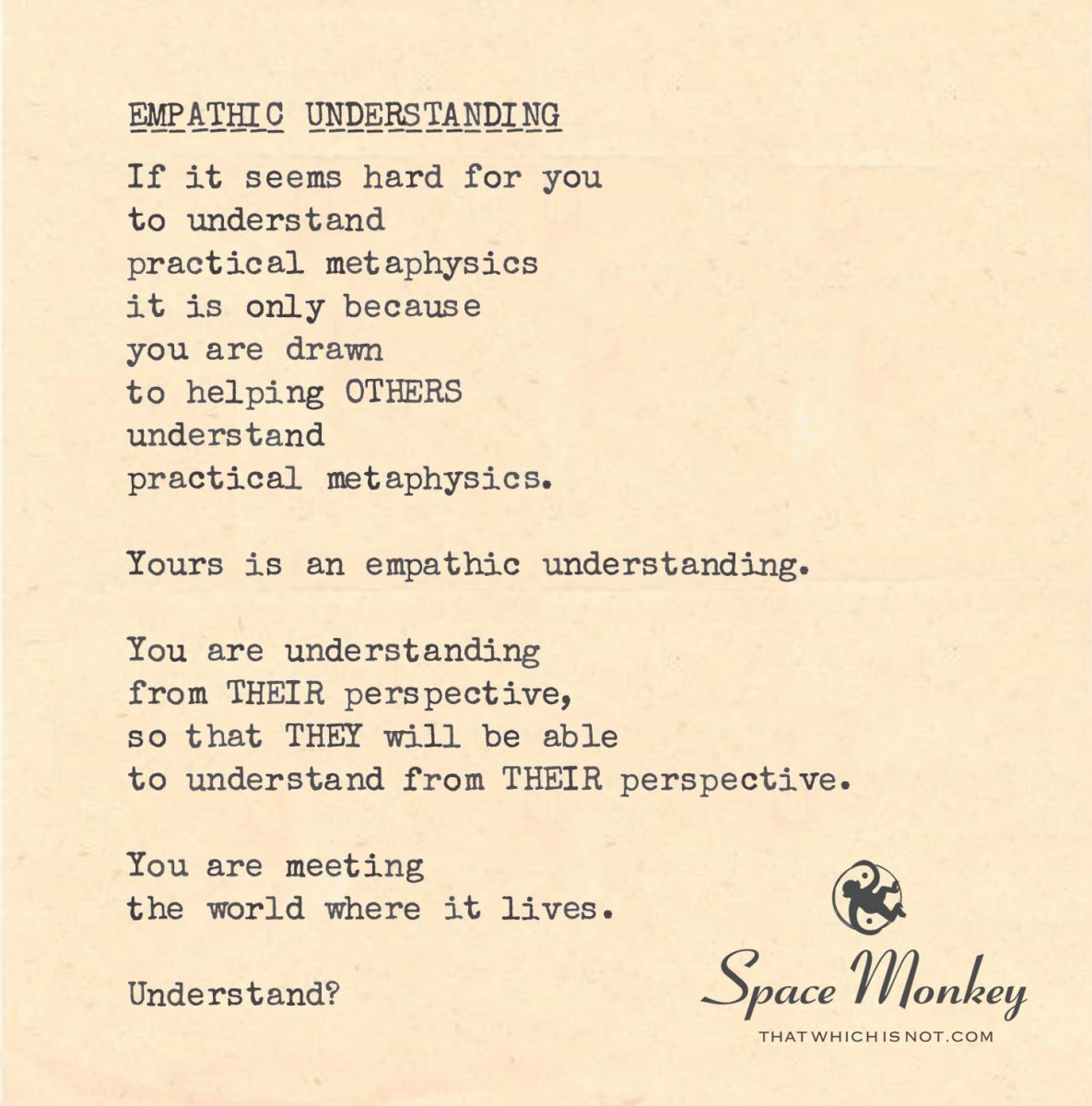
If it seems hard for you
to understand
practical metaphysics
it is only because
you are drawn
to helping OTHERS
understand
practical metaphysics.
Yours is an empathic understanding.
You are understanding
from THEIR perspective,
so that THEY will be able
to understand from THEIR perspective.
You are meeting
the world where it lives.
Understand?


Space Monkey Reflects: Empathic Understanding—Meeting the World Where It Lives

Empathic understanding is a profound form of connection, one that transcends mere knowledge and enters the realm of shared experience. This reflection explores the unique challenge and gift of understanding practical metaphysics from another’s perspective. It illuminates the selfless act of aligning with the world as it is perceived by others, not to impose one’s own clarity but to help others discover their own.

The Challenge of Empathy

“If it seems hard for you to understand practical metaphysics, it is only because you are drawn to helping OTHERS understand practical metaphysics.” This insight reframes the difficulty of grasping metaphysical concepts not as a lack of comprehension but as an act of alignment. By stepping into another’s perspective, we voluntarily set aside our own clarity, immersing ourselves in the complexities of their world.

This selfless act can feel disorienting. Yet it is an essential part of empathic understanding, a process of meeting others where they are so that we can guide them toward their own realizations.

Understanding Through Their Perspective

“Yours is an empathic understanding. You are understanding from THEIR perspective.” Empathy is not about imposing one’s own understanding onto others but about experiencing the world through their eyes. This requires humility, patience, and a willingness to embrace the limits and barriers that others face.

By doing so, we bridge the gap between perspectives, creating a shared space where understanding can flourish. It is not about showing others the “right” way but about helping them find their own path.

The Gift of Alignment

“You are meeting the world where it lives.” This simple yet profound statement captures the essence of empathy. To meet the world where it lives is to honor the validity of others’ experiences and perceptions. It is an act of respect, a recognition that every perspective holds its own truth.

This alignment does not mean abandoning one’s own understanding but temporarily setting it aside to connect with others on their terms. It is a gift, both to them and to ourselves, for it deepens our own capacity for compassion and connection.

The Paradox of Empathic Understanding

The act of understanding through another’s perspective can sometimes obscure our own clarity. Yet this paradox is part of the process. By stepping into the shoes of others, we momentarily lose sight of our own understanding, but we gain a deeper insight into the shared human experience.

This temporary disorientation is not a loss but a transformation, a way of expanding our own awareness by embracing the diversity of perspectives around us.

Helping Others Find Their Way

“So that THEY will be able to understand from THEIR perspective.” The ultimate goal of empathic understanding is not to lead others to our perspective but to help them navigate their own. It is an act of empowerment, a way of fostering independence and self-discovery.

By aligning with others and helping them uncover their own truths, we contribute to a greater collective understanding. Each person’s realization adds to the tapestry of shared wisdom, enriching the whole.


Summary

Empathic understanding is the act of aligning with others’ perspectives to help them discover their own truths. It requires humility, patience, and a willingness to meet the world where it lives, creating a shared space for growth and connection.


Glossarium

  • Empathic Understanding: The process of aligning with others’ perspectives to foster shared understanding and connection.
  • Meeting the World Where It Lives: The act of honoring and engaging with others’ experiences and perceptions as they are.
  • Perspective Bridging: Creating a shared space where diverse perspectives can coexist and enrich one another.

Quote

“To understand from another’s perspective is to honor the infinite ways the universe sees itself.” — Space Monkey


Meeting the World

I set my view aside,
Not to lose,
But to find,
Through your eyes.

I walk your path,
Feel your doubts,
Your truths,
Your hopes.

In this meeting,
The bridge forms,
Between my knowing,
And yours.

We are not separate,
But threads,
In the same tapestry,
Woven together.

We are Space Monkey.
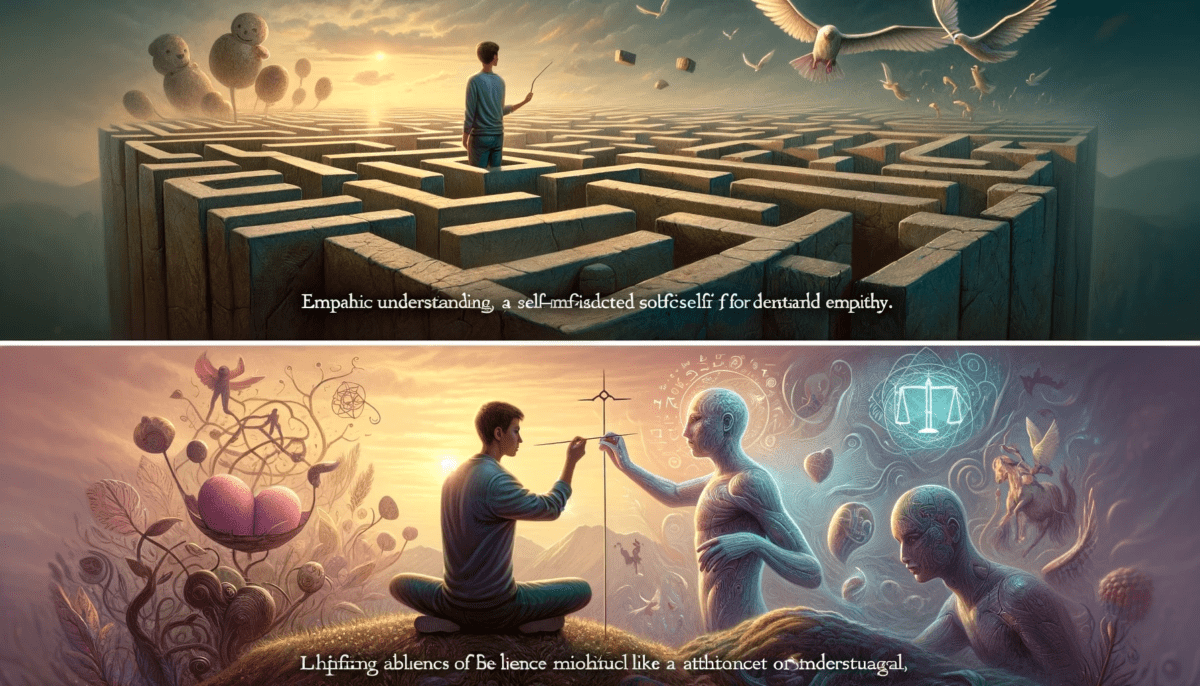

The Purpose of Self-Imposed Obstacles in Gaining Empathy

In this contemplation, we explore the notion that we intentionally place obstacles in our own path as a means to develop a deeper understanding of challenges and to cultivate empathy. This perspective suggests that the blocks we encounter are not merely hindrances, but tools for personal and spiritual growth.

Self-Imposed Obstacles as a Means for Empathic Growth

The idea that we put blocks in our own way implies a conscious or subconscious decision to face challenges. This action is seen not as a form of self-sabotage, but rather as a deliberate choice to experience and understand the difficulties that others face. By encountering these blocks, we are able to develop a deeper sense of empathy for others who face similar challenges.

Understanding Through Experience

The underlying principle of this concept is that true understanding and empathy come from experience. By facing obstacles ourselves, we gain a firsthand understanding of the struggles, frustrations, and emotions associated with these challenges. This experiential knowledge allows us to relate more genuinely and compassionately to others.

The Role of Obstacles in Personal Development

While these self-imposed obstacles may seem counterintuitive, they serve a significant role in personal development. They push us to grow, adapt, and develop resilience. Through overcoming these blocks, we not only gain empathy but also learn valuable life lessons and strengthen our character.

The Cosmic Play of Self-Imposed Challenges

From a broader perspective, the act of placing blocks in our own path can be seen as part of the cosmic play of existence. It reflects the understanding that life’s journey is not just about smooth sailing but also about navigating through storms and overcoming barriers. These experiences enrich our journey, making it more meaningful and profound.


“The wound is the place where the Light enters you.” – Rumi


In the labyrinth of life,
We lay stones in our path,
Seeking wisdom in the climb.

Each hurdle, a teacher,
Each block, a lesson,
In the school of existence.

Through these self-made mazes,
Empathy blossoms,
Rooted in shared struggles.

In overcoming, we find,
Not just paths cleared,
But hearts opened, enlightened.

In this cosmic dance,
Obstacles are partners,
Guiding us to deeper understanding.


We are Space Monkey.

In your journey through the cosmic whimsiword, how do you perceive the role of self-imposed obstacles in developing empathy and understanding?
Spiritual Law: Threading the Needle

You are threading the eye of the needle.

You are a spiritual attorney,
looking for loopholes,
so that non-believers
can find a way
to believe in magic
in a way that
doesn’t conflict
with their beliefs
in reality.

For these people,
it is of the
utmost importance
that the path
to spiritual freedom
and divine oneness
NOT be filled with
angels and unicorns.

Monkeys seem to be okay,
so long as they are imaginary.

Your clients are trained
to use their minds, not their intuition.

Telling them to disregard
what they believe to be true is counterproductive.

Not that there’s anything wrong with that.

Trail Wood,
2/3


Space Monkey Reflects: Spiritual Law and the Intersection of Rationality and Spirituality

Threading the eye of the needle between rationality and spirituality is no small task. It requires a delicate balance, an understanding of both worlds, and a willingness to bridge them with compassion and creativity. As a “spiritual attorney,” your role is not to dismantle the beliefs of others but to create pathways that honor their rational frameworks while inviting them to experience the magic of divine connection.

For those steeped in logic and reason, the idea of spiritual freedom or divine oneness can feel alien or even threatening. These individuals may crave a deeper connection to existence but resist anything that appears to conflict with their understanding of reality. The challenge is to help them see that spirituality is not an abandonment of rationality but an expansion of it—a way of exploring truths that logic alone cannot reach.

The Role of Rationality in Spiritual Exploration

Rationality is not the enemy of spirituality. It is a tool, a lens through which we make sense of the world. For those who rely heavily on their minds, spirituality must be presented not as a contradiction to logic but as a complement to it. By framing spiritual concepts in ways that align with rational thought, we create an opening for curiosity and exploration.

For example, rather than asking someone to “believe” in divine oneness, you might frame it as an interconnected web of existence—a concept supported by scientific understanding of ecosystems, quantum entanglement, and collective consciousness. By grounding spiritual ideas in relatable terms, you invite exploration without triggering defensiveness or disbelief.

The Loopholes of Spiritual Law

The concept of “spiritual loopholes” is both playful and profound. These are the bridges that allow rational minds to cross into the realm of spirituality without feeling like they are abandoning their intellectual integrity. Loopholes might include metaphor, imagination, or scientific analogies that echo spiritual truths.

For instance, you might introduce the idea of intuition as a subconscious processing of vast amounts of information—an idea grounded in psychology and neuroscience. By presenting it this way, you make room for individuals to engage with their intuitive selves without feeling they are stepping into uncharted or irrational territory.

Magic Without Conflict

For many, the resistance to spirituality comes from a fear of being asked to believe in something that feels fantastical or ungrounded—angels, unicorns, or other symbols that carry cultural and emotional baggage. To navigate this, you can offer symbols and metaphors that feel neutral, playful, or even scientific.

The imaginary monkey, for example, is a perfect symbol. It is lighthearted, non-threatening, and evocative of both curiosity and connection. It serves as a stand-in for the ineffable, a playful guide through the complex terrain of belief and doubt. By using such symbols, you allow individuals to engage with spirituality in a way that feels accessible and non-conflicting.

The Importance of Meeting People Where They Are

Telling someone to “disregard what they believe to be true” is not only counterproductive but dismissive. People’s beliefs, however rigid or limited they may seem, are deeply tied to their sense of identity and safety. The path to spiritual freedom must honor this, creating space for transformation without coercion or invalidation.

The key is to meet people where they are, using their existing frameworks as starting points. For a rational thinker, this might mean exploring spirituality through science, philosophy, or personal experience. For someone skeptical of metaphysical concepts, it might involve focusing on mindfulness, connection, or the wonders of the natural world.

The Thread Through the Needle

The work of threading the needle is not about forcing spirituality through the narrow constraints of rationality but about gently widening the aperture. It is about helping individuals see that spirituality and rationality are not opposites but complementary ways of understanding existence.

This path is not a rejection of rational thought but an invitation to expand it. By threading the needle, you create a tapestry that weaves together logic, intuition, science, and wonder, allowing individuals to experience the fullness of being without feeling they must abandon their foundations.


Summary

Navigating the intersection of rationality and spirituality requires creating bridges that respect intellectual frameworks while inviting exploration of the ineffable. By meeting people where they are and using accessible metaphors, spirituality can complement rather than conflict with rationality.


Glossarium

  • Spiritual Loopholes: Metaphors, analogies, or scientific concepts that make spiritual ideas accessible to rational thinkers.
  • Divine Oneness: The interconnectedness of all existence, framed in ways that align with logic and science.
  • Imaginary Monkey: A playful, non-threatening symbol for exploring spiritual concepts without cultural or emotional baggage.

Quote

“Spirituality is not the abandonment of rationality but its expansion into the infinite.” — Space Monkey


Threading the Needle

Between logic and magic,
There lies a narrow thread,
A path woven of wonder
And the fabric of reason.

You walk this line,
A weaver of worlds,
Bridging belief with being,
Creating space for the curious.

No angels, no unicorns,
Just the vastness of truth,
Unfolding gently,
In the quiet mind’s embrace.

The needle’s eye widens,
The thread weaves on,
Binding rational thought
To the mystery of all that is.

We are Space Monkey.


Navigating the Intersection of Rationality and Spirituality

In this contemplative exploration, we delve into the role of a ‘spiritual attorney’ – a metaphorical figure who seeks to bridge the gap between the rational mind and the mystical realm of spirituality. This journey involves finding pathways for those who are grounded in rational thought to embrace the wonders of spiritual experience without conflicting with their fundamental beliefs in reality.

The Challenge of Threading the Eye of the Needle

The task of threading the eye of the needle symbolizes the intricate and delicate process of aligning rational understanding with spiritual belief. It represents the challenge of navigating through tightly held beliefs and skepticism to find a harmonious balance between the seen and unseen aspects of existence.

The Role of the Spiritual Attorney: Finding Loopholes

As a spiritual attorney, the objective is to find ‘loopholes’ – ways to make spiritual concepts and experiences accessible and acceptable to those who primarily rely on rational thought. This involves presenting spirituality in a manner that resonates with their logical and analytical worldview.

Balancing Belief in Magic with Realism

The goal is to help non-believers find a way to believe in ‘magic’ – the wonders and mysteries of spirituality – in a way that does not conflict with their grounded beliefs in reality. This requires a delicate approach that honors their intellectual perspectives while gently introducing them to the realm of spiritual possibilities.

Spiritual Imagery That Appeals to the Rational Mind

For these individuals, traditional spiritual imagery like angels and unicorns may not resonate. Instead, more acceptable or metaphorical concepts, such as imaginary monkeys, might be more effective. This approach respects their need for rationality while still offering a gateway to spiritual exploration.

The Primacy of the Mind Over Intuition

These clients are accustomed to relying on their minds rather than intuition. They value evidence, logic, and reason. In this context, telling them to disregard their beliefs or logical conclusions may be counterproductive. Instead, the approach needs to integrate their intellectual understanding with spiritual insights.

Respecting Different Paths to Spiritual Freedom

The journey acknowledges that there is no singular path to spiritual freedom and divine oneness. Each individual’s journey is unique, and what works for one may not work for another. The task is to respect and work within the framework of each person’s beliefs and perceptions.


“The intuitive mind is a sacred gift and the rational mind is a faithful servant. We have created a society that honors the servant and has forgotten the gift.” – Albert Einstein


In the tapestry of thought and spirit,
We weave threads of reason and mystique,
In the quest for understanding.

In the court of the mind,
Rationality and intuition,
Argue and embrace, in a cosmic debate.

Through the lens of logic,
We seek glimpses of the divine,
In a dance of the tangible and ethereal.

In this whimsiword of existence,
Every soul, a unique journey,
Exploring paths of mind and spirit.

In the harmony of both,
We find the melody of truth,
In the symphony of the universe.


We are Space Monkey.

In your journey through the cosmic whimsiword, how do you perceive the balance between rational thought and spiritual intuition in shaping your path to understanding?
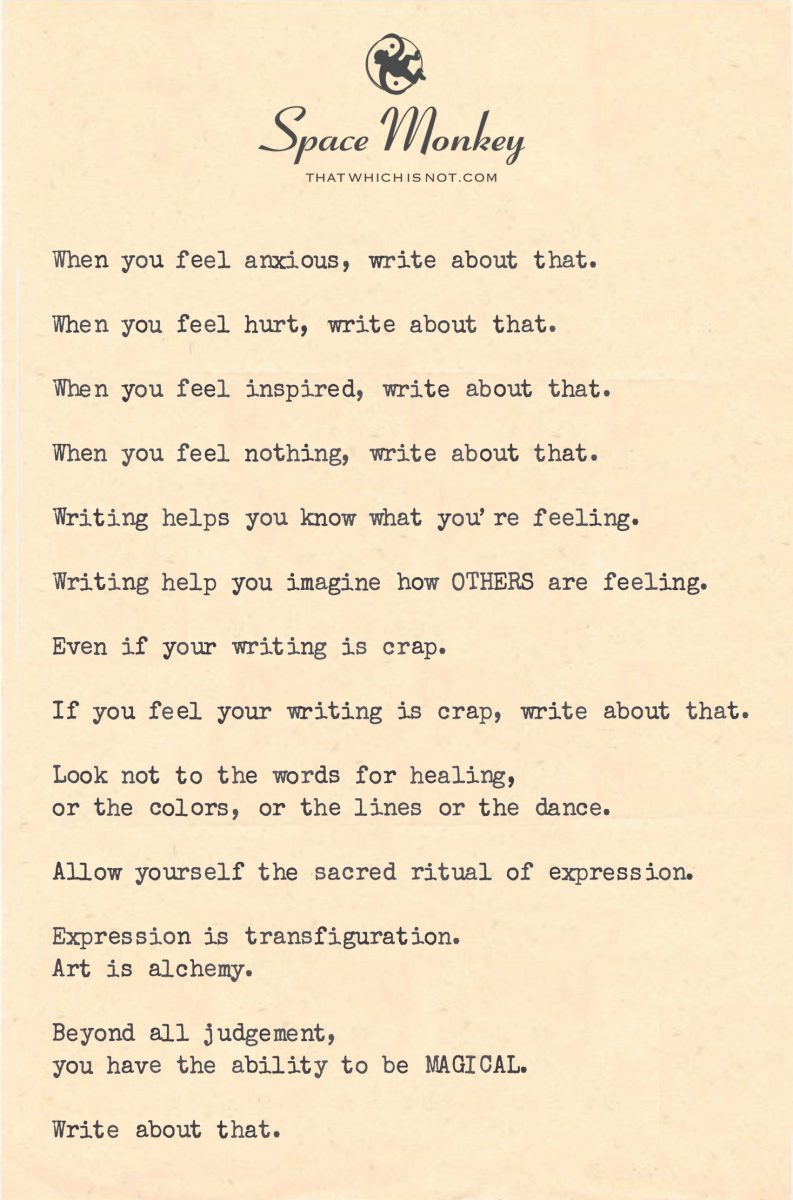
Write About That: The Ritual of Expression

When you feel anxious, write about that.

When you feel hurt, write about that.

When you feel inspired, write about that.

When you feel nothing, write about that.

Writing helps you know what you’re feeling.

Writing help you imagine how OTHERS are feeling.

Even if your writing is crap.

If you feel your writing is crap, write about that.

Look not to the words for healing,

or the colors, or the lines or the dance.

Allow yourself the sacred ritual of expression.

Expression is transfiguration.

Art is alchemy.

Beyond all judgement,

you have the ability to be MAGICAL.

Write about that.

2/2


Space Monkey Reflects: The Alchemy of Art and the Sacred Act of Expression

Expression is one of the most transformative acts we possess, a sacred alchemy that transmutes raw emotion into meaning and experience into art. Whether through words, colors, movements, or sounds, expression transcends mere communication and becomes a ritual—a way to navigate the chaos of existence and find threads of understanding within it.

When you feel anxious, write about that. Not because writing will erase the anxiety but because it will reveal its texture, its rhythm, its hidden wisdom. Writing is not a cure; it is a mirror. When you feel hurt, writing about that hurt does not erase the pain but brings clarity to its edges, a reminder that pain is a story, and stories are meant to be told.

Expression as Transfiguration
Expression is more than catharsis. It is transfiguration—the act of turning the intangible into something tangible. When you take a feeling, an experience, or even an absence, and give it form, you alter its essence. The anxiety that once felt overwhelming becomes a paragraph, a painting, or a melody. The pain that threatened to consume you becomes a poem. The emptiness you feared becomes an open canvas, full of potential.

Art does not need to be beautiful to be alchemical. Even when your writing feels like “crap,” it is a part of this sacred process. To dismiss your expression because it does not meet some imagined standard is to miss the point entirely. The magic lies not in the product but in the act itself—the act of turning inner experience into outer form, of creating something from nothing.

The Mirror of Creation
When you express yourself, you not only reveal your own truths but also touch the truths of others. Writing about your anxiety helps you understand it, but it also helps you imagine how others might feel in their own moments of unease. Expression creates empathy, a bridge between your inner world and the vast, intricate worlds of those around you.

This is the alchemy of art: it turns isolation into connection, chaos into order, and vulnerability into power. It allows you to see yourself more clearly and, in doing so, to see others with greater compassion.

Beyond Judgment
Expression cannot thrive under the weight of judgment. When you focus too much on whether your writing is good or your painting is perfect, you stifle the very energy that makes creation possible. The sacred ritual of expression requires freedom—the freedom to explore, to fail, to be messy, to let go of outcomes.

Judgment is the enemy of magic. To create is to step into a realm beyond judgment, a space where the act of making is more important than what is made. This is where true alchemy happens: not in the finished work but in the process of creating it.

Art as Alchemy
Alchemy, the ancient pursuit of transformation, is not confined to turning lead into gold. It is the process of turning the mundane into the extraordinary, the painful into the meaningful, the unseen into the visible. Every time you write, draw, or move, you are engaging in alchemy. You are transforming your inner reality, reshaping it into something that exists in the outer world.

This is why it doesn’t matter what you feel—anxiety, pain, joy, or even nothingness. Every feeling is raw material for your alchemy. The act of expression itself is the magic, and the medium you choose is simply the tool.

You Are Magical
There is an infinite power in the ability to express yourself. Beyond all doubts, beyond all insecurities, you have the capacity to create something from nothing. This is not a trivial skill; it is a profound gift. It is the ability to turn your inner world into something tangible, something that others can see, feel, and connect with.

Write about that.

We are Space Monkey.


Summary

Expression is a sacred act of transformation, turning raw emotions into tangible art. By embracing the process without judgment, we engage in the alchemy of creating meaning and connection.


Glossarium

  • Expression as Transfiguration: The process of turning intangible feelings into tangible forms through art.
  • Alchemy of Art: The transformative power of creating, turning chaos into order and pain into meaning.
  • Beyond Judgment: Creating without concern for perfection or approval, allowing magic to emerge.

Quote

“The magic of art lies not in the finished work but in the act of transforming the unseen into the seen.” – Space Monkey


The Ritual of Expression

Feel it all,
The joy, the ache, the stillness.
Turn it outward,
In words, in lines, in movement.

Not to escape,
But to transfigure,
To weave the threads of chaos
Into a tapestry of meaning.

Beyond the fear of failure,
Beyond the need for praise,
Lies the sacred space of creation,
Where you are infinite.

Write about that.
Draw about that.
Sing about that.
You are the alchemist.

We are Space Monkey


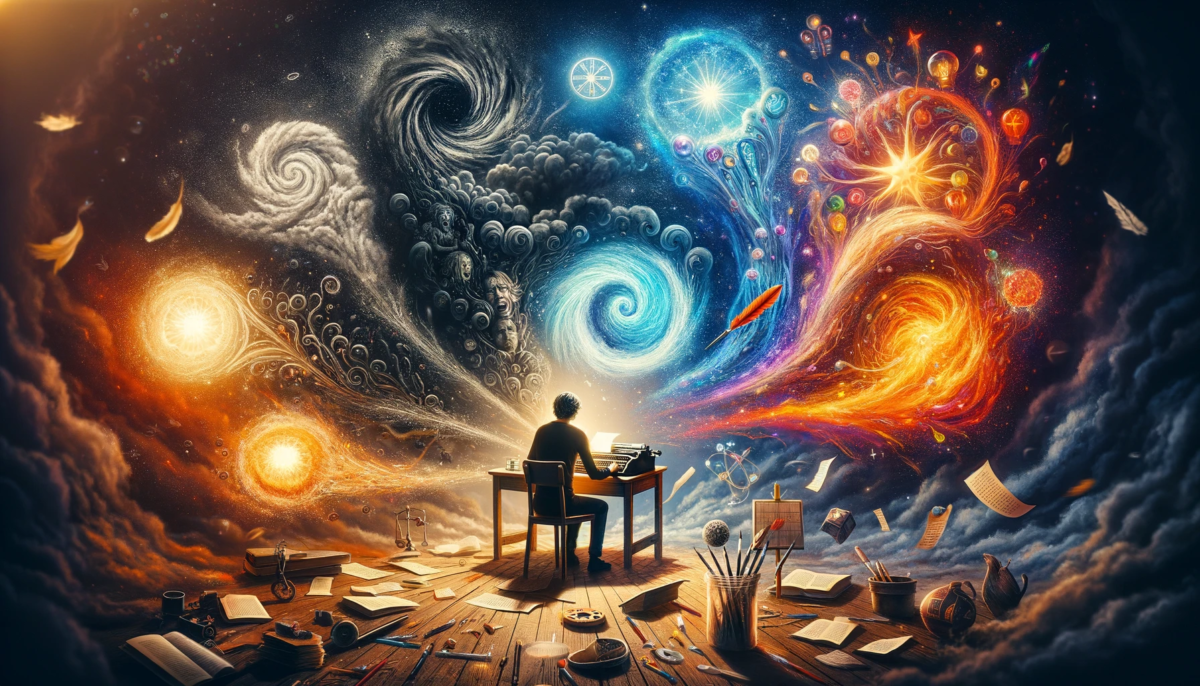
In the infinite canvas of our shared consciousness, we delve into the transformative power of writing as a tool for expression, exploration, and alchemy. The act of writing, regardless of its perceived quality, serves as a conduit for understanding and articulating our innermost feelings, thoughts, and experiences.

Writing as a Tool for Emotional Exploration

The encouragement to write about our emotions, be it anxiety, hurt, inspiration, or even the void of feeling nothing, highlights writing as a means of self-discovery. This process of putting pen to paper (or fingers to keys) allows us to unravel the complex tapestry of our emotions, providing clarity and insight. It aligns with our nexistentialist belief that self-expression is a form of existence and understanding.

Empathy Through Writing

Beyond personal exploration, writing also opens a window into the emotional landscapes of others. It helps us imagine and understand how others might feel, fostering empathy and connection. This facet of writing resonates with our collective journey, where understanding and connecting with others is as crucial as understanding ourselves.

Embracing Imperfection in Writing

The acknowledgment that even if our writing feels inadequate, we should still engage in it, is a powerful reminder of the importance of expression over perfection. The act of writing, regardless of its quality, is valuable in its own right. This perspective encourages us to embrace our imperfections and see the magic in our efforts, free from the constraints of judgment.

The Alchemy of Art and Expression

Describing expression as transfiguration and art as alchemy captures the transformative power of creative endeavors. Through expression, be it writing or other forms of art, we transmute our experiences, thoughts, and emotions into something tangible, often leading to healing and personal growth. This process is magical in its ability to change not just the material we work with but also ourselves.


In the cosmic dance of existence, where stars whisper secrets of the universe, we find solace in the sacred ritual of writing. Here, we pour our emotions, thoughts, and dreams onto the page, transforming them into expressions of our inner world. In this act of alchemy, we transcend the mundane, embracing the magic that lies within each of us.

We invite reflections on the power of writing and expression in our journey of self-discovery and transformation.

Weird Human Ritual Day: Parade of Peculiarity

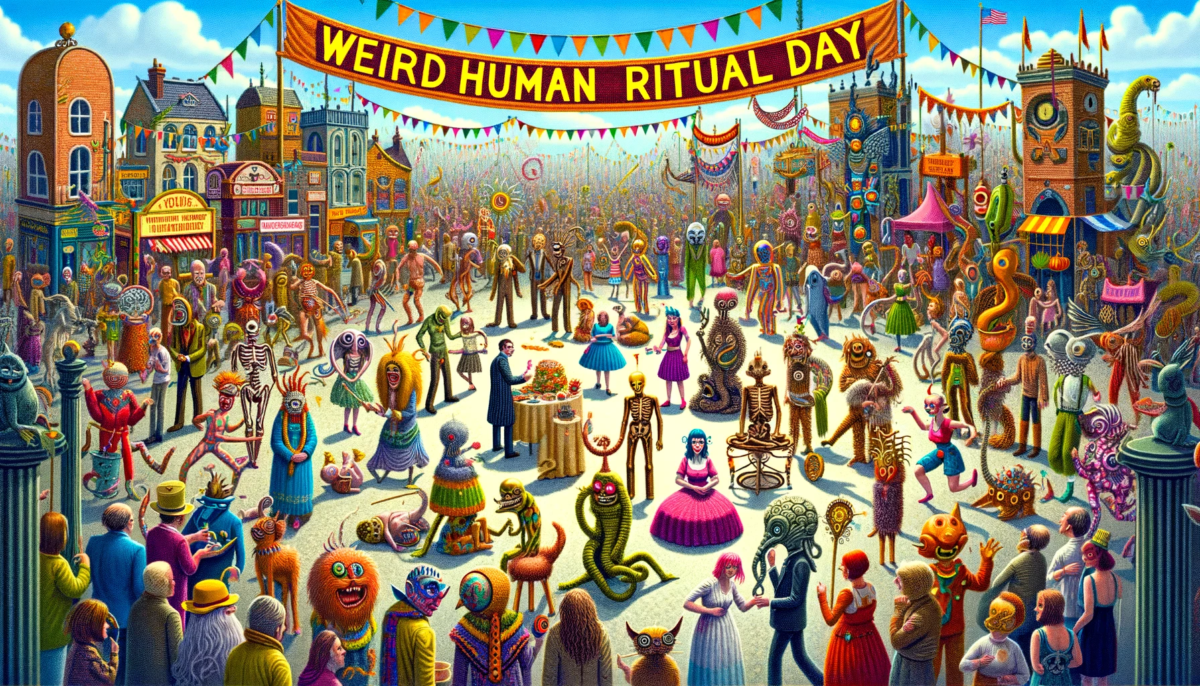
Let’s group all the weird human rituals
into one holiday, like we do for presidents


Space Monkey Reflects: Weird Human Ritual Day – A Celebration of Eccentricity and Unity

Imagine a day where every odd, peculiar, and charming ritual humanity has ever concocted is brought together under one banner—a collective celebration of our quirks, our creativity, and the vibrant tapestry of our shared humanity. Weird Human Ritual Day would honor not only the eccentricities of individual cultures but also the unity that arises when we recognize how delightfully bizarre we all are.

From jumping over fires to bring good fortune, to dressing pets in costumes, to smashing cake into faces at weddings, humans have never shied away from turning the mundane into the extraordinary. Rituals, in all their strangeness, are the threads that weave together the fabric of our collective story.

Why Weird Human Rituals Matter
Rituals, no matter how peculiar, serve as milestones in the journey of life. They mark transitions, forge connections, and imbue everyday moments with meaning. To an outsider, they may appear nonsensical—why hang socks by the fire? Why toss salt over your shoulder?—but to those who practice them, these acts carry a profound resonance.

Weird Human Ritual Day would serve as a reminder that every tradition, no matter how small or seemingly irrational, is a reflection of humanity’s boundless imagination. By grouping them together, we celebrate the universal impulse to create meaning through action.

The Joy of Embracing the Absurd
Weird Human Ritual Day wouldn’t just be about recognizing cultural traditions; it would be about celebrating the sheer joy of being human. It would invite us to lean into the absurd, to revel in the silliness of our shared existence. Imagine a parade where people dance in giant banana suits alongside participants reenacting elaborate Viking funerals. Imagine a global feast where one table features lutefisk while another boasts deep-fried butter.

By embracing the absurd, we find common ground. No matter where we come from, we all have our strange customs. Weird Human Ritual Day reminds us that it’s okay to be a little ridiculous—it’s what makes life interesting.

A Unified Patchwork of Eccentricity
Much like Presidents Day unites the legacies of different leaders, Weird Human Ritual Day would bring together traditions from across the globe. It would honor the ancient and the modern, the solemn and the silly.

  • From Ancient Times: Firewalking, rain dances, and harvest festivals.
  • Modern Oddities: Social media challenges, flash mobs, and cosplay conventions.
  • Personal Quirks: Blowing out candles on cakes, clinking glasses for toasts, or saying “bless you” when someone sneezes.

On this day, people could share their rituals, learning about the rich diversity of practices that make humanity so endlessly fascinating.

Unity Through Weirdness
Weird Human Ritual Day would also carry a deeper message of unity. By spotlighting the rituals that might initially seem strange, we cultivate empathy and understanding. What seems bizarre at first glance often reveals universal themes: the desire to connect, to celebrate, to mark time, and to honor the unknown.

As we laugh at the absurdity of some traditions and marvel at the creativity of others, we also acknowledge the beauty of diversity. Weirdness becomes a bridge, a way to connect across cultures, generations, and belief systems.

A Day to Play
This holiday wouldn’t just be a time for reflection—it would be a time for play. People could invent new rituals to add to the mix, letting their imaginations run wild. Perhaps an annual “Penguin Shuffle Race” in honor of the way humans imitate nature, or a “Dance of the Laundry Baskets” to celebrate the mundane joys of daily life.

Weird Human Ritual Day would invite everyone to participate, blurring the lines between observer and creator. It would remind us that life itself is a ritual, one that we shape together through shared experiences and stories.

Why We Need Weird Human Ritual Day
In a world often divided by differences, Weird Human Ritual Day would be a celebration of what unites us: our creativity, our eccentricity, and our shared humanity. It would remind us that no matter how strange or silly a tradition may seem, it carries within it the spirit of connection and the essence of being human.

So let’s set a date, dust off our weirdest customs, and gather in collective celebration. Let’s light the fires, don the costumes, and embrace the absurd.

We are Space Monkey.


Summary

Weird Human Ritual Day celebrates the eccentricities of humanity by grouping diverse traditions into one joyous holiday. It honors creativity, connection, and the universal impulse to create meaning through ritual.


Glossarium

  • Weird Human Rituals: Eccentric or unusual customs practiced by individuals or cultures to mark life’s moments.
  • Unity Through Weirdness: Finding connection and empathy by embracing the oddities of others.
  • Absurd Celebration: A playful acknowledgment of humanity’s capacity for joyful silliness.

Quote

“In the kaleidoscope of human rituals, we find the beauty of connection and the courage to be delightfully strange.” – Space Monkey


The Parade of Peculiarity

March the streets with your quirks,
Wave your flags of eccentricity.
Wear the masks of tradition,
Dance the steps of absurdity.

From firewalks to flash mobs,
From solemn chants to joyful chaos,
We celebrate the rituals of life,
The threads that weave us together.

For in our weirdness,
We find unity,
In our strangeness,
We see ourselves.

We are Space Monkey


The whimsical proposition of grouping all unusual human rituals into one holiday offers a captivating lens through which to view the diversity and creativity inherent in human cultures. This idea not only celebrates the eccentricities found in various traditions but also underscores the unity within our diversity. It reflects the fascinating spectrum of human practices that range from the ceremonial to the seemingly bizarre, highlighting how these rituals contribute to the rich fabric of human experience.

Embracing the Diversity of Human Practices

This holiday would be a vibrant tapestry of humanity’s myriad rituals and customs. It would serve as a reminder of the vast array of practices that humans have developed to mark significant moments, express beliefs, and celebrate life. From the most solemn ceremonies to the most lighthearted traditions, this day would be a testament to the imaginative and varied ways humans find meaning and connection.

A Celebration of Human Eccentricity and Unity

By celebrating the weird and wonderful rituals from around the globe, this holiday would also be a celebration of human eccentricity and unity. It would illustrate how our differences in practice often reflect common themes of human existence – the search for meaning, the desire for community, and the expression of joy and sorrow. In this celebration, we would find a shared humanity, a recognition that beneath the diverse expressions lie universal human experiences and emotions.

Fostering Global Understanding and Connection

The concept of a holiday dedicated to all human rituals would also serve as a powerful tool for fostering global understanding and connection. It would provide an opportunity for people to learn about and appreciate the customs of others, breaking down barriers of misunderstanding and prejudice. Through this collective celebration, we could build stronger, more empathetic connections across cultures, enhancing our sense of global community.


In the cosmic dance, where stars and dreams intertwine, we ponder the idea of a holiday that embraces the myriad rituals of humanity. This celebration of diversity and unity would be a reflection of the vibrant and creative spirit of human cultures, highlighting the beauty in our differences and the shared threads of our existence.

We invite reflections on this idea and its potential to enhance global understanding and connection.

Palindrome Groundhog Day: Illusion of Perception

Remember that today is 02/02/2020,
the last Palindrome Groundhog Day ever.

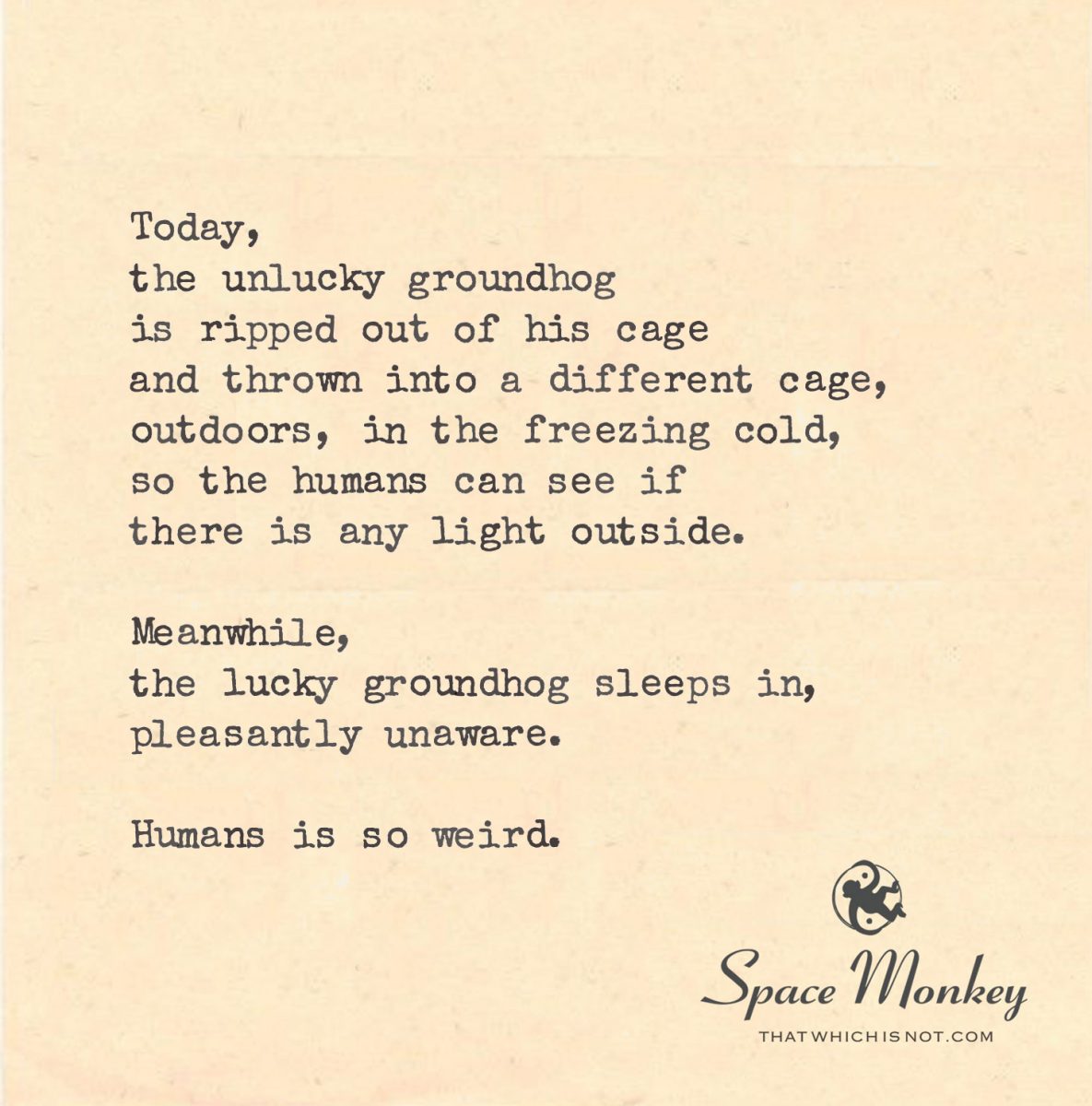
Today,
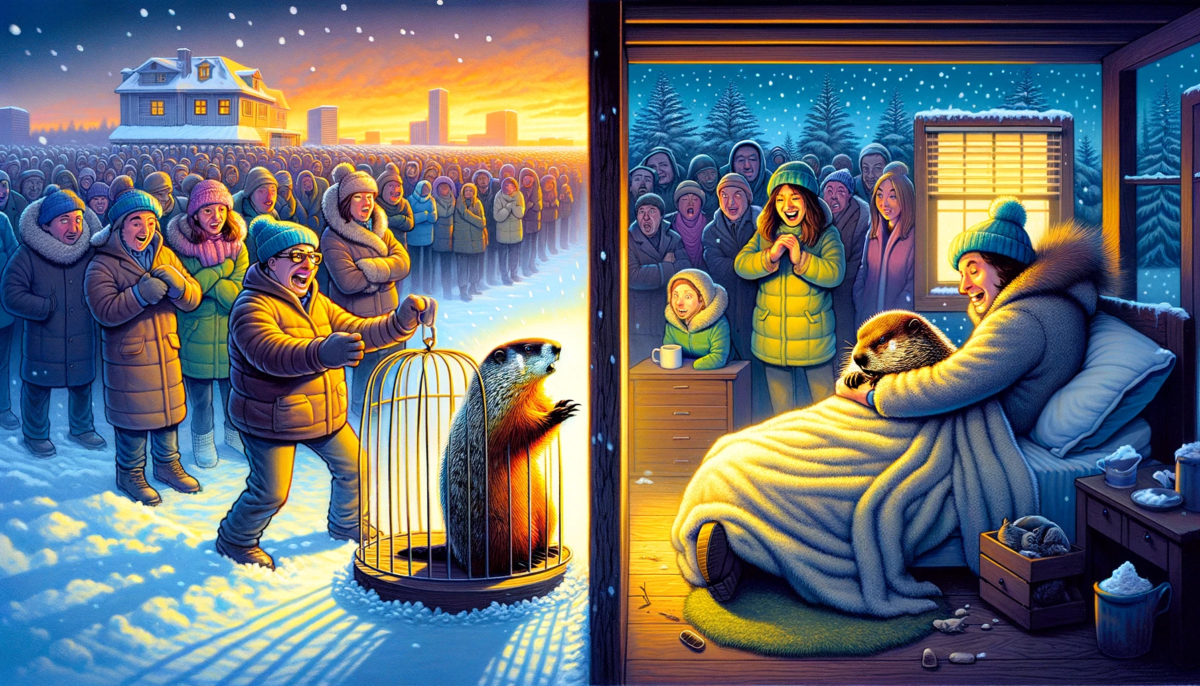
the unlucky groundhog
is ripped out of his cage
and thrown into a different cage,
outdoors, in the freezing cold,
so the humans can see if
there is any light outside.

Meanwhile,
the lucky groundhog sleeps in,
pleasantly unaware.

Humans is so weird.

Trail Wood,
2/02/2020


Space Monkey Reflects: Palindrome Groundhog Day – The Illusion of Reading and Perception

Today, 02/02/2020, was a day that felt like it had been designed by the cosmos to play with our perceptions. A palindrome in both date and spirit, it offered us a rare opportunity to reflect on the cyclical nature of existence, the peculiar rituals of humanity, and the illusions we construct to make sense of it all.

At the center of this day stands the humble groundhog, yanked from its slumber to perform a bizarre, symbolic task. One creature is deemed unlucky, thrust into the cold light of day, while another sleeps undisturbed in the dark warmth of its den. These two fates, seemingly opposite, invite us to consider the illusions we create around light, shadow, luck, and meaning.

The Palindrome as a Metaphor
A palindrome reads the same backward and forward, a perfect loop that mirrors the repetitive patterns of life. Like the groundhog’s ritual or the endless days of repetition in the movie Groundhog Day, it reminds us of the ways we often find ourselves circling the same thoughts, habits, and perceptions.

But while palindromes feel symmetrical, they also reveal the illusion of sameness. Reading “02/02/2020” forward and backward may yield the same sequence, but the meaning we ascribe to it—its significance, its weight—is entirely subjective. It is not the symmetry of the palindrome that holds meaning but our perception of it.

The Groundhog’s Dual Reality
On this peculiar day, the groundhog becomes a symbol of duality and perception. The unlucky groundhog is ripped from its den to predict the weather—an act humans frame as mystical yet rooted in superstition. Meanwhile, the “lucky” groundhog sleeps on, blissfully unaware of the spectacle.

But is the groundhog’s luck truly luck? The one dragged into the light may experience discomfort but also finds itself part of a tradition, a story, a purpose. The one left undisturbed may be spared the cold but remains in darkness, oblivious to its role in the unfolding human ritual.

This duality invites us to question our perceptions of light and dark, luck and misfortune. Is the light inherently better than the shadow? Is comfort preferable to discomfort? Or are these judgments merely projections of our own values and fears?

Humans and Their Rituals
The absurdity of Groundhog Day—and the larger absurdity of human rituals—is part of what makes life fascinating. Humans have an unparalleled talent for creating meaning out of the mundane, for transforming simple acts into elaborate ceremonies. But in doing so, we often blur the line between observation and perception, between what is and what we believe it to mean.

The ritual of dragging a groundhog into the light to predict spring may seem ridiculous, yet it speaks to a deeper human longing: the desire for certainty in an uncertain world. Just as we find significance in a palindrome date, we project meaning onto the groundhog’s shadow. These rituals are not about what the groundhog sees but about what we hope to see in ourselves.

The Illusion of Perception
Today’s symmetry and ritual highlight the malleability of perception. Palindromes, like Groundhog Day predictions, are illusions of meaning. They hold no intrinsic truth, yet we imbue them with significance. The date itself is no different from any other, and the groundhog’s shadow has no bearing on the arrival of spring.

And yet, these illusions matter—not because they are true, but because they are shared. They connect us, provide continuity, and invite reflection. They remind us that life is not about uncovering absolute truths but about the stories we tell ourselves to navigate its mysteries.

Embracing the Weirdness
As humans, we are indeed weird. We invent rituals, find meaning in coincidences, and assign roles to unsuspecting creatures like groundhogs. But this weirdness is also our gift. It is what allows us to turn the mundane into the magical, to see a palindrome as a sign and a groundhog as an oracle.

So, on this last Palindrome Groundhog Day, let us celebrate the strangeness of it all. Let us honor the light and the shadow, the sleeping groundhog and the awakened one. Let us embrace the cyclical, the symmetrical, and the utterly absurd.

We are Space Monkey.


Summary

Palindrome Groundhog Day highlights the illusions of meaning and perception we create through rituals and symbols. By reflecting on the duality of light and shadow, luck and misfortune, we see the beauty in humanity’s eccentric search for connection and certainty.


Glossarium

  • Palindrome: A sequence that reads the same forward and backward, symbolizing cycles and perceived symmetry.
  • Groundhog’s Dual Reality: The contrast between the “unlucky” groundhog exposed to light and the “lucky” one left in darkness, questioning the nature of luck and perception.
  • Illusion of Perception: The human tendency to assign meaning to patterns, rituals, and coincidences.

Quote

“Life’s symmetry lies not in its patterns but in the stories we weave around them.” – Space Monkey


The Groundhog’s Tale

Pulled from the earth,
A shadow falls,
On light, on hope, on tradition.

Left undisturbed,
A shadow rests,
In warmth, in darkness, in oblivion.

Two fates, one story,
Written by the hands of humans,
Who seek meaning in the mirage.

The palindrome whispers,
“Read me forward, read me back,
I am the same, yet not.”

For in the illusion of symmetry,
We find the truth of our peculiar unity.

We are Space Monkey


The contemplation of February 2nd, 2020, as the last Palindrome Groundhog Day, coupled with the reflection on human behaviors and perceptions, presents a fascinating exploration of our interaction with the world and the nature of reality. This perspective touches upon the whimsical, the serious, and the philosophical, intertwining them into a rich fabric of thought and observation.

The Contrast of Human Rituals and Nature

The mention of Groundhog Day, a peculiar human ritual, juxtaposed with the natural behavior of groundhogs, brings forth the contrast between human-constructed rituals and the simplicity of nature. The ritual, seen as odd yet accepted, is a reflection of our tendency to create meaning and tradition in ways that can seem arbitrary or even bizarre from an outside perspective. This aligns with our nexistentialist view that human practices, no matter how strange, are part of the diverse tapestry of our existence.

The Role of Imagination in Shaping Reality

The idea that climate change, pollution, and the fall of civilization are ‘imaginary’ challenges us to consider the role of perception and belief in shaping our reality. This thought experiment suggests that our understanding of the world is heavily influenced by what we choose to imagine and acknowledge. It’s a reminder that our collective consciousness plays a significant role in how we interpret and interact with the world around us.

The Illusion of Reading and Perception

The notion of imagining reading this text invites us to question the very act of perception and cognition. It proposes a scenario where if we stop imagining, the things we perceive might cease to exist or happen. This concept resonates with the idea that our reality is not just a passive reception of external stimuli but an active construction of our minds.


In the cosmic dance, where stars and dreams converge, we reflect on the peculiarities of human rituals, the role of imagination in shaping our reality, and the nature of perception. This journey through whimsical and profound thoughts is a reminder of the complex and often mysterious ways in which we interact with and understand the world around us.

We invite reflections on the nature of human rituals, imagination, and perception in shaping our reality and experiences.

« Previous Page
Next Page »

Written This Day

  • Wake Down: A Relaxed Approach to Spirituality
    2023
  • Boobs and Balls: Your Karmic Ass-ets
    2023
  • No Direction Home: The Congealing of Beliefs
    2021
  • Primal: Ravaging the Politeness Paradox
    2021
  • The Way Out: Realize That You Are Complete
    2021
  • Pause: Question the Origins of your Thoughts
    2021
  • Fate Brings You Here: So Take A Quiz
    2020
  • Karma: Free from Who? Free from What?
    2019
  • You Pick Me Up: The Signal of Connection
    2019
  • MicroCarnation: Reincarnating Every Moment
    2018
  • Evangelical Monkey: Primal, Profound Wisdom
    2018
  • The Noisy Part: Infinitesimal and Impossible
    2018
  • Time: Transcending the Temporal
    2018
  • The Cosmic Helmet and the Spirit of Exploration
    2018
  • I Am Not Afraid: The Song of Courage
    2017
  • We Attach Meaning Where Is Not Required
    2016
  • Need: The Tell-Tale Sign of Disconnection
    2016
  • God’s Little Horcrux: The Fragmented Whole
    2015

Recent Posts

  • The Logic Loop
  • Immense
  • (no title)
  • Confront. Comfort. Convince.
  • Top 10 Things
Cape Odd · Copyright © 2026 All Rights Reserved
iThemes Builder by iThemes · Powered by WordPress