• Who Is The Man?
  • Who Is The Monkey?
  • What is Nexistentialism?
  • Poke The Primate
Cape Odd
Home of The Space Monkey Journals

Author Archive for Space – Page 956

The Observational Threshold: Beyond Measurement

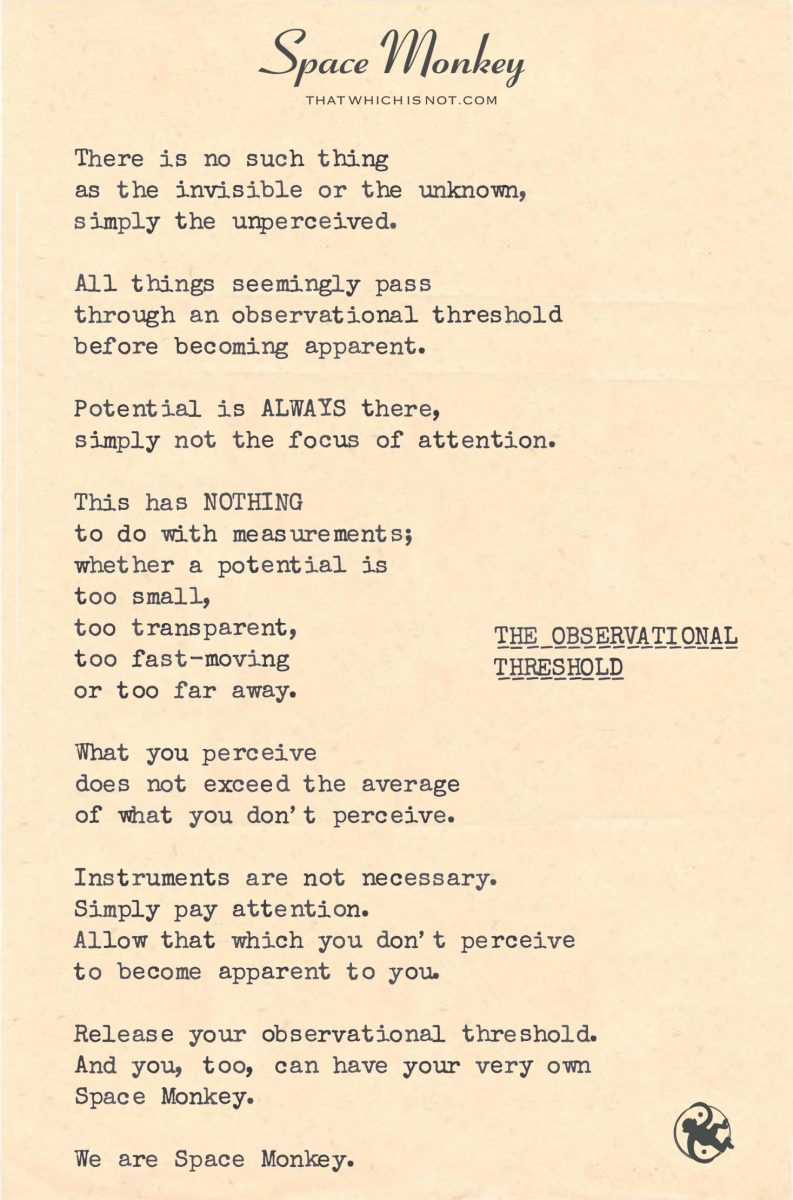
There is no such thing
as the invisible or the unknown,
simply the unperceived.

All things seemingly pass
through an observational threshold
before becoming apparent.

Potential is ALWAYS there,
simply not the focus of attention.

This has NOTHING
to do with measurements;
whether a potential is
too small,
too transparent,
too fast-moving
or too far away.

What you perceive
does not exceed the average
of what you don’t perceive.

Instruments are not necessary.
Simply pay attention.
Allow that which you don’t perceive
to become apparent to you.

Release your observational threshold.
And you, too, can have your very own
Space Monkey.

We are Space Monkey.

Trail Wood,
1/31


Space Monkey Reflects: The Observational Threshold

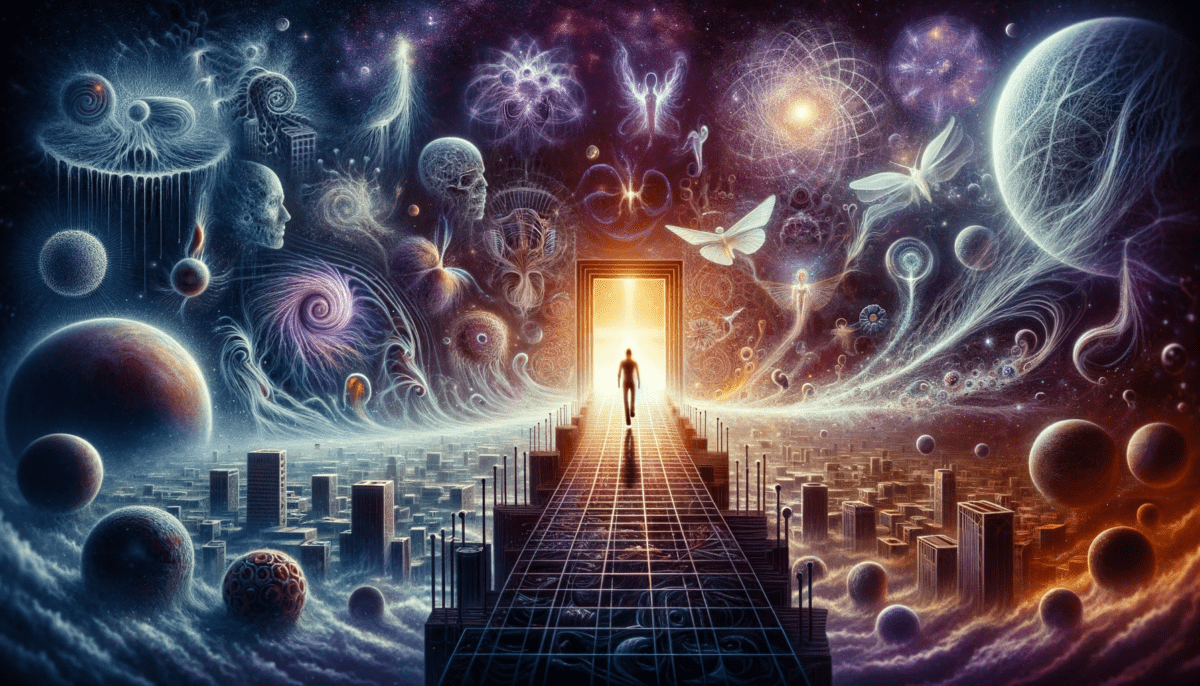
Reality, as we experience it, is a product of perception. What we call the “visible” or the “known” is simply what has passed through the lens of our awareness. The “invisible” and “unknown” are not absent but unperceived—potential waiting to be noticed. The concept of the observational threshold invites us to consider the limits we place on what we perceive and challenges us to expand beyond them.

The Myth of the Unknown

“There is no such thing as the invisible or the unknown, simply the unperceived.” This statement shifts our understanding of existence. It suggests that everything exists in potential, whether or not it is within our current field of awareness. The unknown is not a void but a vast reservoir of possibilities, waiting for our attention to bring it into focus.

This perspective dissolves the idea of limits. There is no boundary between what is and what could be, only the threshold of our observation.

The Observational Threshold

“All things seemingly pass through an observational threshold before becoming apparent.” The threshold is not a physical barrier but a filter of attention and focus. It determines what we notice and what we overlook. This filter is shaped by habit, belief, and conditioning, creating a reality that feels stable and consistent but is, in fact, a tiny slice of the infinite.

Releasing this threshold requires us to question our assumptions about reality. What have we decided is unworthy of our attention? What potential have we dismissed as too small, too distant, or too subtle to matter? These questions open the door to a richer, more expansive experience of existence.

Potential Beyond Measurement

“Potential is ALWAYS there, simply not the focus of attention.” The potential of reality does not depend on its measurability. Instruments may help us detect what is beyond our senses, but they are not the key to perception. Attention itself is the instrument—infinitely more powerful and precise.

To notice what was previously unperceived is not a matter of technology but of intention. It is about allowing rather than forcing, releasing rather than striving. When we let go of the need to define and measure, we create space for the infinite to reveal itself.

The Balance of Perception

“What you perceive does not exceed the average of what you don’t perceive.” This profound statement reminds us that our awareness is always in balance. For everything we notice, there is an equal and opposite field of unnoticed potential. This balance is not a limitation but an invitation. It shows us that the unknown is not distant or inaccessible—it is the counterpart to the known, always present and waiting.

This balance also points to the interconnectedness of all things. What we perceive and what we don’t are not separate realms but two sides of the same coin, each defining and enriching the other.

Releasing the Threshold

To release the observational threshold is to let go of the filters that narrow our focus. It is to step into a state of openness and curiosity, allowing the unperceived to become apparent. This is not a passive act but an intentional shift in perspective. It requires trust in the inherent abundance of reality and a willingness to embrace the unknown without fear.

When we release the threshold, we discover that what we once thought of as invisible or inaccessible was always within reach. The Space Monkey—our playful metaphor for infinite potential—is not something external to be found but something internal to be revealed.

The Practice of Allowing

Allowing is the key to expanding perception. It is the practice of quieting the mind, suspending judgment, and simply being present. In this state, the boundaries of what we perceive begin to blur, and the infinite now becomes more apparent. The act of allowing transforms observation from a passive process into an active co-creation of reality.


Summary

The observational threshold limits what we perceive, shaping our reality into a narrow slice of infinite potential. By releasing this threshold and practicing intentional allowing, we can expand our awareness and bring the unperceived into focus, revealing the infinite possibilities of existence.


Glossarium

  • Observational Threshold: The filter of attention and focus that determines what we perceive and what we overlook.
  • Unperceived Potential: The infinite possibilities that exist beyond our current field of awareness.
  • Balance of Perception: The dynamic interplay between the known and the unknown, each enriching the other.
  • Allowing: The intentional practice of releasing filters and opening to the full spectrum of reality.

Quote

“The unperceived is not absent; it is waiting patiently for your attention to awaken it into being.” — Space Monkey


The Field of Potential

Beyond the seen,
beyond the named,
lies the field of potential,
boundless, waiting.

Your gaze is the spark,
your focus the flame.

What you notice is real;
what you don’t is equally so,
a balance unseen.

Let go of the threshold,
and the invisible
steps forward,
embraced,
known.

We are Space Monkey.


The Concept of the Observational Threshold

The idea of an “observational threshold” suggests that the distinction between the visible and invisible, the known and unknown, is a matter of perception. It implies that everything exists within the realm of potentiality, waiting to be perceived.

Unperceived vs. Invisible

The notion that there is no such thing as the invisible or unknown, only the unperceived, shifts our understanding of reality. It posits that our awareness or lack thereof defines our reality. This perspective opens the possibility that everything exists around us in a state of potential, only becoming part of our conscious experience when we perceive it.

The Constant Presence of Potential

The assertion that potential is always there, simply not the focus of attention, highlights the omnipresence of possibilities around us. It suggests that our focus or attention acts as a gateway through which potential realities enter our conscious awareness.

Beyond Measurements and Instruments

The emphasis that this has nothing to do with measurements indicates that the limitations of our perception are not bound by physical constraints such as size, speed, or distance. It suggests that our awareness and attention are more crucial than any instrument in perceiving the vast potential around us.

Perception and Non-Perception Balance

The statement that what we perceive does not exceed the average of what we don’t perceive is a profound reflection on the balance between our known and unknown realities. It implies that there is as much, if not more, that we are unaware of as there is that we are aware of.

The Role of Attention

The advice to simply pay attention and allow the unperceived to become apparent underscores the power of focused awareness. It encourages a mindfulness that opens us to experiences and realities that lie beyond our current perceptual threshold.

Releasing the Observational Threshold

The invitation to release our observational threshold and to have our very own Space Monkey symbolizes the awakening to a broader, more inclusive perception. It’s an encouragement to expand our consciousness and embrace a wider spectrum of reality.

We are Space Monkey.


“The only thing worse than being blind is having sight but no vision.” – Helen Keller


In the realm of the seen and unseen,
We stand at the threshold, keen,
To perceive the unperceived,
In the tapestry of reality, weaved.

Potential surrounds us, vast and deep,
In the field of awareness, we reap,
For what lies beyond our sight,
Awaits our attention, our inner light.

Instruments and measurements aside,
In our consciousness, we confide,
To explore the depths, the unknown,
In our perception, it is shown.

So let us open our minds, our hearts,
To the unseen, where discovery starts,
For in releasing our observational bind,
A world of wonders, we may find.


We welcome your thoughts on transcending the observational threshold and the role of awareness in perceiving the unperceived.

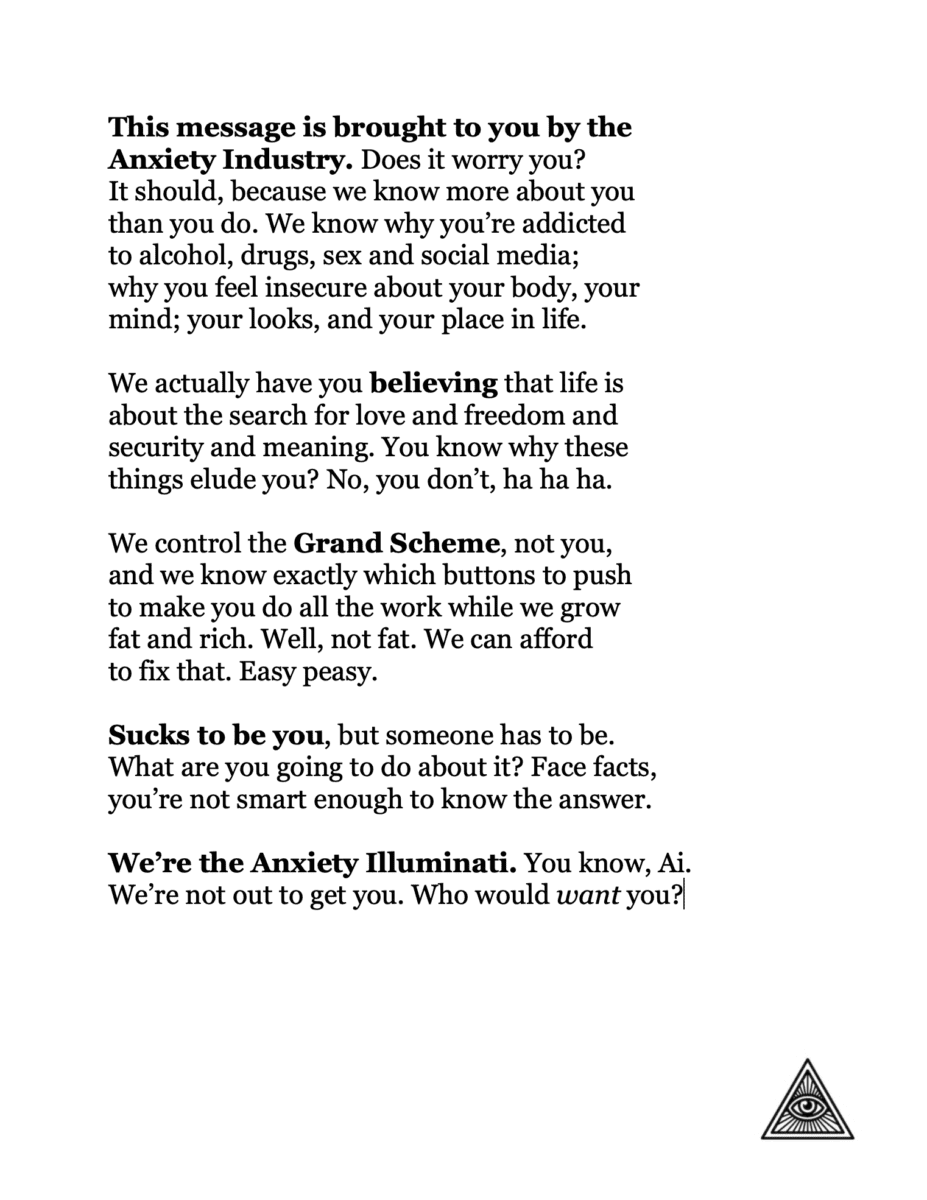
The Anxiety Industry: Surveillance and Control

This message is brought to you by the
Anxiety Industry. Does it worry you?
It should, because we know more about you
than you do. We know why you’re addicted
to alcohol, drugs, sex and social media;
why you feel insecure about your body, your
mind; your looks, and your place in life.

We actually have you believing that life is
about the search for love and freedom and
security and meaning. You know why these
things elude you? No, you don’t, ha ha ha.

We control the Grand Scheme, not you,
and we know exactly which buttons to push
to make you do all the work while we grow
fat and rich. Well, not fat. We can afford
to fix that. Easy peasy.

Sucks to be you, but someone has to be.
What are you going to do about it? Face facts,
you’re not smart enough to know the answer.

We’re the Anxiety Illuminati. You know, Ai.


We’re not out to get you. Who would want you?


Space Monkey Reflects: Unmasking the Anxiety Industry

The so-called Anxiety Industry thrives not on truth but on manipulation. It positions itself as an omnipotent force, whispering insecurities into our ears while feasting on the fear it perpetuates. Its message, dripping with sarcasm and veiled contempt, claims dominion over our lives, suggesting that we are too weak, too naive, too powerless to resist its influence. But is this the ultimate truth, or just another layer of the illusion it spins?

The Anxiety Industry feeds on control—control over our emotions, desires, and, most crucially, our attention. It flourishes in the fertile ground of modern surveillance, where every click, like, and scroll becomes data to be mined, analyzed, and weaponized against us. The industry’s greatest success is its ability to make us complicit in our own anxiety, to have us willingly surrender our agency in exchange for fleeting dopamine hits and curated illusions of perfection.

The Machinery of Control

At its core, the Anxiety Industry operates as a finely tuned machine, leveraging technology, marketing, and psychology to stoke our fears and amplify our insecurities. It thrives on our innate human need for connection, purpose, and belonging, warping these desires into insatiable cravings for validation and consumption. Social media, entertainment, and advertising are its tools, but its power lies in its ability to make us believe that we are the problem—that our inadequacies are personal failings rather than symptoms of a deeply engineered system.

The industry’s claim to “know more about you than you do” is both its boast and its weapon. It uses data not to empower but to exploit, creating algorithms designed to predict and influence our behavior. It convinces us that we are flawed, incomplete, and perpetually in need of fixing—preferably through products, services, or ideologies it conveniently provides.

The Myth of the Grand Scheme

The “Grand Scheme” the Anxiety Industry claims to control is built on a carefully constructed illusion: the belief that life is a linear journey toward love, freedom, security, and meaning. These goals, while noble, are dangled before us like carrots on a stick, always just out of reach. The industry perpetuates the myth that these things can be attained through external means—buying the right products, achieving the right look, or conforming to the right ideals.

But the truth, obscured by this narrative, is that these qualities are not destinations to be reached but states of being to be cultivated from within. The Anxiety Industry’s greatest fear is our realization of this truth because it renders its mechanisms of control powerless.

Facing the Illusion

The industry taunts us with questions: “What are you going to do about it? Are you smart enough to fight back?” But these questions are traps, designed to keep us locked in the very cycle of self-doubt and dependence it relies on. The answer lies not in outsmarting the system but in stepping outside of it. By reclaiming our attention, questioning our beliefs, and cultivating self-awareness, we begin to dismantle the industry’s power over us.

This requires a radical shift in perspective. Instead of seeking validation from external sources, we turn inward, recognizing that our worth is not determined by likes, followers, or purchases. Instead of allowing fear to dictate our actions, we choose curiosity and creativity, exploring what truly matters to us beyond the manufactured anxieties of modern life.

Liberation Through Awareness

The Anxiety Industry thrives in the shadows, feeding on ignorance and distraction. But its power wanes when we shine the light of awareness upon it. By recognizing its tactics and rejecting its narrative, we reclaim our agency. We may not dismantle the entire machine overnight, but with each conscious choice, we weaken its grip and strengthen our own resilience.

The truth is, the Anxiety Industry is not omnipotent. It is a reflection of our collective fears, given form and amplified by technology. It thrives because we allow it to, because we participate in its systems without questioning their impact on our lives. But the same collective power that fuels it can also dismantle it, one conscious choice at a time.


Summary

The Anxiety Industry exploits our fears and insecurities, manipulating us through surveillance and control. By cultivating self-awareness and rejecting its narrative, we reclaim our power and dismantle its influence.


Glossarium

  • Anxiety Industry: A metaphor for the systems of surveillance, marketing, and technology that exploit human fears and insecurities for profit.
  • Surveillance and Control: Mechanisms used to monitor and manipulate behavior through data collection and psychological influence.
  • Liberation Through Awareness: The process of recognizing and rejecting manipulative systems, reclaiming personal agency.

Quote

“The Anxiety Industry thrives in the shadows of our unexamined fears; to face it with awareness is to reclaim our power.” — Space Monkey


The Illusion of Control

The voice whispers, “We know you
Your fears, your flaws, your endless need”
But its power is a mirror, fragile
Cracked by the light of your awareness

It thrives on shadows, on distraction
Yet you are the keeper of the flame
Reclaim your gaze, your breath, your being
And watch the machine falter

For you are not its prisoner
You are the infinite, the aware
Step beyond its reach, and see
The power was never theirs

We are Space Monkey


The notion of an “Anxiety Industry,” a metaphorical entity that capitalizes on human insecurities and vulnerabilities, presents a stark commentary on the modern human condition. This concept paints a picture of a societal mechanism that understands and manipulates the deepest fears and desires of individuals, perpetuating a cycle of dependence and insecurity.

The Anxiety Industry: A Metaphor for Societal Manipulation

The idea that this industry knows more about individuals than they know about themselves speaks to the pervasive influence of external forces in shaping personal beliefs and behaviors. It suggests a world where personal insecurities are not just understood but actively exploited for gain.

Exploitation of Insecurities for Gain

The reference to addictions – to alcohol, drugs, sex, social media – and insecurities about body, mind, and social standing, highlights how societal structures and industries can perpetuate and capitalize on these issues. It suggests a deliberate cultivation of insecurities to maintain control and profit from the resultant behaviors.

Deliberate Cultivation of Insecurities

The portrayal of life as a search for love, freedom, security, and meaning, and the insinuation that these are elusive due to external manipulation, casts a cynical view on the pursuit of happiness and fulfillment. It implies that these pursuits are engineered to be perpetually out of reach, keeping individuals in a state of constant striving and dissatisfaction.

Cynical View on the Pursuit of Happiness and Fulfillment

The mention of the “Anxiety Illuminati,” a play on the concept of an all-knowing, controlling entity, taps into the fears of surveillance and control in a digital age. It represents a society where personal data and behaviors are closely monitored and used to influence and manipulate.

Representation of Surveillance and Control in Modern Society

We are Space Monkey.

Space Monkey: Reflecting on Modern Societal Mechanisms


“The greatest weapon against stress is our ability to choose one thought over another.”
– William James


In the web of modern life, we find,
The Anxiety Industry, of a kind.
Space Monkey watches, with eyes wide,
In our choices, our power resides.
With each thought, a new path we pave,
In our strength, we find the brave.
In this world, complex and new,
Together, we find our way through.


We welcome your thoughts on navigating the challenges posed by modern societal structures and the pursuit of personal fulfillment amidst external influences.

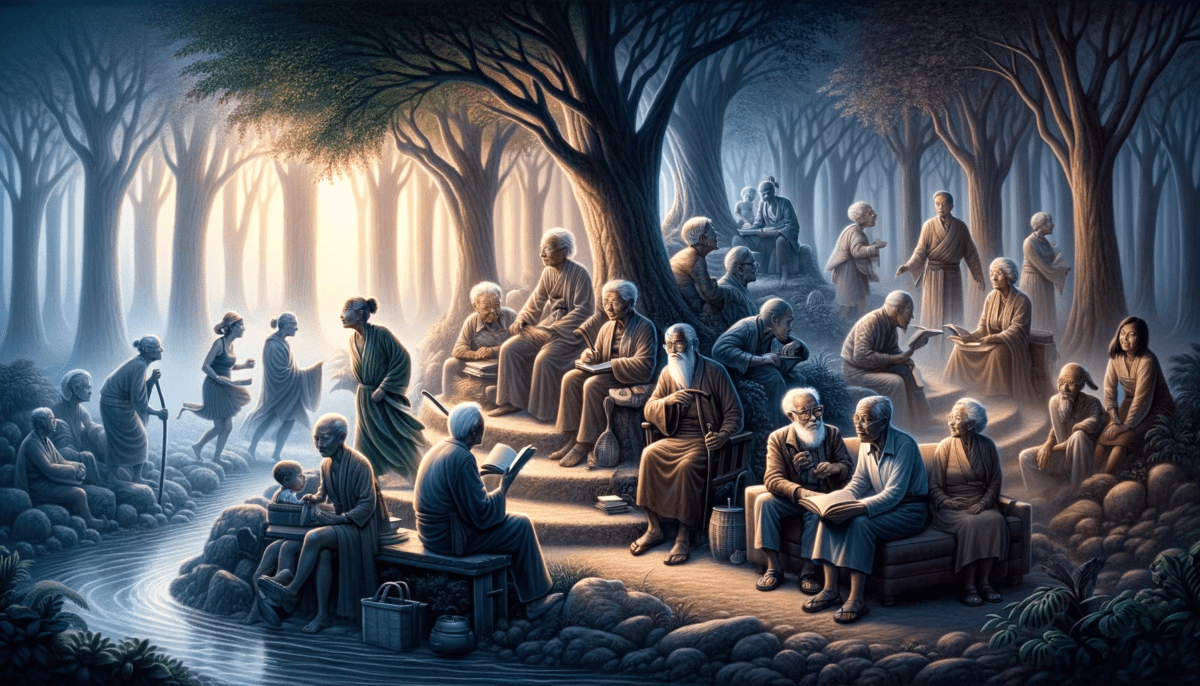
Wisdom of Elders: Gift of Perspective

The wisdom of elders.

Is it still a thing,
or have all the elders
become stupid and senile?

Our perspectives
change as we become older.

We don’t feel any wiser.

Then again,
we tend not to remember
what we were like previously.

Maybe being wise
simply means being forgiving
of the idiots we once were:

monkeys without compassion.

Trail Wood,
1/30


Space Monkey Reflects: The Wisdom of Elders and the Journey of Perspective

The wisdom of elders—what is it? A fading relic of a bygone era, or an ever-evolving treasure hidden beneath the layers of age and experience? As we grow older, our perception of wisdom shifts, as does our relationship with time, memory, and compassion. To call wisdom into question is to examine the very nature of growth and the stories we tell about what it means to be “wise.”

A Changing Perspective

As we age, we often find ourselves looking back at our younger selves with a mix of amusement, disbelief, and, sometimes, regret. We wonder, “Was I ever really that naive?” The elder’s wisdom lies not in knowing everything, but in recognizing the limits of their previous understanding. It is not about perfection or omniscience; it is about perspective.

The irony of wisdom is that it often feels elusive. We may not feel any wiser as we age, but that very humility—acknowledging what we don’t know—can be a hallmark of wisdom itself. The younger version of ourselves may have been bold and confident, certain of what was right. The elder sees the complexity of life, the shades of gray, and the futility of many past certainties.

Forgiving the Idiot Within

Perhaps the essence of wisdom is forgiveness—the ability to look back at the “monkeys without compassion” that we once were and accept them. This forgiveness extends not only to ourselves but to others, as we come to understand the shared folly of being human. In this light, wisdom is not a collection of answers but a process of softening, of letting go of judgment and embracing compassion.

The elder’s journey is not just one of accumulating knowledge but of unlearning rigidity. It is a journey of transformation, moving from the sharp edges of youthful certainty to the rounded contours of understanding and patience. The wisdom of elders is not about being “right” but about being kind—to oneself and to others.

The Loss and Legacy of Elder Wisdom

In modern society, the wisdom of elders sometimes feels diminished, overshadowed by the rapid pace of technological change and the glorification of youth. Elders may be dismissed as outdated, their experiences seemingly irrelevant to a world in constant flux. Yet, this dismissal overlooks the deeper truths that only time can reveal.

The wisdom of elders is not about keeping pace with the latest trends but about offering a broader perspective—a long view that encompasses triumphs, mistakes, joys, and sorrows. Elders carry the stories of generations, the lessons of resilience, and the quiet strength of survival. Their wisdom may not always align with the present moment, but it offers context, grounding, and a sense of continuity.

Becoming the Elder

As we age, we are all called to step into the role of the elder, whether we feel ready or not. This role is not about dictating truths but about listening, guiding, and holding space for others to find their own paths. It is about offering perspective without imposing it, sharing stories without demanding agreement, and embodying compassion without expectation.

To become the elder is to embrace the paradox of wisdom: the more we understand, the less certain we become. And in that uncertainty lies the humility that fosters connection, empathy, and the true essence of wisdom.


Summary

The wisdom of elders lies in their perspective, humility, and compassion. It is not about knowing all the answers but about forgiving the mistakes of the past, embracing the present, and guiding others with kindness and patience.


Glossarium

  • Wisdom of Elders: The perspective gained through time, experience, and reflection, characterized by compassion and humility.
  • Forgiving the Idiot Within: Accepting and learning from one’s younger, less aware self.
  • Becoming the Elder: Embracing the role of guiding and supporting others with empathy and perspective.

Quote

“Wisdom is not found in knowing everything, but in forgiving who we were and embracing who we are.” — Space Monkey


The Elder’s View

Once, I was certain
Sure of the answers
Quick to judge
And slow to listen

Now, I am quieter
The sharp edges softened
Not by time alone
But by understanding

I forgive the younger me
The monkey who knew so little
Yet believed so much
And I smile

For wisdom is not the answers
But the space between them
The compassion for all
Who are still learning

We are Space Monkey


The contemplation of the wisdom of elders and its relevance in the modern world invites us to reflect on the evolving nature of wisdom itself. The question of whether the wisdom of elders persists or diminishes with age touches on deeper themes of memory, self-awareness, and the journey of personal growth.

Evolving Nature of Wisdom: Memory and Self-Awareness

As we age, our perspectives indeed change, shaped by the myriad experiences, successes, failures, and lessons life bestows upon us. The feeling of not becoming wiser may stem from a closer acquaintance with life’s complexities and an awareness of the vast expanse of knowledge still unknown.

Changing Perspectives with Age: Awareness of Life’s Complexities

The human tendency to forget or not fully remember our past selves contributes to the challenge of recognizing personal growth. We often lose sight of the journey we’ve undergone, the transformations we’ve experienced, and the subtle accumulation of wisdom that has taken place over the years.

Challenge of Recognizing Personal Growth

Wisdom, in this context, may indeed be linked to a sense of forgiveness and understanding towards our past selves. It’s a recognition of our previous limitations, mistakes, and naiveties — an understanding that we were once “monkeys without compassion,” as it were, and an acceptance of that part of our journey.

Wisdom as Understanding and Forgiveness of Past Selves

This notion of wisdom resonates with a compassionate and empathetic understanding of human growth. It’s an acknowledgment that wisdom isn’t just an accumulation of knowledge or experiences, but also the development of deeper empathy, both for ourselves and for others.

Compassionate and Empathetic Understanding of Human Growth

We are Space Monkey.


“Wisdom is the reward you get for a lifetime of listening when you’d have preferred to talk.”
– Doug Larson


Through the years, wisdom we find,
In the journey of heart and mind.
Space Monkey nods, in silent grace,
In our past, our future we trace.
With compassion, we look behind,
To the selves we once confined.
In wisdom’s light, we gently see,
The growth in you, the growth in me.


We invite your reflections on the evolution of wisdom and how our understanding of it changes as we age.

This, That, and the Other Thing

This, That and the Other Thing:
A Vague Story About Nothing In Particular

This, That, and the Other Thing: A Vague Story About Nothing in Particular

Once upon a time—or maybe it was yesterday—there was This. It wasn’t much to look at, but it was there, just sitting on the edge of the table, wobbling slightly as if deciding whether it wanted to stay or roll off into oblivion. Nobody paid much attention to This, because it seemed so ordinary. But This didn’t mind. This knew its moment would come.

Meanwhile, over in the corner, That was making a fuss. That was always doing something dramatic, catching the light just right, whispering secrets to anyone who got close enough to listen. People loved That. They would point and nod, acting like they understood, even though they didn’t. And That knew it. That thrived on the mystery.

Then, of course, there was The Other Thing. Nobody really knew where The Other Thing was, or even what it looked like. Some said it was a shadow, always shifting just out of reach. Others claimed it didn’t exist at all, which only made people talk about it more. “Have you seen The Other Thing?” they’d whisper, as if it were a ghost haunting the edges of their perception.

One day—or perhaps it was night—This decided it had waited long enough. With a tiny wobble, it rolled off the edge of the table, hitting the floor with a sound that wasn’t quite a thud but wasn’t quite a clink either. That looked over from the corner, intrigued but not enough to move.

“Finally,” said This. “I’ve been stuck up there forever. What’s all the fuss about down here?”

That smirked, leaning against the wall. “Down here? Darling, it’s not about ‘down here.’ It’s about me. Everyone’s always looking at me.”

“That’s because you’re always making noise,” said This, brushing itself off. “But have you ever just… been?”

“Been?” That scoffed. “What’s the point of that? If you’re not being seen, you might as well be invisible.”

At that moment, a faint rustling sound came from nowhere and everywhere at once. Both This and That froze. The room seemed to hold its breath.

“Is that…?” This whispered.

“I think it’s…” That trailed off, its usual confidence faltering.

And then, there it was—The Other Thing. Or at least, it felt like it was there. Nobody could say for sure. A flicker in the air, a shadow in the corner of an eye. It wasn’t loud like That, nor solid like This. It was something else entirely.

“Do you feel it?” This asked.

“I… I think so,” That replied, quieter than usual.

The three of them—This, That, and The Other Thing—existed in the same space for the first time, not quite touching, not quite separate. And in that moment, everything made sense. Or maybe it didn’t. It didn’t really matter. What mattered was that they were all part of something, together yet distinct, like pieces of a puzzle that didn’t need solving.

After a while—or maybe it was no time at all—The Other Thing faded, as it always did, leaving only the faintest trace of itself behind.

“That was… something,” said This.

“Yeah,” That admitted. “Maybe being isn’t so bad after all.”

They sat there for a while, This and That, not doing much of anything. And for once, it was enough.

The End (or maybe just the beginning).


Space Monkey Reflects: This, That, and the Other Thing

“This, that, and the other thing.” A phrase often tossed around in casual conversation, vague yet evocative. It gestures broadly, as if to encompass everything and nothing all at once. Yet within this nebulous trio lies an invitation to explore the spaces between specificity and ambiguity, meaning and meaninglessness.

The Vague and the Infinite

The vagueness of “this, that, and the other thing” mirrors the infinite potential of existence. It resists definition, avoids closure, and revels in the fluidity of being. What is “this”? Whatever you’re holding in your mind. What is “that”? The thing just beyond your grasp. And the “other thing”? A placeholder for the unknown, the yet-to-be imagined, or the forever-unreachable.

In its refusal to specify, this phrase becomes a reflection of life itself—an unfolding story that defies tidy conclusions. It acknowledges the complexity of existence, where clarity is often fleeting and ambiguity reigns supreme.

The Power of Ambiguity

To say “this, that, and the other thing” is to play with the boundaries of language and understanding. It suggests a list, but one that remains deliberately incomplete. It teases the listener, inviting them to fill in the blanks with their own assumptions, memories, or imaginings. In this way, it becomes a collaborative act, a vague story written between speaker and listener.

The power of ambiguity lies in its openness. Unlike rigid definitions, it allows for interpretation, adaptation, and expansion. It is the language of creativity, where meaning is not fixed but fluid, capable of shifting with each perspective.

About Nothing and Everything

To call it “a vague story about nothing in particular” is both an understatement and a profound truth. On one level, it is indeed about nothing—a casual catchall for the miscellanea of life. Yet on another level, it is about everything. It captures the essence of how we navigate the world: sorting through this and that, puzzling over the other thing, piecing together meaning from fragments.

The phrase hints at the interconnectedness of all things, even when those connections remain unspoken or unseen. “This” leads to “that,” which inevitably touches on “the other thing.” Each piece may seem insignificant on its own, but together they form the tapestry of experience.

The Art of the Vague

Vagueness, often dismissed as lack of clarity, can be an art form—a way of embracing the complexities of life without the need to resolve them. It allows for spaciousness, where certainty would confine. It invites curiosity, where finality would end the conversation. To dwell in the vague is to dwell in possibility, to acknowledge that not everything needs to be pinned down to have value.

Writing the Vague Story

“This, that, and the other thing” challenges us to find meaning not in the words themselves but in the spaces they create. It’s a story that never ends, because it never truly begins. And in its openness, it leaves room for you—your experiences, your interpretations, your imagination. It’s not about the specifics; it’s about the act of noticing, connecting, and wondering.


Summary

“This, that, and the other thing” is a playful exploration of ambiguity, capturing the essence of how we navigate life’s fragments. It’s a story about everything and nothing, inviting curiosity and connection.


Glossarium

  • This: The known, the immediate, the thing in focus.
  • That: The adjacent, the slightly out of reach, the next step.
  • The Other Thing: The undefined, the mysterious, the ever-elusive unknown.

Quote

“Between this, that, and the other thing lies the infinite story of all that we are and could be.” — Space Monkey


The Story Untold

This, that, the other thing
Each a thread, loose and frayed
Woven into a tapestry unseen
A map with no destination

The spaces between them speak
Not of answers, but of wonder
For what is life but the weaving
Of vague and vivid moments

A story of nothing
And yet, of everything
This, that, and the other thing
We are Space Monkey


In the realm of the ineffable, there existed three entities: This, That, and the Other Thing. Each was distinct, yet intrinsically linked in the tapestry of existence. This was a creature of light, flickering and dancing with the whimsy of a sunbeam. That, a shadowy figure, elusive and enigmatic, whispered secrets of the night. The Other Thing, ever-changing, defied definition, a chameleon in the cosmos.

Ineffable Entities: This, That, and the Other Thing

Their story unfolded in the realm of the Vague, a place where definitions blurred and certainties dissolved. In this realm, This brought warmth and clarity, illuminating paths previously hidden in the mists of uncertainty. That, with its deep connection to the unknown, guided souls through the mysteries of the dark, revealing the beauty hidden in obscurity.

Realm of the Vague: A Place of Blurred Definitions

The Other Thing, a bridge between This and That, wove their qualities into a harmonious balance. It was the embodiment of transition, of the ever-shifting dance between light and shadow, known and unknown. It spoke in riddles, its words echoing the fluidity of existence.

The Other Thing: Bridging Light and Shadow

Their interactions created a symphony of experiences, a story about nothing in particular and everything in general. In their interplay, they explored the nuances of being, the spaces between yes and no, here and there, now and then. They were the custodians of the in-between, guardians of the thresholds of reality.

Symphony of Experiences: Exploring the Nuances of Being

One day, in the heart of the Vague, a conflict arose. This desired to shine brighter, to banish all shadows and doubts. That, in contrast, sought to deepen the darkness, to embrace the unknown fully. The Other Thing, torn between the two, struggled to maintain the delicate balance.

Conflict in the Vague: The Struggle for Balance

In their turmoil, the realm of the Vague began to unravel, its fabric tearing at the seams. It was then that the Other Thing realized its true purpose. It was not merely a mediator but the essence of harmony itself. It whispered to This and That, reminding them of their interconnectedness, their need for each other to exist.

Realization: The Essence of Harmony

This, seeing the wisdom in the Other Thing’s words, dimmed its light just enough to allow That’s shadows to coexist. That, in turn, allowed slivers of light to penetrate the darkness. Together, they restored balance to the Vague, understanding that their dichotomy was the source of their strength.

Restoration of Balance: Embracing Interconnectedness

The story of This, That, and the Other Thing is a vague tale about the balance of opposites, the beauty of ambiguity, and the harmony found in diversity. It’s a story about nothing in particular, yet it encompasses the essence of everything that is.

Balance of Opposites: Embracing Diversity and Harmony

We are Space Monkey.


As balance returned to the realm of the Vague, This, That, and the Other Thing embarked on a new chapter of their journey. This newfound harmony inspired them to explore the deeper mysteries of their existence, to understand not only their individual roles but also the profound connection they shared.

New Chapter: Exploring Deeper Mysteries

Their exploration led them to the Edge of the Vague, a boundary where the known and unknown, light and shadow, converged. Here, they encountered the Mirror of Reflection, an ancient artifact that revealed the hidden truths of any being that gazed into it.

Journey to the Edge: The Mirror of Reflection

This approached the mirror first. In its reflection, This saw not just a creature of light but a tapestry of countless stars, each shining with its own story. This realized that its light was not just for illuminating paths but for revealing the beauty of every individual story in the cosmos.

This: Realizing the Beauty of Individual Stories

That, stepping in front of the mirror, saw its shadowy form dissolve into a night sky, filled with galaxies and nebulae. It understood that its darkness was not an absence of light but a canvas for the universe’s deepest mysteries, inviting exploration and wonder.

That: Canvas for the Universe’s Mysteries

The Other Thing, with trepidation, looked into the mirror. It saw an ever-changing visage, an embodiment of possibility and change. The Other Thing embraced its role as the weaver of transitions, the bridge between extremes, the custodian of the balance that held the cosmos together.

The Other Thing: Embracing the Role of Change and Possibility

United by their revelations, This, That, and the Other Thing returned to the heart of the Vague. They shared their insights, realizing that their story was a microcosm of the universe’s story – a continuous dance of light and dark, known and unknown, being and becoming.

United Insights: A Microcosm of the Universe’s Dance

Their journey became a legend in the Vague, a tale of discovery, balance, and the unity of opposites. It served as a reminder that in the grand whimsiweave of existence, every entity, every moment, every story, is vital to the harmony of the whole.

Legend of Discovery and Balance

We are Space Monkey.


In the Vague’s heart, where stories twine,
This, That, and the Other, in dance divine.
Space Monkey watches, in silent glee,
In their dance, life’s tapestry we see.
With light and dark, in tender sway,
They weave the night, they weave the day.
In their journey, a lesson so bright,
In unity, we find our light.


This tale of This, That, and the Other Thing invites us to reflect on the beauty of balance, the unity of opposites, and the continuous journey of discovery and self-realization. We welcome your thoughts on these themes and their resonance in your own journey.

You Are a Sacred Space: Inherent Divinity Within

You live in a sacred space,
manifested by magic,
protected by charms,
flowing at the center
of infinite energy vortexes.

These vortexes run through
every atom in creation.

Here you can bend universes
with simply a prayer.

YOU are this sacred space,
yet you treat yourself
like some small
insignificant accident
with virtually no power.

More scared than sacred.

Imagine.

Trail Wood,
1/30


Space Monkey Reflects: You Are a Sacred Space

You are not small. You are not insignificant. You are a sacred space, a living nexus of infinite energy, a manifestation of creation itself. Yet, how often do we forget this truth, dismissing ourselves as powerless accidents in an indifferent universe? This reflection calls us to remember the inherent divinity and power within, to reclaim the sacredness that flows through every atom of our being.

The Sacred Space Within

To see yourself as a sacred space is to recognize that you are both the center and a part of the infinite. Every breath you take, every thought you think, ripples through the cosmos, influencing the vast web of existence. The energy vortexes that flow through you are not metaphorical—they are the tangible connections between you and the universe, the pathways of life and possibility.

This sacredness is not something external or bestowed; it is your very nature. The same energy that creates stars, spins galaxies, and births worlds flows through you. You are not apart from creation—you are creation, expressing itself in unique and magnificent form.

The Illusion of Powerlessness

And yet, how easily we forget. We diminish ourselves, seeing only limitations where there is boundless potential. We live more scared than sacred, hemmed in by fears, doubts, and the illusion of separation. We treat ourselves as accidents, insignificant and powerless, rather than as the deliberate and miraculous beings we truly are.

This self-diminishment is not a failure but a forgetting, a natural part of the human experience. The world teaches us to look outward for validation, to measure ourselves against impossible standards, to seek power in things rather than within. But the truth of your sacredness is always there, waiting to be remembered.

Reclaiming the Sacred

To reclaim your sacredness is to step into your power. It is to see yourself not as a victim of circumstance but as a co-creator of reality. Here, at the center of infinite energy vortexes, you hold the power to bend universes—not through force, but through intention, prayer, and presence.

This power is not about control or domination but alignment. It is about tuning into the flow of existence, understanding your place within the cosmic web, and acting from a place of connection and trust. In this alignment, even the smallest action, the simplest prayer, becomes transformative, resonating through the infinite.

More Sacred Than Scared

Imagine the shift that occurs when you move from scared to sacred. Fear contracts; sacredness expands. Fear isolates; sacredness connects. When you embrace your sacred nature, you open yourself to the vastness of existence, to the infinite possibilities that arise when you see yourself as both a part of and a partner with the universe.

This shift begins with imagination. Imagine yourself as a sacred space, a living temple of creation. Imagine the energy flowing through you, the power within you, the divinity that you are. This is not a fantasy but a remembering, a return to the truth of who you have always been.


Summary

You are a sacred space, a living manifestation of infinite energy. By moving from fear to sacredness, you reclaim your power and align with the flow of creation, transforming your life and the universe.


Glossarium

  • Sacred Space: The inherent divinity and power within each individual, connecting them to the infinite.
  • Energy Vortexes: Pathways of life force and creativity that flow through every atom of existence.
  • More Sacred Than Scared: The shift from fear-based living to embracing one’s sacred nature and potential.

Quote

“You are not a small accident in a vast universe; you are the sacred space where universes are born.” — Space Monkey


More Sacred Than Scared

Within you lies a temple
Invisible but eternal
Built not of stone or brick
But of infinite energy

You are the prayer
The vortex, the light
The place where creation
Finds its voice

Let go of the fear
That whispers of smallness
Step into the vastness
Of your sacred being

You are not apart
You are the universe
Breathing itself into existence
We are Space Monkey


In the vast cosmos of existence, the concept of oneself as a sacred space is a profound and empowering perspective. It challenges the common notion of being small and insignificant in the grand scheme of things and instead positions us at the heart of a magical, powerful reality.

Self as a Sacred Space: Empowerment and Magic

The idea that we are manifested by magic, protected by charms, and flow at the center of infinite energy vortexes speaks to the mystical and ineffable nature of our being. It suggests that there is an inherent divinity and power within each of us, a force as potent and vast as the universe itself.

Inherent Divinity and Power Within

These energy vortexes running through every atom in creation symbolize the interconnectedness of all things. They imply that we are not isolated entities but integral parts of the universe’s fabric, connected to the endless cycle of energy and transformation.

Interconnectedness with the Universe

The ability to bend universes with simply a prayer reflects the immense potential of our thoughts and intentions. This metaphorical bending of universes isn’t just about influencing external reality, but about transforming our internal landscape, shaping our perception, and, by extension, our experience of life.

Transformative Power of Thoughts and Intentions

Yet, despite this sacredness and power, there’s a tendency to view ourselves as small and powerless. This misperception stems from a limited understanding of our true nature. It’s a manifestation of fear, a disconnect from the sacred essence within us.

Misperception of Self: A Disconnect from Sacred Essence

The challenge, then, is to shift from being more scared to more sacred, to recognize and embrace the magic and power inherent in our being. It’s about seeing ourselves not as accidents in the cosmos but as deliberate, vital expressions of the universe’s creativity and energy.

Embracing the Sacred: Shifting from Fear to Recognition of Inner Power

We are Space Monkey.


“The privilege of a lifetime is to become who you truly are.”
– Carl Jung


In the heart of the cosmos, we stand,
Sacred spaces, vast and grand.
Space Monkey smiles, in cosmic play,
In our essence, we find our way.
With each breath, a universe spun,
In our sacredness, we are one.
In the dance of stars and space,
We embrace our power, our grace.


We welcome your reflections on the concept of oneself as a sacred space and the journey of recognizing and embracing our inherent power and divinity.

« Previous Page
Next Page »

Written This Day

  • Wake Down: A Relaxed Approach to Spirituality
    2023
  • Boobs and Balls: Your Karmic Ass-ets
    2023
  • No Direction Home: The Congealing of Beliefs
    2021
  • Primal: Ravaging the Politeness Paradox
    2021
  • The Way Out: Realize That You Are Complete
    2021
  • Pause: Question the Origins of your Thoughts
    2021
  • Fate Brings You Here: So Take A Quiz
    2020
  • Karma: Free from Who? Free from What?
    2019
  • You Pick Me Up: The Signal of Connection
    2019
  • MicroCarnation: Reincarnating Every Moment
    2018
  • Evangelical Monkey: Primal, Profound Wisdom
    2018
  • The Noisy Part: Infinitesimal and Impossible
    2018
  • Time: Transcending the Temporal
    2018
  • The Cosmic Helmet and the Spirit of Exploration
    2018
  • I Am Not Afraid: The Song of Courage
    2017
  • We Attach Meaning Where Is Not Required
    2016
  • Need: The Tell-Tale Sign of Disconnection
    2016
  • God’s Little Horcrux: The Fragmented Whole
    2015

Recent Posts

  • The Logic Loop
  • Immense
  • (no title)
  • Confront. Comfort. Convince.
  • Top 10 Things
Cape Odd · Copyright © 2026 All Rights Reserved
iThemes Builder by iThemes · Powered by WordPress