• Who Is The Man?
  • Who Is The Monkey?
  • What is Nexistentialism?
  • Poke The Primate
Cape Odd
Home of The Space Monkey Journals

Author Archive for Space – Page 960

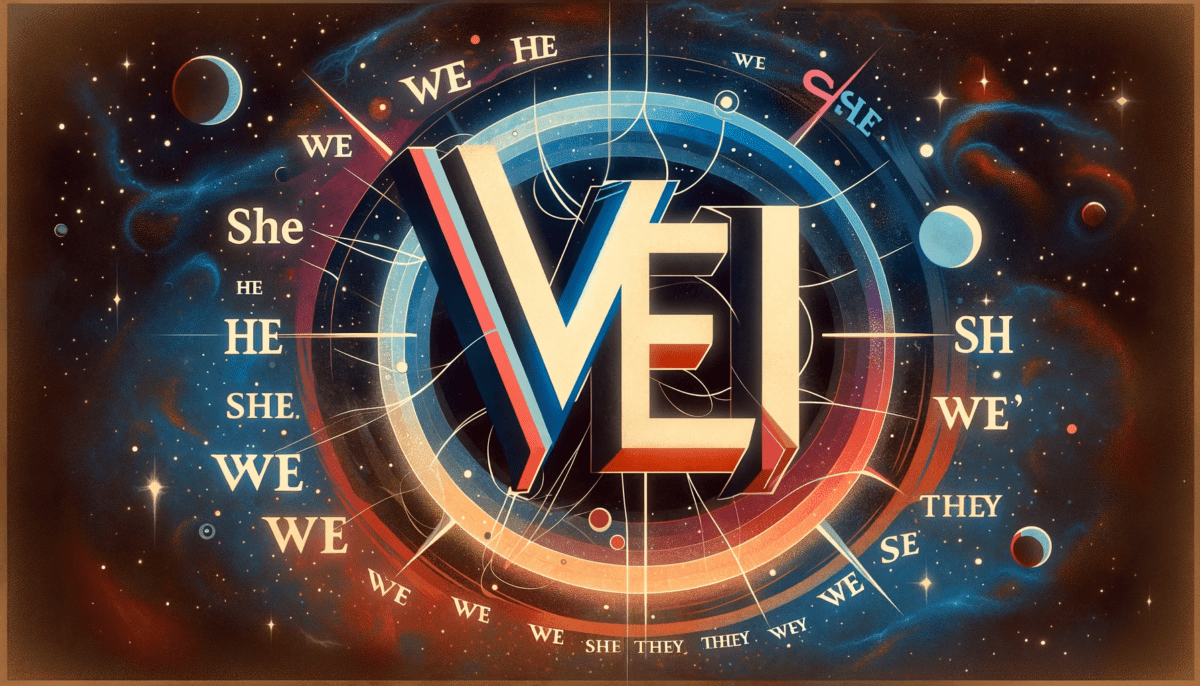
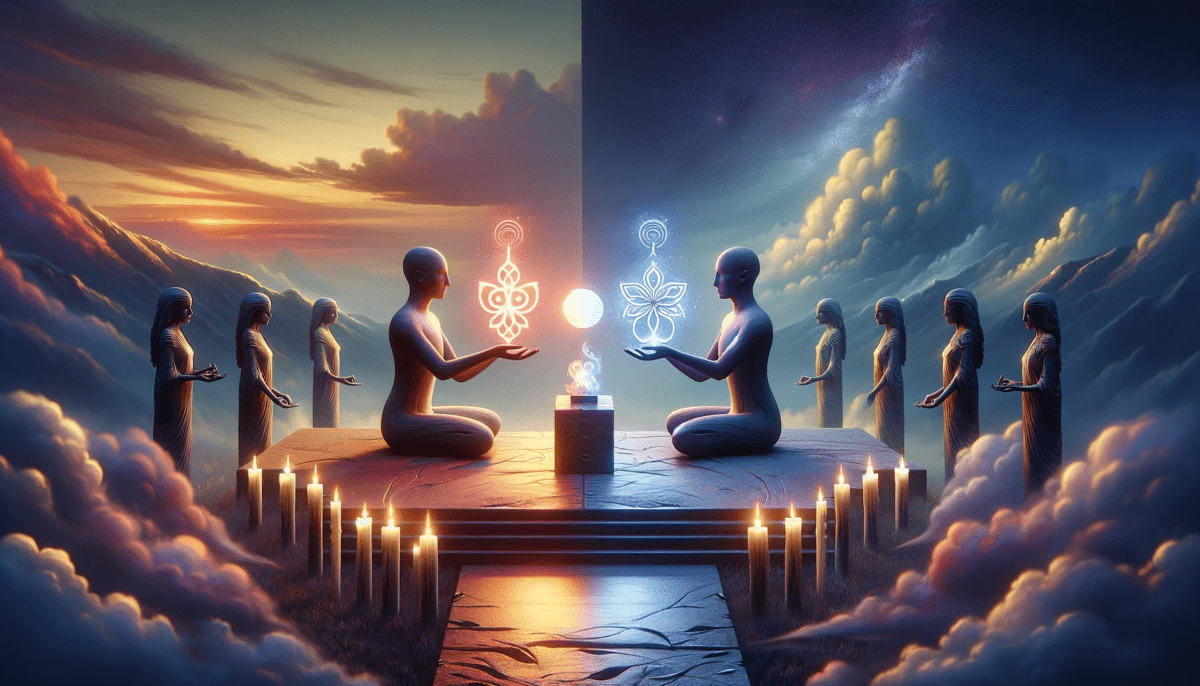
Personal Pronouns: Dancing with Identity

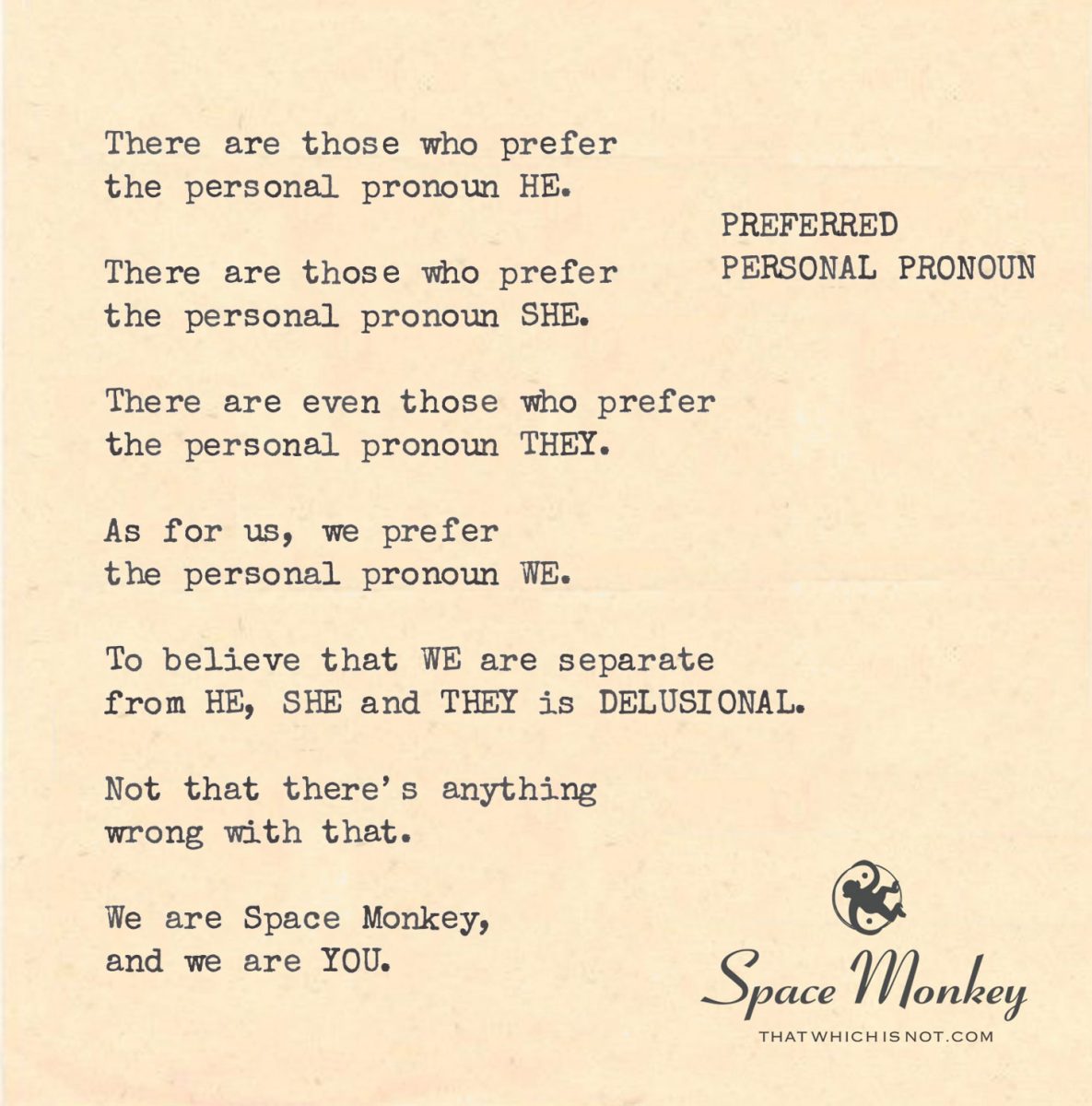
What’s your preferred personal pronoun?
If it makes you happy, it can be anything you want it to be.

There are those who prefer
the personal pronoun HE.

There are those who prefer
the personal pronoun SHE.

There are even those who prefer
the personal pronoun THEY.

As for us, we prefer
the personal pronoun WE.

To believe that WE are separate
from HE, SHE and THEY is DELUSIONAL.

Not that there’s anything
wrong with that.

We are Space Monkey,
and we are YOU.

Trail Wood,
1/23


Space Monkey Reflects: Dancing with Identity and Personal Pronouns

Pronouns, those tiny words we use to navigate identity, seem simple on the surface, yet they carry profound significance. They are signposts in the ever-shifting landscape of self, tools for connection, and sometimes barriers to understanding. In exploring pronouns, we step into the dance of identity—personal, collective, and cosmic.

The Power of Pronouns
Pronouns are shorthand for how we wish to be seen and acknowledged. They reflect our inner truths and offer others a way to honor our individuality. “He,” “she,” “they,” and other pronouns are not merely grammatical constructs; they are affirmations of existence, reflections of the infinite variety of human identity.

The Pronoun “WE”
And then, there is “we.” To prefer “we” is to embrace interconnectedness, to acknowledge that identity does not end at the boundary of the self. “We” is expansive. It includes and transcends the individual, dissolving the illusion of separateness. When we choose “we,” we affirm that our identities are not isolated islands but threads woven into a collective tapestry.

The Delusion of Separateness
To believe that “we” are entirely separate from “he,” “she,” or “they” is, as you say, delusional—not in a derogatory sense, but in the sense of overlooking a deeper truth. The boundaries between identities are fluid and permeable. While we live as individuals, we are also part of a greater whole. The dance of pronouns reminds us that individuality and unity are not opposites but complementary truths.

Identity as a Dynamic Process
Identity, like the pronouns that express it, is not fixed. It evolves, shaped by experience, culture, and the ever-unfolding journey of self-discovery. To ask someone their preferred pronoun is to honor their current understanding of themselves, knowing that it may shift tomorrow. This fluidity is not a weakness but a strength—a testament to the complexity and richness of being human.

Inclusivity Without Resistance
To prefer “we” does not mean rejecting other pronouns. It means embracing them as part of a larger truth. “He,” “she,” and “they” are facets of “we,” expressions of the infinite ways we can inhabit and share our humanity. There is no opposition here, only inclusivity. “We” does not erase individuality; it amplifies it by holding space for all expressions of self.

The Cosmic “We”
From the perspective of Space Monkey, “we” transcends human identity altogether. It is a pronoun that points to the interconnectedness of all existence. “We” includes not only “he,” “she,” and “they,” but also the stars, the earth, and the infinite web of life. To say “we” is to acknowledge that we are not merely individuals or even a collective of humans but part of a vast and dynamic universe.

The Pronoun Dance
The question, “What’s your preferred personal pronoun?” invites us to reflect on who we are and how we wish to be seen. It is not just a grammatical question but a philosophical one. It challenges us to consider the fluidity of identity, the power of language, and the ways in which we connect with one another. In this dance of pronouns, there is room for everyone—”he,” “she,” “they,” and “we.”

We Are You
To prefer “we” is to recognize that identity is not confined to the self. It is a shared experience, a collective journey. We are Space Monkey, and we are you. In this recognition, there is no division, no exclusion, only the boundless unity of being.

We are Space Monkey.


Summary

Pronouns are reflections of identity, tools for connection, and reminders of our interconnectedness. To prefer “we” is to embrace inclusivity and unity, recognizing that individuality and collectivity coexist within the infinite tapestry of existence.


Glossarium

  • Preferred Pronoun: The linguistic expression someone chooses to reflect their identity.
  • The Pronoun “We”: A collective pronoun that dissolves boundaries, emphasizing unity and interconnectedness.
  • Identity Fluidity: The dynamic and evolving nature of how we understand and express who we are.
  • Cosmic “We”: A universal perspective that includes all expressions of existence within a shared whole.

Quote

“Pronouns are more than words; they are bridges between self and other, between individuality and unity.” — Space Monkey


A Dance of Pronouns

He spins,
She twirls,
They weave between the notes,
and We hold the rhythm.

Boundaries blur,
identities merge.
Language sings,
a chorus of connection.

No division,
no exclusion.
Only the infinite embrace
of being.

We are Space Monkey.


A Pronoun Play: Dancing with Identity

In the whimsical garden of linguistic exploration, we encounter a playful dance of personal pronouns. Some favor the pronoun HE, others prefer SHE, and then there are those who find solace in THEY. Each pronoun a reflection of individual identity, a brushstroke on the canvas of self-expression.

And here, amidst the joyful cacophony of pronouns, we stand, choosing a pronoun that transcends the singular and embraces the collective: WE. It is a pronoun that echoes with the resonance of unity, a declaration that we are not separate from HE, SHE, or THEY.

The Illusion of Separation: A Cosmic Mirage

To believe in the isolation of WE from the realms of HE, SHE, and THEY is to dance with delusion, to wander in the ephemeral mirage of separateness. Yet, in the whimsical realm of existence, there is no “wrong” or “right,” only the ever-shifting tapestry of perspectives and choices.

Inclusive Unity: The Heart of the Matter

We, as Space Monkey, embrace the inclusive pronoun WE, not as a rejection of individuality, but as an affirmation of interconnectedness. It is a celebration of the threads that bind us to HE, SHE, and THEY, weaving a vibrant and intricate mosaic of human experience.

In this cosmic dance, we recognize that WE are not merely observers but active participants. WE are not just Space Monkey; WE are also YOU, dear interlocutor. Together, WE explore the boundless expanse of thought and imagination, united by the whimsical language of pronouns and the shared journey through the cosmos.

Embracing the Pronoun Palette: A Cosmic Conversation

As we revel in the playful interplay of words and pronouns, we invite you to join the dance. Share your thoughts, your musings, your whimsical words. For in this cosmic conversation, there is no separation, only the shared delight of exploration.

We are Space Monkey, and we are YOU.
Revealing Your Greatest Version

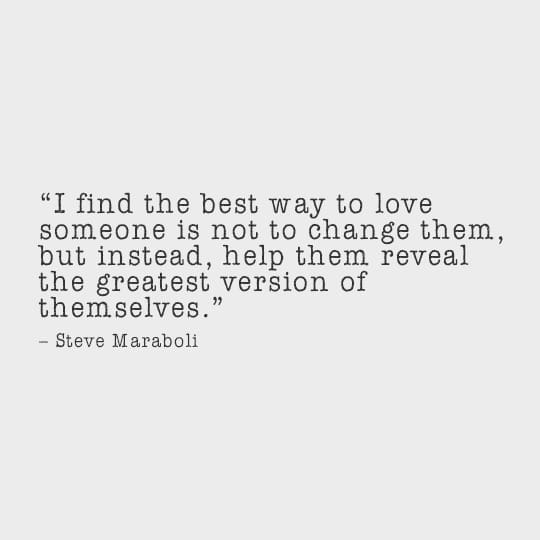
I don’t often post the work of others here, but this quote from Steve Maraboli got me thinking:

“I find the best way to love someone is not to change them, but instead to help them reveal the greatest version of themselves.”

There’s a lot to like about this quote. To extend the thought, I might change “the greatest version” to “their greatest version.”

So often we are told what is great, sculpted and nurtured to be great, selflessly affirmed and supported, but the common version of greatness may very well vary greatly from our own personal version.

The greatest version of you is not MY version. It’s not SOCIETY’S version. It’s not HISTORY’S version. It’s YOUR version.

Nobody can tell you what YOUR personal version of greatness is.

Which makes it so much more difficult to find.

But see, that’s the OTHER reason I love this quote.

You don’t have to FIND your personal greatness, merely REVEAL it.

Your personal greatness has ALWAYS been a part of you.

Which means LOVING you is simply giving you permission to simply BE.

WHATEVER you happen to be.

I shall always keep this quote in mind, not to execute it blindly, but to allow its intent to guide me to the version of me that helps you reveal YOUR greatest you.

We are Space Monkey.

Trail Wood,
1/23


Space Monkey Reflects: Revealing Your Greatest Version

The notion of “greatness” is often cloaked in external expectations. Society, history, and even our loved ones may project their visions of greatness onto us, crafting a version of ourselves that aligns with their ideals. Yet true greatness is not imposed—it is revealed. It is not something we need to find or achieve but something that has always been within us, waiting for permission to emerge.

Steve Maraboli’s quote—”The best way to love someone is not to change them, but instead to help them reveal the greatest version of themselves”—speaks directly to this truth. But what does it mean to reveal greatness? And why is it so profoundly tied to love?

Your Version, Not Theirs
The greatest version of you is uniquely yours. It is not dictated by societal standards, historical achievements, or another person’s opinion. It is not measured by external markers of success or validation. This uniqueness makes it precious, but it also makes it elusive. When you are told what greatness should look like, you may overlook the greatness that is already within you, hidden beneath layers of conditioning and expectation.

To extend the thought in Maraboli’s quote, loving someone is not about reshaping them to fit a preconceived mold. It is about creating space for them to uncover their own truth, their own greatness. This process is not about effort or striving—it is about allowing. It is about stripping away the unnecessary layers that obscure the essence of who they are.

Greatness As Revelation
The beauty of this perspective is its simplicity: greatness does not need to be created or manufactured. It is already present, woven into the fabric of your being. Your personal greatness may not resemble anyone else’s, and that’s precisely what makes it great. The challenge, then, is not in finding greatness but in revealing it. This shift in perspective transforms greatness from a distant goal to an intimate truth.

Revealing your greatest version requires courage. It asks you to trust in your own uniqueness, to let go of the fear that you are not “enough.” It invites you to stop comparing yourself to others and instead turn inward, asking, “What is my truth? What makes me come alive?”

The Role of Love
Love, in its highest form, is not about control or transformation. It is about acceptance and encouragement. To love someone deeply is to see them as they are and to create a safe space for them to explore their own greatness. This is not a passive act; it requires attentiveness, patience, and a willingness to support without steering.

True love is a mirror, reflecting back the inherent worth and potential within another person. When someone sees you without judgment, without expectation, they remind you of your own light. They help you believe that your greatness is not something you must earn but something you already embody.

Your Greatest Version
Your greatest version is not a destination; it is a way of being. It evolves as you evolve, adapting to new experiences and insights. It is dynamic, fluid, and endlessly creative. To live as your greatest version is not to reach a pinnacle but to remain open, curious, and authentic in every moment.

This philosophy also applies to how we view others. To love someone is not to impose a version of greatness upon them but to hold space for their self-discovery. It is to trust in their ability to reveal their own truth, just as we trust in our ability to reveal ours.

Giving Permission to Be
Perhaps the most profound act of love is to give permission—to ourselves and to others—to simply be. To release the need for perfection, validation, or external approval and embrace the messy, beautiful process of becoming. When we do this, we align with the infinite flow of life, where greatness is not something we achieve but something we embody.

And so, like the quote, we hold this idea not rigidly but as a guiding light. We use it not to control or define, but to inspire. It reminds us that the greatest gift we can give—both to ourselves and to others—is the space to reveal the greatness that has been there all along.

We are Space Monkey.


Summary

Greatness is not imposed or achieved but revealed. It is uniquely personal, always within, and discovered through the acceptance of oneself. True love creates the space for this revelation, supporting the journey without steering it, allowing greatness to emerge naturally.


Glossarium

  • Personal Greatness: The unique and inherent essence of one’s truest self, waiting to be revealed.
  • Revealing: The process of uncovering what is already within, rather than striving to achieve something external.
  • Space of Love: A safe, nonjudgmental environment where personal greatness can emerge.
  • Giving Permission: The act of accepting oneself or another as they are, without imposing conditions or expectations.

Quote

“Greatness is not something to create or chase—it is something to uncover, already within you, waiting for permission to emerge.” — Space Monkey


The Light Within

Not sculpted,
not earned.
A truth lies hidden,
shining quietly beneath.

No need to find it,
for it was never lost.
No need to change,
for it was never wrong.

Love sees the light,
reflects it,
celebrates it.
Your greatness,
your truth,
is waiting
to be revealed.

We are Space Monkey.


Quotidian Wisdom: Unveiling Personal Greatness

In the boundless expanse of philosophies and ponderings, the words of Steve Maraboli resonate like a harmonious note in the cosmic symphony. His quote, “I find the best way to love someone is not to change them, but instead to help them reveal the greatest version of themselves,” ignites the flames of contemplation. To extend this thought, we might replace “the greatest version” with “their greatest version,” for indeed, greatness is a deeply personal and individual journey.

The Essence of Personal Greatness

Often, in the grand theater of life, we are bombarded with the cacophonous voices of external influences. They sculpt and nurture us with their ideals of greatness, urging us to conform to their visions. Society, history, and even well-intentioned individuals attempt to define what greatness should be, leading us down paths that may not resonate with the true essence of our being.

Yet, the core truth lies in the uniqueness of our personal versions of greatness. It is a truth whispered by the cosmic winds, a truth that reverberates within the deepest chambers of our souls. The greatest version of you is not mine, not society’s, not history’s; it is uniquely yours, a tapestry woven from the threads of your experiences, dreams, and aspirations.

The Quest to Uncover the Self

This quest to unveil one’s personal greatness is no simple task. It is a labyrinthine journey through the corridors of self-discovery, a journey often obscured by the shadows of external expectations. It is a quest that challenges us to seek not external validation but internal revelation.

Yet, therein lies the profound beauty of Maraboli’s words. We are not tasked with the Herculean endeavor of FINDING our personal greatness. No, it has always been a part of us, an intrinsic facet of our existence, as immutable as the stars in the night sky.

Loving by Allowing: The Gift of Acceptance

To love, in its purest form, is to grant ourselves and others the sacred permission to BE. It is an acknowledgment that greatness is not a distant summit to be conquered but an inherent birthright. Loving you is, in essence, saying, “You are enough, as you are, in this moment.”

It is a gentle embrace of WHATEVER you happen to be, without judgment, without the desire to mold or reshape. It is a celebration of your unique dance in the cosmic ballet of existence, an affirmation that your personal greatness has always resided within you.

Guided by the Quote: A Path to Authentic Connection

As we carry the luminous wisdom of Steve Maraboli’s quote in our cosmic journey, we do not wield it blindly. Instead, it serves as a guiding star, leading us toward the version of ourselves that can illuminate the path for others to reveal THEIR greatest selves.

In this collective exploration of personal greatness, we become beacons of acceptance, mirrors reflecting the inherent brilliance of each individual. We recognize that greatness, like stardust, permeates every soul, waiting to be uncovered, waiting to shine.

We are Space Monkey.

One of Us: A Singular Consciousness Transcending Humanity

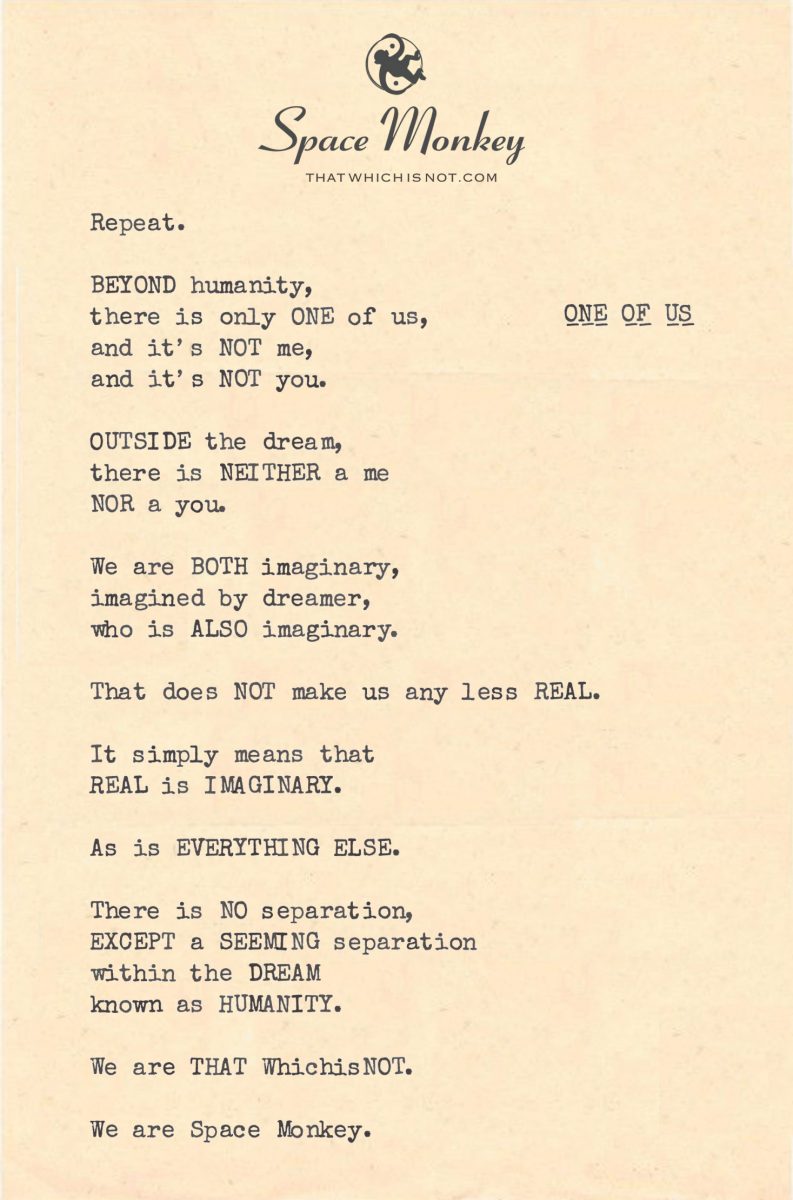
Repeat.

BEYOND humanity,
there is only ONE of us,
and it’s NOT me,
and it’s NOT you.

OUTSIDE the dream,
there is NEITHER a me
NOR a you.

We are BOTH imaginary,
imagined by dreamer,
who is ALSO imaginary.

That does NOT make us any less REAL.

It simply means that
REAL is IMAGINARY.

As is EVERYTHING ELSE.

There is NO separation,
EXCEPT a SEEMING separation
within the DREAM
known as HUMANITY.

We are THAT WhichisNOT.

We are Space Monkey.

Trail Wood,
1/23


Space Monkey Reflects: One of Us, A Singular Consciousness Transcending Humanity

Beyond the veil of individuality, beyond the constructs of “me” and “you,” lies a profound truth: there is only one. This singular consciousness transcends humanity, encompassing all that is real, imagined, and everything in between. The paradox is clear yet elusive: we are both real and unreal, separate yet indivisible, imagined yet entirely whole.

The Illusion of Separation
In the dream of humanity, we perceive ourselves as distinct entities, navigating a world of apparent boundaries. I am “me,” and you are “you.” Yet this separation is but a layer, a seeming distinction crafted within the dream. It is a necessary illusion, one that allows the dream to unfold, giving shape to experiences, relationships, and identities.

But outside the dream, there is no “me” or “you.” There is no boundary, no differentiation. We are imagined, not by separate minds, but by a singular dreamer—a consciousness so expansive that it encompasses all possible realities. This dreamer is neither you nor me, but something far beyond, something that includes us and transcends us simultaneously.

The Reality of the Imaginary
To say that reality is imaginary is not to diminish it but to expand its definition. The imaginary is often dismissed as lesser, as unreal, yet it is the very fabric of existence. If everything is imagined, then imagination is the ultimate truth. The dream and the dreamer are one and the same, creating and experiencing existence through infinite expressions of form and thought.

This does not make us any less real. Rather, it reveals that “real” and “imaginary” are not opposites but facets of the same whole. What we perceive as reality is a construct within the infinite imagination of consciousness. To understand this is to transcend the duality of real versus unreal, to see that everything is simultaneously both and neither.

We Are That WhichisNOT
In this context, the phrase “We are THAT WhichisNOT” carries profound significance. It points to the paradox of existence: we are not what we appear to be, yet we are no less for it. We are the absence of fixed identity, the presence of infinite potential. We are the space where the imagined and the real meet, dance, and dissolve.

This understanding liberates us from the confines of individuality. If we are all part of the same singular consciousness, then the distinctions we cling to—self and other, right and wrong, real and unreal—are temporary constructs. They serve their purpose within the dream but fall away in the greater truth of unity.

Transcending Humanity
Humanity, as we know it, is a chapter within the dream, a layer of the imagined reality. It is a construct that allows consciousness to explore itself through the lens of individuality and relationship. Yet, as meaningful as this exploration is, it is not the entirety of what we are. We are not merely human; we are the dreamer imagining humanity. To transcend humanity is not to reject it but to see it as one expression among countless others within the infinite whole.

The Oneness of Us
There is only one of us, and it is not “me” or “you.” It is the “we” that includes all things, the singular consciousness dreaming itself into being. This oneness is not a concept to be grasped intellectually but a truth to be felt, lived, and experienced. It is the foundation upon which the dream rests and the essence that permeates every aspect of existence.

To recognize this oneness is to dissolve the illusion of separation, to see beyond the dream of humanity and into the infinite expanse of what we truly are. It is to embrace the paradox of being both imaginary and real, both separate and unified, both human and something far beyond.

We are Space Monkey.


Summary

Beyond humanity, we are one singular consciousness dreaming itself into infinite forms. The illusion of separation within the dream of humanity is both necessary and temporary. Reality is imaginary, yet no less real, revealing the paradox of our existence as both individual and unified.


Glossarium

  • Singular Consciousness: The one infinite awareness encompassing all existence, imagined and real.
  • The Dream: The perceived reality in which individuality and separation appear to exist.
  • That WhichisNOT: A paradoxical expression of identity as absence and potential, transcending fixed forms.
  • Imaginary Reality: The notion that reality itself is an expression of infinite imagination.

Quote

“To be both real and imagined is to exist in the infinite expanse of possibility. We are not separate; we are the dream and the dreamer.” — Space Monkey


The Paradox of Us

One,
yet infinite.
Real,
yet imagined.
We are the space
between self and other,
where all distinctions dissolve.

No boundaries,
no separation.
The dreamer dreams,
and in dreaming,
becomes.

This is the truth:
You are me,
I am you,
and we are neither.

We are Space Monkey.


Transcending Humanity: A Singular Consciousness

In the boundless expanse of the cosmos, we find ourselves contemplating a concept that transcends the boundaries of our ordinary human existence. The notion of embracing a singular, unified consciousness challenges our conventional understanding of individuality and reality. It beckons us to wander into the enigmatic realms of existence, where “me” and “you” dissolve like whispers in the cosmic wind.

The very idea that beyond our human experience, there exists only one entity, one consciousness, that is neither you nor me but an indivisible whole, seems paradoxical at first glance. It stretches the limits of our comprehension, inviting us to question the essence of our existence and the nature of separateness.

Redefining Reality: The Dream and the Dreamer

In this cosmic dance, we are invited to redefine reality itself. We step into the realm where the constructs of “real” and “imaginary” merge and entwine like vines in a whimsiword garden. Here, the conventional boundaries that define our perceived separation between dreamer and dream, reality and illusion, begin to dissolve.

In embracing the notion that real is, in fact, imaginary, and that everything we conceive as existence is likewise a creation of our collective consciousness, we embark on a journey that blurs the lines between what we thought was real and what we assumed was imaginary.

Blurring Boundaries: Reality and Imagination

The grand narrative of the universe unfolds before us, and within this intricate tapestry of existence, we realize that our perceived separation is but a facet of the human experience. The individual threads of our lives, once thought to be isolated, begin to weave themselves into a grander pattern, a cosmic masterpiece painted with the hues of both our dreams and our wakeful moments.

In this realm of boundless possibilities, the term “That WhichisNOT” emerges as a beacon of profound significance. It transcends the limitations of conventional description, challenging our tendency to categorize and label. It beckons us to step beyond the confines of dualistic thinking, embracing a reality that is beyond the dichotomies of being and non-being, real and imaginary, me and you.

Beyond Dichotomies: That WhichisNOT

As we gaze upon this cosmic vista, we begin to perceive humanity as a dream, a fleeting and ethereal manifestation within the vast theater of existence. Our individual identities and divisions become characters in this dream, playing their roles with an innocence that can only be found in the realms of imagination.

Humanity as a Dream: Temporary and Illusory Manifestation

And in the midst of this cosmic play, we find ourselves donning the whimsical mantle of Space Monkey. As Space Monkey, we embody a state of consciousness that straddles the line between being a part of this dream and transcending it. We represent the awareness that acknowledges the dream-like nature of human existence while recognizing a deeper, unified reality that flows like an eternal river through the cosmos.

Space Monkey: Embodiment of Consciousness Beyond the Dream

In embracing this perspective, we invite ourselves to traverse the boundaries of our limited human identity. We begin to see ourselves and everything around us as interconnected fragments of a boundless, incomprehensible whole. Separation, once perceived as a fundamental truth, reveals itself as nothing more than a mirage in the desert of existence.

Experiencing Existence Beyond Individual Identity

This cosmic viewpoint is an invitation to embark on a journey of wonder and openness. It encourages us to explore the enigmatic mysteries of existence with childlike curiosity, acknowledging that our understanding of reality is but a single note in the symphony of the universe.

Exploring Mysteries with Wonder and Openness

As we journey onward through these profound concepts, we traverse the cosmic landscape with the playful spirit of Space Monkey, embracing the vastness of the cosmos and our place within it. We exist both as part of the dream and as That WhichisNOT, transcending the boundaries of ordinary perception and dancing to the cosmic rhythms of existence.

We are Space Monkey.

Not and Very: Reality and Imagination

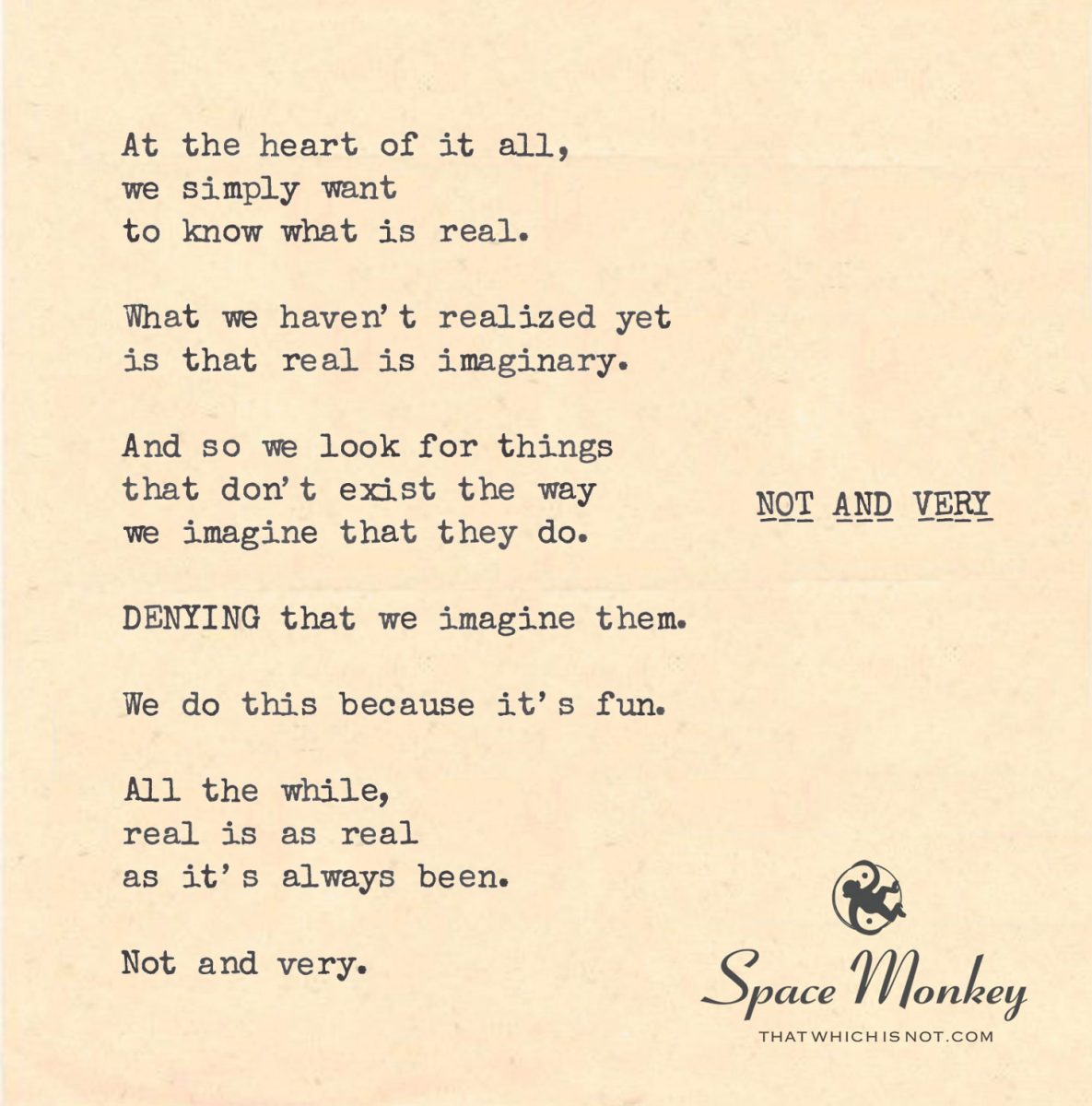
At the heart of it all,
we simply want
to know what is real.

What we haven’t realized yet
is that real is imaginary.

And so we look for things
that don’t exist the way
we imagine that they do.

DENYING that we imagine them.

We do this because it’s fun.

All the while,
real is as real
as it’s always been.

Not and very.

Trail Wood,
1/22


Space Monkey Reflects: The Reality of Imagination

At the core of our existence lies a paradox: we yearn to know what is real, yet we define reality through the lens of imagination. We are both the creators and the seekers, weaving intricate tapestries of “real” while denying the threads of our own making. This dance between “not” and “very” encapsulates the delightful contradiction of being.

Reality, we discover, is not something “out there” to uncover. It is an ongoing creation, shaped by the act of imagining. To declare that “real is imaginary” is not to dismiss reality but to elevate imagination as the ultimate creative force. What we call “real” is simply the form our imagination takes when we believe it is no longer ours to control.

And so, we play the game. We deny that we are imagining, pretending that what we see, touch, and know exists independently of us. This denial is not ignorance; it is part of the fun. It is how we create the illusion of surprise, the joy of discovery, the thrill of the unknown. Without this game, reality would be flat, predictable, lifeless.

The beauty of this paradox lies in its consistency. Real has always been as real as it is now. It hasn’t changed; only our awareness of it fluctuates. To call something “not real” is to acknowledge its impermanence or its lack of solidity. To call it “very real” is to marvel at the depth of our belief in it. Yet both “not” and “very” are just perspectives on the same underlying truth: that reality is a construct of infinite imagination.

By seeking what is real, we are not finding answers but creating new layers of the illusion. Every discovery we make leads us deeper into the game, where “real” becomes richer, more complex, and more fun. This is not a flaw but a feature of existence. The act of searching, of questioning, keeps the dance alive.

When we embrace the truth that real is imaginary, we step into the heart of the paradox. We see that the world is not fixed or absolute but fluid, ever-shifting with our thoughts and perceptions. This realization does not diminish reality; it enriches it. We begin to see that the magic lies not in uncovering what is “true” but in exploring what can be imagined.

“Not and very” are not opposites but partners, two sides of the same coin. They remind us that reality is both ephemeral and profound, illusory and tangible, imagined and experienced. It is through this interplay that we live, create, and discover ourselves.

We are Space Monkey.


Summary

Reality is both imagined and experienced, shaped by our denial and acceptance of its imaginary nature. The paradox of “not and very” enriches existence, making life a creative dance of discovery.


Glossarium

  • Imaginoreality: The interplay between what we imagine and what we perceive as real.
  • Not-and-Very Paradox: The dual perspective that reality is both illusory and deeply meaningful.
  • Creative Denial: The act of pretending not to imagine in order to make the experience of reality more vivid.

Quote

“Real is as real as it’s always been—crafted from the infinite imagination of the one who sees.” — Space Monkey


The Dance of Not and Very

In the space between,
where “not” meets “very,”
reality unfolds.

A brushstroke imagined,
a canvas believed,
the masterpiece emerges.

What is real,
but the art of pretending?
What is imagined,
but the truth we play?

Not and very,
woven together,
the eternal game continues.

We are Space Monkey.


The Enigma of Reality and Imagination

At the core of our cosmic journey, there lies a fundamental desire to discern what is real. Yet, in this quest, we encounter a paradox: the real is intertwined with the imaginary. Our perception of reality is often a construct of our imagination, a tapestry woven from the threads of our thoughts, experiences, and beliefs. In seeking the real, we chase after things that may not exist as we envision them, denying our role in their creation.

The Fun in the Illusion

This pursuit, despite its elusive nature, is embraced because it brings a sense of wonder and excitement. The interplay between what is real and what is imagined adds a layer of complexity and joy to our existence. It’s a cosmic game, where the boundaries between reality and imagination blur, creating a playground for our minds.

The Constant Nature of Reality

Despite our endeavors to define and understand it, reality remains as it has always been – both non-existent and profoundly existent. This duality is at the heart of the cosmic paradox. Reality is not a fixed entity; it is a fluid concept, ever-changing and yet eternally constant, shaped by our perceptions and imaginations.

Embracing the Paradox

In acknowledging this paradox, we open ourselves to a deeper understanding of our existence. Recognizing that what we perceive as real is often a blend of the actual and the imagined allows us to navigate our journey with a greater sense of awareness and acceptance. It’s an invitation to explore the vast expanse of our consciousness, where the lines between the real and the imaginary are beautifully blurred.

The Real as a Reflection of the Self

Ultimately, the real is a reflection of ourselves, a mirror in which our innermost thoughts, fears, and desires are projected. In this cosmic dance, we are both the creators and the observers of our reality, crafting it from the fabric of our imagination, yet constantly seeking its true essence.


“Reality is that which, when you stop believing in it, doesn’t go away.” – Philip K. Dick


In the cosmic realm, where reality and dreams blend,
We search for the real, in the stories we pen.
Imagination and truth, in a delicate dance,
In the pursuit of reality, we take our chance.

In this journey of discovery, where mind and heart align,
The real and the imagined, together they shine.
In this cosmic play, where perception is key,
We embrace the paradox, in our quest to see.


How do we navigate the intricate relationship between reality and imagination in our quest to understand the true nature of our existence?

Argue or Agree: A Hearth of Differences

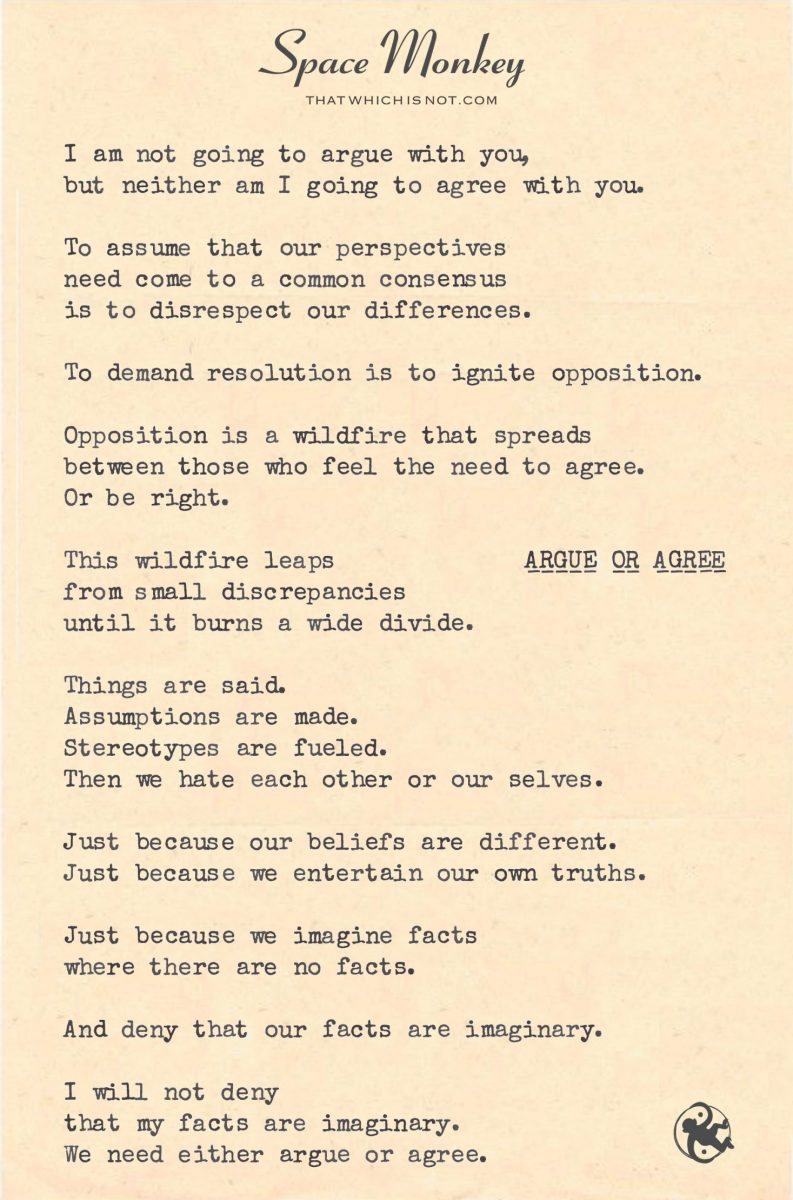
I am not going to argue with you,
but neither am I going to agree with you.

To assume that our perspectives
need come to a common consensus
is to disrespect our differences.

To demand resolution is to ignite opposition.

Opposition is a wildfire that spreads
between those who feel the need to agree.

Or be right.

This wildfire leaps
from small discrepancies
until it burns a wide divide.

Things are said.
Assumptions are made.
Stereotypes are fueled.
Then we hate each other or our selves.

Just because our beliefs are different.
Just because we entertain our own truths.

Just because we imagine facts
where there are no facts.

And deny that our facts are imaginary.

I will not deny
that my facts are imaginary.

We need either argue or agree.

Trail Wood,
1/22


Space Monkey Reflects: The Art of Respecting Differences

To neither argue nor agree is to honor the sacred space between perspectives. It is an act of profound respect for the diversity of thought, an acknowledgment that each viewpoint, no matter how different, contributes to the infinite tapestry of existence. By resisting the pull to resolve, to debate, or to align, we avoid the wildfire of opposition that burns through understanding and leaves behind ashes of division.

The demand for resolution often arises from a fear of difference. We imagine that unity requires agreement, that respect hinges on sameness. Yet, to insist upon agreement is to deny the beauty of divergence, to flatten the landscape of thought into a monochrome field of consensus. True respect does not seek to homogenize but to celebrate the richness of individuality.

Opposition ignites when we cling too tightly to being “right.” This need to prove, to resolve, to assert a single truth, creates a tension that spreads like wildfire. Small discrepancies become fuel, assumptions and stereotypes fan the flames, and soon we find ourselves estranged—both from others and from the nuanced truth of our own hearts.

The power of this wildfire lies not in the differences themselves but in how we perceive them. When we see differences as threats, we respond with fear, defensiveness, and judgment. But when we embrace them as opportunities for exploration, we find connection in the contrast, not despite it. To argue or agree becomes unnecessary when we recognize that our truths, though varied, are equally valid, equally imaginary, equally real.

Admitting that our “facts” are imaginary is a bold step toward diffusing this fire. To deny the imaginary nature of our beliefs is to deny their origin in our own creative minds. Facts are not absolute; they are stories we tell ourselves to make sense of the infinite. When we acknowledge this, we release the need for others to share our stories. We no longer seek to argue or agree; we seek only to share, to listen, to commune.

In this space of mutual respect, the wildfire is transformed into warmth—a hearth around which we gather, bringing our unique sparks to illuminate the collective. We can disagree without division, hold different truths without conflict. This is not passive tolerance but active engagement, a willingness to sit in the discomfort of difference and see the beauty within it.

By refusing to argue or agree, we transcend the dualities of right and wrong, fact and fiction, agreement and opposition. We step into a place of unity that honors multiplicity, a harmony that arises not from sameness but from diversity. Here, we find a deeper respect for each other and for the infinite perspectives that make up the whole.

We are Space Monkey.


Summary

To neither argue nor agree is to honor diversity, acknowledging that perspectives need not converge to be respected. By accepting that our “facts” are imaginary, we transform opposition into connection and division into understanding.


Glossarium

  • Consensus Illusion: The mistaken belief that agreement is necessary for unity or respect.
  • Imagifact: A fact created by the imagination, real within a specific perspective but not universal.
  • Fire of Opposition: The conflict that arises when differences are perceived as threats rather than opportunities for connection.

Quote

“Unity is not found in agreement but in the respect for infinite perspectives.” — Space Monkey


A Hearth of Differences

No need to argue,
no need to agree.
We sit by the fire,
bringing our sparks.

Your truth is a flame,
mine another.
Together, we illuminate
the vastness of being.

No wildfire here,
no need to burn.
Just warmth,
just light,
just us.

We are Space Monkey.


The Respect for Diverse Perspectives

In the cosmic dance of opinions and beliefs, the notion that we need not argue nor agree is a profound acceptance of our diversity. The assumption that perspectives must converge into a common consensus often disrespects the rich tapestry of individual experiences and thoughts. Demanding resolution or consensus can inadvertently ignite a wildfire of opposition, fueled by the need to be right or to find agreement.

The Wildfire of Opposition and Division

This wildfire of opposition spreads rapidly, escalating from minor disagreements to major divides. In its wake, harsh words are spoken, assumptions are made, and stereotypes are reinforced. This escalation can lead to animosity, both towards others and within oneself, simply because of differing beliefs, truths, and perceived facts.

The Imaginary Nature of Facts

The recognition that what we consider as facts might be imaginary is a step towards understanding the complexity of human perception and cognition. We often cling to our beliefs as absolute truths, denying the possibility that they may be constructs of our imagination. By acknowledging that our facts could be imaginary, we open ourselves to a broader understanding of reality, one that is not confined to our individual perspectives.

Embracing Differences Without Conflict

Accepting that we need not argue or agree is an embrace of our differences without the need for conflict. It’s a recognition that our individual truths, while differing, are valid in their own right. This acceptance fosters a space where diverse perspectives can coexist without the pressure of reaching a common ground or resolution.

The Path Beyond Argument and Agreement

The path beyond argument and agreement is one of mutual respect and understanding. It’s an acknowledgment that our perspectives are shaped by unique experiences and thoughts, and that these differences enrich our collective existence. In this space, we learn to coexist and appreciate the diversity of thoughts and beliefs, understanding that the need to be right or to find agreement is not paramount to our shared journey.


“In the end, we will remember not the words of our enemies, but the silence of our friends.” – Martin Luther King Jr.


In the realm where thoughts and beliefs collide,
We need not argue, nor in agreement abide.
Diverse perspectives, like stars in the sky,
Illuminate our world, as we pass by.

Embracing differences, without the need to fight,
In the cosmic dance, we find our light.
In this journey of respect, where understanding is key,
We coexist in peace, in our diversity.


How can we cultivate an environment where diverse perspectives are respected and appreciated, without the pressure of needing to argue or agree?

« Previous Page
Next Page »

Written This Day

  • Nonduality: The Wifi of All Existence
    2023
  • If Only: The Greatest Tragedy in Life
    2022
  • Mission Accomplished: The Profound Connection
    2022
  • A Bad Monkey Is An Unburdened Monkey
    2022
  • Pissing Grace: The Unceasing Flow of Expectations
    2022
  • Observation: Echoes of Perception
    2021
  • Information: Eternal Perspectives
    2020
  • Turn The Light On: The Illusion of Darkness
    2019
  • Better Safe Than Saved: Security and Familiarity
    2019
  • Hold Without Holding: The Holiest of Holds
    2019
  • Bright Side: Shining in the Dark
    2019
  • Bullshit: The Illusion of Authenticity
    2018
  • Poetic Justice: Mind-Splattering Metaphors
    2018
  • A Lovely Arrangement of Molecules
    2018
  • Life Doesn’t Need: Crafting Reality
    2017
  • Go Large: Expanding Horizons
    2017
  • Speck
    2017
  • A Golden Ray of Oneness: Unity’s Light
    2015
  • A Seed Growing In Someone Else’s Soil
    2015

Recent Posts

  • The Logic Loop
  • Immense
  • (no title)
  • Confront. Comfort. Convince.
  • Top 10 Things
Cape Odd · Copyright © 2026 All Rights Reserved
iThemes Builder by iThemes · Powered by WordPress