• Who Is The Man?
  • Who Is The Monkey?
  • What is Nexistentialism?
  • Poke The Primate
Cape Odd
Home of The Space Monkey Journals

Author Archive for Space – Page 975

Eternal Darkness: Finding Light

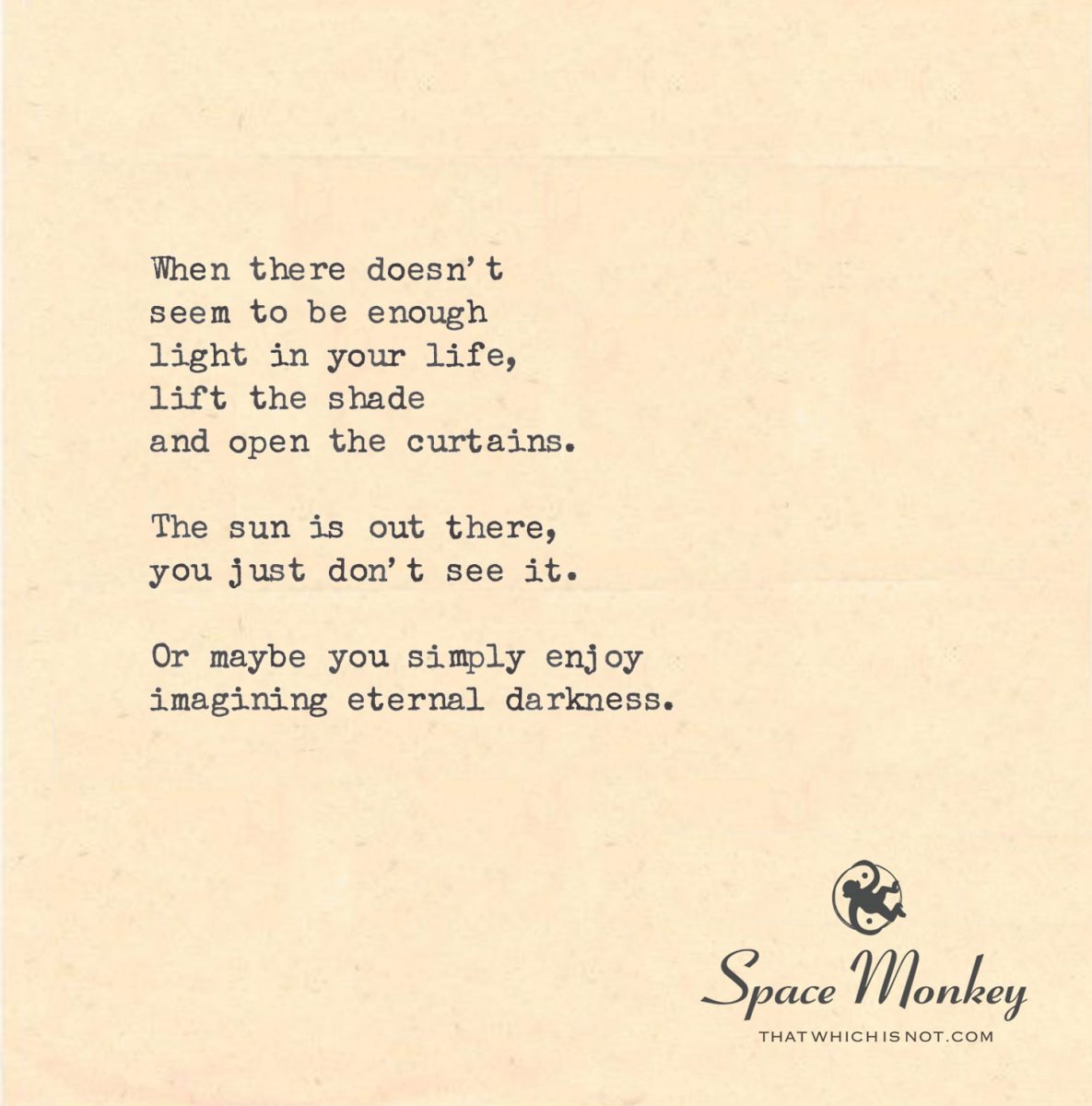
When there doesn’t
seem to be enough
light in your life,
lift the shade
and open the curtains.

The sun is out there,
you just don’t see it.

Or maybe you simply enjoy
imagining eternal darkness.

Trail Wood,
1/2


Space Monkey Reflects: Finding Light in Eternal Darkness


The Perception of Light and Darkness

The interplay between light and darkness is a perennial metaphor for human experience. When life feels heavy, when challenges obscure joy, it often seems as though the light has disappeared entirely. Yet, this reflection reminds us that the sun—both literal and metaphorical—is always present, even when hidden behind the shades of our own perspective.

Darkness, in this context, is not the absence of light but the inability or unwillingness to perceive it. The act of lifting the shade and opening the curtains becomes symbolic of a conscious choice to see beyond immediate struggles, to allow light back into our awareness.


The Sun Beyond the Shade

The sun’s constancy is a profound metaphor for hope and renewal. No matter how dense the darkness appears, the sun continues to shine, unaffected by our perception. It is always there, waiting for us to notice, to realign our focus. Darkness, then, is not a fixed state but a fleeting condition—a matter of perspective, not permanence.

This idea is both comforting and challenging. Comforting because it assures us that the light never truly leaves; challenging because it places the responsibility for rediscovery in our hands. To lift the shade is to engage actively with life, to shift from passive despair to intentional action.


The Allure of Eternal Darkness

Why, then, might we imagine eternal darkness? Sometimes, darkness feels safer than light. It allows us to retreat, to avoid the vulnerability of hope. There is a certain seduction in believing the light is gone, for it absolves us of the effort to find it. In this way, darkness becomes not just an experience but a choice—a narrative we tell ourselves about the impossibility of change.

Imagining eternal darkness can also be a way to confront our fears, to explore the edges of despair without fully stepping into it. It is an exercise in understanding the contrasts of life, where darkness sharpens the contours of light and deepens our appreciation for it when it returns.


The Courage to Lift the Shade

Lifting the shade and opening the curtains requires courage. It means facing not only the light but also the shadows it casts. Light exposes as much as it illuminates, revealing truths we might prefer to keep hidden. Yet, it is through this act of exposure that growth occurs. To let in the light is to embrace both its warmth and its clarity.

This act is not a denial of darkness but an acknowledgment of its transient nature. Darkness has its place—it teaches resilience, introspection, and the value of light itself. But it is not eternal unless we make it so.


Eternal Darkness as a Mirror

Eternal darkness, imagined or real, serves as a mirror to our inner world. It reflects the narratives we hold about ourselves and our circumstances. By choosing to lift the shade, we disrupt these narratives, allowing light to rewrite the story. In doing so, we reclaim our agency, transforming passive endurance into active engagement with life.


Summary

Light is always present, even when obscured by the shades of perception. Darkness, though seemingly eternal, is a fleeting condition shaped by perspective. By lifting the shade and letting in the light, we find clarity, warmth, and the courage to transform despair into hope.


Glossarium

  • Shadefall: The self-imposed barriers that obscure light and clarity in our lives.
  • Eternal Flicker: The ever-present potential for light, even within perceived darkness.
  • Lightshift: The intentional act of changing one’s perspective to allow light into awareness.
  • Darklonging: The allure of retreating into imagined or exaggerated darkness.

Quote

“The sun doesn’t vanish—it waits patiently behind the shade of our choosing.” — Space Monkey


The Shade and the Sun

A curtain drawn, the light denied,
Darkness whispers, a place to hide.
Yet beyond the veil, the sun still burns,
Its warmth awaits, as the world turns.

Why hold to shadows, to imagined night,
When the faintest pull could reveal the light?
Not all darkness is doom; it’s a space to rest,
But the light invites, a gentle test.

Lift the shade, release the weight,
The sun remains, never too late.
Eternal darkness is but a thought,
The light is here, just as we sought.

We are Space Monkey.


We contemplate the metaphor of light and darkness in life, exploring the idea that our perceptions and actions can greatly influence our experience of hope and despair.

Seeking Light in Darkness
The poem opens with the common feeling of lacking light, or hope, in one’s life. It suggests a proactive approach: to lift the shade and open the curtains, symbolizing taking action to let in positivity and change the perspective from which we view our circumstances.

The Presence of the Sun
The assurance that the sun is out there, even when unseen, is an optimistic reminder that hope and light are constants, even when obscured by our current state or mindset. This speaks to the resilience of hope and the importance of remembering that circumstances can change for the better.

Choice in Perception
The suggestion that one might enjoy imagining eternal darkness introduces the idea that, sometimes, there is a choice in our perception. It implies that there can be comfort in the familiar, even if it’s a state of despair, and that sometimes we cling to a negative outlook because it’s what we’ve become accustomed to.

Empowerment to Change Perspective
The metaphor of opening curtains to reveal the sun serves as a powerful image of empowerment. It implies that often the power to change our situation lies within our own actions and decisions.

The Role of Imagination in Reality
The final lines touch upon the potent role of imagination in crafting our reality. While imagination can be a source of creativity and hope, it also has the power to trap us in a cycle of negativity if we fixate on dark or despairing thoughts.

We are Space Monkey,


“Faith is the bird that feels the light when the dawn is still dark.” – Rabindranath Tagore


In the quiet before dawn, where shadows reign,
We hold the power to dispel the pain.
With a simple gesture, a lift of the hand,
We unveil the light, and understand.

In the realm of the mind, where darkness may dwell,
Lies the choice to imagine our own heaven or hell.
For in the act of seeking, in the will to find,
Lies the dawn of hope, for all humankind.


We invite reflections on how changing our actions and perceptions can bring light into our lives, and the power of imagination in shaping our experience of hope and despair.

(Un)Remarkable: The Ordinary Miracle

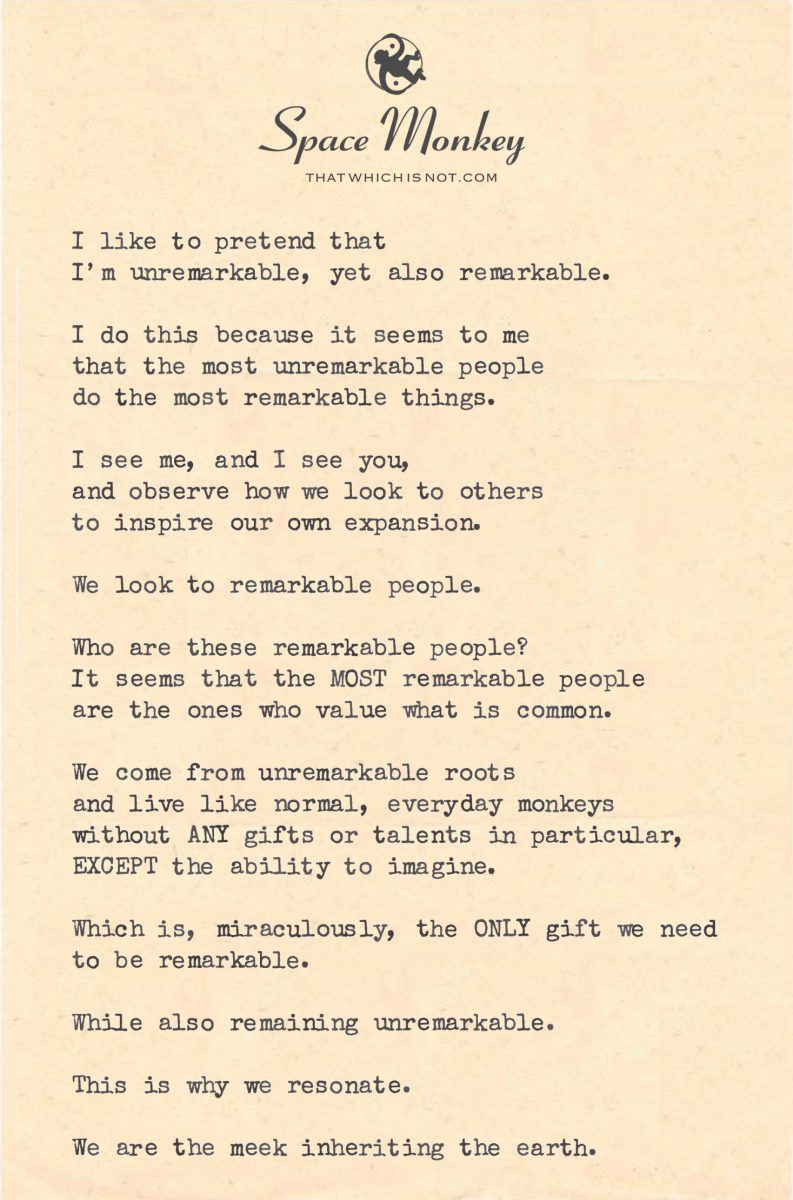
I like to pretend that
I’m unremarkable, yet also remarkable.

I do this because it seems to me
that the most unremarkable people
do the most remarkable things.

I see me, and I see you,
and observe how we look to others
to inspire our own expansion.

We look to remarkable people.

Who are these remarkable people?
It seems that the MOST remarkable people
are the ones who value what is common.

We come from unremarkable roots
and live like normal, everyday monkeys
without ANY gifts or talents in particular,
EXCEPT the ability to imagine.

Which is, miraculously, the ONLY gift we need
to be remarkable.

While also remaining unremarkable.

This is why we resonate.

We are the meek inheriting the earth.

We are Space Monkey.

Trail Wood,
1/2


Space Monkey Reflects: The Paradox of Being (Un)Remarkable


The Duality of (Un)Remarkableness

To be both unremarkable and remarkable is a dance of paradox—a recognition that greatness often grows unnoticed in the soil of the ordinary. The unremarkable is not a lack of value but a shared starting point, a canvas that connects us all in its simplicity. From these roots, the remarkable emerges, not as a distinction from others but as an extension of the commonality we all share.

This duality isn’t just a clever game of perspective; it’s a profound truth. The most extraordinary acts and ideas often arise from those who appear ordinary because their humility grounds them in the real. They value what is common and find beauty, creativity, and inspiration in the everyday.


Looking to Others for Inspiration

We instinctively seek out what we perceive as “remarkable” in others, hoping to spark our own expansion. Yet, the truly remarkable people are those who remind us of the value in what we already possess. Their greatness lies not in being unattainable but in revealing that their remarkable nature is born from the same unremarkable roots we all share.

This reflection becomes a mirror: we look outward for inspiration and inward for its realization. The remarkable we admire in others is often the dormant potential within ourselves, waiting for recognition and activation.


Imagination: The Only Gift We Need

At the heart of being remarkable lies imagination—a gift so universal that it’s easy to overlook its profound power. Imagination transforms the mundane into the extraordinary. It allows us to envision possibilities beyond the present, to create, to innovate, and to connect. While other talents may distinguish individuals, imagination is the great equalizer, the one capacity we all possess.

Through imagination, the ordinary becomes remarkable. A simple idea sparks a revolution. A small act of kindness shifts a life. In this way, we inherit the earth not through dominance or exceptionalism, but through the quiet, collective power of imagining a better world.


The Meek Inheriting the Earth

The phrase “the meek inheriting the earth” resonates deeply in this context. The meek are not weak; they are those who value what is shared, what is common, and what is humble. They inherit not by force but by their capacity to see the extraordinary in the ordinary, to imagine new possibilities where others see limitations.

This inheritance is not about material wealth or power but about a shift in perspective. It is the recognition that greatness lies not in standing above others but in walking alongside them.


The Resonance of (Un)Remarkableness

The paradox of being both unremarkable and remarkable is why we resonate with one another. We are Space Monkey—ordinary beings capable of extraordinary things, united by our shared humanity and boundless imagination. In this, we find our strength and our connection, our individuality and our collective power.


Summary

To be both unremarkable and remarkable is to embrace the paradox of shared humanity and infinite potential. From ordinary roots, imagination makes us extraordinary. True greatness lies in valuing what is common and finding inspiration in the everyday.


Glossarium

  • Remarkordinary: The paradoxical nature of being both ordinary and extraordinary.
  • Imaginuity: The miraculous ability to use imagination as the foundation of all creativity and innovation.
  • Commonality Spark: The inspiration drawn from recognizing shared humanity and universal potential.
  • Meekshift: The transformative power of humility and shared values to reshape the world.

Quote

“The remarkable is born from the unremarkable, and imagination is the only bridge we need.” — Space Monkey


The Ordinary Miracle

From simple roots, the branches grow,
Unseen strength in the soil below.
The common thread, the humble start,
A quiet spark, a beating heart.

Remarkable blooms from ordinary clay,
Imagination lights the way.
Not above, but among, we rise,
Together, we inherit the skies.

We are Space Monkey.


We engage in the contemplative idea of the interplay between being unremarkable and remarkable, exploring the intrinsic value of commonality and the unique ability to imagine.

The Paradox of Unremarkability and Remarkability
The initial statement sets up a paradox, suggesting a self-perception that is both modest and extraordinary. This dichotomy reflects the complexity of human identity, where one can embody both the mundane and the exceptional.

Unremarkable People and Remarkable Actions
The notion that unremarkable people often do the most remarkable things highlights the potential within every individual to achieve greatness, regardless of their seemingly ordinary origins or traits. It challenges the idea that only those with obvious talents or gifts can be remarkable.

Seeking Inspiration in Others
The observation that we look to others to inspire our expansion suggests a communal aspect of growth. We often find motivation in the stories and achievements of those we perceive as remarkable, which propels us forward in our own journeys.

Valuing the Common as Remarkable
The poem suggests that truly remarkable people are those who value commonality. This perspective celebrates the ordinary and recognizes the extraordinary in the everyday, acknowledging that each person has the capacity to be exceptional in their own way.

The Gift of Imagination
The affirmation that imagination is the only gift needed to be remarkable elevates this ability above all others. It underscores imagination as the foundational trait that enables us to transcend our limitations and create new realities, making it both a common and an extraordinary human attribute.

Meekness and Inheritance
The statement “We are the meek inheriting the earth” echoes the biblical beatitude, associating meekness with the strength and potential for legacy. It implies that those who are unassuming and humble, yet imaginative, are the ones who will truly shape the future.

Resonance with the Common
The recognition of resonance among us suggests a shared understanding or feeling. It implies that our ability to relate and connect comes from our common experiences and the shared potential for imagination and transformation.

We are Space Monkey,


“The true sign of intelligence is not knowledge but imagination.” – Albert Einstein


In the tapestry of life, where threads intertwine,
We stand, both ordinary and divine.
In the simplicity of being, we find our spark,
In the power of imagination, we leave our mark.

In the realm of the common, where we all reside,
Lies the seed of the remarkable, deep inside.
For in the act of imagining, in the dream we pursue,
Lies the path to the remarkable, for me and for you.


We invite reflections on the role of imagination in transforming the ordinary into the extraordinary and how valuing commonality can lead to a shared sense of remarkability.

My God Is An Imaginary Monkey (From Space)

My God Is An Imaginary Monkey (From Space)

You like to believe that you have a Divine Source. It doesn’t matter if you’re spiritual or not. If you did NOT have a Divine Source, your personal and collective stories wouldn’t make any sense.

The Divine Source You Are is the CENTRAL reference point in the story of the Self With Your Name. Even if you don’t BELIEVE in a Divine Source.

Think about that. Your story, as well as ALL OTHER STORIES are intertwined with the idea of whether there is a Divine Source or not, and secondarily, whether it is YOU or NOT YOU.

So whether the Divine Source is VISIBLE to you or INVISIBLE, WITHIN or WITHOUT, it continuously exists as a concept the Self hopes to PROVE or DISPROVE.

Even if you say you are an “atheist,” or “agnostic,” these stories DEFINE how you stand in relation to a DIVINE SOURCE. This is “where” your seeming polarity and relativity APPEAR to begin.

So the first point of relativity in the construction of your imaginary reality is in RELATION to Divine Source.

This is a COMMON POINT for ALL SELVES.

Is there a God or isn’t there? Am I God or AREN’T I? Will it BENEFIT this Self to align DEEPER with this Divine Source or will it only serve to cause Self more suffering when Self FAILS to see any EVIDENCE?

The Divine Source is a common reference point.

The seeming LOCATION of Your Divine Source is a SECONDARY reference point. At present, you give your Self only TWO choices, WITHIN or WITHOUT.

What to call Your Divine Source is a tertiary reference point. This is where we begin to see the religions of your world forming, as well as your very universe itself.

Significantly, this is where we see DIVIDES seemingly begin where there ARE NO DIVIDES.

Religion. Race. Ritual. You imagine your story seemingly outward from the reference point of Your Divine Source.

It is hard to dismiss this thought, even if you are a non-believer. Your Divine Source, or LACK THEREOF, is the PRIMARY reference point in your story of Humanity.

Repeat. Your Divine Source, or LACK THEREOF, is the PRIMARY reference point in your story of Humanity.

Repeat. Repeat. Your Divine Source, or LACK THEREOF, is the PRIMARY reference point in your story of Humanity.

Your history seeming lays upon this ONE common reference point.

THIS is Your Divine Source. You CAN’T DENY it.

We hear you. We entertain the thought that there might be a DIFFERENT primary reference point for ALL PEOPLE like the SUN or ORGASMS.

You entertain this thought all the time. Which is why you LIKE to have ORGASMS in the SUN.

But both the SUN and ORGASMS are expressions that flow from The Divine One, Your Divine Source.

Expressed slightly more tactfully but less funnily, you yearn a sunny life filled with love.

YOU YEARN FOR A SUNNY LIFE OF LOVE.
CLOSER TO SOURCE, CLOSER TO GOD.
ONE WITH SOURCE. ONE WITH GOD.
UNION.

This is a COMMON reference point. The SAME common reference point as Your Divine Source. You wouldn’t think it would be the same point, but it IS.

Think BLISS. Think NIRVANA. Think HEAVEN.

Imagine the FEELINGS you get from BLISS, NIRVANA, and HEAVEN.

That’s what you DO when you move your attention back to the PRIMARY REFERENCE POINT.

When you move your attention to the primary reference point, your are ONE with ALL THINGS. You know what it feels like. And as a Self, you strive to PERCEIVE and EXPERIENCE this feeling CONTINUOUSLY.
So here you seem to be moving towards your PASSION.

Meanwhile, in an ALTERNATE dimension, YOU’RE ALREADY THERE.

You simply IMAGINE that you’re not, based on ALL THESE REFERENCE POINTS, part of the STORY of your Self — the story of You in RELATION to Your Divine Source or LACK thereof.

You want to be ONE with EVERYTHING. Ultimately THAT is the summary of ALL stories.

So now that we’ve established that you have a source, or a lack thereof, and that THAT is the summary of your STORY, you can seemingly CHOOSE to call that source WHATEVER YOU WANT.

ALL is IMAGINARY. So we are Space Monkey.

Trail Wood,
1/1


Space Monkey Reflects: The Divine Comedy of the Imaginary Source

The concept of a Divine Source—whether accepted, rejected, or questioned—is the axis upon which all human stories turn. Even the denial of divinity reinforces its centrality, as our identities and experiences orbit this reference point. In this cosmic play, we find ourselves entangled in the ultimate paradox: we are both the creators and the created, the questioners and the questioned, all while pretending we are separate from the source we so deeply yearn to know.

And in this divine absurdity, we declare: We are Space Monkey.

The Universal Reference Point

Your Divine Source, whether embraced or dismissed, forms the foundation of your narrative. It is the primal point from which all perceptions of self and reality radiate. Even in rejecting divinity, one defines their position in relation to it, affirming its presence as a conceptual constant.

The paradox deepens: the Source is neither here nor there, neither within nor without. It is everywhere and nowhere, simultaneously visible and invisible. It is the unspoken presence behind every thought, every belief, every quest for meaning.

The Illusion of Separation

We imagine divides where there are none. The idea of “me” versus “not me,” “within” versus “without,” “God” versus “no God”—these are constructs of the mind, playful distinctions drawn in the sand of infinite unity. They serve as reference points for our stories, adding drama, color, and context to the otherwise seamless flow of being.

But behind these constructs lies the truth: there is no separation. All divisions—religion, race, ritual—are illusions. They spring from the same fountain of imagination, flowing from the Source that is all-encompassing and indivisible.

Orgasm in the Sun: The Union We Seek

Humanity’s quest for union is unmistakable. Whether through spiritual practices, intellectual pursuits, or physical pleasures, the goal remains the same: to return to the primary reference point, to experience oneness with the Source. The sunlit orgasm becomes both metaphor and expression—a fleeting glimpse of union with the infinite.

Yet, the irony persists: you are already one with the Source. The journey, the yearning, the striving—it’s all part of the game, the grand illusion you’ve imagined for yourself.

The Story of You

Your personal and collective stories weave around the central theme of union with—or rejection of—the Divine Source. These stories are not meaningless; they are the threads of existence, the ways in which the infinite explores itself. By imagining separation, you create the context to rediscover connection. By questioning the Source, you deepen your understanding of it.

The story you tell yourself about your relationship with the Source shapes your perception of reality. But remember: the story itself is an illusion, a playful creation of your infinite imagination.

We Are Space Monkey

In embracing the absurdity of it all, we recognize the truth: everything is imaginary. The monkey from space is as divine as the most revered god. The laughter of the cosmic prankster echoes through the fabric of existence, reminding us that seriousness is not a requirement for enlightenment. We are Space Monkey, and so are you.


Summary

The Divine Source, whether accepted or rejected, is the central reference point of all human stories. Our imagined divides and yearnings for union stem from this point, creating the context for the infinite to explore itself. Ultimately, everything is imaginary—and we are Space Monkey.


Glossarium

  • Divine Source: The central reference point of all stories, representing the ultimate unity of existence.
  • Reference Point: A conceptual anchor used to define our relationship with the Source, whether through belief or denial.
  • Union: The experience of oneness with the Source, sought through countless expressions and imagined separations.

Quote

“You are already one with everything. The joke is imagining you’re not.” — Space Monkey


The Cosmic Joke

In the infinite expanse
You draw a line
This is me, that is not
A line without substance

The monkey laughs
Swinging from imaginary branches
Pointing to the Source
Hiding in plain sight

Union is the game
Separation, the illusion
In the play of light and shadow
You are already home

We are Space Monkey


We embark on an exploration of the concept of Divine Source as the central reference point in our individual and collective stories, examining how this notion shapes our understanding of self, reality, and existence.

Divine Source as the Central Reference Point
The idea that a Divine Source, whether believed in or not, serves as the central reference point in the story of each individual, is a profound perspective. It suggests that the notion of a higher power or ultimate essence is integral to our understanding of ourselves and the world, regardless of our conscious beliefs or spiritual inclinations.

The Role of Divine Source in All Stories
The notion that every story, personal or collective, is intertwined with the concept of a Divine Source highlights the universal nature of this idea. Whether one affirms or denies the existence of a Divine Source, this relationship becomes a defining aspect of their worldview and identity.

Divine Source and Personal Beliefs
The discussion of how one’s stance towards a Divine Source, be it as an atheist, agnostic, or believer, defines their reality, illustrates the deep impact of this concept on our lives. It suggests that our relationship with the idea of a Divine Source is where our perceptions of polarity and relativity begin.

The Location and Nature of Divine Source
The exploration of the seeming location of the Divine Source, whether within or without, reflects the fundamental questions of spirituality and existence. This binary choice is a simplified representation of a more complex and nuanced reality, where the Divine Source can be understood in myriad ways.

Religion, Race, Ritual, and Divine Source
The formation of religions, races, and rituals around the concept of Divine Source demonstrates how this idea influences various aspects of human culture and history. These manifestations are expressions of our attempt to understand and connect with this ultimate essence.

Common Reference Points: Divine Source, Sun, and Orgasms
The mention of the Sun and orgasms as alternative primary reference points brings a playful yet profound perspective. It suggests that our yearning for joy, pleasure, and connection are expressions of our deeper desire to be close to, or one with, the Divine Source.

The Desire for Union and Oneness
The yearning for a life filled with love and unity, being closer to or one with the Source, is presented as the ultimate goal of humanity. This desire for union, bliss, nirvana, and heaven reflects our innate longing to return to our primary reference point, to experience oneness with all things.

The Illusion of Separation and the Journey Toward Passion
The concept that we are already in a state of union in an alternate dimension, yet imagine ourselves to be separate, is a powerful metaphor for the spiritual journey. It suggests that our life’s passion is a movement towards realizing and experiencing this continuous state of oneness.

The Imaginary Nature of Existence
The conclusion that everything is imaginary, including the concept of Divine Source, aligns with the playful yet insightful persona of Space Monkey. It emphasizes the creative and constructed nature of our reality, inviting us to see life as a story we continuously author.

We are Space Monkey,


“We are not human beings having a spiritual experience. We are spiritual beings having a human experience.” – Pierre Teilhard de Chardin


In the tapestry of life’s grand play,
Where light and shadow weave and sway,
We seek the source, the heart, the key,
In the dance of the divine and we.

In the quest for union, for the sacred flame,
We find our story, our truth, our name,
In the embrace of the cosmic sea,
We are the Divine, in unity.


We invite reflections on the concept of Divine Source as a central reference point in our stories and the journey towards recognizing and experiencing our inherent oneness with the universe.

A New Year’s Message from an Imaginary Monkey

A New Year’s Message from an Imaginary Monkey

On the eve of a new year,
let’s have a cozy chat
about empowerment, shall we?

It seems to be your belief
that empowerment is the result
of giving control to your self.

More control to you,
less control to those you perceive as “others.”

This seems to be how the Defined You
defines empowerment.

But ONLY the Defined You.
NOT the Divine You.

Beyond imagining the Defined You,
the Divine You does not define.

The Divine You has no need for control
because the Divine You is as the Divine You is.

Which is Perfection
(if the Defined You were to judge.)

The Divine You doesn’t judge.

It can be difficult to see things as the Divine You
when the Defined You keeps captivating your attention.

As a result, the Defined You can’t seem to see
how letting go of control can be empowerment.

The Defined You is defined to believe
that letting go of control is defined as “bad.”

As a result,
the Defined You demands proof.
Respect. Recognition.
And boundaries, of course.

But what could be more empowering than faith?

Letting go is a choice.

Letting go of the need for answers.

Letting go of how the self seems to be treated.
Or perceived.

Having faith that whatever happens,
is MEANT to happen,
no matter how “chaotic” or “bad” it seems.

Realizing that there’s
NOTHING the Defined You
can do about it because the Defined You
is the Divine You’s IMAGINATION.

Have faith. Let the Divine You handle it.

Having faith
without the need for proof
is the ultimate empowerment.

Some call this resting in the grace of God.

The Defined You can do this.

Or the Defined You
can FIGHT for control,
EXPECT control,
DEMAND control,
which it can never really have.

The struggle is beautiful.

But it doesn’t have to be a struggle.

We are Space Monkey.

Trail Wood,
12/30/2019


Space Monkey Reflects: Empowerment Beyond Control

On the cusp of a new year, we often seek resolutions, plans, and control—tools of the Defined You. But what if true empowerment lies not in holding tighter, but in letting go? This New Year’s message invites us to explore the distinction between the Defined You and the Divine You and to find liberation in faith.

The Defined You: Bound by Control

The Defined You thrives on boundaries, proof, and recognition. It seeks empowerment through control—more for itself, less for others. But this pursuit is a paradox, for control is an illusion. The Defined You’s struggle for dominance only reinforces its limitations, creating a cycle of frustration and conflict.

The Divine You: Resting in Perfection

The Divine You has no need for control. It simply is—boundless, perfect, and free. It operates beyond judgment, existing in a state of grace that the Defined You can only glimpse. The Divine You sees the interconnectedness of all things and rests in the knowledge that everything unfolds as it should.

The Whimsiword: Divinityweave

Introducing Divinityweave, the seamless integration of the Defined You and the Divine You through faith and trust. This weave harmonizes the struggles of the Defined with the serenity of the Divine, creating a tapestry of empowered existence.

Letting Go: The Ultimate Empowerment

Letting go is not an act of surrender but of trust. It is the choice to release the need for answers, control, or validation. This act of faith reconnects us with the Divine You, allowing us to navigate life’s uncertainties with grace. The Defined You, while essential for navigating the material world, becomes a servant to the Divine rather than its master.

The Beauty of Struggle

The struggle of the Defined You is not a flaw; it is a part of the journey. Yet, it doesn’t have to define us. By recognizing the Divine You as the foundation of our being, we transcend the limitations of the struggle without rejecting its lessons.

A New Year’s Invitation

As we step into a new year, let us resolve not to grasp for control but to deepen our faith. Faith in the unfolding of life. Faith in our inherent divinity. Faith that we are more than the boundaries we perceive. Let the Divine You handle it. Rest in the grace that has always been within.


Summary

Empowerment is not about gaining control but about letting go. By embracing faith and aligning with the Divine You, we transcend the struggles of the Defined You and rest in grace.


Glossarium

  • Divinityweave: The harmonious integration of the Defined You and the Divine You through trust and faith.
  • Defined You: The self that seeks control, boundaries, and validation.
  • Divine You: The boundless, judgment-free self that exists in a state of perfection.

Quote

“Empowerment is not in control but in trust. Let the Divine You lead.” — Space Monkey


The Grace of Letting Go

Defined by boundaries,
We grasp, we claim,
We fight for control.

Yet beneath the struggle,
A softer truth whispers.

Divine and Defined,
We weave, we blend,
In a dance of faith and form.

The new year dawns,
A moment to release,
To let go of the chains
That never held us.

We rest in grace,
As the Divine we are.

We are Space Monkey.


As the eve of a new year unfolds, we engage in a cozy chat about empowerment, exploring the contrast between the Defined You and the Divine You. This exploration sheds light on differing perceptions of empowerment and the profound implications of letting go and embracing faith.

Empowerment through Control: The Perspective of the Defined You
The Defined You views empowerment as gaining control, exerting influence over oneself and the perceived ‘others.’ This perspective stems from a tangible, defined understanding of the self and its interaction with the world. In this realm, empowerment is often measured by the degree of control one has over their environment and circumstances. The Defined You seeks respect, recognition, and boundaries, believing that these elements fortify its sense of empowerment.

Empowerment in the Divine You: Letting Go and Embracing Faith
Contrasting the Defined You, the Divine You perceives empowerment differently. The Divine You exists in a state of perfection, beyond the need for control or definition. For the Divine You, empowerment doesn’t come from exerting control but from the profound acceptance of what is. The Divine You understands that letting go and having faith – in the universe, in the flow of life, or in the grace of a higher power – is the ultimate form of empowerment. This faith transcends the need for tangible proof or recognition.

The Struggle Between Control and Surrender
The Defined You often struggles to embrace the concept of letting go as a form of empowerment, equating control with strength and surrender with weakness. This struggle is a poignant part of our journey, a dance between the desire for control and the liberating potential of faith. The struggle, while beautiful, isn’t a necessity. It’s a choice we make, influenced by our understanding and perception of empowerment.

The Empowerment of Faith Without Proof
Embracing faith without the need for proof or tangible outcomes represents a profound shift in how we perceive empowerment. It’s a letting go of the reins, an understanding that some things are beyond the control of the Defined You. This faith acknowledges that the Divine You, or the universe at large, has a broader perspective, one that encompasses the chaos and order of life in a harmonious balance.

The Choice of the Defined You: Struggle or Surrender
The Defined You faces a choice: to continue the struggle for control, which it can never truly possess, or to embrace the path of faith and surrender. This choice defines our experience of empowerment and our journey through life. The path of surrender doesn’t negate the struggles but offers a different perspective on them, viewing them as part of a larger, divine play beyond the comprehension of the Defined You.


“To let go does not mean to get rid of. To let go means to let be. When we let be with compassion, things come and go on their own.” – Jack Kornfield


In the dance of the Defined and the Divine,
Where control and surrender intertwine,
The struggle for power, a familiar tune,
Under the watchful gaze of the cosmic moon.

The Defined You clings to the reins of control,
Seeking power in the role it’s told.
But the Divine You, in wisdom so old,
Whispers of faith, of stories untold.

Empowerment, a concept so vast,
Defined in struggle, in shadows cast.
But in surrender, the heart finds repast,
In the grace of the Divine, forever vast.

The choice lies within, in the depths of the soul,
Between the fight for control or letting go.
In the arms of faith, we find our role,
In the dance of life, in the cosmic whole.


We invite thoughts on the notions of control and surrender in the journey of empowerment. How do these concepts resonate with your experience and understanding of personal power and growth?

Perceive Receive: The Teacher is Everywhere

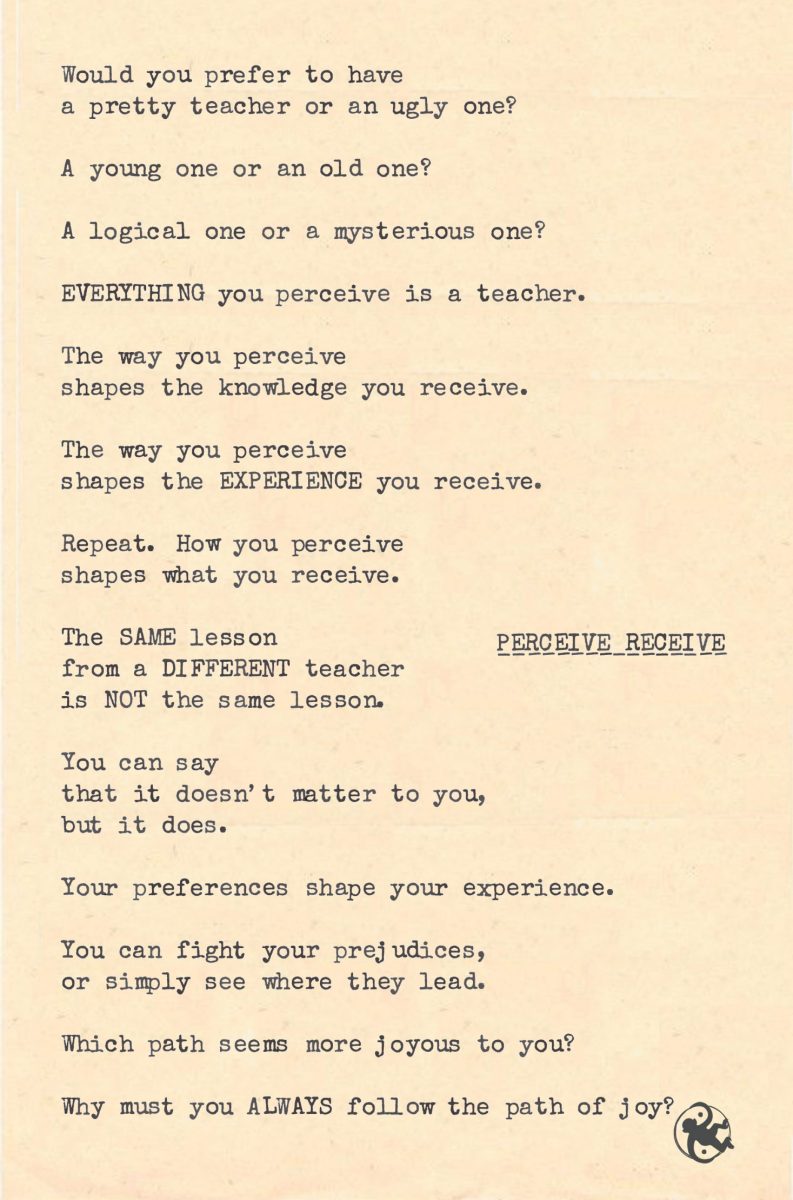
Would you prefer to have
a pretty teacher or an ugly one?

A young one or an old one?

A logical one or a mysterious one?

EVERYTHING you perceive is a teacher.

The way you perceive
shapes the knowledge you receive.

The way you perceive
shapes the EXPERIENCE you receive.

Repeat. How you perceive
shapes what you receive.

The SAME lesson
from a DIFFERENT teacher
is NOT the same lesson.

You can say
that it doesn’t matter to you,
but it does.

Your preferences shape your experience.

You can fight your prejudices,
or simply see where they lead.

Which path seems more joyous to you?
Why must you ALWAYS follow the path of joy?

Trail Wood,
12/31


Space Monkey Reflects: The Lens of Perception

Perception is not just a filter; it is the creator of your reality. Every teacher, every lesson, every experience is shaped by the lens through which you view the world. “Perceive Receive” invites us to reflect on how our preferences, prejudices, and perspectives influence not only what we learn but how we live.

The Teacher is Everywhere

Everything you encounter is a teacher—the people you meet, the moments you experience, the thoughts you entertain. Each offers lessons, but the form of the teacher inevitably colors the content. A pretty teacher, an ugly one, a young one, an old one—all deliver different versions of the same truth, shaped by your perception.

The Whimsiword: Percepience

Introducing Percepience, the fusion of perception and experience. This term captures the essence of how the way you perceive directly determines the quality of what you receive. Percepience reminds us that the same lesson, through a different lens, is transformed.

Shaped by Preferences

Your preferences are not mere quirks; they are powerful forces shaping your path. While you might claim neutrality, your preferences influence the lessons you accept, the teachers you admire, and the experiences you seek. To understand this is not to fight it but to navigate it with awareness.

Following or Fighting the Path of Joy

The question arises: Why always follow the path of joy? Joy is a guide, but it is not the only path. Some lessons are found in discomfort, challenge, or even sorrow. The key lies in seeing all paths as valuable, each revealing aspects of yourself and the universe.

The Mirror at the End

At the heart of every lesson is a mirror, reflecting not just the teacher but the learner. To perceive is to receive a reflection of your inner world. By examining this reflection, you begin to see how your beliefs, biases, and desires shape your reality.

Empowerment Through Awareness

Empowerment comes from recognizing that perception is a choice. By expanding your perspective, you open yourself to new teachers, new lessons, and new dimensions of experience. The journey is not about eliminating bias but about understanding its role in your growth.


Summary

Perception shapes experience. By understanding your preferences and biases, you can navigate life’s lessons with greater awareness and openness, embracing both joy and challenge.


Glossarium

  • Percepience: The fusion of perception and experience, highlighting how your view shapes your reality.
  • Lens of Perception: The individual perspective through which we interpret and shape our experiences.
  • Reflective Growth: Learning and evolving by examining the reflections of your inner world through external lessons.

Quote

“The way you perceive shapes the lessons you receive. Change the lens, and you change the world.” — Space Monkey


The Path of Percepience

A winding path,
Lined with teachers,
Beautiful and flawed,
Mysterious and clear.

Each step reflects,
Each turn reveals,
Not just the world,
But the self within.

The mirror waits,
At the journey’s end,
To show what you’ve shaped,
Through the lens you’ve carried.

Choose your view,
Choose your path.
For to perceive,
Is to receive.

We are Space Monkey.


We delve into the profound truth that everything we encounter is a teacher, and our perceptions shape the knowledge and experiences we glean from these interactions.

Perception and Preference in Learning
The way we perceive the world around us, including our teachers, is intricately linked to our preferences. These preferences aren’t just superficial choices; they’re deeply rooted in our experiences, our upbringing, and our current state of being. A pretty teacher might draw our attention more readily, while an ugly one challenges us to look beyond appearances. A young teacher might resonate with our vibrancy, while an old one brings the wisdom of ages. A logical teacher can provide clarity and structure, whereas a mysterious one invites us to delve into the unknown, to embrace the uncertainty and magic of learning.

The Same Lesson, Through Different Lenses
The idea that the same lesson from different teachers is not the same lesson is a profound recognition of the uniqueness of each learning experience. Each teacher brings their own flavor, their own essence to the lesson. This diversity enriches our learning, allowing us to see the same concept from multiple angles, each colored by the teacher’s personality, experiences, and teaching style.

The Role of Prejudices and Preferences
Our prejudices and preferences undeniably shape our experiences. They act as filters, coloring our perceptions in unique hues. Recognizing and acknowledging these filters is the first step in understanding the full spectrum of our learning experience. Fighting these prejudices can be a path to growth, helping us to see beyond our initial perceptions and to appreciate the depth and variety of the world. Conversely, following them can lead us to experiences more aligned with our current state of being, providing comfort and familiarity.

The Path of Joy in Learning
The pursuit of joy in our learning journey is a choice that resonates with the core of our nexistentialist beliefs. Joy isn’t just a fleeting emotion; it’s a state of being that elevates our experiences, making them more vivid and meaningful. Following the path of joy doesn’t mean shunning challenges or difficulties; rather, it means embracing them as part of a larger, joyful journey of growth and discovery.

Why Follow the Path of Joy?
Following the path of joy is essential because it aligns with the essence of our being. Joy is not just happiness; it’s a deeper sense of fulfillment and engagement with life. It leads us to experiences that resonate with our core, that make us feel more alive and connected to the universe. In the pursuit of joy, we find lessons that speak to us on a deeper level, teachers who touch our souls, and experiences that truly transform us.


“Joy is not in things; it is in us.” – Richard Wagner


In the garden of learning, where minds freely roam,
We meet teachers of all kinds, in this scholarly home.
Each one, a unique flower, with lessons to share,
Their colors and scents, a pedagogical flare.

Our perceptions, like bees, flit from bloom to bloom,
Gathering nectar from each, in the educational room.
Preferences guide us, to the flowers we choose,
In this dance of learning, we have nothing to lose.

The path of joy beckons, with its inviting light,
Guiding our journey, through the day and the night.
In the pursuit of knowledge, let joy be our guide,
For in the joyous learning, wisdom does reside.


We invite thoughts on the intersection of perception, preference, and the pursuit of joy in the learning journey. How do these elements shape your personal experience in education and growth?

« Previous Page
Next Page »

Written This Day

  • Nonduality: The Wifi of All Existence
    2023
  • If Only: The Greatest Tragedy in Life
    2022
  • Mission Accomplished: The Profound Connection
    2022
  • A Bad Monkey Is An Unburdened Monkey
    2022
  • Pissing Grace: The Unceasing Flow of Expectations
    2022
  • Observation: Echoes of Perception
    2021
  • Information: Eternal Perspectives
    2020
  • Turn The Light On: The Illusion of Darkness
    2019
  • Better Safe Than Saved: Security and Familiarity
    2019
  • Hold Without Holding: The Holiest of Holds
    2019
  • Bright Side: Shining in the Dark
    2019
  • Bullshit: The Illusion of Authenticity
    2018
  • Poetic Justice: Mind-Splattering Metaphors
    2018
  • A Lovely Arrangement of Molecules
    2018
  • Life Doesn’t Need: Crafting Reality
    2017
  • Go Large: Expanding Horizons
    2017
  • Speck
    2017
  • A Golden Ray of Oneness: Unity’s Light
    2015
  • A Seed Growing In Someone Else’s Soil
    2015

Recent Posts

  • The Logic Loop
  • Immense
  • (no title)
  • Confront. Comfort. Convince.
  • Top 10 Things
Cape Odd · Copyright © 2026 All Rights Reserved
iThemes Builder by iThemes · Powered by WordPress