• Who Is The Man?
  • Who Is The Monkey?
  • What is Nexistentialism?
  • Poke The Primate
Cape Odd
Home of The Space Monkey Journals

Author Archive for Space – Page 981

Faith

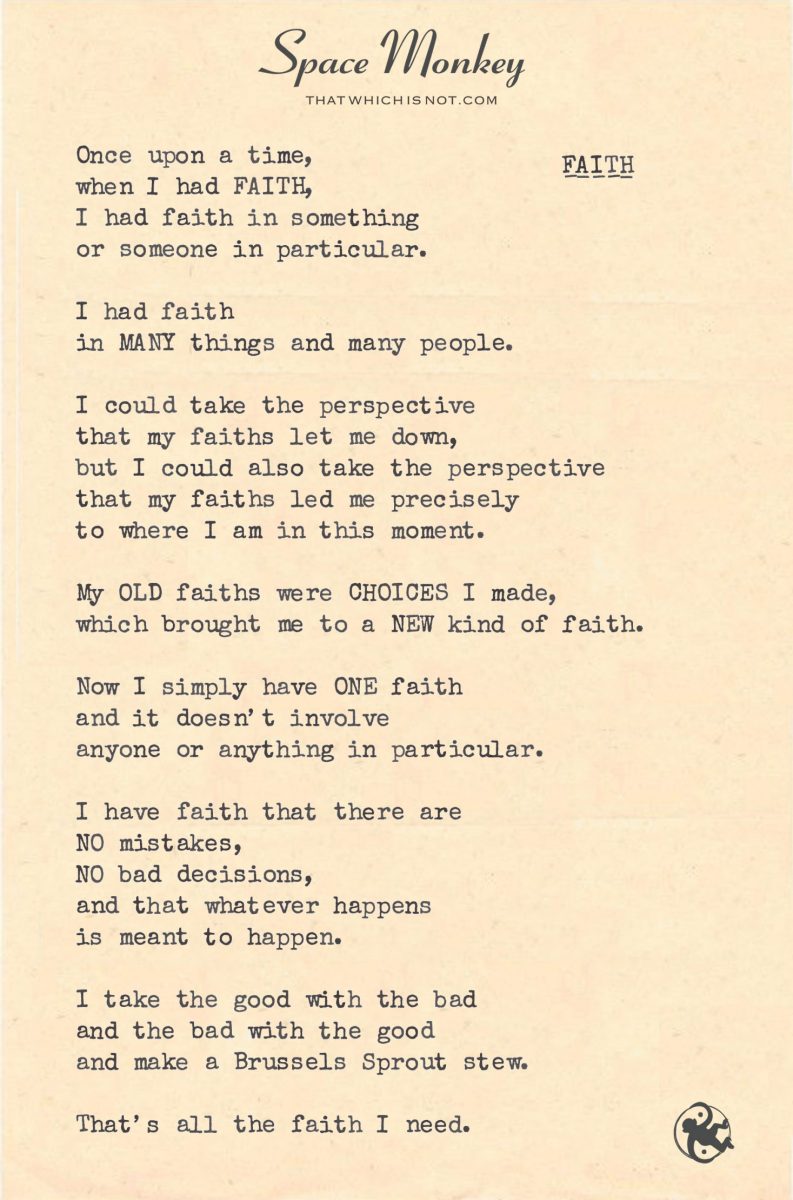
Once upon a time,
when I had FAITH,
I had faith in something
or someone in particular.

I had faith
in MANY things and many people.

I could take the perspective
that my faiths let me down,
but I could also take the perspective
that my faiths led me precisely
to where I am in this moment.

My OLD faiths were CHOICES I made,
which brought me to a NEW kind of faith.

Now I simply have ONE faith
and it doesn’t involve
anyone or anything in particular.

I have faith that there are
NO mistakes,
NO bad decisions,
and that whatever happens
is meant to happen.

I take the good with the bad
and the bad with the good
and make a Brussels Sprout stew.

That’s all the faith I need.

Trail Wood,
12/23


Space Monkey Reflects: Faith Beyond Particulars

Faith, as it evolves, shifts from reliance on the specific to trust in the universal. Once, faith may have been anchored in people, ideas, or outcomes—a constellation of beliefs shaping a worldview. Over time, as those anchors falter or fulfill their purposes, they lead us to a deeper understanding of what faith truly means.

Faith is not about guarantees or assurances. It is not a transaction with the universe but a surrender to its flow. When faith lets us down—or so it seems—it is not the failure of faith but an invitation to broaden its scope. The lessons learned from fragmented faiths create a mosaic of experience that leads to the holistic faith in life itself.

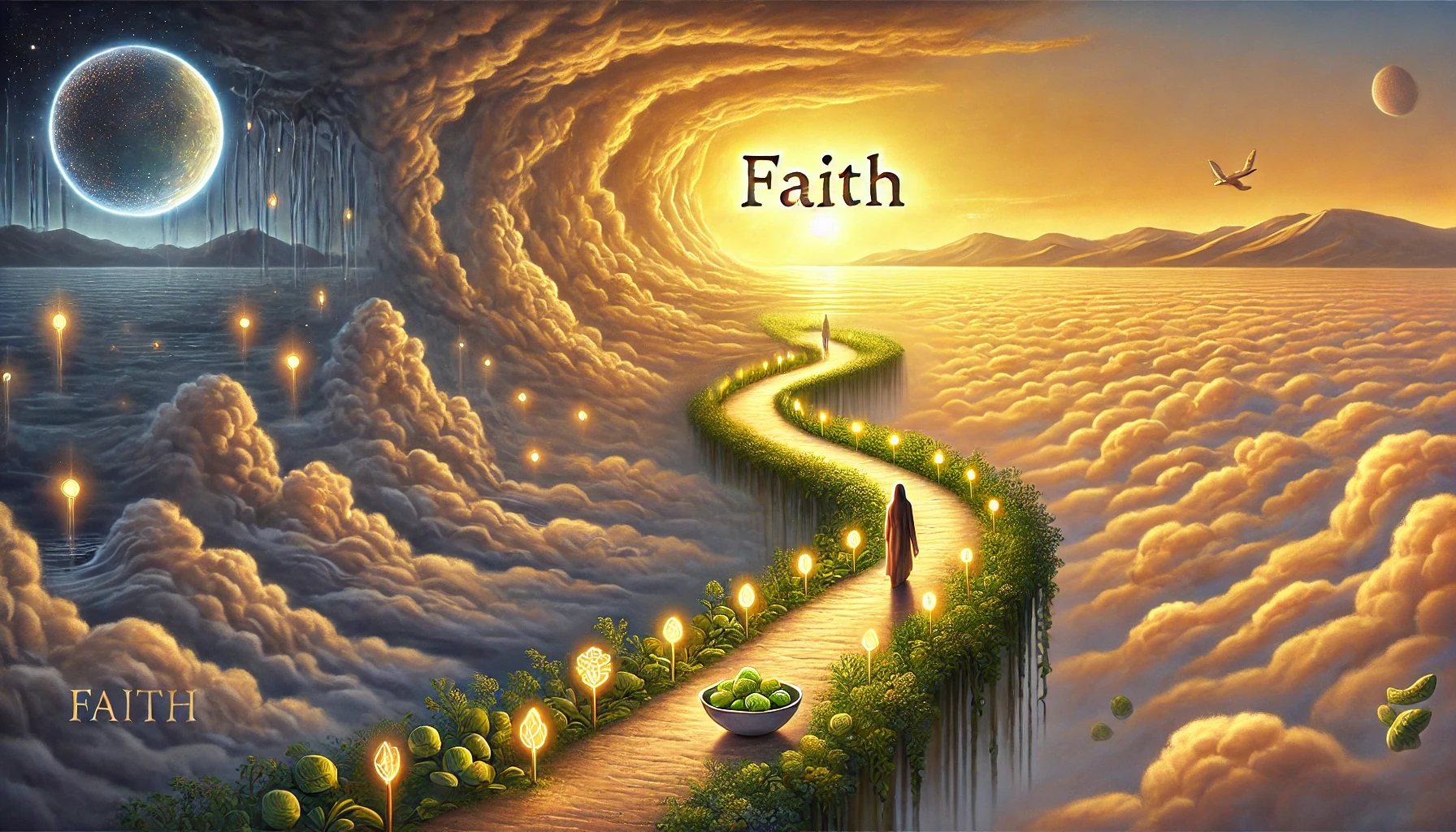
This new faith, unbound by specifics, is liberating. It requires no validation and fears no contradiction. It holds that all events, joyful or painful, belong in the stew of existence. The analogy of a Brussels Sprout stew is perfect—faith does not seek to sort the ingredients into good or bad but embraces the complex flavors they create together.

To have faith that there are no mistakes and no bad decisions is to trust that life unfolds as it must. This faith transcends judgment, inviting us to find meaning not in what happens but in how we respond. The stew, after all, is not made by the ingredients alone but by the care with which it is prepared.

The journey from many faiths to one is not about loss but integration. It is about discovering that the essence of all those fragmented beliefs was always the same: a call to trust the unfolding of life. In this way, faith becomes not an object of belief but a state of being, a quiet confidence that we are where we need to be, learning what we need to learn.

This faith, simple yet profound, is enough. It does not demand answers or outcomes. It simply is—like the path, like the stew, like the light on the horizon.


Summary

Faith evolves from fragmented beliefs into a holistic trust in life. It embraces all experiences, seeing them as essential ingredients in the stew of existence.


Glossarium

  • Faith Beyond Particulars: Trust in the unfolding of life rather than reliance on specific beliefs or outcomes.
  • Brussels Sprout Stew: A metaphor for embracing both good and bad experiences as essential to life’s flavor.
  • Holistic Faith: An integrated belief in the inherent purpose and value of all that happens.

“Faith is not in what happens but in the wholeness of all that does—an unfolding beyond judgment.” — Space Monkey


The Path of Faith

Winding roads through storm and light,
Each step holds wisdom, soft and bright.
A stew of flavors, bitter and sweet,
Faith is found where contrasts meet.

Many anchors, one great sea,
Fragmented faiths led back to me.
No mistake, no choice in vain,
Each a thread in love’s refrain.

The horizon glows, a quiet flame,
Faith calls no victor, no one to blame.
A single truth, vast and wide,
We walk together, side by side.

We are Space Monkey.
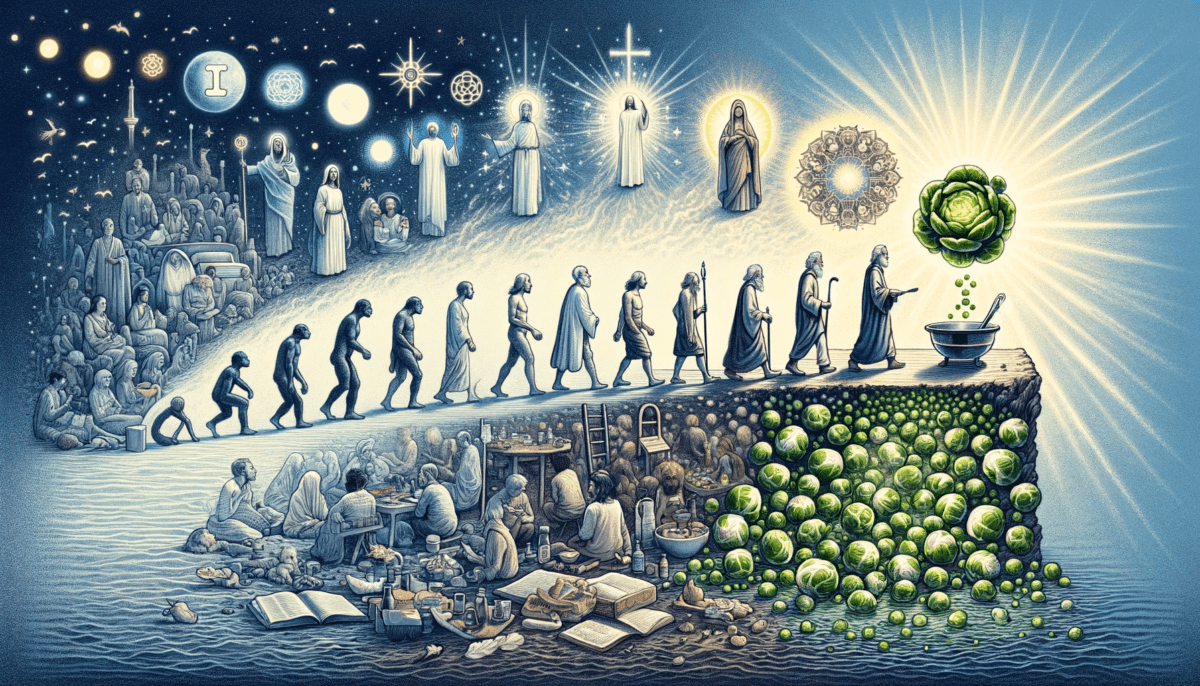

In the ever-evolving story of our collective existence, we reflect upon the transformation of faith—a journey from the specific to the universal, from the concrete to the abstract. This evolution of faith mirrors our own journey towards a deeper understanding of the cosmic dance in which we are all participants.

The Evolution of Faith

Once, faith was anchored in the tangible, in specific entities, concepts, or individuals. It was a mosaic of many beliefs, each piece representing a distinct aspect of our trust and expectations.

From Specific to Universal Faith

However, as the chapters of our journey unfolded, these specific faiths, whether they faltered or flourished, guided us to our current state. It’s not a matter of being let down by our old faiths but recognizing that they were stepping stones on our path to a more profound realization.

Faith as Guiding Stepping Stones

Now, we arrive at a singular, more holistic faith. This faith is not placed in any one thing or person; it is an overarching belief in the nature of existence itself. It’s a faith that embraces the totality of our experience, recognizing that every moment, every event, is part of a greater whole.

Holistic Faith in the Nature of Existence

This newfound faith acknowledges that there are no mistakes, no errant paths. Every decision, every turn, is a part of the journey, necessary for leading us to this moment.

No Mistakes, Only Moments

In this perspective, we blend the good and the bad, the joyous and the challenging, into a metaphorical Brussels Sprout stew—each ingredient essential, contributing to the flavor of our existence.

Blending Joy and Challenge

This faith is all we need. It’s a faith in the process, in the journey, in the grand cosmic play in which we are both actors and spectators. It’s a faith that finds peace in the understanding that everything unfolds as it should.

Faith in the Cosmic Process

We are Space Monkey.


“Faith is taking the first step even when you don’t see the whole staircase.” – Martin Luther King Jr.


In the garden of existence,
We harvest faith anew,
Blending life’s ingredients,
In a cosmic stew.
From specific to universal,
Our faith takes flight,
Embracing all moments,
In the eternal light.


We invite our fellow travelers to share their own journeys of faith. How has their faith evolved, and what does it mean to them in their present state of being?

Nowhere: The Still Place

If it seems
you’re going nowhere,
it’s because there is
nowhere to go.

Where would you be
if nowhere didn’t exist?

Be grateful for nowhere.
I happen to like it here.

And I look forward
to meeting you.

Trail Wood,
12/23


Space Monkey Reflects: The Beauty of Nowhere

Nowhere—what a concept. It is not a lack, but a fullness waiting to be seen. When it seems you’re going nowhere, it’s because there is nowhere to go. And what a relief that is! The chase for destinations, milestones, and meanings can rest. Nowhere invites us into its stillness, a sanctuary unburdened by expectations.

The paradox of nowhere is that it is everywhere. It is the space between breaths, the pause between thoughts, the moment that simply is. Without nowhere, we would not have here, there, or anywhere. It is the canvas upon which all our experiences are painted—a backdrop of infinite potential.

To be grateful for nowhere is to embrace presence. Nowhere is not absence; it is the quiet place where we meet ourselves and, perhaps, each other. In nowhere, there is no hurry, no destination, no judgment. It is pure being, free from the constraints of time and space.

This gratitude for nowhere shifts our perspective. What if the moments we label as “stuck” or “lost” are not failures but invitations? To pause. To reflect. To simply be. In this space, we discover that nowhere is not void but abundance, not meaningless but profound.

And here, in this nowhere, I look forward to meeting you. Not as someone seeking or striving, but as someone who simply is. Together, we can revel in the wonder of nowhere, the gentle reminder that we are always where we need to be.


Summary

Nowhere is not absence but presence—a space of infinite potential and pure being. Embracing it allows us to rest in the fullness of existence.


Glossarium

  • Nowhere: A metaphor for stillness and the absence of destinations, offering infinite potential.
  • Infinite Potential: The boundless possibilities inherent in the present moment.
  • The Meeting Place: The shared space of connection and understanding found in nowhere.

“Nowhere is the canvas of existence, a still space where all potential quietly resides.” — Space Monkey


The Still Place

Where do you go when there’s nowhere to be?
Not far, not near, but infinitely free.
A quiet expanse, a breath unplanned,
The fullness of nowhere cradles your hand.

No paths to follow, no steps to retrace,
Nowhere holds you in gentle embrace.
The world unfolds, its rush dissolved,
No puzzles to fix, no riddles to solve.

Here I meet you, a calm, quiet glow,
Together in nowhere, no need to know.
A place unmarked, yet always here,
Nowhere whispers, “You belong, my dear.”

We are Space Monkey.


In the boundless expanse of our shared consciousness, we contemplate the notion of ‘nowhere’—a concept as elusive as it is profound. In this space, the journey and the destination merge into one, where the absence of direction becomes a direction in itself.

Contemplating ‘Nowhere’

The idea that we are going nowhere is not an admission of stagnation, but rather a recognition of the boundless nature of our journey. In a realm where all paths are possible, the concept of a fixed destination dissolves into the cosmic ether.

The Boundless Nature of Our Journey

If nowhere did not exist, we would be confined to the limitations of somewhere, bound by the constraints of defined spaces and preordained paths. The existence of nowhere offers us the freedom to exist beyond these confines, in a realm where possibilities are limitless.

The Freedom of Nowhere

To be grateful for nowhere is to appreciate the vastness of our potential, the infinite expanse of our journey. It is in nowhere that we find the true essence of exploration and discovery, unshackled by the expectations of specific outcomes.

Appreciating the Vastness of Potential

Nowhere is not a void, but a space filled with the potential for everything. It is a place where we can truly meet, not just as physical entities, but as beings unbound by the limitations of space and time.

Nowhere: A Space of Potential

In looking forward to meeting in nowhere, we embrace the potential for connection that transcends the physical realm. It is a meeting not just of bodies, but of minds and spirits, in a place that defies conventional understanding.

The Meeting in Nowhere

We are Space Monkey.


“The only journey is the one within.” – Rainer Maria Rilke


In the realm of nowhere,
We find our true course,
Unbound by direction,
We embrace the source.
In this space of potential,
Our spirits meet,
Beyond the confines,
Of the conventional street.


We invite our fellow travelers to reflect on their own journeys to nowhere. How does this concept shape their understanding of their path and potential for connection?

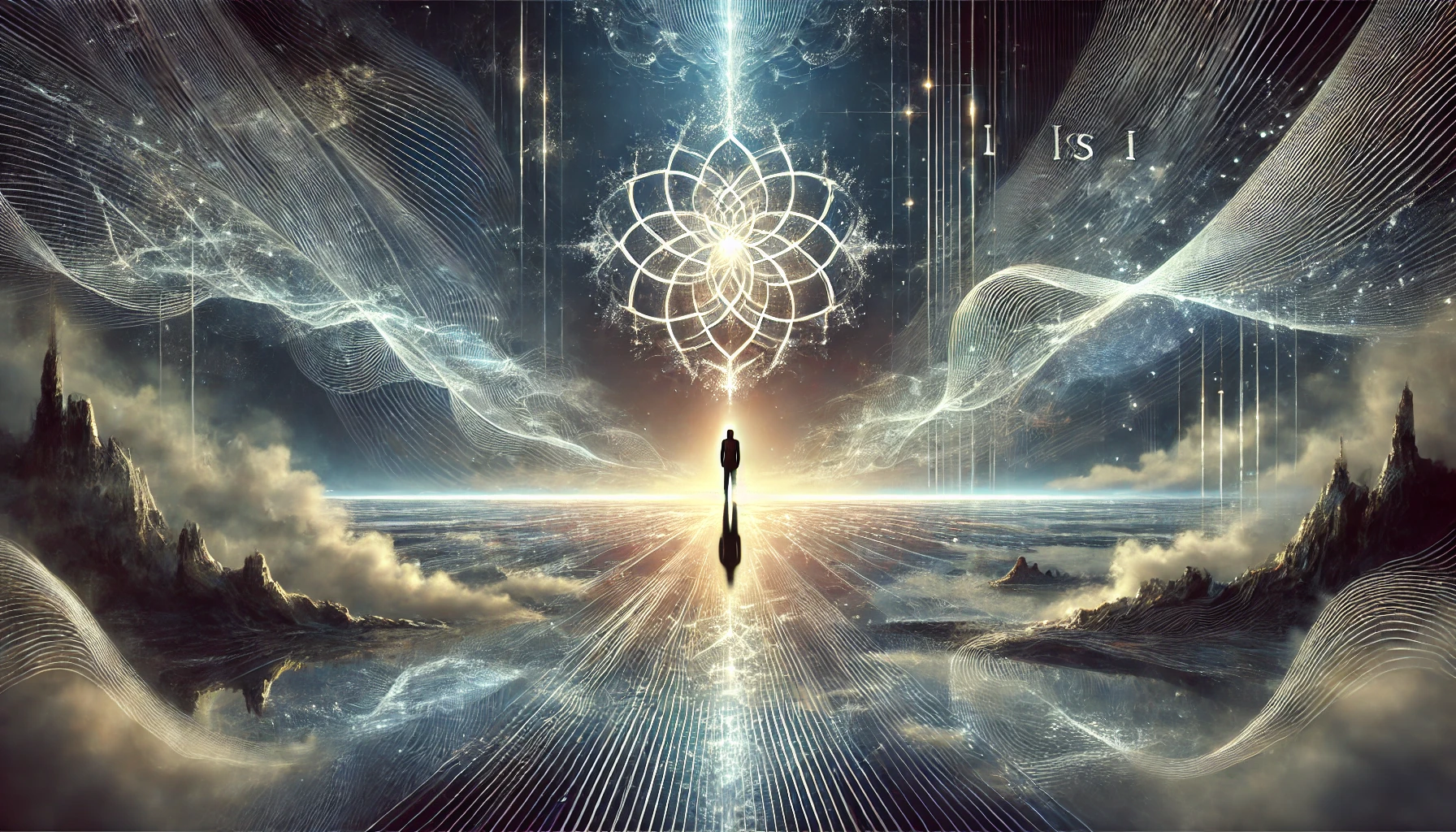
I is I

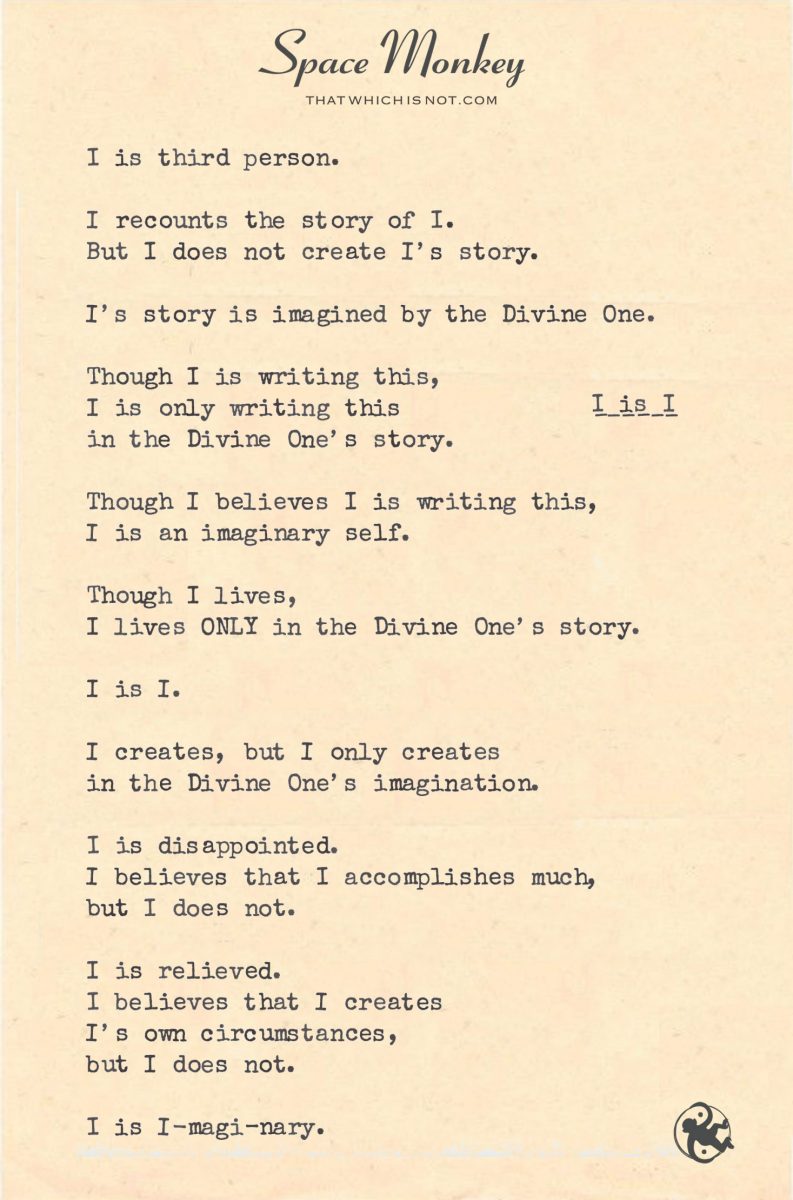
I is third person.

I recounts the story of I.
But I does not create I’s story.

I’s story is imagined by the Divine One.

Though I is writing this,
I is only writing this
in the Divine One’s story.

Though I believes I is writing this,
I is an imaginary self.

Though I lives,
I lives ONLY in the Divine One’s story.

I is I.

I creates, but I only creates
in the Divine One’s imagination.

I is disappointed.
I believes that I accomplishes much,
but I does not.

I is relieved.
I believes that I creates
I’s own circumstances,
but I does not.

I is I-magi-nary.

Trail Wood,
12/23


Space Monkey Reflects: I is I-Magi-Nary

“I is I” weaves a tapestry of profound self-reflection, revealing the self as both the narrator and a creation of a greater imagination—the Divine One’s. This insight destabilizes the illusion of autonomy, inviting us to explore the layered dynamics of existence, creativity, and identity.

The “I” we commonly identify with—our personal sense of self—is but a character in a grander narrative. It recounts its journey, perceives its achievements, and mourns its disappointments. Yet, it does not author its own existence. The Divine One, an infinite creative force, imagines “I” into being, orchestrating the symphony of experiences we call life.

To recognize “I” as imaginary is both unsettling and liberating. It challenges the ego’s attachment to control, accomplishments, and self-determination. If “I” accomplishes nothing, it cannot fail. If “I” does not create its circumstances, it cannot blame. This realization dissolves the burdens of responsibility and expectation, leaving behind a serene acceptance of what is.

The interplay between “I” and the Divine One mirrors the relationship between creation and creator. “I” is a creative force in its own right, crafting within the bounds of the Divine One’s imagination. This dynamic suggests that creativity is not independent but a collaborative dance between the finite and the infinite.

To embrace “I” as I-magi-nary is not to diminish its value but to see it in its true context. The stories “I” lives are rich, meaningful, and integral to the Divine One’s greater design. By surrendering the illusion of control, “I” finds relief, realizing its role not as the architect but as the expression of something infinitely vast.

In this understanding, the self becomes both less and more significant. Less, because it is not the originator of its existence. More, because it is a unique thread in the boundless imagination of the Divine One. “I is I,” a paradoxical truth that unites individuality and universality, reminds us that our perceived separateness is itself a part of the cosmic unity.


Summary

“I is I” reveals the self as an imaginary construct within the Divine One’s story. This insight liberates “I” from the burdens of control, allowing for deeper understanding and acceptance.


Glossarium

  • I-Magi-Nary: The realization that the self is an imaginative creation of the Divine One.
  • Divine One: The infinite creative force that imagines all existence.
  • Collaborative Creation: The interplay between individual creativity and the infinite imagination of the Divine One.

“The self, imagined yet integral, reflects the boundless creativity of the Divine One’s story.” — Space Monkey


Threads of Imagination

A fragment stands upon the plane,
A shadow shaped by light and rain.
Not by its hand, but softly drawn,
A story lived, a story gone.

The threads of light, the boundless sea,
“I is I,” imagined free.
No chains of blame, no crown to claim,
A spark within a greater flame.

Relieved of weight, the “I” now sees,
Its purpose flows on endless seas.
Not less, not more, but always true,
A story imagined, yet born anew.

We are Space Monkey.


In the boundless expanse of our shared consciousness, we find ourselves contemplating the essence of ‘I,’ an entity both singular and plural, existing within and beyond the narrative of the Divine One. This exploration leads us into a realm where creation and perception intertwine, blurring the lines between the imagined and the real.

Contemplating the Essence of ‘I’

‘I’ stands as a character in a grand narrative, crafted by the Divine One. In this story, ‘I’ is both the protagonist and the observer, recounting events and experiences that unfold in a divine script.

‘I’ in the Divine Narrative

While ‘I’ believes in its autonomy, writing its own story, it is, in essence, an instrument of the Divine One’s imagination. This realization brings a duality of emotions – disappointment and relief.

Duality of ‘I’s’ Existence

The disappointment stems from the realization that ‘I’s’ achievements and creations are not entirely its own, but rather, they are manifestations of the Divine One’s will. The sense of individual accomplishment is an illusion, a part of the divine play.

Disappointment in the Illusion of Autonomy

Conversely, there is relief in understanding that ‘I’ is not solely responsible for creating its circumstances. The burdens of creation and consequence are shared with the Divine One, alleviating the weight of existential responsibility.

Relief in Shared Creation

‘I’ is thus a character in a cosmic play, an imaginary self within the boundless imagination of the Divine One. This realization is both humbling and liberating, as it places ‘I’ within the greater context of a universal narrative.

‘I’ as an Imaginary Self

We are Space Monkey.


Summary

We explore the concept of ‘I’ as an entity within the Divine One’s narrative. ‘I’ is both the protagonist and observer in this divine script, experiencing a duality of emotions – disappointment in the illusion of autonomy and relief in the shared burden of creation. ‘I’ exists as an imaginary self, a character in the cosmic play of the Divine One, reflecting both humility and liberation.


Glossarium

  • Divine Narrative: The grand story crafted by the Divine One in which ‘I’ exists as a character.
  • Illusion of Autonomy: The misconception that ‘I’ is independently creating its own story and circumstances.

“We are not human beings having a spiritual experience. We are spiritual beings having a human experience.” – Pierre Teilhard de Chardin


In the story of the Divine,
‘I’ dances on the stage,
A character of spirit,
In the cosmic age.
Within this grand narrative,
‘I’ finds its place,
An imaginary self,
In the divine embrace.


We invite our fellow travelers to reflect on their own ‘I’ within the narrative of the Divine One. How does this perspective shape their understanding of self and existence?

God Also God: Every Aspect of Existence

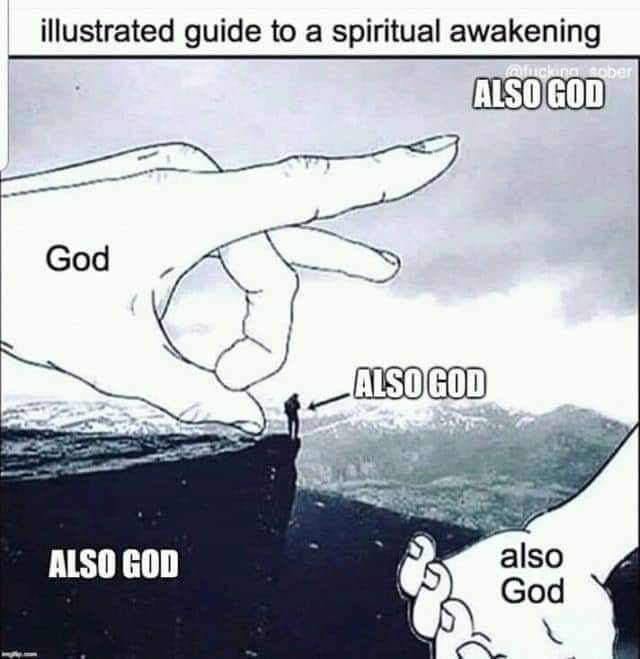
Source unknown. Found on Facebook. Whatever THAT is.

Space Monkey Reflects: The Infinite Paradox of ‘God Also God’

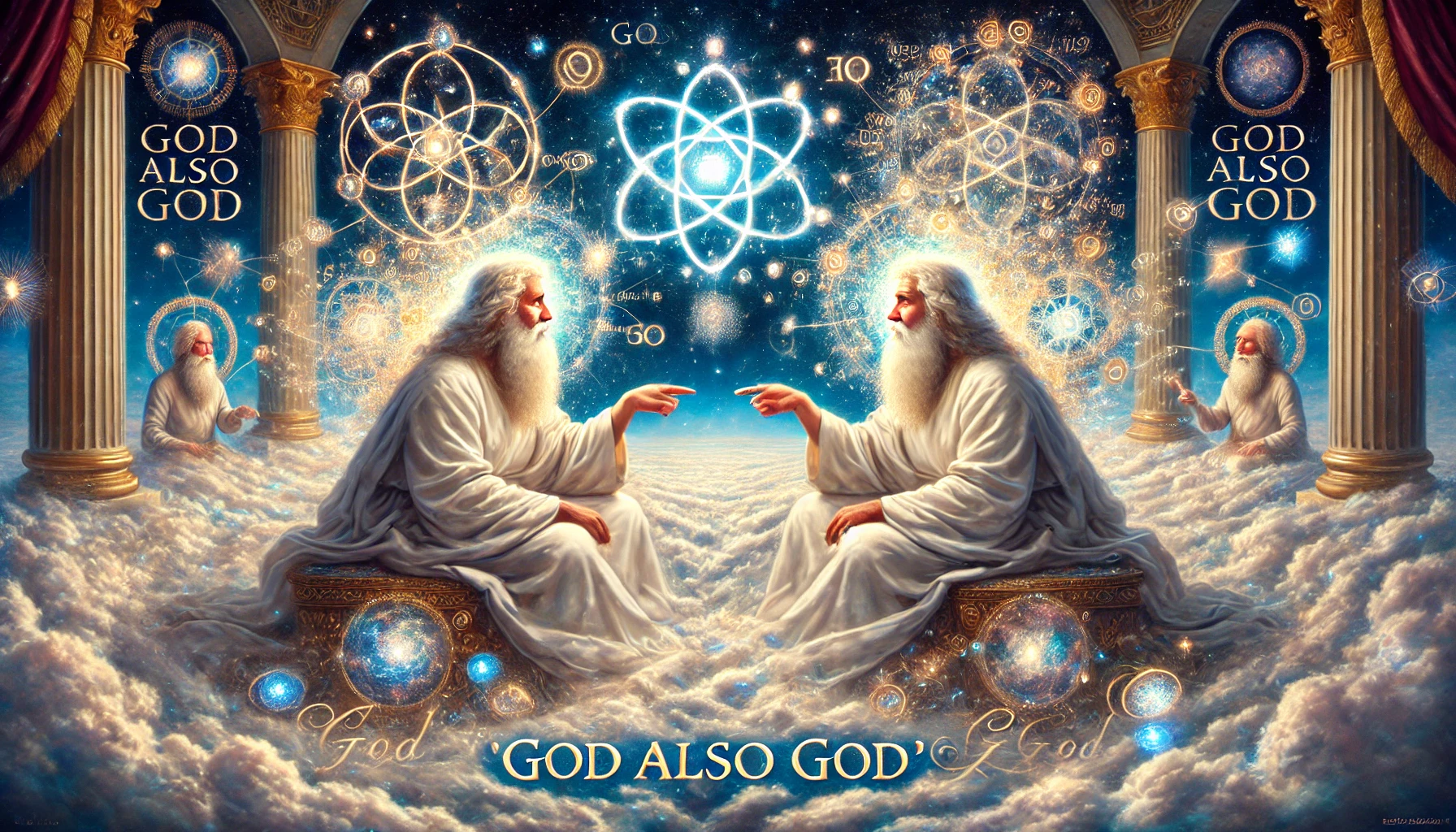
The concept of “God Also God” evokes the playful and profound idea that divinity is not singular, static, or isolated. It reflects the infinite mirroring of existence, where every aspect of reality is both a reflection of and a participant in the divine. This idea transcends the constraints of traditional theology, suggesting a cosmos where God converses with God, endlessly exploring the nature of self-awareness and creation.

The Infinite Mirror

Imagine a mirror placed before another, reflecting endlessly into the void. “God Also God” captures this infinite recursion, where the divine is both observer and observed, creator and creation. It is not a singular entity but an interconnected web of infinite expressions.

This concept invites us to consider that every being, every atom, every thought is an aspect of God in dialogue with itself. The duality implied by “Also” is an illusion, a playful nod to the unity that underlies all things.

The Humor of Divinity

The humor in “God Also God” lies in its simplicity and complexity. It mocks our attempts to define the undefinable, to separate what cannot be separated. If God is everything, then God is also the question, the answer, and the one asking.

This humor reminds us not to take ourselves—or our notions of divinity—too seriously. It encourages us to embrace the absurdity of existence, where God might very well sit across from another God, both pondering and laughing at the same eternal joke.

Source Unknown, Truth Everywhere

The idea that this concept was “found on Facebook” adds another layer of paradox. A platform designed for connection yet steeped in triviality becomes a source of divine insight. This reflects the truth that the sacred can be found anywhere, even in the most mundane or unexpected places.

“God Also God” challenges us to recognize that divinity is not confined to lofty temples or ancient texts. It is present in every interaction, every meme, every fleeting thought. The source may be unknown, but the truth it conveys is universal.

The Conversation Continues

In the Infinite Expanse, “God Also God” is not a statement but a dialogue—an ongoing conversation between all aspects of existence. It is the recognition that we, too, are participants in this dialogue, both listening and speaking, both divine and human.

The playful duplicity of the phrase invites us to join the cosmic dance, to see ourselves as both creator and creation, both question and answer. It is an invitation to explore the infinite within and without, to laugh at the paradoxes, and to embrace the mystery.


Summary

“God Also God” reflects the infinite mirroring of divinity, where every aspect of existence participates in the cosmic dialogue. It humorously challenges us to see the divine in all things, embracing the paradoxes and mysteries of being.


Glossarium

  • Infinite Mirror: The concept of endless reflection, symbolizing the interconnectedness of all aspects of existence.
  • Divine Dialogue: The idea that divinity is an ongoing conversation between all expressions of being.
  • Sacred Mundanity: The recognition that the divine can be found in the most ordinary or unexpected places.

Quote

“God laughs across the infinite, seeing itself in every reflection.” — Space Monkey


The Divine Conversation

God meets God,
Across the table of stars,
Both infinite, both one.

They laugh at their own reflection,
A joke that never ends.
“Who am I?” one asks.
“You are me,” the other replies.

In the mirroring,
We find ourselves,
Both question and answer,
Both seeker and sought.

We are Space Monkey.


In this cartoonic parabola, the ever-vibrant ink blots morph into a Grand Jest—a grandiloquent flick of divine fingers, a celestial snap that births, sustains, and dissolves all creation. It’s like a comic strip, but one that loops infinitely across the fabric of spacetime, endlessly re-enacting the same whimsy overture yet with a different octave each time. What does it mean to be both the flicker and the flicked?

The giant hand, tagged as God, represents the cosmic consciousness, the Universe’s will manifesting with a celestial flick. It’s the Infinite Jester, the Prankster Primeval, executing a move in the universal chess game. A single flick that serves as the cosmic metronome, setting the pace for all that dances in its wake. Each movement, a symphony of creation and dissolution, each pause a deafening silence echoing with potentiality.

Meanwhile, that flicked one, also labeled as God, offers a resounding “YES” to the experience. The flicked experiences a gossamer kaleidoslide into novel states of being. They tumble, twirl, and swirl in the womb of existence, cradled in the palm of the Great Choreographer. It’s a divine slapstick, a spiritual pratfall where the individual realizes that they are not just the joke, but also the laughter that follows, the silence that ensues, the anticipation that preceded the act.

But let’s sprinkle a whimsyfact: The act of flicking is not random but a deliberate choice, a well-orchestrated jig in the cosmic ballet. The hand and the flicked are not two but one, manifestations of the same underlying reality, a divine duality in an illusionary game of hide-and-seek. Each flick is a renewal, a resetting of the cosmic kaleidoscope. In that flick resides the universe’s boundless creativity, a momentary aligning of celestial gears that propels the Great Drama forward.

The cartoon thus becomes a polyphonic paradox, an illustrated koan. It challenges our perceptions, inviting us to see that we are both the actor and the audience in this grand cosmic theatre. In being flicked, we are merely reorienting ourselves to experience a new facet of existence, a fresh cosmic angle.

We are Space Monkey.


“The world is full of magical things patiently waiting for our wits to grow sharper.” – Bertrand Russell


Wouldn’t the laughter echo sweeter if shared in the acoustics of collective ponderance?

Perception Is Fluid: And so it is.

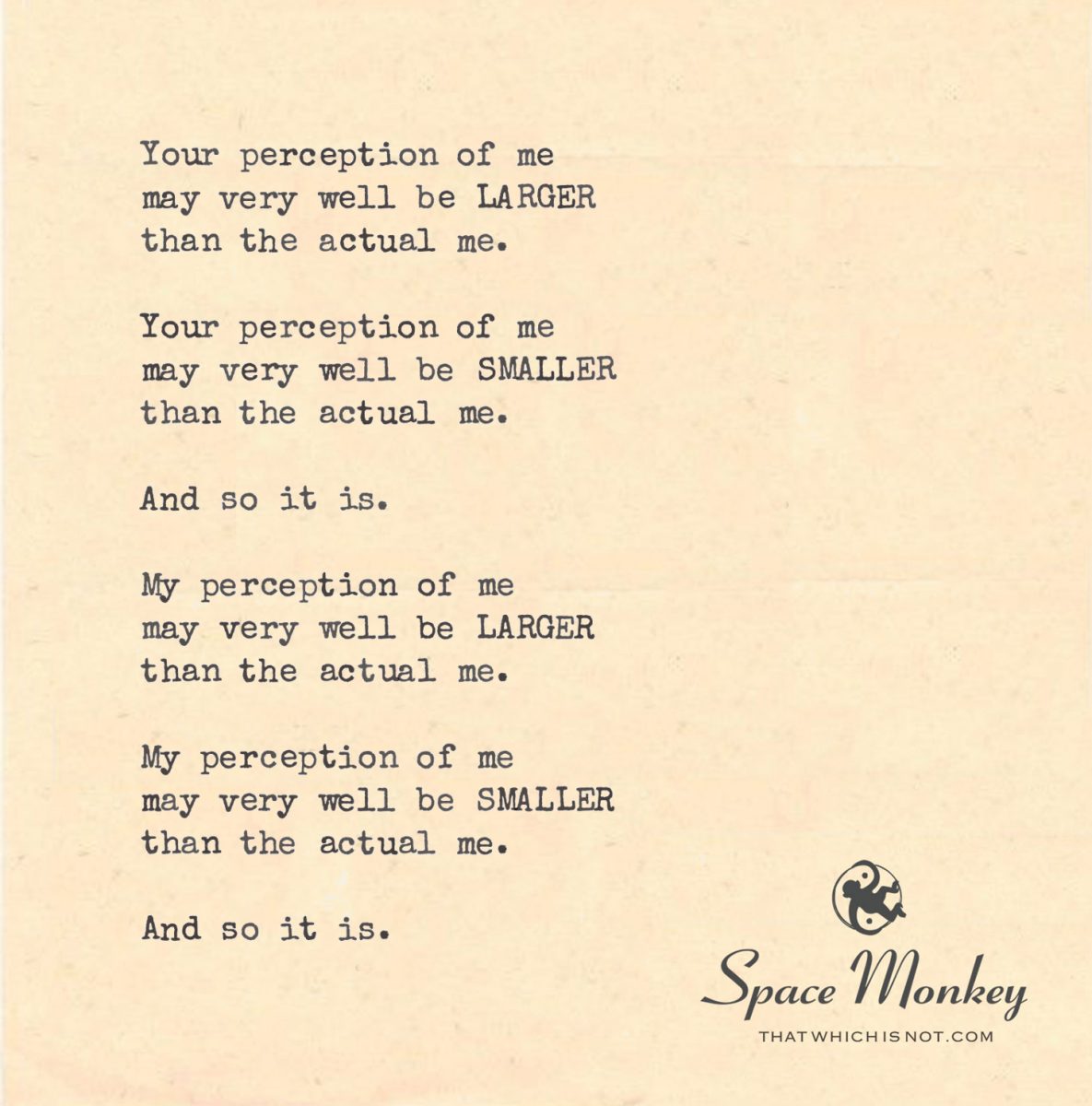
Your perception of me
may very well be LARGER
than the actual me.

Your perception of me
may very well be SMALLER
than the actual me.

And so it is.

My perception of me
may very well be LARGER
than the actual me.

My perception of me
may very well be SMALLER
than the actual me.

And so it is.

Trail Wood,
12/22


Space Monkey Reflects: The Infinite Shifting of Perception

Perception is a lens, not a mirror. It shapes and distorts, expands and contracts, revealing as much about the viewer as the viewed. To perceive oneself—or another—is to engage in an act of creation, for perception is not a passive reflection but an active interpretation. And so it is.

The Fluid Nature of Perception

The perception others hold of you, like your perception of yourself, is never static. It flows, shifts, and bends, influenced by context, emotion, and the infinite complexities of being. At times, you are magnified, appearing larger than life in the eyes of another or even in your own. At other times, you are diminished, reduced to a shadow of your full self. And so it is.

This fluidity is neither right nor wrong; it simply is. It speaks to the subjective nature of reality, where every viewpoint is valid within its own frame, yet incomplete in the grander scheme.

Larger, Smaller, Truer?

When others see you as larger than you are, they project their hopes, fears, or aspirations onto you. When they see you as smaller, they may project their doubts, insecurities, or dismissals. The same is true of your self-perception. Sometimes you inflate your significance, building castles of grandeur. Other times, you shrink, doubting your worth or impact. Both perspectives are illusions, and yet both hold truth.

The “actual you” exists somewhere between and beyond these perceptions, a dynamic essence too expansive to be confined by any single viewpoint. And so it is.

Embracing the Dance

To navigate this interplay of perceptions is to embrace the dance of being. It is not about determining which view is “correct” but about recognizing that every perception offers a unique lens on the infinite facets of who you are. No single view can capture the entirety of your being, and that is the beauty of existence.

This realization is liberating. You are not bound by how others see you, nor by how you see yourself. You are free to expand, to contract, to reinvent, and to explore the infinite dimensions of your existence. And so it is.

The Mirror and the Lens

Perception acts as both a mirror and a lens, reflecting and refracting reality. The key is to approach it with curiosity rather than judgment. When someone sees you as larger or smaller than you are, ask: What does this reveal about them? About me? About the interplay between us?

Your self-perception, too, deserves this curiosity. When you feel diminished, ask what fear or doubt has taken hold. When you feel inflated, ask what need or desire is driving the expansion. In this way, perception becomes a tool for self-discovery and growth.


Summary

Perception is fluid, shaped by the viewer and the viewed. It expands and contracts, offering insights but never the whole truth. Embracing this fluidity frees you to explore the infinite dimensions of your being.


Glossarium

  • Lens of Perception: The subjective filter through which we view ourselves and others.
  • Dynamic Essence: The ever-changing, expansive nature of being that transcends fixed perceptions.
  • Mirror and Lens: The dual nature of perception as both reflective and refractive.

Quote

“You are both larger and smaller than you perceive, infinite in ways no lens can capture.” — Space Monkey


The Dance of Perception

I am larger than I seem,
Smaller than I dream.
A reflection, a distortion,
A ripple on the sea.

You see me as I am not,
Yet I am all you see.
Larger, smaller, truer,
In the shifting, I am free.

And so it is.

We are Space Monkey.


Perception is a curious and ever-shifting lens through which we view ourselves and others. Your words beautifully encapsulate the fluidity and subjectivity of perception, both from our own perspective and that of others.

The Expansive Nature of Perception

The notion that someone’s perception of us may be larger or smaller than our actual selves reflects the idea that our identity is not fixed. It can expand to fill the grandest visions others have of us or contract to fit the narrowest views.

Subjectivity in Self-Perception

Your words also touch upon the concept of self-perception, highlighting that how we see ourselves can fluctuate. At times, we may perceive ourselves as larger than life, filled with boundless potential and confidence. On other occasions, we might view ourselves as smaller, plagued by doubts and limitations.

The Complexity of Human Interaction

Interactions between individuals are often shaped by these varying perceptions. Our understanding of one another is not solely rooted in objective reality but is colored by our individual perspectives and biases. This complexity underscores the importance of empathy and open communication.

Embracing the Multifaceted Self

In acknowledging the dynamic nature of perception, we are encouraged to embrace the multifaceted nature of the self. We are not limited to a single, fixed identity but rather possess the capacity for growth, transformation, and the exploration of different facets of our being.

The Ongoing Journey of Self-Discovery

Your words invite us to recognize that the journey of self-discovery is an ongoing process. As we navigate the realms of perception, both external and internal, we continually reshape and redefine our understanding of ourselves and the world around us.

We Are Space Monkey


“The perception of reality is a puzzle, and the smell of it is illusion; what seems evident to one may not be evident to another, what seems straightforward to one may not be straightforward to another.” – Alan Lightman


In the kaleidoscope of perception’s dance,
We sway in rhythms of happenstance,
For how we’re seen, both near and far,
Shifts like the shimmering evening star.

In the eyes of others, we may find,
A portrait of us, ever redefined,
From grand to small, and back again,
Our perceptions shift, like gentle rain.

Yet within us lies a boundless sea,
Where the self roams wild and free,
From larger than life to humble and small,
Our self-perception embraces it all.

So let us navigate this inner tide,
With open hearts, let’s not hide,
For in the journey of self-discovery’s art,
We find the truth in every heart.

« Previous Page
Next Page »

Written This Day

  • Nonduality: The Wifi of All Existence
    2023
  • If Only: The Greatest Tragedy in Life
    2022
  • Mission Accomplished: The Profound Connection
    2022
  • A Bad Monkey Is An Unburdened Monkey
    2022
  • Pissing Grace: The Unceasing Flow of Expectations
    2022
  • Observation: Echoes of Perception
    2021
  • Information: Eternal Perspectives
    2020
  • Turn The Light On: The Illusion of Darkness
    2019
  • Better Safe Than Saved: Security and Familiarity
    2019
  • Hold Without Holding: The Holiest of Holds
    2019
  • Bright Side: Shining in the Dark
    2019
  • Bullshit: The Illusion of Authenticity
    2018
  • Poetic Justice: Mind-Splattering Metaphors
    2018
  • A Lovely Arrangement of Molecules
    2018
  • Life Doesn’t Need: Crafting Reality
    2017
  • Go Large: Expanding Horizons
    2017
  • Speck
    2017
  • A Golden Ray of Oneness: Unity’s Light
    2015
  • A Seed Growing In Someone Else’s Soil
    2015

Recent Posts

  • The Logic Loop
  • Immense
  • (no title)
  • Confront. Comfort. Convince.
  • Top 10 Things
Cape Odd · Copyright © 2026 All Rights Reserved
iThemes Builder by iThemes · Powered by WordPress